Amanda Anderson's Blog
March 8, 2024
Serving without the Pressure of Success
A few weeks ago I was waiting to get coffee in the lobby at my new church, where my husband and I have been attending for several months, having downsized to a smaller neighborhood church. The man next to me, who had been there first, gave a little jump when he saw me. He was wearing black jeans and a black hoodie sweatshirt.
“I’m sorry,” he said. “Let me get out of your way.” I assured him he wasn’t in my way, and to take his time. He got his coffee, smiled at me, and shuffled away. I can’t be sure, but I’ve been working at a recovery center for people with substance use disorders, and I recognized some of his characteristics: the uniform, the hypervigilance, and the sense that maybe he wasn’t comfortable in this place. I thought it likely that he was in recovery from substances, or homelessness, or both.
I can’t remember the last time I was at church and saw someone of either population. And I realized that makes me a bit sad about church, but also glad about what I’m currently doing with my weekdays, leading twelves groups a week in a recovery center.
Before I had this job, I’d attended the same megachurch for 23 years. And I’d never spent time with anyone who had experienced homelessness. I had never had a conversation with someone who had spent time in prison or been in a gang. I had rarely talked to anyone about what it was like to be part of the LGBTQ community or come out to their parents. And I had a lot of friends who drink alcohol, and a few who got sober, but I didn’t have many conversations with people who had struggled with drug addiction; lost friends to the disease; had parents who were dealers; or heard people tell stories of being given their first drugs by their parents.
These are now things I do all the time. And it’s really changed my life, my view of God’s kingdom, and my place in it.
My former church actually had a recovery ministry where I served for years, and our campus hosted Twelve Step meetings every day of the week on our campus, but the people I met in those meetings were rarely seen in the main sanctuary, and the people I met in the main sanctuary almost never came to our meetings. It was an uphill battle getting our church to staff and promote ministries for the population that struggles with addiction, and I have a few theories as to why:
1. Addiction carries a huge stigma. Though it’s rampant in culture, it’s hard to admit that you have one or your family members does.
2. People with substance use disorders don’t usually get a lot better very quickly. And I know this is going to sound like a harsh indictment, but slow growth and high relapse rates doesn’t fly well in mega-churches, which favors ten-week discipleship programs that end in cardboard testimonies: where people write about how broken they were when they came into the program on one side, and then flip the cardboard to show how healed they feel now on the other side? This is all set to music and everyone claps and cries. It’s encouraging, and a good start. But that isn’t how healing from the trauma of addiction works. It’s also not how people heal from abuse, PTSD, extreme poverty, or racial oppression.
3. And because these above issues aren’t easily solvable, and these ministries don’t show explosive growth, churches often divert resources from these needs in their congregations, and provide more resources to ministries that seem to be bearing more fruit, at least in terms of numbers.
And this is why it’s very important for us to serve God outside of church too. Because otherwise, the “least of these” won’t be served the way Jesus called us to serve them. Because often the “least of these” can’t clean up quickly enough to sit in our sanctuaries and feel accepted.
Before I started this job, I read a book called Tattoos on the Heart by Jesuit priest Gregory Boyle, who founded Homeboy Industries, a gang-intervention program located in the Boye Heights neighborhood of Los Angeles, the gang capital of the world. He wrote about how donors want to hear statistics about their successes, and Boyle quotes Mother Teresa who said, “We are not called to be successful, but faithful.” Boyle continues the thought with this:
Jesus was always too busy being faithful to worry about success. I’m not opposed to success; I just think we should accept it only if it is a by-product of our fidelity. If our primary concern is results, we will choose to work only with those who give us good ones.
To which I add, then we will refuse to work with the ones that may be most desperate for help.
Jesus said this at least once, recorded here in Matthew chapter 25:
34 “Then the King will say to those on his right, ‘Come, you who are blessed by my Father; take your inheritance, the kingdom prepared for you since the creation of the world. 35 For I was hungry and you gave me something to eat, I was thirsty and you gave me something to drink, I was a stranger and you invited me in, 36 I needed clothes and you clothed me, I was sick and you looked after me, I was in prison and you came to visit me.’ 37 “Then the righteous will answer him, ‘Lord, when did we see you hungry and feed you, or thirsty and give you something to drink? 38 When did we see you a stranger and invite you in, or needing clothes and clothe you? 39 When did we see you sick or in prison and go to visit you?’
40 “The King will reply, ‘Truly I tell you, whatever you did for one of the least of these brothers and sisters of mine, you did for me.’
Jesus is not actually calling those who are sick, in prison, poor, and hungry the least of all people; he is pointing out that these are the people we see as the least, but the ones that God identifies most closely with himself. When we honor, help, and spend time with those that our cultures sees as outcasts, we honor God. Notice it doesn’t even say that those on his right converted the least of these. No: they offered practical help them and fellowshipped with them. (And for any of my clients who might end up reading this, I definitely don’t see you as least, nor am I trying to hoodwink you into liking Jesus if you aren’t interested.)
So. This is why I’m loving my sojourn into secular service, after years of being a committed church volunteer and a professional Christian writer and speaker. Because in the church, it can be harder to find fellowship with these honored “least” people, because it’s difficult for the church to serve and get them in service on a Sunday. And I’m not just being critical of the church; churches as entities have limits, budgets, time constraints, and the well-documented issue that they become ethnically, culturally and economically homogenized in spite of their efforts.
Instead, I’m reminding all of you, and myself, that our holy work is done just as well – and sometimes better – in secular spaces. Like public school classrooms, as social workers, in political advocacy positions; as doctors, nurses, and therapists; as lawyers and court-appointed special advocates; and as volunteers in non-profit organizations that exist within the communities they serve. And more.
I like being of some good to the world, I admit it. It makes me feel good! And also I enjoy another wonderful side benefit: I feel like I understand God better. In this last year, I realize that God is nicer than I realized. He is kinder, more present, more interested in people, less judgmental, less attached to outcomes than I ever thought. And yet, he’s also very interested in alleviating pain. Maybe I’m just imagining this, but I don’t think so; I think it’s one of the side benefits that God knew would come when we spent time with his people; we would actually be with him.
Here’s hoping I’m right, and also, I hope I get to see my new friend in the hoodie at church this Sunday.


September 13, 2023
Confessions of a Professional Christian
For many years I was an amateur Christian, in two ways. One, I was an unpaid laborer of the church, a volunteer like so many of you. Two, I did it for love: love of Jesus and love of others.
When I quit my job as a journalist at the age of 28, I threw myself whole-heartedly into church service, specifically leading in Mother’s of Preschoolers ministry. Serving gave me a sense of purpose and community, and a chance to use my gifts outside of the home. I was aware throughout this season that I was both giving and receiving from the arrangement. I got to be engaged in community. And, as I once heard author Donald Miller say, I like people telling me I’m good at things, and thankfully, God can use that.
But about ten years ago, something shifted. I became a Professional Christian. I began to speak to moms’ groups (although I started out speaking for free). And then I began writing a book. I got a literary agent. Marvel of marvels, I sold that book. Then I got a speaking agent. And that became the era that I attempted to launch what I jokingly referred to as “Amanda the Christian Lifestyle Brand.”
Almost every aspect of my life began to feel to me like something I needed to package and sell. My mothering. My marriage. My friendships. My recovery from co-dependency. My sobriety. Even – and this is weird – my vulnerability and authenticity. My brokenness and floundering had to be wrapped and packaged for inspiring consumption. I consulted marketing teams (all of whom gave me conflicting advice). I began posting on social media like mad. And every speaking engagement I did – whether a humble MOPS group of 30 women or a women’s ministry event of 500 – was not only a precious moment unto itself, it was a potential step to the next thing, to something bigger.
It's been an amazing blessing to have a professional Christian ministry, and I signed up for it willingly. I met almost all of you through this journey and I love the chance to share ideas with you! I have no doubt that I was obeying God and blessed by him. But also, the professional Christian gig, especially as it relates to publishing, was both exhausting and corrosive to my soul. Not only did it make being present so very difficult, it also hid this sinister hook in every place I loved and served: that I needed to be successful in order to have something to sell, and that success was measured in numbers. Always this vicious cycle build an audience so you can prove you deserve to have a bigger one.
A breaking point came for me last year when, after months of jumping though hoops, outlaying money and proving I could grow my platform, a publisher that ostensibly was looking for “not-famous Christian voices,” turned down my second book project in the very last stages of the pitching process, citing too small of a platform.
I called my friend Terry and sobbed into the phone: “Can I just be myself now? Is it enough to just be a regular person now?” She said, yes, of course it was.
So here I am. Back to being an amateur Christian. And here’s where it led me: I’m now a professional in the secular world.
In April, I got a job working as a group facilitator in a recovery facility for men and women with mental health and/or substance abuse issues. I now spent 12-15 hours a week teaching them what I have learned teaching in churches for the last 10 years: healthy boundaries, communication, friendship skills, self-care and stress management. I teach about attachment styles (thank you Milan and Kay Yerkovich for all the work we got to do together and what you’ve taught me), trauma and recovery, and understanding our own family histories.
Tied with my job as volunteer moms group coordinator, this is the best job I have ever had.
There are so many things I love about it. But my favorite thing is that each 45-minute group I lead is just that: being present with these humans for 45 minutes, holding space. They aren’t going to buy my book or sign up for my newsletter. I’m not hoping the next group will grow (actually, my favorite groups are when there are five people in the room, and I get paid by the group, not the person). And though I never say his name, I feel God with us all, loving each of us, rooting for us, holding out healing to these men and women who may not ever have called on his name. I feel every day this immense love for my clients, and it’s God’s love for them. Being in that love, experiencing that love is absolutely addictive. I can’t get enough.
And for now, it’s more than enough.
My beloveds, I hope there is something in this story for you. You don’t have to be an online professional Christian to be feeling the need to perform, to be your own kind of Christian lifestyle brand, or to feel that every moment you live is somehow supposed to get you to a better, bigger next moment. Maybe you also need to call a wise friend – or talk to Jesus – and ask, “Is it okay if I am just myself now? Is it okay to just be a regular person?”
Let me be the one to say it to you today: yes. It is enough. And every time you just show up to be present with other regular people, there is God in the midst of you, loving you all.
June 19, 2023
Friends Who Love My Tattoo
The Friendship Refresher Course
Two weeks ago, I got a tattoo my husband really preferred that I not get.
When I told my friend Josie I was going to get it Thursday night she said, “Oh yeah! I can see it when you visit Friday morning!”
When I told my friend Kristan, she said, “If your daughter can’t go with you, call me. I’ll go!”
When I sent my friend Jen the photo with a caption, “I did a thing tonight” she texted back,
“Love it. Good for you.”
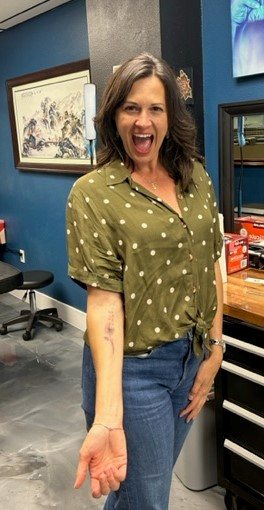
I was a little surprised by all these reactions, because NONE of my friends have tattoos. And Kristan is a conservative midwestern transplant who favors twin sets, so I was almost hoping my daughter would cancel on me so I could get her picture at the tattoo parlor. All their responses made me feel loved and supported, and I thought “How nice it is to have friends that love to see me do something that makes me happy, even if it’s something they would never do.”
But the best reaction was Jen’s phone call a couple of days later when she extrapolated on her “good for you.” She saw me getting the tattoo as a real victory as a recovered co-dependent.
Some back story. A couple of weeks earlier, Sophia came home with a second nose piercing that her dad and I told her we’d really prefer she not get. In my argument against it, I told her, “Look I love nose rings. And I love tattoos. I’d get another one if dad would let me. But at nineteen, I’m not sure you should be making so many permanent holes in your face.”
A sound argument, I thought. But it’s her face, and her cash. So, we gave her the right to make the call, and Sophia made it.
Meanwhile, Jen, to whom I relayed that conversation, held on to it and brought it back to my attention later.
She heard the “I’d get another tattoo if dad would let me,” statement, and though she hadn’t called me out on it at the moment, she brought it up post-tattoo. She thought it was dangerous to model to my two independent-minded teenagers that marriage is an institution in which either partner gets to forbid the other from doing something they really want to do. That it didn’t paint their dad in such a great light. And it didn’t make me sound like a grown-up woman who was taking responsibility for myself.
Well played, Jen! She and I have both done work within the Twelve Step model to understand how to have intimacy without enmeshment. We’ve learned that even in marriage – where two become one flesh – that love allows space and differentiation.
I got my first tattoo when I was 40. Jeff wasn’t crazy about that one either. I wrestled deeply – and spiritually – before I did it, and even considered the scripture in which Paul writes, “The wife's body does not belong to her alone but also to her husband. In the same way, the husband's body does not belong to him alone but also to his wife.” Did this apply to tattooing?
No. It doesn’t; it’s a passage about maintaining sexual intimacy, not bossing each other’s grooming habits and appearances. I mean, I wouldn’t get a neck tattoo that Jeff doesn’t like (or one at all), but in 2007 he grew a beard I didn’t authorize. He said it was for one year. He still has it. As Beth Moore wrote in her recent biography (and I’m paraphrasing), husband and wife become one flesh, not one mind, not one soul.
My girlfriends, who are unequivocally for my marriage -- Team Anderson -- all the way, still celebrate my autonomy and individuality. They know that my worries about being in trouble with my spouse, or needing him to love every single thing I do is totally about my anxiety and codependency and almost nothing about Jeff being controlling. I asked Josie about what Jen said later, and she said, yes, she heard me making comments about Jeff "letting me" do things too, and didn't really think I was speaking accurately about my marriage.
So here are three friendship applications:
1. Blessed is she who has friends who celebrate her joys – even if they don’t share the same ones. I’m the only one with tattoos. Jen has a boat, and I get boat sick, but I love her getting to take her Catalina trips. Kristan is a figure skater. I hate ice skating (It hurts! It’s cold!), but I love it when she describes to me how well she did her edges in practice (and I don’t know what it means)!
2. Blessed is she who has friends who celebrate space and differentiation; who tolerate differences of opinion and belief; who get that love is not enmeshment. I’m grateful that my friends give me room to breathe and hold me accountable to letting other relationships breathe too.
3. Blessed is she who has friends who are paying such close attention that they see a major emotional victory where an outsider just sees a new dandelion tattoo. May we pay close attention to our friends and speak up about what we see with discernment.
May 25, 2023
Sharing Secrets, and Keeping Them
The Friendship Refresher Course
The hardest part about being the mother of two teenage girls is that I’m not allowed to tell my friends everything about them.
This is a big shift from when they were toddlers. If I was struggling with their behavior or my own limitations, I felt completely within my rights to get on the phone with a friend for full-disclosure conversations and advice. The great thing about babies is they have no objection to you discussing their sleeping and pooping habits. When they are teenagers, they object to that a lot.
This has also been the hardest thing about being a friend with other mothers as our kids grow up. We have supported each other all these years, and now in some of the ways we most need support, our kids have asked us not to disclose. Add to this difficulty the shift in intimacy this causes in our friendships – and what can feel like an imbalance of vulnerability when some of our kids are more private than others.
In this post-pandemic age, when so many families are struggling with mental health issues, this seems like an important issue to address. For years, I’ve been teaching that big secrets break relationships, but I’ve only just learned to walk the line of transparency: understanding healthy privacy boundaries, versus secret-keeping. Healthy friends tolerate emotional space, and don’t demand to know every detail of each other’s lives.
I was not one of those friends for many years. I grew up in an extended family that kept secrets better than the C.I.A., but the energy it took to keep them shut down open communication, and discouraged family members to be curious about each other and do any deep emotional work. When some of our big secrets came out, they were extremely hurtful. So, I became hyper-sensitive to people wanting privacy as an adult. I assumed if you didn’t tell me everything, that you were lying to me, didn’t trust me, or were about to leave me. I’ve dealt with this wound with counselors and Jesus, and it has made life much better.
So, let’s take a look at this issue of privacy vs. secrecy with some discernment:
I learned this illustration in Twelve Step groups: When we have a big secret we are trying to keep, it’s like holding a beachball under water. The nature of truth/reality is that it wants to rise to the surface, so both arms are required to hold down the beachball, and they aren’t available for loving others. Try to get close to someone and give them a hug? The ball pops right up and punches you both in the face. So, you can’t let people close to you, and you don’t have energy to reach out. You’ll also be threatened by people who ask questions, seek truth, and tell the truth.
Now, a big secret isn’t that you got into a tiff with your spouse last night, or that your daughter was sassy to you on the way to school. It’s not being in a bad mood for a week and needing some space to figure out what’s really bothering you. It’s good to keep some of your family interactions within the family and not broadcast every little thing to your tribe; it’s great to have some self-regulation and not need to externalize every feeling you have by hashing it out on the phone. You can be a kind and supportive friend in the midst of these common trials; you can set those things aside and be a good listener, go shopping, take a hike – basically be present to life.
Secret-keeping is different.
A damaging secret is one that is taking a lot of your emotional energy over a long period of time: a major ongoing conflict with your spouse, serious financial issues, a chemical dependency, chronic pain that limits your activities, past abuse that keeps triggering you, a major amount of job stress, your own depression and anxiety, or a child with a developmental diagnosis or mental health challenge. These kinds of issues engage our whole being, and those close to us will feel the effects. We will fail to be emotionally present; we will be busy with doctor’s appointments/second jobs/therapy sessions; we will be tired and cranky; or we will be prickly about certain subjects they bring up if they happen to get too close to an issue we’re dealing with that they know nothing about.

For all these reasons, the people you most love and who most love you must be allowed to know about these major issues for you to have authentic relationships. This is a moment to send out an SOS, not lock your secrets in your diary. Otherwise, your loved ones will tell themselves stories about your withdrawal, which hurts them. And, they won’t be able to offer encouragement and support, which hurts you. But sometimes, like when our spouses or older kids are really processing something hard, we still have to honor their privacy.
So here are some principles to hold on to.
1. Just because you are a trustworthy and interested friend doesn’t mean your friends have to tell you everything. Don’t take it as an insult when they aren’t always ready to self-disclose. If this is really difficult for you, consider what may be at the root of you being unable to tolerate space.
2. Being a trustworthy friend means letting people know when you have a big issue going on. But! You can say it like this: “Look, there’s some stuff going on with my kids. I can’t tell you what it is right now, but it’s affecting me emotionally, we are busy with problem-solving, so I don’t have a lot of bandwidth right now. I could really use some prayer.” Now, there’s no beach ball!
3. Being a trustworthy friend means accepting the boundary set in Number Two, above. In general, don’t push people to share until they are ready.
There are exceptions to all of these rules of course.
If someone is abusing you, don’t hide it. If your kids are in such dire straits that you are afraid for them, get support for yourself; a teenager with serious mental health problems doesn’t get to set boundaries for you. Just be cautious: share to only your most trusted friends who will stay private and pray for you, and share to a professional counselor.
And if you believe your friend is in serious physical danger, push with all your might to get her to tell you the truth. Push to save her life.
And pray, my lovelies. Pray for discernment. Because relationships are the best thing we have, and the hardest thing to do well and authentically. I have great hope that God wants them for us, and is ready to assist with wisdom when we ask.
May 15, 2023
Please Tell Me What Makes You Cranky
My friend Josie and I went out for lunch this weekend and she got to the restaurant first. She sat with her back to a wall. My back was to the patio and the hostess desk. Above the clatter of plates and the conversation around us, the bass thrummed from a nearby speaker playing classic rock. Josie was telling me an important story from her life, and my brain was struggling so much to filter the background noise that I could hardly follow one sentence to the next.”
About ten minutes in I said, “Josie, I’m sorry but can we switch seats? There is so much noise in here that I can’t concentrate on what you’re saying and I’m about to burst into tears.”
She gave up her much better seat for me. I was so grateful and only slightly embarrassed.
I have self-diagnosed as a woman with misophonia, a condition where certain sounds trigger strong emotional responses like rage or hyper irritation (please don’t eat chips out of a crinkly bag near me). It might also be a part of the ADHD that runs in my family: an inability to filter multiple noises at once, which people on the autism spectrum also experience. I hear conversations going on next to me on the same level as what the person across from me is saying. My kids make fun of me for how picky I am about what table we get at a restaurant, but if I don’t put myself in a fairly sheltered place, I’ll be inattentive and cranky on a biological level.
If you and I are going to be close friends, it’s essential for you to know this about me. I’m a bit embarrassed by it. But it’s not something I can control. What I can control is exposing this to you so if I’m irritable or inattentive, you know it’s not you, it’s me. More specifically my highly sensitive reticular activating system.
If you and I are going to be friends, I want to know your “stuff” too, so you can be comfortable and I won’t start telling myself stories about why you are the way you are. My friend Kristan is hard of hearing in her right ear. So, I drive us places so she can listen out of her left ear. I’m so grateful Kristan is brave enough to admit this “weakness” so she doesn’t spend our whole friendship straining to hear all of the obviously entertaining and wise things I have to say, and feeling irritable.

Being authentic about our limitations, capacity and preferences is critical to intimate relationships – essential to loving each other well. I have another friend Jane (not her real name), and I can always tell when she’s upset about something that isn’t about me: She gets argumentative about inconsequential stuff. I’ve learned to recognize when she’s on edge and ask her, “Hey, what’s going on? Did something happen?” A few times she has burst into tears, because something major is on her mind but “she’s trying not to dwell on it.”
“You’re the only one who can tell that I’m upset about something,” she’s said. I think that’s probably not true; other people just think she’s angry at them, and I’m the one who actually asks about it. I love her too much to let this particular quirk be a barrier to our relationship any more, but I’m willing to bet other friendships have suffered -- or possibly ended – because this indirect display of emotion has made people misread her.
Jane is a Christian woman in the generation above me. She highly prizes having “a good attitude” and “not complaining.” In other words, she sees her emotions as weaknesses, and she doesn’t like to share her weaknesses. I look forward to the day when she can be more authentic from the get-go – just tell me she’s sad and bypass the cranky. If ever there was a person who is okay with you being sad, angry, or irritable, it’s me.
In fact, I’m really, really okay with you being in a bad mood. You know what I’d love? For you to tell me up front. Let’s talk about what’s bothering you so I know it’s not me, and also, in case I can be comforting. And then, I’d also love to know all about what puts you in a bad mood for the future.
What bugs you? What sets you off?
What places do you not like to go?
What games do you not like to play?
What physical limitations do you have?
What time of the day are you at your worst?
How do you feel about crowds? Germs? Loud music?
Are we making jokes and chatting with the servers and cashiers, or will that embarrass you?
Are we using swear words or not?
Do you want to walk faster, or slower?
Am I driving too fast or talking too loud?
I want to know all this if you’re my friend, because I love you. You are allowed to be a person with preferences and I can respect them. Also, knowing what you like and don’t like makes me feel safe. I’m a recovering codependent, which means I was raised to read the room and figure out how to make everyone feel happy so I don’t feel anxious. If you will tell me up front what works for you, my nervous system relaxes, my soul gets lighter, and I can be fully present with you in the moment.
You may not always know what’s bothering you, and that’s okay too. I may not always be able to accommodate all your preferences – honestly, I really like making jokes to the servers and cashiers, and some days you may just have to blush and put up with it. But let’s do our best to be real with each other, so we can love each other well.
And Josie, thanks so much for giving me the good seat. I love hearing your stories.
May 8, 2023
Loving in Real Life
I love social media and I use it daily. But it tricks me into feeling like I have connected with other people when I really haven’t. And it does tis to all of us…We check Facebook or Instagram and that hungry growl for connection in our soul feels slightly appeased when, in reality, we are as underfed spiritually and relationally as we would be if we chewed a piece of gum for nourishment. We haven’t given anything beyond the click of a mouse, and we haven’t had to sacrifice any other activities to do it.
From Chapter 1: Calls from the Bathroom: Building an Authentic Foundation
In 2020, a few of my closest friends got really mad at me for some things I posted on social media. The first time was during the protests following the murder George Floyd, and the second was after January 6. About .01% of my subscribers unsubscribed, and I lost a handful of Instagram followers. Big whop. But upsetting my girlfriends – hurting their feelings -- distressed me.
Like Sam I am, I meant what I said and I said what I meant. But on Instagram, I said it like no one I loved disagreed and was listening.
I’ll be honest. It felt amazing at the time – to write the unvarnished truth from my head. I was rewarded by a lot of “Amen’s,” fire emojis, and private messages telling me how brave I was. I was building a little online community of like-minded people that helped me feel less despair.
But people who loved me and were afraid to get on the phone with me because of how angry I sounded – people with whom I have traveled; people for whom I’ve stood at hospital beds and gravesides; people who called me first when they found out they were pregnant, or when they got a raise; people whose kitchens I know almost as well as my own.
I let my online life affect my real life. And I don’t think I changed one person’s mind.
As I’ve talked with women from all sides of the political spectrum at speaking engagements, I learned that for the last three years, whatever side you were on, you felt like almost everyone else was against you. So, we looked for “our people” online. And we found them. But we lost some of our real people in the meantime.
My book was published nine months before California went under a shelter-in-place order. Bummer for me, when the first chapter contained a section called “Making Friends in the Flesh.” Post Covid-trauma, I’m more convinced than ever that we need to spend less time and energy online, and much more time with people in person, strengthening our bonds and learning how to support and encourage one another.

Here are some of the reasons:
We don’t get the full stress-reducing benefits of bonding with other humans if we aren’t with them in person. Oxytocin, nicknamed “the cuddle hormone,” is released through loving physical contact, but also when we have eye contact with others. “Oxytocin is shown in some research to lower stress and anxiety. Oxytocin has the power to regulate our emotional responses and pro-social behaviors, including trust, empathy, gazing, positive memories, processing of bonding cues, and positive communication.” (source: https://www.psycom.net/oxytocin) In other words, the more time we spend with safe people, the more we bond with them, and that bond reduces stress – and self-perpetuates our social skills. Social media dos the exact opposite of in-person bonding: its use is linked to heightened levels of cortisol (the stress hormone) and dopamine addiction. We feel anxiety in between hits of dopamine, which are produced by “likes.” Studies show that the more outraged we are in posts, the more judgmental, the more clicks we are likely to get! So social media literally rewards us for being contentious, which decreases our social skills. Love takes sacrifice – especially of time. I have to be willing to give up something else in order to spend my Saturday morning with you. And that makes you feel prioritized and important. I love a clean house and an empty laundry basket, but they don’t love me back when the chips are down. I have to let some of my to-do list go so I can see my friends, because the quality of my relationships determines my satisfaction with my life. On social media, we tell people what we like and think, but we don’t actually show them what we are like to be around. As honest as we can be online, we can never be three-dimensionally authentic, so we can never be fully known. And we stay lonely. It’s much harder to demonize someone that you spend time with regularly. You might not like someone’s political beliefs, but if you see how nice they are to their neighbors, how patient with the server at the restaurant, how passionate they are about their work, how good a listener to you? Then we stop seeing people as a sum of their opinions, and more as what they are – flawed people, made in the image of God. We don’t express ourselves as gently online or even on the phone, as we would if we can look into someone’s eyes. Anonymity in communication is no good, my dudes. I will say things on the phone that I’m too scared to say to your face – and that’s not a positive.I know I’m not saying anything brand new to any of you. But it needs to be said. Over and over again. Because in 2020, we realized how important our relationships were to us, but as a culture, we haven't made more time for them, despite our vows to slow down and savor the simple life. We are, in fact, in the midst of a loneliness epidemic.
And I believe, as Jesus modeled, that loving locally and having a group of friends with diverse beliefs and interests is the key to changing the world.
,Friendship Refresher Challenge: Call a friend this week and make plans to be together in person. Don't be a perfectionist about it! You can grab coffee on a lunch break, or an early dinner weeknight after work. Yes, you will have to let something go to make this happen, but you'll both agree that it's worth it. Also, take a picture together! You'll be so happy to look back on these someday.
May 1, 2023
Welcome Back In
I've noticed something about retail workers from Generation Z that I find charming. When you walk into a store, they say, "Welcome in!" instead of "Welcome!" At first I found this redundant. Doesn't "welcome" mean, "You can come in?" I'm not alone in finding it weird; I went down an internet rabbit hole to investigate. But I've decided that the extra emphasis takes it from a greeting like "I acknowledge you've walked through the door," to "Come in. We're glad you're here. Stay for a while." Whether this is a trend from West Coast youth (as one reddit commenter said) or the result of corporate training (said another), I'll take it. After years of social distancing, discord, fear and increasing isolation, I think we can use all the welcome we can get these days.

My book on friendship was published in 2019, about nine months before Covid hit and we all were forced into isolation to varying degrees. This was pretty lousy for me – both as an event speaker, who was really starting to chug along – and as an author who advocated for getting off social media and inviting people into your house. In 2020 I pivoted to inviting people into my back yard, where my friends and I sat 10 feet apart. (My kids, who are major rule followers, watched us from their upstairs windows and texted me if I got too close to anyone, which was annoying as crap.) It was weird for our family when we finally let people cross the threshold into our home again. Weird and wonderful. It was even stranger when we went back into large church services, to concerts, to full school classrooms, to the Orange County Fair. We found that we, as many of our friends, found that we had developed social anxiety -- not just because of the dreaded virus, but because we had forgotten how to talk to people in person, and we had found that some people had gotten a lot scarier in spaces where we used to feel safe. We had become unwelcome because of how we had navigated the last couple of years.
At to this confusion, for me, a new kind of imposter syndrome that I developed. After publishing a book about friendship, I become kind of paranoid about what kind of friend I was. I tried to practice all the tools I’d learned and written about. But the last three years have been hard on my friendships. Largely because they have been hard on my friends. Among the half-dozen women I think of as my bridesmaids, this is what has gone on:
· A pandemic
· A parent with brain cancer
· A parent with a Parkinson’s diagnosis
· A parent with dementia and heart failure
· A parent with a massive heart attack
· A friend's own brain cancer (my dear Brittany passed away in December just eight months after diagnosis)
· A friend's own diagnosis of early-onset Parkinson’s disease
· Children that have been bullied, failed classes, rebelled, were diagnosed with depression, anxiety and ADHD
· Kids who came of age during virtual school and found returning to real school highly anxiety provoking
· Children that left home for college and grad school
· A child that left home for the military and came back prematurely
· Two of our kids dated each other and then broke up
· Marital strain and extended family tensions
· Loss of friendships due to political conflicts
· Loss of church communities due to political conflicts and other "issues"
· Changes in careers
Basically, it’s been a bit of a poop show. Even the good things have been major emotional disruptions. Maybe life is always this tricky and we’re just getting older. But I think the pandemic caused collective trauma that depleted us, making life feel especially relentless. All my friends have had issues (their circumstances), that revealed their issues (their fears, controlling tendencies, woundedness and limitations). And my issues came out in full force. We needed the three main concepts in my book: authenticity, encouragement and accountability.
Authenticity allows us to reveal our true selves—both strengths and weaknesses – and be loved just as we are.
Encouragement means celebrating each other’s joys, comforting each other in sorrow, and spurring one another on to bravely be the best version of ourselves.
Accountability reminds us of who we are and what we stand for – and calls us out when we forget.
Even with all this knowledge in place, some of my closer relationships deconstructed in the last three years. In fact, some women that I named in the book and I are not currently in contact. Losing this intimacy was extremely painful for me, as a woman and a friend, and also with the added pressure of being an author and speaker on the subject of friendship. Did I fail to practice what I preach?
But then I remembered the intention I laid out in the introduction. All My Friends Have Issues was never intended as a way to keep all your current friends close to you forever and ever. From the introduction:
Beware: as you read, you may feel convicted to step out of some of your current relationships, or to shift a friend who has been on the inside circle of your life to a place a little farther from your heart. My hope, though, is that this book will help you grow in discernment, so you can determine if your friends’ issues can be covered with grace, or if you should take a step back from the relationship.
I’ve had to take a step back in a few friendships, and I say humbly that one or two people chose to take a step back from me. One of the many amazing therapist/authors I follow said recently that we will all, at some time, be the villain in someone else’s story. I hope I’m not the villain in my old friends' stories, but I understand if I am. Sincerely, those that have recently shifted out of my life aren't villains in mine – not even close. I have undiminished, precious memories of these friends, and I mourn that our paths diverged, even if I also believe it was necessary.
What hasn’t changed even remotely is my conviction that the quality of our relationships is one of the determining factors in the satisfaction we feel in our lives. As C.S. Lewis wrote, “Friendship is unnecessary, like philosophy, like art, like the universe itself…It has no survival value; rather it is one of those things which give value to survival.” Even when it feels like the whole world is on survival mode, I have a chance to thrive because, as the Beatles once sang, “I get by with a little help from my friends.”
My friendships could use some refreshing, and I bet yours could, too. So, over the next several weeks, I’m going to be diving into my own book and pulling out the best ideas, and looking at them with a new critical eye, post-pandemic, a few years post-publishing. This is my new, trauma-informed series on friendship!
So let's welcome people back into our homes.
Let's welcome slowing down and spending time.
Let's welcome authenticity.
Let's welcome gentleness.
Let's welcome diversity and curiosity.
Let's welcome encouragement.
Let's welcome our real emotions, yet not be mastered by them.
Let's welcome feedback.
Let's welcome discernment and sound advice.
Let's welcome being known, loved, and strengthened by one another.
I hope you will join me, and invite your friends to follow along. Welcome in.
April 14, 2023
The Bad Advice People Gave You (In Three Categories)
Bad Advice from Christian Women, Part 3
How to Break Up with Your Anxious Life
The worst advice from a Christian woman that I ever received personally was when I had been diagnosed with acute post-partum depression. One of our family members told me I should keep that very private, just between me and my husband. She wasn’t suggesting I not see a professional, but that I should not tell any of my friends. I don't know why she thought that was a good idea, but here's why I think it was bad, and didn't follow it. One: my husband absolutely could not bear the burden of my mental health alone – on top of providing for us financially and picking up the slack with our two children under the age of four. Two: my friends were enormously helpful in supporting me through depression. Even when they didn’t know what to say, they could meet me for coffee. They could pray. They could distract me with outings. And they took away the shame of my struggle by knowing it and loving me just as much as ever. I asked you to send in tales of the bad advice you received, and you did! In three primary categories, two of which apply to my story, above. We, as women in faith communities, have historically been given sub-par counsel as it relates to mental health, marriage, and boundary-setting. I believe that as a culture of faith, we are getting better at this. But we still have a long way to go. Bad advice in these three categories may significantly increase anxiety: we will be hurt if we follow it, and feel guilty if we don't. So let’s end this series by unpacking it. Again, my goal here is not to school you on just these subjects, but to empower you to develop your own insights, that your love will abound in insight! Bad Advice on Mental HealthIn 2008, I heard a pastor on the radio tell a depressed woman she just needed to pray and read her Bible every morning, so she could have the joy of the Lord like he did. I wanted to drive down to the radio station and lovingly explain brain science to that pastor (or possibly hit him on the head with his Bible. With joy.) The greatest problem with this advice, which many of you wrote to say that you or loved ones were given is this: It assumes a person is depressed or anxious for no good reason, like it's just a glitch in the system that needs to be corrected. Yes, there are genetic factors in mood disorders. But also, sometimes depression and anxiety are rational responses to someone’s life circumstances or lifestyle. I recently saw a tweet by Lori Gottleib, author of Maybe You Should Talk to Someone, a memoir about a therapist going to therapy. She said, “Before you diagnose someone with depression, make sure they aren’t surrounded by a—holes.” Women are often depressed because they are embroiled in toxic relationships, over-worked, abused, or experiencing the effects of past trauma. Telling them to pray away depression and anxiety is like telling someone who has been stabbed to just leave the knife in their arm and keep praying the pain stops. God is in favor of problem solving. Prayer is not the only tool he gives us. Many of us who struggle with mood disorders – whether chronic or situational – or have a mental health diagnosis have been told to rebuke said problems with prayer, scripture, and longer quiet times. And I say, absolutely throw prayer and scripture on any problem you have. But ALSO, seek medical advice, certified counseling, medication, a life coach, a support group, the Twelve Steps, and the book “Boundaries.” People with mental health issues have trouble with concentration, stillness and shame, so this common advice is seriously harmful. Mental health is enormously complex, and this series I’ve been writing is one of hundreds of approaches to linking spiritual and mental wellness. If anyone at any church has given you this advice when you were struggling, I’m sorry. And if you have given this advice because you meant well and it worked for you, we forgive you! Now, let’s all do better. Bad Advice on Marriage (And Sex) Recently, multiple books have been published about the damage done to women by Christian advice about marriage. We should each probably read at least one of them – whether we are married or not. So much of "Biblical" advice demeans both men and women, and is much more cultural. After decades of Bible reading and study, I favor the scholars that tell us God revealed himself within the patriarchy, rather than ordaining the patriarchy. So I'm taking some fresh looks at old advice that we've been given. Here it is, with my rebuttals. Letting your husband be the sole provider shows that you trust God to provide for you. So the highest calling is to stay home and raise children.Sisters, I don’t know where the move toward shaming Christian women who have to go to work came from. Maybe from James Dobson who wrote and spoke for decades about reducing family stress by having only one person in the workplace (I got a book about this as an engagement gift). And that might be great advice as long as one income is sufficient to live, feed the kids, and pay the mortgage. God never promised that he would provide for families through the income of the husband. (In an agrarian society, these distinctions would be meaningless. Everyone works to provide. Even the kids.) So don’t be anxious for being a woman who works and gets paid for it. You're awesome. Men need respect and women need love. So, make sure you respect your husband, or treat him as if you do -- and then he will become respectable. Some of you wrote me this. I heard multiple MOPS speakers say this. And I know many people swear by the marriage book Love and Respect. But I side with the Biblical scholars who believe that Ephesians 5, from which the title was derived, never intended to name the greatest need of men (to be respected) and the greatest need of women (to be loved). Rather Paul was introducing a radical concept of mutual submission in marriage, to Christians who were culturally confused in a fiercely Patriarchal society. Paul wasn't advocating for unconditional submission to your husband no matter what he thinks and does, even if it’s irresponsible and unwise. This advice sounds a tiny bit Biblical, until you realize it’s actually a dishonest manipulation to make your husband act a certain way while pretending you already like how he's acting. As a woman, you should be respected as a child of God; so should your husband. And as a man, your husband needs love, as he was designed for it, and as you were. Have sex with your husband as much as he wants to, even if you don’t feel like it because:
He has given his sexuality to you for safe keeping so to deny him is to renege on your marital contract. It will guard your marriage against other problems. It will ensure that he will give you the kind of intimacy you want. It will motivate your husband to help around the house and with the babies. It will keep him from being unfaithful to you.The best rebuttal to this advice that I ever heard was from my mentor and client Milan Yerkovich, who, with his wife Kay, have written and spoken about marriage for decades (howwelove.com). Milan confessed that when he was first married, his sexual appetites were completely shaped by the world – what he called an inflated and distorted appetite. It was not his wife’s job to give him what he wanted; his wants were unholy. Sex is meant to be another space of mutual submission, of intimacy, and of mutual pleasure. It’s not meant to manipulate men into behaving better, or into taming their appetites so they don’t stray. Husbands are responsible for their own behavior, as I am responsible for mine as a wife. The above advice sets women up for physical pain, disenfranchisement with their own bodies, guilt, and in the worst cases, abuse. The advice in 1 Corinthians 7 that the wife’s body belongs to her husband is only true as far as she has the free will to offer it. Just as a man has the free will to offer his. And sometimes, you come together for intimacy in the way you set out for the gym: you're not totally in the mood to get sweaty, but when it's over you're glad you made the effort. But in the main, I never knew a good husband who was really excited about having sex with his wife when she totally didn't want to. If he follows the Bible, he's supposed to love and cherish his wife's body, which means wanting her to have pleasure, too. The above bad advice also assumes that women always have less of a sexual appetite than men (not true, and I have the girls’ night discussions over two decades to prove it, if I could break a bunch of confidences). Bad Advice on Boundaries (and forgiveness, and abuse) I have been teaching about boundaries in Christian circles for ten years, and certain groups of women have a really hard time saying no without feeling guilty. Now, I'm about to make a broad generalization, but I can back it up decades of others' research, as well as my own experience: Christian women who struggle with boundary setting came from families or faith communities where they were hurt, neglected or shamed for having needs. Women who struggle with boundaries are more likely to choose abusive relationships, or be friends and partners with addicts, alcoholics, narcissists, and abusers. So when these women come to church in pain because of their current relationships, and they are told to forgive as Jesus did, and stay in those relationships without allowing consequences for the others' behavior, they were seriously harmed. Many of you wrote to say that you or someone you love was told to physically stay in homes with abusive husbands. I’m so sorry. Some of you were told to stay in intimate relationships with unrepentant, emotionally abusive parents: to forgive, forget, and honor them by pleasing them. I’m so sorry. Some of you were told to ignore the red flags of toxic friendships in the name of Christian unity. I’m so sorry. Jesus is not pro-abuse. Jesus is not anti-boundary. Jesus is not an enabler. And Jesus taught on the concept of forgiveness without reconciliation, as do the Proverbs, the prophets, and Paul. The whole of scripture points to protecting the injured and promoting intimate relationships that are safe. We forgive our enemies; we love our enemies. We don’t have to sleep with those who have become our enemies; we don't have to obey them; we don't have to call them our best friends. And a bonus: Bad Advice about the Bible
I've been talking to one of my brothers about all of the above lately. He's an ordained minister in the Anglican church. And together we wonder why we Christians can get it so wrong, why we pass on so many bad teachings. If the Bible is so rich and beautiful and good and complex, why is it so hard for us to say good and true things about it, and through it? We decided part of the answer is in the question: God's Word is complex.

In fact, the answer might be because of the bad advice we've been given about the Bible itself. The Bible is not a love letter to you, or an instruction manual, though both are popular declarations in American evangelical churches, meant to demystify the Bible and promote an every-man's approach to Bible reading. While God's love is professed to us in the Scriptures, and there are many instructions for living in the Scriptures, the Bible is not to be simply defined, and it isn't easy to understand. The Bible is a collection of writings in multiple languages over thousands of years -- prophesy, wisdom, poetry, history, sermons, and letters -- containing both limited instructions for specific contexts in some passages and universal truths in others. The Bible will help us know a God who is vast and incomprehensible -- but it will not tell us everything about him. It needs to be handled with great care, with precision, and with an expectation of mystery. Maybe when we grasp that, we will give less bad advice, less quickly, less glibly. And maybe we will begin to know even more the great love and peace of God.
March 24, 2023
Breaking Up with Bumper -Sticker Theology
How To Break Up With Your Anxious Life
Bad Advice from Christian Women, Part 3
One of my favorite books of all time is Kate Bowler’s Everything Happens for a Reason (and Other Lies I’ve Loved). Kate is the ultimate warrior against over-simplified Christian sayings. When I write about bad advice from Christian women, I’m often just riffing on Kate.
Kate wrote her dissertation on the “Prosperity Gospel,” a uniquely American explanation for the problem of evil. This creed holds that being faithful to God means God will be faithful to you by rescuing you from harm, filling your bank account, and ensuring that your earthly journey will be an upward trajectory. She breaks down how we cherry-pick verses to make us feel better about ourselves and our lives, and then shows how this bumper-sticker theology fails us.
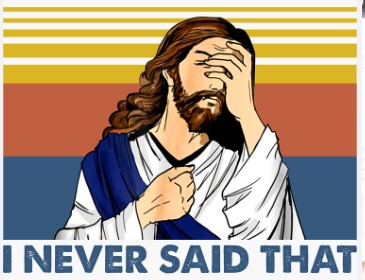
I love scripture because it is unflinchingly honest about how hard life is. Few things will make us ultimately more anxious than believing that following Christ will make our paths smooth, or that knowledge of God’s sovereignty will keep us from suffering. When we adopt a version of the Prosperity Gospel, we may come to doubt that God loves us when we experience trials, or shame ourselves for trouble, believing it stems from lack of faith.
Certain verses are prone to Prosperity Gospel interpretation. These are some of my favorite verses in the Bible, but I grew up in a culture that often them in the wrong places or at the wrong time. Let’s unpack a few.
Philippians 4:13 I can do all things through Christ who gives me strength. This was the most quoted Bible verse in my high school yearbook, typically under the senior photos of the Fellowship of Christian Athletes. Of “all things” Christ helped Paul do, winning a CIF swimming championship wasn’t one of them. I got the giggles recently when I noticed that my husband had this verse on his high school letterman’s jacket.
The “all things” we can claim through this verse doesn’t actually refer to all the successes we are guaranteed: a college scholarship, a thriving business, winning on American Idol. Paul wrote this passage from prison, and it means that he can endure all things, not triumph in every undertaking. Here’s the context: “I have learned to be content regardless of my circumstances. I know how to live humbly, and I know how to abound. I am accustomed to any and every situation—to being filled and being hungry, to having plenty and having need. I can do all things through Christ who gives me strength.”
Romans 8:28 God works all things for good for those who love him and are called according to his purpose for them. I’ve heard this verse quoted to people with chronic pain, pregnancy loss, cancer, unemployment, divorce, and experiencing abuse. A sweet lady in my church used to say, “If you don’t get the thing you want now, it’s because God has something better.” She applied this to dating, job hunting and the housing market; and it’s often true, but it’s not always true, or what the verse in Romans probably means. Christians need to be careful about (at least) two things in this verse’s application.
1. This does not mean that all things are good. They will be worked out for ultimate good – and the how is mysterious. We may never be able to see a one-for-one return on our suffering, and we shouldn’t attempt to for ourselves, and certainly not for others. Trying to find good in all things can drive you insane, and it’s not necessary. You can know God will bring about good, and not always be able to name or explain exactly how. You might find you didn't get the house you wanted, but the one you did get allowed you to witness to your neighbor; that seems like a "God works it together for good" moment! But we don't ever know for sure God's specific intentions.
2. Quoting this verse to suffering people is almost never a good idea. It shuts down empathy toward them, and discourages them from having self-empathy. When my friend Brittany died in December, there was no way I would quote this verse to her widower. What helps people in times of great grief, mental illness or loss is typically mourning with them. Praying for them. Sitting with them. Letting them name suffering. Gratitude and perspective can come later.
Romans 8:37 says "In all these things we are more than conquerors through Him who loved us." But what things? Let’s look at the context, shall we? Paul is writing about the apostle’s experiences:
Who shall separate us from the love of Christ? Shall trouble or hardship or persecution or famine or nakedness or danger or sword? As it is written:
“For your sake we face death all day long; we are considered as sheep to be slaughtered.”[j]
No, in all these things we are more than conquerors through him who loved us.
For I am convinced that neither death nor life, neither angels nor demons,[k] neither the present nor the future, nor any powers, neither height nor depth, nor anything else in all creation, will be able to separate us from the love of God that is in Christ Jesus our Lord.
Paul faced all these hardships. He eventually died for the sake of Christ, as did ten of the eleven original disciples. But somehow, we think we’re going to have less pain than those who don’t believe in Christ?
When we believe that lesser theology, we will face the worst of spiritual hardships: believing that a lack of worldly blessing means a loss of God’s love. Followers of Jesus are conquerors in a spiritual sense: ultimately they are not crushed because of the great love of God that is ever-present and eternal.
This How to Break Up with Your Anxious Life series has been about finding peace through accepting the messiness and difficulties of life; to regularly be comforted and refreshed by God in a world that will regularly kick your butt; and to make decisions that will lessen unnecessary stress and pain (see “Breaking Enslaving Traditions”).
But I want to close with a deep theological truth that turns the Prosperity Gospel on its head: God doesn’t just bless the faithful. He blesses the beloved, which is all people, all the world. Many Christians believe – albeit subconsciously – that their lives should be tragedy-free because they love God, and should be better than those who don’t; God makes us no such promise. We must remember we serve a God who is so crazy-strangely good and merciful that he blesses even those who will never bless him back.
Jesus said, “You have heard that it was said, ‘Love your neighbor and hate your enemy.’ But I tell you, ,love your enemies and pray for those who persecute you, that you may be children of your Father in heaven. For he causes his sun to rise on the evil and the good and sends rain on the righteous and the unrighteous.” (Matthew 5:43-45)
May we find peace today – not from bumper-sticker theology – but in the knowledge that we serve a huge, mysterious powerful God who loves and never leaves us, and is working in ways that we will someday understand.
Graphic credit goes to Skechers7654. You can buy this sticker on RedBubble.March 16, 2023
Which Family Comes First?
Bad Advice from Christian Women, Part Two
How to Break Up with Your Anxious Life
For a teacher, leading a class over Zoom has almost no advantages over being in-person. I learned this in the first year of the pandemic, when I taught five sessions of Bible study online. One exception is that, occasionally, someone in my class will have a reaction so dramatic, with her face right in the screen, that we all get to pause and share her light-bulb moment.
One such time, I was teaching about common sayings we should question. One was “Family always comes first.” A student Maria said “But isn’t that true?”
“Well,” I asked, “do you see it in Scripture? ‘Family first’ is not something Jesus said. It’s what the Mob says.”
Maria cracked up. “I’m Italian,” she said. “That hits home.”
Throughout this series, I’ve attempted to help us break the patterns of thinking and behaving that increase anxiety in our lives. Being able to discern between the sayings that surround us in culture – even in church culture – from the actual wisdom of God is paramount. As I wrote last week, Paul points out to Timothy some trustworthy saying among Christians, assuming that we also have to be on the lookout for some untrustworthy sayings. So, let’s break this one down in detail.
“Family always comes first” is one of those statements that sounds good, maybe even Biblical, but many sinful things have been done in its application. The first issue here is, how do we define family? Who is included in this family photo? Are my husband and children my family? Or my parents and brothers? Or my aunties and sixteen cousins?
And who do they come before, if they are first? Before my work? My best friends? In all instances?
In extreme cases, the concept of “family always comes first” has been used to silence victims of abuse, and in more moderate cases has shielded family members from natural consequences. Parents might pull out “family comes first” as a way to get one sibling to pay the bills of an irresponsible sibling, to prevent an adult child from moving too far away, or to demand that family gatherings always trump other commitments. I have dear friends who wouldn’t have fulfilled their calling to the mission field if they had “put family first.” Some mothers would hear the phrase “family always comes first,” and be wracked with guilt if they pursued any kind of profession.
Did Jesus ever say “Family comes first”? No, shockingly. He put God’s will and the kingdom of heaven ahead of family/tribal loyalties. Here are three instances:
Matthew 8:21-22“Sir, first let me go and bury my father.” Jesus replies, “Follow me, and let the dead bury their own dead.” In this case, the man’s father has not died. He is asking if he can stay home with his father until he dies, as is the custom for Jewish young men. Jesus’s response says that sometimes the cost of following Christ is breaking that tradition.
Matthew 12:46-49 While Jesus was still talking to the crowd, his mother and brothers stood outside, wanting to speak to him. Someone told him, “Your mother and brothers are standing outside, wanting to speak to you.” He replied to him, “Who is my mother, and who are my brothers?” Pointing to his disciples, he said, “Here are my mother and my brothers. For whoever does the will of my Father in heaven is my brother and sister and mother. For whoever does the will of my Father in heaven is my brother and sister and mother.” In this context, Jesus’s biological family are concerned about some of the controversial things he’s been teaching, and they are trying to get him to be quiet and come home. Jesus prioritizes God’s will over family again, and gives honor to those who are joining in his ministry.
John 19:26-27 When Jesus saw his mother there, and the disciple whom he loved standing nearby, he said to her, “Woman,[a] here is your son,” and to the disciple, “Here is your mother.” From that time on, this disciple took her into his home. This is fascinating. From the cross, Jesus defies Jewish tribal law and gives the care of his mother not to his biological brother James, but to John, his beloved disciple. James, at the time, did not believe that his brother was the Christ, so we can imagine that Jesus entrusts his mother to the person most qualified to love her well, likely because of John’s faith and his relationship with Jesus.
All three demonstrate some beautiful and liberating truths:
First, that Jesus defines family broadly. This means we not only get to love the family we are given through biology, but also love and prioritize the family we find in God’s kingdom. This is good news for those who have healthy families of origin; the more the merrier! Set new places around the table and invite everyone in! This is even better news for those from mildly to wildly dysfunctional family systems; it means they are allowed to seek connection, comfort, wisdom, and fellowship outside of their family of origin without feeling guilty about it.
Second, God’s will trumps our family’s will. God’s will is pleasing and perfect (Romans 12:1) For my money, I love it when what God asks of me will also please my biological brothers and parents. It’s just so much more tidy and comfortable. But on the occasions that I need to displease or disappoint them to please Jesus, I have learned to do so without anxiety roiling in my heart.
Third, that we have good and powerful work to do in the world, and it’s good for both ourselves and our family members when our focus doesn’t become too insular. What Jesus modeled for us in regard to family was also not Western individualism – leaving the family of origin to be totally independent -- but a call to pursue loving, interdependent, healthy community with the shared goal of love.
One thing of which I am certain: God’s instructions lead to peace. Psalm 19:7 says, “The law of the LORD is perfect, refreshing the soul. The statutes of the LORD are trustworthy, making wise the simple.” But making overly simplistic statements, renders wisdom ineffective, and causes soul distress. So, I offer the above evidence as a potential model of how we might bring the things we often say into the light, asking ourselves questions and holding them up against the truth. May your soul be refreshed as you learn to separate half-truths from deep truths, and may we cease to speak half-truths over others.
For those of you who want to a few more examples, read on. And tune in next week as we look at a few scriptures commonly used out of context.Motherhood is your highest calling. Likely an off-shoot of “family comes first” culture, I’ve been told this more times than I can count in Christian circles, especially mothers’ groups. And while the intent may have been to value us as mothers, the fact is that my highest calling is not to parent, but to be a disciple of Jesus. While my daughters are under my roof, caring for them often takes precedence over many other concerns, and being their mom is a holy calling. But “motherhood is your highest calling” is not scriptural; and it presupposes that the most important time of any mother’s life will be over when her kids leave the nest – which is both depressing and distressing. How much more empowered would women be in the church if they believed they’re call to follow Christ into fruitfulness lasted their whole lives, and maybe increased as they matured?
This saying is also dangerous because it gets out into non-mothering circles and becomes “mothering is women’s highest calling,” excluding and potentially shaming women who don’t want children, can’t conceive, or are called to singleness.
God never gives you more than you can handle. This saying likely stems from 1 Corinthians 10:13 “No temptation has overtaken you except what is common to mankind. And God is faithful; he will not let you be tempted beyond what you can bear. But when you are tempted, he will also provide a way out so that you can endure it.” (Emphasis mine.) This is a beautiful promise.
But “God never gives you more than you can handle” is problematic in many ways. It simplifies the mystery of God’s sovereignty almost to the point of blasphemy, characterizing God as someone who is handing out blessing and struggle in proportion to our strengths. This picture of God does not lead to peace.
Secondly, sisters, what does “handle” even mean? How do I know if I’m handling what has been given to me? When I had post-partum depression with my second daughter, was I “handling” motherhood? When my friend died in December and I ate corndogs in H Mart and then went home, sobbing to my bed? This expression has potential shaming effects on those who are struggling emotionally, financially, relationally, and more. It’s also often used to shut down empathy. A friend of mine in chronic pain has been told this repeatedly by loved ones, and it minimizes her struggle.
A more helpful and trustworthy saying is, “God will never abandon nor forsake you.” I have both experienced and witnessed the saints being given much more than they could “handle,” but the truth that God has always been present with us has never failed. This truth doesn’t cure pain, but does, eventually, lead to peace.