
Mehmet Yildiz's Blog: Updates from Dr Mehmet Yildiz - Posts Tagged "emerging-technologies"
Introduction to Technology Horizons 2050 and Beyond: Emerging Technologies Shaping the Next 50 Years of Human and Machine Evolution
I am pleased to announce the preorder of
Technology Horizons 2050 and Beyond
https://a.co/d/9xMxVcK
What will the world look like in 2050 when emerging technologies in biology, artificial intelligence, quantum computing, and space exploration converge into one interconnected fabric of human and machine evolution?
image: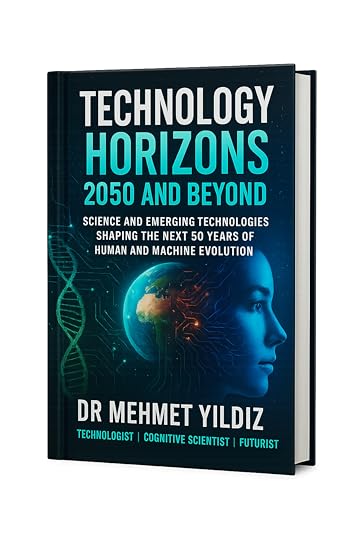
This book is part of my Technology Excellence and Leadership Series on Amazon
In Technology Horizons 2050 and Beyond, I draw on five decades of work in technology, cognitive science, and global innovation to predict the coming five decades.
Yet this vision began far earlier, rooted in a childhood where I cultivated extraordinary imagination through cognitive enhancement methods, learned to think beyond the box, and developed the ability to view reality from both the microscopic and telescopic scales.
This dual perspective allows me to link scientific precision with metaphysical insight, creating forecasts that connect present-day breakthroughs with their long-term implications.
Going beyond technical analysis, the book is a synthesis of rigorous research, scenario planning, and intuitive pattern recognition, an approach that anticipates shifts others may overlook. I map the future of technology not only through the lens of engineering and economics, but also through the cultural, ethical, and philosophical questions it raises.
You will explore thirty interconnected domains shaping the future: regenerative medicine and biotechnology, bioprinting and nanotechnology, advanced genetic engineering, the Internet of Bodies and planetary connectivity, intelligent automation and the future of work, artificial general intelligence, neuromorphic computing, quantum computing and AI integration, smart cities of the future, tokenized economies, immersive realities, space colonization and planetary defense.
Each chapter follows a three-stage foresight model—2030 Outlook, 2040 Transition, and 2050 Vision—providing a roadmap from today’s innovations to the transformative systems that will redefine life, work, and human potential over the next half-century.
This book goes beyond speculative science fiction. It is grounded in current research, industry developments, and practical foresight, making it a credible and indispensable resource for thought leaders, entrepreneurs, artists, technologists, policymakers, and philosophers who seek to understand the future of human-machine evolution.
Whether you are building the next breakthrough company, shaping policy for emerging technologies, investing in frontier science, or exploring the deeper meaning of human evolution in an age of machines, this book offers both a strategic guide and a creative provocation.
The future will not wait for us to be ready. It will unfold in the minds of those who dare to see it before it arrives, who can stand at the intersection of science and imagination, and who have the courage to turn the improbable into the inevitable. This book is an invitation to be among them.
I will continue to upload the sample chapters of Technology Horizons 2050 and Beyond to the
Digitalmehmet Content Ecosystem
For advanced copy and beta readers, it will be available on Digitalmehmet Discount Bookstore/a>
Some chapters will be available to the subscribers of https://substackmastery.com/
Technology Horizons 2050 and Beyond
https://a.co/d/9xMxVcK
What will the world look like in 2050 when emerging technologies in biology, artificial intelligence, quantum computing, and space exploration converge into one interconnected fabric of human and machine evolution?
image:
This book is part of my Technology Excellence and Leadership Series on Amazon
In Technology Horizons 2050 and Beyond, I draw on five decades of work in technology, cognitive science, and global innovation to predict the coming five decades.
Yet this vision began far earlier, rooted in a childhood where I cultivated extraordinary imagination through cognitive enhancement methods, learned to think beyond the box, and developed the ability to view reality from both the microscopic and telescopic scales.
This dual perspective allows me to link scientific precision with metaphysical insight, creating forecasts that connect present-day breakthroughs with their long-term implications.
Going beyond technical analysis, the book is a synthesis of rigorous research, scenario planning, and intuitive pattern recognition, an approach that anticipates shifts others may overlook. I map the future of technology not only through the lens of engineering and economics, but also through the cultural, ethical, and philosophical questions it raises.
You will explore thirty interconnected domains shaping the future: regenerative medicine and biotechnology, bioprinting and nanotechnology, advanced genetic engineering, the Internet of Bodies and planetary connectivity, intelligent automation and the future of work, artificial general intelligence, neuromorphic computing, quantum computing and AI integration, smart cities of the future, tokenized economies, immersive realities, space colonization and planetary defense.
Each chapter follows a three-stage foresight model—2030 Outlook, 2040 Transition, and 2050 Vision—providing a roadmap from today’s innovations to the transformative systems that will redefine life, work, and human potential over the next half-century.
This book goes beyond speculative science fiction. It is grounded in current research, industry developments, and practical foresight, making it a credible and indispensable resource for thought leaders, entrepreneurs, artists, technologists, policymakers, and philosophers who seek to understand the future of human-machine evolution.
Whether you are building the next breakthrough company, shaping policy for emerging technologies, investing in frontier science, or exploring the deeper meaning of human evolution in an age of machines, this book offers both a strategic guide and a creative provocation.
The future will not wait for us to be ready. It will unfold in the minds of those who dare to see it before it arrives, who can stand at the intersection of science and imagination, and who have the courage to turn the improbable into the inevitable. This book is an invitation to be among them.
I will continue to upload the sample chapters of Technology Horizons 2050 and Beyond to the
Digitalmehmet Content Ecosystem
For advanced copy and beta readers, it will be available on Digitalmehmet Discount Bookstore/a>
Some chapters will be available to the subscribers of https://substackmastery.com/


Introduction to the The Dawn of Bioprinting and Engineered Healing
Dear Subscribers,
I shared a new chapter from the book Technology Horizons 2050 and beyond, featured at https://books2read.com/2050, ISBN: 9798231583355.
The official page for this book is here
A Glimpse Into Bioprinting and Living Tissue Engineering
The idea of constructing the human body one layer at a time was once the stuff of science fiction. Today, it stands at the threshold of medical practice.
Bioprinting is no longer confined to the dream of replacing what is broken. It has become the design of living systems that work in harmony with the body, each part shaped not only to fit anatomically but to function biologically. In this sense, bioprinting is not just repair but reimagining what it means to heal.
From an early age, I found myself fascinated by how nature repairs itself. A wound that closes over time or a bone that slowly regrows shows us the profound intelligence embedded in living matter.
Bioprinting mimics and seeks to accelerate those lessons, borrowing from both engineering and biology to replicate the patterns nature perfected over millions of years.
The imagination of scientists, artists, and engineers now converges in laboratories where life itself is being printed with remarkable precision.
Breakthroughs and Milestones
The pace of discovery in bioprinting has been extraordinary, even if most applications remain in advanced experimental stages.
In the United States, surgeons achieved a world-first by transplanting a 3D bioprinted living ear, created from the patient’s own cartilage cells. This was more than a technical triumph; it was proof that tissues grown in the lab could integrate with the human body, restoring both form and function.
Elsewhere, within the Feinberg Laboratory at Carnegie Mellon University, researchers have achieved a significant milestone using the FRESH (Freeform Reversible Embedding of Suspended Hydrogels) 3D bioprinting technique.
They successfully engineered pancreatic‑like tissue constructs composed entirely of biologic materials, specifically collagen, featuring perfusable, blood vessel–like channels down to capillary size (about 100 microns in diameter) that respond to glucose by releasing insulin, outpacing current organoid models
These constructs not only survive but also respond with insulin release in ways that move us closer to functional organ replacements for conditions such as Type 1 diabetes.
In Australia, scientists at the Murdoch Children’s Research Institute created hundreds of “mini-kidneys” for drug screening and disease modeling. These tiny organoids are not yet ready to be transplanted, but their complexity demonstrates that larger-scale organs are within reach.
Some of the most surprising progress has come from work inside the body. In China, researchers used micro-bioprinting tools delivered through an endoscope to repair stomach wounds in animal models.
Tissue printed in vivo not only survived but also integrated with surrounding cells, hinting at a future where surgical repair might mean printing directly where damage has occurred.
Each of these examples represents more than a technical feat; they mark stepping stones toward a future where organs are not scarce commodities but renewable resources.
image:
I will continue to upload the sample chapters of Technology Horizons 2050 and Beyond to the
Digitalmehmet Content Ecosystem
For advanced copy and beta readers, it will be available on Digitalmehmet Discount Bookstore/a>
Some chapters will be available to the subscribers of https://substackmastery.com/
I shared a new chapter from the book Technology Horizons 2050 and beyond, featured at https://books2read.com/2050, ISBN: 9798231583355.
The official page for this book is here
A Glimpse Into Bioprinting and Living Tissue Engineering
The idea of constructing the human body one layer at a time was once the stuff of science fiction. Today, it stands at the threshold of medical practice.
Bioprinting is no longer confined to the dream of replacing what is broken. It has become the design of living systems that work in harmony with the body, each part shaped not only to fit anatomically but to function biologically. In this sense, bioprinting is not just repair but reimagining what it means to heal.
From an early age, I found myself fascinated by how nature repairs itself. A wound that closes over time or a bone that slowly regrows shows us the profound intelligence embedded in living matter.
Bioprinting mimics and seeks to accelerate those lessons, borrowing from both engineering and biology to replicate the patterns nature perfected over millions of years.
The imagination of scientists, artists, and engineers now converges in laboratories where life itself is being printed with remarkable precision.
Breakthroughs and Milestones
The pace of discovery in bioprinting has been extraordinary, even if most applications remain in advanced experimental stages.
In the United States, surgeons achieved a world-first by transplanting a 3D bioprinted living ear, created from the patient’s own cartilage cells. This was more than a technical triumph; it was proof that tissues grown in the lab could integrate with the human body, restoring both form and function.
Elsewhere, within the Feinberg Laboratory at Carnegie Mellon University, researchers have achieved a significant milestone using the FRESH (Freeform Reversible Embedding of Suspended Hydrogels) 3D bioprinting technique.
They successfully engineered pancreatic‑like tissue constructs composed entirely of biologic materials, specifically collagen, featuring perfusable, blood vessel–like channels down to capillary size (about 100 microns in diameter) that respond to glucose by releasing insulin, outpacing current organoid models
These constructs not only survive but also respond with insulin release in ways that move us closer to functional organ replacements for conditions such as Type 1 diabetes.
In Australia, scientists at the Murdoch Children’s Research Institute created hundreds of “mini-kidneys” for drug screening and disease modeling. These tiny organoids are not yet ready to be transplanted, but their complexity demonstrates that larger-scale organs are within reach.
Some of the most surprising progress has come from work inside the body. In China, researchers used micro-bioprinting tools delivered through an endoscope to repair stomach wounds in animal models.
Tissue printed in vivo not only survived but also integrated with surrounding cells, hinting at a future where surgical repair might mean printing directly where damage has occurred.
Each of these examples represents more than a technical feat; they mark stepping stones toward a future where organs are not scarce commodities but renewable resources.
image:
I will continue to upload the sample chapters of Technology Horizons 2050 and Beyond to the
Digitalmehmet Content Ecosystem
For advanced copy and beta readers, it will be available on Digitalmehmet Discount Bookstore/a>
Some chapters will be available to the subscribers of https://substackmastery.com/
IoT 2.0 for Agile Digital Transformation Is Now Available on Multiple Bookstores Globally
Dear Followers and Subscribers,
I am pleased that my new book, IoT 2.0 for Agile Digital Transformation, was published.
Order link: https://books2read.com/iot2
When I first wrote this book in 2019, the convergence of the Internet of Things (IoT), Artificial Intelligence (AI), Edge Computing, and Cloud Services was an emerging horizon. Many of us sensed its potential, but few imagined how fast it would reshape industries, economies, and societies.
What once seemed futuristic is now the baseline of modern business strategy. In 2025, organizations that cannot architect secure, scalable, and intelligent systems risk being left behind, not by technology, but by the rapid changes across multiple domains and industries.
This updated edition carries forward the original mission of helping architects and decision-makers design dependable, ethical, and adaptive systems.
It now expands that mission to address the realities of the AI-driven era where algorithms act autonomously, devices collaborate intelligently, and edge platforms make decisions faster than humans can respond.
This 2025 edition preserves the timeless foundations of the original work (security, availability, performance, agility, and cost-effectiveness) while extending them to reflect five years of unprecedented transformation. It acknowledges that architecture today is not static documentation but continuous adaptation.
Why This Book Matters in 2026 Onwards
In this age, architecture is strategy. IoT, Big Data, and Cloud are no longer discrete domains. They are interdependent forces shaping a global intelligence network.
The most successful enterprises are those that treat architecture as a living system, continuously refined through feedback, analytics, and governance.
I wrote this book for professionals across various roles and industries:
· Solution architects and enterprise engineers designing intelligent ecosystems.
· CTOs, CIOs, and CDOs aligning technology with organizational vision.
· Product managers and consultants leading digital innovation.
· Entrepreneurs creating adaptive business models grounded in technological reality.
· Educators and advanced students shaping the next generation of systems thinkers.
The principles discussed here apply equally to start-ups deploying smart devices and to global enterprises managing millions of endpoints.
The emphasis is on architecture as a unifying language that connects business intent with technological design and long-term human impact.
A Book for Builders of the Future
This edition differs from the original not just in scope but in spirit. In 2019, we built connected systems. In 2025, we must build connected intelligence. The difference is profound.
Systems today must sense, think, and act while remaining ethical, explainable, and secure. The challenge is no longer scale but significance for society.
S.P.A.R.K.S.™ embodies this evolution. It helps professionals and organizations create architectures that perform under stress, adapt under change, and learn from experience. It ensures that technology serves a purpose, not the other way around.
In an era when AI agents converse with humans, when digital twins represent entire cities, and when autonomous systems shape economies, architects must think beyond performance metrics. They must design for trust, transparency, and long-term alignment with human values.
I wrote this book to guide that journey to equip you with the clarity, precision, and foresight to design systems that matter. It is both a map and a compass for those who will build what comes next.
Because in the end, progress does not begin with a machine or a model. It starts with a spark, the decision to build with wisdom, vision, and integrity.
Thank you for checking it through https://books2read.com/iot2
And thank you for reading my perspectives
As a quick update, I recently created a special publication on Medium for scholarly writers.
You can apply for the Illumination Scholar via this registration portal at my site: https://digitalmehmet.com/illuminatio...
I'd like to share a list of books I added to the Digitalmehmet Discount Bookstore to give you an idea. They include PDF, EPUB, MOBI, or MP3 formats for downloading.
Audio + Digital Bundle: The Mysterious Leadership Mind of Robert F. Kennedy Jr.
Substack Mastery Version 2 (Digital + Audio Bundle)
Agile Business Architecture for Digital Transformation (Audiobook)
Audiobook: Monetize Your Passion with WooCommerce
Monetize Your Passion with WooCommerce (Book)
Agile Business Architecture for Digital Transformation V2
Cortisol Clarity (Audiobook)
A Powerful Toolkit for Substack Newsletter Mastery (Audio)
Smart and Ethical SEO (Book)
Train Your Brain for a Healthier and Happier Life (Audio)
Modern Affiliate Marketing for Writers (Audiobook)
Modern Affiliate Marketing for Writers (Book)
4 Pillars of Enterprise Architecture
Smart Email Marketing Content Integration
A Powerful Toolkit for Substack Newsletter Mastery
Cortisol Clarity (Book)
Train Your Brain for a Healthier and Happier Life (Book)
Illumination Book Club on Substack
Illumination Book Chapters on Medium
I am pleased that my new book, IoT 2.0 for Agile Digital Transformation, was published.
Order link: https://books2read.com/iot2
When I first wrote this book in 2019, the convergence of the Internet of Things (IoT), Artificial Intelligence (AI), Edge Computing, and Cloud Services was an emerging horizon. Many of us sensed its potential, but few imagined how fast it would reshape industries, economies, and societies.
What once seemed futuristic is now the baseline of modern business strategy. In 2025, organizations that cannot architect secure, scalable, and intelligent systems risk being left behind, not by technology, but by the rapid changes across multiple domains and industries.
This updated edition carries forward the original mission of helping architects and decision-makers design dependable, ethical, and adaptive systems.
It now expands that mission to address the realities of the AI-driven era where algorithms act autonomously, devices collaborate intelligently, and edge platforms make decisions faster than humans can respond.
This 2025 edition preserves the timeless foundations of the original work (security, availability, performance, agility, and cost-effectiveness) while extending them to reflect five years of unprecedented transformation. It acknowledges that architecture today is not static documentation but continuous adaptation.
Why This Book Matters in 2026 Onwards
In this age, architecture is strategy. IoT, Big Data, and Cloud are no longer discrete domains. They are interdependent forces shaping a global intelligence network.
The most successful enterprises are those that treat architecture as a living system, continuously refined through feedback, analytics, and governance.
I wrote this book for professionals across various roles and industries:
· Solution architects and enterprise engineers designing intelligent ecosystems.
· CTOs, CIOs, and CDOs aligning technology with organizational vision.
· Product managers and consultants leading digital innovation.
· Entrepreneurs creating adaptive business models grounded in technological reality.
· Educators and advanced students shaping the next generation of systems thinkers.
The principles discussed here apply equally to start-ups deploying smart devices and to global enterprises managing millions of endpoints.
The emphasis is on architecture as a unifying language that connects business intent with technological design and long-term human impact.
A Book for Builders of the Future
This edition differs from the original not just in scope but in spirit. In 2019, we built connected systems. In 2025, we must build connected intelligence. The difference is profound.
Systems today must sense, think, and act while remaining ethical, explainable, and secure. The challenge is no longer scale but significance for society.
S.P.A.R.K.S.™ embodies this evolution. It helps professionals and organizations create architectures that perform under stress, adapt under change, and learn from experience. It ensures that technology serves a purpose, not the other way around.
In an era when AI agents converse with humans, when digital twins represent entire cities, and when autonomous systems shape economies, architects must think beyond performance metrics. They must design for trust, transparency, and long-term alignment with human values.
I wrote this book to guide that journey to equip you with the clarity, precision, and foresight to design systems that matter. It is both a map and a compass for those who will build what comes next.
Because in the end, progress does not begin with a machine or a model. It starts with a spark, the decision to build with wisdom, vision, and integrity.
Thank you for checking it through https://books2read.com/iot2
And thank you for reading my perspectives
As a quick update, I recently created a special publication on Medium for scholarly writers.
You can apply for the Illumination Scholar via this registration portal at my site: https://digitalmehmet.com/illuminatio...
I'd like to share a list of books I added to the Digitalmehmet Discount Bookstore to give you an idea. They include PDF, EPUB, MOBI, or MP3 formats for downloading.
Audio + Digital Bundle: The Mysterious Leadership Mind of Robert F. Kennedy Jr.
Substack Mastery Version 2 (Digital + Audio Bundle)
Agile Business Architecture for Digital Transformation (Audiobook)
Audiobook: Monetize Your Passion with WooCommerce
Monetize Your Passion with WooCommerce (Book)
Agile Business Architecture for Digital Transformation V2
Cortisol Clarity (Audiobook)
A Powerful Toolkit for Substack Newsletter Mastery (Audio)
Smart and Ethical SEO (Book)
Train Your Brain for a Healthier and Happier Life (Audio)
Modern Affiliate Marketing for Writers (Audiobook)
Modern Affiliate Marketing for Writers (Book)
4 Pillars of Enterprise Architecture
Smart Email Marketing Content Integration
A Powerful Toolkit for Substack Newsletter Mastery
Cortisol Clarity (Book)
Train Your Brain for a Healthier and Happier Life (Book)
Thank you for reading my post. You can connect with me on my author platform Digitalmehmet Content Ecosystem.
If you are a book author, you can join our book club on Substack and share your book chapters at Illumination Book Chapters on Medium. Here are the links:
Illumination Book Club on Substack
Illumination Book Chapters on Medium
Updates from Dr Mehmet Yildiz

Dr Mehmet Yildiz is a postdoctoral researcher in cognitive science and technologist who has worked as a Distinguished Enterprise Architect certified by the Open Group on multi-billion dollar enterpris
...more
- Mehmet Yildiz's profile
- 57 followers

