Michael Chin's Blog
October 24, 2022
I Love You
For the immediate future, I wanted to go to a full-time MFA program in creative writing. One last shot at chasing a dream of being a writer that I’d deferred and pursued in cockeyed ways like a daily fictional blog project and starting a website about a cappella music.
There were other things I wanted, too. A lifelong romantic, I still wanted to find a more permanent, loving relationship. I’d had two long-term relationships that, against the odds, I’d called off, as age and experience showed me not every relationship could be happy, or had to be the one. I wanted to be a father, too.
So, when I started this blog, I didn’t know what I was doing with life, professionally or personally, only that I wanted more and starting this blog felt like a step in the right direction.
I described the project of this blog to a friend—that it was the one writing project that might last a lifetime because it could be whatever I wanted it to be, not beholden a specific topic or format, no pressure or expectation it would ever reach an audience beyond my family and friends.
That was all ten years ago.
I’m ready to stop now.
Looking back, I can recognize some overlap between starting to this blog and when my relationship with my wife first started, or perhaps even more apropos, when our son was born. There are intentions and there are realities. A planner like me can lay out what I expect and what I want, but there’s also the reality of the day-to-day and the way a life changes the more time goes by, the more you do, and the more people you invite into it.
I’ve used the space of this blog to reflect on my people—my difficult relationship with my father and my joyous relationship with my son, bits and pieces about my mother and sister and grandparents. I’ve written about my wife, but also about ex-girlfriends. I’ve written about friendship and travel and writing, about books and music and television and films and sports I enjoy. I wrote about a lot of steps I took all alone. Indeed, in the last few years, my thinking about the blog has shifted, and I consider that part of it's legacy may be as a way for my son to know the person I was before I was his father and in these first years. In other words, if something were to happen to me, this blog might be a vehicle for him to continue knowing me after I'm gone.
One of my favorite quotes about writing, courtesy of Flannery O’Connor, suggests that anyone who survived childhood has enough material to write about for a lifetime. I hold that to be true, particularly as elements of my past seep into my creative work, but all the more so in this blog where one memory leads to the next until I have an entry written, or sometimes several.
But the story I set out to tell here is done. The reality of this blog is that I typically had its contents written well before I posted them, always ahead so I’d never fall behind or grasp at straws to write something at the last minute that wasn't up to my standards. It was a joy to get six months, a year, a year-and-a-half ahead at given times. But, if I’m being honest, for the last couple years, this blog has at least equally often felt like a burden, as opposed to a pleasure.
I called this blog Three Words That Became Hard to Say after an Avett Brothers song that uses those lyrics. The words they’re getting at are the title of the song, which they don’t actually sing until the final stages of “I and Love and You.” I used that title as a gimmick, titling each post itself with three words. But I also hope the undercurrent came through, in a blog about me and people in my life, past and present—maybe even future. This blog was for me. This blog was for you.
I love you. Be well, and I hope I’ll see you down the road.


October 16, 2022
You Slay Together
I suppose it’s not uncommon to be attached to the media that meant the most to you at a formative point in your life. My favorite band is Counting Crows. My favorite move is Angus. If I were forced to pick a single favorite book, I’d probably go with John Irving’s A Prayer for Owen Meany. I don’t hold any illusions about any of these selections being the best in their given genre, but they each share that I first fell in love with them between the ages of fourteen and eighteen. Not unlike my best friends, the things I hold most dear are not only the highest in quality or the most in sync with my present aesthetic, but were with me through good times and bad, and have held a place in my heart for two decades now.
To grow older—particularly in our present moment—is to reckon with the problematic nature of old favorites. In the realm of television alone, I can’t re-watch episodes of Friends without recognizing the rampant homophobia and misogyny. It’s hard to cheer on other sitcoms with Tim Allen or Kelsey Grammar playing the protagonists. And Buffy?
In addition to the goal posts for diversity and inclusivity shifting over time and rendering BtVS in a less positive light, there have been revelation after revelation that Joss Whedon wasn’t such a nice guy (putting it very diplomatically). The identity of Buffy the show is hard to extricate from its (it turns out evil) genius showrunner—and that’s not getting into other Whedon vehicles like Angel, Firefly, and Dollhouse that I also held dear.
So do we love a show like Buffy unconditionally, much like I’ve willfully turned a blind eye to many of pro wrestling’s most problematic pieces or given John Irving a pass for some questionable remarks (and diminishing quality of his books). Or do we put our foot down in a more principled manner, the way I haven’t engaged with texts by Junot Diaz since revelations about his poor behavior? There are always matters of convenience and personal taste at hand in conversations of cancel culture, like how I didn’t have to feel conflicted about denouncing Louie CK because I’d been pretty indifferent about his work anyway.
Rather than get into the weeds of whether or when it’s right to “cancel,” it feels more appropriate to discuss why I still hold BtVS dear across decades, across problematic issues for its mastermind, when I haven’t watched the whole show through in years , and doubt I watch more than two or three stand-alone episodes most years nowadays.
The central metaphor of Buffy--that high school and growing up are hell--and, moreover, that the people in your life spell the difference between it being a Hellmouth that swallows you whole and a series of monsters you slay together—still resonates with me. More than that, it’s foundational to what I believe about and how I walk through the world. (Spoiler alert to anyone who hasn’t watched the show all the way through and intends to:) the fact that the story begins with Buffy as a single girl up against the world, and ends with her as one of a cast of women holding the world on their shoulders together is beautiful and important for people to hear in whatever form is most palatable to them.
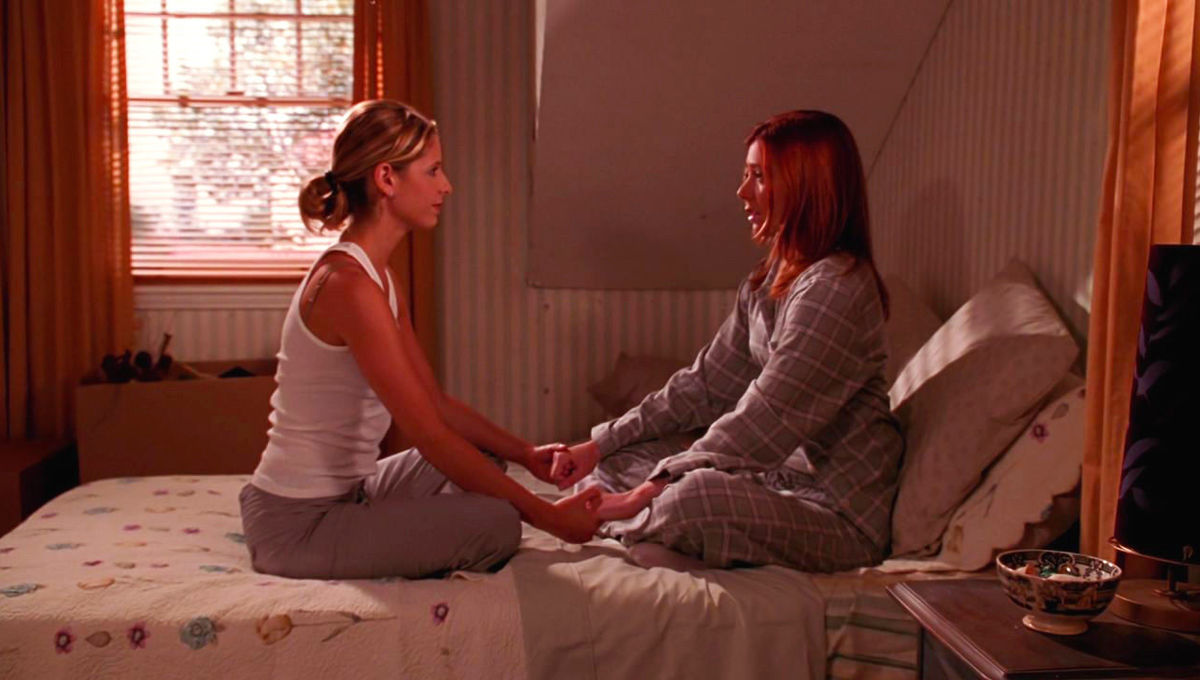 Indeed, I remember, as a teenager, wishing there were more Buffy. Not (only) more episodes, but more of getting to see these people interact outside of crisis, getting to live in their world a bit more in a way that wouldn’t be sustainable for a general audience, but that would make Willow and Xander feel even more like not just TV characters I liked, but people I knew.
 I suppose all of the above is at the heart of my affection and dedication to this show. Growing up, I remember my sister guiding me to a number of my favorite bands (after all, she owned an audio cassette of August and Everything After before I could justify buying the CD when she left for college). My parents dictated most of what I watched on TV. Buffy the Vampire Slayer is about the only show I remember bringing into the house—finding, falling for, and over a series of episodes convincing at least my mother and sister that it wasn’t just about the attractive women in the cast, but actually much more about how good this show was.
So, this October, I’ll be sure to fire up at least one episode. Maybe a seasonally appropriate “Halloween” or “Fear Itself,” or maybe one of the campier monster-of-the-week episodes from season one or two. Regardless, I’ll remember this show once made me feel, and the unique capacity for a show like it to still facilitate me losing myself to my imagination—that demons just might be real, but so are friends good enough to help me stand up to them.
October 2, 2022
She's Gonna Die
“Prophecy Girl” distinguishes itself as one of the best early episodes of the series, not because Buffy fights through the prophecy (it’s sort of a given she will), nor because the prophecy proves more or less true (“dying” only to be brought back by CPR straddles the line between clever and contrived). No, I’d suggest that what makes this one as good as it is is that Buffy’s reaction is to cry, be afraid, and mourn the life she’s known. She’s a hero for ultimately fighting on, but first she’s a human for experiencing a very relatable sense of doubt and sorrow.
Indeed, Buffy isn’t the only one to face her limitations. A hitherto emboldened Willow, on her way to the iconic strong woman she’ll ultimately be, gets smacked down into her place when she’s the one to come upon the bodies of students whom vampires brutally murdered in school grounds. Giles has his own kind of crisis of faith in aiming to fight in Buffy’s place, with every implication he expects to die in her place, too. Angel, for all of his heroics, faces his limitations because he does not physically have breath to breathe into Buffy’s body after she drowns, thus leaving not only the slayer but her super hero-esque boyfriend at the mercy of Xander of all people.
 So “Prophecy Girl” is about crises of faith and those moments when we seemingly don’t have it in us to carry forward against overwhelming odds. What does it say that Buffy and friends do ultimately prevail, surviving and slaying The Master, with Buffy even getting to wear a well-received gown to the spring dance afterward?
 These victories could be dismissed as cliches of the TV hero, but the nature of each character’s, and most particularly Buffy’s redemption leans less on individual strength and resourcefulness than the support the good guys find in one another. Xander, probably the weakest Scoobie, breathes Buffy back to life. Buffy protects Giles from himself in fighting her own fight, and empowers Willow by avenging the scene she witnessed and demonstrating once and for all that good can win out.
It’s a central concern for this show that there’s strength in community. Season two sees Spike, a slayer of slayers, explicitly attribute Buffy’s un-kill-ability to the network of support. Season three sees not just the Scoobies, but a quorum of high school classmates rally together to fight the mayor, not to mention that Faith is established as an example of what Buffy might have been without a loving family and friends to lean on. These themes carry straight through to the seventh and final season, in which the only way to beat back evil itself, and the only way to truly free Buffy from carrying the weight of the world turns out to be in spreading the load: going from the chosen one to the chosen ones, in an army of slayers.
“Prophecy Girl” sees Buffy die. That much is inevitable. With her character’s passing, the show as we know it, too, dies and is resurrected as season two brings with it far fresher villains than The Master, and an increasingly rich sense of mythology as we know these characters, their relationships, and their (no pun intended) stakes better going into a second season.
September 18, 2022
Musical Love Tour
It’s spring semester freshman year. To no credit of my own—perhaps in spite of my efforts—I’ve brought a girl back to my dorm room on a Saturday night for the very first time. My roommate is serendipitously out of town for the weekend, so it’s just her and me.
I open Windows Media Player on my desktop and turn on a playlist of mellow music, that I’ve had vague aspirations might set the mood for a hookup—a prospect that has hitherto been comically out of reach.
But here we are.
A lot of songs play. Some I remember, more I forget. I know “Bad” by U2 was on there, though. I’d written a sex scene of a failed novel set to this song and here I was living the loosest approximation—making out, at least on an extra-long twin-size bed, barely wide enough for two bodies, though it occurs to me for the first time that’s an advantage in a case like this, no choice but to come together.
”Delicate Few” by OAR
It’s toward the end of fall semester junior year of college and I’m at a concert with a girl I’ve been playing a will-they-won’t-they game with since last spring as flirtatious daylight conversations gave way to late night conversations over AOL Instant Messenger, to later night pizza runs and movie night and walks along sleepy campus pathways.
I learned of OAR freshman year, when a local cover band played “Crazy Game of Poker” at an over/under night at a bar off campus, and I downloaded most of their albums off the college network after. So, OAR became a band I’ll forever connect with college in my mind, for listening to them passionately for four years then hardly ever in the years to follow. I introduced them to this girl via mix CDs I made for her.
“Delicate Few” is her favorite song from the band’s catalog, and a song I like a good bit, too, but a relatively deep cut I don’t much expect to hear when the band plays our college gym.
Only, at the end of the show, on their second encore, after some proclamation about this really and truly being the last song they’re going to play, the lead singer launches into those lyrics the girl and I know so well.
Amazing, how we all want this
Life a little more everyday
It’s “Delicate Few,” and the girl jumps in the air, so I jump, too and we hug tight and holds hands for the whole song. It’s an extended version of the song, because OAR’s the kind of band prone to long instrumental jam breaks when they’re playing live. And I think this relatively chaste moment and the front end of what we’ll become is just about the best moment of my life to date.
“Accidentally in Love” by Counting Crows
Counting Crows have been my favorite band for about five or six years (which at the age of twenty feels like a really, really long time) when “Accidentally in Love” hits Top 40 Radio, a single attached to Shrek 2, and though it’s a little more pop in its sensibilities than my favorite material from the band, I still eat it up with a spoon, the song of the summer as I drive around my hometown in the gap between the end of the semester and my camp job, then on my way to the camp job, then while I’m there and meet another girl and she and I fall into a kind of summer love that’s improbably practical, because outside of the world of camp, our hometowns are less than an hour drive from one another, and our colleges are less than two hours apart—entirely doable for weekend road trips.
We decide “Accidentally in Love” is our song. She’s the director of an all-female a cappella group, and the first time I hear them perform it, I fall even deeper, because I can feel this is her love letter to me, though in my more rational mind I know that’s a small part of the puzzle to selecting the right pop song to arrange for the group to close out their competition set that next spring. Our accidental love carries on for years to follow into the first live-in relationship either of ushave had, past the point when life comes to obscure our innocent beginnings because we’re grownups and even after it feels like we’ve been together forever, three and a half years also doesn’t feel like so long when I move away for a job opportunity. Just past the four year mark, we break up.
”Cologne” by Ben Folds
I didn’t end my first multi-year relationship to date another woman, but it also wouldn’t be entirely honest to ignore that dating someone new gave me the kick in the pants I needed to end a relationship I wasn’t really happy in anymore.
This new woman and I make plans to go to Ben Folds concert, because we fell into an easy friendship in no small part because of a shared affinity for Folds and a bunch of other musical acts that were popular when the both of us were on college campuses a half hour away from one another, years before we ever met.
In an unexpected turn, Folds plays almost entirely new songs from his forthcoming album, Way To Normal. I’ve been wanting to make a move, and thought I might wait for a slow song, when it dawns on me there may not be a ballad on the new record. So, in the opening bars of “Free Coffee,” I go for it and reach for her hand. We hold hands the rest of the show, but after that initial contact, it’s “Cologne” I remember best.
It’s a beautiful, if sad song. But the chorus rubs me the wrong way when Folds sings Four, three, two, one… I’m letting you go because in an overly literal way, letting go of this woman’s hand is the last thing I want to do.
We kiss good night outside her apartment building after the show and date for a few weeks to follow. Then she ends it.
I listen to “Cologne” in the least healthy of ways for months to follow. Pining, yes, but I realize later, probably also mourning the relationship before this one--because even though I chose to end it, I hadn't really paused to process that situation.
The truth is, for years, long after I’m over these women, after my whole life has moved on, I still indulge in the song now and again to remember how the night of that concert felt, and how the nights to follow felt, too--all of it, the bittersweetest. A song that feels like a whole world.
”Us” by Regina Spektor
A woman and I meet at a conference and hit it off, but it looks like that’s the end of it until she invites me to come to her birthday party and we make out there, then she winds up back at my apartment to end the night. We spend a lot of time together the week or two to follow, before she ends it, then says she doesn’t want it to be over. I’m along for the ride.
Rather, I’m driving.
It’s a birthday in my late twenties and I do the driving for a day out she’s planned for us, well outside our city, closer to where she grew up, complete with a brewery tour and picnic. We drive down one particularly pretty country road where leaves fly down with the wind just as “Us” by Regina Spektor plays over the car speakers with its flurry of fanciful piano riffs. It all feels like an adventure. She embarks on a grad program in Scotland weeks later and I visit her there that fall, come to Europe again for a trip through France and England in the spring.
We last two years.
”I Choose You” by Sara Bareilles
Barring a handful of dates, I’ve been single for a full year when Heather and I really talk for the first time.
Coming out of this late night conversation, the end of our time working together, I can’t escape a sense of regret at not talking much to her sooner. Because I have the sense, given more time, she might be a really good friend. Or maybe more.
We text a lot those days to follow, before, during, and after her journey from the Bay Area back down to her home in San Diego, and while I go on a vacation road trip around various California locales. Finally, I ask if she’d like to meet up again, volunteering that I could drive down to her during my final stretch of my vacation, when I’m staying in LA.
I’m not sure it’s a date until we hold hands watching along the beach side, and not sure we’ll get any more intimate that until I wind up back at her apartment after midnight and she says I can stay. I’m not sure what we have will transcend that single, twenty-four hour period until she drives up to LA to hang out for most of the next day, and I tell myself not to get ahead of myself assuming anything on the cross country flight back to where I live on the east coast. But when the plane lands and I take my phone out of airplane mode, there are a series of texts from her waiting.
“I Choose You” becomes our song, out of a combination of my musical obsession du jour with Sara Bareilles, and more importantly the content of the song, all about choice—because what is a long distance relationship defined by weekly-ish Skype dinners and bi-monthly-ish cross-country flights but a matter of choosing, against all convenience and ease, to be together.
A year in, I start my MFA in Oregon and Heather moves there to live with me.
Six months later we get engaged.
A year and a half later, we’re married.
”Uptown Funk” by Bruno Mars
“I Choose You” is the song Heather and I pick for our first dance at our wedding reception. Of course it is.
But it’s a long song, and we know people will get bored, and we’re not boring people, we think.
Just before the final chorus begins, a specially edited version of the song cuts to the sound of an alarm, then segues into the Stop, wait a minute of “Uptown Funk” by Bruno Mars. We proceed into a one-minute choreographed dance routine, fully conscious of the absurdity of the moment. Embracing it.
Three and a half years pass. Heather and I are no longer principally known by our names around the house, but rather as Mama and Dada. Truth be told, these are the names we use most often, period, in this time of the pandemic when most of our lives occur in the confines of our home, most of our daily plans scheduled around our three-year old son.
And our son loves “Uptown Funk.”
He comes to prefer the Kidz Bop cover over the Bruno Mars original, but requests either version ad nauseam, dancing with reckless abandon around the living room in jumps and thrusts, singing the lyric hot damn as hot dance. Now and again, Heather and I break out bits and pieces we remember from our old dance routine and he delights when we sync up especially well for an especially sharp move. But mostly, he’s more interested in his own dancing and singing along.
I watch. I listen.
I think this is the greatest love song of all.
September 4, 2022
Apophenia, Summer 2007
It was my first time out of New York State for longer than a vacation. It’d be a long stretch away from my then-girlfriend, too, after our first year living together which had been about equal parts rocky and intimate in cycles that may or may not have caused one another.
When I look back, I consider that month apart, the both of busy at work, rarely finding or making time to talk to one another, foundational to our breakup a year later. The breakup probably had more to do with my move out of state that following winter and falling for someone new that spring, but look back at wide enough swathes of your life, and if you’re like me you start making connections.
Apophenia is a common psychological phenomenon, the crux of which is people fabricating patterns and causal relationships between experiences and observations. People want to find order and meaning. To understand their lives as stories. But sometimes something random happens. Then something else. There may be idiosyncratic overlaps and similarities—a-butterfly-flaps-its-wings-in-the-Amazonian-rain-forest-and-indirectly-causes-a-tornado-in-Texas-level chains of cause and effect. But apophenia facilitates leaps and through lines no objective outsider would call rational.
Apophenia. It’s the kind of term I thought I’d have learned at Princeton.
My first day at Princeton, I learned the campus wouldn’t allow a fire alarm to sound without an actual emergency. My job and my conscience alike required a fire drill and the resolution was for the RAs under my direction to clear out kids from the hall by yelling fire drill at them over and over while corralling them out their designated stairwells and exit doors to arrive at a courtyard where I stood waiting, holding my laptop computer over my head, playing a CD recording of what an actual fire alarm in the building would have sounded like.
Midway through playing the alarm track, I got an AOL Instant Messenger notification. The screen was far away enough for no one to see my girlfriend saying hi, but the sound was universally familiar enough for everyone to know what it was. For teenagers to snicker.
But in between learning there would be no actual alarm and when the RAs arrived on campus for training, and the subsequent arrival of the students, my boss disappeared.
My boss had been the rock of those first days, returning from the previous summer and boasting a reassuring combination of competence and level-headedness I knew by then was uncommon among people in upper management positions. She up and left one evening in a manner that I could only assume reflected some family emergency. She never said goodbye to me and I never saw her again. Her boss would wind up sticking out the summer in her role—rather than returning to the central office to manage from afar as he ordinarily would have. He confided in me when we were friendlier that she never explained her departure to him either, even after the summer when he followed up in equal parts to give her an out and maybe be allowed to work for the program again, and to scratch his own itch of curiosity.
She left and Chris Benoit killed his wife, son, and himself days later.
Chris Benoit existed a world away from our summer academic camp and from Princeton. He was a WWE Superstar respected as one of the most sound technicians of his generation, gifted in athleticism and at figuring out the mechanics of manipulating bodies in front of a live audience; as hard a worker as anyone in the business had ever been. I can’t say he was my favorite wrestler, but I liked him.
Then he was gone.
Benoit wasn’t just dead, but as the details of what he’d done in his final days on earth crystallized, he momentarily became as famous as Hulk Hogan or Steve Austin, but not as a people’s champion but at best as someone whom steroids and brain damage had done a number on, and at worst as a cold-blooded killer of a woman and defenseless child.
When my work at Princeton settled some, I made it to a drugstore for snacks and sodas and a copy of People magazine with Benoit’s face on the cover. Stealing time to learn more about the Benoit murder-suicide was an absurdity all its own—a summer busy enough not to obsess over the biggest wrestling news of my lifetime the way I would have over WrestleMania or SummerSlam, or a particularly good episode of Monday Night Raw at most other points in the year.
I tried to explain about that summer to my girlfriend. I talked about those tumultuous few days of my boss disappearing and the Benoit tragedy and how the two events would always be linked in my mind and maybe the end of Benoit’s life could shed some light on the degree of catastrophe that must have hit my boss’s life for her to abandon her post so suddenly and completely.
It was a moment that bespoke our disconnect—the girlfriend I’d been with for three years by then, who didn’t understand my obsession with or the degree to which I understood the world through a filter of professional wrestling (not least of all because I’d hidden these factors); the summer months apart; it all resulted in a sense of apophenia I didn’t know what to label and that she couldn’t follow.
No, of course I didn’t think my boss was involved in or connected to the Benoit murder-suicide. But I did think her departure and the killing spoke to one another in ways undeniable, too profound to be entirely coincidence. The world turned and these things happened. These things rocked me.
It was a summer of playing alarms through laptop speakers. It was a summer of crushing cockroaches in dilapidated old dorm rooms, and a summer I had an ant infestation in my private bathroom that out of busy-ness and exhaustion I let go for a week before a morning of going through half a roll of paper towels hunting and killing every individual one I could find. It was a summer I bought the So I Married an Axe Murderer soundtrack from a used music store in town and listened to the tracks by Big Audio Dynamite and Toad the Wet Sprocket over and over again.
Maybe murder was in the air that summer. Or at least an end of things I’d known and expected and taken for granted.
Maybe there were no connections at all.
August 21, 2022
Fadeaway Jump Shot
Having taught the essay a number of times, I’ve fallen into a semesterly routine of examples I use to illustrate her point outside the realm of writing. You won’t be a great singer based on your impersonation of Adele, I tell them. Nor was I great basketball player because I practiced taking a fadeaway jump shot I’d fashioned after Michael Jordan’s.
Muscle memory is a funny thing. I haven’t actually taken a Jordan-esque shot in over a decade. I only remember actually playing basketball a small handful of times in the last fifteen years, and what I remember of these experiences was how poor my cardio had grown and how rusty all my basketball-specific coordination had gotten—perhaps most of all, consciously avoiding anything so showy as a special shot built to imitate one of the all-time-greats.
Still, the muscle memory. When I raise my hands around a make-believe basketball in front of that room of eighteen- and nineteen-year-old students, I instinctively leap back for the shot designed to fire over the outstretched arm of a defender, trying to block the shot.
The reality of my fadeaway was that I so rarely used it for practical purposes. When I used it in a game, I was usually the tallest player on the court, rendering such a move impractical. Usually, I shot the fadeaway outside the context of a game. Look at that objectively, and it's little less absurd than doing so from the front of the classroom, with no ball at all.
*
I always recall the wisdom passed on by my friend’s father who had played high school ball, and was briefly recruited to play at the collegiate level. He told anyone who’d listen that the fadeaway was a fool’s shot—to move away from the rim rather than toward the rebound, despite knowing that, on a statistical basis, most contested jump shots would miss.
He singled out Knicks center Patrick Ewing, saying that if he’d been Ewing’s college coach, the legendary John Thompson, he’d have punched Ewing in the head the first time he did it, and told him never to take that shot again.
*
My basketball education was fragmented.
I never played for a team, never had a formal teacher who knew much better than I did. I played in driveways and at playgrounds. I watched NBA games, with a particular focus on the Sunday NBA on NBC broadcasts.
I read voraciously. Magazines. Sam Smith’s The Jordan Rules. Autobiographies by Wilt Chamberlain, Pat Riley, and Dennis Rodman. Any book the public library or used bookstore in town allowed me to get my hands on--usually offering few-page profiles of popular players of yesteryear. Full entries about NBA seasons from the Encyclopedia Brittanica “yearbooks” my parents had collected throughout the 1980s, I think for educational purposes, though I scarcely recall using them for school purposes.
I played a lot of NBA Jam.
I cobbled together a piecemeal understanding of basketball that privileged superstars and history, lending the sport a sense of myth making that I suppose it was predisposed to, but I was much slower to pick up the fundamentals like the defining skill sets of the core positions, or the mechanics of how to run plays more complicated than a pick-and-roll.
*
I discovered Hang Time. A Saved by the Bell knock-off inspired by a surge in NBA popularity for kids like me. It aired on Saturday mornings and I started watching in a late-mid-90s period when my basketball obsession peaked.
More than liking the show, I recall a brief period when I wished my life were the show. The trappings of being on the basketball team were appealing, sure, but more so to have a crew of faithful friends as committed to the game as I was, to get into hijinks that would be resolved within the twenty minute run-time of an episode. The mix of boys and girls (Amber Barretto is a celebrity crush I forgot I’d had until I started writing this post, and checked the show's IMDb page).
*
My infatuation with Hang Time only ran so long. The show was only good enough to hold out idealism for it for so long, besides which casting changes like the head basketball coach being portrayed by decorated former NBA star Reggie Theus and then, less sensibly, NFL legend Dick Butkus started to wear.
Still, I think there was more than a little Hang Time that infused my first novel, Free Throw, a melodramatic high school romance centered on an aspiring basketball player—a book I’d self-publish coming out of high school, and a book I’d largely regret having put out into the world years later, recognizing its many contrivances, derivations, and over-arching limitations.
*
It’s funny how the game can pass you by. Enough years pass not playing, and you lose a feel for the game. Enough years not watching, and you can hardly recognize any of the players anymore—just those few who transcend the game to become part of pop culture.
In grad school, a friend whose fandom had peaked in a similar period as mine invited anyone who was interested to join him at a bar to watch the Golden State Warriors win their seventy-third game of the season, toppling the record I’d seen the Bulls achieve in 1996.
I balked, rejecting this step toward erasing a defining story written in our youth.
He countered that this was a chance to watch a new story getting written.
He was probably right.
I still didn’t go.
*
But after grad school, on a cross country road trip, I started writing prose poems about basketball players as a way of writing in the shortest spurts, a way of keeping the poetic impulse I’d rediscovered over the two preceding years alive.
They’d become a chapbook called Distance Traveled.
I got that friend from grad school to write a blurb.
*
A different friend texted me the day Kobe Bryant died.
He texted about how Bryant had been a huge part of our childhood.
I wasn’t so sure.
Because Bryant hadn’t been drafted into the NBA, and thusly entered into our consciousness until our teenage years. Because I’d generally felt he was overrated. Because, particularly in the more recent wake of MeToo, I wasn’t so sure he should remembered more as a basketball legend and family man than he was a credibly accused rapist.
For all my hesitations, I was still sad.
Because Bryant was a great basketball player, who’d bridged eras, from when I was a fervent fan of the game, to an era long past that. Wasn’t there something to be said for not only greatness, then, but longevity. Because for all of the elements I questioned about him, his loyalty to basketball, at the least, had so exceeded my own?
*
Bryant lost a daughter in that helicopter crash, too.
Vanessa Bryant lost the both of them.
I wouldn’t wish that on anyone.
It’s enough to make you pray. *
“Ball” was among my son’s first words. An easy word to say. An easy concept to access with balls among those toys around him from the very beginning.
My mother-in-law bought him a small-scale, big-rimmed plastic basketball hoop for his second birthday.
I took no small pleasure in watching him dunk the ball and laugh.
For though I’ve missed more Super Bowls than I’ve watched in my lifetime and never really learned to throw a spiral, and though I never could hit a baseball, and I don’t know a thing about hockey or soccer or golf or tennis or—
I know something about basketball.
August 7, 2022
Conversations About Sex
Sex is, simultaneously, the most horrifying topic to talk about. When it came to talking to parents, for example--the parties society has anointed as the most appropriate purveyors of knowledge about the birds and the bees, despite no parent I know of really being prepared for such conversations--the topic of sex is impossible. To talk about sex means revealing that you have thought about sex and, in so doing, probing crushes and hitherto-unspoken-of experiences and masturbation and insecurities and a laundry list of other topics you have no interest in sharing with someone you’ve desperately been keeping secrets from, and yet simultaneously seek the approval of. And all of that doesn’t begin to address an implicit understanding that the parents who gave birth to you and are talking with you about sex are speaking from personal experience. Is there anything more fundamentally problematic than really thinking about your own parents’ pre-, post-, and mid-coital moments?
I learned about sex around the age of ten, from my sister. I don’t remember much particular context, but I can only assume that she had only recently learned the mechanics and thus, like any good older sibling, felt duty-bound to share when she volunteered that if I ever wanted to know how people have sex, I could ask her. Naturally, within a couple minutes, I had asked.
She asked how I thought people had sex and I responded that it had to do with a man’s penis and a woman’s breasts--already aware that each part of the anatomy had its own taboo qualities and that adults referred to them as private parts. She clarified the particulars for me.
The next time I had a conversation about sex with a family member, the talk was shorter and more to the point. My father and I had just pulled into the driveway at home after some errand or other. I was sixteen years old and junior prom was less than a week away. I was taking Jenny, about as clean-cut of a Christian girl as the school had to offer, and moreover a friend with whom I hadn’t given or received any hints at romantic overtures. She was the kind of girl who, despite my budding hormones and finding her pretty, I had absolutely no plans, expectations, or even hopes of engaging with in anything more intimate than a slow dance in full view of the dance chaperones.
But my father didn’t know that. He put the car in park, turned to me, and asked, “Do you need any rubbers?”
There is an extent to which this interaction could make you characterize my dad as kind and charitable--dare I say, even cool--for offering his unconditional assistance in this matter. He wasn’t trying to guilt me into confessing dirty thoughts; he wasn’t trying to give me a lecture about the evils of premarital sex. If anything, he was kinda-sorta trying to play wing man.
By the same token, the idea of my father talking to me as a sixteen year old--a sixteen year old who had never had a real date, let alone had a girlfriend at that point in my life--still seems off. Perhaps we had watched enough television shows and films together with sex subplots that he assumed I knew what I needed to know. Likely, he felt as tongue twisted and unsure as I have for most of the awkward conversations in my life that he didn’t know what to say and spat out the most concise version of the sentiments he wanted to get across.
I didn’t thank him. I don’t remember my exact words, but it was something along the lines of, “No, Dad. No.”
I wouldn’t have sex until a few years later, but a couple months after it had happened, another conversation about sex came my way, this time in the newspaper office in which I worked during my undergraduate years. I don’t remember the context, but I must have said something about sex to prompt Sally, a co-worker I’d been perfectly friendly with up to that point to say, “But wait, you’re a virgin, right?”
This is the sort of question about sex to which there’s no right answer, particularly when you’re a skinny, not particularly suave young man who’s non-virginity could justifiably be in doubt. If I were too explicit, it would, at the least, be ungentlemanly and, more to the point, run the risk of circling back to my first partner and precluding future encounters. Too vague and I could just as easily come off as a liar with all the grace of American Pie’s Sherminator, boasting of conquests no one would trust I'd actually had. Undershoot or sidestep the conversation--keeping things ambiguous, rightfully telling Sally it was none of her business, or shying away in such a way that might imply she were right and, well, I’d reinforce the image that I was a virgin, and when you’ve a young man who just lost your V-card, that’s about the last thing you want to do.
I tried to strike a balance between indignant and disaffected when I told her I was not a virgin, but recall leaving the conversation with the sentiment that I, like the lady who “doth protest too much” had come off the worse for the exchange. Thus, much to my dismay, conversations about sex didn’t come any easier after I was actually having it.
But conversations about sex grew less frequent in the stages of my life to follow, progressing from one office job to the next. While I still indulged in my share of inappropriate conversations after hours, including an ill-advised short-term obsession with translating every sentence I heard into a “that’s what she said” joke, I recognized that personal matters generally grew more taboo as I progressed in my career--awkward and out of place, if not the stuff of cautionary tales bout sexual harassment suits.
So, perhaps it wasn’t so surprising that conversations about sex returned to the fore after I walked away from office work for full-time graduate studies, working toward my second master’s degree. I was surrounded by a cohort that was mostly several years younger than me, and more often than not in different places in their lives. I recall a late-night talk over beers and barbecue plates at a restaurant off campus, after a reading. The conversation arose as to whether it were OK to wake one’s partner with oral sex.
One of my peers argued that he couldn’t imagine a scenario when he would object to waking to that sensation.
Another party put forth that someone asleep couldn’t possibly give consent, so, even if the act were well-received, it was nonetheless an act of rape.
“You can talk to your partner,” I ventured. To my surprise, all eyes turned to me. I had been relatively quiet in this social circle, and I think they were surprised to hear me pipe up, not on a conversation about literary aesthetics, but something so personal. “If either of you is interested in doing it, you have a conversation about what each of you is and isn’t comfortable with.”
After a pause one of the women I was talking with nodded. “That makes a lot of sense.”
I don’t recount this final anecdote to suggest that I have grown particularly enlightened, or that my insights were so original, unique, or impressive in that moment. Just the same, in reflecting on the conversation, I marveled that, at the age of thirty-one, I had just had a mature adult conversation that was not only about sex, but about other conversations about sex—that I hadn’t been embarrassed, and that what I had to say had been reasonably well received.
And I guess that’s what happens as we grow more comfortable with not only our sexuality and our partners, but most fundamentally in our own skin. Conversations about sex grow more practical. Less concerned with image and cool. More concerned with trust and caring. At one time or another, we learn sexual desires. We learn mechanics. We learn etiquette.
But perhaps best of all, we learn the companion piece to all this talk of penetration, rubbers, virginity, and oral sex in the morning. We learn to talk about love.
July 24, 2022
In A Weekend
Life was moving fast. There was the busy summer I’d grown accustomed to while I lived in Baltimore. At the end of it, I’d decided to end a two-year relationship, that I’d less changed my mind about than been trying to figure out the right time to end for months.
Then I got an invitation to emcee an a cappella competition in Chicago that felt like a validation of my blogging effort for the five years leading up to that point, just as I’d launched a new “season” of The A Cappella Blog, with a ten-part feature called “The Cool 100”—ranking the hundred coolest singers, arrangers, recording professionals, producers, and other miscellaneous folks affiliated with the a cappella world. It was a project I envisioned giving a credit to under-recognized people in the niche market I blogged about—an embodiment of the ethos of the website on the whole—not to mention that I’d hoped it would be a big draw for website traffic.
When the invitation to emcee came in, my first impulse was to write the girlfriend I’d just dumped, whom, despite my mounting dissatisfaction, I still thought of as the top cheerleader of efforts related to blogging, writing, and a range of other personal pursuits. I stopped myself. I was single again. Despite never having a relationship that lasted over a couple weeks until I was twenty, I’d spent about six and a half out of the eight years to follow committed to someone, and I took a moment of pause, recognizing I’d have to relearn to operate without someone’s unconditional support or out of proportion excitement for what I might accomplish.
I bought tickets to a wrestling show.
Though my most recent partner had been a “team player,” going along with my wrestling habit, including attending my then-annual WrestleMania party and even going to a live event with me, I also appreciated that it wasn’t a personal interest for her and tried not to push it. Newly single, I felt a degree of liberation to attend King of Trios—a three-night wrestling festival of sorts, put on by the small Chikara promotion, chock full of meet and greets in addition to three-person team tournament that highlighted the weekend.
I departed for King of Trios in Easton, PA—two hours outside Baltimore—the same day that the final post of “The Cool 100” went live. While the series of blog posts had drawn a spike in traffic to the site, it hadn’t come without its lumps. More than one person I’d written about or worked with in the past wrote me to express their surprise at their exclusion from the list, while I came upon others posting on social media about errors in what I’d written. A particularly stark message expressed resentment at the omission and asked me to remove his name from a list of “honorable mentions” and people I’d acknowledged making a mistake in forgetting, because mention in that list itself came across as an insult.
It wasn’t until after I’d checked into my hotel that I realized the full scope of the backlash, though. There were quite a few more social media posts and more vitriolic conversations about “The Cool 100” than I’d realized, knocking not only the series of blog posts, or even The A Cappella Blog, but me personally as a hack who didn’t know what he was writing about (and wasn’t writing about it well, either). All of this came into sharper relief with an email from the event organizer in Chicago, asking me if I’d like to step down from my emcee duties given how the community at large was responding to my work.
“The Cool 100” experience as about as close as I have been and ever hope to be to feeling “canceled” for a transgression. While there were a handful of private messages to follow from friends in the a cappella community expressing their support and checking in that I was OK after all the pushback, it only did so much to balance the scales—if, simultaneously, offering a bit clearer picture of who my friends really were.
I felt a sense of isolation that Friday and Saturday, into Sunday. Despite a cappella being such a big part of my life, it wasn’t something I shared to any significant degree with many friends, family, or coworkers. In a sense, it fell alongside my lifelong fanhood for professional wrestling—despite following the form obsessively since before I’d learned to read, I didn’t have many people close to me or in my day-to-day life who cared about it beyond recognizing it as one of my quirky points of interest. So, I was alone in relishing the joy of watching great wrestling matches, and meeting stars like Tatanka, Tommy Dreamer, and Marty Jannetty, just as I was alone in my moment of going on trial before the a cappella world.
Everything culminated on Sunday. I’d spent time before the Saturday night show drafting a follow up blog post in which I explained my intentions in writing “The Cool 100” and owned up to my mistakes and miscalculations. I woke up early Sunday—exhausted after a poor night of sleep, spurred on by the adrenaline of the wrestling show and still mulling over what I’d done wrong and what to say and not to say in my a cappella apology.
And in the weeds of all of this, I realized I’d forgotten my grandmother’s birthday.
Grandma Jean had passed away four and a half years earlier. I’d felt as though I’d lost her a good two or three years before that as she slipped into a state of dementia and it was decreasingly likely she’d recognize me when I came to see her. Still, I rated her among my most important, most favorite figures from my childhood, teenage years, and early adulthood. The kindly grandparent who spoiled me with gifts, but more importantly, read any story I put in front of her and offered words of encouragement, who lent me her full attention to play board games and do arts and crafts and participate in whatever imaginary worlds my sister and I concocted when we weren’t the coolest kids in school and didn’t have the happiest lives at home.
I checked out of my hotel Sunday morning. When I found a public park, I pulled over and went for a walk. There was no one else around, and I had a conversation with my grandmother.
I told her about the breakup and about a cappella and about wrestling. I told her about my ambitions of pursuing an MFA soon and how it felt like one last stab at making something out of all that potential I’d always thought, or at least hoped I’d had as a writer.
I asked her what I should do.
I didn’t hear anything back.
I didn’t really expect an answer, because I’ve never had much faith in ghosts or signs.
It was nice to talk to her again anyway.
And though my grandmother may not have been with me in that park and may not have heard a word I said, I still couldn’t help thinking of her again that evening. I went to the last wrestling show of the weekend and bought a raffle ticket at intermission. Before the main event, there was a drawing for a poster signed by every wrestler who’d appeared that weekend, and I was more than a little incredulous to hear number on my ticket called from the ring.
I jogged to ringside, ticket in the air, and accepted my prize. I held it over my head, something like a championship belt, to a smattering of applause from the first few rows.
And though it was an odd—probably silly—connection to make, I thought of my grandmother then, and when she’d bought me a subscription to Pro Wrestling Illustrated for Christmas even though she detested wrestling, and all the CDS she’d bought me long after she stopped understanding my taste in music.
Maybe this was one more gift. A supernatural hand tipping the raffle bucket in my odds.
Maybe not. But it was a complicated moment, and I was happy to accept a small victory amidst it. I went home with the poster in hand and carried on with my life.
July 10, 2022
The Best Days
I was in my second semester teaching at UNLV at the time, and at least in my mind, hitting my groove teaching the courses at hand, when I joined the masses of faculty across the country teaching remotely. Moreover, working from home, I found myself distracted with my wife and our son right there, a kitchen full of food, not having embedded accountability of other people working around me in an office or on campus.
As the pandemic carried on, I told people who asked that my job and life were in many ways easier in than life outside it. After all, once I’d established routines, recording video lectures and facilitating discussion boards was less taxing than leading class in person. It’s just that it was less fun, too, not to interact with students in real time or in person all that much. The more time that went on, though, the more I found myself adapting, and appreciating that at least a portion of the time I’d traditionally spend on a daily commute did feel like it was going toward my writing. And perhaps most importantly, I was spending at least double, quite possibly closer to triple the time with my son than I had in pre-pandemic times, I felt closer and more attuned to him than I had for months before.
I can’t in good conscience claim that the times of working from home and social distancing were good, and yet, in my personal life, there were a number of very good pieces. By the time the pandemic was drawing to a close, I knew there’d be a time I looked back on them with the warmth of nostalgia.
In the next phase of the pandemic, after my closest friends had been vaccinated, I caught a flight and spent a weekend hanging out with them. We ate good food and caught up on our lives. We played video games we hadn’t played together in twenty years and quoted sophomoric movies we’d spent late nights watching together.
Even in the moments when I missed my wife and son, and struggled with the time change and sleeping poorly at the Air BnB where we stayed I knew that I’d look back on pictures and memories from that weekend in the most positive of lights and my only regrets would be about not staying longer.
Toward the end of that trip, though, one of my friends and I got in a forward-looking conversation about where we were headed and what life might look like as our kids grew older, when we had more money, even so far as imagining our retirements. My friend arrived at a question, “Do you think the best days are still ahead of us?”
I knew what this friend was getting at. Neither of us were all that popular in high school, and indeed we’d come to feel sorry for people who peaked then, talking about how sad it was to have one’s best days come so young.
And yet, one of the bonds that friend and I shared was we could work ourselves into a nostalgic fervor about anything.
When we weren’t popular in high school, we nonetheless spent late nights in his room drinking Mountain Dew and watching basketball games or movies. When I worked my first job in residence life for the smallest full-time salary I’ve made, he’d come to visit me and we’d make the most of being bachelors who didn’t have meaningful responsibilities those weekend days and nights, when we’d shoot the shit into the wee hours of the mornings. When we were older and single, we’d keep each other informed on pursuits--fumbles and miscues that we couldn’t help laughing about in recounting to one another, the thrill of a first date that had gone well, the joy of seeing each other when we lived a long road trip or a flight apart. And that very weekend, in between catching one another up and reminiscing, hadn’t we traded stories about our kids--how funny they were and how quickly they were growing up?
We’d reminisced about a lot of those times over that weekend, and it could be hard to resist calling those times past the good old days. Was it naïve, then, to assume that we’d have days we liked even more ahead of us?
Are our best days ahead of us? It’s all a matter of perspective. The more I thought about it, long after that conversation was over, the more it occurred to me the best days were all around us--years past, years ahead, and even in the present moment. Not that we were happy in every given moment, but every moment did have its place and value, its meaning, and even if we weren’t happy in the moment, plenty we’d look back on with a sense of wonder.
June 26, 2022
Bird in Hand
I don’t remember many specific moments from this show that I watched in my middle and high school years, and wasn’t passionate enough to keep up with when I left home for college (truth be told, I didn’t realize it had run for eight seasons until looking it up on Wikipedia as I wrote this introduction). One of the few moments I do recall with any clarity was when aged lawyer, past his prime was teamed with McDermott and company for some reason, with a running theme that the old attorney was too old to still responsibly be practicing law. In his closing statement, he forgets what he was supposed to say or what the case at hand was about, but falls back an old trick, telling the jurors a generic fable about youngsters who try to fool and old wise man. They catch a bird in their hands and ask him if the bird is dead or alive, on the premise that they’ll prove him wrong either way—crushing the bird if he says it’s alive, letting it fly free if he says it’s dead. The wise man has the answer, though, telling the kids it’s in their hands. By extension, the attorney suggests that jurors now hold the fate of his client in their hands.
It was a fun bit of wisdom that hit me at just the right time. I’d go on to use the story myself, citing Kelley as inspiration, in a speech competition for a commencement speech when I finished college. I called on variations of it again for speeches to parents and students when I worked at CTY, always a suggestion of the responsibility in the hands of the youngsters in the audience, and that they were ready for it.
I came upon the speech again years later in a textbook reading I’d assigned for a humanities course at UNLV. This time, it came from Toni Morrison in a lecture she gave when she was awarded the Nobel Prize in Literature in 1993.
Morrison herself didn’t take credit for having invented the tale, but upon reading it in this context, I immediately recognized there was a fair chance Kelley, in his stream of writing two or more hours of television a week for much of the 1990s, likely poached it from her.
But more than Morrison suggesting wisdom in the fable, or that we should all stand in wonder of its rhetorical twists and turns, she bent it to her own will in likening the bird’s fragility to that of language, and in criticizing the supposedly wise elder for giving a non-answer that saved face rather than actually teaching the kids from the story something of substance.
So it is that a story changes with each interpretation, with each re-telling, with each access point. I haven’t told the story again since reading it from Morrison, though if I ever do, I suspect it won’t sound the same at all.