
Adeena Mignogna's Blog
September 16, 2023
Arts & Crafts Time: Making Geeky Sparkly T-Shirts
I made these T-shirts a few years ago and whenever I wear one (or post a photo with me wearing one) someone inevitably asks, “OMG! Where did you get that?” To which, I reply, “I made them!”
Then they (almost inevitably ask) if I’d make one for them. As much as I wish I could, I don’t have the time for that, no matter how much someone offered to pay me (okay, if someone offers me a thousand dollars, I’d make the time). Instead, I’m always happy to share the details of how I made these and what supplies I used.
The key really is: finding your favorite plain T-shirt. For the first couple I made, I bought a nice soft t-shirt from Target. But a year later when I wanted to make some more, Target didn’t make them anymore, so I ordered something I liked from Amazon. I prefer a loose, soft t-shirt.
The other key: finding your favorite image. The first one I did was the Trek delta followed by an outline of the Enterprise. I just scoured the web looking for B&W line art that I could size and print. Or something I could turn into something with lines to follow.
So here’s the complete list of supplies
T-shirtI like these from Amazon: https://www.amazon.com/gp/product/B07FDM5QJFArtworkFabric pencil (I bought from local craft store)Fabric glue (I bought from local craft store)RhinestonesWhite/clear: https://www.amazon.com/gp/product/B07D3Q1FKJMixed colors: https://www.amazon.com/gp/product/B07FCTLX19Tweezers (the ones I used came with the rhinestones)From there, the basic steps are:
Print the artworkPoke holes in the artwork for where rhinestones will goTransfer those holes to the t-shirt with a fabric pencil (since I used darker colored shirts, I used a white fabric pencil).Layout the rhinestones to make sure you have rhinestones that are the right size, shape, and color.Then one at a time, glue each rhinestone with fabric glue. I used tweezers to lift and place each rhinestone and a toothpick to place dots of glue where I wanted them to go.Let dry at least 24 hours.Wash the t-shirt to remove extra fabric pencil marking. I wash the shirts in garment bags and lay flat to dry.That’s about it! Depending on how detailed you get, it can be time consuming. And if you’re using really little rhinestones, have some patience with picking them up and placing them with tweezers.
Now here’s a carousel of pictures…
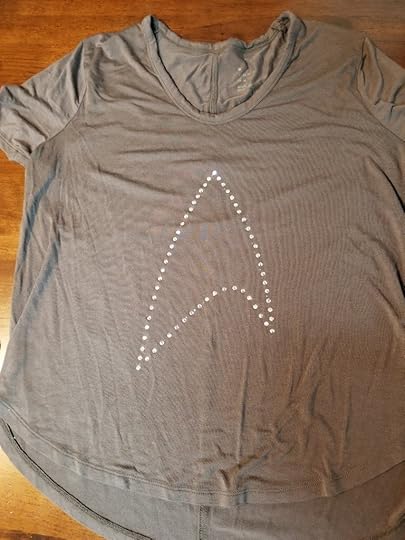 Star Trek delta, rhinestones are single color, single size
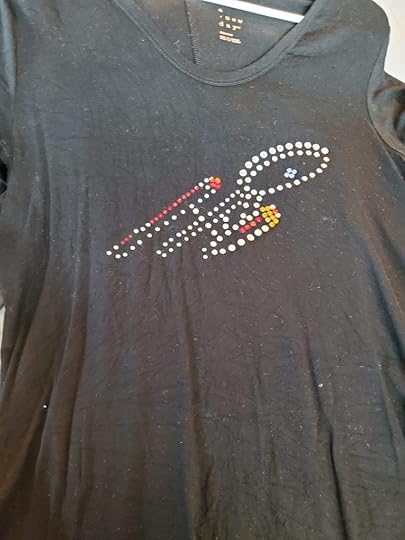 Enterprise. I eyeballed the colors.
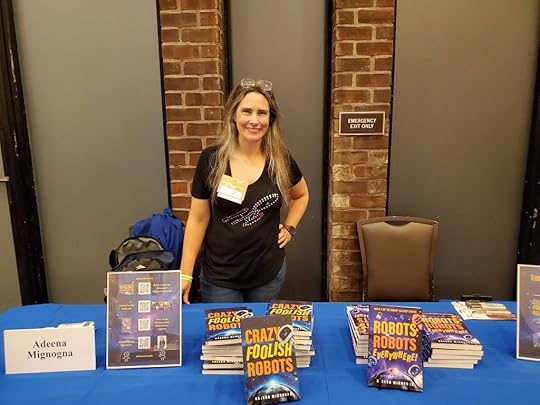 Me sporting the Enterprise shirt at an event
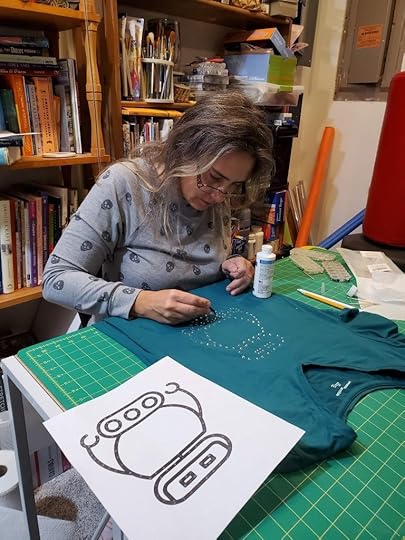 Me working on gluing rhinestones for the robot shirt
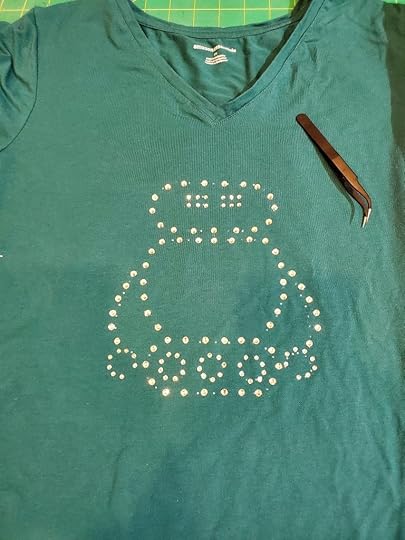 The robot shirt. I choose all the same color, but there are at least 2 different sizes
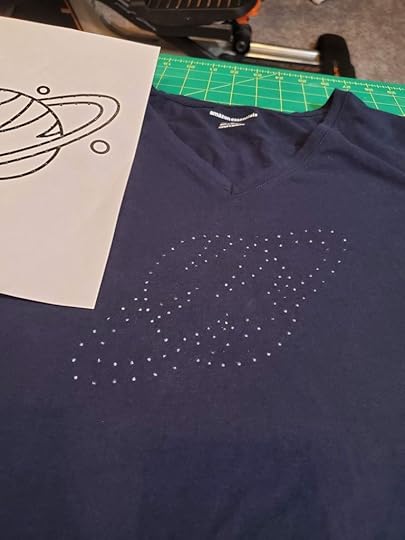 Ringed planet showing the white fabric pencil dots where I’m going to glue rhinestones
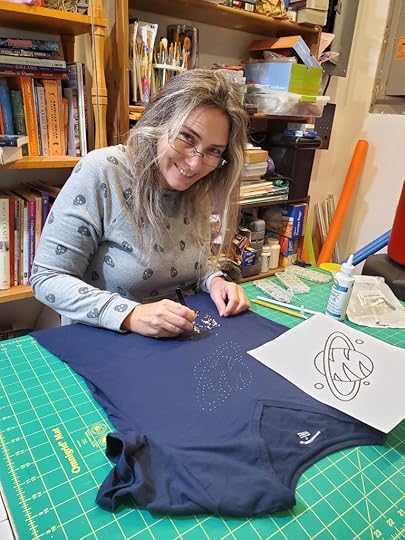 Me looking up from gluing rhinesones
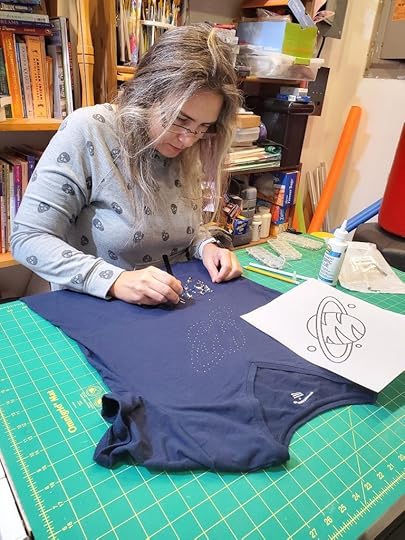 Me gluing rhinestones. For the ringed planet shirt, I choose different colors, but all the same size
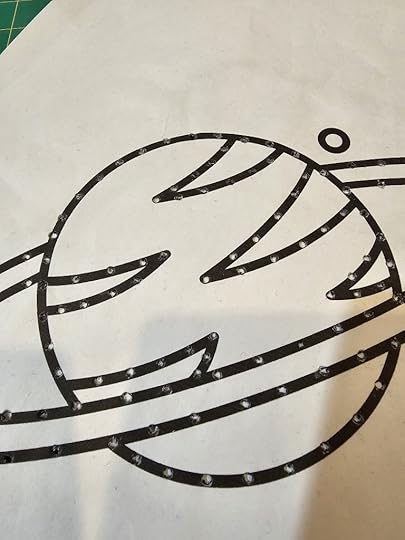 Showing the line art with holes poked in them. I eyeball this.


July 18, 2023
Star Trek Quotes To Get You Through Your Work Day – Their List vs Mine
A few times on the interwebs, I’ve seen something titled, “10 Star Trek quotes to get you through your work day.” But recently, when I came across this particular list:
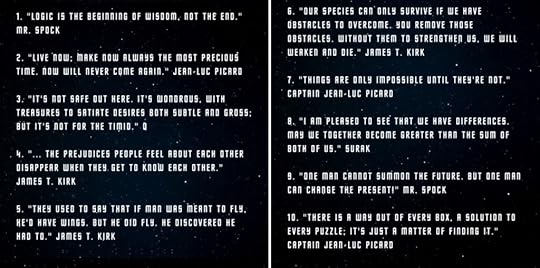
…and felt I needed to comment on them. Do they actually help me get through my workday? (I initially posted these, one a day, on LinkedIn, but felt the need to re-post here.)
If you don’t already know, I’m a huge Trekkie. Trek is responsible for my love of space exploration and desire to work in the aerospace industry. So I’m wondering if the quotes that others have put forth… to “get you through your work day” makes sense.
Starting today and for the next 10 days, I’m going to take one a day and see they really having meaning or applicability at work.
1. “Logic is the beginning of wisdom, not the end.”
~Spock (From the movie STVI:The Undiscovered Country)
In present day, engineers aren’t taught logic explicitly — not the way philosophers were. I believe when Spock talks about logic (as he did in this quote from the movie STVI:The Undiscovered Country), he’s talking about philosophy.
However, I think the sentiment still applies to engineering and any career field. Spock is trying to tell his mentee to have a more open mind and YES — that’s 100% necessary in engineering.
Thumbs up to this quote helping me get through the workday.
2. “Live now. Make now always the most precious time. Now will never come again.”
~Picard (From the TNG episode “Inner Light”)
While this quote is more about life in general, and possibly life outside the office, appreciating what you have in the moment at work can make some sense, too
People think that engineering is all about the application of science and the resulting technology. While that’s a big part of it, engineering is equal parts project management, which includes cost and schedule management.
So, maybe this quote is about schedule management and some zen surrounding it (if we apply it to work).
Or, maybe it’s for those moments when we get stressed out and wonder if we should be looking for another job. The grass is always greener and all.
Yeah, I’m going with one of those.
So while I love the quote and love the episode it came from, this one is probably not one on the top of my own list to get me through the work day, but I’d use it on a list for getting through life in general.
3. “It’s not safe out here. It’s wonderous, with treasures to satiate desires both subtle and gross, but it’s not for the timid.”
~Q (From the TNG episode “Q Who?”)
I’m going with the direct applicability to the fact that human spaceflight is still a dangerous and risky venture. Many of us, even if unawares, have lived through a launch or spacecraft failure (or two or three or four). It is not the safest way to fly.
Not yet.
But, the rewards will be immeasurable.
So yeah… completely applicable, at least to my career in aerospace!!
4. “… the prejudices people feel about each other disappear when they get to know each other.”
~Kirk (TOS episode “Elaan of Troyius”)
A clearer diversity and inclusion statement there is not!
And D&I belongs in any and all workplaces, not just engineering — although as someone who has spent most of my career as the only STEM woman in the room, we still have a long way to go in STEM, although I’ve seen great improvements in the last few years.
I’m almost never the only woman in the room, but minorities are still woefully under represented.
So a good quote for any situation needing some D&I… which is essentially anywhere and everywhere.
5. “They used to say that if man was meant to fly, he’d have wings. But he did fly. He discovered he had to.”
~Kirk (From TOS episode “Return to Tomorrow”)
…and then we went to space.
Though obviously related, taken out of context of Kirk’s longer speech, it loses something.
Because shortly after he utters this, he also says “risk is our business.” That couldn’t be more true about aerospace (if not other domains). We’re pushing the envelope and doing new and potentially dangerous things. So this goes along with the quote from Q from Day 3 where we were reminded just how dangerous space exploration can be.
Thumbs up to the quote and completely relevant (in context).
6 .”Our species can only survive if we have obstacles to overcome. You remove those obstacles, without them to strengthen us, we will weaken and die.”
~Kirk (From the TOS episode, “Metamorphosis”)
This is really interesting if you pull it apart because it seems to be the opposite of something Jean-Luc Picard said a couple of decades later in ST:TNG.
Picard said, “we work to better ourselves and the rest of humanity.” Of course, he said that immediately after stating, “the acquisition of wealth is no longer the driving force of our lives” which is not the kind of obstacles Kirk was referring to. Or was it? I mean, most of us endure hardships at a job, to acquire wealth for our basic needs. Somewhere between Kirk’s time and Picard’s time (or maybe it started before Picard’s time… I think there’s some debate on that matter… humanity moved into what is called a “post-scarcity society.” One where everyone’s basic needs of food, shelter, medical care have been met.
There’s been a few books written on that topic, by the way. (And I wrote a semi-related blog post… link in the comments… too)
Anyhoo… back to the original quote and figuring out if it’s related to my day job. I’m going to say yes. Engineering is inherently all about problem solving — which could be another way of saying that it’s about overcoming obstacles. Thumbs up to this quote as one that gets me through my work day!
7. “Things are only impossible until they’re not.”
~Picard (From the TNG episode, “When the Bough Breaks”)
Perfect for engineering! Seriously. This should be the motto of engineering. Remember that as an engineer in the aerospace industry, that’s the lens I’m using to evaluate these quotes, and this couldn’t be more perfect.
Did I say it was perfect? Engineering is problem solving. What once was impossible is now possible. I use a lot of modern technology as an illustration. Can you imagine telling someone 200 years ago that there was a way to instantly communicate with someone on the other side of the planet, not to mention the next town over? You’d be tried as a witch! Okay, maybe the witch thing was done 200 years ago, but you’d certainly be known as the town kook.
It’s similar to the quote from Arthur C. Clarke that’s often cited: “Any sufficiently advanced technology is indistinguishable from magic.”
So big thumbs up to this one getting me through my day — and any rough spots in that day!
8. “I am pleased to see that we have differences. May we together become greater than the sum of both of us.”
~Surak (From the TOS episode “The Savage Curtain”)
And IDIC was born.
Hopefully, if you’re a Trekkie, you already know what IDIC is.
If you’re not, IDIC is a Star Trek term that means “Infinite Diversity in Infinite Combinations.”
And before you ask, “wait…. Surak? Who’s that? Did you just typo ‘Sarek’, the name of Spock’s father?”
Nope, I did not typo that. In Trek lore, Surak was the ‘father’ of modern Vulcan philosophy. We were introduced to him in this original series episode, “The Savage Curtain,” and then didn’t really hear about him much until the Enterprise series. (Yes, there were mentions…) Surak and IDIC were mentioned every now and then, or you could spot the symbol (like in Spock’s quarters in “Star Trek II: The Wrath of Khan” on the wall behind Spock and Kirk when he expresses to Kirk that he will always be his friend…).
I’m getting off track. This is another fantastic quote for diversity and inclusion. This could even be any D&I initiative’s motto (but I’m pretty sure the Trek franchise has it trademarked).
So thumbs up to not only getting me through the workday, but any day, any time, any month/year/etc.
9. “One man cannot summon the future.”
~Spock
“But one man can change the present!”
~Kirk (From the TOS episode “Mirror, Mirror”)
First, of course, today we’re easily accepting that “one man” equals “one person.” (Honestly, I don’t worry or get upset at the use of language like that. Especially when evaluating an almost 60-year-old TV show. It’s the sentiment that counts. It’s wasted energy to get upset at those little details…)
Of course, Kirk was encouraging Spock to start a revolution and change the course of his whole universe. That’s a big ask.
Bringing it a little more down-to-Earth (pun-ish intended; I always intend my puns), and bringing it into an engineering workplace, it could mean:
point out the issues, find solutions, be bold with your ideas.
Definitely applicable to my day job and probably yours, too.
10. “There’s a way out of every box. A solution to every puzzle. It’s just a matter of finding it.”
~Picard (From the TNG episode “Attached”)
Maybe Picard was more engineer than we give him credit for? We know he’s somewhat of a scientist. That seems almost normal when we think of some of the starship captains (like Janeway).
But anyhoo, solving problems is what engineers do. That could even be a definition of engineering.
So not only is this quote applicable and one we might want to put on a little sticky note by our monitor, it’s a good one to end our 10 days of diving into each of these quotes on. If you read my little bits on this each day, thanks for sticking with me on it.
Now, here are my top 10 Star Trek quotes that relate to work. They are presented in no particular order and without commentary at this time. And yes, at least one overlaps with the above.
1. “Ye dinna tell him how long it would really take!”
~ Scotty
(Star Trek: The Next Generation — “Relics”)
2. “There are times, sir, when men of good conscience cannot blindly follow orders.”
~Picard
(Star Trek: The Next Generation — “The Offspring”)
This is about thinking outside the box.
3. “Change always comes later than we think it should.”
~Picard
(Star Trek: Picard — “Watcher”)
4. “Things are only impossible until they are not.”
~Picard
(Star Trek: The Next Generation — “When the Bough Breaks”)
5. “To say you have no choice is a failure of imagination.”
~Picard
(Star Trek: Picard — “Et in Arcadia Ego, Part 2”)
6. Mr. Scott. Have you always multiplied your repair estimates by a factor of four?”
~Kirk
“Certainly, sir. How else can I keep my reputation as a miracle worker?”
~Scotty
(Star Trek III: The Search for Spock)
7. “I realize that command does have its fascination, even under circumstances such as these, but I neither enjoy the idea of command nor am I frightened of it. It simply exists, and I will do whatever logically needs to be done. ”
~ Spock
(Star Trek: The Original Series Episode — “The Galileo Seven”)
8. “If we’re going to be damned, let’s be damned for what we really are.”
~ Picard
(Star Trek: The Next Generation — “Encounter At Farpoint”)
9. Every choice we make allows us to manipulate the future… A person’s life, their future, hinges on each of a thousand choices. Living is making choices.”
~Picard
(Star Trek: The Next Generation — “A Matter of Time”)
10. “It is possible to commit no mistakes and still lose. That is not weakness, that is life.”
~Picard
(Star Trek: The Next Generation — “Peak Performance”)
June 9, 2023
A Gift to My Writerly Brethren: An Exploration of Process and Tools
This post will always be in a state of incompleteness. I’ll do my best to keep it updated. It is so incomplete that today, June 9th, 2023, I thought I had posted this two years ago and found it sitting in my “drafts” section of my blog admin panel. I was thinking about it because I’m in the process of planning to take my books “wide” and figured I would do an update… only to find I hadn’t released the first version of this. lol
I am an Indie Author and most of what’s contained within is more relevant to Indie’s vs traditionally published authors. The stuff that’s the same is: writing a good book.
After that, for us Indie’s we have A LOT of work ahead of us… we’re not just author’s but project/business managers and that’s not for everyone.
As a project manager for our books, in addition to writing it we have to:
figure out the best path for a quality coverhire one or more editorsmarket, market, marketmarket some morewrite the next book (while marketing the first one)Since beginning my journey as an Indie author, starting with the pre-marketing phase where I tried hard to engage in social media in advance of the release of “Crazy Foolish Robots” (Book 1 in The Robot Galaxy Series), I’d noticed that a lot of writers tended to develop a platform around helping other writers with their craft and all aspects of being an Indie Author.
While I want to help, too, I don’t think I know enough or have the—something—to make a whole platform of it. Instead, I’m dolling out my advice within a few blog posts.
I’m more than happy to provide insight into my process and tools, and describe what worked and what didn’t, hoping this information is helpful to someone else. Please leave notes in the comments and let me know what you think!
I’m started drafting this post in mid/late May 2021. It’s while “Crazy Foolish Robots” (CFR) was in the final stages of editing with a planned release of late June 2021. While CFR was with my editor, I was working on drafting book 2 in the series “Robots, Robots Everywhere!” While I also write short stories, my focus for these posts are the novels that I’ve planned, are in work, and want to write.
Many people who are starting out on their writing journey might be inclined to ask questions that begin: “Can I…?” or “Should I…?” Let me tell you right now that WWFMMNWFY and most answers do these questions will be found within your own journey. You probably can *try* anything. And whether or not you *should* will often come down to your own financial situation (i.e., “should I buy X?” “should I pay for this class?” etc).
I find that most of the “Can I?” or “Should I?” questions are born of people looking for the quickest path to success. Just remember: TANSTAAFL
All links are provided for convenience. None are affiliate links.
General Writing:Studying the craftI think the best way to learn the craft of writing is to write. And read. And let others read your writing and absorb feedback. Over the years I’ve taken a couple of writer’s critique classes at my local community college and I take part in a local writing group where we take turns critiquing each other’s work.
Besides that, I’ve read a lot of books on the craft of writing. This is a list of some of my favorites.
The Emotional Thesaurus. It was the Best of Sentences; It was the Worst of SentencesSeveral of the writing books by Chuck WendigWriting books by James Scott BellScience Fiction Genre SpecificI study science fiction by reading a lot of science fiction authors I like. Early on, I read “How to Write Science Fiction” by Orson Scott Card.
More about the craft of writing in this post: You Can Write, Too! (Adeena’s Tips, Advice, and Fave Books on the Writing Craft)
Tools I Use: For Writing and Drafting.(Note: I’m a PC, not a Mac, so I don’t have any Mac-specific software and some of my tools could be PC-specific. Sorry, not sorry. I am what I am.)
For a very long time, I simply used Microsoft Word. When Google Docs became a thing, I started using that too. (And I still use that as one way to share my work with critique partners and some of my most trusted beta readers, although I have ONLY used it to share with people I know in real life.)
Two problems:
#1) What do I use when I’m away from my computer?
#2) And how do I keep track of longer works?
Google docs sort of answers the mail for #1, but it eh – something about it always bothered me.
Enter Evernote. I’ve been using Evernote for more than a decade and these days, it’s where I start all my drafts for short stories, blogs, and take notes. (Even on my desktop – I drafted this blog post in Evernote) I’ve tried a lot of other apps, but Evernote has consistently worked the best for me to have seemless integration between my mobile devices and my PC. (I use Evernote for a lot of things besides writing… I use it for many notes, for my recipes, etc.)
For the longest time, I was only interested in writing short stories, so Word was sufficient. Once I got serious about writing novels and novellas—well, it just wasn’t working for me anymore. So, I joined the Scrivener community and am pretty happy I did. I love having my outline handy, I sort-of love the corkboard, I love having metadata per scene, including custom metadata. For my current works, I created the following custom metadata tags that I can see in the outline view and it’s very helpful to keep track of what I’m writing:
Who: who is in the scene
Where: where is the scene taking place
POV: POV character of the scene
I also like how Scrivener breaks down my word count per everything, plus keeps track of my writing history.
I haven’t fully explored all the features of Scrivener — and lately I’ve been struggling with the compile options. All in good time…
Yes, I pay for Evernote, and yes I pay for Scrivener. And it’s not lost on me that the way I use Scrivener, I could use Evernote. (I could make a notebook for the book, and each note could be a scene, and I can have tags that represent my metadata… I could also create a note that is the outline note lined to the other notes.)
Everything above was from 2021. It’s 2023. EverNote is still one of my top key and fave tools, especially for organizing my notes (although I have also been experimenting and using Obsidian). I still use Scrivener, although something about it bothers me… I think it’s because it’s not entirely seemless between devices. I’ve also purchased Plottr, but haven’t used it as much as I plan to use it for future works. Plottr is meant for outlines, and as an imperfect outliner, in theory, it’s more than I need, but might be exactly what I should use.
For Worldbuilding.Again, when I was working on short stories, I wasn’t overly concerned with this.
I’ve tried several tools, but the two that are working for me right now are Aeon for timelines; Mindmaping tools for the rest of the world. Specifically, I’m using miMind, because I can save to Google docs and see/edit on my mobile device – although I rarely do. For my PC, I actually like Freemind better.
That was 2021. In 2023, Mindmapping was getting cumbersome. I’m now using a wiki-like tool called Confluence by Atlassian. I don’t necessarily recommend it to everyone. The reason I chose this is more because I also use it for wiki-like content at work, so I was already VERY familiar with the ins and outs and limitations. I looked into a few different wikis-for-personal-use tools and there are a lot out there.
For Editing.Books, advice from other authors, these steps, and ProWritingAid.
Under a pen name, I had self-published some works. At the time, spending as little as possible was the goal, so I made my own covers, and did as much editing as I could myself with some help from friends who have the right skills and were willing to take a run through.
I am currently working with a copy editor who I’m paying and will likely only do that in the future. Especially this one. She brings a lot of skill to the table and gets my work. Totally worth it.
I wrote the above in 2021. It’s 2023 and I’m still using a combo of ProWritingAid and the same editor who continues to be super awesome.
For Self-Publishing.For “Crazy Foolish Robots” I’ve chosen to focus on Amazon’s KDP Select. I plan on putting out a Kindle eBook and paperback.
Originally, I was going to make my own cover, but eventually convinced myself that hiring a professional was best.
As of right now, I am planning on doing all the book formatting on my own and I’ll be doing it in Word. I feel comfortable enough following KDPs guidelines and feel like I understand what I’m doing, why, and how.
That was 2021. It’s 2023 and all 4 books of The Robot Galaxy Series are on Amazon in both paperback and Kindle versions. I used ebooklaunch.com for all the covers and plan to continue to use them since I’m super happy with their work.
But I’m also planning to take my books “wide.” Meaning, they’ll eventually be on more platforms that just Amazon. The background and decision making here might be worthy of its own post once I’m further along that process.
Social Media, Marketing, and AdvertisingI’ve done the social media thing for a while, but more for personal stuff. At this point, I’ve mostly commandeered my social media-ing for connecting to readers and to do things that will help market me as a writer.
I’m on Twitter, Facebook, Goodreads, and this blog.
While I’ve had an Instagram account, I only started using it for this purpose this past week. I don’t think I’m really ready for this. While I know a lot of folks think Twitter is currently a pretty toxic place, I’ve been able to ignore that and focus on the other like-minded people who treat others respectfully and are just there to get their books out, their science out, etc.
Twitter to me is like if you have text you want to write, and maybe include a picture. Instagram to me is like if you have a picture you want to share, and maybe include some text. I think those of us with analytical leanings (like myself) are more comfortable with Twitter.
Oh, and there’s LinkedIn. It’s related but different. Ideally, I want my professional worlds to collide, so they do a little. In fact, I just posted a roll-up post on this blog of all my current LinkedIn articles.
I’ve read/watched other writers who know more about marketing than I say you need to have a YouTube channel, and that you need Instagram and you need to be using Pinterest. I don’t think that’s true. If it’s so overwhelming that it’s sucking the joy out of my life, then I don’t need it and right now, I have all the social media I can handle. Now, also know that my primary income is a 9-5 office day-job, so I’m not earning my full living as a writer. If I was, I might have a different opinion on doing more on more social media platforms – I’d be more motivated.
I created a low-volume email newsletter using MailChimp. Low-volume means that I only send one or two out a month. At most.
I am looking for ARC reviews of “Crazy Foolish Robot.” I plan to use StoryOrigin to deliver ebook versions to anyone who wants to ARC review.
I’ll have more to say about advertising at a later time…
That was all 2021 and it’s now later… 2023… and I have a few things to say.
First, we all know the hubabaloo that happened with Twitter this last year. I’m still on it, though. Is it helping me with book sales? Probably not. But it’s helping me engage with people, and that’s cool.
I switched from MailChimp to MailerLite and am happy with that decision. Growing the email newsletter has been my focus and while I went into this not excited about email newsletters… it’s one of my fave things to write every other week! (BTW, you can sign up for that newsletter here and get some FREE short fiction for doing so: https://adeenamignogna.com/signup/ )
One of the pieces of advice that I’ve taken to heart is to focus on 2 SM platforms (3 at most). Get good at those. So for me that’s Facebook, LinkedIn, and Twitter. I just can’t get the hang of Instagram. I’m on more places, (like Mastadon), but I don’t have the mental bandwidth to deal with more.
I’m also running ads on FB and Amazon and have done promos with BarginBooksey, Goodreads Giveaways and more. Again, maybe worthy of its own post.
Other:I’d like to give a shout out to coffee and all the other beverages I enjoy while writing. But mostly coffee. Dark, black, coffee.
Specific Projects:Ruby & Robots Series (I don’t have an official title for the series… yet!)“Crazy Foolish Robots” – novel 1 of 4“Robots, Robots Everywhere” (working title) – novel 2 of 4 Title TBD – novel 3 of 4Title TBD – novel 4 of 4“With the Moon as My Witness” – a novelWow. I wrote that list in 2021, too. It’s before I even knew all about what is now my existing series! Here’s what the current list looks like:
COMPLETE:The Robot Galaxy SeriesBook 1 – Crazy Foolish RobotsBook 2 – Robots, Robots Everywhere!Book 3 – Silly Insane HumansBook 4 – Eleven Little RobotsWIPSLunar Logic4 more books in the Robot Galaxy Universe (not a series, per se…)a series of 4 books in The Robot Galaxy Universean independent series where The Office meets Utopia Planetia (not the real name of the location in my books)May 3, 2023
You Don’t Need a Fancy Degree to Understand Modern AI
With everything going on in the world of AI computing lately, and people panicking about AI, it’s important that people understand the basics.
(Note: I will likely update this post from time to time depending on questions I get.)
We fear what we don’t understand. The best way to overcome that is with a little knowledge.
And no, it doesn’t mean we should we should willy-nilly accept this (or any) technology into our lives. Like everything, it has its caveats. It has things it’s good at, and things it’s bad at.
A car is a mode of transportation. That doesn’t mean it works will in all situations. In fact, if you use it in the wrong situation, it could get you killed. i.e., try driving it into the ocean to get to another continent…
So as to with AI, we have to understand it and its limitations.
Start here, with some common terminology that’s popping up all over the place:
Artificial Intelligence
First, let’s talk about the term “AI.” AI stands for “artificial intelligence.” IMHO, that’s 80% of the problem right there. It’s a misnomer. We gave the domain the name “intelligence” before proving that we know how to prove something is in fact intelligence. And what kind of intelligence, anyway? We all know now that human intelligence comes in different forms… so why this one blob of a term to describe anything that happens in computing that reeks of mimicking the human brain? But I digress. I’m not going to change that, but I would if I could. (If I could, I think I’d call it something like ‘computational mimicry.’ Spoiler alert: one of the characters in The Robot Galaxy Series also takes issue with the term ‘artificial intelligence,’ but you have to read through to Book 3 to get there.)
LLM or Large Langauge Model
This is a type of AI algorithm. It create one, you start with a lot of text. (And when I say a lot, I mean, A LOT, like the entirely of Wikipedia a lot) Then you “train” it with other techniques that are part of the “deep learning” suite of methods in AI. Once the model exists, you can do a variety of things with it like translate text, answer questions, summarize text and more.
The simplest way to describe the training is that it’s looking for connections and patterns of words and phrases.
“GPT” (Generative Pre-trained Transformer) is one kind of LLM.
Go deeper: https://vitalflux.com/large-language-models-concepts-examples/Generative AI
This is a very broad term. It’s used to describe any system or tool that can create new text, code, images, video, etc. ChatGPT is a generative AI system. Many tools that offer to autocomplete or rephrase your text are also generative AI systems.
Natural Language Processing (NLP)
NLP is one of the subfields of AI in Computer Science that specifically deals with how computer programs process and analyze human language. Even though a lot of people are hearing this term for the first time lately, it’s been around for decades.
Token
I’ve included this because many articles on LLMs inevitably mention things like “training on a X million tokens” or something like that. A token is a piece of text. It can be a word, subword, character, or even punctuation marks. One of the first things people learn to do when they’re getting involved with NLP is to learn to “tokenize” a body of text.
Transformer
Here, we don’t mean the electrical type, but I think the term came about because it is an analogy to that. In NLP, you’ll see the term “transformer” and “transformer model” used interchangeably. It’s based on neural networks (explained below) and it’s essentially the algorithm that takes your input and produces your output.
Neural network (NN)
Sometimes you’ll see the term “ANN” which stands for “Artificial Neural Network.” It’s another algorithm type, one that is inspired by biological neural networks in our brains. It’s a way to teach computers to process information, and usually falls under the heading of “machine learning” along with many other ML algorithms.
And for those of you who are true computer novices, here are a few others:
GPU: Graphical Processing Unit
Hopefully, you’ve at least heard of “CPU” (Central Processing Unit). A GPU is the same thing conceptually, but faster. The “G” stands for “Graphics” and GPUs were initially developed to speed up graphics rendering. But the key is that a GPU can process data faster than a CPU.
API: Application Programming Interface
Let’s simplify for a second and just call it an “interface” and mention that an “interface” is exactly what it sounds like: how you use a computer or computer program. Add in the “Application Programming” part and now we’re talking about a specific way to interface with a computer program and is usually used to describe how one computer program interacts with another. The API usually specifies what and how Program A supplies data to Program B and vice versa.
You might also want to read the other blog posts I’ve written that relate to AI: https://adeenamignogna.com/tag/ai/
April 14, 2023
May the Harmony of Numbers Guide Your Journey
This is Hugh Howey’s fault. (Okay, not really, but that was a fun way to start a blog post.)
[Interlude 1: If you already know who Hugh Howey is, then cool. If you’re a sci-fi fan and don’t know about him yet, let me catch you up with the short version: he wrote this wonderful series called ‘Silo’ starting with book 1, Wool, as an Indie Author. I read it several years ago, and it’s awesome. And it’s just been turned into an AppleTV show that we’ll all get the pleasure of watching soon. In the meantime, watch the trailer. It looks fabulous!]
I follow him on Twitter, and like a lot of people, he’s been tweeting quite a bit about ChatGPT. A week or so ago, he posted about how he asked ChatGPT to create a religion and it was interesting. It sounded nice. One of the holidays really caught my fancy. It was called a “Day of Whimsy” and it sounded so cool and so much less problematic than other holidays…
[Interlude 2: Here’s the deets on my religious background, which is important to how I got here. I come from a mixed family. My father’s side of the family is Roman Catholic. Not surprising if you see notice my uber-Italian last name. My mother’s side of the family is Jewish (and according to DNA tests, I’m more like 75% Jew… there’s another story in there about my dad’s mom, but that’s for another day). Not wanting to raise me and my younger brother in either faith, my parents found the Unitarian Universalists and so from the age of 8, I could stop telling people I’m half-Jewish/half-Catholic, which seemed to break everyone’s brain (“You can’t be half and half! You must be one or the other!” — also another story for another day) and tell them I was part of this obscure thing they’ve never heard of. It required additional explanation, but people seem to have an easier time of accepting I’m part of something they’ve never heard of, rather than accept I belong to these two other worlds.
Anyhoo… I went through all the rituals of UUism, and if I have to claim I belong to one particular religion, I do claim it although I haven’t stepped into a house of worship is a bazillion years because leaving the house on Sunday morning isn’t something I want to do. You’ll also here me tell people I’m an “Italian-Jew” but that’s more from the cultural/DNA side than anything religious.]
Hugh’s ChatGPT religion is called “Harmonism” and I like a lot of the things about it, but not everything. So, it started the wheels turning: why not make my own? And really make it my own? Tweak it until it perfectly represents all the things I would wish for in a “religion.”
So I did. Here was the initial prompt I gave ChatGPT:
“Let’s develop a new religion that draws from your knowledge of all the world’s religions and schools of thought and philosophy. Please start with a central belief system that combines science, stocism, hope, logic, math, semantics, and treating everyone well. Make use of the golden rule. Also make use of the Star Trek philosophy of Infinite Diversity in Infinite Combinations (IDIC). Assume that participants love color and whimsy in their lives. Also include the fact that this religion doesn’t preclude belonging to any other. This religion should be hopeful for the future and help people not be fearful of the world or each other.
List seven founding commandments for this fictional religion.
Come up with a name for this new religion and define 2 major holidays and 3 minor holidays. Also add a daily greeting or affirmation and add sayings for each of the major holidays. Feel free to add any other customs or practices. Food should play a big part in all the holidays and customs, especially fruit.”
Now, I’m going to spare you all the iterations we went through from there. I was incredibly disappointed with the initial results. It was little more than a parrot back of my input, but structured in the form I asked for. You might have already come across the term “prompt engineering.” Well, yes, learning how to create the best input to get the best output is going to be an important skill to cultivate. That shouldn’t be a surprise. New technology often means we need to learn new skills. Typing. Driving a car. Heck, riding a horse.
So it is completely reasonable that learning how to best structure a natural language input to get the most meaningful output will be a thing someday soon. Very soon.
But getting back to the results. I wasn’t happy. I walked away from the computer for a bit, leaving my ChatGPT window open and throughout the next couple of days, came back to it periodically to ask it to revise bits and pieces here and there until ultimately I was happy-ish enough to take it off ChatGPT and continue tweaking it on my own.
I’m not going to present all the back and forth. Honestly, it’s boring. It’s tedium. Seeing the sausage made isn’t nearly as awesome as eating the sausage… if you like that kind of thing. I’m mostly vegetarian, so maybe I should talk about making a good loaf of bread instead.
Throughout this process, I’ve been struggling with the definitions and difference between a “religion” and a “philosophy” or “religion” and “belief system.” What I’ve created might be more of a belief system that is not entirely a religion. There are holidays, prayers, and even a leadership/scholarship structure. But there’s no house of worship. No dictum that we must gather and practice Harmonumerics collectively, although nothing precludes having group celebrations or study sessions and so forth.
There’s also no deity in what I created. Although again, nothing precludes the idea that there are one or more deities in the Universe.
Maybe calling this a “belief system” is most appropriate.
But what I’ve created represents a lot of the philosophies I’ve always embraced: IDIC from Star Trek; the Golden Rule from UUism (and every other religion on the planet which has a version); stoicism (although I’ve never been able or willing to fully embrace stoicism because of their ‘eat to live, not live to eat’ philosophy — I like good food too much); and more.
So, after all that, I claim that this is something I created, using an AI tool to help along the way. Not the other way around.
Sci-fi writers aren’t shy when it comes to writing about religion, and Hugh and I aren’t the first sci-fi writers to embark on potentially starting a religion, although I don’t know if he has any plans to go beyond his blog post. But I’ll tell you that we are not the first sci-fi writers to actually start a religion.
The most well-known of the made-up-by-sci-fi religions is Scientology. L. Ron Hubbard was the sci-fi writer who pulled it off (although he wrote more broadly than just sci-fi, but I think sci-fi was paying his bills for a while). Scientology has fascinated me since I learned what it was. Not Scientology per se as a religion, but that it was created by a sci-fi writer. As an 80s kid in NY, I was bombarded by commercials for the book Dianetics. I didn’t know what it was, although I retained a clear memory of the commercial itself and always thought it strange that there was an overabundance of commercials for this one book.
A copy of Dianetics found its way to me in 1985 when my grandmother passed away. It was in a pile of her paperbacks that I inherited and took home and read (there were several Agatha Cristie novels too, and some books of “real” ghost stories in her collection, too, that I inherited and read).
[Interlude 3: OMG because everything really is on the internet, so is that commercial. It was the erupting volcano at the end that always stuck with me. ]
I don’t know when exactly I made the Dianetics < – > L. Ron Hubbard < – > Scientology connection, just that it happened maybe sometime in the late 80s/early 80s. A sci-fi writer started a major religion. A sci-fi writer. (Other sci-fi writers have inspired new religions. The Church of All Worlds, a recognized religion, is modeled after the organization of the same name in Robert Heinlein’s Stranger in a Strange Land)
I’m a sci-fi writer, too (although not as far along in my writing career as any of the others I’ve mentioned so far). But I love math and numbers and the Universe and such. I love creativity and having fun with language and writing and math. What better way to indulge all of this than to take what I started with ChatGPT a few steps further…?
What does “a few steps further” mean? It means I set up a website for Harmonumerics and even had a symbol/logo created. Yes. Yes, I did.
I imagine people are going to ask me whether or not this is a joke or if it’s real. I think my answer is going to be: Does it matter? (Although it probably matters if you’re worried if I’m destined to attempt a coup to try to take over your home town — I assure you I’m not; Nor are any aliens or other real or imagined beings speaking to me or through me — I’m 98% sure about that one. And if the Church of the Flying Spaghetti Monster can make it as a legit religion, then surely Harmonumerics has a shot! )
You’re welcome to come explore Harmonumerics for yourself!
(PS, yeah there’s even a Harmonumerics twitter account… )
April 12, 2023
Trekonomics *IS* the Case for Nukes
If you’ve been following real-world space exploration for a few decades, you might know of Robert Zubrin, who established The Mars Society back in 1998 after the success of his book, The Case for Mars.
Well, when I saw Zubrin was offering signed advanced reader copies of his upcoming book, The Case for Nukes, I was intrigued. First, before I go any further, know that the “nukes” Zubrin is making a case for is not weapons, but power. The subtitle says it all: “How We Can Beat Global Warming and Create a Free, Open, and Magnificent Future.”
“Free, Open, and Magnificent Future.” Sound familiar? Any of my fellow Trekkies get a chill up their spine?
Of course, I grabbed a copy of the book. Now, you should know that I am and have always been for the concept of nuclear energy as a power source. This is my dad’s fault. He supported the concept of nuclear energy and, as a metallurgist/structural engineer, explained to me at a young age all about how and why the safety of nuclear power plants was possible, but people were simply fearful. This was, after all, the 1980s and I was living with my family on Long Island. Home to the Shoreham Nuclear Power Plant which was the source of a lot of “current events” reports I wrote when I was in middle school. (Like, remember when we had a current events assignment, and we had to cut out an article from a real, print newspaper, and then write about it?)
Construction began on the Shoreham plant in 1972, but faced a lot of issues beginning in 1979 after the Three Mile Island Accident. An accident that resulted in no injuries and no loss of life. Was radiation released? Yep. How much? Best estimates seem to be that individuals nearby were exposed to less than half a dose of a standard medical x-ray.
Zubrin talks about this and the other few disasters (that occurred outside the U.S.), and the damage comparison between these and fossil-fuel burning power plants. While fossil-fuel plants have gotten better over the years — they certainly release less stuff into the air and water than they once did, If it were up to me, as a “practical environmentalist” I’d convert everything to nuclear in a second (again, I was already pre-disposed to this point of view).
Let’s move on to Trek. Back in 1986, in Star Trek IV:The One With the Whales, uh, I mean, Star Trek IV:The Voyage Home (my favorite Trek movie of all of them), Kirk claimed they don’t use money in the future.
Since that one little comment, the franchise has done everything to back-up that statement, to include stating that certain phrases regarding money (“I sold my first book today!” and “It’s above my pay-grade” and “You just earned your pay for the week“) were “just a figure of speech.” Although, there are “Federation credits” (TNG, “The Price”), and Starfleet officers go shopping (TNG, “Encounter at Farpoint”), and Starfleet officers even have value (“Do you know how much Starfleet has invested in you?” Kirk said to Spock in the TOS episode, “The Apple”).
Us in fandom have been left to make sense of it all. And try to make sense of it folks did. There are at least two books out there on the topic. One, “Trekonomics” by Manu Saadia and the other “The Economics of Star Trek” by Rick Webb. If you’re short on time, I recommend reading the latter. It’s more concise, having sprung from a Medium article several years ago.
Whether or not you believe that a future can exist without money is one thing. (FWIW, I don’t and I like Webb’s idea that it’s not that there is no money necessarily, but it’s more like an evolution of digital crypto and people don’t have to think about it like do because of the second thing… “post-scarcity.”) The Federation (at least the primary worlds like Earth, Vulcan, etc) is certainly and evidently a “post-scarcity” economy.
What is a “post-scarcity” economy? (Or “proto-post-scarcity” as Webb puts it — which I like better) It’s an economic solution, right now a theoretical one, where “most goods can be produced in great abundance with minimal human labor needed, so that they become available to all very cheaply or even freely.” We’re talking about food, clothing, stuff to house people… you know, things that can help eliminate poverty, homelessness, etc.
Sound a little like a Trek future?
Sound like the future we want when we in fandom talk about striving towards a Trek future? (Other than people simply accepting each other for who they are and stuff.)
Well, all the automation and “minimal human labor” is lovely, but there’s still one piece of the puzzle we’d be missing. Energy. Energy is needed to produce anything and everything. And that energy needs to be inexpensive and available to all. Expensive, dirty energy is not going to make that happen. But what about wind and solar? you ask. They’re lovely, but expensive and unreliable. Hence, they might exist in a Trek future, but there is no way they can be the primary power source. Not while meeting our increasing energy needs.
So let’s circle back to Zubrin and his book. He’s telling us exactly where we can get that energy. He even has a whole chapter dedicated to explaining how cheap and abundant energy lifts everyone up. “If you have access to energy, and the things made by energy, you are rich. If not, you are poor,” says Zubrin on page 6.
In fact, Chapters 2 and 3 make the case for Nukes. Most of the rest of the book is more of the technical and scientific information. It’s all the physics and engineering that has the potential to bore anyone not deeply interested in science. So, if you’re not all that interested in taking a physics class, you can then skip to the later chapters where Zubrin circles back to what it all means and what we can do.
That would be the last three chapters (14 thru 16) where he’s writing the most hopeful and optimistic stuff, but with some of the most depressing stuff to make his case. To include reviewing the misguided ideology that fueled some of the worst genocide in history: “There’s not enough to go around! We must get more and get rid of all the people we don’t like who aren’t like us, so we have enough!”
Zubrin’s counter to all the pessimism, which I think is just lovely, is on page 238:
“True environmentalism takes a humanist point of view, seeking practical solutions for real problems in order to enhance the environment for the benefit of human life in its broadest terms. It therefore welcomes technological progress.”
And technological progress is something else integral to a Star Trek future. Starships, space stations, transporters, replicators, Data-like androids, shuttlecraft, medical devices and advancements, and more!
It’s just going to take a lot of energy. Clean, efficient energy.
February 20, 2023
If You Want a Star Trek Future, Accept AI Now
“Computer, extrapolate…”
Spock, “Wolf in the Fold”
“Correlate following hypothesis.”
Kirk, “Mirror, Mirror”
“Computer, analyze and reply… …Your recommendation?”
Spock, “Wink of an Eye”
These quotes are lines said by Kirk or Spock to the Enterprise computer. Besides a vision of an egalitarian, peaceful, benevolent future, apparently Gene Roddenberry also envisioned one where we would fly around in spaceships with ridiculously advanced AI.
And it was a good thing. The Enterprise computer was there as a tool to help Kirk and his crew solve problems every week. It wasn’t there to replace anybody (well, except in that one episode, “The Ultimate Computer,” where that was the exact plot of the episode)—but act as a tool, the same way any other technology is handled. Technology are tools we use.
There were several episodes in the original Trek where Kirk (or Spock) made use of the computer as a powerhouse of a problem-solving tool. Technology doesn’t appear overnight. Technology evolves as our abilities and scientific knowledge evolves. So, it has to start somewhere.
That somewhere might be the technology of today. Siri, Alexa, Google Assistant, and now tools like ChatGPT are likely the precursors to what we see on the Enterprise. And folks should be excited, not freaked out. Especially if we accept that, in a bright future like Star Trek, these tools are helpful, not harmful.
And there’s no need to freak out that these tools are taking over… they’re nowhere near as advanced as what we see with the capabilities of the Enterprise. (Note: What’s interesting is that in TNG, the Enterprise computer, while we adore that the lovely Majel Barrett Roddenberry voiced it, wasn’t nearly as sophisticated as its predecessor! They seemed to replace that capability with Data, a truly advanced AI. The Enterprise-D computer only provided factual data, responded to commands, etc. The crew rarely asked it to extrapolate or speculate. The one memorable time it did, it wasn’t even the real computer in the real universe, but in the “bubble” universe—I don’t even know what to call it—that had Dr. Crusher trapped in the episode “Remember Me.”)
Try asking Alexa or Siri to “extrapolate” or “analyze.” I asked Alexa, “Alexa, can you extrapolate?” and she responded by giving me the definition of the word and following up with product recommendations. She didn’t even give me a straightforward answer to a straightforward yes/no question.
Don’t get me wrong. I love Alexa (and Google Assistant). They’re super handy when I need to be hands free at home and set a timer in the kitchen, or play music, or find out the weather outside. But they’re not AI. Alexa even has some fun pre-canned answers to things like, “Who is your father?” or “Beam me up!” Over the years, it’s clear that Natural Language Processing capabilities have improved across the board.
If you’re not familiar with the concept, Natural Language Processing (or NLP) is a branch of computer science that deals with understanding human language (spoken or written). I’ve written and spoken about the challenges of NLP several times before, particularly when it comes to keeping an understanding of the context going through a conversation.
We humans do this quite naturally… we understand more than just the spoken or written words. If I had asked my simple yes/no question, “Can you extrapolate?” to a person, it’s possible that they would have answered yes or no and left it there. But it’s more likely they would have either taken clues from any prior interactions we’d had, and/or the tone of my voice, and/or other knowledge about me or why I might be asking to provide more than just a “yes” or “no” in response.
When I asked Alexa this question, I expected her to respond with a definitive no… and then maybe add some extra information like the definition, or ask a follow-up question.
In this case, Alexa clearly failed because it didn’t directly answer my question at all. Although indirectly it did by not answering it. If I had wanted a definition of “extrapolate” I would have asked for that instead.
Alexa, Google Assistant, and the like (I don’t really every talk about Siri much because I don’t have one-on-one experience with Siri. I’m Android and PC, not Mac/Apple)–while they fall under the modern day discipline of AI in Computer Science– truly don’t live up to the “I” in AI. Not in the way we’ve seen AI in science fiction, anyway.
In order to really live up to the “I,” that technology is going to need to reason, to extrapolate, and to analyze like humans can. Like the Enterprise 1701 could.
Enter ChatGPT and brand-new freak-outs.
ChatGPT is new and shiny and… very interesting. Everyone has been freaking out about it and upcoming competitors. I like to reference this xkcd comic when people freak out: https://xkcd.com/1289/
Now that we’re done freaking out, the question is: have we now taken some steps to get to the level of AI of the Enterprise?
Yes. It’s better.
I asked ChatGPT if it could extrapolate. Here’s what it told me:
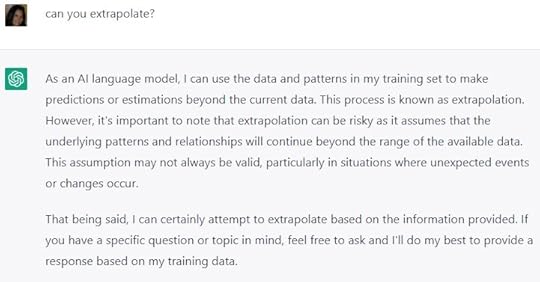
That’s a pretty cool answer. It’s non-committal. It basically said it would try to provide an answer, but don’t necessarily trust the answer.
I then asked it, “Can you correlate a hypothesis?” because that was something the Enterprise computer could do. I’m not posting the screenshot because it was very long and boiled down to: “No, because all I am is an AI language model. But here’s how you can do it.” (and then it listed out the steps on how-to do this)
So since it said it could try to extrapolate, I poked at that some more.
I asked it: “can you extrapolate what will happen in the next twenty years?”
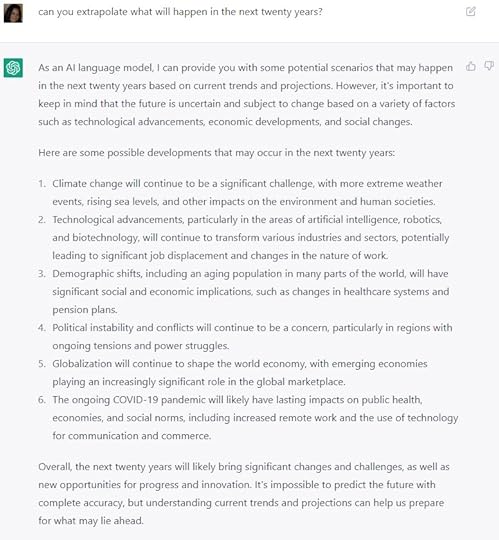
This answer initially sounded pretty good… until I followed up with “what about the next 100 years?” and it gave me nearly an identical answer and made me realize that the original answer wasn’t insightful in the least.
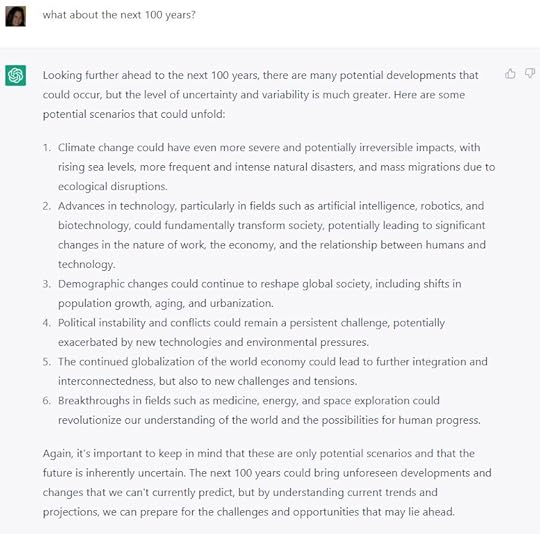
ChatGPT isn’t replacing the deep thinkers anytime soon. But I am impressed with ChatGPT’s responses and it gives deeper appreciation for what the Enterprise computer can do.
The Enterprise computer:
understands language, possibly the subtletieshas access to a large store of informationcan relate that informationhas the ability to extrapolate, make conclusions, predictions, etcThe first two items on that list are what we see with something like ChatGPT. ChatGPT even does some of item 3. But item 4 still needs work in the real world. If you ask ChatGPT if it can make predictions, similar to when I asked to about extrapolation, it hedged its answer and said that any prediction it might make depends on the accuracy of its training data.
What’s not on that list, and where the next level of advanced AI comes in, is the ability to solve problems. Data fits that level of AI.
All that said… I’m loving ChatGPT as a brainstorming buddy. For example, before this tool came into our lives, while writing, I would often need to look for synonyms for words on Google. Like what if I was looking for not only a synonym for ‘computer,’ but a humorous synonym for ‘computer.’ Asking Google yields this:
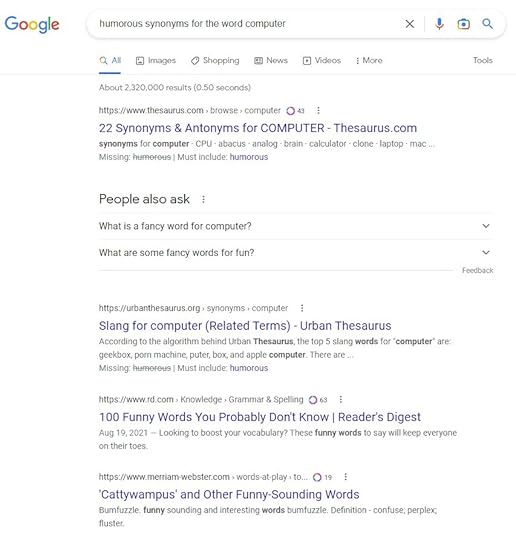
I get synonyms, but not necessarily humorous ones. I get other links to other humor-related sites. I would need to click on each and see if there are any nuggets or anything that sparked an idea. Essentially, Google granted me synonyms for “computer” and completely ignored my request for “humorous” ones.
But when I ask ChatGPT, I get the kind of answer a research assistant might give me:
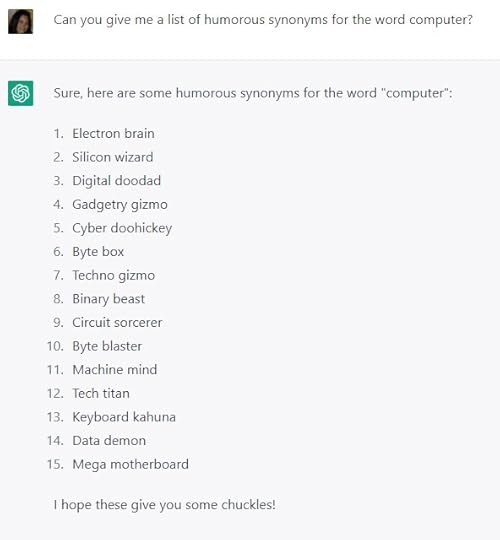
There’s a Facebook group for SFF writers that I’m active in. The kind of results that I just received from ChatGPT are similar to what I would get if I posted the same question there, minus the completely snarky and often unhelpful comments to a request like that (e.g., “what’s wrong with the word computer?” or “what do you mean by humorous (crazy-hilarious, or witty or…?)” or “Try googling it.” or “I’ve never heard of a humorous computer” and so on). In other words, it’s similar to brainstorming with people, minus some of the time-wasting unhelpful bits.
To summarize…
I’m thankful that we’re making progress and I can envision a time in the future where we’ve integrated tools such as Alexa, Watson, ChatGPT, and others to make our increasingly complex lives more manageable. From writing tasks, to medical diagnosis, to engineering, to navigating starships across the galaxy and encountering new problems, these technologies can help us move closer to achieving our goals, individual or collectively.
Related posts:
> My Unexpected Realization When I Tried to Create Artificial Intelligence
> Behind the Curtain (aka Calm down… the Google AI isn’t sentient. Yet.)
January 8, 2023
You Can Write, Too! (Adeena’s Tips, Advice, and Fave Books on the Writing Craft)
Since I have several (not just one or two, but several) books published, I often find myself in conversations with people who make a comment like, “I have an idea — maybe I could/should write a novel.” My response is always an enthusiastic, “Go for it!” (Well, if it ever seems not so enthusiastic, that has to do with my personal caffeine level and the amount of sleep I got the night before) And this usually leads to me saying things like, “You, too, can learn the craft of writing!” and then promising to send the person a list of my favorite books on the writing craft.
Well, I figured it would be more efficient if I wrote this down here and when these conversations come up, I can just refer people here. While I have several books published, I’m always reading more books on writing and so I might have reason to come back and update this when I have new information to share.
General AdviceI started thinking about writing science fiction and fantasy in high school, probably when I took my first creative writing class—over 30 years ago. Over those 30 years I’ve read a LOT of books on writing and seen all the classic advice out there. In recent years, people have turned a lot of the classic advice from people like Stephen King, Robert Heinlein, and others—even Pixar’s 22 storytelling rules—into meme’s.
I bring this up because it’s unlikely that there’s advice out there that I haven’t seen. And I bring that up because out of all this advice, the one bit that I constantly come back to, the one bit that is more true that all the other bits, and the one that is worth more than any other advice on the planet is what Robert Heinlein said:
You must write.You must finish what you write.
(There are actually 5 rules credited to Heinlein. But it’s the first two that writers need to grapple with before all else and the first two that should constantly be gnawing at you if you want to get a novel, or even a short story, out there.)
Books – about structure, plot, etc.Below is a list of books and my thoughts on them. One thing to know is that this is not as simple as saying, “hey, this is a great book on writing!” The order that I read them in is important. The stuff I knew or didn’t know, the experiences I had or didn’t have, all played a part in how meaningful or impactful the book was. This will happen to you, too. (This is probably true for all books… and actually all media consumption, which is why I also recommend that everyone watch all book series, TV series, and movie series in the order in which they were produced and made available and never any other order. But that’s a discussion for another day.)
For example, right now, one of my favorite books on writing is “Save the Cat.” But I think in order for that one to be my favorite, it had to come after going through a lot of James Scott Bell’s books and learning about his 14 signposts, which had to come after reading about the Snowflake Method. For many who have an idea, but have never thought about developing it into a story or novel, the Snowflake method might be the best book to start with.
Save the Cat! and Save the Cat! Writes a Novel: My current faves. Note that I read these after all the others below, which is one reason they are my current faves. Save the Cat! is supposed to be for screenwriters, but the concept is the same as writing a novel and I recommend this one before the one specifically for novelists because the chances that you’ve seen every movie referenced in this book is higher than having read all the examples in the one for novelists.
Bell on Writing: These are all James Scott Bell’s books on writing. It’s where I learned about the “14 signposts” before I got into Save the Cat. That helped me take “Crazy Foolish Robots” from a rough draft to a draft that made sense.
How To Add Humor To Your Novel: I claim to write humorous fiction and sometimes I even try to be deliberate about it. This is my fave book on that topic.
How to Write a Novel Using the Snowflake Method: This is a GREAT book to start with if you are one of those people who say, “I have an idea, but I don’t know how to write a novel.” Start here. The Snowflake Method works you through a sentence that describes the idea to a paragraph and then a page, etc etc.
Books – on writing wellHow to Write Short and It Was the Best of Sentences, It Was the Worst of Sentences: These are my two fave books when looking at how to write individual sentences that don’t make your readers’ eyes bleed. Okay, that’s probably never happened, but many a reader has turned away a book because the individual sentences sucked and were not readable.
The Emotion Thesaurus: I cannot write a novel or any creative work of fiction without this. I can draft a work, but when I got back to edit I need massive help with figuring out how to show emotions and emotional stuff in your writing is what will separate you from the AI bots writing on the internet these days. I struggle with this probably because I’m part robot myself. I have the DNA results to prove it. (jk. Or am I?) FWIW… I bought a hard-copy of this book maybe 20 years ago and when I realized there was an update, bought that. I also have all the other books in the series and refer to them, too — they are pretty awesome, too — but this one is a MUST have.
Books – in a category by themselvesAll writing advice books by Chuck Wendig but these two specifically: Damn Fine Writer and The Kick-Ass Writer. It’s a lot of miscellaneous advice on all parts of the writing craft. However, if you’re offended by potty-mouth language, these might not be for you.
WorldbuildingI specifically don’t have a favorite book on worldbuilding and for science fiction writers, I’m not sure it’s necessary. If you’re a fan of the genre, you’ll be able to world-build. Be self-consistent. That’s it.
November 28, 2022
Dear Interwebs: November 2022 Edition (aka Book 3 is here, and a mini-tribute to my Dad)
Dear Interwebs,
Blogging is secondary when there are books to write. Blogging is somewhat of a distraction…. a procrastination technique.
But, with Book 3 of The Robot Galaxy Series coming out tomorrow, Nov 29th 2022, I thought I could take a minute and update the interweb on things, list** style:
I’ve got a great start to Book 4 of The Robot Galaxy Series. It’s meant to conclude the series. I may write other books in the same universe with the same characters, but they’ll be standalone books.I have a drafted standalone novel that has nothing to do with The Robot Galaxy Series that I’m considering finishing and getting out there next—but it is about robots/AI/androidsThere’s an entirely unrelated series I want to write that’s calling me…I’ve been following the Artemis I mission carefully. I care about this mission both professionally and personally. Professionally because I work on stuff that supports NASA’s Moon to Mars objectives. Personally, because I care about the future of space exploration—and these missions are fodder for some of my science fiction, to include Book 4 of The Robot Galaxy Series!(** Note: I’m not a fan of how WordPress or this theme I’m using—I can’t tell which—handles lists. I want a stronger indent! Why can’t I have that?)
November is always a hard month for me. It’s primarily driven by the fact that it’s the month of my dad’s birthday, along with the anniversary of his death. He was one of my biggest supporter—with writing, my career, and everything—and didn’t live to see The Robot Galaxy Series come into existence. He didn’t even know about the NaNoWriMo book I wrote that became The Robot Galaxy Series because I wrote it in 2012, the year after he passed away. Instead, there were countless short stories of mine that he read and responded with, “This isn’t a short story, it’s the first chapter of a longer book.” That was always frustrating because I didn’t think I could do a longer book. Well, he was right. I could.
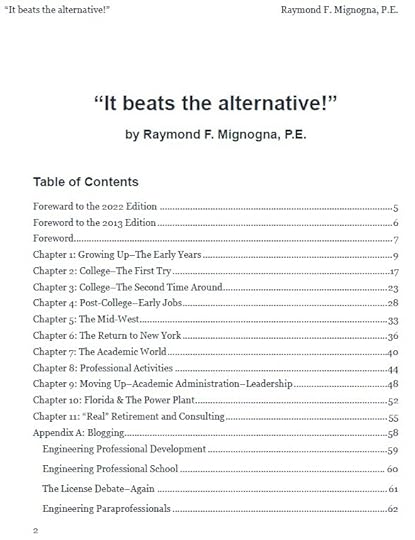
As a way of honoring his memory, every couple of years I make his memoir—which is part memoir, part writings and advice on a range of topics—available to family and friends. I’ve done that again this year. It started out as a memoir I asked him to write when he was ill and we knew it was terminal. I wanted all the things of his early life that I wouldn’t be able to ask about later written down. A couple of years later, I added his blog posts and miscellaneous writings to the document. This year, I added all the advice he’d given me over email to it.
And I’m posting the table of contents here. If anyone is interested in more of it, use the contact form over on the menu.
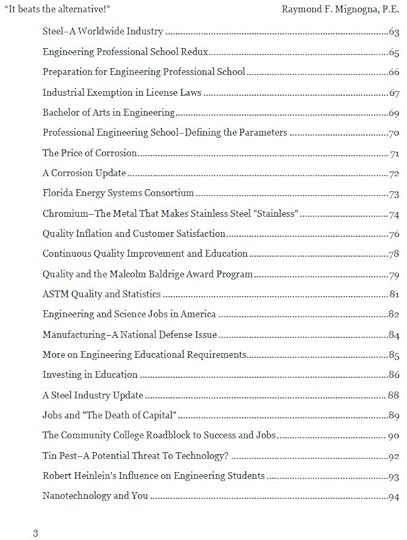
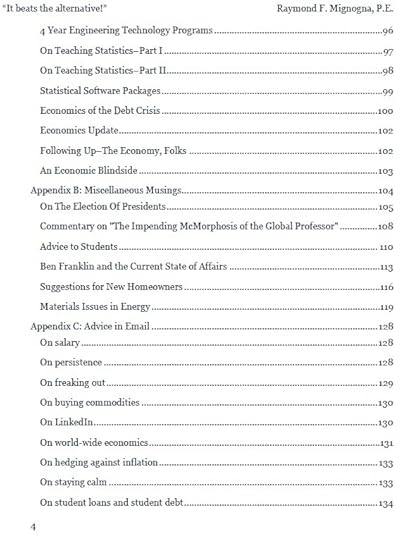
Thanks for reading. Follow me on all the social media of your choice as well. I’m making videos on FB often and I’ve joined Mastedon (without leaving Twitter). You can find me on all the places here: linktr.ee/adeenam.
September 26, 2022
On Our Way to Having a Holodeck…
I’ve been fortunate to be involved in a lot of different engineering “things” at my day job when it comes to designing and building satellites. I’ve worked on all phases of satellite missions, from when we write and prepare proposals all the way through designing, building, testing, launching, and operating (although not usually on the same mission). This is real, physical stuff for the real world. Real hardware. Real software. Should we care about “virtual reality?” Isn’t that the stuff of video games and science fiction?
Yes, to both.
First, I need to start off by explaining the basic difference between Augmented Reality and Virtual Reality. They often get lumped together* and while there are some similarities, their differences are more defining and important to understand because it means how they are used is VERY different. Look around you. That’s your reality. Put on a device, like a pair of glasses, that doesn’t cut you off from that reality but might overlay some digital content. That’s “Augmented Reality.” It is literally augmenting what you see. Now put on a device that completely cuts off your vision from the real world and replaces what you see (and maybe hear, and someday feel) with something different, digital, and virtual… that’s Virtual Reality.
The Holodeck of Star Trek:TNG (and DS9, Voyager, etc.) is an extreme evolution of today’s virtual reality where the device isn’t something you wear, it’s a room you walk into.
When we are in Virtual Reality, partially cut off from the real world around us, we are indeed in a parallel digital world that exists alongside our own. While Star Trek Holodeck realism isn’t yet possible, there is still a host of meaningful things we can do today with what we have available.
Virtual reality is inherently an interactive medium. Somewhere around 30 years ago, computers and CAD started to replace 2D mechanical drawing. It was recent enough that some readers will remember when this happened.
I started my career during the transition… In 1993, the Space Physics Group hired me at the University of Maryland to be a CAD drafter. I was using Autodesk v11 (or was it 10 and we transitioned to 11 while I was there?) But the remnants of mechanical drawing were still there. We had a drafting table. Hard plastic drawing triangles were still in the desk drawers and hung on the walls. Not all the manufacturers we worked with could accept a digital file, so we still turned our digital drawings into blueprints — I can still remember the ammonia smell and the feel of them as my boss showed me the proper way to fold up a D-size drawing.
CAD was definitely a game-changer since it made the process of making changes much quicker. As the internet became more ubiquitous, it made sharing those drawings with people not local to you quicker and easier. As the manufacturers upgraded their technology, eventually not only did they get a digital version of the drawing, that digital version gets immediately supplied to the machine itself, like a CNC, speeding up that process as well.
CAD did eventually completely replace mechanical drawing. Sometimes technology does that, and sometimes it was obvious that it was going to happen.
Not so much with VR. I frequently have colleagues tell me that they don’t see how gaming tech can apply to the engineering world. That is until I make them put on a headset…
In the engineering process we follow, VR certainly isn’t about to replace anything today. This process we follow, in general engineering terms, is defined by a series of steps that take us from concept to satellite-in-hand that we launch and operate. Unlike how blueprints went from a piece of (often large) paper to digital, no one thinks we can launch a digital satellite — so the analogy breaks down there.
But all the engineering work, until we can build a prototype (if we can build a prototype — it’s not always practical) and the final article, takes place on a 2D screen. With a 2D screen, a lot of interpretation is left up to individual perception. Because of no failing of their own, not everyone can imagine what that 2D image would really be like in 3D. Even a 3D model on a 2D screen, even if it’s one of those isometric models so you can tell it’s meant to be 3D, is still a 2D image on a 2D monitor. It’s a limited view. It’s also small. Because of those limitations, I could have a group of half a dozen engineers look at that screen, and we all don’t translate it into “real” 3D in the same way.
Enter VR. With VR, you are standing next to or inside the model. Much less is left up to imagination and interpretation. If we use this tool at selected points in the engineering process, we are giving ourselves access to what is currently out of reach physically and economically. No, we haven’t replaced anything like CAD replaced mechanical drawings, but we’ve added a valuable tool to our toolbox.
Places in the general engineering process where VR can help:
Researching ideas and exploring possibilitiesConsidering alternative solutionsModeling prototypes without the expense or time involved in making and buying hardwareTesting and evaluationCommunicate with teammates, management, and customersIt allows us to do these things without investing in potentially expensive hardware. It saves manufacturing time that way, too. Of course there are things we still might choose to do this with… If you’re building a small device, prototyping with a 3D printer might make sense and could be affordable. But this is not practical with a complicated spacecraft that is expensive, although we often 3D print specific parts along the way.
30 or 40 years ago, when PCs were becoming a thing, many people said they weren’t necessary… and now look at how ubiquitous the technology is. VR (and AR) is poised to be the same. And I can’t help and wonder what my currently VR-poo-poohing colleagues were back when they saw their first PC.
I love computers and technology. I’ve watched them become that ubiquitous tool over the last 30 or 40 years, although I didn’t know what I was seeing at the time. Just a tool I grew up with, and was one of only a small number of friends I knew with a computer as a kid in the early 80s. As I entered the workforce in the 90s, everyone was getting one. I didn’t think any deeper about it back then.
Computers are an amazing tool for scientists and engineers. While they’ve increased the speed at which computation and analysis can get done (as opposed to the pre-computer era where everything was done with slide rules, log tables, etc.), they introduced a level of abstraction and took away some of the physical intuition that comes with designing and then prototyping a part.
VR can bring back some of that intuition that comes from hands-on experience. In the last few years, VR headsets and the computers to run them have made this technology economically justifiable… more so that it had ever been in the past. Even a digital, hands-on, life-size model that you can walk around in, in a virtual space, is superior to a 2D screen, no matter how advanced that high definition monitor is. I expect to see haptic devices in the next few years become as equally economically justifiable, and a host of other improvements such that when my kiddos are in their 20s, and start a job as an engineer or scientist someplace (a mom can dream, right?), besides their highly advanced PC, their issued a VR headset on their first day.
(* by “lumped together” I mean I’ve found myself in conversations where I’m talking about VR, and the person I’m talking to is imaging AR)


