Yukesh Chaudhary's Blog
January 20, 2026
The X ‘For You’ Algorithm Explained: How Posts Are Ranked and Why the First 30 Minutes Matter Most
New details about how content is ranked on X (formerly Twitter) reveal a scoring-based system that determines the reach and lifespan of every post within minutes of being published. According to the information, the platform now relies almost entirely on automated evaluation, with no manual engineering rules influencing visibility.
Base score determines initial reachEvery account on X starts with a base score that is calculated before a post is even evaluated. Verified accounts receive an automatic +100 score, giving them a significant advantage in early distribution. Unverified accounts can reach a maximum base score of +55, placing a clear ceiling on their potential visibility from the start.
This base score is then multiplied by two additional factors:
The account’s follower-to-following ratio, which only significantly affects reach if the ratio is extremely poor.The account’s restriction status, meaning any limits or penalties applied to the account can sharply reduce visibility.Once these factors are applied, the post enters the ranking system.
No manual rules, Grok drives the systemUnlike earlier versions of the platform’s algorithm, there are reportedly no manual engineering rules shaping content distribution. Instead, Grok, X’s AI system, is said to fully determine how posts are ranked and distributed across the platform.
This means content is judged purely on performance signals rather than curated relevance, trending topics, or editorial decisions.
The critical first 30 minutesThe survival of a post is decided almost entirely within the first 30 minutes after publishing, based on what the system calls “velocity”—the speed and strength of engagement.
Minutes 0–5: A post is shown to roughly 5–10 percent of the author’s followers, along with a small sample of users outside the author’s network.Minutes 5–15: If engagement is strong, distribution expands to 20–30 percent of followers and a much larger out-of-network audience.Minutes 15–30: Posts that continue to perform well are pushed into “For You” feeds at scale, reaching users far beyond the original follower base.If a post fails to gain momentum during this window, it is effectively sidelined.
Older posts are quickly deprioritizedOnce the initial 30-minute window passes, underperforming posts are trimmed from circulation. They are not given a second chance, as they must compete with newer posts generating stronger velocity signals. As a result, timing and early engagement are far more important than long-term relevance.
Engagement signals and their weightThe algorithm assigns specific numerical values to different forms of engagement, revealing what matters most:
Reply engaged by the author: +75Reply: +13.5Profile click: +12Repost: +1.0Like: +0.5Report: −369 (effectively kills the post instantly)Notably, video performance plays a minimal role. Even a 50 percent video completion rate contributes only +0.005, indicating that text-based interaction and conversation matter far more than passive viewing.
No relevance ranking between postsContrary to common assumptions, posts are not ranked based on topical relevance, trends, or what is popular at the moment. Instead, each post stands alone, with its score remaining fixed once calculated. Visibility is determined purely by that score, not by comparison with other posts in the feed.
What this means for creatorsThe system heavily rewards immediate interaction, especially replies and direct engagement from the author. Verified status provides a major structural advantage, while negative actions such as reports can instantly destroy a post’s reach. In the current X ecosystem, success depends less on content longevity and more on early momentum, conversation, and account standing.
With Grok now fully driving the algorithm, the platform’s “For You” feed has become a high-speed competition where posts either take off within minutes—or disappear just as fast.
Sourced from yukesh.com.np


November 25, 2025
Cursor IDE Connection Error
Today, while working inside the Cursor IDE, I suddenly encountered a connection issue that completely interrupted my workflow. Out of nowhere, Cursor displayed this message:
“Connection failed. If the problem persists, please check your internet connection or VPN.”
At first, I tried the usual fix — refreshing the page inside Cursor — but nothing changed. The error reappeared instantly. I didn’t refresh or restart the Windows app itself; the issue was happening directly in the IDE’s built-in interface.
Since my internet connection was stable, it didn’t seem like a problem on my side. Soon after, I noticed that many other users across the world were reporting the same connection failure, suggesting that this wasn’t an isolated incident but a broader outage or backend issue affecting Cursor’s services.
For now, the only option is to wait and retry periodically. If the situation improves or Cursor provides an update, I’ll post more information here.
Here is What people are posting on Twitter/X.
is it just me or @cursor_ai hits this error a lot often lately pic.twitter.com/dhxzzoevrT
— poobesh (@pbshgthm) November 25, 2025
cursor is going to 0. pic.twitter.com/p5aP58OHbs
— crashout (@0xCRASHOUT) November 25, 2025
Sourced from yukesh.com.np
November 2, 2025
Niriv launches its live version
After years of planning, designing, and building, I’m excited to share that Niriv is now live. This version brings together search, information, and a range of everyday tools in one simple platform. My goal with Niriv has always been to make accessing useful digital features faster, cleaner, and more connected.
At its core, Niriv focuses on a fast and minimal search experience. It delivers results, summaries, and updates in a way that feels natural and distraction-free. I wanted a search that isn’t just about links, but about helping people find exactly what they need in less time.
The platform currently includes:
Search – quick and clean results with summariesTrending – what’s gaining attention in news and across the webFor You – a personalized feed from news, Cafe, and creatorsBaje – Niriv’s AI assistant designed for helpful responses and insightsNews – updates from both global and Nepali sourcesWeather – real-time forecasts and local conditionsMiti – Nepali calendar with date conversion between BS and ADWallet – an expense tracker for managing daily financesNotes – a simple notes app for quick ideas and listsNfit – fitness tracking for health and activity goalsNsuite – a hub for business tools and resourcesSpeedtest – internet speed checking across NepalFun & Games – a light section for interactive content and entertainmentEach service has been designed to feel consistent, lightweight, and easy to navigate. I wanted users to have everything they need in one place — whether it’s finding news, checking weather, managing tasks, or simply exploring what’s trending.
Alongside these:
Real-time weather updatesCurrency exchange ratesNepali date converter (BS↔AD)Unicode converterDaily horoscopeEach of these features is designed to be lightweight and straightforward. They’re not meant to overwhelm but to simplify small digital tasks that we often have to visit multiple sites for.
The interface of Niriv is intentionally minimal clean layouts, smooth navigation, and consistency across devices. I wanted it to feel modern and cohesive, where every interaction feels familiar and fast.
This launch is just the beginning. In the next phase, I’m working on AI-powered summaries, improved search precision, and a more personalized experience. A mobile app is also in development, set to bring everything together by 2026.
You can now explore the live version of Niriv at Niriv.com.
Sourced from yukesh.com.np
October 1, 2025
Sora 2 launch could reshape Nepali video marketing and creativity
OpenAI has launched Sora 2, its flagship video and audio generation model, marking a major leap forward in AI-driven content creation. The model produces highly realistic, physically accurate, and controllable videos, complete with synchronized dialogue, background soundscapes, and sound effects. Compared to the first version released in early 2024, Sora 2 is being described as the “GPT-3.5 moment” for video a step towards world-simulation level AI.
Key features of Sora 2Sora 2 introduces several advanced features that make it a powerful tool for creators:
Realism and Physics Accuracy: Unlike earlier models, which often bent reality to fit a prompt, Sora 2 follows the laws of physics more reliably. For example, if a basketball player misses a shot, the ball rebounds off the board instead of magically scoring. This ability to model both success and failure makes it more natural and believable.Complex Motion & Dynamics: It can handle extremely difficult sequences like Olympic gymnastics, skateboard tricks, triple axels on ice, or backflips on paddleboards, with realistic physics such as buoyancy, balance, and rigidity.Multiple Styles: Sora 2 excels in cinematic productions, hyper-realistic shots, and anime-inspired visuals. From a Japanese anime hero awakening powers to underwater diving scenes, it adapts to a wide range of artistic directions.Audio Generation: Alongside video, the model creates realistic speech, ambient sounds, and sound effects. This allows creators to generate complete multimedia experiences without needing separate editing software.Cameos (Personal Insertion): Users can record themselves once and then drop their likeness, voice, and movements into any AI-generated scene—walking in New York, surfing in Hawaii, or standing on Mount Everest. This feature could redefine influencer and brand marketing.World State Continuity: The model can handle multi-shot sequences while keeping consistent environments, characters, and actions. This makes it ideal for storytelling, advertisements, and even short films.Social App Integration: Alongside the model, OpenAI has launched the Sora app, a social platform where users can generate, remix, and share videos. The app focuses on creation over consumption, encouraging collaborative and community-driven content.Possible impact on Nepali video marketingFor Nepal, where video marketing has grown rapidly across platforms like TikTok, YouTube, and Facebook, the arrival of such a tool could be transformative. Brands, influencers, and creators may no longer need expensive cameras or production teams to create professional-level videos. Instead, they can generate high-quality promotional clips, advertisements, and even animated campaigns directly from text prompts.
If the Sora app becomes available in Nepal, its influence on the country’s video marketing landscape could be significant. The platform’s TikTok-style design, combined with advanced AI video generation, may allow businesses and individuals to create polished, engaging content at a fraction of the cost of traditional production.
For brands and small enterprises, this could be particularly transformative. Instead of hiring production teams or renting expensive equipment, shop owners, restaurants, and local businesses could generate professional-quality promotional videos directly through the app. A small clothing boutique in Kathmandu, for instance, could showcase its latest designs in a cinematic fashion video created entirely by Sora’s AI, and then distribute it instantly on the app’s social feed.
Influencers and content creators would also stand to benefit. Nepal’s TikTok stars, who already dominate the country’s social media culture, could push their creativity further by placing themselves in imaginative or global scenarios. A creator could appear at Times Square in New York, perform at an international concert stage, or even feature in an animated Nepali folk tale, all with the help of Sora’s cameo feature.
The tourism industry is another area that could see major change. Travel and hospitality companies could use Sora to produce visually stunning clips of Nepal’s heritage sites, trekking routes, and natural wonders even during off seasons. Such promotional material could be more cost-effective while still appealing to international audiences.
For young Nepalis, Sora might open an entirely new space for digital storytelling. Much like TikTok gave rise to a generation of short-video influencers in the country, the Sora app could empower a wave of AI-powered creators who use the technology to experiment with new forms of art, culture, and communication. This may not only enrich the country’s digital ecosystem but also allow Nepali voices to compete in a much larger, global creative market.
Cost Reduction: Small businesses that cannot afford professional video shoots could generate realistic product demos, ads, and campaigns with minimal expense. For example, a restaurant in Kathmandu could create cinematic food commercials within minutes.Tourism Promotion: Travel companies could craft breathtaking promotional videos of trekking routes, heritage sites, and natural wonders—even in off-seasons—helping attract global attention.Influencer Marketing: With cameos, Nepali influencers can place themselves into global or imaginative settings instantly, expanding creativity and storytelling possibilities without needing to travel.Cultural Storytelling: Local filmmakers and artists could bring Nepali myths, festivals, and traditions to life in anime or cinematic form, helping preserve and promote culture digitally.With such power, however, challenges are inevitable. The risk of deepfakes, misinformation, and identity misuse will grow. For a country like Nepal, where digital literacy and regulation are still developing, the rise of hyper-realistic AI video may raise questions about authenticity and ethics in media and advertising.
OpenAI has built parental controls, safety checks, and moderation systems into the Sora app, but adoption in Nepal will also require public awareness and responsible use by creators and brands.
AvailabilitySora 2 is currently rolling out in the U.S. and Canada through the Sora iOS app, with plans to expand globally. Once available in Nepal, it is expected to have a significant impact not only on marketing but also on education, media, entertainment, and social communication.
If used responsibly, Sora 2 could empower Nepali creators and businesses to compete globally, pushing digital creativity beyond traditional limitations and shaping a new era of video marketing in the country.
The Sora app – TikTok-style with a new approachAlongside the release of its upgraded video generation model, OpenAI has also introduced the Sora app, a social platform that takes clear inspiration from TikTok’s short-video format but is designed with a different philosophy. The app features a familiar vertical feed where users can scroll through videos, but instead of prioritizing passive viewing and endless consumption, Sora emphasizes creation and participation.
Inside the app, users can generate their own AI videos, remix content created by others, and even collaborate through a feature called cameos, which allows people to place themselves directly into AI-generated scenes. This means a user could appear in a friend’s video set on Mars, or in a cinematic festival scene in Kathmandu, simply by recording a one-time likeness.
The feed itself is also designed differently from existing platforms. Instead of an opaque algorithm optimized to keep users scrolling, the Sora app allows people to customize their feeds with natural language instructions, giving them more control over the type of videos they see. The default feed heavily prioritizes content from people a user follows or interacts with, encouraging community-driven sharing rather than algorithmic virality.
Safety has also been built into the app’s foundation. OpenAI has stated that it is not optimizing for “time spent on the platform,” a common design choice in apps like TikTok and Instagram. Instead, the focus is on empowering creativity and reducing harmful usage patterns such as doomscrolling or algorithm-driven addiction. The app also comes with built-in parental controls, daily limits for teens, and stricter cameo permissions for younger users. Human moderation teams and AI safety systems will review content to address bullying or misuse quickly.
Unlike other major platforms that are moving away from the traditional social graph, OpenAI says Sora will be more community-centric, encouraging interaction between friends and groups. Early internal testers at OpenAI reportedly used the cameo feature to connect with colleagues and even make new friends, showing how the platform blends entertainment with personal expression.
With this combination of TikTok-style presentation and creative-first design, the Sora app could become a major new player in the social video space. For Nepali creators and marketers, it represents not only a new distribution channel but also a new way of engaging audiences through AI-powered, personalized storytelling.
Sourced from yukesh.com.np
September 4, 2025
Nepal begins blocking Facebook and other unregistered platforms
The Ministry of Communication and Information Technology has started blocking social media platforms, including Facebook, that have not registered in Nepal. The decision was finalized in a meeting led by Minister Prithvi Subba Gurung.
On August 25, 2025, the Cabinet had instructed all social media operating in Nepal to register within a week. Since no formal applications were submitted by the deadline of August 28, 2025, the ministry moved forward with restrictions.
According to Minister Gurung, only platforms that complete the registration process will be allowed to continue operating in Nepal. The responsibility of implementing the decision has been given to the Nepal Telecommunications Authority.
The government had earlier introduced the Social Media Directive 2023 to regulate online platforms, citing rising misuse of social media. The directive requires platforms to register within three months of operation, renew their license every three years, and allows the government to shut down any unregistered platforms.
Despite repeated calls, including an official notice on August 28 to Facebook, YouTube, Instagram, Twitter (X), LinkedIn, and others, officials confirmed that no platforms submitted applications on time.
Sourced from yukesh.com.np
September 3, 2025
Nepali creators can now monetize on Facebook
Facebook has officially enabled monetization in Nepal, opening a new opportunity for local creators to earn directly from their content. Until recently, Nepali users could only access features like Stars Monetization, where income depended on gifts from viewers. Now, with full monetization active, creators can generate earnings from photos, videos, reels, text posts, and live streams.
Eligibility requirements: Are you qualified?To join the Facebook monetization program, creators in Nepal must meet these conditions:
At least 5,000 followers on your profile or pageA minimum of 60,000 minutes of video watch time within the last 60 daysOriginal content (no copied or unlicensed material)Compliance with Facebook’s Community StandardsNo past violations such as posting sexual, violent, or criminal contentFacebook’s monetization policiesCreators must follow strict rules to remain eligible:
Content Monetization Policies (CMP): Content must be authentic and original.Partner Monetization Policies (PMP): Pages and profiles must represent real people or organizations with genuine engagement.Content ownership: You can only monetize content you own or have rights to.Engagement integrity: No artificial boosting, clickbait, or spam.Ad-friendly content: No graphic, violent, or sensitive posts.Step-by-step guide to setting up monetization in NepalFor profiles:
Open your profile and click the three-dot menu.Turn on Professional Mode.Go to the Monetization tab.Complete setup by adding PAN and bank details.For pages:
Open your Professional Dashboard or Meta Business Suite.Select the Monetization section.Check eligibility and apply if qualified.Provide your PAN, bank details, and tax information.Tip: Always select Nepal as the payment country to receive money directly in a local bank account.
Risks of scamsWith monetization trending in Nepal, scammers are also targeting creators. Common scams include:
Fake emails or messages claiming “Your page is eligible for monetization” with suspicious linksImpersonation of Facebook or Meta accounts asking for login or bank detailsFake pages designed to trick creators into applying through non-official linksHow to stay safe:
Only set up monetization through the official Facebook app or websiteNever share your passwords or banking details via email or DMsCheck your eligibility and status only in Professional DashboardWhy this matters for Nepali creatorsNepal was excluded from Facebook’s eligible country list for years, even when other South Asian countries gained access. With monetization now available, Nepali creators can finally earn from their content at the same level as global creators.
While early earnings may be small, consistency, originality, and compliance with policies can help build sustainable income streams. This development could empower a new generation of Nepali digital creators, turning content creation into both passion and profession.
Sourced from yukesh.com.np
August 26, 2025
Google launches AI mode search feature in Nepal
Google has rolled out its much-awaited AI Mode search feature in Nepal. Since Monday night, Nepali users can now use this new option directly from the Google search bar.
With AI Mode, search results look different from the traditional list of blue links. Instead, users get a chatbot-style interface where Google provides detailed answers to queries. This feature was first introduced in May, but it was limited to the US, UK, and India. Last week, Google expanded it to 180 countries, including Nepal.
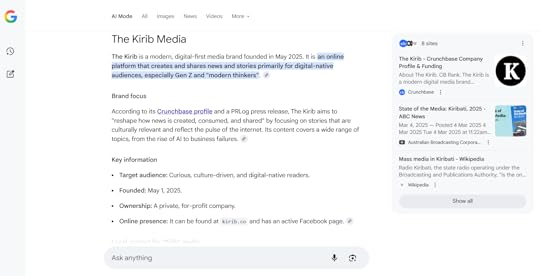
When AI Mode is turned on, the search bar shows a new “AI Mode” button. Tapping on it opens a chat-like interface. The answer to your query appears on the left, while the sources are displayed on the right. Users can also ask follow-up questions in the “Ask Anything” box, where Google AI replies instantly. If users prefer the old style, they can still switch to traditional tabs like All, News, or Images. For now, the feature works only in English.
How to activate AI Mode:Go to Google Search and type “AI Mode”.Click the “Turn On” button that appears.If available on your device, you will see the AI Mode option in the search bar from then on.Google also announced that it is preparing to add an “Agentic” feature to make AI Mode smarter. In the beginning, it will help with tasks like finding restaurants. However, this upgrade will only be available to Google AI Ultra subscribers.
Sourced from yukesh.com.np
August 23, 2025
How I Stay Curious and Turn Ideas into Projects
Curiosity has always been the engine behind everything I build. From my early days in college to launching platforms like Scriling, The Kirib, and Niriv, the process of turning a simple idea into a working project has always followed the same pattern: notice, explore, experiment, and execute. Here’s how I do it, based on my own journey.
Noticing OpportunitiesEven when I was in college, finances were tight, but my mind was always considering possibilities. I would think, “How can I use my skills and vision to create something meaningful?” Even without money or technical training, I focused on learning, observing trends online, watching how digital platforms worked, and thinking about what could work in Nepal.
Later, working at Helen International as a parts seller and occasionally helping in bike sales, I noticed how systems worked and where gaps existed. This work taught me to observe processes carefully. While working in Kuwait in 2015 to support my family, I observed everything administration systems, office processes, IT tools and noted ideas about building better solutions.
Exploring IdeasCuriosity alone is not enough; it needs exploration. While working in Kuwait, I read, learned online, and tested small experiments in my mind. I asked myself: “If I had the chance, how would I solve this problem? How could I improve it?” This habit of analyzing processes and systems formed the foundation for future projects.
After returning to Nepal in 2018, facing setbacks like my Denmark application failing and dealing with a 23-lakh loan, I continued experimenting. I started publishing news content on Scriling.com. I researched what readers wanted, wrote, and tested. Every article and every trend provided data that shaped the next move.
Experimentation and ActionTurning curiosity into a project requires experimentation. I started Scriling without expecting huge results, focusing on testing, learning, and iterating. Over time, the small experiments produced results Scriling eventually reached revenues of 50,000 NPR in early 2021 and at its peak, 13,000 USD per month. My younger brothers also applied the same methods and reached 10 lakh per month at times.
I applied the same approach to The Kirib, a Gen Z-focused media platform, and Niriv, a homegrown digital portal. For Niriv, I have been quietly building the platform since 2019, aiming to launch a hybrid website and app in 2026 that includes search, news, commerce, payments, discussions, and more. These projects have been possible through consistent observation, experimentation, and iteration.
How I Spot SignalsI developed the habit of noticing signals small trends or gaps that indicate bigger opportunities. The lack of Nepali-focused platforms for Gen Z inspired The Kirib. Observing content consumption patterns during COVID influenced Scriling. Even small observations, such as difficulties in finding localized services online, informed Niriv’s development.
Failures also provide data. Not all experiments succeed, and some partnerships like early Manoble efforts did not work out. Learning from these outcomes informs new strategies and opportunities.
Tips from My JourneyObserve Everything: Watch how systems and people interact. Every process can provide insight.Ask “What If?”: Imagine alternatives and better solutions.Experiment Small: Start with small tests and iterate.Track Signals: Identify patterns, gaps, or frustrations that others overlook.Learn from Failures: Use unsuccessful experiments to refine future projects.ConclusionCuriosity is a practice that guides my work. It has helped me build multiple projects in Nepal, including Scriling, The Kirib, and Niriv. By observing, exploring, experimenting, and learning from signals, I turn ideas into projects that serve real needs.
Following this approach allows small ideas to develop into projects that can have meaningful impact.
Sourced from yukesh.com.np
Why Every Marketing Agency in Nepal Needs SEO
Search Engine Optimization (SEO) is no longer an option—it’s a necessity. In today’s digital world, businesses compete for visibility on search engines because that’s where customers start their journey. Whether someone is searching for a marketing agency in Nepal, a digital marketing agency in Kathmandu, or simply looking up the marketing meaning in Nepali, the results they see influence their decisions.
SEO ensures that when people search for products, services, or information related to your business, you appear at the right time in the right place. This guide will take you through everything you need to know about SEO, from the basics to advanced strategies, global trends, and why SEO is critical for businesses in Nepal.
What is SEO?SEO stands for Search Engine Optimization, the process of improving your website’s visibility on search engines like Google, Bing, and Yahoo. It involves a combination of technical adjustments, content creation, and strategic promotion to ensure your site ranks high for relevant search queries.
How Search Engines WorkSearch engines use complex algorithms to determine which pages to show for any given query. These algorithms consider hundreds of ranking factors, including:
Relevance of contentWebsite authorityUser experienceTechnical performanceYour goal with SEO is to align your website with these ranking factors to appear higher in search results.
Why SEO is ImportantMore than 90% of online experiences start with a search engine. If your business doesn’t show up on the first page, you are losing potential customers.
Benefits of SEOIncreased Visibility: Higher rankings mean more clicks and traffic.Credibility & Trust: Users trust businesses that appear at the top.Better ROI: Unlike paid ads, SEO provides long-term results.Competitive Advantage: If your competitors are investing in SEO, you need to keep up or risk falling behind.Types of SEOSEO is not a single activity—it consists of multiple layers that work together to improve rankings.
1. On-Page SEOThis includes everything you do on your website:
Keyword optimizationMeta tags (title, description)Headings (H1, H2, H3)Image alt textInternal linking2. Off-Page SEOThis focuses on actions outside your website to improve authority:
Link buildingSocial signalsBrand mentions3. Technical SEOThis ensures your website is technically sound:
Fast loading speedMobile-friendlinessSecure HTTPS connectionXML sitemaps4. Local SEOEssential for businesses in Nepal targeting local customers:
Google Business Profile optimizationLocal citationsReviews and ratingsKey SEO ElementsFor successful SEO, focus on these core components:
Title Tags & Meta Descriptions: These appear in search results and influence clicks.Structured Headings (H1, H2, H3): Improve readability and help search engines understand your content.Image Optimization: Use descriptive alt text for better indexing.Internal Linking: Connect related pages to improve navigation.Content Quality: The most important factor in ranking.Modern SEO Trends (2024–2025)SEO is evolving. Here are the latest trends you need to know:
1. E-E-A-T FrameworkExperience, Expertise, Authoritativeness, and Trustworthiness are key. Google wants content from credible sources, so build authority in your niche.
2. Core Web VitalsGoogle measures user experience using three metrics:
Largest Contentful Paint (LCP) – loading speedFirst Input Delay (FID) – interactivityCumulative Layout Shift (CLS) – visual stability3. AI and Machine Learning in SEOAI tools now help in content creation, optimization, and predictive analysis. Search engines also use AI to deliver more accurate results.
4. Voice Search OptimizationWith smart assistants, more people use voice queries like “best SEO expert in Nepal.” Optimize for conversational keywords.
5. Video SEOVideo content ranks higher. Platforms like YouTube are search engines themselves, so video optimization is crucial.
SEO and Digital MarketingSEO is a foundational pillar of digital marketing. While paid ads (PPC) give quick results, SEO provides long-term benefits. A strong SEO strategy supports:
Content MarketingSocial Media MarketingEmail MarketingBrand BuildingWhen integrated, SEO makes digital campaigns more effective and sustainable.
Why SEO Matters for NepalNepal’s digital landscape is growing rapidly. Internet penetration is increasing, and more businesses are going online. People frequently search for:
Marketing agency in NepalDigital marketing agency in KathmanduSEO expert in NepalSEO specialist in NepalBusinesses that rank for these terms will dominate the market.
Benefits of SEO for Nepalese BusinessesMore Local Customers: Appear in local searches like “marketing in Nepal.”Cost-Effective: SEO costs less than traditional ads.Brand Authority: Being on the first page builds trust.Statistics and Insights (Text-Based Table)Actionable SEO Strategies for NepalTarget Local Keywords: Use terms like “SEO in Nepal” and “digital marketing in Kathmandu.”Optimize Google Business Profile: Essential for local visibility.Content in Nepali Language: For searches like “marketing meaning in Nepali.”Mobile Optimization: Most users in Nepal access the web via smartphones.Build Local Backlinks: Collaborate with Nepalese blogs and directories.Challenges in NepalLack of awareness about SEO.Limited budget for digital marketing.Growing competition among agencies.SolutionsEducate businesses about ROI from SEO.Offer affordable SEO packages.Focus on niche keywords.Future of SEOThe future is AI-driven. Search engines will become smarter, and user experience will matter more than ever. Voice search, visual search, and hyper-local targeting will dominate. Businesses that adapt early will stay ahead.
SEO is not just about ranking; it’s about visibility, trust, and growth. For businesses in Nepal, this is the perfect time to invest in SEO and stay competitive in a digital-first world. Whether you’re a digital marketing agency in Kathmandu or a small shop in Pokhara, SEO can change your game.
Sourced from yukesh.com.np
August 22, 2025
Nepali Digital Entrepreneurs Deserve Smarter Payments
Nepali IT-savvy youth and small digital entrepreneurs often find their earnings bottlenecked by banking rules. Global platforms like PayPal and Stripe are essentially unusable for receiving money in Nepal. Freelancers report having to rely on indirect methods – international digital wallets, wire transfers with high minimums and fees, or even asking friends abroad to funnel payments – all of which erode their income.
In practice, Nepalese banks impose strict controls. Domestic transaction caps and layered fees make sending small payments costly and complicated. Without a streamlined system, many Nepalis either lose clients or settle for riskier workarounds. Even policymakers acknowledge the gap: Nepal Rastra Bank has confirmed efforts to connect with global payment platforms to broaden options for local freelancers.
Payment challengesNepal Rastra Bank forbids individuals from holding foreign currency accounts, so platforms like PayPal only let Nepalese send money, not receive it. International wires carry flat fees and tax withholdings, and transfers above certain thresholds require heavy paperwork and reporting. Opening a “dollar account” in Nepal requires government permission, and transactions incur VAT and documentation fees.
Even open data shows the squeeze: without a safe and efficient way to bring money home, freelancers endure convoluted workarounds and sometimes miss out on international gigs.
Cryptocurrency: A Risky StopgapUnable to use regular channels, some Nepalis are turning to cryptocurrency – at great risk. Cryptocurrencies offer instant transfers and low fees, and freelance platforms around the world now accept bitcoin or stablecoins as payment. In theory, a Nepali developer paid in USDT could receive funds in minutes instead of weeks.
But Nepal’s laws make this a high-wire act. The central bank has banned all crypto transactions, and anyone found trading or using crypto is liable to prosecution. Despite this, underground crypto trade is surging for remittances. Freelancers report asking clients to pay in USDT or BTC, then using unregulated peer-to-peer platforms to sell it for rupees. Analysts warn this creates a shadow economy and exposes freelancers to risks such as frozen bank accounts.
Learning from AbroadSome of Nepal’s neighbors have tackled this gap with bold policies. Pakistan, for example, allowed freelancers to receive PayPal payments locally through designated partner services. This has helped Pakistani IT professionals earn substantial export remittances.
By contrast, Bangladesh still struggles with repatriation issues, leaving much of freelancers’ earnings in foreign accounts to avoid taxes. Regional initiatives hint at possible models. Nepal’s payment authority has signed agreements to link Nepal’s new NPI system with India’s UPI, and fintech firms are piloting tools to enable instant foreign payments. These experiments show that government-backed corridors can allow global money to flow seamlessly rather than routing everything through slow wire transfers.
Nepal’s Own Payment SystemExperts say a government-backed solution must marry local control with global reach. A unified payment gateway could connect all Nepali banks and wallets under one platform, using secure APIs to remove integration barriers and cut costs for businesses and freelancers. Such a gateway should allow instant foreign currency receipts and automatic conversion to rupees at fair exchange rates.
Policy-wise, the system should embed strong anti-fraud checks and KYC so the government is comfortable extending it internationally. Incentives could help too, such as matching remittance bonuses. On the technical side, Nepal is already laying groundwork with retail payment switches and pilot digital currency initiatives. Linking Nepal’s systems with global networks rather than reinventing the wheel could be key.
Key features of an ideal system include:
Global connectivity with major payment networks and the ability to settle in multiple currencies.Low-cost transfers, especially for small payments.Transparent, real-time currency conversion.Ease of use with one-stop digital onboarding and APIs for freelancers.Regulatory clarity to protect users while enforcing anti-money-laundering laws.With these components, freelancers would no longer need risky middlemen or illegal workarounds.
A robust international payment infrastructure could be transformative for Nepal’s digital economy. Today, many young designers, coders, educators, and content creators struggle to turn their global work into local income. By enabling them to collect payments directly, Nepal would capture foreign exchange and jump-start new micro-exports.
Streamlined digital payments would make Nepal’s economy more vibrant. Youth unemployment could fall as online entrepreneurship becomes viable. Small businesses could pay foreign suppliers or receive diaspora gifts easily. More money flowing into local banks and wallets would strengthen fintech adoption.
Modern payment rails would unleash innovation in countless sectors – from tech startups to freelance journalism to social media content – by removing a critical bottleneck. If Kathmandu can build the right system, Nepali freelancers and creators will be free to join the global marketplace on equal footing, fueling the country’s digital rise and giving its young talents the economic freedom they seek.
Sourced from yukesh.com.np