Leslee Sambor's Blog
February 24, 2024
It's Birthday Weekend!
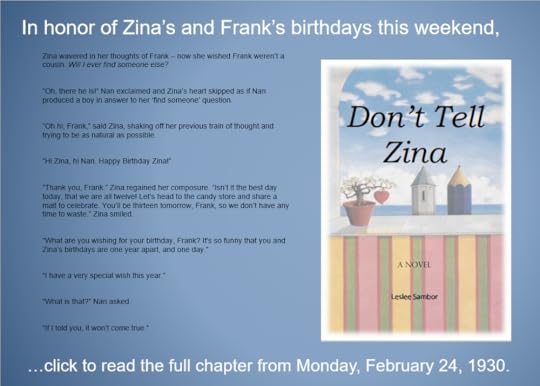
CHAPTER 29
ZinaMonday, February 24, 1930
“Happy Birthday Day, Duey!” Zina looked back at her kitten to share her enthusiasm. “Oh! Nan will be here soon and then Frank will be by around six o’clock.”
Duey was apparently more interested in grooming himself than in whatever a ‘birthday’ might be. Zina smiled at him and quickly got changed out of her school clothes behind her screen and began to fix her hair.
As she smoothed her nearly black shoulder length hair, she struggled with a particularly unruly curl twisting the wrong way. She licked her fingers to try again. Duey copied her with his white tipped paws.
She giggled about how he mimicked her, but she certainly wouldn’t use his techniques herself. “I’m not going to care today about this cowlick, Duey. Even if it were called a ‘catlick’ you aren’t going to help me, but thanks anyway.” Zina was sure he understood, as he turned his attention to his other paw, nonchalantly.
Satisfied with her appearance, she went downstairs and out to the porch. Nan was already there.
“Hello, fellow twelve-year-old!” Zina greeted Nan; they locked elbows and walked toward the park to wait for Frank by ‘Aunt Etna’.
It was a beautiful sunny day for February, and although the air was brisk, it was wonderfully dry and void of snow.
“I know what I wish for you, Zina. That you finally find the perfect boy you are looking for. Oh, it is the most wonderful feeling!” Nan began skipping with happiness.
Zina smiled at her best friend while trying to keep up, metering her breath as best as she could to avoid a coughing fit.
“Oh, and I can’t believe I almost forgot to tell you!” Nan came to a sudden halt to face Zina. “I talked with Father Antonio after our church meeting on Friday and he gave me an answer about the cousin question.” Nan was more excited now than anyone would normally be after talking with their priest.
“So, Father Antonio said that Michael and I would be allowed to marry!” Nan squealed.
“Nan, wait, you asked Father about Michael?”
“Well, I didn’t drop names, but I asked about the rules. I know we share the same uncle on his father’s side, and the church has rules about cousins getting married. So, the point is, Father Antonio said its allowable; we are within the rules!” Nan released Zina to spin and twirl with pure happiness.
“But Nan, we are twelve, remember? Well, technically. You’ll be thirteen in two months, but right now we are all twelve, you, me, and Frank.”
“I know, but that is not the point.” Nan brushed the small detail of age away like lint off her skirt. “Of course, we have to wait a few years still – plenty of time for Michael to fall in love with me.” She squeezed Zina’s hand with confidence.
The girls walked together in awkward silence since Zina’s mood shifted. What are these rules for cousins? Frank and I share an uncle too, and we are closer relatives than Nan and Michael are. We are most likely outside of the rules Nan mentioned, but that really doesn’t matter anymore, I can’t think of him that way.
Nan began talking again about all the visions she had for her future. Zina just smiled and was happy in all the right spots for Nan as she went on and on with her dreams of marrying Michael.
Zina wavered in her thoughts of Frank – now she wished Frank weren’t a cousin. Will I ever find someone else?
“Oh, there he is!” Nan exclaimed and Zina’s heart skipped as if Nan produced a boy in answer to her ‘find someone’ question.
“Oh hi, Frank,” said Zina, shaking off her previous train of thought and trying to be as natural as possible.
“Hi Zina, hi Nan. Happy Birthday Zina!”
“Thank you, Frank.” Zina regained her composure. “Isn’t it the best day today, that we are all twelve! Let’s head to the candy store and share a malt to celebrate. You’ll be thirteen tomorrow, Frank, so we don’t have any time to waste.” Zina smiled.
“What are you wishing for your birthday, Frank? It's so funny that you and Zina’s birthdays are one year apart, and one day.”
“I have a very special wish this year.”
“What is that?” Nan asked.
“If I told you, it won’t come true.”
“I thought that only holds true when you blow out candles.” Zina said.
“No, I’m pretty sure it works with any birthday wish.”
“Whatever you say Frank.” said Nan.
~
On the walk back to Zina’s house, Frank purposefully fell behind so he could talk with Zina alone. Nan eventually got the hint and started skipping ahead with the sucker she bought.
Frank took this chance to give Zina something he brought for her. “I know we have our candies, but I have an apple for you, Zina. I saved two from the final harvest last fall, especially for our birthdays.”
“Oh Frank, the first of the year for me. Thank you, that’s very sweet of you.”
“Funny, I’m not so sure how sweet the apple is, but you can try it.” Frank smiled.
Zina bit into it and said it was the perfect amount of sweetness.
Frank brought out his pocketknife and proceeded to walk and peel his apple in a long continuous peel, the way he always did. He’d start from the top by the stem and go in a spiral motion, coiling the peel as he slivered it off, creating one long strand that kept going, all the way down to nearly touching the sidewalk. He made sure he stopped before it hit the ground. Next, he grabbed the edge of the peel with the knife hand and brought it to his lips. He started eating the end of the peel, moving and sliding it into his mouth inch by inch, chewing the entire length before he took a bite of the apple that he removed it from. Zina looked at him in disbelief.
“If you were going to still eat the peel, why did you even peel it? I just don't understand you, Frank.”
“There’s nothing wrong with the peel so why waste it?”
“Well why don’t you just eat it with the apple? Why cut it off at all?” Zina asked and took another bite of her apple.
“Oh, that? I think it's fun. Why do you crochet granny circles?”
“What? How is that in any way similar?”
“Well, since you asked Zina, here is what I think. They are both lines and circles. Your crocheting is a line being made into a circle and my apple peel is a circle, or I suppose a sphere, being made into a line. The line becomes a circle in your granny circles, and the circle becomes a line with my apple peel. They were one of the same, and then, they were different.”
It was just an apple, wasn’t it? Until Frank explained it, it was. Frank always sees things for more than what they are.
“Ok Frank, are you going to do that other thing now?”
“Of course,” he said. He had just finished his complete apple. He ate the entire core but saved the seeds in his cheek. He did this with every apple she had ever seen him eat. As they were walking, Frank made sure to go to the edges of the woody areas at the north end of the park. He spit out one seed onto the ground, after making a divot in the dirt, and then covered it over. The ground was hard, but he could scratch some dirt to cover.
“Someday it might be a tree. Perhaps not, but it has a chance now. I can’t always see what will happen, but I can set things in motion for them to.” He spit the last seed in the last hole.
“Like how the seed can’t see the tree it will be someday.” Zina handed him her finished core.
He smiled, she remembered.
"The seen and unseen – exactly,” he said, as he made an extra-large hole and dropped her entire core into it. Zina looked at him in surprise. “But maybe this will work just as well.”
Zina smiled.
“Zina, imagine what the apple might think, if it could think. It has just been devoured, now it is buried in the ground.”
“How morbid.” Zina shuddered.
“Right, but think of it, now the apple has two choices, to decay and die right there, or to wiggle its seeds deeper in the soil and grow into something new.”
“You are a puzzle, Frank. Ah, but there is one more thing that could happen to the seed. It could get scratched and pecked at and eaten by a bird. It has no choices then.”
He laughed and she smiled.
“If I plant enough seeds, one will take eventually, right? And can you imagine how many apples we’d have then?”
“From one tree Frank?”
“No, from one tree and the seeds of all those apples. Then the seeds from all those apples that were just seeds, and so on and on.”
“Oh,” Zina got quiet. Sometimes Frank overwhelmed her with the visions he had. He can see the entire universe in the blink of an eye, she thought.
“Happy Birthday Zina, may all of the small seeds in your life grow to bear countless fruit.”
“Happy Birthday, tomorrow, to you too Frank. May you always see the universe in every small seed.”
They both smiled. A friend that understands you completely. Birthday wishes do come true.
Thank you for reading. Get your copy of Don't Tell Zina today!


January 19, 2024
Mamie: Twelve-year-old girl or Great-Grandmother?
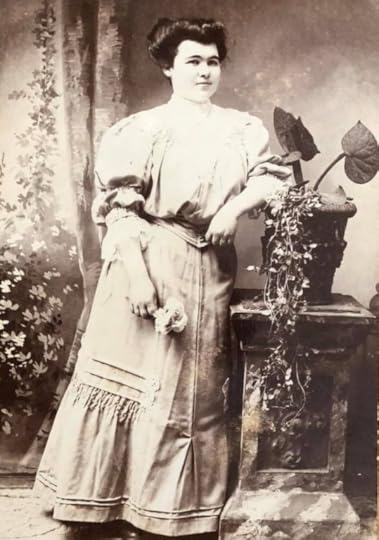
How do I even begin to tell her story? Domenica Privitera (Mamie) was a great-grandmother (but probably not in her lifetime), a grandmother, mother, and obviously, she was once a young girl. Sometimes we lose sight of that realization - that all the old people in our lives were once young. Recently, during an interview (!!) I was asked why I chose to begin Mamie's and Zina's stories when they were twelve. I guess that's an age I feel is most relatable. It's an age that is on the brink of adulthood, when we realize our future lies ahead and we are excited and anxious and impatient. It's an age when we don't yet have autonomy or authority over ourselves but we think we should. It's an age when everything is possible yet nothing is possible.
Maybe for you that age is slightly younger or older, but you know what I mean, right? I can recall myself at twelve, starting a new school and puberty, wondering about the future. It doesn't matter if the year was 1895, 1930, or 1981, facing uncertainty is ageless. We may want to grow up, but we are not sure how.
When I look at this picture of Mamie as a young woman, likely taken around 1903 when she first arrived in NY, or in 1905 after the family photo shoot when they all arrived and were reunited, I wonder about her. They didn't take other individual pictures, only hers. Was it meant for her betrothed? It's possible. But it appears to me she is posing in such a way as to portray an air of sophistication and poise, polish, and beauty, and I wonder, was this the real Mamie?
Tell me what you see. (Really, I'd love for you to comment!) Do you get the sense that she was comfortable in these clothes? Do you think she was vain or modest? Would she have seen this picture taken of her and said, "oh my, how glamorous I really am," or would she consider the whole exercise frivolous and wonder why she accommodated whoever it was that talked her into taking this picture in the first place.
Of course, how can we really know what she thought, right? But with a little insight from the facts I could gather and a little more imagination, I found a way to relate to and appreciate a woman who was so important in my grandma's life.
Now, here are those facts.
Fact One: Her birth information
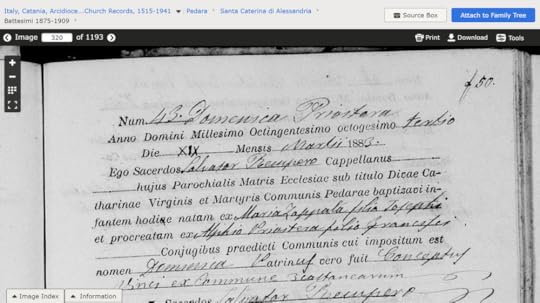
When Mamie was born on March 15, 1883, her father, Alfio, was 24, and her mother, Maria, was 20.
Here is her birth record from the church in Pedara, Santa Caterina di Alessandria, in Sicily. We find here her parents' father's names. This helped us to build the family tree. We also found out that her father, Alfio's mother's name was also Domenica, and she was named for her. Honoring their parents was an important family tradition, we see that in another one of my blogs - about Domenico - as well.
Fact Two: She was the oldest
I can relate - I am also the oldest in my family. Does the oldest typically have a certain personality? More responsibility? I think so. She might have been a mother's helper when her other siblings were born. She might have been sent on errands and asked to help around the house. Her parents may have been trying to figure out how to do the "how do we parent all these children" thing, and she was the guinea pig. There is definately something to birth order, and it likely shaped who she was. She might have been a hard worker with not that much time for herself.
Fact Three: The family moved when she was fourteen
Through her siblings' birth records we were able to trace the years the family lived in Pedara, and then we found, at the next birth, they lived in Regalbuto. I wrote about this in another blog:
So sometime after Stella was born and before Alfia, the family moved from Pedara to Regalbuto. This must not have been an easy move, since the towns were almost a ten hour walk away from each other. Why the family decided to up and move is a mystery. I imagined they would only do so if they needed to start over for some reason. It must have been a very stressful time.
So back to her being the oldest. It's likely she felt all the anxiety her parents felt. If there were financial troubles, she would have been old enough to work and contribute. She might have been dutiful and helpful. She was a young girl growing up in Pedara and moving to Regalbuto, the oldest of eight siblings - at the time. It might have been a very big deal, to move this far with such a big family.
Fact Four: (Would involve spoilers)
I don't want to spoil the book for you if you haven't read it!! Two important events of Mamie's life that I included in the book were based on pieces of information that my grandma Zina told me about her. That's as close to a reliable source as I could possibly get, those events did not get recorded in church records, I'll say that much. But because of these events, her innocence would have been erased. I'm sure this changed the way she viewed the world.
Fact Five: She came to America
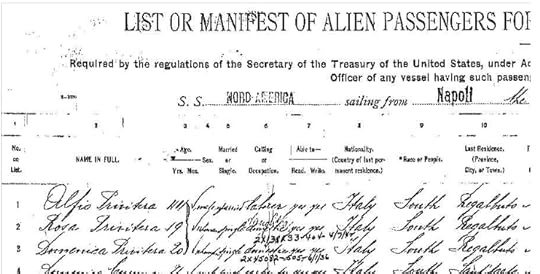
We found Mamie's ship record when she arrived in NY in 1903. She came with her father and the second oldest, her sister Rose. The rest of the family stayed in Sicily. This was an interesting fact; they did not all come at once. They came in waves, a group in 1904 then the rest in 1905; it seemed to be very systematic and planned out. It did make us wonder if financial reasons played a part in this decision. But how would this have effected Mamie?
Did Mamie look thrilled to be in America in the photo I showed at the start of our discussion? Was she ready to take on the adventure? She didn't look very happy to me, she looked a bit complacent, sullen, obliging; so from these impressions, and those I gathered from the other facts we talked about, my stories about who Mamie might have been unfolded.
I do wish I had all the facts. I wish I could turn back time and ask the right questions.
I hope anyone reading this feels the need to contact loved ones and spend some time. Ask about life; shed light with details, share truth and experiential wisdom.
Otherwise, one day, all anyone will have left is wonder.
January 6, 2024
A Privitera Timeline: 1859-1905
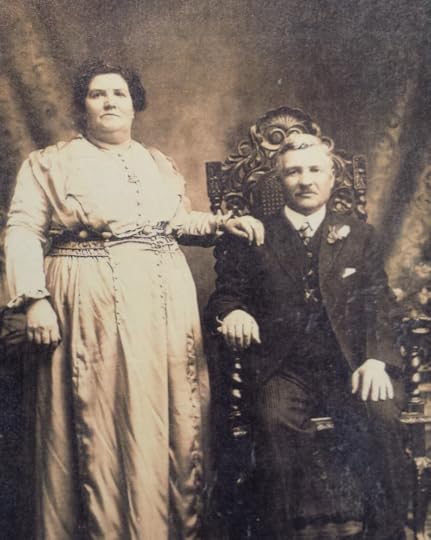
Alfio
When Alfred Privitera was born on February 11, 1859, his father, Francesco Privitera, was 33 and his mother, Dominica Barbagallo, was 28. He married Maria Zappala on May 7, 1882. They had 13 children in 21 years. He died on November 30, 1936, in Brooklyn, New York, at the age of 77.
Alfio Privitera and his family were from La Punta, and the church of San Giovanni Battista la Punta.
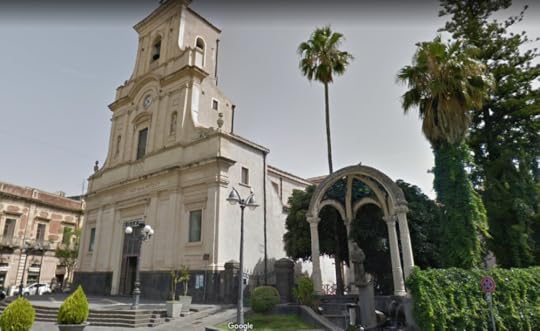
We visited this church at night, so it's not that great of a picture!
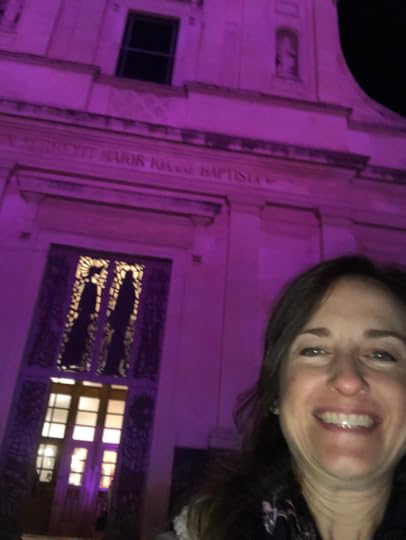
Maria
Maria Zappala was born on November 26, 1862, the daughter of Rose Rizzo and Joseph Zappala. She married Alfred Privitera and had 13 children in 21 years. She died on January 9, 1932, in Brooklyn, New York, at the age of 69.
So somehow, they met (I might have to look into that sometime) and then they were married in Pedara, Sicily, at the church called Santa Caterina di Alessandria. Maria Zappala and her family have long standing roots in Pedara. This was about an hour and a half's walk away from Alfio's home church. It was traditional for the groom to marry in the bride's church, and for the family to settle there.
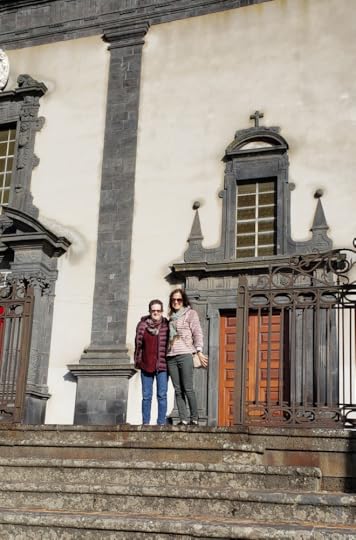
Notice in the picture: Mt. Etna in the background and her black lava rocks used to adorn the church.
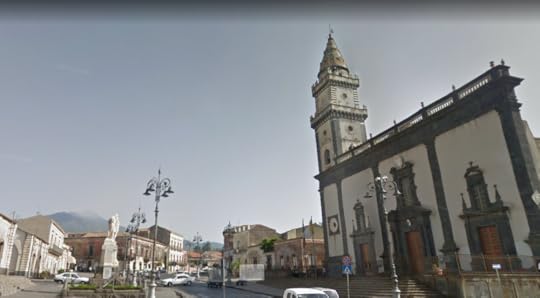
Here I am with my mom on our first day in Sicily, standing on the steps of this same church, the one we read about in every family record! Every birth was recorded here. Our ancestors could have stood in this exact spot holding my mom's grandmother as a baby!
Their Children
It was in Pedara that Alfio and Maria started their family.
Domenica was the oldest. When Domenica Privitera was born on March 15, 1883, her father, Alfio, was 24, and her mother, Maria, was 20.
Rose, born on August 16, 1884.
Domenica and Rose are a big part of Zina's story. I will share more about them in future posts!
Concetta and Grace, twins, were born on May 25, 1886. Grace passed away on June 2 that year.
Francesco, born on October 15, 1887,
Grace, or Grazia, born on May 16, 1889,
Agatha, born on April 24, 1892,
Joseph, born on September 21, 1893,
Santina, also called Sarah, born on July 19, 1895,
Stella, born on February 21, 1897.
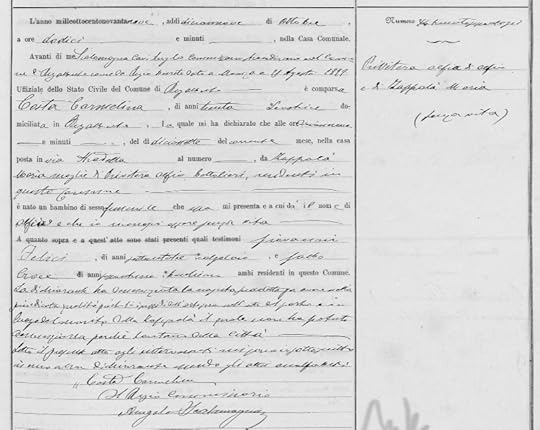
October 19, 1899, Alfia was born and died the same day - in Regalbuto.
So sometime after Stella was born and before Alfia, the family moved from Pedara to Regalbuto. This must not have been an easy move, since the towns were almost a ten hour walk away from each other. Why the family decided to up and move is a mystery. I imagined they would only do so if they needed to start over for some reason. It must have been a very stressful time.
Here is Alfia's birth/death record. "Senza vita" means she was born without life, so sad.
Then, Mary was born on April 24, 1901.
The family began their plans to leave for America, starting in 1903.
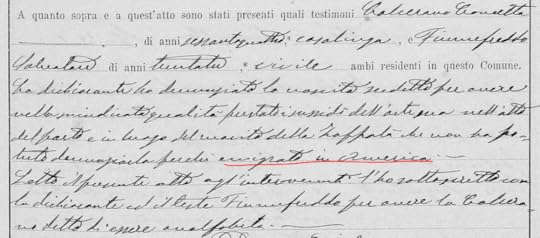
Giovanna, the goodbye baby, was born in 1904 but passed away six months later.
When Giovanna was born, Alfio was already in NY. Interestingly, the records actually state this! I'm sure the birth was an embarrassment to Maria, needing to explain that she did indeed have a husband because that fact had to be confirmed and recorded!
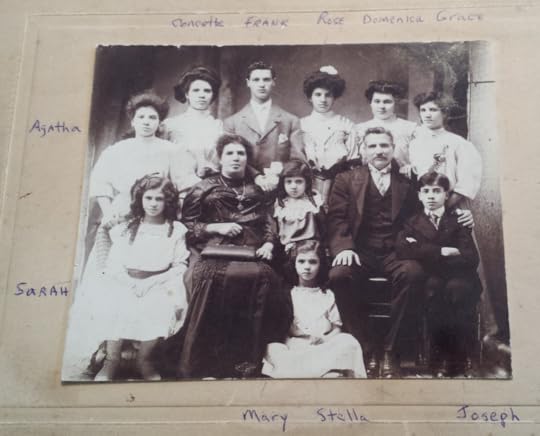
This is the surviving family when they made it to New York after travelling in 1903, 1904 and twice in 1905 to get the entire family across the ocean. This picture was taken in NY probably shortly after Domenica was married, in 1905. I will share more about this in my next post.
Thank you for visiting!
December 14, 2023
The Root of the Story
Grief leads you down paths you don't expect. The starting point for the idea of the story was probably somewhere between thirteen and fifteen years ago when first my grandma, Zina, passed away in 2008, and then in 2010 when my grandpa, Frank, joined her again. My path led me to wanting to find a way for their lives to continue touching mine and my children's.
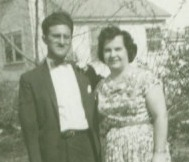
So I started to write down some memories. The cherished little moments of life; like how their butter tasted better on English muffins than mine at home. Or how grandpa used to shake my hand, like my arm was rubbery. He did it to all of the kids. My kids called him "shaky hand grandpa" for lack of a more imaginative description. Or how he kissed both my cheeks when he said hello or goodbye. Not a typical greeting; but I could relate. I kissed my kids that way too because one kiss was never enough. (When we went to Sicily in 2019 and everyone was doing it, I imagined my grandpa chuckling.)
Grandma was a complicated lady. Full of love; but it seemed difficult for her to express. Full of generosity; she was always finding a way to satisfy a need - whether with scrumptious homemade cooking, or crocheted blankets, baby sweaters, or booties - for the whole family. She had a special and unique upbringing that shaped her into the woman I knew as grandma. As I got older, the influence of her life events made more and more sense to me about how it affected her. So I tried to see the world through her eyes.
Those visions became little stories. Can I be a fly on the wall in the past? When grandma found out her family's secret about who she really was, what would that fly see? I wanted to understand her life. I wanted to give her a voice to explain to me what it was like for her, how it made her feel, and what she thought about it as she probably tried to understand why it all happened.
The little stories began to fit on a timeline. My mom began a genealogical trip probably ten years before my grandparents, her parents, passed away. Researching documents in Sicily was easy because we knew the towns they were from. My mom went to Family History Centers, even the one in Utah, and pieced together parts of the family tree. My grandma loved it. All except for the part that we could not find her real father's family. Then all of the records became digitized. My mom quickly became a devoted on-line historian and keeper of the family tree, gathering names like she was raking leaves. As she found names, I got inspired. I saw in the records the places, dates, and connections. I tried to imagine how they met. How did they get from there to here? What was that like? And my stories grew.
Finally, I realized it was 2018. Seriously? Remember it's the little details that bring meaning, right? So 2018 marked 100 years after my grandma was born. My grandpa was one year older than she, and met her when she was a week old. So I realized that year marked a centennial moment. I would have loved to have a family reunion of all the Vincenti family. A Vincent-ennial. It would have been perfect. Except for logistics, time and money.
So I decided to mark the moment by finishing my manuscript. The little stories became organized and intertwined with the history and family memories. My imagination, a fly on the wall perspective, and all my mom's research began to form into pages and chapters.
Now I am on the journey of sharing it with more than just my mom and sisters, aunts and cousins. I think Zina would get a kick out of being "famous" and her story being told to many. So as my story of Zina unfolds, thank you for joining me :)
December 2, 2018
More about Chapter 1- Zina and her Little Book
My grandma, who became grey and shorter as I got older, whose laugh I can still hear when we play cards, who I can still see in my mind's memories when I look at the blanket she made me or when I think of Christmas cookie baking; my grandma once was a twelve year old girl.
How to imagine someone's childhood when decades separate you? This was probably my most favorite process in developing her story. When I started writing, my two youngest were in their early teens, so to imagine my grandma as a friend or cousin to them, having feelings and thoughts about growing up that transcend time; endeared young Zina to me even more.
Of course I had to take some creative licenses to her days; how she spent them and with whom. The genealogical records of birth, marriage, or even census records can never say what colors she loved or what season she looked forward to. So these things I lent her: details from my own childhood and memories my mom and her sister shared of their lives. So Zina journaled on dates that are family birthdays, she looked forward to foods we still make as traditional holiday food, she laughed or marveled at things my grandpa did or said when we were kids, but she experienced them for the first time in the story.
Of course there were details that were indeed real and concrete; things that would have been puzzling to just find as an artifact in a shoe box, (and I did actually find something odd - the amulet from Zina's story - more on that another time) if we did not know some of Zina's story from her own voice.
When I was in college I asked her about her life for a Family and Consumer Studies research paper I was to write. She told me some of her memories, feelings, regrets; I wrote them down then, never knowing how cherished it would be today and always.
One thing Zina told me about was taking a train to school and carrying all of her heavy books. She told me about having to go to school to be a translator. She said she wasn't happy about it. I made sure I included this life detail in her story, as if she was telling me her thoughts when she was going through this time of her life. Of course, the journal itself is fictitious, no such book exists, but I wanted to give young Zina a voice which echoed Grandma Zina's interview for that college paper.
So I dove into the details I knew about. When I looked at a map to see where Lloyd Court in Brooklyn, where they lived, was located in comparison to David Boody Junior High School; I saw they were in walking distance. My mom had this pin from my grandma, so she may have actually graduated from Boody JHS in 1933, or it marked what class she would have been in - the class of 1933 (graduating to HS, this was a middle school). So she must have changed schools at one point. Boody would not have been a train ride away.
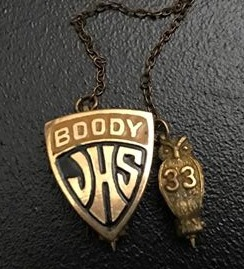
But my mom also had this paper. We've probably overlooked it so many times, and its so interesting that my grandma would have kept this; I can't imagine why.
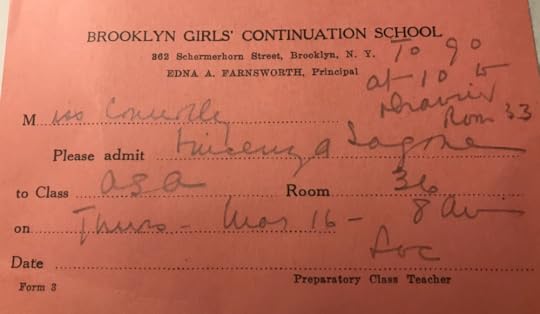
A building still exists on Shermerhorn street, which could have been the same place as this school. I mapped out a train route from her house on Lloyd Court to this building. She had a long trip everyday and I was able to google the transit information and see how long it truly was.
There is no date on this "hall pass," and after I wrote the story I noticed that it does give a clue - Thursday March 16. The year that March 16 falls on a Thursday is 1933. I considered changing the year in the story but that was too complicated for a small detail.
I do think that Zina being in 8th grade in 1933 makes more sense than in 1930. I think she might have only completed the eighth grade, I have to find that information, but it wasn’t important in the story except to say that her parents may have finally heeded her wishes of no longer attending to this school. Perhaps this little pink paper was her last memento of attending a school she didn't wish to.
Creating the story in 1930 was purposeful. I used my memories of Grandpa for this. Grandpa, Frank, did love wordplay, palindromes, puzzles, and any sort of existential mystery. The dates in the year 1930 were full of palindromes so I colored in Zina's journal with dates that would make grandpa smile; as if we were sharing a secret code.
Grandma told me about Frank in the interview, some games they would play like stickball and roller skating. Frank told me about Zina one day after she passed; how beautiful she was and how he loved her his whole life. I built on this foundation and hoped to create a sweet young budding relationship to honor his lifelong feelings.
So this is how Chapter one of my book starts, with a little "more." Thank you for reading!
December 1, 2018
Domenico Brex - the Domino Effect
How do you piece together someone's life when all you have is a paper trail?
Domenico, or as I call him in my book, Dom, was an interesting character to write about. Zina called him "Uncle Domino" in the story, which was fitting - his actions caused a "domino effect" that shaped everyone.
When we first asked family members about him, we heard many rumors surrounding his immigration to America: why he came and how. He died in 1937, so all we had were stories from fuzzy memories, and it felt like the old game of telephone. So, my mom and I did some research to try to piece things together. Of course these pieces were only the first step, I will write more about the rumors later ;)
First piece: He was born (obviously)
When Domenico Brex was born on February 7, 1870, his father, Vitus (whose father was also named Domenico), was 30, and his mother, Guiseppa Timpanaro (whose father's name was Carmelo), was 22 years old. They were married in 1865. Here is a screenshot of that record.
Side note: the word figlio (or figlia) was commonly used in church records directly following the person's name - meaning "son of" or "daughter of." So when I mention Vitus and Guiseppa's fathers' names in parentheses here, it is actually in keeping with how records were commonly noted in Sicily - of course the records below in these screenshots are worded differently - a mix of Latin and Italian :)
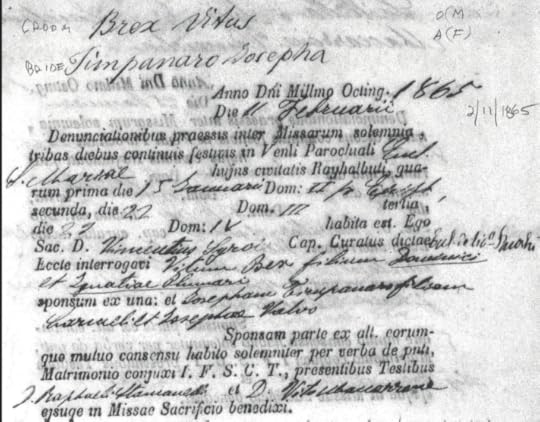
Below is a screenshot of the birth record of Domenico, from Regalbuto.
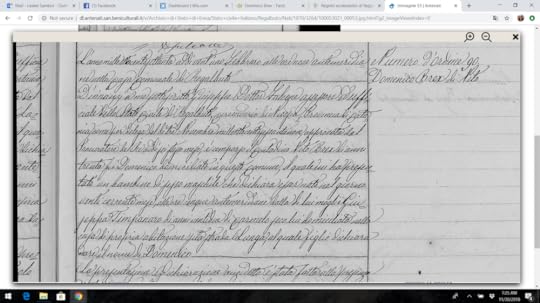
The first red line on the next screenshot (below) indicates where it states "Vito Brex of thirty years, of Domenico" (his father,) the second red line indicates where it states "Guiseppa Timpanaro of twenty-two years of Carmelo" (her father.)
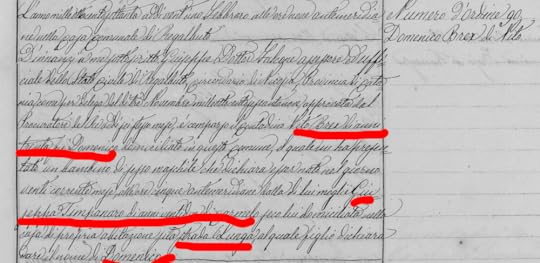
The third red line actually shows where he was born. Here you can see it is written, "strada Lunga". This is the street name! I'm still trying to find it on the map. It is possible that the name was changed over the years, but look at this current map of today:
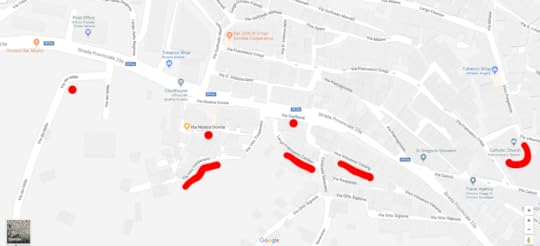
This is a section of Regalbuto on Google Maps. Notice on the far right is San Basilio, that is the church in which we found many records for the Brex and Timpanaro families, online. The three dots are also interesting things to note. I will probably do another blog or two on them as we go. Two are named for historic significance- Garibaldi, and the March of the Thousand Men. The other we found in records when we researched the period when Domenica Privitera's family moved to Regalbuto. The three lines that "underline" streets are the same surnames we found in our family tree. Timpanaro, Cardaci, and Catania are ancestors, so a guess might be this is the area that the family may have lived.
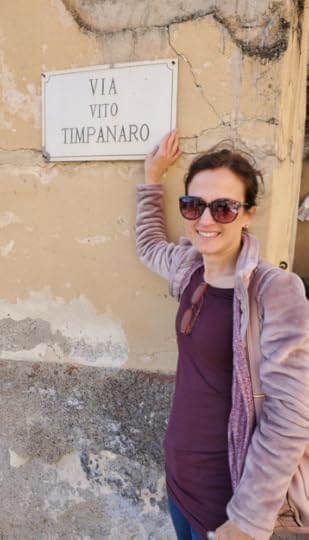
Here I am standing by a sign for Via Vito Timpanaro when we visited Regalbuto in November of 2019. Was he a relative of Domenico's mother? Possibly!
Okay, I am digressing quite a bit here! So getting back on track.
Second piece: His childhood
Domenico was the first son born to Vitus and Guiseppa. They first had 2 daughters, Gratia and Maria. Gratia married Vito Marraro, had three children, and she lived to be 69. Maria married Vincent Catania and had 5 children. She died at age 63. These sisters stayed in Regalbuto as far as I know.
After Domenico was born, Vitus and Guiseppa had 6 more children. They all died in infancy. What could their parents have felt all this time? They were probably trying so hard to have their family thrive only to be struck down over and over. Was it due to poverty? Poor health and living conditions?
Josepha was born in 1872 and died in 1873.
Another Josepha was born in 1874 and died in 1875.
Vito was born in 1875 and died in 1877.
Another Vito was born in 1878 and died the same day.
Angelo was born in 1879 and died in 1881.
Carmelo was born in 1882 and died in 1883...
Note: Naming conventions were very traditional in Italy. Children were often named for other family members, so if one child died, they often would use the name again for another so that they may still have the opportunity to honor that family member - regardless of gender. The "root" name would just use a masculine or feminine suffix.
Another Angelo was born on October 22, 1884. At this time Domenico was fourteen years old.
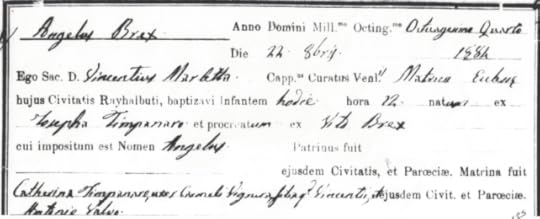
I imagine the family was relieved at every birthday milestone this Angelo hit. In 1887 he turned three, and that was older than any of the previous six children had the chance to be.
But then, another tragedy struck. Vitus, Domenico's father, passed away on March 22, 1887, at the age of 49. Guiseppa was pregnant at the time. On May 26,1887 that baby, Vita, was born and passed away the same day.
Now, Domenico was seventeen. He had a three year old brother, and an understandably very sad mother. What would he, as a young man, be feeling about the hand he had been dealt? Did he try to be the man of the house, take care of his brother and mother? His two older sisters married and moved out before their father died, so they had their own families to tend to.
So I imagined Domenico felt a sense of responsibility. He probably felt badly for his little brother and didn't want him to grow up without a father, so he stuck around.
But his mother, Guiseppa, had an idea about that as well. She remarried. Guiseppa Timpanaro married Vincenzo DiBattista in September 1890 when she was 42 years old. Vincenzo was only 30. He was ten years older than Domenico. I imagine Domenico may have resented a stepfather so close to his age. In my book, Domenico remarked that they were closer in age than he was to his own blood brother, Angelo, and Vincenzo was to be a father figure? Right? So what were they all thinking?
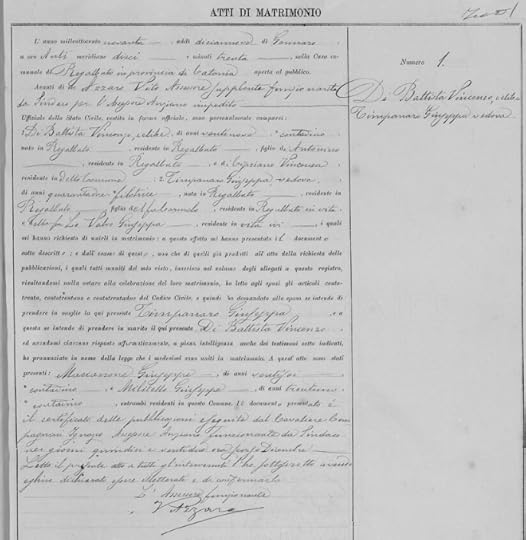
Third piece: He Left for America
In my story, I felt that Domenico would have planned to leave for America right after his mother remarried. I believe he immigrated in 1895 (some say as a stowaway, some say he traveled with his brother Angelo - but we found Angelo came later in 1898 when he was thirteen.) Why wouldn't Domenico have waited until Angelo was older and travel together? It seemed Domenico was anxious to leave as soon as he could, and the rest of the reason may have been financial. Neither Domenico's mother or the man she married ever came to America, so theirs wasn't a typical family bond. Domenico left everything behind, but he made provision for his brother to leave too.
Here is a screenshot of what I believe to be Domenico's immigration record. He traveled alone, a peasant, no luggage, and his age was about right. (These things were not always accurate, often the person didn't know exactly how old they were!) He was heading to NY. We know NY was his destination because he was there when Angelo arrived - on Angelo's immigration record, but more on that in a future blog.
What was this journey like for him? How did he feel leaving his mother and young brother? Was he scared? Nervous?
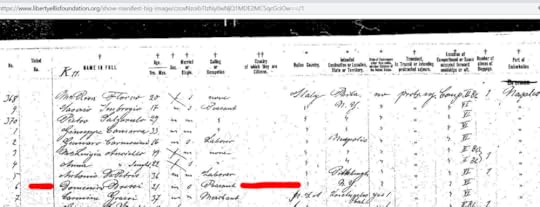
I kept in mind some of those family rumors surrounding why he left Sicily while I told my story - rumors of a curse, murders, and secrets. Did you notice the difference in how his name is spelled here? Brex is now shown as Bressi. If you say them both with an Italian accent, they sound very similar. Which led me to another set of questions; was this misspelling a result of Domenico's illiteracy, poor documentation at Ellis Island, or part of an escape plan - done for protection? More on that too, later!