
Jonathan Ingram's Blog
February 26, 2021
Flat Spot On: Earnhardt's Crash -- The Man & the Myths

Safety is again in the forefront this year in NASCAR, because it’s the 20th year since seven-time Cup champion Dale Earnhardt was killed on the last lap of the 500 in 2001. That crash turned out to be one of the most controversial in NASCAR history for a variety of reasons. Time to sift the facts from the myths.
MYTH: It wasn’t that serious of a crash.
The facts: When Ken Schrader’s Pontiac hit the black Chevy of Earnhardt, it added 9 to 11 mph according to the highly detailed NASCAR investigation, shortly before it hit the wall. In addition, the car was turned from a glancing angle toward a straight-in impact on the right front corner. The impact moved the transmission housing back three inches, indicative of the amount of energy involved.
MYTH: A SAFER barrier might have saved him.
The facts: Each crash has a moment of peak energy transfer. The Delta V measures the change in speed from start to finish during the milliseconds of an impact. If it’s more than 40 mph, the peak energy will be enough to create fatal tension in the neck leading to a basal skull fracture absent a head restraint. That’s true even with a SAFER barrier. The Delta V in the Earnhardt crash was measured at 42 to 44 mph.
An “elongation” of the elapsed time of an impact takes place as a SAFER barrier is crushed, but there’s still a peak moment of energy transfer.
MYTH: Weekend warriors enjoyed better safety thanks to the changes implemented by NASCAR, which mandated head restraints for its major traveling series in 2001, and CART, which mandated the HANS for ovals in 2001 and for all races in 2002.
The facts: In the ten years following the Earnhardt crash, the number of driver deaths in U.S. racing due to crashes increased compared with the 10 years prior to 2001. (The Charlotte Observer conducted these two surveys from newspaper reports of incidents at local tracks across the country.) Short tracks and drag strips eventually had the same problem that plagued Formula 1 first, then Indy cars and finally NASCAR. Technology led to cornering speeds that exceeded the capacity of cockpit and driver safety equipment. Think powerful crate motors and much stiffer chassis as technology trickled down. Unfortunately, safety didn’t always trickle down with the go-fast technology.
MYTH: Earnhardt loosened his belts in the late stages of races so he could move around better in the car.
The facts: Only armchair racers believe in this urban/rural legend. Earnhardt’s lap belt broke because it stretched as a result of being tight. The belt being mounted about eight inches too far back contributed to the stretch problem. The fibers began to tear and the belt got caught in the adjuster. Had the belts been loose, the driver would have slipped out and gone through the windshield. As it was, the belts held him before “dynamic overshoot” predictably resulted in too much neck tension.
MYTH: Earnhardt died because his head hit the steering wheel and he wasn’t wearing a full-face helmet.
The facts: A multi-car incident just a few laps prior to the Earnhardt crash left Tony Stewart with a concussion after his head hit the steering wheel. Whether it was head whip or contact with the steering wheel, excessive neck tension resulted in Earnhardt’s fatal skull fracture. A full-face helmet protects the head and is not designed to prevent neck tension.
MYTH: The lap belt was cut after the crash by a worker at the scene.
The facts: The belt’s ripped fabric confirmed it was torn after “dumping” occurred, when it got caught in the adjuster due to stretching.
MYTH: A HANS Device would not have saved Earnhardt.
The opinions: NASCAR’s own investigators privately believed a HANS Device would have reduced the neck tension enough to prevent a deadly basal skull fracture. Jim Downing, whose company developed the HANS along with inventor Bob Hubbard, believes the seat belt would have remained intact long enough to sufficiently reduce the neck tension.
NASCAR drivers Ernie Irvan and Stanley Smith each survived basal skull fractures in the 1990s, because of prompt medical care and their bleeding was not sufficient to kill them. Future world champion Mika Hakkinen survived a basal skull fracture at the Australian Grand Prix in 1995, again due to prompt medical treatment. When severe, a basal skull fracture results in a fatal loss of blood from the arteries and veins that run from the neck to the head in a matter of seconds.
MYTH: The fatal ARCA Series crash of Blaise Alexander at the Charlotte Motor Speedway in October of 2001 forced NASCAR to mandate head restraints.
The facts: NASCAR’s investigation of Earnhardt’s crash led the sanctioning body to conclude it had to change its safety policy, previously built on the legal premise of not mandating anything that might fail, a policy which also included helmets and fire suits. (Drivers used them voluntarily.) It took several months for NASCAR to make sure its teams had the proper seats, harness installations, and head surrounds before manding head restraints. Otherwise, the HANS could have been subject to failure and a liability suit. The goal was to have teams fully compliant with cockpit installations in time for Talladega in October of 2001 and the following races, including Charlotte.


December 1, 2020
Flat Spot On: Grosjean's 28-Second Escape Took Years of Safety Work
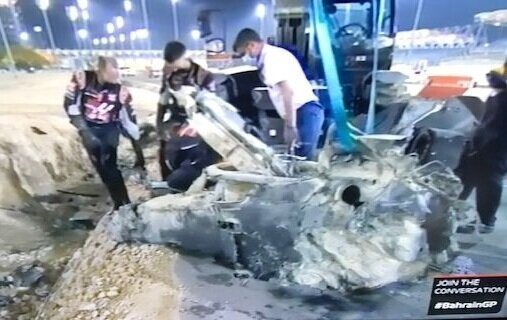
In the aftermath of Romain Grosjean’s ability, thankfully, to get out of a car torn in half and engulfed by flames during the F1 race in Bahrain, here are ten insights from the long view of history and my book “CRASH! From Senna to Earnhardt — How the HANS Helped Save Racing.” For more info visit www.jingrambooks.com
1. Grosjean, who climbed out of the flames 28 seconds after his Haas sliced through an Armco barrier, is one of thousands of lives saved by a commitment to safety by the FIA.
How so?
The safety cell that remained intact, despite an impact of more than 50G, was strengthened by an FIA mandate in 2001. OK, not so unusual. Well, under Max Mosley, the FIA was also actively introducing its European New Car Assessment Program for highway cars. After strengthening the rigidity of F1 cars by a factor of three and adding a new intrusion test, the FIA tied F1 to highway safety by using the sport’s engineering expertise to evaluate highway cars.
In the aftermath of criticism that Ayrton Senna’s death demonstrated F1 had no moral value, the FIA created the New Car Assessment Program. It forced car manufacturers to upgrade the structural integrity of their highway cars by giving every new car a grade of one star (dangerous) up to five stars (highest safety standard). While not legally binding, the public attention forced manufacturers, which had successfully lobbied the European Union against such changes on the basis of cost, to improve their cars. Renault was the first company to endorse the NCAP. To say it has saved thousands of lives and critical injuries in highway crashes is probably an understatement.
2. Had Grosjean been wearing a Nomex fire suit that met only the FIA’s standard for flame retardation, he might have perished. He escaped from his car in 28 seconds. The minimum standard for a fire suit at the FIA? Twelve seconds.
3. The FIA made massive changes to tracks in the aftermath of Senna's crash to reduce exposure to dangerous runoffs, hobbling some great tracks and corners. The sanctioning body clearly missed the mark in Bahrain with the location and angle of the exposed Armco barriers hit by Grosjean's Haas.
4. The last driver to die due to a fire in an F1 car was Elio DeAngelis. He died in a testing accident at Paul Ricard on board a Brabham BT55 in 1986. A small fire erupted. Trapped in his car, the Italian eventually died of smoke inhalation. Where was the safety crew? There wasn’t one. A far cry from the FIA’s chase car with a doctor on board following the field at the start of the race in Bahrain, a standard procedure.
5. When Max Mosley sold the marketing rights for F1 to his longtime associate Bernie Ecclestone in 2001 for $360 million, it eventually led to the halo – which also was instrumental in saving Grosjean.
The money from the sale of marketing rights to Ecclestone was used to create the FIA Institute. The establishment of the Institute, whose first president was Dr. Sid Watkins, created the resources and commitment needed for new safety developments. Over a decade later, one of the Institute’s many initiatives became manifest in the form of the halo—following the fatal head injury to Julian Bianchi resulting from a crash at the Japanese Grand Prix in 2014.
6. Bianchi’s head injury claimed his life in the following year, 2015. If Grosjean had perished, he would have been the first to die in an F1 car on live television since Senna in 1994 at Imola. That produced enough outcry to launch the safety revolution leading to Sunday’s thankful and safe outcome. Among the many disapproving accusers after Senna’s death – L'Osservatore Romano, published by the Vatican.
7. Bernie Ecclestone, who owned the Brabham team when De Angelis was killed, was a strong safety advocate for F1, although he gets little credit. Ecclestone hired Dr. Sid Watkins as the first Medical Officer in 1978 and eventually paid for the construction of hospital-quality trauma units at each track visited by F1. Watkins was responsible for the chase vehicle that was first on the scene after Grosjean’s crash, driven by Alan van der Merwe with Dr. Ian Roberts on board. It is one of many significant improvements pioneered by Watkins.
8. Mercedes helped HANS Performance Products design a slimmed down version of the HANS after Mika Hakkinen was almost killed by a basal skull fracture in a crash at the Australian Grand Prix in 1995 — 18 months after Senna’s death. CART was also instrumental in the development of the HANS, mandating the new Model II device in 2001—two years before it became mandatory in F1. It was the use of the HANS by CART drivers, who each had a custom-made device, that enabled HANS Performance Products to produce a universal fit. Due to fit issues, F1 teams and drivers resisted using it for two seasons until the CART-developed universal device, created by Jerry Lambert at HPP, became available.
9. General Motors offered to make a custom-built HANS Device available to Dale Earnhardt, which he declined, prior to the Daytona 500 in 2001, where he suffered a basal skull fracture on the last lap. Would a HANS have saved Earnhardt? Yes. Although unconfirmed by the sanctioning body in its official crash investigation, NASCAR’s own investigator privately acknowledged to his colleagues the HANS would have saved Earnhardt.
10. Both the halo and the HANS were met by resistance from the majority of F1 drivers—because they find it difficult to accept changes to their cockpits. In this respect, they are like most high-performing athletes who are wedded to routines they know work under conditions of great stress. These athletes need outside assistance when it comes to change. To call them out after the fact—including Earnhardt—for resistance to safety is a disservice to them and the sport.
March 5, 2020
Flat Spot On: Safety Revolution Saves Newman
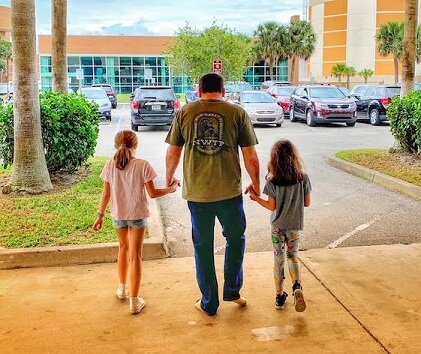
Newman and his daughters leave thospital two days after Daytona crash.
For a guy who recently finished a book on some of the deadliest years of professional racing—and the safety revolution those years spawned—I felt strangely numb the day after Ryan Newman escaped from his finish-line crash on Monday night in Daytona. A brutal series of events, the crash included four different circumstances in a couple seconds that can potentially kill a driver.
The end of this Daytona 500 was like a near death experience, except not your own. Once the thankful outcome became certain, there’s an aftermath. Relief comes first and before nagging doubts finally pass in one last shudder of horror.
On Tuesday, I found initial relief in some thoughtful online comments plus the professional work of a couple of fellow commentators. Writer Ryan McGee and broadcaster Ricky Craven helped sum up that whole oddball process of a brilliant racing enterprise, invariably part ritual and part magic, turning into something else.
Those two summed up the nagging doubts that creep in when the close-to-the-bone nature of racing gets revealed and how the sport’s community of participants and fans face up to the reality of the mechanized, ritualized danger. Oh, there was plenty of standard stuff out there, too. Some expressed their doubts by criticizing the drivers—or NASCAR for how it operates the races on the Daytona and Talladega tracks. Some took it as an opportunity to express envy disguised as sarcasm, because NASCAR’s stock cars and drivers are so popular compared to their own preferred style of racing.
In fact, the Daytona 500 requires each driver to make critical split-second decisions at sustained speeds of 200 mph during every lap. If it becomes a race of cautions and attrition, well nobody complained in the years when only three or four drivers finished on the lead lap.
I felt lifted, and fully relieved, at the end of the day on Tuesday when I came across one road racing photographer’s Facebook post that was a funny take on his family members’ relative lack of racing knowledge. It underscored that everybody, not just race fans, were talking about Newman’s crash. (This was a particularly poignant as well as funny post considering the family has been fighting, successfully, alongside a teenage son in his battle with cancer.)
The potential for gut-wrenching outcomes have always been there in racing and will continue. Monday night’s crash, for example, was a reminder of Sebastien Bourdais’s head-on collision with the barrier at Indy during qualifying for the 500 in 2017 at a speed of 227 mph. The difference was the French driver, who suffered a fractured pelvis and broken hip, remained conscious and alert afterward, immediately easing fears of the worst-case scenario.
The replays of Newman’s finish-line crash will be replayed ad infinitum—because the driver survives to tell about it. I like this element, given that I wrote a book titled “CRASH!” containing voluminous research on how the safety revolution brought racing to the point where this kind of crash can be survived.
The safety revolution occurred across all the world’s major racing series. It started in Formula 1 with the death of three-time world champion Ayrton Senna in 1994. CART simultaneously began making major safety improvements after the injurious crash of two-time world champion Nelson Piquet during practice at Indy; CART became the first to mandate the HANS device prior to the 2001 season. The movement then came to NASCAR as a result of four driver deaths over a nine-month period, including Dale Earnhardt’s last-lap crash at Daytona. Given that these series operate in their own orbits and fans often do likewise, very few fully recognized how the safety revolution actually occurred. And how decisions in all three of these series helped make it happen.
The book is subtitled “From Senna to Earnhardt” for this reason. One could argue that their deaths—the great F1 champion from an errant suspension piece and Earnhardt from a basal skull fracture—during races watched by tens of millions of fans on live television were the two biggest events in motor racing in the last 100 years. After a full century of professional racing where death was commonplace, organizers realized, as we all did on Monday night, the sport simply could not be sustained if it continued to kill its drivers on live television.
There’s a touch of controversy to the book, because it’s based on the idea that the brilliant work of so many dedicated racing professionals to achieve the safety revolution might have faltered absent the HANS Device. That’s the organizing principal of the story and the reason for the other subtitle: “How the HANS Helped Save Racing.” I worked directly with HANS inventor Dr. Robert Hubbard and his business partner, five-time IMSA champion Jim Downing, to write the book. But the thesis is entirely mine. Resolving the issue of basal skull fractures was the one thing sanctioning bodies could not figure out entirely on their own. During the 1990s, this type of injury was the most frequent cause of death or critical injury in all forms of major league racing around the world.
There’s no doubt all the elements of safety developed by NASCAR came into play on Monday night. The cockpit safety cocoon with its carbon-fiber seat, six-point harness, the head surrounds and a head restraint were the first line of defense. The SAFER barrier did its job—which includes sufficiently reducing g-forces so that the cockpit restraints could do their job without being compromised. The impacts of Newman’s Ford getting hit in the door and then the final impact of landing on its roof – in addition to the initial impact with the wall – all showed the value of NASCAR’s Gen 6 car construction requirements.
When it comes to safety, NASCAR operates from its own dedicated Research and Development Center in Concord, N.C., which makes it the world leader. (The FIA’s Formula 1 and IndyCar must rely, in part, on vendors instead of a fully equipped staff under one roof.) Although it’s not really feasible, I, for one, would like to see the in-car video from Newman’s cockpit taken by one of the recent innovations of a digital camera installed to observe what happens to the driver during a crash.
It’s not as if the safety revolution stands still. F-1 has introduced the life-saving Halo and IndyCar enters the 2020 season with the first generation of the Aeroscreen in place. Roger Penske’s ownership may yet lead to improvements in track fencing for open-wheel cars. Competitors to the HANS have emerged and the cost of a certified head restraint continues to decrease without a compromise in safety. (My favorite new arrival is the innovative Flex made by Schroth.) Weekend warriors can no longer offer the excuse that head restraints, which are needed in all forms of auto racing, are too costly, too uncomfortable or don’t fit in their vehicle.
History reminds us that far too many drivers died while Rome was burning and before the major sanctioning bodies recognized they needed to apply their technical and financial resources to greatly reduce the chance of death behind the wheel. The sanctioning bodies realized they had to act to save a sport dependent on the fan appeal of star drivers and dependent upon participation by car manufacturers, TV networks and corporate sponsors. Monday night was a reminder they did the right thing.
January 1, 2020
Flat Spot On: It's Junior Johnson. Yes!
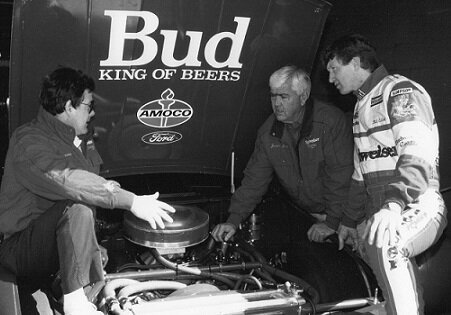
Johnson, here with Crew Chief Tim Brewer and Elliott, never let up.
Some ten years ago, on a Sunday prior to the start of the Daytona 500, I sat in the eating area of the Daytona track’s media center, ho-humming. Free food is always a major calling card and the place was jammed. Quite unexpectantly, I heard Junior Johnson’s booming voice over my shoulder. “Ah’m sitting he-ah!” he declared, grabbing a chair from another table and pulling it up next to me at a blank spot left open at the table where I was sitting.
To promote his deal with a legal moonshine brand, during the pre-race morning hubbub I had seen Junior in the passenger seat of a golf cart, which was dodging fans milling through the garage and pits amid forgettable public address pronouncements. These PA pronouncements were akin to the radio ads Tom Wolfe claimed to have heard in the mid-1960s while going to the North Wilkesboro Speedway in pursuit of his story “Junior Johnson is the Last American Hero. Yes!” Wolfe recalled something funny, bawdy and probably untrue about a labial cream ad, which sponsored a couple of talking pointy heads who filled the airwaves with the usual useless crap about the state of things in the South.
On this day, Junior was with two young PR reps, the prim female proudly driving the cart straight-backed, arms fully extended, and the other directing from the rear-facing back seat by cocking himself sideways and leaning forward. They kept Junior, who always traveled in style and often as not with moonshine, moving. The whirlwind single-cart cavalcade, which included a carboard carton of the officially labeled—and taxed—moonshine, did not hesitate, an effort to prevent fans and gawkers from bird-dogging Junior for autographs. Once stopped, Junior had a penchant for everyday conversation with racing people who initiated one, so the youngsters kept the cart moving. Junior held his usual deadpan face and wily, knowing eyes as the cart trundled through the milling fans, destined for another pre-race appearance. No time for talk with the Last American Hero.
Once they’d arrived in the media center lunchroom, I’d like to think that Junior recognized me from all our conversations in the garage over the years. Invariably, those garage exchanges were about matters at hand in the conduct of NASCAR’s version of stock car racing, so Junior understood me to be about racing and not chit-chat. It was probably more a matter of getting away from the two young PR reps, who possibly had the bright idea of incorporating the media members on their tour by stopping in for a pre-race lunch. Junior ditched them in a heartbeat. “Ah’m sitting he-ah!” The words, as always, came from the deeper regions of his ample throat and upper chest.
Here was the man who loved to see his hunting dogs go at it with a cornered coon, the blood-curdling ferocity rising into the night as razor-sharp claws and ravenous teeth fought to the death in the nether regions of the North Carolina forest. Here was Junior, ready to talk about racing, ready to reveal his philosophy and none of his secrets unless you asked the right question. Even then, the coon hunter often played possum. Like Wolfe, who had to get with the people of Wilkes County, you had to get with the people in the garage to crack into the legend when it came to racing.
Wolfe’s story helped make Robert Glenn Johnson Jr. a household name beyond the established shores of stock car racing in the Southeast. Within his own territory, Johnson’s bootlegging and stint as a federal guest at Chillicothe, the lurid, hellbent slides through the corners on dirt tracks, the drafting that brought him a Daytona 500 victory in 1960, the dust-ups with the likes of Lee Petty, and a philosophy that it was OK to beat the hell out of somebody who deserved it, this all preceded him whenever he curled that hefty body through the window and into a stock car. Throughout his driving career, people loved him or called him out with words like “Hog-jaw!”—from a safe distance. Like frat boys hazing a hulking college football player in a campus bar, the name callers were looking to pole-vault into another man’s success built on physical prowess and intimidation and just sheer horse’s ass cockiness.
In his story, Wolfe studiously ignored the word redneck, the “r” word for white Southerners. In fact, it had proud origins and came from the red bandanas the reprobates in the Scottish Lowlands wore around their throats when defying the English army’s efforts to keep coming north. The brave-hearts of Jack the Bruce became the Scots-Irish who eventually careened all over the Appalachians from Pennsylvania down to Alabama. The Lowland Scots fancied mobility as a form of survival from the start, often finding themselves on different sides of the same coin in this pursuit of the next horizon. Having failed to establish a boundary with the English, they soon got up and went—taking an offer of free land in Ulster, boosting the English crown’s stake in Ireland. It was all about land and freedom. Finding the Ulster Plantation not much to their liking, the Scots-Irish, proud rednecks, migrated again to America, heading for the next horizon so long as it was isolated enough a man could do as he pleased with his passion for land, independence, self-determination, and loyalty to like kind. The kinfolk, including hard-working and tough women, sustained life in a difficult environment that yielded little but independence. Meanwhile, the loyalty to like kind could just as easily turn into virile and violent differences of opinion, not unlike coon dogs and raccoons. This tendency toward violence, according to “Hillbilly Elegy,” included women, too. No wonder they often showed up in rough-and-tumble short track grandstands.
Hello, Junior—a man who became the face of the 20th Century South’s melting pot where the Scots-Irish values incorporated the English (see Petty) and the Germans (see Earnhardt). Stock car racing, it turns out, was nothing more, or less, than the Lowland Scots and their allies against the Establishment once again. It was the rowdy rebellion of the lower orders in the South, again hung up on mobility, this time in the form of the automobile. I saw this as a boy when a carpenter would visit our house in Northern Virginia to help my father finish the basement, driving from the hinterlands of West Virginia in a low-slung, dust-covered Chevy with a burbling engine. I also saw it at the Beltsville Speedway in Maryland. A man could be loyal to the cherished land and still make a living with an automobile without giving up freedom, which often enough manifested itself as driving stock cars on Saturday nights. The whole wild thing with cars had an appeal as combustive as gas mixed in multiple four-barrel carburetors, swirled into gigantic cylinders, then hammered by big pistons, rushing to the glorious judgement of a spark. This mobility and anchored-ness to the land was a welcome order to life’s business exemplified by bootleggers poppin’ rocks from underneath tires on dusty back roads under the blanket of darkness in the backwoods at breakneck speeds. Moonshine money could buy mobility a lot quicker than carpentry. Out on the highway, quicksilver quickness was the key. That way, the chases with Revenuers didn’t last long. As Junior once told newspaper writers at a dinner in Daytona, his 1951 Ford equipped with a Cadillac engine and three carburetors was almost too fast for driving. “I’ve had cars that run so fast on a straight road that it looked like it was two-foot wide, on down the road, you know. And I never had nothing like that on the racetrack.”
The Revenuers never caught him in the car, tackling Junior at his family’s still one day, and they never caught him carrying ’shine to Daytona in the Junior Johnson and Associates hauler throughout his NASCAR team owner days, either. The defiance, standing up to City Hall in the name of a country boy/mountain man’s independence never quit. He defied NASCAR by dodging the rulebook to win races or championships so often they might as well have not had one. When Big Bill France wanted him to run regularly in his still growing series for a NASCAR points championship, Johnson chose instead to appear in selected races with his “go or blow up” approach that won 50 times and even in defeat usually left little doubt about who was the fastest car and engine and driver on the track. “The chicken is participating,” he told Big Bill over a breakfast of eggs and sausage one day. “That hog was committed.” Junior preferred participating, and by doing so on his own unmistakable terms he became the unofficial king of this “wild new thing” in the late 1950s and early 1960s. Later, his drivers Cale and DW each won three points titles out of shops in little Ingle Hollow, unincorporated, that allowed Junior to do his farming thing along with tilling his garden barefoot behind a mule and to maintain a racing schedule at his leisure as a team owner while still conducting himself in that deadpan, wild-ass manner he had of doing things. He got serious about the points championship only after he helped bring R.J. Reynolds in to sponsor the Winston Cup, which meant those points paid good money. When the big money businessmen arrived as team owners, Junior out-sponsored them for a while, but the portents were clear and he made good on his threat to quit, which he did every time the France family got sideways about him fudging on the rules. Life was bigger than being a racing hero or a sports hero, which, of course, sustained the anti-hero status of Junior. Uh-huh. He had all angles covered.
Welcome, Junior! I had never gotten an invitation to breakfast at Junior’s house in Ingle Hollow, only covering the North Wilkesboro race occasionally, like the 1991 season when Harry Gant, Mr. October, tried to win a fifth straight race on the new Goodyear radial tires. (Junior soon came up with some rear suspension “technology” of his own with the radial tires that enabled Bill Elliott to win four straight races in 1992 before NASCAR ownership publicly admitted it was being snookered and created some new procedures for rear suspensions.) Once the money got too big and Ford chose Robert Yates’ cylinder heads as the designated choice in NASCAR’s scheme to create a standard part to try to prevent team owners from out-spending each other on engine development, Junior lost the edge of more money. And, he also had to give up on his big pistons versus those smaller domed jobs used by Yates and the Ford-approved cylinder head.
But there were always the restrictor plate engines. When he really needed a win, such as the summer Elliott was trying to walk off with sponsor McDonald’s to return to running his own team in Dawsonville, suddenly Jimmy Spencer won races at Daytona and Talledega, the only two victories of his career. Those wins came driving as a teammate to Elliott, demonstrating it was Junior’s car that won, not necessarily the driver. It seems Junior concocted a special baffle to direct the air beneath the carburetor and restrictor plate in the manifold on Spencer’s car. By the rules, any baffle had to be secured inside the manifold when inspectors tugged and pulled on it. But this trick version was released when Junior’s mechanics re-installed the carburetor after the NASCAR pre-race inspection by back-clicking on two of the mounting screws. When the engine cranked, that supposedly stationary baffle sucked up under the carburetor and restrictor plate, directing the air into the manifold more smoothly, adding horsepower that nobody else had. Prior to post-race inspection, mounting screws were again back-clicked to lock down the insert for inspection. No wonder that manifold eventually sat on the corner of the air-craft-carrier-sized desk of Bill France Jr., who challenged any technical person that came into his office to figure out how it worked. By then, Junior was long gone, back to the farm and eventually to a $5 million house in Charlotte, raising a family with his second wife. If you can’t beat them, then join them. That retirement house was in the same posh neighborhood where NASCAR team owners Rick Hendrick and Felix lived, each a multi-millionaire from businesses outside racing.
Yeah, buddy. Junior didn’t just go around the track sideways at full speed, he went full circle. And here he was, grabbing a chair and pulling up to the table. The PR minions, taken by surprise, offered to get him a plate of lunch, which he declined. “Nice to see you, Junior,” I said. Deadpan. About this time, I was reminded of the day I talked to him in the garage when he was wearing one of those tiny cloisonné pins high up on his red Budweiser jacket. Inside the little glass bubble against a blue background were two words in gold stacked one above the other: Moon Dick. You couldn’t make it out unless you were standing close by. Even then, it took a little study to actually see the words. “Junior,” I said, “Am I reading that pin correctly?” “Uh-huh.” Big, sly, almost bashful smile.
You just never know with Junior, so after some talk about taxable moonshine I told him I had recently completed a book with a chapter in it about Raymond Parks, the biggest bootlegger in Georgia, possibly the Southeast, who lived in Atlanta. Parks’ car had won the first NASCAR Cup championship in 1949, an Olds built by Red Vogt and driven by Red Byron. But I knew Junior held north Georgia bootleggers in low regard for what he said was the poor and sometimes dangerous quality of their liquor. Parks himself had confessed to me his crews sometimes used castor oil as an accelerant in his vast wooden mash tuns. It produced, in part, a nasty, unhealthy mash that bubbled to the top, which was then scooped off, distilled and sold to poor people at a lower price.
Junior’s father was the biggest moonshiner in North Carolina, so big that he was the first to have a home with indoor plumbing and electricity in unincorporated Wilkes County. He made quality corn liquor, a tradition Junior continued throughout his life with his famed—and privately distributed—cherry moonshine. Junior first began running liquor for his Daddy at the age of 14, which led to racing because a tractor accident took him out of contention for a pro baseball contract as a pitcher, a profession where he was also shining among the veterans in the minor leagues of North Carolina. No doubt, Junior, a lefthander, didn’t mind throwing the high hard one to batters to keep them guessing. Junior threw me a high hard one about Raymond Parks.
“I heard this story,” said Junior. “Parks was driving along one day outside of Atlanta and he came across a nice big house in the country sitting up on a hill. He stopped and went to the door of the house and knocked on it. When a fella’ answered the door, Parks asked who owned the house and said he wanted to buy it. The fella’ said a man in Atlanta owned it. Parks went to check on who owned the house when he got back to Atlanta and found out he owned it hisself!”
Junior never let up. After his release from federal custody in Chillicothe, not long after Parks was there, he returned to driving at high speed under the cover of darkness. He spent his nights driving all over North Carolina and Virginia collecting his debts in cash for what had been delivered prior to his incarceration. One night, he fell asleep at the wheel, ran a stop sign and hit another vehicle, killing the occupant.
There were other feet of clay episodes beyond losing McDonald’s sponsorship to Elliott, which led to Junior’s decision to quit racing as a team owner. For the 1991 season, Junior had tried to hire Alan Kulwicki, telling the Wisconsinite that “nobody can outcheat us.” Owner/driver Kulwicki, who earned an engineering degree in Milwaukee, held honorable racing in high regard and turned down the offer to join Johnson’s team, an offer made because Junior believed Kulwicki to be one of the Cup series’ best drivers on worn tires late in a driving stint, a significant advantage. Junior then snaked Kulwicki’s sponsor, Maxwell House, leaving the owner/driver without sponsorship for the 1991 season. Junior declared Kulwicki to be “ignorant,” because he worked on his own cars. “He ain’t gonna ever succeed in it. You know, even if he runs his own car, he’s still got to turn it over to somebody else. He can’t work on it and drive it, too.” A year later, Johnson hired Elliott after persuading him to give up working on his own cars. But in 1992, it was Kulwicki who defied Junior’s prediction after landing Hooter’s sponsorship and beat Elliott to the championship by the closest margin in Cup history in the season finale in Atlanta, a race considered by many as one of the greatest in NASCAR history. Junior high-tailed it out of the track with his soon-to-be second wife, a much younger gal than first wife and high school sweetheart Flossie.
The greatest of heroes in stock car racing have all had ups and downs. Nobody wins all the time. But Junior, because of his bootlegging, stirred up the collective loins, hearts and minds of the work-a-day Southerners who thrilled to stock car racing and helped make it big enough for the pointy heads in Detroit to sit up and take notice of fans buying the same cars that were racing. None of the emerging stars of the 1960s had run moonshine in the manner of the legendary Johnson and his bootleg turns. It was a matter of fate that he, unlike, say, Tim Flock or Buck Baker, arrived when the superspeedways got built, creating a far bigger stage for ex-bootleggers. The lone exception to Johnson’s status might have been whiskey tripper Curtis Turner, but he, as the saying goes, was a pussy, afraid to fight unless he was surrounded by sheet metal. Fireball Roberts had a lot of nerve and high-speed skill, but he came up by pitching baseball in college. Then Junior was gone from driving, leaving that stage to the four horsepower men—Petty, Pearson, Allison and Yarborough—before re-establishing his mobility and anchored-ness to the land as a free-wheeling team owner and farmer. Once Junior transitioned from those two-lane blacktops and no limits about building Cadillac engines with three carburetors and hauling loads of white whiskey without ever getting caught in his car, well, people always knew they were seeing a real wild-ass, mother-thumping, ingenious, wily, fearless good old boy, one who would remain forever defiant toward those greedy bastards of convention, living large until the very end.
November 23, 2019
Flat Spot On: The Book, The Saga, The Writer
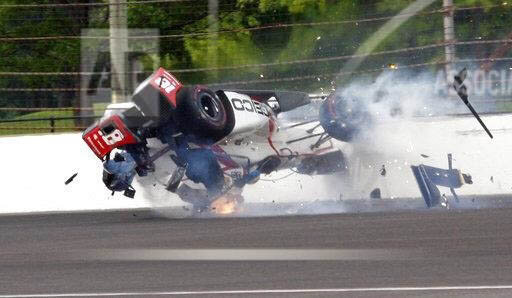
Sebastien Bourdais did not walk away from this Indy qualifying crash in 2017, but returned to racing thanks to the SAFER barrier, car construction and the HANS Device.
By Jonathan Ingram | Senior Writer
RacinToday.com
Why would a guy write an entire book on a single safety device? At first blush, that sounds like a rather narrow, technical subject. I’ve had friends and publishers tell me this on more than one occasion.
Offered in good faith, I wonder about such advice and observations. My book titled CRASH! is the story behind the saga of the HANS Device. It touches every form of auto racing on the planet and several subjects close to all of us: political intrigue and struggle; scientific discovery; tragedy; triumph; and matters of conscience. There’s some romance and bromance, too. Above all, there’s a lot of racing and information that even the most diehard fan will find new and compelling.
Through sheer fate, CRASH! has arrived in the same time frame as major motion picture documentaries on racing safety. One was built around the story of Daytona 500 winner Michael Waltrip and the other is about the work of racing physician extraordinaire Steve Olvey. I humbly and honestly don’t know if my book, which I started researching in 2012, will ever get that far. At least the book’s title easily fits on a marquee …
Subtitled From Senna to Earnhardt -- How the HANS Helped Save Auto Racing, I believe CRASH reflects a recently established pantheon of books whose theme is the danger in racing’s major series. My colleague Olvey (in terms of writing, not doctoring!) started it with the book Rapid Response, followed by the extraordinarily detailed Black Noon by Art Garner and Brian Redman’s Daring Drivers, Deadly Tracks, which was co-written with Jim Mullen.
Each of these books examines the safety conditions at certain times in auto racing’s history and how they influenced the racing in those times. CRASH! tells the story of how the safety picture has changed since the dawn of auto racing and why. It is dedicated to those drivers whose deaths led to the recent revolution in safety as well as the work of racing professionals who were instrumental to the revolution’s success. The sad list includes three-time World Champion Ayrton Senna, a future IndyCar and Indy 500 champion Greg Moore and seven-time NASCAR Cup champion Dale Earnhardt.
The saga closely follows the work of HANS inventor Dr. Bob Hubbard, his brother-in-law and business partner Jim Downing and their struggle to change racing safety. If one includes the families of drivers, their work has saved thousands from the plight of death from basal skull fracture, the plague that haunted major league auto racing for more than a decade (and still continues among weekend warriors). Without the HANS, of course, the plague would have continued in the major series and subjected big-league racing to almost certain death by the withdrawal of media partners, sponsors and manufacturers. Had the sport tried to continue to thrive on the specter of drivers cheating death, it’s future would have been uncertain at best if its biggest stars continued to be killed on live television in front of millions.
Yet … The idea of a head restraint met resistance at every turn despite its life-saving benefit tested with laboratory sleds and in real world racing.
Starting with the Paris-Madrid race in 1903, at least one major driving star was killed behind the wheel in each decade of the 20th Century. A sad fact, that pattern has continued despite so many successful efforts to make safety a fundamental part of the racing equation. (Think Earnhardt in the first decade of this century and Dan Wheldon in the second.) But thanks to the efforts of hundreds of safety experts, teams, manufacturers and sanctioning bodies, the number of deaths at the major league level has diminished considerably compared with the decade before Earnhardt died on the last lap of the Daytona 500 and the century before.
Who killed Ayrton Senna at Imola in 1994? How accurate was NASCAR’s investigation into the death of Earnhardt? In what manner did the deaths of Indy car drivers Scott Brayton and Greg Moore influence the HANS saga? In addition to what made each of these individuals such great drivers, these questions are answered in significant detail with an author’s eye jaundiced only by a penchant for the facts and admittedly aided by the passage of time.
There was plenty of political blood on the operating room floor when it came to implementing change. CRASH! also details the stories behind the safety initiatives in CART, NASCAR, Formula 1 and IndyCar. Above all, it follows the efforts of Hubbard and Downing to create the device, prove its worthiness and their decision to shoulder the responsibility for its implementation. For these two gentlemen, it was a matter of conscience despite enormous resistance from drivers, teams and sanctioning bodies in all forms of racing. The saga of resistance continues, unfortunately, in the realm of weekend warriors.
I conceived of CRASH! as a tribute to a time when the risk of fatality was considered integral to auto racing and as a way to document why this approach to racing had to change. In many respects, it sums up a career of chasing the racing circus all over the world, to any locale and track where I could get paid as a full-time journalist to work on the front lines of the sport’s history.
(Editor’s note: Jonathan Ingram is a 43-year veteran of reporting on racing and the author of six books. CRASH! / From Senna to Earnhardt / How the HANS Helped Save Racing has been released by RJP Books. To purchase the book, see www.jingrambooks.com.)
November 22, 2019
Flat Spot On: Formula Ford Rides Again
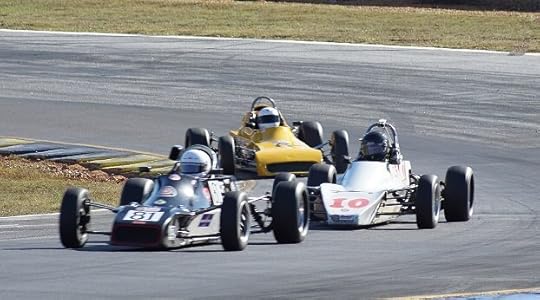
Drivers of .three different makes of Formula Fords charge up hill toward the Bridge. (Clark McInnis Photo)
By Jonathan Ingram | Senior Writer
RacinToday.com
BRASELTON, Ga.—Here’s an SCCA racing quiz for you. When did Formula Ford, celebrating its 50th anniversary this year, reach its peak in America?
One could argue that 2019 has been the best year ever for the category that launched a thousand professional careers for drivers, car designers/constructors and engine builders. There’s been celebrations around the country, notably at Road America and Lime Rock Park, plus the Formula Ford Festival in England. This past weekend, I went to one such celebration, which was part of the American Road Race of Champions (ARRC) at Michelin Raceway Road Atlanta.
The ARRC is a regional runoff that’s been attracting solid fields of club racers for 26 years. This year’s running drew over 220 entries from 20 states. Hosted by the SCCA Atlanta Region, the event has maintained the top drawer, multi-class racing atmosphere and spirit of the SCCA Runoffs, the national championship event which ran at Road Atlanta from 1970-1993 before it was moved to other circuits. The spirit was evident in an entry of 39 Formula Fords at a track that helped make the class iconic.
From the time Formula Ford made its debut in England as an affordable class within a few rungs of Formula 1, the spindly, low-powered single seaters have been about the passion to race. Speeds were relatively low, but aspirations very high. Competitors looked over the steering wheel and saw a bright future for themselves in the top ranks of professional road racing. Everyone could afford a Formula Ford and, it seemed, was willing pay the price of crashing one on the way to the front. If you couldn’t dominate and win in Formula Ford, you might as well pack up those Formula 1 ambitions.
The stories of this class at the Runoffs are legendary and a brief visit with some veteran hands in the paddock on Saturday at the ARRC revealed several. My own experience of publishing the SCCA Runoffs programs at Road Atlanta for a decade also turned up a few memories as well.
In the 1970s and early 1980s, the Formula Ford race at the Runoffs was a de facto American version of the all-important Formula Ford Festival, which began in England in 1972. Drivers and their fathers (yes, even then) did what it took in terms of guts and aggressiveness to make sure to win the Runoffs at Road Atlanta in hopes of getting an invitation to the Festival at Brands Hatch.
David Murry, born in Cartersville, Ga., and one of the Atlanta Region’s local heroes, saw this future for himself in 1983. But he got brake-checked at the Turn 11 bridge in his Van Diemen, on loan from the factory. It flipped twice and then half again, and he ended up on his lid. Few, if any, are ever comfortable in a race car upside down. “The corner worker asked if I was OK,” recalled Murry. “I said if he would just tip the car up I could get out.”
Murry’s incident, which occurred early in what became a highly successful professional career, was one of many in the annual cut-and-thrust. There were fists thrown after Formula Ford events, notably by Mario Andretti at Michael Roe on the podium when Michael Andretti finished behind Roe in third following some on-track disagreements over real estate. There was at least one threat to a team owner involving a handgun and an invitation to England. In 1978, an Eagle chassis was surreptitiously borrowed, if not purloined, from the shops of Dan Gurney (because the team owner was no longer keen on building cars for an entry level class). The Eagle was then trucked from California to Georgia so David Loring, who helped build the machine, would have a chance to prove his greatness in the Runoffs, which he did. He was leading by 18 seconds when the Eagle ran out of gas and he coasted to victory.
Then there’s the story of Atlanta Region hero Anthony Lazzaro of Acworth, Ga. When his factory team owner sold Lazzaro’s Van Diemen to a paying driver on the eve of the 1993 Runoffs, the Georgia driver built up his own new steed out of a box. He won going away and was soon in the ranks of professionals …
The winningest Formula Ford driver at the Runoffs is Dave Weitzenhof of Bath, Ohio, who was back at Road Atlanta to compete in the ARRC this year. With his cap perennially pulled low, Weitzenhof is always one of the guys to beat. I was introduced to him in 1981, indirectly, from the grandstand at the Turn 11 bridge, during the peak of the Formula Ford era.
That day, Weitzenhof was behind the wheel of an unmistakable Citation painted day-glow green and orange in a half-and-half, longitudinal scheme. He diced with Arnie Loyning and Dennis Firestone for lap after lap in front of a swarm of drafting cars and their jousting contenders, fully visible in their cockpits. With their extended, double-A arm suspensions and narrow fuselages, these Fords, still similar to the original cigar-shaped Lotus 51, were not much cover for a driver in what were mechanized knife fights.
This race actually occasioned a strange metaphor of the drive to get to the top. About halfway, a cluster of Fords hit the apex at Turn 11 at the same time. One driver’s car shot straight up out of the pack like it was on top of a geyser. Just briefly, I feared the driver’s helmeted head would make contact with the bridge some 20 feet above the track. At the flag stand down the hill, such was the carnage sliding down toward Turn 12 that a rare red flag was suddenly dropped a few seconds later, which again threw drivers into chaos at the start/finish line.
Weitzenhof, who won the 1981 race in his Citation, returned this year to Road Atlanta with a Zink Z10 similar to the one he drove to his first two Formula Ford National Championships in 1977 and 1979. Prior to those two titles, Weitzenhof won a Formula Vee championship in 1972. He received some interesting phone calls from team owners and manufacturers in the 1970s. A full-blown pro career never materialized and he continued as a Formula Ford competitor with his own team. The driver himself shrugs it off, saying it probably wouldn’t have worked out. “It always takes me a long time to learn a track,” he said.
In truth, the idea of advancing by winning a big race or National Championship – the Runoffs races were both—was always a myth and never enough. Emerson Fittipaldi, the two-time F1 champion, advised that after winning a Formula Ford title in your home country, go immediately to Europe—and bring a lot of money. As it was, by the 1980s most Americans were staying in the U.S. to pursue rapidly expanding racing prospects at home. American drivers who did compete in the Formula Ford Festival or in Europe usually found themselves up against a deck stacked by those using tactics similar to Fittipaldi.
Greenville, S.C. engine builder and longtime competitor Rollin Butler, also at the ARRC, observed that the aggressiveness in Fords never faltered. “You always had to worry,” he said, “about somebody else’s car coming over your head.” Or just flat running you over. Weitzenhof, trying to win a fourth Runoffs title in the span of six years in 1982, was run off the road in Turn 1 at the start by a nut case, one of those drivers who didn't have the talent. But this guy knew his “career” would be stillborn without a win at Road Atlanta. Once the dust cleared, Weitzenhof unceremoniously hauled the offending driver out of his Ford prior to letting him know his thoughts on the incident.
American Loring, who died in 2012, was so depressed by the lack of interest in his considerable talent after more than 50 Formula Ford victories in the U.S., Canada and Europe that he took a job as a ranch hand on Alaska’s Kodiak Island and tried to give up racing. The winter temperatures never got above freezing. The snow was heavy and frequent, helping to blight his disappointment before Loring later returned to competition in IMSA’s Camel Light and GTU categories as a paid co-driver who helped car owners win championships.
Starting in Canada, where he could race as a teenager, Loring’s willingness to undertake an international career was the exception. In general, the lack of enthusiasm for racing in Europe, the increasing number of entry level classes that began competing with Formula Ford in the U.S., and the increase of professional road racing avenues in both the SCCA and IMSA all contributed to the denouement of Formula Ford’s significance. Formula 1 became a distant shore.
Many competitors cite just one factor for the changes in Formula Ford: the Swift DB1, designed and wind tunnel-tested by David Bruns at the company that became Swift Engineering. With its sleek aerodynamics and inboard suspension, the DB1 turned Formula Ford on its head overnight. The cost of the cars went up and the drafting packs that also contributed to equality disappeared due to the changing aerodynamics of the cars. Weitzenhof won in a Citation in 1987, proving experience and treachery could still win the day. But that victory plus Lazzaro’s victory in a Van Diemen, were the last hurrahs. The Swift chassis won ten of 13 races starting in 1985, the beginning of an expensive race to cheat the wind.
Eventually the Club Ford class was born, where the older chassis and their exposed suspensions could continue to race. Raced in vintage events as well as in SCCA competition, the elegant beauty of the cars themselves and the relative ease of working on them is not the only appeal. There’s value behind the wheel. “No street car I've ever driven, no matter how expensive or exotic, slithers through a corner with the same sense of control and speed as an ordinary, sub-$25,000 used Formula Ford.” That’s how Peter Egan, the longtime Road & Track writer, summed up the Club Ford category.
Many an example was on hand at the ARRC. My favorite, in addition to the Zink of Weitzenhof, was the 1980 Lola T540E raced by Bill Manofsky of Flat Rock, N.C. In all, there were a host of Crossles, Van Diemens, Zinks and Mygales on an entry list of 19 Club Fords from 14 states.
The Group 4 entry also included DB1 chassis that continue to run in the standard “modern” class now known as Formula F after the arrival of Honda’s Fit engine. (Ford was not interested in casting new blocks of the four-cylinder Kent engines that succeeded the Cortina in the back of the Fords, so Honda became an additional player.)
As a longtime racing writer, I would be remiss without a report on the winners. In the 50th Anniversary Race on Sunday, Simon Sikes of Martinez, Ga., scored the victory among 20 Formula F entries onboard a 2013 Mygale chassis. In Club Ford, Phil Kingham of Dexter, Mich., took top honors from 19 entries driving a Zink 10c. In the grand finale, a combined race of the two classes with a split start, the same two drivers won again.
Weitzenhof, one of the favorites in Club Ford, started the weekend with a recalcitrant gearbox, then moved to working on some balance issues. In Sunday’s races, happy handling was undercut by a horsepower deficit. But judging by events in 2019, there will be more opportunities for everybody to chase victory in Club Ford, where just owning, maintaining, or driving one of these chassis has its appeal.
(Editor’s note: Jonathan Ingram is a 43-year veteran of reporting on racing and the author of six books. CRASH! How the HANS Helped Save Racing, has just been released. For more information, see www.jingrambooks.com.)
September 24, 2019
Flat Spot On: Where Have You Gone Jimmie Johnson?

Jimmie Johnson is riding an 87-race winless streak as the NASCAR Playoffs hit high gear.
By Jonathan Ingram | Senior Writer
RacinToday.com
We may have seen the last of Jimmie Johnson in Victory Lane for at least the remainder of the 2019 season.
Currently riding an 87-race losing streak, Johnson and his Hendrick Motorsports team face an uphill battle to beat the teams vying for the Monster Energy NASCAR Cup title. Although Johnson has often been successful at upcoming tracks like Dover and Martinsville, and showed well on the new roval in Charlotte, I don’t expect him to beat the playoff teams.
Johnson and two different crew chiefs spent the season trying to win a race to get into the playoffs, which the California driver, who turned 44 last week, failed to make for the first time in his career. It’s likely the same challenges with Chevy’s Camaro faced all season long have yet to be overcome. Playoff teams, meanwhile, have momentum and cars they’ve been working on ever since they were confirmed for the postseason.
The present circumstances seem like a long way from “Five Time” and seven total championships. But the problems also have the look of a typical racing cycle.
It’s not physical for Johnson, who has rarely found himself in a slump. A guy who ran this year’s Boston Marathon in just over three hours is not lacking in physical conditioning. Like so many stock car drivers before him who have been victorious long after their 600th start, the quickness in the hands and hand/eye coordination are still there. As for motivation—see that marathon he ran on an off weekend while vying to get a stellar time under three hours.
When he won five straight titles from 2006 through 2010, Johnson had everything working his way. The Car of Tomorrow was introduced in 2007 and became the full-time Cup vehicle in 2008. One of its many new attributes, according to the designer Gary Nelson, was a center of aerodynamic pressure moved back toward the rear. This meant a car sliding out of control due to a loss of grip in the rear tires was more likely to self-correct. Theoretically, this meant fewer “Big Ones” on the restrictor plate tracks and the specter of cars flying into grandstands.
This characteristic of the COT was exploited to the maximum by Kyle Busch, who had a lot of incredible saves (and some not-so-successful saves where the COT safety cocoon certainly helped). Johnson, who likes to drive a tail-happy car, banked on this handling characteristic and ended up with a string of championships.
It wasn’t just about the car. Johnson won a sixth title with the new Gen 6 chassis in 2013 and his seventh in 2016. In these years, as before, the original championship format of the Chase suited Johnson and his Hendrick team. Johnson relied on consistency and winning form on the tracks at Dover, Martinsville and Charlotte in the era when 1.0-mile and 1.5-mile tracks dominated the final 10 playoff races. In all, Johnson won 18 races during the Chase in his seven championship seasons. Missing from the Chase was a road course, not Johnson’s strongest suit. Talladega has been the sole “restrictor plate” track, also not Johnson’s strong suit, on the postseason schedule. (Johnson’s two victories at Talladega have come in the spring.)
In the 2018 season, Johnson and his long-time crew chief, Chad Knaus, struggled with the new Chevy Camaro. In the past two seasons, only one driver, Chase Elliott, has more than one victory onboard the Camaro. Among teammates at Hendrick, Alex Bowman has one victory while Johnson and William Byron, now paired with Knaus, remain winless in the latest Chevy.
Johnson and his hand-picked crew chief, Cliff Daniels, who succeeded Kevin Meendering, can be expected to make gains on understanding the Camaro chassis. Therein lies the rub. In the good ol’ days, before stage racing, a consistent driver like Johnson could work his way to front over the course of an entire race. Stage racing means the car needs to come off the truck in competitive shape. Sorting a chassis and getting the most out of the chassis is a tough nut to crack if the driver doesn’t initially jell with a new machine, which appears to be a problem with the majority of Chevy drivers and the Camaro. Over time, the good teams and drivers figure these things out.
It’s impossible to name a champion driver in NASCAR who hasn’t hit an occasional dip in performance. One of NASCAR’s most consistent winners, David Pearson retired with 105 victories—and a 47-race losing streak. It’s usually a matter of adapting to changing mechanical issues or adapting to a new team.
I don’t expect to see Johnson and his Hendrick Motorsports team, the only one he has ever known at the Cup level, to return to Victory Lane this year. Although I wouldn’t be totally surprised if he breaks through at Dover or Martinsville, where he’s won a combined 20 races. If the 2020 season proves to be a winless campaign for Johnson and Daniels, well, that would be a surprise.
(Editor’s note: Jonathan Ingram is a 43-year veteran of reporting on racing and the author of six books. CRASH! How the HANS Helped Save Racing, is being released this month. For more information, see www.jingrambooks.com.)
April 29, 2019
Flat Spot On: Talladega Lives Up To Its Reputation
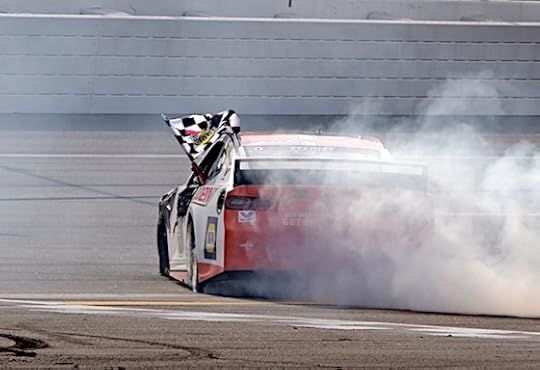
Chase Elliott chased down the checkered flag at Talladega on Sunday. (RacinToday/HHP photo by Alan Marler)
By Jonathan Ingram | Senior Writer
RacinToday.com
TALLADEGA, Ala. – Maybe this NASCAR thing is going to work out OK after all. A victory by Chase Elliott at the Talladega Superspeedway in front of a big crowd capped a race under new rules that produced bellowing engines, more horsepower, greater speed and closing rates, not to mention more passing. The Geico 500 was, using some old-fashioned terminology, an excellent motor race, even if a last-lap caution meant Elliott didn’t race to the finish.
On the 50th anniversary year of Talladega’s opening, there couldn’t have been a better result than a nearby Georgia native and the son of “Awesome Bill of Dawsonville” getting his first win at the track where his father earned his nickname and set the all-time NASCAR qualifying record at 212.809 mph. This time, the cynics couldn’t crank the crank by suggesting Chase had received a special restrictor plate, because tapered spacers now rule.
As it was, Kurt Busch’s extraordinary re-start and assault on leader Joey Logano set the table for Elliott to move to the front with 4 laps to go. That was action aplenty. Chevrolet driver Busch’s aggression in his Chevy versus leader Logano’s Ford might not have been possible without the new rules package. Prior to the race, the jawboning by Chevy executives with its teams to encourage them to work together probably had something to do with Busch’s effort as well.
It was only a few weeks ago that a Facebook fashion, if not a thing, broke out that featured photos of empty grandstands at the Bristol Motor Speedway after a fine race on the half-mile bullring. The promoters at Bristol goofed by closing off certain sections of the stands, setting themselves up for vast empty stretches and photos by those who seem to love NASCAR’s fall from grace.
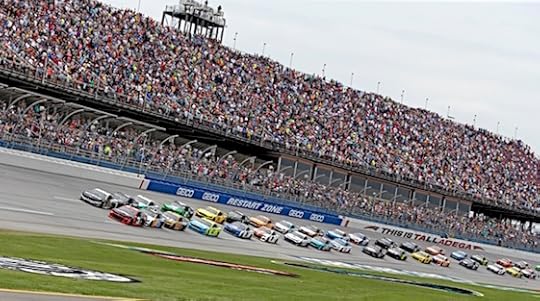
A big crowd showed up to watch stock car racing at Talladega on Sunday. (RacinToday/HHP photo by Alan Marler)
At Talladega, the promoters produced a full grandstand, and the sanctioning body got it right. There was some risk that came with speeds averaging more than 200 mph. One car, the Chevy of Kyle Larson, almost reached the top of the inside fencing after getting airborne during a last-lap schlemozzle. (It fell short of The Big One.) But the fact drivers had an additional 100 horsepower with the tapered spacers appeared to result in a little more patience and fewer cautions. Drivers were confident about being able to regain positions and a bit less inclined to throw audacious, wreck-inducing blocks. The overshoot by “Bubba” Wallace in the early laps that took out three other cars was the lone exception.
Prior to the race, I met a fan during the infield party known as “The Big One on the Boulevard” who seemed to sum up the attitude of lapsed fans. He had not been to a race at Talladega in three years, he said, and only came back due to the availability of three $500 spaces on the Boulevard, where the reserved plots are hard to come by unless you know somebody willing to give them up. “The racing’s not as good as it used to be,” he told me over beers.
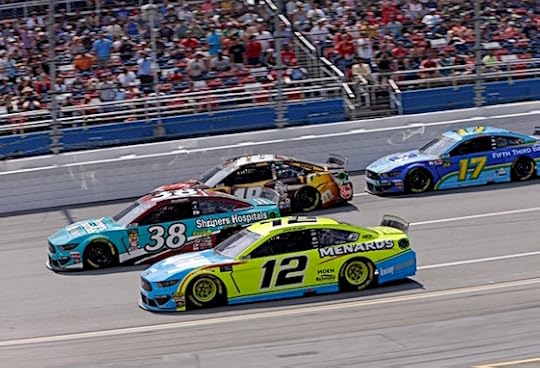
They were racing four wide at Talladega on Sunday. (RacinToday/HHP photo by Alan Marler)
If he had last fall’s race at Talladega in mind, he had a point. In that one, Kurt Busch led almost all the laps before Aric Almirola led only the last one for the victory. This after the Fords of Stewart-Haas Racing teamed up to produce a snoozer by drafting together.
It used to be fans always accused NASCAR of manipulating events to get a preferred outcome. Once the sanctioning body started using video to police the pit lane and intense pre-race and post-race inspections, plus penalties for those trying to “fudge” who were caught during inspections, the complaint became “too many rules”. NASCAR took much of the subjectivity out of the equation and fans jumped to a new island of woe over too much rule enforcement.
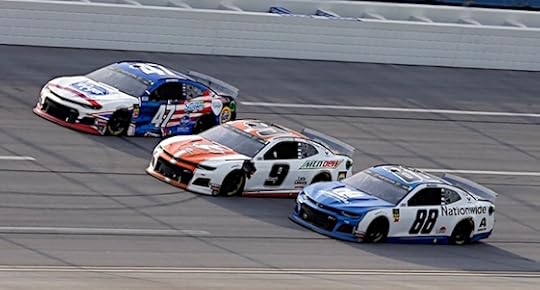
Chase Elliott, center, and Hendrick Motorsports teammate Alex Bowman, right, didn’t get to race to the checkered flag but that was about the only bummer in Sunday’s race at Talladega. (RacinToday/HHP photo by Andrew Coppley)
I must admit that my first thoughts about the new generation of rules for the restrictor plate racing were not positive. Prescribed nine-inch rear spoilers and splitters plus more horsepower sounded like NASCAR was sounding an alarm and dreaming up a prescription for ignominious failure. But on this occasion, “too many rules” and other such complaints did not seem to apply.
Yet, there were calls for a change in the rules. Twitter-dom had posts against the rule calling for the race to end on a caution if the leader has taken the white flag at the Start/Finish. Some fans insist on a race ending under green – or they feel like they are not getting their money’s worth.
In this case, Ricky Stenhouse Jr. hit the wall on the front stretch without a caution being thrown as the pack continued to race across the Start/Finish. There are races, such as the Indy 500, where a caution is automatic if a car hits the wall, but that has never been the procedure in NASCAR. Instead, the race directors took a “wait and see” attitude about Stenhouse Jr.’s Ford, which appeared it might continue on the last lap.
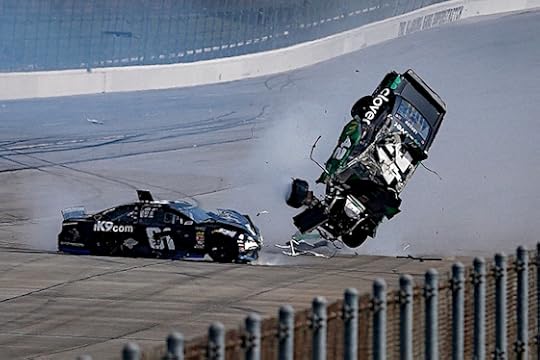
What would Talladega be without an OMG wreck. This one saw Kyle Larson go airborne. (RacinToday/HHP photo by Barry Cantrell)
The caution fell after a large piece of debris came off the No. 17 Ford that would have been dangerous for a pack coming back to the Start/Finish and the checkered flag. Ironically, a wreck occurred at the exit of Turn 2 at the tail end of the pack, which appeared to bring out the yellow. NASCAR could not have predicted the multi-car incident that collected Larson, among other drivers, and that’s not why the race ended under yellow.
Should NASCAR have thrown a yellow earlier for Stenhouse Jr.’s incident as soon as he hit the wall? Maybe so, but the opinion here is that NASCAR should not be in the business of guaranteeing overtimes. The last lap rule works well – if only because there’s no incentive to intentionally spin another driver to bring out a caution. Was NASCAR playing to the crowd, which would have liked to see an Elliott victory? Well, Elliott had to drive around a large chunk of material on the front straight after the race in order to do a last-pass victory lap in front of the grandstands.
At the end of the day, the sentiment appeared to be that NASCAR and its participants deserved to have a relatively safe and successful day at a track that was commemorating 50 years of extraordinary events. In any case, a good race in front of a good crowd at an iconic track was a welcome change.
February 8, 2019
Flat Spot On: Hubbard, HANS Helped Save Racing
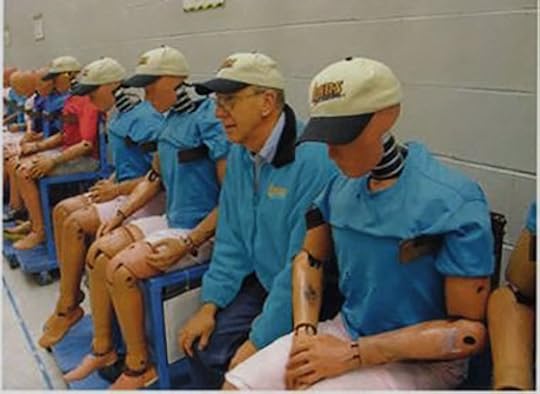
Bob Hubbard, who died earlier this week, was no dummy when it came to saving the lives of race car drivers.
By Jonathan Ingram | Senior Writer
RacinToday.com
The safety revolution that motor racing has experienced in the last two decades would not have been possible without Bob Hubbard, who died Tuesday at age 75.
The inventor of the HANS Device, motor racing’s first head restraint, Hubbard created what became the needed linchpin. For want of a head restraint, the revolution might have otherwise been lost.
Fortunately for fans and all who make a living in auto racing, the sport has been bolstered, if not saved, by improvements to cars, cockpits, and the arrival of improved containment systems such as the SAFER barrier. Starting with Ayrton Senna’s death in 1994, the push for safety at the major league level began with the FIA, continued in CART and then arrived in NASCAR, which built its one-of-a-kind safety research center as a result of Dale Earnhardt’s death from a basal skull fracture in the 2001 Daytona 500.
Yet, no matter how good the car construction, how improved the barrier systems, how much better the seats, harnesses, helmets and head surrounds, none of it could be truly relied on to prevent fatalities without Hubbard’s concept of a head restraint to prevent basal skull fractures.
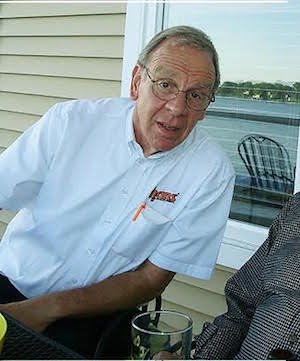
Safety champion Bob Hubbard.
The safety revolution occurred because professional racing could not be sustained by live television, corporate sponsorship and manufacturers if the sport’s star drivers were continually being killed by crashes occasioned by increased cornering speeds. One need only look at the current status of all the major series to realize how delicate the financial health of the sport can be. In the U.S., had the safety revolution not occurred, perhaps there would have been a repeat of what happened in the early 1970s, when enough pressure from the U.S. Congress forced U.S. manufacturers out of racing.
Max Mosley thought enough of the need for safety in the FIA that he sold the marketing rights to Formula 1 to Bernie Ecclestone for $360 million in 2001, which created howls of protest given the 100-year duration of the deal. That money funded the FIA Institute, which spearheaded the international safety movement in racing and on highways. The latter effort, Mosley believed, was necessary to insulate the FIA from political pressure on Formula 1 from individual countries, pressure that had been so acute in the aftermath of Senna’s death.
It was the FIA’s initial push for safety after the death of Senna and Roland Ratzenberger (killed by a basal skull fracture) at Imola, Italy that eventually led to the smaller Model II HANS in 1998. This was the offspring of investigations into the use of air bags in F1 cars after future two-time world champion Mika Hakkinen barely survived a basal skull fracture in Adelaide, Australia the year after Imola. The air bags came to naught because the small explosion necessary to open the bags fast enough in an F1 cockpit would have been enough force to kill an occupant. A downsized Model II HANS, a static device by comparison that could work in multiple hits, became the best choice.
The Model II was the second major breakthrough for Hubbard and his device. The first was the decision by him and brother-in-law Jim Downing to start their own company to market the HANS. It was Downing who originally posed the question about head injuries to Hubbard, who pinpointed the basal skull fracture as the key element behind many of them.
Starting in 1986, when Hubbard received a patent for the admittedly bulky original Model I HANS, he and business partner Downing, a five-time IMSA champion, diligently sought an established safety equipment manufacturing company to market it. No company was interested. In 1990, Hubbard expressed to Downing that they had a moral obligation to create their own safety company and bring the HANS to market themselves, resulting in HANS Performance Products. Hubbard had documented the HANS worked in sled testing and felt that it was a matter of saving lives.
The first key design revelation for Hubbard, a professor of biomechanical engineering at Michigan State, came in the early 1980s when he realized that he only needed legs in the front of his device and nothing in the back below the tall collar. This was his big conversion moment, the point when he realized his head restraint concept was feasible. He already had figured out the high collar and tether system to transfer energy from the head to the torso in a crash. That transfer of energy is the key to keeping the head in place relative to the torso and preventing a basal skull fracture.
Creating his tether system was more complicated than it might appear, because the device had to work without unintended consequences and with drivers of widely varying physiques. I am well steeped in this subject because I worked for several years with Hubbard during his retirement and Downing to write a book on the history of the HANS. Titled Crash! – How the HANS Device Helped Save Auto Racing, the book is due for publication later this year.
I had a professor/student relationship with Hubbard, a fellow Duke graduate, since I had to learn a lot about engineering to tell the tale in full. As anybody who ever worked with Bob knows, he had a professor’s knack for orienting his conversation and approach in a way that made sure what he was talking about made sense and was accessible.
Always an engaging man to talk with, I learned a lot about Bob’s depth of character in the course of writing the book.
The CART team of Newman/Haas Racing, for one example, played a key role in developing the smaller Model II in terms of its shape – how the device’s legs fit over the shoulder so it would not interfere with a driver’s arms or cause too much discomfort around the collar bones. The testing, at one point, became a little testy with Christian Fittipaldi at the wheel and he told Hubbard, “This thing is shit.” He later suggested Hubbard probably didn’t like him. The professor thought about it overnight and came back to the testing at Sebring the following day and told his test driver, “Christian, I like you enough to save your life.”
Eventually, the two became friends. It’s likely a HANS later saved the career of Fittipaldi, possibly his life, in a 60G crash on the oval in Cicero, Ill. in 2000.
That testing in the winter of 1999 with Newman/Haas led to a universal shape for the HANS and enabled drivers of all physiques to use it comfortably. Downing’s longtime fabricator, Jerry “Rabbit” Lambert, played a key role in this process. The HANS was mandated on ovals prior to 2001 by CART and was mandated by NASCAR in October of 2001.
The adaption of the HANS in Formula 1, ironically, was delayed by the fitting problems, individual driver and team resistance. That was eventually resolved in 2003 by introducing to F1 what was learned about the Model II during testing in conjunction with Newman/Haas.
Another future two-time world champion, Fernando Alonso was wearing a Model II custom-built by Renault that, according to an FIA physician, saved his life after his horrendous multiple impacts at the Brazilian Grand Prix in 2003. This helped finally quell the ongoing revolt by F1 drivers about wearing the strange new device.
These were the initial steps that led to the adoption of motor racing’s first head restraint by 200,000 drivers around the world, including mandates in every FIA international championship. The number of lives – and families – saved by the HANS is hard to calculate, but it’s no doubt in the hundreds, possibly more.
Hubbard may have been in the right place and right time when brother-in-law Downing posed the significant question of “Why can’t something to be done about head injuries in racing?” But it took twenty years of non-stop development work, testing, networking, financial risk and faith before his device became an “overnight sensation” following the death of Earnhardt in 2001.
Bob and I became friends in the course of writing the book, in part because he shared his struggle with Parkinson’s as part of the process. He was professorial in a kind manner, which meant we sometimes enjoyed dinner together or watched Michigan State football. He was a deeply generous, caring and committed man as well as brilliant and hard-working, which is why the kingdom of motor racing was saved from basal skull fractures.
January 25, 2019
Flat Spot On: Rolex, IMSA a Long Way from Formula Fords at Pocono

Oliver Jarvis put the No. 77 Mazda Team Joest DPi car on the pole for the 2019 Rolex 24 sports car race in Daytona. The 57th running of the race begins on Saturday afternoon and ends on Sunday.
By Jonathan Ingram | Senior Writer
RacinToday.com
DAYTONA BEACH, Fla. – Here we go again.
Hope springs eternal in the paddock at Daytona as the start of the Rolex 24 approaches and everybody thus far remains a winner until the green drops Saturday afternoon.
On Thursday, lightning bolts and thunder came through in the morning, a hyper-breeze assaulted the afternoon before the evening brought a high ceiling of pearly, pale blue and undulating flags. The kinder, gentler Florida weather graced the post-qualifying hubba-hubba of activity in the paddock in preparation for night practice. Meanwhile, Mazda Team Joest celebrated a record pole time thanks to Oliver Jarvis, the RT24-P prototype, and Michelin, which celebrated its new status as the tire supplier to the entire Rolex field.
It’s the racing that brings everybody back, on this occasion the 50th anniversary season of IMSA. It’s come a long way since the initial fierce cluster of Formula Ford drivers christened IMSA in 1969 on the oval and road course at Pocono, the 2.5-mile triangle better known for Indy cars and NASCAR. The new sanctioning body branded itself as “Racing With a Difference” by greeting entrants at registration with smiles and fresh apples. More importantly, each driver left the track with a check for his earnings, a nod to professionalism that got a lot of sports car drivers’ attention. It also aggravated the hell out of the Sports Car Club of America that a new rival was willing to pay drivers.
Motorsports sanctioning groups are often fond of the attitude “We’re in charge and you’re not.” A friendlier, more practical approach was launched by IMSA founder John Bishop, a former president of the SCCA whose partner was “Big Bill” France of NASCAR and Daytona International Speedway fame. The atmosphere fostered by Bishop from the beginning has kept bringing people back – fans, participants, manufacturers – just as much as the fiery and often unforgiving crucible of motorsports.
There is an excellent new book just released by Octane Press titled IMSA 1969-1989 that tells the inside story of how Bishop built IMSA. Written by John’s son Mitch and longtime IMSA technical guru Mark Raffauf, it’s a treasure trove of car and driver photos plus many insights from the IMSA founder himself. Full disclosure: I happen to be biased about this book, in no small part because I worked as the copy editor.
Bishop had a certain genius when it came to working the personal side with racers as well as on the technical side. With people, Bishop and his IMSA organization had a live and let live approach, which at one point led to a lot of drug smugglers laundering their cash in the series by buying and racing cars – which proved, as much as anything, that IMSA had no aspirations to be the FBI.
On the technical side, the man who created the legendary Can-Am and Trans-Am series while at the SCCA continued to demonstrate his knack for creating series. He found a way to include the prevailing GT equipment from manufacturers with a sharp eye on what people wanted to race – and watch race. This eventually led to the Grand Touring Prototypes in the 1980s, arguably the greatest sports cars of all time. No doubt, the GTPs put sports car racing on the same footing as Indy cars and Formula 1 in the go-go years of professional racing’s growth around the world.
One can now look back at the prototypes from Lola, Jaguar, March, Ford, Porsche, Nissan and Toyota – to name a few that readily come to mind – and wonder why Bishop didn’t turn IMSA into a major league on a par with Indy cars or Formula 1. Well, IMSA’s brand of sports car racing was destined to be a niche motorsport, because it walked the line between professional and amateur when it came to participants, and because the rise-and-fall of manufacturer interest, which promoted professionalism, couldn’t be predicted with a compass, gyroscope, Ouija Board or any other instrument known to man.
The calling card of sports car racing since the first Le Mans 24-hour in 1923 has been a multiclass format, another major reason for niche status. Too many notes, as the saying goes, worked OK for Mozart. But serious racing is one car, or horse, finishing first.
These days, the roles are reversed when it comes to comparisons. Formula 1, Indy car and NASCAR are all facing uphill battles to sustain themselves in the manner to which they have been accustomed. The niche of sports car racing, in general, and IMSA, in particular, is thriving due to the platform of multiple classes and drivers. Manufacturers at long last have figured out this format helps sell cars – but only if they don’t drive each other away by trying to out-spend one another. Meanwhile, many of them have borrowed the Porsche model and created profit centers by selling customer GT cars.
As for drivers, it’s unofficial, but this year’s Rolex probably has the largest entry of drivers with Formula 1 experience and/or Indy car experience. There are 11 drivers with Formula 1 experience, some quite familiar such as longtime Corvette Racing driver and former Panoz Motorsports driver Jan Magnussen. An additional 11 drivers have Indy car experience.
There’s also an all-female team featuring three drivers with Indy car experience plus IMSA veteran Christina Nielsen. They are likely to gain a lot of attention – by being competitive in an Acura.
The “live and let live” approach by IMSA, survives in the form of a special car for Alex Zanardi, the former CART champion and F1 driver who will use hand controls in his BMW M8 fielded by Bobby Rahal’s factory team. Having lost his legs in the horrendous accident at the CART race in Germany in 2001, Zanardi went on to become the world’s No. 1 hand cyclist. Using prosthetic devices, he returned to racing and won four World Touring Car races in a BMW. The recent video of Zanardi using his special hand controls on board his BMW at Daytona during testing have gone viral, enabling him to eclipse the “other” world famous driver with Formula 1 and Indy car experience, Fernando Alonso.
Not a surprise to friends and fans of Alex. What an amazing human being.
There are enough major story lines to live up to the golden aura over IMSA’s marquee event this year. TV coverage of these story lines will be brought to you by a story line of its own – starting with the Rolex, NBC Sports is launching its first full season of IMSA coverage. This will be a long way from hither and yon coverage sports car fans grudgingly became accustomed to after SPEED was swallowed by Fox Sports.
Can Mazda, which has been one of IMSA’s building blocks since the days of the RX-3 in the 1970s, finally score an overall victory after its record pole? Or, will its customer-built engine expire in the long run? The RT24-P itself has been completely re-built since midway in the 2017 season after Reinhold Joest of Le Mans fame was hired to run the team launched under the new DPi formula two years ago.
Alonso has a chance to complete a unique double by winning with Wayne Taylor Racing in a Cadillac DPi after his success with Toyota at Le Mans last year. The Taylor team is coming off a brilliant win in the Petit Le Mans at Road Atlanta last fall and has previously won the Rolex when NASCAR champion Jeff Gordon was a newcomer to the team. Alas, it’s Daytona – where the night is long, the traffic unpredictable due to the inexperienced drivers, and demands on the equipment are exaggerated by the banking.
Will Corvette Racing claim its 100th official IMSA win versus the usual runway show of the latest technology from Ford, Porsche, BMW and Ferrari? Technically, the answer is already in: Corvette Racing collected its 100th win two years ago – but that includes eight victories at Le Mans.
Of course, one could argue that technically the years from 2000 through 2014 counted double when it comes to the history of professional sports car racing in the U.S. Unification brought the Grand-Am owned by NASCAR together with the IMSA-sanctioned American Le Mans Series in 2014 after 14 seasons of trying to rip each other’s throats out, metaphorically speaking, as rivals.
Thanks to the racing gods, NASCAR’s Jim France and ALMS founder Don Panoz, who owned the IMSA sanction, finally reached an accord and U.S. sports car racing took a great leap forward as a single entity under the France banner. It wasn’t quite the same when the Rolex 24 belonged only to the Grand-Am and the link to Le Mans was not much in evidence.
All’s well that ends well – no matter how this version of the Rolex 24 turns out.


