
C.S. Fuqua's Blog
October 9, 2026
Shadow of the Storm’s Path to Publication
 Shadow of the Storm has weathered a long, uncertain journey from idea to publication with a few casualties along the way, the kind that could make a person who believes in fate or luck a bit apprehensive or superstitiously fatalistic. I’d love to blame the puppet-string theory from time to time, but I understand unexpected failures are simply happenstance, that the only way something can be achieved is to keep pushing.
Rob’s confidence in the Wolfshadow story proved indestructible. Based on my publishing experience, I’d sometimes caution him about being over-enthusiastic and optimistic. He’d chuckle and tell me he hadn’t felt such excitement for a project since his days playing football or with his band, The Penthouse Five, “and you see how good all that turned out.” I’d grunt, “Uh-huh,” and we’d get back to the novel.
When he began sending me first draft chapters, I got onboard with his enthusiasm. The story wasn’t run-of-the-mill science fiction, but a blend of SF, dark fantasy (my genre specialty), and spirituality—an unusual combination, certainly, but one that worked beautifully well. Every few weeks, I’d receive one to three first-draft chapters in the mail. I’d revise them—reduce the word count, ensure continuity, embellish or enhance plot characters, improve flow—and send them back to him for the next revision. (Those edited first draft chapters vanished with the first drafts of the final chapters, discussed in an earlier post.)
Rob’s style allowed story action to dictate each chapter’s point of view, much like a movie or series script, providing the reader with information from disparate locations and viewpoints that increasingly narrowed to the climax. It’s a technique as old as fiction writing itself, but some insist point of view must at all times remain with one character—“no head jumping!” It’s a good rule if you understand the difference between head jumping and alternate points of view dictated by scenes and chapters. Even occasional head jumping is fine if done correctly, and many authors have done it quite well, from Asimov to Christie to King to O’Connor to Carver to Vonnegut to you-name-them. Every “rule” in writing, however, can be violated if you know how. And most experienced authors know how. Despite one editor’s accusing and demeaning rejection tirade, head jumping isn’t utilized in Shadow. Points of view between scenes or chapters change, but each scene or chapter remains steadfast in the particular point of view.
Another editor took issue with how the two Cheyenne protagonists are portrayed, calling them “stereotypical”—specifically, how Sarah Little Bird Boone sets up a meeting with Nattech scientists that involves native flute music, peyote, and a bit of mystical ritual. The editor insisted the scene used “stereotypes.” Apparently, she skipped over the passage in which the characters themselves address stereotyping:
“Stereotypical, cliché settings and getting stoned are not research or reality,” Landrum said.As mentioned, the original first draft’s final chapters were lost, so Rob had to write a new ending, leaving the recreation of missing chapters to me, drawing the storyline to Rob’s new ending—which, by the way, is quite poignant. I finished revisions about two years after Rob passed and then began the arduous task of submitting to publishers.
“No, they’re not,” Russell said, “but stereotypes arise out of reality, and clichés become clichés because they’re utilized repeatedly and are what people come to expect. They make people comfortable. Anything different can cause confusion or obstinance. Certain drugs, meanwhile, are essential to exploring expansive concepts—especially if something encompasses new and bizarre ideas.”
As it was with my first novel, Big Daddy’s Fast-Past Gadget, publisher response for Shadow proved mixed—most kicking it back with the “go away” form letter, some praising it, some trashing it, yet none offering to publish. With Big Daddy’s, a few editors, including the editor for TSR, publisher of Dungeons & Dragons, wanted to publish, but couldn’t for various reasons. In the case of TSR, the line for which it was suited had been eliminated. Both Big Daddy’s and Shadow of the Storm, however, were eventually accepted by several publishers (three for Big Daddy’s; four for Shadow), but each of them either went out of business before publication or were consumed by larger publishers that eliminated the lines—all of which consumed long periods of time. Both novels waited months and, in some cases, years for publication after acceptance only to be kicked back, unpublished—time wasted that could’ve been used in submitting to other potential publishers.
Eventually, both novels landed in houses where editors liked the stories enough to offer a contract, houses that were stable and eager to publish rather than wait indefinitely. And for that, I’m deeply grateful to Foolscap & Quill for making Rob’s dream of becoming a published author a reality. Seventeen years after his passing, Shadow of the Storm is a fitting and well-deserved memorial to a talented writer and wonderful human being, Robert Edward Graham. I suspect he’s strolling his imagined Elysian Fields, grinning with pride.
Shadow of the Storm will be published October 15, available from Foolscap & Quill at https://tinyurl.com/4db6bkju and Amazon at https://tinyurl.com/yc8z26ht, as well as other bookstores. Dystopian science fiction at its best. Read more about its development and characters at https://csfuqua.com/blog.


October 3, 2026
Shadow of the Storm Characters
 **Pre-order Shadow of the Storm at https://www.booksamillion.com/p/97819... or
https://www.amazon.com/Shadow-Storm-R....
An earlier post examined Shadow of the Storm protagonist James Pleasant Wolfshadow, styled after cowriter Rob Graham—his rugged good looks, devotion to others, honesty, courage, and optimism. In essence, Wolfshadow became Rob in fictional form. But what about the other characters?
“I learned a lot on the street,” Rob told me. “When you’ve lost damn near everything but your life, you come face-to-face with what’s really important.”
After rehab, Rob became a student of religion—no, not a cultish, true-believer, controlling type. Rather, he studied religious doctrines and beliefs from cultures around the world, becoming well-versed in their mythologies while delving deep into quantum mechanics and theoretical physics. He thrilled in making connections between science and spirituality, and he wanted to share his enthusiasm and discoveries by marrying the two in an epic story about a Native Cheyenne American pitted against the most powerful negative force in the universe. He wanted to craft a story that celebrated his faith in humanity’s ability to overcome its self-destructive nature through a scientific spirituality that many scientists are now exploring. And he wanted that story populated with extraordinary but believable characters.
Sarah Little Bird Boone is Wolfshadow’s lifelong friend, the two having grown up together on their home reservation. After the death of his wife, Wolfshadow’s relationship with Sarah becomes more than friendship as Wolfshadow takes refuge in their deep and trusting emotional connection that occasionally culminates physically, but their strongest bond is and has always been spiritual, two parts of a whole.
I can only guess who Rob had in mind when he created Sarah, but I suspect she embodies many of the qualities of the women he loved and admired—strength, extreme intelligence, devotion, determination—qualities I enhanced in rewrites, based on the important women in my life. While other characters who’ve worked with both Boone and Wolfshadow view Wolfshadow as the primary hope for saving Earth and humankind, it is Sarah who is Wolfshadow’s strength, quietly and persistently moving events positively forward, the true shadow of the storm.
Mahu, the novel’s evil antagonist, is an amalgamation of bad actors from the various religions of the world, from Buddhism’s Mara and Islam’s Iblis to Christianity’s Satan and Gnosticism’s Yaldabaoth, as well as many others. He is the ultimate narcissist, hopelessly lost in delusion, believing himself the only true and infallible ruler of the universe despite his past and current failures and defeats. Yes, we utilized a few politicians and preachers as well in modeling Mahu.
Mahu’s daughter, Tanta, is everything you’d expect from an extremely beautiful, pampered, spoiled twat. But, unlike her father, Tanta has a saving grace—the ability to peer through her father’s delusions to accept reality with a sense of self-awareness and reluctant objectivity that provides the strength to change—even if change takes an excruciatingly long time with a lot of whining.
Old Charon, perhaps my favorite of the novel’s characters, is a cantankerous coot, literally rotting toward death when Wolfshadow encounters him on Mahu’s home world. He is a member of the planet’s indigenous species, which has been enslaved to serve Mahu’s vanity, constantly suffering the ruler’s cruelty with no recourse or hope of escaping the torture. Charon doesn’t have a high opinion of his lord and master, harboring a deep-seated hatred that he carefully conceals from fear of even worse torment. Wolfshadow, with food and kindness the gnarly gnome has never before experienced, not only earns Charon’s respect and friendship, he receives the creature’s devotion and help in confronting the evil master.
Then there’s Achates, perhaps the novel’s most enigmatic character, a shapeshifting, other-dimensional being that could be the basis of some people’s belief in angels, but I’m going to leave this entity for you to discover and interpret on your own. And when you do, I suspect you’ll reflect the character’s Cheshire grin.
The novel is populated with numerous other characters you’ll recognize in your own life—from the nerdy genius to the power-hungry corporate prick to the female scientist smarter and more clever than anyone else in any room. To detail these and other characters, we’d have to write a novel, which is exactly what we did.

Throughout plot and character development, especially after Rob passed and I began revisions, Wolfshadow increasingly took on Rob’s traits. One of Wolfshadow’s defining props is an impressive Bowie knife that goes with him on every adventure. Rob relished and respected the Bowie knife’s history and usefulness as a tool and weapon. During the first-draft writing, he sent me a 16-inch replica of the knife, and that’s when he became inseparable in my mind from the fictional man he’d created.
Shadow of the Storm is slated for publication 15 October from Foolscap & Quill and is now available for pre-order at the following links:
https://www.booksamillion.com/p/97819...
https://www.amazon.com/Shadow-Storm-R...
Stop by Foolscap at https://www.foolscap-quill.com/ for an array of exceptional novels in various genres.
The next and final background post will detail the novel’s journey from completion to publication—quite a ride. Receive posts automatically by visiting https://windpoemcreative.blogspot.com to subscribe via the RSS feed. For more information about my work, especially the latest novel, The Crosses ~ A Baker Street Irregulars Mystery, cowritten with my late spouse, Bonnie Del Aguila, available from MX Publishing and most bookstores, please visit https://csfuqua.com.
September 30, 2026
The Crosses and a Career
 My freelance career began with trade journals in the late 1970s while in college—breathtaking articles on how some Western wear store marketed apparel, or how a certain beer distributor expanded its distribution territory, or how some rich white boy buffed his classic car into local legend. Yeah, Pulitzer-worthy stuff, let me tell you. But it brought in a little cash that helped with the bills.
While writing commercial pieces for pay, I struggled to pen a decent poem or short story that would garner more than a contributor’s copy in compensation (try buying a loaf of bread with contributor’s copies), but the ever-growing pile of rejection slips suggested I was either not trying hard enough or, more likely, I didn’t have the talent required to craft a piece intellectually or entertainingly worthwhile. Time and again I threatened to quit and “get a real job,” only to have Bonnie counter sternly, “Oh, no, you’re not. This is what you’re meant to do. It will come.”
I continued to write creatively on the side while eventually landing commercial pieces in better paying magazines such as Business Alabama and Honolulu. It was Bonnie who had the idea for my first novel, a socially satirical science fiction story set in Hawaii, titled Big Daddy’s Fast-Past Gadget (still in print, so get a copy!). Through the years, she suggested many of the ideas that became published pieces, both creative and journalistic. She’d offer suggestions on plotting, on characters, on setting. I didn’t realize it at the time, but I suspect she harbored a secret desire to be a writer herself, and, in truth, she was already my cowriter even though I didn’t have the good sense to realize it. She certainly had the creative mind, in part because she was a voracious reader of mysteries, science fiction, and fantasy, which vastly expanded her literary knowledge and imagination.
As retirement from a career as a federal investigator neared, Bonnie had an idea for a novel featuring a former member of Sherlock Holmes’s Baker Street Irregulars, with the story set in the US. In an earlier post, I recounted how the novel came to be, guided by the notes Bonnie had made before and during retirement, even as she contended with cancer. The Crosses ~ A Baker Street Irregulars Mystery is one of the last books that will be published with my name as part of the byline. As I wrote that last sentence, I could hear Bonnie’s voice: “Oh, no, it isn’t, buddy.” But we’ll see.
The Crosses is set in 1925 in Las Cruces, New Mexico. The investigation into the murders of three tribal councilors has stalled amidst accusations of racial bias. Newspaper publisher Bessie de la Paz, who is biracial—white and indigenous Mexican—seeks guidance from former Baker Street Irregular Ben Irwin, who’s in the country on another matter. Irwin offers his services in tracking down the perpetrator. The investigation culminates in a fourth death that leads to the killer but erodes Bessie’s trust in those once closest to her as she increasingly relies on Ben for more than she could have ever anticipated.
I began the first draft of The Crosses not long after Bonnie’s passing as a way to keep her close and with the goal of providing a memorial that she could be proud of, the book she’d planned, published with her name on the cover. Three years later, I typed “the end” and began the submission process. No book I’ve written or cowritten has been considered, accepted, and published faster than The Crosses. In the past, from submission to publication has taken one to several years—for example, Big Daddy’s and the upcoming Shadow of the Storm from Foolscap & Quill, each taking more than a decade to find a home that would survive long enough to put them in print. The swiftness with which The Crosses journeyed from submission to publication with MX Publishing, the world’s largest publisher of Holmes-related literature, attests to the strength of Bonnie’s idea and her notes that guided its writing.
I’m deeply grateful to MX Publishing for bringing Bon’s vision to a worldwide audience. And I’m grateful to you who’ve supported the project through good wishes, spreading the word, and purchases. The Crosses is available in hardcover, paperback, and digital formats from MX Publishing, Amazon.com, Barnes & Noble, and other book retailers.
I have one remaining book circulating to potential publishers—a collection of poems written for or about Bonnie over the decades and beyond her passing, addressing all aspects of a relationship, including the grief and guilt one feels when a partner passes. Poetry is notoriously difficult to place, with many publishers charging authors for the “privilege” of submitting books for consideration and, if accepted, also charging for production costs while leaving the bulk of promotion to the author. It’s always a risk for a publisher to take on a book, but that’s the business. They take a risk on something they believe in and then work with the author to make it a success. A writer provides the creativity off which everyone else in the industry profits. If a publisher deems a collection worthy of publication, then it’s the publisher’s duty and responsibility to invest in production and marketing at least as much as the writer has invested in the product's creation.
Of all past collaborations, The Crosses, by far, is the one for which I am most proud and honored. It and the upcoming Shadow of the Storm are good books with good publishers, fulfilling promises to two extraordinary people, Bonnie and Rob Graham, Shadow coauthor. I can easily imagine Bonnie kicking back in some quantum alternate reality with Sir Arthur Conan Doyle as he nods in approval and says, “Bonnie, you’ve done a good job with the Holmes legacy.”
That she has, Arthur. That she has.
September 24, 2026
Shadow of the Storm ~ Missing Chapters & New Ending
 An excerpt from Rob's final notes regarding the novel's ending.
chapters and direct the plot to the new ending Rob had envisioned in his last hours.
Rather than tackling reconstruction of the chapters immediately, I revised what I had in hand, paring down the existing draft from 140,000+ words to a more manageable and publisher-preferred word count for novels. By the time I finished revising the existing chapters, I was fully refreshed on where the plot was headed and how to steer it to Rob’s new ending. To my delight, crafting the new chapters went rather quickly. Throughout writing the first draft, Rob and I debated various plot and character aspects, fully establishing his point of view and voice in my psyche. It was not surprising as I reconstructed the missing chapters to hear him in my mind, either objecting to or approving the direction the story was taking. In the end, we landed exactly where he’d indicated in his final notes the book should end.
Shortly before he lost his voice during hospice care, Rob assured me that he’d found peace with his life—the good, the bad, the in-between. “Sure,” he said one of the last times we talked, “I’d change some things if I could, but we don’t get to do that. And we don’t get to change whatever may lie ahead. We can influence the future, but what’s gonna happen’s gonna happen.” He sighed. “I won’t be going home, Chris. But let me tell you, I’ve had a good life—good friends, great family. Now I have cancer. Everyone dies. It is what it is.” He chuckled softly. “Piss on it.”
No self-pity. No remorse. Only acceptance and truth. The past is gone. The future is something that may or may not occur. We control neither. All we have is the moment. Rob learned how to use the moment to its potential right up to the end. One result is Shadow of the Storm, a darn good story with meaning.
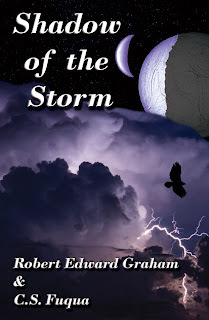
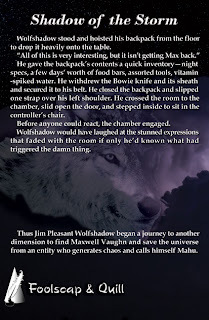
Societal fear and unrest on Earth have skyrocketed due to increasingly bizarre and destructive events around the globe. A team of the world’s top physicists, working for America’s ruling corporation, Nattech Inc., has determined that future-based “time ripples” are triggering the events. Nattech enlists Cheyenne Native Americans Wolfshadow and Sarah Boone to track down and eliminate the source of those ripples, an other-dimensional, megalomaniacal, narcissistic entity known as Mahu, whose twisted goal is to rule a gutted Earth.
Shadow of the Storm is slated for publication mid-October 2026 from Foolscap & Quill. Stop by Foolscap at https://www.foolscap-quill.com/ for an array of exceptional novels in various genres. Upcoming posts will explore other characters and the novel’s long journey to publication. Receive posts automatically by visiting https://windpoemcreative.blogspot.com to subscribe via the RSS feed. For more information about my work, especially the latest novel, The Crosses ~ A Baker Street Irregulars Mystery, written with my late spouse, Bonnie Del Aguila, available from MX Publishing and most bookstores, please visit https://csfuqua.com.
September 17, 2026
James Pleasant Wolfshadow
 Whether Rob planned it or not, I’ll never know, but James Pleasant Wolfshadow came to embody many of his creator’s qualities even in the first draft—determination, loyalty, duty, humility, forgiveness, acceptance, and compassion. By the time he pitched the idea to cowrite a science fantasy novel featuring a Native American protagonist, set in a dystopian future that our present resembles more each day, Rob Graham had worked out most plot and character details that would guide first-draft writing.
Jim Wolfshadow is a former special ops agent who retired to apply his clandestine abilities for America’s ruling corporation, Nattech. After his wife dies in a terrorist attack most likely designed to take him out, Wolfshadow retires into seclusion, guilt-ridden and struggling to find redemption, confiding in only one person, his lifelong friend and occasional lover, Sarah Little Bird Boone.
Wolfshadow’s guilt over his wife’s death is based on a love so deep and primal that he cannot forgive himself even though he had no control over events. Wolfshadow’s devotion is a reflection of Rob’s deep love for his former wife, Teri. To honor her, he named Wolfshadow’s wife Teri. As Rob’s alcohol addiction worsened, his relationship with Teri deteriorated to the point she could no longer remain with him. They divorced, and his addiction and decline continued until he hit bottom, losing everything, ending up on the street, scrounging from garbage bins to stay alive until that morning when an especially awe-inspiring sunrise provided the epiphany and clarity he needed to change his life. The moment proved one of Rob’s most spiritual, if not the most, and he dedicated himself to kicking alcohol and rebuilding his life. He began to explore his spiritual side, reflected in the meditative practices employed by Wolfshadow and Little Bird. His affection for his former wife never waned as he harbored the unlikely hope that he would one day reunite with her.
Rob lived in Texas, and I in Alabama. He didn’t like computers, instead writing detailed outlines in longhand, which he would then flesh out via hunt-and-peck typing on an old typewriter. He’d mail the first-draft chapters to me to revise. I’d then send them back. Chapter by chapter, back and forth. It proved time-consuming, of course, but it also enabled us to consider more closely the plot and characters, especially as he explored the mythologies of religions from around the world, something that affected his personal outlook and beliefs as well as Wolfshadow’s.
To support himself, Rob worked as a server for a family steakhouse, earning about $2.50 an hour plus tips. He busted his ass for a pittance on which he could barely survive. The job included no benefits, certainly no health insurance. When Rob developed worsening pain in his throat, he delayed a medical checkup until he could no longer bear it. It turned out to be cancer. He began to decline somewhat physically, but continued to work even as he struggled to pay for treatment, eventually securing some assistance from the state. The cancer appeared to go into remission, but that was short-lived. Eventually, he lost his job and ability to pay for treatment. The cancer spread. The pain increased. He could not afford the exorbitant costs of medication, but he could afford a bottle of cheap alcohol, and that helped deaden the pain. It also rekindled his addiction.
Progress on the novel slowed until it stopped completely. We’d finished the first draft and had begun the second, but the last three chapters of the first draft and all of the second draft, for whatever reason, went missing. The cancer worsened, along with his consumption of alcohol, until Rob finally arranged a deal with a teaching university to provide palliative care in exchange for the donation of his body for study upon his death. In care, he again kicked alcohol, but his physical decline continued at an increasing rate as the cancer spread.

Nevertheless, he expressed a desire to get back to the novel, but the missing chapters were an issue. We talked at least once a week, his growing weakness evident in his voice. I encouraged him to write what he could recall of the chapters, that I would flesh them out. He promised he would, but he simply didn’t have the energy.
Near the end, he grew too weak to communicate with me via letter or phone. His brother David became our go-between, urging Rob to scribble whatever he could about the chapters, which would then be passed on to me. David’s encouragement had two purposes—to press Rob to complete his final creative dream, and to distract him from the painful decline he was experiencing. Two days before he passed away, Rob wrote several lines on the yellow notepad, tapped it with the pencil, and told David that I would understand what he’d written was the end, that he’d leave me to fill in the missing chapters leading up to this new ending. Over the next two years, that’s what I did, along with revising the novel numerous times until it eventually became the completed Shadow of the Storm in which Wolfshadow seeks self-forgiveness and understanding regarding the death of his wife, much like Rob had in life.
Soon after entering the palliative care facility, Rob contacted Teri. They had the conversation he had imagined many times before, deep, reflective, and affirming, affording him some peace despite his regret that life had not been different. But isn’t that the way we all end up, wishing we had been better, had made different choices, that we had shaped ourselves in a far more constructive, compassionate way, that the life we live actually has meaning? Thing is, Rob’s life did have meaning. And much of that truly meaningful life is reflected in the character of James Pleasant Wolfshadow.
Upcoming posts will explore other characters, revisions based on Rob’s final directions, and the novel’s long journey to publication. Receive posts automatically by visiting https://windpoemcreative.blogspot.com to subscribe via the RSS feed. In the meantime, please stop by Foolscap at https://www.foolscap-quill.com/ for an array of exceptional novels in various genres. For more information about my work, especially the latest novel, The Crosses ~ A Baker Street Irregulars Mystery, written with my late spouse, Bonnie Del Aguila, available from MX Publishing and most bookstores, please visit https://csfuqua.com.
September 10, 2026
Piss on It ~ Shadow of the Storm’s Genesis
 Optimism defined Robert Edward Graham. He’d greet the day with the conviction that, no matter what it threw at him, it would place him closer to goals he was determined to reach. I don’t know if he’d always been such a man, but it was certainly the man who’d overcome alcohol addiction and homelessness, who’d found his strength in a soul-moving sunrise to rebuild his life.
Born in 1945 in Corsicana, Texas, Rob became an all-state tackle in high school during his team’s 1963 winning season and post-season state football championship victory. While many of his classmates entered college after graduation, Rob took off in an artistic direction with an eye on the big time. As he did with every endeavor, he prepared relentlessly until he felt he was ready. Then he went for the primary goal, not a hundred smaller goals that might or might not lead to the big one.
He ventured first into music as a founding member of the Penthouse 5, a rock garage band that became a regional sensation in the mid-1960s. Rob served as primary songwriter and vocalist. Penthouse 5 quickly became known for blending vocal harmonies with increasingly heavier music to create something new and exciting. The band cut several singles for regional labels, one reaching number one in the Dallas market, bringing the group to the cusp of national success. (The band’s album, The WordD is Love, is on YouTube at https://www.youtube.com/watch?v=ehElqibg0TE&list=RDehElqibg0TE&start_radio=1.) But rifts developed between several of the members, and the group split in 1967. Due to copyright ownership shenanigans by one of the members, Rob never received any royalties for the songs he wrote.
 “Piss on it.”
That phrase became his trademark. Whenever life didn’t go quite the way he wanted or landed wide of his target, he’d shrug it off with a hearty “piss on it.” He’d laugh and move on—sometimes to better things, sometimes to worse.
After Penthouse 5 split, Rob pursued acting, appearing in commercials and regional stage productions. To supplement his income and further expose himself to potential acting opportunities, he relied on his rugged good looks to become a popular male model, remaining in high demand for several years. Such demand provided ample opportunities to indulge in various vices, and Rob chose alcohol. At first, he limited consumption to social engagements, but then he began to drink heavily and regularly in private as well, developing a strong alcohol dependency that destroyed several close relationships. Job offers dried up. His wife left him. Eventually, he wound up on the street, surviving on what he could scrounge from restaurant garbage bins.

“Then one morning,” he confided, “I woke beside a dumpster with my face in a puddle of vomit. The sky was on fire with the rising sun. At that moment, I had an epiphany. I had two choices—die or get sober. Piss on it.”
He checked himself into a detox center and spent the next desperate months getting straight. He’d been clean for a couple of years when he enrolled in Writer’s Digest School’s short fiction course, and the school assigned him to me. For whatever reason, he found it easy to work with and confide in me, and we developed a deep friendship that led to the creation of James Pleasant Wolfshadow, Sarah Little Bird Boone, and the odyssey that culminates this October with Foolscap & Quill’s publication of Shadow of the Storm.
Upcoming posts will explore the development of the novel’s plot and characters, Rob’s final tragedy, and the eventual realization of his dream to become a published author. You can receive posts automatically by visiting https://windpoemcreative.blogspot.com to subscribe via the RSS feed. In the meantime, please stop by Foolscap at https://www.foolscap-quill.com/ for an array of exceptional novels in various genres. For more information about my work, especially the latest novel, The Crosses ~ A Baker Street Irregulars Mystery, written with my late spouse, Bonnie Del Aguila, please visit https://csfuqua.com.

September 8, 2026
The Crosses: From Notes to Novel
 As mentioned in earlier posts, Bonnie proposed in the late-2000s that we write a Holmes-universe-based novel. As her retirement from federal service approached, she diligently documented various possibilities, characters, historical events, and more, meticulously organizing them in a compact blue notebook. Following her retirement, she continued compiling notes even as she dealt with recurring cancer that ultimately claimed her life in 2022.
In previous posts, I have alluded to certain aspects of characters and plot based on her notes. Today, I’m including images of actual samples from her notebook. Upon reading the novel, you will likely realize connections between the notes and how they shaped the plot and character development.
Weeks after her passing, I began reading the notes, and I could hear her voice distinctly, brimming with excitement and anticipation. It was time to begin. I felt a profound sense of connection to her by engaging in the very endeavor we had envisioned—writing that book together. In April of this year, a little more than three years after her passing, The Crosses ~ A Baker Street Irregulars Mystery was a reality, and I began the submission process. I anticipated the customary fluctuations in consideration and rejection that can persist for months and even years. However, consideration of The Crosses proved exceptional—the swiftest book acceptance in my career and by the most suitable publisher, MX Publishing, the global leader in Sherlock Holmes-related literature.
Set in 1925 Las Cruces, New Mexico, The Crosses delves into the investigation of the murders of three tribal councilors, which has stalled due to accusations of racial bias. When newspaper publisher Bessie de la Paz seeks guidance to revive the investigation, former Baker Street Irregular Ben Irwin arrives to assist her and the investigating deputy sheriff in tracking down the perpetrator. The investigation culminates in a fourth death that leads to the killer but erodes Bessie’s trust in those once closest to her as she increasingly relies on Ben for more than she anticipated.
The Crosses is a fitting memorial to Bonnie, a novel she coauthored in honor of one of her literary heroes and the genre she cherished most. I am grateful to MX Publishing for bringing her vision to a worldwide audience. Additionally, I extend deep gratitude to you and every reader for your interest. The Crosses is available in hardcover, paperback, and digital formats from MX Publishing, Amazon.com, Barnes & Noble, and other book retailers.

September 4, 2026
The Seed for Shadow of the Storm
The Seed for Shadow of the Storm
During the mid-1990s, I was an instructor for Writer’s Digest School’s short-fiction writing course. The mail order course comprised several lessons that covered idea generation, plot development, setting, and character creation and development. The majority of students were hobbyists while the more serious were beginning their writing journey. One of the students in the latter group was Robert Edward Graham.
Through our correspondence, Rob and I gradually developed a friendship. When he requested a phone call, that he had a proposal to make, I explained we’d have to wait until after he’d completed the course due to school regulations regarding student-teacher contact. When we connected after the course, I discovered him to be an intriguing, optimistic, compassionate, and deeply introspective individual with a wickedly funny sense of humor. We solidified the friendship swiftly and became entangled in each other’s lives as friends do.
He shared with me his experiences growing up in Texas, playing high school football for the state championship team, foregoing college to form a regionally popular band, pursue acting and modeling careers, marry the woman he’d love his entire life, and become immersed in the destructive glamor of his life — until he lost everything to alcoholism, resulting in divorce and eventual homelessness. These experiences will be detailed in a later post.
After a sunrise epiphany as he awoke in a gutter and vomit, he entered rehabilitation, got himself clean, secured a job as a restaurant server, and began rebuilding his life. Now he wanted to explore his potential as a writer, demonstrating a talent uncommon among most students who enrolled in the course. I urged him to
revise some of the stories he’d written for the course and submit them to magazines to learn the industry and establish himself.
“I don’t have the time for that,” he scoffed with a laugh. Neither of us realized the gravity of those words. “I have an idea for a novel. But I need some help, someone who knows the ins-and-outs, someone I can trust as a co-writer. You’re that person. Together, I think we can write a winner.”
Thus commenced our collaboration, the creation of James Pleasant Wolfshadow and the odyssey that culminates this October with the the publication of Shadow of the Storm from Foolscap & Quill. What an extraordinary journey it has been, a journey subsequent posts will explore. In the meantime, please stop by Foolscap at https://www.foolscap-quill.com/ for an array of excellent fiction in various genres. For more information about my work, especially the latest novel The Crosses ~ A Baker Street Irregulars Mystery, written with my late spouse, Bonnie, please visit https://csfuqua.com.
The Seed for Shadow of the Storm
 Posts leading up to Foolscap & Quill’s mid-October publication of
Shadow of the Storm
will explore the novel’s genesis and introduce co-writer Rob Graham, whose idea became an extraordinary tale of greed, hate, cruelty, compassion, and selflessness. A big thank you to Foolscap & Quill for enabling Rob’s dream finally to be realized. I’m certain he’s grinning with delight and satisfaction as he strolls his idea of heaven, the Elysian Fields.
The Seed for Shadow of the Storm
During the mid-1990s, I was an instructor for Writer’s Digest School’s short-fiction writing course. The mail order course comprised several lessons that covered idea generation, plot development, setting, and character creation and development. The majority of students were hobbyists while the more serious were beginning their writing journey. One of the students in the latter group was Robert Edward Graham.
Through our correspondence, Rob and I gradually developed a friendship. When he requested a phone call, that he had a proposal to make, I explained we’d have to wait until after he’d completed the course due to school regulations regarding student-teacher contact. When we connected after the course, I discovered him to be an intriguing, optimistic, compassionate, and deeply introspective individual with a wickedly funny sense of humor. We solidified the friendship swiftly and became entangled in each other’s lives as friends do.
He shared with me his experiences growing up in Texas, playing high school football for the state championship team, foregoing college to form a regionally popular band, pursue acting and modeling careers, marry the woman he’d love his entire life, and become immersed in the destructive glamor of his life — until he lost everything to alcoholism, resulting in divorce and eventual homelessness. These experiences will be detailed in a later post.
After a sunrise epiphany as he awoke in a gutter and vomit, he entered rehabilitation, got himself clean, secured a job as a restaurant server, and began rebuilding his life. Now he wanted to explore his potential as a writer, demonstrating a talent uncommon among most students who enrolled in the course. I urged him to
revise some of the stories he’d written for the course and submit them to magazines to learn the industry and establish himself.
“I don’t have the time for that,” he scoffed with a laugh. Neither of us realized the gravity of those words. “I have an idea for a novel. But I need some help, someone who knows the ins-and-outs, someone I can trust as a co-writer. You’re that person. Together, I think we can write a winner.”
Thus commenced our collaboration, the creation of James Pleasant Wolfshadow and the odyssey that culminates this October with the the publication of Shadow of the Storm from Foolscap & Quill. What an extraordinary journey it has been, a journey subsequent posts will explore. In the meantime, please stop by Foolscap at https://www.foolscap-quill.com/ for an array of excellent fiction in various genres. For more information about my work, especially the latest novel The Crosses ~ A Baker Street Irregulars Mystery , written with my late spouse, Bonnie, please visit https://csfuqua.com.
August 26, 2026
The Crosses' Easter Eggs
https://tinyurl.com/3xed6txk
The Crosses’ Easter Eggs
Authors often insert subtle references known as literary Easter eggs into their stories for a number of reasons — to enrich the tale with hidden references or symbols; to add depth by alluding to works of literature, music, culture, or personal experience; to connect to broader themes; and, sometimes, to engage in a game between author and reader. We intentionally included several Easter eggs in The Crosses.
One reference involves the Baker Street Irregular. Bonnie decided his initials should be the same as his former gang’s acronym, BSI. Researching popular names of the time, we decided on Benjamin Scott Irwin, choosing “Benjamin" also to honor Bonnie’s father, Edward Benjamin Del Aguila, a former Navy pilot, who died in 1972 when wind shear slammed his jet into the tarmac during an Air National Guard training flight.
Bessie de la Paz, the novel’s heroine, is the object of several references. Bess’s mother is of European descent, while her father is indigenous Mexican, that background mirroring Bonnie’s own genealogical history. Bonnie’s maternal line is European. Her paternal line includes the indigenous Mexican Zecatecas people. And, yes, Bessie resembles Bonnie physically — small in stature but formidable. Similarities don’t end there. Bess’s determination, honesty, dedication, optimism, humor — all inspired by Bonnie. Bess and Bonnie are linked loosely by careers as well. Bess is a former agent for Pinkerton. Bonnie spent nearly three decades as a federal special agent. Both are experts in law-and-order and are guided by high ethical and moral standards. Further, they have the same initials, BLD — Bessie Laine de la Paz, Bonnie Lynne Del Aguila.
Bonnie’s love of mysteries — especially her devotion to Sherlock Holmes and Agatha Christie’s characters, Hercule Poirot and Miss Marple — is legend among those who know her. The book pays tribute to that love of mystery when Bess remarks to Ben that Holmes’s methods are similar to Hercule Poirot’s. Ben quips, “Yes, but Poirot is fiction. Mr. Holmes is real,” a remark that would generate a roll of the eyes from both Bess and Bonnie. Other Easter eggs link Bess and Bon as well, but I’ll leave those for you to find.
One reference involves the secondary character, Teri Johns. Teri’s family claims her death is suicide, but circumstantial evidence suggests otherwise. Her death and circumstances were inspired by the purported suicide of one of Bonnie’s colleagues. Though suspicious — from the method, to the person’s excited anticipation of specific future events, to the known animosity between her and her immediate relatives, especially her mother — Bonnie’s friend’s death was never investigated beyond the assumption of suicide.
We titled the book The Crosses for several reasons. Las Cruces, the novel’s setting, translates from the Spanish as “The Crosses,” the name based on a legend that’s recounted in the book. The cover itself is based on a photo that Bess shoots to illustrate an article on the murders. A tribal cemetery is maintained beside the dilapidated tribal council hall. Crosses have been erected over the murdered councillors’ graves. The framed shot features the crosses and council building in silhouette against a sky illuminated by the setting sun, a symbol for the approaching end of life.
Before the publisher completed the book’s cover design, I posted a photo of a desert cardinal in connection with the story. Birds are referenced several times in the book, each symbolic. The first reference comes in the prologue when the young girl who discovers the bodies arrives at the tribal council hall. A burrowing owl is perched on the roof above the door. Burrowing owls in some Southwestern native cultures are often associated with wisdom and protection but are considered a bad omen if witnessed during daylight hours. The girl spots it at dusk, a time when its mystical meaning is murky at best.
A desert cardinal appears twice in the novel, at the beginning with the owl and near the end, described at one point as having blue and orange plumage, although most have blue and red plumage. The colors are so rich and vibrant, that the red sometimes appears orange. Their plumage symbolizes life, energy, and a connection to the spiritual realm. The photo I posted with earlier announcements is one I shot of the only desert cardinal I’ve seen in the twelve years I’ve lived in southern New Mexico. On Bonnie’s birthday following her passing, I hiked a canyon that she and I had planned to hike together. As I started out, I heard a beautiful birdsong and spotted the cardinal in a small, spare tree about thirty yards away. I was afraid that readying my camera would scare it away, but it simply looked at me and kept singing.
I later learned that the desert cardinal has significant spiritual meaning within many indigenous cultures. I had never seen one before that day. I haven’t seen one since. Near the end of the novel, in a letter to John Watson, Ben writes, “A bird on the windowsill across the room is singing the most beautiful song. I have learned that it is a desert cardinal. Native people believe these birds embody deceased loved ones who return briefly to reassure those left behind that all is well. It’s a comforting myth, one I wish I could accept. Alas, a bird is a bird.”
These are a few of the primary Easter eggs scattered throughout the novel. There are more, but I’ll leave them for you to find.
Now that you know some of the background on writing The Crosses, we hope you enjoy the story. Thank you much for coming along with us. The Crosses will soon be available through Amazon, B&N, other booksellers, and directly from the publisher, MX Publishing.


