Tom Roberts's Blog: Ancient Dispatches
January 1, 2026
Back to the Past


March 7, 2025
Exploring the Genre: Historical Fiction, Alternate History, and Historical Fantasy – What's the Difference?
August 31, 2020
Ancient Dispatches: Research, Research. What is Research?
In this post, I’ll discuss the research I did before and during my writing of Lost Scrolls of Archimedes. I’ll list my main sources of historical data that provided background for the people and places that appeared in the book. I’ll include a few historical novels that, consciously or unconsciously, influenced my writing. A partial list of my resources appears at the end of this blog.
First, let me discuss a few practices I used for spellings and naming conventions in my writing. For historical figures, I deferred to modern conventions. Instead of the more historically accurate Marcus Antonius and Kleopatra, I’ve gone with Mark Antony and Cleopatra. Likewise, instead of Octavius or Octavianus, I’ve used Octavian.
A side note: after Caesar’s assassination in 44 BC, Mark Antony and Octavian, along with Marcus Lepidus, had formed the Second Triumvirate—a trio of three equal magistrates—to put down the resulting civil unrest and to punish the assassins, the Liberatores, Brutus and Cassius.
After achieving victory at the Battle of Philippi, the Triumvirs split the territories of Rome. Octavian ruled Italy and the western provinces, while Antony ruled the provinces of Greece, Syria, Asia, and the other eastern lands, while poor Lepidus got North Africa, though not Egypt which was a sovereign nation and ally of Rome.
Lost Scrolls of Archimedes is a kaleidoscope of historical fiction, science mystery, and speculative storytelling, tinted with coming-of-age and romantic hues. Researching the story required multiple facets of investigation. The first facet was getting grounded in the history that had occurred just prior to the events of my story.
In my research, I looked at the historical period of the Roman Republic in the first century B.C and its important relationship with Egypt, Rome’s breadbasket. This relationship had become quite prominent due to Julius Caesar’s scandalous love affair with Cleopatra that started in 48 BC Caesar had come to Egypt on the heels of his chief rival for power, Pompey the Great. The two generals had met in eastern Greece at the great Battle of Pharsalus. Pompey had lost and fled to Egypt, seeking help from the teen-aged King Ptolemy III and sister Cleopatra VII.
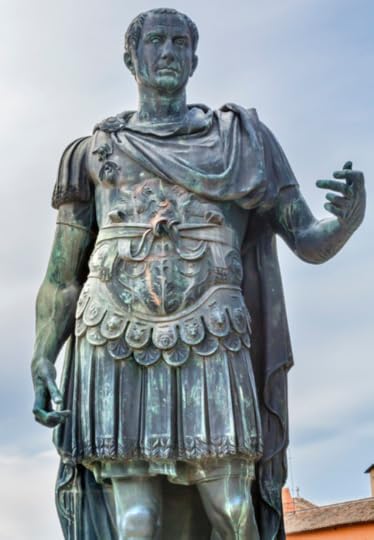
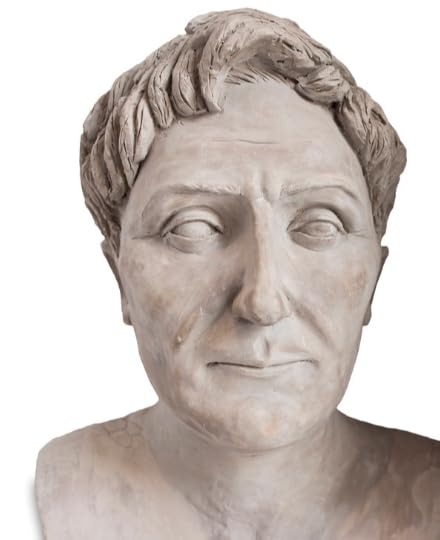
Statue of Julius Caesar and Bust of Pompey
Acting on a tip from Brutus, Caesar had pursued Pompey to Alexandria, where he found his rival beheaded by the Egyptians under Ptolemy XIII. They knew better than to be on the wrong side of Caesar.
However, Pompey was popular with Egypt’s people, and they didn’t take to Caesar, who soon found himself besieged in King Ptolemy’s palace. This is where Cleopatra makes her pitch—flirtatiously the kinder historians say, wantonly the others say—to turn Caesar away from her brother and toward her as single ruler of Egypt. Though it took him half a year to defeat the Egyptians under their young king, Caesar finally won, not only Egypt, but the heart of Cleopatra. In June of 47 BC, she would give birth to Caesar’s son, who became known as Caesarion. But Caesar had a Roman wife, and the child born of a foreign woman did not sit well with many in Rome. Cleopatra would never find legitimacy for herself or her son, and after Caesar’s assassination in 44 BC, she retreated to Alexandria to raise her son.
After the defeat of the Liberatores, Brutus and Cassius, at Philippi by the Second Triumvirate, Antony took control of Rome’s eastern territories. Cleopatra saw the handwriting on the wall—an independent Egypt was threatened. She was quick to curry Antony’s favor, meeting him in Tarsus (southern Turkey) in 41 BC, sailing into the harbor on an extravagant barge with a golden prow, purple sails, and silver-tipped oars. Cleopatra, dressed as the goddess Aphrodite, reclined under a golden canopy. Antony was impressed to say the least, especially when Egypt’s queen threw a feast that was estimated to have cost 10 million sesterces—enough to pay a legion’s soldiers for a full year. Antony and Cleopatra soon began a torrid love affair which resulted in Cleopatra giving birth to twins, a boy and a girl, in the autumn of 40 BC Meanwhile, back in Rome, Antony was consummating a political marriage with Octavian by renewing their triumvirate in the Pact of Brundisium, while also tying the matrimonial knot with Octavia, sister of Octavian.
As Antony and Cleopatra’s obsession for each other grew, so too did the animosity between Octavian and Antony, especially after Octavia had Antony’s second daughter (Antonia Minor) just months before Cleopatra had her own child by Antony (Ptolemy Philadelphus). In the lead up to the year 34 BC, the year my protagonist, Marcus, took his first look at Archimedes’ cryptic scrolls, civil war between Octavian on one side and Antony and Cleopatra on the other, was a rampant rumor. When the Pact of Brundisium expired in 33 BC, the drums of war would begin to sound. Young Marcus was to be caught up in its turmoil and set on an adventure that history never recorded but which could have happened.
Books used for historical background:
Augustus by Anthony Everitt, 2006
Warfare in the Age of Gaius Julius Caesar, Volume 2 by Theodore A. Dodge, 2013
Caesar Life of a Colossus by Adrian Goldsworthy, 2006
Cleopatra by Michael Grant, 1972
Cleopatra A Life by Stacy Schiff, 2010
Cleopatra and Antony by Diana Preston, 2009
Slavery and Society at Rome by Keith Bradley, 1994
Life in Ancient Rome by F.R. Cowell, 1961
The Romans: From Village to Empire by Mary T. Boatwright, Daniel J. Gargola, and Richard J. A. Talbert, 2004
The New Penguin Atlas of Ancient History by Colin McEvedy, 2002
Some novels that influenced my writing:
Roman Blood (series) by Steven Saylor
Under the Eagle (series) by Simon Scarrow
Alexandria by Lindsey Davis
Conspirata by Robert Harris
Emperor: The Gates of Rome (series) by Conn Iggulden
Cleopatra's Daughter by Michelle Moran
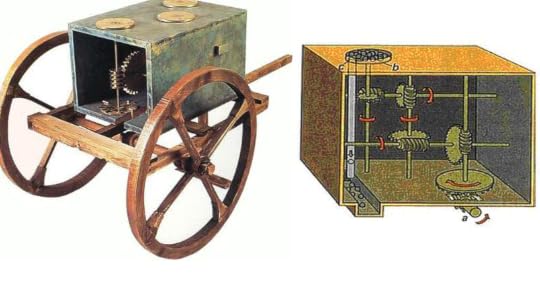
What about ancient technology? This was a critical area of research, given my central idea that the technology I posited would be a feasible invention of Archimedes and his collaborators in the third century BC. The picture shows a Roman hodometer used to measure distance.
The theory of steam was known to the Greeks by the fourth or perhaps early third centuries BC, but it was not until Hero of Alexandria invented the aeolipile in the early first century AD that we have any documented evidence of a mechanical device using the power of steam. I wondered when exactly did theory turn into practice?

Artist concept of an Aeolipile
The aeolipile device was more fancy than useful. It consists of a sphere mounted on a boiler by an axial shaft with two slanted nozzles that produce a rotary motion as steam escapes. The rotary motion could have been harnessed to do some mechanical work, but the level would be low. The device had little practical use.
Hero based his work partially on the pioneering work of Ctesibius (285–222 BC). Besides Archimedes, I speculate in my novel that Ctesibius is one of the Greek scientists/engineers responsible for the weapon detailed in the lost scrolls that my protagonist comes to possess. Ctesibius, coined the “Father of Hydraulics,” is known to have invented a compressed air cannon. Could a steam cannon be far from his mind? There’s no written or archaeological evident for that, but one can speculate (and I did).
Some of the texts I relied for technology research:
Engineering in the Ancient World by J.G. Landels, 2000
Technology in the Ancient World, by Henry Hodges, 1970
The Pneumatics of Hero of Alexandria, Translated by Bennet Woodcroft, 1851
The Great Archimedes, by Mario Geymonat, translated and edited by R. Alden Smith, 2010
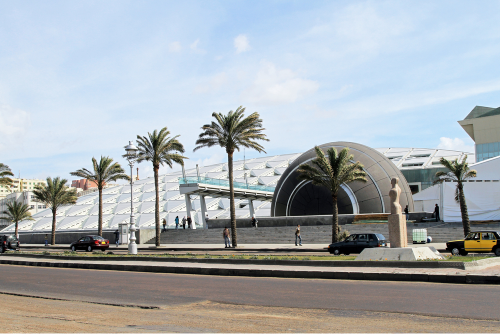
Since high school history class, I have always had a fascination with the great Library of Alexandria. I lament it’s partial (and likely inadvertent) burning by Julius Caesar in 47 BC and its ultimate destruction in 391 AD by a mob whipped into a frenzy by the Christian bishop of Alexandria, who had just read a decree from the emperor Theodosius ordering the Library and pagan temples of Alexandria be destroyed.
In my research on the library, I came across the intriguing term, “In the Cage of the Muses.” For Marcus, that was an apt description. My protagonist saw the Library of Alexandria as his sanctuary, the place where he spent hours and days searching for the lost knowledge of the ancient Greeks that would lead to a better world. It’s also where he meets Electra, his love interest in the novel.
Sadly, details about the famous library are sketchy. We don’t even know what it actually looked like in its heyday before Caesar came to Alexandria, nor is there general agreement about how much of the library was consumed in Caesar’s fire.
The following are resources I referenced for the Library of Alexandria:
The Library of Alexandria by I. B. Tauris, edited by Roy MacLeod, 2004
The Vanished Library by Luciano Canfora, translated by Martin Ryle, 1990
The Rise and Fall of Alexandria by Justin Pollard and Howard Reid, 2006
Libraries in the Ancient World by Lionel Casson, 2001
Since Lost Scrolls of Archimedes is an adventure story, there had to be a lot of moving around. Besides Marcus’ sea voyages in commerce and in war, I had quite a few scenes where Marcus is on the trail of those who kidnapped Electra. Since he traveled by sea in many of these scenes, I had to know how ships were handled, how fast they could sail, how many men they carried, etc. For this, I relied on several sources as listed here:
Travel in the Ancient World by Lionel Casson, 1994
Ships and Seamanship in the Ancient World by Lionel Casson, 1971
Early Ships and Seafaring by Sean McGrail, 2014
The Navies of Rome by Michael Pitassi, 2009
To close out this post on my research, I turn to the setting for Lost Scrolls of Archimedes. Naturally, with Cleopatra and Antony involved and with the Library of Alexandria playing a key part, the setting had to be Alexandria, Egypt in the final years of Cleopatra’s rule. The library, the Pharos Lighthouse, the Royal Palace, the Great Harbor, the Serapeum, and the Necropolis all hosted scenes in the novel. Most of my information about Alexandria came from the Pollard and Reid book mentioned above, with the odd fact coming from Internet searches.
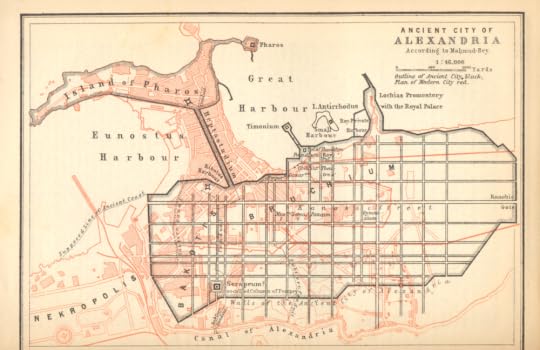
MAP OF ANCIENT ALEXANDRIA
That pretty much sums up my sources. Many were technical in nature, all were informative and entertaining—for this history buff anyway—and some were inspirational. Most of the important research was done in the period 2015-2017, but much of the background reading was done in a leisurely fashion over the previous decade. It was a hobby I turned into a story.
Marcus, Electra, and Talus will continue the adventure in my planned sequel to Lost Scrolls of Archimedes. Stay tuned to this blog for updates on my progress.
August 9, 2020
Ancient Dispatches
Hello, all. This is my first blog ever! I’m excited to share thoughts about my writing, what has influenced me, and what my future plans are.
When I started writing several years ago, my goal was not only to tell a thrilling adventure story but also to slip in a theme or two first voiced in the ancient past that is still pertinent today. It’s not that new wisdom and knowledge are not being generated now, but given that human nature has remained much the same over the millennia, much can be gleaned from history we can apply to modern life.
Why Historical Fiction?
In today’s blog, I’ll discuss my decision to make my first novel, Lost Scrolls of Archimedes, a work of historical fiction and not stray into historical fantasy or alternate history. This was easier said than done as my book dealt with technology not known to have existed in the time of my story (1st century B.C.). To do so, I had to avoid magical powers and keep the plot contained within what my research would show was a possibility, no matter how remote. The work had to be believable, even as it skirted the edge of the era’s scientific capabilities.
So, in this blog entry, I’ll discuss the differences between the genres of Historical Fiction, Historical Fantasy, Historical Romance, and Alternate History. They have several commonalities but differ in critical ways.
Historical Fiction. Historical Romance. Historical Fantasy. Alternate History. What do these terms mean, and what writing does each encompass? First, let me define each of these labels in the context of literary genres as I understand them.
Historical Fiction is a term used to describe a literary work of fiction where the primary plot and story action take place in a time at least 50 years in the past—measured from when the author wrote the story—and in which the time and setting play a prominent role.
Time and Place
The time and place often dictate how the action plays out and will rule out anything unreasonable. For example, you can’t take a trip by plane in ancient Egypt, right? The setting of the story also imposes restrictions on how the story’s characters act and even think. Though it’s not impossible for a character in the Dark Ages to see women as little more than property, it was not a common concept in the era. A story may want to illustrate enlightened beliefs in a character, and it’s acceptable as long as the author gives a reasonable basis for the belief.
The fictional world should also adhere to the physical, cultural, political, and scientific characteristics of the time and place. These elements set the stage upon which the action plays out. These parameters—the facts—the reader is familiar with, at least in broad terms, though the characters inhabiting the fictional world may not be aware of what these parameters are. And they may not even understand their meaning. In all cases, the story must be true to these basic tenants of the world.
As an exaggerated example, a Roman legionnaire can’t pull out a machine gun and start mowing down Hannibal’s troops. Likewise, Abraham Lincoln can’t show up in a historical fiction novel set in World War II.
To be authentic, characters should avoid modern slang or colloquialisms. It irks me somewhat to have a Roman soldier say “bloody hell” or another modern phrase. But I don’t like stories to use so much in the character dialog that you end up not knowing what they are talking about. As a reader, I like realistic dialog, but I also don’t want to be running to Google or Wikipedia every third sentence to get a definition of a word or concept. Even a glossary in the back of the book can get tiresome. As an author, I would rather sacrifice a little authenticity than make my story tedious or obscure.
Oh, Rhett... Not now, Scarlett. The Yankees are coming!
Most of you are acquainted with the characteristics of the modern Romance genre: love or a romantic relationship is the primary focus, and it’s usually between the major characters or between a protagonist and a secondary character. These stories can be aspirational, escapist, or both. For a contemporary/modern romance story, another dominant element is a happy ending, an emotionally fulfilling. Often the primary relationship in the story starts in a terrible place and tension builds as the characters warm to each other. For modern Historical Romance, the basic concepts are the same, but the story has a setting in the past. It is often the wildness and the inherent adventure found in those olden times that define another layer of conflict on top of the romantic/relationship conflict.
I say, chap. Magic in old London?
Before I discuss Historical Fantasy, let me define the Fantasy genre. Fantasy is a broad genre encompassing everything from Lord of the Rings to Alice Adventures in Wonderland. I’ll concentrate here on what I call epic or high fantasy. Fantasy stories need a lot of world-building by the author, as the reader needs to learn the makeup and internal “rules” of the world. Often, these worlds are a place other than Earth—although that is not an absolute requirement—and can be populated with either imaginary life forms or familiar flora and fauna or a mix. Fantasy can involve supernatural or god-like beings, good and bad, either created by the author’s imagination or based on the popular mythology of various cultures. While there may be monsters of various types (think dragons and krakens), the story characters are human or human-like (think elves, dwarves, and orcs). These stories often focus on the adventure and exploits of the chief hero/heroine. High Fantasy has escapist elements, but often also has high concept and premises. In most Fantasy, magic is a central focus, theme, or plot device of the story.
Historical Fantasy is a kind of crossover genre with features of both Historical Fiction and Fantasy. The stories take place in a world of familiar historical context, where everyday people co-exist with beings with magical powers. Often “regular” people are unaware of the existence of the fantasy characters or their superpowers. Magic exists, but only a group of elite initiates fighting evil forces know its secrets. For example, the Harry Potter books contain magic and fantastic creatures, and the setting is in the near past of 20th century Britain. Sometimes Historical Fantasy is set in a secondary world but one which has parallels to a known historical context and place (Renaissance Italy or Medieval Japan). Here, the author may ignore historical facts and events to give himself free rein to explore alternate paths.
Alternatives?
Alternate paths? That brings us to the Alternate History (or Alternative History), a fiction genre in which one or more historical events are altered to create a changed but familiar world. The author may alter the historical facts to suit the needs of the story. Alternate History, often included in the speculative fiction genre, focuses on What-Ifs.
One of the first examples is Livy’s famous History of Rome (Ab Urbe Condita Libri) in the section where he speculates on what would have happened if Alexander the Great has not died young and had attacked west into Europe. Livy wonders how Rome would have handled the event.
A more recent example is the 1962 novel, The Man in the High Castle, by Philip K. Dick, in which he speculates on a world in which the Allied Powers lost World War II. It’s also the basis of the Amazon series of the same name. The king of Alternate History is Harry Turtledove, who has written a series of novels including themes such as the South wins the civil war, the Spanish Armada defeated the English in the Elizabethan era, and the British Colonies stay part of England as George Washington and King George make peace. This blend can make for some wild stories.
There or not there. That's the question.
In my historical fiction novel, Lost Scrolls of Archimedes, I strove to avoid the alternate history label by not changing any historical events and by leaving the knowledge in the scrolls to a handful of people. I also researched the scientific knowledge of the time, making use of new archeological discoveries that reveal the ancients to be far more advanced technologically than we ever suspected.
In particular, a book that influenced me was one by Jo Marchant, Decoding the Heavens, a fascinating story that continues today about the Antikythera device discovered off Greece by sponge divers in 1901. The device, on display in the National Archaeological Museum in Athens (which I had the great fortune to visit in 2013), is essentially a 2,000-year-old astronomical computer for calculating the positions of the moon, planets, predicting eclipses, and much more. It made use of gearing technology that we never suspected the ancients ever had. This was an example of technology that history knew not a whisper of and gave me the foundation for the technology I would use in Lost Scrolls of Archimedes.
For my novel, I also made sure that no written records of the story events are made by the characters. The story is like a ripple in a pool—there one moment in time and then gone without a trace the next. I’ll let you be the judge of whether I succeeded in walking the line between the two genres of Historical Fiction and Alternate History.
What's next?Now, dropping no spoilers for those who have not read Lost Scrolls of Archimedes, let me say a few words about the sequel I am planning for my Lost Artifacts series. Marcus, my protagonist, realizes his new reality. After the Roman Consul Octavian’s victory at the naval battle of Actium, there is nothing to stop the future Roman Emperor from overwhelming Marc Antony’s remaining troops and taking possession of both Cleopatra and the rich country of Egypt.
Marcus sees no haven for him in the Roman world and plans to flee East to the exotic land of India. It’s a long journey that will involve a caravan crossing of the desert from Gaza to the northern tip of the Red Sea and from there by ship down the Red Sea, pass the Horn of Africa, and into the Arabian Sea where the seasonal monsoon winds will propel him to the western coast of India.
Many adventures will ensue along the way. Marcus will, at last, meet the Oracle Prime. How will Marcus react when the top Oracle asks him to help study a new artifact that will magnify the impact of the new technologies revealed in the scrolls of Archimedes? Will he eschew a fresh adventure and stay with his plans for a new life in India? Or will he follow his old dream of bettering the world and choose a path that will take him into lands at the edges of the world known to the Romans?
So, there’s a slight peek at what’s in store for Book 2 of the Lost Artifacts series. I’m in the final outlining stages (yes, I’m a planner) now and hope to begin writing before this summer fades. Stay tuned to this blog as I report on my progress. In the meantime, please consider buying my book on Amazon (where the eBook has a new, lower price), Barnes and Noble, or Kobo.
If, like me, you enjoy ancient history, especially the lessons it can teach us, I recommend you check out the website Classical Wisdom. Their blogs are full of thoughts on how history can guide modern man and his societies.
Until next time, look to Ancient Dispatches to shine a light on your path.
July 30, 2020
Book signing for Lost Scrolls of Archimedes
Whenever it becomes safe to go into bookstores, libraries, and other settings, here is the banner I'll use at my book signings.