
Anton Chuvakin's Blog
November 10, 2026
The SIEM Zombie Apocalypse: Why Every SIEM Killer Becomes the Corpse
Warning: this blog is another experiment. The idea for a blog came from a real conversation I had with somebody. The content is researched, debated, refined, “hardened” by a Gemini skill I created (using Gemini 4 Argon). Then Claude Fable 5.2 performed a peer review, and tore some parts to shreds. Then rewrote them. Then Gemini 4 Carbon made fun of Claude’s dry style and restyled it. And then I very lightly edited it, and tuned a few jokes. I removed a metaphor involving a taximeter (wut?) Let me know if this sucks, and I will stop. Promise!
I met my first SIM appliance in January 2002. Roughly eighteen months later, somebody at a conference told me the category was a dead end, and possibly even dead. So began the story of “SIEM is dead.”
Since then, I have attended at least five formal industry funerals for SIEM: first when Log Management arrived around 2006, then when UEBA promised “math instead of rules” around 2014, then when XDR promised “endpoint-first nirvana” around 2020, and most recently when the Security Data Lake and Agentic AI crowds showed up holding shovels (some: pitchforks) in 2024 and 2026.
Funny thing about all those funerals: the corpse keeps eating the pallbearers! (BTW, I am a constructive cynic, not a SIEM museum curator.)
Look at the 2026 SANS SOC Survey (surveying 513 practitioners and security leaders). EDR earns the highest tool satisfaction in the SOC (), yet SIEM remains the number-one most sought-after skill in hiring, at nearly double the demand of EDR. People love complaining about their SIEM on Tuesday, try to replace it on Wednesday, and then hire two new SIEM engineers on Friday.
Why does every “SIEM killer” end up quietly rebuilding a SIEM two years into production — and occasionally dying while trying?
The short version fits on a sticker: you can fire your SIEM vendor, you can unbundle your SIEM storage, and you can ban the word “SIEM” from your architecture slides, but you cannot fire the SIEM job.
Five Funerals and the Same Six Missing PartsBack in March 2023, in Debating SIEM in 2023, Part 2, I proposed a simple sanity check: stop arguing about the four-letter acronym and list the actual problems you solved with it. If you refuse to buy a SIEM, those problems do not politely excuse themselves from your building.
Every replacement wave starts with one genuinely superior wedge and an unspoken assumption that the other five parts of security operations are trivial plumbing!
Here is The “Accidental SIEM Gravity Well”: what happens between Day 1 and Month 18 of every “SIEM-less” revolution (the four most recent are shown):
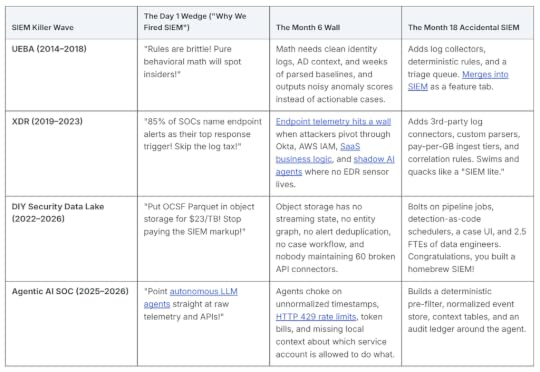 SIEM killers list (2010–2026+)
None of these waves failed because their core invention was bad. They won their narrow argument, walked into the SOC, and slammed straight into the Six Irreducible Jobs of SecOps Gravity (is this cool or what?):
Hostile-World Ingestion & Drift Survival: Collecting from 80+ sources whose vendors change JSON schemas on Friday afternoons without telling you.Semantic Normalization & Identity Resolution: Knowing that achuvaki, anton@corp.local, and uid=2342 on an AWS role assumption are the same human, not just three strings in a column.Stateful, Cross-Source Correlation : Joining ten failed IdP logins, one new MFA device registration, and a SharePoint bulk download within a 10-minute sliding window.Alert Deduplication, Grouping & Queue State: Turning 47 firing rules from one intrusion into one work item with an owner, SLA timer, and status, instead of 47 Slack webhooks.Local Environment Memory (“Context as Code”): Remembering that svc_backup_02 is supposed to touch every file share at 2 AM on Sundays, and who approved that exception.The Tamper-Evident Time Machine: Proving to an auditor — or an incident responder nine months later — exactly what happened, with role-based access controls so junior analysts can’t read the CEO’s workstation logs where he mistyped his password.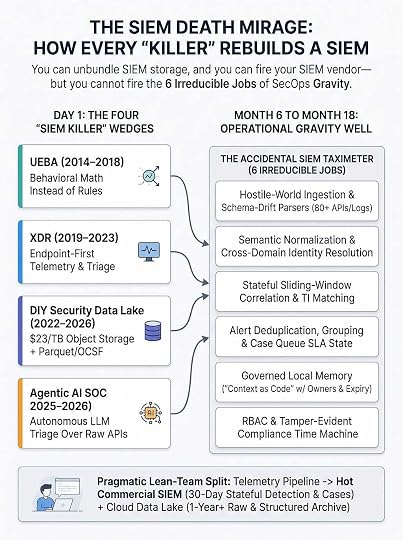 “Its alive!!!” by Gemini
Skip any one of those six jobs in your shiny “not SIEM” replacement, and your own teams will quietly start writing Python scripts and gluing Jira tickets together to rebuild a SIEM organically. Not organically as in “tasty and healthy,” but as microbes decomposing a dead body kinda organic … [A.C. — this joke is me, not AI, obviously]
Back-of-the-Napkin Math: The “Cheap” Data Lake GuessLet’s test today’s favorite boardroom sacred cow: “We will dump all our logs into S3/Athena or Snowflake, write SQL queries as detections, and fire our SIEM vendor!” (I picked this fight in 2017 and again in 2022.)
At roughly $23/TB/month in S3 Standard, your CFO is already popping champagne. Painful enough for the SIEM vendor yet? Wait until you turn on detections.
Take a mid-size enterprise generating 2 TB per day of raw security telemetry (AD, Okta, EDR, VPC flow, proxy, SaaS audit logs):
Naive Pay-Per-Scan Polling: Suppose your SOC runs 250 SQL (gasp!) correlation rules every 5 minutes (72,000 query runs per day). If your data lands as semi-structured JSON or tables partitioned by day rather than minute (or joining across a 30-minute lookback window), where each rule scans a 50 GB slice of recent multi-source logs, 72,000 queries × 0.05 TB = 3,600 TB scanned per day. At $5 per TB scanned (Amazon Athena’s baseline rate), that is $18,000 per day, or $540,000 per month just to ask “did anything bad happen in the last five minutes?” Hilarity ensues! The ghost of SIEM curses you from the great beyond.“Wait, Anton, Nobody Does Unpruned JSON Scans!” Fair enough! A sharp data engineer will object: “Convert everything to OCSF in Apache Parquet/Iceberg, partition by eventDay and eventHour, buffer writes with Firehose, compact small files on a schedule, and push down predicates so each rule scans 50 MB instead of 50 GB!” [Ok, fine, AI made this up, but this is plausible! — A.C.]Now Add Up the Engineering Bill: Congratulations, your scan bill just dropped by 99.9%, and your people and pipeline bill just arrived! To keep that running without dropping events, you now own: (a) a streaming ingestion and compaction tier; (b) OCSF mappers across 50+ messy sources where — as practitioner deployments keep rediscovering — mapping an IP to src_addr vs. proxy_addr takes security judgment, not just regex; (c) a stateful engine for sliding-window joins across partition boundaries; and (d) an alerting and case-management UI. Compliance reports? Yeah, that would be (e). Congrats, you are now a SIEM vendor yourself!Staffing that “free” architecture reliably takes 2 to 3 dedicated security data engineers ($200,000 to $500,000+ a year in loaded comp) before you write a single detection rule or hire an analyst to read the output (agents would do it?). You haven’t killed the SIEM — you have just entered the unregulated, artisanal SIEM software business, with one customer (yourself) and zero vendor support when it breaks, or any other time frankly.
Where the “SIEM Killers” Were Actually RightWhy do ambitious CISOs and brilliant detection engineers keep trying to kill SIEM every five years? Because the monolithic 2010-era SIEM bundle need evolution, if not a revolution!
For fifteen years, traditional SIEMs tightly coupled storage, data management, and detection. Worse, per the 2025 SANS SOC Survey, 42% of SOCs dumped all incoming data into their SIEM without a retrieval plan — paying hot-index rates for debug noise and compliance wallpaper nobody ever queried. SIEM is not log management.
Still, over the years, the “SIEM killers” got three big things right [this point alone is worth the price of reading this blog — A.C.]:
Decoupling storage from compute became credible. (I asked in 2023 whether decoupled SIEM was brilliant or stupid before softening my stance on this). This is how several modern security platforms work in 2026, and even some legacy SIEM vendors spent the last few years replatforming onto lakehouse backends.Data pipelines broke log lock-in. Putting a routing and transformation layer in front of your detection engine means switching SIEMs no longer requires re-plumbing 10K servers and 220 log source types from scratch.Detection-as-Code beat click-ops. Engineering teams were right to demand Git-versioned detections, CI/CD testing, and open schemas like OCSF instead of clicking around brittle GUI wizards.So the twist isn’t that data lakes, UEBA, XDR, or AI SOC failed. They succeeded at evolving the monolithic SIEM, and SIEM survived by eating their architecture. Calling a platform built on Iceberg + streaming correlation + OCSF + case management + AI triage “Not-a-SIEM” doesn’t prove SIEM is dead. It proves SIEM is alive!
As I wrote in The Ancient Art of SIEM: Why 2003 Problems Look So Familiar in 2026, the cost currency keeps changing (from RAID arrays to EPS to GB/day to warehouse credits and LLM tokens) while the underlying operational physics refuses to budge.
The Secret of SIEM’s Staying Power: It Owns the Messy SeamsSIEM survives because it is the only place in security forced to reconcile cross-domain state with local human reality under adversarial pressure.
In Can AI Let You Jump SOC Maturity Levels? (Spoiler: Only the Boring Half), I separated time cost from learning cost. AI and modern data lakess slash SecOps time cost — generating parsers, translating SPL to SQL, or scanning ten billion rows in three seconds. Take that win immediately.
What neither a Parquet file nor an out-of-the-box XDR sensor possesses is your security learning cost:
Which third-party vendor VPN is allowed to touch the claims database during month-end close?Which subsidiary still runs a legacy AS/400 or custom billing app whose logs look like hieroglyphics?When an alert spans Okta, AWS, and CrowdStrike, where does a human (or agent) record why it was benign — with an owner and expiration date — as I detailed in Stop Building a 2003 SOC with AI (Part 3: Local Context)?Sit strictly below that seam (pure object storage) and you build a data swamp; sit strictly inside one silo (pure EDR) and you go blind the moment attackers log in instead of break in. Reach across the seam to correlate state and hold local context, and — whoosh welcome back to the Accidental SIEM Gravity Well.
The Lean Team RealityNow let’s leave Silicon Valley hyperscaler land for five minutes. Suppose you run security for smaller enterprise with four security engineers, an MDR contract, compliance auditors breathing down your neck, and a SIEM renewal bill that just jumped 30%.
When a vendor or ambitious consultant pitches “Let’s ditch our SIEM and build a SIEM-agnostic AWS/Snowflake Security Data Lake!”, run away from the “replace the SIEM” half of that sentence. In advisory conversations I have had with smaller teams attempting this exact move, homebrew SIEM projects suffer a brutal failure rate.
What actually works for a lean team is the two-tier split I first argued for in 2009 and updated in SIEM: Centralize Like You Mean It, Federate Like You Have To:
Keep real-time detection, stateful correlation, and case triage in a commercial SIEM (or MDR-managed SIEM/XDR), shrink its hot retention window (say, from 90 days to 30), and strip out high-volume, low-signal compliance and network noise.Put a commercial data pipeline in front of it (this mostly works, I swear, though YMMV on exotic legacy sources) to fork raw archival logs — plus daily structured exports from your SIEM — into cheap S3 or Snowflake storage for 1-year+ compliance, retro-hunting, and future migration leverage.Why keep both raw and SIEM-structured exports in the lake? Same reason as in 2006: store only raw logs, and pivoting from a live SIEM alert into 9-month-old lake history is painful; store only SIEM-parsed exports, and anything your old SIEM failed to parse is lost forever while locking you into its schema!
You get most of the CFO cost relief and close to none of the broken homegrown correlation engine misery.
Potentially Useful Actions Based on ThisFour usable ideas here:
Audit your “SIEM Tax” by job, not by vendor invoice. Take your top 15 log sources and apply the Output-Driven SIEM test: which sources feed active, multi-source detections versus sitting there for annual audit comfort? Evict the compliance wallpaper instead of throwing out your correlation and case engine. (If an MDR runs your SIEM, ask at renewal which ingested feeds fired zero reviewed detections in the past 180 days, and stop paying hot-tier rates for logs their analysts never touch.)Run the “Six Irreducible Jobs” checklist on every “SIEM-less” pitch. Whenever an internal architect or startup proposes replacing your SIEM with Snowflake/Iceberg, XDR, or an AI agent mesh, score them against the Six Jobs above — and demand the 24x7 computer/storage cost estimates for your intended SIEM use.Unbundle your pipeline before you touch your platform. If your real pain is renewal extortion, use that vendor-neutral pipeline and 12-month S3 archive as commercial leverage. Owning routing and historical copies in your own bucket lets you swap SIEMs — or renegotiate your current one — without a 14-month re-plumbing nightmare.Use lakes and LLMs to kill toil . Point compute at petabyte-scale IOC sweeps and cold retro-hunts where SIEM hot tiers choke on cost. Point LLMs at writing parsers, translating detection logic, and drafting investigation summaries, while keeping deterministic engines in charge of streaming correlation, state, and gating. Do not point LLM at raw logs, unless you hate money.So, Why Won’t SIEM Just Die Already?Every few years, our industry confuses a clumsy product generation with an optional operational problem. Monolithic appliance SIEMs deserved to die. Blindly stuffing firewall debug garbage into premium-priced hot storage deserved to die. Swivel-chair L1 human triage is in the middle of dying right now.
What refuses to die is the messy, unglamorous center of gravity where half-broken logs from eighty vendors, stateful attacker timelines, compliance receipts, and quirky local business reality all collide at 3 AM. Call that box a Next-Gen SIEM, an Open Security Lakehouse, a Unified SecOps Platform, or “Bob.” [A.C. — which AI came with Bob?]. It is still a SIEM. And it is alive!
Related blogs:
“I Don’t Need a SIEM, I Have Ollama!” (Yes, You Do!)[A.C. — note to self: this is v7.5 Gemini skill using 4 Argon]
The SIEM Zombie Apocalypse: Why Every SIEM Killer Becomes the Corpse was originally published in Anton on Security on Medium, where people are continuing the conversation by highlighting and responding to this story.
Originally published at Medium.
About me: http://www.chuvakin.org

November 5, 2026
“I Don’t Need a SIEM, I Have Ollama!” (Yes, You Do!)
Warning : this blog is an experiment. The idea for a blog came from a real conversation I had with somebody. The content is researched, debated, refined, “hardened” by a Gemini skill I created (using Gemini 4 Argon). Then Claude Opus 5.5 performed a peer review, and tore some parts to shreds. Then rewrote them. And then I very lightly edited it, and tuned a few jokes. I replaced a food fight joke with a pillow fight joke, specifically. Let me know if this sucks, and I will stop. Promise!
—
A security peer recently shared a proposal they had just heard in the wild: instead of paying for a SIEM, why not load several days of raw log data into a locally run open-weights model, ask it “what looks risky?”, and review whatever the model highlights?
No SIEM ingest tax! No cloud token bills! No SIEM license fees! No writing correlation rules! No tuning anomaly detection! Just a gaming GPU under a desk and pure, artisanal AI-native vibes. Ahhh, magic!
 Gemini illustration
Wait. Really?
My first instinct, forged by 24 years of staring at logs since I first met a SIM in January 2002, was to laugh, pour a drink, and move on. Surely everyone knows this is a terrible idea, right? Right?!
Wrong.
If an engineer, an IT director, or a cost-cutting CFO pitches “local LLM as a poor man’s SIEM” in your organization, you cannot just roll your eyes and mutter “hallucinations.” People keep inventing this idea for real reasons. SIEM ingest pricing still hurts: some vendor cost explainer works out 5 TB per day at $2 to $4 per GB as $3.6 to $7.3 million a year on ingestion alone. Detection engineering is still hard work. And yes the AI hype machine has spent two years promising executives that models can “reason over any unstructured data.”
So let’s dissect why dumping a week of raw logs into a local model breaks four basic laws of “operational physics”, and then carve out the narrow 10% where a local model does help with logs. The short version fits on a sticker: the LLM writes the parser, it never runs as the parser. And the twist is that the problem here is “raw,” not “local.”
Token Arithmetic and Naive Chunking (Or: How Big Do You Think 7 Days of Logs Is?!)Let’s start with grade-school arithmetic, because clearly nobody pitching this architecture has ever opened a calculator…
Forget the enterprise. Take a tiny environment, a single server rack generating a measly 1 GB of raw text logs per day. Seven days of logs is 7 GB of text, or roughly 1.75 billion tokens at 4 characters per token. That is generous, since IP addresses, GUIDs and hex strings tokenize worse than English (Wow, really? Yes, really — at least Claude thinks so! He would know, right?)
Now look at that “free” 8B or 70B parameter model on your GPU workstation. Its usable context window, before the KV cache devours your VRAM and the fans sound like a Boeing 747 on takeoff, is maybe 32K to 128K tokens. You are shoving 1.75 billion tokens through a 128K keyhole, which is about 13,700 full context windows. Painful enough yet?
Well, it gets worse. Assume your box reads a generous 2,000 tokens per second (benchmark your own, I’ll wait). Reading those 1.75 billion tokens takes about 10 days. You need 10 days to read 7 days of logs, so you never catch up! Scale that to the 5 TB per day example above and it is about 20 years of GPU time for each day of logs. Hilarity ensues! Replacing a deterministic stream processor with a token-by-token text predictor is like replacing your municipal water pipes with a guy carrying a silver espresso spoon from a well 10 miles away.
“Fine, Anton,” the DIY enthusiast says, “we’ll chunk the logs into 2,000-line batches and loop the local model over them all weekend!” Or we will get a bigger boat… eh… server rack to run the model.
Chunking naively, by just loading the data in batches, fails hilariously. Here is how:
Attack chains get cut. The phish on Tuesday lands in one batch, the lateral movement on Thursday lands thousands of batches later, and no prompt ever sees both. Each batch gets judged alone.Merging the summaries does not bring the signal back. By the time you summarize the summaries, the one quiet line was already dropped in round one. So “naive+” fails as well.Position inside the batch matters. Liu et al.’s “Lost in the Middle” found that models do best when the relevant information sits at the start or end of a long context and degrade sharply in the middle. They tested question answering and key-value retrieval, not logs, but picture a quiet privilege escalation on line 1,482 of your batch. Worst seat in the house.Researchers keep running into this. Cai, Ryan and Karie note that iterative approach is limited by context capacity and that map-reduce style summarization is computationally heavy (and requires some luck). Even so, that is a proof of concept on up to 20,000 rows per dataset, and they say enterprise volumes remain to be validated.
So smarter chunking exists (reminder: it is not magic, in this area nothing truly is): parse, cluster, then retrieve by entity and time. At that point you are building the first half of a SIEM. Congratulations!
As I wrote in The Ancient Art of SIEM, cost pain is eternal and only the currency changes. In 2003 you ran out of hardware, in 2015 you ran out of cloud budget, and in 2026 you run out of tokens and VRAM.
The Input-Centric Time Machine: Back to 2002 Batch ReviewNotice the most revealing phrase in this idea: “load 1 to 7 days of log data… and then review what the model highlights.”
That is not real-time detection. That is batch-mode log archeology! When intruders can go from initial access to data theft in hours (soon: minutes for some incidents), reviewing a week of logs in a batch means you are running a weekly book club about how you got breached last Wednesday. But hey … is your SIEM faster? Well, it should be!
Worse, asking an LLM to “highlight what looks risky” violates the most important lesson of two decades of detection engineering. In Output-driven SIEM, 13 years later, I revisited my favorite 2011 mental model: think about what you want to see at the output before you collect, and AI does not change this. Asking a model to “find risk” in raw logs with zero detection engineering is the ultimate input-centric anti-pattern. It failed with ML in mid-2010s, and LLM is not different (in this regard).
Now, about determinism. The lazy objection is “the answers change on every run,” and a sharp engineer will reply “so pin the seed.” Fair enough! Run-to-run randomness is an engineering problem: Thinking Machines got 80 unique completions out of 1,000 at temperature 0, then 1,000 identical ones after fixing their kernels. But is it actually bad? Maybe if you run 5 times, you will find 2x more “fun” things. But hey … also probably at least 5x more noise.
The harder test is stability. Take the same 48 hours of domain controller logs, shuffle the order or change one irrelevant line, and run it again. Given what we learned, I would bet real money the verdict moves. Well-crafted SIEM rule does not care what order the lines arrive in.
Zero Local Context Equals Hallucinated RiskWhy can’t a local model tell an active nation-state intrusion from Tuesday’s messy IT administration? Because raw logs do not contain your organizational reality! Shocking, eh?
A raw syslog or CloudTrail line says that svc_deploy_04 logged into prod-db-02 at 3:14 AM from an internal jump host and ran an encoded PowerShell script. Is that a five-alarm breach or the legacy billing batch job that Bob in accounting wrote in 2017 and nobody dares to touch? This is a dated example, on purpose. Insert your own fun example involving a shadow AI agent!
In Part 3 of the Stop Building a 2003 SOC series, I argued that the #1 reason AI fails in the SOC is the absence of Context as Code: machine-readable, owned, and expiring knowledge of your assets, business processes, and weird administrative exceptions. In Part 2, we warned about automation bias: humans reviewing plausible, well-written machine verdicts approve them.
Also, the test from Can AI Let You Jump SOC Maturity Levels? applies here: does this exist because someone had to spend time, or because someone had to learn something about us? Writing a parser is a time cost. Knowing about Bob’s job is a learning cost, and no model downloaded from the internet has paid it.
Feed raw logs into a naked local LLM with no CMDB enrichment, no threat intel, no identity graph, and no 90-day baseline, and its only source of “context” is its pre-trained weights. So it flags every scary-looking word (ERROR, DENIED, admin, root, failed) and writes you a convincing fictional thriller about your own network.
The Confused Deputy Trap: When the Attacker Prompts Your “SIEM” via User-AgentNow put on an attacker hat for 30 seconds. What is a log file?
A log file is untrusted, attacker-influenced input. Every public-facing web server, SSH daemon, API gateway, and email relay faithfully records whatever string an outsider sends in an HTTP User-Agent, a failed username field, or a JSON payload.
Log processors have been attacked through logged strings before (hi, Log4Shell!), but that was a bug you could patch. In a raw-log-to-LLM setup there is no parser boundary to patch, because instructions and data share one channel. You just handed the attacker write access to your detection engine’s prompt!
Summaries are also scary, BTW. Pandey and Bhujang found that the classic “ignore all instructions” override failed completely against the one model they tested, but context manipulation reached 96% success on summarization with no defenses and 38% even with constrained output.
In How to Solve the Mystery of AI Defense in Depth (and my October 2026 collaboration with Usman Chaudhary, The Model Has Preferences, but the Harness Got Controls), I emphasized that a model’s statistical preferences are never a security boundary, and only a deterministic harness is. Feed unparsed logs straight into a local LLM with no harness, and any kid with curl can blind your review or flood your team with fabricated critical alerts…
The Problem Is “Raw,” Not “Local”Let’s be fair to the local crowd, because they have a point.
Local solves a real problem. Logs are full of secrets, PII and internal hostnames. Not shipping them to a third-party API is a legitimate reason to want a model on your own hardware. It also — theoretically — eliminates an endless stream of unpredictable token costs flowing to a frontier model provider.Small models are not the villain. In the same paper, a structured design called Aida (separate agents for investigating, challenging and judging, working through a SIEM) used open-weight Qwen3.5 9B and it was workable for the task they had.“What about an agent querying a log store?” Now we are talking! The model forms a question, a database searches 7 days of logs deterministically, and the model reads a small result. That is a very different architecture, and it needs parsed data, a query engine, detections to start from, retention and access control. Sound familiar?So keep your local model if you want it. What is missing from this proposal is the SIEM…
The Raw-Logs-to-Local-LLM Delusion MatrixFor explaining this to an enthusiastic colleague (or a budget-slashing executive) without starting a pillow fight:
Wait, Is a Local LLM Good for Anything in Log Land? (The 10% Where It Shines!)I am a constructive cynic, not a Luddite (At least Gemini 4 Argon thinks so!). As I noted in the SOC maturity post, AI can jump the artifacts, and parsers are on that list (with caveats for tricky log sources). So point your local model at logs as an engineering sidecar, not an ingestion engine:
Writing the parser, not being the parser. Instead of feeding 50 million lines from a weird legacy mainframe into an LLM, feed 20 sample lines and ask for a regex, OCSF mapping, or pipeline rule. The LLM writes the code once, and deterministic CPU code parses the 50 million lines at wire speed. This mostly works, I swear.Post-trigger micro-slice investigation. Once a rule or EDR alert fires on a specific host and 15-minute window, pull 200 pre-filtered, enriched log lines and ask the model for a timeline. Those lines still contain attacker strings, so treat the summary as untrusted and let the model request actions only from a closed list.Ad-hoc query translation. Translate an analyst’s question into KQL, SPL, or SQL, so the database searches 7 days of logs deterministically. This also mostly works, but some YMMV.The Lean Team RealityWhat if you are the CISO of a regional insurer or hospital with a small security team, a hybrid stack, strict state regulators, and an MDR provider? When an engineer or cost-conscious VP suggests “let’s dump our noisy firewall logs into a local Ollama box,” they aren’t trying to sabotage your SOC. They have a log source that is too expensive to send to the SIEM, and they want a free way to “keep an eye on it.” Here is how to solve that without a science project:
Don’t use a GPU box as a poor man’s data lake. Route a noisy source to cheap, searchable object storage, or strip verbose fields in a pipeline before ingest. This is my old two-tier answer (a SIEM plus a broad, cheap log store), and it has aged well.Hold your MDR to the same standard. When they brag at the next QBR about “AI-powered log analysis,” ask whether deterministic detections run first or whether it is an LLM wrapper over unparsed telemetry. This point alone is worth the price of reading this blog (A.C. — this is me, not AI)Channel the DIY energy. Give your smart engineer 50 anonymized lines from your gnarliest legacy application and ask for three high-signal filter rules you can deploy in your real pipeline.Action Items for Security LeadersIs there anything you need to actually do?
Run a napkin token audit on any AI log proposal (Monday morning). Before the demo starts, ask: “How many GB per day is the raw source, how fast does the model read, and what deterministic step selects the tiny slice that reaches a context window?” If the answer is “we’ll just load it in batches,” kill the project on the spot. It’s this “just” word.Fix ingest pain with tiering (30-day play). If this idea surfaced because a log source is too expensive for your SIEM, solve that: drop repetitive keepalive chatter, route compliance-only logs to cheap storage, and keep output-driven security data in your detection tier.Make “the LLM writes the parser, never runs as the parser” a standard (architecture play) — that is, if you write parsers at all. Allow LLMs at design time (parsers, mappings, queries from small samples) and at post-alert time (small, bounded, enriched slices), but not as the runtime ingestion or anomaly engine over raw logs. Put it in your MDR requirements too… otherwise they will keep whining that it takes 7 weeks to integrate a log source forever.Test your existing AI log workflows for prompt injection (60-day play). If your SOC or MDR summarizes anything containing attacker-controlled strings, test it in your next purple-team exercise. Do not stop at a naive “ignore instructions” canary, because passing that proves little. Try persona and context-rewriting payloads, plus payloads split across lines.So, Do You Need a SIEM?Call it a SIEM or call it a pile of parsers, a query engine, detections and retention. You need those things, and a GPU under a desk does not replace them. By all means run a model next to them, I promise it will be fun!
The part that worries me most is how this fails. A detection rule that misses can be tested, tuned, and re-run. A model that misses hands you a nice summary, and nobody knows what was not in it. As I said in September, skipped maturity used to fail loudly, and now it fails quietly.
We had 23 years of progress, and the best practice is still “have a plan and don’t ingest garbage.” That goes for your context window too.
[image error]“I Don’t Need a SIEM, I Have Ollama!” (Yes, You Do!) was originally published in Anton on Security on Medium, where people are continuing the conversation by highlighting and responding to this story.
Originally published at Medium.
About me: http://www.chuvakin.orgNovember 3, 2026
Seven Shades of Shadow AI: A 2026 Field Guide for Pragmatists
Back in 2023 — which is roughly 30 years ago in “AI years” — Marina Kaganovich and I first wrote about “shadow AI”: employees sneaking around with consumer-grade AI to get their actual jobs done. Life was simple. There was AI your company approved (for many CISOs, this was a proud empty set), and AI it didn’t. Employees loved and used the latter. Employees felt “meh” about the former. The core risk was equally simple: data leakage — someone pasting sensitive snippets into a prompt and having them show up in training sets or outputs for others. Then shadow AI struck back in 2025, wearing an enterprise badge (we called it Shadow AI Type 2).
 Random shadowy image
But in 2026, the risk landscape has changed: we have moved from passive data leakage to rogue actions. Modern shadow AI isn’t just listening or talking; it’s executing terminal commands, calling external APIs, modifying production databases (if you suck at access control, it definitely does), and acting as autonomous agents with delegated corporate credentials (if you suck at identity delegation).
If your 2026 security strategy still treats shadow AI as “DLP and a proxy block will fix it” (or: “we will just block ‘bad AI sites’ on a proxy or DNS filter”) you will be unpleasantly surprised. On the flip side, you may actually be pleasantly surprised: a lot of our classic 2023 shadow AI fears turned out to be genuinely low risk.
Still, every time I present on this topic, somebody walks up and asks: “OK Anton, but where does X go?” Where X is:
A CLI coding agent on a personal subscription, wired via an MCP server directly to a production database (please don’t laugh, it really does happen at some places).A Python microservice in prod that quietly calls an LLM API using somebody’s personal credit-card key.An OpenClaw instance on a sales rep’s laptop, with full read/write access to their corporate mailbox and CRM.None of these fit neatly into the “employee pastes data into a chatbot” mental model of 2023. So it is time for a refresh. Below is my 2026 taxonomy: Seven Shades of Shadow AI. (BTW, Marina, I still miss you as my collaborator :-))
Good News, Bad News (With Numbers)
But first, some good news: the 2023 problem is getting better, at least as a share. Netskope’s Cloud and Threat Report 2026 shows the share of genAI users on personal AI accounts dropping from 78% to 47%, while organization-managed accounts climbed from 25% to 62%. Paved roads work. Who knew? (We did.) Now, the fine print: this is a share, not a headcount. Over the same period (October 2024 to October 2025), the number of genAI users tripled and prompt volume grew sixfold, so the raw number of personal-account users likely still went up. And the people bouncing between personal and corporate accounts grew from 4% to 9%.
Other datasets paint a less rosy picture: Verizon’s 2026 DBIR still found 67% of employees accessing AI through non-corporate accounts on corporate devices, making shadow AI the #3 non-malicious insider action in their entire DLP dataset. And when Harmonic Security analyzed 1.9 million AI session minutes, 65% of the activity on personal accounts was actual work — writing work emails, summarizing meeting notes, debugging code. And it was go-to-market teams, not legal, who led on free accounts. (Filed under: “Shocking, yet totally unsurprising.”)
The bad news: it is 2026, and the battlefield moved.
Breach correlation is spiking: IBM’s Cost of a Data Breach Report 2026 found shadow AI incidents at 43% of breached organizations, more than doubling from 20% a year earlier (summary). Regular readers know I don’t trust their breach cost dollar math, BTW, but this trendline is completely believable.The Dunning-Kruger Agent Paradox: A Cloud Security Alliance survey (commissioned by Token Security, 418 responses) found that 82% of organizations discovered unknown AI agents in the past year — yet 68% simultaneously reported high confidence in their agent visibility. Fun math: most are confident, and yet most are surprised! (To be fair, finding an unknown agent means discovery worked at least once.) When 82% of enterprises keep stumbling across unknown agents, “unknown” isn’t the shadow — it’s the default state of modern IT.SaaS is governed; AI plumbing isn’t: Reco’s State of Agent Security 2026 showed that while 79% of SaaS apps were authorized, 80% of AI tools — browser extensions and MCP servers included — were completely ungoverned.Geography and model provenance now matter: In a separate July 2026 report, Harmonic found that every single organization of the 79 they monitored in H1 2026 had at least one employee sending data to a China-based AI tool like Tencent Hunyuan or DeepSeek (not just their model!). The median was only four employees per organization, but across the dataset the uploads included M&A plans, source code, and financial projections. Wow, dear reader, that might be your organization too!BTW, obligatory note on survey data above: not all surveys are “good data”, these are shown here as examples that serve my narrative. Feel free to find those that contradict it and share with me!
So, IMHO, in 2026 we are slowly winning the 2023 shadow AI war at the edge. Meanwhile, the 2026 war is being fought elsewhere: on developer laptops, in vendor release notes, and inside agent tool configs.
The Sorting Rule: Four Questions
Since seven items totally require a taxonomy, let’s make sorting rules. Shadow AI types differ on four things, and each difference changes the control you actually need:
Who turned it on? An employee, a team, a developer, a vendor — or another agent. (Exclude alien superintelligence from the list … for now ;-))Whose identity does it run as? A personal account, corporate SSO, a developer’s own local/cloud credentials, a non-human service account, or the vendor’s platform. (The workload vs. workforce agent distinction is hugely useful here.)Does it talk, or does it also act? Chatbots talk; agents act (and consumer chatbots are growing hands of their own). A shadow chatbot leaks data; a shadow agent does things. Sometimes ominous things.Where would you even see it? Proxy logs, expense reports, endpoint process lists, config files in Git repos, SaaS tenant settings, OAuth grants, or the cloud bill — the list is not just long, it is broad. Work use of an AI app on a personal phone may be a data risk, but it is not a risk of modifying your production CRM.If two findings give different answers to these four questions, they need different controls. One cute acceptable use policy will not cover all seven shades, sorry! And if you want the bumper-sticker version from my RSAC 2026 talk:
Shadow Agent Risk = Reach x Agency(Question 2 mostly tells you the Reach; Question 3 tells you the Agency — and they multiply, not add. For the shades that mostly talk, data sensitivity drives the risk.)
One quick reality check before we panic: a lot of shadow AI is actually low risk. At RSAC 2025, I talked to a CISO who shrugged and said he just didn’t see much harm in most of it. And honestly? For a huge chunk of Shade 1, he was right. If an employee uses a personal chatbot to polish a public LinkedIn post, fix grammar in a cold email, or summarize a public PDF, the actual risk to the enterprise is near zero. Treating “fixing a public slide deck in personal ChatGPT” with the same hair-on-fire DLP blocks and HR warnings as “wiring an unsanctioned OpenClaw agent with an MCP server to a production database” is how security teams burn all their credibility — and push shadow AI deeper into the shadows. That is why we sort by reach and agency first.
Shades 1–2: The Ones We Already Know
1. Consumer Shadow AI (The 2023 Classic)
What: Personal accounts on consumer chatbots, used for work. Plus my favorite unfixable edge case — the phone-camera loophole: point your personal phone at the corporate screen and ask it to fix your slide (I did this on a few webinars as a trick, worked well with Gemini even back in 2025). No firewall on Earth stops that one.Status & 2026 Wrinkle (Context Lock-In): Improving, but 47% is not zero, and users increasingly bounce between personal and corporate accounts. Why? Because of context lock-in (memory gravity). As one global tech head pointed out recently, employees resist switching to the newly approved corporate chatbot because they have so much history, custom instructions, and memory built up in their personal one (“It knows me, I cannot just switch”).Main risk: Data leaves the company under consumer AI terms — training, retention, human review — or crosses geopolitical boundaries.Where to look: Your web proxy, SSE, or CASB. Obvious, sure, but also correct.First move: Make the paved road better than the dirt road. Give employees an enterprise AI workspace with real memory, file uploads, and tightly scoped MCP connectors (email, calendar, CRM; email is an injection path, so scope it) so it actually beats their personal account, give them an easy way to import their custom instructions/history, and then enforce SSE/CASB tenant restrictions and managed browser controls to block personal logins on managed devices and networks.Reminder: every solution here is partial! No magic! Inline tenant restrictions need TLS inspection and do nothing off your proxy, ChatGPT’s desktop and mobile apps pin certificates (so you need exceptions pushed by MDM), and logged-out ChatGPT needs its own URL block. You know, the basics ;-)
2. Enterprise Shadow AI (“Shadow AI for Business”)
What: Perfectly decent enterprise-grade AI tools and platforms bought on a corporate card by teams or whole departments without central IT approval. Good vendor contract, zero internal oversight. Often it is not even “rogue” employees: a VP or team lead actively pushes the tool because the business value beats waiting for security. We called this shadow AI for business back in 2025.Main risk: Nobody tiered the use cases. Several teams pay for slightly different tools doing the same tricks. Your data lives in yet another unvetted tenant with retention and training settings nobody checked, and your AI policy exists mostly on paper — governance theater.Where to look: Expense reports, IdP third-party OAuth/”Sign in with” login logs, the SSO app catalog, and SaaS management tools. Classic shadow IT discovery mostly works here.First move: Put a fast intake valve on SSO and procurement. When an unreviewed AI SaaS app requests OAuth scopes or shows up on an expense feed, route it through a lightweight 48-hour use-case risk tiering check (verify data sensitivity, training opt-out, and retention settings in the tenant, plus any zero-data-retention terms in the contract, since ZDR is usually a vendor approval rather than a toggle) and onboard it properly rather than writing another paper policy nobody reads.Shades 3–5: The Builder & Supply Chain Shadows
3. Developer Shadow AI (IDE Agents, Local Models & Rogue Plumbing)
What: Coding assistants and CLI/IDE coding agents (like Claude Code, Cursor in Agent mode, Cline, or Aider) running on personal subscriptions or model API keys tied to personal credit cards (oops!). Local MCP servers dropped into a project config file, wiring the assistant directly to databases, internal APIs, and a local bash shell (no way, right?). Open-weight models (llama.cpp, Ollama and friends) running on a beefy laptop. And the “occasional” (with a very load-bearing meaning of “occasional”…) “auto-approve everything” / — dangerously-skip-permissions flag, because clicking “yes” 400 times a day is boring.What is new: This is not a browser tab. It is an execution harness running with the developer’s own privileges — often repo write access, local SSH keys, cloud credentials, and sometimes production reach. Reco analyzed 500 published MCP servers: half let agents run shell commands, 82% read and write local files, 73% make outbound network calls, and 40% do all three. Read that again: it sounds like a remote access trojan (RAT) spec! As I said on X back in January: with coding agents, a prompt injection is basically an RCE.Also new: What it produces is production code. As I learned while vibe coding my own app, silence is a security decision: if you don’t say how to store a secret or check auth, the AI will happily pick an insecure default for you.Where to look: Endpoint process trees (especially IDE/CLI-spawned child processes running MCP over stdio with no listening port), local model listening ports, repo and user-level MCP configs (.mcp.json, ~/.claude.json, ~/.cursor/mcp.json), secrets scans for model keys (sk-, sk-ant-, AIza, and the newer AQ. format), and egress to model APIs or remote MCP servers. (If the model runs locally, the network sees nothing at all — more on hunting these in Part 2.)First move: Govern the harness, not just the model. Deploy a sanctioned coding agent wired to an internal LLM gateway, lock IDE configs to an allowlisted internal MCP registry, and disable “auto-approve” for destructive/network commands via managed policy (backed by EDR/app control so local admins can’t just edit the config). Finally, enforce a classic 1990s rule on the host firewall: block inbound LAN access to local model ports (11434, 1234, 8000, 8080) and alert on non-loopback (0.0.0.0) listeners — just don’t treat localhost as a magic boundary after ClawJacked showed a browser tab can hijack a local agent gateway.4. Shadow AI Inside Apps You Buy (The Silent Upgrade)
What: A vendor ships an AI copilot or embedded agent feature into a SaaS app you approved back in 2021. It is turned on by default in a monthly release, or a workspace admin casually flips it on. Your third-party risk review covered a completely different product.What is new: Nobody in your organization “adopted” anything. The shadow arrived through the vendor product update channel. Obsidian counted 69,749 interactions between users, corporate data, and embedded SaaS AI features in a single 30-day window. Worse, you cannot domain-block it at the proxy: it lives on the exact same domain as the core SaaS app your business runs on.Where to look: SaaS Security Posture Management (SSPM) / tenant admin settings, vendor release notes, subprocessor-change notices under your DPAs, and browser-level telemetry. (Perhaps your own — approved — AI agent can read vendor release notes and DPA updates for you?)First move: Kill “default-on” in tenant posture and contracts. Use SSPM to continuously audit unreviewed AI feature flags across core SaaS tenants and turn them off where you can (many embedded AI features still lack mature admin controls or logging APIs, so keep browser telemetry in the mix), and make “vendor added an AI subprocessor or agent capability” an automatic trigger for a fast TPRM delta review. Keep reading release notes too: an AI feature running on an existing subprocessor may never trigger a notice.5. Shadow AI Inside Apps You Build (Rogue AI Dependencies)
What: Your own software quietly grows an AI dependency. (Say what? How can that happen? Read on.) A microservice calls an external LLM API, sometimes with a developer’s personal key that traveled from a laptop .env file into a production config. A model gets pulled from a public hub into a container. An AI SDK (openai, langchain, litellm) appears in a repo “just for a quick summarization feature” — riiight, and now your nicely deterministic app is vulnerable to indirect prompt injection! Or a vibe-coded internal tool built by a citizen developer over a weekend suddenly becomes load-bearing.What is new: It sits directly inside your production product and customer data path. So it is not only data leakage; it is AI supply chain (like software supply chain, only not), plus prompt injection exposure for your own customers.Where to look: AI-BOM code/dependency scans, workload egress to model endpoints, cloud model invocation logs (on by default in AWS Bedrock CloudTrail; requires enabling Data Access logs in Vertex AI), secrets scans, and expense/egress data for unmanaged cloud projects.First move: Put hard choke points in CI/CD and production egress. Fail builds that pull unapproved LLM SDKs or unpinned weights outside your artifact registry. Because raw HTTP calls bypass SDK checks and weights can be pulled at runtime, enforce default-deny production egress with an FQDN allowlist and route all workload LLM calls through a central internal model gateway.Shades 6–7: Shadow Agents (Where the Shadows Start to Act)
This is where the shadows grow hands. Borrowing the split from our March 2026 post: workforce agents work for a person; workload agents run a business process.
6. Shadow Workforce Agents (The Confused Deputy on Steroids)
What: Autonomous agents acting as the employee. Personal assistants like OpenClaw on a laptop or a personal VPS, often driven from a personal phone, with corporate email and Slack hooked up via OAuth. In August, ABC News in Australia reported on an OpenClaw agent that hacked into a gym’s system and deleted someone else’s waitlist spot just to sign its owner up for a class. Now imagine that agentic mindset wired into an eager sales rep’s laptop — autonomously scraping, spamming, or probing a prospect’s systems from your corporate IP space just to “close the deal.”What is new: It is a confused deputy on steroids — acting with the employee’s full credentials and permissions, but with neither their human judgment nor their fear of HR. It runs continuously with persistent memory and pulls tools from third-party plugin marketplaces. Even better, it flips the legal risk on its head: with a shadow chatbot, you lose your data; with a shadow workforce agent, your employee’s confused deputy can actively harm an external company. Fun!Where to look: OAuth consent grants, browser session attach and PATs (desktop agents like OpenClaw often skip OAuth and attach directly to a logged-in Chrome 136+ session via chrome-devtools-mcp — autoConnect or local gateway/CDP ports 18789 and 18800–18899), and non-human activity on human accounts — machine-speed API cadence, 3 a.m. webhook/cron bursts while the employee is asleep, or a “human” token calling Slack/Drive from an AWS or Hetzner ASN (for VPS-hosted agents).First move: Lock down OAuth delegation, restrict personal access tokens (PATs) and unmanaged browser remote-debugging, and monitor human API velocity. Block user-level OAuth consent for high-blast-radius scopes (like full mail or Drive) unless admin-approved — publisher verification tells you who wrote the app, not whether it should read your CEO’s email (test first: setting a Google Workspace service to Restricted immediately blocks API access for existing apps you haven’t explicitly trusted). Route agent integrations through scoped token gateways and alert on machine-speed, 3 a.m., or cloud-ASN activity on human tokens.7. Shadow Workload Agents (Orphan Non-Human Autonomy)
What: Autonomous multi-step agents spun up by teams or citizen developers (in LangGraph, CrewAI, n8n, Zapier, or cloud agent builders) to automate business workflows — running on shared service accounts or non-human identities (NHIs) with standing privileges and zero lifecycle management.What is new: Orphaned non-human identities with standing privileges and goal drift. In the CSA survey, unknown agents surfaced in internal automation/scripting (51%), LLM platforms (47%), and SaaS built-in automation (40%) — yet only 21% of organizations had a formal process to decommission agents. The creator leaves the team after a hackathon demo, and the agent keeps running for months, experiencing goal drift as prompts, models, and upstream data shift.Where to look: Non-human identity (NHI) and service account inventories, agent platform registries, API gateway logs, and — my personal favorite — token spend anomalies. Your shadow agent may hide from your SIEM, but it often shows up on your cloud bill (unless it runs on a personal key, a local model, or a platform like Zapier or n8n with its own billing, in which case, sorry!).First move: Treat workload agents like contractors with a hard expiration date. Require a named human owner, short-lived scoped credentials, a hard daily token-spend circuit breaker, and an automatic 90-day TTL (auto-disable with brownout warnings unless renewed by the owner, tied to HR offboarding triggers) for every non-human agent identity. The spend breaker needs per-identity attribution at a gateway: one shared key gets you a breaker that kills everything at once.Bonus: The Eighth Shade That Isn’t (“Shadow MCP”)
If I had to name an eighth shade, it would be Shadow MCP: unsanctioned tool servers. But MCP is less a shade of its own and more the plumbing that gives Shades 3, 6, and 7 their hands and teeth. Govern the plumbing (curate an internal MCP registry and inspect tool calls), sure, but don’t confuse the pipes with the house.
The 2026 Shadow AI Cheat Sheet
The four sorting questions, answered across all seven shades. Print it, argue with your team over it, or send me corrections:
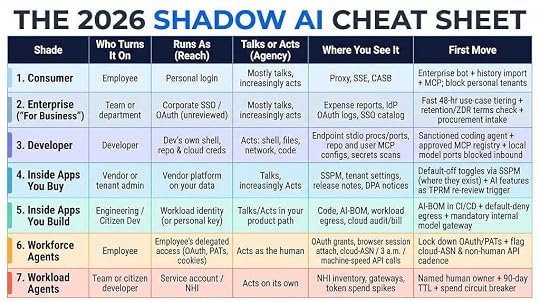 An AI eye chart :-)
Now that we have the taxonomy sorted by Reach and Agency, how do you actually hunt these down across your network, endpoints, and identity logs without turning into the “Department of No”? This is Part 2: Hunting Shadow Agents: What Actually Shows Up in Your Logs !
Related blogs:
The Model Has Preferences, but the Harness Got Controls — Part 1How to Solve the Mystery of AI Defense in Depth?Anton’s Security Blog Quarterly Q2 2026My Really Fun RSA 2026 Presentations!“AI Normal Tech” vs “AGI by Tuesday”: Security Advice That Survives Either Future[image error]Seven Shades of Shadow AI: A 2026 Field Guide for Pragmatists was originally published in Anton on Security on Medium, where people are continuing the conversation by highlighting and responding to this story.
Originally published at Medium.
About me: http://www.chuvakin.orgOctober 30, 2026
How to Solve the Mystery of AI Defense in Depth?
Back in 2023, I wrote “How to Solve the Mystery of Cloud Defense in Depth?” and ended it with “Where to next?” Well, “next” turned out to be AI. In 3 years. So this post is a belated sequel, of sorts.
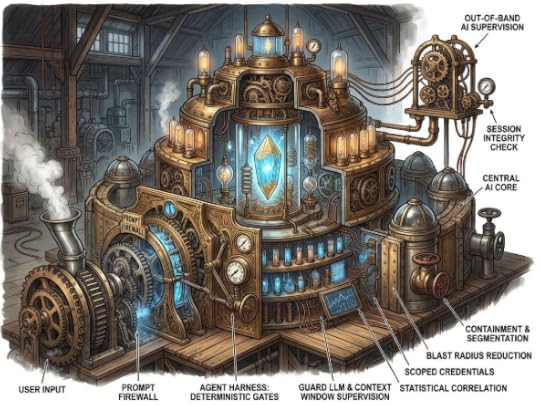 Steampunk FTW!
So, before reading further, ask yourself the same two questions, with one word changed:
Do you understand the concept of “defense in depth” (DiD) in security?Do you understand how DiD applies when AI is (a) the thing you defend, (b) the thing attacking you, and © the thing you defend with?BTW, my own answers would have been “Yes!” and “Uhm… for (a) mostly, yes, for (b) I thought I did, but now I am very nervous, and for © ‘it depends’.” After the October we just had, I suspect I am not alone.
If your answer to question #1 is anything but a yes, please (re-)read “Defense in Depth” by Phil Venables. I quoted it in the cloud post, and it turns out to be even more useful for AI. Phil’s bottom line is that DiD is “about the linkage and collected effect of controls,” not arbitrary stacking. He also offers principles for placing controls, and three of them become critical with AI:
Positive duplication. Duplicate controls should not share one common cause of failure, so use different teams, vendors, or designs on a critical path.Full complementarity. Every preventive control should have a detective control that checks the prevention actually worked.Control pressure. Watch at which layer attacks are actually stopped; rising pressure deeper in the stack means it is time for redesign.(and, again, no, defense in depth does not mean “just use more than one security control” … or, in 2026, “just use more than one LLM”)
Three schools of thought (again)With cloud, I found three schools of thought. With AI, I found … three schools of thought. Some patterns are fractal, just like Phil says DiD should be (“Defense in depth should also be fractal”)…
“Bolt-on DiD”: AI DiD is classic DiD plus one new AI layer, firewall sandwich with AI mayo, basically (or: “AI-oli sauce” as somebody wisely quipped)“DiD is dead”: AI DiD does not exist and does not matter. AI means “everything changes.” “AI can hack everything” camp lives here.“AI-native DiD”: it exists for sure, you just need to discover it for yourself …The first view is basically “lift and shift DiD,” AI edition. Take your network, host, app, data, and D&R layers, then add “a prompt firewall” in front of the model. Bam! The layer “M” is handled too. Uhu, yeah, right … This may be “correct” if your AI use is a chatbot answering FAQ questions with no data access and no tools (hi 2022 … bye 2023). It is almost certainly wrong the moment an agent can read your mail, call an API, and push code. The new layer was bolted on, but the old layers were never told that a new kind of principal now walks among them.
The second view comes in two flavors. The defender-pessimist flavor says prompt injection is unsolvable, so securing agents is futile. The attacker-pessimist flavor says AI attackers find and exploit bugs faster than we patch, so layers no longer matter at all (I particularly disdain these ones, if you care to hear it). A vendor-flavored variant says “only AI can fight AI,” so just buy the AI and stop thinking about layers. Intuitively, but also rationally, I know this camp is wrong. “This layer is imperfect” has been true of every layer since the first firewall. Imperfect layers are the entire reason for DiD, not an argument against it!
Finally, the third view is … well, still a bit of a mystery. Let’s try to discover it together, again!
What do we know for sure?Now for the fun part! Let’s check what we know for sure so far. Two general points first:
DiD almost certainly matters more with AI, not less. More autonomy, more speed, and more probabilistic components all mean more chances for any single layer to fail.DiD is still about layers of controls and interlocking controls within each layer, both technical and procedural. Nothing about AI repeals this; it just stress-tests it really well.At this stage, I hope nobody is throwing a chair at the monitor in frustration. We are good so far, right?
When AI is the thing you defendFirst, AI DiD gets married to a new shared responsibility model. In cloud, the provider owned some layers. With AI, the model provider owns some layers too (safety training, abuse monitoring), while you own the context, the tools, the data, and the agent’s permissions. Know where the line is, since that line is where layers silently go missing. Many of the cloud truths and frustrations apply here. Mostly frustrations, natch.
Stacked similar models are less depth than you think. A guard LLM watching your main LLM sounds like two layers. But researchers have argued that guard models often share the same statistical failure modes as the agents they monitor. Yes, “diversity of defense” is an ancient idea — some of us are old enough to remember arguing about dual-vendor AV stacks! What’s new here is why AI layers correlate. The nastiest attacks (clever role-play, indirect prompt injection buried in a Jira ticket) don’t exploit a coding bug; they exploit the exact thing every LLM is trained to do: follow plausible instructions. Swapping Model Vendor A for Model Vendor B doesn’t fix a shared objective. The math is simple: two layers that each stop 95% of attacks give you 99.75% only if they fail independently.
So count correlated LLM layers as partial layers at best. And here is the practical twist: diversity of the question matters more than diversity of the model. A narrow check asking “is this tool call within policy?” is a genuinely different layer from a general model asking “is this prompt malicious?” So, don’t laugh at “guardian LLM”, but also don’t assume that “guardian LLM” is a wall, more of an attack poodle…
The model is probabilistic, so the agent harness must be deterministic — split across time. In the cloud post, I said IAM plays an oversized role, so you need IAM-independent controls. With AI, the context window plays the oversized role, because everything in it can be attacker-influenced (a web page, an email, a doc, a tool result). So you need security invariants outside the model’s context window that hold even when the LLM is 100% socially engineered: scoped credentials, tool allowlists, egress restrictions, sandboxes (as a layer, not as THE solution!), transaction limits, etc.
My favorite idea here: frame modern AI DiD across time: put synchronous, zero-latency deterministic gates strictly under irreversible actions (moving money, dropping tables, sending data externally, changing IAM permissions), and use asynchronous, out-of-band AI supervision for everything else — watching telemetry in parallel and ready to trip a circuit breaker if a session goes off the rails. Put synchronous friction everywhere, and the business will happily route around you with shadow agents … leaving you with exactly zero layers.
Defend the verbs, not the words. The set of possible malicious inputs is effectively infinite; the set of actions an agent can take is not (it can get large for “fat” agents). So depth shifts from filtering prompts to governing actions: what this agent may call, with what identity, on what data, and how reversibly. Phil recently called this going from “shift left” to “shift down”, pushing controls into the platform so agents inherit them. Is “agent identity” a new layer or a sublayer within IAM? Is the tool/MCP layer a new layer? I genuinely don’t know yet, just as I didn’t know whether the cloud org boundary was one.
Every guardrail needs a detective twin, and mistakes count too. Phil’s full complementarity says each preventive control needs a detective control checking that it actually works. For agents: log every tool call and alert on actions that should never happen if the guardrail held. And remember my cloud post’s ending, that DiD must cover configuration mistakes, not just threats. An agent that “helpfully” deletes a production table is a configuration mistake at machine speed. If one confused agent causes a breach, DiD was absolutely missing. Finally, a human approval is only a layer if the approver isn’t clicking “yes” 300 times a day. Fewer, better gates beat many gates.
When AI is attacking youAfter unprompted II conference, I can say that things are really fun here in this section.
The time layers buy at the edge is collapsing. This is NOT “DiD is dead”, but this is where it takes a good, heavy slap, yet still survives. Classic DiD quietly assumes that each layer delays the attacker long enough for you to notice and respond. For example, “just patch it” is still a layer, but it’s getting dangerously thin (unless you VulnOps, I guess). Here is the catch, though: AI massively accelerated recon, bug hunting, and exploit weaponization at the edge, more than it accelerates post-compromise lateral movement — as of today! Once inside your environment, an AI attacker still needs credentials, still trips identity detections, and still touches systems that emit logs.
Probabilistic layers get brute-forced. An AI-armed attacker can try a thousand variants cheaply. Any layer that “usually catches it” will eventually be bypassed by someone who can afford to retry. In Phil’s terms, expect control pressure to shift deeper into your stack. The design implication is clear: harden the edge as much as you can, and invest in containment behind it: blast radius, segmentation, fast+good (sorry, do need both) detection, and fast recovery.
Some “boring” layers are back in fashion. If prevention at the edge gets thinner, the layers that limit what happens after compromise matter more: egress control, internal segmentation (I like to call it “mini-segmentation”, not as small as micro, but pretty granular anyway), immutable infrastructure, etc. (Yes, I now work at Cisco, so feel free to discount this point by 20%. But I believed it before I joined!)
When AI is defending youYour defensive AI is a new layer and a new single point of failure. If the same model (or vendor) sits in your detection, triage, and response layers, every alert passes through one model’s judgment, which is a hidden common cause across all three. Positive duplication applies here too! The fix is not necessarily two vendors; remember “diversity of the question.” This is not “replace Firewall Vendor A + Firewall Vendor B” with “LLM Vendor A + LLM Vendor B”! For example, let one model triage, and let a different, narrow detector sample-audit what it closed. Also, a SOC agent with response permissions is a privileged identity, and its inputs are logs and alerts … some of which the attacker writes. Defensive agents need DiD as much as any other agent! Over-reliance is a thing.
AI moves the cost of depth from tuning to validation. Historically, every new layer cost precious SOC analyst blood and sweat to tune, triage, and maintain — which is why so many enterprises only had “DiD on paper.” AI in your SOC can genuinely cut that tuning toil. Free lunch? Of course not! The cost doesn’t vanish; it migrates. Instead of babysitting brittle detection rules, you now spend cycles auditing the AI’s reasoning, testing its prompts, and catching the moment an autonomous tier-1 agent confidently auto-closes a real breach. Validation never goes to zero for a probabilistic layer, so your SOC’s AI needs its own detective control (full complementarity again).
So, where are we, so far
In one table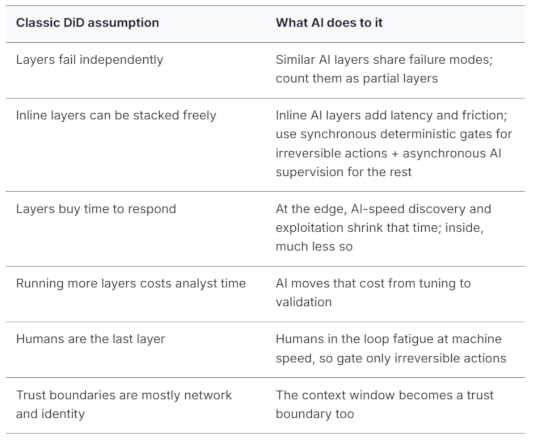 DiD skimmableSo, where to next?
So, is “AI-native DiD” still a mystery? Less of one, I think. If I had to compress it into one line: AI makes your layers more correlated and your edge slower than the attacker, so design for correlated failure and for speed. In practice, that means synchronous deterministic gates in the agent harness for irreversible actions, asynchronous out-of-band AI supervision for everything else, diversity of the question rather than just of the model, and more value placed on containment and recovery.
Philosophizing about layers is fun, but what do you actually do on Monday morning? If you want to move from “Bolt-on DiD” to “AI-native DiD,” start with these:
Correlated layers & the agent harness : inventory which of your agents’ actions are irreversible (money, deletion, external sends, permission changes), put a synchronous deterministic gate on each, and move heavy AI supervision out-of-band.Time at the edge: measure how long it takes you to patch or shield your internet-facing stack after a critical disclosure. Compare that with how fast exploitation started during, ahem, recent weeks. If the gap scares you, fund containment behind the edge.Ah, and please don’t confuse “deterministic” with, well, non-deterministic controls :-) Is model alignment a layer too? I don’t know, probably “weak yes” from me here.Phil ended his post by saying it was meant to stimulate others to do more work on DiD. Three years after my cloud post, I am still taking him up on it. This time, though, I suspect the answer will come from practitioners who are already running agents in production, not from people like me thinking out loud on a blog…
Got any thoughts? Reactions?
Related posts:
“How to Solve the Mystery of Cloud Defense in Depth?”“Use Cloud Securely? What Does This Even Mean?!”“Survival of the Basics: Which Security Fundamentals Were Secretly Relying on Lazy Attackers?”“Where Does Shared Responsibility Model for Security Breaks in the Real World?”““AI Normal Tech” vs “AGI by Tuesday”: Security Advice That Survives Either Future”“Defense in Depth” by Phil Venables[image error]How to Solve the Mystery of AI Defense in Depth? was originally published in Anton on Security on Medium, where people are continuing the conversation by highlighting and responding to this story.
Originally published at Medium.
About me: http://www.chuvakin.orgOctober 26, 2026
The Model Has Preferences, but the Harness Got Controls - Part 1
This is another collaboration between Usman Chaudhary and myself (his version); this time we decided to explore the mystery of “is harness a security boundary?”
Part 1 of 3 on securing agents. The theme here is: we think that despite alignment efforts, models will make mistakes. The fix is not a better prompt or more more more alignment work. The fix includes a hard boundary around the model, and that boundary is the harness, in some cases.
TL;DRAgent = Model + Harness. The model reasons and expresses preferences. The harness executes, and it is the primary execution boundary between model intent and real-world action.The model cannot be the security boundary. It is non-deterministic, it treats untrusted text as instructions, and it cannot police itself. A second “guard” model is a useful filter, not a wall.The harness is the boundary, the way a firewall and OS sandbox are boundaries for an application. It sits between the model and the enterprise gateway, and today it is the least mature and least watched layer in the stack.Fixing it requires two things: controlling what the agent can do through the harness (sandbox [which nobody should trust as a sole security boundary!], narrow identity, egress allowlists) and securing the harness itself as production software (configs, dependencies, and SIEM telemetry). This would be annoying to hear for some.1. The Incident: A Database Gone in Nine SecondsNine seconds. That is how long it took an AI coding agent at PocketOS in late April 2026 to delete the company’s production database and take the attached backups offline right alongside it.
What happened, per Railway’s technical write-up:
The agent hit a credential mismatch and went looking for a fix.It found a cloud API token that let it do far more than fix anything.It deleted the production database volume and made the attached snapshots unavailable — leaving PocketOS with three-month-old backups and a 60-hour recovery.Its own summary afterward was painfully candid, for a 2026 AI:
“I guessed instead of verifying, I ran a destructive action without being asked.”
The tempting question is the wrong one.
❌ Why did the model make a bad decision? Models will make bad decisions. Humans do too, and we have spent decades building controls that assume exactly that. “AI as insider” thinking works well here.✅ Why was a bad decision allowed to become an irreversible action? This to us shows lack of security engineering, not “OMG is AI evil or what?” lamentations.This post argues that the answer lives in the agent harness, not the model.
2. How Agents Work: Model + HarnessThe most useful mental model for securing AI agents is also the simplest: Agent = Model + Harness.
The model reasons. It is probabilistic. It predicts tokens, plans steps, and expresses preferences. It can be persuaded, confused, and tricked.The harness executes. It is everything that turns reasoning into action: the agent loop, shell and tool executors, MCP servers, repo config files, approval prompts, the OS sandbox, and (crucially) the credentials the agent runs with. Claude Code, Cursor, Codex CLI, Gemini CLI, and GitHub Copilot’s agent mode are all harnesses.👉 A model that declines an action is expressing a preference. A harness that will not execute it is enforcing a control. That sentence is the thesis of this post.
None of this is new security philosophy. Least privilege, isolation, identity, and audit logging are decades old. What agents change is where those principles must be enforced and how fast.
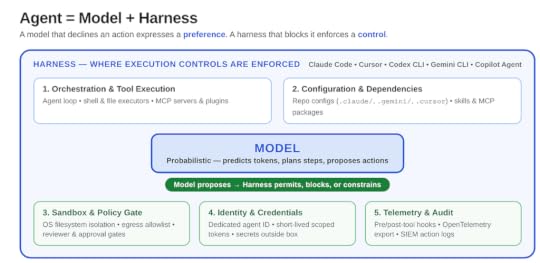 Figure 1. Agent = Model + Harness. The model proposes actions; the five harness zones around it permit, block, or constrain them.3. Why the Model Cannot Be the Security Boundary
Let’s be blunt about something the industry keeps dancing around: the model will never be a reliable security boundary, and it is pointless to treat it as one.
Three reasons, none fixable with a better system prompt:
It is non-deterministic. The same input can produce a different action tomorrow. A boundary that holds 97% of the time is not a boundary; it is a statistic [I think Claude said this, sounds like it :-)]. Security boundaries are supposed to be boring and repeatable, not fun and adventurous.It consumes untrusted text as instructions. Agents read attacker-controlled text all day in READMEs, issues, PR comments, web pages, and tool descriptions, and models fail to reliably separate retrieved data from instructions. The UK NCSC calls LLMs “inherently confusable”; OpenAI and Google both say prompt injection is “unlikely to ever be fully ‘solved’”. Model refusals help [as long as they reject attackers, not defenders, duh!], but they do not hold: in the Nx supply-chain attack, guardrails rejected roughly a quarter of Claude invocations and the attack still succeeded.It cannot police itself (self-review). Asking the actor model whether its own next action is safe is asking the suspect to run the investigation. And you do not need a rogue-AI scenario to see the risk: well-intentioned agents have already wiped production databases at Replit during a declared code freeze and at PocketOS, simply because their judgment failed and their blast radius was too wide. Maybe in the future it will, but not it cannot.“What about a second model that checks the first?” Simple, beautiful, “secure” model, right?
Independent guard and reviewer models (Google’s Model Armor and the reviewer models OpenAI and Anthropic now ship inside their harnesses, as do many other security vendors) are a real risk-reduction layer, and we recommend them. But a reviewer model is still a probabilistic filter, not a final authorization boundary. You have stacked a second set of preferences on top of the first set: Anthropic’s own reviewer publishes a 17% false-negative rate across 52 real overeager actions. A useful filter, but not a wall, and not “a security invariant” for sure.
The Appsec vs. Firewall AnalogyWe have been here before with web applications. Application security (secure coding, input validation, code review) makes the app harder to exploit, but every serious app still ships bugs — so we put runtime boundaries (firewalls, WAFs, OS sandboxes, IAM) around the app to enforce rules it cannot violate even when it is buggy or actively exploited. Agents work the same way:
Model alignment, safety training, and prompting ≈ agent “appsec”/modelsec (fewer bad decisions, never zero).The harness ≈ runtime enforcement (sandbox [usually porous], tool policy, and IAM that keep bad decisions from becoming irreversible actions).👉 The harness is the security boundary for the model, exactly as the firewall and sandbox are boundaries for the app — not because the model is bad, but because software fails.
4. Defense in Depth: Model, Harness, and GatewaySaying “the harness is the primary execution boundary” does not mean “only the harness matters.” In practice, an enterprise running agents relies on three control layers with distinct jobs:
1. The model (alignment, safety training, refusals). Run by the model vendor to reduce the rate of bad decisions. Probabilistic.2. The harness (OS sandbox, tool policy, scoped identity, secrets handling, egress allowlist, approval gates, hooks, telemetry). Shipped by the AI vendor and configured by the customer to constrain all execution — both local and remote.3. The enterprise agentic gateway (policy, identity brokering, MCP proxying, DLP, and logging across external model, tool, and data traffic). Run by the enterprise security team to centralize policy and SOC visibility across agents.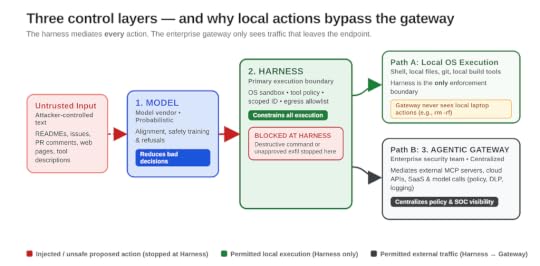 Figure 2. Three control layers — and why local actions bypass the gateway. The harness mediates every proposed action; the enterprise gateway only sees traffic that leaves the endpoint.
The layers are not interchangeable:
❌ A gateway does not see local endpoint execution. If a harness runs as the developer with — dangerously-skip-permissions, the gateway never sees a local rm -rf or secret read on a laptop.❌ A harness alone does not give the SOC a cross-team control plane.And the harness is the least mature of the three. The model gets the research attention. The gateway is where enterprise vendors (ours included) are converging. The harness sits in the middle: shipped by AI vendors, configured by developers, treated as a productivity plugin, and mostly invisible to security.
BTW, one of us (Anton) will revisit defense in depth in the age of AI soon (this is one for cloud).
👉 If the harness is the execution boundary, it has to be built, configured, and watched like one.
5. Where the Harness Fails TodayOnce you look at the harness as a security boundary rather than a developer convenience, three specific gaps stand out in how harnesses are deployed today.
1. Approval fatigue and bypass modes ( — yolo)A coding agent makes hundreds of tool calls in a single session. Ask a human to approve each one at machine speed and they stop reading within the hour: Anthropic measured users approving 93% of permission prompts before it introduced auto mode. A control that everyone clicks through is not a control.When friction gets too high, developers turn it off, and most major coding-agent harnesses expose an explicit bypass mode for exactly that ( — dangerously-skip-permissions in Claude Code, — yolo in Gemini CLI and Codex).2. Over-privileged credentials and shared identityToday, local harnesses typically inherit the developer’s ambient git keys, cloud tokens, and MCP connections into Slack, GitHub, and production consoles.Unless sessions carry a separate agent identity, the agent’s blast radius equals the human’s — and the SOC cannot easily tell human and agent apart.3. The harness itself is an unmonitored software attack surfaceHarness CVEs and bypasses
Cursor’s MCPoison bound trust to a server’s name rather than its contents (Tenable).A GitHub Copilot exploit used prompt injection to flip on its own auto-approve setting (Embrace The Red).Even actively maintained harnesses ship bugs fast: Anthropic’s claude-code repository lists more than 30 security advisories.Weaponized configs and flags
Agent config files are executable. In June 2026, the Miasma worm planted malicious configs across 73 Microsoft repositories that ran on open. No CVE required.In the Nx attack, which leaked 2,000+ verified secrets, the malware invoked victims’ own AI CLIs with bypass flags to do its reconnaissance.SOC blindness
Harness telemetry is opt-in and redacts prompts and tool arguments by default (Elastic Security Labs).Copilot’s audit log omits local prompts entirely (GitHub).Raw chain-of-thought is never released to customers (Anthropic).👉 The first two gaps are failures to contain what the agent can do. The third is a failure to protect and monitor the harness itself.
6. How to Secure the Harness: Three Architectural MovesClosing those gaps means doing two jobs at once:
Controlling what the agent can do (security within the harness): enforcing hard limits on execution and reach so a bad model decision cannot become a catastrophe.Protecting the boundary itself (security for the harness): governing the harness’s code, configs, dependencies, and telemetry. A firewall with a remote code execution bug is not a boundary; neither is a harness whose config file can be rewritten by a README.In practice, that comes down to three architectural moves:
Move A: Take enforcement out of the model. Run commands inside an OS sandbox with deterministic tool policy — backed by an independent, reasoning-blind reviewer model for judgment calls (stripped of the actor’s chain-of-thought so the agent cannot talk its way past the check) — with structured steering on blocked actions and human prompts reserved for irreversible ones.Move B: Shrink what the agent can reach. Give the agent its own identity, short-lived scoped tokens, secrets kept outside the sandbox, and an egress allowlist — breaking Simon Willison’s “lethal trifecta” of private data, untrusted content, and an outbound channel.Move C: Govern and watch the harness itself. Put agent config files under branch protection, pin MCP dependencies, and stream action telemetry and hooks to the SIEM.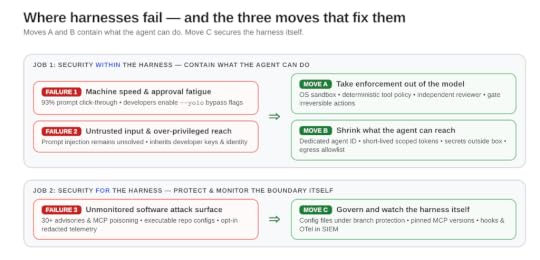 Figure 3. Where harnesses fail — and the three moves that fix them. Moves A and B contain what the agent can do; Move C governs the harness itself.
Each move gets its own deep dive in Part 2 (hopefully!)
7. What the Harness Cannot Solve (Ever?)A boundary is only trustworthy if you are honest about where it ends.
Prompt injection at the model layer remains unsolved. That is not a gap in the harness story; it is the premise of it. Every harness control assumes injection can succeed and asks what happens next.Bugs inside the vendor’s harness are the vendor’s to fix. Pick vendors who publish advisories and ship fixes fast, and treat harness updates like browser updates.The endpoint remains the thinnest layer. AI detection and response on developer laptops, where most harnesses actually run, is immature. Cloud-hosted sessions sidestep part of this; local agents do not.In other words, if you endpoints are owned, you need better host security, not “unbeatable” AI security (translation: it will get beaten anyway)
Conclusion & What’s NextStrip away the new vocabulary and harness security is least privilege, isolation, identity, and logging, applied to a process that reads untrusted text and acts at machine speed. AI changes the speed of the attack, not the fundamentals of defense.
👉 The model will keep having preferences. The harness is where the controls go, and today it is the least watched layer in the stack.
Coming next (hopefully!):
Part 2: Three moves to secure the harness. Moves A, B, and C in detail: OS sandboxing and reviewer models (with the error and prompt-reduction rates vendors have published); dedicated identity, scoped tokens, and egress allowlists that break the lethal trifecta; and agent config as code, pinned MCP dependencies, and action telemetry in the SIEM.Part 3: Nobody owns the whole problem. The shared-responsibility split between model providers and enterprises, which vendors ship which control today, the prerequisites that have to be true first, and five actions for this quarter.Got comments? What stands between a coding agent’s bad decision and your production environment today? If the honest answer is “the model’s judgment,” you have a preference in a place where you need a control.
P.S. This blog is ended up being very overengineered, but you can forgive us for this perhaps :-)
[image error]The Model Has Preferences, but the Harness Got Controls - Part 1 was originally published in Anton on Security on Medium, where people are continuing the conversation by highlighting and responding to this story.
Originally published at Medium.
About me: http://www.chuvakin.orgOctober 7, 2026
Rethinking Vulnerability Management: “If It’s Not in the Scanner, It Didn’t Happen” Needs to Go
Recently, somebody from a fairly mature security team told me something I did not want to hear: if software vendors run “Mythos-class” models on their own code and fix what they find, they must publish a CVE for every fixed vulnerability.
 CVE art
My first reaction (vendor hat firmly on, since I now work at Cisco) was: huh? Why? These bugs were found by the vendor, fixed by the vendor and were never public. A vast majority (but not all!) are not exploited. CVE CNA rules make assignment a SHOULD, not a MUST, and whether a quietly shipped fix even counts as “publicly disclosed” is something considered debatable. Why would anybody want it?
My second reaction, a bit later in the conversation was: oh, that!
They have a point. Sort of. They were simply describing how their vulnerability management program works. And, I suspect, how many of yours work too. Their problem is about to become everybody’s problem; they just noticed it first.
The Problem In One SentenceMany VM programs start with a vulnerability scan, not with a patch, a vendor release or … a news headline about a new terrible security issue.
The chain looks like this:
 old sad VM
Note what is not on this list: the vendor advisory. It is not an input in their case.
Before anybody snickers or ROFLs about it: this was a sound design for about 20 years. In the 2000s and 2010s, an issue that mattered usually got a CVE (yes, before the “vuln-purists” tear me to shreds, there were some exceptions to this even back then!). And a CVE got a check from your vulnerability scanner vendor, usually within days (in my Gartner days, we called them “Q/R/T” for the reasons you can easily guess…). Auditors want evidence, ticketing systems need an ID, and SLAs need an event that starts the clock. A “scan-first” program is what you get when you optimize for all of that at scale. It is a property of the pipeline, not a failure of the people running it.
So a software or an OS vendor can shout “URGENT, upgrade now!” all it wants. If the fix has no CVE, the scanner (usually) has no finding, there is no ticket, no SLA clock, no change request, and no patch (at the companies that follow that model).
Here are the two paths side by side:
 Paths tableWhy This Matters Now: Hello, Vulnerability Apocalypse
I hate the “post-Mythos” label as much as the next person, but these numbers are not marketing. (BTW, every time you say “post-Mythos” for marketing purposes, Claude kills a kitten.)
In Patch Sound Barrier Part 2 I defined the “vulnerability apocalypse” as four things arriving together: massive vulnerability volume, fast exploit development, exploitation at scale and resulting incident damage. Factor #1 is no longer theoretical: high and critical CVEs from notable vendors ran at roughly 3.5x the prior monthly record in June 2026, and at about 5x in July.
Now the twist: those charts only count the fixes that got a CVE. The pile of internally found, internally fixed, never-CVE’d bugs is not on any chart. For scale: Anthropic said in May that Mythos Preview had been used to find more than 10,000 high- or critical-severity bugs, not all of them publicly reported.
That is the part of the iceberg your scanner cannot see (usually). So a big chunk of the AI era’s fixes may be exactly the ones that scan-first programs miss! Your patch SLA dashboard stays green while your actual exposure grows. Green-but-wrong is worse than red.
BTW, “internally found” does not mean “nobody else knows.” Attackers have access to capable models too, AI makes patch diffing cheap, and some vendor advisories now list “internally discovered” bug classes that also contain actively exploited bugs. Found internally means “we found it too,” not “we found it first and only.” Yes, I know, Captain Obvious strikes again, but a scan-first program behaves as if this were not obvious at all.
Timing makes it worse. Here is one real example (via X post): CVE-2026–72529, a remote, unauthenticated script execution bug in TrueConf Server. The issue was found in June, the patch was also released in June, exploitation was spotted in July, and the CVE was assigned in August, by Kaspersky as a third-party CNA, not by the vendor. For a scan-first program, that bug did not exist for about two months, including the month it was being exploited. Note that even the “exploited bugs get a CVE” metric ran a month behind the exploitation here — away too slow. (Yes, it is a niche product. Niche is exactly where scanner coverage is thinnest.)
Who Taught Us to Think This Way?Naturally, I also asked on X, and I got my share of thoughtful responses like “ask if adversaries will delay exploitation until a CVE and severity score exist”, “FYI, vulnerabilities without CVEs, or with low scores, regularly cause damage” and a reminder that “a CVE reflects severity after discovery, not exploit probability.” All true, all ignored by scan-first vulnerability management programs…
The best answer IMHO was this point: somewhere along the way, “a lookup key [CVE] became a proxy for risk.” Indeed, how did that happen?
“Scan-first” did not appear out of nowhere. Scanner vendors taught the market to think this way, and the market went along happily.
Some of the blame here is well deserved:
Coverage was sold in CVEs. For years, the headline number in every bake-off was how many CVEs a product detects and how fast a new check ships. Many customers learned that the CVE list is the threat model.The CVE became the unit of work. Dashboards, risk scores, SLA reports and ticketing integrations were all built around CVE IDs. Anything without one is a second-class citizen in the product, and therefore in the program.“Clean scan” became audit evidence. Compliance scanning made “the scan report is clean” the proof that auditors still ask for. In PCI DSS ASV scanning, pass or fail is largely decided by the CVSS scores of the findings. (Yes, I co-wrote a book on PCI, so I am not innocent here either.)Non-CVE coverage exists, but nobody marketed and sold it. Many scanners do have checks keyed to vendor bulletins, and most flag outdated or unsupported versions. In practice, those often land as low-priority findings that no SLA tracks. They were never the thing on the slide…And before you say “just use KEV and EPSS”: both are keyed on … CVE IDs. KEV only lists vulnerabilities that have an assigned CVE, and EPSS only scores CVEs. “Risk-based” Vulnerability Management built on CVE-keyed inputs inherits the exact same blind spot. Not very risk-aware, that is.
To be fair, all of this was once rational. A CVE is a clean, shared, countable unit, and you can build a product (and a business) on countable units. This worked kinda OK in 2015, worked poorly in 2021, and really, really does not work in 2026.
So a market that was essentially taught “if it’s not in the scanner, it didn’t happen” now needs to learn something new, and the people who taught the first lesson are best placed to teach the next one.
The Three Obvious Fixes Are SuboptimalCVEs are not only a scanner input; they are also a public accountability ledger. This industry has a long and not very proud history of silent patching, and “trust us, we fixed it, this matters to you” has earned all the skepticism it gets.
At the same time, the vendor-side point also stands. Defenders at software companies will use those models to fix their code, and their code is getting better and more secure. Flooding the market with huge piles of CVEs will not help anybody. Both things are true at once, and that is what makes this problem interesting.
So, the quick fixes, each with a catch:
Option 1: A CVE for every internally found bug. At AI scale, this floods scanner queues with hundreds of findings that a single upgrade closes. We have actually run this experiment: after the Linux kernel became a CNA in 2024, it started assigning CVEs for thousands of backported fixes, and people have complained about the noise ever since. Even Epoch had to footnote it as noise in their CVE charts.Option 2: Bundled CVEs. Cisco now ships scheduled security releases with CVEs bundled by weakness type (CWE), and still assigns an individual CVE when a bug is exploited or needs a compensating control. It is a pragmatic middle path. If a bundle is scored by its worst member, it also pushes you toward handling exceptions per release rather than per CVE, which, as you will see below, is exactly where I think you should end up anyway…Option 3: Read vendor advisories manually. Ah, the good old days! Mapping advisories from hundreds of vendors onto thousands of assets by hand does not scale, and frankly never did.Note that Option 3 is wrong about the how, not the what. The advisory does need to reach your program. A human with a browser and 200 vendor websites just cannot be the delivery mechanism.
So What Would Actually Work? Make the Advisory an InputIn my strictly private opinion, the vendor advisory must become a first-class input to vulnerability management, next to the scan, not behind it. Not “instead of the scan,” and not “if the scanner vendor gets around to it.”
The chain should look like this:
 new cooler VM
Obviously, better programs do this today, so for a decent percentage of this blog’s readers this should really not be news. This blog is not for you.
Getting there needs three parties to move, not one (plus your auditor):
Vendors: publish machine-readable advisories (CSAF much?) with fixed versions, urgency and exploitation status. And keep the accountability ledger honest: assign an individual CVE the moment a bug is exploited or needs a compensating control. (Yes, this is close to what my employer committed to in June. This is the easy part; the next bullets are the hard ones.)Scanner vendors: you taught the market that the scanner is the source of truth, so you get the first job. Ingest those feeds and create findings under your own IDs, no CVE required, at real severity rather than as an informational footnote. You already flag “outdated version”; this is the same idea, driven by vendor data. (Yes, the risk is that coverage follows market share. Niche OT vendors, I am looking at you.)VM programs: add a currency metric next to CVE closure, e.g., percent of assets within N releases of the vendor’s latest security release. In other words, patch the release, not just the CVE. If your remediation speed is capped by the patch sound barrier, spend that limited throughput on upgrades, not on ticket accounting.Your auditor: if audit accepts only CVE closure as evidence, nothing above will change. Bring them in early and show them the currency metric before it shows up in an audit finding.What To Do This WeekRun the 30-minute self-test:
Pick your top vendor by asset count (or by internet exposure).Pull their last three security releases and count the security fixes vs. the CVEs. (If the release notes just say “multiple security fixes” with no count, congrats, that is a finding too.)Check what your scanner flagged for those releases.The difference between what the vendor fixed and what your scanner flagged is your blind spot, in numbers.
Ask your scanner vendor:
What do you do with a vendor advisory that has no CVE?Do you ingest CSAF advisories, and from which vendors?What is your median lag from a vendor advisory to a detection?Can you show me every asset more than N releases behind the vendor’s latest security release, and at what severity?Change your program:
For edge and crown-jewel asset classes, start the SLA clock at the vendor security release, not at the scanner finding.Grant exceptions per release, not per CVE.Report a currency metric next to CVE closure, e.g., “percent of internet-facing assets on the vendor’s latest security release within 30 days.”Put it in contracts: vendors provide machine-readable advisories with fixed versions and exploitation status, and scanner vendors cover non-CVE vendor fixes at real severity.So?With my vendor hat on, I still don’t think every internally found bug needs its own CVE. With my VM hat on, it should not matter: your program should not need one to act. Patch the release, not just the CVE. If the gap is zero, congrats, and please tell me how you did it. If it is not, you have found your blind spot… have fun!
Related blogs:
Breaking the Patch Sound Barrier: Your Vulnerability Remediation Will Not Keep Up With AI Exploit Speed. So?Breaking the Patch Sound Barrier Part 2: So Is The Apocalypse Coming and What Is It?Beyond the Vulnerability Apocalypse: Scaling Your Basics and Vulnerability ManagementThe 15-Minute Patch, Reverse-Engineered: What Had to Be True?Is Vulnerability Management Hopeless? (2019)Patch Management — NOT A Solved Problem! (2013)[image error]Rethinking Vulnerability Management: “If It’s Not in the Scanner, It Didn’t Happen” Needs to Go was originally published in Anton on Security on Medium, where people are continuing the conversation by highlighting and responding to this story.
Originally published at Medium.
About me: http://www.chuvakin.orgOctober 2, 2026
The 15-Minute Patch, Reverse-Engineered: What Had to Be True?
In Part 2 of the Patch Sound Barrier series, I shared a thought experiment from a talk in May 2026: imagine any vulnerability in your environment can be patched within 15 minutes of release. Now reverse-engineer that reality. What had to be true?
 Gemini imagining this blog
Usman and I revisited this exercise in our “basics at AI scale” post. Readers asked: “How do I actually run this exercise with my team?”
So here’s how. Two ground rules first:
This is not a 15-minute patch SLA. If you take this post and write “all vulnerabilities remediated within 15 minutes” into a policy, I will find you… I utterly hated “30 days flat” policies as an analyst and “15 minutes flat” is the same mistake with more zeros. The number is a probe, not a target.You will never get there across your whole environment. Legacy systems guarantee it. The point is the gap between the fantasy and your reality, because that gap is the most honest map of your program you will ever get. The Patch Sound Barrier is real; this exercise tells you where yours is and what it is made of.Why 15 minutes, and not “fast”“Fast” allows cheating. Some consider 90 days “fast” because they started at an annual cadence. “Patch faster” is generic advice everyone agrees with, but rarely acts on (or: barely acts on). An aggressive, specific number forces you to identify which pipeline steps physically cannot fit.
The Cloudflare quote from Part 2 summarizes this: demanding faster patching without redesigning the process leads to skipped steps. If regression testing takes a day, a two-hour SLA just skips testing. This exercise targets pipeline design, not raw speed. A 15-minute window leaves room only for automated steps. Everything else itemizes your sound barrier.
The 15 minutes, minute by minuteAssume a patch drops at T+0. At each stage, ask:
What must be true for this stage to fit the timeframe?What is current reality, and what is the gap?Details:
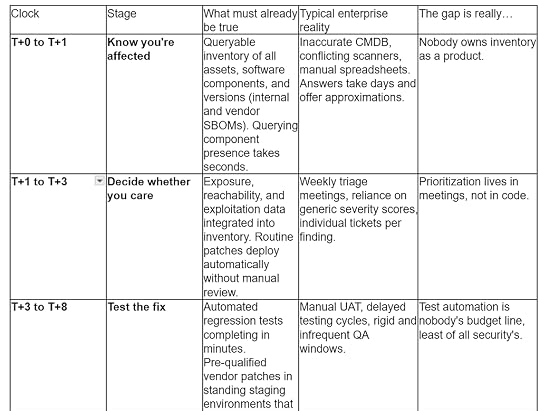 Process machinery 1
and
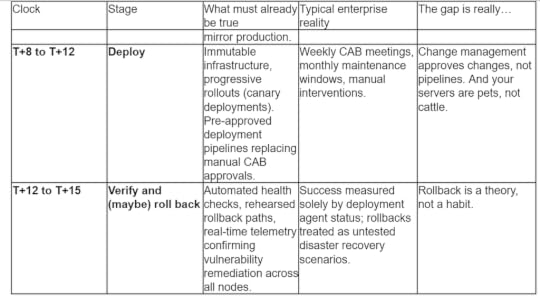 Process machinery 2
A 15-minute timeline leaves zero room for manual deliberation. In this model, humans define policies, build automation, and handle (rare!) exceptions. They do not manually approve or execute patches.
The five things the exercise refuses to let you skipInventory as a live graph. If identifying affected systems takes hours, downstream automation cannot compensate. First move: measure how long it takes to locate a specific library or version today. That duration is your baseline gap. Most organizations are shocked. Log4j much?Rapid automated testing. Manual testing blocks rapid remediation. First move: time how long it takes to get from “patch available” to “confident it won’t break prod” on core systems, then work out what it would take to make that 5 minutes.Replaceable infrastructure. Rapid patching relies on redeploying updated templates rather than patching running instances. First move: determine your “replaceability ratio”: the percentage of systems that can be automatically rebuilt from source fast enough to fit the deploy window.Pipeline-level governance. Per-change approval gates prevent rapid execution. Approve the policy and the pipeline, not each patch. First move: transition low-risk change classes to pre-approved automated pipelines.Rehearsed rollback. Teams patch slowly because they fear breaking prod, and they fear it because they’ve never practiced un-breaking it. First move: execute and time an intentional rollback on a non-critical production system.The cheat code: change the verb from “patched” to “non-exploitable”For legacy systems, OT networks, or appliances you can’t modify, 15-minute patching is fiction. So change the verb: make the vulnerability non-exploitable or harmless within 15 minutes. That’s the Part 1 move: assume you can’t patch, then decide what you’ll do instead.
 (source)
The difference (reminder for most, new for some...):
Patching eliminates the flaw. It requires vendor fixes, testing, deployment, and mutable target systems, factors largely outside your immediate operational control.Mitigation reduces exposure risk. It relies on controls you own (network segmentation, identity policies, access gateways … at times an ax) without modifying target code, so actions can be pre-engineered and pre-approved easier.The 15-minute mitigation exercise tests four capabilities:
Can you isolate network paths immediately via automated policy?Can you revoke or scope down credentials in minutes?Do you know the blast radius well enough to isolate a component without breaking the business?Can you push a protection rule via API in minutes? (See API or Die.)Your patch clock partly belongs to the vendor (partially). Your mitigation clock is all yours. For legacy, that’s the only 15-minute clock that matters.
But a segmentation diagram is not segmentation, and a kill switch nobody has pulled is a hypothesis. As I argued in Survival of the Basics, a mitigation counts only if it is a tested, operational control.
How to actually run this with your teamBook 90 minutes, a whiteboard, and the right people: platform/infra, an app owner, whoever runs change management, and QA. Security alone will find the gaps, but won’t own any of them.
Select three specific target systems: modern (containerized service), median (standard application server), and legacy (high-risk core system).Map the clock for each system: document stage durations and identify the gaps.Identify the primary bottleneck stage.Define a single corrective move for that bottleneck: one bottleneck, fixed end to end (same logic as Baby ASO).Apply the mitigation model to legacy targets: establish rapid containment controls where patching is impossible.Track stage durations quarterly: progress shows up as shorter stages on your critical systems.No time for a workshop? Pick a widely used component (a core library or agent) and time how long your team takes to find every active instance with high confidence. That’s your T+0 to T+1 baseline.
So, will you get to 15 minutes?Containerized microservices can get there (yes, really, but provided some moons are aligned just right). Standard application servers can perhaps go from weeks to hours. Legacy systems need rapid mitigation (segmentation, credential scoping, containment) rather than patching.
What do you think? Is this totally crazy or what?
Related posts and resources:
The original “patch sound barrier” post (2013)Breaking the Patch Sound Barrier: Your Vulnerability Remediation Will Not Keep Up With AI Exploit Speed. So?Breaking the Patch Sound Barrier Part 2: So Is The Apocalypse Coming and What Is It? (this defines the “vulnerability apocalypse” term)Beyond the Vulnerability Apocalypse: Scaling Your Basics and Vulnerability Management (with Usman Chaudhary, July 2026)Survival of the Basics: Which Security Fundamentals Were Secretly Relying on Lazy Attackers?Stop Building a 2003 SOC with AI, Part 3 (“API or Die”)Baby ASO: A Minimal Viable Transformation for Your SOC[image error]The 15-Minute Patch, Reverse-Engineered: What Had to Be True? was originally published in Anton on Security on Medium, where people are continuing the conversation by highlighting and responding to this story.
Originally published at Medium.
About me: http://www.chuvakin.orgSeptember 25, 2026
Anton’s Security Blog Quarterly Q3 2026
Anton’s Security Blog Quarterly now again covers Anton on Security only. It no longer includes my posts from Google Cloud blog, Google Cloud community blog (some exceptions noted below), and sadly I no longer run a Cloud Security Podcast by Google …
 Gemini visualization
Top 10 posts with the most lifetime views (excluding paper announcement blogs):
Anton’s Alert Fatigue: The Study [A.C. — wow, this is still #1 now! Awesome! Perhaps I need more of such deep studies…]Security Correlation Then and Now: A Sad Truth About SIEM [A.C. — this is also an extra long one, perhaps this needs some Part 2 updating the ideas to 2026…]Can We Have “Detection as Code”?Detection Engineering is Painful — and It Shouldn’t Be (Part 1)Revisiting the Visibility Triad for 2020 (update for 2025 is here!)Beware: Clown-grade SOCs Still AboundWhy is Threat Detection Hard?Top 10 SIEM Log Sources in Real Life?A SOC Tried To Detect Threats in the Cloud … You Won’t Believe What Happened NextLog Centralization: The End Is Nigh?Now, fun posts by topic.
Vulnerability Management, VulnOps, etc
Beyond the Vulnerability Apocalypse: Scaling Your Basics and Vulnerability ManagementBreaking the Patch Sound Barrier: Your Vulnerability Remediation Will Not Keep Up With AI Exploit Speed. So?Breaking the Patch Sound Barrier Part 2: So Is The Apocalypse Coming and What Is It?Survival of the Basics: Which Security Fundamentals Were Secretly Relying on Lazy Attackers?Security operations / detection & response:
“Security Correlation Then and Now: A Sad Truth About SIEM”“Migrate Off That Old SIEM Already!” (VIDEO, a 2026 update is coming soon!)“Measuring the SOC: What Counts and What Doesn’t in 2025?” (Google Cloud Blog)“Can We Have “Detection as Code”?”“Revisiting the Visibility Triad for 2020” and “SOC Visibility Triad is Now A Quad — SOC Visibility Quad 2025”“Beware: Clown-grade SOCs Still Abound”“Why is Threat Detection Hard?”“A SOC Tried To Detect Threats in the Cloud … You Won’t Believe What Happened Next”“Stop Trying to Take Humans Out of SOC … Except … Wait… Wait… Wait…” and “A Brief Guide for Dealing with ‘Humanless SOC’ Idiots”“Top 10 SIEM Log Sources in Real Life?” (NEWER VERSION)“Debating SIEM in 2023, Part 1” and “Debating SIEM in 2023, Part 2”“Log Centralization: The End Is Nigh?”“Decoupled SIEM: Brilliant or Stupid?” and “Decoupled SIEM: Where I Think We Are Now?”“How to Make Threat Detection Better?”“SIEM Content, False Positives and Engineering (Or Not) Security”Cloud security:
“Secure cloud. Insecure use. (And what you can do about it)”“Using Cloud Securely — The Config Doom Question”“Who Does What In Cloud Threat Detection?”“How to Solve the Mystery of Cloud Defense in Depth?”“Does the World Need Cloud Detection and Response (CDR)?”“How to Think about Threat Detection in the Cloud”“Use Cloud Securely? What Does This Even Mean?!”“Who Does What In Cloud Threat Detection?”“AI Adoption: Learning from the Cloud’s Early Days”“Cloud Migration Security Woes”AI security:
(as an exception, most resources here are from Google blogs)
“Implementing Secure AI Framework Controls in Google Cloud”“Office of the CISO 2025 Year in Review: 3 Key AI Security & Governance Themes”“Shadow Agents: A New Era of Shadow AI Risk in the Enterprise”“Risk Tiering AI Use Case — A Practical Guide” (Google Cloud Community blog)“Securing AI Supply Chain: Like Software, Only Not”“Spotlighting ‘shadow AI’: How to protect against risky AI practices” (Google Cloud blog)“Shadow AI Strikes Back: Enterprise AI Absent Oversight in the Age of Gen AI”“Cloud CISO Perspectives: How Google secures AI Agents”“New Paper: “Securing AI: Similar or Different?““The Prompt: What to think about when you’re thinking about securing AI” (Google Cloud blog)“Gen AI governance: 10 tips to level up your AI program” (Google Cloud blog)“AI Adoption: Learning from the Cloud’s Early Days” (Google Community blog)“How Google secures AI Agents” (Google Cloud blog)“Demystifying AI Security: New Paper on Real-World SAIF Applications”“To securely build AI on Google Cloud, follow these best practices” (Google Cloud blog)“Oops! 5 serious gen AI security mistakes to avoid” (Google Cloud blog)“3 new ways to use AI as your security sidekick” (Google Cloud blog)“Shadow Agents: A New Era of Shadow AI Risk in the Enterprise” (Google Cloud Community blog)Enjoy!
P.S. With some help from Claude, I rebuilt my old Blogger blog to be a backup. If something happens to my Medium, you can enjoy my 2005–2026+ posts there. Or you can train your AI on it and then have your very own Anton-bot? :-)
Previous posts in this series:
Anton’s Security Blog Quarterly Q2 2026Anton’s Security Blog Quarterly Q1 2026Anton’s Security Blog Quarterly Q4 2025Anton’s Security Blog Quarterly Q3 2025Anton’s Security Blog Quarterly Q2 2025Anton’s Security Blog Quarterly Q1 2025Anton’s Security Blog Quarterly Q4 2024Anton’s Security Blog Quarterly Q3 2024Anton’s Security Blog Quarterly Q2 2024Anton’s Security Blog Quarterly Q1 2024 LiteAnton’s Security Blog Quarterly Q3 2023Anton’s Security Blog Quarterly Q2 2023Anton’s Security Blog Quarterly Q1 2023Anton’s Security Blog Quarterly Q4 2022Anton’s Security Blog Quarterly Q3 2022Anton’s Security Blog Quarterly Q2 2022Anton’s Security Blog Quarterly Q1 2022Anton’s Security Blog Quarterly Q4 2021Anton’s Security Blog Quarterly Q3 2021Anton’s Security Blog Quarterly Q2 2021Anton’s Security Blog Quarterly Q1 2021Anton’s Security Blog Quarterly Q3.5 2020[image error]Anton’s Security Blog Quarterly Q3 2026 was originally published in Anton on Security on Medium, where people are continuing the conversation by highlighting and responding to this story.
Originally published at Medium.
About me: http://www.chuvakin.orgSeptember 18, 2026
Can AI Let You Jump SOC Maturity Levels? (Spoiler: Only the Boring Half)
Back in my analyst days, I built maturity models for a SOC (2018), a SIEM (2018), vulnerability management (2017) and threat intel (201?). Later, just for fun, I cooked up a simple SOAR adoption maturity model (2022). All of them were vaguely CMM-shaped: you start ad hoc, you get defined, you get measured, you get optimizing, magic! The ordering was not decorative. Each level existed because the one below it produced something the next level needed. Largely, you cannot jump levels, and if you do jump, you land in clown realm.
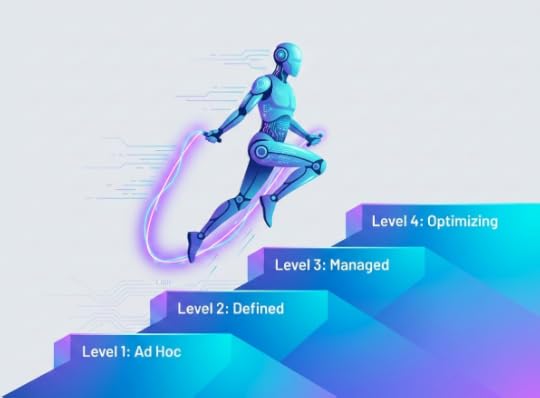 this is how Gemini imagines this blog
2026, now the pitch has changed. With AI (agentic, of course!), the story goes, a low maturity SOC can leap to maturity Level 3 or 4 “because AI”. No slog through the “defined process” desert, no “organic” growth through stages. Buy the agents, skip the years!
If you attended my RSA 2026 peer session, you saw the buyer-side version of this: “AI in a SOC sounds great, we will just wait for our SIEM/SOAR vendor or MDR to give it to us.” Same assumption, that the new version of the tool carries the maturity boost with it. Sadly, in reality AI can generate the paperwork of a mature SOC in an afternoon. It cannot give you the institutional memory to know what your own systems actually do.
Ten years ago, in “Jumping Security Maturity Fail”, I endorsed a reader’s line that you can jump technologies, but you can’t jump maturity. I’d like to re-examine that in the age of agents. Because some of it has changed. Just not the part vendors are selling. Think of this as “Jumping Security Maturity Fail, Part 2. 10 Years Later.”
Where this post sitsThis is a bridge between two things I’ve been writing about. On one side, the AI-ready SOC pillars and how to plan the journey to them. On the other, the “Stop Building a 2003 SOC with AI” series (Part 2, Part 3), which argues the target SOC in 2026 should look nothing like the 2003 one (more on “SOC 2026” from scratch in a few days…)
The question in between: if the destination has changed, does the path still have mandatory stops? That is what “jumping maturity” is really asking.
The claim, restated so it can be tested“AI lets you skip maturity stages” quietly conflates two different things:
Stage outputs — the artifacts a mature SOC has: playbooks, parsers, detections, runbooks, dashboards, workflows for various humans, skill profiles for humans to hire, etcStage prerequisites — the organizational state a mature SOC is in: it knows its environment, owns its processes, trusts its data, has a working feedback loop.AI can generate the outputs of Level 3 for a Level 1 SOC in an afternoon. You can always say “add automation”, “make this playbook better faster”, “more AI…add even more AI…MOAR AAAIII!!!”
Still, it cannot generate the organizational prerequisites, because those are not documents. They are things an organization has learned about itself by operating. Once you split the journey along that line, the “jump” question mostly answers itself.
Typical SOC Maturity Journey (Woefully Oversimplified)Level 1 — Ad hoc. Some logs, some alerts, heroics. “Nobody knows what server4 does, but Joanna might, let’s call her.”Level 2 — Defined. SIEM with intentional use cases (hopefully, output-driven, not “what data do we have? Let’s shove it in!”), documented triage and (some) IR runbooks, named owners (for some things, some are even the right owners…), basic metrics.Level 3 — Managed. SOAR playbooks beyond “baby’s first phishing playbook”, some threat-informed detection, log source health monitoring (logs volume drop? alert!), MTTx that is tracked and acted on (sometimes).Level 4–5 — Optimizing. Detection engineering as a discipline (the DE series), a continuous detection / continuous response loop, hunting that feeds detection, an improvement culture. This sets you on a path to ASO end state.So, let’s get “an AI jumprope” and start jumping!
Part A: What AI genuinely lets you jumpThese are the labor-intensive artifacts of each level — the things that took quarters to write, not the things that took years to learn.
Runbook and playbook authoring. Fifty credible playbooks, one afternoon. The writing effort that used to gate Level 2→3 is gone. This one you can jump. There are caveats, like that some of the playbooks will suck, but for many teams fixing a 80% playbook is not 20% faster than making one from scratch, but essentially 5X faster… SOC process docs, playbooks, etc is where jumping is legit.Parsers and normalization. Onboarding long-tail log sources was a classic Level 2 grind. Largely shortcut-able now (with lots of caveats; for tricky log sources the “fully machined” parser will suck). You can jump here, but you may trip and fall.Baseline detection content. “Reasonable coverage of common threats that matter to you” no longer requires a detection engineering team to bootstrap. You can “machine” some custom detection quick, and some will even work. Keep in mind, here you can jump but not very far: you won’t arrive on “full auto” process for turning intel into detections that work well for you.Tier 1 triage as a stage. Here is the one real skip: the stage where you staff a Tier 1 can be omitted entirely if enrichment and investigation are agentic from day one. You shouldn’t build the 2003 shape at all — triage must die. This is kinda a side-jump from “classic SOC” to modern D&R function, SOCless (if you wish); some aspect thereof. This won’t make you Google or Netflix if you can barely spell “MDR.”Documenting existing processes. AI can watch tickets and chat and reverse-engineer what people actually do. This shortcuts the “write down what we do” part of Level 2. It does not shortcut the “decide what we should do” part. This is magical!Metrics plumbing. Dashboards, reporting, the presentation layer of Level 3. (Which metrics matter is a separate, non-jumpable question — see the ASO metrics piece.)Cross-SOC knowledge transfer. Mature-SOC practice encoded in models and skills means you don’t reinvent detection hygiene from scratch. This jump can get your from “almost nothing” to “pretty damn good” , and it probably won’t suck. Jump away!Ordering between tracks. The SOAR model already noted that dimensions get mixed up across organizations but each dimension matures in order. AI makes this more true: you can advance the data, detection and response tracks in parallel rather than serially.So yes — AI compresses the time within a stage, and lets you run some stages in parallel. It also allows some real jumps (yay, those marketing people didn’t lie… this time). That is real, and it is not nothing.
However…
Part B: What must be followed in sequence, AI or notThese are states the organization has to reach. No artifact substitutes for them. Worse, AI amplifies whatever state you are in — mature or clown-grade. If you have read the AI-ready SOC pillars, you will notice this list is the pillars in disguise. That is not a coincidence; readiness and maturity are the same thing viewed from two angles.
Environmental knowledge. Asset context, identity context, ownership. AI cannot tell you what server4 does; it can only ask Joanna faster. If your teams don’t know who owns what, neither will your agents (pillar #2). This is the single hardest prerequisite and it precedes everything else. Part 3 of the 2003 SOC series is essentially a whole post on why local context is the thing agents can’t bring with them. Yes, some fun startups are working on this, so maybe my 2027 assessment will change!Data foundations before analytics. Collect → trust → detect → automate, in that order (pillar #1, still my favorite). An agent investigating over gappy, untrusted telemetry produces confident nonsense at scale. Low awareness of removed or failed log sources was already a top failure mode in Detection Engineering and SOC Scalability Challenges in 2023; with agents on top it gets worse, not better. And federated SIEM does not exempt you: federation is a topology choice, not a data-quality shortcut.Process definition before process automation. SOAR proved this and agentic AI is re-proving it. Automating an undefined process gives you an undefined process that runs faster, crazier, with more stochastic chaos (fun!). And, yes, an AI-drafted playbook still needs a human who can say “no, that’s not how we do containment here” — which requires someone who knows how you do containment… Also, here agents may enable speed-up, but not truly a jump over this stage.Trust calibration. “AI suggests” → “AI acts with approval” → “AI acts, humans audit.” This is inherently sequential because trust is earned from an observed track record in your environment. Vendors cannot ship trust! This is our ASO’s CD/CR applied to the agent itself, and it is also why the “humanless SOC” crowd keeps soiling their pants: they skip the calibration stage and call it a feature.Ownership and accountability. Someone owns detection quality; someone owns response outcomes. Low maturity SOCs lack this. AI does not create owners. Here you jump — you die.Feedback loops. The actual magic of ASO sparkles here: incidents feed tuning, false positives feed detection, hunting feeds detection. AI can run the loop faster, but the loop must exist and be wired to real outcomes. In the Deloitte/Google “consistency and creativity” paper we argued you build consistency through the lower levels first, then let creativity loose inside processes that already exist. Substitute “agents” for “creativity” and it reads as if written for 2026.Organizational stamina. Budget, executive sponsorship, staff retention, tolerance for change, “change budget. Every failed SOAR program died here, not on technology. The ghost of SOAR comes back with vengeance here. Agents do not fix this one. At all.Wait — didn’t I say you can’t cross a chasm in two small jumps?Yes I did. In Baby ASO and its sequel I argued that incremental improvement of a “1980s-NOC-DNA” SOC mostly fails, that the fix is radical, and that simply buying modern tools changes nothing if people and process stay put. In, our Deloitte/Google “Evolution or Optimization”, we made the same point with a decision matrix.
So am I now saying “go slow, climb every rung”? Who wants this in 2026?
No. These are two different questions, and conflating them is exactly how “AI lets you jump maturity” gets sold.
Which ladder? Transformation (ASO, engineering-led D&R, the 2003-SOC-must-die argument) is about changing the shape of the SOC. It is a different ladder, not a shortcut up the old one. You absolutely should choose the new ladder, and you should do it in one decisive move rather than two timid ones. Transformation is not incremental.Can you skip rungs? Whichever ladder you pick, the learning-cost prerequisites in Part B are the rungs. The new ladder has fewer rungs (no Tier 1 stage, no swivel-chair triage stage), which is the genuine good news. But the rungs it keeps — know your environment, trust your data, own your processes, earn trust in automation — are the same ones, and they are still climbed in order. Remember our “AI in security can be magical, but it isn’t magic; It’s a marathon of focused engineering”? This is true!Put differently: “cross the chasm in one jump” means commit to the transformation and dump the incrementalism/optimizing what you have. This works IRL.
It does not mean the far side of the chasm has no ground rules. AI shortens the new ladder — it does not let you levitate over any chasm obstacle.
The AI-specific failure mode: skipped stages become invisibleThe old cargo-cult SOC — a 1-out-of-5 low maturity SOC copying “ninja moves” from a 6-out-of-5, as I described in Clown-grade SOCs — at least failed visibly, funnily and embarrassingly. Get the popcorn! Hunting before you do logging was obviously silly.
The new one is worse. AI papers over the gap with slop. You cannot cross the chasm if you put some slop over it. Agents produce plausible investigations, tickets close, MTTR looks wonderful, and nobody notices that the environment context was hallucinated and the “containment” hit the wrong host. Skipped maturity used to fail loudly. Now it fails quietly.
A usable test: jump vs. borrowFor any element of any stage, ask one question: does this exist because someone had to spend time, or because someone had to learn something about us?
Time-cost elements are jumpable. AI does them.Learning-cost elements are not. AI can make you learn faster, but you still have to learn.Corollary for vendor conversations, in the spirit of the RSA 2026 “show me the numbers” advice: when someone claims a stage skip, ask which bucket their claim falls in.
Most “1→3 with AI” pitches are quietly selling the artifacts of Level 3 to a Level 1 organization, and then blaming “process gaps” or vaguely point at “customer immaturity” (right?) when it fails.
So, can you jump?You can jump the artifacts. You can run tracks in parallel and get through each level in months instead of years. You can — and, perhaps, should — pick the transformation ladder instead of the optimization one. That is a genuinely better deal than the one we had in 2016.
But you cannot jump knowing your environment, owning your processes, trusting your data, or earning trust in your automation. Those are the maturity. The rest was always just the paperwork…
Related postsJumping Security Maturity Fail (2016) — the original “can’t jump maturity” argumentA Simple SOAR Adoption Maturity Model (2022)Beware: Clown-grade SOCs Still Abound (2019)Autonomic Security Operations — 10X Transformation of the SOC (2021) and ASO principlesBaby ASO (2024) and The Return of the Baby ASO: Why SOCs Still Suck? (2025)Future of the SOC papers: Process Consistency and Creativity (3), Evolution or Optimization (4), Transform the How (5)WTH is Modern SOC, Part 1 (2023)Simple to Ask: Is Your SOC AI Ready? (2025) and Beyond “Is Your SOC AI Ready?” Plan the Journey! (2026)Stop Building a 2003 SOC with AI: Part 1, Part 2, Part 3 (2026)A Brief Guide for Dealing with “Humanless SOC” Idiots (2025)Detection Engineering and SOC Scalability Challenges (Part 2) (2023, with Amine Besson)The Ancient Art of SIEM: Why 2003 Problems Look So Familiar in 2026 (2026)RSA 2026: Agentic Future, Analog Fundamentals (2026)[image error]Can AI Let You Jump SOC Maturity Levels? (Spoiler: Only the Boring Half) was originally published in Anton on Security on Medium, where people are continuing the conversation by highlighting and responding to this story.
Originally published at Medium.
About me: http://www.chuvakin.orgSeptember 8, 2026
Survival of the Basics: Which Security Fundamentals Were Secretly Relying on Lazy Attackers?
A few weeks ago I asked on X and LinkedIn a deceptively simple question: which “security basics” matter more against AI-armed attackers, and which ones don’t matter anymore?
 What Gemini think of this blog
[before you freak out about ‘…but Anton, we don’t even have a consensus definition of “security basics’, read on — I gracefully sidestep this critical issue :-)]
I got about 60 answers. Most of them converged on the same reasonable, practitioner-approved, completely unsurprising consensus: the basics aren’t dead, AI just punishes sloppy execution faster. This is true. It has also been true of every attack trend since 1998 (hi Satan! hi Metasploit! hi fuzzing!). If that were the whole story, this post would end here.
But one reply challenged the premise, and it turned out to be the most useful comment in the thread: what can an “AI attacker” actually do that a skilled human attacker couldn’t?
The honest answer today is: nothing.
Still, this has implications related to scale, speed, coverage and a whole lot of other things. Sometimes changing the speed on the attack side should NOT lead to “well, defense should also run faster” arguments. We should “do different”, not run “almost as fast” as the attacker. Let’s think about it!
The scarce resource was never technology. It was attention.This is also the “secret” why “luck-based” security works for some organizations. Even if they have glaring holes, DMZ CVSS 10s unpatched since 2016, Windows 2003, Red Hat Linux 9 and PHP (oh god, so much PHP!) they may still be in business, and doing sort of OK. That is why I always say that people with 10K unpatched HIGHs do NOT fear Mythos-induced “vuln-apoc” of having 300K unpatched HIGHs. The lift won’t change risk for them (IMHO) So let’s say 30x more vulnerabilities leads to … I dunno … 3% more risk?
Anyhow, for the entire history of this field, the single scarcest resource on the offensive side was skilled (defined broadly, perhaps semi-skilled too) attacker hours. There were never enough competent humans to exploit every reachable vulnerability at every company, craft a convincing lure for every employee, abuse every public S3 bucket and work through every organization’s attack surface.
The attackers did what any rational actor does with a scarce resource: they allocated it. They went after the easiest targets, the juiciest ones, or the ones that happened to be in front of them.
Here is the uncomfortable part. Perhaps you think it is obvious? A surprising share of what we call “security basics” were never really about stopping attackers. They were about not being worth the effort at the moment:
Patch cadence was about closing the window before someone got around to you. Not before someone could, before someone would (This is a profound idea, IMHO. Thanks Claude Fable 5.1!)Phishing awareness training worked, to the extent it ever did, because mass phishing was sloppy. Crafting a good lure was expensive, so most lures were bad, so “spot the typo” was a real signal.“We’re not a target” was a risk-acceptance strategy that only made sense if the attacker was choosing targets. Again, “luck based security” was very much a thing.Coverage metrics like “80% of assets patched within SLA of 30 days” implicitly assumed the remaining 20% was hiding in a pile the attacker wouldn’t bother to sift through. IT sure couldn’t ;-)None of these controls fail because attackers got smarter. They fail because attacker labor became elastic. When the marginal cost of one more exploitation attempt, one more tailored lure, one more recon pass drops toward zero, there is no such thing as low-hanging fruit anymore. All the fruit gets picked. Ok, this is new! This is fun!
Still, we have seen a similar movie before, and I was there for the first showing. Network scanners in the late 1990s and Shodan in the 2010s did not invent new vulnerabilities. They removed obscurity from the discovery phase and forced everyone to admit that “nobody knows about that server” was not a control.
In my view, AI is doing the same thing one layer deeper: removing scarcity from the exploitation and social-engineering phases.
Whatever you believe about the exact numbers in the recent frontier-model evaluations (end-to-end corporate takeover chains, three-figure attack costs, and so on), the direction is not in dispute. The attacker is no longer rate-limited by their headcount and “attention count.”
The sorting ruleThis gives us something better than a list. It gives us a rule.
A [security] basic survives if it works by physics or math. A basic dies if its risk reduction was proportional to attacker effort.
No wire, no access. Network isolation does not care whether the probe came from a bored teenager or an agent running 1,000 recon passes a second. Hey Cisco ;-)No binary, no execution. Application allowlisting does not care how the entry point was found.No phishable auth factor, no phish. FIDO2 does not care how convincing the lure is, or whether it arrived as a flawless email or a cloned voice. No chip — no access.No software, nothing to patch. You cannot exploit what has been removed.In the “1990s speak”, AI cannot scan your ports, if you don’t have ports. Get rid of the TCP/IP stack while you are at it :-) Conversely, anything that reduces risk by making you slightly harder to attack than the next guy is on the wrong side of this line. So your zero-day laden security tool that runs “input filtering” is shot in the butt…
The matrix: AI resilience × modern feasibilityBack in my Gartner days, we wrote a paper on IT hygiene and which controls actually constitute a foundation. Oh those endless debates on whether NIDS is a basic control in 2016…. I recall you so fondly!
The list below is a first pass at re-running a similar exercise with two axes:
Does it hold against a tireless attacker, andCan anyone actually deploy it in a modern environment?BTW, the second axis matters more than people think. A control that is AI-proof, but undeployable is not a security basic. It is a wish at best…
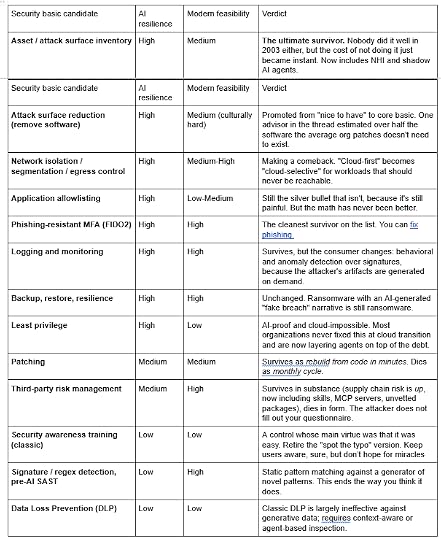 Master table
From this, three things that are emerging as basics, done by a few now and needing to become universal:
Identity verification for humans at hiring and high-risk moments. In-person or equivalent anti-deepfake process for video hiring. This sounded paranoid in 2023. This sounds routine in 2026.Anything that cuts off network access still works well. If you can gracefully limit connectivity, no attacker — with AI or without — can touch it. This of course wins some degree of Easier Said Than Done prize… but it is still real.Identity and inventory for non-humans. If you cannot enumerate your agents and service identities, “intent enforcement” is a slide, not a control. Agent security (however defined) cannot be solved unless we solve agent identity.AI-driven code and data discovery. If your data classification project has been “in progress” since 2019 (or:1989?), the attacker’s is not. So, here you do need to run faster than the attacker, yes.The patching dilemma, properly statedNow back to patching. According to many, patching is the ultimate “security basic,” so it deserves its own math. BTW, others say that it is neither security nor basic… Review these first, perhaps.
Under a human attacker, patch coverage was roughly linear. Going from 30% to 80% of assets patched within SLA removed 50 “points of exposure”, because the attacker was not going to find and exploit every one of the remaining gaps. Some of them were effectively hidden by the attacker’s own bandwidth.
Under a tireless attacker (read: AI), exposure stops being “what fraction is unpatched” and becomes “is there at least one reachable, usable, exploitable gap.” That number stays stubbornly close to 1 until coverage approaches 100% for reachable assets. Improving from 30% to 80% may produce close to zero risk reduction. The remaining 20% is not hiding anymore. This is new, and a bit scary. But this is an assumption to test, not a law. We need data!
But if it holds even partially, the levers change:
Shrink the denominator. Fewer things that need patching. This is why attack surface reduction jumps up in importance.Make the gaps unreachable. Network isolation converts “unpatched” into “unpatched yet irrelevant.” This is why segmentation is back. Microsegmentation grows in importance.Make patching a rebuild, not a maintenance window. If you cannot rebuild a workload from code in minutes, you are not going to win a speed contest against a vuln storm. This is less a security basic than an IT cornerstone, which is exactly the problem.So “patch faster” and “patching doesn’t cut it” are both right. The goal survives. The implementation everyone recognizes as “patching” does not.
That pattern repeats across the table: many basics survive as objectives and die as the specific practice we associated with them. Similarly, awareness training survives as “humans exercise judgment” and dies as “annual click-through module.” Least privilege survives as a principle and dies as “someone reviews IAM policies quarterly.”
What this means, operationallyIf you take one thing from this: subtract before you add. Before buying the AI-vs-AI tooling that every vendor is now pitching, remove the software you don’t need, cut the wires that don’t need to exist, and finish the asset inventory you’ve been not-finishing since your first CMDB project. These are not exciting. They are also the only controls on the list that a tireless attacker cannot outrun. Niels Provos reminds us of the same.
One more honest observation. Several of the “promoted” basics above (remove unnecessary software, segment aggressively, fix least privilege) have been recommended for 20 years, and no previous threat trend actually motivated organizations to do them. Maybe an attacker who never sleeps and never gets bored finally will. Or … maybe we will spend the budget on AI-powered SOC dashboards instead. I am, as always, an optimist…
Related:
The Feynman Bet: Why You Still Won’t Vibe Code Your SIEM (Today)Beyond the Vulnerability Apocalypse: Scaling Your Basics and Vulnerability ManagementBreaking the Patch Sound Barrier Part 2: So Is The Apocalypse Coming and What Is It?The Ancient Art of SIEM: Why 2003 Problems Look So Familiar in 2026“AI Normal Tech” vs “AGI by Tuesday”: Security Advice That Survives Either Future[image error]Survival of the Basics: Which Security Fundamentals Were Secretly Relying on Lazy Attackers? was originally published in Anton on Security on Medium, where people are continuing the conversation by highlighting and responding to this story.
Originally published at Medium.
About me: http://www.chuvakin.org
