N.L. Brisson's Blog
November 26, 2025
The Loneliness of Sonia and Sunny by Kiran Desai – Book
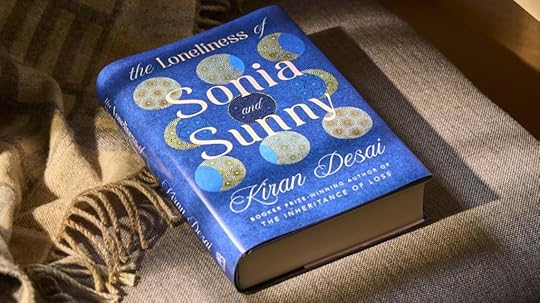
From a Google Image Search – Shortlisted for the Booker Prize, 2025
Sonia Shah is in her junior year at a college in Vermont and she is lonely. She cries on the phone to her parents in India. Thus begins the story by Kiran Desai, The Loneliness of Sonia and Sunny. It’s an excellent story of two upper middle-class families in India experiencing the injections of modernity into their traditional lives. There is the traditional reliance on arranged marriages, for example, while all the younger people seem to believe that it is better to marry for love.
Sunny Bhatia’s father died young so Babita, his mother, is left to fend for herself. Her father (the Colonel) happens to play chess with Sonia’s Papa, Manav, and he suggests an arranged marriage between his daughter, Sonia, and Sunny. A letter is sent to Sunny in NYC and to Sonia in Vermont. The timing is bad, as these are two of those modern children who want to marry for love.
Sonia, in her loneliness, becomes involved with an older man, an artist, with a personality that wavers between charming and mentally abusive. Ilan de Toojen Foss, is a strange man given to magical imagery and manipulation. He’s a painter and very ambitious. The relationship of these two has a Haruki Murakami vibe.
Sunny is living with an American woman from the Midwest, Ulla. They travel together to meet her parents in Kansas, which Ulla thinks will be a disaster. It isn’t a great success, but it isn’t terrible. When they return to NYC, Sunny goes home to visit his family in Delhi. He’s working as a reporter-at-large for the Associated Press and he plans to write and publish articles as he travels. When he arrives back in New York, he finds that Ulla has left him, moved out with all her possessions.
Sonia, who wants to write a book, is still with Ilan when his wife arrives and eventually evicts Sonia. Sonia’s mother keeps a cache of jewelry at an Indian bank, intended for her daughter’s dowry, but she gives Sonia an amulet in a silver case carved with Tibetan clouds and dragons holding a little demon figure. The demon is a talisman called Badal Baba, or Cloud Baba. When Sonia leaves Ilan he keeps her amulet.
Is this why Sonia and her family have a run of bad luck? Is this why a fierce ghost dog keeps chasing Sonia and disappearing. Is this why she almost drowns in Goa.
Sonia and Sunny do not realize that their parents have arranged their marriage, although they give them a choice in the matter. These two meet entirely by chance in India on a train. Sunny likes her right away because of the title of the book Sonia is reading. They have a few conversations in India, and when Sunny’s friend Satya gets married, Sunny convinces him to go to Goa where he also plans to meet Sonia. Goa is on the ocean and the two of them encounter the terrifying ghost dog who, fortunately, disappears into thin air.
Sunny returns to NYC, and Sonia stays in India with her family. Sonia’s mother and father live separate lives. Her mother lives in the cloud cottage in the mountains, full of magical visions and fantastical imaginings. There are eyes everywhere in this story.
Sometimes the story turns very informative, revealing aspects of Indian life, relationships with servants, the tensions between Hindus and Muslims. Parents are aging and need care, so Sonia becomes the caregiver for her father. Sunny’s mom faces a crisis that forces her to sell her home. Her families’ ties to corruption are revealed. She ends up in Goa.
It’s a long time before Sunny and Sonia meet again after a disastrous trip to Venice. Read the book. It’s wonderful, but I can’t tell you all the reasons why. I listened to the book on Audible because I had built up credits. The voice of Sneha Mathan, the woman who read the story made the story even better. Then I bought the book so I could get all the names straight.


October 30, 2025
What We Can Know by Ian McEwan-Book

From a Google Image Search – LA Times
Ian McEwan’s new book What We Can Know is a non-dystopian view of how human indifference might change world geography, it’s a celebration of nature, the humanities and poetry, and it’s a mystery. Any story that begins in the Bodleian Library generally offers us a kind of magic. I guess we can blame that on Deborah Harkness and on the academic glamor of Oxford University.
It takes a while to place everything in the correct historical time and to adjust to bouncing back and forth across a century. Tom Metcalfe is living in 2119, but he is a historian whose interest lies in the period from 1990 to 2030. He is trying to find a poem that was written by a writer named Francis Blundy for his wife Vivien. Blundy read it aloud on her fifty-fourth birthday at what came to be called “the Second Immortal Dinner.” Then he gave Vivien the poem, and no one ever saw it again. There are secondhand reports of what was said in the poem, but the poem itself vanished.
The poem was written in a very lengthy and difficult form called a corona. Blundy’s corona consisted of 14 Petrarchan sonnets and a fifteenth which had to repeat the first line of each of the 14 and that had to make sense. A Petrarchan sonnet had 8 lines that rhyme ABBAABBA and 6 lines that rhyme CDECDE. The literary world held its breath, but after almost a century the poem was still missing. Tom has taken on the task of finding the “Corona”. As he searches, we get glimpses of what neglecting to deal with climate issues has done to the planet. There are allusions to Nigeria, although they are rather vague. Tom seems to live in what is left of England, now a series of archipelagos and islands. The Bodleian library has been moved to higher ground making it problematic to travel there.
Apparently, the humanities academics have always been a rather randy bunch, with all kinds of sexual adventures and affairs causing ruffled emotions that are often hidden under polite exteriors (and sometimes not). Vivien was apparently a charming and beautiful woman who had a few adventures before she married Percy Green and a few while she was married to him. She loved her husband very much but only enjoyed his company for a few years as he developed early onset Alzheimer’s. He had been a craftsman making classical-quality violins. Alzheimer’s disease worsens over time and requires extended and intense caregiving. Percy’s Alzheimers was already advanced by the time Vivien met Francis Blundy, although she had already ended an affair with his editor, Harry.
Tom, in an off again, on again relationship with Rose is somewhat in love with Vivien although she has been gone from his world for a hundred years. He loves the property she lived in with Francis, after Percy died and they married. The property was known as The Barn and Vivien had her own office in the dairy building nearby. Everything had been carefully renovated, and since the “Derangement” (wars, and flooding) had not happened yet much of nature was still intact. Tom gets a valuable clue from a colleague about the possible place where the Corona might be buried. What he finds out says more about human nature than it does about poetry. It’s a book to love and ponder about, but it does not mince words about the human condition.
October 23, 2025
Circle of Days by Ken Follett-Book
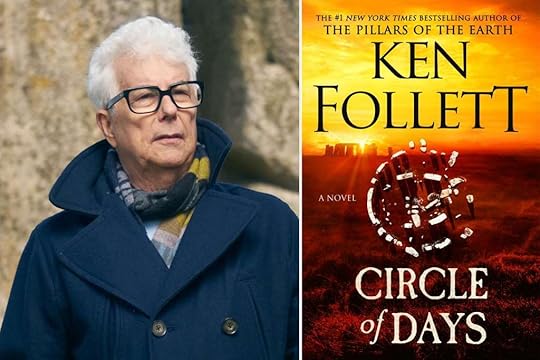
From a Google Image Search – People.com
In the Pillars of Earth, Ken Follett got us involved in the building of a Gothic cathedral in the fictional town of Kingsbridge. Many readers already knew the architectural features of classic Gothic cathedrals right down (or up) to the flying buttresses. It was one of Ken Follett’s finest novels. Obviously, cathedrals were not a primitive undertaking. Societies and population had to reach a certain point before such a building might be needed or even imagined.
In Follett’s newest book, Circle of Days, he weighs in on the speculations of how a place like Stonehenge could have been built before the age of machines. His words draw for us a possible moment in time when tribes of people occupied a fictional Great Plain. He gives us the flint miners, the herders, the farmers, and the Woodlanders. The herders have more time to think about eternal questions like the human spirit and practical matters like seasons, the heavens, and math (counting) all of which affect the herds of cattle they protect. Herders’ duties were not constant burdens as were the survival struggles of the other groups.
Often the fortunes of a tribal group depended on the temperament of the leaders. Follett’s farmers have a cruel authoritarian leader, who does not respect the boundaries of the other tribes and who exercises absolute authority over everyone (especially women).
Herders happen to have a council of leaders who make decisions after discussion by majority agreement. It’s not voting but it’s similar, although only involving a small group of elders.
Woodlanders are more primitive than other tribes. They love their woods which provide them with all their simple needs. They stay hidden and speak a language of their own.
The herders have built a circle of tall tree trunks joined by a wooden lintels and arranged in pairs. They have priestesses who know how to count, something others have trouble mastering beyond what they can see on their fingers and toes. The priestesses know how long a year is. They memorize songs which keep their knowledge in a form that can be passed on to new priestesses. They know about equinoxes and solstices, although not necessarily by those words. Four times a year they perform the songs, and they count. The tribes gather and travelers come to trade. The flint miners play a large part in these markets.
But because these are humans, the tribes do not always live in harmony. When there is a years-long drought, those who are cruelest seem to have better survival skills because these leaders have no boundaries and will steal land or cattle or woodlands, exercising a sort of early imperialism. When the farmers (the men only) decide to divert the midsummer market, which is the biggest market, from the monument of the herders with the circle of trees, they burn down the circle to rob the herders of the ceremonies that bring travelers to the village near the circle.
Because of the moral character of some of the herders (mostly the women) the priestesses refuse to be beaten. Joie, daughter of the wisest woman Ani, has seen a field of giant stones out on the Great Plain. She wants to build the monument circle out of these giant stones so they cannot be destroyed.
Follett tells the story of how he thinks they did it. Are humans with extraordinary talents, born at the right moment, responsible for the progress of human societies? Follett seems to suggest that is true. This project is not as complex as building a cathedral but, considering that the population of the area was much smaller and the social structures so much simpler, we have all wondered and speculated about why Stonehenge would have been imagined and how it could have been built.
Reading about the state of humans on and around the Great Plain is made interesting by giving the people in the story names, personalities, families, sexual structures that helped prevent inbreeding, and by creating a crisis that brings out the best and the worst in his characters. Even more interesting is Follett’s theory of how this magical circle was built which stays close to our current educated guesses about how such primitive people could produce such a sophisticated monument involving a detailed knowledge of astronomy, in particular the movements of the sun and moon. I found the novel enjoyable. Perhaps you will too.
October 15, 2025
An Inside Job by Daniel Silva – Book
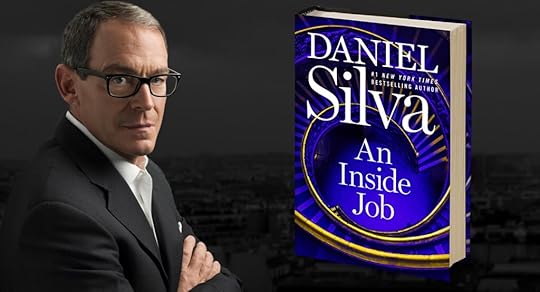
From a Google Image Search – Daniel Silva
Daniel Silva has published a new book called An Inside Job. His key character is Gabriel Allon, a retired head of Israeli intelligence. He is also a talented artist who restores Renaissance Italian artworks, often frescos in cathedrals. He has a connection to the Pope and knows his way around the Vatican because he has worked on restorations there. He lives with his wife Chiara and their precocious twins in Venice.
Gabriel is almost finished with his current restoration project, a project requiring scaffolding and spotlights with a canvas curtain to separate him from tourists. When he spots an anomaly in Venice waters one day, the police investigate and pull the body of a young woman from the harbor.
This young woman has a connection to the Vatican, so we leave the rather lighthearted watery environs of Venice and find ourselves once again immersed in the Byzantine politics that surround, but do not implicate, the Pope. This time the object of contention is the discovery of a possible new painting by Leonardo da Vinci. It’s all about money after that and involves a shadowy mafia-style group that skims money from the Catholic Church and is determined to keep these activities secret.
Facing possible murder, Allon finds the evidence to hold the perpetrators accountable along with the help of some of our favorite old members of the Allon team. In the end we find ourselves back having ice cream with Chiara and the twins in Venice. All-in-all a very satisfying installment, rumored to be based in reality, and, indeed, An Inside Job á la Daniel Silva.
August 15, 2025
The Emperor of Gladness by Ocean Vuong – Book
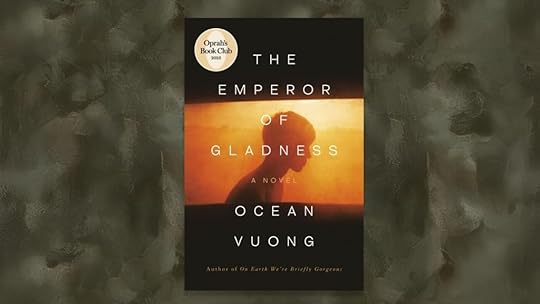
From a Google Image Search – NPR
Fiction reflects the culture of the particular moments in which it is created. The Emperor of Gladness by Ocean Vuong is a book of the twenty-first century, but its characters are immersed in three different wars.
Hai and Sony (named after a TV) are refugees from the Vietnam War. Sony, whose damaged brain makes him a target for bullies, knows every detail about the American Civil War. And Grazina, an immigrant from Lithuania, now in her eighties and in and out of dementia, is reliving the Second World War.
None of these good people are thriving. Grazina meets Hai when she stops him from throwing himself off a bridge into the river that runs by her house. She has a son and daughter who rarely, or never, visit her at their ramshackle childhood home. After she saves Hai, he stays to take care of her. When she imagines she’s back in the war, he stumbles onto the perfect strategy for managing her dementia. He pretends he’s Sgt. Pepper and he joins her in her war memories about being chased by Germans. When she can name the current president, he knows she is back in the present.
Vuong’s book is not only about the wages of war. It’s also about families, both biological and accidental families – families that just happen. Sony has a mother, Hai’s Aunt Kim, but she’s in jail right now. Hai has a mother, but she thinks he’s in med school in Boston. Grazina is a mother but for Hai she takes the place of his deceased grandmother, and for Grazina, he takes the place of her neglectful son.
When Grazina runs out of money for the Stouffer’s dinners she loves and for utilities, Hai hits Sony up for a job at the “HomeMarket”, a fast-food restaurant that offers “Thanksgiving dinner year-round. Another ersatz family results from the many hours these workers spend together in this economically challenged rural town of East Gladness. There are not a lot of distractions or opportunities.
Drug addiction is also an undercurrent in this story, with Hai popping the downers that Grazina no longer takes. Drug addiction along with the experiences of immigrants in America connects these characters with each other and with the sinking economic circumstances of many Americans living in the twenty-first century.
Ocean Vuong is a master of description, Although often stark, and therefore strangely beautiful, his descriptive style captured my attention right away. The unique quality of his descriptions comes from his ability to make the landscape suit the characters.
“But it’s beautiful here, even the ghosts agree. Mornings when the light rinses this place the shade of oatmeal, they rise as mist across the tracks and stumble toward the black-spired pines searching for their names, names that no longer live in any living thing’s mouth.” (pg. 1)
Ocean Vuong – here’s a good writer, and a book that will stay with you. As for the ending, I forgive you Ocean Vuong, maybe.
June 15, 2025
Atmosphere by Taylor Jenkins Reid – Book

From a Google Image Search – ABC News
Atmosphere by Taylor Jenkins Reid is a novel that has several themes. It begins in the 1950’s in America, but it mainly takes place in the 1980s. Joan Goodwin grew up loving the stars in the sky. She watched when Americans first walked on the moon in 1969. As a grownup she earns degrees in astronomy and is teaching at a college, but she dreams of going to space. When the space-shuttle-years begin an era of multiple space launches and flights, Joan, in a hopeful moment, fills out an application for NASA. The space program is hiring women for the first time. Since Joan is an expert in the field of astronomy, since she knows the constellations, knows the myths by which the ancients delineated them, and can steer by the stars, she is hired by NASA.
The people she meets at NASA become her co-workers and her social cohort. Eventually they learn to accept each other’s eccentricities, and they bond, some better than others. Everyone wants to be included in a shuttle mission and there is some competition and even some backstabbing. Joan’s calm demeanor and social common sense are important assets at NASA.
Joan’s sister, Barbara, is a hot mess. She got pregnant too young, and she is a reluctant single mother to Frances. Barbara’s selfish lifestyle keeps Joan involved in Frances’s live and they grow close. Frances can rely on Joan. She visits her at her NASA apartment often. Circumstances arise that make Joan escalate her involvement in Frances’s life.
Joan, who has never been in love before, falls in love with fellow astronaut, Vanessa Ford. It’s a relationship they must hide because it isn’t accepted anywhere, but especially not at NASA. It’s a love story that shouldn’t make any reader uncomfortable.
I recently read Orbital by Samantha Harvey which took me to the space station. It gave me a detailed view of a place I will never go, but that I value as a place that today’s risk-takers go to support tomorrow’s space adventures. However, Reid’s book, Atomosphere is peopled with emotional connections, human interactions, and historical realities that are more important than the mere technology of space flight, and more universal. These human interactions enrich the experience of NASA but do not put you right in space as Orbital does. Both are fine books about human space adventures, but offer different experiences. I enjoyed reading both books. You might also enjoy this pair of space odysseys.
Lucy by the Sea by Elizabeth Strout – Book
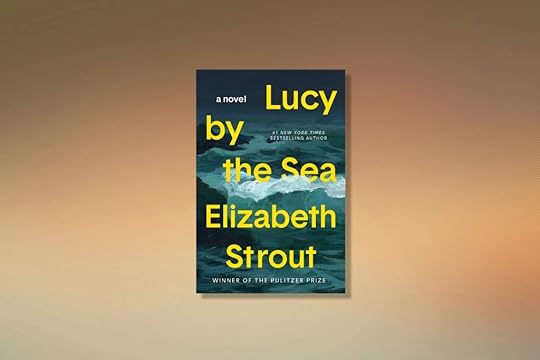
From a Google Image Search – Time Magazine
From time to time, I have checked in with Lucy and her now ex-husband, William. In Lucy by the Sea by Elizabeth Strout we meet these two again. Lucy is a writer; William is a scientist. They were married for twenty years and have now been divorced for 20 years. They have two daughters, Chrissy and Becka, both grown and married. It’s the time of the COVID pandemic. Lucy cancels a book tour. She is sheltering in place in her apartment in New York City. She’s getting older and is considered high risk. She can wear a mask to shop if she can find a place that’s open.
New York seems deserted except for near the hospitals. People celebrate nurses, doctors, and hospital staff with cheers, and bang pots and pans to express gratitude. Refrigerated trucks are no longer full of frozen food. Those who died of the virus are kept there until they can be buried, without ceremony, in mass graves.
William learns of an empty house by the sea in Maine. He whisks Lucy away, as soon as she agrees, from the dark pandemic days in the city. She is somewhat reluctant to go as these two are divorced and she is grieving the recent loss of her husband, David, with whom she had a good relationship. William, whose third wife recently left him, is not convinced that monogamy comes naturally to men (or even to women).
In the last Strout book where we caught up with William and Lucy, William finds out that he has a half-sister. When he decides that he would like to meet her, she doesn’t want to meet him. Lucy meets Lois and reports back to William. Lois lives in Maine.
Lucy has found William to be a rather preoccupied partner. She thinks he is rather unengaged. She always has. He is not attentive and often seems to be elsewhere in his mind while Lucy is trying to communicate with him. Is it because he is a scientist, a jerk, or just very self-involved? As they live together once again in Maine, she still sees his limitations but is not as bothered by them. Still, being alone with him in a house in Maine is awkward at first.
Lucy worries that she no longer has a role in her daughters’ lives. For several reasons this turns out not to be the case. It’s an intimate story although it seems rather unemotional. The story line seems to go nowhere because it’s a story about family feelings, relationships, judgments made, and lessons learned. Strout’s writing has a pleasing spareness.
It’s quite an enjoyable episode in a series of books reminiscent of the TV series that we binge watch these days. It’s similar to a memoir, but involving two people rather than one, although the story is told from Lucy’s point-of-view.
May 25, 2025
The Next Day by Melinda French Gates – Book
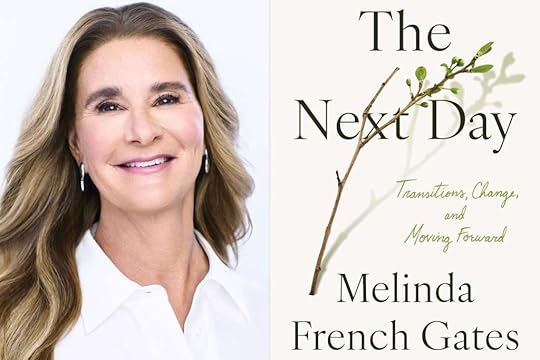
In her book The Next Day: Transitions, Change, and Moving Forward, Melinda French Gates reveals what led her to divorce Bill Gates, but this book is not intended to feed the gossip mills. Gates explores her life lessons arising from several times of transition, in her life.
Melinda Gates does not travel a superficial path. She may be religious, but in this book her journey is more spiritual. She acknowledges her feelings, analyzes her deepest fears, and conquers obstacles.
Leaving a supportive, loving family to go to college at Duke in North Carolina she encountered homesickness, loneliness, doubt, and academic difficulties but she stayed at Duke. Sometimes she found solace in books or poetry. She joined a sorority and made new friends. What she went through is not unusual. Many freshmen make this adjustment. But she knew that it would change her life if she left school. She even went on to earn an MBA at Duke. Her father saw her as a scientist and mathematician, giving her the confidence to compete in tech fields mostly pursued by men.
A second key moment Gates describes came at the birth of her first child, Jennifer Katharine Gates. An earthquake brought this realization:
“My new world spun on a new axis, with Jenn at its center, I realized I would have died for her that night. I would have sacrificed Bill for her in an instant. I would have given my own mother’s life to save Jenn’s.” (p. 32)
She continues to talk about parenting:
“Eventually, I found that framework in the concept of the “good enough” parent. The concept traces back to a British psychologist named Donald Winnicott, who coined the phrase in the 1950s… (p. 42)
and
“Most of all, we need the discipline to separate our own needs from our children’s and the wisdom to know when to let go. (p. 35)
Bill and Melinda had a close bond with another couple, Emily and John. When John dies of cancer, Melinda goes through all that comes with a great loss. She describes how she goes on with her life, and how she supports Emily in her grief.
The moment Melinda understands that her gut is telling her that she needs to divorce Bill and pursue her own goals almost sends her world almost out of control. She finds a therapist, after much self-reflection who helps her find her way to her next day.
All these transitions are difficult, but even more so when your life is so public. Melinda wants to put her considerable gifts to work helping women around the globe achieve their own goals. Considering the challenges to women’s rights, even in supposedly enlightened nations, we can only applaud her present and future contributions on behalf of women.
Melinda French Gates is an authentic person, as reflected in her book The Next Day. Her experiences are not so different from those of all women. Even so, her book is inspirational and aspirational because of the courage and clarity with which she faces each challenge.
May 14, 2025
The Oligarch’s Daughter by Joseph Finder-Book

From a Google Image Search – AP News
The Oligarch’s Daughter by Joseph Finder is a thriller that brings Russia to America. Arkady Galkin lives large and seems to be wired into power in two nations that we usually think of as enemies. However, when Paul Brightman falls in love with and marries the oligarch’s daughter, Tatyana, it becomes quite clear that the Russian is somehow connected to powerful people in America and that Paul is at risk. Paul had a job at a hedge fund, a job he liked with people he also liked. Galkin pressures Paul into working for him in his “investment firm”. As Paul learns that Galkin’s business involves illegal financial moves, Paul becomes aware that his new father-in-law will not tolerate any disloyalty. He decides that he needs to run.
The book opens with a man with two names fighting for his life. Grant Anderson/Paul Brightman wins this battle, but it’s just the beginning of a war for his own survival. Paul’s father was a survivalist who lived much of his life in the deepest forests of America. Paul, who lost his mom at sixteen, thinks his father is a nut. He finds him embarrassing. Little does he realize that the survival skills his father taught him are about to come in handy.
As we switch back and forth from Paul’s past with Tatyana to his present life as Grant Anderson, we find Paul caught up in running from dangers he should have been aware of as he courted Tatyana. Why are the FBI and CIA involved in all this, and why are they not on Paul’s side.
It’s a good thriller, although a bit offbeat from a classic one. We share Paul’s anxieties and his controlled panic. We travel to Moscow and back in the years of Paul’s marriage and then we run with him through the woods chased by people who should not be chasing him in the present. Of course, people die.
There is a section in the middle of the story which gets a bit bogged down in complexities and details. slowing our fevered dash from danger. It’s complicated. But soon it’s a headlong adventure in survival and Paul learns to take new pride in his father’s lifestyle. Who survives and who doesn’t? What happens to Paul’s wife Tatyana and Grant Anderson’s girlfriend, Sarah? It’s a good read, but not on my best thriller’s list.
May 5, 2025
Orbital by Samantha Harvey – Book
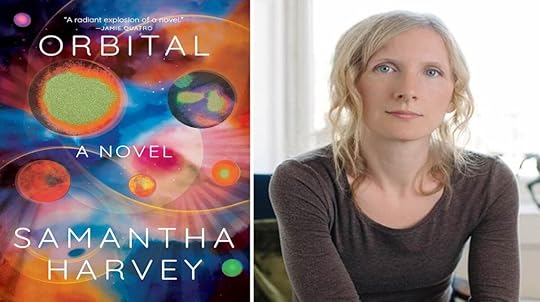
Being a physical chicken made me realize that I could never be an astronaut although I love science fiction stories that take place in space. No Blue Origin for me. No Mars on the Space X Starship. However, it no longer matters because Orbital by Samantha Harvey will allow even the most cowardly human to travel in space for a too-brief time. We travel with Anton, Roman, Pietro, Shaun, Chie and Nell, a diverse six pack of astronauts, aboard the space station.
No plot, no conquest of space and time, no spin-out into emptiness, only small dramas. Just the day-to-day minor miracles in the lives of these six people, eating, sleeping, conducting experiments in space science, their travels across time zones, across dawns and evening and nights. The earth in daylight appears unpopulated – at night the clusters of lights from cities and towns makes life visible from space, but the stars glowing in inky space outshine the city lights.
These astronauts have been through years of training to sleep in sleeping bags that hang without gravity. The descriptions reminded me of the way whales sleep, hanging vertically in the salty ocean, sleeping together in pods.
“Outside the earth reels away in a mass of moon-glow, peeling backward as they forge towards its edgeless edge; the tufts of cloud across the Pacific brighten the nocturnal ocean to cobalt. Now there’s Santiago on the South American coast in a cloud-hazed burn of gold. Unseen through the closed shutters the trade winds blowing across the warm waters have worked up a storm, an engine of heat. (p. 2)
“They retreat inside their headphones and press weights and cycle nowhere at twenty-three times the speed of sound on a bike that has no handlebars, just a set of pedals attached to a rig, and run 8 miles inside a slick metal module with a close-up view of a turning planet.
Sometimes they wish for a cold stiff wind, blustery rain, autumn leaves, reddened fingers, muddy legs, a curious dog, a startled rabbit, a leaping sudden deer, a puddle in a pothole, soaked feet, a slight hill, a fellow runner, a shaft of sun. Sometimes they just succumb to the uneventful windless humming of their sealed spacecraft.” (p. 16)
“How the earth drags at the air. See how the clouds at the equator are dragged up and eastward by the earth’s rotation. All the moist warm air evaporating off the equatorial oceans and pulled in an arc to the poles, cooling, sinking, tugged back down in a westward curve. Ceaseless movement. Although these words – drag, pull, tug – they describe the force of this movement but not its grace, not its what? It’s synchronicity/fluidity, harmony.” (p. 83)
“And when the ocean comes again you think, oh yes, as if you’ve woken up from a dream in a dream until you’re so dream-packed that you can find no way out and don’t think to try. You’re just floating and spinning and flying a hundred miles deep inside a dream.” (p. 189)
“You are looking now straight into the heart of the Milky Way, whose pull is so strong and compelling that it feels some nights that the orbit will detach from earth and venture there, into that deep dense mass of stars. Billions upon billions of stars that give off their own light, so that it’s no longer true to speak of darkness.” (p. 191)
In this space station, “far from the earth” they watch two earth events – an enormous typhoon and a moon launch. Although they think about what will happen to the humans in the typhoon’s path and they envy the astronauts going to the moon, they are not sorry they chose this mission. These events, in the end, do not change life aboard the space station. You should go on this mission. I doubt that Samantha Harvey ever went to space, but she nailed it – the beauty, the possibility for disaster, the tedium, the homesickness. The full-color-palette beauty of earth overrides all. Orbital is a trip.
**I have a Space playlist. It begins with Space Oddity by David Bowie, then Major Tom (Coming Home) by Peter Schilling, Rocketman by Elton John, Starman by David Bowie, Shooting Star by Bad Company, Drops of Jupiter by Train, and A Sky Full of Stars by Coldplay