D.P. Benjamin's Blog
August 7, 2026
The Author’s Plate
When an independent author takes on the task of writing a novel then adds to this challenge the goal of marketing the thing, that combined work represents a very full plate. (I would have written “a very, very full plate” except the late Mrs. Dawson, my old high school English teacher, would spin in her grave at the use of excessive superlatives. She also used to cringe (with justification) at such phrases as “He was very dead” and “She is very married.” and “He is very much the gentleman.”)
Anyway, where was I? Oh yes, the full plate. The entrées on the writing-plus-marketing menu include (but are certainly not limited to) the following items:
Sell Sheets omelet—a robust one-page summary of a book’s basics: Title: Author: Publisher and Year: ISBN: List Price: Discount (if any): Series/Set (if any): Summary (usually back cover blurb): Rave Reviews (if any): Contact Information and/or Location(s) where book may be purchased. To be handed out at book shows, left with bookstores (as opposed to giving the bookstores a free copy of your book), distributed to libraries (again, in lieu of giving a book away), or placed on the floor of a bird cage.
News Releases du jour—a scrumptious compilation of self-serving platitudes written in third person by the author. To be sent (fingers crossed) into a cosmic black hole consisting of local, regional and national newspapers, magazines and other periodicals (including online publications.)
Book Launch stew—a potpourri of tasty activities including finding a space (ideally a free site), setting a date and time, gathering allies (other authors), publicizing the event (see also News Releases du jour), prayer for sunny weather (if outdoors) or inclement weather (for indoor venues), and a thousand-and-one details too numerous to mention.
Video Vichyssoise—a lively soup of copyright-free images and soundtrack designed to satisfy the pallet of peers who grew up listening to the radio and youngsters who crave action-packed videogames.
Publishing pizza—Whether an author self-publishes or lands a traditional publishing contract, all of the above menu items are, in both cases, piled upon the author’s plate. The myth that traditional publishers will handle all the marketing only applies to big-name, best-selling authors. Meanwhile, an author must create of pay someone else to format a finished manuscript to produce paperback, hard cover, e-book, and audio book versions. Not to mention cover design, and so on.
Ala carte—There are many (many, many) other tasks which fall to the writer/marketer, including:
Book Signings
Book Give-Aways
Book Contests
Book Talks
Blog
Newsletter
Marketing Campaigns (such as Good Reads, Amazon, Facebook)
Webpage and Facebook (Meta) Page
Etcetera, Etcetera, Etcetera
You get the idea . . .
Seems like the writing is the easy part.


July 23, 2026
Head Hopping: Good? Bad? Something Else?
Head hopping allegedly occurs when a writer begins a scene from the point-of-view of one character, only to “hop” to the point-of-view of another character. Most English and creative writing instructors would condemn such “hopping.” I’m not so sure.
When it comes to the concept of head-hopping, I have a cartoonist’s advantage. Working in multiple panels, I can draw two characters, provide an accumulating dialogue as the story advances one panel at a time, and supply my characters with exaggerated facial expressions and body language to communicate outward emotions and inner thoughts. I can even make sweat beads sparkle in the air next to one character while adding imaginary steam coming out of both ears of the other.
No head-hopping here. In fact, if needed, I can, literally, have my characters switch heads as the story evolves.
Which brings us to fiction writing and the tyranny of point-of-view (aka, POV).
I don’t hold a degree in creative writing, but I’ve always been able to spin a story. Seeking to hone my craft, I’ve joined writers’ groups, studied books on the writing craft, and attended a seemingly endless array of workshops and seminars. And, I’ve endured critical comments from my peers, encountered instructional testimony in writing textbooks, and absorbed workshop presentations—all of which draw attention to the issue of POV and the related condemnation of head-hopping.
Ideally, to aid the reader, an author might adopt a single POV. A story can be written from the standpoint of a first-person narrator—using “I” as the guiding pronoun. Rarely is a modern tale written in second-person where “you” is the operative pronoun. Generally, third-person is the weapon of choice. This approach opens up a world of possibilities including such versatile notions as “he,” “she,” and “they.” But writing in third person tends to lead to head-hopping.
Choosing POV and sticking with it might be a textbook approach to writing. The challenge arises when POV is allowed to terrorize the narrative. Consider this excerpt from the draft of one of my upcoming mystery novels:
Trinidad padded downstairs in his stocking feet to stand quietly behind his wife. She’d been working on her novel for hours and he was burning with curiosity. Peering over her shoulder, he reviewed her writing and offered a gentle critique.
Anne looked up from her typewriter and stared at her husband, unable to comprehend his unsolicited evaluation. “You’re accusing me of head-hopping?” she demanded.
“What I’m asking,” he explained, “is how can your character know that the husband padded downstairs and that he’s curious? How does the wife know his criticism is meant to be gentle? First, you’re in his head and suddenly you’re in her head and then back in his again,” he pointed out. “If that ain’t head-hopping I’m a monkey’s uncle.”
The POV police might suggest that this scene needs to be edited. If we remain exclusively in Anne’s head, the writing will definitely change. Here’s one possible revision which keeps us in Anne’s head throughout:
Without looking up, Anne heard Trinidad padding downstairs and supposed her husband was in his stocking feet. He’d probably heard the sound of her hammering away at her vintage Remington. She imagined her mischief-loving spouse couldn’t resist tiptoeing into the sunroom to hover behind her. So, she continued typing and guessed what was coming.
Arising before dawn, she’d been at it for hours and she supposed he must be burning with curiosity. Anne didn’t turn around, she kept working. As she labored, she could almost feel his eyes sweeping over her evolving narrative—constructed letter-by-letter; each keystroke burrowing black and solid into a snowy expanse; the virgin paper pinned between the bail and the rollers of the heavy manual typewriter. She was weaving a tapestry of words etched in place and permanent as a stone carver’s mark. What would her husband, her staunchest supporter and most unswerving critic, think of this, her first draft?
Peering over her shoulder, Trinidad cleared his throat. She sighed, paused, and placed her hands in her lap, signaling that she was ready to hear his critique.
I began this piece as a condemnation of the tyranny of POV. Is it possible that the latter paragraphs—designed to keep the reader exclusively in Anne’s head—are superior to my former adventure into the realm of head-hopping from husband to wife and back to husband?
If nothing else, recognizing the hopping has compelled me to explore other avenues. Which one serves the reader best? I’ll have to think about that one, so pardon me while I hop into my head.
June 29, 2026
What Have You Killed Today?
As a mystery novelist, I tend to be cavalier about murder—most authors are. The typical fiction writer thinks nothing of crafting a scene of mayhem. Death comes easy. Books on writing and writers’ workshops traditionally refer to eliminating fictional characters, wonky plot-lines, or even unruly sentences as “killing your darlings.”
As media consumers, we’ve viewed countless hours of homicide. Readers and writers alike are constantly bombarded with murder and the repetition breeds indifference. But what does it mean to actually kill something—not on the page or in a dream, but in this waking life?
I’ll explain.
This month, my new bride and I moved into our forever home only to be greeted by a platoon of wasps. Seeking to discourage the critters, I searched our eaves for the insects’ papier-mâché nests. Armed with a broomstick, I pulverized a handful of nests until I arrived at one perched above our back door. I rammed the broomstick home, intent on destroying what I supposed was wasp habitat.
But I was wrong.
It was a hummingbird nest.
The damage was instantaneous and irreversible. Dislodged by my ill-fated blow, two tiny unhatched eggs slipped from their cradle to shatter on the unforgiving surface of the patio deck. Killing them spawned a physical reaction. I inhaled sharply as a weight seemed to press on my chest. My knees wobbled. I slumped into the nearest patio chair, sniffing as tears welled up.
Murdering wasps had seemed like self-defense—a necessary evil. The wasps were a threat. They were competitors. Killing the unborn hummingbirds was quite another matter.
I laid my weapon aside and wept.
As the morning progressed, the mother often returned to the nest, apparently hoping, with each repetition, that her missing eggs would somehow reappear. The father came too, joining his mate to flutter over the crime scene like avenging Furies, seeking retribution. I remained in my chair, unable to move, longing to turn back time, wanting to erase my impetuous action, to stay my hand, to pull back the broomstick at the last second, to spare the birds.
The lesson is clear. Next time I write a homicide, I’ll remember to give the reader insight into the killer’s emotional state. Deprived of the perpetrator’s emotion, fictional murder seems contrived. To reflect reality, the murderer must feel something; must grieve or gloat. Taking a life has consequences which must be explored. Murder most certainly alters the story arc of the victim, but—to be authentic—it must also change the killer.
June 4, 2026
My 81st birthday. Still trying to get my head around that...
My 81st birthday. Still trying to get my head around that impressive number. My advice to anyone in their twenties: pay attention and live each day to its fullest, because it goes so fast, you won’t believe it.
June 3, 2026
Show Your Grasshopper the Sky
Throw your character into a situation, of course. For which you need a setting.
Now begins the tricky part. Imagining a room, a chair, a lamp, a rug, a wall, and a ceiling is about as far as some of us are willing to venture. Afterall, our character is just passing through, to answer the telephone perhaps, or to pick up a newspaper, or search for a missing car key, or stumble upon a body.
But making the setting too vague has consequences. So does making the scene too perfect. Either way, you risk constraining your character in an unwieldy box. Suppose your character takes up residence in a contrived place. How do you keep that critter from becoming stuck there? On the other hand, how do you pull that character out and then return that character to the same setting without artificially reorienting the reader? And how do you reorient the reader? How do you remind them that Joe or Sally or Fido has once again returned to familiar surroundings? How do you accomplish such movements without the risk of repetitive redundancy?
Try thinking of your character as a grasshopper—a living organism which, through no fault of its own, is captured by a writer and placed inside a glass jar. The fact that airholes have been incised into the lid is of little consequence to the captive character who longs for freedom. The grasshopper doesn’t belong in the jar any more than an invented character belongs in a contrived setting.
You need to make your character feel something, or better yet, want something. To make the character work, to make the scene work, you must transcend the scene. If you want to animate your character and enthrall your reader, you have to make both the character and the reader care.
To do that, you must reach higher. To make anybody care about a character trapped in a box, you have to give everyone a glimpse of the sky.
April 26, 2026
One Finger or the Wave?
I live in a rural community where it’s common practice to acknowledge a passing motorist. If the acquaintance is a casual one or even a complete stranger, lifting a single index finger will suffice. If the relationship is closer, a purposeful wave is best.
When creating a fictional character, I apply the passing motorist test.
Meeting someone for the first time, on a single-finger basis, generates superficial questions. What’s the motorist’s name? Where is the driver coming from? Where is the driver going?
Meeting again on a lonely road inspires deeper questions and answers—inquiries which generate plot lines and bring a personality to life. A character who’s better-known has a history—a background which, whether shared with the reader or residing in the writer’s mind, ignites memories of previous encounters and speculations regarding future action. Fashioning a complex character, a writer’s thoughts dive deeper: Joe’s pickup is caked with mud. He’s been to the lake no doubt. Does he remember that summer we swam there as boys? His sister almost drowned that July. I wonder how she’s doing since her husband died.
Allowing a character to travel on unrecognized without a familiar wave and a desire to pursue probing thoughts is a missed opportunity, reducing that fleeting personality to a casual passerby. A reader won’t relate to such a one-dimensional character. A writer should care enough about a character to slow down, pull to a stop, roll the window down, and bide awhile in the middle of the road, vehicles nose-to-tail, chatting over old times, debating the present, and making future plans.
March 23, 2026
Famous Writers School
After high school, I enlisted in the U.S. Army for a three-year tour of duty. Never having traveled farther than a car trip from Colorado to Iowa, I took the train to basic training in Missouri. Before I completed basic, President Kennedy was assassinated, and our inexperienced platoon of raw recruits and reluctant draftees was issued live ammunition and ordered to guard the perimeter of our base. After the crisis passed, I rode a cross-country bus to my training site in Long Island Sound, New York. While attending my military school, I got a three-day pass and took my first airplane ride to Washington, D.C. A month later, I was on my way to San Francisco where I joined the staff of a monthly magazine which served the patients and staff of Letterman Army Hospital. A year later, I shipped out on a troop transport to Korea where I served as editor for the Bayonet Newspaper, a weekly publication of the 7th Infantry Division.
I mention my military experience because, as soon as I was honorably discharged, I returned home to Colorado with the idea of making my living as a writer. As an older-than-average but still impressionable college freshman, I saw a magazine advertisement for the Palmer Writers School. This now-defunct correspondence school invited prospective authors to take a rather mundane four-part test and send it in for evaluation, as stated in the brochure:
“The purpose of this test is to give you an estimate of your writing capabilities. We will grade your test and return it to you as soon as possible with our frank, expert opinion of your chances for success as a writer.”
I must have fallen for this offer because, while cleaning out my old filing cabinet the other day, I ran across my old, graded test. In those days before personal computers, my answers had been carefully composed using a manual typewriter. I can’t recall what my expectations were, but apparently, I completed the test, used the supplied gummed label to seal it, and mailed it to the school in Minnesota.
My test was eventually returned. I was given a score of 90 out of 100 and someone had written, in red cursive letters, a single pithy critique on each part: “Interesting, Appropriate, Sets mood, Perceptive.”
After sending back my graded test, I undoubtedly received follow-up literature outlining the cost of taking the Palmer course. Whatever the price tag, as a starving college student, I’m certain I decided to pass.
I won’t risk lowering my score by reproducing the details of the squalid writing sample which I innocently mailed to Palmer more than half a century ago. However, I’ve reproduced Part A of that long-ago exam in case anyone would care to take a crack at it. Here it is:
“Part A. In the following paragraph from a published story, we have left out certain words. Read the selection carefully. Think about the mood and then write in the word that you think belongs in each blank.
She ____ her faded chenille robe around her as she _____ toward the door in her ____ slippers. The little dark eyes ____ suspiciously out of her ____ gray-crowned face. She seemed to ignore the ____ rose-strewn wallpaper, the ____ rag rugs and the white iron bed.”
These days, the online marketplace is awash with workshops, how-to videos, seminars, and virtual retreats aimed at writers. I didn’t take the Palmer course. I opted instead for four years of writing college term papers, followed by a master thesis, followed by decades of on-the-job training as a college administrator, legislative policy analyst, and journalist.
Like a character in one of my novels, I sometimes wonder how my story arc would have changed had I enrolled in the Palmer Writers School. I wonder about how my life might have been different, how my fortunes might have altered. I wonder about these heady topics, but mostly I wonder why this once-famous school didn’t include an asterisk in its company name.
February 14, 2026
Googly-Eyes and the Writing Life
Once upon a time, I taught cartooning and storybook illustration to elementary school children. At our first class meeting, I came prepared with a variety of fruits, vegetables, and inanimate objects like a stapler, a bottle, and a cup. I lined these objects up on a raised box and invited the children to tell me about each one in turn.
Typical responses were: “Something to eat.” “An old bottle and a cup you could drink from.” “Something you use to staple papers with.”
Pretty dull stuff.
“Those are all good observations,” I noted. “But can you tell me how they feel?”
This question generally went unanswered. The children fidgeted and remained silent. I could tell by their expressions that some of the more insightful youngsters were seriously beginning to doubt my sanity.
“Let’s try something,” I suggested.
I then produced a bag of googly-eyes, those round, flat plastic discs which resemble eyeballs. I pasted a pair of the wiggly eyeballs on each object and again asked the children to tell me how the objects felt.
Typical responses were: “They’re alive.” “Yikes!” “He’s looking at me.” “The apple and the orange don’t like each other.” “The potato’s in love with the banana.” “The tomato is afraid and says, ‘Please don’t eat me!’” “The stapler is tired of working all day.” And so on.
The point being that the simple act of adding eyes to inert objects breathed life into them. This idea inspired the children to imagine and sketch incredibly creative and fanciful characters—everything from talking shoes to dancing noodles.
This concept might work to inspire writers as well and get them thinking outside the box (by putting a pair of eyes on that pesky box and literally molding it into a character.) Think of your story—that string of words and punctuation which you’re striving to corral, harness, harass, cajole, herd, and shepherd into a reasonable facsimile of a narrative. Think of that hot mess as, let us say, a zucchini.
And suppose, like many a misunderstood zucchini, your story is going nowhere. It’s just a vegetable, incapable of emotion, dialogue, and action. Ah—but what if you give it eyes? What if you give it a point-of-view, a way to see the world, a way for the world to notice it and consider its existence. For one thing, a zucchini with eyes might cause an observer to look more closely—taking a step which may lead to the discovery that it’s not a vegetable at all. Just for the record, it’s a fruit.
If you have created a wooden character, who refuses to become a waking, walking, talking, emoting being. Try giving him, her, or it a pair of googly-eyes. It might be just what’s needed to animate that character.
If you don’t use the idea of googly-eyes to spice up your characters, you could try putting a pair on your computer mouse or your desk lamp or the frame of your computer screen or a pen or pencil. Animating your writing instruments and your workstation may encourage you to interact on a more intimate level with the tools of the trade. Seeing familiar objects suddenly spring to life might even cause you to laugh out loud. Writing is a serious business—sometimes a bit too serious. Even the most dedicated writer could benefit from an occasional dose of comic relief.
October 24, 2025
Packing to Perfection in Pompeii
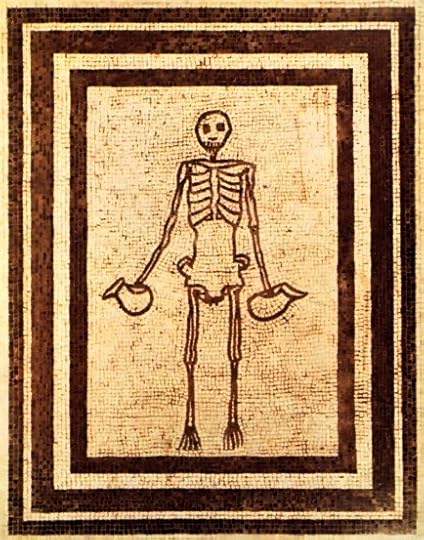
Around lunchtime, in the year 79 of the Christian Era, on the coast of what is now modern-day Italy, a once-dormant volcano rumbled. Ash rained down on the first day as residents of the nearby city of Pompeii gathered their belongings and debated whether to leave or stay. A day later, Mount Vesuvius erupted in spectacular fashion. Filling the air with searing debris and gases, the eruption blotted out the sun and trapped the city, along with its lingering inhabitants, beneath twenty-feet of smoldering rubble.
The city lay buried for centuries until searchers began digging. Soon sizeable walls, expansive gates, colossal public buildings, and massive statuary were discovered, seemingly frozen in time and largely intact. Meticulous excavation of the 163-acre site also revealed tragic images of people, encased in cocoons of ash and pumice—some embracing, some in poses of abject terror, some clutching pottery, keepsakes, and other intimate possessions.
A few residents of Pompeii had fled their fate. Most had stayed—taking time to pack—a delay which sealed their doom.
Over time, archaeologists have relished the historic wealth of Pompeii. But they are not particularly impressed by the lavish public buildings or the statuary or even the mosaics and frescos adorning the floors and walls of wealthy residences. What most impresses those studying the soul of Pompeii are the number of well-preserved private homes and the shadows of ordinary people which offer glimpses into the city’s everyday life.
When we write, there is a tendency to trumpet the grandiose—focusing almost exclusively on our larger-than-life characters who are immersed, with burning passion, in the pursuit of magnificent goals. Often, we forget to draw attention to more ordinary characters who, with equal passion, quietly pursue less lavish, but nevertheless still noble dreams.
As we edit our craft, it will be best not to forget these little characters. Rather than asking after the motives of our most outlandish and heroic lead characters, it might be better to question other, more earthy personalities. Take the example of Pompeii. Which seems more interesting? And which would more likely appeal to readers? A tale of happenings in the city’s huge town square or gigantic forum? Or smaller stories of the final hours of families, caught in the grip of an unthinkable disaster, taking precious moments to collect loved ones and sentimental treasures, and measuring their chances before fleeing?
January 13, 2025
Breakfast Serial
The English language is resplendent with homophones—words which are spelled differently but pronounced alike. By some estimates, there are more than four hundred such conundrums. Examples are the words ail and ale, bate and bait, cheap and cheep, and so on.
My favorite pair is cereal and serial. A misuse of this duo gives a whole new meaning to the phrase cereal killer.
I recently struck a deal with our local newspaper to publish my latest novel in a weekly serial format. Thanks to a generous editor, for two years and encompassing 92 episodes, local enthusiasts were able read a serialized episode every Wednesday morning. Some of my more insightful followers had even taken to referring to the continuing story as their breakfast serial.
I have no intention of correcting them.
Taking my draft manuscript and dividing it into sequential 9,000-word episodes—each closing with an appropriate cliff-hanger—presented a unique challenge. The word count was essential so that each episode would fit on a single page of newsprint. In addition to the episode itself, each segment requires a “tickler” opening. For example, the tickler for Episode 11 (Missing Person) read as follows:
“Mountain: A Cautionary Tale is an alternative history covering 1936-1942. Set along the Kansas-Colorado border, it’s the story of a misguided man, his star-crossed family, and an enormous public works project, gone terribly wrong. In Episode 10, Mountain workers helped Iris Hazelwood retrieve her luggage. In today’s episode, she expands the search for her missing brother.”
Moreover, each episode required an image illustration which hinted at the topic but didn’t represent a spoiler. So, the serial turned out to be quite a project, but well worth the effort since knowing each weekly episode would be read by a couple of thousand subscribers certainly compelled me to keep the story fresh and moving.
Serializing a novel was once a widely accepted practice. As my editor, Stu Carlson, put it in introducing the concept on January 4, 2023:
A note about serial novels – A serial novel is a work of fiction that is published in sequential chapters or episodes. In the early 1800s to the mid-1900s, serialization was a popular form of publishing. Works published in serialized form gave authors a much wider readership, since nearly everyone at the time read their local newspapers. Many works were later revised and published as complete novels. From “The Count of Monte Cristo” and “A Tale of Two Cities” in the 1800s to works like “In Cold Blood” and “Fear and Loathing in Las Vegas” in the mid-20th century, many seminal works of fiction began their lives as serials. The following is the first episode of a novel written by local author Don Benjamin. We hope our readers enjoy this limited weekly segment. Each episode can also be found at HighCountryShopper.com as they are released each week.
If this blog topic has sparked your curiosity, you can join our local population in following the serial because the episodes have now been compiled into two volumes available through our bookstore at this link.