Ronald Alexander's Blog
April 25, 2024
Enhance Your Communication Skills with Constructive Feedback
Sometimes, it’s hard for people to be honest with us even when we ask them to be.
Early on in my career, I was consulting for a major film and music studio in Los Angeles when a woman approached me to say, “Dr. Ron, I really love what you are teaching us, but would you like some feedback?” I had learned from Ram Dass that he always read letters and evaluations he got from his talks and teachings and what he listened most intently to was in reading negative feedback. And he would not only read and reread the more hostile and critical feedback forms but, when he could, he would either call the people up or write to them to better understand the feedback and where it was coming from. Some of those letters turned into long exchanges he kept going until he felt he had truly processed what they were telling him. I knew that even if it bruised my ego a little to be criticized, this woman who had approached me might offer me some helpful insights, so I said, “Fire away.”
She said that she loved what I was teaching—“but you’re teaching in the voice of an upper-crust white male.” I was taken aback but recognized that this woman had done me a favor in pointing out my bias. I took a deep breath and said, “Tell me more,” and she gave me at least five examples where I had offered case examples about work that were all about men—and white men at that. In my family, we had six sisters and four brothers, but it was obvious to me that I’d adopted some of my dad’s strongly embedded views that came from spending his career in a corporate world dominated by white men. My dad had always seemed to discuss men when he told his work-related stories. Rarely, if ever, had he brought up any stories about women. I hadn’t thought about how his limited experience working with women at his office back in an era when there were fewer women in the workplace might have influenced the types of anecdotes he shared.
I thanked the woman for sharing her perspective and promised I would change up my teaching stories. As a result of her feedback, I now think and teach with diversity in the foreground.
Fortunately, this woman’s criticism came from an open heart so it was easy not to take offense to her suggestion. If you’re asked to give feedback to someone in your life or at work, I find these four techniques from my book Core Creativity keeps the conversation positive and productive:
1. Give your undivided attention. When someone is telling you about their project or showing it to you, give them your undivided attention. Don’t scroll on your phone, don’t multitask, and don’t interrupt except to ask for clarification. Set the foundation for them to be honest and vulnerable.
2. Respond with positivity. If you think it’s an awful idea, you can say something like, “It sounds like you’ve put a lot of thought and work into this project so far.” Go ahead and compliment them for their efforts rather than the outcome.
3. Ask questions from a place of genuine curiosity. Use questions like, “I don’t think I’ve
heard that before. How did you come up with that idea?” and “What about this plan appeals to you the most?” Understanding where they’re coming from and what their aspirations were can help you to better encourage them and give them constructive feedback. You can share what you’ve done in similar situations and what the outcome was. In this way, you’re making yourself vulnerable and making them feel more comfortable with any criticism you offer because you’re showing that at times, you’ve been unsure or made wrong turns.
4. Offer feedback diplomatically. Finally, you can suggest something you think they might work on, but wait to see how they respond before you give them more feedback. Don’t overwhelm people with criticism and advice. You can ask whether they would like more feedback or if they would rather work with their project some more first. In both my Art of Leadership and Core Creativity workshops, I’ll often ask: Would you like feedback from me mild, medium, or severe like the hottest salsa?
If you want feedback on a project or issue you’re working on remember that you’ll want diversity among the people you consult with in your decision-making process. You might benefit from asking for feedback from someone with expertise in a particular area, someone who is good with alerting you to your emotions, someone with a different temperament—or someone who is very intuitive.
The post Enhance Your Communication Skills with Constructive Feedback appeared first on Ronald Alexander, Ph.D..


May 2, 2023
Mindfully Boost Your Brain’s Interconnectedness & Creativity
Creativity is among the top qualities that employers look for. If you feel that you need to become more creative in hopes of boosting and sustaining your career, you can do so by developing the areas of the brain associated with creativity — and diminishing the areas that squelch it.
According to research, the systems of the brain that communicate with each other effectively, sharing neural networks for exchanging information, have been identified as the “default mode network,” the “executive control network,” and the “salience network.”
Default mode network – We’re using our default mode network when we’re engaged in imagination or simply letting our mind wander — and this network is active when we’re retrieving memories.
Executive mode network – When we use our executive network, we’re making decisions and problem solving.
Salience network – The salience network is our inner editor. We use it when we decide what we’ll take note of and what we’ll ignore.
We need these three networks to function well and communicate with each other so that we can shift among daydreaming, analyzing our ideas, and discerning what is and isn’t important to explore further.
People who have weaker interconnectivity among these regions would get stuck overthinking things or imagining but not being able to build on the ideas.
Research also shows that the key brain difference between very creative people and others is having more neural connections among different systems within the brain. Highly creative people are able to activate and use these systems simultaneously, which contributes to their innovative abilities.
You can increase the brain function that will help you tap into your core creativity. Here are five strategies from my book Core Creativity: The Mindful Way to Unlock Your Creative Self to help you:
1. Practice mindfulness. Mindfulness develops the area of the brain associated with self-awareness and reduces the density of the right amygdala — the part of the brain associated with immediate response to stimulation. As little as half an hour of mindfulness practice a day for eight weeks was found to measurably reduce amygdala density. Training your brain to quiet the chatter of the analytical brain and become less emotionally reactive allows a clear-headedness and an ability to steer the energy of strong emotions in a direction you choose. Anger, excitement, or despair can be transformed into a creative force.
2. Embrace a beginner’s mindset. Many highly creative artists recognize that, despite their expertise and mastery, they still have much to learn. They embrace what Buddhists call “beginner’s mind” — a willingness to approach what’s familiar with a fresh perspective, as if they knew nothing. That level of curiosity and willingness can inspire great success.
3. Promote the flow of ideas by doing nothing. Highly creative people often earn a reputation for being lazy. This can come from the times when they appear to be doing nothing. But on the contrary, they are actually doing something very important: working with the brain and their open mind state to prime themselves to experience creativity. In open mind, you enter into a space of not knowing and not doing. You experience an abiding appreciation of silence as you wait patiently for your inner wisdom and awareness to speak to you. James Taylor said in a 2015 Hemispheres magazine interview, “Given enough empty time, the songs show up… you have to be in a place where you can receive the song, more than generate it.”
4. Pay attention to dreams. Consider paying more attention to your nighttime dreams, and even priming yourself to have helpful ones. Dreams are portals into open mind and can offer ideas and insights once you’ve interpreted them. They can even lead you to achieve breakthroughs. The melody for the Beetles’ song “Yesterday” came to Paul McCartney in a dream.
5. Form a Creative Support Pod. With the rapid pace of change in the world, you are going to have to be a lifelong learner. You’ll be called on to build new skills and expand your knowledge base. If you find yourself with a problem to solve that needs a creative solution, form a Creative Support Pod. This is a group of people who want to support each other in developing new ideas, sharing resources, and overcoming challenges. Invite people with different strengths and perspectives who can help you consider ideas from other points of view as you work together to creatively solve a problem.
As you enhance your brain’s sharing of neural networks that exchange information and tap into creativity, you become better able to fire up your creative flow. With practice, you’ll continue to improve your ability to break through to your deepest state of core creativity.
The post Mindfully Boost Your Brain’s Interconnectedness & Creativity appeared first on Ronald Alexander, Ph.D..
December 5, 2022
How to Mindfully Shift Out of a Doom & Gloom Perspective
Our emotions don’t linger if we allow ourselves to feel them. Mindfulness practice helps you to shift out of feelings and even longer-lasting moods—if you have the physiological foundation for experiencing and sustaining emotions such as joy and excitement.
Mindfulness can awaken what is known as the witnessing or observing self, a facet of your consciousness that observes what you’re experiencing. There is the self who is immersed in the intensity of feeling an emotion and the experience you are having (such as a verbal argument), but there is also the mindful self that is noticing the event unfold and how your anger or frustration feels in your body. This mindful self can create a space between you and your emotions when you are feeling overwhelmed.
In my book Core Creativity:The Mindful Way to Unlock Your Creative Self I encourage readers to take their emotional pulse with a mindful pause at intervals throughout the day, in order to observe what they’re experiencing. Mindful pauses let you tune into what’s important and what’s not, making it easier for you to remember to let go of what is unimportant—or unwholesome. In Buddhism, we talk about wholesome, neutral, and unwholesome thoughts (“wholesome” means “supporting well-being”). If you’re not aware of your mind’s internal chatter, you might not realize how many of your thoughts are, at best, neutral and too often, damaging to your sense of well-being. Taking mindful pauses can help you become conscious of the quality of your thoughts, giving you the opportunity to consciously replace them with ones that are conducive to feeling equanimity, tranquility, and optimism.
You might even want to set aside a day to practice taking mindful pauses: Set a timer to go off every hour to remind you to tune into what you’re doing rather than letting your mind wander. Or, use sticky notes to post reminders to yourself to take a mindful pause: Affix them to spots in your home or office that you come into contact with often such as light switches, windows, and doors. Whenever you encounter them during your day, stop and take a mindful pause. Notice what’s happening, and ask yourself:
What am I feeling now?What am I sensing now?What am I thinking now?Am I having the type of experience now that I want?If the answer to the last question is “yes,” take a mindful breath and savor the experience. If not, ask yourself, “Where does my attention and awareness need to be refocused for me to feel that I am in a zone of calm and openness to creative flow?”
Mindfully redirecting your awareness provides you with the opportunity to reset your compass. Let’s say you’re in a conflict with someone. If your observing self is active, you might notice tightness in your muscles and a desire to forcefully voice your opinion even as the other person is talking. At the same time, your witnessing self is able to silently say, “I’m frustrated.” Then, you’ll find yourself thinking about what you want to do next. Being aware of your emotions and not trying to repress them allows you to tolerate them for a time before they shift—or before you consciously do something to change them.
For example, you might envision them taking form and then seeing this form grow smaller and smaller until your emotion feels manageable. Think of a sailboat sailing away from you toward the horizon, growing smaller and smaller, or a ball of anger or anxiety that begins to shrink until it is small enough for you to throw into the distance.
Because it activates the witnessing self, mindfulness practice can train your brain to alter any habitual resistance to feeling your emotions, making it easier for you to experience them and observe as they transform, naturally flowing and shifting like the currents of a river. And over time, being able to access your witnessing self when you’re upset develops your ability to be less emotionally reactive and have less intense reactions as well. That allows you to be more adventurous and creative, more open to experiences that might not be pleasant but could be valuable.
The post How to Mindfully Shift Out of a Doom & Gloom Perspective appeared first on Ronald Alexander, Ph.D..
August 18, 2022
How to Mindfully Break Through Creative Blocks
In the forty years that I’ve been working as a creative coach and a mind-body psychotherapist I’ve discovered that blocks to creativity and change can be rooted in old losses or trauma and can arise unexpectedly.
That’s what happened to one of my clients who was a writer who had been successful in her craft for many years but had suddenly developed writer’s block. When she came into my office, she reported that she felt as if she were inside a large block of ice and her arms and hands were frozen. She had no ideas and would stare at her laptop screen paralyzed, unable to type more than a few sentences before deleting them. After I took her medical and psychological history over a few sessions, I recognized signs that she might be dealing with unconscious trauma and abuse.
I knew my client had to release the pain and afflictive emotions and harness them to use in a pursuit of her own choosing and that doing this healing work could help her get to a new level in her writing—I’d seen it happen with other clients. I felt confident that Somatic Experiencing work would help my client liberate herself from her creative block. As we worked together, I had her meditate and focus on her “blocked” feeling. Where did it reside? What were its qualities? As she identified the blockage, her shoulders rolled forward, and she bent in on herself as if she were frail and frightened. She began talking about when she had been molested by a family member, a memory she had not retrieved for many decades.
As we worked together, she began to have dreams of scenes from her screenplay, and
upon waking, she felt renewed and eager to work. Soon, her writer’s block began to melt away. My client’s story illustrates that sometimes, a feeling of being stuck in a rut—a block—can be connected to something deeper that our unconscious needs to attend to. Towards the end of our therapy, as my client was writing again, she told me that it felt as if the ice blocks had melted and become streams and rivers of beautiful words.
Emotions don’t just reside in your brain. You experience them in your body as well as your nervous system. Even if you don’t feel you’ve experienced a trauma, emotions can get stuck energetically in your body. A mindfulness meditation practice and mindful movement, such as yoga and Tai Chi can help you discover insights that might include past trauma, and you might be able to release the emotional energy related to trauma by using these techniques. Many people though find it difficult to access their emotions. They feel numb or minimal emotion even when in a situation that we would expect would cause a strong emotional reaction.
Here are four techniques from my book, Core Creativity to help you get in touch with your emotions:
Go to art museums and galleries, concerts, and comic or dance performances if you can, but also, find online sources of art whether it’s on social media, a website for a museum or artist, a site for artistic photographs of nature, or something else. You might also want to sit back, turn off any devices that could interrupt you, and listen to some music that takes you on a deep journey inside yourself, whether it’s music with lyrics or only instrumental.Do mindful listening, paying attention to your emotional and physical responses to the experience. What if any thoughts come up? Notice them and consider having a creativity journal by your side to write down your impressions or sketch them out during or after the session.Watch a film or read a book that inspires you to self-reflect.If uncomfortable emotions or sensations arise, take deep, slow breaths and exhale slowly to cue your parasympathetic nervous system to become active, relaxing you as the emotion moves through your body and your stress hormone levels drop.These activities can often bring your emotions and sensations into your consciousness. You might find yourself tearing up over a piece of music or when reading a passage in a book and decide to explore why you were so moved. Did a forgotten memory resurface? Did you connect with an aspiration you set aside long ago? If you start to cry about a character’s emotional pain in a book or movie, you might find you’re ready to reflect on your own emotional pain, having released some of it through crying.
The post How to Mindfully Break Through Creative Blocks appeared first on Ronald Alexander, Ph.D..
June 30, 2022
How to Debunk the 5 Myths of Creativity
According to a recent Gallup Poll the world is unhappier and more stressed out than it has ever been.
Billions of people around the world were jolted out of the belief that life would go on as always when the Covid-19 pandemic began. Many became anxious or depressed, not knowing how to adjust to the new reality. Creativity can help us navigate this time of transition and create new visions.
As author, ethnobotanist, and philosopher Terence McKenna has said, “You are an explorer, and you represent our species, and the greatest good you can do is to bring back a new idea—because our world is in danger by the absence of good ideas. And so to whatever degree any one of us can bring back a small piece of the picture and contribute it to the building of the new paradigm, then we participate in the redemption of the human spirit.”
But many of us are reticent to deepen our creative skills due to our misconceptions of highly creative people. Here are five myths about creativity from my book Core Creativity to debunk these illusions.
Myth #1 – Creatives are lazy and lack discipline.
I’ve always found it curious that people who are out of touch with their creativity assume that creative people are lazy and lack discipline. With almost no exceptions, the highly creative people I have met and worked with over the last 40 years are the opposite of this myth. They pick up an instrument or a paintbrush, get themselves to the dance studio and begin to warm up, set appointments to collaborate with others, and persevere at generating ideas until something comes to them. Many have some type of regular mindfulness practice that quiets the chatter of the analytical brain and awakens the parts of the brain involved in creativity. You might say that when they seem to be idle, they are actually doing something very important: Working with the brain and their mind state to prime themselves to experience high levels of creativity.
Myth #2 – Creatives are depressed or mentally unstable or both.
Another myth people have heard about creatives is that they are depressed or mentally unstable or both. It is true that some creatives, like Van Gough, have been diagnosed with bipolar disorder, depression or anxiety but the vast majority of studies today show no connection with these psychological disorders and creativity. In fact, they demonstrate that creative people are less likely to be mentally ill than people who are out of touch with their creativity. However, if you do have an emotional/mental disorder, a mindfulness practice can be extremely helpful for managing it.
Myth #3 – You lose your creativity as you get older.
Many people subscribe to the myth that we automatically lose creativity as we get older. We’ve all heard of late bloomers who hit their stride creatively after midlife. Frank McCourt, who taught English at high schools and technical colleges, wrote his first book when he was in his mid-sixties: Angela’s Ashes, his memoir about his impoverished upbringing in Ireland. The book went on to win a Pulitzer Prize and became an acclaimed feature film. If you’re afraid it’s too late to become highly creative, recognize that creative people may simply have developed and sustained habits of thinking differently—something you, too, can choose to do at any age.
Myth #4 – A child’s imagination needs to be deprioritized in order be successful as an adult.
It’s unfortunate that myths about creativity and pressures in our younger years keep so many people from accessing and maintaining their creative abilities. That marvelous sense of freedom to create that you had as a child is something that you can get back. If you feel you didn’t really have it, you can get it now—even into your 100s. It’s available to you and everyone. From a brain plasticity perspective, closed doors can spring open in the pursuit of creativity, but for this to happen, you have to let go of old notions that were drilled into you. Imagination is underrated. I’ve seen it be the key to people moving past devastating losses and into a new state of happiness, well-being, and satisfaction.
Myth #5 – Groups or teams can’t be creative unless they are in a room together.
Some believe that teams can’t be creative or productive unless they’re in a room together, so people must spend their workdays in offices for the creativity to flow and people to remain on task. A better way to think about the current mix of working in offices and remotely is to recognize that even if workers are able to return to open-space offices completely at some point (and many workers hated this type of setup anyway), there might be an advantage to changing how teams work together remotely and in physical space. Zoom and similar software apps weren’t on anyone’s radar twenty years ago, but now we can’t imagine life without them.
I encourage you not to let your misconceptions about creativity and creatives stop you from exploring your creative abilities and imagination.
The post How to Debunk the 5 Myths of Creativity appeared first on Ronald Alexander, Ph.D..
June 16, 2022
Highly Creative Artists Share Where Ideas Ultimately Originate
(Excerpt from Dr. Ronald Alexander’s book Core Creativity: The Mindful Way to Unlock Your Creative Self)
Whether you sit quietly, walk meditatively, or take other actions that allow you to absorb stimulation from your unconscious or from the world around you, you are likely to slip into open mind at some point. From there, you recognize that you have access to ideas that were hidden from you when you’re in an ordinary waking state. Some say that you’re not just drawing in ideas and insights from what’s in your personal unconscious but from something larger—even a spiritual source perhaps. For example, the ancient Greeks believed that creative ideas came from nine goddesses who bestowed inspiration on humans.
I’ve always been fascinated by how creative artists describe their process. Inevitably, they talk about being in a state of open mind where the download of core creativity can happen, even though they use their own words to explain this experience. James Taylor said in a 2015 Hemispheres magazine interview, “Given enough empty time, the songs show up. I’ve often said that it’s an unconscious and mysterious process, my type of songwriting. You really are just waiting to hear it, and you have to be in a place where you can receive the song, more than generate it. There’s just something about songwriting. It’s like a musical puzzle or a math problem. When you solve it, it’s like you’re being surprised by your own subconscious in a way. That’s an unparalleled delight.” Robbie Robertson of the Band said in the documentary Once Were Brothers, “The creative process is a process catching you off guard. You write about what you know, where you have been, who you knew and know. . . . Creativity comes from the womb of emptiness.”
In a 2020 interview for AARP: The Magazine, Bruce Springsteen said, “You have your antenna out. You’re just walking through the world and you’re picking up these signals of emotions and spirit and history and events, today’s events and past remembrances. These things you divine from the air are all intangible elements: spirit, emotion, history. These are the tools of the songwriter’s trade before he even picks up the pen. . . . People who are attuned to that atmosphere usually end up being artists of some sort. If you are attuned you pick up on the information and with the desire to record, you learn a language to do so whether it’s paintings, films, songs or poetry.
Helen Mirren said in an interview with Robert Love for AARP: The Magazine, “I would say there is a spirituality in being a human being that is connected to the imagination in some way. . . . I find the engagement in the imagination very appealing.” Love points out that in her autobiography, Mirren wrote, “The theatre became my religion, and I wanted to serve it.” And songwriter Leonard Cohen summed up absorption and surrender to open mind in his song “A Thousand Kisses Deep,” written with Sharon Robinson, where he says, “You lose your grip and then you slip into the masterpiece.”
What are you surrendering to when you experience a downflow of core creativity? Painter Ronnie Landfield says, “My work comes from my connection to the universe.” Actor Jodi Long says, “Whether I am singing, dancing, playing an instrument, or acting, I am just channeling the Universal energy through me.”
Many people believe that ideas can come from what Carl Jung called the collective unconscious—which all human beings share. It’s here that the archetypes of stories, themes, and characters are said to reside, seeping into our conscious and unconscious and influencing our perceptions about ourselves and our lives. You can tap into your personal unconscious, but some would say that you can also access what’s in the collective unconscious, too.
You might believe that ideas are coming only from your own unconscious mind, but in my many years of working with creative people, I’ve found that curiosity about the ultimate origin of the ideas and insights that come to us, as well as the power of core creativity and intuition, can lead to explorations about one’s spiritual nature. That can result in valuable discoveries and help people find a sense of purpose, optimism, and comfort. It’s a payoff you might not be aware of as you use the ideas in this book to expand your creativity to help you with transformation and bringing your dreams to fruition, but it’s one I hope you’ll keep in mind as you read more about open mind and what it offers you.
Stillness, exploring, observing, researching, learning, and working with dreams and intuition are all essential components of taking in stimulation and ideas that can help you, but then you have to take action and work with the ideas that come to you or generate ideas through rituals of action. Even after Paul McCartney dreamed the entire melody for “Yesterday,” he had to come up with lyrics and an arrangement. While inspiring ideas and insights may have come to you as a result of tapping into your core creativity and intuition, you have more work to do to turn those ideas into something bigger, building on them as you continue to tap into your core creativity again and again.
The post Highly Creative Artists Share Where Ideas Ultimately Originate appeared first on Ronald Alexander, Ph.D..
June 2, 2022
10 Mindful Strategies to Creatively Change or Re-invent Your Life
What do you want to create or change in your life?
Some of my clients want to experience financial success. Others want to make their mark on the world or to untether themselves from a job so they can spend their time doing what has meaning for them. Some people love their jobs but need to alleviate some of the stressors related to it.
Whatever your big goal is, you need to become clear on the outcome and then identify the first three steps you need to take today, this week, or this month to set it in motion.
Declaring what the goal is has a powerful effect on your commitment to it. If you continue to affirm your goal, it’s easier to avoid distractions and explore what the true goal really is. Is it really to acquire a certain amount of money or is it to enjoy the life that having that amount of money would afford you?
In my book Core Creativity I write about the mind-sets and habits of highly creative people. Here are some are some of their strategies to help you manifest your goals.
#1. Be Solutions Oriented as You Create a Vision for Yourself
For many people, the default is to focus on problems. A solution orientation means
focusing on what you would like to create and experience, crafting a vision that can inspire you even when challenges and obstacles threaten to derail your goal.
#2. Identify Winning Formulas You Can Use
Identify winning formulas you can use: blueprints for success you or someone else have benefitted from. A winning formula is a structure for playing to win rather than playing to not lose. You want to be focused on the positive—winning in a competitive situation, creating something fresh, and opening the door to new possibilities.
#3. Repurpose a Winning Formula, Breaking the Rules and Combining Ideas
When you’re thinking of reusing a winning formula of your own or someone else’s, take
the time to identify any elements that would need to be updated or altered given to what you’re trying to do. Are there any aspects that need to change or adjusted?
#4. See Failures and Setbacks as Offering Opportunities
If you’re willing to detach from your winning formula and your ego’s ideas about who
you are and what you’re not capable of, you might find that failures, setbacks, and mistakes can be viewed as “mis-takes”. Like a director telling an actor “Let’s do another take,” you can do another “take.” You might not like the choices that you’ll have as options, but at least you’ll have options.
#5. Take a Risk Rather Than Stay in Your Lane
Creative artists break the rules all the time. One of those rules is “stay in your lane.” Great musicians often venture into film, painting, and sculpting, and even inventing devices—we wouldn’t have multitrack recording or electric guitars if it weren’t for guitarist Les Paul tinkering with electronics.
#6. Persevere and Be Patient
Often, ideas come as mere snippets. Academy Award-winning director’s Steven
Soderbergh’s film sex, lies, and videotape began with brief notes for a potential screenplay that he wrote in a notebook. When I swim in the ocean, I often get downloads of ideas. As soon as I get out of the water, even before I towel off, I record them. An idea that seems too brief and lacking detail can be built upon and might become a full-fledged creative work if you don’t give up on it too early.
#7. Acknowledge Your Successes to Maintain Your Motivation
When you’ve completed a project or even just a challenging part of it, be present with the feeling of satisfaction and pride. Journal about your creative successes, analyzing all that you did right. And talk with supportive creative people who will acknowledge your creativity and take it seriously.
#8. Get Organized in a Way That Works for You
Respect your habits and rhythms as you organize your time and possessions. You might have to do some research to figure out what organizing systems work for you.
#9. Establish Routines and Rituals, Respecting Your Natural Rhythms
Simple systems that don’t require a lot of brain power to use along with the habit of checking your calendar first thing every morning and straightening up your workspace as an end-of-the-day ritual can help you avoid feeling scattered and being less productive than you could be.
#10. Setting Goals and Staying on Track
If you don’t have a ritual for beginning your day, you might start it by visualizing
yourself accomplishing what you are planning to do and then visualize yourself arriving at the completion, maybe imagining yourself focusing on your three or four most difficult and important tasks. Do you know what they are each day? Identifying them might help you stay on course.
These strategies and habits of highly creative people are portals to help you enter what I call open mind so that you can access your core creativity and use it for whatever you would like to create or change in your life.
Excerpt from Dr. Ronald Alexander’s book Core Creativity: The Mindful Way to Unlock Your Creative Self
The post 10 Mindful Strategies to Creatively Change or Re-invent Your Life appeared first on Ronald Alexander, Ph.D..
April 12, 2022
Unlock Your Creative Self & Transform Your Life
You might not even think of yourself as being creative, but there is much you can learn from highly creative people and their processes to turn up the volume on their own creativity.
Why is creativity important for you (and the world) right now?
Billions of people around the world were jolted out of the belief that life would go on as always when the Covid-19 pandemic began. Many became anxious or depressed, not knowing how to adjust to the new reality. Now many of us are looking for a much-desired personal transformation or have experience a loss that’s forcing change. Some of us are looking to build our careers in a time of tremendous change due to pandemics, globalization, climate change, and technological advances. Research has shown that employers and businesses are embracing innovation and creativity as key employee skills.
Ideas can help us navigate this time of transition and create new visions.
When you’re transforming personally, it’s natural to feel some resistance to change as you wonder who you are becoming and whether the “new you” is a self you’ll feel comfortable with. Even when transformation seems positive, you can experience fear, loss, or discomfort with a significant change in your personal identity. Creativity involves reassembling what already exists: putting together ideas that haven’t been combined before. It also involves perceiving differently instead of from a default perspective.
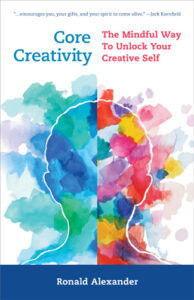 In my book Core Creativity: The Mindful Way to Unlock Your Creative Self I guide readers utilizing powerful guided visualizations, insights and interviews with highly creative artists, and stories of ordinary people to help them access what I call their “Core Creativity.” This is the creativity that comes from the very center of your being: your unconscious mind. The process of achieving core creativity involves three mind states: absorbing mind, open mind, and generating mind.
Absorbing Mind
The activity zone of absorbing mind is when we draw in information and stimulation, without analyzing it, free of filters and judgments. In absorbing mind, we can move from that activity to an intuitive understanding that we are taking in information that was hidden from us when we were in an ordinary “I have to find some answers and ideas” state.
In absorbing mind your intuition is at full power so you remain open to stimulation and ideas rather than rejecting them out of hand. Too often, people try to “brainstorm” and their instant reaction to an idea is to say, “No, that’s not it” and reject it. In absorbing mind, you still might say, “No, I don’t think that’s it,” but you are willing to play with the concept some more, exploring what other ideas come from its essence or form. You recognize that wrong as the idea is, playing with it may suggest to you an even better one.
Open Mind
In open mind, you bypass the limited thinking and the biases of the rational mind, leading to breakthroughs and intuitive insights. You experience a sense of spaciousness as your anxieties about time and your perceptions of limited options fall away, and you feel yourself open up to receive knowledge and ideas that were previously hidden from your awareness.
The most efficient way to bring yourself into a state of open mind is through mindfulness practice. Research shows that mindfulness practice increases creativity, which is why it’s a vital part of the core creativity process. I tell my therapy and coaching clients that they can choose not to begin a mindfulness meditation practice, but it’s rocket fuel for transformation. You can also access open mind through the activity zones of absorbing mind and generating mind, as many creative artists know very well.
Generating Mind
In generating mind, you play with ideas that have come to you, and go over into the absorbing zone again and again as if drawing water from a well or pulling photos from a backup drive. Generating mind is the activity zone that people typically associate with creativity and in fact, creative activities—playing a musical instrument, free writing, doodling—can all result in new insights and ideas arriving in your consciousness.
Through play, you can open the portal to generating mind and then walk down the corridor to the room of open mind. Creativity as most people think of it can simply be defined as play, and engaging in it preps your mind to experience open mind awareness and the big idea you seek.
Absorbing mind, open mind, generating mind: Each are ones for accessing core creativity, and moving among them naturally will happen with practice. You will know when to meditate, when to dabble, when to sit in a state of quiet receptivity, when to listen to your instincts, and when to play.
Excerpt from Dr. Ronald Alexander’s book Core Creativity: The Mindful Way to Unlock Your Creative Self
The post Unlock Your Creative Self & Transform Your Life appeared first on Ronald Alexander, Ph.D..
January 27, 2022
How to Access Your Next Big Idea through Core Creativity
Whenever we’re challenged to jumpstart our creative process the old technique of brainstorming or collaborating with others who are also struggling to be creative on demand, isn’t going to cut it.
The world is changing rapidly and people and workplaces need true innovation ideas. Trying to “figure out” what to do can waste valuable time because in an ordinary state of consciousness, you end up relying on outdated formulas and patterns. When we’re in this state, it’s as if our mind’s Wi-Fi signal is too weak for the really big ideas to load. That’s when we need the strongest creative force there is, which is what I call core creativity.
Core creativity is the creativity that comes from the very center of your being – the unconscious mind. You are accessing this deep, core creativity when the ideas are flowing and you feel as if they aren’t even coming from you but from a source that is infinitely abundant. When your mind opens the portal, core creativity can download like the ultimate software program for achieving ground-breaking creative ideas.
I’ve been coaching clients and executives, treating individual patients in my Los Angeles institute, and doing workshops and presentations to the public and organizations for decades. Recently, I was speaking about mindfulness and creativity to a hundred staffers at a tech company, and I asked, “How many of you are here because you want to become more creative?” Almost everyone raised his or her hand. Then I asked, “How many of you are here so you can learn to concentrate and focus your mind?” About half raised their hand. What good is focus and concentration if you don’t know where to aim it—if you have no creative vision?
We were been taught to think that creativity is only for the chosen few—“creative types” with “an artistic temperament.” Well-meaning adults in our lives taught us to shut down our imagination and get serious about our futures very early on so we could conform to systems that were created long ago. Now those systems are changing dramatically. We’ve got people microdosing, taking very small doses of hallucinogenics to jumpstart their creativity at work.
The Beatles and Steve Jobs both took LSD, but they stopped after recognizing there were safer, more accessible pathways to the deepest creativity and this portal is within. One of those pathways is core creativity, which reconnects you with your creative self and can lead to profound, radical transformation.
The three-part core-creativity process is like an Internet connection far superior to any that has yet been experienced. Core creativity allows you to progress far beyond surface-level tinkering that comes from the limited resources of the everyday mind. The three states of this process are Open Mind, Absorbing Mind, and Generating Mind, and to access core creativity, you progress from one zone to the next.
We first access core creativity through Open Mind. This is a state of consciousness that can be thought of as the room where core creativity appears, and ideas and insights are downloaded into your consciousness. However, the big, breakthrough “aha!” doesn’t necessarily come to you the first few times you go into open mind consciousness and download core creativity. It takes a little practice and patience, but then a sense of expansiveness and vitality arises.
After entering the state of Open Mind consciousness you then transition into Absorbing Mind – a mind state of receptivity in which images, words, and ideas come to you. To be in a state of absorbing mind the self needs to be receptive to all the phenomena they are aware of during the day as well as to look, study, and analyze their dreams. For example Paul McCartney was asleep when his unconscious mind received the melody for the hit song “Yesterday” from his Absorbing Mind. To understand the creative messages from the dream state write down the dream and then free associate by journaling the feeling, texture, and/or color of it that immediately comes to your mind.
Once you have absorbed the ideas you then transition into Generating Mind. Here you’re not just “playing around with ideas” but instead enter a flow state of generating ideas and insights that seem to be channeled directly from a consciousness much wiser and a source more creative than your own. When we enter into Generating Mind we can access states of core creativity and bring forth new and original concepts or ideas.
All three of these states can be accessed through a mindfulness practice—sitting meditation and other forms of meditation such as walking meditation in nature, mantra meditation, chanting, and tai chi. They can all lead to a download, and in pouring of core creativity. For more strategies read my article 6 Steps to Ignite Your Core Creativity.
This formula for creative innovation can be adapted by anyone—whether or not they consider themselves “the creative type.” I have seen single mothers of limited means use the core creativity process to reinvent their lives. As well I’ve seen my clients through the core creativity process breathe new life into old ideas, renew success, and even go far beyond the original benchmarks that they figured could never be recreated much less surpassed.
Excerpt from the forthcoming book “Core Creativity: The Mindful Path to Unlock Your Creative Self” by Ronald A Alexander, PhD (copyright 2022)
The post How to Access Your Next Big Idea through Core Creativity appeared first on Ronald Alexander, Ph.D..
December 10, 2021
6 Steps to Ignite Your Core Creativity
Most of us were taught that creativity comes from the thoughts and emotions of the mind. The greatest singers, dancers, painters, writers, and filmmakers recognize that the most original, and even transformative, ideas actually come from the core of our being, which is accessed through an “open-mind consciousness.”
In ancient traditions, open-mind consciousness was considered to be a spiritual awakening, the great enlightenment that dissolves the darkness of confusion and fear, and ushers in peace, happiness, clarity, and contentment. Today the notion that there’s one formulaic way to achieve this spiritual awakening and creative vibrancy has been blown apart. You don’t have to run off to a monastery or practice meditation for thirty years before attaining a breakthrough. A few years ago, I had a client, named Sarah who’d completely given up on psychotherapy until a failed suicide attempt convinced her to try it one more time. I urged her to begin a mindfulness practice, and she agreed. After several months—not years, but months—she had an extremely powerful experience while meditating. As she described it, she felt a rush of light and energy infuse her body, and experienced an ineffable sense of the presence of the divine, the cosmos, and a collective consciousness. After this transcendent experience, Sarah who’d been overweight to an unhealthy degree, lost several pounds, became more engaged by her work and closer to her friends, and was no longer suicidal. It was a major turning point for her.
What Sarah described has been called not only “open-mind awareness” but also, in the West, a “peak experience,” “being in the flow,” or “being in the zone.” I call it accessing your “core creativity,” because I believe that deep inside every person lies this potential for connecting to a universal flow of knowledge and creativity that’s boundless and expansive. Our individual thoughts and memories are a part of this greater, larger resource.
Just as an athlete who’s in condition has the muscle tone to be able to spring into action instantly, someone who regularly accesses their core creativity becomes creatively toned. For this person, the faucet to this remarkable flow of inspiration opens up easily, naturally, and often, allowing spontaneous and dramatic breakthroughs. When you’re creatively toned, instead of merely dipping your toe in the water and playing it safe, you’re willing to be utterly daring. Knowing this, you can navigate through a sea of self-limiting thoughts and transform such unwholesome beliefs as “I had my chance and blew it,” “It’s too late; my time is over,” “I’ll never be happy again,” and “I can’t.”
Here are 6 ways you can stimulate and tone your creativity from my book, Wise Mind, Open Mind.
Mindfulness Meditation Practice
One of the most effective ways to become creatively toned and start accessing core creativity is through a mindfulness meditation practice. Mindfulness allows us to listen and pay attention to what we might otherwise overlook—whether it’s a fresh idea or a new way of perceiving a situation—enhancing our creativity and letting go of our obstacles to innovation. Many people are intimidated with the idea of meditating with excuses of not having the time or ability to quiet the mind. Really all you need is 5 to 20 minutes a day and there are many mediation CDs that can help guide you through the process. In fact my CD Mindful Meditations for Creative Transformation was created to specifically help one access their inner resources.
Dabbling in the Arts
Our culture’s overemphasis on fame and great success often turns people away from their creative inclinations, because they feel that if they can’t reach a professional goal with their writing, singing, or painting endeavors, they shouldn’t bother. What they don’t realize is that simply dabbling in the fine arts, with no specific goals or intentions, awakens our ability to approach life with greater openness and curiosity. In the same way that mindfulness practice jogs the areas of the brain associated with well-being, optimism, and compassion for yourself and others, so too does immersing yourself in any artistic exploration or enjoyment jog your creativity.
Immersing Yourself in Nature
Experiencing nature can awaken in you a sense of vitality and infinity, which becomes a path to your core creativity. Without conscious thought, you can look up at the astonishing number of stars in the sky or leaves on a single tree in a forest, and feel a sense of vastness and spaciousness. As you gaze at the heavens the ancients observed, knowing that humanity throughout history and across continents has pondered these very stars, you experience being a part of something larger than yourself that feels as if it has always existed and always will.
Entering Sacred Space
In ancient times, sacred spaces, such as churches, temples, and sites for group rituals, were built on land whose features evoked a sense of spirituality. Treks to places like Machu Picchu, the temples of India, and Stonehenge have become more popular for Westerners who yearn for a sense of connection to their divine nature. Yet sacred spaces can exist wherever you feel a sense of spaciousness and connection to the creative, life-supporting forces of the universe. Arranging the space in your home or office to bring in light and nature will help you feel expansive and access your core creativity as you open up to your important role in all of creation.
Seeking Out Creative Stimulation
When the Irish band U2 wanted to reinvent their music, they traveled to Berlin, a bustling, gritty city unfamiliar to them, and soaked in the atmosphere, allowing its energy to infuse their songwriting and sound. Similarly, a famous actor I once spotted in an art museum stood before a painting for a good ten minutes before throwing his arms out and his head back, and standing for many more minutes, as if opening his heart to a beam of creative energy emanating from that painting. We all have this capacity to open to the vital forces around us and allow ourselves to take them in, mingling them with our own passions.
Mindful Movement
Many forms of physical movement can be an entrée into open-mind consciousness. Somatic therapy or somatic disciplines such as martial arts, tai chi, and yoga are the most well-known ways of quieting the rational mind and opening up to the intuitive mind and its connection to the numinous creative force. Any physical activity that involves discipline and a slowing down of thoughts, from skiing to dance, actually creates new neural pathways in your brain that become roads to innovation.
Becoming creatively toned can lead to a breakthrough in parenting or relating to others, or it can make you feel vitalized and fully engaged in the mundane chores of the day. The Buddha said that to find enlightenment, one must chop wood and carry water, meaning that the deepest, more purposeful life may not be one dedicated to an extraordinary cause or endeavor, but one that’s simply lived with a deep sense of awareness and openness to both the known and the unknown. A passion for discovery, for embracing the new and the unfamiliar can help you transform your life in ways you never dreamed possible, as you find the strength to move out of fear and resistance and into something new.
The post 6 Steps to Ignite Your Core Creativity appeared first on Ronald Alexander, Ph.D..