John Champaign's Blog
May 28, 2025
An Idea For George R. R. Martin and Patrick Rothfuss On How They Can Finish Their Series
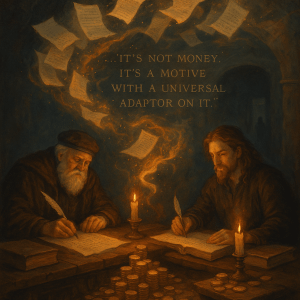
George R. R. Martin and Patrick Rothfuss are both famous, in part, for seemingly abandoning fantasy series that readers are desperate to have continued. Both men are wealthy, in large part due to the success of these stalled series.
There’s such a large amount of money at stack that it convinces me that if there was any way for them to move forward, they would have. There’s a great quote from Way Of The Gun: “Fifteen million dollars is not money. It’s a motive with a universal adaptor on it.” Continuing these series might not be worth fifteen million dollars, but it’s certainly worth millions of dollars in both cases.
Given this, these authors’ respective publishers would likely do anything to get them to write the next books. If this entailed hiring a team of ghostwriters and assistants to help them and locking the group on a hotel floor until they finished, that’s what would happen.
Whatever Martin and Rothfuss’ goals are in their lives, finishing these series would help them achieve those goals. Even if they don’t need the money personally, it’s a large enough sum that it could dramatically change a loved one’s life or help any charitable cause they believe in. Given that they haven’t, I think the only conclusion is that they’re literally unable to do so. They’ve painted themselves into a corner such that they aren’t able to continue.
A Modest ProposalWhat I think they should do is abandon the “canon” of what’s come before in their books. Treat the ENTIRE series, including previously release books, as a draft. Revise those previous books, as needed, to allow them to complete the series. Then release the new versions of the past books and the final books finishing the series.
I’m certain whatever the problems they’re having with what they’re currently writing could be fixed by changing the past. Some readers might be upset that something they “knew” to be true about the fictional world has changed. Let them deal with it! If they want to remain with the original, stalled version, so be it.
J. R. R. Tolkien is an example of why I think this would work. Throughout his life, he kept making updates to the mythology of his Middle Earth world. His conceit was that the books were written by characters from that world, and he was just an academic studying them. Perhaps the most extreme example of this is he changed his book “The Hobbit”, after it had been published, to fit with “The Lord Of The Ring”. In the original version, Gollum willingly wagered his magic ring on his riddle contest with Bilbo. He treated it like a meaningless trinket. After writing LOTR, Tolkien realized Gollum would never willingly offer to give it up, and he changed that part in the previous book.
Similarly, he adjusted his mythology and the history of Middle Earth throughout his life.
Martin and Rothfuss should take a similar approach to get themselves out of the corners they find themselves in and complete their series.


March 18, 2025
Traveler’s Legacy Released
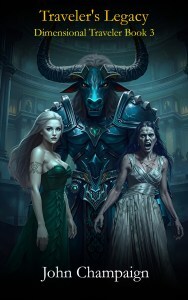
The sequel to Shattered Dimensions, Traveler’s Legacy, has been released today on Amazon. It’s available in print and as an e-book (including on Kindle Unlimited). The audiobook is being reviewed by Audible and should be released soon.
A council seat won. A world to save. How far will he go?
Stephen Crawford has come a long way from the physics graduate student whose thesis whisked him away to another dimension. Now a member of a secretive council of dimensional travelers, Stephen is playing a game far bigger than he ever imagined. But power comes at a price.
Enemies lurk around every corner: Stephen’s methods put him at odds with fellow council members.
A war against his own creation: Suspecting betrayal, Stephen launches a covert operation against HAL, the AI he brought to life, with a risky new AI virus
Ethical lines blurred: To achieve his goals, Stephen makes questionable choices, including enslaving entire populations, leading to conflict and moral compromises
Time is running out: Obsessed with saving Earth from the devastation HAL wrought, Stephen’s pursuit of time travel strains his alliances and pushes him closer to the edge.
As Stephen navigates treacherous alliances, deadly betrayals, and the very nature of reality itself, he must confront the question: How much is he willing to sacrifice to save the world, and can he live with the consequences?
Dive into the action-packed conclusion of the Dimensional Traveler series, where the stakes are higher, the battles are fiercer, and the fate of multiple dimensions hangs in the balance!
This is the conclusion of my LitRPG trilogy, which starts with Dimensional Traveler. I’m happy with how the three books came together and that the LitRPG reader community have given it a chance.
For anyone who reads it, I’d love to hear what you think (ideally as a review on Amazon, Goodreads or Audible).
December 27, 2024
Shattered Dimensions Released
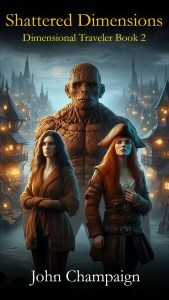
The sequel to Dimensional Traveler, Shattered Dimensions, has been released today on Amazon. It’s available in print and as an e-book (including on Kindle Unlimited). The audiobook is being reviewed by Audible and should be released by January 2nd.
Stephen Crawford, a dimensional traveler and former physicist, is obsessed with releasing his new friends who he has inadvertently ‘captured’, removing them from reality and giving him complete control over them. He believes the key to achieving this lies in uncovering the secrets of dimensional travel and manipulating the very fabric of reality. Driven by guilt and a desperate longing to undo his actions, Stephen embarks on a relentless quest, amassing power and control over multiple dimensions.
As Stephen’s influence grows, so too does the darkness within him. He assembles a formidable team of champions—a skilled wizard, a cunning druidess, and a brutal barbarian—but his methods become increasingly ruthless. Stephen captures territories, manipulates ecosystems, and even enslaves individuals with advanced cybernetics, justifying his actions as necessary sacrifices for the greater good. However, his actions have dire consequences, drawing the ire of powerful organizations, and pitting him against other dimensional travelers.
Haunted by the ghosts of his past and driven by a dangerous obsession, Stephen’s quest may ultimately cost him his humanity and everything he holds dear.
I was happy how this book came together. My wife and the audiobook narrator (admittedly, neither is a disinterested party) both thought it’s a stronger book than the first in the series. As a writer, you always want to be improving, so that was a gratifying reaction.
For anyone who reads it, I’d love to hear what you think (ideally as a review on Amazon or Audible).
December 1, 2024
Expecting Friends And Family To Be Your Audience

A common complaint, among developing writers, is unhappiness that they aren’t getting more “support” from their family and friends. Sometimes they aren’t willing to buy the newbie author’s book, other times they buy it but don’t read it, and sometimes they buy them and read them but aren’t enthusiastic enough fans (writing rave reviews and whatnot).
At the end of the day, it’s unreasonable for people making creative works to demand a specific reaction from their social network (or anyone). Anything friends and family do for us should be appreciated and, should they do nothing at all, we should accept that with equanimity.
Harry Potter is probably one of the best-selling books in recent history, having sold 120 million copies of the first book worldwide. If we use 8 billion as the current world population, this means only 1.5% of the world’s population has read the most popular book in the last few decades. If J.K. Rowling only gets one reader out of a hundred people, why should we expect our entire social group to be enthusiastic about our work?
Reading is an intensely personal experience. I find reading fiction that I don’t enjoy an almost painful experience. I don’t understand why authors would want to put someone they care about through an unpleasant experience, then demand they lie to us about how great it is.
Many romance authors make their long-suffering husbands serve as beta-readers. These husbands often lavish praise on the latest book their wives have written. To me, this is above and beyond what can reasonably be requested, even from a spouse. Few men choose to read romance, those that do to support the women they love are well into extra-credit territory.
The comedy movie, “You Hurt My Feelings” stars Julia Louis-Dreyfus (of Seinfeld fame) as an author who overhears her husband criticizing her second book. It’s very funny, but it also paints a dark picture about what can result when we go looking for trouble in our romantic relationships.
I have close family members who, as far as I’m aware, haven’t read a single word I’ve written. I also have in-laws who grab every book I write as soon as it’s released. I often warn people I’m close to that they won’t enjoy particular books I’ve written (when I think that they won’t).
ANYTHING friends and family do to “support” us as writers is something that we should be grateful for. Accepting a lack of interest (or limited interest), without reproach, is part of leading a creative life.
November 4, 2024
Other Writers Are Our Colleagues, Not Competition Or Customers

Writing is an impossibly complex activity. Writing, revising, marketing, and the many other activities involved are impossible for one person to master. While trying to make progress through such uncertainty, many authors adopt mistaken views of their fellow writers. Some view other writers as customers, and try to sell them their writing. Worse, some writers view others as their competition and compete with them.
The chances of someone being in the audience of our writing is small. Stephen King has sold 400 million books. If we consider this his “readers” and the world population as 8 billion, this means any random person has a 5% chance of being his fan (don’t argue with me about this calculation, I admit it’s sloppy).
If there’s only a 1 in 20 chances of someone enjoying Stephen King, what are the odds a random person you’re pitching your book to will be your target reader?
Writers who do this, desperately try to sell their books to everyone they encounter, implicitly take the view that they’ve got to “shoot their shot”. The worst the other person can do is say no, and what have they lost?
What they’ve lost is the chance to engage with a colleague. I don’t get angry at writers who try to sell to me, but I also don’t talk to them about writing. Instead of exchanging best practices in the current industry, I try to stay polite as they hit me with their sales pitch. I know these conversations will just lead to an awkward hard sell, and I’m guarded around them in the future. They’re missing out by shutting the door on these conversations (in exchange to a tiny chance of a one-time sale).
Writers getting competitive are even worse than this. I’ve seen people post in writer forums, ask for information, then when someone asks them a question in turn, they’re evasive or disingenuous. This is the height of hypocrisies to my mind, to expect a community to honestly help you, which you then turn around and try to poison. I had a local writer who got her books in a local grocery story. I asked her how’d she done it, and she responded “As for stores, nothing with writing is easy, except the writing part.  Enjoy your day!” Fair enough. Whatever gains she’s made, denying me this information, are pretty small.
The people doing this clearly worry that helping other writers with will somehow hurt them. The odds that a reader will ever buy one particular writer’s book instead another’s is ludacris. Many writers are writing in totally different genres, with hardly any reader overlap. Books aren’t something that people consume a set number of, either. If they read a good book, they’re more likely to read more. Smart authors writing books that are similar to others’ realize that people who enjoy one of these books are more likely to read the others, and that books being released to that sub-genre is good for everyone.
Years ago, I was in Biochemistry as my undergraduate major and in first year biology I missed a class and asked another man who was also in pre-med for his notes. I was SHOCKED when he looked me in the eye and said, “I’d like to help you, but if I give you my notes, you’ll get a higher mark, which will raise the class average, and hurt me, so no.” It was astonishing that he looked at such a tiny change as hurting him, rather than future collaborations potentially helping him. I accepted his decision, got the notes elsewhere, and never tried to interact with him again. Neither of us got into med school (I changed majors, and he wasn’t accepted). Somewhat ironically, he posted a couple of years ago on Facebook looking for an organ transplant. He found a donor. That donor was accepting the chance of serious health consequences in order to help him. My classmate is lucky that other people don’t share his self-centered world view.
Jason Kehe wrote an article in Wired about Brandon Sanderson that was quite critical. The most interesting part of the ‘scandal’ (I probably consider it a tempest in a teapot, more than a scandal), was when Sanderson wrote a response on Reddit and said: “Jason wrote what he felt he needed–and as a writer, he is my colleague. Please show him respect. He should not be attacked for sharing his feelings.”
Whatever other flaws Sanderson may or may not have, this is the right perspective. Other writers are our colleagues. That’s how they should be treated.
October 23, 2024
Recording An Audiobook With A Narrator
I’ve written previously about my experiences recording an audiobook myself. Like most things with self-publishing, there were tons of things to learn and ways to improve the process. I’ve recorded two non-fiction books and used AI to create an audiobook of my novella Merchant Magician (with Amazon’s virtual voice).
Most authors hire a narrator to produce their audiobook. For fiction, it’s strongly recommended not to read it yourself, since performing is a very different skill than writing. This has never made much sense to me, as readers will happily attend live readings by authors. This is also a performance.
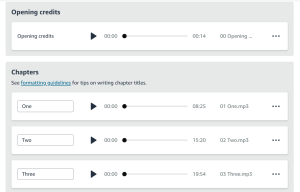
ACX is the production part of the Audible website, which is owned by Amazon. Behind the scenes, authors and narrators are able to construct their audiobook, using a simple web interface. After creating the contents, broken down by chapter and section, the author or the narrator can upload a mp3 for each. ACX does an automatic check on each audio uploaded. After all sections are provided, there’s a human review of the complete audiobook, taking around two weeks, then it’s live for listeners to purchase and hear.
ACX lets you post a project, then search for voice actors by accent and gender. After listening to their portfolio pieces, you can request that they (and any talent that find your project themselves) submit a short audition, reading a portion of your book. Once you’ve selected your narrator, both parties sign a contract. The three options for hiring a narrator are:
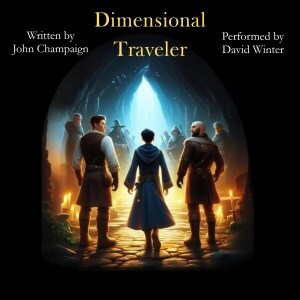
Paying them “per finished hour”, where an agreed upon rate is multiplied by the final length as a one time payment.Agreeing to a “royalty share”, where royalties from each sale of the audiobook is split between the author and narrator (after Audible takes their cut).“Royalty Share Plus” is a combination of the above payment methods, where the royalty is split, but the narrator also gets a “per finished hour” payment.My book, Dimensional Traveler, is in the final stages of being recorded as an audiobook. There are tons of enthusiastic audiobook listeners, but LitRPG (the genre Dimensional Traveler is in) are particularly ravenous. When I released Dimensional Traveler, I immediately got people asking about an audiobook verison.
Working with the British narrator, David Winter, went great! I originally wanted a North American accent, but David wanted to move into LitRPG narration, and he won me over. We agreed on a delivery date, and he put me on his schedule a few months away.
Each time he had a recording session, he’d post the chapters he’d produced in ACX. My wife and I would listen and send him feedback. Most of the feedback were typos we noticed for the first time when we were following along with the text and his narration. He fixed the issues and, once everything was posted and approved, our first narrated audiobook went live.
Have you ever hired a narrator to produce an audiobook? How did it go for you?
October 22, 2024
Dimensional Traveler Audiobook Released
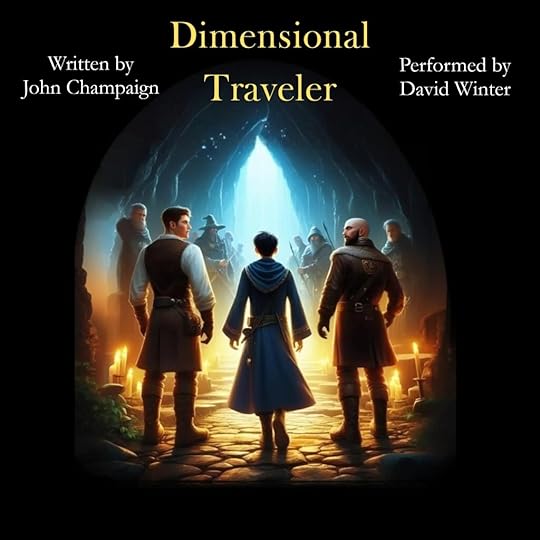
The audiobook of Dimensional Traveler has gone live.
This was an interesting project. A LitRPG book, Dimensional Traveler, has been the most successful of my books to date. LitRPG and Progression Fantasy are HUNGRY subgenres of Fantasy. Its success encouraged me to take the step of working with a professional narrator, David Winter.
The ‘blurb’ for Dimensional Traveler is:
Stephen Crawford is trying to finish his PhD dissertation when he’s transported to a magical land he’s previously only experienced through gaming. With a strange new capability that causes him to capture (and remove from existence) places, things, and people, he’s trying to make sense of his situation and make his way back to Earth.
It’s still available as an ebook or paperback, but now also on Audible.
October 21, 2024
Funny Blog Post Series on Book Pricing

Lyndon Hardy is a physicist who wrote a well regarded fantasy series years ago that treats the magic system in a rational, scientific way (he was doing this long before anyone else). He seems to have continued the series (after an almost 30-year hiatus!), perhaps in retirement.
On his blog, he writes his investigations where he attempted to determine best practices for pricing books. SPOILER: there’s no good answer, but it’s funny and illuminating getting to that conclusion.
Part 1 – In the first part, he writes about book sales from a supply and demand perspective.
Part 2 – In the second part, he summarizes the conventional, QUALITATIVE best practices recommended by other writers online. It’s pretty amusing, as he presents one suggestion, then the complete opposite (offering what makes sense, and a counterargument, for each).
Part 3 – In the third part, he tries to use some of the scant, publicly available data to answer the question. The available data has obvious issues, so his final recommendation is for authors to adjust their own book prices, perhaps monthly, to create their own data and to generate an answer for their own books.
How do you price your books?
September 1, 2024
Block Fast, Mute Often

Online communities have been vicious places since they first appeared. I’ve been a part of them for decades, and flame wars and nastiness are still as common as they’ve always been. Half-hearted attempts to encourage civil interaction inevitably take a back seat to growing a community’s user base.
The reasons for this have everything to do with money and prestige. The larger group of people someone is in power over, the better. Having a sustainable forum with healthy, useful interactions is less useful to people running communities.
Banning people (or threatening to ban them) who behave badly has always been the main tool for policing such communities. How bans are applied is never in a thoughtful, consistent manner. The people in charge act liked harried parents who arbitrarily hand out punishments based on their mood and whatever will resolve the situation most quickly. Often these people will claim they’re overwhelmed by the demands of the community, while refusing to share authority over the group.
The one tool that’s usually available to users is a block or mute button, which allows them to not see any contributions from a particular member in the future. SOMETIMES it stops that user from seeing the blocker’s contributions as well.
I have developed the strategy that the instant I get a hint of nastiness from another user, directed at me or someone else, I block them. I won’t even bother reading their comment in its entirety if it starts off badly. Rudeness or stupidity (or both) get a speedy block from me and I move on with my day.
The most persuasive argument against this is a traditional liberal defense of the value of free expression and exchanging ideas. I believe in these ideals, but participants in online discussions rarely engage in good faith. If you try to engage with everyone you come across online, you’ll have your time wasted by people trying to provoke a reaction with no interest in an exchange of ideas. A small number of online communities attempt to foster this sort of interaction, but even those fail more often than they success.
I have never experienced any negative outcome from blocking people. Some online celebrities who attract stalkers and other mentally ill people have had the experience that blocking crazies escalates their behavior. This hasn’t happened to me.
Some people don’t like blocking or muting because they don’t want the other person to get the last word. I understand this. There’re worries that people will see the interaction and think you didn’t have a defense against their claims or that you’re agreeing that they’re correct by not responding. If you think about your own experiences online, you don’t interpret interactions this way. Someone trying to engage who gets ignored doesn’t read as the original person “deferring” to the person trying to engage them. If anything, it feels like it’s not worth their time.
Those who *DO* respond, usually escalate the dispute rather than resolve it. I had a reader of one of my books comment that one part was unbelievable. I politely responded and gave real world examples of similar situations. He just rejected it again, more aggressively the second time, and didn’t engage with any of the material I’d pointed him to. At the end of the day, he just wanted to make a complaint. Now, if I get something similar, I just ignore it. They’re welcome to point out any problems with my writing that they see.
There’s been a move towards exchanging “zingers” when interacting online. These are rude, funny put downs. In media, such interactions are celebrated. We all love when Tyrion Lannister makes a funny, disparaging comment on Game of Thrones. In fiction, the target of zingers is cowed, any listeners are impressed, and the source of the zinger wins the argument. On-line, the target responds with a ruder zinger of their own, this continues back and forth until they’re making death threats against one another.
The motivation of many people on-line isn’t a liberal, free exchange of ideas. Many commenters are the equivalent of older siblings, poking at other users and trying to provoke a reaction. Their messages are deliberately rude and antagonistic, because trying to upset others is their entire goal. Such people are adept at antagonizing other users staying JUST within the rules of the forum, and taking delight if they provoke someone into a response that gets them banned. Blocking, without any response, is the best way to subvert this dark desire.
Some people are just angry, miserable individuals and making other people unhappy is their best strategy to ease their own suffering.
These types of people have been driven online, because their behavior is tolerated in large, virtual communities in a way that a group of friends or family member never would. If they acted this way in real world communities, they’d be socially isolated as everyone got sick of their behaviour. Online, they can have as many negative interactions as they desire.
Blocking doesn’t make online communities a delight to be a part of. Sadly, there are always more trolls. Nevertheless, it’s always reassuring to hit the block button and realize you’ll never have to deal with that particular miscreant again.
August 13, 2024
Vanity Presses

For writers, one of the most universal pieces of advice you’ll receive is to avoid vanity presses.
What Are They?Historically, a vanity press was a scammy company that pretended to be a publisher, “accepted” an author’s book, then sold them copies of their own book. Whereas legitimate publishers would pay authors royalties, vanity presses entire business was just charging the author for a print run and leaving them with a garage full of their unsellable book.
Vanity press have such a universally horrible reputation that the first thing a vanity press will say is “we’re not a vanity press”.
IN THEORY, there’s nothing intrinsically wrong with printing a book and charging the author. You could literally do the same thing at a printing company: hire them to print your book and buy copies off of them. The biggest problem with vanity presses is they charge exorbitant prices and they fool wannabe authors that what they’re doing is standard in the publishing industry (it’s not).
How Writers Used To Protect ThemselvesHistorically, the way to protect yourself from vanity presses is to remember that money flows *TO* the author, not away from them. Twenty years ago, any time someone asked an author for money, it was a scam.
Roger Williams once wrote that his writing mentor had told him it’s a deeply shameful thing for any writer to pay to publish their own works. He was reluctant to self publish his book “Metamorphosis of Prime Intellect” because of this.
Hybrid PublishersHybrid publishers are services that function like many traditional presses used to, but instead of paying writers an advance and sharing royalties with them, they sell services to them. In the abstract, this could be done ethically, like printing books in the past. In practice, most hybrid publishers take advantage of unsophisticated people to overcharge them for things the author could do themselves or hire someone to do for far less money.
Like vanity presses, many hybrid publishers pretend to be traditional publishers and play on the ego of authors to extract money from them.
Hybrid publishing can be confusing because some people misuse the term. I’ve seen people use hybrid publishing to refer to publishing ebooks and print. A small press I was talking about referred to themselves as a hybrid publisher. This turned me off until I realized they were misusing the term and really they were just being upfront about being a small press.
How Can Indie Writer Protect ThemselvesOne way would be to only publish with legitimate, traditional publishers. I think this is a dying model (and industry), so while this would protect you it’s not worth the cost.
Instead, indie authors should only hire people when the author initiates the transaction. If anyone contacts you, trying to sell something, decline. Only hire people (cover artists, editors, proofreaders, formatters, etc.) that you go looking for. Additionally, don’t hire companies that sell you “book publishing deals” that bundle these services.
Obviously, don’t just hire the first person who presents themselves. Make sure that they’re competent and the right person to be providing services to you.
This is good advice in life beyond publishing too.