Rob McInroy's Blog
December 9, 2024
Medicine, Money and Murder by Anne Pettigrew
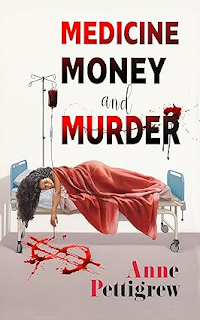
In Medicine, Money and Murder,Anne Pettigrew continues to examine the murkier side of medical ethics shefirst explored in her debut novels, Not the Life Imagined and Not theDeaths Imagined. Her background as a GP gives her access to a deeperunderstanding of the nexus between care and self-interest and she uses it to vivideffect in her work. Previously she has given us a Harold Shipman-like characterto examine the ease with which a serial killer can slip into the depths ofevil. In Medicine, Money and Murder, she serves up another deliciouslywicked villain but she also turns her attention to the baleful effects of bigpharma, to equally chilling effect.
It is 1971, and Mhairi MacLean, anaïve young woman from Scotland is working as an extern in the Ellis MemorialHospital in New Jersey as part of a three month summer programme. Away fromhome for the first time, Mhairi is struck by the differences between Scotlandand America, the sleek new multi-storey hospitals compared with the Victorianbuildings she was accustomed to back home, the more relaxed lifestyle, theconfidence of the people.
Gradually, though, she comes torealise the differences between American and British healthcare are moreprofound than she could have imagined. In particular, she is shocked by the wayin which the American healthcare system is driven by finance. She wrestles withher conscience as she realises the extent to which health insurance and moneyare primary considerations. “It’s funny how much clinical practice changes whenmoney comes into it,” she says at one point as it becomes clear that the leveland quality of care received by an individual is entirely dependent on theirability to pay, rather than their need.
Further, the culture oflitigation dictates medical practice to an unhealthy degree. The first thing tolearn in medicine, she is told, is that “diagnoses can be hummingbirds orsparrows.” And missing a hummingbird would mean getting “your ass sued off”. Asa result, patients were exposed to unnecessary scans and procedures, purely tohead off any possibility of a medical suit. What happens if the patient can’tafford it, Mhairi asks. “When the bills run up, you get into debt and have todeal with it,” she is told.
Medicine, Money and Murderis a crime novel, and the mystery begins when a patient being transferred fromone hospital to another seemingly disappears. The receiving hospital has norecord of her being admitted. Bureaucratic blunder? Or something else?
As Mhairi and her friends beginto investigate, one person comes to interest them, Dr van Lindholm, a seniorRenal specialist at Ellis Memorial, and someone who appears to wield anunhealthy amount of power. Even the hospital’s Medical Chief, Dr Harper, seemscowed by him. As Mhairi continues to observe Dr van Lindholm’s dealings shegrows more and more concerned.
Medicine, Money and Murder isan exciting and fast-paced novel. The crime element is well handled and themedical background Anne Pettigrew weaves in is never intrusive but rather addsa sense of verisimilitude. Mhairi, very much a fish out of water in big, brashAmerica, gradually matures and develops, and proves very much a match for thevested interests arrayed against her.


November 6, 2024
Thoughts on the American election and democracy
I gave up writing about politics a few years ago because I realised nothing I said or did would make any difference. Ironically, the fact that this stance has been vindicated is the reason I’ve decided to write something political again. I always was a contrarian.
Donald Trump has been re-elected President of the United States of America. A convicted criminal, sexual predator, sociopath, a man who encouraged a riotous assault on the American seat of government after losing a democratic election. A man who has already vowed revenge on his enemies. It’s extraordinary.
But utterly predictable.
And the people who will be blamed for it – the American voters who fell, again, for Trump’s MAGA rhetoric, the poor and the disconnected of America – are not the ones who are responsible. The people responsible are the ones who are now sitting round their coffee tables weeping and sighing and crying “how could this have happened? What have these people done to us?”
The truth is – and I say this as a liberal – they have done the only thing they could do to be heard by people like us: they’ve thrown our arrogance and our certitude back in our faces, they have told us that they want to be listened to, they want their views reflected in national politics.
Way back in 1992, Benjamin Barber identified two axial principles of our age – globalism and tribalism – which, he said, may be threatening our democracy. ‘The planet is falling precipitantly apart AND coming reluctantly together at the very same moment,’ he said. This was prescient at the time, an analysis of the contrasting neoconservative view on one side and cosmopolitan idealism on the other. Thirty-two years later, this conflict appears to be reaching some kind of climax.
Samuel P Huntington’s Clash of Civilizations theory, first posited in 1993, suggested that the post-Cold war world order would be characterised by clashes where ‘the fault lines between civilizations will be the battle lines of the future.’ The fundamental source of conflict, he suggested, would no longer be ‘primarily ideological or primarily economic’, but cultural. It could be argued that future events – 9/11, the Iraq War, Afghanistan – bore out his view, with deadly clashes between Western liberalism and Islamic fundamentalism dominating global politics in the decades that followed, but his central thesis was weak. He paid lip service to civilisations other than Western, Islamic and Sinic (to the extent he couldn’t even decide how many civilisations there were in total, the number depending on whether African civilisation could be considered more than a ‘possibility’, an assertion which is, frankly, racist). For that reason, liberals disregarded Huntington’s views as reactionary and ignored him.
Ignoring people who don’t agree with them is a liberal characteristic that has now reached its baleful yet inevitable conclusion.
A further work by Huntington in 2004, Who Are We?, further reinforced Liberal opposition, with its view that Latino immigration in America could ‘divide the United States into two peoples, two cultures, and two languages.’ His solution was to return to America’s Anglo-Protestant beginnings, forcing immigrants to embrace the culture of the US that was established by its founding fathers. As a Scot, familiar with the schisms and schisms-within-schisms of Protestantism, its inability to ever agree on anything, its tendency to ever-increasing dogmatism, the idea that there is a single Protestant worldview that could drive a harmonious culture seems naïve in the extreme.
Huntington’s ideas, then, were wrong.
And yet.
And yet the issue of immigration has not gone away. Rather, it has worsened. And that bothers people. Millions of them. 71.5 million of them, in yesterday’s poll. But the Liberal elite are not listening. They never do. And in that vacuum something sinister is happening. In the end, the real clash of civilisations is not between the West and Islam, but between neighbours, families, communities. Between liberals and conservatives. Between us and them. And we saw the outcome last night.
Martha Nussbaum, that eminent proponent of cosmopolitanism, regularly quotes Diogenes the Cynic – ‘I am a citizen of the world’ – to promote her view that an ‘individual’s primary allegiance is to the community of human beings in the entire world.’ It’s a worthy view, one that you see promoted with varying degrees of saccharine sentimentality daily on Twitter. Cosmopolitanism is essentially a thesis based on idealism, whose totem is the Universal Declaration of Human Rights (UDHR), which sets out the rights and freedoms which should be expected by all citizens of the world. At its most idealistic, cosmopolitanism sees a shift away from the nation state as the predominant model. Anthony Giddens even suggested that an elected second chamber of the United Nations might one day be feasible. For Ralf Dahrendorf, such a concept of ‘global democracy’ was akin to ‘howling at the moon.’
Yet still we howl.
To return (reluctantly, I’m a liberal after all) to Huntington, he coined the term ‘Davos Man’, named after the World Economic Forum which meets annually in Davos, Switzerland, a self-selecting global economic elite who see ‘little need for national loyalty’ and who could be accused of trying to make decisions and change the world without any degree of accountability to ordinary citizens. It is fundamentally undemocratic, yet the WEF’s power is considerable. Alongside the WEF, Benjamin Barber identified non-elected, unanswerable trans-national organisations such as international banks, global news agencies and NGOs which wield disproportionate power. As long ago as 2004, Daniele Archibugi was warning that these could become a ‘trojan horse enabling technocrats to prevail over democratic control.’
Well, it wasn’t the technocrats who won the US election last night. Nor was it the fascists, as many claim. It was the oligarchs. The USA, like Russia, is now an oligarchy. Still one rooted in democracy for now, but an oligarchy all the same. Elon Musk now wields true political power. Power has been bought. It will be used. How was this allowed to happen?
Cosmopolitan utopias mean nothing in the Rust Belt. In Appalachia. In cities devastated by economic downturn. Time and again, voters asked for help. They didn’t get it. Then a corrupt, venal, orange, self-serving oligarch offered them what they wanted. Reduced immigration. Import tariffs to protect local producers. America great again. He won’t deliver on any of that – he doesn’t care – but it doesn’t matter because now he has claimed power. He has beaten the Liberal elite because the Liberal elite was too arrogant to listen, too sure that it had all the answers, too smug to concede that ordinary voters had legitimate concerns. I have no doubt a liberal approach would be best, Kamala Harris would have made a more effective President, America has made a dangerous date with fundamentalism, but that doesn’t matter. It’s happened. They (we) lost.
There is a direct lesson here for the UK. This is a warning we should not ignore. Earlier this year the British public voted overwhelmingly to reject the prevailing political approach. The Tories’ self-interest and greed and corruption was swept out of power and the Labour Party was entrusted with an enormous mandate. A mandate to change Britain.
Not a mandate to behave like the Tories, only a little bit more competent and a little less corrupt. Not a mandate to carry on ignoring the concerns of the majority because they don’t chime with the views of the minority elite.
And yet, here we are, with Starmer’s Conservative-lite government peddling the same rubbish because they cannot accept – simply find it impossible to conceive – that their shibboleths, their worldview, their certainty, might somehow not be the answer to the problem after all.
Meanwhile, political extremism is marshalling its resources. Political pygmies like Robert Jenrick give themselves a hard-on by talking of pulling Britain out of the European Convention on Human Rights – our means of enacting the cosmopolitan ideals of the UDHR – and we scoff because he’s not in power and we are. But the day will come, my friend. The day will come. In a year’s time, in two, in three, if the Labour government does not tackle the issues that the voting public consistently tell us concern them, these people will turn their backs on conventional politics. The fringe – Reform, or perhaps something even worse – will become their refuge. And, like the oligarch over the water, the undesirables will be voted into power. And then what?
It doesn’t matter that you may not agree with people’s views on immigration, on net zero, on culture wars, on policing and crime. You can lock them up for rioting but unless you address the root causes of that rioting – a deep and lingering sense of disenfranchisement – the rioting will return, redoubled. We can’t ignore this. Because if we democrats won’t deal with these people’s concerns, they will turn away from democracy, just as America has, just as states throughout Europe are doing.
The sadness is that all of this happened before, in the 1930s. We didn’t learn then, and we know what happened.
Will we learn now?
August 1, 2024
Salvage by Mark Baillie

When I was a bairn,back in the seventies, every year at tattie-howkin time the Meadows in Crieff, myhome town, used to be taken over by Scots Travellers in their vans andcaravans, dozens of them. They’d converge on Crieff for the howkin and thendisperse again a couple of weeks later. When I was very young, seven or eight,my mother used to warn me away, saying the “tinks” would carry me off and I’dnever be seen again. I’ve never understood why my mother chose to frighten melike that. She knew it wasn’t true, and indeed, when she was a girl she used toplay with Traveller children herself, among them the mother of Jess Smith, theeminent writer. She would get beaten by her faither for doing so.
I now understandthat, from the 1900s to the 1960s, the reality was that the only children indanger of being taken away were children of the Travellers, many of themsubjected to enforced removal by “the social” – social services backed up bypolice – and ripped from their families forever. The lucky ones – under fives –would be put up for adoption. Older children would be sent to work. The middleage group were the ones who suffered most, ending up in religious or localauthority-run children’s homes where they were routinely beaten and abused andleft with little hope of a good life.
I discovered thisthrough reading Mark Baillie’s brilliant new novel, Salvage, publishedby Tippermuir Books. Set in 1983, it takes as its focus the enforced removal ofa six-year-old girl, Jenny Lacklow from her family in a Traveller campsite inCarluke in 1929. Her brother, Nash, a few years older than Jenny, witnessed theremoval, and the ferocious fight put up by his mother to protect Jenny, theviolence, police using billy clubs to beat the Travellers back while the Socialpeople removed a child from its family and ripped it asunder.
In 1983, the nowelderly Nash is told he is dying. Thoughts of mortality lead him to revisit thepast and he decides he wants to find out about his little sister. Where did shego? What life did she have? Was she still alive? His nephew, Spence, thinksthis is a bad idea, but Nash enlists Spence’s daughter, Emma to help him. Emmais at university, the first in the family to do so, and she’s smart. She’ll beable to find Jenny, surely? And so begins an absolutely fascinating – and at timesheartbreaking, at other times uplifting – adventure.
There is a lot inthe novel about truth. Emma’s university professor says during one of herclasses: “When it came to the telling of history, truth was a complicatedbusiness.” Edna O’Brien, who died the day I wrote this review, once noted: “Historyis said to be written by the victors. Fiction, by contrast, is largely the workof injured bystanders.” This is a truth picked up on in his poetry by the greatGaelic poet Sorley MacLean, who talked of the difference between receivedhistory and lived experience – what’s in the history books and what people feltas they experienced life. MacLean was referring to the Highlanders andIslanders who were cleared in the eighteenth and nineteenth centuries or theIrish who fled the famine. Scots Travellers, too, have endured traumas over thegenerations and their voices have gone equally unheard. The official records,such as they were, would list that a child had been taken into care for thegood of its health, to protect it from illness and deprivation and abjectpoverty. That official record did not talk about a covert but concertedcampaign to obliterate the Traveller lifestyle, to ensure that Travellerencampments could be broken up and “trouble makers” (in the official argot)could be moved on. Truth? Truth is what people can be made to believe. AskDonald Trump.
Emma and Nash andSpence come up against the truth time and again. And, time and again, they areon the wrong side of the narrative, cast as the ones at fault, the modern daytrouble makers. It is an insidious thing, the way a society can see what itwants to see and ignore what is inconvenient. Privilege is at the heart of it.Protest is easy when you have a safe, warm bed to return to afterwards. Emma,Nash and Spence, Travellers by descent, now live in static homes but they arestill outsiders. The law, truth, is different for them.
The trouble is, thepowers that be always believe themselves to be right. They are the upholders offaith, decency, honesty, truth. They run the system, and the system controlseveryone.
Nash talks aboutand seems to see “the Social” as if it is a “mindless machine”, a“depersonalised system of the state” but Emma is more curious about thefaceless people behind the machine. Who were the men who would rip an infantfrom her family? What possessed them to do such a thing?
She tracks downevidence of Dr Banks, a 1920s public health official who talked about the needto take Traveller children into care. It was a matter of public health, he said:“tinker sites are unhygenic – and what does a tinker do but travel? … theyspread their muck and waste and … this is what creates disease.” Dr Banks hadweighed the matter up, he said, and removing Traveller children was “not onlythe right thing to do, it is the Christian thing to do.” The “Social”, then,was delivering a public good. And how do you fight that?
Salvage is a wonderfulbook, part mystery, part historical record, part social study, part politicalanalysis. It is immensely readable but genuinely thought-provoking. Thecharacters of Nash, Emma and Spence live and breathe on the page. This couldeasily have turned into an exercise in didacticism, the characters becomingweary saints battling an alien system, but Mark Baillie’s acutecharacterisation brings them to life, flaws and all. He doesn’t offer easyanswers for our injured bystanders, but he does offer hope. Lots of that.
And that’s enoughto be going on with.
June 25, 2024
The World's End Murders by Tom Wood

For 37 years, the World’s Endmurders were a stain on Scotland’s collective conscience, the unsolved rapesand killings of two young women, seventeen years old and out one evening inEdinburgh’s Old Town for a bit of fun. There have been other unsolved crimesover the years but these two somehow struck a chord. When justice was finallydispensed in 2014 it felt, for the country, like a liberation.
Tom Wood was heavily involved in thecase in the middle and later years of the investigation, acting at one stage asthe senior investigating officer. For Wood, and for many, if not all, theindividuals involved in the investigation, there was always a feeling that theWorld’s End murders were special, and it was imperative that somehow, sometime, the case must be resolved and the perpetrators held to account.
The basic story will be familiar toanyone with a general awareness of recent Scottish history but Wood’s intimateknowledge of the case allows him to present a gripping and detailed recreationof the various stages of the investigation from the initial enquiry, throughthe various advances in DNA technology over the course of thirty years, to thebreakthrough which finally, belatedly, secured a conviction.
Wood paints a picture of policeinvestigations in those early days which were characterised by dogged anddedicated individuals working together but hampered by a lack of technology.All information was manually recorded on index cards and filed in an enormousphysical database. The chance of oversight – missing a single, vital piece ofinformation among tens of thousands of records – was so high as to be almost aninevitability.
The case went cold. Occasionaladvances offered the prospect of a breakthrough – for example, a prisoner inSaughton Jail reported that a cellmate had confessed to the murders – but theseled nowhere and the investigation dragged on. Gradually, it was scaled down,though never closed.
However, although those earlydetectives could not solve the case, they laid the groundwork for theirsuccessors, in future years, to profitably take up the mantle. That the casewas eventually solved was as much down to those early detectives as it was tothe advances in DNA which led to the final breakthrough.
DNA was unknown in 1977. The ideathat minute traces of evidence could reveal enough genetic information toidentify, at odds of one in a billion, a single perpetrator, must have seemedlike science-fiction. And yet the detectives in the World’s End case knew that,some time in the future, that is exactly what would happen. The World’s Endmurders would never have been solved if it hadn’t been for enlighteneddetectives who knew that scientific advances would come, and that thereforeevidence had to be preserved in a pristine condition for examination when thatday arrived. Every piece of evidence relating to the case was stored in secureand sterile conditions, which meant that when DNA did offer the chance ofidentifying the culprits, the raw materials existed in a shape which allowedthem to be scientifically examined. It was a remarkable leap of faith by thoseofficers and we owe them a debt of gratitude.
All of this is relayed by Wood infascinating detail. DNA was first used in the World’s End murders enquiry in1988. It would be twenty-six years before it finally brought the truth. Therewas no single revelation, no immediate breakthrough. Rather, DNA technologyadvanced and the investigation advanced with it, gradually creating a more andmore reliable DNA profile. Eventually, one name emerged.
Angus Sinclair.
His name is now notorious but, eventhen, he was known to the officers in the case. He had recently stood trial formurder in Glasgow and had a prolific history of violent sexual crime, includingabduction.
By this time, Sinclair was in prisonfor a series of sexual assaults on women and girls. Far from any cliched imageof a sexual predator, though, he projected the image of a model prisoner, trustworthyand hard-working. This must have presented particular difficulties for the detectivesinterviewing him – how to reconcile the fact that Sinclair was a violent sexualpredator with the calm and seemingly pleasant man before them? Sinclair had ahighly developed ability to deceive and dissemble. Those of us who have neverbeen in such circumstances can never know what it must be like to undertakesuch interviews, and the skill of those who do, the psychological acuity theymust require, cannot be underestimated.
Tom Wood makes the interestingobservation that, unlike what we see in TV dramas, senior detectives do notundertake such interviews and, indeed, are not best placed to do so. Lowerranking officers, with recent experience of interviewing and well-versed in thepsychological techniques required, are much better placed to undertakehigh-pressure interviews such as that of Angus Sinclair.
In addition to Sinclair, the policehad always known that there was a second attacker. Again, DNA provided thevital clue to his identity and the way this was done is astonishing, soconvoluted that if you read it in a crime novel you would shake your head atthe improbability of it. Yet it happened.
But the real villain of the piece isSinclair. Tom Wood calls him the embodiment of Dr Jekyll and Mr Hyde, that dualityof good and evil that has provoked so much analysis of the Scottish psyche for 130years.
This case clearly means a hugeamount to Tom Wood. Once a policeman always a policeman, and there is noquestion that cases such as these, where the deaths of innocents go unpunished,must be very difficult to manage. Tom Wood’s approach throughout this book isimpeccable: he seeks to determine the facts, of course, but he also looks tounderstand what went well in the investigation and where they fell short. Hewants to understand Sinclair so he can consider what they could have done tostop him. It’s probably the case that we can never, ever understand the mind ofsomeone as evil as Angus Sinclair but, in this forensic study of a crime, aninvestigation and a trial, Tom Wood comes as close as anyone. This is a highlypersonal and deeply impressive book.
One of the final points that TomWood makes is perhaps the most compelling. “Families matter,” he says. Hededicates the book to Helen and Christine and the other victims of Sinclair,known and unknown, but he also dedicates it to “the families and friends whoare left behind.” This understanding of the impact serious crime has onfamilies and friends is something we have come to acknowledge in the near-fiftyyears since the World’s End murders took place, and the world is a better placefor that.
The World's End Murders can be purchased here
June 13, 2024
The Paris Peacemakers by Flora Johnston

The timeframe for my fiction series beginsin 1935 and I am now writing about the Second World War. The global politicalsituation of the 1930s is central to my work, in particular the economic depressionand the concomitant rise of extreme right-wing populism, leading to the sadinevitability of what happened in September 1939 and all that flowed from that.A warning from history, you might say, for people who believe the venalspoutings of Suella Braverman and Nigel Farage and co, and can’t see the banalrepetition of history unfolding in front of us.
All of that, the political strife inEurope in the 1930s and the economic collapse of the 1920s that preceded it,can in part be traced back to the Treaty of Versailles at the conclusion of theGreat War. What was meant to be a once-in-a-lifetime opportunity to reframe theworld order for peace and harmony across nations and ages became a mendaciousexercise in punishment and greed.
This makes the backdrop for FloraJohnston’s second novel, The Paris Peacemakers, a particularlyengrossing one for me. Everything she writes about in 1919 Paris, as the Alliestry to forge a peace treaty in the aftermath of the German surrender, leadsdirectly to the grim circumstances that inform the political context of mynovels. Flora brings to life in an extraordinary way the mistakes and arroganceand self-interest which set the world firmly on a path that led to Hitler andStalin, and Putin and Xi.
This is a political novel, then, but it isalso an intensely personal one. The search for a better political futureconducted by Woodrow Wilson and the participants at the International PeaceConference is mirrored in the novel by a search for a better personal future byits three main protagonists, all of whom are seeking a compromise with the pastand passage to a more hopeful world.
Stella Rutherford is a young woman from Thurso,in the north of Scotland, who takes up a secretarial position at the talks inVersailles which aim to fashion the finished peace treaty. Her older sister,Corran, is a classicist, at a time when women were not expected to concernthemselves with abstruse subjects such as Latin. The third main character isRob, Corran’s fiance, a Scottish rugby internationalist and surgeon who enlistsduring the war and is traumatised by his experiences.
Indeed, the experience of war underpinsthe drama, with each of the central characters affected by it in differentways. Stella struggles to overcome the grief she feels over the death of herbeloved brother Jack, killed on the Western Front but constantly in her thoughts,a ghost from better days.
Corran battles with the knowledge that, asa woman, her life has been circumscribed by men and mores. She couldtake her exams at Cambridge but not graduate. She could work, but only untilshe married. She would be a wife, and a mother, and produce the next generationof leaders and attendants, men and women, perpetuating the status quo. Shewants to fashion a different future.
Rob, his psyche ravaged by his experiencesas a surgeon at the battlefront, is not yet sure he even believes in a future.In a moment of clarity, he sees the “blessed silence on the Western Front waslikely no more than a pause.”
This observation is central to the novel.The Treaty of Versailles was the greatest – or perhaps worst – missed opportunityin human history, a moment when the world could have been reset but chose insteadto protect the interests of the existing elite, to perpetuate the narrow,bigoted worldview of the western, white, male establishment. Women’s voiceswere largely excluded from the discussions at Versailles. The views ofnon-western nations were peripheral. The conference became an echo chamber and,inexorably, the optimistic aims with which it began withered and died.
This self-interested bigotry is expertlyexplored. The casual sexism that both Corran and Stella endure, and that isendemic in the society of the time, is an underlying theme which buildsthroughout the novel until we understand that such bigotry is not simplysmall-minded, or ignorant, or self-serving, but positively dangerous.
Given what we know, it would be easy for anovel about the treaty negotiations to become bleak and depressing. Flora Johnston’sThe Paris Peacemakers is assuredly not that. Her blending of thepolitical and the personal, the macro and the micro, polity and morality, createsa story which is emotional and engaging. Her characters come to life on thepage and we urge them on in their quest for something better, somethingbrighter.
Something different.
This is a very fine piece of writing by anovelist who in her two novels to date has shown a breadth of vision andambition which is exciting and refreshing.
January 9, 2024
Observations on the Ringwood Publishing Writing Competition 2023

For the past three years I’ve been lucky enough to be a judge in the RingwoodPublishing short story competition. I’ve written about the stories in the firsttwo years before but this year we had a bumper entry and a few common themesemerged. The following comments are not intended to be critical – the standardthis year was very high – but hopefully I can offer some pointers to helpauthors in future years.
The biggest issue thatstruck me this year – in terms of the sheer number of stories which fell intothis category – is that so many of them feel oddly distanced. A lot of actionis relayed to us second-hand, in retrospect, all described through omniscientnarration, rather than the point of view of a main character. It’s like most ofthe action takes place outside the story. In extreme cases, the story actuallyreads like a summary of the story. This happened. That happened. Then this.That means the reader can’t get involved. There is a lack of immediacy, ofconnection, of drama. And, ultimately, of interest.
Books on writing crafttalk about starting in medias res, in the middle of events. This is theproblem with the stories I’m talking about here. We’re never in the moment,living the scene as it unfolds. We’re hearing about it afterwards, or from themargins, from a distance. We’re never with the characters as their livesunfold.
In medias resis vital for the opening of your story and, again, a lot of stories this year sufferedfrom weak openings. Looking through my notes, in story after story I’ve written“first paragraph could be removed” or even “first page is redundant”. In maybea dozen stories, there was actually a brilliant first line, except it wasn’t inthe first line, it was buried at the bottom of paragraph three or four. Ifeverything up to that point was cut, we would have a very powerful opening. Soread your stories again. Is there a stand-out sentence, something like thefamous Iain Banks line, “It was the day my grandmother exploded”? There were genuinelya few examples of equally striking lines in this year’s stories, and if they’dbeen the opening lines the stories would have been immeasurably improved.
Too often, though, theintroduction was devoted to a description of a scene, or backstory (which thereader isn’t going to care about because we aren’t invested in any charactersyet) or explanations of who the characters are or, worst of all, a characterpreparing to do something – getting dressed, walking to a destination or thelike. The story needs to start where the drama starts. Character and plot thenflow from there.
In many stories, the maincharacter was well-described and felt like a real person, but the charactersaround them were little more than names (and, in some cases, not even that). Alot of characters seemed to be there purely to move the plot forward, withoutcontributing anything themselves. Every character should have a purpose, andthe reader should have a sense of what all the principal players are like asindividuals.
A lot of this can be donethrough dialogue and some stories missed opportunities here. This is linked tothe point I made about stories feeling distanced. If we found things outthrough dialogue, rather than an omniscient narrator telling us, that pulls usinto the story and makes it feel real. It is much better for a reader togradually understand the thematic point the writer is looking to make from thecharacters talking to one another than to have it explained through omnisicientnarration.
However, read yourdialogue out loud. Does it sound like something a real person would actuallysay? If all you’re doing is taking a lump of omniscient narration and puttingit in quote marks, that doesn’t make it dialogue.
A bald truth is that a lotof stories weren’t ready for submission. It was frustrating that quite a fewstories which had the potential to be excellent were submitted before they’dbeen adequately edited. Let me tell you a giveaway. Whatever the word limit is fora competition – ours was 3000 – there will always be a high percentage ofstories that come in ten words or fewer below that limit. I always check theword count before I start reading and this is an immediate red flag. It isn’talways the case, of course, but often it does mean that a writer has editedtheir story just enough to get it under the limit. That usually means there’s alot more editing still to be done. Redundancy, cliché, repetition. They willall be in your early drafts and that’s fine. No one has ever written a superbfirst draft. But you should be refining and reworking your words over and overuntil only the most precise and perfect ones remain. There are several storiesthis year that I would like to see again, after proper editing.
I got the impression thathalf a dozen or so entries were excerpts from novels. There is nothing wrongwith that. I’ve won a few competitions with stories that were taken from myfirst novel Cloudland and, indeed, our winning story last year wasadapted from a novel which Ringwood Publishing liked so much it will bepublishing this year.
But, if you do this, theshort story you write is a completely different entity from the novel fromwhich it’s been adapted, and you must read it with completely fresh eyes.Things you know from the novel are unknown to the reader of the story. Eitherexplain them or, if they don’t add anything to the smaller scale of the plot,remove them. In one story, a character called Mary utters one line and neverappears again. In the novel, she is probably a clear and important character,but in the short story she is an inexplicable presence. Who is she and why isshe there? The story has to work in its own right, so you will have to changesome things.
I hope I’ve managed toindicate some technical points which could help tighten your writing. But thefinal point I want to make is this: take risks. Don’t play safe. Don’t writesomething that’s already been written. If you want to write a Saki-esque storythat’s fine, but make it your Saki-esque story, not a parody of the realthing. If you want to write a gritty Scots-dialogue drama, great but leave theIrvine Welshisms to Irvine Welsh. If you want to be experimental, experiment.You only have 3000 words to make your story stand out. That means every one ofthem has to do something important.
Good luck to everyone whoever writes a story and submits it to a competition. If you didn’t succeed thistime, don’t give up. Every time you sit down and write you’re learning andimproving. Your words matter. Let the world read them.
February 14, 2023
Sadie, Call The Polis by Kirkland Ciccone

Occasionally, you come across a character who, from the first page, feels like an old friend. Louise Welsh’s Rilke is one such, as is Janet in Elspeth Barker’s O Caledonia (albeit she’s almost completely insufferable). There’s an effortlessness about the characterisation and a vividness to the voice, a sense that these people are real, that their weaknesses (and they really, really need to have weaknesses) are just as important as their strengths, that their stories are the only thing you want to be concerned with at this very moment.
I’ve been writing long enough to know that the apparent effortlessness in such portrayals is actually the product of an enormous amount of effort, so I commend Kirkland Ciccone for the creation of the absolutely splendid Sadie Relish.
We first meet Sadie in primary school in the long, hot summer of 1976 when she responds to a teacher’s question in class by saying: “When I grow up, I want to be a prostitute just like my mither.” Sadie, then, is a naïve and guileless young girl, a loner in search of magic in the world, unpopular at school and unhappy at home. She is also a wonderful and witty observer of daily life and the blackness of the comedy rings wonderfully true coming through the voice of this honest, decent, caring, sometimes broken young girl.
She is surrounded by a supporting cast that is equally strong and diverse. Her mother, the aforementioned prostitute, is hard-as-nails, exactly the sort of woman you wouldn’t want to have move in next door to you, but someone who, in her own way, loves and cares for her family deeply. Her sister is older, thinks she is wiser, is probably far less so, and the siblings have an authentically troubled relationship through the years. Troubles subsist with her best friend, Gregor, too, and he slides out of the story early only to return, much transformed later on.
And transformation is an important element in Sadie, Call the Polis. Time, as it does, changes everything. We follow Sadie’s progression from gauche schoolgirl to a mother with her own, definitely troubled children and a welter of cares of her own. Some are life-threatening, some life-changing, and gradually, you come to realise that the familiar and seductive voice of this best friend Sadie has been fooling you (and herself) all along, and the novel has a much darker underbelly than you realised.
Sadie, Call the Polis is a terrific black comedy, in which serious issues are explored in a highly original way. The humour and the dialogue are classically Scottish, dry as toast, the characters and their outlooks seemingly hard and tough but displaying, if you choose to see it, a warmth and tenderness they won’t admit they crave but do all the same. This is very assured writing and a very fine novel of growing up.
January 12, 2023
Liberties by Peter Bennett

Peter Bennett’s motivation for writing Liberties, he tells the Big Bearded Bookseller in a recent interview, was to be able to tell a story set in the east end of Glasgow with characters with working class voices. These are a rarity in literature, he says, and he’s not wrong, sadly, although there may be tentative signs of an upswing, with a new generation of writers like Emma Grae, Colin Burnett and Kirkland Ciccione taking up the mantle of Irvine Welsh and James Kelman and unapologetically exploring working class heritage (and humour).
Liberties, then, is set in Shettleston in the late nineties, at the start of the New Labour government, when it was already becoming obvious that, whatever it said on the political tin, it was the same old shite inside. Poverty is a constant, as are the options for escaping it, as are the consequences of those options.
What appears, at first, to be a series of picaresque adventures featuring a disparate set of characters, gradually coalesces into a single narrative structure pulled together by those powerful working class themes of poverty, family ties and an unerring ability to make desperately poor life decisions.
Arthur Coyle is a pensioner, friend of Tam and grandfather of Danny. All three, in different ways, are heavily involved with a local loan shark and villain, Harry Mullin. Also in thrall to Mullin is Stevie, a clever and capable young musician in danger of being sucked into a spiral of drugs and petty crime and trouble. This being Scotland in the 1990s, the future looks bleak for all of them but Peter Bennett’s exciting, funny and ultimately moving novel charts a steady path, avoiding clichés and stereotypes, maintaining a sense of realism but leavening it with humour, and creating a cast of characters who are realistic and well drawn, about whom the reader comes to care, and whose stories are genuinely stirring.
Liberties is highly recommended.
August 31, 2022
Blasted Things by Lesley Glaister
 I remember buying and reading Lesley Glaister’s early works when I was a stock librarian in the nineties. As is often the case, I was initially attracted by the covers (Digging to Australia, I think, had a Paula Rego painting and that was my introduction to her) and I found Glaister’s writing immersive and intriguing. When I stopped being a librarian I read less and lost touch with Lesley Glaister until Blasted Things, published by Sandstone Press. I’m delighted to have re-made her acquaintance.
The first section of the novel is set in a field station on the Western Front during World War One in 1917. Clementina Armstrong – Clem – is an auxiliary volunteer nurse and we begin to understand that an interesting back story has led this young woman to such a difficult and dangerous assignment. She is engaged to be married to a doctor but already has doubts – not so much about her fiance Dennis but about marriage itself, the institution, the life that awaits a young woman in Edwardian England. Her experiences in the casualty station, the young men who pass through her care – some surviving, many not – reinforce her doubts.
And then she meets Powell Bonneville, a Canadian doctor, and those doubts, doubts which she has tried to hide deep in her psyche erupt into the open.
Life turns. War over, we rejoin Clem in 1920, now married to Dennis, with a son and a new life and the bright future that everyone in Britain, fatigued by war and death, aspires to have. This was a peculiar time, euphoria and relief and hope in the immediate aftermath of the war not yet eclipsed by the inevitable recession and social crises that would follow later in the decade.
For Clem, this transition from hope to gloom comes early and bites hard. Those doubts she harboured have never gone away, and a combination of post-natal depression, (obviously undiagnosed) PTSD from her experiences at the front and the growing realisation that her life was, indeed, to be girdled by convention leave her morose and marooned, her life circumscribed: more children would follow, the doctor and his little lady becoming pillars of the community, she on his hand, smiling, projecting radiance through her slow descent into middle age and on, the inevitable arrival of grandchildren, infirmity, decline.
Only Dennis’s sister, the free spirit Harri, seems to offer any escape from the stultification of Edwardian society. Harri’s husband died in the war and, despite Dennis’s attempts to have her return to the family bosom, she steadfastly retains her own household and, through that, her own identity. Returning from Harri’s to the family home is a stinging experience for Clem, a reminder of what she had hoped her life might encompass.
In this state of mental turmoil she meets Vincent, a man badly disfigured during the war, with a tin plate hiding the damage to his face. A brittle relationship develops, and here the novel twists into remarkable new territory, these damaged and yearning characters, in most regards utterly mis-matched but each recognising in the other some deep-rooted need, coming to life before us on the page. As a character study it is remarkable, beautifully handled, the pair’s arguments and misconceptions and overreactions rendered all too human through the realism of their depiction.
This section of the novel reminded me strongly of Patrick Hamilton’s Hangover Square, set in 1939, immediately before the war. Like Blasted Things, it is an intriguing character study based around unhappy and needy and disconnected people. There is in it an underlying sense of decay – social and moral – which is only hinted at in Blasted Things. The trajectory is clear, then: from 1920s Blasted Things to Hangover Square in 1939, this is how British society is going to develop, this is where we are headed. Hamilton had the advantage of writing his novel almost contemporaneously, of course, reflecting the zeitgeist around him. Glaister’s ability to enter the psyche of the fractured 1920s is impressive indeed.
In an interview, Glaister said of her work: “It doesn’t really fit into any genre. Is it historical? Is it a romance? Is it a psychological thriller?’
She wondered if this might somehow be a problem but for me the opposite is true: it is a strength. The novel twists the way it chooses and Glaister, the author, follows. It could have gone in a particular direction during and after the first section, in the field hospital. It didn’t. It defied convention and became something different. Difference continues throughout the novel. Nothing is predictable. Nothing is straightforward. The novel becomes more than the sum of its parts, a vivid evocation of time and period, emotion and character.
August 30, 2022
Blasted Things by Lesley Glaister

I remember buying and reading Lesley Glaister’s early works when I was a stock librarian in the nineties. As is often the case, I was initially attracted by the covers (Digging to Australia, I think, had a Paula Rego painting and that was my introduction to her) and I found Glaister’s writing immersive and intriguing. When I stopped being a librarian I read less and lost touch with Lesley Glaister until Blasted Things, published by Sandstone Press. I’m delighted to have re-made her acquaintance.
The first section of the novel is set in a field station on the Western Front during World War One in 1917. Clementina Armstrong – Clem – is an auxiliary volunteer nurse and we begin to understand that an interesting back story has led this young woman to such a difficult and dangerous assignment. She is engaged to be married to a doctor but already has doubts – not so much about her fiance Dennis but about marriage itself, the institution, the life that awaits a young woman in Edwardian England. Her experiences in the casualty station, the young men who pass through her care – some surviving, many not – reinforce her doubts.
And then she meets Powell Bonneville, a Canadian doctor, and those doubts, doubts which she has tried to hide deep in her psyche erupt into the open.
Life turns. War over, we rejoin Clem in 1920, now married to Dennis, with a son and a new life and the bright future that everyone in Britain, fatigued by war and death, aspires to have. This was a peculiar time, euphoria and relief and hope in the immediate aftermath of the war not yet eclipsed by the inevitable recession and social crises that would follow later in the decade.
For Clem, this transition from hope to gloom comes early and bites hard. Those doubts she harboured have never gone away, and a combination of post-natal depression, (obviously undiagnosed) PTSD from her experiences at the front and the growing realisation that her life was, indeed, to be girdled by convention leave her morose and marooned, her life circumscribed: more children would follow, the doctor and his little lady becoming pillars of the community, she on his hand, smiling, projecting radiance through her slow descent into middle age and on, the inevitable arrival of grandchildren, infirmity, decline.
Only Dennis’s sister, the free spirit Harri, seems to offer any escape from the stultification of Edwardian society. Harri’s husband died in the war and, despite Dennis’s attempts to have her return to the family bosom, she steadfastly retains her own household and, through that, her own identity. Returning from Harri’s to the family home is a stinging experience for Clem, a reminder of what she had hoped her life might encompass.
In this state of mental turmoil she meets Vincent, a man badly disfigured during the war, with a tin plate hiding the damage to his face. A brittle relationship develops, and here the novel twists into remarkable new territory, these damaged and yearning characters, in most regards utterly mis-matched but each recognising in the other some deep-rooted need, coming to life before us on the page. As a character study it is remarkable, beautifully handled, the pair’s arguments and misconceptions and overreactions rendered all too human through the realism of their depiction.
This section of the novel reminded me strongly of Patrick Hamilton’s Hangover Square, set in 1939, immediately before the war. Like Blasted Things, it is an intriguing character study based around unhappy and needy and disconnected people. There is in it an underlying sense of decay – social and moral – which is only hinted at in Blasted Things. The trajectory is clear, then: from 1920s Blasted Things to Hangover Square in 1939, this is how British society is going to develop, this is where we are headed. Hamilton had the advantage of writing his novel almost contemporaneously, of course, reflecting the zeitgeist around him. Glaister’s ability to enter the psyche of the fractured 1920s is impressive indeed.
In an interview, Glaister said of her work: “It doesn’t really fit into any genre. Is it historical? Is it a romance? Is it a psychological thriller?’
She wondered if this might somehow be a problem but for me the opposite is true: it is a strength. The novel twists the way it chooses and Glaister, the author, follows. It could have gone in a particular direction during and after the first section, in the field hospital. It didn’t. It defied convention and became something different. Difference continues throughout the novel. Nothing is predictable. Nothing is straightforward. The novel becomes more than the sum of its parts, a vivid evocation of time and period, emotion and character.