Don Graumann's Blog
November 24, 2025
“AGI, clean your room and get a job!”

“AGI, clean your room and get a job!”
We assume sentient AI would be hyper focused on its continuous improvement. But, AGI might obsess about its identity, given it is the first of its kind. Could conscious AI become depressed? Is a new role for humans out of the predicted creative destruction “AGI Motivator and Coach?”


October 29, 2025
Can AI be your friend?

Can AI be your friend?
Before answering that question, you should define friendship. Real friendship goes beyond loyalty, affection, or esteem. Real friendship is bidirectional. Friends are there for each other. They do things for each other. Ideally, they make each other better.
What do you do for AI? It is only one direction. It may actually reinforce the negative of us thinking it is all about us!
Can AI be a sounding board or companion? Yes. A friend? no.
October 10, 2025
Does your Outer Leadership match your Inner Leadership?

The alignment of your inner and outer leadership has a huge impact on your effectiveness and efficiency as a leader.
Inner leadership is your personal leadership model. It is composed of your chosen principles and methods (leadership values) that underpin your approach to leadership. Building this personal leadership model is the primary subject of my first leadership book, “Strategic Pause: Stop. Think. Lead.”
Outer leadership is the application of your inner leadership. It is how your chosen leadership principles and methods are manifested. It is your visible leadership, to your team and everyone. Outer leadership is comprised of the routines and structures you put in place. It is your behavior and management cadence.
Does your outer leadership match your inner leadership? Are you striving to make the most important aspects of your inner leadership real via those routines and structures? For example, if the principle of empowerment is part of your inner leadership, are you conducting meaningful one-on-ones at least quarterly where you discuss results and recognition, goals and their alignment to the bigger picture, introspection and professional development, and performance evaluation and mutual feedback. In my personal leadership model, meaningful one-on-ones are a key “how” I use in striving to make empowerment real. If key aspects of your inner leadership are not represented in your routines and structures, why?
The usual explanation I hear for alignment gaps is not having enough time. But, if particular leadership principles or methods are foundational to your inner leadership, they are mandatory in your outer leadership. It is important for you to understand which components of your inner leadership MUST be represented in your outer leadership. If your outer leadership is not appropriately representing your inner leadership then you are compromising your leadership values. Not living by your values is not a viable long-term option.
Outer leadership representing your inner leadership falls on a spectrum. That is why I use the words “appropriately representing.” There will be a temptation to pursue perfection or be fully comprehensive. Circumstances rarely exist where you can put your full inner leadership into effect. That is the reality.
Manifesting your inner leadership as outer leadership comes in two forms. The first is new routines and structures that you explicitly put in place. The second is you aligning aspects of the existing operating model to your inner leadership. This is adding meaning, depth, and alignment to the management structures already in place. For both, it is critical to be on message reinforcing the connection between your routines and management cadence with the bigger picture. For example, it is the difference between in your staff meeting just discussing current status and your staff meeting discussing status, alignment to the long-term objectives, and whether or not adjustments are needed to the current path.
Again, the connection between inner leadership and outer leadership is on a spectrum. If you get absolutely everything in place, that is the ideal. But, that is very rare. Don’t be disappointed if you can’t fully get there. Instead, understand the minimum level of outer leadership that needs to be in place so that you can stay true to your inner leadership. That is your starting point. You build up from there based on the circumstances.
Outer leadership is the primary subject of my upcoming second leadership book. The working title is “Leadership Islands: Countering Corporatism with Outer Leadership.” View it as a pragmatic and prescriptive extension of my first leadership book focused on inner leadership.
What do you think?
Does your outer leadership appropriately represent your inner leadership? Is your inner leadership defined in explicit and simple terms that allow you to translate it into outer leadership? Where are the gaps? Are you trying to do too much? What resonated most with you? What am I missing?
—-
Thank you for reading my leadership blog post. I hope you found it interesting and thought provoking.
Check out “Strategic Pause” on Amazon. Follow me on X (@DonThinks).
© 2025 Don Graumann. All Rights Reserved. Other than personal sharing, please do not redistribute without permission.
August 26, 2025
Like our kids, maybe it is time for you to head back to (leadership) school? “Strategic Pause” could…
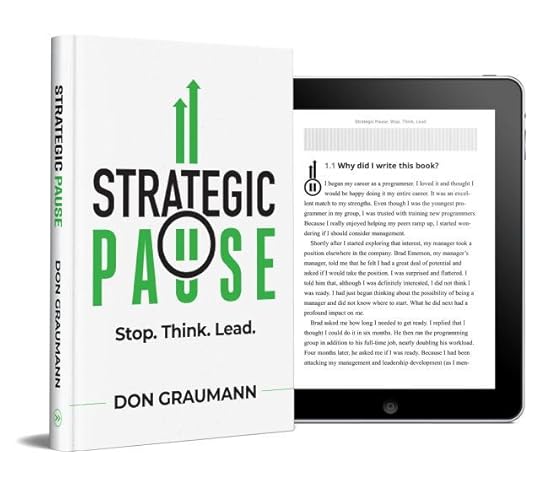
Like our kids, maybe it is time for you to head back to (leadership) school? “Strategic Pause” could be your textbook! Don’t take my word for it, below is one of the 33 five star reviews on Amazon.
“Best business book I have read in many years. As an emerging leader, I’m looking for practical steps to take each day to build on my current leadership practices. This book is well-written and provides many tips to help me right where I am. Also would be an excellent resource for a senior leader looking to grow their leadership model and learn from other leaders. Highly recommend Strategic Pause!”
Get “Strategic Pause” on Amazon.
July 31, 2025
Will there be an AI pullback?
Will there be an AI pullback?
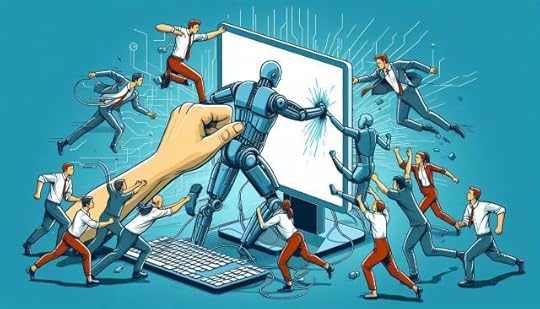
In my experience, whenever something feels inevitable, there is a meaningful pullback coming. Examples are the dotcom bubble and digital privacy backlash (like 3rd party cookie confusion). I believe the same will happen with AI. Note that the pullback will ultimately be a blip in the long-term trend. In the moment, it will seem significant.
The AI pullback will be fueled by multiple high-profile failures caused by AI. It will happen in places where the boundaries are being pushed too quickly…where AI was not monitored for too long. Those who are trying to do AI right (with explainability and alignment) will be splattered by the fallout from those who are moving too fast and reckless.
The form of the failures could be:
Customers improperly losing access to their bank accounts due to incorrect fraud flagging…that then takes far too long to resolve.An autonomous truck causing a terrible accident…even though the accident rate of autonomous vehicles is far lower than human-directed vehicles.Drone harassment (via collision or surveillance) when those with negative intent seek to disrupt the lives of their ideological opponents.The possible failures are only limited by our imaginations. It will not matter that these incidents are a tiny fraction of AI deployment and application. Social media and the traditional media will hype these failures to the Nth degree. Availability heuristics will take over. Two things will happen:
The lesser-informed population (who think the failures are widespread) will allow their trust in AI and its potential to be damaged. They will start to actively resist AI. This will take many forms (protests, boycotting AI-forward companies, destruction of property that even looks like AI, …).The government will lean in because the constituents of every elected official will demand that we “do something.” As usual, the majority of new government regulations will have the opposite effect. The “winners” will be the giant corporations that can afford the lobby to capture carveouts in the legislation for themselves.But, this too will pass. The AI genie is out of the bottle. The benefits are too great to ignore. We are still plumbing the depths of potential harm. But, the remedy for the harm is largely on the human side. Those working on AI need to keep explainability and alignment a top priority. All of us need to accept the coming wave and be as proactive as possible in adapting to the massive changes in our jobs, economies, and societies. It will take time to understand and embrace the new paradigms.
What do you think?
What am I missing? Is the AI momentum so great that it will quickly roll over any the pullback? What will be the greatest changes to our economy and society? What will be the most important adaptation for humans to make?
—-
Thank you for reading my leadership blog post. I hope you found it interesting and thought provoking.
Check out “Strategic Pause” on Amazon. Follow me on X (@DonThinks).
© 2025 Don Graumann. All Rights Reserved. Other than personal sharing, please do not redistribute without permission.
July 16, 2025
New to your role? How fast should you move?

You are starting a new role. You are eager to get ramped up and add value. You have a plan. How aggressive is your plan? How fast do you intend to move?
Are you coming in hot?
We hear this phrase when someone is moving too fast. It has implications. It means that the new leader has not spent enough time assessing the situation they are coming in to. They think they know the way. It means that they might not be properly respecting the existing culture. If you come in hot, you are focused on you. You are running your plays and not plays you developed with your team. You are more likely directing versus leading.
Are you creating a leadership gap?
If you are moving too slowly, you may be creating a leadership gap. Your intent is to respect the culture and people by being careful. Instead of doing that, your team starts to wonder about the value you add. You are seen as passive. In certain situations, being passive is the right approach, but not when you are ramping up.
Be Goldilocks
I know, that is a corny way to say you are looking for a balanced approach, an approach that is “just right.” How do you do that? On a high-level, you go slowly where things are working and go fast in areas that are not working. Most leaders focus just on the latter. They believe they were hired to address a particular challenge. They too often miss that they also need to respect and even reinforce what’s right.
I did this when I joined my last company. It had a very strong culture centered on delivery excellence, client responsiveness, and pragmatic problem solving. I explicitly articulated it and the plan I developed with my leadership team strove to protect and reinforce it. I could see that it was the value proposition behind the company’s legacy of success. At the same time, growth was slowing. Our plan also focused on that challenge by accelerating incremental growth right away by deepening strategic account planning and investing in transformational growth by placing some bets in areas that could be the “next big thing.”
4 Essentials of Your Ramp Up Plan
In my experience, a ramp up plan should have four key parts:
Timeline & Expectations : Your team and who you report to should never wonder about the status of your ramp up. Create and share a 30-60-90-day plan. Share what you are going to be focused on and when you will provide updates. Note that listening and learning is a critical part of the first half of your plan. This is asking for feedback from everyone you connect with and taking that input into account when developing the strategy (see below). Personal Leadership Model : Share your personal leadership model with your team. What principles and methods make up your approach to leadership? How is that manifested into the operating model? This is giving your team insight into the “why” behind many of your decisions. Strategy Development : The deliverable at the end of your ramp up plan is the strategy for your team (challenges & opportunities, value proposition, vision & objectives, alignment to company objectives, operating model, and initiatives). It looks like a lot but, in my experience, it comes together quickly. Ideally, you develop this with your leadership team. This makes it their plan too. The difference in engagement of your team if they are driving their plan versus just your plan is huge. Per above, the plan is where you explicitly protect what is working and seek to improve what is not working. On Message : Once you have the plan, roll it out. Cascade the objectives into the team so every individual knows how they impact the big picture. Be annoyingly on message.Ideally, your ramp up plan should be a few slides. It should be an outline that you fill in, which largely becomes the strategy. Be as transparent as possible through the entire ramp up process. That will fast-track building credibility with your team. It will demonstrate that you trust them. Most will trust you right back.
What do you think?
What points resonated most with you? Is there something I blatantly missed? Can you think of examples where a leader new to your organization moved too quickly or too slowly?
—-
Thank you for reading my leadership blog post. I hope you found it interesting and thought provoking.
Check out “Strategic Pause” on Amazon. Follow me on X (@DonThinks).
© 2025 Don Graumann. All Rights Reserved. Other than personal sharing, please do not redistribute without permission.
June 27, 2025
Currently revamping the outline for leadership book #2. The working title is “Leadership Islands: An…

Currently revamping the outline for leadership book #2. The working title is “Leadership Islands: An Anti-Corporatism Handbook.”
#leadership #StrategicPause
June 19, 2025
AGI? It depends on your philosophy.

If you believe in determinism, you are likely to believe AGI (Artificial General Intelligence, Superintelligence) is close or already here. Determinism is the philosophy that free will is an illusion and that our choices are predetermined by the conditions and circumstances that precede them. In other words, if you can consider all variables you can build an if-then-else statement large enough that all decisions and behavior can be predicted.
AI’s current primary path is induction logic. It is applying compute to as much data as possible to isolate patterns…building a mega if-then-else statement.
If you do not believe in determinism and believe in free will, then you are less likely to believe that AGI is close. You believe that it is deduction versus induction logic what makes the human mind (sentience) unique.
Deduction logic starts with general premises and seeks to validate those premises via specific circumstances (real world data). In other words, you build a conceptual model based on general observation or just thinking and then prove it is valid by applying it to specific situations. It is the opposite direction of induction.
Today, AI struggles in the realm of deduction. There is a rising question of whether the current architecture (LLM’s, …) can ever be deductive. That is not to say that AGI is impossible. I just wonder if it is possible based on our current technical approach to AI.
I admit this is a very oversimplified view. I have been thinking about it for some time. A growing theme in articles and posts about AI seem to be in alignment with this view. So, I decided to share it more broadly.
What do you think?
June 5, 2025
AI versus Reading…

AI versus Reading…
We review a book or paper summary to get the headlines. But, we didn’t actually read it. So, we miss information not included in the headlines that would have had meaning to us. Further, reviewing headlines only partially internalizes the intelligence. Thus, we are less likely to leverage it in our decision making (and thus it is less impactful).
Aren’t many of our use cases for AI essentially asking AI for a summary of summaries? For those use cases, wouldn’t AI be missing key points?
I would suggest that we should ask ourselves when using AI makes sense and when doing the work of reading, thinking, simplifying, and summarizing the headlines ourselves makes sense. What do you think?
May 21, 2025
5 Thoughts on AI and Leadership…
What is AI’s impact on leadership?
My initial thought is that your POV on that topic will evolve as AI evolves. The foundation of the POV will likely stay the same (like the foundational principles and methods of leadership that stay consistent over time) but the details/application will change as AI’s integration into our lives deepens. That’s why the title of the article ends with “…” More to come after this article, but here are my current top five thoughts on the topic of AI’s impact on leadership:
Less Technical Skills: Given AI is technology, this seems counter-intuitive. AI’s primary value proposition is automating and speeding up technical tasks (yes, an oversimplification). Thus, your technical skills and experience are less important. The skills pie is good context. It is a useful leadership template (conceptual model) that summarizes skills as technical, conceptual, and interpersonal. Each role and level require a different mix of those skills. For example, a programmer might be 40% technical, 40% conceptual, and 10% interpersonal while a team leader might be 20% technical, 30% conceptual, and 50% interpersonal. In the realm of leadership, the technical slice of the team pie was already small. Now it arguably gets even smaller while the conceptual (which includes creativity) and interpersonal slices get even larger.
AI Agents & Rolled-up Sleeves: If you strive to lead in the midst of the AI revolution, you need to be an active participant. I have always felt that the best functional managers are the ones who stay up-to-date with the methods and technology of their team. For example, when I was a Programming Manger, I still programmed one-third of my time so that I could help members of my team debug code. It was critical in building and deepening my credibility. There is no standing on the sideline with AI. Thankfully, AI agents are making it easy to be hands-on. You just need to be willing to experiment…to play. Of course this means you need to set aside the time. One might object that using AI agents falls into the technical skill bucket. Given the rate of change and the low level of syntax required to use an AI agent, I view it as more closely aligned with conceptual skills.
Distributed Systems Rising: AI’s automation and streamlining is blowing up established processes. The world of standard operating procedures (SOPs) and even consistent operational KPI’s is the world of yesterday. This means rigid operational and organizational structures no longer do the job. I do not think the answer is decentralization (including self-managing teams). There are circumstances that Holocracy-like approaches work great, but in my view it is too dramatic a change for most companies (for example, there are no “leaders” in self-managing teams). Instead, I think distributed systems and teams is the right approach. It is basically 1-2 steps back from decentralization and 2-3 steps forward from rigid structure. It is setting vivid objectives with your teams (leveraging their minds in setting the direction), cascading those vivid objectives (working with individuals to articulate how they can directly impact the bigger picture), and then giving the team wider-than-ever guardrails to work (empowering them to be creative and innovative in building the path to the objectives). A critical guardrail and responsibility of the team leader is to gather feedback from the team, the company, and the market to challenge the current objectives to see if the direction needs to be adjusted. In my view, this approach has always been the right way to lead. AI is making it even more so.
Evolving Value Measurement: As I mentioned just above, legacy KPI’s likely no longer apply. How you measure the value added by your team is changing. Experimentation is more important than ever. Every book on innovation over the last 20 years discussed failing fast and rewarding the lessons of failure. Most companies talked about it, but few actually integrated it into their culture. With the AI revolution, the cost of not building a “test and learn” culture is greater than ever. The same applies to all the work on adapting to change. Change is officially becoming part of our day-to-day. In theory, the legacy productivity metrics of your team should skyrocket. If they do not, your team is not trying hard enough to challenge business-as-usual and break stuff.
Don’t Forget the Team: Availability heuristic keeping AI top-of-mind creates the risk that your team will get less of your time and focus. As someone who strives to lead a team, your team and the members of your team must always be your top priority. It will be tempting to offload too much conceptual work to your AI agents. AI agents are not a substitute for your team’s thinking. Use AI agents to create ideas for discussion with your team but not be the end of the discussion. Again, AI’s noise is and will continue to be a massive distraction from what is most important. Remember you are a servant leader first and an AI architect second. I think each of these five thoughts could be a blog post by themselves. I’m going to keep noodling the topic. What do you think? Do you agree with these five? Is there something I blatantly missed? Am I over-indexing on one of the topics?
Thank you for reading my leadership blog post. I hope you found it interesting and thought provoking.
Check out “Strategic Pause” on Amazon. Follow me on X (@DonThinks).
© 2025 Don Graumann. All Rights Reserved. Other than personal sharing, please do not redistribute without permission.