Amy Rupertus Peacock's Blog
October 16, 2025
I’ve Been Thinking
After all my research and conversations on the Pacific War over the years, I can’t help but see echoes today as I watch the news and read the papers and military magazines.
China pushes deeper into the Pacific—building bases and reshaping islands just as Japan did before and during WWII. Meanwhile, Russia provokes our Allies, our border, and our military. I wonder: is our military applying the lessons learned from WWII?
From assault tactics to force allocation, to caves and tunnels -history offers warnings we can’t afford to ignore.
Especially in the Pacific.
Take Peleliu, for example. Of course, I think a lot about that battle since my grandfather is blamed for thinking it would be a faster campaign but instead became a drawn-out horrific battle of attrition. Maybe the worst conditions and Japanese tactics my grandfather and the 1st Marine Division had faced in the Pacific since the landed in the Pacific in August 1942.
As he wrote after leaving the island, for all …”It was a “Hell hole.”
But…What if higher command had chosen not to split focus—invading Angaur and Ulithi at the same time as Peleliu—but instead concentrated Marines, Navy, and Army forces solely on Peleliu? Would the battle have been shorter? Would fewer lives have been lost?
In Bloody Beaches The Marines at Peleliu. Brigadier General Gordon D. Gayle, USMC (Ret) notes there was a “paucity of resources” for Peleliu.
Angaur’s timing was also controversial from the start.
“The operation on Angaur, the planning which attended it and the decision on its timing, impacted heavily upon the Peleliu operation. The naval planners early on proposed landing on Angaur before Peleliu. Only when Major General Julian C. Smith, commanding Expeditionary Troops/X-Ray Planning Group, explained that such timing would invite the numerous Japanese in northern Palau to reinforce Peleliu was it agreed that Angaur be assaulted only after the Peleliu landing was assured of success. However, the Angaur landing was initiated before the Peleliu landing had been clearly resolved. The commanding general of the 81st Division wanted to land as soon as possible, and he was supported in his view by his naval task unit commander, Rear Admiral William H. P. Blandy.
Opposing the 17 September date for the Angaur landing was Marine Major General Julian Smith. Smith argued that committing the element of III Corps Reserve before the Peleliu operation was more fully developed would be premature. His advice was ignored by Vice Admiral Theodore S. Wilkinson.
A related decision for 17 September committed the III Corps’ final reserve to the Ulithi landing. The task was assigned to the Western Attack Force, which was ordered to seize Ulithi with “available resources.”
Over General Smith’s advice, Wilkinson chose to commit the entire 323d RCT, the 81st Division’s other maneuver element. The 321st subsequently and successfully occupied an undefended Ulithi while reserves were sorely needed at Peleliu…”
On Peleliu, Marines faced tough resistance and terrible conditions along with the caves and tunnels the Japanese had built.
By September 21, General Geiger told General Rupertus the Marines could no longer hold Peleliu alone—help from the Army was essential.
Contrary to scuttlebutt, General Mueller never radioed to say, “We’re ready.” It was Geiger who initiated contact with Mueller, only to be told the 321st (of the 81st Division) could be available, but he needed time to reorganize them – while still engaged on Anguar.
Unsatisfied, General Geiger, General Julian Smith, and Admiral Forte went by ship to General Mueller’s headquarters on Angaur to press him directly to speed things up.
The 321st RCT reached Peleliu on September 23, but the remainder of the 81st could not be released. The assault phase on Angaur was not declared complete until October 14, and the full Army division was not available for Peleliu until October 22, when the final cave was cleared on Anguar.
By then, thousands of Marines had fallen or been injured in one of the Pacific’s bloodiest battles—casualties levels that might have been spared had higher command concentrated its strength?
But was Iwo Jima any different? Okinawa? Both would test the lessons in force allocation, timing, and the sheer cost of frontal assaults and the caves and suicide bombers.
At Iwo Jima, the Marine Corps effort was concentrated on one huge volcanic island—yet the Japanese, dug into caves and tunnels (Marines later said they could hear them beneath the volcanic sand), inflicted enormous casualties in a battle that dragged on far longer than predicted – like Peleliu.
What did we learn about the caves and tunnels we’d seen at Peleliu?
At Okinawa, the stakes grew even higher: Army and Marine divisions committed together, a drawn-out fight that became the bloodiest and deadliest (on both sides) of the Pacific campaign.
I am not a military planner, but it is stunning when you look at the numbers of lives lost and casualties in WWII. I pray our military leaders and experts are examining the lessons learned from WWII Pacific.
And show us a path towards peace through strength, not war.
The post I’ve Been Thinking appeared first on Amy Rupertus Peacock.


February 13, 2025
My Dad Patrick Hill Rupertus (1939-1991)
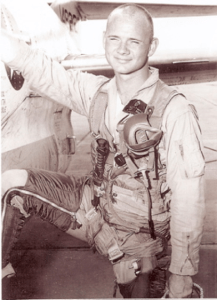 Capt. Patrick Hill Rupertus, son of Gen. Rupertus. Circa 1963.
I’ve been working on a book about healing grief, and this chapter about my father was originally part of it. A version of it also appeared in my first manuscript, Tenacity of Purpose, which partially evolved into Old Breed General. But the feedback was clear—I had to take it out.
Our dad, Patrick Hill Rupertus, was a Marine aviator and Vietnam veteran. Lately, as I’ve been watching Vietnam: The War That Changed America on Apple TV and reflecting on the anniversary of his passing from Agent Orange-related cancer (March 6, 1991), I felt compelled to share this story. This is for him—the general’s son, our beloved father.
Our father, Marine aviator Captain Patrick Hill Rupertus (Pat), came into this world in the shadow of history—born in Washington, DC, in 1939, while his father commanded the Marine Barracks at 8th and I Streets. He entered a life steeped in military tradition, one that would bring both honor and heartbreak.
The historic brick buildings that housed the Marine Corps’ most cherished traditions would later become the site of unimaginable grief.
In 1942, when Dad was just three years old, his father, who had been with the Marine Corps since 1913, joined the 1st Marine Division as assistant division commander (ADC) to fight the Japanese in the Pacific. It was the first in a series of separations, each one deepening the pattern of loss that would shape Dad’s early years.
General Rupertus came home from the Pacific in November 1944, and was head of Marine Corps Schools at Quantico. Video shows he took Dad all around Quantico, on horses, planes and tanks. And on a cold January day in 1945, video shows our family and friends coming to town for a big ceremony for his Distinguished Service Medal. https://youtu.be/dZ3svI_C3z0?si=e7GZZvYdIvbOxbUb
Three months later, as the Marines had their victory on Iwo Jima, tragedy struck with brutal swiftness. During a 1st Marine Division Veterans’ gathering at the Marine Barracks in Washington, DC, his father Major General William H. Rupertus suffered a heart attack and collapsed on the steps of Col. Kilmartin’s house, his former chief of staff in the Pacific.
Our grandmother, Sleepy, only 34 years old, ran to him in a well of tears, cradling her husband as he took his last breath.
In the aftermath of this devastating loss, Sleepy and young Pat had to quickly rebuild their lives. They carefully packed up their belongings for the move from Quantico to Washington, DC. She ensured they preserved all of her husbands uniforms and military memorabilia—precious artifacts of his distinguished service from 1907 to 1945, including many condolence letters. All of which we have today.
Their saving grace came through the unwavering support of Tom and Edythe Hill, whose friendship with General Rupertus dated back to Washington, DC and their shared time in the Marine Corps.
The Hills had stood by Rupertus during his darkest hour when he lost his first family to Scarlet Fever while they were all stationed with the 4th Marines in Peking, China (1929-1931) at the Peking Legation, and now they stood ready to help his widow Sleepy and son Pat in 1945.
They helped Sleepy and our Dad find refuge in McLean Gardens, a residential community in northwest Washington, DC. Here, amid the post-war housing development’s brick buildings and tree-lined streets, Sleepy worked to create a new normal.
Dad attended nearby Sidwell Friends School before moving on to Landon School in Bethesda, where he boarded. At Landon, he found solace in football and forged friendships that would last a lifetime. But fate wasn’t finished testing his resilience. During his high school years, Sleepy succumbed to an aggressive, three-month battle with leukemia, dying at age 43.
At sixteen, Dad was left without his parents.
Sleepy’s sister, Josephine Hill Carter, became a second mother to our Dad, embracing him as one of her own children and providing the loving stability he desperately needed. And so did his father’s Marine friends who served with General Rupertus in the Pacific.
Grief found Dad, but it never broke him. Instead, he set his sights on the United States Naval Academy—an institution that had been part of his family’s legacy since 1922.
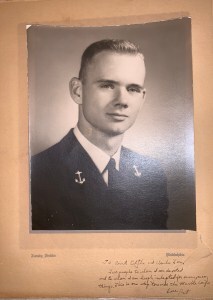 Dad at USNA. Note on photo thanking the Hills for their support.
Despite repeating his plebe year, to the shock of one of his close friends who dropped out, his characteristic grit and determination carried him through to graduation in 1962. That same year, he married our beautiful mother, Gail Bennett, before embarking on his journey to flight school.
 Pat Rupertus and Gail Bennett circa 1961 at Raquette Lake, NY.
As a Marine aviator, Dad flew A-4 Skyhawks from aircraft carriers and completed two tours in Vietnam, earning citations for his bravery in supporting his fellow Marines. His squadron, VMA 332, nicknamed him “Mr. Clean”—a moniker that spoke to to his similar look to the image of the man for the Mr. Clean brand.
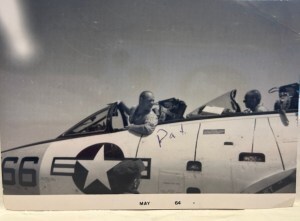 Dad in his A4-SkyHawk with co pilot.
My understanding is Dad spent a lot of time in Chu Lai, Vietnam. He also was a FAC.
Dad carried his early losses quietly, rarely speaking about his parents, his Naval Academy years, or his Vietnam service. Only later, as I researched our grandfather’s story for my book Old Breed General, did I fully grasp the weight my father carried. He had built his life not just on resilience—choosing to honor the past by forging ahead, even when grief threatened to hold him back.
Through my father’s journey—from the loss of his parents, to a Naval Academy graduate, from Vietnam veteran to loving father—he embodied the Marine spirit his own father had instilled: unwavering determination in the face of adversity – and a love of family. The military memorabilia he and Sleepy had so carefully preserved would later help tell not just General Rupertus’s story, but open my eyes to Dad’s own story of resilience and strength.
A Daughter’s Memories
The military had shaped our family’s entire geography: Heather was born at Kingsville Naval Air Station in Texas, Kimberly in Bryn Mawr while Dad was deployed in Vietnam, and me (a surprise) in Pittsburgh, after he joined the reserves and was working at Westinghouse as an engineer.
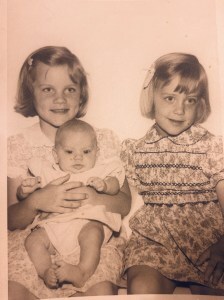 Heather, Kimberly and Amy Rupertus. Circa 1970.
We moved through Chicago, where Dad transitioned to life insurance, until 1980, when the sudden passing of a close friend and client made him reevaluate his path. A “What Color is Your Parachute” weekend inspired him to pivot from insurance to real estate development—something he’d always dreamed of.
That year, he moved us to McLean, Virginia, closer to his Washington, DC roots. It was a massive change that seemed to help Dad—and all of us—thrive and reconnect.
As the youngest daughter, I spent a lot of time with Dad while Mom worked in real estate on weekends and my sisters were with their friends or working. We were buddies. He played guitar for me. He took me to the bakery to get those giant yellow smiley cookies. He took me shopping for clothes, and even to his barber for my haircuts. He was strict—sometimes scary strict—and he disciplined me when I needed it. Though, according to my sisters, I got off easy.
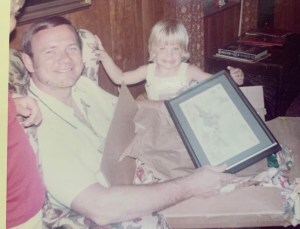 Dad and Amy on this birthday with a sketch of the USS Rupertus.
We were not supposed to watch TV during the weekdays or get phone calls past seven pm. Of course my sisters and I snuck in some TV time. But, if Dad came home early from work and he thought we had been watching TV, he’d go over to the TV and place his hand on it. If it was still warm to his hand…
Run!
Dad pushed us to work hard, stay humble, and laugh at ourselves. He would always say “Don’t take a lazy man’s load,” as we girls were raking mounds and mounds of leaves in the Fall or carrying grocery bags.
Good or bad, I always felt deeply connected to his emotions, as if they were my own. He used to joke how sensitive I was. Wonder why? We also resembled each other. Sometimes, he would grab my square jaw, look into my eyes, and say, “Ahh, it’s just like looking in the mirror,” and “If Sampson had a jaw like yours he could have slayed another 1000 Philistines.”
Life in McLean was filled with family, tradition, and reunions. Weekends were spent with his mother’s sisters and their husbands: Aunt Jo and Uncle Bev, Aunt Dixie and Uncle Steve (both men had attended the Naval Academy, and served with the Navy in the Pacific during WWII).
We were now also closer to our grandparents, and more family and cousins on my Mom’s side. Great move, Dad.
His Naval Academy Class of 1962 reunions became regular events, and we went to magical evening parades at the Marine Barracks at 8th and I. I can still see those Marines at the evening parades—immaculate in their uniforms, executing rifle drills with perfect precision in DC’s sweltering summer heat. The rhythmic clatter of rifles, the sharp snap of dress shoes against pavement, the hushed reverence of the crowd—those nights felt almost sacred.
In the background, though, Vietnam still lingered, especially when it came to the big screen. In the 1970s and 80s, as movies about Vietnam started to emerge, I had the opportunity to watch them with my father, this USMC Aviator and Vietnam veteran.
Films like “The Deer Hunter,” “Apocalypse Now,” “The Great Santini,” “Top Gun,” captivated him, particularly when jets roared onto the screen. Deer Hunter was depressing (for me). When Top Gun came out in May 1986, we went to the movie with our Dad. During flying scenes, he’d light up, arms swooping through the air, demonstrating flight patterns right there in the theater. As a teenager, I’d slide down in my seat, mortified.
Now, those memories make me smile.
But Platoon, which came out in December, 1986 was different. Dad never flinched at war movies—until Platoon. He hesitated, unsure if he wanted to see Oliver Stone’s unfiltered portrayal of Vietnam. But one Saturday, he suddenly decided to go—and wanted me by his side. I sensed he needed company. The movie was tough to watch, and the drive home was quiet, heavy with unspoken emotions. And, at age 16, I never asked him what he thought about the movie.
If you grew up with a military parent, especially a Marine, you understand: sometimes you walk on eggshells. Sometimes, there are no words. Looking back, I realize that silence was its own kind of story.
The Vietnam Veterans Wall
A delicate silence had also surrounded the Vietnam Veterans Memorial when it was completed four years earlier in November 1982. Maya Lin’s design and the overall idea of the wall had sparked controversy, though I couldn’t understand why. How could honoring those who served, died, and went missing be divisive?
The dedication was set for November 13, 1982 with an unveiling and a parade of veterans. When Dad said we should go, my sister Kimberly and I joined him on that gray, cold November day. I imagined a quick outing from McLean—take the George Washington Parkway to Pennsylvania Avenue, see the wall, then get back to my friends.
But time seemed to slow as we drove. Even the Potomac River appeared to move in slow motion, the atmosphere dense with something I couldn’t name.
When we arrived near the Vietnam Veterans Memorial, I expected crowds, bands warming up, the kind of excitement that usually surrounds events in Washington, DC. Instead, there was silence. Parking was easy. The rain had started to mist.
We were drawn to the glow of a lantern inside an old brown canvas tent, where solemn veterans stood watch over a table covered with POW/MIA information. They weren’t there as parade guides. They were there for those who didn’t make it home.
As we walked toward the wall, the hush deepened. People knelt, searching for names, crying when they found them, pressing their cheeks against the smooth stone as if making a long-lost connection. Some bent their foreheads against it in prayer, while others traced names onto paper, preserving the memory of loved ones.
Dad walked back and forth in a trance, silently taking it all in. His striking light blue Irish eyes were red-rimmed, his brow furrowed. No jokes, no laughter, no smiles—not today.
I wanted to hug him but was afraid to interrupt his silence. He seemed so far away. I wonder now—was he back in Vietnam, watching a friend die? Calling in support for troops under fire? Flying his A-4 over dense jungle, spreading Agent Orange? Remembering landing on an aircraft carrier in the middle of a storm? Or, remembering all this, and the unwelcome home?
The Vietnam Veterans Parade
The parade that passed before us defied everything I knew about celebrations in our nation’s capital. No blaring horns split the air, no bands, no drums thundered down Pennsylvania Avenue. The familiar sights were absent—no majorettes twirling in the sun, no politicians’ practiced waves from convertibles, no children diving for candy thrown from floats.
Instead, a battalion of Vietnam Veterans marched. They came from every race and background, unified by their shared experience, many still wearing their old green fatigues. Some carried company flags, others the American flag. Though most were only in their late 30s and 40s, their faces carried the weight of decades.
Even as a young girl, I could see how grief had aged them beyond their years. Yet in their unified march, I glimpsed something else—a quiet strength forged in fire.
History frames the Vietnam War as a Cold War chess piece, a stand against communism after France’s failed occupation. Our military answered the call, fighting in a conflict that our own leaders struggled to define. The cost was devastating. Some never returned, and those that did were haunted by the memory of war—and that shameful unwelcome home. Others, like our family friend Air Force aviator Quincy Collins, endured seven years of brutal captivity alongside Senator John McCain in the Hanoi Hilton.
Back home, the nation fractured. When actress Jane Fonda visited Hanoi, she turned her back on our American POWs.Returning soldiers faced contempt—denied cab rides, spat upon, with Black veterans bearing even harsher treatment. Protests grew, clashed—until gunfire at Kent State left four students dead. The nation bled from self-inflicted wounds.
They didn’t seem to openly call it PTSD back then—that fog that settled over the 1970s and ’80s. But that’s what gripped so many Vietnam veterans and the families who loved them—a weight of unresolved grief that refused to lift. Those icicles inside.
We did not treat our Vietnam vets well.
That’s a hard truth we must learn. But this black wall, with its sharp angles cutting through the November mist, began to slice through decades of that shit. That hazy, suffocating PTSD fog.
The monument is now a guardian for our Vietnam Veterans. It made an unshakable statement: We honor those who sacrificed for our country.
As we can see in the Vietnam War documentary, like all warriors, their memories may have softened with time, but the feelings, sights, sounds, and losses remained etched in their hearts. Today, after watching our military endure multiple tours in the Middle East, we better understand the invisible wounds of war. We’re learning, finally, to recognize and support those who carry these scars.
But for those without a connection to the military, the bone-deep camaraderie and unwavering commitment to service over self, and etched in memories, might always remain a mystery.
Dad used to tease my sisters and me about being “God Damned Civilians”—whether he picked that up from the Marine Corps or The Great Santini movie, I’ll never know. But now, I wonder: Could we GDCs ever truly understand the sacrifice these men and women make to protect our right to live, work, worship, and yes, even protest in peace?
Our father never defined himself as a Vietnam Veteran. But how would I know? He never spoke about it to me. Yet I now know, he carried a lifetime of memories too profound for words. On that gray November day in 1982, as the parade marched past and veterans shouted for Dad to join them, something began to heal—not just for him, but for all of us who loved these warriors enough to stand with them in their silence.
The First Signs
At 49, Dad was still young and a strong presence. He and Mom were loving their new chapter as empty nesters, and I cherished our time together when I visited from college.
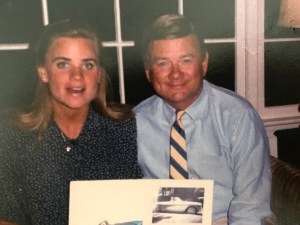 Amy giving Dad a birthday gift.
One autumn afternoon during my break from the University of Georgia, something changed. My favorite ritual with Dad was biking the W&OD Trail in Virginia—his competitive spirit always on display. He’d race ahead, blue eyes gleaming, legs still strong and muscular, leaving me trailing behind no matter how fast I was. He did the same thing if we were running – sprinting past me.
That day, as dusk settled in, I raced ahead on my bike, expecting his usual playful ambush. When I glanced back, he was far behind. I stopped at a crosswalk, watching him approach—slowly.
“Hey, Daddy, you okay?”
“I’m fine,” he said. “Just had to slow down a bit. My hip’s been bothering me for a few weeks.”
“Have you seen a doctor?”
“Not yet. I’ll check it out when you go back to UGA. Just don’t tell your mom, okay?”
That request haunted me later. They never kept secrets from each other. Those two were lovebirds. But I went back to Athens, swept up in soccer and college life, barely thinking about his hip pain.
The Diagnosis
When I came home for Christmas break that sophomore year, I was happy to be back in our cozy and bright home with my parents. Dad called me into the living room almost as soon as I had dropped my bags in my bedroom. Hmm, I ran downstairs and sat near him on the sofa, smiling. My mind raced through possible college transgressions. Nothing could have prepared me for his words.
“Amy… I have cancer.”
Whoa. What? Oh my God. Talk to me.
My lungs burned. Tears blurred my vision.
Agent Orange-related lung cancer, the doctors said it is another cruel legacy of the Vietnam War, claiming its veterans decades later.
The Final Months
By that summer of 1990, Mom sought solace in painting and played Chopin on the piano, her fingers soaring across the keys as she faced the uncertain path ahead. Mom loved Dad with every fiber of her being – a love so deep it made the impending loss almost unbearable.
Dad was thinner, but his spirit remained unbroken, his bright sweaters a defiant flame against his fading frame. Even with a chemo pump tethered to his body like an unwelcome companion, he refused to be grounded, returning to the skies he loved as pilot. Some days, he’d appear like a vision in the halls of the U.S. Senate where I was interning, his brave smile trying to preserve our last fragments of normalcy.
But by January 1991, when I left for school after Christmas break with a cold, he ended up in the hospital with pneumonia. His lungs, once strong enough to carry him through the heavens, now betrayed him, filling with fluid.
Damn cancer. Damn it to hell.
A month later, Mom’s February call pierced my heart – she said I needed to come home. She already booked my flight. The urgency in her voice told me everything words couldn’t. My boyfriend Edwin Peacock (now my husband) raced me down Atlanta Highway to Atlanta Airport in his black Scirocco, the world blurring past as I braced myself for what awaited – a journey straight into the darkest storm clouds of grief.
At home, Dad lay propped up in their bed, a shadow of his commanding presence. I embraced him, fighting back tears as I massaged his feet like I had so many times before.
My sisters gathered, and we maintained our vigil with our Mom, clinging to every precious moment. As Mom’s piano echoed through sleepless nights, the angels of the Visiting Nurses team drifted in and out. Grief took over until I could barely breathe, until Dad’s doctor prescribed anti-anxiety medication to dull the pain of loss.
Dad’s final flight path was set, and we were approaching the end of the runway. On March 6, 1991, sixteen months after his diagnosis, we huddled close – Mom, my sisters, and me – watching helplessly as Dad took his last breath in the home he had filled with so much fun and love.
I fled downstairs to my bedroom, buried my face in my pillow, and released a lifetime of sobs that would echo in my heart forever.
He was only 51. Mom was 50 years old and had lost the love of her life. I was 20, and my sister Kimberly was 26 and Heather, 27.
The Farewell
Our church Saint John’s Episcopal Church in McLean, Virginia, overflowed with people who loved Dad as we did. Neither my mom, sisters or I could speak—the weight of loss left us silent. Thankfully close family and friends did.
As we turned from the front pew, his casket was beside us. I burst into tears, unable to leave him. My heart, my arms, my head laid against the wood, as if my energy had fused with it. I would have let them carry me out with him. Our Aunt Jane had to pull me away.
I can still feel that moment in my chest and all its power today.
At the reception, people called us Rupertus girls strong. Really, we were in shock.
The Final Honors
His funeral brought a clear, cold March morning at Arlington National Cemetery. Six black horses pulled Dad’s flag-draped casket on a caisson, their breath visible in the winter air, hooves clicking solemnly against the pavement. Our family followed the caisson, passing rows of white headstones stretching endlessly over Arlington’s rolling hills.
The Marine Corps Body Bearers—stoic, disciplined, and precise—moved in perfect unison, their white gloves stark against dress blue uniforms. They carried Dad with the dignity he deserved.
At the gravesite, the ritual unfolded with military precision. The Marines folded the flag—thirteen deliberate folds, each with meaning. Our beloved minister spoke, though his words barely penetrated our grief. Then came the rifle salute—three volleys cutting through the silence, making us jump despite knowing they were coming. A lone bugler played Taps, its mournful notes floating over the hallowed ground.
A Marine knelt before Mom, presenting the folded flag.
“On behalf of the President of the United States, the United States Marine Corps, and a grateful nation, please accept this flag as a symbol of our appreciation for your loved one’s honorable and faithful service.”
Mom received it with grace, though through my tears, I saw her hands trembling.
Here was Dad’s final flight. His last mission.
Complete anguish.
We left him among heroes—his family, and the soldiers, Marines, and sailors who had also answered their country’s call. His final resting place, in Section 60, beneath the shadow of the Tomb of the Unknown Soldier, became sacred ground for our family.
A Bond That Never Breaks
A week after his funeral, a manila envelope arrived at our house. Inside were black-and-white glossy photos from Dad’s burial at Arlington. Tucked among them was a note from Lenny, one of Dad’s closest Naval Academy friends—a man who had spent years in the shadows at the CIA.
Thank you Lenny, we never even saw you there. We would have embraced you.
Thirty years have passed since that day at Arlington. I’ve come to understand that some bonds never break—they only change form. I see Dad in my own square jaw, in the blue eyes, empathy and competitive spirit I inherited, that have been passed down to my children. I hear him in my head—”Don’t take a lazy man’s load!”—in the moments that demand resilience.
His grave at Arlington is a place of peace I love to visit. The Vietnam Veterans Memorial still stands, reflecting both our past and present. When I visit the family grave, where he, my mom, and his father and more family is buried, I lean back on the headstone, feeling the smooth stone, and connect to their love and perseverance.
I understand now why he needed Kimberly and I there that day in 1982—not just as witnesses, but as a bridge between his military world and civilian life, between his pain and his hope.
Only later, as I researched my grandfather’s story for Old Breed General, did I fully grasp the weight my father carried. He had built his life not just on resilience, but on service and tenacity—choosing to honor the past by forging ahead, even when grief threatened to hold him back.
I only had had my father in my life for twenty years and it took me years to heal from that loss.
But today, I’m so thankful we had Dad for the years we did, and that he had so many people who loved him. Dad was more than a Vietnam veteran. More than a Marine. More than the father who checked for warm TVs and made jokes about “God Damned Civilians.” He was a guardian of memory. A keeper of tradition and stories both told and untold. A man who left a legacy of passion, kindness, and courage.
He taught me that strength isn’t about being better than someone else—it’s about being the best you can be. It’s about facing life with grace, grit, and humor, even if your heart is breaking.
For my father, Patrick Hill Rupertus, USNA Class of ‘62— We loved you. We remember. We honor. We heal.
Semper Fidelis.
The post My Dad Patrick Hill Rupertus (1939-1991) appeared first on Amy Rupertus Peacock.
February 3, 2025
Four Chaplains Day
Today is Four Chaplains Day in remembrance of the four US Army chaplains who died on this day.
It is also a day to honor our military chaplains.
I read about this tragedy in Sea of Glory by Ken Wales and Dave Poling.
On February 3, 1943, during World War II, our grandfather and the Marines were still on Cape Gloucester in the Pacific, when four Army chaplains displayed extraordinary bravery and self-sacrifice as the USS Dorchester sank in the North Atlantic after being torpedoed by a German submarine.
In WWII, German submarines were prowling the east coast of the United States into the North Atlantic.
The USS Dorchester, was a civilian ship that became a troop transport ship carrying over 900 soldiers. It was en route to Greenland when it was torpedoed by a German U-boat.
Within 20 minutes, the ship sank beneath the icy waves, claiming hundreds of lives.
The Four Chaplains—Lieutenant George L. Fox (Methodist), Lieutenant Alexander D. Goode (Jewish), Lieutenant Clark V. Poling (Dutch Reformed), and Lieutenant John P. Washington (Catholic)—were Army chaplains serving aboard the USS Dorchester to provide spiritual support to the troops.
When the torpedo struck, chaos and panic gripped the ship.
Men scrambled to find lifeboats and life vests as freezing water rushed in. In this moment of terror, the chaplains sprang into action, offering words of encouragement, guiding soldiers to safety, and distributing life vests to those in need.
When the supply of life vests ran out, the chaplains made the ultimate sacrifice. Without hesitation, each man removed his own life vest and gave it to a soldier who had none.
As the ship sank, survivors in lifeboats and the freezing ocean saw the chaplains standing arm in arm on the deck, praying together and singing hymns.
Their faith and courage provided a beacon of hope even in the face of certain death.
Of the 902 men aboard the Dorchester, only 230 survived. The Four Chaplains were among those lost, but their legacy endured.
In 1948, the U.S. Congress authorized a special posthumous award, the Four Chaplains’ Medal, to honor their sacrifice.
The Four Chaplains’ courage continues to be commemorated each year on February 3, known as Four Chaplains Day. Their sacrifice remains a testament to the highest ideals of duty and devotion, transcending religious and cultural differences in service to humanity.
#NeverForget 

The post Four Chaplains Day appeared first on Amy Rupertus Peacock.
January 15, 2025
Battle of Cape Gloucester
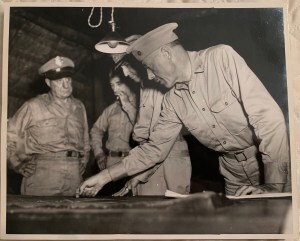
On December 26, 1943 in WWII Pacific, our grandfather, General Rupertus and the 1st Marine Division landed on Cape Gloucester as part of the wider Pacific plan called Operation Cartwheel. This was a joint operation with the Army.
For this operation, the 1st Marine Division and Army were under the overall command of General MacArthur.
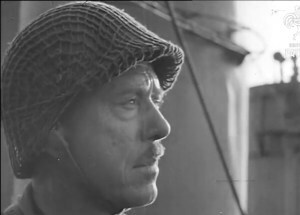
General Rupertus on deck viewing the naval bombardment.
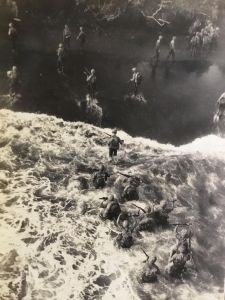
The Natives warned the Marine planners it would be the rainy season with a potential monsoon. But, the Marines had no time to wait for better weather, as the Joint Chiefs of Staff, particularly Admiral King, wanted a full press forward.
Though the enemy’s organized resistance ended on January 16, the Marines continued to work to clear the island of the enemy until they could be relieved by the Army in April, 1944.
The Improvised Air ForceIt was indeed wet … a slog. To get supplies to his troops navigating the swamped inland, Rupertus could not rely on trucks or the heavy bombers. So, General Rupertus started the Improvised Air Force with twelve Piper Cubs he obtained from the Army to assist the Marines in this tough terrain. He directed his personal pilot, Captain Theodore A. Petras, and pilot First Lieutenant R. F. Murphy to organize a small aviation unit from Marines volunteers. They had to quickly vet the Marines to train them how to fly a plane! This is fascinating and fun history many do not know … and certainly was not in the Pacific series. However, this Improvised Air Force provided essential medical supplies, plasma, rations, and did artillery and reconnaissance spotting, and messages delivery. Our grandfather appreciated this little air force and made sure the Marine volunteer aviators (who he said were like his children) received an Air Medal for the contribution.
Here is a short video of the naval bombardment, the Marines landing and wading through the jungle. You can see our grandfather on deck of the ship as the naval bombardment began. And, we only have a newspaper photo of him cooling his feet in the mud. You can actually see him doing it in this video and …laughing at himself.
US Marines Take Cape Gloucester: https://youtu.be/VxlDQYFUbSA?si=jVDoQLfQtUoBC0Z6
The Sun comes out on Cape Gloucester See this video of the sun coming out on Cape Gloucester! It shows the first plane (our grandfather’s) landing on the newly rebuilt airfield an Army engineering battalion built.
Major General William H. Rupertus, USMC Commander of the 1st Marine Division watches as the first plane lands on airstrip #1 of the recently captured and rebuilt Cape Gloucester airdrome and greets the crew with many spectators.
https://digital.library.sc.edu/collec…https://youtu.be/tIEiT7kfmaE?si=_pL8TwhmK6XcadJu The plane is a Beechcraft UC-45J, designated with the Guadalcanal 1st Marine Division emblem and named “Sleepy” after General Rupertus’ wife. Rupertus congratulates his pilot, Captain Theodore Petras on the landing. Troops enjoy the moment and take turns inspecting the plane.
This video is courtesy of the History Division of the United States Marine Corps. Other amazing films from the USMC History Division can be viewed at the United States Marine Corps Film Repository, a partnership between the History Division and the University of South Carolina.
Want more information on this battle? Here is the monograph of the history of the Battle of Cape Gloucester: The Green Inferno https://npshistory.com/publications/wapa/npswapa/extContent/usmc/pcn-190-003128-00/sec8.htm#airforceThe post Battle of Cape Gloucester appeared first on Amy Rupertus Peacock.
October 31, 2024
From Cadet to Marine – The Remarkable Journey of William H. Rupertus
History Matters
As I dive back into my original manuscript in hopes to publish it, I am once again in awe of my grandfather’s perseverance over his lifetime, and what he witnessed in Washington, DC and in the world … which I was never taught about in school.
If you have read or not read Old Breed General, here is a summary of why it matters TODAY.
The fact that his story wasn’t told until Old Breed General was published in 2022, really highlights how many important WWII stories need to be discovered and told for the record. They can guide us.
Today, as I read the headlines of what is happening around the world, and China’s advance in the Pacific …I see starkly clear similarities to the build up to WWII …that I have studied for the last seven years while resarching our grandfather.
Tis’ interesting as I began this blog post today, I received this article from the Washington Post. I’ve been following this Chinese military activity for years. Have you? https://www.washingtonpost.com/world/interactive/2024/china-built-50-billion-military-stronghold-south-china-sea/
It is concerning. I am sure our grandfather would agree. Oh, how I wish I could talk to him.
Washington, DC
Our grandfather, General Rupertus, was born, raised and died in Washington, DC (1889-1945). He grew up in a close German American community that thrived in Washington, DC in the mid 1800s-mid 1900s. If you go to DC now, you can find remnants of these innovative German Americans.
He attended church at the Concordia Evangelical Church that still does a service in German each month!
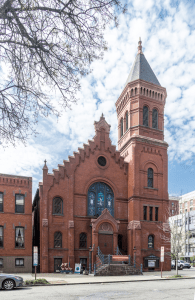
He also witnessed the industry of entrepreneurs like Christian Heurich, whose brewery, https://en.wikipedia.org/wiki/Christian_Heurich_Brewing_Company ,was the largest in Washington DC back then, and employed countless German-Americans while supporting the German community’s charitable causes, including the German orphanage, where Rupertus grandmother and mother served as leaders.
He saw the brilliance of compatriots like August Gottlieb Schönborn, whose design of the United States Capitol dome reached skyward like the aspirations of Americans. And, his grandfather, father, and uncle were entrepreneurs in the retail, real estate and restaurant arena.
Many of these Germans are buried at the old German Prospect Hill Cemetery. https://www.prospecthillcemetery.org
In the bustling halls of McKinley Technical High School in Washington, DC, his military journey began in the ROTC program. His path would wind through three branches of service, face personal tragedy, and ultimately lead to his becoming one of the Marine Corps’ most influential leaders.
From Cadet to Marine Corps Officer
After graduating high school, he enlisted in the DC National Guard and within three years, he was promoted to an officer. Something or someone inspired him to apply to be a cadet at the U.S. Revenue Cutter Service Academy, which he did in 1910.
Do you know the history of the Revenue Cutters Service Academy? The historical evolution from the Revenue Cutter Service to the U.S. Coast Guard is such an interesting part of American maritime history.
Created in 1790 under Alexander Hamilton as the Revenue-Marine, the Revenue Cutter Service was America’s first armed naval force after America’s independence. When it merged with the Life-Saving Service in 1915, it became the modern Coast Guard we know today.
The Revenue Cutter Academy (now the Coast Guard Academy) was training officer candidates where Rupertus’s exceptional intelligence and dedication were evident in his continued mastery of multiple languages and academic excellence. Each summer they would go on a cruise to see the world. He took many pictures of these cruises between 1910-1913 we have in his albums.
He graduated second in his class of fourteen in 1913 with his future brother in law, Frank Gorman, Elmer “Archie” Stone, who became Coast Guard Aviation Pioneer #1, and Carl Christian Von Paulsen, who also became a significant figure in early Coast Guard aviation.
But, upon getting his final medical exam to become an Revenue Cutter officer, his promising career was seemingly cut short by a diagnosis of Bright’s Disease, with doctors predicting he had just five years to live.
Shaken but not stirred.
Undaunted, Rupertus set his sights on the Marine Corps, headquarterd in Washington, DC.
Armed with several strong letters of recommendation we discovered in his file at the National Archives, he presented himself to the Marine Corps Examining Board. He was accepted to officer candidate school, and his laser determination paid off – in 1915, he graduated first in his Marine Officers School class alongside future generals Henry L. Larson, Keller E. Rockey, and Allen H. Turnage. (Henry Larson also became my father’s Godfather in 1939).
What followed was a distinguished career spanning three decades. His service included the Marine Corps Rifle Team, duty aboard USS Florida, Haiti, Cuba, San Diego, Marine Corps Barracks, but a significant chapter of his life occurred during two tours in China.
The China Marines
As a commanding officer of the 4th Marines (China Marines), http://chinamarine.org who guarded the American sector of the Peking Legation (1929-1931), he endured personal tragedy with the loss of his first family to Scarlet Fever (who are all buried below his grave at Arlington National Cemetery).
The Battle of Shanghai
Then, he returned to Shanghai, China in 1937 with his second wife, our grandmother Sleepy (Alice Hill Rupertus), as a commanding officer of the 4th Marines protecting the American sector of the Shanghai International Settlement.
Its is here where they witnessed firsthand Japanese aggression when they attacked Shanghai August, 1937, and throughout the Battle of Shanghai that lasted through November 1937. In August, our grandmother and Marine and Navy wives were evacuated to the Philippines. They did not return until December, 1937. About the same time the Japanese began their infamous attack on Nanking, and attacked the USS Panay and Standard Oil tankers who were evacuating civilians.
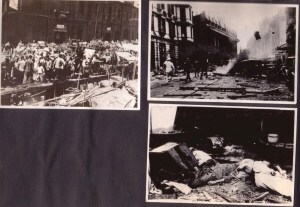
The China Marines: A fascinating part of Marine Corps history
Our grandfather and the 4th Marines (aka China Marines) who guarded the American sectors of the Shanghai International Settlement, and international settlements “aka legations” around China, represents a unique period of American presence in Asia that many are unaware of. From protecting American interests and citizens, to witnessing the rising tensions with Japan, these Marines had a front-row seat to a violent history unfolding that would last until August 1945.
Yet, in Shanghai, they were told to hold fire by the highest echelon – despite the bombing, violence, executions, stray gun fire and taunting they witnessed.
Hold fire.
When I discovered this history, and as I write it now, my heart rate rises. Every single time.
I sense the frustration my grandfather and the Marines must have felt – being ordered to hold fire while witnessing atrocities and protecting refugees flooding into the Settlement – surely influenced their later wartime leadership.
Attack on Pearl Harbor
When Pearl Harbor finally came, they’d already seen what the Japanese military was capable of four years earlier.
My Rifle the Creed of a United States Marine
In March 1942, shortly after the Japanese attacked Pearl Harbor, as CO of the Marine Barracks San Diego, Rupertus penned “My Rifle: The Creed of a United States Marine” – words that would become immortalized in Marine Corps history and recited by every Marine since.
WWII Pacific Theater
These experiences in China would prove crucial when he later commanded the 1st Marine Division in the Pacific Theater during World War II, leading Marines through brutal campaigns against the Japanese from Tulagi and Guadalcanal to Cape Gloucester and Peleliu.
Major General Rupertus lived until March 25, 1945, defying his early medical prognosis by four decades. It’s incredible that he and the Marines, soldiers, sailors and airmen served through the grueling conditions of the Pacific campaigns. I imagine the stress of commanding the division through four island campaigns would have been enormous.
Home
When he came home in 1944, he looked years older than when he left for war in 1942. And, he only had four months with Sleepy and my dad before he died in 1945 (at a party of 1stMarDiv veterans at the Marine Barracks in Washington, DC).
Legacy
His legacy lives on not only in the Rifle Creed but in the traditions and spirit of the Marine Corps he helped shape during pivotal moments in American military history. From that determined young cadet who refused to accept medical limitations, to the general who led Marines in combat, his story embodies the perseverance and warrior spirit of the Corps.
Thanks goodness I (and those that helped me) https://amyrupertuspeacock.com/acknowledgements/ had the passion, energy, time and grit to chase history.
It was 100% worth it.
Get your family story down for the record. Now, before it is too late.
In closing, God bless those who fought so bravely in WWI and WWII to those who continue to protect us today.
S/F
PS. God, I pray for smart leaders, who know this history – so they can keep us out of war.
The post From Cadet to Marine – The Remarkable Journey of William H. Rupertus appeared first on Amy Rupertus Peacock.
September 18, 2024
Old Breed General News
This Scuttlebutt is true.
I hope you had a wonderful summer and are looking forward to the crisp Fall weather, time with friends, and a good football season for your favorite team. We’ve been through quite a whirlwind since May, which was just starting to settle down before our September rugby matches started up. Yes, both my son and daughter play rugby!
In May, my husband and I spent two weeks in Thailand and Singapore, then were at Wrightsville Beach, NC, the Adirondacks in NY, and Ireland.
Although my father and grandparents had traveled to the Far East, this was my first time experiencing it. The journey was long—22 hours in total—starting in Charlotte, with stops in Boston and Qatar, before finally landing in Bangkok. During our brief layover in Qatar, it became evident that we had entered a different, more exotic corner of our world.
Thailand. 
We visited Bangkok, Chiang Mai, and Phuket. Despite it being the “shoulder season” (or rainy season), we were lucky enough to avoid any rain. I was struck by how kind the Thai people are—both to visitors and to one another. This was active travel; we walked, ran, biked, hiked, and kayaked. The food was delicious, and if we had stayed any longer, I think we would have gained a few pounds trying everything.
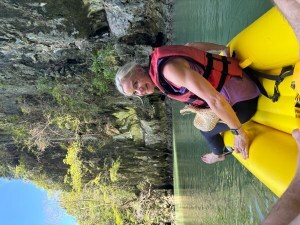
Singapore. 
After touring Thailand, we traveled to Singapore for the 2024 Rotary International Conference, which felt like the Olympics. More than 14,000 Rotarians from the U.S. and around the world attended.
Singapore is immaculately clean, and the metro system is just as spotless and efficient. Everywhere we went, the city was bursting with greenery. Our hotel and the surrounding buildings were adorned with outdoor plants, both at ground level and on multiple floors. Singapore is also making strides to become the sixth official “Blue Zone” for longevity, focusing on creating a more walkable, biking and runner-friendly environment.
Given my love of history, I had to explore Singapore’s significant role in WWII. We visited the National Museum of Singapore, and I also took time to see the WWII War Memorial, which was conveniently located near our hotel. As you may know, the Japanese occupation was particularly harsh on Singapore during WWII.
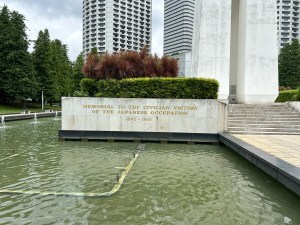
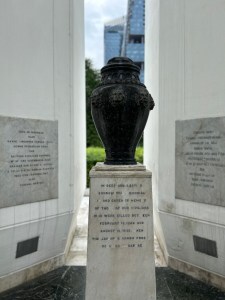
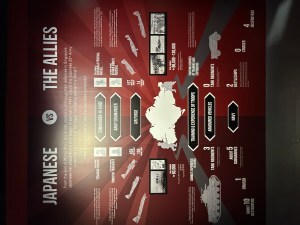
It was interesting to learn how Singapore carefully rebuilt itself after they officially gained independence in 1965. And, yes, its airport is pretty amazing.
Ireland. 
In August, we got our kids off to college, and jumped on a plane for Ireland to celebrate our friend’s 60th birthday. He is from Dublin, and we had a fun time with his family and friends in Dublin, Wexford and Roundstone! The crew from the US drank a lot of Guinness . In fact, many Irish people of all ages drink it as well. I have to say … I prefer a good Irish Whiskey like my grandfather.

The Book
I am still working to break the silence and promote this history, and finally got permission from our publisher to do an e-book of my original (edited) manuscript, which will be a companion to Old Breed General. Cheers to that!
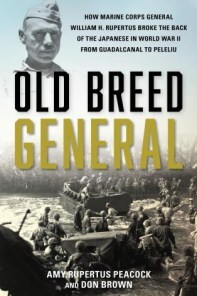
2024 Author Talks
We had a wonderful time speaking at Charlotte’s Southminster Retirement Community in April, and will be speaking at Charlotte’s Cypress Retirement Community in celebration of Veterans Day on November 11. The day after the Marine Corps 249th Birthday!
The Pacific War Channel
In August, this YouTube channel released a documentary of General Rupertus, based on previous interviews Don and I did with them in 2022. It is good. Though, it was one of my first few interviews. Thankfully Don, an attorney and my co author, is a pro at speaking. I am slowly getting better. The “Old Breed” General Rupertus USMC Full Documentary has already had 9K+ views: https://youtu.be/LJWgG66Iank?si=QeTIsZgMkhKWXWuT
A Special Note to Vietnam Veterans
Ahh, how I wish my Dad was alive to share his knowledge and experience in war with me. He died in 1991 of Agent Orange related cancer, yet I still miss him -and think of him every day.
.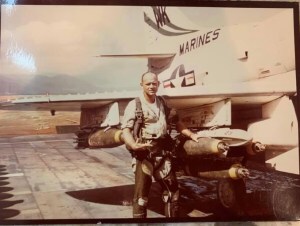
In addition to WWII and Korea War vets, I’ve have had the honor to meet so many Vietnam War Vets on this book journey, and even a Vietnam Veteran, Kirk Hauser, who served with my father in Chu Lai, and created a PDF for my sisters and me to understand a difficult operation they worked through in Vietnam.
Thankfully, there are books coming out about the Vietnam War to give me glimpses of what it was like for our father and other Vietnam Veterans.
This year my friend Tracy Himes Smith published a book called Pennies from Vietnam: A Sister at Home, a Brother at War about her brother Larry’s experience in the Army’s 1stCalvaryDiv and his 99 letters home. It is a good read I recommend it – though it’s brutally tough at times.
I also read a book called “The Women” by Kristin Hannah about women nurses in Vietnam and the surgeons and aviators they knew. Like Tracy’s book, this gives a clear vision of what hell our men and women who served in Vietnam went through at war, and when they got home.
God Bless You Vietnam Veterans. 
Recent Blog Posts you can find on site:
The Critics: https://amyrupertuspeacock.com/the-critics-the-good-the-bad-and-the-ugly/
Rupertus’s Roots Began in Germany: https://amyrupertuspeacock.com/general-rupertus-roots-began-in-germany/
A Tenacity of Purpose -Original Manuscript Summary: https://amyrupertuspeacock.com/a-tenacity-of-purpose/
And, in case you missed it:
Who is General Rupertus? https://amyrupertuspeacock.com/who-is-major-general-rupertus-and-why-did-i-want-to-write-this-book/
In closing, please reach out to me with your thoughts and questions. And, share the news of our Old Breed General book!
I will continue to post videos from the Pacific, etc on his YouTube Channel: https://www.youtube.com/@MajGenRupertus
On Facebook? Please connect. I have a Facebook group for the book where I share photos, thoughts and intel about our grandfather and WWII Pacific: https://www.facebook.com/groups/majgenrupertus
Best regards and Semper Fidelis,
Amy
The post Old Breed General News appeared first on Amy Rupertus Peacock.
May 2, 2024
The Critics -The Good, the Bad and the Ugly
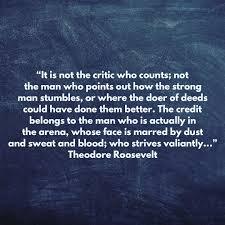
It’s not the critic that counts…..or is it?
You know those good, bad, and ugly critics that take up space in your head?
It is ultimately you (not the critics), in the arena, doing your best day by day, with grit, sweat, and tears to persevere on your craft.
When you step into the spotlight, whether it’s through writing and publishing a book, delivering a speech, posting a video, and engaging on social media about your work, you’re answering a call to share your voice and ideas with the world. As in my case, to share stories and history that lights the way for others.
It’s a courageous act of vulnerability, a leap of faith into the unknown, and with it comes the inevitable chorus of voices: the critics, the good, the bad, and the ugly.
But, as all leaders and creators know, critics, in their various forms, come with the territory of putting oneself in the arena.
Critics can be the discerning voices that help you refine your craft. But the harsh critics who seem to relish tearing down your efforts with their keyboard- or the indifferent observers – ultimately offer little substance.
So, do critics count? In a way, yes. Their feedback, whether positive or negative, can provide valuable insights into how your work is perceived. And, why you must carry on.
Positive feedback allows you to see blind spots, refine your message, and hone your skills. Constructive criticism, delivered with kindness to help you improve, can be invaluable in your growth as a leader and creator.
In my early days of blogging, devotion writing for my church, and later, the making of Old Breed General, I was often nervous about hitting publish.
I am thankful I did press publish. And for constructive criticism from my family and friend’s, my co-author, editors, and several Marines on military facts and jargon.
However, not all criticism is created equal. There’s the bad and the ugly critics—the kind of criticism steeped in negativity, devoid of substance, and often fueled by personal biases or misinformation. This type of criticism can be hurtful, paralyzing, and ultimately unhelpful. Sometimes straddling the line of downright slander.
It’s important to discern between constructive feedback and negativity and not let the latter derail your creative journey.
Thankfully, I have learned the difference over the years – and it’s been reinforced since Old Breed General was published two years ago. Ultimately, while it’s natural to feel a twinge of discomfort or frustration in the face of criticism, the good, the bad, and the ugly, it’s important to remember that it’s all part of the process.
So folks, let us embrace the constructive feedback, learn from it, and use it to fuel our growth.
And as for the rest—the barbs, the arrows, the venomous words – let them fly by you, so you can stay laser-focused on your mission and the meaningful impact you’re making in the world.
Onward.
The post The Critics -The Good, the Bad and the Ugly appeared first on Amy Rupertus Peacock.
February 5, 2024
General Rupertus Roots Began in Germany
To understand the drive of our grandfather, General William “Bill” Rupertus, we need to set the stage of our grandfather’s paternal side. Our father’s side of the family.
Way back in 1980, for our father’s 40th birthday, our mother hired Ginny Hunt, a genealogist, to do a Rupertus family history for our dad Patrick Hill Rupertus. Wow, did she work hard. She delivered the detailed report in a red folder along with a family tree we still have.
Years before ancestry.com, she was able to trace our family back 200 years to Johannes Rupertus in Kirchheim, Germany.
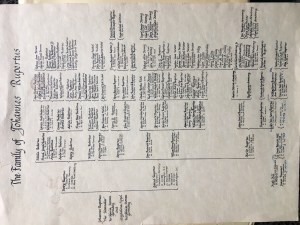
Germany.
The Rupertus’s came from a family of entrepreneurs and community leaders with a strong German work ethic who emigrated to America. Gen. Rupertus’s grandfather, Gottlieb Rupertus, and great uncle Henry Rubertus, who emigrated from Germany, also served in the Civil War.
Johannes Rupertus, his great-grandfather, was a master shoemaker who lived and worked in the riverside town of Kirchheim in Baden-Württemberg, Germany. He married Magdalena Siefert, and they had two sons, Gottlieb and Henry.
Gottlieb (our great, great grandfather) was named for his Godfather, Gottlieb Lange, the Oberbürgermeister of Kirchheim at the time and dear friend of Johannes. When Gottlieb’s wife Magdalena died in her 30s, Johannes remarried, and his sons set their sights on creating a new life in America.
America.
When Gottlieb turned 21, he left Kirchheim by ship and landed in Baltimore City, Maryland in July 1851. Gottlieb eventually moved to Washington, DC, to join the large German American community to look for work and a German wife.
His brother Henry followed Gottlieb to America when he turned 21 but settled further west in Harrison County, Indiana. Interestingly, at customs, the agent wrote his name as Henry Rubertus vs. Henry Rupertus, which for some reason, he did not challenge. As a result the Rupertus family is also part of the Rubertus family.
Washington, DC.
Gottlieb applied for U.S. citizenship under his preferred middle name of Herman on July 15, 1854 (Though, everyone still called him Gottlieb).
While waiting for his naturalization date, he met his beautiful bride, who had emigrated from Hesseldorf in Hessen, Germany. They were a handsome match. He was 5’6 with a light complexion, crystal bright blue eyes, and a mess of silky dark brown hair. Marie Kramer, his future wife, was six years younger, slim, 5 feet tall, with blonde hair, a heart-shaped face, shiny blue eyes, and a cute dimpled chin. In 1855, this young German couple was happily married and quickly started a family.
Their first son, Henry Rupertus, was born in December 1856. Gottlieb gained his U.S. citizenship a year later in November, 1857. Their second son, William Henry Rupertus, was born in July 1858. During this time, Gottlieb’s father, Johannes Rupertus, died, so Gottlieb traveled alone to Germany to close out the family responsibilities and say a final goodbye to his previous homeland. He was now an American citizen.
The Civil War.
When Gottlieb returned, the drumbeat of a US Civil War was beginning to get louder. He arrived in time to welcome their third son, General Rupertus’ father, Charles Rupertus, who was born on December 3, 1860.
Four months later, Gottlieb enlisted as a sergeant in Washington’s 8th Battalion of the District of Columbia Volunteers and served for three months before being honorably discharged for fulfilling his duty.
Meanwhile, his brother Henry Rubertus joined the famed 23rd Indiana Infantry Regiment and served for three years.
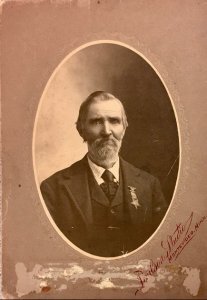
Henry Rubertus
Gottlieb and Maria lived at 1326 6th Street in Washington, DC. After Gottlieb returned from war, he used the inheritance he saved from his father Johannes to buy, own and manage a luxury goods store in Washington for many years. This store carried premium embroidery materials, Berlin Zephyr Worsted wool, Genilles Headdresses, fans, sofa cushions, slippers, purses, floss and tapestry silk, crochet cotton, canvas, beads, and sultry items from Paris, including patterns for braiding and embroidering.
President Lincoln is assassinated in Washington, DC.
In 1860 the Washington National Monument was opened. And in 1865, days after the end of the Civil War, President Lincoln was shot and killed by John Wilkes Booth in Ford’s Theatre in Washington, DC, shocking the country and Washingtonians. A huge funeral procession took place that the Rupertus family may have watched from the sidelines.
Raising three boys and running a retail store was a blessed handful. Yet, their family grew. Gottlieb and Marie’s fourth son, John Frederick Rupertus, was born in May 1870.
I imagine Marie loved her precious boys, but secretly hoped for a girl. Her prayers were answered four years later. Gottlieb and Maria’s baby girl arrived healthy, happy, and cooing into the family. Mary “Mamie” Rupertus was born in November 1874.
Maria had seven children with Gottlieb, but only five survived—the four boys and Mamie.
The patriarch, Gottlieb Rupertus, dies at 51.
Sadly, Gottlieb died of a heart attack on January 1, 1886, at the young age of fifty-one.
Maria loved Gottlieb dearly and chose never again to remarry. Luckily, she was surrounded by family and the tight German-American community.
At his death, they lived at 1418 P Street, N.W. Washington, DC.
There sons Charles, Henry, and William had already moved out. The two youngest children were still living at home and thankfully kept Marie busy during the years after Gottlieb’s death. John Frederick was 16. Mamie was the youngest at age 12.
Prospect Hill Cemetery.
Gottlieb Rupertus, the family’s patriarch and father of five, is buried in the old Rupertus family gravesite at the German-American Prospect Hill Cemetery in Washington, DC. https://www.prospecthillcemetery.org/
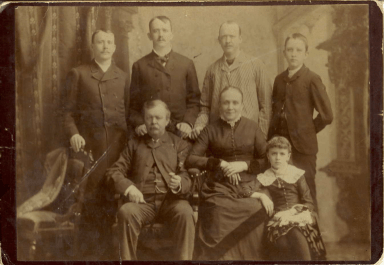
Gottlieb and Marie Rupertus with family.
General Rupertus’s parents and siblings.
Charles Rupertus, (General Rupertus’s father and our great grandfather), was 26 and married when Gottlieb died. Charles had met and married Augustina Miele of Baden Baden, Germany after she emigrated to the United States with her family in 1883 and became a U.S citizen.
Augustina was a strong-minded outgoing woman with rosy cheeks, light hair, and a humorous sparkle in her bright blue eyes. She had a heart full of kindness, just like Charles’s mother. They married in 1884 and settled in Washington, DC.
Charles and Augustina had three children within four years. Mary Louisa was born December 10, 1885, Frederick George was born November 1887, and William Henry “Bill” Rupertus, our grandfather, arrived November 14, 1889.
Charles and Augustina enjoyed a good life in the close-knit German American community of family and friends in Washington, DC.
Though our grandfather would choose a military career over real estate and retail, he came from a long line of entrepreneurs, starting with his great grandfather Johannes Rupertus the “Master Shoemaker.” That self-starting, entrepreneurial spirit surely impacted future Marine Rupertus. Add the military service of his grandfather and great uncle.
No sitting around.
Retail and Real Estate.
In Washington DC, his grandfather Gottlieb owned a luxury goods store. His father, Charles, owned a restaurant from 1892 until 1907 when he sold it and bought a cigar store, which he managed until 1919. With any profit, Charles and Augustina invested in D.C. real estate and lived in various locations in the Northwest corridor of Washington throughout their lives.
Rupertus’ uncle, John Rupertus, owned and operated a bar on 14th and P. According to what his son John Rupertus (a former Baltimore City policeman) said, rumor has it, the bar was also a brothel. Interestingly, years later, John would meet Rupertus in the Pacific in WWII.
Many of their friends, neighbors and citizens of D.C. were part of a wave of Germans who immigrated to the United States from Germany in the early 19th century.
They were soldiers in the Civil War, craftsmen, tradespeople, shopkeepers, social champions for the underserved, churchgoers, and beer brewers who contributed their varied skills and talents to the buildings and history of Washington DC.
A talented German American, August Gottlieb Schönborn, devised the dome of the United States Capitol. Christian Heurich owned Heurich Brewing Company, the largest brewery in Washington, DC. Heurich employed many German Americans and actively supported the German orphanage and charitable causes.
You can read about Heurich here: https://heurichhouse.org/
And, the German influence in Washington, DC here: https://www.goethe.de/ins/us/en/kul/sup/deu/was.html
As his granddaughter, I imagine our grandfather as a young boy and teen running around Washington, enjoying this tight community, and having a supportive family with an entrepreneurial spirit that inspired a degree of determination, courage, character, and duty.
Concordia German Evangelical Church.
Rupertus had a solid faith foundation that would sustain him for life battles.
Rupertus’s parents, family, and friends attended the Concordia German Evangelical Church in Northwest Washington (Circa 1833). Here, Gottlieb was baptized as an adult and married Marie, his parents Charles and Augustina, were married, and Rupertus was baptized and participated in communion classes with his brothers and friends. Augustina was also a leader at the German Orphanage, just as his grandmother had been.

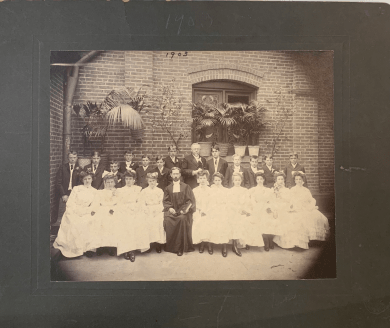
Rupertus on far left next to his brother.
The German American parishioners at the Church remained committed to the Church, as the Church has been committed to them over the years, despite various challenges to the German community, including church politics, mergers, and two world wars brought on by Germany.
If Rupertus were to stroll by this Washington, DC church like my sister and I did in 2023, he would see that the outside still looked like it did in 1932. Going inside, he would recognize the Church’s stained-glass windows and the words “Zum Andenken,” meaning “in memory,” in honor of the members and clergy who served the Church.
On the 1st and 3rd Sundays of every month, they still offer services in German. German customs and traditions are supported. Rupertus could join the Christmas Eve service in Germany and attend many other German celebrations throughout the year -just as he did when he was younger.
He witnessed the “Glory Days” of US power and innovation.
The United States was in a progressive era of innovation and power, often referred to as the “glory days.” The United States was on its way to being a super achiever in politics, social and environmental change, and invention. Between 1900 and 1920, some of the most critical designs in U.S. history took place, with many “firsts.”
Opening the Panama Canal.
In 1901, when Rupertus was twelve, Theodore Roosevelt became president of the United States. Roosevelt was an active and activist president who served two terms, ending in 1909.
Roosevelt, a Republican, was a driving force in consumer safety, protecting the environment by designing parklands across the country forever wild and advocating for economic prosperity and military power. He was a staunch promoter of the opening of the Panama Canal, as it would shorten the transportation route for commerce and the U.S. Navy and solidify the role of the U.S. on the world stage.
The Model T.
By 1903, when Rupertus was fourteen, he witnessed a new invention arriving on the streets of Washington, DC, that would change the world. Henry Ford, another visionary entrepreneur, formed the Ford Motor Company and developed a transport vehicle unlike anyone had seen before – an automobile.
Ford sold their first car, a Model T, for $950.00. This invention by Ford made a huge social impact. People could travel faster and further than on horse, buggy, or streetcar.
Washingtonians could now take a Sunday to drive out to the county and farms in Virginia and Maryland, picnic by the roaring waters at Great Falls Park, paddle a boat on the Potomac River in Georgetown, and get home much faster. Though living in the city, they may not have needed the car since there were so many options for transportation. Washington, DC, was a transportation mecca in the early 20th century.
Rupertus’s military service begins in high school.
Rupertus pursued a military path in high school. He attended Emerson School and McKinley Technical High School as a cadet. McKinley is still at 7th Street N.W. and Rhode Island Avenue N.W. in Washington, DC. Its motto today was made clear to Rupertus as a student: “No excuses, just solutions.”
Rupertus and his siblings were in the center of a tidal wave of “no excuses.” He honed his science, engineering, history, and language skills as a cadet for four years while watching the world change.
Your roots matter.
Now you have some background on our Rupertus family and what may have influenced General Rupertus as a young boy.
I am so thankful the genealogist Ginny Hunt did our genealogy back in 1980 that gave us clues to our family roots, especially since our parents died young, and we never had the chance to ask them as adults what more they knew about family history.
Whenever I visit Washington, I first go to Arlington Cemetery to visit our parents and grandparents, and graves of extended family and friends. It’s so peaceful there.
My sisters and I also love to go on a treasure hunt to find many of the old Rupertus houses, stores, and gravesites at Prospect Hill Cemetery.
Rupertus’s father, Charles and his mother Augustina, and many German Americans who attended the Concordia Church through 1950 now lie at rest with Gottlieb in the ancient-looking tree-lined Prospect Hill Cemetery, which the Church owned. It’s a cool old cemetery that is a special part of Washington DC history.
The post General Rupertus Roots Began in Germany appeared first on Amy Rupertus Peacock.
January 31, 2024
A Tenacity of Purpose
Our book “Old Breed General” published February 2022, catapults readers into the storm of WWII in 1942, where Rupertus and the 1st Marine Division face the Japanese in a ferocious war in the Pacific alongside the US Navy, Army, and our Allies.*
Though we flashback to Rupertus’s early life, this tale is not confined to the battlefields alone, as you will read in the book.
My original manuscript called Tenacity of Purpose (not published) covered his whole life.
Perhaps readers don’t want all that chronological data. But….
Many readers told me they wanted to know more about General Rupertus.
Therefore, this information I will be posting will be a companion guide for family and those curious readers.
With my personal insight.
I plan to break it into four parts. For those who would like to know about his experience pre WWII, and what road he took from an enlisted man to become a Major General in the Marine Corps during WWII, this is the story.
Part I: Family Roots to the end of WWI
Part II: Haiti to Peking
Part III: Shanghai to the 1st Marine Division
Part IIII: Pearl Harbor to the Pacific in WWII
How did this all get started?It actually began with our Mom, Gail Bennett Rupertus.
Yes! I learned our Mom began this journey into the past after our father died of cancer in 1991, but never finished it because was diagnosed with ALS in 1999 (At age 58!), and died of ALS in 2004.
Flashback to 1998.As former Marine, author, and revered historian Colonel Joseph H. Alexander (now deceased) penned in response to our mother’s inquiry regarding a Lou Reda Production on the Pacific and Peleliu on April 16, 1998:
“Any general or admiral who commands in a great battle becomes, thereby, a public figure, subject to the evaluation by future historians. In the battles of World War II, legendary commanders like MacArthur, Patton, Montgomery, and Halsey each had their decisions reviewed and critiqued, often in less favorable terms. That’s history. I respect the man as I do any commander in a tough spot. He certainly had the much more difficult task of fighting that battle (Peleliu) than I have had in analyzing it a half-century later. Please let me suggest an alternate course for you; the field of military biography is crying for fresh accounts of World War II Marine commanders. Why don’t you undertake the story of the life and service of General Rupertus, a distinguished Marine about whom little is known?”
I wish we had a chance to meet you Col. Alexander.
After our parents died, my sisters and I were left with trunks full of military history from two Marines; our Grandfather and his son Patrick Hill Rupertus (our father).
There was no talk of doing anything with it other than …
We agreed our Grandfather’s life would make a great movie someday.
This journey took flight again in 2016 when Don Brown, a lawyer and former Navy JAG officer, stumbled upon our grandfather, General William H. Rupertus, during his research for “The Last Fighter Pilot.”
Like many others, Don saw the potential for a book that would honor our grandfather’s memory, serving not only our family and the Marine Corps but also contributing to the historical record.
He told me I should write it “before it was too late.”
Yes, time flies. Don’t let the drift set in.
There emerged a purpose—a chance to weave a narrative from what we had in those trunks and family files.
Silence creates a problemWhy did it take us so long to pick up where Mom left off?
The prospect of such a project was daunting, overshadowed by being married with kids, jobs and the loss of those family legends.
But, it was time to get off my ass, as our Dad would say.
I soon learned the silence surrounding our grandfather and other veterans perpetuated a troubling void, leaving their stories untold, and their experiences shrouded in mystery.
With many lessons learned- lost to time. And too often, authors and historians leaned on hearsay, unwittingly perpetuating the void and inaccuracies.
#Mojo.
It was time for us to seize this unique opportunity and add facts to the narrative and contribute to history.
We began this when Old Breed General was published in 2022 (with Don as my co-author)…. twenty-four years after our mother was given this challenge by Col. Alexander!
Discovering our Grandfather
When I started down this path, we knew very little about our Grandfather. Or, what all the military and family memorabilia in those trunks and our home library might have meant to him.
We were aware that he had reached the two-star rank of major general in World War II, was the author of the legendary Rifleman’s Creed that many a Marine has since committed to memory, and also been featured in movies and videos.
I knew he lost his first family, married our young grandmother Alice Hill Rupertus aka “Sleepy,” and welcomed a son—our father.
We also knew he had served as a leader in the 1st Marine Division, had been at Guadalcanal and someplace called New Britain, and, as he would put it,“Bloody Peleliu.” I knew he died when my father was young, and that a naval destroyer, the USS Rupertus, was named in his honor. That was it.
What was the in-between—mainly, who was he? What sort of man, in other words, existed beyond the Marine Corps legend?
I hadn’t considered how massive this undertaking would be, knowing he died of a heart attack in 1945, and all of his friends and our family who knew him were also gone.
Hunker DownBy hunkering down and grabbing this mission like a bulldog, and not letting go, we’ve made progress!
After 80 years of carrying those trunks, uniforms, flight jackets, Marine Corps swords, guns, knives and medals, books and years of research gathering, joint work, Old Breed General, and an exciting book tour, I’m thrilled at our accomplishments.
We now know so much more than we started back in 2016. We could sit down and talk to our grandparents for hours.
Once you learn about your family’s experience during two world wars -it’s hard to leave behind.
And you pray we will never have another world war.
I hope you’ll enjoy learning more about this travel into the past as much as my sisters, Don, the readers and I have.
*Rupertus was a commander of the 1st Marine Division in WWII.
There were a total of Six Marine Divisions in WWII. USMC EDU
The post A Tenacity of Purpose appeared first on Amy Rupertus Peacock.
Discovering my Marine Grandfather
Our book “Old Breed General” published February 2022, catapults readers into the storm of WWII in 1942, where Rupertus and the 1st Marine Division face the Japanese in a ferocious war in the Pacific alongside the US Navy, Army, and our Allies.*
Though we flashback to Rupertus’s early life, this tale is not confined to the battlefields alone, as you will read in the book.
My original manuscript biography (not published) covered his whole life.
Perhaps readers don’t want all that chronological data. But….
Many readers told me they wanted to know more about General Rupertus.
Therefore, this information I will be posting will be a companion guide for family and those curious readers.
With my personal insight.
I plan to break it into four parts. For those who would like to know about his experience pre WWII, and what road he took from an enlisted man to become a Major General in the Marine Corps during WWII, this is the story.
Part I: Family Roots to the end of WWI
Part II: Haiti to Peking
Part III: Shanghai to the 1st Marine Division
Part IIII: Pearl Harbor to the Pacific in WWII
How did this all get started?
It actually began with our Mom, Gail Bennett Rupertus.
Yes! I learned our Mom began this journey into the past after our father died of cancer in 1991, but never finished it because was diagnosed with ALS in 1999 (At age 58!), and died of ALS in 2004.
Flashback to 1998.
As former Marine, author, and revered historian Colonel Joseph H. Alexander (now deceased) penned in response to our mother’s inquiry regarding a Lou Reda Production on the Pacific and Peleliu on April 16, 1998:
“Any general or admiral who commands in a great battle becomes, thereby, a public figure, subject to the evaluation by future historians. In the battles of World War II, legendary commanders like MacArthur, Patton, Montgomery, and Halsey each had their decisions reviewed and critiqued, often in less favorable terms. That’s history. I respect the man as I do any commander in a tough spot. He certainly had the much more difficult task of fighting that battle (Peleliu) than I have had in analyzing it a half-century later. Please let me suggest an alternate course for you; the field of military biography is crying for fresh accounts of World War II Marine commanders. Why don’t you undertake the story of the life and service of General Rupertus, a distinguished Marine about whom little is known?”
I wish we had a chance to meet you Col. Alexander.
After our parents died, my sisters and I were left with trunks full of military history from two Marines; our Grandfather and his son Patrick Hill Rupertus (our father).
There was no talk of doing anything with it other than …
We agreed our Grandfather’s life would make a great movie someday.
This journey took flight again in 2016 when Don Brown, a lawyer and former Navy JAG officer, stumbled upon our grandfather, General William H. Rupertus, during his research for “The Last Fighter Pilot.”
Like many others, Don saw the potential for a book that would honor our grandfather’s memory, serving not only our family and the Marine Corps but also contributing to the historical record.
He told me I should write it “before it was too late.”
Yes, time flies. Don’t let the drift set in.
There emerged a purpose—a chance to weave a narrative from what we had in those trunks and family files.
Silence creates a problem
Why did it take us so long to pick up where Mom left off?
The prospect of such a project was daunting, overshadowed by being married with kids, jobs and the loss of those family legends.
But, it was time to get off my ass, as our Dad would say.
I soon learned the silence surrounding our grandfather and other veterans perpetuated a troubling void, leaving their stories untold, and their experiences shrouded in mystery.
With many lessons learned- lost to time. And too often, authors and historians leaned on hearsay, unwittingly perpetuating the void and inaccuracies.
#Mojo.
It was time for us to seize this unique opportunity and add facts to the narrative and contribute to history.
We began this when Old Breed General was published in 2022 (with Don as my co-author)…. twenty-four years after our mother was given this challenge by Col. Alexander!
Discovering our Grandfather
When I started down this path, we knew very little about our Grandfather. Or, what all the military and family memorabilia in those trunks and our home library might have meant to him.
We were aware that he had reached the two-star rank of major general in World War II, was the author of the legendary Rifleman’s Creed that many a Marine has since committed to memory, and also been featured in movies and videos.
I knew he lost his first family, married our young grandmother Alice Hill Rupertus aka “Sleepy,” and welcomed a son—our father.
We also knew he had served as a leader in the 1st Marine Division, had been at Guadalcanal and someplace called New Britain, and, as he would put it,“Bloody Peleliu.” I knew he died when my father was young, and that a naval destroyer, the USS Rupertus, was named in his honor. That was it.
What was the in-between—mainly, who was he? What sort of man, in other words, existed beyond the Marine Corps legend?
I hadn’t considered how massive this undertaking would be, knowing he died of a heart attack in 1945, and all of his friends and our family who knew him were also gone.
Hunker Down
By hunkering down and grabbing this mission like a bulldog, and not letting go, we’ve made progress!
After 80 years of carrying those trunks, uniforms, flight jackets, Marine Corps swords, guns, knives and medals, books and years of research gathering, joint work, Old Breed General, and an exciting book tour, I’m thrilled at our accomplishments.
We now know so much more than we started back in 2016. We could sit down and talk to our grandparents for hours.
Once you learn about your family’s experience during two world wars -it’s hard to leave behind.
And you pray we will never have another world war.
I hope you’ll enjoy learning more about this travel into the past as much as my sisters, Don, the readers and I have.
*Rupertus was a commander of the 1st Marine Division in WWII.
There were a total of Six Marine Divisions in WWII. USMC EDU
The post Discovering my Marine Grandfather appeared first on Amy Rupertus Peacock.