
Stephen Alder's Blog
October 17, 2025
Remembering Pictures in a Cave
 What is this Animal?Roommates
In Deehabta’s Song Krissa and Jo are roommates who live in Krissa’s apartment on the planet Erunanta. One day Jo was surprised to see an animal on her bed. I suppose if this particular animal suddenly appeared on my bed I would be surprised too. But I would immediately recognize this creature and wonder why a rabbit was on my bed. But Jo’s surprise was on a deeper level than mine would be because she could not identify the creature on her bed. Her first response was to misidentify it. “Oh it’s Krissa’s skritcher.” (Author’s note: a skritcher is a cat.) But then Jo realized that this creature looked very different than a skritcher.
Unraveling the MysteryJo now was not just surprised. She was completely mystified. Not only had she never seen this kind of animal in her life, as far as she knew there was no such animal in the animal kingdom. The mystery deepens when we examine why Jo saw this animal.
Jo saw an animal appear on her bed.The animal seemed to be of a nonexistent species.The animal was a hallucination.The hallucination was caused by Krissa’s singing.The key to understand this mystery is that Krissa, even though she did not realize it, was singing verses of an epic poem (The Epic Poem). An epic poem, like the Iliad or Beowulf, tells a story of heroic or epic events of the past. It keeps the memory of those events alive. So memory is key to understanding Jo’s experience. This epic poem, we learn, is a tradition among the Onye people. Whenever the epic poem is properly recited (or sung) people have visions of animals. As Drey explained to Ilyani, “No one sees animals native to Caderyn or the other planets. … And only certain animals are seen.”
Animals of a Forgotten WorldThis brings us to an idea that people have theorized about in different ways, whether it is inherited memory, past lives, or collective unconscious (Collective Unconscious). The inhabitants of the planets in Deehabta’s Song are descended from the original settlers, but the current inhabitants have no written history to tell them where these settlers came from or how they arrived. Certain memories of that history, however, were contained in the epic poem.
The poem therefore was a virtual cave painting. Cave paintings on earth have pictures of what our ancient ancestors observed in their daily lives. And mostly they depict animals, including animals that are now extinct, animals that do not exist in our era. When Krissa sang this poem, Jo entered a deep cave in the subconscious realm where animals are displayed—animals that only the ancient settlers knew.
Get Deehabta’s SongThe post Remembering Pictures in a Cave appeared first on A Warrior's Journey.


October 6, 2025
The Struggle to Know Ourselves
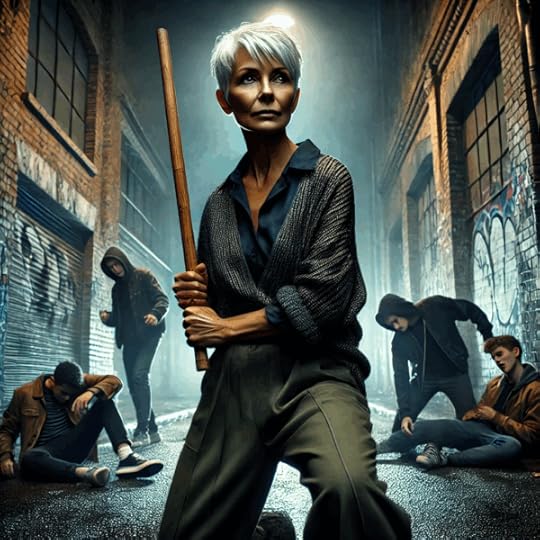 The Main Character
Krissa’s personal struggle with the past is a major theme of Deehabta’s Song. The character of Krissa developed over a long period of time. When I first imagined the book, she was not the main character. And it took the help of a developmental editor to bring out Krissa’s full depth, something I truly appreciate.
I love this character. She is so sincere. Her reaction to use her fighting skills to help others is instantaneous. She doesn’t hesitate. Her tendency to fight before she thinks gives her an advantage in a street fight, but it also gets her into trouble. In her sixties, when she struggles with deep mental issues, her reliance on fighting through her problems by herself doesn’t help her, and her roommate finds her very difficult to live with.
SuccessIn her prime, Krissa is not someone you would want to attack. Even from behind. Here is an excerpt from the book about an occurrence when she is 36:
Struggles
Suddenly, she senses the presence of someone behind her. Her fighting instincts kick in. She has always had a heightened awareness of her surroundings, and now she hears what she knows is a staff slicing through the air behind her. She reacts immediately, spinning in the direction of the staff’s motion and pulling it forcefully out of the hands of her attacker as it approaches her. As she continues her spin, she is now behind the man and delivers an upward blow to his head with her newly obtained staff. She has already spotted a second man holding a staff as the first guy tumbles to the ground. Now, with perfectly fluid motion, she rotates her staff at high velocity to knock the staff out of the hand of the second man and delivers a swinging upward blow to his jaw, which knocks him flat.
She throws the staff to the ground and stands over the two men. They are quite younger than she is, probably teens, with scruffy clothes and long hair. “Who in the pits are you guys?” she demands. Neither of them can answer, as one is unconscious and the other is lying on his back moaning in pain. She presses a button on her comdev to contact emergency services. A dispatcher takes the call.
“What is the nature of your emergency?”
“I was assaulted in the street,” Krissa responds.
“What is the location of the assault?”
“At my current coordinates.”
“Do you need medical attention?”
“No, but my attackers do.”
In spite of her success, one spontaneous act results in difficult circumstances for her. Here is another excerpt from the same time period:
Despair
Before she acts, she thinks about the consequences. Challenging the EPF is foolhardy. She knows what could happen to her. However, she is compelled by a drive to fight the injustice done to her and her friends. As she paces back and forth, rage ultimately overcomes reason. Making what could be the worst decision of her life, she spots the EPF vehicle, waves to the agents inside, and charges into the building.
At this provocation, two EPF agents immediately emerge from the vehicle with their weapons drawn and follow her in. The agents hesitate near the entrance and look around to see if they can locate Krissa, but she has positioned herself behind some scaffolding. Before they have a chance to spot her, she jumps in front of them, knocks the weapons out of their hands, and runs directly between them to go outside. Krissa hears a flurry of curses from the men as she continues running and attempts to disappear in the crowd. When she arrives at Pioneer Plaza, she looks around to see if she is being followed. Surprised that she is not, she stands at the tram stop with her senses on high alert and her fight reactions on a hair trigger. She remains in this heightened state the entire trip home. She is not foolish enough to assume that because the EPF has not tried anything, they are reluctant to come after her. In her apartment, she sits in her chair—EB off—holding her staff. It is not long until she hears the door chime and an angry voice coming through the speaker. “This is General Stasis of the EPF. I’m coming in.”
Krissa’s troubles pile up to the point she begins to lose hope. In the next excerpt, she is in her early sixties. She has hit bottom, emotionally, and is trying to drown her troubles in ale imported from Caderyn. This time she is not able to fend off an attack from behind:
She picks up her latest bottle and sees it is empty. Setting it down, she gets up and walks out of her apartment, uncharacteristically without her staff, and makes her way to a nearby liquor store. There, the proprietor greets his new best customer, who quickly walks to the refrigerated section and pulls out two liter-sized bottles of ale. After she pays the store owner with her dwindling cash account for the semi quarter, he puts the bottles in a bag for her and says, “Have a good night, Krissa.”
“Good night, Magsin,” she replies as she walks out with her bottles.
On her way home, she hears a voice behind her shout, “This is for Mindas!” Inebriated and sluggish, with no staff and exhibiting none of the reflexes she is known for, she is hit on the head from behind and collapses in the gutter.
Krissa does not know for how long she is unconscious, but when she awakens, she sees that a young man has grabbed her bag and appears about to run off with her bottles of ale. At this, her arm automatically extends and her fingers clutch the guy’s throat. Maintaining her iron grip on the terrified youth, she slowly gets up. He is noticeably trembling as she glares at him. Then she releases her hand, and he takes off down the street as if fired out of a hand weapon. Feeling understandably light-headed, she has a little trouble grabbing the bag containing the bottles, which are surprisingly unbroken. She does so, however, and starts walking home, for the first time feeling the blood trickling down her head. Once she arrives in her apartment, she sits in front of the EB and passes out.
I hope you enjoyed these excerpts. Read the book to learn what unfolds after this. It is a thrilling story.
Get Deehabta’s SongThe post The Struggle to Know Ourselves appeared first on A Warrior's Journey.
September 27, 2025
The Way of an Empire
 Cardo in JerusalemThe Cardo
I took this photo of the Roman cardo in Jerusalem in 1999, using a camera with a size 110 film cartridge, which contained 17.5 mm film (half of 35 mm). Apologies for the reduced image quality, but I chose something personal rather than a stock photo.
The cardo, or cardo maximus, was the main north-south road in a Roman city. So, why are there ruins of a Roman cardo in Jerusalem? Was Jerusalem a Roman city? It is difficult to imagine it being that, since westerners tend to project onto Jerusalem the stories in the Bible, which are of events before Jerusalem was razed in 70 AD. Around 130 AD, the emperor Hadrian set about to turn Jerusalem into a Roman colony and named the city Aelia Capitolina. The cardo is dated from that time.
Roman DominationThese ancient ruins are fascinating. There are many examples of Roman architecture in the Middle East, throughout Europe, and wherever the Roman empire reached. It is fun to study these structures and learn about history. For many people at the time they were built, however, these structures represented something that was not so fun. They represented Roman domination, crushing defeat, and forced assimilation. In the case of the Roman domination of Jerusalem, Hadrian attempted to remove everything related to Jewish worship and replace it with Roman religion. Jews were not allowed entry into their holy city except for one day a year, a prohibition that continued for another 500 years.
Some have soft-pedaled Roman control. “Rome was basically tolerant. If you paid your taxes and gave tribute to the emperor and the Roman gods, you were left alone, and everything was fine.” This presumed tolerance, however, vanished if you wanted to be free of Roman rule. Jewish culture and religion were seen as motivating factors in their rebellion against Rome. Consequently, those factors had to be eliminated. The same thing happened to the Celts. After the conquest of Gaul, the efforts to eliminate the Druids began. Suetonius wrote concerning Claudius:
Control of CultureSince the Jews constantly made disturbances at the instigation of Chrestus, he expelled them from Rome. … He utterly abolished the cruel and inhuman religion of the Druids among the Gauls, which under Augustus had merely been prohibited to Roman citizens.
Here in the same section, Suetonius applauds the suppression of the Jews and the Celts. The expulsion of the Jews and the abolishment of the Druids involved religion, beliefs, mindsets that Rome saw as threats to their control. Notice also that Suetonius used the name “Chrestus.” Acts 18:2 records that Aquila and Priscilla, Jewish believers in Christ (Chrestus to Suetonius), took up residence in Corinth when Claudius expelled the Jews from Rome. Clearly, Rome did not distinguish between Jews and Christians at this point. The influence of Christ was just another aspect of Jewish religion that had to be removed, according to Rome.
Suetonius goes on to relate that, while Claudius did not tolerate Jewish or Celtic religion, he “attempted to transfer the Eleusinian rites from Attica to Rome, and had the temple of Venus Erycina in Sicily, which had fallen to ruin through age, restored at the expense of the treasury of the Roman people.” Apparently, some religions were preferred above others. One could argue that the Druids practiced human sacrifice, so getting rid of this “cruel and inhuman” religion was a good thing. The hypocrisy is that Rome slaughtered thousands with their cruel and inhuman crucifixions, and they continued to murder people in arenas for their amusement.
The book Deehabta’s Song was inspired by the Celtic revolts against the Roman empire. These and the Jewish revolts are probably the most famous. There were many others, and I’m sure the Romans were consistent in their methods of suppression. I will explore this theme in future posts.
Get Deehabta’s SongThe post The Way of an Empire appeared first on A Warrior's Journey.
July 5, 2025
The Epic Poem
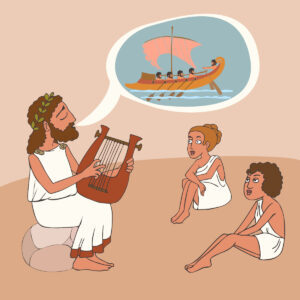
The epic, or epic poem, is an ancient literary form that tells the story of a hero’s mighty deeds. The Iliad and the Odyssey by Homer are familiar epic poems. Estimated to be written in the 8th century BC, the Iliad tells of the Trojan War, which occurred in the 13th or 12th century BC. Ugaritic texts, also from the 13th and 12th centuries, include about 50 epic poems. The Epic of Gilgamesh is a Sumerian epic poem written between 2100 and 1200 BC.
These written texts were probably based on stories that were handed down orally. The Iliad was written possibly 500 years after the event it describes. So, it makes sense that Homer based his work on stories that, at some point in time, had been transmitted orally. My book Deehabta’s Song draws from this oral tradition and even includes references to an epic poem.
The book explores the power of speech, making parallels to Celtic history and mythology. The planet name Caderyn is derived from the Celtic name Cadeyrn, meaning “king of battle.”
Also, the fierce Onye warriors of Caderyn are loosely based on the Picts, the British tribe that tormented the Roman armies. Whether unique to them or not, the Celtic people saw speaking as a way of wielding power. They deified eloquence in the god Ogmios, who used the power of words to bind people to himself.
OgmiosDepictions of Ogmios show him with chains coming out of his mouth, and these chains are connected to the ears of people he is pulling with him. I included this imagery in my book, as shown in following excerpt:
The TheaterNear the end, the video redeems itself somewhat, offering a relatively steady shot of a fascinating building. On the exterior of this building is a bas-relief depiction of a man’s face with chains coming out of his mouth, and the chains are connected to the ears of people looking up at him. “Wow, what is that?” Jo exclaims as she leans in closer to the console screen. Krissa doesn’t answer, and Jo gives her an irritated sideways glance. Krissa has been playing this silly video incessantly for three days straight, yet she does not seem interested enough to share any thoughts about it.
The building described in this excerpt is an Onye theater where an epic poem is recited. The words of this poem elicit an interesting reaction in some listeners. Here is another excerpt from the book:
Ilyani notices that he is reciting a poem, but she does not recognize the language. Yet the words come with a force that she feels deeply. After a while, she is no longer watching the old man but is basking in the sound of his voice with her eyes closed. She is abruptly wrenched out of this meditative state when she hears a scream from a woman in the audience. As Ilyani opens her eyes and looks around, she hears different people emit yells, laughter, or exclamations of some kind. “Wow, that is awesome!” “Beautiful!” The old man simply ignores the reactions in the audience and continues reciting the poem. Thoroughly bewildered, Ilyani looks at Drey. “What just happened, Drey?” He gives an unexpected response. “Did you see them?” “See what?” Ilyani replies.
In the book, this event occurs at the outset of the Caderyn War. The power of this poem to evoke visions of animals, a power enhanced through song, is later used as a weapon in the war. Deehabta’s Song contains many other allusions to the Celts, including their struggles against the Roman empire. I hope you enjoy the book.
Get Deehabta’s SongThe post The Epic Poem appeared first on A Warrior's Journey.
April 25, 2025
The Fighter
 This story is based on the character Ilyani in the book Deehabta’s Song by Stephen Alder.
Caderyn, 3983 AFS
Papa Tee wastes no time launching into his favorite rant. “You know, the stancheon is named after the great Onye warrior who invented it. For too long, the Caderyn military has ignored their roots and acted as if they are the ones who invented the fighting skills that came from us.”
“That’s not entirely true,” Ilyani protests. “There is a core teaching that we call Onye style discipline.”
“Oh, they called it that because it reminded them of Onye dance moves! The truth is that the entire foundation of the Caderyn military is Onye.”
Deehabta’s Song page 163
Caderyn, 3969 AFS
“Ilyani! Get up here!” Miram yells.
A young girl turns rapidly in her chair and faces her teacher, plopping her hands on the desk in front of her. “I dint do anything Madam Miram!” A boy sitting next to her is holding his nose as their classmates titter and giggle.
“I saw you hit Tan. Now get up here like I asked you to!”
“But he was teasing me!” Ilyani whines.
“We don’t hit people, Ilyani. I have talked to you about this before. Come up here and stand in the corner until your mother arrives.”
Ilyani gets up and stomps over with such a big pout on her face that Miram tries hard to keep from laughing. After this, Ilyani stands completely still with perfect posture, not moving a muscle, as she faces the wall. Miram knows Ilyani is physically gifted, already skilled in several martial arts disciplines at the age of six. That is why she is determined to get Ilyani’s temper under control, before someone really gets hurt.
She turns to address the other children. “Okay, class. We’re almost at the bell. I need you to pass up your writing examples, finished or not.” Next, the room is filled with the sounds of groans and the rustling of paper being handed from one child to another. After they are dismissed, the children rush out of the classroom while Ilyani stands forlornly in the corner.
When Ilyani’s mother arrives, Miram stands up to greet her. “Hi Andaya. How are you today?”
Andaya’s expression is sad and angry at the same time. She looks tired. “Not happy that I have to deal with another hitting incident.”
“I understand,” Miram responds. She turns to Ilyani. “Your mother’s here, Ilyani. You can step away from the wall.”
Ilyani pivots like a graceful dancer. When she sees her mother, she reacts by looking at the floor, her lower lip extended. She is no hurry as she walks over to where Andaya and Miram are standing. Andaya looks at Ilyani and says, sternly, “You’re going to stay in your room tonight.”
“But I have my Onye style dissapin!” Ilyani protests.
“You’re not going tonight, sweetheart.”
“Daddy will let me go!”
“No, he won’t. Your father and I agree. You cannot hit people, IIyani.”
Ilyani starts to cry. “Tan said my hair looks like a pidgee’s nest!”
Andaya crouches down and wipes away strands of hair from Ilyani’s eyes. “Oh sweetheart, you are a beautiful girl with beautiful hair. It doesn’t matter what anybody says. Don’t they teach you in martial arts that fighting is a last resort to defend yourself? You can be angry. But answer with your words, not your fists. Okay?”
“Okay,” Ilyani sniffles.
Just then, Tan’s mother walks into the classroom with her son in tow. “You have to make her stop hitting people,” she says scornfully.
“We’re working on it,” Andaya reacts.
Tan’s mother looks down at her son and says, “Go ahead.”
Tan walks over to Ilyani and mutters, “I’m sorry I made fun of your hair.”
“I’m sorry I hit you,” Ilyani replies.
As the two children give each other a hug, Miram smiles. “Reconciliation is so much easier at that age, isn’t it?”
The post The Fighter appeared first on A Warrior's Journey.


