Sarb Johal's Blog
February 21, 2023
When windows get smashed
In Dan Siegel’s book, The Developing Mind, he describes how everyone has a range of intensities of emotional experience that they can comfortably experience, process and integrate. This is the ‘window of tolerance’, and it varies widely. For some, this window is wide: they can feel reasonably comfortable even when experiencing high levels of emotional intensity. It can also span a wide range of emotions, from pleasant, like joy and excitement, to unpleasant, such as anger or shame. People with a wider window of tolerance can also think, feel, and behave flexibly, even when going through extreme and potentially traumatic experiences.
When the window of tolerance stays wideThis is our best-case scenario: when potentially traumatic events happen in our lives, we have enough experience and range of coping with past events, are well-practised and effective at regulating our emotions, and haven’t experienced too much trauma previously in our lives, meaning that we have a wide window of tolerance. This means that we are more likely to stay present, flexible, open, and grounded when awful things happen. We can think calmly, even when chaos may surround us, without feeling either overwhelmed or withdrawn.
In those areas affected by Cyclone Gabrielle and the Auckland Storms of recent days and weeks, what we are seeing now is what happens when we move beyond the upper and lower boundaries of this window. Here’s where we see the fight/flight and freeze responses we are familiar with.
Hyper and hypo-arousalPeople have been talking about the adrenaline that has taken them through the first few days of the response after the Cyclone passed. The hyper-arousal, beyond the upper zone of the window of tolerance, commonly brings physiological activation and excessive energy, but also agitation, too. We can become alert to and deal with threats, but it can leave us feeling anxious, irritable or angry. We can feel out of control or overwhelmed, as well as distrusting of others.
The zone of hypo-arousal beyond the lower boundary of the window of tolerance is what we are seeing people enter and talk about. In this state, we may conserve energy and ‘shut down. We can feel numb and want to withdraw and isolate ourselves from others. We can feel foggy-headed, exhausted, flat, powerless, hopeless and helpless.
It’s important to remember that, as well as all the above, we may also become quite cut off from our own emotions and bodily sensations. This may be a way of detaching from what is a genuine threat – the daunting nature of the task that faces those who have been affected by these traumatic weather events, and the hard path that lies ahead.
Avoiding the doom loopSo what happens next and how can we help? Here’s the risk: even the smallest stressful event for people operating outside their usual window of tolerance can feel overwhelmingly stressful. They can respond with either hyper or hypo-arousal. Continued stress may make them feel that the world is unsafe, and their window of tolerance narrows. That can lead to a negative feedback loop, causing people to operate in a heightened state of vigilance for danger, and to react to perceived or real threats with flight, flight or freeze responses. Persistent states of hyper-arousal may not only lead to a narrow window of tolerance, but it may also lead to the experience of mental health problems, such as depression or anxiety, or traumatic stress responses.
Beyond the opposite edge of tolerance, people who are spending long periods of times in hypo-aroused states of flatness, exhaustion, hopelessness and helplessness may experience cognitive and memory issues, and experience feelings of not-really-being-here of depersonalisation, as if you were a detached observer of yourself.
When I worked in the recovery from the Canterbury earthquakes, I emphasised the importance of messages and stories of hope to counter the effects of hyper and hypo-arousal. I also advocated for time spent building relationships with affected people and communities to ensure re-establishment of a sense of trust, and efforts toward building small islands of predictability in life to counter the effects of hyper-arousal and feelings of life being out of control.
What now?At present, attention is focused on preservation of life, and ensuring that basic support needs such as food, water, secure and safe accommodation, ongoing protection of physical health, and social connection. This is entirely appropriate and needed. But a multiple track approach that addresses deeper needs of returning to a more manageable window of tolerance for individuals and communities will be required, and soon.
Build trust by continuing conversations about what happened and what happens next. Make things as predictable as possible in these wildly uncertain circumstances. Give people a sense of agency and control in these powerless circumstances. Help people who are over-aroused to see the world as a less dangerous place. Give those who are flat some hope for the future.
Repairing windows is going to be a critical task in the weeks, months and years ahead.
(First published on my Substack here).
The post When windows get smashed appeared first on Sarb Johal.


February 19, 2023
How do we respond to the psychological impacts of Cyclone Gabrielle?
My heart goes out to those all over NZ coming to terms with flooding events recently. Just heart-wrenching. Even with my 35+ years of experience, even I wonder what is to be done. This interview I did with RNZ last Friday might help orient you
I’ve also been thinking about the experience of Canterbury and those who worked closely alongside affected communities, not just in the short term, but in the medium to long term too. This will be similar, if not even bigger, with enormous implications and flow on impacts. With that in mind, I’m thinking about developing a resource in trauma-informed communication and response for those working alongside these affected communities and people. Ppl like journalists, camera operators, reporters, emergency response workers, construction folks…
I’m wondering if that would be useful? Drop me your thoughts. Thanks.
The post How do we respond to the psychological impacts of Cyclone Gabrielle? appeared first on Sarb Johal.
January 24, 2023
Injury come back: First run in weeks
My physio, Seth, shrugged. It was mid-decemnber, and I’d gone to the clinic because I had done something to my calf. A day later, by back had also seized up. Turns out I had injured a calf muscle – my left soleus.
“You’re soleus starts to get loaded more once you start getting over 10-11kms in distance on your runs,” Seth explained. In my training plan, it was my third run over 10km that I sustained this injury.
I asked if there was anything that I did wrong in my return-to-running programme that I had just laid out in great detail. Not much at all, he concluded. I really think you’ve been unlucky. The only thing you could have done was bent-legged calf raises which specifically targets your soleus, rather than your general calf muscles.
“No-one tells you about that exercise”, I grumbled.He agreed.
So there I was, some 6 weeks later, yesterday at the clinic, where Seth gave me the once over, looked at my running form, watched me hop on one leg, fall and land on a step, and do single bent-legged calf raises to failure. He also recommended I start adding dead lifts to my strength training regimen.
As far as my back was concerned, he could see anything neural going on. But as time had gone on, my left back extensor muscles were becoming very tight. We deduced this was because I had stopped doing any core, yoga or leg work. I needed to start this up again now my soleus seemed rehabilitated and recovered enough to start taking significant load again.
I also got the all clear to start running again. Gently, starting with a run/walk every other day, and progressing from there. If things go well, I can still probably do the 5.5km at Round the Bays in the middle of next month. The next few days will tell.
But the run today at Newtown track went well. To be sure, it’s a little disappointing to be back at the run/walk stage again: 4 min walk + 1 min run in Zone 3, x6. But those 30 minutes were fun. And my back actually felt looser after focusing on activating my glutes when running. My back was not working so hard as perhaps it had been over the past few weeks.
I’m hoping the ramp up to running again this time will be significantly quicker than last. I’m at least encouraged by today.
The post Injury come back: First run in weeks appeared first on Sarb Johal.
December 19, 2022
It’s been a while
With my focus on building my Substack and other life things, I’ve neglected my blog a little. I hope to remedy that in 2023.
In the meantime, please let me wish you all the best for Christmas and the holiday season, and a very happy new year.
The post It’s been a while appeared first on Sarb Johal.
August 1, 2022
How will 3000 counsellors fit into a new National Mental Health System in NZ?
There is a new pathway for about 3000 counsellors to be accredited to work in publicly funded mental health and addiction roles. Until now, counsellors haven’t been able to work in publicly funded clinical roles, because it’s a self-regulated profession in New Zealand. A new accreditation pathway has addressed this concern. This has raised hopes that the shortfall in capacity to tackle mental health service demand in the public system.
But I wonder how this will be achieved. Here’s why.What incentive is there for Counsellors to enter the public health system? Salary stability and regular hours might be one reason, but the caseload would need to be carefully managed, in terms of both case numbers and case complexity. If this move is to enable work with people earlier in the trajectory of their mental health difficulties before it gets too entrenched, then case assessment and allocation will be critical.. Otherwise, it will be a case of revolving doors as people enter the system, get overwhelmed, and decide they prefer working outside the public mental health system after all. Counselling services are inundated outside the public health system, as well as inside it. But working privately, counsellors can take charge of their own caseload. Management, as well as counsellor capacity, would also need to be strengthened. Maybe that’s happening already – I don’t know.What happens to clinical psychologists?Under the new pathway, NZCA counsellors would be able to work as health improvement practitioners, health coaches or publicly funded counsellors in their community, GP clinics, in kaupapa Māori, Pacific, and youth settings and in schools, Minister of Health Andrew Little said. “They could join a therapeutic multidisciplinary mental health team in a specialist hospital environment which could free up other specialists, such as psychologists and psychiatrists, to focus on the most acute cases and presentations.”
This is a good move, but the addition of a large number of counsellors to the public mental health system will have a knock -on effect on how teams function, and the work that other professions will be asked to focus on. If this means that clinical psychologists will take more responsibility in management and in working with complex cases, are they being trained to do this? At the moment, there seems to be a problem with many junior clinical psychologists leaving the public mental health system because they become overloaded with cases. Taking some of this load from them is a good move, but what will be left? And is there adequate training and supervision for this work to take place safely and effectively? And will this still be an attractive proposition for potential clinical psychologists to work in the public mental health system?
How is this being coordinated? These are early days for Health NZ, after amalgamating the previous DHB system. Not much has been said about how a new National Mental Health System may emerge from this, or even if there is going to be one. More information on this would be really helpful.I’d love for this to work. But if we are not careful, we will end up with revolving doors as people enter the system, and then exit straight back out again. We need a focus on why counsellors may be attracted to this work, and encouraging them to develop their skills while they embark on a career in the public mental health system. Pay attention to professional development and building all tiers of management and supervision to ensure support while working. Build for the long term, as well as dealing with mental health service demand.
Make it sticky.
Build a National Mental Health Service professionals want to work in.Make them proud that they work there.
The post How will 3000 counsellors fit into a new National Mental Health System in NZ? appeared first on Sarb Johal.
April 21, 2022
AA Directions Magazine – Autumn Cover Article
I was very pleased to feature in the Autumn AA Directions magazine cover article, Finding the Good, How to thrive in the new normal. Go check it out here!
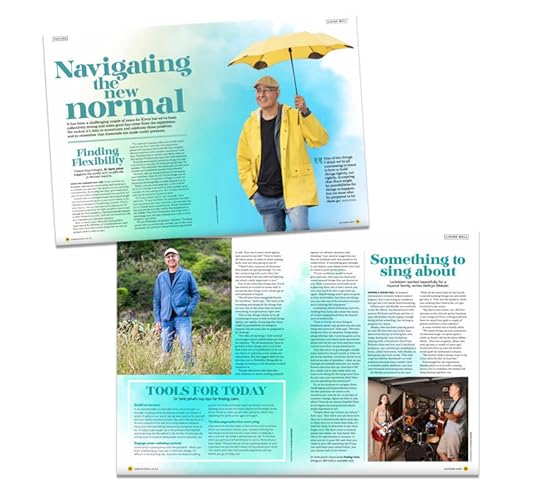
The post AA Directions Magazine – Autumn Cover Article appeared first on Sarb Johal.
April 14, 2022
Books that Work Podcast
I was interviewed on the ‘Books that Work’ podcast about my book, Finding Calm, which they’ve summarised into a handy infographic you can use. Listen in here.
The post Books that Work Podcast appeared first on Sarb Johal.
April 5, 2022
My 30,000 Days Project
I have burned 1378 candles on all my birthday cakes. I have travelled around the sun 53 times – that’s about 50 billion kilometres. The moon has circled around me 706 times. I’ve been on the internet for over 31 years.
And today, I am 19,301 days old (or thereabouts – I’m not giving that away here)
The reason that I am telling you this is that we live for around 30,000 days.
I’m almost two-thirds of the way there.
So what have I done with my time?
And what are you going to do with yours?
Read more here
The post My 30,000 Days Project appeared first on Sarb Johal.
April 3, 2022
Two years later: Review and pivot
Through this I helped to set up the pillars of the United against Covid-19 campaign, consulted to three Government Departments and many other public and private organisations, delivered so many webinar sessions I’ve lost count, written many Twitter threads and other social media posts, as well as hours of conversations with journalists to support public mental health through news and other articles. I hope you’ve found them helpful – I’ve had lots of great feedback and support for which I am very grateful. Thank you.
But, it’s time for me to take a break from my intense working life of these two years and more. That means I’m cutting right back down on my consulting work for three months initially. I’ll review things sometime in mid-2022.
I’m doing this not because I am burned out, but because I am trying not to burn out.
Hence, this break.
But, I need your help.I love writing and I want to carry on doing so. But I can’t do it without your support.
Please click through to my Substack to find out how you can help. Thank you.The post Two years later: Review and pivot appeared first on Sarb Johal.
March 2, 2022
The protest is over, read my Opinion article in The Guardian
Now the parliament protest is over, New Zealand must ask itself what lay behind it, have a read of what I think about the protest and my article here.
The post The protest is over, read my Opinion article in The Guardian appeared first on Sarb Johal.