Robin Schadel's Blog
January 19, 2023
Inspiration from Unlikely Sources: The Hellbound Heart


January 17, 2023
Brainstorming: The Notebook Hack
January 14, 2023
Writing with Mental Health Struggles
January 9, 2023
The Magician’s Child: First Excerpt
January 6, 2023
Covering the Basics: The Magician’s Child
January 4, 2023
Writing Goals 2023
November 26, 2022
Updates: Casting Pods and Streaming Games
November 9, 2022
Carmilla’s Ghost: One Year’s Retrospective
September 19, 2022
Banned Books Week
It’s Banned Book Week here in the US. For those who don’t know, Banned Book Week started in 1982 as a way for librarians, teachers, authors, etc. to combat the growing (and it still grows every year) trend of censorship. The American Library Association has amazing resources on their website for those who want to know more about the history of book banning in the US and about Banned Books Week. Follow this link to reach their timeline of significant book bans.
As the number of books challenged and bans continues to rise, we have to ask ourselves why people are seeking to ban books. The tendency is to default t the generic “to protect the children”. I want to talk abut that. For those who don’t know, my Ph.D. is in rhetoric, so I speak from a place of education and academic authority on this. In rhetorical scholarship, we have a specific term for phrase like “protect the children”, Charismatic Phrases. In a nutshell, a charismatic phrase is a word or series of words that lack a physical denotative referent but allow the audience to interpret based upon their own understanding of what these concepts mean.
Example: One example I used when I taught was the phrase “support our troops”. I would ask students what that meant. Often, I would get answers such as: “thank them for their service,” “cheer them on at parades,” “tie ribbons around trees,” “pray for their safety,” etc. Not once in ten years of teaching did a student say anything along the lines of (1) provide quality mental and physical health care for them during and after their service, (2) adequately compensate them financially while they serve, (3) care for their families while they are deployed through financial and social channels, and (4) ensure they have jobs (and that their employers didn’t use a legal loophole to fire them while they were deployed – it happens) when they return.
I would then ask them why none of them mentioned those things, and without fail, they responded either (a) “Of course those things are included, or (b) “but that’s not how people use that phrase in the news.” I floored them when I asked if these news references mentioned anything about the things they mentioned. They said no.
So, then I explained that by tossing this charismatic phrase out in a speech without any explanation, the audience did the interpretive work of deciding what the speaker meant. What the speaker said had no meaning, but the audience imparted the meaning. Thus, if the audience grows angry at the speaker for having a different meaning, the speaker can technically say “I didn’t mean that. I never said that. You decided that’s what I meant, so this is on you.”
This explains how charismatic phrases like “to protect the children!” get thrown out: School board officials, PTA groups, etc. gain power and legitimacy by talking about protecting children, but they never say what they are protecting the children from (or they speak in exaggerated myths and slander). These phrases also serve another purpose: they end debate by forcing an opponent into a defensive corner. “Don’t you want to protect children?” Of course, the person does, and so they must stop debating the proposed action and spend time proving they want to protect children. This allows the speaker to claim a moral high ground against the opponent without demonstrating any moral character.
But Robin, you don’t write children’s books or YA books. Why do you care? No (at least not yet), but I read them. And as a member of the LGBTQIA+ community, dozens of books aimed at normalizing the existence of queer people and queer families (written for young children) or YA books with queer heroes and other characters, are being challenged by ignorant bigots who, if I am being honest, don’t want queer people to exist. These are the same people who cheered Reagan for ignoring the HIV/AIDs epidemic, the people who protest Drag Queen Story Hour and Drag Brunches, the type of believe queer kids should be identified and placed in separate classrooms, and the type who pass laws criminalizing queer existence and health care. Some of them even call their laws “Defense of Children” acts. Their rhetoric is as hollow as their moral cores.
I don’t write children’s books, but I write queer books. I write books with queer characters, particularly queer women, who fight against patriarchy and white supremacy. If you think my books would fare better, consider why Samantha Hain has a coffee mug that reads “I violate the Hayes Code.”
Join me in celebrating the freedom to read. Read a banned book this month, chances are, you already have.
September 8, 2022
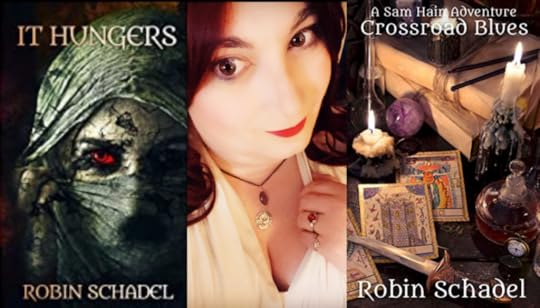
Crossroad Blues, Excerpt 1: A Letter Arrives
This post contains the first excerpt from my upcoming novel, Crossroad Blues. This snippet occurs later in the book, when Sam and Destiny are at the office.
Thursdays were quiet days around the office, unless it was a full moon that day. Since today wasn’t a full moon, I enjoyed a peaceful morning sitting at my desk, organizing the documents for Charlene Meyers, and sipping black coffee. Joan Jett and the Blackhearts drowned out the construction sounds from the street behind me. We were well into the black again this month. Activating a teleportation beacon in Castle Karnstein effectively removed the “long distance” from my long distance relationship. I glanced down at my mug and smiled; I was living my best Hayes Code violating life.
One glance at my father’s traveling grimoire proved enough to dissuade me from arrogant happiness. It wasn’t what he did, that was horrible enough, or who he was, but it was what loomed in the next few months. My confrontation with Doctor Johann Faust, whom my father helped escape Hell. I had to drag him back there, or I would take his place. Nick Scratch loved his irony. I made the deal. Now, the consequences of my actions breathed hot, dry, and hungry air on the back of my neck.
Destiny entered, holding a stack of envelopes in her hands. “Mail’s here, Sam,” she said. “We got the usual assortment of bills, junk, and a new mall Chinese place opened down the street. They deliver, and they gave us coupons. We’ll have t check them out. Oh! Here’s a letter from your father.”
She handed me the envelope from Hain & Corrigan, Barristers. The envelope was light, so it was likely just a letter. My heart pummeled my ribs as I held it. I shook my head and tossed it in the trash. “There. It’s been filed.”
Destiny shook her head and sighed. “Look, Sam. I know you two have a strained relationship on a good day, but he took the time to write you a letter. There’s no harm in reading it.”
I growled and returned to my work. “You’re welcome to dig it out and read the trash he spews.”
Destiny glared. She grabbed Donal’s letter from the trash and returned to her desk, muttering about me being as stubborn as an Irish mule. She meant well, but after the events in Bannagh, it wasn’t happening. I was ready to give Donal a chance after I returned from Faerie, but then I saw him on Old Tom’s Hill, trying to sacrifice Frank to that demon as part of some work he was doing alongside the Order of the Dragon. And then what I read in his grimoire, what he did so he could pull a soul from Hell, no fucking way. Mom wouldn’t be happy.
Mom. I clenched my jaw and sighed. I got myself into this shit hole because I didn’t want to accept that she died. That she died the way she did. I put my elbow on my desk and rested my chin on my hand. I exhaled. Mom hated what I did. As much as she enjoyed both the one hour reprieve each year and the additional time we spent together, she worried my recklessness would get me killed or damned. Like her.
I kicked my desk and then winced. My breaths came faster. I rolled and stretched my neck before grabbing my mug. It was empty. I walked into our main office and poured myself another cup. Destiny sat at her desk, paying the bills that came in. I smiled. This was the first time in our business history we could pay our bills as soon as we got them. Donal’s note lay on the corner of her desk.
I walked over and asked, “Was I right? Nothing in the note?”
She clicked send on our water bill, spun her chair to face me, and said, “You need to read it. This isn’t about sentiment or warm fuzzies and giving your dad a chance. This is about information regarding open cases and current events. Don’t think like a daughter. Think like an investigator.”
“Fine.”
Yes, I know I didn’t include the letter in this excerpt, but that’s intentional. If you want to know what Donal Hain wrote to his daughter at this time, you’ll need to buy my book when it comes out on 25 October of this year!