Nick Chellsen's Blog
April 27, 2026
5 Ways to Lead Like Jesus
The Bible tells us that Jesus was perfect. 1 Peter 2:22 reads, “He committed no sin, and no deceit was found in his mouth” (NIV). Because Jesus was perfect, we can conclude that His leadership was also perfect. So by looking at the 33 years of His life, we can see what it truly means to be a leader.
In this article, I will share five ways you can lead like Jesus.
1. Lead with PurposeThe first way to lead like Jesus is with purpose.
A leader’s purpose is the reason he leads. You might call it your goal, cause, or mission. It’s what gets you up in the morning. It’s the reason behind everything you do.
In this book, I argue that the purpose of Jesus’ leadership was to reconcile humanity’s relationship with God.
We see this in the covenants of the Old Testament as well as the new covenant Jesus established through His death and resurrection.
Throughout the book, I explain how the leadership decisions Jesus made were rooted in this purpose.
2. Lead with a TeamAnother way to lead like Jesus is with a team.
While many people idealize the idea of DIY leadership or admire lone ranger leaders, this is not an accurate view of leadership.
You might do a lot of things well. However, you cannot do everything. You need help.
When we look at the leadership of Jesus, we see that He had a team. His team was made up of twelve men: Simon Peter, Simon the Zealot, James (son of Alphaeus), James (son of Zebedee), John, Andrew, Philip, Bartholomew, Matthew, Thomas, Judas Thaddaeus, and Judas Iscariot (Mark 3:16–19).
If there was one leader who did not need a team, it was Jesus. He was the Perfect Leader. He could have done everything Himself.
However, despite His perfection, He showed us the value of having a team.
3. Lead through InspirationAnother way to lead like Jesus is through inspiration.
There are two reasons someone might follow a leader: obligation or inspiration.
Obligation is when you have to follow a leader. Inspiration is when you want to follow a leader.
When we look at the leadership of Jesus, we see that He inspired His team.
An example of this is when He called His disciples in Luke 5:1–11.
If you are familiar with this story, you will remember that they caught so many fish that the nets almost broke and the boats began to sink. Peter is moved by this miraculous sign, and Jesus tells the men that if they follow Him, He will make them fishers of men.
The story ends with them leaving everything and following Him.
4. Lead with Clear ExpectationsAnother way to lead like Jesus is with clear expectations.
Setting expectations is about helping your team know what they need to do.
When we look at the leadership of Jesus, we see that His disciples knew what was expected of them.
An example of this is when Jesus instructs His disciples to take up their cross. Luke 9:23 reads, “Whoever wants to be my disciple must deny themselves and take up their cross daily and follow me” (NIV).
There are two ways to think about the cross in this passage: physical and spiritual.
A physical cross is the death of our bodies. A spiritual cross is the death of our will.
In addition to this, you can only take up a physical cross once. However, you need to take up your spiritual cross every day.
Being a Christian is not easy. It requires us to die daily to our will.
As a Christian leader, the work you and your team do may not be easy. However, it is your responsibility to not only set expectations but also to model them.
5. Lead through SacrificeAnother way to lead like Jesus is through sacrifice.
It can be easy to focus on what your purpose gives you. However, there will come a point when you have to give your purpose something.
To fulfill your purpose as a leader, you will have to make sacrifices.
When we look at the leadership of Jesus, we see that He made sacrifices to fulfill His purpose.
There is no better example of this than His crucifixion.
When Jesus said, “It is finished” (John 19:30, NIV), He was not referring to His life being finished. He was referring to His purpose being fulfilled.
Through His crucifixion, we see that He sacrificed His life to reconcile humanity’s relationship with God.
As Christian leaders, we will also have to make sacrifices to fulfill our purpose.
While we may not be called to sacrifice our lives, we are called to live sacrificially for those we lead.
Final ThoughtsLeadership isn’t simply something you do. It’s something you become.
As you follow the Perfect Leader, learn from His example, and apply His way of life, you will find yourself becoming a better leader wherever you lead.
If this was helpful, you might enjoy going deeper. I wrote A Leader Worth Imitating: 33 Leadership Principles From the Life of Jesus to explore these ideas more fully, with short chapters and application questions to help you apply them to your life and leadership.
Purchase a copy at your favorite retailer, or get a free excerpt from my Leadership Toolbox.
SubscribeSubscribe to have posts like this emailed to you.


April 6, 2026
Even More Leadership Red Flags

A few years ago, I wrote a post about 3 leadership red flags. Last year, I wrote about 3 more leadership red flags.
In this post, I’m going to discuss even more leadership red flags. You can read about leadership red flags 1–3 here and leadership red flags 4–6 here. If you hear a leader you know say one of these things, then you might want to take it as a sign that it’s time to find a new leader to follow.
Red Flag 7: “I don’t have time for you.”
This is a leader who isn’t present with their team. They may not say it with their words, but they say it with their actions. You may have experienced meeting with someone who spent the majority of the time responding to messages or broke away to take a call. Even though they were physically present, it felt like they weren’t really there. Being present is not just being in the same room with someone. Being present is about giving your time, attention, and interest to that person.
Red Flag 8: “Do I have to do everything myself?”
This is a leader who micromanages. Micromanagement happens when you keep power to yourself. Empowerment is when you give power to your team. As a leader, you can’t do everything. You need help. You need a team. If you want to have a team that wants to follow you, you need to give them autonomy.
Red Flag 9: “I will die on this hill.”
This is a leader who doesn’t know how to choose their battles. Choosing your battles is not about avoiding conflict. It’s about deciding which conflicts to engage in. When you engage in every small disagreement, you don’t have the time and energy to engage in more significant matters. This is why choosing your battles is important.
Think about it: What are some other leadership red flags that you’ve seen?
SubscribeSubscribe to have posts like this emailed to you.
April 5, 2026
The Availability Principle: Leadership Lesson from Jesus’ Resurrection
In my book A Leader Worth Imitating, I explain that this event has given hope to past, present, and future followers of Christ. In that book I also discuss the opportunity principle. Essentially, leaders are people who look for opportunities to lead, even if they lack experience, education, and/or expertise.
Here I want to explain how Jesus’ resurrection can also teach us that leadership opportunities are often given to leaders who make themselves available. I like to call this the availability principle.
In Luke’s account of the resurrection, three women (Mary Magdalene, Joanna, and Mary the mother of James) were tasked with delivering the message that Christ had risen to His other disciples (Luke 24:1-12).
Some apologists have concluded that the fact that women were the first to witness and testify to Jesus’ resurrection is evidence that the resurrection actually happened. In their book Evidence That Demands a Verdict (2017), Josh and Sean McDowell write, “If one were to fabricate an empty tomb and risen Jesus in first-century Mediterranean culture, one would not cite women as eyewitnesses, given their low status as credible witnesses in the eyes of the people and the courts” (p. 26)
However, these three women were not given the opportunity because of their status in society or their influence among Jesus’ followers. The reason they were given the opportunity was simply because they were the ones who were available.
Application Question: How can you make yourself available to follow Christ and lead others this week?
The Week That Changed Everything (Day 8: Resurrection Sunday)
SubscribeSubscribe to have posts like this emailed to you.
March 2, 2026
Holy Week Devotional for Leaders — The Week That Changed Everything

Holy Week Starts March, March 29, 2026
Holy Week commemorates Jesus’ final days of His earthly ministry. Even though the events of Holy Week took place over 2,000 years ago, they still have the power to teach and transform Christ followers and Christian leaders today.
To help Christian leaders follow Jesus’ example during the Holy Week, I wrote an easy-to-read devotional called, The Week That Changed Everything.
This devotional guides you through the eight days of Holy Week as you explore themes that shaped Jesus’ final week and continue to shape those who follow Him today. Each reading includes a Bible passage to look up, a short devotional to read, an application question to ponder, and examples from Jesus to encourage us in our own life and leadership.
In this devotional, you will be encouraged to:
Use your anger for good, like Jesus cleansing the temple.Cultivate real spiritual fruit, not just the appearance of it.Honor the in-between, embracing the lessons of Holy Saturday.…and more.
As you reflect on Jesus’ example throughout Holy Week, you will discover what it means to follow Him more faithfully and lead others more purposefully.
Choose your format:
Ebook (Kindle, Apple Books, Kobo, Nook, etc.): https://books2read.com/u/3GRNOr
Paperback on Amazon: https://www.amazon.com/dp/B0GG67ZC64
Want it free? Join my email list and I’ll send you a free digital copy: https://forms.gle/6Mwucwd8kPULDXYz7
Originally posted on March 2, 2026.
January 29, 2026
Underpowering vs. Overpowering: How to Empower Your Team
Have you worked for a leader who didn’t train their team? Have you worked for a leader who micromanaged?
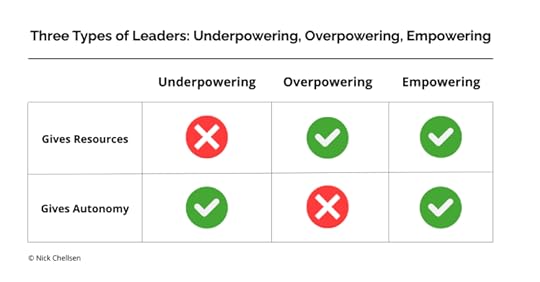
Here’s a simple framework I created to think about leadership: underpowering, overpowering, and empowering.
If you can relate to the first, then you had an underpowering leader. If you can relate to the second, then you had an overpowering leader.
An underpowering leader doesn’t give their team resources.
An overpowering leader doesn’t give their team autonomy.
The problem with these two types of leadership is that they leave your team stuck. Teams with underpowering leaders don’t have the tools and training they need to succeed. Teams with overpowering leaders don’t have the authority and ownership they need to get things completed.
Because of this, we don’t want to underpower or overpower our teams. Instead, we want to empower them.
An empowering leader gives their team both resources and autonomy.
Application questions:
Which leader are you most like?How can you better empower your team?What resources can you give them?Where can you give them more autonomy?SubscribeSubscribe to have posts like this emailed to you.
January 8, 2026
What Christian Leaders Can Learn from THE ART OF WAR
 Article Summary
 When you think about Christian leadership, The Art of War probably isn’t the first book that comes to mind. However, Sun Tzu captured a principle every Christian leader needs to understand: knowing who your enemy is and how they work. Jesus modeled this kind of discernment in Matthew 10:16, instructing His disciples to be “as shrewd as snakes and harmless as doves.” Christian leaders need to see people for who they really are, understanding opposition without acting like it, so they can protect those they lead and make wise, strategic decisions.
Full Article1When you think about Christian leadership, The Art of War by Sun Tzu is probably isn’t the first book that comes to mind. Written centuries before Christ, it’s a manual for military strategy, not ministry. However, Sun Tzu understood something every Christian leader still needs to learn today: the importance of knowing who your enemy is and how they work.
As a leader, it can sometimes be difficult to know who to trust. We may encounter people who are not who they seem to be. These are people who appear to want to help us but actually want to harm us. Because of this, it is important to have discernment.
In The Art of War, military strategist Sun Tzu observed, “Determine the enemy’s plans and you will know which strategy will be successful and which will not.”2 When we know how our enemy works, we can plan accordingly. Our discernment will then resemble that of Jesus in the desert, rather than Adam and Eve in the garden.
Discernment is the ability to see people for who they really are. It’s the ability to distinguish safety from harm. When you have discernment, you can identify who is a sheep, who is a wolf, and who is a wolf in sheep’s clothing. Because of this, it is essential for Christian leaders to have this kind of discernment.
When we look at the leadership of Jesus, we see that He taught His disciples to have discernment. In Matthew 10:16, Jesus said, “I am sending you out as sheep among wolves. So be as shrewd as snakes and harmless as doves” (NLT).
Jesus’ instruction to be “shrewd” is thought-provoking. Shrewdness might not be a characteristic you associate with leadership. It’s not something you would list on a résumé or praise if you saw it in someone else. The word “shrewd” could be substituted for “wise,” but the word choice was intentional. “Shrewd as snakes” is a direct reference to Genesis 3:1: “The serpent was the shrewdest of all the wild animals the Lord God had made” (NLT).
In that story, the serpent (Satan) used his shrewdness to tempt Adam and Eve. As a result, sin entered the world, and humanity’s relationship with God became estranged. Based on this passage, shrewdness could be seen as a characteristic of Satan. While this book focuses on imitating Jesus, Matthew 10:16 could be misunderstood as instructions to imitate the Devil. As Christians, we don’t want to imitate Satan, but we do want to understand how he works.
Jesus warned His disciples that they were being sent out “as sheep among wolves,” meaning they would encounter harmful people. In such situations, it’s not enough to know how your team works. You must also know how your enemy works. As Sun Tzu taught, understanding the enemy’s plans enables us to act wisely and strategically.
While Christian leaders need to have this kind of “devilish wisdom,” we also need to keep it in check. That’s why Jesus’ instruction had two parts: “Be as shrewd as snakes and harmless as doves.” Satan’s shrewdness caused harm; Jesus’ shrewdness prevented it. We must think like the enemy without acting like the enemy.
A Christian has discernment. Jesus modeled discernment and instructed His followers to do the same. As Christian leaders, we need to see people for who they really are. To do that, we must know how our enemy thinks and works. When we have discernment, we can protect ourselves and those we lead from harm.
Application Question: Have you ever worked with people who were not who they seemed to be? Looking back, were there any signs they shouldn’t be trusted?
NotesThis article is adapted from Principle 10 of my book, A Leader Worth Imitating: 33 Leadership Principles from the Life of Jesus . ︎Sun Tzu, The Art of War, trans. Samuel B. Griffith (New York: Shelter Harbor Press, 2021), 52.. ︎Subscribe
Subscribe to have posts like this emailed to you.
January 5, 2026
Small Beginnings: The Key to Achieving Your Goals
In the beginning of the year, as you begin thinking about new goals for the coming year, you’re also reminded of the goals you didn’t accomplish last year. Maybe you didn’t run that 5K. Maybe you didn’t write the book.
And you might be asking yourself, “Should I even set new goals this year? What makes this year any different?”
One way to make this year different is by breaking your big yearly goals into smaller daily, weekly, and monthly steps.
Don’t say, “I want to run a marathon this year.”
Instead say, “I want to run around my block first thing in the morning.”
Don’t say, “I want to write a book this year.”
Instead say, “I want to publish a blog post every week (or month).”
Now, you might think running around the block won’t get you to a 5K, any more than publishing a blog post will automatically produce a book. And you’d be right. The point of these smaller goals isn’t instant achievement, it’s habit formation. Small beginnings lay the foundation for long-term growth.
Running around the block every weekday builds the habit that grows into running a mile each day. That becomes running a mile Monday through Thursday and three miles on Friday. Soon, you’re running three miles every weekday. That steady foundation makes a 5K not only possible, but likely.
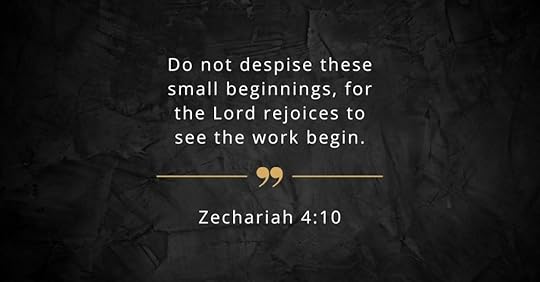
Zechariah 4:10 reads, “Do not despise these small beginnings, for the Lord rejoices to see the work begin” (NLT). Small goals are not wasted goals. They’re the starting line of the bigger victories ahead
Application Questions: What’s one big goal you’ve been hesitant to set because it feels overwhelming? How can you break it down into a smaller step this week?
SubscribeSubscribe to have posts like this emailed to you.
December 15, 2025
The Gift of Presence
Have you ever worked with a leader who wasn’t present? Perhaps he saw himself as being separate or above his followers. Because of this, he never made himself accessible to you. Or perhaps she made herself physically present, but when you met with her, she spent the majority of the time responding to messages or broke away to take a call. Even though she was physically present, it felt like she wasn’t really there.
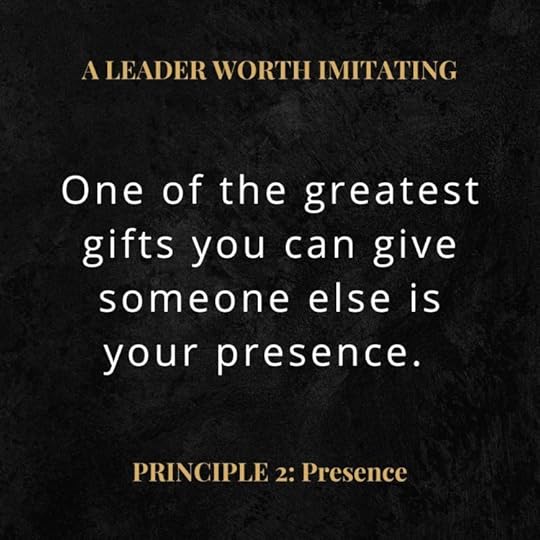
Being present is not just being in the same room with someone. Being present is about giving your time, attention, and interest to that person. As a leader, one of the greatest gifts you can give someone else is your presence.
Being present is about giving someone your time, attention, and interest. This could simply be making time to talk with them. During this time, put away distractions. Show genuine interest in who they are and what they are talking about.
Application Question: Who can you give the gift of presence to this month?
A Leader Worth Imitating, Principle 2: Presence
SubscribeSubscribe to have posts like this emailed to you.
December 1, 2025
Advent Devotional for Leaders — Leading with Hope, Peace, Joy, and Love

The Advent season arrives during the busiest time of the year. Because of this, we can easily become distracted from the true meaning of Christmas. Advent invites us to pause, reflect, and remember why Jesus came and why He is coming again.
To help Christian leaders slow down and refocus, I wrote an easy-to-read Advent devotional called, Leading with Hope, Peace, Joy, and Love: A 4-Week Advent Devotional for Leaders.
This short devotional guides you through four weeks of Advent as you explore what it means to lead with hope, peace, joy, and love. Each reading includes a Bible passage to look up, a short devotional to read, an application question to ponder, and examples of biblical leaders whose stories encourage us in our own life and leadership.
In this devotional, you will be encouraged to:
Be expectantly hopeful, like Jesus’ ancestors.Be peacefully attentive, like Mary and Joseph.Be joyfully resilient, like (or unlike) Zechariah.Be fearlessly loving, as the angels commanded.As you learn from their example, you will discover what it means to lead with hope, peace, joy, and love, not only during Advent, but in every season of life and leadership.
Choose your format:
Ebook (Kindle, Apple Books, Kobo, Nook, etc.): https://books2read.com/u/4jnrgo
Paperback on Amazon: https://www.amazon.com/dp/B0G4JQRQ11
Want it free? Join my email list and I’ll send you a free digital copy: https://forms.gle/6Mwucwd8kPULDXYz7
Originally posted on December 1, 2025. Last updated on January 6, 2026.
November 10, 2025
The Power of Gratitude in Leadership

“I have not stopped thanking God for you. I pray for you constantly.” – Ephesians 1:16 (NLT)
I’m sure there are people on your team you are grateful for. But while you know you’re grateful for them, do they know it? Paul didn’t just feel gratitude for the believers in Ephesus, he expressed it. It’s not enough to quietly appreciate others in our hearts. Christlike leaders make their gratitude known.
Application Question: Who on your team could you intentionally thank or acknowledge this month?
Read this next: Why Honor is Important
SubscribeSubscribe to have posts like this emailed to you.