Maureen Boyle's Blog
January 19, 2026
Decades of questions, Waiting for answers


December 20, 2025
What makes a good man?
November 11, 2025
On a chilly November day, memories of a murder and shattered hope rush back
October 19, 2025
On a sunny day, a grim find
September 6, 2025
A girl on a bike, a life cut short
June 8, 2025
A man of honor
February 14, 2025
Reliving past questions, hoping for future answers

More than 30 years ago, a group of young reporters waited in the cold along the highways ringing New Bedford, Massachusetts as body after body was discovered. Eleven women had gone missing in 1988 and, slowly, they were being found. Some by individuals stopping along the highway, others by cleanup crews, still others by search dogs.
The anguish of the families left behind as the searches, then the identifications, then the investigation dragged on was heartbreaking. The private frustration of the investigators could be seen just below the surface. It was a case that rocked the community. Who killed the women remains unknown.
Some of the reporters from that time are now retired, others died, still others found different jobs. I moved into academia to teach journalism and wrote a true crime book, Shallow Graves: The Hunt for the New Bedford Highway Serial Killer and giving talks on the case. One of the last reporters still actively working in journalism, Bob Ward, still does segments about the case as part of his series, New England's Unsolved, on Boston 25. His most recent piece notes that tips are still coming in to police and police are still working the case. You can watch his segment here: New England's Unsolved
One day we hope we can list this cases as one of New England's Solved.
December 4, 2024
Remembering Chief Greg Adams
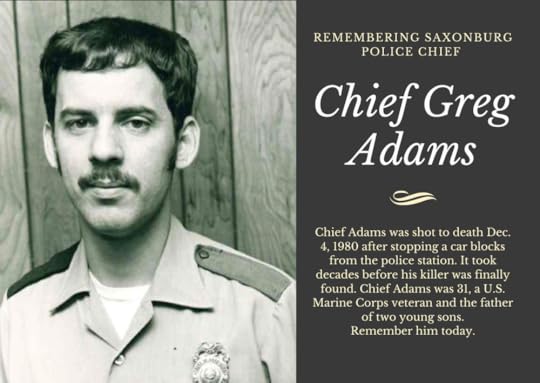
December 4 marks the anniversary of the murder of Saxonburg Police Chief Greg Adams at the hands of a crook who escaped justice by hiding in the shadows for decades.
Adams left behind a wife, two young boys and a heartbroken community that refused to forget either his death or the man wanted for his murder.
It was a cold December afternoon in 1980 when the chief stopped a car not far from the police station. What Adams didn't know was the driver, a man named Donald Webb, was a wanted man.
A struggle ensued. Shots were fired. Adams was left mortally wounded behind a home next to the store. His killer sped off.
The suspect was quickly identified and was placed on the FBI Most Wanted list but it would take decades before he would be found.
For those who knew Greg Adams, his memory lives in a community that never forgot and always prayed for justice.
September 14, 2024
Law, grief and justice
The book I'm writing now delves into the dark corners of murder, grief and the toll the criminal justice system takes on families and a community. While it is a haunting story, it is also one that illustrates a single person can make a difference. It can be a cop. It can be a witness. It can be a single juror. It can be a therapist. It can be a child. One voice doesn't call out in a void. It echoes into the community and grows louder.
This story is about loss but it is also about growth.
It is a story about a small community banding together, one by one, to find justice.
No matter how long it takes.
June 30, 2024
The summer of loss
The summer of 1988 was hot. That's what we all remember. It was a summer of beaches, pools, and seeking out air conditioning. No one expected it to also be the summer of grief.
It started on July 3, at least for the public, when the remains of a woman were found along Route 140 northbound in Freetown, a then quiet highway that ended in New Bedford at the corner of a park and zoo. She was found by a passerby who stopped to relieve herself in the bushes. The remains were partially clothed and had no identification. She would remain unidentified for months.
By month's end, on July 30, another body was found, this time on Interstate 195 in nearby Dartmouth, a town to the west of New Bedford, by two men on motorcycles who stopped to relieve themselves in the brush. The woman had no identification. She would also remain unidentified for months.
It would take months, and the reported disappearance of more women, before the community realized a killer lurked in its midst. Eleven women went missing sometime between April or March and September of that year. Nine were found; two remain missing.
In July, we should remember the first two women who were found: Debra Medeiros and Nancy Paiva. We should remember their families, including those members who passed without knowing who was responsible. Remembering is important if whoever is responsible is ever to be identified.