Jane Ward's Blog
May 1, 2025
Brushstrokes of a Story: the art behind Should Have Told You Sooner
The idea for my forthcoming novel–Should Have Told You Sooner (She Writes Press, releasing February 10, 2026)–came to me while I was immersed in a book of Welsh folk tales. One Moonlit Night, written by T. Llew Jones and translated into English by Gillian Clarke, is a child’s book, full of lovely illustrations among the simplified stories, perfectly written for either the young or the newbie to Welsh mythology—for anyone really who loves cultural lore.
I found the Welsh lore transportive. One story from this collection in particular, “The Lady of Llyn Y Fan Fach,” captivated me and set my imagination racing. In it, a young farmer named Gwyn visits the lake named in the title, and while he is there, a most beautiful fairy rises from the water and speaks to him. She is Nelferch, and in an instant, Gwyn is in love.
After a courtship that is more a test of Gwyn’s devotion, Nelferch agrees to marry him, sacrificing the watery world she knows for a life with him on dry land. But before they marry, she serves him with a warning. “If you strike me three times, I will return to my home in Llyn Y Fan Fach.”
Gwyn is horrified by the suggestion that he might harm his new wife, and he vows he would never. But then he does, over the course of several years after having three children together. All three “strikes” are completely without malice and range from careless to accidental, but that doesn’t matter to Nelferch. All she knows is Gwyn failed to love her the way he promised. She dives back into Llyn Y Fan Fach, leaving Gwyn on the shore, bereft and with three young boys to raise on his own.
Long after finishing the entire collection, this one story occupied my mind. I kept thinking about Nelferch and Gwyn and all the ways we might harm those we profess to love.
With that big idea on my mind, it wasn’t long before I stopped thinking about the folk tale characters and began imagining a more contemporary pair. A young woman off to college in a country she doesn’t know well, studying art history and falling in love for the first time. A young man on the cusp of fame as a painter, falling in love with her right back. And finally, the two people they become after thirty years of living without each other: a recently separated art historian living and working outside Boston, and a renowned artist living like a hermit in his grandfather’s cottage along the southwest coast of Wales. Noel Enfield and Bryn Jones.
While “The Lady of Llyn Y Fan Fach” contributed to the plot, Noel’s and Bryn’s art-related occupations put the meat on the plot’s bones. I stared at art images in between writing sessions, wandered in and out of art museums in London, bent the ears of two very lovely women artists who were (and are) so generous with their time and thoughts. Every piece and place I explored got poured into Noel’s chosen vocation; into Bryn’s art; and into the art of Henry Bell, an up-and-coming young painter who touches their lives in a very profound way.
In the video above, I pulled together for you a handful of paintings that became important to the telling of this story, along with some notes about each one. I hope you‘ll give it a look as you get ready to meet Noel, Bryn, and Henry.
Links for further reading:
About The Lady of Llyn Y Fan Fach
JMW Turner’s Slave Ships
About Kyffin Williams and the Welsh Landscape
About Kyffin Williams and his paintings of melancholy mountains
About William Blake


January 1, 2025
Here We Are in 2025
Hello readers!
It’s been a while. I have spent the entirety of 2024 finishing and polishing one novel and immediately starting a new one–its sequel–as soon as I sent the completed manuscript off to the publisher. (I like the characters too much to let them go without telling more of their story. It happens.)
With my head in this all-absorbing fictional world for so many months, I find it hard to transition to writing promotion mode. But for the next few paragraphs, I’d like to tell you a little about the book I just finished in the hopes you’ll be as excited to immerse yourself in its world as I have been. If you’ve read any of my books, you won’t be surprised that I’m writing about people and relationships, a human’s propensity for making mistakes and the desire to eventually confront and repair the damage of those. Folks like you and me, trying to do their best and picking themselves up to try again when they don’t. You may be surprised, though, that the storyline goes international! I have always wanted a reason to set a story in London and elsewhere in Britain. These characters, and their movements through time and space, gave me that reason.
Here’s a brief synopsis for you:
“What’s done is done.”
Nine-year-old Noel Enfield first hears this piece of her loving-but-stoic grandmother’s life advice when she arrives on the woman’s doorstep accompanied by a social worker and the terrible news that Noel’s mother had been killed in a car accident. Amid the bewilderment and grief, Gran suggests that Noel must learn to put tragedies behind her and relegate them to the past; that way forward builds resilience. Noel takes the lesson to heart.
At age eighteen, while studying art history at a London university, Noel falls passionately in love with aspiring artist and art school student, Bryn Jones. Shortly after Bryn leaves for a five-month painting trip through Italy, Noel discovers she is pregnant. She is ecstatic and believes Bryn will be too–they have plans to marry, after all. But mishaps and misunderstandings part the two lovers, and, desperate, Noel channels her grandmother’s counsel once again, this time choosing to move forward in a way that will change not only her life but the lives of everyone she loves.
Three decades later, when she is offered a six-month secondment to a London museum, Noel decides it’s time to prove she really has moved on from that difficult period by returning to the city where she met and lost Bryn. But rather than proving she has persevered, the move lands Noel in the thick of London’s insular art world, and only one or two degrees of separation from her past and the people she once loved. After she reconnects with an old, dear friend and learns finally what kept Bryn from returning to her all those years ago, the revelation rocks the very underpinnings of her life. Some decisions made in the past could never be put behind her, she realizes, and armed with this new understanding, she sets out on a journey to reclaim what–and who–she left behind.
This book has a working title that I won’t share with you, as it looks like the title will change sometime later this month. I’m all for that! My working titles tend to keep me focused on a book’s big themes but may not necessarily work in a commercial sense. I hope to release the new title and the cover art soon.
I can tell you, however, when you’ll see this new work: February 10, 2026. While that may seem eons away, I’ll need every single day of the next year working closely with the publisher to make sure you all get the best book you can from me. January 2025 launches the process with the title change. Then, in no particular order, comes cover art approval, procuring book blurbs and industry reviews, entering into several rounds of proofreading for typos and subsequent corrections, completing the book’s tip sheet (a behind-the-scenes sales/marketing document that helps a publisher’s sales team position any book into its proper markets), and launching strategic publicity efforts. (In case you’ve ever wondered why there are so many months between a book being accepted by a publisher and its landing on bookshelves!)
When it finally does land in your hands, I hope you will love this book as much as I do. For at its core, this is a book about love: a mother’s love, a first love, deep and enduring friendships, the kind of love that is very real but somehow incongruously hard–complicated as it can be by time and circumstance and the baggage humans carry, and the kind of love that can be so very simple if only we let ourselves accept it. The novel is also about other essential human pursuits, such as making art and creating beauty and taming the demons by releasing that beauty into the world. For me, the relentless pursuit of love, as well as the urge to create light in the darkness, defines what it is to be human.
and . . . Coda
I send my wishes to you all for an upcoming year filled with peace and community. Why not noisemakers and parties, prosperity and lots of happy, you ask, all the things people usually hope for at the cusp of a new year? Why peace? Why community?
As I get older, I better understand that new years always begin with some uncertainty. Who among us can know what a year has in store? I couldn’t have told you last December 31 that a longtime couple’s decision to marry would take us by joyful surprise or that a usually healthy loved one would have a health scare. Humans aren’t good at predicting the distant future; often we can’t even predict what will happen tomorrow. So, instead of an impossible-to-promise state of constant happiness, I wish you peace–inside yourselves, within your homes, among your friends and co-workers. Peace as a quiet starting place for concentration and creation and caring for your people. I hope you foster community within these peaceful spaces, leaving no room for prolonged periods of an isolation that breeds dread and fear. Find your people, keep them close, promise you will be their safe space and hope the same of them in return. As I said earlier: this relentless pursuit of all kinds of big love and light defines us. It will be what sustains us too.
-Jane xx
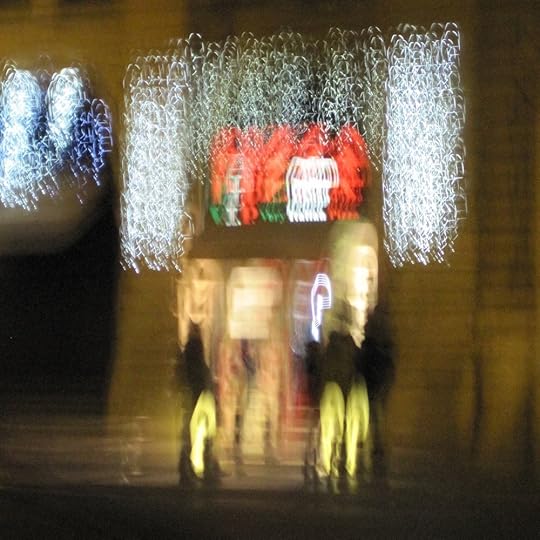
Photo caption: Early New Year’s morning, 2016. The line for pizza, Rome. Taken by the author.
December 1, 2022
IN THE AFTERMATH is now an audiobook!
One year after the launch of the print and digital versions of IN THE AFTERMATH, I have released an audiobook version! Making this audiobook over the summer was a great deal of fun, mostly because it gave me the opportunity to learn several new skills and work with some very cool people at Findaway Voices.
I’m so pleased to launch this audiobook today with fanfare! To celebrate, I offer a Read and Relax Gift Basket Giveaway! You don’t have to purchase anything to enter. Between December 1 and December 25, simply sign up to “Connect with Jane” using the form at the bottom of my website’s home page, adding your name and email address to the mailing list for my blog and newsletter. Your names will be collected there for the drawing on December 26.
We’ll select one Grand Prize winner for the basket full of goodies you can enjoy while you spend the winter months reading or listening to your favorite books. The handy reusable basket includes: a book passport for recording books you’ve read, assorted Whittard of Chelsea teas, Whittard cocoa, handmade marshmallows, cookies, a pair of warm slipper socks, a subtly scented relaxation candle, and a ceramic travel mug for keeping your drinks hot.
Two runners-up will receive a book passport and an assortment of Whittard’s tea.
Again, all you have to do is sign up to connect. Click on HOME in the navigation bar and you’ll find the form at the bottom of that home page..
Thanks to everyone who has lifted this book over the past year. Those of you who love audiobooks will love the reading done by Kathleen Godwin, trained actor and voice artist. She’s wonderful at capturing the emotional journeys of each character. Some people have asked why I didn’t narrate the work myself and I answer, “Kathleen is why. She is simply the best at what she does.”
You’ll find this version on Audible/Amazon, Barnes&Noble/Nook, Google, and most other platforms where audiobooks are sold.
September 22, 2022
BookBub Featured E-Book Deal!
Between Sept 22 and Sept 26, IN THE AFTERMATH is a BookBub featured eBook. Get your copy for 99 cents on Amazon, Nook, Apple, Google Play & Kobo!
Readers in US, UK, Canada, and Australia can take advantage of this amazing price. Head over to any one of these platforms and you'll find IN THE AFTERMATH is available to you for 99 cents through the 26th!
Don’t wait!
For more information:
June 28, 2022
Goodreads Giveaway!
I’m up posting early (and after a hiatus dedicated to moving house and working–more on all that later) because I’m so excited to be giving away 12 signed copies of award-winning In the Aftermath!
Enter on Goodreads between now and July 28. At the end of the month-long period, I’ll be drawing 12 names and sending books to the lucky winners.
Learn more about the In the Aftermath giveaway and enter here.
October 2, 2021
“Don’t be afraid to claim your place.”
So said my book publicist, Caitlin Hamilton, on Thursday when our six months of planning for the launch of IN THE AFTERMATH came to a close. She got to know me really well in the months that we worked together to get the word out, and her parting pep talk was aimed at my reluctance to promote myself, my work. “You’ve written a beautiful book and you owe it to yourself to continue promoting it.”
There are two things I want to say about this reluctance. First, most writers shy away from self-promotion, but it is often harder for women writers to speak up and claim their place. We typically make sure others–our children, our spouses, our colleagues–have their needs met before we sit down to write or collect our own accolades. We are fierce advocates…but not always for ourselves.
The second is that self-deprecation can seem like the polite course of action, but it is no course of action at all. It’s dressed up self-sabotage that doesn’t get us anywhere. The “Aw shucks, I don’t really like to talk about myself. Let’s talk about you” type of deflection may feel less braggish, but it will consign your book to sitting on a shelf, or worse–being tossed in the remainders pile and shipped back to your publisher. I’ve written a book, I want people to read it. I think it’s a story folks will relate to and maybe learn from.
So here’s what I’m working on:
Potential Reader: “I hear you’ve written a book. Congratulations.”
Me: “Thank you. It’s getting very good reviews and I know you will like it when you read it.”
This week, IN THE AFTERMATH set out on an 18-day book blog tour hosted by TLC Book Tours. I’ve collected the first week’s reviews and am posting the highlights here, along with links so you might read them in their entirety.
Because I’ve written a book. Because I want people to read it. Because I think it’s a story folks will relate to and maybe learn from.
(End note: This is a special request. If you have read this book and its words and message linger, please leave a review on Amazon , Goodreads , or both. My future books depend on how much engagement I get with this one, and one way publishers determine reader engagement is by watching review numbers. I thank you very much for taking a few minutes to leave your thoughts and impressions. -JW)
• • •
@tlcbooktours, week 1: Reviews for In the Aftermath
“…a thoughtful, character-driven novel. It’s a novel about learning to forgive oneself, learning to move on after grief, and truly seeing those around us. I hope I haven’t made it sound like a depressing novel because it isn’t, although it’s dealing with hard things….Highly recommended.” —Five Minutes for Books
“I couldn't put it down! Jane Ward is a phenomenal writer, and she does an excellent job painting her characters. The comparison made between her writing and Anne Tyler's is well-deserved. —The Bookish Dilettante
“Wow! What a brilliant story! I LOVED In The Aftermath by Jane Ward. It was simply put, an excellent read…a compelling story that is character-driven, slow-paced, and unputdownable.” —A Bookish Way of Life
“…a compelling and mysterious read. I recommend it!” —@meghans_library
“… a beautiful novel about tragedy, regret, healing, and hope. From the first pages, I was drawn in. Ward's writing is beautiful in a subtle way…realistic and powerful. —@g.reads
“Guilt, anger, depression, healing, and forgiveness all share a stage in the stories of those left behind… about life and the way our lives are connected.” —Stacy’s Books
“…as the best stories always do, this book will stay with me long after I’ve read it. If you’re looking for a deeply moving and insightful read, I highly recommend In the Aftermath.” —Tabi Thoughts
“…showed how it is possible to overcome and rebuild life after such a tragic loss. This was a beautiful novel that is worth taking your time to read…It really left a lasting impression that left my heart full.” —What Is That Book About
“…a deeply involving story about the impacts of this one action on so many different people…strong narrative, well developed characters and story that keeps you turning the pages until the very end.” —Books, Cooks, and Looks
July 28, 2021
Finding Your People, Building A Community
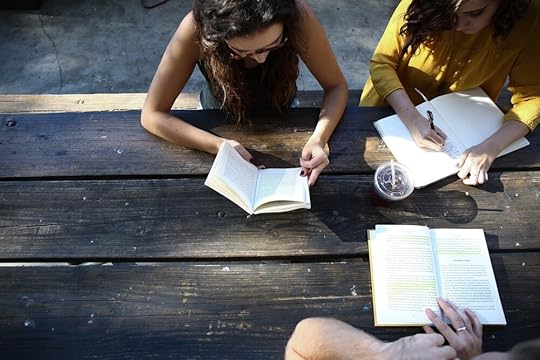
Solitude is an essential part of a writer’s life. Alone, our imaginations can run wild. We can read passages of written work aloud to hear how the writing flows. We can talk to ourselves to puzzle out plot problems. We can sit and write for stretches and get up for tea or a walk whenever we need the break without answering to anyone. This time spent in solitude is something I protect and cherish.
But it’s healthy to balance isolation with connection—especially to the wider world of books and readers and other writers. The company of other bookish people gives us the support we need to keep going, affirmation of our written work, and the sense of belonging to a broader community of people with the same goals.
I treasure three distinct communities of people who keep me moving forward as a writer: my writing group of four, the beta readers I reach out to for help with drafts, and the large and diverse group of writers I have come to know from attending writing events and through personal introductions. Each group challenges me in different ways to be a better writer and an even better writer friend.
The how-to of meeting and connecting can be bewildering for everyone, more so if we’re new writers. Nudge yourself to sign up for writing conferences or workshops. When there, be just as prepared to read and discuss your group members’ work as you expect them to be prepared for yours. Attend author readings whenever possible and help spread the word about others’ books at your local bookstores, among book discussion groups, and across your social media platforms. Bolster your newfound friends when they are down and need encouragement. By being genuinely helpful and engaged, you’ll establish yourself as a supporter of other writers—a reputation that can only help you grow your circle.
Reach out to astute readers when you’re ready for, or in need of, constructive feedback on your story. Some writers ask beta readers to look at a full, close-to-final draft for general impressions of the work. I ask for beta reads in my early or middle drafts when I want an assessment of something specific, such as “Is the time shift between sections comprehensible? Or confusing?” My go-to beta readers are a few writer friends who read critically but helpfully, and I always offer to return the favor. By trusting each other with our writing, we’ve built friendships that affirm and elevate each other’s work.
This is true of my writers’ group also, although the work we do there is equal parts manuscript critique, craft discussion, and support group. When assembling a writing group, large or small, you’ll likely invite individuals at various stages in their manuscripts. Keep in mind that group goals must adapt and grow as the individuals’ needs change, and a schedule of submit work/critique work might not suit everyone at every stage. Allowing for conversation time helps keep a group vital and fresh. Some of the best bonding happens in the moments of off-script conversations about our writing struggles or our craft or something altogether unrelated to writing.
With time, authentic engagement in all these areas will reward you with welcoming, supportive circles of writing friends. Together, you will motivate each other through the solitary times, celebrate each other’s successes, and offer a buffer to the disappointments. Start finding your people. You’ll be glad you did.
June 24, 2021
The Crayfish in the Alley
Sometimes the way forward is unclear
I woke up on Tuesday to a flurry of texts from my neighbors. Usually, I worry about opening these because most often they are about a crisis in the building, like Monday’s thread about the flooding in the basement following an early-hours downpour.
But on Tuesday, my downstairs neighbor wrote: “Our neighborhood has gotten so bougie that we no longer have rats in the alley,” and followed that comment with a photo of a crayfish he had spotted meandering out back near the garages.
Likely it got carried here from the fresh water of Lake Michigan, either on the high winds of the aforementioned storm or through the flooded storm drains. But the roll of commentary about the creature’s origins and even its species was hilarious, entertaining, imaginative. An exercise in brainstorming as we tried to make sense of something—a crayfish out of place in a Chicago alley.
One of my first draft writing mantras is, And what comes next? The question is my prompt for brainstorming when I reach a point in the story I am putting down on paper where I can’t see the way forward. It causes me to flex my imagination to picture all the different scenarios that could move the story forward. How does this work?
Let’s say I am writing a story about a person heading out to walk his dog. That person has embarked on the same route he takes every day, but on this day that I am writing about, things feel a little off to him. Maybe he didn’t have his coffeepot aligned correctly in his coffee machine and coffee spilled on the counter. His dog ate too fast and regurgitated its breakfast. The morning walk was delayed by all the cleanup, which means leaving for work will be delayed as well. As he’s trying to hurry his old dog along, he happens to encounter something unusual on his path, something that causes him to pause. Let’s say it’s a crayfish in the alley.
That’s a pivotal moment in my draft! But now that I’ve arrived here, I don’t know where to take the story. So, I ask myself: what comes next?
For me, that one simple question is a reminder to unleash my imagination while being focused and strategic with it. For those of you who can’t see inside my mind, here is a sample of the kinds of thoughts going through my head when I ponder what will happen next.
1. I am evaluating the setting of the story using my character’s senses.
Sight, sound, smell, taste, touch—these are actions that will begin to form pictures in my mind, pictures of the progress of the story. What can I see my character doing in this moment? Is he looking up from the pavement to see if he can find clues to the crayfish’s sudden appearance here? Does he see any other wildlife out of place? Any traces of a neighbor’s ornamental pond flooding? Does he hear the muffled laughter of neighborhood kids pranking him? Might he reach down to pick up the creature but pause when he sees its claws snap?
2. I am curious about my character’s emotions and emotional reactions.
Because I am curious, I will ask myself: What do I already know about his feelings? He is harried and rushed because his morning hasn’t gone according to plan. What else could I know? Is he angry because violent storms that displace creatures like the crayfish are becoming more common due to global warming? Is he afraid to pick it up because it is snapping? Is he ashamed to be so afraid? Is he energized with a sense of purpose because he can rescue the crayfish? Or is he sad because he thinks he won’t make it to the lake in time to save its life?
3. I wonder if someone else will happen on the scene.
Chicago’s alleys are busy places. This is where the city collects our trash and sites all our communications and power cables. This is where we house our cars. Our protagonist might not be alone for long. Who will join him? A neighbor, whether friend or foe? One of those pesky kids responsible for pranking him with the crayfish? Is a recycling or moving truck with a distracted driver bearing down on him? Or is it the woman on the bike who rides by him every morning at the same time, the one he would like to speak to but hasn’t had the courage to?
4. I suspect the crayfish may remind him of something in his past.
What if the crayfish in the alley reminds our protagonist of all the times he used to go fishing with his father? Back then, while he waited for a bite on his line, he watched crayfish scuttling in and out of the water. Those were simpler times. He and his father haven’t done anything together in years because a terrible argument estranged them.
Now, I suggest using flashbacks sparingly because too many time shifts will make a story unwieldy and hard to follow. But maybe this is one of those moments that calls for a memory. Flashing back to a scene from the past can be used to highlight something unresolved that needs to be addressed in the present. Maybe addressing it is what will propel this story forward.
I hope you’ll remember some of these thought progressions the next time you have trouble figuring out the way forward in your draft. Maybe you even have some of your own to share. If so, let me know and I’ll do a roundup of good tips in a future blog post.
Happy drafting!
April 13, 2021
Sometimes a flashlight, sometimes a floodlight
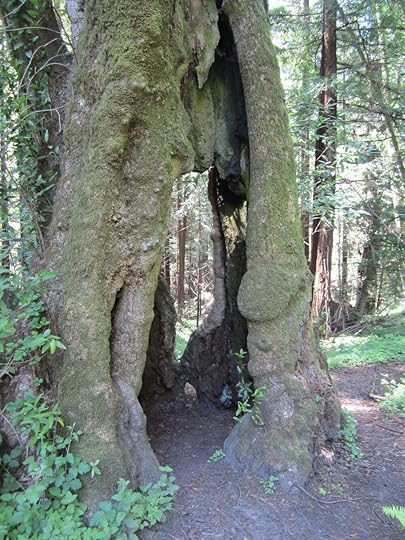
The tree
In a recent writing group meeting, I said to my fellow writers that a lot of working through the first draft of a novel is like swimming through mud. In the beginning, so much is unclear: Who are these characters, anyway? How would they really act? What will they do? Where will they end up? What is their journey to that end point? What is this story even about?You’ve all heard the old adage that success is 99% perspiration, advice meant to keep us working and not expecting any breaks, and so we write and rewrite and rewrite again, hoping to find our way through the murk of all the false starts and wrong turns and dead ends to successfully complete a draft.
Most writers accept hard work as a given. But does our work have to be exclusively a dark, joyless slog? Are we only good writers if we toil? I don’t think so. After all, the second part of that adage: “and 1% inspiration.”
Inspiration is the X factor, something a writer experiences that will leave her with the clarity she needs in order to understand just what is going on in her story. You’ll often hear these moments expressed in terms of light: a bright or brilliant idea came to you; the solution struck like a lightning bolt; it was as if a lightbulb turned on in your mind. And the image of light works, doesn’t it? You find that after the dark hours of struggling to put thoughts on a page, you have been touched by an idea that is sublimely illuminating for your work. In my own work, I think of these bursts of inspiration as flashlight moments and floodlight moments. The flashlight helps me see the way forward with who or what I am writing about; and the flood casts a wide light on broader pieces of the story’s landscape—its themes.
Anything you encounter in your life can serve as inspiration for your work. In mine, it’s been overheard conversations, works of art, food, and birds, to name a few examples. The brain consumes and reviews and shuffles this sensory data, eventually returning relevant and helpful details when these are most valuable to you. Details in two poems became valuable to me as I continued through the drafts of In the Aftermath, and because April is National Poetry month, it’s a good time to share how images created by poets using the spare language of the art form can work as inspiration.
I first read Joseph Fasano’s “Hermitage” in 2016, during an early stage of drafting when I was struggling to pin down the character of David. David makes few direct appearances in the story and yet he’s the catalyst for much of what happens. If readers were going to understand what he set in motion and why, I was going to have to understand him. While I worked, I found my mind wandering back to the first four lines of Fasano’s poem.
“It’s true there were times when it was too much
and I slipped off in the first light or its last hour
and drove up through the crooked way of the valley
and swam out to those ruins on an island.”
The lines about people slipping off, driving away, and making solitary swims out to ruins when things got to be “too much” created a vivid picture in my mind of a man alone on a beach. When that happened, the events of David’s morning and what his state of mind must have been became clearer to me.
Something similar happened in the spring of 2018. That April, I had gone on a weeklong writing retreat to Wellstone Center in the Redwoods just outside of Santa Cruz, intending to dedicate myself there to the final draft of In the Aftermath. A day or so after settling in, my writing friend, Terry—also on retreat that week—suggested a walk in the woods behind the retreat house after we stopped work for the day. Assured we’d see trail markers and have no trouble finding our way back, we set off.
We did in fact have trouble and got turned around for a bit—proof that what’s evident to some isn’t evident to all. After a few futile circuits of the woods (“Didn’t we already pass that tree, twice?”), we eventually found the path home. As I got ready for bed that evening, still trying to relax after being not-quite-lost, the first two lines of the David Waggoner poem, “Lost”, ran through my mind.
“Stand still. The trees ahead and bushes beside you
Are not lost. Wherever you are is called Here”
Yes, these lines fit our experience with getting lost and with the tree standing in its place, knowing where it was all along while we tried to figure ourselves out. But the lines also illuminated the experiences of all the characters in my novel, I realized—some were lost in their circumstances and uncertain about the future but tried to calm down enough to imagine a way out; others were simply lost and struggling in a liminal existence. I kept these ideas close by until I crossed the finish line.
Click the links and read both poems in their entirety. They are beautiful pieces. They might give you ideas that you can use too, some light when you most need it in your drafting.
March 17, 2021
In the Aftermath: Cover Reveal
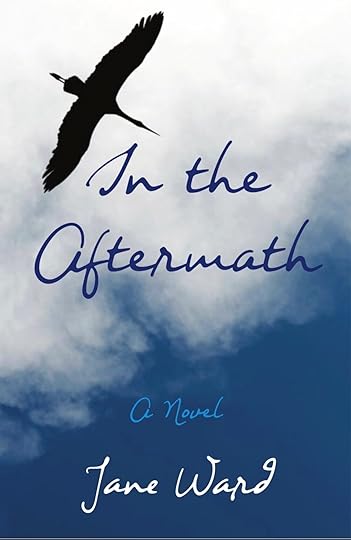
Hello, cover!
Say hello to the cover of my forthcoming novel, In the Aftermath (She Writes Press; releases September 21, 2021, available for pre-order). Now, let me tell you the story behind the heron.
In 2014, I began a book called The Welcome Home and brought (what was at the time) the first chapter to the Yale Writers’ Conference that June for workshopping. Those few thousand words got some good feedback as well as some helpful guidance about a plot point that I felt would become unwieldy. I had plotted that one of my characters would pick up and vanish, leaving his family behind, but the most cursory research revealed that, between cell phone tracking and traffic cameras and other trappings of our highly monitored 21st century lives, it’s hard to simply walk out of a life and disappear. I came away from Yale knowing I had to rethink David’s disappearance rather than get bogged down in the minutiae involved in changing an identity. But I was encouraged to keep going. I gave the book a new Big Event and a new title, and from there, I took the story in new directions.
I also took the story with me to Nyon, Switzerland when we moved there in 2015. My expat days in a French-speaking canton among people who were not naturally inviting consisted largely of holing up on the Rue de Rive to write this book and long dog walks around town and throughout the surrounding countryside. Outsider status had its advantages. Being left alone meant I might finish this book. It also meant I could explore my new home without interruption.
For many of the very early morning explorations, the dogs and I found ourselves on Nyon’s stretch of Lake Geneva, captivated by all the water birds, but especially by the stillness of a solitary gray heron who traveled around to perch on any one of the several rock jetties scattered along the lake’s edge. Drawn by how self-contained he seemed, I began to look for him on walks and felt satisfied on the days I spotted him. When I didn’t see him, I daydreamed about him. I felt he was trying to tell me something.
I’m convinced it was this heightened awareness of the gray heron on the lake that made me stop cold during one of my dog walks to stare at the sign hanging over the Benu pharmacy on the Avenue Perdtemps. On the green cross that advertised the shop’s purpose was a company logo: a stylized, tufted bird that looked an awful lot like a heron.
Curious about the company’s unusual name and especially its logo that reminded me so much of my feathered lake friend, I went right to the internet when we got home to google “Benu.” The first hit was the parent company’s website where I read their corporate philosophy:
“The ‘benu’ in our name refers to the purple heron. In ancient Egyptian mythology, the benu—the historical predecessor of the phoenix revered in ancient Greece—returns each year, reborn, from its winter home.”
A deeper dive into this Egyptian tale of the Benu led me to an illustrated children’s book called Cry of the Benu Bird by C. Shana Greger. In it, Shana’s gorgeous illustrations and retelling of the myth confirmed for me the parallels between the legend of the Benu, a bird reborn with the seasons, and that of the Phoenix—the bird that dies over and over, exploding into flame only to be reborn for a new generation.
—————
What I think now is that Lake Geneva’s heron was telling me I needed to include in the novel a creature very much like him who might symbolize this idea of renewal and remaking life after death. And so I did. A heron-like bird makes a late appearance in the book when it flies by David, who is standing on a beach during a stormy April morning with only his tortured thoughts for company.
In the book, I write about the bird’s sudden entrance like this:
“A new, rushing noise fills his ears, growing steadier and more insistent. He feels something rush past, and he opens his eyes once more. A large bird, pewter colored under the dull sky, pushes by, large wings beating, pressing down on the air to make progress.”
I received many cover samples from my publisher—all of them beautiful—but it was this cover that captured that bird on the beach with David and, ultimately, the essence of what it means to be in the aftermath of something life altering. When I look at it, I can hear the large bird’s wings as David does, hear it making flight through the storm, through the thick clouds that eventually break to let light in, and straight into the hopeful blue skies ahead.
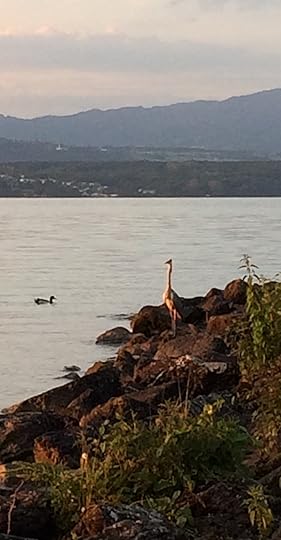
“My” gray heron
IN THE AFTERMATH is available for pre-order now from Amazon, Barnes & Noble, and Bookshop.