Andrew Neil Macleod's Blog
August 22, 2023
The Big Men of Raasay
 ">
">I’m very proud of my Raasay connections. My grandfather’s first cousin Calum MacLeod famously built the two-mile stretch of road on the island using only a pickaxe, a shovel, a wheelbarrow, and his bare hands. Experts come from all over the world to view Calum’s Road, declaring it a wonder of modern engineering, and a testament to one man’s spirit of endurance and industry.
The photo shows me holding a fragment of Calum’s Road. There is a very interesting story behind this particular fragment of rock, but to tell it I need to take you back almost three hundred years to the time of the Jacobite uprisings, and the last pitched battle on British soil, when the Jacobite army, led by Charles Edward Stuart, were massacred where they fell on Culloden Moor.
Following his defeat, the doomed prince, known to his enemies as the Young Pretender, was forced into exile. During his flight through the heather he stayed at many a poor farmhouse or bothy. The people who hid him from the Redcoats were dirt poor, but despite the prince having a bounty of £30,000 on his head - that’s around £5 million in today’s money - they never surrendered him. Hunted like a hare from glen to glen, the prince finally came to the Isle of Raasay, and was hidden for a while in Raasay House, before being taken by Flora MacDonald across to Skye, then onwards to France and into the history books.
As punishment for harbouring a known fugitive, Raasay House was burned to the ground by the British army. But the MacLeods of Raasay were nothing if not resilient, and Raasay House was rebuilt a few years later by the young chief John MacLeod, in the form that you see it in today.
But by now the clan system and the old ways of life were already in decline. The newly Anglified Highland chiefs, London educated and keen to modernize, had already begun the systematic evictions of their former tenants, replacing them with sheep, in the shameful episode that would come to be known as the Highland Clearances.
The Raasay chiefs were perhaps more benevolent than most, and struggled to preserve the old clan way of life, doing everything they could to protect their tenants. But nothing can halt the progress of time, and their efforts were ultimately doomed to failure. In 1838 clan chief James MacLeod, the last in an unbroken line of Raasay chiefs, declared himself bankrupt. He sold Raasay House, and emigrated to Australia.
Enter the villain of the story, one George Rainey, a wealthy London merchant who had made his fortune on the back of the slave trade. When George Rainey bought the Raasay estate he immediately set about making changes that would earn him the reputation of a cruel and tyrannical overlord. Adopting the same methods he used to control the slave population on his plantations, Rainey prohibited his new tenants, the men and women of Raasay, from marriage. Then he built a wall. Or rather, he forced the islanders to build a wall.
Rainey’s Wall ran from east coast to west coast, crossing the island like a belt at its narrowest point. Rainey used the land to the south of his wall for his own personal hunting estate. Meanwhile, the islanders were forced onto a narrow strip of land to the north, with poor soil unsuitable for tillage or grazing. They were forbidden from killing any of Rainey’s livestock that wandered onto their end of the island, on pain of death.
For over twenty years George Rainey harassed and oppressed the people of Raasay, until his death in 1863, when his place was taken by another rich landowner. He was not mourned.
The people of Raasay struggled on. They fought for their country in two world wars, but they were never given back the land which had been promised to them for their service. Meanwhile, the population of Raasay continued to dwindle.
Then, one hundred years after Rainey’s demise, along comes Calum MacLeod with his pickaxe, his shovel, and his wheelbarrow. By this time, Calum’s once thriving part of the island is desolate. In fact he and his wife and young daughter are the only crofters left. The road would be a lifeline for his family, providing access to the village and ferry terminal. It would take him ten years to complete.
When the road reaches the old Rainey wall, Calum smashes right through it with his pickaxe, using the dismantled stones to build a portion of his road.
I don’t claim to know my great uncle Calum’s mind, but I think like my grandfather he was a modest, self-effacing man, and not given to grand gestures. He wouldn’t have seen the significance of the wall as some symbol of oppression, rather an obstacle that had to be overcome like any other boulder or incline. But I like to think as he swung his pickaxe and made that first breach, he had a smile on his face.
I am very proud of my grandfather and his cousin Calum’s achievements. When we visit Raasay I always take the time to visit Rainey’s Wall, now in ruins, but once used to keep people like my great great grandfather Charles MacLeod and his family in bondage.
The piece of stone you see me holding in the photo is part of that same wall. It now sits beneath a rosebush at the bottom of my garden. I take it out every now and then just to look at it, and remind myself where I come from.
Our motto: Luceo non uro. "I burn but am not consumed", or "I shine, not burn"


May 7, 2023
Return to Castle Doom
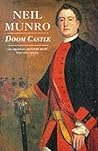 Doom Castle by Neil Munro
My rating: 5 of 5 stars
There is something deeply satisfying about finding in an old library or attic some fusty old book that hasn't been opened in decades, only to find within its pages an exciting adventure as fresh and as vibrant as the day it was written. Neil Munro is the natural successor to R.L. Stevenson, who in turn is the natural successor to Walter Scott. Tremendous good fun.
View all my reviews
April 13, 2023
Should the Stone of Destiny be returned to Westminster for the Coronation?
Last week I was invited to appear on TalkTV with former First Minister of Scotland Alex Salmond and top royal correspondent Michael Cole. The subject under discussion: Should the legendary Stone of Destiny, rapaciously stolen by the English in 1296 and 'lent back' to Scotland in 1996, be returned to Westminster in time for the coronation of Charles III? Or should Charles III be crowned on the Stone of Destiny in a separate ceremony in Scotland? Do we even need a monarchy at all? Please watch the 15 minute video on my profile page and let me know what you think in the comments!
October 30, 2022
Launch Day!
Today I celebrate the launch of my second book THE STONE OF DESTINY. A huge thanks to all who have ordered already, or acquired an ARC through the publishers. Perhaps it goes without saying, but if you enjoyed my book, I’d be really grateful if you, the reader, could leave an honest review on Amazon, Goodreads, or your favourite bookshop’s website.
Happy Halloween!
Andrew
Happy Halloween!
Andrew
July 7, 2022
Calum's Road
In 2013 I finally fulfilled a wish to visit my grandfather’s birthplace on the isle of Raasay, and to walk the famous road built by his first cousin Calum.
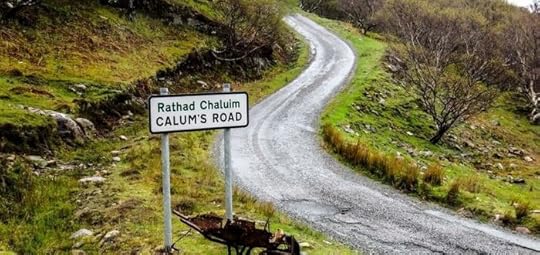
It’s quite a story. After unsuccessfully campaigning for two miles of road to be built linking Arnish in the north to the village, Calum decided to take matters into his own hands, quite literally. And so one morning in 1964, armed with only a pickaxe, a shovel and a wheelbarrow, Calum set out to begin what would take 10 years, and ultimately his life, to complete. (It might have been finished sooner, but Calum was also a crofter, the island’s postman, and part-time lighthouse keeper.)
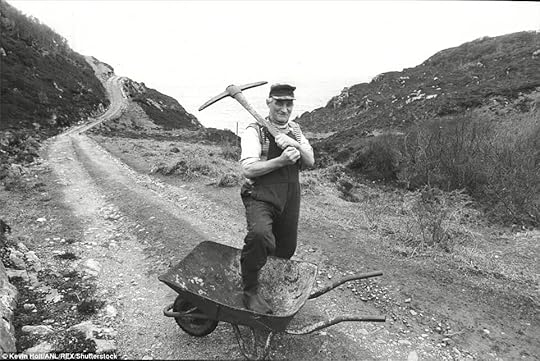
What strikes visitors most on seeing the road for the first time is the sheer magnitude of his accomplishment. The stretch of land between Arnish and the village is rugged and inhospitable, and Calum never chooses the easiest or shortest route. For example the road gracefully zig-zags to accommodate the steepest gradients, with supporting wooden buttresses carefully slotted into place. Engineers the world over have come to marvel at this testament to one man’s spirit, declaring it a wonder of modern engineering. Most touching of all is the fact that Calum couldn’t drive. The road was built for the ambulance that would prove a lifeline to his ailing wife Lexie.
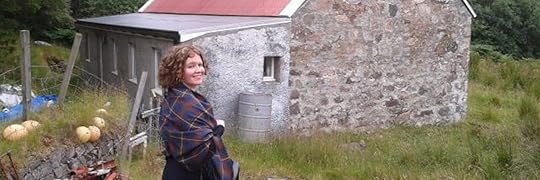
My wife Amber outside Calum’s cottage. Arnish, Raasay
My own grandpa Calum, as Calum-of-the-Road’s first cousin, lived in the same house for a time as well. Being something of a black sheep and not overly religious, my Grandpa joined the Glasgow police in the early 1930s. He and I were very close. He would get misty-eyed after a few drams and talk about Raasay, sing songs and teach me snatches of Gaelic. He never told us about his famous cousin, though, until one day he pointed to an obituary in the newspaper and said quietly, ‘that’s my cousin’. They were like that.
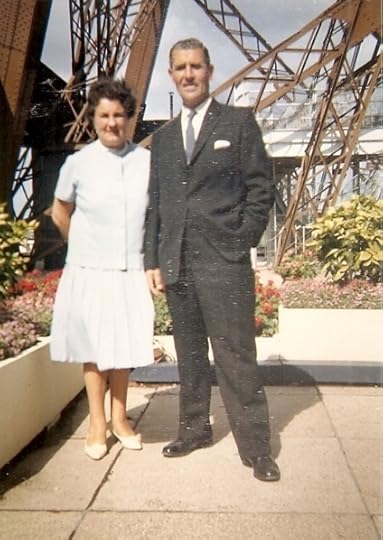
My Grandpa Calum and Grannie Margie on holiday. Note the suit, even on a sweltering hot day.
It’s quite a story. After unsuccessfully campaigning for two miles of road to be built linking Arnish in the north to the village, Calum decided to take matters into his own hands, quite literally. And so one morning in 1964, armed with only a pickaxe, a shovel and a wheelbarrow, Calum set out to begin what would take 10 years, and ultimately his life, to complete. (It might have been finished sooner, but Calum was also a crofter, the island’s postman, and part-time lighthouse keeper.)
What strikes visitors most on seeing the road for the first time is the sheer magnitude of his accomplishment. The stretch of land between Arnish and the village is rugged and inhospitable, and Calum never chooses the easiest or shortest route. For example the road gracefully zig-zags to accommodate the steepest gradients, with supporting wooden buttresses carefully slotted into place. Engineers the world over have come to marvel at this testament to one man’s spirit, declaring it a wonder of modern engineering. Most touching of all is the fact that Calum couldn’t drive. The road was built for the ambulance that would prove a lifeline to his ailing wife Lexie.
My wife Amber outside Calum’s cottage. Arnish, Raasay
My own grandpa Calum, as Calum-of-the-Road’s first cousin, lived in the same house for a time as well. Being something of a black sheep and not overly religious, my Grandpa joined the Glasgow police in the early 1930s. He and I were very close. He would get misty-eyed after a few drams and talk about Raasay, sing songs and teach me snatches of Gaelic. He never told us about his famous cousin, though, until one day he pointed to an obituary in the newspaper and said quietly, ‘that’s my cousin’. They were like that.
My Grandpa Calum and Grannie Margie on holiday. Note the suit, even on a sweltering hot day.