Joyce Job's Blog
August 24, 2026
Poem: Will You Be There on the Day I Win?
Will you be there on the day I win?
After all these years of scraping vessels
just to make ends meet…
Will you be there on the day I win?
In a black tux, holding my hand,
leading me toward the stage?
Or beaming proud, tearing up…
the loudest claps in the crowd?
Riding that long distance from home,
crowded trains, general tickets, no seats.
Throngs of people, boarding and departing,
how we fought for air just to reach the door.
Late trains, missed trains, monsoon rains…
A black umbrella, dripping.
A golden lady, glimmering.
Every crevice in the platform
sprouting a flower now.
Every doorless waiting hall
rolling out a red carpet.
Will you be there on the day I win?
In that black tux, cleaned up pretty well.
Knowing a million trivia, people would die to know,
between me, and you, and God, sealed forever.
Author’s Notes
Thank you for reading. 
Did someone come to mind while reading this poem: a sibling, a best friend, a lover, or a mentor who stood by you through the difficult days? Send this to that special person to let them know. 


August 21, 2026
Trivandrum Series: A Crazy Journey from Kazhakkoottam to Muthalapozhi – 3
Missed how this crazy journey started? Catch up on Part 1 and Part 2 first.
A Traumatic Encounter
While I was resting in a shopfront in Puthenthoppu, a lady – a total stranger demanded money from me. She shouted and berated me when I refused.
Surely, nobody wants to be publicly yelled at for no reason! However, despite being scared and intimidated, I had a secret advantage – it wasn’t my first time. Yikes!
Over the past 12 years of my working life, many toxic managers, writers, editors, and seniors had trained me in the art of being treated like a housemaid (not that anybody, including housemaids, deserves to be treated that way).
Underpaid but overworked, shouted at, belittled, yet forced to endure it all in silence until they returned, guilt-struck, realizing they overreacted or misunderstood the situation, and apologized for jumping the gun.
So, even when the stranger’s remarks got personal, I didn’t budge. Anybody who listened to her would have mistaken me for a lady up to some shady business in Puthenthoppu, without my husband’s knowledge.
In between, I dared to update her that I was unmarried. Furious and irritated, she insisted I was lying: “Why you don’t have a husband? You look like you have a husband!”
Stupid of me to believe that I could get through to a stranger like her!
A Narrow Escape
Like an angel rescuing a child from a snake’s mouth, a KSRTC bus scooped me up from the shores of Puthenthoppu, just inches away from the lady’s fangs, and flew to Muthalapozhi Harbour. Never in my life have I leaped into a vehicle so fast.
My whole body was shaking. Like a convict who had just escaped the prison, I kept looking back at the windows, worrying the lady’s orange paan-stained teeth were still following me.
By 3 pm, I landed at the Muthalapozhi Harbour stop. When the salty coastal air hit me, the first thing I did was save the contact details of the Coastal Police, Anchuthengu, displayed on a signboard.
Muthalapozhi Harbour
I was too traumatised and pissed off when I explored the Muthalapozhi Harbour, the beach, and the bridge. Though I saw many beautiful, ugly, and confusing sights that day, I couldn’t make much sense of it then.
Only later, while listening to Kerala’s revised budget for 2026-27 delivered by Chief Minister V D Satheesan, did those sights finally make sense to me. He had allocated funds to fix the unscientifically constructed Muthalapozhi Harbour.
Let me share what I learned about the harbour and its issues.
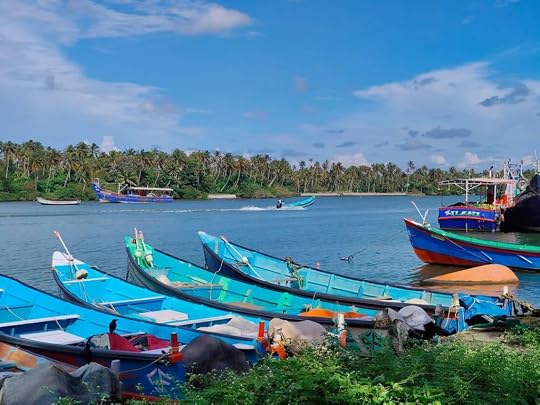 Boats docked at the Muthalapozhi Harbour
Muthalapozhi is a natural sandbar sandwiched between the villages of Perumathura and Thazhampally. It is also an estuarine inlet where the Vamanapuram River meets the Arabian Sea.
Historically, the river mouth of this estuary was accessible only during the monsoon from June to November. The estuary had to be closed around February or March as it silted up during summer.
The Muthalapozhi fishing harbour and the rock breakwaters were constructed by the government to ensure the fishermen could navigate year-round. Though it offers wanderers like me stunning sunset views, with a river on one side and the sea on the other, over the last decade the harbour has been in the news for all the wrong reasons.
Mouth of Death
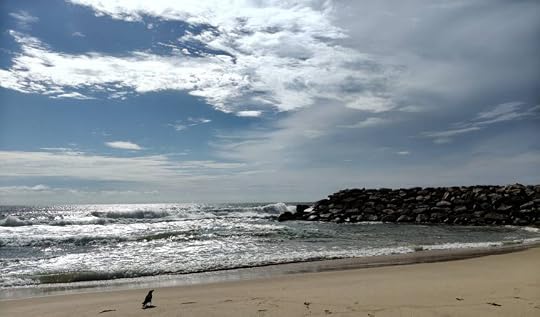 A crow kept me company at the Muthalapozhi Beach
Known notoriously as the “Mouth of Death,” Muthalapozhi Harbour has witnessed the tragic deaths of over seventy fishermen due to frequent boat capsizes. These accidents have also caused widespread damage to local boats and fishing equipment.
Both natural and man-made factors are to blame. Sediment from the Arabian Sea and the Vamanapuram River creates underwater hillocks that are dangerous to navigate, and irregular dredging compounds the risk.
During the monsoon, rough seas push boats against the rocky breakwaters and tetrapods installed to prevent coastal erosion, putting both the fishermen and their vessels in constant danger.
Clueless
While I was roaming the Thazhampally part of the Harbour, I had no idea the locals were suffering from such grave issues. A middle-aged Chetan, in a blue lungi, showed me the rows of small and big boats docked in the harbour.
He wanted to know why I was visiting a smelly fishing harbour, while most visitors came only for the sunset views from the beach or bridge. So I told him a bit about my blogging and trips.
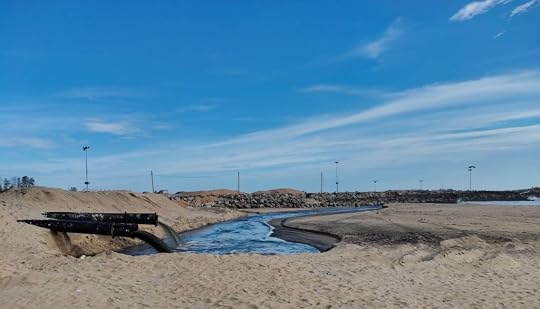 A sight that confused me – an open pipe gurgling black liquid into the beach
.
A sight that confused me – an open pipe gurgling black liquid into the beach
.Walking past the miraculous shrine of the Holy Cross (as I was not in the mood for miracles), I reached the beach area. The familiar sights of families laughing, people savouring ice creams, clicking photographs, the warm beach sands, the milky clouds, the whistling pines, crows and cranes, litter, and the footprints of innocent kids on the wet sand felt like nature’s attempt to cheer me.
Irregular sand mounds and an open pipe gurgling black liquid into the beach irked me. Both were unsafe, especially for kids. What if they accidentally fell into it while playing on the beach?
I blew raspberries at the beach and climbed the bridge to cross to Perumathura.
Muthalapozhi Bridge
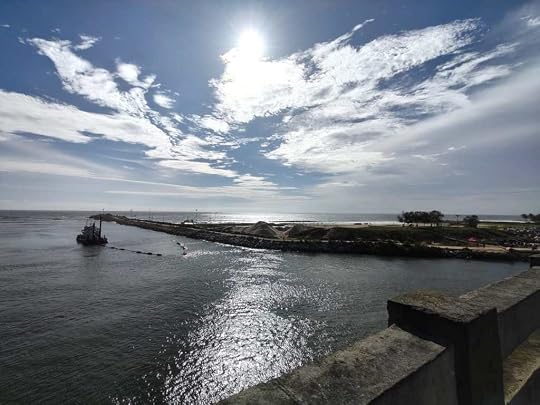 View from the Muthalapozhi Bridge
I was standing atop the bridge enjoying the view when a man collecting money for an event approached me. When I refused to pay, he seemed taken aback and asked if I was studying or working, throwing glances at the mobile phone in my hand.
After the last mishap, I didn’t have the energy for another wild personal conversation. So I said sorry and walked away.
Fish sellers, both ladies and men, with vessels full of fish soaked in ice, didn’t force me to buy. As they sat on the ground, swatting the mosquitoes and flies off their catch, I smiled a sad smile, and they smiled right back at me.
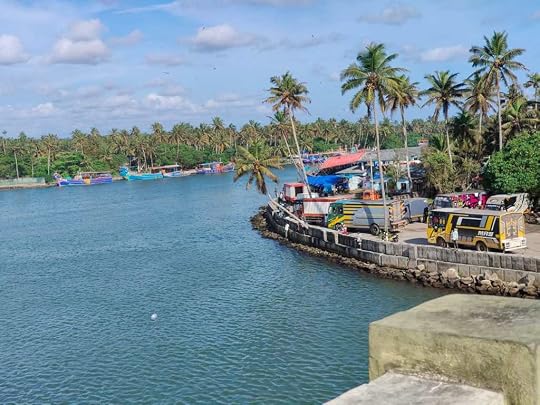 Boats docked at the Muthalapozhi Harbour – a view from the bridge.
Every time a heavy vehicle such as a lorry passed through, the bridge shook. When I reached the other side of the bridge, I gazed at Perumathura’s side of the harbour.
Opposite me, at a distance, I could see the long stretch of rock breakwaters and tetrapods laid out in the sea. But I sighed. I didn’t have the energy to explore it.
My Demons
A hypothetical husband and constant demands for money! Patriarchy and capitalism loomed over my mind like Mephistopheles over Doctor Faustus.
“Get married. Have kids. Do a 9-5 job. Go the conventional route. Maybe you won’t win big, but at least you won’t fail so hard. If you have a family and money, society, the Betaal might finally be off your back,” they whispered in my ear.
Cold darkness spread into my heart. Only one voice has ever broken through that ice.
My elder sister playfully nudging me every time I feel disheartened, asking, “Ithrayumeyullo Indian kathakrithukkal?” It means “Is this all there is to Indian storytellers?” It’s her way of saying, “Don’t give up, writer. You got this.”
Society had shown its teeth; it was time to bare my fangs at them.
I stared at the rocks lining the sea and gulped. “Geez. Now, I gotta climb that, don’t I?”
Rocks and Tetrapods
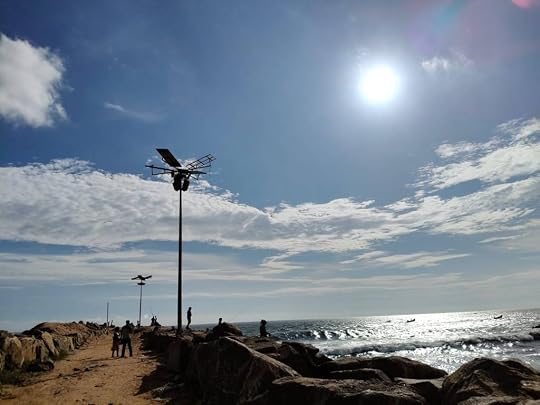 Walking through the Muthalapozhi breakwaters.
I walked all the way to the end of the rock breakwaters. I even saw the area where they mixed sand and cement to make tetrapods. Tetrapods lay bare in the sun, drying, cementing.
Many youngsters were sitting in a row near the tetrapods and rocks, and even under the shade of the bridge, fishing with rods. Small boats and speedboats passing under the bridge were a mesmerising sight.
Children played in the sand hills. Some construction activity was going on. Families wet their feet in the Perumathura beach area.
Battery Down
Around 4 pm, my phone battery was a bare 16%. My body battery too. I had walked over 20k steps. Dead tired, I didn’t stop to chitchat with the people fishing near the rocks or check out the cut fruits in the stall.
I waited 45 minutes at the Perumathura bus stop, counting a guy riding a horse, a child who got scared of the horse and ran away, a girl riding a bullet with a proud boyfriend at the back, and a thin drunkard who asked me the time, sat on the ground, and announced – the bus will arrive at 5 sharp. I prayed he was right, and thank God he was.
At 5, I boarded a bus to Kaniyapuram. It was the only one available at that time. While the bus rode through the Puthukurichy route, I bought a Rs 20 ticket and settled in a seat, letting my guard down for the first time that day.
After weekend traffic and the railway crossing at Kaniyapuram, I boarded another bus to Attinkuzhi, reaching my hostel just after 6.
Reflections
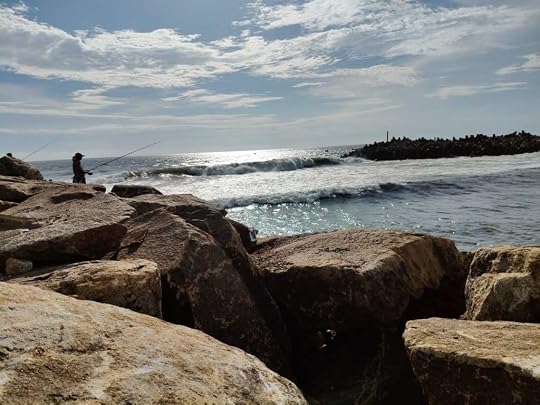 Silhouettes of people fishing at the Muthalapozhi rock breakwaters.
When I started my journey in the morning, my only worry was why no buses were plying between Kazhakkoottam and Menamkulam. Turned out there were many buses connecting the Veli-Perumathura-Muthalapozhi route. Later, safety concerns crowded my mind.
I was hoping to become a braver, more empowered, and compassionate version of myself through these trips. But all the moral and social policing that day made me wonder whether I was shrinking back into silence.
Later, learning about the tragic deaths of fishermen in Muthalapozhi filled me with guilt. I had let the minor mishap put me in a bubble, insulating me from other people’s lives and hardships.
By navigating my country alone and experiencing all its glories and shortcomings firsthand, my idealistic, naive self was getting a masterclass in realism. My rose-tinted glasses were finally cracking.
References
The New Indian Express: Article ‘Muthalapozhi Turns Death Trap: Two More Fishermen Drown,’ dated August 12, 2025.Mongabay: Article ‘A fisher haven that harbours death,’ dated September 4, 2024.South First: Article ‘Blood-thirsty Muthalapozhi in Kerala gobbles up lives as fishermen keep sailing into the mouth of death,’ dated July 12, 2023.Author’s Notes
~ All content on this blog is the intellectual property of the author. © 2026 Lirio Marchito. All rights reserved.
~ This blog is part of a series exploring my travels through Trivandrum, the capital city of my home state, Kerala, in India. You can read more posts from this series here. Trivandrum | Kerala| India
August 10, 2026
Trivandrum Series: A Crazy Journey from Kazhakkottam to Muthalapozhi – 2
Please read the first part of the blog here.
“ Country roads, take me home
To the place I belong …”
– Take Me Home, Country Roads; A song by John Denver.
Leaving behind the hot beach sands of Thumba Beach, I trudged back to the main road. Trees shedding brown-tainted leaves and small, yellow flowers bid me farewell. Many cars and two-wheelers whooshed past me.
St Andrew’s Church
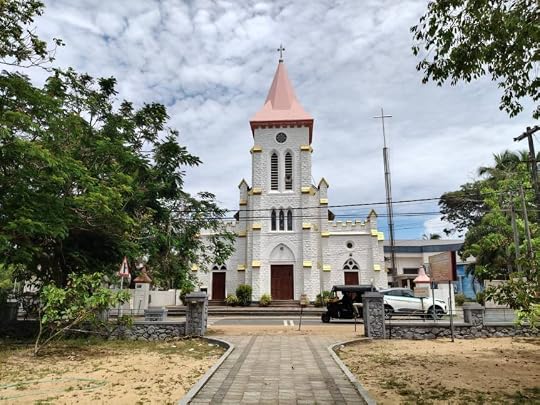 St Andrew’s Church Near Menamkulam, Trivandrum.
My next destination, St Andrew’s Beach and Church, was 1.5km away. Luckily, a Kizhakkekota-Perumathura City Shuttle bus came to my rescue. Paying Rs 12, they dropped me off at the St Andrew’s Junction. I had to walk 500m back to reach the Church, a Holy Mary shrine nearby, and the Beach in the distance.
More than the white-painted church, I was drawn to the little cave-like Holy Mary’s shrine with an aluminum roof. I sat on a plastic chair, my feet resting on the white beach sand, and prayed for some time. It helped me to calm down and to stay hopeful.
I called Naden Agro Farm near St Xavier’s College, Trivandrum. But they didn’t pick up. I was hoping to visit their sunflower farm in bloom. Later, I received an update that they had already harvested the sunflowers, so I struck it off my day’s itinerary.
Time was around 12:30 pm. I munched a few biscuits, gulped down some water, and tied my hair in a ponytail. As I resumed my walk to the beach, my left leg hurt a bit, but I chose to ignore it as I still had a long way to cover.
St Andrew Beach
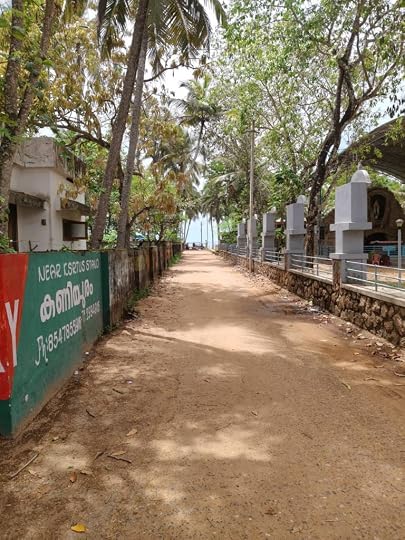 The path leading to St Andrew’s Beach. You can also see the Holy Mary’s Shrine on the right.
Have you ever felt that the roads leading to your destination look more beautiful than the destination itself? Just like the road bound to the Golden Beach in Thumba, the one leading to St Andrew Beach, too, captured my heart.
The coconut and mango trees on both sides, and the lure of the blue sea in the distance. Maybe I was a sea creature in my past life, because every time I see the sea, it feels like some molecules are rearranging inside my brain. My breath slows, and my brain calms down like a baby cradled by her mom.
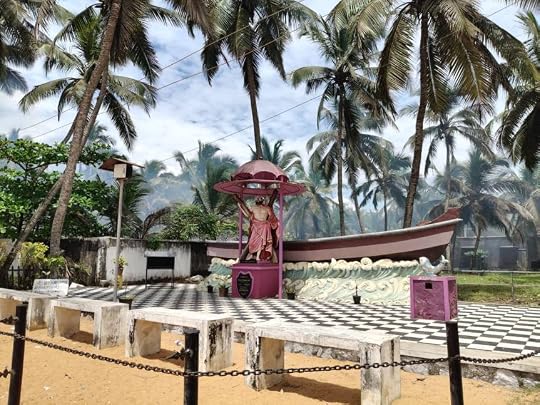 St Andrew’s Shrine Near St Andrew’s Beach, Menamkulam.
On the way, a shrine of St. Andrew caught my attention. Based on my Catholic tradition, he is my patron saint. My birthday coincides with his feast day in my parish church in Alappuzha.
People on the Beach
One driver, carelessly reversing the car and striking two scooters in one go without even checking the rear properly, broke my reverie. He didn’t even apologize before driving off. I’m sure the scooter owners cursed under their breath at him.
My stomach was grumbling in protest. It was time for lunch. There was an aesthetic cafe nearby, but it was closed. Its opening time was listed as 1 pm online. Since it was already 12:45 pm, I stayed hopeful. There was another cafe nearby, Chai Chillum, but it opened only around 4 pm.
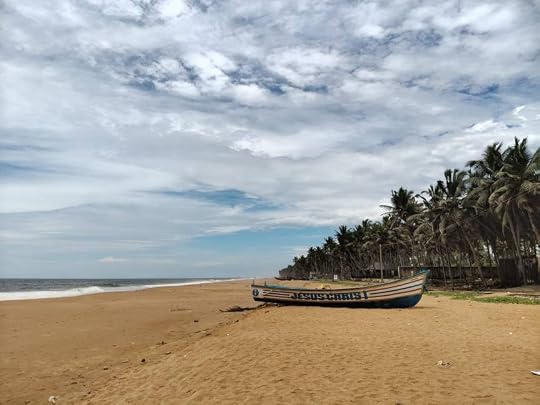 Scenes from St Andrew’s Beach, Menamkulam.
While I was checking these details online, I accidentally overheard a young guy arguing with his mother. He claimed that his needs were never met even though he made no big demands like most youngsters. When he complained that his mom was always overriding his decisions with hers, she started arguing back.
I’m not a fan of family drama. It brings out bad memories, so I moved to the beachside, gazing at the waves and the milky clouds, clicking photographs. To my glee, I saw a signboard for the G-Farm Horse Riding Academy. I love horses. I think they’re magnificent creatures. More than learning to ride them, someday, I would love to learn how to be friends with them.
Beaches vibe best at sunset or night, with all the fairy lights on. But since I travelled solo, I always had to settle for the safer and boring daylight vibes. Gazing at the docked boat named ‘Jesus Christ’ and internally screaming at all the trash scattered over the beach sand, I wished I was either swimming or paragliding, or learning to snorkel or scuba dive in the sea.
The Great Chatsby
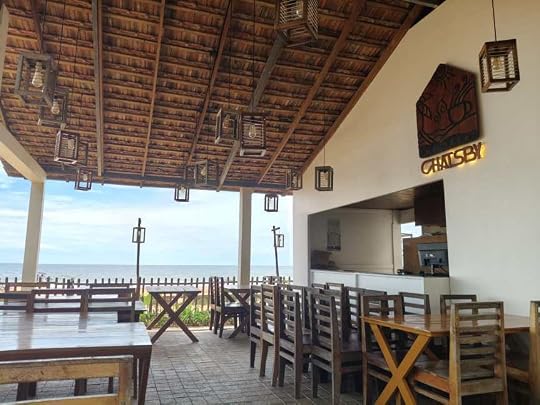 The Great Chatsby restaurant, located near St Andrew’s Beach, Menamkulam.
When I saw a few staff members wiping the tables of the Great Chatsby cafe, my mind somersaulted with hope. As I walked toward the cafe and said hi to the waiters, I sincerely wished its kitchen was in full swing.
The menu looked so yummy and expensive. But above that, I loved the whole vibe of the place. The white walls, the brown terracotta-tiled roof, the wooden tables and chairs, and the old-fashioned yellow light bulbs, a few out in the open and the others caged in wooden lanterns. Besides, from where I was sitting, I could see the sea. What more could I ask? As a woman, I was grateful for the clean toilets too.
While waiting for my falafel wrap, I snapped a few photos of the cafe. Spotting my camera, the non-Malayali staff member at the counter kindly switched on the warm yellow lanterns to give me better light.
The manager, or probably the owner, a young Malayali guy, came across as wonderfully goofy and friendly. He apologetically explained that they were still finishing up the morning cleaning. His demeanor reminded me of Nivin Pauly’s character, George David, who runs Cafe Agape in the popular Malayalam movie Premam. To be fair, I thought the cafe looked pretty clean already.
A beautiful, young, Hindi-speaking couple occupied the table next to me. When their fried rice arrived, its wafting aroma and sheer quantity made me wonder if I should have ordered one too. But it was an unnecessary worry because my wrap and fries turned out to be so yummy and filling. After the meal, as I was washing my hands, a crow stole the wrapping paper from my table, inviting chuckles from the other tables.
The goofy owner was atop a ladder fixing a light when I went to pay the bill. Have you ever met someone in their regular surroundings and wished you could see them again in a more casual place, chat a bit, and become friends? I guess we all do. But like many introverts, I walked out of the restaurant without saying an extra word, running an entire imaginary conversation with him inside my head.
Puthenthoppu
My next stop was the Puthenthoppu Church. From St Andrew’s Church it was a 1.5km, 22-minute walk. Since I had refueled, I ventured on that walk enthusiastically.
The path was nice with good roads and trees on both sides. In between, I saw many private beaches and spots like the Ochre Beach and Wild Palms Beach Resort, but I didn’t stop.
As the sun burned my neck, I pulled out my umbrella; I was wearing only a cap until then. When I ran out of water, I wished I had bought a bottle of mineral water from the restaurant.
Slowly, the roads turned busier. Around 2:10 pm, I reached Puthenthoppu. Even before reaching the church, I could see the path to the beach on the left. It looked nostalgic with the coconut trees on both sides.
Puthenthoppu Church
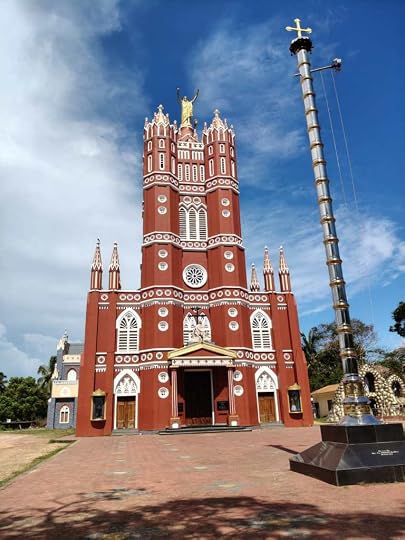 St Ignatius of Loyola Latin Catholic Church, more popularly known as the Puthenthoppu Church.
I was determined to explore the red-painted Puthenthoppu Church, officially the St Ignatius of Loyola Latin Catholic Church, before venturing onto the beach. So, I spent some time around its premises, ogling the view of the church, trees, the tall kodimaram (flagstaff), and the golden statue of Jesus with open, raised arms, slightly reminiscent of the Christ the Redeemer statue in Rio de Janeiro.
Did you know such kodimarams (flagstaffs) were usually found only in temple premises? Much like the rituals ‘lighting the lamp’ (vilakku kathikkuka), ‘tying the knot’ (thaali kettal or minnu kettal), and ‘exchange of garlands’ (maalayidal) during marriage functions, the flagstaff is also a borrowed tradition from Hindu temples and ceremonies.
This time, it was a procession of believers, dressed mostly in white clothes, that broke my reverie. They prayed in front of the church and trotted towards the beach. Despite being born and brought up as a Christian, I had no idea what kind of a prayer procession it was. Keeping a safe distance from the crowd, I followed them to the beach. It was around 2:30 pm.
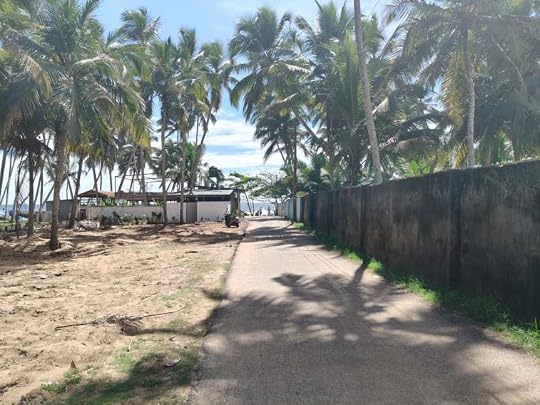 The road leading to Puthenthoppu Beach.
From one of the signboards, I learned that Puthenthoppu beach and church fall under the Kadinamkulam Grampanchayat. The road leading to the beach gave me deja vu. Have I already seen it in a dream, or was it just my brain glitching the view with one of my past beach visits? I didn’t know for sure.
Not just the road bound to the beach but the beach sand too was burning hot. And the sea was glistening like glitter. I realized I wouldn’t be able to rest there either. The familiar sight of splashing sea waves, wet and hot beach sand, docked boats – a few covered with blue tarpaulin, fish nets, bikes parked in the shade of Indian almond trees (thalli thenga marangal), and scores of coconut trees filled me with warmth.
A Typical Malayalee Dream
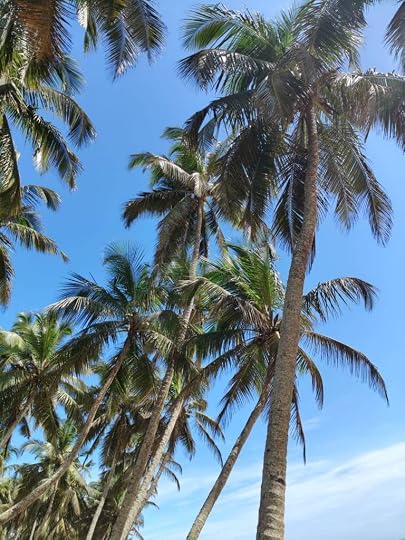 A coconut tree grove near Puthenthoppu Beach
The youngsters in Kerala joke that if their parents or grandparents had buildings or plots they could inherit, preferably a shop or a coconut grove, they would gladly resign their IT jobs and live purely out of the shop rents and coconut sales. But this is only the plan B. The universal plan A of all Malayalee youngsters is to open a tea and snack shop, colloquially called ‘chaya kada.’
Under the blazing sun, I stood daydreaming about making sufficient money from my imaginary shops and hypothetical coconut groves, and thereafter lavishing the lion’s share of my time working on only the things I genuinely love and enjoy, spending quality time with my family, going on a world tour and blogging about it, then writing and publishing hundreds of books including fiction, poetry, and travel memoirs and becoming a world renowned writer, who also works on humanitarian causes. A girl and her small dreams.  If only the universe were a wish-granting machine!
Tired of Beaches?
I stared at the signboards put up by the church, declaring the beach as a “non-lahari” zone. In my native tongue, Malayalam, Lahari means intoxication.
As someone who has lost close family members to alcoholism or alcoholism induced health problems, watched helplessly as they ruined the peace of their families, especially their partners, and set wrong role models to their kids, and been a miserable witness of youngsters losing their careers to drug addictions, I couldn’t stress enough how much I support the ‘say no to drugs’ campaigns. People call me boring and uncool for it. That’s okay. I believe living life to the fullest is the biggest high worth exploring.
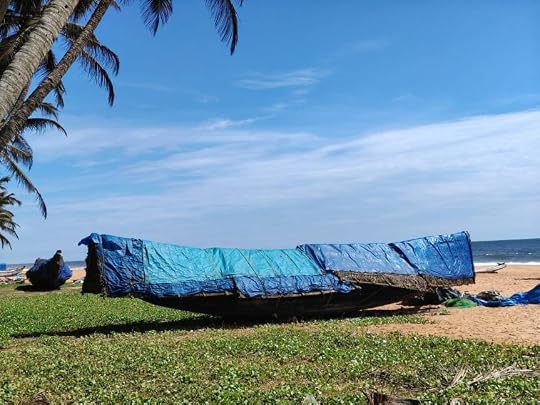 Scenes from Puthenthoppu Beach
On that note, I was ready to wrap up my exploration of Puthenthope Beach and head to the next spot. At that point, I felt I had seen enough beaches for a month. For me, a beach needs a sunset and chill people to vibe. As I walked back, I couldn’t shake a thought, though. Maybe I would revisit the beach with my person or people in a few years. Maybe I would never come there again. That’s the beauty and tragedy of our totally unpredictable and uncertain human lives.
A Terrifying Woman
Just opposite the Puthenthoppu Church, there was a small stall selling snacks and juices. A differently-abled Chetan, who was either injured or born with a disability in his leg, ran the shop. I bought some water from there. The nearby ATM also proved useful.
Next to the shop and ATM, there was a hotel with a raised platform at the front. Since I was tired, I sat there for some time, grateful to get some rest before hopping on a bus to my next spot – Muthalapozhi Harbour.
Just then, a lady, dressed in a saree and chewing paan, came near me and asked me for money. In Kerala, paan is a combination of pakku (areca/betel nut), vettila (betel leaf), and chunnambu (slaked lime).
I don’t like the orange stains it leaves on its users’ teeth or its smell. Pretty much like the smell of alcohol and cigarette smoke, paan too gives me a headache. It might be just my prejudice or boring preference, but that’s who I am.
I didn’t want to pull out my wallet in front of a stranger in an unknown place, especially since I was alone. Besides, she seemed fully healthy. There was a differently-abled person just a few metres away from us running a shop to earn his living. So what could be her excuse? I also felt that any money I gave her would go straight to the paan shop or worse, a toddy shop.
So against my fears and better judgement, I said no, that I didn’t have any money. I did expect her to be pissed, but I didn’t expect the amount of anger she would soon shower on me.
She got so furious; she demanded I tell her my personal details. She asked me my name, where I was from, where my husband is, why I was there without my husband, whether my husband knew that I was there, what I was doing in Puthenthope all alone, how I would reach home without money, how dare I roam around alone like this, and what if something happened to me.
She shouted at me and scolded me, asking me to go back home immediately. Her exact words were “Ninnu karangathe vegam veetl poku. Enthenkilum pattiyalo?” meaning “Don’t loiter around; go home. What if something happens to you?” Was that a statement or a threat? I still shudder in fear and recoil in disgust.
Honestly, I hated her – her words, the way she shouted at me, the way she assumed I had a husband I was answerable to, as if women are nothing but their husbands’ properties, the way she demanded money from a complete stranger as if she had loaned me some, and worst of all, the smell of paan around her. The only danger to my life at that point was her. She scared me.
She wanted money, and she was trying to berate and intimidate me into giving her some. Maybe I should have caved in. It would have been safer. Maybe people like her are the reason why our parents warn us not to speak to strangers. They’re so irritating and don’t know how to mind their own business. All I wanted at that point was to escape, to run away, to never ever see her again.
To be continued…
Author’s Notes
~ All content on this blog is the intellectual property of the author. © 2026 Lirio Marchito. All rights reserved.
~ This blog is part of a series exploring my travels through Trivandrum, the capital city of my home state, Kerala, in India. You can read more posts from this series here. Trivandrum | Kerala| India
Trivandrum Series: A Crazy Journey from Kazhakkoottam to Muthalapozhi – 2
If you haven’t been along for the ride yet, catch up on Part 1 before diving in.
“ Country roads, take me home
To the place I belong …”
– Take Me Home, Country Roads; A song by John Denver.
Leaving behind the hot beach sands of Thumba Beach, I trudged back to the main road. Trees shedding brown-tainted leaves and small, yellow flowers bid me farewell. Many cars and two-wheelers whooshed past me.
St Andrew’s Church
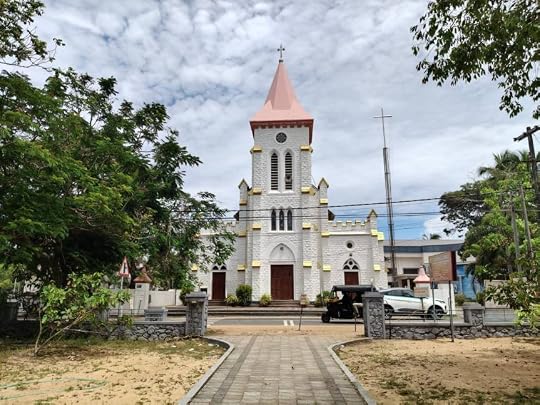 St Andrew’s Church Near Menamkulam, Trivandrum.
My next destination, St Andrew’s Beach and Church, was 1.5km away. Luckily, a Kizhakkekota-Perumathura City Shuttle bus came to my rescue. Paying Rs 12, they dropped me off at the St Andrew’s Junction. I had to walk 500m back to reach the Church, a Holy Mary shrine nearby, and the Beach in the distance.
More than the white-painted church, I was drawn to the little cave-like Holy Mary’s shrine with an aluminum roof. I sat on a plastic chair, my feet resting on the white beach sand, and prayed for some time. It helped me to calm down and to stay hopeful.
I called Naden Agro Farm near St Xavier’s College, Trivandrum. But they didn’t pick up. I was hoping to visit their sunflower farm in bloom. Later, I received an update that they had already harvested the sunflowers, so I struck it off my day’s itinerary.
Time was around 12:30 pm. I munched a few biscuits, gulped down some water, and tied my hair in a ponytail. As I resumed my walk to the beach, my left leg hurt a bit, but I chose to ignore it as I still had a long way to cover.
St Andrew’s Beach
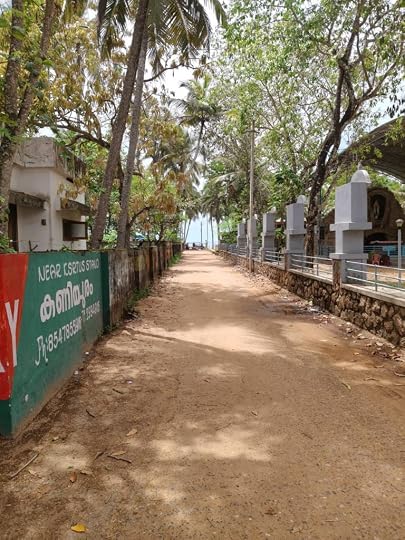 The path leading to St Andrew’s Beach. You can also see the Holy Mary’s Shrine on the right.
Have you ever felt that the roads leading to your destination look more beautiful than the destination itself? Just like the road bound to the Golden Beach in Thumba, the one leading to St Andrew Beach, too, captured my heart.
The coconut and mango trees on both sides, and the lure of the blue sea in the distance. Maybe I was a sea creature in my past life, because every time I see the sea, it feels like some molecules are rearranging inside my brain. My breath slows, and my brain calms down like a baby cradled by her mom.
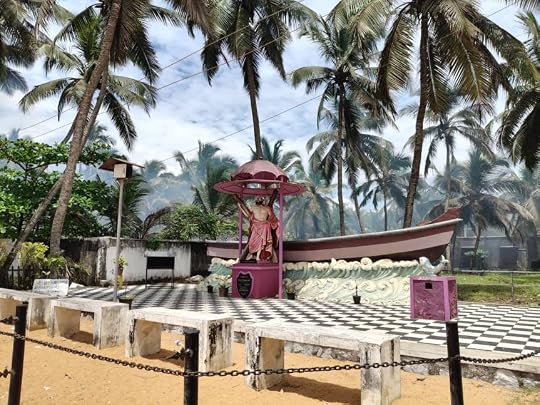 St Andrew’s Shrine Near St Andrew’s Beach, Menamkulam.
On the way, a shrine of St. Andrew caught my attention. Based on my Catholic tradition, he is my patron saint. My birthday coincides with his feast day in my parish church in Alappuzha.
People on the Beach
One driver, carelessly reversing the car and striking two scooters in one go without even checking the rear properly, broke my reverie. He didn’t even apologize before driving off. I’m sure the scooter owners cursed him.
My grumbling stomach reminded me it was time for lunch. There was an aesthetic cafe nearby, but it was closed. Its opening time was listed as 1 pm online. Since it was already 12:45 pm, I stayed hopeful. There was another cafe nearby, Chai Chillum, but it opened only around 4 pm.
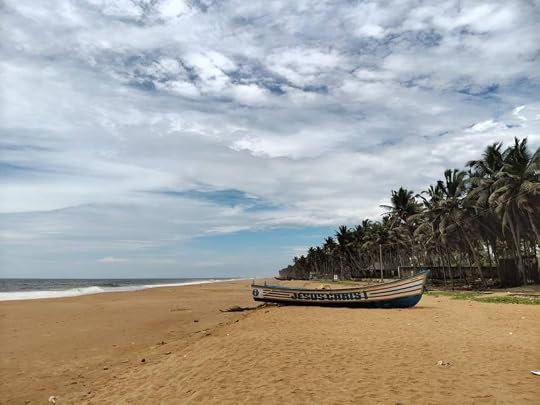 Scenes from St Andrew’s Beach, Menamkulam.
While I was checking these details online, I accidentally overheard a young guy arguing with his mother. He claimed that his needs were never met even though he made no big demands like most youngsters. When he complained that his mom was always overriding his decisions with hers, she started arguing back.
I’m not a fan of family drama. It brings out bad memories, so I moved to the beachside, gazing at the waves and the milky clouds, clicking photographs. To my glee, I saw a signboard for the G-Farm Horse Riding Academy. I love horses. I think they’re magnificent creatures. More than learning to ride them, someday, I would love to learn how to be friends with them.
Beaches vibe best at sunset or night, with all the fairy lights on. But since I travelled solo, I always had to settle for the safer and boring daylight vibes. Gazing at the docked boat named ‘Jesus Christ’ and internally screaming at all the trash scattered over the beach sand, I wished I was either swimming or paragliding, or learning to snorkel or scuba dive in the sea.
The Great Chatsby
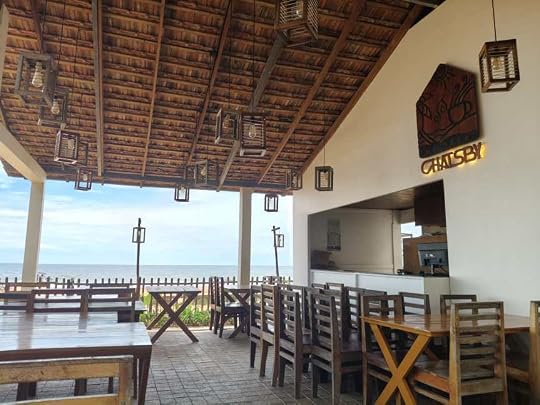 The Great Chatsby restaurant, located near St Andrew’s Beach, Menamkulam.
When I saw a few staff members wiping the tables of the Great Chatsby cafe, my mind somersaulted with hope. As I walked toward the cafe and said hi to the waiters, I sincerely wished its kitchen was in full swing.
The menu looked so yummy and expensive. But above that, I loved the whole vibe of the place. The white walls, the brown terracotta-tiled roof, the wooden tables and chairs, and the old-fashioned yellow light bulbs, a few out in the open and the others caged in wooden lanterns. Besides, from where I was sitting, I could see the sea. What more could I ask? As a woman, I was grateful for the clean toilets too.
While waiting for my falafel wrap, I snapped a few photos of the cafe. Spotting my camera, the non-Malayali staff member at the counter kindly switched on the warm yellow lanterns to give me better light.
The manager, or probably the owner, a young Malayali guy, came across as wonderfully goofy and friendly. He apologetically explained that they were still finishing up the morning cleaning. To be fair, I thought the cafe looked pretty clean already. His demeanor reminded me of Nivin Pauly’s character, George David, who runs Cafe Agape in the popular Malayalam movie Premam.
A young, good-looking Hindi-speaking couple occupied the table next to me. When their fried rice arrived, its wafting aroma and sheer quantity made me wonder if I should have ordered one too. But it was an unnecessary worry because my wrap and fries turned out to be so yummy and filling. After the meal, as I was washing my hands, a crow stole the wrapping paper from my table, inviting chuckles from the other tables.
The goofy owner was atop a ladder fixing a light when I went to pay the bill. Have you ever met someone in their regular surroundings and wished you could see them again in a more casual place, chat a bit, and become friends? I guess we all do. But like many introverts, I walked out of the restaurant without saying an extra word, running an entire imaginary conversation with him inside my head.
Puthenthoppu
My next stop was the Puthenthoppu Church. From St Andrew’s Church it was a 1.5 km, 22-minute walk. Since I had refueled, I ventured on that walk enthusiastically.
The path was nice with good roads and trees on both sides. In between, I saw many private beaches and spots like the Ochre Beach and Wild Palms Beach Resort, but I didn’t stop.
As the sun burned my neck, I pulled out my umbrella; I was wearing only a cap until then. When I ran out of water, I wished I had bought a bottle of mineral water from the restaurant.
Slowly, the roads turned busier. Around 2:10 pm, I reached Puthenthoppu. Even before reaching the church, I could see the path to the beach on the left. It looked nostalgic with the coconut trees on both sides.
Puthenthoppu Church
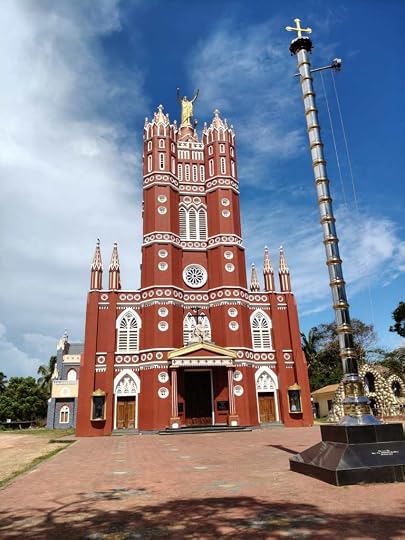 St Ignatius of Loyola Latin Catholic Church, more popularly known as the Puthenthoppu Church.
I was determined to explore the red-painted Puthenthoppu Church, officially the St Ignatius of Loyola Latin Catholic Church, before venturing onto the beach. So, I spent some time around its premises, ogling the view of the church, trees, the tall kodimaram (flagstaff), and the golden statue of Jesus with open, raised arms, slightly reminiscent of the Christ the Redeemer statue in Rio de Janeiro.
Did you know such kodimarams (flagstaffs) were usually found only in temple premises? Much like the rituals ‘lighting the lamp’ (vilakku kathikkuka), ‘tying the knot’ (thaali kettal or minnu kettal), and ‘exchange of garlands’ (maalayidal) during marriage functions, the flagstaff is also a borrowed tradition from Hindu temples and ceremonies.
This time, it was a procession of believers, dressed mostly in white clothes, that broke my reverie. They prayed in front of the church and trotted towards the beach. Despite being born and brought up as a Christian, I had no idea what kind of a prayer procession it was. Keeping a safe distance from the crowd, I followed them to the beach. It was around 2:30 pm.
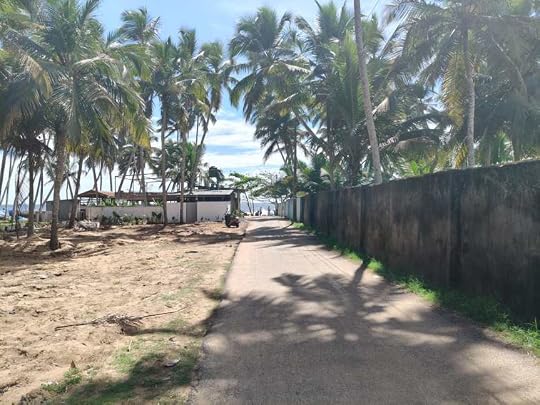 The road leading to Puthenthoppu Beach.
From one of the signboards, I learned that Puthenthoppu beach and church fall under the Kadinamkulam Grampanchayat. The road leading to the beach gave me deja vu. Have I already seen it in a dream, or was it just my brain glitching the view with one of my past beach visits? I didn’t know for sure.
Not just the road bound to the beach but the beach sand too was burning hot. And the sea was glistening like glitter. I realized I wouldn’t be able to rest there either. The familiar sight of splashing sea waves, wet and hot beach sand, docked boats – a few covered with blue tarpaulin, fish nets, bikes parked in the shade of Indian almond trees (thalli thenga marangal), and scores of coconut trees filled me with warmth.
A Typical Malayalee Dream
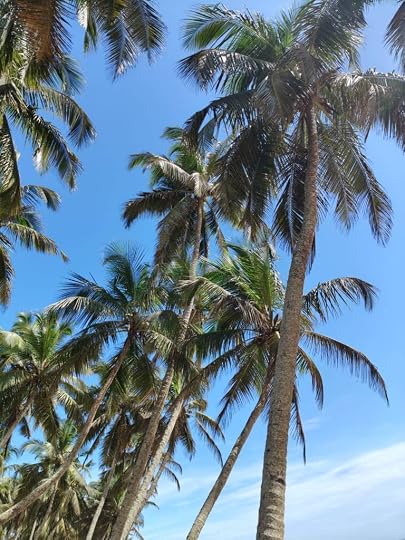 A coconut tree grove near Puthenthoppu Beach
The youngsters in Kerala joke that if their parents or grandparents had buildings or plots they could inherit, preferably a shop or a coconut grove, they would gladly resign their IT jobs and live purely out of the shop rents and coconut sales. But this is only the plan B. The universal plan A of all Malayalee youngsters is to open a tea and snack shop, colloquially called ‘chaya kada.’
Under the blazing sun, I stood daydreaming about making sufficient money from my imaginary shops and hypothetical coconut groves, and thereafter lavishing the lion’s share of my time working on only the things I genuinely love and enjoy, spending quality time with my family, going on a world tour and blogging about it, then writing and publishing hundreds of books including fiction, poetry, and travel memoirs and becoming a world renowned writer, who also works on humanitarian causes. A girl and her small dreams. If only the universe were a wish-granting machine!
Tired of Beaches?
I stared at the signboards put up by the church, declaring the beach as a “non-lahari” zone. In my native tongue, Malayalam, Lahari means intoxication.
Having lost close family members to alcoholism and alcohol-induced health issues, watched helplessly as they ruined their family’s peace—especially their partners’—and set poor examples for their children, and having been a miserable witness to youngsters losing their careers to drug addiction, I cannot stress enough how strongly I support “Say No to Drugs” campaigns. People call me boring and uncool for it, but that is fine. I believe living life to the fullest is the ultimate high worth exploring.
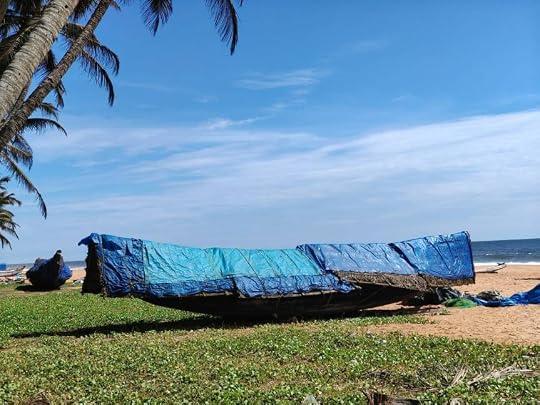 Scenes from Puthenthoppu Beach
On that note, I was ready to wrap up my exploration of Puthenthope Beach and head to the next spot. At that point, I felt I had seen enough beaches for a month. For me, a beach needs a sunset and chill people to vibe. As I walked back, I couldn’t shake a thought, though. Maybe I would revisit the beach with my person or people in a few years, or maybe I would never go back again. That was the beauty and tragedy of our totally unpredictable human lives.
A Terrifying Woman
Just opposite the Puthenthoppu Church, there was a small stall selling snacks and juices. A differently-abled Chetan, who was either injured or born with a disability in his leg, ran the shop. I bought some water from there. The nearby ATM also proved useful.
Next to the shop and ATM, there was a hotel with a raised platform at the front. Since I was tired, I sat there for some time, grateful to get some rest before hopping on a bus to my final spot – Muthalapozhi Harbour.
Just then, a lady, dressed in a saree and chewing paan, came near me and asked me for money. In Kerala, paan is a combination of pakku (areca/betel nut), vettila (betel leaf), and chunnambu (slaked lime).
I don’t like the orange stains it leaves on its users’ teeth or its smell. Pretty much like the smell of alcohol and cigarette smoke, paan too gives me a headache. It might be just my prejudice or boring preference, but that’s who I am.
I didn’t want to pull out my wallet in front of a stranger in an unknown place, especially since I was alone. Besides, she seemed fully healthy. There was a differently-abled person just a few metres away from us running a shop to earn his living. So what could be her excuse? I also felt that any money I gave her would go straight to the paan shop or worse, a toddy shop.
So against my fears and better judgement, I said no, that I didn’t have any money. I did expect her to be pissed, but I didn’t expect the amount of anger she would soon shower on me.
She got so furious; she demanded I tell her my personal details. She asked me my name, where I was from, where my husband is, why I was there without my husband, whether my husband knew that I was there, what I was doing in Puthenthope all alone, how I would reach home without money, how dare I roam around alone like this, and what if something happened to me.
She shouted at me and scolded me, asking me to go back home immediately. Her exact words were “Ninnu karangathe vegam veetl poku. Enthenkilum pattiyalo?” meaning “Don’t loiter around; go home. What if something happens to you?” Was that a statement or a threat? I still shudder in fear and recoil in disgust.
Honestly, I hated her – her words, the way she shouted at me, the way she assumed I had a husband I was answerable to, as if women are nothing but their husbands’ properties, the way she demanded money from a complete stranger with the audacity of a loanshark collecting interest from his debtors, and worst of all, the smell of paan around her. The only danger to my life at that point was her. She scared me.
She wanted money, and she was trying to berate and intimidate me into giving it to her. Maybe I should have caved in. It would have been safer. Maybe people like her are the reason why our parents warn us not to speak to strangers – they’re so irritating and don’t know how to mind their own business. All I wanted at that point was to escape, to run away, to never ever see her again.
To be continued…
Author’s Notes
~ All content on this blog is the intellectual property of the author. © 2026 Lirio Marchito. All rights reserved.
~ This blog is part of a series exploring my travels through Trivandrum, the capital city of my home state, Kerala, in India. You can read more posts from this series here. Trivandrum | Kerala| India
August 8, 2026
Poem: Trespassers
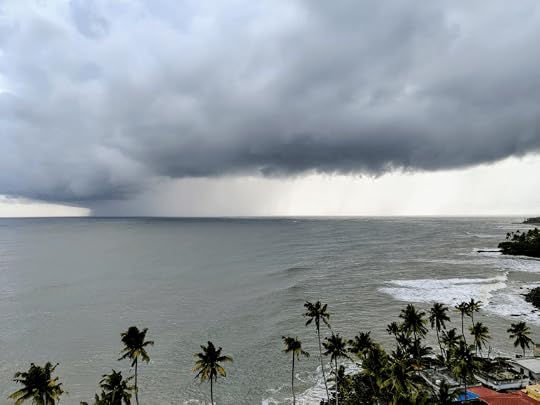
Storms in my heart
trespassing.
Two fish in a monsoon flood,
hikers lost in a valley of flowers.
I can’t breathe.
I can’t focus.
I must empty this trash can.
“What’s the plan?” Everyone asks.
A lot of nicknames, but no labels.
Shuts the front door, but longs for a whistle.
One is territorial.
The other lacks boundaries.
Wishes – mere coins tossed in a cave pond.
Love – an act, an ecstasy, a deep cut.
No prospects. No promises.
Yet I wait for doomsday.
Do I surrender
or let go?
Does anybody know?
Big breaths.
Count to three.
He takes off with no sirens. I have no wings.
My body burns with shame and guilt.
There are no ashes, only fumes.
No bloodshed, only souvenir scars.
Months of therapy for five cups of tea.
July 26, 2026
Trivandrum Series: A Crazy Journey from Kazhakkoottam to Muthalapozhi – 1
Standing in solidarity with the students peacefully protesting the NEET paper leaks at Jantar Mantar, Delhi.
~~~
The day after my Amboori trip, I was returning from Trivandrum to Kollam with my school friend, Bhagu. I was chilling in the passenger seat, listening to old Tamil songs on the car radio, and watching my friend drive. We had just had breakfast from the Indian Coffee House at Sreekaryam.
Bhagu asked me if taking the longer, beachside route was okay. I nodded as I didn’t have any plans till evening. It was obvious that she loved the long drives.
On the way, she pointed to one side and said, “This place has a great restaurant. The food is good, but the night vibe is stellar.”
“Oh, the Great Chatsby, isn’t it? I’ve been there before. One day, I went for a long, solo walk from Kazhakkoottam till Muthalapozhi harbor. In between, I was so hungry I had lunch from that restaurant.”
“What are you saying, Jo? That’s crazy. Muthalapozhi is close to my relatives’ place, Chirayinkeezhu. That’s at least 15km from Kazhakkoottam. Don’t tell me you walked all the way?” Bhagu asked, flabbergasted.
“Oh, I didn’t walk the entire route. I took a bus or two in between. And it wasn’t one long walk. There were many pit stops. I explored the beaches and churches on the way. I rested and had food, too.”
“Still! What are you, mini Santhosh George Kulangara?” She teased me, worried for my safety and health.
I swear I’m a normal person, but on some days, the inner David Goggins overpowers me. That’s exactly what happened on that October day last year.
October 5, 2025, Sunday
My month-long stay in Trivandrum was coming to an end in three days. I woke up at 3 in the morning, in the middle of a beautiful dream. In the dream, I had access to the best library in the world. If only!
Outside my hostel, it was raining heavily. I tried to go back to sleep, but I couldn’t. So I daydreamed about becoming a librarian. It’s a fascination I have carried privately in my heart ever since I read Haruki Murakami’s celebrated book Kafka on the Shore.
Since the weather reports predicted an average temperature of 26 degrees and a 35% chance of precipitation in Trivandrum, I assumed it would be a stay-indoors kind of day. So I spent the next few hours working on my Sambranikodi blog.
But when I climbed the tin-roofed terrace to exercise, I saw immigrant workers in the nearby construction site toiling in the rain, wearing yellow safety caps. I felt bad seeing their state and realized I shouldn’t take my opportunities or time for granted. So by 10, I walked out of my hostel, determined to explore the Perumathura route.
One of my hostel mates, Eesha from Madhya Pradesh, who worked in the Techno Park, had told me about her visit to the Thumba Beach. She and her friends had taken a rapido to the beach, as it was just 3km from Kazhakkoottam. I, on the other hand, was determined to find the bus route. I assumed there would be buses every few minutes from Kazhakkoottam to Menamkulam, where the Thumba Beach is situated.
Where are you going?
As I walked out of my hostel, a bag on my shoulder and my purple umbrella in my hand, envisioning myself as a grown-up Dora Buji, an unexpected question from the hostel caretaker stopped me in my tracks: “Where are you going?”
To the naive ear, it might sound like an innocent question. But every grown-up woman in India knows it’s part of the social and moral policing. Guess I didn’t realise how much I was enjoying my last 25 days of freedom, of not being questioned or stopped, until it was revoked.
“There’s a new rule,” she explained. “Anybody leaving the hostel for matters outside of work must jot it down in the register.”
This new rule, introduced by the owner’s daughter, irked me on many levels. First, travel writing is part of my job, so my solo travels are not exactly “matters outside of work.” Second, such rules are not in practise in men’s or boys’ hostels, as far as I’m aware. Third, I’m an Indian citizen; I’m a working adult woman pursuing her dreams; I see myself as an empowered and liberated human being; I don’t like unnecessary questioning and checks like this.
But hiding my irritation, I just scribbled “Menamkulam” on the register against my name and left without any argument. Patriarchy is so deep-rooted in my society. Decades of verbal arguments with people who happily stay ignorant of gender inequalities have exhausted me. Living my life on my own terms is the only way I’m resisting it now.
Kazhakkoottam
Even if your tongue stays silent to avoid a fight, your mind won’t. All the way from Attinkuzhi to Kazhakkoottam, I was running through the could-have-been arguments in my mind, even as I bought the Rs 12 ticket from the bus conductor.
Maybe I was too pissed to notice it sooner. Even after waiting at the Kazhakkoottam bus stand since 10:20 am, I couldn’t see any Menamkulam buses. I couldn’t figure out the route with Google Maps either. So I asked around— an autorickshaw chetan offered to take me to Thumba Beach for Rs 72. But the wanderer in me was not ready to accept defeat.
Menamkulam
A tall, lean senior Chetan, in white mundu and shirt, who was a shopkeeper in Kazhakkoottam, came to my rescue. “Moley (daughter), you see that banyan tree at the Kazhakkoottam bus stand. Behind that tree, there is a route to the market area. It’s a busy area with many sellers. Take the road to the right; then reach its end. There, take the road to the left and walk till its end. You will come across a bridge. There will be a railway crossing underneath it. If you walk straight ahead and keep at it for about 30 minutes, you will reach Menamkulam. But mind you, it’s going to be a long walk.”
I thanked him profusely before venturing on the path. His smile was so affectionate. I love knowledgeable people like him. He didn’t ridicule me even once for not taking an auto. Only a fellow wanderer can remember such intricate details and appreciate another long-walker.
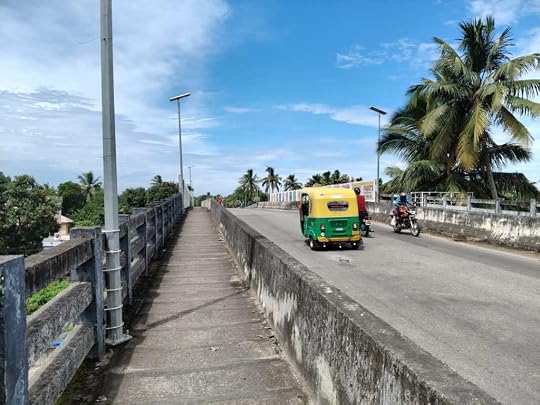 A long walk to Menamkulam Junction
Long story short, I walked the 2.5km to Menamkulam Junction. Everything was exactly as the uncle told me. I saw the crowd in the market area. At the bridge, I paused for some time, staring at the railway crossing. Then I came across the Kazhakkoottam Nalumukk Junction, later the KTDC beer parlor on the left, and finally reached Menamkulam Junction by 11 am.
The gulmohar tree shedding its yellow flowers felt like a crowd cheering for me at the finish line of a marathon. I mentally raised my hands, punched the air, feeling like Ronaldo after scoring a World Cup goal. There was a tiny teeny-weeny catch, though. There was no beach in the vicinity.
Perumathura
On an average day, Google is not a bad guy. In fact, he is the only person who has accompanied me on all my trips. But that particular day, he was nothing but a cruel prankster.
I don’t know why Google marks the location of Thumba Beach and its adjacent Thumba Arattuvazhi Beach (also known as Golden Beach Thumba) as spots in Menamkulam. I had to walk TWO MORE KILOMETERS from the Menamkulam Junction to reach the beaches.
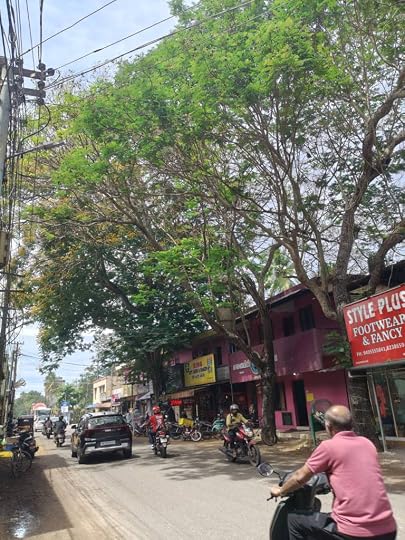 Menamkulam Junction
Had I known that at the beginning of the walk, I would have absolutely taken an auto. 2km is the threshold I have set for my long walks. A 4.5 km straight walk is a definite no-no. I assume Eesha and her friends took an alternate shorter and easier route in the rapido.
While walking past the Marian Edu City building and KINFRA International Apparel Park, I caught the first glimpse of the sea’s blue waves in the distance. Humbled and overjoyed, I felt like a pilgrim catching the first glimpse of the Kaaba in Mecca.
When I looked at the signboard, it said in bold letters PERUMATHURA, and not “sigh” Menamkulam. Like we say in Church, my mistake, my mistake, my most grievous mistake!
Golden Beach
It took me almost an hour to walk from Kazhakkoottam to the Golden Beach in Thumba. My immediate thought was – “Jo, please learn to drive or at least find a travel partner who can drive. An EV would do if you’re so worried about using fossil fuels. We will keep it sustainable.” Finally, in my 30s, I have drawn a conclusion most people know by 18 or 25 – the cons of rejecting everything regular and conventional outright. If my knees had a mind of their own, they would have knelt and begged for their deliverance.
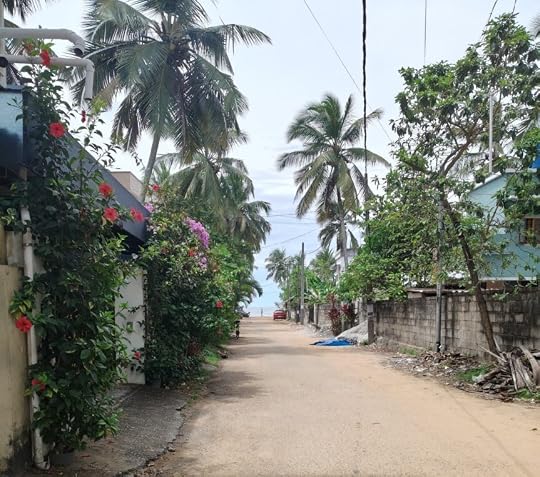
Maybe because of the struggle involved, the path leading to the Golden Beach looked extra cinematic, with the blue sea in the distance and the red hibiscus and pink bougainvilleas in bloom on both sides.
I reached the beach by 11:30 am. Since it was a weekend, there were many families, friend groups, and couples at the beach. I sat on the dry beach sand, catching some much-needed rest and sipping some water. A group of teenage boys was swimming in the sea; a gang of middle-aged men was playing cards in the shade.
At a distance, a young lady in a golden-yellow dress was posing for a photographer holding a DSLR. After some time, they swapped their positions. Thereafter, the photographer guy in the light-blue shirt became the muse, as the girl snapped pictures, and their mutual friend, a guy in leopard-print pants, watched them fondly.
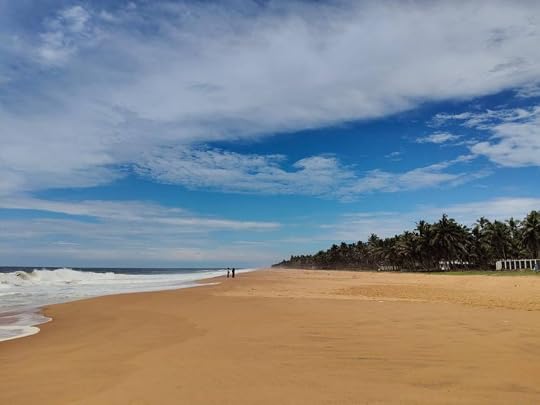
The usual beach sights surrounded me – the foamy white clouds and waves in an otherwise blue sky and an even bluer sea, the row of coconut trees swaying in the wind, boats docked on the shore, kids playing in the water, teenagers enjoying ice creams, and families immortalizing the memories as selfies.
There were also the not-so-eye-candy regular sights: plastic covers, beer bottles, soft drink cans, newspaper shreds, and whatnot strewn on the beach sand. Of course, we can erase this garbage from our photos, but our nature will continue to suffer.
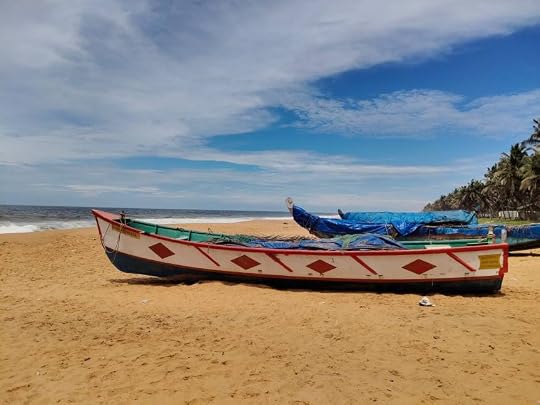
We get defensive when foreigners berate our whole country as dirty and ridicule our civilians for lacking basic civic sense. But it’s high time we admitted our shortcomings, learned the best methods from across the globe with an open mind, built appropriate systems, and put those lessons into practice. Japan is one country I admire in this regard; they respect their surroundings and never litter. In a state like Kerala, where the tourist outflow is massive, stringent measures must be taken against littering.
Thumba Beach
Around 11:45 am, I left the beach and walked back to the crossroad. Autorickshaw drivers looked at me expectantly. But Thumba Beach was just 550m to the right, so as usual, I walked.
First, I reached Pallithura; ‘Palli’ means church and ‘Thura’ means beach. There was a shrine of Jude Thaddeus the Apostle nearby. I sat on a plastic chair in the shrine and prayed for a few minutes.
Do you know that historically Christian believers have hesitated to pray to this saint just because his name is similar to the apostle who betrayed Jesus Christ – Judas Iscariot? As a result, Jude Thaddeus was invoked in prayers only as a last resort. Eventually, he became the patron saint of impossible causes. Since I, too, have a few impossible causes I was striving for, one of them being this India trip, I mumbled a few prayer requests before leaving the shrine.
Just to the left of the shrine, before reaching the Fathima Matha Pain and Palliative Care Centre, there’s a road to Thumba Beach. As I ventured on this road, I could see a cemetery on the left, and St Jude L P School, Thumba, on the right. I learned all these buildings are part of St John the Baptist Church.
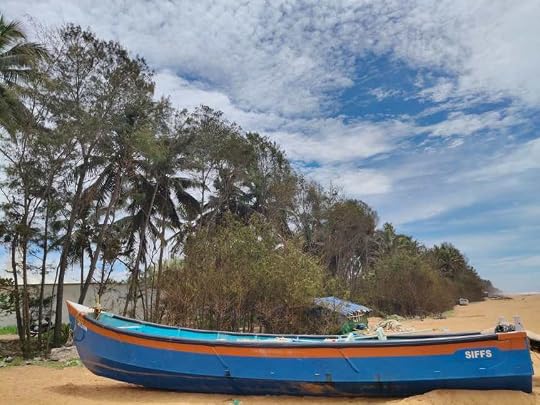
Thumba Beach looked pretty much like the Golden Beach. Obviously, they are just half a kilometer apart. Duh! The only difference I could find was the rows of Kattadi Marangal (or whistling pine trees). God save the young lovers and that one senior husband-wife duo who unknowingly kept me company on the beach.
My feet burned when they plunged into the hot sand. Thereafter, I treaded the beach with more caution, staring at the peacock blue fish net drying on the sand and the docked navy blue boats, one of them named ‘Jesus.’
Since I’ve lived in coastal villages most of my life, I know how close the fishing community is to the church and God. I’ve heard them talk about how risky and lonely their journeys into the deep sea are. They pray not just for good weather, a profitable catch, and the safety of their own lives, but also for the well-being of their families who await them on the shore.
Around 12, I left the beach. My digital watch beeped, announcing I had walked 10k steps. The first 2k must have been the morning walk on the terrace. It was a bit concerning because I still had a long way to go, and many more important stops to cover. What do I do? Will I collapse by the time I make it to the Muthalapozhi Harbour?
To be continued…
Author’s Notes
~ All content on this blog is the intellectual property of the author. © 2026 Lirio Marchito. All rights reserved.
~ This blog is part of a series exploring my travels through Trivandrum, the capital city of my home state, Kerala, in India. You can read more posts from this series here. Trivandrum | Kerala| India
July 13, 2026
Ernakulam Days: The Lore of Iringole Kavu
Generally, once I come back from a trip, I stuff all my memories and photos into a jar of neglect and wait for at least a few months before sitting down to write about them. Like the crushed grapes stored in earthen jars by my grandpa, I want my memories to sediment, decay, and ferment before jotting them down as a blog.
Because, wise men say, time is a great editor. It filters out the irrelevant and the superficial, until only the distilled essence remains. But this time, I didn’t have the patience. Maybe because even plucked straight from the vines, grapes were fresh, tender, and sweet.
One of my close friends, whom I’ve only known for a bit over half a year now but with whom I share a sibling-like bond, suggested we visit the Iringole Kavu in the Kunnathunad Taluk of Ernakulam district in Kerala. It’s one of the 108 temples in Kerala, dedicated to Goddess Durga, and is located in the middle of a forest.
A Monsoon Trip
Even before reading the lore surrounding Iringole Kavu, my friend had bowled me over with the photos and Insta reels of its lush forest. Rain-kissed trees, muddy forest paths, grounds sponged with decaying leaves, big, black stone lamps (deepasthambhams), the cement steps leading to the temple, and the quaint temple itself piqued my interest. But there was a catch.
Any Kerala trip you plan in June is by default a monsoon trip. Despite the local knowledge, we were intimidated by the heavy rains, fatal lightning strikes, and orange alerts in Ernakulam and postponed our initial dates.
On 28th June, 2026, I hurried from my apartment to catch the 5:45 am private bus to the Kollam railway station, and groaned as the drizzle fell on my face and already wet hair. Like the red smoke in Neville’s rememberall, a mockery ran inside my head: “Dude, how can you forget your umbrella in peak monsoon?” Not one of my proudest moments.
There was only one other woman in the private bus. Any other time, I would have blamed the weekend and early hours, but I knew it was because of the newly announced Priyadarshini Free travel scheme for women in ordinary public transport buses.
Rain Scenes
By 6:15 am, I was hopping over the railway tracks towards the second platform, a hand over my head to shield myself from the raindrops. I settled on a drenched iron chair, waiting for my Venad Express, which was expected to arrive by 6:30 am.
I passed my time watching other people. Their umbrellas, pants, and shawls dripping, and rubber chappals and suitcase wheels squeaking as they walked through the wet platform or ran behind trains, determined to catch a particular coach or seat. A lean, tall senior lady who slipped on the opposite platform and the middle-aged men who casually covered their heads with white kerchiefs made me wonder if they had forgotten to carry their umbrellas, too.
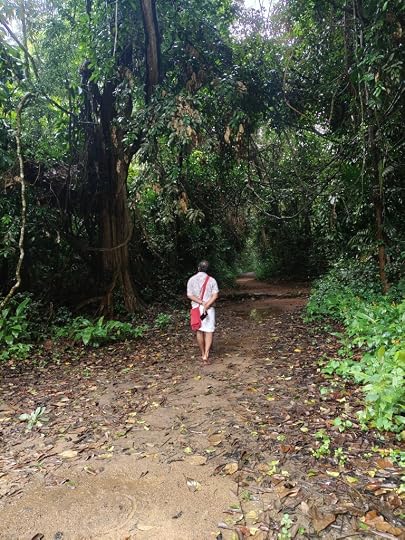 A barefoot walk through the sacred grove.
Kollam-Aluva is a 155-kilometer, 3-hour-long train journey via the Kottayam route. Since my train ran late, I reached Aluva station only by 10:15 am.
My friend had boarded the same train on the way. While we were walking towards the exit, he accidentally slipped into a hole on the platform. Luckily, he wasn’t hurt. An elderly lady rushed to our side to enquire if he was okay. I was concerned too, but as is customary between friends, I had to troll him first.
We quickly enquired about the route to an autorickshaw chetan, before taking a detour to the nearest restaurant. After devouring two rolls, tea and a glass of Horlicks, we walked to the nearest transport stand. Walking from one end of the terminal to the other, we finally found a Perumbavoor bus.
Bus Journey
Since it was an ordinary bus with free travel for women, I warned my friend that we would never get seats. But I had to eat my words, as he scored the seat and even dozed off comfortably, while I stood for most of the route and had to settle for the free ticket.
There was a North Indian family on the bus. The two young women wore skirts and shirts, and had their faces covered with scarves. They had toddlers latched to their waists and carried two bulging school bags. They tried to shove a big sack beneath a seat, but eventually left it near the driver’s seat. One of them called her husband, not by his name, but as “Rahul ka papa,” her son’s father.
Once my friend and I got down at Perumbavoor, a grandpa who stood next to the lottery seller directed us to catch a Kothamangalam bus. The sweet pardha-wearing grandma who sat next to me on the Kothamangalam bus, the conductor, and the stranger who stood next to my friend, all alerted us when we reached our destination – the Pattal post office stop. We got down from the bus, crossed the road, and walked towards the Iringole temple.
On the way, we ogled at a European-style house named ‘Manchester.’ In the middle of discussing workplace dramas, the plot of an old Malayalam Dracula movie titled ‘Kalpana House,’ where the Dracula asks the local priest played by Oduvil Unnikrishnan to come back with more confidence, and debating whether shaving our heads bald will help to grow better hair next time, we reached the entrance of Iringole Kavu.
Spellbound
We stopped in our tracks, swallowing our words, awestruck by the beauty of the place. There was a symphony of creaking crickets, chirping birds, and rain drizzling down wet leaves all around us.
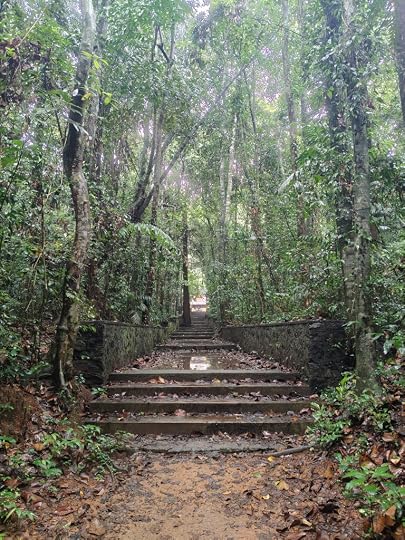 Cement steps leading to the Iringole Kavu temple
Unarguably, one of the most beautiful and soul-calming places I’ve been to in recent times. Like a master painter at play, God has thrown a hundred varieties of brushstrokes and even more hues of greens into his canvas.
The sky peeked through the densely packed tree roofs like a shy child. The woody tree branches were entangled like mating snakes.
Pond
The dark green pond had cobbled stone walls and cement steps strewn with fallen leaves and moss. All the clayey groundwater and rainwater must have seeped its way through the mud and tree roots to reach the pond, making it so pristine.
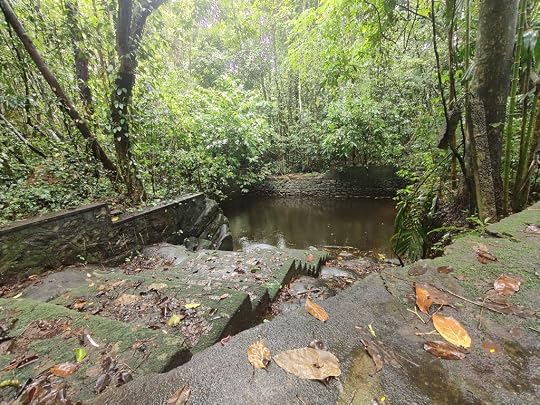 Iringole temple pond strewn with fallen leaves and moss
Why did the authorities have to lock the gates to the pond though? Maybe they worried the visitors might slip on the wet steps, get hurt, or worse, drown. After my last swimming fiasco at Chengannur, I wouldn’t have dared to enter the water. But I would have loved to sit on the last step, with my feet dipped in the cold water, watching the ripples.
Temple
We took off our sandals before entering the temple premises. As expected, the Iringole Sreebhagavathy Temple was closed. We had already seen a board mentioning the daily ritual timings as 5 am.
The cream walls, the brown-tiled roof, the tulsi plants, and the stone lamps made me wonder how the deity and the temple would look during deeparadhana (traditional Hindu ritual where oil lamps are lit at dawn or dusk for prayer).
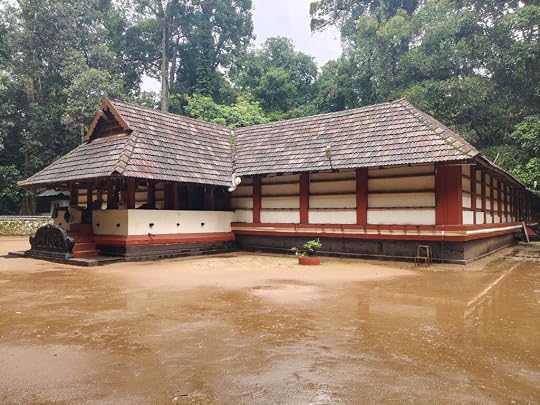 Iringole Sreebhagavathy Temple and the shanthaswaroopini inside
Since we couldn’t enter the temple, we decided to walk till the end of the sacred grove. Young ladies in ethnic wear, risking their saree pallus and skirt hems getting soaked in clayey puddles, and barefoot couples were either posing for photographers or exploring the forest.
Navigating the waterlogged, clayey footpath, with stones and pebbles, barefoot turned out to be uncomfortable. We groaned when we realized there was an alternate path to reach the forest area, without entering the temple premises. We could have worn our sandals.
Sacred Grove
Nonetheless, we walked all the way to the end of the grove, marked by a deepasthambham. On the way, we watched seniors in mundus and kasavu sarees praying to a pala tree, believed to host yakshis and gandharvas.
I collected a few panamkuru – seeds of the palm trees – in my bag. I usually collect kunnikuru and manjadis, but this was my first time truly noticing panamkurus, so I felt I had to commemorate it.
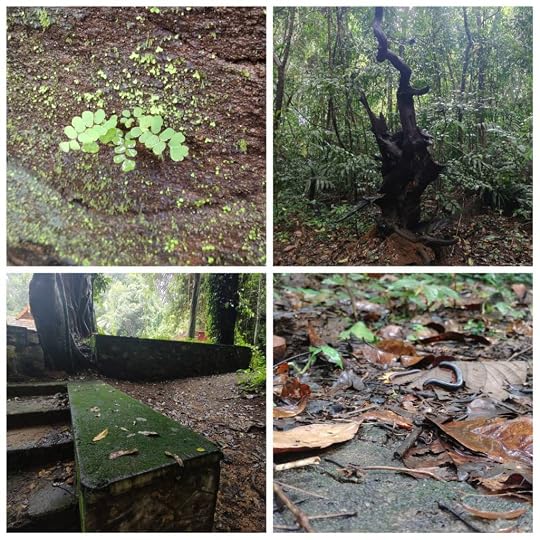 Glimpses from the Iringole Kavu forest temple
I zoomed my mobile camera lens on leeches curling on fallen wooden trunks and tiny ferns growing in the cracks of walls. I couldn’t help but laugh at my own contradictions. I chased a lot of big dreams and societal expectations for three decades, only to feel happy at the sight of silly mosses and grasses. How random and unpredictable is life!
The song that was running through my head at this point was ‘Akale oru Kaadinte’ from the Malayalam film ‘Ramante Edanthottam.’ We could easily shoot a music video or short film with a romantic theme in this location.
But the big headless tree that stood right in the middle of the main path, the dense forest around us, the isolated pineapple farmland on the side, and the snake pits also made it an apt location for a horror or even time-loop themed sci-fi short film.
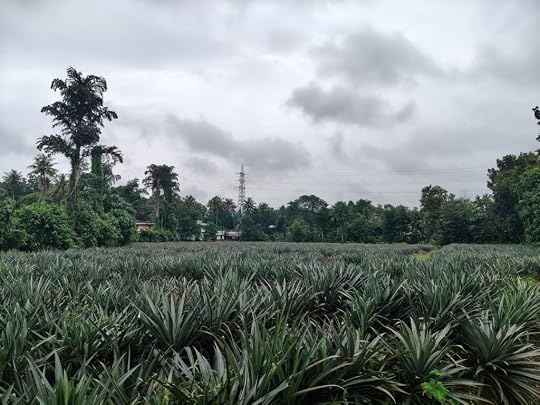 A Pineapple farm near the Iringole Kavu
In between, my friend got hijacked by a lovely couple to take their photos and videos. He thoroughly enjoyed the assignment, experimenting with all his favorite camera angles and reel ideas. Meanwhile, I spoke with Sadhanandhan Chetan, who introduced himself as the temple committee president and a lover of E.M.S. and Kerala history.
Lore of Iringole
In Hindu Mythology, Kamsa, the tyrant ruler of Mathura, imprisoned his cousin Devaki and her husband Vasudeva, fearing the prophecy that their eighth son would murder him. Determined to save their eighth son, Lord Krishna’s life, the young parents shifted the baby boy to Vrindavan and instead kept a baby girl in the cradle.
Realizing the mix-up, Kamsa furiously lifted the baby above his head to kill her. Miraculously, she glided out of his hands, turned into a supernatural power, and stayed suspended in the air.
Legend says the same power resides(Irinnole) in this temple, and other gods and goddesses surrounded the temple in the form of trees and plants to worship her. Later, this place grew into a thick, beautiful forest and got the name ‘Iringole.’
The lore claims the deity is an incarnation of the illusory Maya or Yaga-Nidra, and that it exists in not one, but in her original three forms of power – as Saraswati, or the Power of Knowledge, in the morning; Vana Durga, or the Power of the forest, in the afternoon; and Bhadrakali, or the Power of Fury and termination of evil, at night.
Worship
Sadhanandhan Chetan mentioned that the temple and forest, comprising around 56 acres of land, are part of the Nagancheri Mana and run by the Devasom Board. I was intrigued when he mentioned it’s one of the largest sacred groves in South India, that too, located within a municipality.
Sacred groves are generally biodiversity hotspots for flora and fauna. But sadly, there are no wild animals in this semi-evergreen forest. Sightings of snakes are also rare. But it does host varieties of trees and plants. Chetan pointed out wild peppers and the shrubs of Chittamrutham(Giloy) to me.
Since I couldn’t enter the temple, he painted a picture for me. There’s only one deity inside the temple – the Goddess – and no minor deities or Upaprathishtas. Since the Goddess is a shanthaswaroopini – in her calm and graceful form – people offer her flowers like chethi (Jungle Geranium), thamara(lotus), and thulsi. I could see torn banana leaves on the steps with sandalwood paste and flowers.
Mana
By that time, my friend was back, and Sadhanandhan Chetan suggested we explore the Nagancheri Mana before leaving. He showed us the path through the forest and suggested we wear footwear before venturing on it.
On the way to collect our footwear, we saw red pagoda-like flowers. While photographing it, my friend mentioned that its local name was Krishnakireedam(Lord Krishna’s crown). I chuckled, forming a conspiracy theory in my head.
What if these plants were Lord Krishna himself, guarding his sister, in return for her sacrifice? What if the other gods and goddesses, in the form of trees and plants, were staring back at us and even judging us with their mischievous, all-knowing celestial eyes, as we walked through the forest and photographed them? Eerie, isn’t it?
To be continued…
Author’s Notes
~ All content on this blog is the intellectual property of the author. © 2026 Lirio Marchito. All rights reserved.
~ This blog is part of a series exploring my travels through Ernakulam, one of the 14 districts in my home state, Kerala, in India. You can read more posts from this series here. Ernakulam | Kerala| India
July 2, 2026
Trivandrum Series: Kerala Chalachithra Academy – A Goldmine for Cinephiles – 2
Please read the first part of the blog here.
What would have been an average visit to the Kerala Chalachithra Academy turned out to be a memorable experience for me, thanks to the warmth and support shared by three of its important staff members – the then Chalachithra Academy Chairman, Prem Kumar sir, a young Librarian named Athira, and Nithin, who worked as a project assistant.
Past Luminaries
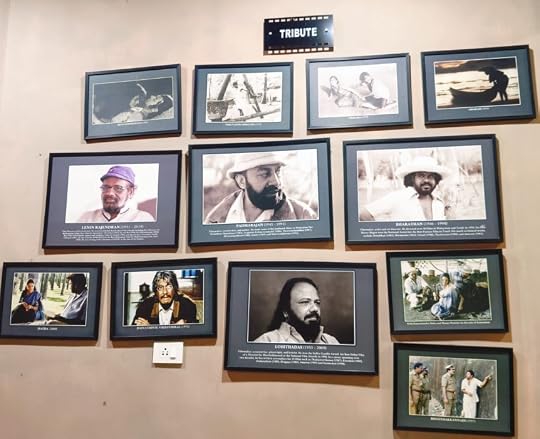 Iconic Malayalam Film Directors – Lenin Rajendran, Padmarajan, Lohithadas, and Bharathan.
I had just climbed up the stairs to the first floor of the academy, taking my sweet time, exploring the photos on the wall. Tribute sections honoring past luminaries made me emotional because death is often too cruel to the artists.
I say this not just because death often steals artists at young ages, before their artistic journeys could hit their peak, or we, as an audience, could enjoy their craft or charm to the fullest, but also because it sometimes takes them right when their years or even decades of struggles were finally starting to bear fruit.
The void left by the untimely death of the legendary Irrfan Khan, or Malayalees’ very own Salim Kumar, or writer-director Sachy, still stings. One of my close friends’ college seniors passed away due to health issues before the release of his first directorial venture.
In Kerala, we say, “Maranam rangabodham illatha komaliyanu.” Death, like a clown with no sense of timing or stage presence, often arrives when least expected, interrupting life’s most ordinary or even happiest moments.
A Film Meeting
Leaving the Obituary section, I approached the photo wall of Kerala State Awards Best Actress winners. Just then, Athira, the then librarian of the academy, tiptoed out of the hall and informed me, “Sorry, there’s an important meeting happening inside the library now. Could you please wait in the lounge for a few minutes?”
I had no issue waiting at the lounge, since it hosted the photo wall of the Kerala State Film Awards – Best Film winners. By the time Athira returned, I was staring at the stills from movies like Thanmathra, Adaminte Makan Abu, and Manhole. “They’re wrapping up the meeting. You can enter now, but please remain silent for the time being,” she cautioned.
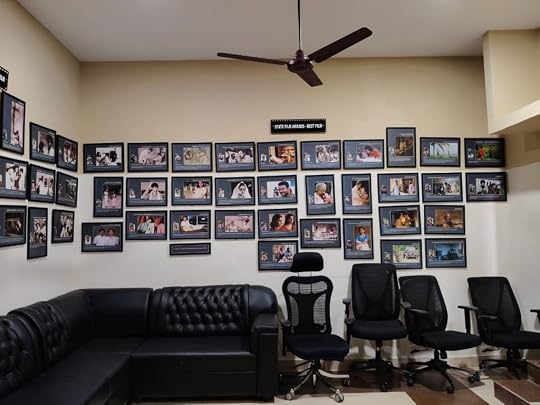 Lounge Area on the First Floor of the Kerala Chalachithra Academy
The introvert in me didn’t mind waiting until the meeting was over and all the staff had left the library. Compared to making a sudden entrance and momentarily interrupting the meeting, I didn’t mind waiting another day or even a week.
I could hear the voices of some politicians and academy members discussing a film event and its allocated funds on the speakers. I opened the door hesitantly, scared they would be angry or irritated. But everyone’s initial look of surprise soon turned into a warm, welcoming smile, especially Prem Kumar sir, who gestured to “come in” with a friendly hand wave.
Like Harry Potter in the Chamber of Secrets movie, I returned the smile and entered the library hall as noiselessly as possible, pretending I didn’t exist. I wished I were invisible or camouflaged on the wall or the bookshelf.
Ammava!
Once the meeting was over, Premkumar sir enquired if I was a film student or researcher. When I told him I work as a freelance writer and book editor, we chit-chatted a bit about work.
As usual, I didn’t dare to ask for a photo, but everyone at home was excited when I mentioned this encounter. Who can forget his iconic “Ammava!” in Aniyan Bhava Chetan Bhava as the character Sundaran, or his Ganabhooshan Sathish Cochin from Puthukkotayile Puthumanavalan, to name a few.
Library
As a forever lover of books, libraries are one of my favorite places in the world. Even in my recent good dreams, the thirteen-year-old me, clad in my navy blue skirt and white shirt uniform, with hair braided on both sides, keeps climbing the long, windy staircase to my school library.
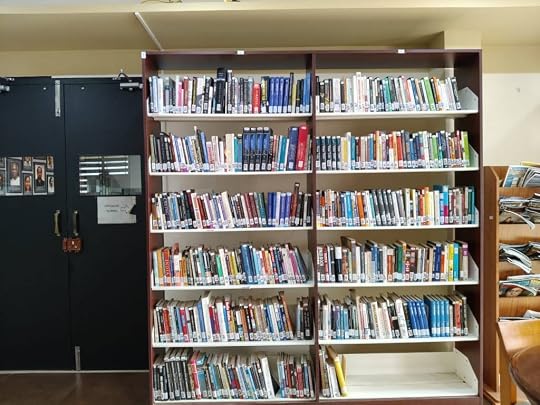 Kerala Chalachithra Academy’s Enviable Collection of Film Books
Dreamworlds aside, I must gush that Kerala Chalachithra Academy has an ENVIABLE collection of books on filmmaking and film personalities, classic literature, archived film magazines, film scripts, and dissertations on film studies.
Not to forget the shelved and boxed collections of hundreds of Audio Cassettes, CDs, VHS tapes, DVDs, and about 200 legendary original film reels. Apart from movies, these storage devices also contained behind-the-scenes footage from various movie sets, film photos, movie interviews, and archived television programmes.
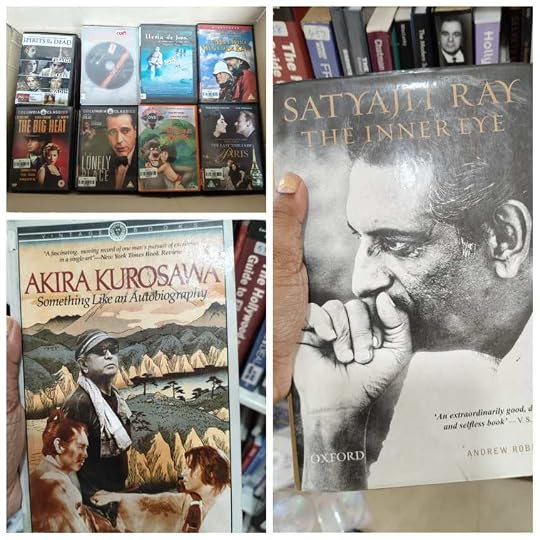 In frame, books about Satyajit Ray and Akira Kurosawa.
 I held scores of Satyajit Ray and Akira Kurosawa books in my hand, reluctant to let go. Athira, the librarian, was sorting and reorganizing a shelf at the moment. We ended up talking about almost every subject under the sun: films, career, books, travel, food, and whatnot. When I told her I had recently visited the Raja Ravi Varma Art Gallery at Palayam and was planning to visit his birthplace – the Kilimanoor Palace – she showed me a big book about him, with beautiful photos of his paintings and their detailed descriptions.
Geographical Restrictions
Kerala Chalachithra Academy’s library section comes under the category of a ‘special library’ with geographical restrictions. This means we cannot borrow the books or films outside the building or premises. However, for an annual subscription fee of just Rs 500/- (as of 2025), we can spend endless hours in the library reading books or watching movies on the desktop.
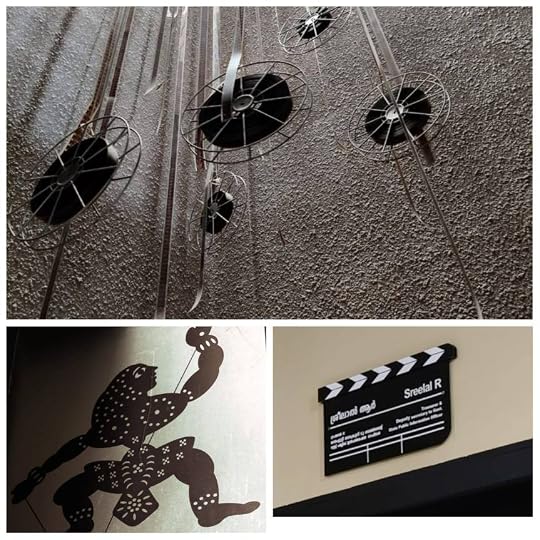 Glimpses from Kerala Chalachithra Academy
For a fee of just Rs 2000/-(as of 2025), we could also rent the projector room and watch a movie with our friends on the big screen. Imagine organizing a 40-member, or even 20-member gang; you could watch a classic or one of your favorites on the big screen for a mere Rs 50 or 100 per head. When I visited the academy, the screening and jury selection for the Kerala State Film Awards were in progress, so I couldn’t see or use this facility.
I couldn’t help but wonder out loud why such a cinematic treasure trove remains hidden or underutilized. Upon hearing my nonstop queries, Athira introduced me to Nithin, who was handling the IIFK-related works as well as the digitization of the film archives.
Academy’s Objectives & Functions
I asked Nithin why, despite every cinephile in Kerala raving about the IFFK, very few people know or use the free film and study resources in the academy. As an ex-IT professional, I imagined at least a hundred cinephiles from Technopark using these facilities regularly.
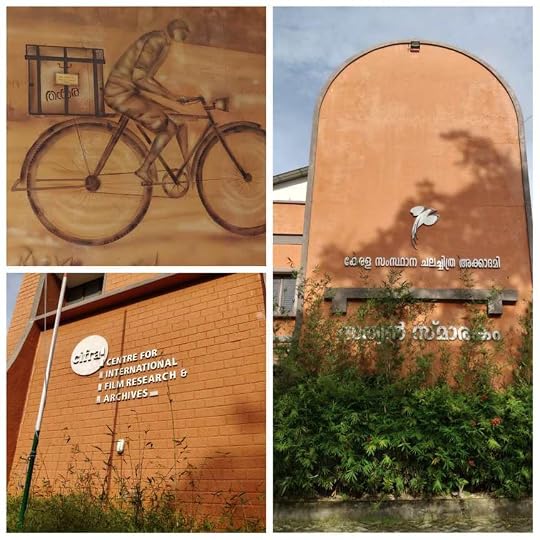 CIFRA – Centre for International Film Research and Archives
Nithin explained the academy’s overall objectives and functions to me: helping the Government to formulate film and television-related policies, setting up an audio-visual library and film and video archives for academic purposes, organizing film festivals such as the IFFK and film study camps, providing financial support, such as subsidies, and promotions to movies of aesthetic and social importance, to name a few.
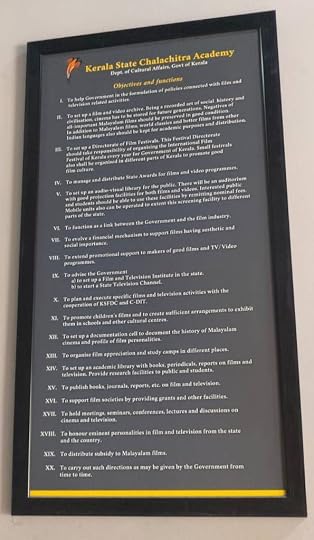 Objectives and Functions of the Kerala Chalachithra Academy
Obviously, driving more visitors to the academy is not a priority on their huge pile of work. But the doors of the academy are always open to the cinephile Santiagos who come in search of its treasure.
When I asked why they can’t promote visits to the academy on IFFK’s social pages, he said they don’t do such integrated or overlapping promotions. Somehow, this conversation deviated into other film topics. I ended up asking him about even taboo topics like state censorship, the casting couch, and the credibility of awards. I loved how refreshingly honest yet hopeful his answers were.
Film Dissertations & Script
Nithin showed me the bookshelf with film studies dissertations. The academy offers a one-year-long fellowship grant to those interested in film research. There are no age restrictions and minimal eligibility checks. But the academy’s board must approve the research synopsis before the grants are allocated. Unfortunately, the last time such submissions were invited was in 2020. I hope the academy resumes this.
Since I’m a creative writer, I asked him if the academy maintains the printed copies of all Malayalam film scripts for academic purposes. I was disappointed to learn that they only have the film scripts published in book form by any publisher due to copyright issues. As a writer-in-progress, I want at least the digital archive of all Malayalam film scripts, and regular movie recommendations, from the academy.
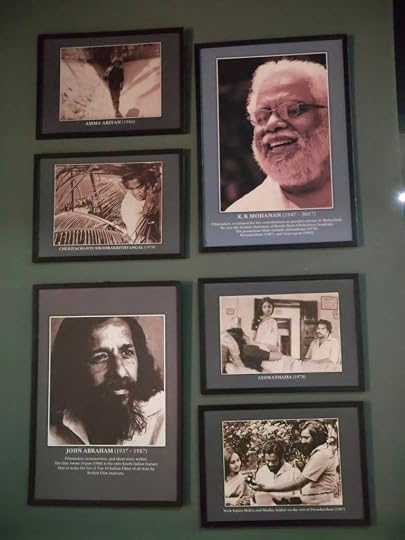 In frame, Malayalam Film Directors K. R.Mohanan and John Abraham.
 Nithin doesn’t believe in must-watch movie lists, as every viewer is different and their taste in cinema is individualistic. He wants everyone to embark on their own unique journeys in search of good movies: asking a friend for their favorite movie, exploring movies from their own favorite genres, outside their comfort genres, movies from different languages, different countries, looking for the underrated gems, not just the award winners or popular ones.
When I said, as someone with only a layman’s knowledge of movies, I wouldn’t mind Kerala Chalachithra Academy social media handles being that cinephile friend who introduces me to great movies, he chuckled and admitted that they have plans to publish the digital catalogue of all movies available at the academy. I requested they also publish a catalogue of all film books available in the academy’s library. I know it would be a gem of a list.
Friday Screening
Nithin also introduced me to a WhatsApp group named ‘Friday Screening,’ maintained by the academy. They organize free, weekly screenings of award-winning and film-festival-screened movies from across the globe at Bharat Bhavan, in Thycaud.
He suggested I join the group to get updates on the international movies screened every week. I joined the group, but since I moved out of Trivandrum soon, I have yet to attend the screenings. Hopefully someday!
Archival Storage Room
Since I mentioned that I was only visiting the academy for the day, Nithin suggested I see the archival room also before leaving. Like a toddler who was offered a box of chocolates, I followed him to the second floor, speeding to catch up with his long strides.
We entered a long, hall-like room where boxes full of VHS tapes, CDs, files, and photos were kept. He explained that he was digitizing all the data in those archaic storage devices. I was intrigued to see boxes full of vintage MiniDV tapes containing the videos of 60-minute episodic television programmes, and old photos of many Mollywood celebrities.
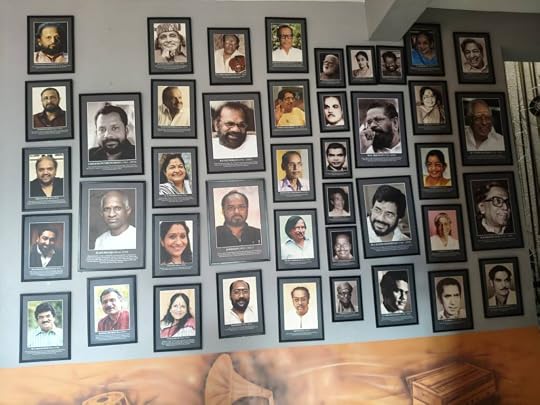 Famous Musicians Who Have Worked in the Malayalam Film Industry
Nithin mentioned that only about 10% of the archival contents have been digitized so far. Since they were understaffed, he had taken it upon himself as a personal project. It was difficult to get help, as others found working with analog devices a chore.
He reminded me so much of one of my IT day friends. Both of them have a tall, lean frame and this shared love for the analog world. I told Nithin the same, “I know someone who would have sat on the floor right next to you and finished it for you.”
Film Vault
The real cherry on the cake was the film vault. Forgive the blurred details since I’m writing this blog a year late. I remember the vault as a shuttered room. Unlit, but definitely visible; cool, but not cold. I’m sure I had the same joy on my face as the child in Cinema Paradiso when I first saw the black film reels on the shelf. There were hundreds of them.
Maybe it wouldn’t have made any difference, but since I was in a light-sensitive area, I didn’t click any photos. Besides, for a cinephile, a film vault is a sacred space that demands respect.
When we were small, my brother and I used to watch the Beyblade series and even had toy Beyblades to play with. In the tale, ancient beasts like dragons inhabited the Beyblade. I felt those film reels had souls inside them, too. All the creative energy, hard work, struggle – the blood, sweat, and tears – of the thousands of people who worked on those projects were stored in those film reels, for future generations to experience.
Visiting the vault was the best climax to the most cinematic day in my life.
Current Reality
Cinema is not just an artistic place but a melting pot of glamour, power, fame, money, and controversies.
The Malayalam film industry has been producing artistic and cult movies since the 80s. However, it took the closure of theatres during the COVID pandemic and the rise of OTT platforms to finally cultivate a global viewership and fan following for our cinema.
Though our industry continues creating great movies and has no plans to slow down, it pains me as an audience that recently Mollywood has been in the news for the wrong reasons – like the 2017 Actress Assault Case, the Hema Committee report, and the recent Ansiba Hassan-AMMA case.
Victims speaking up about the crime is a healthy sign in any society and is definitely not what is tarnishing our industry’s face, but the actual crime, abuse, or assault is. While we continue creating magic through our films, we must also strive to become a safer workplace for all its members, irrespective of star value, power, money, gender, religion, or caste.
I hope our film industry will become a reflection of Malayalees’ humanitarian values, not our moral lapses, and win hearts across the globe, just like our movies.
Author’s Notes
~ All content on this blog is the intellectual property of the author. © 2026 Lirio Marchito. All rights reserved.
~ This blog is part of a series exploring my travels through Trivandrum, the capital city of my home state, Kerala, in India. You can read more posts from this series here. Trivandrum | Kerala| India
July 1, 2026
Trivandrum Series: Kerala Chalachithra Academy – A Goldmine for Cinephiles – 1
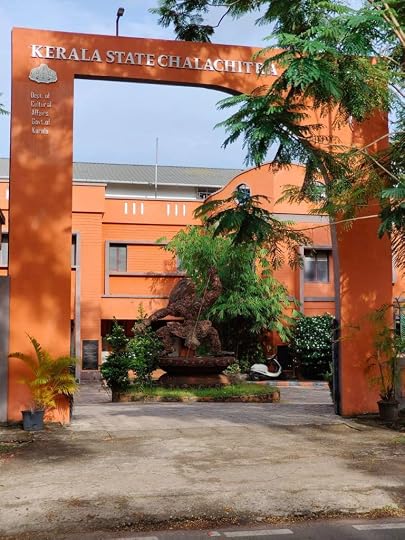 Kerala Chalachithra Academy
If there’s one thing that can distract an average Malayalee from the magical world of books and literature, it’s the allure of cinema. I’m no different. My family is no different. Even my close friends are no different. We are all movie aficionados who love catching the latest releases in theatres, before the spoilers from social media posts destroy the experience.
So, it ain’t any surprise that visiting the Kerala Chalachithra Academy, located inside the KINFRA Film and Video Park campus in Kazhakoottam, was a priority item on my Trivandrum itinerary. The place is open Monday to Saturday from 10:30 AM to 5:30 PM. But do call ahead to inform the staff about your visit, and carry a valid ID for security check-ins.
A Rainy Start
September 24, 2025, my 14th day of a month-long stay in Trivandrum, was a rainy Wednesday. I woke up at 6:30 am, worrying if it was going to be a stay-in kind of day. So, I spent an hour on my hostel’s terrace, pacing and exercising, while listening to both the pitter-patter of rain on the tin roof and a YouTube video of Anupama Chopra interviewing the core trio of the superhit Malayalam movie, Lokah Chapter 1: Chandra. – Director Dominic Arun, Actor-Producer Dulquer Salmaan, and Lead Kalyani Priyadarshan. At that time, that film was a rage in theatres, and like the rest of Kerala, I was also impatiently awaiting its sequels.
Bus Route
By the end of the video, the rain stopped too. The sun shone not just on the muddy paths outside my hostel, but also on my travel plans for the day.
I quickly freshened up, devoured my idli-sambar breakfast, and caught a bus to Kazhakoottam. From there, I boarded another bus to the Venjaramoodu route and bought a Rs 15 ticket to KINFRA. Since it was my first time on that route, I asked the bus conductor to give me a holler when my stop arrived.
2.3 kilometers away from my destination, barely a 6-minute distance by bus, the traffic came to a standstill on the waterlogged road. But the police officers soon cleared the congestion and let the bus pass. The bus rolled past the Sainik School, where the famous Malayalam actor-brother duo Indrajith Sukumaran and Prithviraj Sukumaran studied. Around 11 am, I reached the KINFRA campus entrance.
Entry Procedures
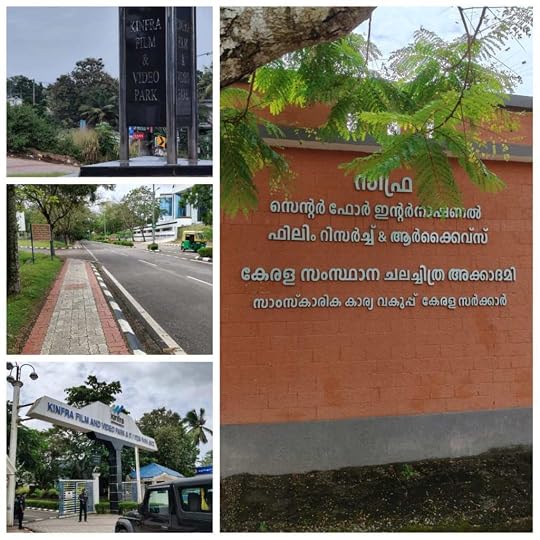 KINFRA – Film and Video Park
I had already contacted the reception desk of the Kerala Chalachithra Academy. When I told them about my Kerala blog series, they were happy to help.
At KINFRA’s entrance gate, the security officer checked my ID and entered my details in the register before letting me in. I had to repeat this procedure again at the academy’s gate and reception desk.
Premises
The security guard told me to walk straight to the roundabout and to find the nearest red building. On the way, I saw the L V Prasad film laboratories on the left, and a company named Systrome on the right.
Soon, I reached the Kerala Chalachithra Academy building. Honestly, it was hard to miss. The whole building gave artistic vibes; maybe because of its rustic, brick-orange color, the art installations outside, or even the lush trees.
Art Installations
Right at the entrance, I was greeted by an art installation featuring a stylised figure from Tholpavakoothu (traditional shadow puppetry). I know this detail because it’s also the official logo of IFFK – the renowned International Film Festival of Kerala, organized by the Kerala Chalachithra Academy.
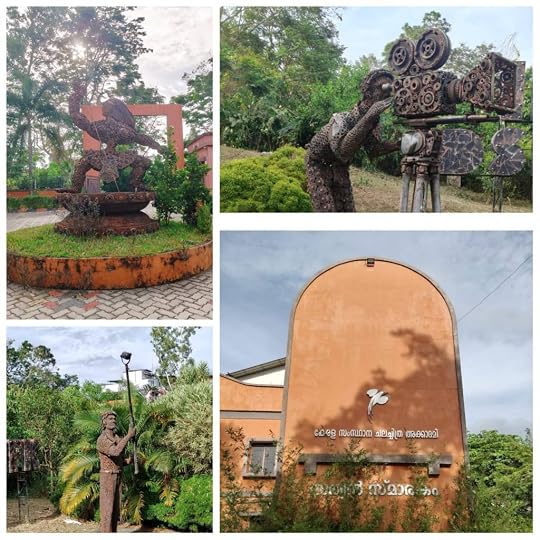 Art Installations on the Premises of the Chalachithra Academy
I’ve never attended it, but it’s on my list. My cinephile friends claim that Trivandrum turns magical during the IFFK days – not just because of the movies they screen and celebrities who visit, but also because of the crowds it draws and conversations it starts.
There were more art installations outside the building, mainly one showing a cameraman and a sound recorder at work. I wondered what their story was. All these art installations were made of bearings; I could see the occasional gears, too. When I showed these photos to my dad later, he immediately spotted the bevel gears.
Reception
Sameer Chetan from Nedumangad was the security guard that day. Jaya Ma’am was at the reception. Luckily, she was the same person I spoke to over the phone. So after a chit-chat, a general introduction of the academy, and going over a few do’s and don’ts, the crux being not to disturb the staff at work, she encouraged me to check out the photos on the walls, awards and books on the shelves, then to take the staircase to the first floor, and to explore the library and archives.
J.C. Daniel & Vigathakumaran
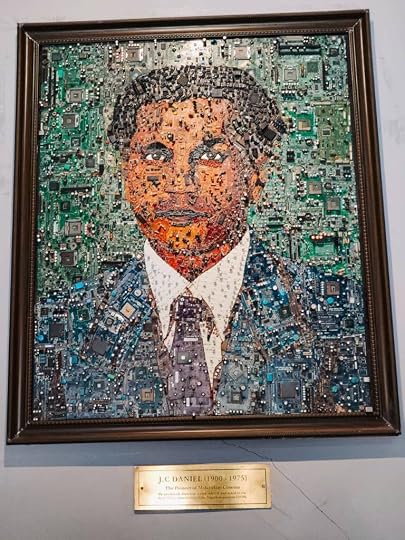 J.C. Daniel – the Pioneer of Malayalam Cinema
My exploration started with the J.C. Daniel image, featured right above the reception desk. It was constructed from electronic items such as the motherboard, capacitors, and resistors.
J.C.Daniel, who lived from 1900 to 1975, is regarded as the pioneer of Malayalam cinema. He produced, directed, wrote, edited, and acted in the first Malayalam feature film, Vigathakumaran (1928).
The 2013 Malayalam biographical drama film Celluloid portrayed the story of J.C. Daniel, focusing on the making of Vigathakumaran and the tragic life of its heroine, P. K. Rosy.
Synchronizer
Up next, an old synchronizer on the ground floor caught my attention. In the film world, it’s a device used to align multiple film strips in a replay or editing device.
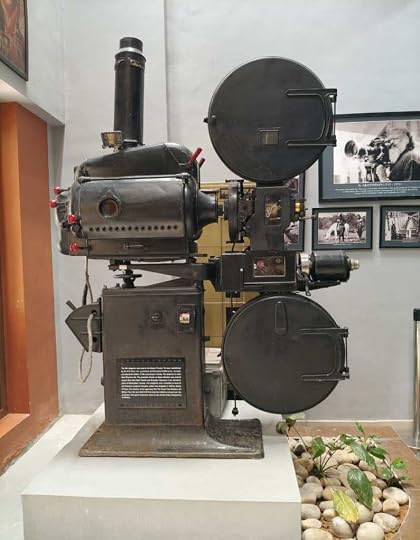 Super Simplex Film Projector used in the Sapna Theatre in Thrissur to screen movies such as Nalla Thanka and Snapaka Yohannan during the formative years of Malayalam Cinema.
 Much to my delight, there were also other yesteryear film equipment next to it, such as a splicer, Moviola – an iconic editing device, an old Arriflex camera – the same camera Adoor Gopalkrishnan sir used to capture his film Swayamvaram, and a film projector.
One other detail that brought a smile to my lips was that each staff member’s room name was written on a clapperboard.
Awards & Photo Walls
Every wall of the building on the ground and first floors was turned into a photo point, with separate sections featuring National Award, State Award, and J.C. Daniel Award winners from the Malayalam Film Industry.
Seeing Mammookka (Mammootty) and Lalettan (Mohanlal) featured in the National Film Award Best Actor section, along with the stills from their winning performances, sent a chill down my spine. Who can forget Mammookka in Oru Vadakkan Veeragadha, Mathilukal, Ponthan Mada, Vidheyan, and Dr. Babasaheb Ambedkar, or Lalettan in Bharatham and Vanaprastham?
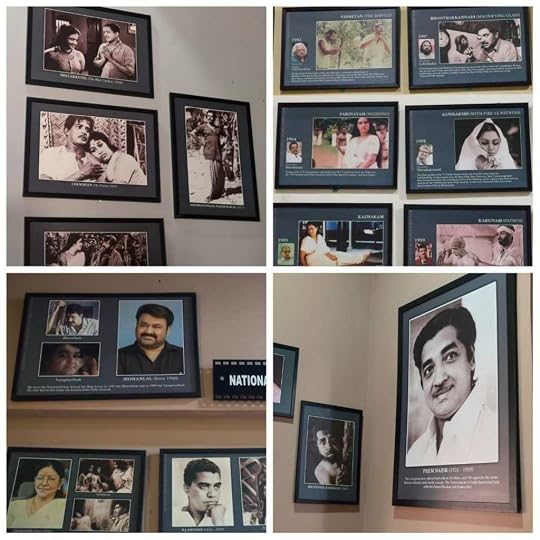 Malayalam film artists have always been celebrated for their deeply authentic and natural character portrayals.
 Apart from the Best Actor or Actress sections, there were also areas dedicated to Best Debut Director, Best Director, Best Films, Best Technicians, and Best Critics. There were also ‘tribute’ sections, displaying photos and character stills of legendary actors like Prem Nazir sir and Sathyan Maashu and iconic filmmakers like John Abraham, Padmarajan, Bharathan, and Lohithadas.
As a bookish person, I was elated to see homages to some of my favorite Malayalam writers. They were also renowned scriptwriters/ lyricists in Malayalam cinema, such as Vaikom Muhammad Basheer, Thakazhi Sivasankara Pillai, O.N.V. Kurup, Kavalam Narayana Panicker, Vayalar Ramavarma, and M. T. Vasudevan Nair.
The shelves on the ground floor also exhibited a few gold and silver medals of National Award winners, the Kerala State Film Award Sculptures, film magazines, and published works of various film personalities.
A Fellow Dreamer
In the film Celluloid, there is a song that starts ‘Enundodi Ambili Chantham, Enundodi Thamara Chantham (Do I have the beauty of the moon? Do I have the beauty of the lotus?).’ I remember having goosebumps the first time I heard the song.
Sithara Krishnakumar’s unique rendition, plus the raw portrayal of the joy and curiosity an amateur actress feels on landing her first gig in cinema, made it unforgettable. I bet any aspiring actor, filmmaker, or writer will be similarly motivated upon visiting the Chalachithra Academy and seeing these photo walls and awards. Just imagine yourself holding one of those awards or your work being featured on its prestigious walls.
I was not the only visitor that day. A bearded young guy in a black T-shirt was also exploring those photo walls, a few steps ahead of me. We never spoke. I just observed him from afar. But I wondered if he was a fellow dreamer on his own unique creative journey, too. I wondered what his aspirations and struggles were.
Was he imagining his name on the walls of Kerala Chalachitra Academy and mentally lifting the State and National Film Awards too? Was he doubting his talent, too, or was he confidently and consistently working on his craft every day? I never found out.
To be continued…
You can read the second part of the blog here.
Author’s Notes
~ All content on this blog is the intellectual property of the author. © 2026 Lirio Marchito. All rights reserved.
~ This blog is part of a series exploring my travels through Trivandrum, the capital city of my home state, Kerala, in India. You can read more posts from this series here. Trivandrum | Kerala| India
June 19, 2026
Amboori – A Monsoon Walk with Appooppanthaadi – Part 2
Please read the first part of the blog here.
Madasseri Waterfalls
Our next stop was the Madasseri Waterfalls. Even from the roadside where our traveller was parked, we could see the stream overflowing. Buddy expressed concern that we wouldn’t be able to cross the stream and see the actual waterfall, due to the rising water levels and strong currents.
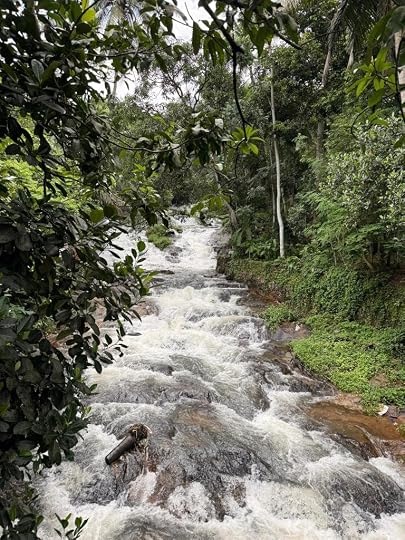 Madasseri Waterfalls
Sadly, her suspicion turned out to be true. However, at the spot where they usually crossed the stream, we took off our shoes, folded up our jeans and pants, and played in the water for some time. The water was so cold and refreshing; we even washed our faces with it.
Plankudikavu View
By 12:40 pm, our stomachs were already growling in protest. So when our traveller headed to another hillside, we couldn’t help but moan, “No, we can’t climb another hilltop.” Luckily, the traveller rode all the way to the top of the hill, where we were surprised to see other cars and vehicles parked.
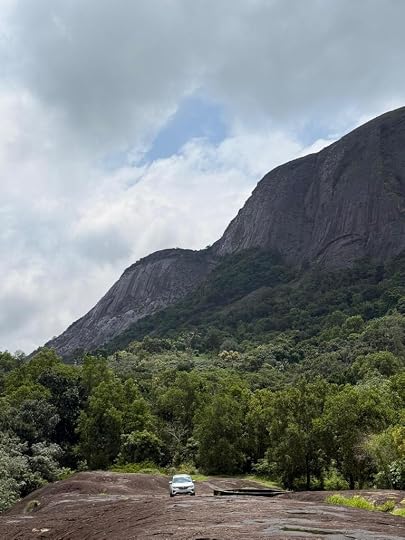 Koonichimala as seen from Plankudikavu View
 Without much physical exertion, we reached the viewpoint atop the rocks called Plankudikavu Vew. From this point, we could see some areas of Tamil Nadu in the front. Behind, we could see the famous hills like Koonichimala, Kondaketti, and Thekkan Kurishu Mala, hidden beneath a ribbon of fog or cloud.
Sumesh Kottoor, a YouTuber whom I met during Kathirmudi Trek, was also there. He gave us a brief of the place and explained how he has been helping to conduct various treks and hikes in the Amboori area. He also recorded our video reviews. Though it was not part of our original itinerary, he suggested that we visit the Narrow Bridge and the Kumbichal Kadav Bridge before visiting the last stop on our itinerary – Mayam Kadav. But of course, all this had to wait until lunch.
Lunch – A Homely Meal
Close to our next spot, Narrow Bridge, the traveller left us before a gated house. Sumesh Chetan and Saji Chetan handed out a packed meal and a bottle of water to each of us from the backseat of the car they were travelling in. A sumptuous homemade meal of boiled rice, beetroot thoran, curd, coconut chammanthi, moru curry, kondattam mulak, pickles, and a fluffy egg omelette.
There was a shortage of chairs, so when the first bunch of people had lunch, others waited for their turn. Some simply sat on the floors, too hungry to wait.
 Eyeing the Leftovers!
Leftovers were placed in two waste baskets: plastic and paper in one, and the food waste in another. A troop of monkeys and their infants soon arrived, eyeing the leftovers in the wastebasket. Saji Chetan had to shoo them away. I sent pictures of the monkeys to my bestie, and we ended up trolling each other.
Narrow Bridge
Even from a distance, the Narrow Bridge and the pristine, greenish water underneath it looked ethereal. The purity of the water made me wonder if I was still in Kerala or in a foreign country.
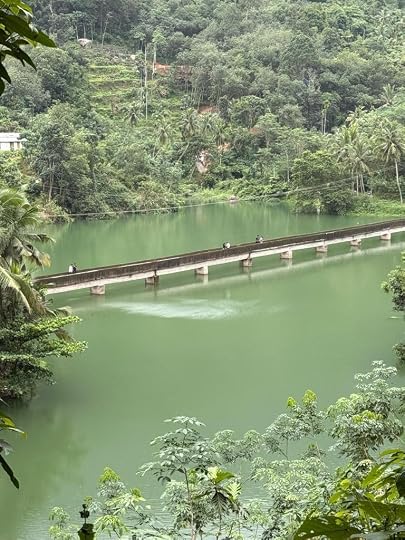 Amboori Narrow Bridge
Sumesh Chetan explained that the area under the bridge was fully empty and dry two days ago. But got filled up by the heavy rains. That explained the quality of the water. If you looked closer, you could see wild plants with yellow flowers submerged in the water and tadpole-like insect larvae swimming over them. It looked like an enchanted garden caught inside an aquarium.
True to its name, the bridge was so narrow that only two-wheelers and barely an autorickshaw could pass through it. Every time a vehicle came, we all had to move to one side and stand in a row to let it pass. I couldn’t help but wonder, since they put the effort into building a bridge, why couldn’t they build a slightly bigger one? Why so narrow?
After exploring the spot, we had to wait for our driver to arrive. He wasn’t confident enough to reverse the vehicle on the narrow, curvy, and steep road near the bridge, so he drove it to a side road to reverse it.
Not just him, many other vehicle tyres were screeching their way through these roads. If Amboori becomes a more popular tourist spot, the narrow, steep roads would definitely be a problem. Too many vehicles could easily choke the roads on this route, too.
Kumbichal Kadav
By 3 pm, we left the Narrow Bridge and boarded the traveller. This time, it sped to the Kumbichal Kadav. To an ignorant visitor like me, it came across as a simple, concrete bridge. But the pristine, green water, and the view of the Thekkan Kurishu Mala on one side made the trip worth it.
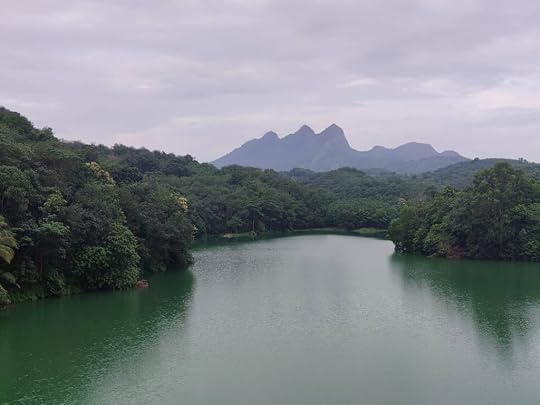 View from Kumbichal Kadav Bridge
If our buddy Reshma had never told us the backstory behind this bridge, I wouldn’t have understood why Sumesh Chetan or the other natives insisted we visit this bridge. She wrote on her status:
“Kumbichal Kadav Bridge may look like just another bridge to many, but for the people of Amboori, it’s an emotion. Opened in 2026, the bridge ended decades of isolation for over 1000 families across 11 tribal settlements. Until then, residents depended on country boats to cross the river, facing immense difficulties during monsoons, at night, and in medical emergencies. More than a structure connecting two riverbanks, this bridge connects lives, hopes, and opportunities. Combined with the breathtaking beauty of Amboori, Kumbichal Kadav Bridge stands as a symbol of progress, resilience, and human connection.”
Moottil Pazham
While Bhagu and I were exiting the Kumbichal Kadav Bridge and walking towards the traveller, we saw a few teenagers, possibly from the tribal community, selling wild berries on the footpath. Saji Chetan explained that it was three varieties of the same wild berry, known as Moottil pazham (scientific name: Baccaurea courtallensis). It’s a fruit native to the Western Ghats in Kerala. They grow directly on the main trunk of the tree, giving it the name; “mootil” means “at the base,” and “pazham” means “fruit.”
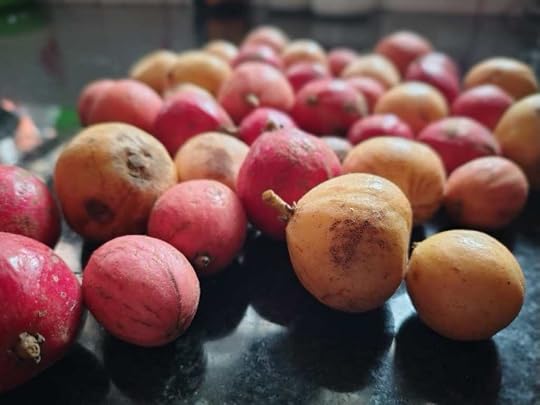 Moottil Pazham
As small as gooseberries, these berries have a softer outer shell and a gel-like inner core. They tasted sweet and sour and were available in three colors – cream, light pink, and dark red. We tasted both the red and white varieties and felt that the reds were more sour than the others. Bhagu bought half a kilo of red ones and half a kilo of white ones, for Rs 100. She was hoping to make pickles with them. But later, I came to know that her entire family found it “too sour.” Still, I thought it was pretty yum, especially if you have a sour palette.
Mayam Kadavu
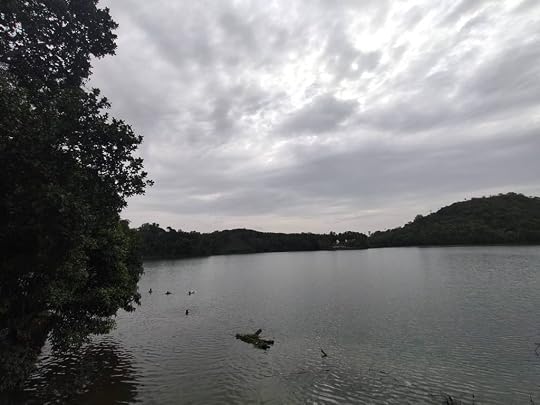 Mayam Kadavu
Up next, we were on our way to the most anticipated spot in the itinerary – Mayam Kadavu. In the hopes of bathing and swimming in the water, we had even carried extra clothes.
Unfortunately, on the way, villagers warned us that we won’t be able to swim. Due to the heavy rains in the previous days, the water level had risen, all the way to the area where vehicles are usually parked. Sadly, this water was also polluted.
Still, since we had come all the way, our buddy suggested that we try our luck. Despite the rows of parked vehicles and tourists, our driver was able to find a spot to park the traveller. Unfortunately, the water was as polluted as the villagers had warned us.
Though a part of me was disappointed that I couldn’t play in the water, the other, lazy part was happy to unwind and gorge on some food again. Bhagu and I had chocolate cone icecreams and salted lemon soda from the nearby small shop. While Bhagu was busy collecting fern leaves and wildflowers to make a tiny bouquet, Saji Chetan offered me a pazhampori(banana fritter), which I devoured in no time.
Neyyar Dam
Though none of us travellers griped about the Mayam Kadavu disappointment, it was obvious that our buddy felt guilty about the missed opportunity. Even though it was an unforeseen incident caused by the rain, she took the initiative to arrange alternate spots for us to visit. It was decided that we would quickly see the Neyyar Dam up close and have an early dinner at Lambodaran Thattukada, en route to Thampanoor.
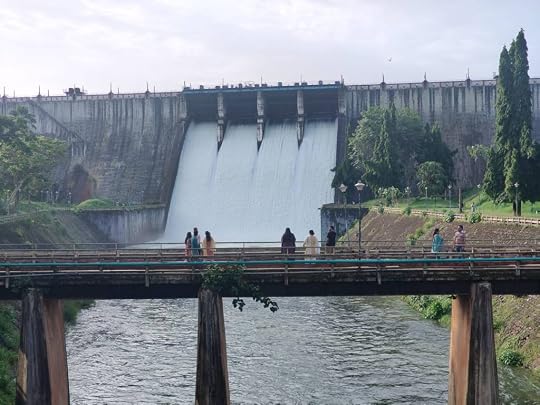 Neyyar Dam with all its four shutters open
So, we got down at a bridge from which we could see the Neyyar Dam and the foamy water pouring down its four open shutters closely. We noticed an entrance that could get us closer to the dam. However, for that, we had to pay an entry fee. Since we didn’t have the time to explore the dam in detail, we decided to enjoy the view from the bridge.
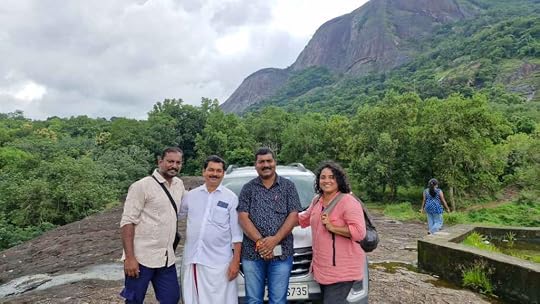 Our team of guides
Sumesh Chetan and Saji Chetan bid us farewell at this point, as their houses were nearby. We clicked photos and shook hands with them. We felt grateful that they took the time and effort to share their knowledge of the Western Ghats, especially the hills and water bodies of Amboori, with us.
Sree Lambodaran Thattukada
Since we had covered the last spot and were on the way to have more food, I was super excited. At Hotel Lambodaran’s, we ordered boiled kappa (tapioca), coin parottas, and chicken perattu.
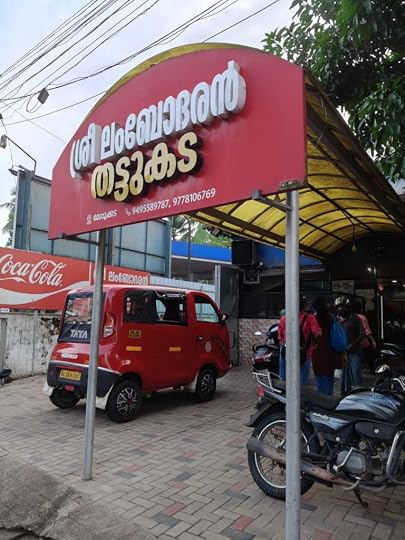 Sree Lambodaran Thattukada
The chicken dish, with its crushed peppers and masalas, was so spicy that I ended up drinking two glasses of hot karinjali water right away. Karinjali water is made by boiling normal water with the dried heartwood/bark of the Cutch tree. Though it sounds like an ayurvedic health drink, it’s a common drink in most Malayalee homes.
Since we were still fanning our tongues after gulping down many glasses of water, we decided to order some cool drinks. The fact that the hotel sold the nostalgic goli soda piqued my interest, and we ordered lime-and-litchi-flavored ones. No wonder the hotel made its non-veg dishes extra spicy. That’s a good business trick to sell more sodas. Anyway, the drinks finally calmed down our spice-kissed lips and tongue.
Back to Thampanoor, and Dispersal
By 7 pm, the traveller reached the entrance of Thampanoor railway station. On the way, a few of us had already gotten off at bus stops close to their homes. The visitor from Ernakulam, who had a train to catch, rushed to the railway station, while the rest of us took our time bidding goodbye to each other. Bhagu and I took an Uber-Auto to her place.
The next day, she drove me back home on the way to her parents’ place. On the way, we listened to songs, discussed family, careers, friendships, and dreams, and made a pit stop in Varkala to meet another school friend.
In between, I couldn’t help but worry about something our buddy Reshma had mentioned. Sajna Chechi, the founder of Appooppanthaadi, had considered closing down her company many times. Why would a flourishing travel group with a 4.9/5 rating on Google ever consider closing down?
I understand it’s difficult to run a business, especially to keep it afloat financially. But considering what a boon this group has been to the average Malayali woman who loves to travel, I sincerely hope Appooppanthaadi will resolve its issues, scale up, and even venture into more countries and premium travel. I hope they never stop being a safe and happy place for women wanderers.
As the red Suzuki S-presso sped through the coastal roads of Varkala, Bhagu broke my reverie and asked, “Jo, will I have to wait another year to read your Amboori blog?”
I couldn’t help but burst into a chuckle. I couldn’t blame her. I had taken close to nine months to catch up and write about the Kathirmudi trek.
“Soon,” I promised her. 
Fair disclaimer: This is not a sponsored post. But if you are interested in going on this trip with Appooppanthaadi, you can book a slot here.
Author’s Notes
~ Ownership of all group photos and nature images belongs to the individual hikers or Appooppanthaadi.
~ All other content on this blog is the intellectual property of the author. © 2026 Lirio Marchito. All rights reserved.
~ This blog is part of a series exploring my travels through Trivandrum, the capital city of my home state, Kerala, in India. You can read more posts from this series here. Trivandrum | Kerala| India