Mia Sivan's Blog
October 29, 2025
Two Paintings, Reunited by an Iranian Missile


September 24, 2025
Jane Austen's Playlist (and Mine!)
April 9, 2025
The Empty Freezer - A tale for Passover
March 29, 2025
How One Question Builds Connection
March 22, 2025
The hottest book Hanukkah Erotica Book Club ever read
March 14, 2025
Happy Purim
January 16, 2025
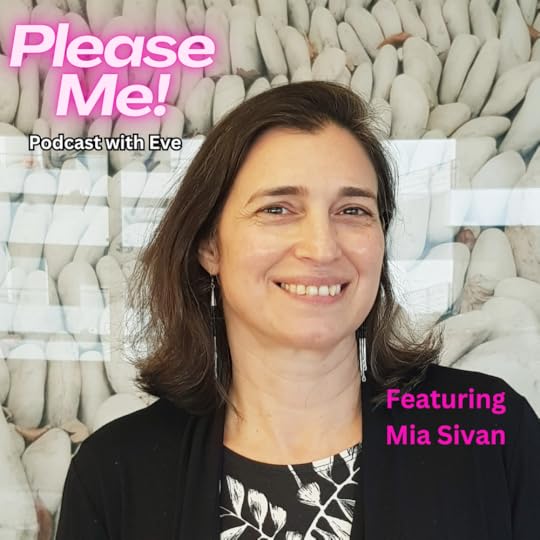
Conversations about sex: Guesting at podcast Please Me!
I recently participated in an interview with Eve who runs a podcast, Please Me!, aimed at destigmatizing conversations about sex.
Eve and I discussed power dynamics, in the boardroom and in the bedroom. She asked me, among other things, did I use any of my workplace real life experience when writing the book, how I came up with the sex scenes, and we explored BDSM as a power dynamic.
You can find the full interview here:
To give you a taste, here are a few short video clips. Below Eve asks me how it is to navigate in a man's world - the fine line between being a bitch and a badass:
In the clip below Eve says:
"I love the heroine in this book because she’s on a journey of sexual exploration and liberation. She’s very much in the world of BDSM. Can you talk about how you brought that into your book?"
January 8, 2025
A Memory that Shaped me
As the new year begins, I’ve been reflecting on how our experiences shape who we become—especially the moments that challenge us. In this first blog post of the year, I want to share a memory that has stayed with me and influenced my behavior to this day.
I was born and raised in a kibbutz - the name derives from the Hebrew word kvutza, meaning “group”. Kibbutz is a unique Israeli type of communal settlement, heavily influenced by socialist ideals.
I grew up living in a communal children’s house (yep, it included shared, mixed-gender showers until I was about ten. Nope, it wasn't traumatic). From an early age, we participated in various tasks that contributed to the community such as gardening, housekeeping, and animal care. We all had access to the same resources. Personal possessions were a rarity, and concepts like buying or earning money were entirely foreign to us.
 When I was 16, my parents decided to leave the kibbutz and move to Uruguay in South America, where I enrolled in an American high school.
"Fish out of water" perfectly describes my initial state, but fortunately, the school was very welcoming. It wasn't like the huge schools you see in the movies, but quite a tiny one - there were only ten of us in the eleventh grade.
After about a week, I was invited for the first time to join my classmates and others for an outing to a popular café. In such a small school, classes of different years mixed socially, and we were a large group, around 20 - sophomores, juniors, and seniors.
We all had coffee (forget France or Italy, South America has the best coffee) and cakes. When we got up to leave, the check was served and everyone was expected to chip in.
It was then that I realized I had no money.
No wallet, no pesos, no credit or debit card. Nada. My naive parents, recently out of the cocoon of the kibbutz themselves, never thought to make sure I carried any with me.
I remember it to this day: the hot wave of humiliation in front of my peers, the bone-deep shame at not contributing, the feeling of utter stupidity - that I should have known better.
My American friends were fine with it, except for one girl named Lisa. Her face scrunched up when she was asked for more money to cover my portion.
Later, as we stood outside chatting, I remained silent, struggling to keep up with the rapid-fire English conversation. Then, one of the guys asked about Argentinian football, a topic I liked and followed, saying, “Mia, what do you think?”
Before I could respond, Lisa chimed in: “She doesn't think.”
I couldn’t come up with an answer, because a treacherous, self-doubting part of me agreed with her. I was speechless and hurt, and I felt so inadequate.
 Decades have passed since this incident.
There is a Hebrew saying : "Do not embarrass your friend in public." (אל תלבין פני חברך ברבים). The Talmud states: "One who shames another in public, it is as though they have shed blood." I don’t consider myself a better person than anyone else, but one thing I've never done is participate in shaming someone.
The other lesson from that moment: I’ve never been caught without the means to pay for my meal. Ever. Even in this era of digital payments, I always carry cash with me.
December 15, 2024
The Real Woman Behind the Story: Fake it till you make it
In my third book Pulling Her Resources, I weave in a financial scam subplot to complicate the lives of my love-besotted heroes. In this blog post I want to tell you about the woman who inspired the scam in my book.

I first met Illit Raz in April 2018.
She was pitching her brand new and promising startup, Joonko, to the women investor group I was part of.
Illit checked all the boxes: a woman at the helm of her own startup, which was dedicated to crafting solutions for companies looking for diversity, equity, and inclusion in their hiring practices.
Not only that, but she was also an incredible person—charismatic, sharp, and ready with an answer to every curveball question.
I almost invested in her company. It only fell through due to a technicality. Still, others did, and I stayed in the loop, gaining insider insights into the company’s trajectory.
In a May 2019 email, Illit’s amazing progress was outlined:
“Without pouring funds into advertising, marketing, and public relations, Illit managed to amass a pool of about 80 companies spanning different industries and around 10,000 diverse candidates, all while maintaining an impressive conversion rate…”
She raised over $38 million(!) from venture capital funds.
But only a few months later it turned out that much of the information provided to investors, including presentations and financial data, was fabricated. The numbers, the clients,- it was all a sham.
The story became front page news.
Yet, was Illit fundamentally different from other startup CEOs who adopt a "fake it till you make it" approach?
I’ve personally encountered two similar cases:
The Phantom Sale
A CEO claimed a significant sale had been finalized in an investor presentation. The truth? It was entirely fabricated. But the CEO’s super-connected father, friends with a leading VC, buried the incident. The son stepped down quietly, and the company moved on.
The CTO’s Big Lie
A startup CTO exaggerated the product’s capabilities to major auto companies and lied about a successful Proof of Concept (POC) to investors. Once exposed, he was pushed out quietly, leaving his co-founders to continue without him.
The truth is, startups lie about their numbers all the time. But their founders’ faces rarely end up plastered all over the news.
Here’s why Illit was different: Illit was a she .
Most of the lying is done by well-connected men, protected by their networks of fathers, friends, and male investors. Illit had no safety net. No one to hush her mistakes. So her case blew out of proportion. I maintain that if Illit were a man, her fall from grace would have been much quieter.
In my low angst/high steam romance, "Pulling Her Resources," ( it's free if you have Kindle Unlimited) I explore this “fake it till you make it” mentality.
Divorced and craving passion, Dafna has a fling with a young, tattooed bartender. Days later, he reappears—as the CPA auditing her struggling startup. Now, the man who set her heart racing holds her company’s future in his hands.
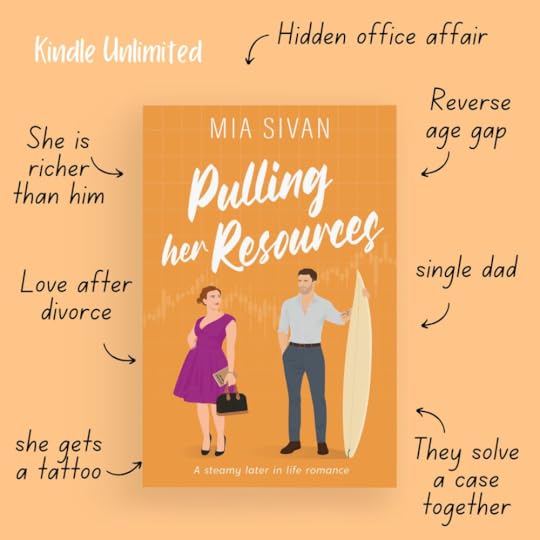
Hint: there's a Happy Ever After.
Yours,
Mia
November 27, 2024
Short Thanksgiving Thoughts from Tel Aviv
Thanksgiving is tomorrow - so happy holiday to all my American friends. Unlike Halloween, which was imported to Israel a few years ago, Thanksgiving—quite logically—isn’t celebrated here.
Still, it’s a good reminder to reflect on the things I’m grateful for in life. Consider it an exercise in positive thinking, especially in light of everything going on. Here are three things I’m especially grateful for:
My family is all safe and well.
I get to write full time even though my writing doesn't support me yet.
I get to travel and meet old and new friends.
As to the last point, if you’ve read my last newsletter (or follow me on Instagram where I posted about it) you know I traveled to Spain recently, and spent some time in Madrid. It wasn’t my first visit—I was there in June 2022 for a writers’ conference
(I wrote about it here).
As I said in my blog, what has truly stayed with me, more than two years later, are the people I met, and the relationships that came out of it. Flying to Madrid and meeting professionals who share my new passion helped me start building a new network.
Sora James was one of those writers and we’re in touch to this day. We met in Madrid for lunch.
We enjoyed an amazing meal—both of us ordered alcachofas a la plancha (grilled artichokes). Honestly, just give me artichokes all day, every day! Over lunch, we chatted like old friends, catching up on life and writing.
Happy Holidays!