Nathan Tudor's Blog
December 13, 2022
My 2022 Favorites
At some point this year, I had the idea of writing up a list of my ‘favorites of 2022.’ These aren’t necessarily works that came out this year (though some of them did), but just things I enjoyed and would like to talk about.
There is no particular order or ranking. Also this post contains affiliate links, so if you purchase something I link to on Amazon, I may receive a small commission at no additional cost to you.
Without further ado…
My 2022 FavoritesYukio Mishima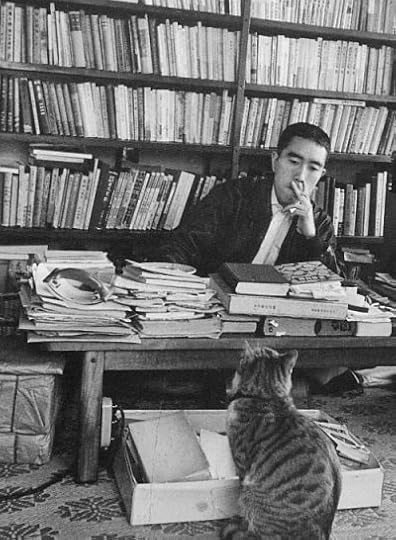
One of the best things to happen to a reader is discovering an author with a large body of work you cannot get enough of. This year, Yukio Mishima was one such author for me.
One of the most significant Japanese writers of the 20th century, Mishima nearly won the Nobel Prize for Literature but was passed over because of his outspoken politics. Deeply critical of Japan’s modernization and the encroachment of Western materialism, Mishima lamented that he would die in peacetime since he considered a warrior’s death the ideal end.
At the age of forty-five, Mishima finished his final novel a day before leading a failed coup attempt. Mishima and his compatriots sought the restoration of emperor-worship and the undoing of Japan’s constitution—but the coup failed, and Mishima committed ritual suicide after shouting, “Long live the Emperor!”
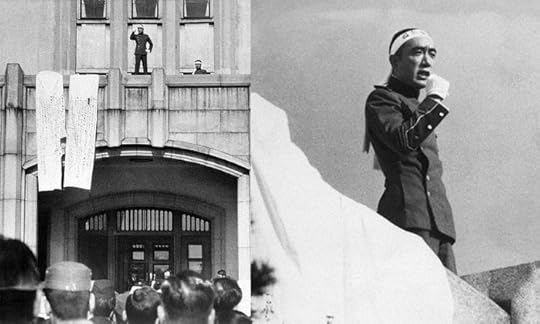
It’s debatable whether Mishima truly thought they had a chance at success or whether he simply longed for a theater where he could claim the warrior’s death he always longed for, but either way, it’s hard to find another writer with such a dramatic finale to his life.
Mishima’s writing pulses with deep aesthetic awareness of tragedy, death, and beauty—and the ways they intertwine. Sometimes his art seems prophetic of his eventual demise. His metaphors and imagery are rich and extravagant, yet somehow never come across as overwrought. His characters have a psychological depth and darkness reminiscent of Dostoevsky.
I’ll constrain myself to recommending three of his books as starting points, but I read more and intend to read more still in the future.
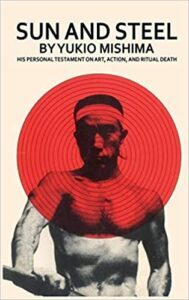
“The cynicism that regards all hero worship as comical is always shadowed by a sense of physical inferiority.”
This is one of precious few books I’ve read multiple times. An essay (Mishima calls it a ‘confession’) on the consequences of embodiment for the intellectual. Mishima recounts how he changed from a sensitive and weak-bodied youth into a strong and integrated adult through a regimen of sun and steel.
Mishima makes the case that a life of words (the intellectual life) is incomplete as it neglects the body—but when the physical life is cultivated, it brings one to the absolute edge of human thought and experience. Sun and Steel is also full of philosophical reflections on literature, art, and what it means to live and die well (that is for Mishima, with beauty and glory).
Valuable reading for anyone who has ever been the pale nerd; it also helps one grasp the ideas Mishima explores in his fiction.
The Sailor Who Fell From Grace with the Sea
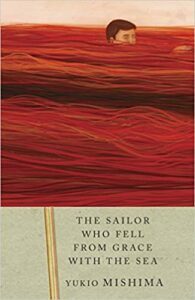
“He hadn’t been able to explain his ideas of glory and death, or the longing and the melancholy pent up in his chest, or the other dark passions choking in the ocean’s swell.”
With one of the best titles I’ve ever encountered, this book grabbed me from the cover. It tells the story of three characters—a sailor (surprise surprise), a widow, and her young son. The story is a romance between the sailor and the widow, but it is also much more.
Under and inside the romance is an exploration of masculinity, heroism, and maturation. This book is brief but powerful and evocative. I recommended it to a friend who later texted me, “Okay, I want to be a sailor now.” (I wonder if he thought the same by the end though…)
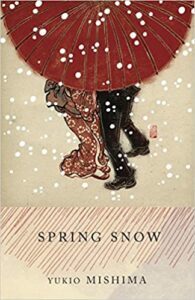
“I’ve known supreme happiness, and I’m not greedy enough to want what I have to go on forever. Every dream ends. But…if eternity existed, it would be this moment.”
Perhaps my favorite of everything I’ve read from Mishima so far, this book is the first in his magnum opus The Sea of Fertility, a four book series that tells the story (stories?) of one character’s successive reincarnations throughout the twentieth century.
Spring Snow is a tragic romance with an unusual quality—the protagonist Kiyoaki chooses to make his love a tragic one. He refuses courtship with Satoko, the woman he loves, until she becomes engaged to a prince and their lives (and families’ reputations) are on the line.
What happens is, in some sense, predictable, yet the ending still managed to shock me. Mishima is incisive in examining the decay of Japan’s aristocratic and warrior classes. The whole book is worth reading if only for one scene where Kiyoaki’s grandmother—after discovering his sin—laughs and commends him for bringing back the virile and violent spirit of an age she had thought lost to effete modern frailty.
Heat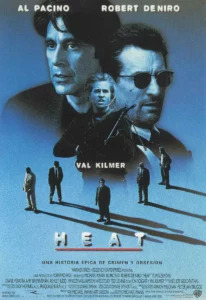
“A guy told me one time, don’t let yourself get attached to anything you are not willing to walk out on in thirty seconds flat if you feel the heat round the corner.”
I love crime movies, but for some reason I don’t seek them out often. After watching Heat, I wonder whether I need to watch another one ever again, because that’s time I could spend rewatching Heat.
Al Pacino and Robert DeNiro star opposite one another as an unhinged detective and elite bank robber, respectively. DeNiro and his crew are preparing for one last big score, while Pacino closes in like a rabid dog.
Not a single scene is wasted. This is one of my favorite praises to offer a story, especially one as long as this film (the runtime is nearly three hours). The plot builds and builds, developing character and themes throughout. Every thread and subthread come together by the end.
The essence of the movie is the famous diner scene where the two men discuss their mutual inability to do anything but what they are doing and how this will inevitably put them on a lethal collision course. You can’t help but get the sense these characters could have been friends if they had met in other circumstances, and it seems they realize that too.
The final act is taut, suspenseful, a masterclass in the genre. I won’t give anything away, but I’ll say it’s pretty much perfect.
Also as a bit of trivia, a friend told me the bank robbery scene is so well done it’s used to train law enforcement.
SPY x FAMILY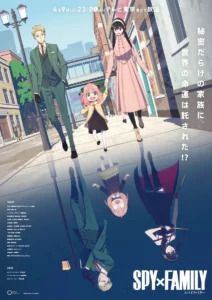
“Papa is a huge liar… but he’s a cool liar.”
Contrary to what my previous picks might suggest, I don’t only enjoy tragic stories. Case in point, Spy Family (excuse me, SPY x FAMILY). My friends and I got together many an evening this year to stream the antics of the Forger family.
The premise is straightforward. In an analogue for Cold War Germany, a spy codenamed Twilight goes undercover as psychiatrist Loid Forger. His mission is to get close to a reclusive political figure and influence him to prevent war from breaking out again. The only surefire way to get at the target is a social event held at his children’s elite private school, so Loid adopts a child and finds a wife in record time.
Except his daughter Anya is a telepath, his wife Yor is an assassin, and he knows neither of these things. Anya, being able to read minds, does know her adoptive parents are a spy and assassin, and she also has the presence of mind to realize that letting either of them in on this would have bad consequences for their home life and world peace.
SPY x FAMILY is just fun. The plots range from light-hearted (the Forgers adopt a dog) to high stakes (stopping a terrorist plot to reignite the war). In fact, those two plots are intertwined because SPY x FAMILY does a stellar job blending comedy and drama, moving between the two with ease.
The show keeps things fresh and exciting while also looping back to how this pretend family has come to love and care for one another despite the pragmatic needs that initially brought them together. Comedic, action-packed, heart-warming—there are plenty of worse shows out there these days, but not many better.
Electra by Euripides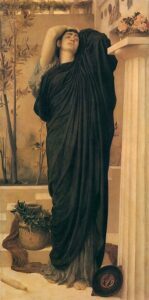
“Give thou to me—peace from my father’s blood!”
All right, back to tragedies. Set in the aftermath of the Trojan War, this play tells the story of the princess Electra and her quest to avenge her father Agamemnon, murdered by his wife and her lover when he returned from Troy.
Part of what makes tragic stories so powerful is the sense of inevitability. Knowing what is going to happen—at least in broad strokes—heightens the tension and eventual catharsis. Euripides executes this flawlessly in this fifth century BC work of art. Even in so short a production, he manages to characterize the cast well, not to mention ask some pressing questions about the nature of prophecy and destiny. The resolution is a bit forced by contemporary standards, but I wonder if it would have been avant-garde or shocking for the time.
Monster by Urasawa Naoki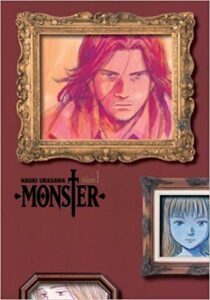
“Look at me. Look at me. Look at how large the monster inside me has become.”
I mentioned above how I love crime stories. I think the serial killer subgenre may be the most potent within that umbrella. Not all stories go to the absolute limits of the human experience, but these often do. Urasawa Naoki’s Monster asks a perennial question about evil—how far should one go to stop it?
Monster tells the story of one Doctor Tenma, a Japanese neurosurgeon practicing in a West German hospital. Tenma has a bright future ahead of him, on track to become the top in his field while engaged to the hospital director’s daughter.
One night, a young boy named Johan is brought in with a gunshot wound to the head. Immediately after, the mayor is brought in, suffering from a stroke. In a moment of moral crisis, Tenma disregards the hospital director’s instructions to prioritize the mayor, choosing instead to operate on the boy.
The mayor dies, and Tenma’s career trajectory with him. He will likely never climb past his current position and his fiancée returns the ring—but at least he saved the boy, right?
The boy Johan is grateful to Tenma for saving his life—so grateful that he kills everyone at the hospital who punished the doctor. Johan vanishes, only to resurface years later to thank Tenma for saving his life—a life that he has dedicated to murder.
Now the police are on Tenma’s trail, thinking they have the evidence to prove it was Tenma who committed the murders. The doctor goes on the run, chasing after Johan in a desperate bid to stop him before he kills again.
Johan is often regarded as one of the greatest antagonists in manga, and it’s plain to see why. When he is off-page, his presence is felt like a haunting shadow. When he is on the page, he exudes a chilling aura. People call him the devil and speculate whether he is the antichrist (an association reinforced by numerous biblical allusions throughout the text). As the story progresses and it becomes clear how Johan became what he is—and what he intends to do—things only darken.
All the while, Tenma wrestles with the moral dilemma of whether he can take the life he once saved. He becomes known across Europe as a mysterious vagabond doctor, helping people who need it for nothing in return. Yet all the while he struggles with the responsibility of being responsible for so much bloodshed. Was it the right thing to do to save Johan? Is it right to kill Johan now that he has done so much evil?
With an intricate plot, a compelling cast of characters, and a shocking yet inevitable conclusion, Monster is a brilliant take on the serial killer genre.
The I Used To Think… Podcast
The only podcast on this list, I Used To Think… is run by my friend Pat Lee, but I’m not recommending it because I have a bias or anything.
Every show, Pat brings on a guest who has changed their mind on some topic. The subjects range from faith to politics to self-image, and in every case Pat asks insightful questions to draw out an interesting narrative. I’ve listened to every episode of I Used To Think… and constantly harangue Pat as to when the next episode is coming out.
(Rumor has it that an episode with yours truly will come out soon, so make sure you’re subscribed to my newsletter to be notified when that drops.)
Blade Runner 2049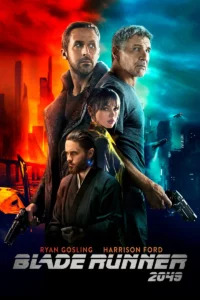
“To be born is to have a soul, I guess.”
Every artist has “I wish I thought of that” moments. Times where we smack our foreheads and imagine we could rewrite reality to slap our names on someone else’s creation. I felt like that watching Blade Runner 2049, especially the brilliant baseline test scenes (language warning).
The protagonist ‘K’ played by Ryan Gosling has been the subject of countless “He’s literally me” memes, and when I finally watched this movie I understood why. I don’t often feel particularly powerful emotions when I watch a movie, but this one got me.
Blade Runner 2049 feels, in many ways, like a story for my generation: increasingly alone in an increasingly technological world. This movie sets up a classic Hero’s Journey—the pattern that teaches us we are the protagonist, the special one, the one who matters, the one who will change the world—and then subverts it. Yet it does not do so in the cynical deconstructive mode so common today, but rather as a melancholic reflection. Blade Runner 2049 does not tear down the notion of the hero, but it does shift the frame—what if the protagonist (and therefore us, the viewer) is the one who enables the hero, rather than the hero?
Blade Runner 2049 is visually gorgeous and atmospheric. Gosling does phenomenal as ‘K.’ Harrison Ford is compelling in his reprisal of Deckard. Ana de Armas twists the emotional knife in her role as AI companion Joi.
This movie also manages the rare achievement of being a sequel that outdoes the original (no mean feat given Blade Runner’s status as a sci-fi classic). Director Denis Villeneuve clearly has great respect and honor for the material he is building upon—something Hollywood could use more of these days.
If you’ve read all this way, my thanks! This was my first year as a published author, and it brought plenty of ups and downs. I look forward to publishing more in the next year, both books and on this blog.
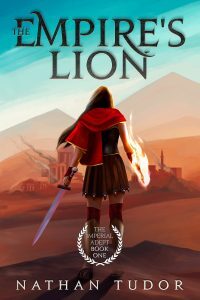
And if you think I have good taste and haven’t yet given my fiction a try, consider my debut novel The Empire’s Lion, an epic military fantasy set in a Mediterranean world of magic, action, and intrigue.


January 28, 2022
What it’s like to write an epic fantasy as your debut novel
Now that The Empire’s Lion is out in the wild, I thought I might as well procrastinate from writing the sequel.
Er, I mean—engage in some reflection on the work that has brought me to the point. Mm, yes.
Drafting a doorstopperI didn’t set out intending to write a 220,000 word book. In fact, I most certainly did not want to write a 220,000 word book. When I started writing TEL, I set my Scrivener project goal at 100,000 words, knowing I would probably overshoot it since I always end up writing more than planned.
But I thought, you know, maybe 125K, or 150K. But as I moved through my outline, writing scene after scene, the total word count just kept going up.
When I finished the first draft, it was somewhere around 190K. I immediately cut 30K from that, because I had gotten a false start. The beginning of the published version of the book is probably the third or fourth attempt, and it’s actually one of the last parts of the book to get written. It was by far the section I struggled with the most, since I knew it had to engage the reader right away while also establishing the tone, introducing Reiva and the world, and setting up plot threads.
And of course, once I had written a beginning i was happy with (I also added the chapter epigraphs at this point) I had blown past that earlier word count and gotten to around 215K. That was the beta version—the one I sent out to some trusted eyes so they could tell me everything that worked and didn’t work.
I wrote Adept Initiate largely while awaiting that feedback, which was actually pretty refreshing. There is one point of view throughout the whole book (with the exception of the epilogue), far fewer subplots and locations, a much tighter cast of characters…it was almost like doing a warm down after exercising.
And yet, I over-wrote even worse with Adept Initiate because I had been aiming to write a novella. I figured 30, maybe 40,000 words, at the absolute outside.
Well, the beta version of Adept Initiate was 90,000 words, which went up to ~95K after receiving some feedback on fleshing out some side characters (which I think made the story much stronger).
Then I was back with TEL, excellent reader notes in hand.
And I realized I needed to add some more to the book. Not too much—only about 5,000 more words it turned out. Most of those words went to two scenes in particular—Domi in Caroshai and the rat scene. The rat scene, by the way, was one of the most fun to write. I can’t believe it took me until draft three to come up with it.
The words that didn’t go into those scenes were small additions—mostly throwing in some more foreshadowing, reworking some of the epigraphs, and slipping in references to characters and events from the prequel.
Which brings us to ~220,000 words.
Would I recommend it to someone else for their debut novel?It depends.
I know, I know–hear me out.
If you’re going into it thinking “I want my book to be a quarter of a million words!” then you might want to pump the brakes.
I’m going to steal something Michael McClellan, author of The Sand Sea, put forth when we talked about this subject: “The best way to write a long book is by not trying to write a long book” (or something like that; it’s been a few months since that conversation).
Michael was absolutely right—and his debut is several tens of thousands of words longer than mine.
The story itself should dictate how long the book is.*
Leaving aside the fact that if I had gone into TEL planning to write 200,000 words, I probably would have inadvertently written 400,000 words, there’s a dangerous sort of attitude that can creep in. With so many words to play with, it can be tempting to indulge. Add an extra intrigue subplot. Expand the romance between those characters. Spend a few paragraphs describing every last dish at the banquet (complete with the tragic backstory of the pig who would become that delectable roast pork).
Nothing’s wrong with intrigue subplots, romances, or descriptions of food (I have all of them in TEL to varying degrees). But I had to be strict with myself. You might not believe that I was strict with myself given the length I ended up at, but trust me, there could have been much more.
The biggest example of that would be the entirety of Adept Initiate.
For a while, I was toying with whether The Empire’s Lion should start with Reiva’s childhood and the story of how she left Talynis and became an Adept before being forced to go back as part of a military campaign. From a structural perspective, that actually has some really nice stuff going for it—most notably that we would have her leaving and returning to her homeland all in one book. It also would have let me play a bit more with certain characters’ arcs and their experiences across AI and TEL—being vague to avoid spoilers.
But that would have been a monstrous book. I would have to cram seven years’ worth of Sanctum training into the first half, then suddenly the back half would be far more intricate and drawn out. There would be the difficulty of what other plot lines to mix into the Sanctum arc. Do we cover Avi’s childhood? How many scenes does he get? When do we start introducing Alyat POVs? Do we need to see Yaros early on so it’s not jarring when he suddenly walks on stage post-Hyrgallia?
And you could say, perhaps fairly, that it could have worked. There’s likely an alternate version of The Empire’s Lion starting with Reiva’s childhood that is effectively told (other fantasy books have done that sort of thing well). But it would be incredibly different, and to be honest, I think it would have a far weaker ending. I came up with the climax of TEL early on, and then I built everything else around that. Instead of the (if I may say so) awesome payoff and resolution, I probably would have had to end things far earlier—maybe with the aftermath of the Bazaar fight if I really stretched my words. It could be climactic enough to be thrilling, but it would leave a horrendous amount of plot threads dangling, so there’s not much of a payoff.
I go into all that messiness to reiterate my point—I did have a point, right?—that the story has the length it needs to be. Stories have beginnings, middles, and ends. They’re not just events strung together; they have unifying themes and ideas.
So you need to write the story according to what it requires. I thought The Empire’s Lion would be in the range of 100-150,000 words, but it had to be 220,000. I thought Adept Initiate had to be 30-40,000 words, but it had to be 95,000.
Does your debut need to be as long? Who knows—you might not even know. Write it and find out.
Thanks for reading,
Nathan
*A bit of a tangent (because as we’ve established, I can’t help but over-write). I’ve heard lots of anecdotes about authors who go the traditional publishing route being forced to cut out huge chunks of their books for publication. I don’t champion writing your story to the length it needs to be as some sort of cover disparagement of authors who’ve cut their books down to comply with editorial order.
For one, there is absolutely bloat, especially in epic fantasy, that detracts from the reader experience. Much as I worked to trim the fat from TEL, I’m sure some has remained.
For two, longer books (especially in print) are a tougher sell. I think one of the great things about indie publishing is the choice to publish a book as long as you choose—I probably could never have sold TEL to a trad house because it’s just too big a risk to take on a new author (“220K debut that opens a trilogy? Yeah no, we’ll take the pitch for a 125K that can work as a standalone”). It happens, of course, but it’s a complicating factor in an already strained publishing model.
So I have a bias here. Any time I hear that an author had to cut out 50K words, I can’t help but wince and think about what great subplots or character interactions got ripped out. But when authors say cutting out those words ended up leaving the book far stronger, I take them at their word for it—after all, they wrote the thing in the first place.
…I now have an urge to write about whether authors really know their own stories the best, but I think I’ll leave that for another day.
January 21, 2022
THE EMPIRE’S LION is now available!
The day has finally arrived! (If you just want the store links, click right here).
Around June 2020, I had an idea for a book.
I knew some things about it—I knew it would be an epic military fantasy set in a world inspired by the first century Mediterranean.
I knew the story would focus on two young warriors on opposite sides of a war: one of them a woman with fire magic, the other a man with an anti-magic blade.
And I knew some other really cool things that would spoil the story 
In the 1.5+ years since I had that idea, I’ve learned a lot more about the book—about the characters whose story it tells, about the world the story takes place in, about the heart of why this story needed to be told.
Today, that book goes out into the world. Thank you for coming along for this journey—I’ve loved hearing your thoughts on Adept Initiate, and I can’t wait to hear what you think about The Empire’s Lion.
Right now, you can get it on Amazon, Apple Books, and Kobo.
December 30, 2021
ADEPT INITIATE is now available for FREE
Adept Initiate, the prequel to my debut series The Imperial Adept, is now available for free download!
[image error]Spanning seven years and reaching from the sun-choked desert to the pirate-ridden seas, Adept Initiate tells the story of how an ambitious young girl becomes a deadly magical warrior in the most formidable army in the world. All subscribers to my newsletter receive this novel absolutely free. If you’re curious about my fiction, it’s the perfect starting point!