Randy Conley's Blog
September 28, 2026
4 Strategies for Leading in Uncertain Times
 If you feel like the world is changing faster than you can adapt, you’re not alone.
We are experiencing the fastest, broadest, most consequential reordering of politics, technology, and business in our lifetimes. Accenture reported the pace of change in business accelerated 183% between 2019-2024, and Gallup surveys show that 79% of employees report their organization has undergone a disruption in the last year.
The result is that uncertainty has become the emotional context of work, not just the operational. For many, work just feels heavier. We see it in the rising tide of employee stress and burnout and the decline in trust and engagement. And leaders are being asked to provide answers when they don’t readily exist. That’s the challenge of leading in uncertainty.
Although we can’t always control the amount and pace of disruption in our organizations, we can control our response to it. Here are four strategies we can employ to lead more effectively in uncertain times:
Build Trust and Psychological SafetyTrust and safety aren’t “nice-to-have” in uncertain times—they are the infrastructure that stabilizes people emotionally so that they can perform effectively.
Trust can become fragile during times of change, especially if leadership hasn’t done an effective job of building it beforehand. Uncertainty amplifies fear, and in the absence of trusted information and guidance from leaders, people fill in the gaps with their own stories that are often more negative than reality.
Although related, trust and psychological safety are two separate constructs. Trust can be defined as the willingness to be vulnerable to another’s actions based on perceptions of their ability, believability, connectedness, and dependability.
Ability refers to a person’s competence. A person is trustworthy when they have the expertise, knowledge, skills, and track record of results for their given position or role. Believability is a measure of a person’s integrity. Are they honest? Do they walk the talk? Do they treat people fairly? Connected leaders demonstrate care and concern for others. They foster trust by communicating openly and transparently, build rapport, and display an appropriate level of vulnerability with their people. Lastly, trustworthy leaders are dependable. They honor their commitments by being accountable, responsive, and doing what they say they will do.
Fear is the enemy of trust.
~Simple Truths of Leadership, Ken Blanchard & Randy Conley
Psychological safety, on the other hand, is a belief that it’s safe to take interpersonal risks like speaking up, offering dissenting points of view, or speaking truth to power, without fear of reprisal. While trust focuses on a person’s behavior, psychological safety focuses on one’s perceived level of risk. They are two sides of the same coin.
So, what are some actions leaders can take to build trust and psychological safety? Leaders can:
Model behaviors that align with the ABCD’s of trust (Able, Believable, Connected, Dependable)Be consistent in words and actionsCommunicate frequently and transparentlyInquire into the views of othersAcknowledge emotions without judgmentSolicit dissenting points of viewTreat trust and psychological safety as strategic assetsBe a SensemakerSensemaking is a term coined by Karl Weick in his book, Sensemaking in Organizations. It refers to how people “create reality” by retrospectively interpreting ambiguous cues and building a plausible story that they can act on.
Why is that important for leaders? Leaders need to take the lead in helping their people make sense of the uncertain environment they’re facing. We do that by asking questions like: What do we know? What don’t we know? What’s likely to change and what isn’t? What should we focus on right now?
It’s critical that leaders remember that this is something they do with people, and not to them. Leaders name the reality and then co-create the picture with their people. That involves framing a narrative that is focused on learning and adapting to what’s happening, and then constantly updating their strategy based on input from others. Sensemakers embrace the nuance and complexity of the environment and resist the temptation to oversimplify the situation by framing it as black and white.
People don’t describe what they see.
They see what they can describe.
~Vicki Halsey
Making sense of uncertainty requires leaders to communicate more, not less. It also requires that leaders pay particular attention to the emotional landscape of their teams and balance honest realism about risks with a hopeful tone for a purposeful path forward.
Provide Clarity in UncertaintyDo you remember the days when “strategic planning” was considering where our organization might be in 5, 7, or 10 years? These days we’re lucky if our strategic plan is 1-2 years out!
We don’t need certainty to provide clarity. In the midst of uncertainty, people need focus. They need priorities. They need to know what “good” looks like right now, even if that definition is likely to change as circumstances evolve. One of the best ways to provide clarity is to anchor goals in values.
Values provide the why behind goals. The goal is how we’ll get something done, but the value speaks to why it’s important. The how can, and should, change as circumstances dictate, but the why remains constant. Values also guide decisions and create coherence across teams. They keep people rowing in the same direction. Goals will frequently change, but values remain constant.
A telling example comes from Brian Chesky, cofounder and CEO of Airbnb. At the start of 2020, he was preparing to take the company public in what was predicted to be one of the largest tech IPOs ever, valued at over $30 billion. But, when the Covid-19 pandemic hit, the company lost 80% of its revenue, and the IPO had to be postponed.
Chesky knew this would be a period of unprecedented uncertainty for the company. So, one of the first things he did was create a list of four guiding principles for himself: Act fast, preserve cash, act with all stakeholders in mind, and play to win the next travel season.
In a crisis, “you make principle decisions, not business decisions,” he said, reflecting on what he learned. A business decision is “a decision predicting the best possible outcome. A principle decision is irrespective of the outcome.” These became Chesky’s anchors as he steered the company through 2020 to position it for success when the travel industry recovered. In December 2020, Airbnb went public, with a market capitalization of $86.5 billion after the first day of trading.
Leaders can provide clarity by narrowing the set of priorities, setting shorter-term goals with clear outcomes, and having regular check-ins to recalibrate. Name what has changed, and just as importantly, what hasn’t. And define what a good job looks like so that team members aren’t guessing at performance standards.
Adapt Your Leadership ApproachThis is where many capable leaders get stuck. They’re consistent, experienced, and well intentioned, so they double-down on what’s always worked. The challenge is that uncertainty changes the context. What worked for you in the past when times were stable may not work now.
Adapting your leadership style is not changing who you are. It’s changing the way you show up.
Blanchard’s research shows that 54% of managers are only comfortable using a single style of leadership. Uncertain times require that leaders flexibly adapt their style to match the needs of the situation, the goals, and the people responsible for executing them.
There are many variables to consider when assessing the situation and the goal. What’s the pace of change? Risk? Urgency? Complexity? Is the work environment remote, hybrid, or in-person?
When assessing the individual, we have to know their level of competence on the task, their motivation and confidence in achieving the goal, and their temperament. We also have to be mindful of cognitive and emotional overload, sense of overwhelm, or change fatigue.
Once we take all that into account, then we choose the leadership style that’s going to be the most effective match for the individual. If the individual is still in learning mode, they’ll need more of a directing or coaching leadership style. If they can operate independently but lack confidence to fully own it, they need more of a supportive style. And if they’re highly competent and committed, they need the leader to delegate and get out of their way.
There’s no one best leadership style. The best style is a one that’s a match for the situation and the person.
Leading Through UncertaintyIf you think you’re leading but no one is following,
you’re simply out for a walk.
~Ken Blanchard
Leaders have a unique and privileged role in today’s uncertain world. They have the power to profoundly shape people’s lives for the better.
Gallup’s Global Leadership Report: What Followers Want highlights four core needs of every employee:
HopeTrustCompassionStabilityAs it relates to having a sense of hope for the future, the number one influence for employees was a family member.
Guess what the second most powerful influence was? Their manager.
In times of uncertainty, people are looking to their leaders for guidance. They’re looking for hope.
They don’t need all the answers, and they don’t expect their leaders to have them. But they are looking for direction forward. They’re looking for leaders to chart a path forward to a hopeful future.
You can be that leader by building trust and safety, making sense of the current reality, providing clarity on priorities, and adapting your leadership approach to meet the needs of your team members. That’s what leading in uncertainty looks like.
For a deeper dive into this topic, watch the recording of my webinar, Leading Through Uncertainty: What People Need Most from Their Leaders
The post 4 Strategies for Leading in Uncertain Times appeared first on Leading with Trust.


July 21, 2026
Creating Environments Where Trust Flourishes
 If you feel the world has become more complicated over the last few years, you’re not imagining it. The data confirms what many of us experience every day.
Organizations are navigating unprecedented change, employees are feeling overwhelmed, and mental health challenges continue to rise.
AI is a leading contributor to these feelings of angst. AI is not just replacing tasks done by people, it’s causing an existential crisis in how people view their identity and value at work.
In short, complexity has multiplied, speed has increased, and technology has advanced faster than we can keep up.
The Leadership ShiftIn these times, leaders can’t control every circumstance, but they can influence the environment in which people experience those circumstances.
People consistently do their best work in environments where they feel trusted, valued, connected, and safe.
Leadership isn’t simply about results anymore. Results still matter, but sustainable success comes from creating environments where people can consistently produce their best work.
Let me share an example from a leader I’ve been working with this year that illustrates this shift.
After a recent session on building trust, Maria realized her team couldn’t meet increasing demands by simply working harder. They needed to change the way they worked together.
So, Maria invited her team into a conversation on how they could create an environment where trust flourishes. Team members shared concerns they hadn’t felt safe raising for years. People who had worked together for decades walked away with new levels of insight into their colleagues and how they can work together more effectively as a team.
Trust Doesn’t Grow by AccidentSome people think trust “just happens,” like some sort of relational osmosis. It doesn’t happen by accident; it takes intentional effort.
Gardeners don’t force growth. They prepare the soil, provide water, remove weeds, and create the conditions where growth becomes possible.
Leadership works much the same way. Leaders can’t force trust or growth, but they can create conditions where both naturally flourish.
Summer of TrustThat’s why this year’s Summer of Trust focus is Creating Environments Where Trust Flourishes. Over the month of August, we’ll explore this idea together.
Each week we’ll focus on one practical aspect of creating an environment where trust can flourish.
Week One
What makes people feel safe enough to contribute? There are specific things a leader says and does that make people feel safe.
Conversely, there are leadership actions that will kill any hope of your people taking a risk with you, no matter what you say or do otherwise.
Week Two
Many leaders believe they must choose between caring for people and holding them accountable. They don’t.
High care and high standards can coexist and we’ll explore how.
Week Three
How do we preserve our humanity in an increasingly AI-enabled world?
This week will find us addressing practical ways we lead in the age of AI and do what AI will never be able to—be human.
Week Four
What kind of environment does your leadership create? We’ll explore what it means to be a steward of human flourishing rather than simply a manager of tasks.
Are you creating an environment that allows people to flourish, or one they’re simply trying to get through?
More Than a Summer Reading SeriesThis year, Summer of Trust is more than a weekly email series.
Instead of simply reading about trust each week, you’ll have opportunities to practice it alongside other leaders through discussion, Trust in Practice videos, practical tools, and shared reflection inside the Blanchard Community. We’ll conclude Summer of Trust by gathering online to celebrate what we’ve learned.
What Are You Growing?Every leader is creating an environment. The only question is: what are you growing there?
If you’d like to spend August intentionally cultivating trust, I invite you to join us.
Because trust doesn’t flourish by coincidence. It flourishes when leaders cultivate the conditions where people can do their best work.

The post Creating Environments Where Trust Flourishes appeared first on Leading with Trust.
April 27, 2026
This is the spirit of leadership and teamwork we need more of today

HOUSTON, TEXAS – APRIL 16: From left, Jeremy Hansen, Victor Glover, Christina Koch and Reid Wiseman, the Artemis II crew, speak during a press conference following their mission orbiting the moon, in Houston, Thursday, April 16, 2026. (Raquel Natalicchio/Houston Chronicle via Getty Images)
There is something different about how the crew of Artemis II led and worked together.
In contrast to the divisive and dominating styles we often see, the crew of Artemis II carried out their mission with a level of precision that reflected their shared identity, disciplined positivity, and trust under pressure.
Shared Identity
Four people sharing approximately 330 cubic feet (about the size of two minivans) for a 10-day orbit around the moon is no small feat. Mission specialist, Christina Koch, spoke to the need for the crew to operate as one unit. In her post-trip reflections, she said:
“A crew is a group that is in it, all the time, no matter what, that is stroking together every minute with the same purpose, that is willing to sacrifice silently for each other, that gives grace, that holds accountable. A crew has the same cares and the same needs, and a crew is inescapably, beautifully, dutifully linked.”
Mission commander, Reid Wiseman said, “We are bonded forever. I mean, that’s the closest four humans can be and not be a family. I am here to tell the world: we launched as friends, and we came back as best friends.”
Leadership is about “we” not “me.” It’s about emphasizing the power and abilities of the team, not those of the one person who’s been designated as the “boss.”
One small but telling example shows up in how they handled photo credits. The team decided credit would be given to the entire Artemis II rather than the individual holding the camera.
That mindset isn’t limited to spaceflight. It applies wherever people work together—the mission belongs to the crew, not the individual.
But identity alone isn’t enough. How they showed up emotionally mattered just as much.
Disciplined Positivity
The crew of Artemis II has been disciplined about speaking in positive, optimistic tones that demonstrate unity among themselves, the broader team at NASA, and even all of humanity.
For example, take their very first video broadcast message from space. Reid Wiseman remarked, “You can see the entire globe from pole to pole,” and pilot Victor Glover chimed in, “Trust us; you look amazing. You look beautiful.”
This positive approach was not accidental. In high-risk, confined environments, emotional tone is contagious. Leaders aren’t just managing tasks, they manage meaning.
They faced their share of challenges. From communication and technical difficulties after splashdown, to the isolation from family and friends, to even fixing a jammed $30 million space toilet (something Christina Koch jokingly said earned her the title “space plumber”), the crew consistently chose a positive narrative.
And all of this rested on one foundation: trust.
Trust Under Pressure
Trust wasn’t just a “nice-to-have” value, it was a requirement for survival.
Reid Wiseman said one thing held them together: Integrity.
The Latin root of the word integrity is “integer,” meaning whole, untouched, or undivided. That’s what a trustworthy leader and team looks like—whole, complete, unified.
That concept was so important that they chose “Integrity” as the name of their capsule—a reflection of the trust, respect, candor, and humility they believed were essential to mission success. Integrity embodied everything they valued as they worked together as a unified crew. “It was easy to slip out, but we pulled each other back into integrity to stay focused,” Wiseman recounted.
When you’re thousands of miles up in space, you don’t have the option of calling in HR to mediate with an unruly teammate. You can’t assign a person to a different team or simply choose not to work with them. Trust cannot just be an agreed upon norm—it must be an operational reality. In practice, this looks like:
We trust each other’s competence to handle the task at hand.We trust each other to communicate openly and empathetically, especially when conversations are challenging.We trust each other to reliably carry our share of the load.Serving Something Bigger Than Yourself
A final word on the crew of Artemis II serving as a leadership and teamwork role model—they knew the world was watching and understood they were serving a purpose larger than their orbit around the moon.
They intentionally chose to model a spirit of unity during a time of global division.
It’s not clear whether this was a formally stated team norm, but their actions made it unmistakable. They knew that this mission afforded them a once-in-a-lifetime opportunity to influence the whole world.
And what was their message?
Christina Koch stated it eloquently as she reflected on what it means to work as a crew. “I know I haven’t learned everything that this journey has yet to teach me, but there’s one new thing I know and that is, planet Earth, you are a crew.”
That’s the kind of leadership and teamwork our world needs more of right now.
The post This is the spirit of leadership and teamwork we need more of today appeared first on Leading with Trust.
February 22, 2026
What Are You Doing to Keep Hope Alive?
 “Keep hope alive!”
Many of us remember Jesse Jackson using that phrase to rally delegates at the 1988 Democratic National Convention after he failed to secure the presidential nomination. It was more than a slogan. It was a call to persevere.
I’ve been reflecting on that phrase this week and what it means for us as leaders. Three ideas rise to the surface.
Hope Requires a SourceIn business, we often say, “Hope isn’t a strategy.” What we mean is that strategy requires more than wishful thinking. It must be grounded in action and reality.
But hope itself isn’t fluffy. It has a source. It’s anchored in someone or something that fuels belief and commitment.
Gallup research shows that a person’s manager is the second-most influential source of hope in their life, trailing only family. That’s sobering. As leaders, we carry more influence than we may realize.
Never underestimate your ability to kindle hope in someone else.
Hope Recognizes RealityIn a hard-edged, competitive world, hope is sometimes dismissed as denial or naïveté. It’s neither.
Consider the Stockdale Paradox, popularized in Jim Collins’ Good to Great. Admiral James Stockdale survived seven years as a POW in Vietnam. When Collins asked which prisoners didn’t survive, Stockdale replied: the optimists. They kept setting dates for their release. Christmas came and went. Easter came and went. Eventually, they lost heart.
Stockdale’s lesson was clear: never confuse faith that you will prevail in the end with the discipline to confront the brutal facts of your current reality.
Hope doesn’t ignore reality. It gives us the courage to face it without being defined by it.
Hope Results in PurposeFyodor Dostoevsky wrote, “To live without hope is to cease to live.” Hope is life-giving.
Viktor Frankl, Holocaust survivor and author of Man’s Search for Meaning, echoed this truth. Drawing on Nietzsche, he observed, “He who has a why to live can bear almost any how.” Frankl survived by holding on to a sense of purpose, even in the bleakest conditions.
Hope supplies that why. It gives us a reason to press forward. It doesn’t just help us endure today; it empowers us to shape tomorrow.
The QuestionSo where does your hope come from?
If you’re a leader, your source of hope must be rooted in something bigger than yourself—values, beliefs, principles that endure when circumstances shift. These are the anchors that steady you and the north stars that guide others.
How are you keeping hope alive—for yourself and for the people who look to you?
I’d love to hear your thoughts.
The post What Are You Doing to Keep Hope Alive? appeared first on Leading with Trust.
December 15, 2025
5 Ways to Avoid Moral Failures as a Leader

Sherrone Moore – Former University of Michigan head football coach (Photo by Luke Hales/Getty Images)
The most dangerous place you can be is if you think it couldn’t happen to you.
Last week’s firing of University of Michigan head coach Sherrone Moore is the latest reminder. He joins a long list of talented leaders who lost their way: Bobby Petrino at Arkansas, Steve Easterbrook at McDonald’s, Brian Krzanich at Intel, or this year’s “Kiss Cam” duo, Andy Byron and Kristen Kat from the company Astronomer.
Different fields, same pattern: people entrusted with influence making choices that violate the very trust that put them there.
Why does this happen so often?
Psychologists have been studying the effects of power for years, and the findings are sobering:
 People who feel powerful judge others more strictly while becoming more lenient with themselves. Researchers call this moral hypocrisy.
Power also creates a kind of moral disinhibition—a focus on rewards, a sense of exceptionalism, and less empathy for how our actions impact others.
Studies even show that people of higher status are more likely to break basic social rules, like cutting off drivers or failing to yield to pedestrians.
And then there’s moral licensing: “I’ve done so much good…I’ve earned this.” Even ethical leaders aren’t immune.
Here’s the truth I keep returning to: Leadership is a sacred trust.
The moment we forget that truth, we start treating our role as a perk instead of a responsibility.
How do you and I protect ourselves from suffering the same fate?
 Clarify your lines before you’re tempted to cross them. Write down the boundaries you refuse to violate in relationships, money, and integrity.
Keep clean, transparent relational boundaries. When you have the power to hire, fire, or promote, there’s no such thing as a “private” relationship. Full stop.
Build an inner circle that can call you out. Give a few trusted people the permission to ask hard questions—and answer them honestly.
Create rhythms of reflection. Regularly ask yourself: Where am I starting to believe the rules don’t apply to me?
Strengthen organizational guardrails. Clear policies, psychological safety, and real accountability protect both people and leaders.
Moral failure isn’t inevitable. But it is predictable when we lose sight of our responsibilities and start treating them as privileges.
Guard your heart. Guard your influence. Guard the trust others place in you.
How do you stay grounded when the temptations present themselves?
I’d love to hear the practices, mentors, or guardrails that help you stay true to your values.
The post 5 Ways to Avoid Moral Failures as a Leader appeared first on Leading with Trust.
November 11, 2025
Leadership Development Carnival — November 2025
It’s my pleasure to host this month’s Leadership Development Carnival, sponsored by Weaving Influence.
The Leadership Development Carnival is a monthly collection of insights from top thought leaders around the world, and this month’s edition features topics related to business, culture, communication, artificial intelligence, career development, team building, and leadership. As with any good carnival, it’s best enjoyed when you immerse yourself in the experience and enjoy the variety it has to offer.
So, without further ado, I present to you the November 2025 Leadership Development Carnival!
A 5-Step Change Management Plan to Lead Your Organization Forward | David Grossman
Find out what’s behind today’s failure rate for transformations and explore a practical 5-step roadmap every leader can use to communicate better, align teams, and turn change into a competitive advantage.Seeing Ourselves Clearly: Overcoming Leadership Blind Spots | John Stoker
We all have blind spots. And often, we’re unaware of our own lack of awareness. Being more personally aware of how we come across and how our behavior impacts our results can be the key to getting the results that we want.The Small Habit That Transforms Culture | John Spence
Recognizing great work is one of the simplest actions with the biggest impact on culture and performance. When you catch people doing things right and call it out with clarity and sincerity, you build trust, increase engagement, and reinforce the culture you want to see in your business or association. This article shares how to make recognition a daily practice that transforms performance.It Doesn’t Have to be Lonely at the Top | Priscilla Archangel
Leaders often say, “It’s lonely at the top,” because until you sit in their seat, you cannot fully appreciate the weight and responsibilities of the role. Learn how to be less lonely and to build community.Win or Lose—Your Attitude Decides | Frank Sonnenberg
There are two types of people in the world—those who face a challenge and say, “This will be tough, but we can do it!” and those who say, “Nobody’s done this before. Why even try?”From DEI to High-Performance: A New Blueprint for Culture Fit | Dana Theus
The old idea of “culture fit”—hiring people who mirror the team you already have—is holding organizations back from real innovation and performance. Instead, we need to shift toward “culture contribution,” where individuals are valued for bringing their unique perspectives, experiences, and strengths to the table.How to improve organizational resilience? | Marcella Bremer
Research discerns seven practices that enhance organizational resilience. Imagine future failure, and define your essential outcomes—what is tolerable if disruption strikes? Anticipate solutions, do some stress testing and develop a learning culture. Check how small to medium-sized organizations prepare themselves.3 Leadership Reversals Required for Success Today | Julie Winkle Giulioni
In today’s fast-changing world, the traits that once defined great leadership are no longer enough. Success now depends on a willingness to rethink old instincts and embrace a new set of counterintuitive skills. This article explores three essential leadership reversals that help leaders thrive amid complexity and change.From Busy to Impactful: A Year End AI Strategy for Leaders | Sara Canaday
Ever end a week wondering how you worked this hard and still didn’t move the needle? You’re not alone. This piece gives leaders a year-end reset button by letting AI spotlight which tasks drive impact versus drain energy. The result? Fewer reactive days, more meaningful progress, and the satisfaction of actually leading where it counts.“That’s Just How I Am”: The Lie That Limits Leadership | Robyn McLeod
In the post, “That’s Just How I Am”: The Lie That Limits Leadership, Robyn McLeod of Thoughtful Leaders Blog shares five important tips for changing unproductive behaviors that may be hindering your ability to have effective working relationships.Breaking Free from Cycles of Judgment | Ann Van Eron
We all get caught in moments of judgment when someone’s behavior irritates or confuses us. Yet each of us is doing what makes sense from our own perspective. When we pause, get curious, and assume positive intent, we begin to shift from tension to understanding and open the door to more meaningful connections.The Importance of the Pause | Diana Peterson-More
How many times have you written or said something that you later regretted—often in the moment? It’s happened to all of us—it’s that immediate, heart-stomping comeback to whatever was lobbed our way. When we do that, a quick, unvarnished apology is the best antidote. How about avoiding the need for an apology altogether? How about taking a pause before responding . . .Open Your Heart and the Door | Bill Treasurer
Before employees care about what you want, they want to know one thing: Do you care about them? When leaders put people first—not as “resources,” but as human beings—trust deepens and performance rises. Open your heart, and you open the door to stronger relationships and better results.Poor vision can keep you from seeing organizational problems | S. Chris Edmonds
Poor vision can hamper leaders from seeing how managers are treating employees, which can damage organizational health.Execution Over Excuses: The Real Reason Businesses Struggle | Jon Verbeck
“Execution is a discipline, and integral to strategy.” In other words, it’s not enough to have a plan. The real work is in driving that plan forward—week by week, person by person, number by number. That’s where most businesses fall short.The Evolving PMO Series: Built for Agility, Led by People, Powered by AI | Naomi Caietti
Project Management Offices (PMOs) weren’t built for agility, enterprise complexity, or strategic return on investment (ROI). They were built to track timelines, push process, and report progress. That was fine when business moved slower.Beyond Goal Setting: What I’ve Learned About Leading Yourself by Design | Susan Mazza
In this article, Susan Mazza reflects on how loss became a turning point for redefining leadership—from achieving more to living with deeper alignment and intention. She reminds us that the most meaningful leadership begins with how we choose to live and lead each day.Why Your Leadership Team Meetings Have Become Tactical Fire Drills (And How to Reclaim Strategic Focus) | Bill Ringle
Smart tech leaders get trapped managing tactical issues not due to poor leadership, but because of systematic “executive escalation syndrome” where operational decisions funnel upward instead of being resolved at appropriate organizational levels. The solution requires implementing escalation architecture: clear criteria, decision boundaries, and systematic frameworks that prevent tactical fire drills from consuming strategic leadership bandwidth.The post Leadership Development Carnival — November 2025 appeared first on Leading with Trust.
May 4, 2025
Airing of Grievances – 4 Ways Leaders Can Combat a Culture of Resentment and Outrage
 Any fan of the old TV series Seinfeld will remember the classic Festivus episode, where George Costanza’s father kicks off the make-believe holiday with the “Airing of Grievances.” At dinner, each person takes turns venting about how everyone else has disappointed them throughout the year.
Lately, it feels like Festivus never ends. Instead of a once-a-year laugh, many of us are living in a constant state of grievance. Political division, economic anxiety, and a non-stop outrage cycle have left people stuck in fight-or-flight mode—and it’s bleeding into our workplaces.
Even the 2025 Edelman Trust Barometer, a well-respected annual global survey, titled this year’s report: Trust and the Crisis of Grievance. Of the 33,000 people surveyed across 28 countries, the majority expressed deep resentment toward business, government, and the wealthy—driven by worries over job security, globalization, economic instability, and technological disruption. Add income inequality, dishonest leadership, and growing support for hostile activism, and you’ve got a potent recipe for disillusionment.
So, what can leaders do? While we can’t control global events, we can shape the culture within our teams. Here are four strategies to help counteract the grievance mindset and cultivate a culture of trust, resilience, and hope:
1. Boost Transparency
When information is scarce, people will fill in the blanks—often with fear or suspicion. That’s why transparency matters. As much as possible, share how and why decisions are made, what’s driving key priorities, and the financial health of your organization.
Also, make it a habit to distinguish facts from opinions. Too often, our conversations are shaped by misinformation or echo chambers. Promoting evidence-based dialogue fosters smarter decisions and better outcomes.
And don’t forget, transparency goes both ways. Create space for feedback. Invite perspectives. Healthy dialogue, especially across differences, strengthens your team’s thinking and builds trust from the inside out.
2. Lead with Empathy
Empathetic leaders are curious. They lean in with genuine interest, seeking to understand the person—not just the performance. They make space for stories, concerns, and identities, honoring each person as more than their job description.
They also listen differently. Most of us listen to respond, rebut, or reinforce our own viewpoint. But empathetic leaders listen to understand. That requires patience, presence, and the willingness to hear what’s not being said.
Lastly, they help. Simple, yes—but not always easy. Being helpful means expending energy, offering support, and taking initiative. And it’s hard to stay resentful toward someone who’s consistently looking out for your well-being. Show up with service.
3. Make Trust a Priority
Trust isn’t a soft skill—it’s a core competency. And too often, we don’t talk about it until it’s already eroded. Make trust a visible, measurable part of your culture.
That starts with defining what trust looks like—then teaching it. Trust-building behaviors can be learned and practiced. Training your team on these fundamentals strengthens relationships and performance alike.
It also means tracking trust. Include it in your leadership dashboard. Use surveys, focus groups, and one-on-one conversations to keep a finger on the pulse of your organization’s trust levels—both internally and externally.
4. Stay True to Your Values
In an unpredictable world, your greatest power is how you choose to show up. Your values don’t matter if they’re just words on a wall—they come alive through consistent action.
Living your values gives people something to believe in. It offers hope, stability, and a shared sense of purpose. As the old saying goes, “Where there is no vision, the people perish.” Your job as a leader is to articulate that vision—and anchor it in values that inspire.
This isn’t a one-time declaration. It’s a daily discipline. Lao Tzu said it best:
“Watch your thoughts, they become your words; watch your words, they become your actions; watch your actions, they become your habits; watch your habits, they become your character; watch your character, it becomes your destiny.”
The “Airing of Grievances” may be funny on a sitcom, but in real life, resentment, disappointment, and disillusionment are serious barriers to connection and performance. As leaders, we have a choice: react to the grievance culture or rise above it.
By increasing transparency, leading with empathy, prioritizing trust, and staying grounded in our values, we don’t just survive the storms—we build teams that thrive through them.
And that’s a Festivus miracle we can all get behind.
The post Airing of Grievances – 4 Ways Leaders Can Combat a Culture of Resentment and Outrage appeared first on Leading with Trust.
April 7, 2025
What Kind of Trust Are You Feeling? A Simple Map to the 4 Ways We Connect
 There’s a kind of magic that happens when we trust someone—but have you ever stopped to wonder what kind of trust you’re feeling?
Not all trust is created equal. Some trust lives in your head, built on logic and consistency. Other trust? It blooms in your heart, born from warmth and connection. I call these two types head trust and heart trust, and understanding the blend of both can transform how we lead, collaborate, and show up for one another.
Head trust sounds like this: “I trust her because she always follows through.” It’s grounded in reliability, competence, and good judgment. Head trust grows when people do what they say they’re going to do. It’s the kind of trust that makes you feel safe putting someone in charge of the numbers, the project, the car keys.
Heart trust, on the other hand, whispers: “I trust him because he truly listens.” It’s the emotional side of trust—rooted in empathy, care, and emotional availability. Heart trust shows up when someone remembers your coffee order, checks in after a hard day, or sits with you in silence without needing to fix anything.
Here’s where it gets interesting: we can actually map our trust experiences by looking at the levels of head and heart trust we feel toward someone. Think of it as a matrix, with head trust on one axis and heart trust on the other, ranging from low to high. The combination of these levels creates four distinct kinds of trust:
Balanced Trust (High Head + High Heart): This is the gold standard. You believe in someone’s competence and feel emotionally safe with them. These are the relationships where trust multiplies and collaboration thrives.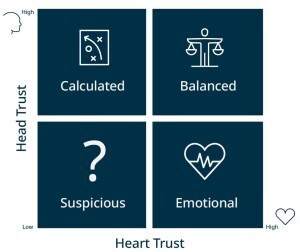 Calculated Trust (High Head + Low Heart): You trust someone’s skills but keep your emotional guard up. This works well in transactional or task-focused situations, but it may feel cold or disconnected over time.Emotional Trust (Low Head + High Heart): You feel a strong personal connection but question their reliability or competence. This can lead to warmth without results—and that can create friction when performance matters.Suspicious Trust (Low Head + Low Heart): Neither competence nor connection are present. This is where mistrust lives, and where collaboration tends to stall before it even starts.
Most of our deep, enduring relationships are built on some mix of head and heart trust. But the balance shapes how those relationships feel and function.
So next time you’re wondering why a relationship feels flat or fragile, ask yourself:
Is the head trust strong, but the heart trust missing?Or is there heart, but not enough follow-through?Am I dealing with calculated, emotional, or even suspicious trust?And most importantly:
How can I offer both head and heart trust to the people around me?Because trust isn’t just something we receive. It’s something we build—with our words, our actions, our presence. And when we build it with both head and heart, we don’t just create better teams.
We create better humans.
The post What Kind of Trust Are You Feeling? A Simple Map to the 4 Ways We Connect appeared first on Leading with Trust.
March 11, 2025
Trusting with Head and Heart: 4 Steps to Making Wise Trust Decisions
 Trust is one of the most valuable currencies in relationships—personal and professional. But have you ever stopped to think about how you trust? Do you lead with your head, relying on logic and evidence? Or do you trust with your heart, leaning into intuition and emotional connection?
The truth is, we need both.
There are two types of trust: cognitive trust (head trust) and affective trust (heart trust). Cognitive trust is built on logic, competence, and reliability—do they have the skills and track record to follow through? Affective trust is rooted in emotions, affinity, and shared values—do I feel safe and connected with this person?
The Elements of Trust Model aligns with this dual nature of trust:
Able (Competence) and Dependable (Reliability) = Cognitive trustBelievable (Integrity) and Connected (Caring) = Affective trustSo, how do we blend both head and heart when deciding whether to trust someone? Follow these four steps:
1. Assess the Context of the Relationship
Before deciding how much trust to extend, consider the nature of the relationship. Does this situation call for more head trust or heart trust? A work colleague may need to demonstrate competence before earning your trust, while a friend might first need to show empathy and understanding. Recognizing the right balance ensures you set realistic expectations.
2. Evaluate Their Trustworthiness
Use Blanchard’s four trust elements as your guide. Is the person Able and Dependable? Do they consistently follow through? Are they Believable, acting with integrity? Do they make you feel Connected, showing care and respect? If any of these areas are weak, trust might need to be earned more gradually.
3. Assess the Risks
Every act of trust involves risk. Consider the stakes—what’s at risk if trust is broken? What are the potential gains if trust is honored? If the downside is minimal, a leap of faith might be worth it. If the risk is high, a cautious, measured approach may be wiser.
4. Make the Call: Extend Trust
Trust is ultimately a choice. Once you’ve assessed the context, the person, and the risk, decide whether to extend trust—and at what level. Not all trust has to be all-or-nothing. Sometimes, it’s best to start small and build up as trust is reinforced.
By integrating both head and heart, we make trust decisions that are both wise and meaningful. The key is balance—leaning on logic when necessary, embracing emotion when appropriate, and knowing that trust, like any relationship, is something we build over time.
How do you decide when to trust? Do you lean more toward head trust or heart trust? Let’s continue the conversation in the comments!
The post Trusting with Head and Heart: 4 Steps to Making Wise Trust Decisions appeared first on Leading with Trust.
February 9, 2025
3 Priorities of Servant Leaders

I find that when I speak about servant leadership, many people misunderstand what it means. Some say, “Oh, you mean being nice to people.” Others think, “That’s all about not micromanaging employees.” One of my favorites is, “Letting the inmates run the prison!” Really? Is a prison the best analogy for the workplace?
Although servant leaders are often kind and avoid micromanaging, those ideas miss the mark. So, how do we define it? The modern father of servant leadership, Robert K. Greenleaf, used this test: “Do those served grow as persons? Do they, while being served, become healthier, wiser, freer, more autonomous, more likely themselves to become servants?”
Servant leaders focus on bringing out the best in people and organizations. To do that, they prioritize three key areas:
1. Results — Does listing this first surprise you? Servant leaders are responsible for their organization’s success. They ensure people achieve their goals, which drives results. Servant leadership isn’t only about people. Without success, there are no people to serve. “No margin = no mission.”
2. Relationships — People are the heart of every organization. Sometimes, we talk about organizations as if they exist separately from people. Without people, there is no organization. Servant leaders prioritize growth and well-being because they understand this truth.
“Servant leadership is the best way to achieve both great results and great relationships.” — Simple Truth #1, Simple Truths of Leadership
3. Trust — Leadership starts with trust. Great results and strong relationships require an environment built on trust. Servant leaders develop trust by showing competence, acting with integrity, demonstrating care, and keeping commitments.
Leaders who focus on results, relationships, and trust bring Greenleaf’s definition of servant leadership to life.
Want to explore these ideas further? Join me in the Blanchard Community on February 10th at 12:00 p.m. Pacific. We’ll discuss Simple Truths of Leadership and other principles from Blanchard’s leadership courses. This interactive session will help turn common sense into common practice. The Blanchard Community is free and open to all.
The post 3 Priorities of Servant Leaders appeared first on Leading with Trust.