Kevin Allen's Blog
February 26, 2026
Casey and Diana at ATP: Theatre & Queer History
Casey and Diana, currently on stage until March 15th at Alberta Theatre Projects, revisits a specific historical moment during the AIDS crisis: Princess Diana’s 1991 visit to Casey House, Canada’s first free-standing AIDS hospice in Toronto. Set against a backdrop of fear, stigma, and widespread misinformation about HIV/AIDS, the play focuses on the residents and caregivers of Casey House as they prepare for a visit that would later be seen as culturally significant.
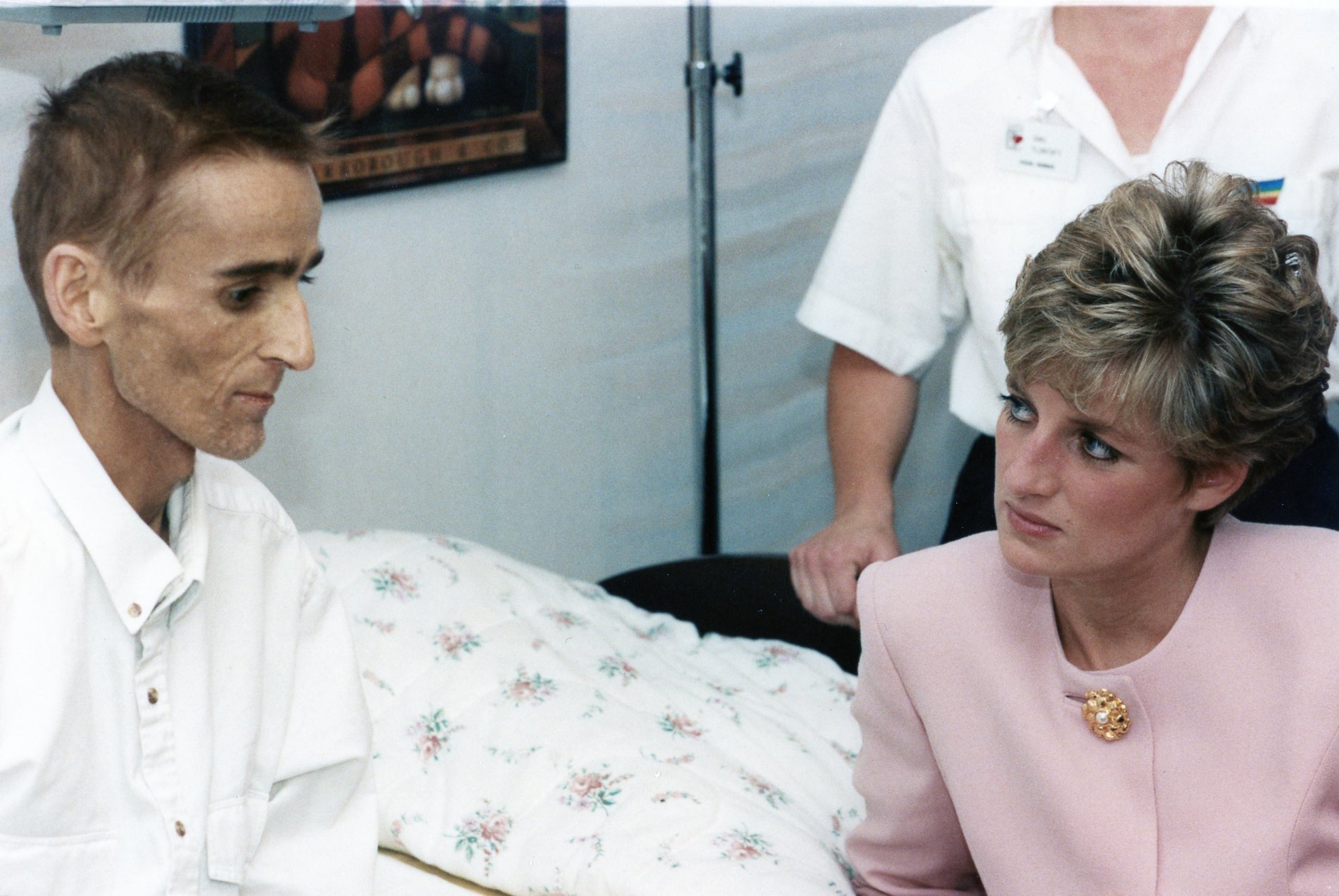 Diana, Princess of Wales with a resident of Casey House in 1991
Princess Diana helped shift public perception by challenging the myth that people living with AIDS were untouchable. But the play’s real power lies in its focus on the residents and caregivers — queer people and allies navigating love, humour, grief, and survival amid a crisis that decimated communities while governments largely looked away.
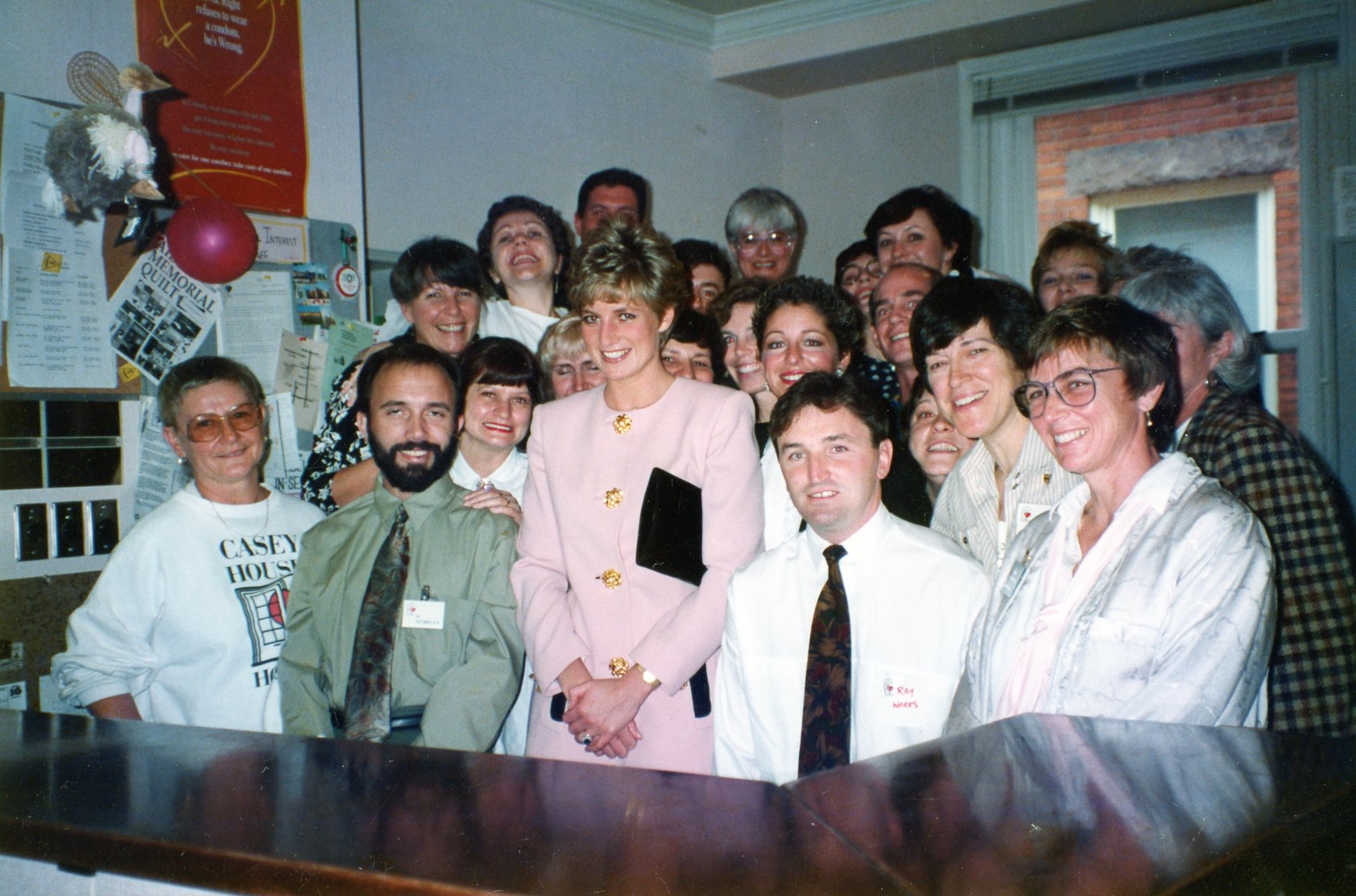 Diana with staff and volunteers of Casey House, 1991
ATP extends this historical framing beyond the stage through its lobby installations and community partnerships. As Raegan Frenette, from the company, notes:
Part of coming to Alberta Theatre Projects is being in the lobby and engaging with activations that make theatre more than just a show, but a full experience. For Casey and Diana, we wanted the lobby to feel like an extension of the story of Casey House, offering more context for how the AIDS crisis impacted our community here in Calgary.
To do this, we reached out to HIV-related organizations that have, and continue to, support our community through education, treatment, and prevention. We also included LGBTQ+ organizations that help build and sustain queer community across generations. Alongside these partnerships, we incorporated historical elements like the Queer Map of Calgary, Section 7 of the Canadian AIDS Memorial Quilt, and anecdotes in our program from real Calgarian experiences.
A very special shoutout to Safelink Alberta, SHARP Foundation, Calgary Pride, Rainbow Elders Society, Grandmothers to Grandmothers, the Afro-Care Support Network, Canadian AIDS Society, and the Calgary Gay History Project for engaging in the arts with us. We are so grateful for their participation and the amazing work they do in the community.
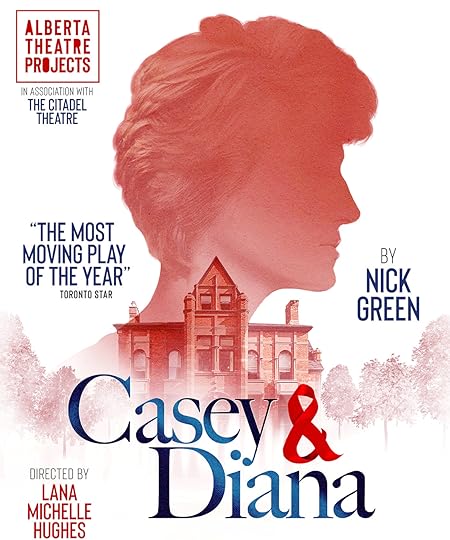 ATP’s Casey & Diana—click image for showtimes & tickets!
By connecting Casey and Diana to Calgary’s own queer and HIV history, ATP makes it clear that the AIDS crisis was not something that only happened elsewhere. It affected people here, and its impact is still felt today. The production invites audiences to reflect on how community care, advocacy, and remembrance have shaped queer life in Calgary, and why those histories continue to matter.
{KA}


February 19, 2026
Queering the Calgary Games
{Welcome to the final installment in our Winter Olympic Series, written by William Bridel!}
You may have heard of a recent show that is—pardon the pun—burning up the internet. Heated Rivalry has quickly garnered critical acclaim as well as a massive viewing audience both within Canada and globally. Situated in the context of men’s ice hockey, the show, while not without its flaws, is nevertheless broaching important conversations about queer representation in sport. Representation matters. That’s one of the reasons I wanted to write this series of posts about queer Olympians from Calgary.
Sharing these stories has provided an opportunity to celebrate queer representation in sport and to highlight that we’ve always been here! While building on that theme, this post has a somewhat different focus: the 1988 Olympic Winter Games, which were held in Calgary.
While some infrastructure built for those Games is now defunct (think ski jumps and the sliding track at Canada Olympic Park) and others torn down (think Olympic Plaza downtown), throughout Calgary, there are reminders everywhere that this city hosted the world now nearly 40 years ago—the Olympic Oval, the Saddledome, Nakiska Station, the C-Train northwest expansion, to name just a few. During our interview, Lindsay Alcock talked about the lasting influence seeing Olympic events in Calgary had on her athletic career. Alcock, Anastasia Bucsis, John Fennell, and Eric Mitchell all trained in Olympic venues built for the ’88 Games. Brian Pockar, the figure skater featured in the first of this series, played a key role in the production of the Closing Ceremonies.
At the community level, a local bus driver, Mark Perry-Schaub, was accepted as a transportation volunteer for the Games but was forced to fight for that position when it was discovered he had AIDS, and the organizing committee told him he was no longer welcome to serve in that role. You can read more about Perry-Schaub’s story here.
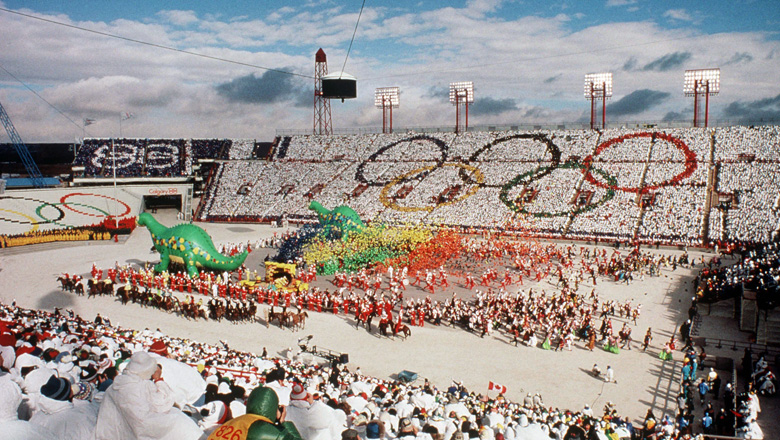 An image from the 1988 Opening Ceremonies, held at McMahon Stadium. This photo was retrieved from the Canadian Olympic Committee website.
The 1988 Games also had an impact on queer fans of sport. One research participant, Fred, spoke about the impact of the Games on community at the time, including meeting at Off Centre, a queer bar that would eventually become Money-Pennies, to meet friends from the community, talk about events, and the general vibe in the city at the time. He also shared this memory:
“Tons of us went… when the Jamaican bobsled team was down on Stephen Ave selling their t-shirts and stuff to raise money to pay for their trip. The bar was stuffed. I’ve got pictures of us all wearing Jamaican bobsled t-shirts, because everybody from the bar had to own that. We all went down to Olympic Plaza and cheered on Eddy the Eagle for being the last and the worst ski jumper. But we were all together. Like you cheer on the underdog. I’ve got pictures of us going into the big Olympic pin swapping tents… I still have all my pins in a box somewhere.”
Queer podcasters Bronwin Parks and Elinor Svoboda of the Late in ’88 podcast reminisced about the 1988 Games in their second episode, “Hometown Olympic Fever.” In general, they commented that anyone in Calgary at the time was aware of the Games, with a noticeable change in the city leading up to and during the event, which they recognized even though they were quite young at the time. They also discussed with friends—and historian Kevin Allen—the impact various events had on them in relation to gender identity and sexuality. One friend commented on figure skater Brian Orser, specifically the celebration of his silver medal and the disconnect between Orser being applauded for that, whereas performances of non-traditional masculinity were viewed negatively in pretty much all other aspects of social life at the time. The whole podcast series is a great listen, but I recommend this one in particular as well as the bonus “Olympic Relics” episode.
While I didn’t live in Calgary at the time, as a 15-year-old figure skater, I was glued to the CBC for all the figure skating events. I cried when Tracy Wilson and Rob McCall won the bronze medal in ice dance—the first ever Olympic medal for a Canadian team in that event. I cried when Brian Orser finished second in the men’s event; an outstanding result without question, but one that I knew he was disappointed with at the time. And I lost my mind when Elizabeth Manley had the skate of her career, famously sporting that white cowboy hat as she exited the ice, earning the silver medal. I also ADORED Katarina Witt for her many achievements in the sport, her performance ability, and the DRAMA she brought to the ice (and off the ice as well)! I may have, in fact, performed along with her in my family room, the opening moves to her long program, choreographed to music from the opera Carmen. Only in recent years, however, have I begun to understand the impact Witt had on other queer folks. Comedian and actor Carolyn Taylor, for example, created a whole television series—I Have Nothing—around the indelible impact the Calgary Olympics had on her, including Witt’s talents and looks, leading to a sexual awakening for Taylor.
The Olympic Games and the International Olympic Committee are, of course, not without their many, many problems. Sport more generally remains a problematic space for queer folks, and a space from which trans and gender diverse folks are excluded through exclusionary practices, policies, and government legislation, such as Bill-29 in Alberta. It is imperative to recognize the work that remains to be done while at the same time finding and celebrating queer joy—be that through the recognition of queer athletes’ successes, their resiliency and bravery in breaking down barriers, or folks finding connection in and through sport, regardless of their role. I hope to have captured some of that joy in this series of posts about queer Calgarians at the Olympics and the Calgary Games. Thanks for reading along.
{WB}
Links to the Winter Olympic Series:
Part One: From the Calgary Winter Club to Olympic Ice
Part Two: Hurtling Headfirst Down Mountains and Into the History Books
Part Three: Faster, Higher, Stronger… Resist
February 12, 2026
Faster, Higher, Stronger… Resist
{Enjoy this third part in our Winter Olympic Series, written by William Bridel!}
In the lead-up to the 2014 Olympic Winter Games, held in Sochi, Russia, much attention was turned to that country’s anti-LGBTQ laws, with questions of athlete, support team, media, and fan safety brought to the forefront. And rightly so. In 2013, CTV quoted a high-ranking member of the Russian government who had stated there would be “consequences for anyone who publicly advocates homosexuality” during the Games. The International Olympic Committee (IOC) issued statements assuring athletes’ safety while reminding them that political protests are prohibited under the IOC Charter, with ramifications for those who do not abide by it. There were calls to boycott the Games or move them to a different location. However, the Games went ahead as planned. This all drove one Calgary athlete to come out publicly, with others following.
Anastasia Bucsis, a long track speedskater, came out as lesbian in the Globe and Mail on September 3, 2013—primarily to make a powerful statement about queer rights ahead of the Sochi Olympics. As Bucsis noted, “I could never promote that message of concealing who you are with all of this going on in Russia… I’m kind of happy that I did it on my own terms” (Cryderman, 2013).
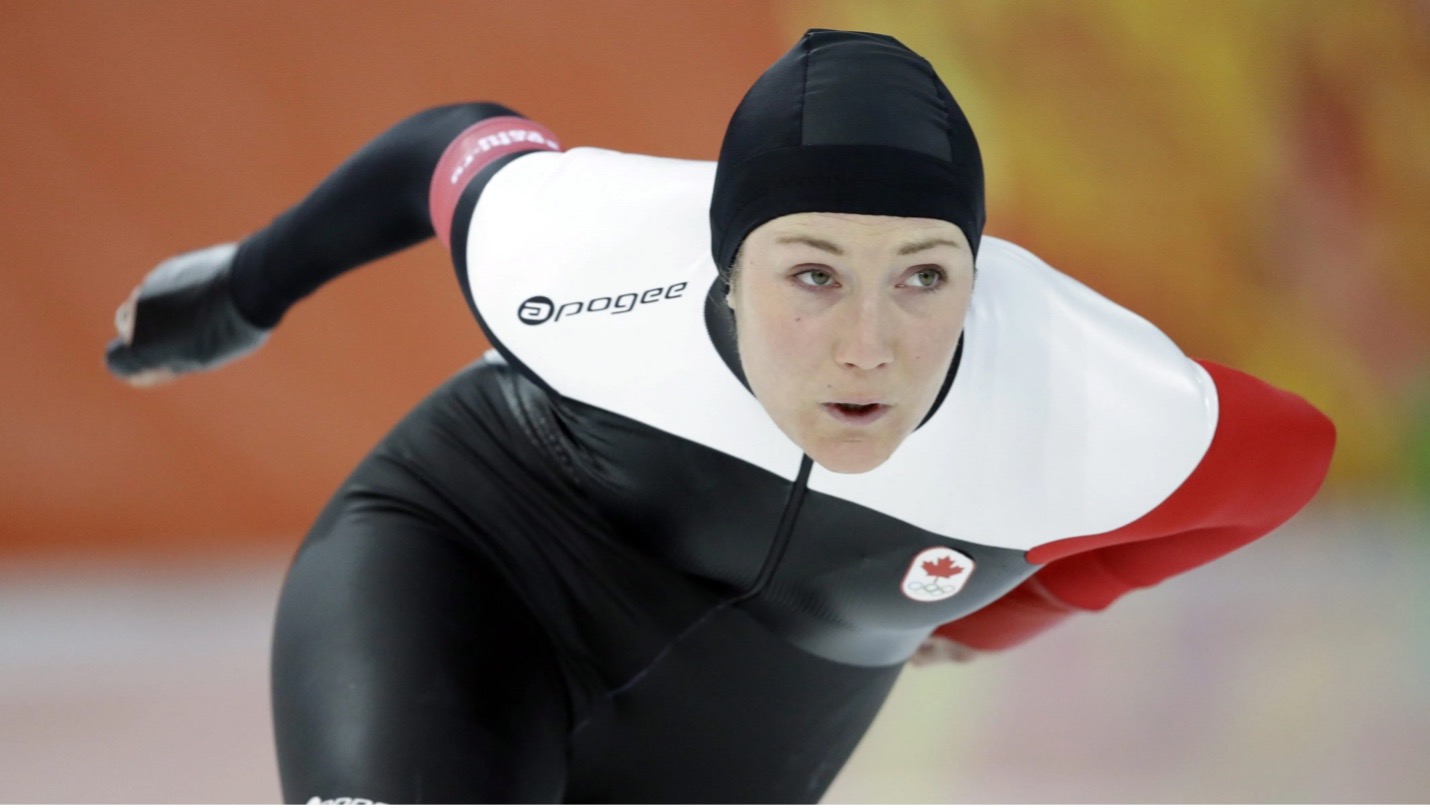 Bucsis competing in a long track speed skating event. This image was retrieved from the Canadian Olympic Committee website and is credited to AP Photo/Patrick Semansky.
Having come out to family, friends, and within the sport in the couple of years prior, Bucsis has commented that everyone, including teammates, sponsors, and coaches, was supportive; she has recognized, however, that not everyone had the same support, knowing many athletes who left sport due to their sexuality and non-supportive environments (Silver, 2021). Bucsis was the only North American athlete to be openly queer and competing at the 2014 Games. She retired from speed skating in 2017 but has since had a very successful career in broadcasting: Bucsis is serving as the host of CBC’s prime-time show during its coverage of the 2026 Games, a role she also held two years ago during the Paris Olympics.
Another Calgarian who competed in Sochi, John Fennell, came out publicly following his participation in the 2014 Games. I was working in the United States at the time, but friends told me about the story as they knew I was researching 2SLGBTQIA+ participation in Canadian sport. I remember being somewhat in awe as it was still rare for elite athletes to be out publicly, but also because of his age—Fennell was just shy of his 19th birthday when he told Vicky Hall of the Calgary Herald that he wanted the world to know he was gay.
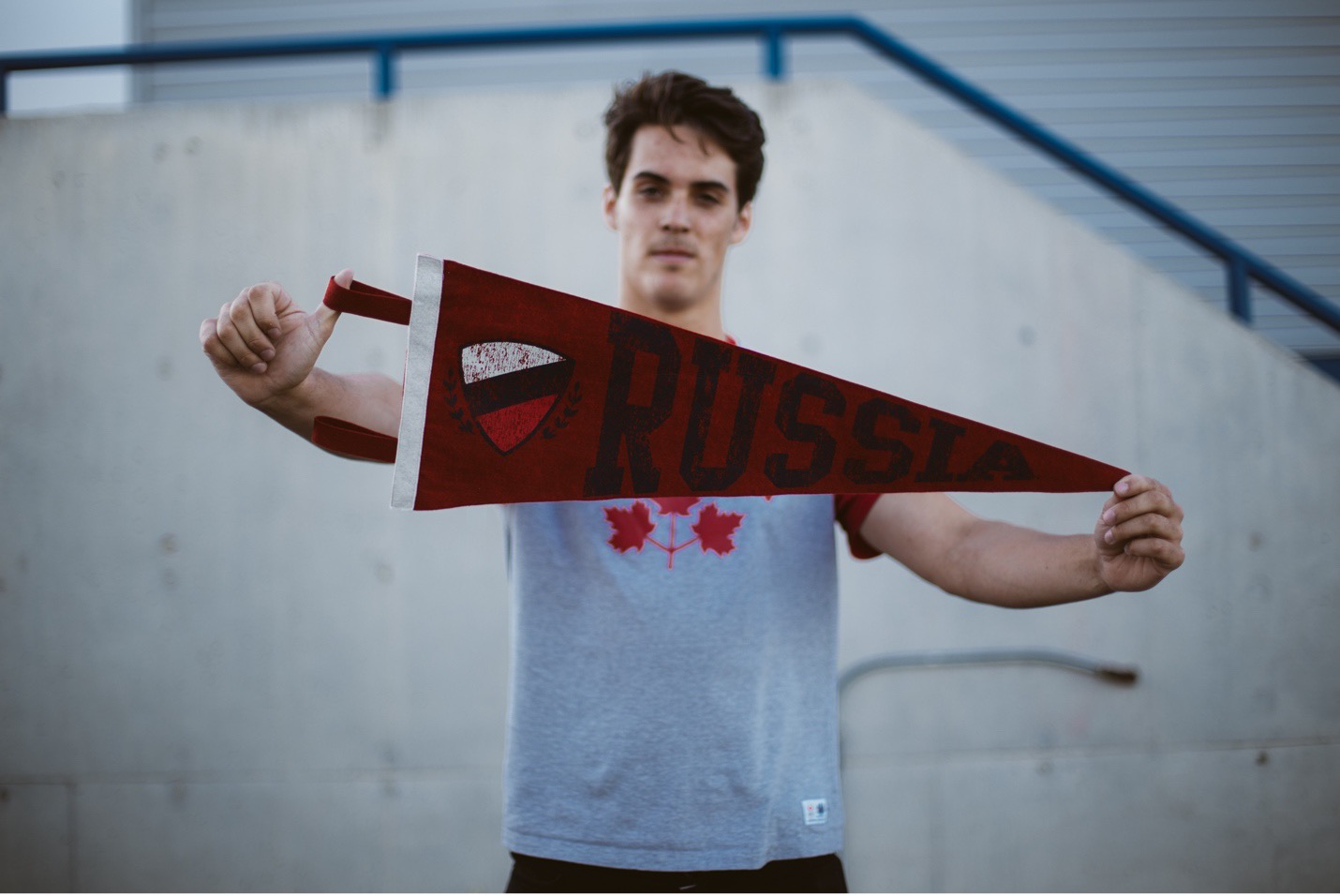 John Fennell competed in luge at the 2014 Games in Sochi, Russia. This photo is from John’s personal collection.
For those not familiar with luge, athletes hurl down a steep and windy ice track, feet first, on a relatively tiny sled. Not for the faint of heart to say the very least, but imagine facing that task in a country where you feel unsafe because of your sexuality. In an interview and follow-up personal communication, Fennell reflected on his experience in Sochi:
“I had been struggling with my sexuality leading up to the Games. I had not come out at all in my personal life and the discourse around LGBTQ+ rights before the Olympics in Russia began to weigh on me. When I arrived at the Olympic Village, I felt a strong sense of discomfort and that I did not belong there. This pressure took me out of the moment and added so much anxiety. After my teammates finished competing, I started speaking with them openly about how I was feeling. During my time in Sochi, I connected with other athletes and staff who had dealt with similar experiences. I started to build a safety net of people around me in Russia, which helped me feel more accepted in that environment. I will not lie, Russia felt unwelcoming to me. At the same time, that feeling pushed me to realize that our sport organizations should be doing more for all athletes—especially during that time in high performance Sport. That realization was profound. I remember thinking, ‘If I could come out in an environment like Sochi, what was stopping me from doing so in Calgary?’”
Fennell took the courage he found in Russia and began coming out to family and close friends here at home. He then took it to the next level by telling the world his story in the Herald, just three months after the end of the Games. When I asked Fennell why it was important for him to come out publicly, he had this to say:
“I wanted other athletes to know. Look, you might feel like you’re alone and you might feel like this is the end of the world, but there’s so many people who are dealing with this and, you know, everyone has a place in sport.”
He told me recently that that quote is just as true today.
Fennell continued to compete after coming out, retiring from elite competition in 2018. He has continued to champion 2SLGBTQIA+ inclusion in sport through public speaking, appearances, and involvement in initiatives such as the Canadian Olympic Committee’s #OneTeam campaign, launched in June 2015 to promote and improve queer inclusion in sport.
This video, produced by the COC, launched the #OneTeam campaign in 2015.Eric Mitchell, who was born and raised in Calgary, didn’t compete at the Sochi Games. Four years prior, however, Mitchell—at just 17 years of age—had qualified for the Vancouver Games in ski jumping. His ascent into the upper echelons of the sport was rapid; he was really just three years out of the developmental levels of the sport when he earned his Olympic spot. Mitchell was focused on qualifying for the Sochi Games but suffered a severe concussion in August 2013. While he was able to return to training and to competition—he won the men’s event at the Canadian ski jumping championships that year—his return was too late to qualify for Sochi. Mitchell retired and focused on his studies at the University of Calgary. A conversation with Fennell, however, would draw Mitchell back into sport:
“John told me how alone and terrible he felt being in a country that put a spotlight on how it wasn’t OK to be gay in Russia. And I felt that was so wrong. How could that be? My Olympic experience was so positive, and I think it should be for everybody. What I heard from him sickened me. It pushed me to decide that this has to change. I want to affect this change.” (Zeigler, 2015)
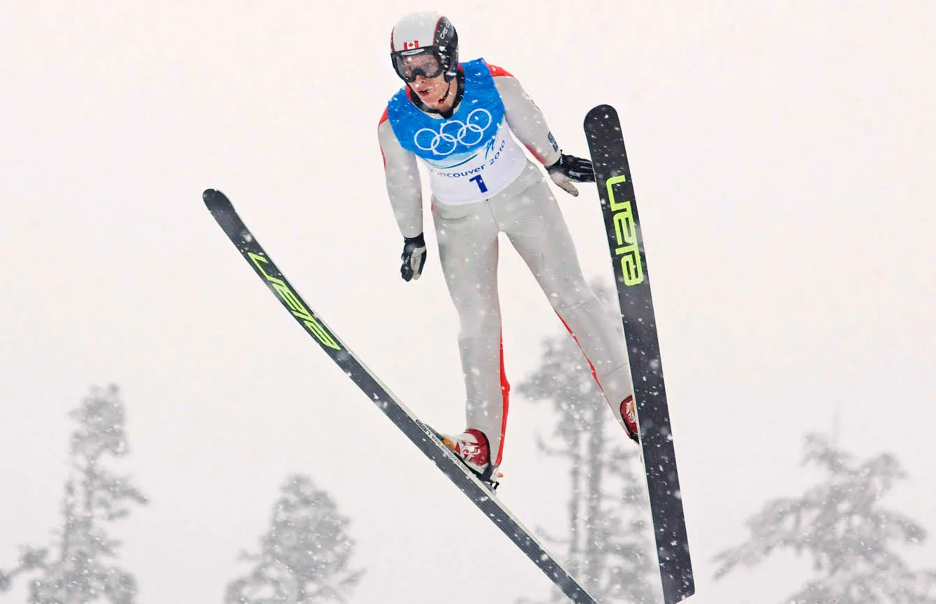 This action shot of Eric Mitchell was retrieved from the Canadian Olympic Committee website.
Having kept his sexuality hidden from family, friends, and within sport—the last because of homophobia often experienced in the form of gay “jokes” made by coaches and other athletes—Mitchell began to come out. He recognized he had a role to play in improving sport for other queer athletes and signed on to be a #OneTeam ambassador, a founding ambassador, in fact, as was Bucsis. In a post written for the COC and published online during Calgary’s 2015 Pride celebrations, Mitchell made it clear why he had come out publicly and gotten so involved with the COC campaign:
“Many young LGBTQ athletes still do not feel welcome within the sporting system and that is why this initiative is so important. Sport has always been able to bring people together and the #OneTeam program has created a framework of resources that will help educate everyone on how to be a better ally and help to make our country more inclusive.”
There is still a lot of work to be done in terms of the safe and meaningful inclusion of 2SLGBTQIA+ people in sport, in all roles—athlete, coach, official, administrator, media, fan. But these three queer Olympians from Calgary have certainly made a difference within sport by sharing their stories publicly and leading advocacy initiatives, while also becoming part of Calgary’s queer history.
Bucsis. Fennell. Mitchell. Olympians. Barrier breakers. Advocates. Calgarians.
{WB}
Sources
Cryderman, K. (2013, September 3). Olympic speed skater Anastasia Bucsis “so proud to be gay.” The Globe and Mail. https://www.theglobeandmail.com/sports/more-sports/olympic-speed-skater-anastasia-bucsis-so-proud-to-be-gay/article14078121/
CTV British Columbia. (2013, August 2). Calls for Olympic boycott after Russia pledges to enforce anti-gay law. CTV British Columbia. https://www.ctvnews.ca/vancouver/article/calls-for-olympic-boycott-after-russia-pledges-to-enforce-anti-gay-law/
Hall, V. (2014, May 27). Calgary Olympian finds three words liberating: “I am gay.” Calgary Herald. https://calgaryherald.com/sports/calgary-olympian-finds-three-words-liberating-i-am-gay
Mitchell, E. (2015, September 4). Mitchell: Reflections on my hometown ahead of Calgary Pride. https://olympic.ca/2015/09/04/mitchell-reflecting-on-my-hometown-ahead-of-calgary-pride/
Silver, E. (2021). Proud to play: Canadian LGBTQ+ athletes who made history. Lorimer.
Zeigler, C. (2015). How this gay Olympic ski jumper did the impossible. Outsports. https://www.outsports.com/2015/7/8/8910379/eric-mitchell-gay-canadian-olympic-skier/
February 5, 2026
Hurtling Headfirst Down Mountains and Into the History Books
{Welcome to part two in our Winter Olympic Series, written by William Bridel!}
I am frequently reminded of Dr. Lindsay Alcock’s humility, despite an incredible athletic career and her many accomplishments in other spheres of life. Just over a year ago, I was interviewing Lindsay for my project exploring the role of sport in Calgary’s queer history, and while we’d known each other since 2014 (not long after I moved to the city, we were both on a panel addressing homophobia in sport and became friends), I found myself learning more and more about her that day. I am proud to share part of her story here.
Born in Bearspaw, Alberta, in 1977, Alcock’s family relocated to Cochrane soon after. With limited sports opportunities for girls at the time, Alcock played soccer on boys’ teams and participated in many school sports. She and her family were also avid downhill skiers, though—as she was quick to point out—only recreationally. Still, the 1988 Olympic Winter Games left an indelible mark on Alcock, as she and her family took in many of the events. As a university student, Alcock joined the University of Calgary’s track and field team as a sprinter and also began working at Canada Olympic Park during the summers—an experience that would change her athletic trajectory.
“I had a tourist ask me one day: ‘Why don’t you do any of these sports?’ I didn’t really have a good answer. So, I thought, well, if anything, I can maybe help my tours by telling them exactly what it feels like to go headfirst on a sled down an ice track, an ice chute. I toyed between ski jumping and doing skeleton. And ultimately skeleton was the most kamikaze in my mind. So based on that tourist’s feedback, I decided to sign up and pay $50 to take a ‘discover skeleton’ class. This would’ve been in the fall of 1998.”
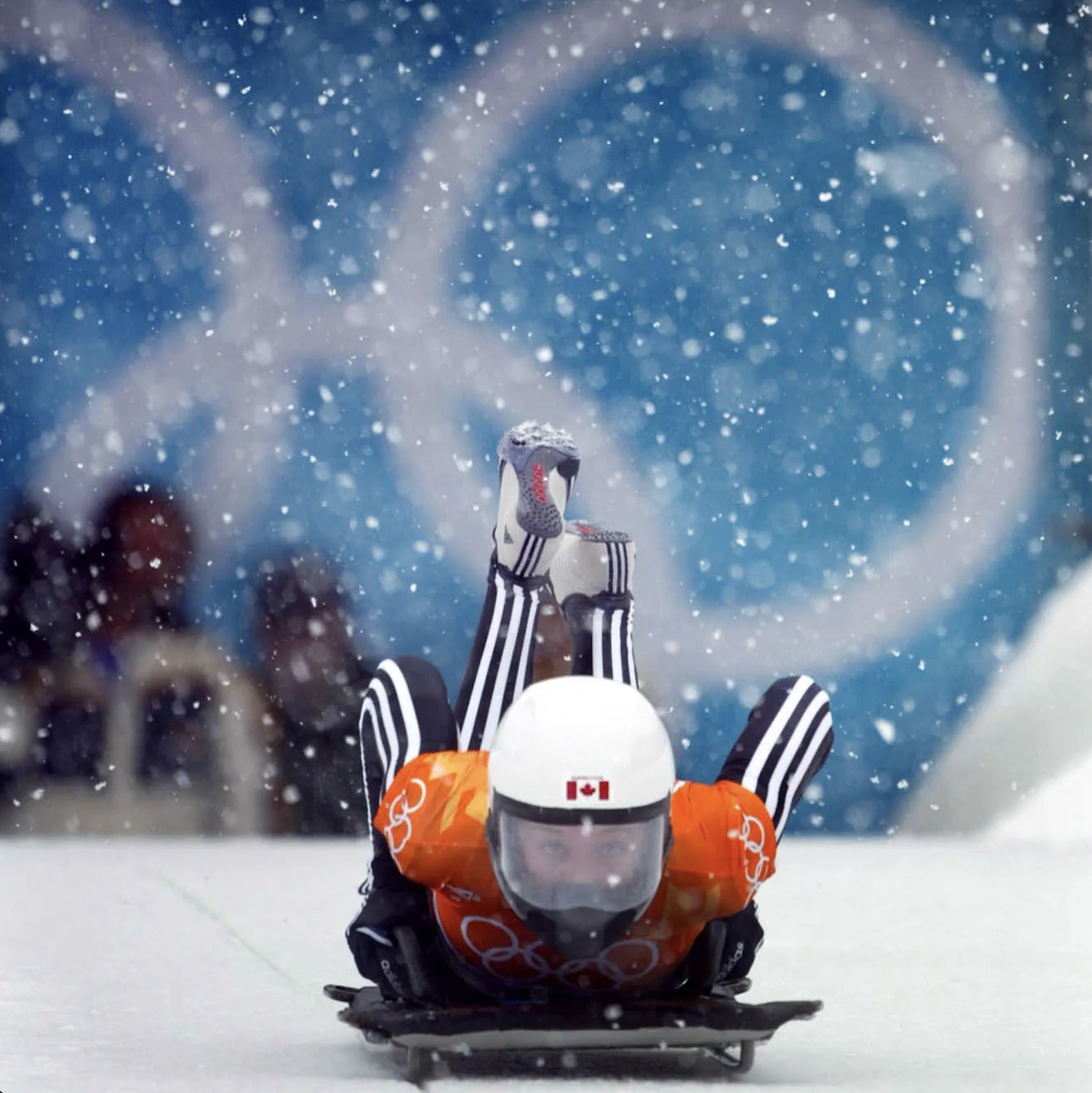 Alcock competing at the 2006 Olympic Winter Games. Photo retrieved from the Canadian Olympic Committee website.
Rising through the Canadian skeleton ranks quickly, within two years of that intro-to-skeleton experience, Alcock qualified to represent Canada on the America’s Cup and then the World Cup teams. While competing internationally, Alcock secured enough top six placements in 2001-2002 that she qualified for her first of two Olympic Winter Games, just four years after being introduced to the sport! At the 2002 Games in Salt Lake City, she finished in sixth place. In the 2003-2004 season, Alcock won the overall Women’s Skeleton World Cup title. She continued to train, with eyes set on the 2006 Olympics, which were being held in Italy.
In the late 1990s, Alcock began coming out to family and friends, and in the early 2000s to teammates and others within the sport, and later more publicly. This made her one of only a few queer Canadian athletes actively competing in elite sport while open about their sexuality; Nancy Drolet, a national team ice hockey standout, and wheelchair basketball star Danielle Peers were others.[1] Alcock describes the support she received from the vast majority of teammates in a positive way. For example, she noted that she would bring the boxset of The L Word on tour, and some of her teammates would sit down and watch episodes with her. They’d also take her, when feasible, to queer villages in various cities on the tour. Alcock also began training and racing with a Pride sticker on her sled, visible to teammates, competitors, spectators, and television cameras. At the same time, she did experience indirect and direct homophobia while on the circuit, and so was grateful for the solidarity experienced with the majority. This allowed her to remain steadfast in being her authentic self after she had come out.
There were still challenges, however. Alcock shared one story about attaining a sponsorship deal—a rarity for skeleton and for women athletes at the time—with a local company:
“I remember signing the contract for this sponsorship, which was a really big deal. It was quite a bit of money. And it was meaningful for my everyday life. I literally had the pen in hand and then I finally just…I put it down and I said, ‘you just need to know, I’m not gonna hide this. I’m a lesbian. I’m in a relationship with a woman. Is that gonna be a problem?’ And he said, ‘No. Are you gonna sign or what?’”
While it was a positive experience of allyship in that moment, not long after signing on, Alcock, as one of their sponsored athletes, had to participate in an event organized by the company.
“I had to sit beside Bishop Frederick Henry. It was a golf tournament, and they put me in the same golf cart with him. For 18 holes, I had to sit beside him! And I was like, ‘how did they not know that?’ That’s not okay.”
{For context, Bishop Henry had a long and public history of opposing 2SLGBTQIA+ rights, including same-sex marriage in the early 2000s and, more recently, gay-straight alliances in schools and, more generally, the provincial NDP’s gender and sexual diversity inclusion guidelines implemented when they were in power.}
Alcock qualified for the 2006 Olympic Winter Games. Based on her performances in the years leading to those Games, including a silver medal at the 2004 World Championships, Alcock was considered a medal favourite but, in her own words, the Olympics didn’t go nearly as well as she hoped. She finished 10th. The disappointment of the finish wasn’t the only thing Alcock was dealing with; the following scenario reflects the still-pervasive heteronormativity in high-performance sport:
“One story I tell quite often is about what happened at the finish line in Torino [2006 Olympic Winter Games]. When I finished the race, I didn’t perform the way I had expected of myself. My wife was at the finish line, and I remember at that moment thinking, ‘So do I kiss her? Do I hug her? Do I… The camera’s on. I can feel it. I can feel it.’ It was burning into me. ‘What do I do?’ And I’m dealing with being really upset with how I did at this event. But I don’t wanna show shame. Like, I’m proud of who I am, and of this marriage, you know? And, so, the fact that I was thinking about that at the Olympic finish line was ridiculous. And I honestly don’t know what I did. I couldn’t tell you now how that went. It’s a total blur.”
Alcock would continue to compete in skeleton for two more years, ultimately retiring in 2008 to pursue a chiropractic degree in California. She once again resides in Calgary with her wife, Heather. Reflecting on her incredible athletic career, Alcock had this to say:
I’m most proud of how I was able to continue competing and to be who I was. It was quite a journey to get there.
Dr. Lindsay Alcock. Olympian. World Champion. Trailblazer. Calgarian.
{WB}
[1] This statement reflects what I’ve been able to uncover in my research to date, based on media stories and personal communications. I’m happy to be corrected if others know differently!
January 29, 2026
From the Calgary Winter Club to Olympic Ice
{This is part one in our Winter Olympic Series, written by William Bridel. Enjoy!}
Brian James Pockar was born in Calgary on October 27, 1959. He began skating as a young boy at the Calgary Winter Club, a club he would represent through the entirety of his skating career. According to Skate Guard, a figure skating history blog, in his early days on Winter Club ice, a coach, Winnie Silverthorne, approached Pockar’s parents after noticing his “daredevil-ness” and natural athleticism. While initially interested in ice hockey, Pockar chose to focus on figure skating and quickly rose through the competitive ranks within Canada.
At the age of 12, Pockar competed at his first national championships. Four years later, he won bronze at the 1976 World Junior Figure Skating Championships, and two years after that, became the national men’s champion of Canada for the first time. At the completion of his amateur competitive career, Pockar was a three-time national champion. He had also won several international medals, most notably the bronze at the 1982 World Figure Skating Championships. Pockar’s third-place finish in 1982 launched a 14-year medal-winning streak by Canadians in the men’s event at the global competition.
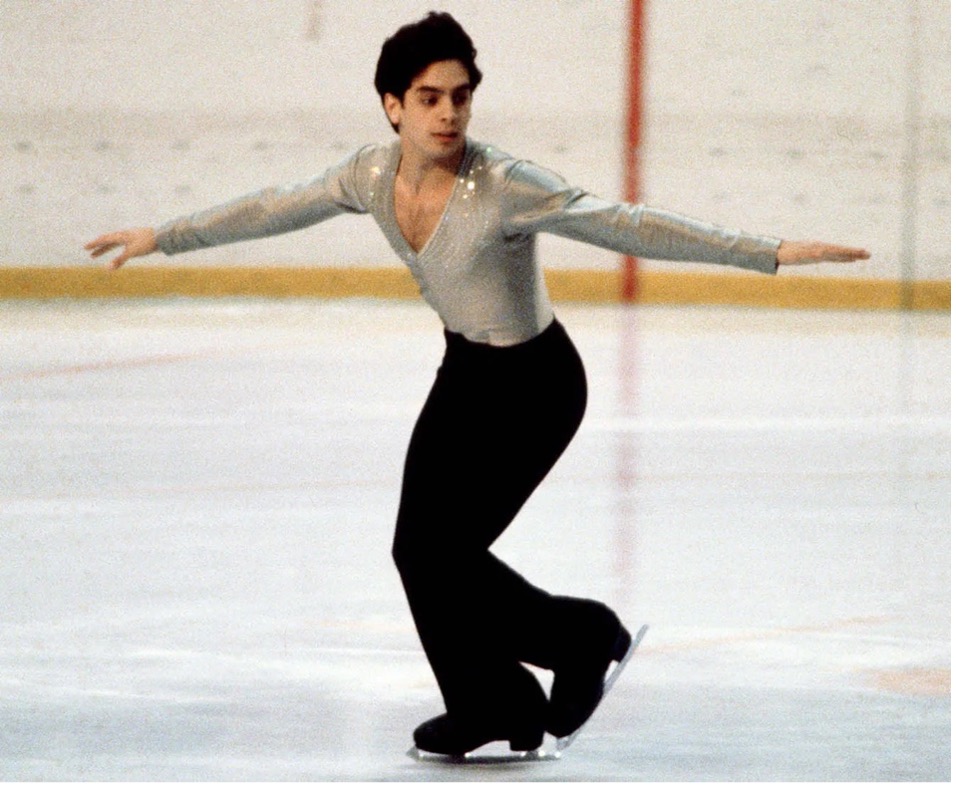 Pockar competing at the 1980 Olympic Winter Games. Photo retrieved from the Canadian Olympic Committee’s website.
Pockar was the lone Canadian entry in the men’s event at the 1980 Olympic Winter Games in Lake Placid, New York, a place he earned having won his third national title earlier that year. He finished 12th in all portions of the Olympic competition, an event won by the incomparable Robin Cousins of Great Britain. Pockar remains the last male from Calgary to compete in the Olympic Winter Games in figure skating. Pockar was also involved in the 1988 Calgary Olympics, credited as the artistic director of figure skating performances in the Closing Ceremonies.
As a young boy in the sport at the time of Pockar’s greatest successes, Brian was my idol. I marvelled at his technical abilities, but even more so, I loved his musicality, his style, his flair. I was nine when he finished third at the 1982 World Championships. I could execute his entire medal-winning performance in the basement of my family home in my sock-feet. The many triples he completed in his program? Well, those were only imagined in my rendition…but I knew the order of elements by memory and believed I “was” Brian Pockar in those moments. I also most certainly had a crush on him. He was a beautiful man. As Ryan Stevens of Skate Guard described him, he was “like the romantic lead in a silent movie.”
Frequently described as a private person, Pockar never declared his sexuality publicly, which was not unusual in the 1970s and ‘80s in sport generally, and in figure skating specifically. Only Great Britain’s John Curry, the 1976 Olympic champion in the men’s event, had discussed his sexuality in mainstream media at the time. According to sociologist and historian Dr. Mary Louise Adams, the first time Pockar’s sexuality was likely specifically mentioned publicly was in a media story published in 1998 about Brian Orser, another great Canadian figure skater. Orser was quoted as saying he was concerned about his own sexuality impacting professional opportunities in and outside of skating and used Pockar as an example. According to Orser, Pockar was fired from his broadcasting position with CTV—a role he held for several years after he retired from amateur competition—when network executives learned he was gay.
Pockar died of AIDS-related illness in Calgary on April 28, 1992. He was 32 years old. According to a statement issued by a family friend at the time of his passing, “Brian wanted to be remembered for his accomplishments in life and not for the cause of his death” (Maki & Toneguzzi, 1992, p. D1). Honouring that statement here, in addition to his many achievements in the sport noted above, Pockar is also credited with landing the first-ever one-foot triple Salchow/double flip combination in international competition—which is wildly difficult! He was inducted into the Alberta Sport Hall of Fame in 1989 and posthumously into the Skate Canada Hall of Fame in 2012. Per one of Pockar’s final wishes, a bursary was established in his name to help support young male figure skaters in the province—a bursary still given out annually.
Brian Pockar: Olympian. World medalist. Choreographer. Broadcaster. Calgarian.
{WB}
Sources
Adams, M. L. (2011). Artistic impressions: Figure skating, masculinity, and the limits of sport. University of Toronto Press.
Skate Alberta/Northwest Territories/Nunavut. (n.d.). About: Athlete Awards. https://skateabnwtnun.ca/about/awards-2/athlete-awards-athlete-funding/
Maki, A., & Toneguzzi, M. (1992, April 30). Friends mourn death of Pockar. Calgary Herald, D1.
Stevens, R. (n.d.) Brian Pockar. Skate Guard: Figure Skating History Blog. https://www.skateguardblog.com/p/brian-pockar.html?m=0
January 21, 2026
Welcome William!
Thrilled to be a part of the Calgary Gay History Project, Dr. William Bridel brings a sociological lens to queer history, with a particular interest in sport, physical activity, and health. William completed his PhD at Queen’s University in 2011, accepted a postdoctoral research position at the University of Alberta from 2011-2012, and then moved to Ohio to teach at a liberal arts college named Miami University of Ohio. He moved to our city in the summer of 2014 to begin work at the University of Calgary. He is currently the Senior Associate Dean, Academic Programs, and an Associate Professor in the Faculty of Kinesiology.
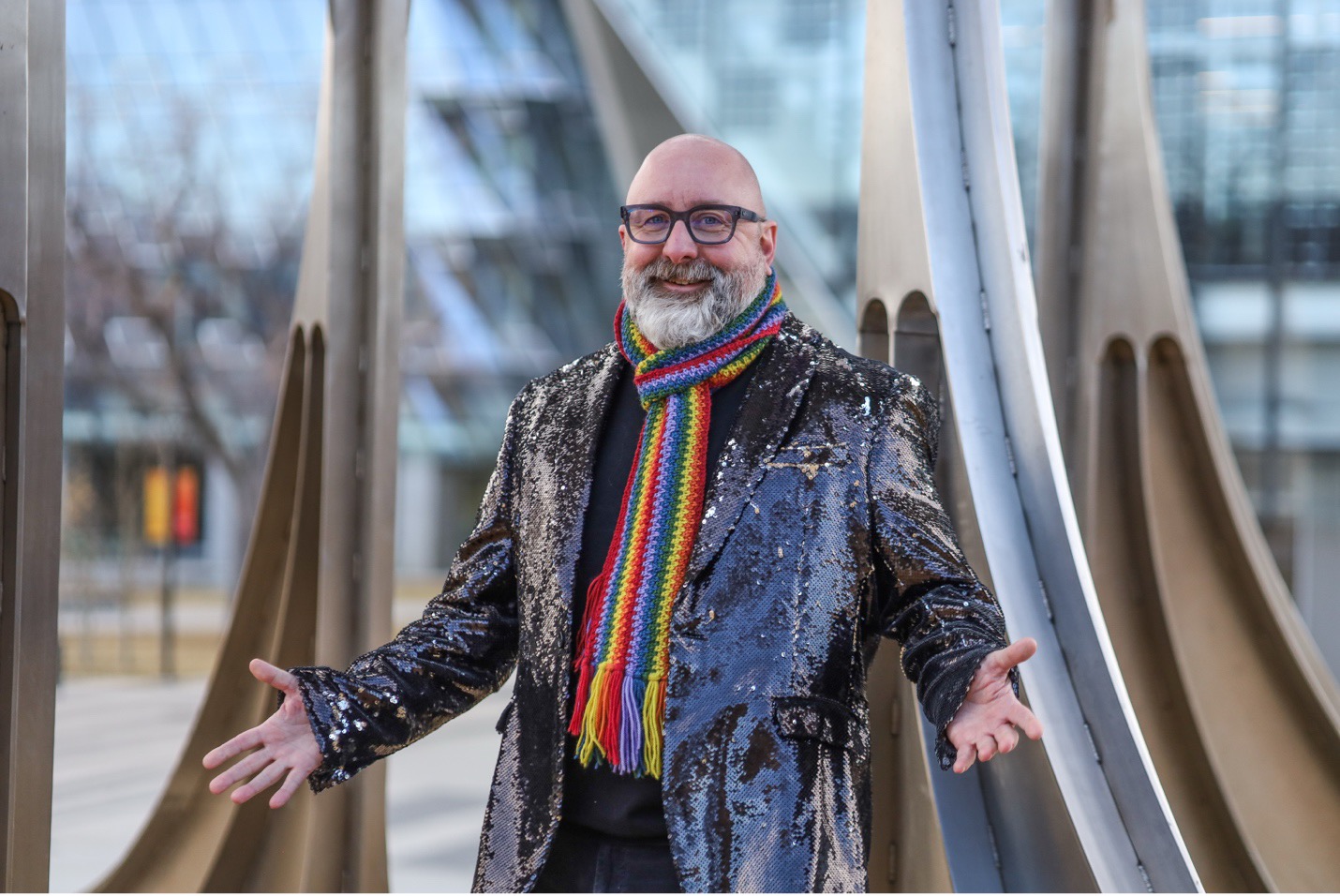 William Bridel. Photo credit: @rising_solstice_photography
Having been involved in sport and physical activity most of his life and experiencing both the benefits of and barriers to participation, William and his research team have, over the years, explored 2SLGBTQIA+ inclusion in various sports historically and in contemporary times. Of particular interest to us is his ongoing research project on the role of sport in Calgary’s queer history.
In October 2025, we posted some of his writing on Calgary’s queer hockey history. To coincide with the 2026 Olympic Winter Games (OWG), which run from Friday, February 6 to February 22, William will be sharing a series of posts featuring queer Calgarians who have competed in past Olympic Winter Games—as well as one that will focus on the 1988 OWG, held here in Calgary.
{WB}
January 15, 2026
Alberta Book Banning in 1997
{Readers of the Calgary Gay History Project know we are dismayed by the Alberta Government’s banning of four graphic novels last Autumn, labelling them pornographic—which, if you read them, is easily contested. The ban is really about anti-gay and anti-trans sentiment, driven in part by the Alberta non-profit Parents for Choice in Education. Recently, our colleague William Bridel sent us an article from the Dec. 3, 1997 edition of Perceptions, a Saskatoon-based queer publication published by activist Gens Hellquist from 1983-2013. We are reprinting the article in its entirety, as the synchronicity is uncanny. -Kevin}
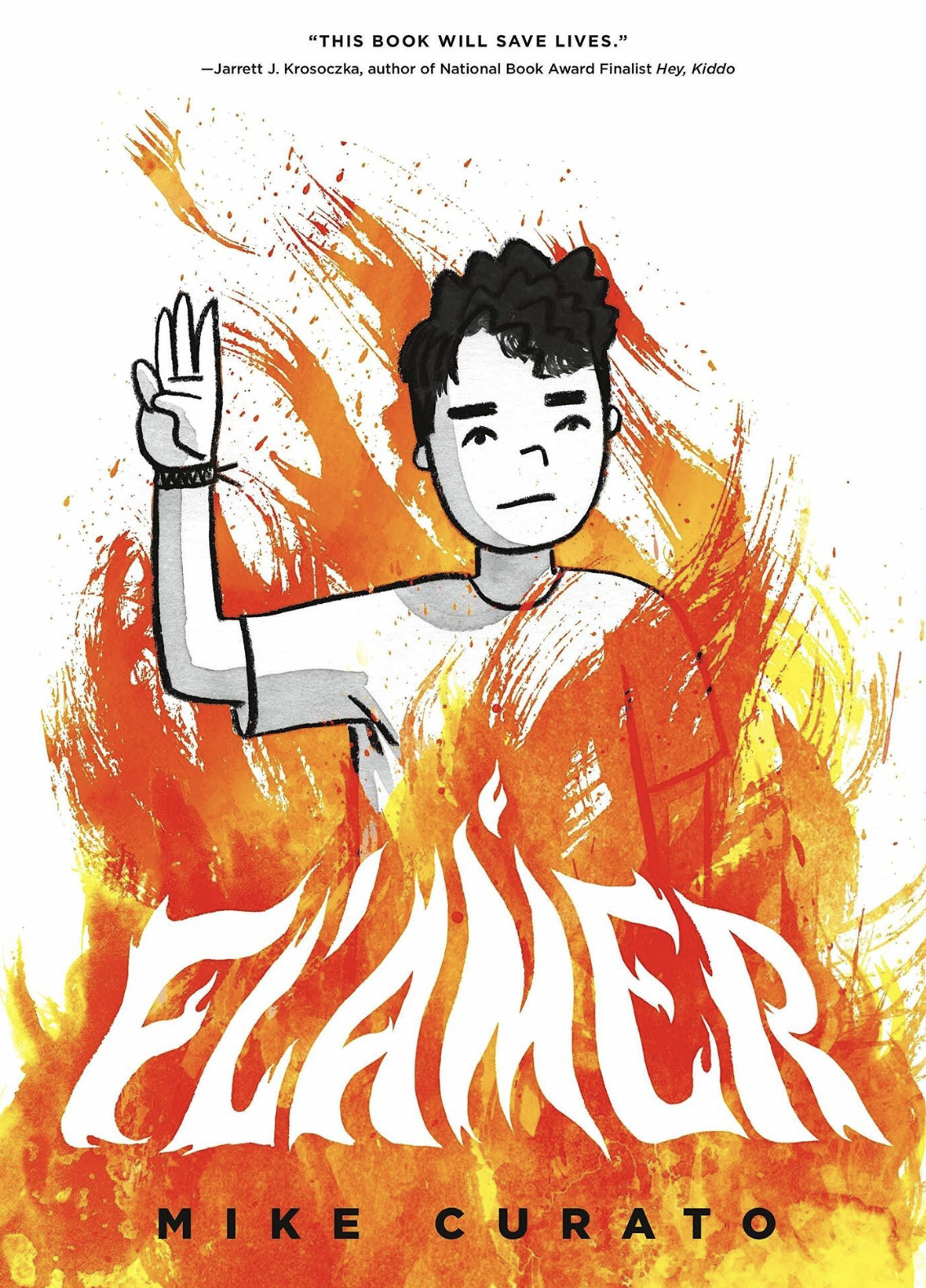 One of the four graphic novels banned in schools by the Alberta Government in Sept 2025—not pornographic, but gay.
Banning Books from Perceptions, December 3, 1997:
(Calgary) Once again an incident has occurred in Alberta that has many people wondering whether the province is becoming more redneck and falling further behind other parts of the country in providing protection against discrimination for minorities. The province has been taken to the Supreme Court over its refusal to provide protection from discrimination for lesbians and gay men, they have refused to allow lesbians and gays to be foster parents, and some MLAs called for the return of a grant which was to be used to document the history of the gay and lesbian community in Alberta.
Now the Calgary Public School Board has banned two books from its shelves after some parents complained about their “promotion of homosexuality.” Dr. Donna Michaels, the school board’s chief superintendent, admitted pulling the books off the shelves after meeting with a group called Parents’ Rights in Education (PRE). The group has been sounding an alarm about the school system allowing the “gay agenda’’ into the schools.
“In my professional judgment, I determined that the language was highly inappropriate,” Michaels said. However, she would not state publicly, or tell the school board, which books had been removed after pressure from PRE. She said the two offending books must first go before a committee set up to hear public complaints about books in the· school system, adding that the process could take a month. She said the language she objected to was pornographic and did not involve gay or lesbian themes.
Tom Crites, a spokesperson for PRE, claimed one of the banned books was the anthology Not the Only One: Lesbian and Gay Fiction for Teens edited by Tony Grima. He could not name the other book his group deemed offensive. He said he too found the swear words offensive but admitted that the real problem is that the book is about homosexuality. “It is really pro-gay,” he said. He was also concerned that many of the stories were about people’s personal coming out story, which his group finds offensive.
Crites indicated his group’s agenda of removing all reference to homosexuality from the school system is far from over. He said PRE is attempting to identify the school board employee who ordered the two offending books. “We do have our suspicions,” he said. “We’re still doing some checking around.” He also indicated that his group has identified 30 to 40 other books that address gay and lesbian issues.
Spokespeople from the gay and lesbian community said this latest move is part of an explosion in anti-gay attitudes in Alberta and a clear sign that Alberta is one of the least tolerant places in Canada. “When you sit around and chat in the community, people feel we’re behind the rest of the country,” said Roy Heale, publisher of the gay newspaper Outlooks. “As long as we continue doing this, we’re perpetuating our reputation of being redneck.”
Gail Allen, a spokesperson for PFLAG, said she could not agree with banning books from school libraries that deal with homosexuality. “I don’t think they should be pulling books from the shelves,” she said, adding that her son, who is gay, would have had a happier adolescence if he had access to books that explain the realities of being gay.
School board members also expressed concern about the removal of the books and the process that was used. “We feel that this is an important issue,” said trustee Jennifer Pollock. “It needs to be addressed.”
December 24, 2025
Dying Young
{This is our last post in 2025! We at the Calgary Gay History Project wish you a warm and festive holiday season – Kevin}
In the history of Calgary’s queer community, few figures loom as large—yet remain as quietly influential—as Doug Young. Born in 1950 near Taber, Alberta, and raised in both Taber and Medicine Hat, Young’s life was marked by a deep commitment to social justice and community building that helped shape the early gay rights movement in Calgary.
Young’s academic journey took him from Medicine Hat College to the University of Calgary, preparing him for a lifetime of advocacy and community service. Before his activism fully took hold, he worked with the Alberta Service Corps and Canada Customs—experiences that undoubtedly broadened his perspective on community needs.
But it was in the late 1970s and 1980s that Doug Young became one of Calgary’s most active voices for gay rights. At a time when queer communities were often hidden and marginalized, Young stepped forward into leadership roles that were both challenging and essential. He served as President of Gay Information and Resources Calgary (GIRC) from 1977 to 1979, and continued on its board through 1981. Under his stewardship, GIRC became a vital resource—offering support, outreach, peer counselling, and serving as one of the few community touchpoints for queer people in the city.
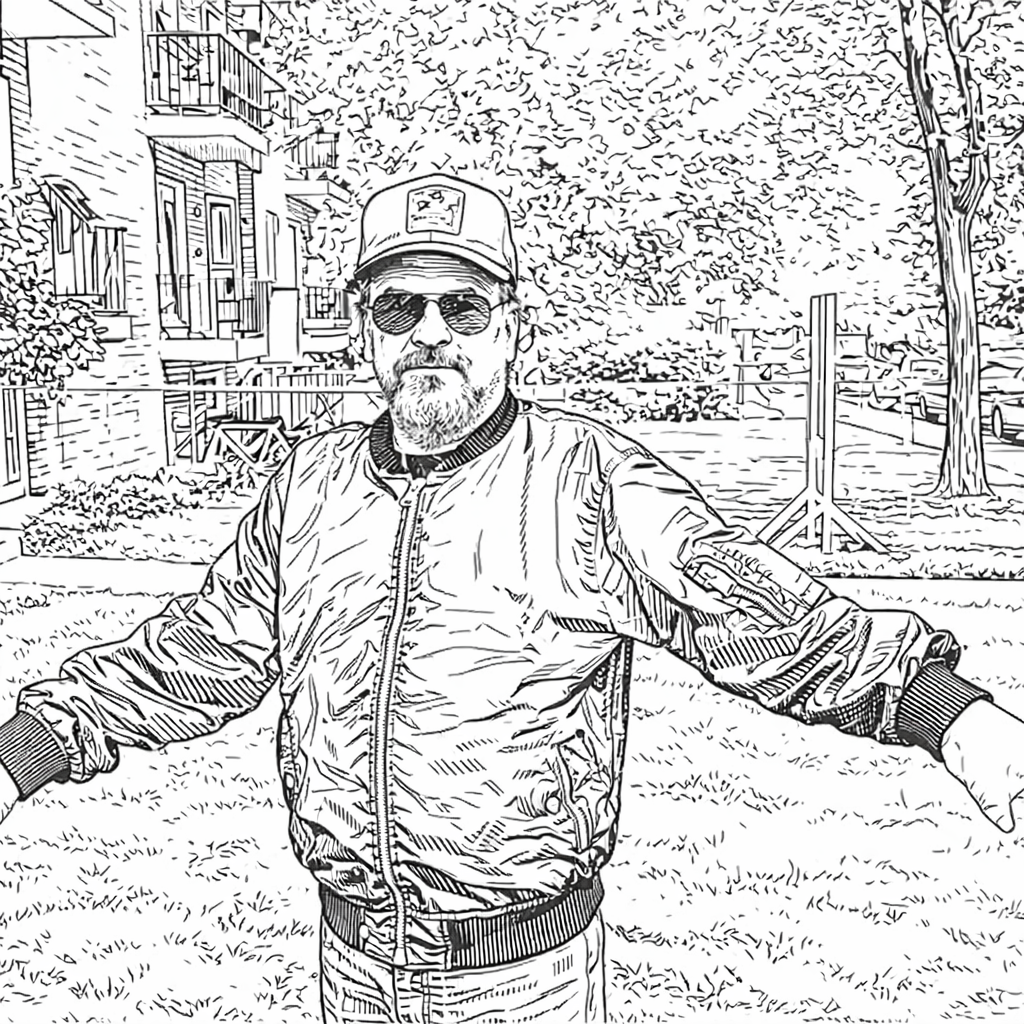 Line drawing of Doug Young derived from a photo in the Calgary Herald, June 14, 1994
Young didn’t limit his work to one organization. He was actively involved with the Alberta Lesbian and Gay Rights Association, AIDS Calgary, Gay and Lesbian Legal Advocates Calgary (GALLAC), the Right to Privacy Committee, and the Gay and Lesbian Community Police Liaison Committee—a network of groups focused on legal rights, health advocacy, safety, and community relations. This breadth of engagement speaks to both the urgency of the issues at the time and Young’s own drive to see real, sustained progress.
Young was an active spokesperson for the gay community and notably contributed to queer history through his extensive records. His personal papers were sorted and saved by Young’s friend John Cooper. They are now housed in the Glenbow Archives, which includes a remarkable hand-drawn map of gay spaces in the Beltline from the mid-1980s.
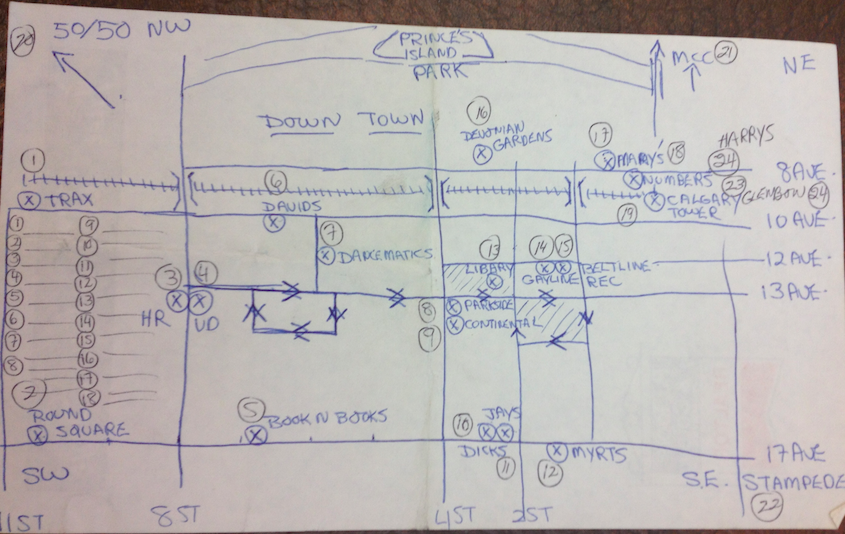 Doug Young personal papers, Glenbow Archives M-8397-1.
Perhaps most poignantly, Young’s leadership bridged the early gay rights era with the inevitable rise of the HIV/AIDS crisis. Community groups like AIDS Calgary grew out of activist networks in which Young was involved, helping mobilize volunteers, advocate, educate, and provide basic support during a time when fear and stigma often overshadowed empathy and action.
Doug Young passed away on April 15, 1994, from AIDS-related complications, a loss felt deeply across the community he helped nurture. While he did not live to see many of the legal protections and cultural shifts that came later, his efforts laid the necessary groundwork for Calgary’s queer organizations, public awareness efforts, and ongoing fights for equality.
At this dark time of year, I like to light candles to call back the light. I also light candles to remember those we’ve lost. Young would have been 75 in 2025 if he had lived, and I’m positive many other organizations would have benefited from his activism. The contributions of individuals like Doug Young are vital reminders of how far the community has come and how central grassroots leadership can make all the difference.
{KA}
December 11, 2025
Introducing Levin
The Calgary Gay History Project has a new volunteer researcher, Levin Ifko!
We first met Levin at the first National Queer and Trans+ Community History Conference in Edmonton in 2024 and have been impressed ever since. Levin has a keen interest in local history and will specifically be digging into trans histories in Calgary—a subject that needs more research attention!
Now for Levin’s introduction:
“Levin Ifko is an artist and writer from and based here on Treaty 7 land in Calgary. He has a 10+ year background in local queer and trans advocacy, from helping start the GSA back in his high school, volunteering with organizations like Skipping Stone Foundation and the Centre for Sexuality, to facilitating arts programming for queer youth and adults.
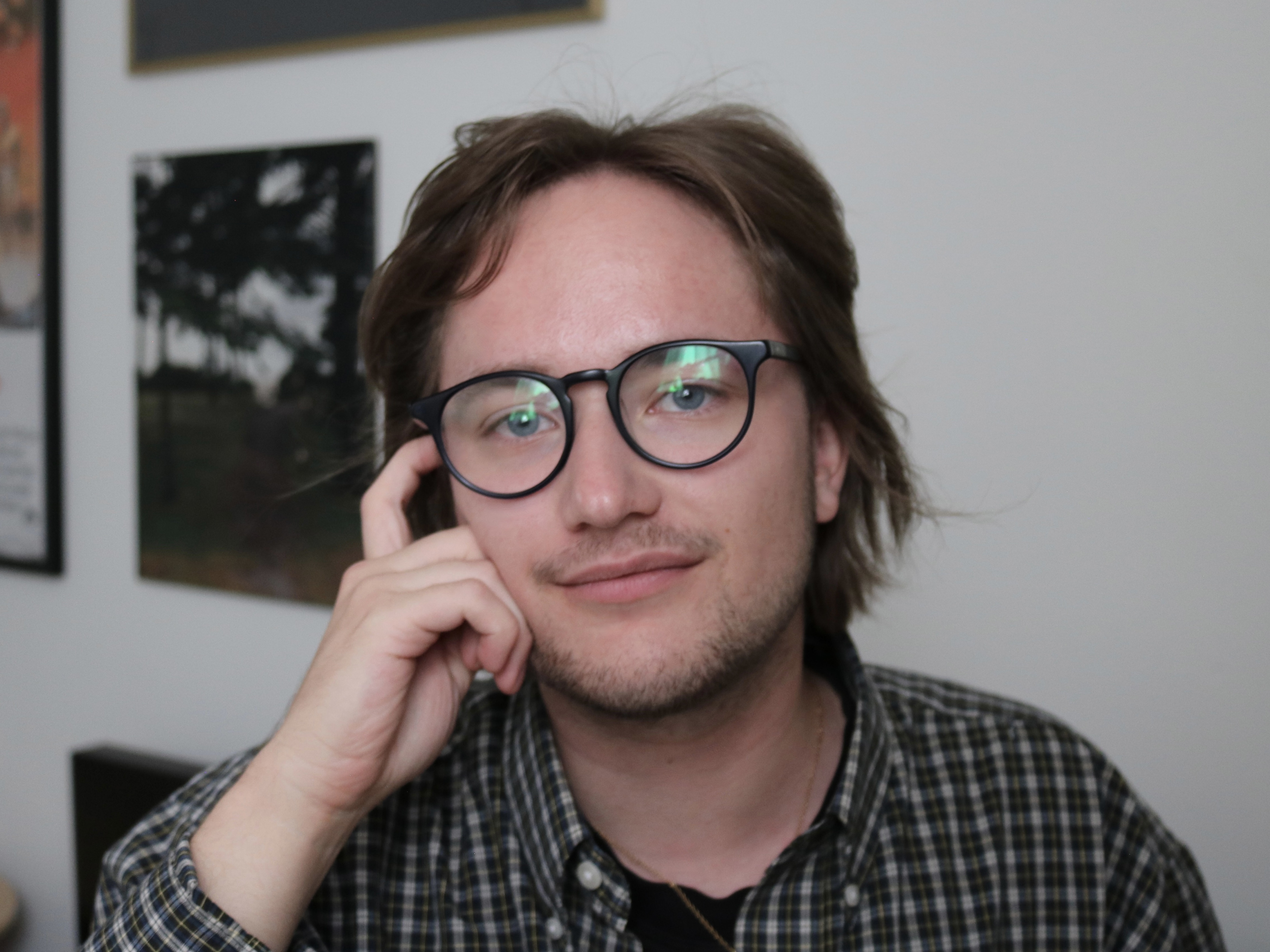
Levin is perhaps best known locally as a visual artist, and often uses his art to speak about navigating and celebrating queer and trans culture. He’s shown his work throughout the city at galleries such as Esker Foundation, Stride Gallery, and The New Gallery, as well as in schools, libraries, and community centres across the province as part of the TREX Travelling Exhibition Program. He received a BFA from Alberta University of the Arts in 2022. Since then, he has worked to support the city’s arts scene through writing about local exhibitions, organizing events and programming, as well as through his work as an arts administrator.
Levin is passionate about the lives of queer people here on the prairies. He is excited to begin sharing research about local trans history as part of the Calgary Gay History Project.”
Welcome Levin! Look for future blog posts with the author’s initials {LI}.
{KA}
December 4, 2025
A gift of queer history for the holidays
Stories have an extraordinary ability to unite us within our communities, bridging gaps and fostering understanding. When we share narratives, we cultivate a deeper sense of belonging, which is especially vital for minority groups whose experiences can be marginalized.
For many 2SLGBTQ+ individuals, the holiday season can be a time of isolation and disconnection from family and friends. One powerful way to combat this alienation is by immersing ourselves in the rich and inspiring stories of our past. Delving into queer history not only enriches our understanding of previous generations, but also provides essential context for our current lives and identities—and generates strategies for dealing with our contemporary foes!
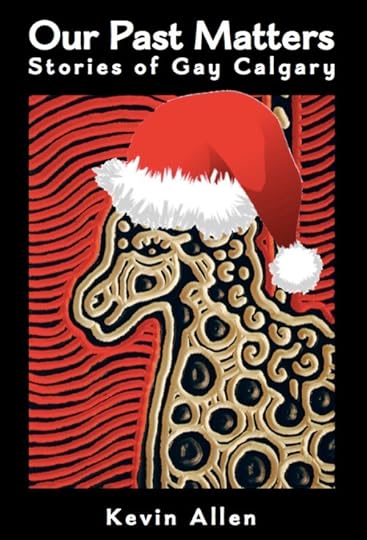 Our Past Matters cover with an Xmas addition
Our Past Matters: Stories of Gay Calgary, a collection of stories that highlights the voices and experiences of Calgary’s 2SLGBTQ+ community, reached #1 on the Calgary Herald bestseller list in 2019 and has continued to resonate with readers ever since. Our friend and Giller Prize-winning author Suzette Mayr praised it, stating, “This book makes me proud to be a Calgarian.”
We are deeply grateful for independent bookstores like Pages on Kensington and Shelf Life Books. These businesses are cozy, queer positive, and significant supporters of Calgary writers. At those stores, not only will you find Our Past Matters but many other queer books and local authors—check them out!
As we come to the end of 2025, we wish all of our readers a happy holiday season and good things in the New Year.
{Here is another local gift idea: Our Past Matters cover artist Lisa Brawn—who is brilliant—has work for sale in this art market on Saturday!}
{KA}