Ann Zhao's Blog
April 23, 2025
I read every Dog Man book
This time, it’s not clickbait. I actually read them all. I might have to keep up with this series through its end. I’m in too deep.
So I decided to read all the Dog Man booksThe most common reference requests I get at the library are probably where to find the Dog Man books and where to find the Diary of a Wimpy Kid books. And while I’m young enough to have once been the target audience for Wimpy Kid, I was certainly past that age for Dog Man, a spinoff of Captain Underpants that began in 2017. I started to wonder why kids love these books so much; when the movie came out, our 200-odd copies of the series pretty much disappeared from the shelves. At one point, I swear we only had two copies that weren’t checked out.
As you may know, I recently spent a month rereading the Baby-Sitters Club books, and it was incredibly fun and also deranged. So why not do something even more deranged and binge-read a series that I’m entirely unfamiliar with? Prior to this, I had only ever read one Dav Pilkey book: my cousin’s beaten-up copy of The Adventures of Ook and Gluk, which went out of print a few years back because of racial stereotypes that Pilkey apologized for. Not exactly the best introduction to his work. In comparison, Dog Man is woke AF, and this is literally a series about a police dog.
Dog Man lore you may not knowDog Man is created when a bomb, fashioned by a villainous talking cat named Petey, blows up a policeman’s head and a dog’s body, so a team of doctors sew the remaining parts (policeman’s body, dog’s head) together into Dog Man. Dog Man and Petey proceed to have a dynamic reminiscent of Perry the Platypus and Dr. Doofenshmirtz from Phineas and Ferb. Petey tries to do evil things, often with odd contraptions; Dog Man always arrests him and disables the contraption. Dog Man never speaks and rarely even barks, which I was surprised by. Not sure why Petey can talk and Dog Man can’t; I think it’s a Goofy vs. Pluto situation.
Petey starts to undergo some significant character development as the series progresses, and the story starts to become more about him than about Dog Man himself. (The thing about Dog Man himself is that his character has to be fairly stagnant just because of the nature of the story; the whole shtick is he’s a man and also a dog and will behave like a dog forever.) Early on, Petey clones himself to try to do more evil and ends up with a loving, good-hearted kitten, and “Li’l Petey,” who calls him Papa, slowly but changes Petey’s heart as well. He’s the sweetest and probably my favorite character in the series because of how much he’s willing to see the good in everyone.
From there, you get more and more of a view into Petey’s (incredibly tragic) backstory: His dad left the family, he and his mom became homeless, his mom died, he committed a crime and went to jail, and when he got out of jail, nobody would give him a job, so he had to resort to a life of crime. At some point, probably because of his dad, the tip of his tail got cut off. I truly did not expect this book series to tackle homelessness, childhood trauma, and prison recidivism, but in fact, those aren’t even all the societal issues you’ll hear about. I told you, Dog Man is woke in comparison to Ook and Gluk.
Where did Dog Man come from?Dog Man actually starts with Captain Underpants. A mini-comic before the beginning of the first book explains that in the Underpants books, these two elementary schoolers named George and Harold loved making comics, and one day, in fourth grade, they turned their school principal into their comic book superhero, Captain Underpants. But once the events of that series ended, George and Harold decided to start drawing more of Dog Man, a character they’d created as kindergartners and abandoned for a while.
I decided to read the last Captain Underpants book to get more context since the intro given in Dog Man (as in, book 1 of the Dog Man series) was pretty minimal. It turns out that George and Harold are two fourth graders with ADHD who like to play pranks; George likes writing and Harold likes drawing! I’m guessing I’d get way more context if I read the whole Underpants series, but I just couldn’t bring myself to do all that; summaries of the series’ events, plus reading the last book in detail, was enough.
Did you know the Captain Underpants books were recently reissued in full color? And also, did you know George and Harold, through time travel, sort of clone themselves, so one version of them at the end of the series is traveling through time to try to save their missing pets while the other version is chilling at home writing Dog Man comics? And also, did you know they travel to the future and find out they become successful cartoonists who’ve published tons of Dog Man books and also Harold is married to a man?
None of that is even really important to the Dog Man books themselves. You can certainly read them without knowing a single thing that happens in Captain Underpants. But I got in too deep and had to share all that.
And so, Dog Man the book series is presented as a collection of George and Harold’s Dog Man comics. They’re initially drawn in a style that evokes the artistic skills and sense of humor of a nine year old (and, at times, a six year old; one of the comics in the first book is presented as an old one from when they were in first grade), but the writing and art style become a little more sophisticated as time goes on and George and Harold age; they’re currently meant to be in sixth grade. The fact that they’re supposed to be the creators of Dog Man becomes less and less relevant as the series goes on; by book 10, they aren’t even introducing themselves in a mini-comic beforehand.
Who’s who in the Dog Man books?The Dog Man books gradually introduce more and more characters into the mix; while it’s really just Dog Man, Petey, and the police chief at first, it’s now at a point where you need a list of characters to keep them all straight. The books started doing this at book 10; here are some screenshots I grabbed from Libby.
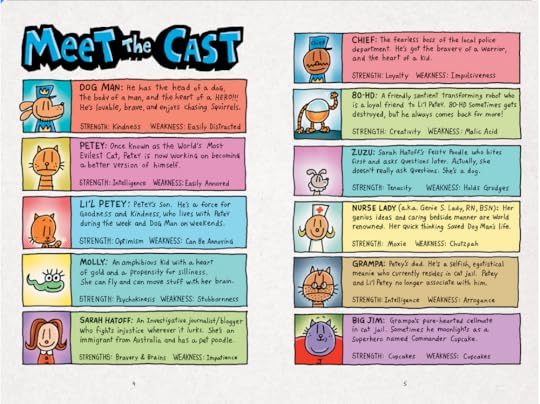
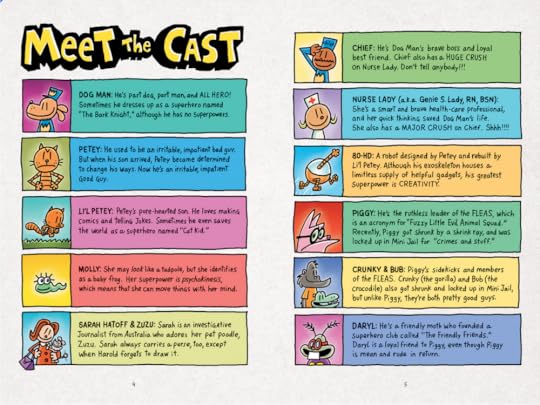
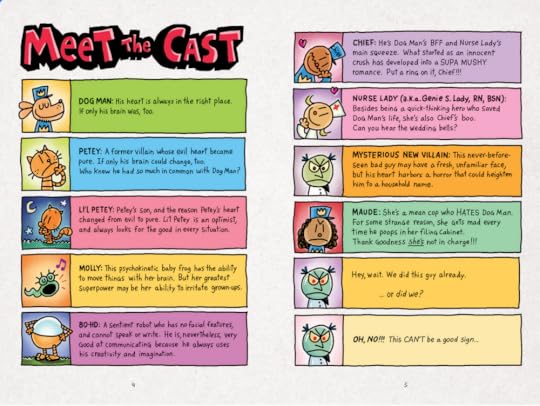
There are plenty of other recurring characters as well, but we’ll cross that bridge when we get there.
If that wasn’t enough, Cat Kid Comic Club also existsLi’l Petey has his own spinoff series called Cat Kid Comic Club. After the events of Dog Man: Fetch-22, Li’l Petey starts a comic club with Molly, Flippy, and Molly’s frog siblings. There’s five of these books right now, so I read those too. They’re a lot less about crime fighting and tragic backstories and a lot more about how to make comics. Like Dog Man, these are presented as being written and illustrated by George and Harold (at least at first), although, like the later Dog Man books, George and Harold aren’t really relevant at all.
I read The Cartoonists Club, Raina Telgemeier and Scott McCloud’s newest book, about a month ago, and Cat Kid Comic Club follows a similar concept: A club meets and all learns together how to create comic books, and in the process, a kid reading the book also learns how comics are created. It’s really cute, and because this series follows Li’l Petey, it’s a great introductory point for a kid who’s already devoured all the Dog Man books. I honestly wouldn’t give it to a kid who hasn’t read Dog Man; knowing these characters really helps!
Each Cat Kid Comic Club book includes, within its narrative, multiple comics by all the frogs, who have distinctive, though classic Dav Pilkey, art styles. I’m particularly tickled by the frogs who create comics using photographs of characters they’ve crafted. Pilkey actually makes these little arts and crafts and takes pictures of them. I really loved the part in the first book where the frogs get challenged to create the worst comics possible because it’s genuinely a good strategy for creative work; when I write the worst first draft possible, it still means that I’ve written something down.
It’s actually very touching that these books encouraging artistic expression are so popular among kids now. I have to wonder if there are any current kids who have become the Georges and Harolds of their school (in the sense of making popular cartoons, not in the sense of hypnotizing their principals into becoming underwear-themed superheroes) after reading these books. This was a great way to end my Dog Man marathon; these books are chill, free of villainous conflict, and without so much fraught backstory involved, but they’re very charming and easy to get through.
Summaries and thoughts on every Dog Man book (but not Cat Kid Comic Club since they’re just about teaching kids to draw and write and you’ll just have to trust that I’ve read them)Dog ManAt the start of the book, George and Harold introduce themselves and give a brief summary of Captain Underpants that leads up to what they’re doing now: drawing Dog Man. In the Dog Man comics themselves, we get Dog Man’s origin story (see above explanation; man’s body, dog’s head, bomb). He fights off Petey a bunch of times, each chapter forming a self-contained story. One chapter is a comic that George and Harold made as first graders where the drawing and handwriting are a lot worse. There’s not much to say about this one because it works well as a standalone and doesn’t really follow the plotlines that future books do. Like other Dav Pilkey books, there’s Flip-O-Rama pages, where you quickly flip pages back and forth to create a low-quality animation. I read the e-book of this, and it’s interesting how they do it; they call it Flip-E-Rama and have instructions on what to do depending on what kind of e-reader you’re using.
Dog Man: UnleashedUnlike the first book, the chapters of this one aren’t so self-contained, and future books also have an overarching plot instead of random standalone chapters. The quality of the artwork also improves quite a bit, no longer looking so much like homemade comics. In this one, Dog Man’s police chief accidentally makes a pet store fish named Flippy become sentient and capable of telekinesis, and Flippy masquerades as Petey to rob the pet store. Meanwhile, Petey creates a dead-looking paper version of himself to escape jail, but the prison guard takes “Flat Petey” to a witch doctor to be “healed” and makes Flat Petey sentient as well. So basically there are three Petey-types running around causing havoc. Flat Petey makes a dinosaur fossil sentient and evil, but Dog Man plays with the fossil’s bones, and it’s all good. Flippy dies when he tries to move his soul to another body and Dog Man plays with his soul like it’s a ball, and then Flat Petey gets cut up by a pair of sentient scissors created by the witch doctor.
When you explain it all like that, the story sounds odd and disturbing, but I guess kids are into odd and disturbing things.
Dog Man: A Tale of Two KittiesApparently this is some sort of spin on A Tale of Two Cities. Petey escapes from jail and clones himself, but the clone is a kitten, so he abandons “Li’l Petey,” who drags himself to the police station. (Li’l Petey also talks, unlike Dog Man.) Dog Man takes him in, then Petey has regrets and makes a machine to find Li’l Petey and takes him back home. Li’l Petey now idolizes Dog Man. Meanwhile, Flippy is revived when scientists turn him into a cyborg and he gets launched into a factory that makes “living spray.” The factory itself also becomes living and starts to make other buildings sentient. Li’l Petey goes and helps Dog Man destroy the buildings, much to Petey’s chagrin. Petey has a heart, though, so when Flippy tries to destroy Li’l Petey, Petey swaps places with him and has Dog Man bring Li’l Petey to safety. Li’l Petey comes up with a plan and draws an adorable picture book about him and Flippy that makes Flippy so sad and guilty that he stops being evil. Petey gets arrested again and then escapes again. Li’l Petey goes to live with Dog Man.
Dog Man and Cat KidThis book is allegedly based on East of Eden. Dog Man gets a catsitter for Li’l Petey who turns out to be Petey in disguise. At work, a Hollywood director comes and tells Dog Man he’s making a movie about him. Petey takes Li’l Petey to infiltrate the movie set. Dog Man wreaks havoc on the set, as an uncontrollable dog might do. Petey tries to do evil; Li’l Petey defects and helps Dog Man and friends stop Petey. Petey lets Li’l Petey move in with Dog Man. There’s probably more to it, but honestly, these books are starting to follow a bit of a formula, and I’m starting to get fatigued already. This doesn’t bode well.
Dog Man: Lord of the FleasI’ve discovered that most of the Dog Man books are dog-related puns on titles of classic novels. Also, I neglected to mention until this point that Li’l Petey has a robot named 80-HD that obeys his every command; it’s very fun. Like the last book, Petey kidnaps Li’l Petey by being in disguise (this time as a rep from Kitty Protective Services saying Petey needs to go to school). Petey explains his childhood backstory and greatly over-exaggerates it (he gets marooned on an island at one point, like in Lord of the Flies); essentially, he betrayed his friends in his scout troop, the FLEAS. One of his friends from then disguised himself as a psychiatrist at the cat jail, but while he was laughing about his evil revenge plans to cause harm to Li’l Petey, Petey stole the disguise and escaped jail to go rescue Li’l Petey. Shenanigans, as always, ensue, this time involving a robot brontosaurus, growing spray, and a shrink ray. Petey is starting to question his evil ways thanks to Li’l Petey’s influence.
Dog Man: Brawl of the WildDog Man gets framed for a bank robbery and gets sent to dog jail, where he has an identity crisis because he doesn’t fit in with dogs or men. Chief and 80-HD break him out of jail, Sarah and an actress named Yolay (seen previously in Dog Man and Cat Kid) find the real culprit (the FLEAS), and Petey and Li’l Petey talk to each other while Petey fixes up an animatronic bee. The movie mentioned a couple books ago has pivoted to claymation with the actors providing voices, and there’s actual pictures of clay people in here. Petey and Li’l Petey eventually save everyone else from a clay taco come to life from a spray that the FLEAS set on it (I think?).
Dog Man: For Whom the Ball RollsDog Man gets distracted by a ball during work, and Li’l Petey and 80-HD decide to help him train to focus better by dunking him in a bath every time he chases a ball or chews a bone. Meanwhile, the FLEAS, still shrunken, hop from Petey to Big Jim’s whiskers (Big Jim is another inmate at the cat jail) when Big Jim hugs Petey goodbye. Petey, now pardoned, comes to collect Li’l Petey and be a proper father to him, eventually agreeing to a custody deal with Dog Man where he gets Li’l Petey during the week and Dog Man gets Li’l Petey on the weekends. Petey reveals that he has daddy issues. Li’l Petey finds Petey’s dad, who he calls Grampa, and he’s evil and steals Petey’s stuff and gets arrested. Meanwhile, the FLEAS hypnotize Big Jim and turn him into a cupcake-themed superhero. Dog Man is now afraid of balls. A villain from book 1, Dr. Scum, makes evil balls to commit burglaries. Dog Man confronts his fears and disables the balls. Big Jim stumbles into being the hero of the day somehow even though all of his heroic doings were happenstance.
Dog Man: Fetch-22Meta note: George and Harold are in sixth grade now! Grampa escapes cat jail, Dog Man accidentally launches “brain dots” (previously seen in the Flippy saga) into a pond full of tadpoles that turns them evil and gives them psychokinetic powers, and Flippy’s evilness has worn off, so he joins Dog Man’s team to fight the now-evil tadpoles who follow the orders of an evil elderly fairy. Li’l Petey makes friends with one of these tadpoles, Molly, and makes her evilness wear off; the two of them, along with Zuzu (Sarah Hatoff’s dog), figure out an antidote to the brain dots. Big Jim again gets credit for saving the day because he and Petey were standing on a sign that falls onto Grampa and the fairy. Flippy and Molly go back to the other tadpoles who are no longer evil or have superpowers.
Dog Man: Grime and PunishmentDog Man gets fired by the mayor for being too much of a dog. Off in cat jail, Grampa makes a helmet that turns you huge and exaggerates your main personality traits; it turns Big Jim into Snug, a muscular guy who loves to cuddle. Li’l Petey and 80-HD make a cat mask for Dog Man so he can get rehired by the police; the cops see right through it but they keep him around anyway since they like him and it’s the mayor that’s the problem. Everyone gets arrested when the mayor figures them out. Meanwhile, Petey explains to Li’l Petey that Grampa left the family when Petey’s mom got sick, and then she died. (This is a very bleak kids’ book!) Also, we follow up with the tadpoles, who are now frogs except Molly for some reason. Grampa puts on the helmet and then turns a huge lunch bag sentient. The tadpoles draw on the lunch bag and it runs away because it experienced the power of love? Flippy and Molly break out Dog Man and everyone else, and then Dog Man saves the mayor’s teddy bear from a house fire, and the mayor is cool with him now. At the end of the book, Petey takes Li’l Petey to his mom’s grave, which is a shockingly emotional moment that I did not expect to ever be in this series??? It made me so sad????
Dog Man: Mothering HeightsI have a tote bag from a Scholastic mailing several years ago with an embroidered image of the characters on this cover. It’s an incredibly roomy and durable bag. Genuinely one of my favorite bags. I kind of regret not keeping the books from that mailing; I gave them to my little cousins, who, it turned out, already owned all those books.
Anyway, Dog Man gets injured and has to wear the cone of shame. Li’l Petey and 80-HD make him a new cone, the Cone of Destiny, that turns into a superhero suit. Grampa tries to escape from jail again. The chief has a crush on the nurse. Sarah interviews Petey about how he’s not evil anymore, but they keep getting interrupted by Li’l Petey and Molly singing songs and playing games. Petey eventually explains he became a criminal because after he went to jail once and tried to be good afterwards, no one would hire him, and he had to resort back to a life of crime. Didn’t realize these books would address grief and prison recidivism one after another?? Grampa makes two sippy cups come to life. The sippy cups threaten the hospital, which is the chief’s chance to make an impression on the nurse (he scores a date with her!). Molly saves the day, but Petey’s house is wrecked, so he goes to live with Dog Man.
Dog Man: Twenty Thousand Fleas Under the SeaThe chief and nurse go on a date. Petey tries to rebuild his house, but businesses keep turning him away because he was a criminal. The FLEAS escape tiny jail. Piggy is mad at the other two for not being evil enough. Many convoluted things happen resulting in the whole gang shrinking to microscopic size and falling into Piggy’s pores (again, Piggy is the size of a fly). They figure out how to be regular sized again. Everyone helps Petey rebuild his house through the power of community. Guys, I think the Dog Man books are going to turn the kids woke. They might be our only hope.
Dog Man: The Scarlet ShedderThe chief and nurse get married! That moved fast! While he’s on his honeymoon, the interim chief is a police officer who hates Dog Man. Dog Man gets sprayed by a skunk, so they bathe him in tomato juice, but it dyes him red and doesn’t take out the stink. They wash out the stink with hydrogen peroxide and baking soda, but he’s still red. Meanwhile, Dr. Scum has made a bunch of AI robots of himself; I guess we’re taking on genAI discourse now too! Scum makes a robot Dog Man, and the gang switches it out for Dog Man himself, but Petey has signed his life away to Dr. Scum in exchange. Scum starts selling AI Buddies to everyone, and they start to run society while people spend all day scrolling on their phones. Dog Man and friends take on new superhero identities with new weapons to battle the AI Buddies. Petey has a dream about his childhood; he moved into a shelter with his mom and met Big Jim (at the time, Little Jim), who was orphaned. He breaks out of Scum’s lab and saves everyone.
Dog Man: Big Jim BeginsBecause this book has a lot of flashbacks, the intro has the cast list, as the last few books did, but it’s all these characters when they were little; Dog Man was still Greg the puppy, Chief was little Clarence Bailey, president of the junior detective club. It’s very adorable.
Big Jim tells his origin story. He had a loving mother and father! Grampa reveals he was super into disco as a youngster. Some aliens came and told Jim’s parents he was the chosen one, and he went searching for a ring that would grant him powers or something. He found Clarence and Greg! Then the aliens are shown in the present day, and the chosen one (a little girl, not Jim) hasn’t found the ring yet, so they decide to take over the world. Jim then reveals his parents died in an accident when he was a little kid, which is SO SAD???? Back in the present, there was a big party, and everyone ate cake that made them fall asleep except Dog Man because he can’t have chocolate, and Jim and Grampa show up and have to help because the cake came from the aliens. They save everyone because the aliens are robots who are allergic to hugs. Grampa might not be a bad guy anymore? Then they tease a sequel because there’s a lot of loose ends.
And that’s where we leave off!I did not expect Dog Man to be what it was! I definitely had the impression that every book was just about Dog Man fighting a bad guy, and while it is true that he does that in most of these books, I got so much more than that. Dav Pilkey might actually be a genius for making a book series that can so easily draw in reluctant readers with its flashy colors and absurd storylines, that also educates kids on real issues that affect us in the real world and encourages them to create their own stories.
All that said, I’d really like to read something now that’s written for people my own age and doesn’t spell “super” as “supa.” There’s only so much of that you can take.


April 2, 2024
my debut-stress-induced cooking
One thing about me is that the more stressed I am, the more food I’ll make, and these last few months have been a very stressful time for me for absolutely no reason whatsoever. But thanks to my stress-induced cooking and baking, I’ve made a lot of new things and figured out the best ways to make some of my old favorites, so here are some of the best and worst things I’ve made since January! Pics of most of these are on an Instagram story highlight.
Tini Younger’s mac and cheeseChef influencer Tini Younger’s mac and cheese recipe took TikTok by storm around Thanksgiving, but I was a bit late to the trend, trying it in January when I was visiting family. Her spice blend is wonderful—don’t skip the smoked paprika and dijon mustard, as it really adds a bite of flavor. The crust of cheese on the top was rather thick, but that very well could have been my error; I might have been able to add more cheese to the sauce. Overall, really great recipe; my aunt, uncle, and cousins seemed to enjoy it.
Chicken katsu curryThis is another recipe I tried at my cousins’ place. I used boneless, skinless chicken thighs to make chicken katsu according to the instructions from Just One Cookbook, and I cooked the curry according to package directions on a pack of Golden Curry. I didn’t season the chicken heavily enough; if I were to do it again, I’d salt them at least 30 minutes before breading and frying. I’d also use chicken breasts, as they’re much more even when pounded out.
Chocolate filled cream puffsThis is the final thing I made while I was visiting my cousins. I used Claire Saffitz’s croquembouche recipe but skipped the craquelin and caramel. This was a big hit. I wouldn’t do anything differently if I wanted to make cream puffs, but I would like to try a full croquembouche someday.
Gluten free white breadMy sibling has a mild wheat allergy, so I try to make some gluten free things when I can to reduce their wheat intake. I tried out The Loopy Whisk’s white bread recipe, and, well, it wasn’t great. The texture was just hard and stale, and it kind of looked like I had cut a log into the shape of bread. I did use some of the substitutions Katarina suggested when I didn’t have the exact flour types listed in the recipe, so I might try this recipe again with the exact flour blend listed in the recipe. (Her method of using psyllium husk definitely does work; I’ve made her lemon roll recipe with far greater success.)
Soy honey glazed salmonLesson learned: don’t just wing a recipe if you aren’t experienced cooking this type of meat. Specifically, I’ve never pan-fried salmon before, and when I added the soy, ginger, and honey glaze to it too early, it ended up nearly burning. The inside still tasted great, but the outside looked downright scary.
Candied Buddha’s handMy mom grows a citrus called Buddha’s hand in her garden, and while they’re nice to look at, they’re not edible as-is because they are made entirely of pith with no edible, juicy flesh. You can zest the outsides and use it in place of lemon zest, or you can candy them. This wasn’t my first time working with sugar, so it was a pretty standard procedure, and we ended up with lots of really great candied citrus peels and some sugar syrup (that later crystallized) scented with citrus fragrance. The only thing I did differently from John Mitzewich’s recipe was cut them into strips instead of cubes.
Recently, I was going to make cookies out of the rest of the candied Buddha’s hand we still had, only to discover that my dad had thrown it away, which he says was because I complained there was too much clutter in our kitchen. It is still cluttered, but now with less candy. Shame on him.
SourdoughI’ve been making sourdough since 2020, and the method I’ve ended up with is adapted from Mary Grace Quigley and The Kitchn. I make this once every week or two, depending on how fast we go through it. It’s pretty easy and relatively hands-free compared to some of the more involved recipes I’ve seen; the results aren’t perfect, but an 8 out of 10 loaf of bread with 2 out of 10 effort is better to me than a 10 out of 10 loaf with 12 out of 10 effort.
The ingredient ratio I use is 1000 g unbleached all-purpose or bread flour, 750-800 g water, 100-120 g starter, and 1 tbsp table salt (equivalent to 2-3 tbsp kosher salt, depending on the brand), to make two loaves. I mix the dough, do stretch and folds until I go to bed (or for a couple of hours, if I’m starting in the morning), then let it rise. I shape it and let it rise again in proofing baskets covered with shower caps until the dough reaches near the top of the basket. Then I bake in a covered Dutch oven at 500 F for 20 minutes, 450 F for 10 minutes, and uncovered at 450 F for an additional 10-15 minutes. It pretty much always turns out good.
Rotisserie chicken phoAlissa Nguyen is one of my favorite food TikTokers. (I can’t wait for her to go back to always saying that her baby is crying now that another is on the way.) I’ve made chicken pho a number of times now, and it always turns out good. If your chicken broth isn’t turning out as flavorful as you’d like, I suggest Better than Bouillon paste.
Maine lobster rollOne of my big regrets about my time in undergrad is I never went to a seafood restaurant in Boston. I know for a fact that it just isn’t the same in Illinois, where our local seafood is from freshwater sources.
I made a lobster roll at home when frozen lobster tails went on sale at my grocery store, and though it’s probably not nearly as good as the ones in New England, it was pretty great! It was a simple mix of cooked lobster, celery, mayo, and salt and pepper, loaded into a buttered and toasted split-top hot dog bun. Highly recommend. (I haven’t tried the Connecticut-style rolls yet; those are just lobster and butter. I feel like you’d need fresh lobster, not frozen, for that to be really good.)
Venison burgersOne day, I dug up a pound of ground venison from my freezer and decided to learn how to make burgers. Where did the venison come from? Not sure. How long had it been there? Also not sure. But the burgers were great! I followed standard smash burger procedure and topped with lettuce, tomato, and caramelized onion. I highly recommend Martin’s potato rolls, which are used by many restaurants.
Vodka pastaI’ve been making pasta alla vodka for years, so it’s not that I tried this for the first time or anything, but now I’ve done it a few ways, with tomato paste and with canned tomatoes. I definitely prefer it with canned tomatoes, though it needs to simmer for a while rather than being instant. I’m honestly not sure if the vodka does anything, but Ethan Chlebowski and J. Kenji López-Alt say it does, so I do include a bit of cheap vodka in the sauce.
Milk breadMilk bread is another thing I’ve been making for a long time, I think since I was, like, twelve. But recently, I tried the recipe from The Woks of Life, and it was incredibly easy and really tasty. I appreciated that tangzhong wasn’t needed (although I’ve found some great recipes in the past that do use tangzhong). I did need to let it rise for longer than they say in the recipe, but I think that’s because it was cold in our house.
Braised short ribsI pretty much used Cassie Yeung’s instructions for how to make braised short ribs. My dad thought I’d bought them pre-made, which I’m still not sure was a compliment or an insult, but he was surprised when I told him I made them myself. My sister is a very picky eater, so I roasted some potatoes for her while the rest of us got mashed, and everyone’s plates were cleaned. 10/10, would make again, but I’d wait until short ribs are on sale.
Beef noodle soupThe Woks of Life’s recipe for beef noodle soup in an Instant Pot was great, but the broth turned out very peppery. I checked their cookbook, and the amount of peppercorns they suggest there is a bit less, so reduce it if you’re using the online recipe! The beef also ended up a little overcooked. If it weren’t for the long timing of cooking it on the stove, I would do it on a stovetop so I could check the beef’s doneness more easily.
Pork pozoleMy sibling got a recipe for Instant Pot pork pozole from their friend. There were a bunch of types of peppers, plus more pepper powders in the broth, and it was very spicy. My sister didn’t even try it (again, picky eater). But we really enjoyed it, and we discovered that my sibling and I have higher spice tolerances than our mom at this point. If I were to make this again, I’d do it on the stovetop; like the beef, the pork turned out a little overcooked.
Crab rangoonMy sibling’s more serious allergy is crustaceans, so they’ve never been able to have crab rangoon before because you can’t really confirm if a restaurant’s imitation crab contains real crab extract (and we don’t have any kosher Chinese restaurants in our area—I know they wouldn’t have any real crab). I used the recipe in The Woks of Life cookbook, though I omitted the Dijon mustard. Turns out, it needed the mustard. It was missing some kind of zing. But I highly recommend making it yourself if you’ve got some time to wrap them all! It’s much more cost-effective than buying it, and since it’s fried fresh, the crispiness is unparalleled.
Pork katsu currySame procedure as the chicken katsu curry, but this time with pork cutlets. I didn’t butterfly the cutlets nearly evenly enough; my knife skills are shabby as it is, and I had a dull knife. Still tasted great, though!
Pan-roasted chicken partsJ. Kenji López-Alt has a recipe in his cookbook The Food Lab for pan-roasted chicken parts that I really enjoyed. It’s absolutely non-negotiable to have an instant-read thermometer on hand when you’re cooking white meat. I cooked the breasts to 150 F (a perfectly safe temperature; 165 kills pathogens instantly, but 150 kills them within a couple of minutes, and 155, which it comes up to as it rests, will kill pathogens in less than a minute). I don’t think I’ve ever eaten chicken breasts that were this tender and juicy before. (My family usually cooks chicken in soup, so my only frame of reference is from restaurants and dining halls.) Highly recommend.
“Future brownies”Sohla El-Waylly’s cookbook Start Here is perhaps one of my favorite cookbooks as of late. Her recipe for “future brownies,” called that because they feel like some sort of food from the future, was pretty much all gone within a couple of days in my household, and we’re not usually huge on desserts. They’re essentially mochi brownies, made using glutinous rice flour, so in addition to their lovely jelly-like texture, they’re also gluten free. And they’re not too sweet, which any Asian person knows is a compliment.
Prime ribWhile I liked Kenji’s method for chicken parts, his prime rib method was a little fussy. He roasts the roast at a painstakingly low temperature in the oven, which takes the whole afternoon, before blasting it with a super hot oven right at the end to form a crust. I had my rib roast in the oven for four hours, and it was still rare in the middle. It’s a good thing most of my family doesn’t mind our beef a little rare, but if I were to do this again, I’d start it in the oven in the morning.
St. Louis gooey butter cakeClaire Saffitz once had a baking competition with her high school friends in which she baked a raspberry chocolate layer cake from scratch and lost to a gooey butter cake made from boxed yellow cake mix. Years later, she included a recipe for St. Louis gooey butter cake in her first cookbook—the yeasted, not-too-sweet version you find in bakeries, not the boxed cake mix version people bring to potlucks. Her friend who won the baking competition tried both cakes, and . . . the boxed mix still won.
Well, I made Claire’s version, and I have a hard time believing a boxed cake mix could possibly produce better results. The cake was light, almost like brioche in its texture, and the goo—for lack of a better word—was the perfect balance of sweet, creamy, and vanilla-y. The overnight rest in the fridge is well worth the wait for this one. My only complaint is that it’s a rather small recipe to be using a stand mixer, but I shudder at the thought of having to make such a buttery dough by hand.
Southern-style fried chicken(Plus coleslaw and biscuits.)
Another Kenji recipe here; the chicken was great, but I think the spice blend in the breading and marinade was lacking. Too much paprika and garlic powder, and not much of anything else. I liked his method of frying the chicken just until the outside is crisp and then finishing in the oven, but it did take quite a long time. The coleslaw was good, but not sweet enough. And I made Bon Appétit’s “BA’s Best” biscuits, which turned out very good, but a little dry. (Maybe that’s on me for skipping the step where you brush it with butter before baking. I didn’t feel like melting any butter.)
February 4, 2023
my dorm cooking recs
Back in November, I wrote a Twitter thread on my favorite things to cook as a Chinese American college student who doesn’t really know how to cook all that well but really misses home flavors. That thread got way more likes than I expected (it wasn’t viral or anything, but it definitely received more attention than most of the things I’ve even tweeted about my book).
But I’ve learned a little bit since November! And also, that thread is super-duper buried in my feed now! So as a gift to, like, the two people who will see this, here it is in a blog post, updated with a few more things, and written with proper capitalization for ease of reading.
contentsI’m too lazy to delve into the HTML and make links to different sections, so use control-f or command-f to look for each section, or just scroll down.
important information
congee, zhou, juk, rice porridge, whatever you want to call it
noodle soup
fried rice
spam musubi
tomato eggs
uh. veggies + protein + rice?
japanese curry rice
miso soup
frozen food… lol
a note on kimchi, since i brought it up
the emily mariko salmon bowl
shanghainese cai fan
important informationBefore I begin, I should let you know, many of these things can still be time-consuming to make, even if they are objectively easy. Prepping these on a free day and refrigerating or freezing the leftovers has been really helpful for me. I just bought a set of deli containers that can go in the freezer, and I plan to portion out full meals and freezing them. Just make sure to Google what can and can’t be frozen because it will affect the texture of some things.
Also, I don’t cook that much. So getting ingredients can be hard! I try to stock up early in the semester on stuff that’s either shelf-stable, very long-lasting in the fridge (napa cabbage seems to last forever), or can be frozen, and then I use it up slowly.
I’m also not a great cook. I know the very basics. Sometimes what I make is worse than what I could get in the college dining hall. But food always seems to taste better when I’m the one who made it. Of all the aspects of my culture, food is what I have the most knowledge of, so it is very special to me when I make something myself—even more special when I get to share it with my loved ones. You don’t have to be a good cook to sustain yourself and enjoy what you’re eating. You just need to know a few staple dishes.
congee, zhou, juk, rice porridge, whatever you want to call itWhen I just want to dump some stuff in a pot and wait, I like to make a pot of plain white congee and just put a bunch of toppings on it. When it comes to cooking, I hate measuring things (I love measuring things when baking, though), so I just put in what looks like an appropriate amount of rice and water. That being said, here is a recipe you might consider following if you’re unsure of the proper ratio—you can just use plain water if you don’t want to bother with chicken stock and other accoutrements. Sometimes I use uncooked rice, sometimes cooked, though my mom always tells me uncooked rice is better because the congee will be more fragrant.
Here are some toppings I usually put on my congee!
pork floss
chili bamboo
century egg
ginger
scallion
fermented tofu
furikake
noodle soupIt’s not quite as quick and easy as ramen, but it’ll make you feel a lot better, and it’s pretty quick if you use thin noodles.
I use premade stock (my favorite is Better than Buillon concentrate) to cook some thin noodles like somen or vermicelli, plus a vegetable like bok choy or pea shoots, and a pre-cooked protein like tofu or Spam—you could even use hot dogs. If your (again, very thin) noodles come in bundles or blocks, you don’t even need to boil it; just add hot water like in this video. (Nutrition by Kylie is one of my favorite YouTube/TikTok food accounts!)
I got fancy once and did one inspired by hot pot, throwing some dried shiitake mushrooms and sliced ginger into the chicken stock. From there, I added napa cabbage, small slices of Spam, glass vermicelli noodles, and thinly-sliced pork belly. It was delicious. Highly recommend if you have the time to slice pork belly or the money to get it pre-sliced.
fried riceThis is a great thing to make if you are a college student and want to try to use your dining hall’s ingredients. You can usually find rice, plus a few vegetables that work well (mine will usually have at least a few of these on a good day: green beans, peas, carrots, edamame, corn, bell peppers, onions, and mushrooms). If you’re vegan or vegetarian, buy some seitan or five-spice tofu for your protein; if you’re not, I suggest lap cheong, Spam, or certain kinds of meat that your dining hall might serve that you can then cut up into cubes, like grilled chicken or roasted pork. And some eggs are always good.
Oh, wait, you’re not a college student? Okay. Get a frozen veggie mix from the supermarket and add the protein of your choice. Also cook some rice, and then let it sit—make sure it’s at least a day old.
Once you’ve got your ingredients ready, fry your rice! Basics with Babish has a decent video on it if you don’t care much about authenticity; otherwise, you can always follow a proper recipe, like this one from Made with Lau.
spam musubiCan you tell yet I’m a fan of Spam? My family didn’t actually eat it much at home, mostly using it for hot pot, but as a college student, I do recommend it because it can be stored at room temperature, is already cooked, and is surprisingly versatile. I started making Spam musubi after seeing a few too many TikToks of people making it. It’s delightful, though very salty—I suggest getting low-sodium Spam if you can find it.
Spam has a good recipe on their website, but it doesn’t have to be this complicated if you don’t want it to be. I just cook the Spam in a pan with a little soy sauce. I don’t have a mold for the rice, either; I just shape it with my hands dipped in water, or with the rice paddle.
tomato eggsChinese people love to stir fry eggs with whatever vegetable. I love tomato eggs; when done right, they’re custardy and flavorful and just really comforting. Here’s a good recipe from The Woks of Life; this isn’t exactly the method I do, but it should achieve good results. I like to make sure the eggs are considerably underdone when I take them out so that some of the uncooked egg later mixes with the tomato juices when you add them back in.
Serve with rice or cooked and drained wheat noodles.
uh. veggies + protein + rice?A continuation of the last thing, kind of. This can be quick and easy, or rather complicated, but a combination of a vegetable, a protein, and a starch is usually nutritious and filling, you know?
Stir frying or blanching leafy greens is fairly straightforward—the way my mom taught me to stir fry, you do it with a bit of oil in a wok on high heat until it wilts, and then season with salt and sugar (and MSG if you have it) to taste, and then cover and put on low heat until fully cooked. If it’s all leaves and no stalk, like pea shoots or spinach, just stir fry on high until it wilts; no need to cover and cook longer.
I’m still learning how to make protein dishes because I dislike handling raw meat, and I lived with a vegan for a year and a half, so there was no real reason for me to be cooking meat until this semester. Sometimes I get pre-marinated bulgogi from H Mart. I tried red braised pork belly recently, but it came out quite tough to chew and very salty.
To be honest, usually, if I’m stir frying a vegetable and serving it with a protein, the protein is whatever leftovers I have from getting takeout.
japanese curry riceAgain, this is just vegetables, protein, and rice, but this time served in a sauce.
Get a packet of curry roux. Follow the instructions on it. The classic vegetables to put in are potatoes, onions, and carrots. If you’re vegetarian, potatoes have an okay enough amount of protein that you won’t have to sub in seitan or anything; if you’re not vegetarian, try doing cubes of chicken or beef. Bam. Quick and easy meal. This, in particular, is good to freeze if you’re doing meal prep, though it may affect the texture a bit.
miso soupYou literally just put your soup ingredients into hot stock (TBH sometimes I just do water) and then add miso paste. I like the classic tofu, wakame, and enoki mushroom combination. Serve with some rice, and maybe fish if you feel like making that.
frozen food… lolOh, you think Trader Joe’s has a good frozen food aisle? Try an Asian grocery store near you. I, of course, am Chinese, so I gravitate towards frozen dumplings, wontons, and buns. It’s quick and easy, and when I’m sick of dining hall food but don’t want to really cook, I grab one of these. I also really like the Yoshinoya beef and onion packets, if you can find them anywhere. I just put them on rice and eat some kimchi on the side so I don’t feel bad about not having any vegetables.
a note on kimchi, since i brought it upMy parents are not from the spicy-food area of China, and I grew up in a town where the Asians were predominantly Chinese or Indian, so we didn’t eat much Korean food when I was growing up. But I enjoy it now! I like to have a bit of kimchi in the fridge most of the time. If I want a vegetable but don’t want to cook, I just get some kimchi out. It’s also very versatile for cooking, though I haven’t actually cooked with kimchi yet. One of my friends who also likes to cook made sujebi one time, and now I want to try it myself at some point.
the emily mariko salmon bowlLifestyle TikToker Emily Mariko popularized a way to make salmon bowls, and now it’s the only way I can tolerate eating the salmon served by my dining hall. Just look it up if you don’t know what I’m talking about. All I do differently is that I don’t reheat my rice with an ice cube, I often don’t put in mayo, and I add furikake seasoning or a little toasted sesame oil if the salmon isn’t too oily. Also, I don’t always have roasted seaweed, so sometimes it’s just the salmon, rice, and kimchi.
shanghainese cai fanMy mom didn’t make this a lot when I was growing up because it’s a very simple one-pot meal, and she can do better than that. But I can’t. So I’ve made this a lot. The Woks of Life has a good recipe. I, however, keep it simple by just chopping up the bok choy and salted pork (or, more often, Chinese sausage) into tiny pieces and then throwing it into a rice cooker along with some rice and water—less water than I’d usually use to make rice, since bok choy has a lot of water already. Then you just wait until it’s cooked through. The bok choy will be kind of yellowish if you do it this way instead of stir frying it separately, but it still tastes fine.
January 14, 2022
questions to ask an agent on The Call
Note: This post was most recently updated on October 21, 2023. (Whenever new things come up in the publishing world, I try to add them to this list.)
Note 2: this list is tailored towards fiction authors of marginalized backgrounds who have not previously published any books / been represented by an agent before. It is not meant to be an exhaustive list, and if you’re an illustrator, a self-pub author, have been previously represented, or write nonfiction, there’ll be some questions here not relevant to you and some questions you should ask besides the ones presented here.
I was afraid of being that author who writes a singular blog post about getting an agent and then never posts on their blog again, but I finally got an idea for a post that I hope will be helpful! When I was in my two-week frenzy of getting agent offers, I found it was helpful to have a list of questions to ask agents so I could better determine if they were the right fit for me, and I thought I’d share my questions now. Will this list make you come off as very type-A? Probably. But is that a bad thing? I don’t know.
This list is adapted from Alexa Donne and Jim McCarthy’s lists. They’re both extremely helpful, but I felt I had to ask more to ensure I was finding the right person to champion me and my work. As a result, I ended up with this massive list of questions tailored to my own needs, and as I’ve been compiling this blog post, I’ve added even more in retrospect. When you’re making your own list, don’t be afraid to add questions of your own if you find any more information to be helpful.
With many of these questions, there’s no right or wrong answer, and they’re just there to gauge expectations for if you sign with this agent. However, if an agent seems to dodge your questions, or if you’re personally not satisfied with an answer, that’s a sign that they may not be the right fit for you.
Without further ado, let’s get into it!
questions about your book
These are helpful to understand your agent’s vision for your book and what it will immediately be like working with them.
What did you enjoy about my book?
Do you have imprints/editors in mind for submission yet?
It may be helpful for you to write these down if they give you any names. If you end up with a different agent, you can still bring up these editors to your agent if you think they’re a good fit.
How close to submission-ready do you feel my book is?
When do you hope to go on submission with this? Is there a specific amount of time you have in mind that we wait?
For me, I wanted an agent who would understand my need for a loose schedule because of school. Other people may want a strict deadline to keep them accountable!
What edits do you want me to make to my book to get it submission ready?
How many revision rounds do you envision us doing before submission?
How do you feel about this book as a series vs a standalone?
This question is only important to ask if you actually want to write a series!
questions about the agent’s editorial process
This section is very important. If an agent’s editorial process doesn’t mesh up with how you work, or if their vision for your book isn’t how you imagined it, that could mean they’re not the right agent for you. A lot of these questions are to help set your expectations for what it’ll be like working with this agent.
Are you editorial?
Some agents aren’t editorial at all, and that’s okay! Ask this question so you know what to expect with both this book and books going forward.
In what ways are you editorial? What are your editorial strengths?
How long is your average turnaround for reading/notes?
This is for your own reference so you know what to expect.
How do you deliver notes? (Word doc comments? Edit letter?)
Do you do line edits? Copy edits?
Will there ever be a case where you will request that I pay someone to edit my manuscript?
If they say yes, run away. This question is here to weed out schmagents. There may be rare cases where an agency hires a freelance editor for your manuscript, but the agency should always be the one paying for it, never you.
What happens if we disagree editorially?
Who decides when the manuscript is ready to go on sub—you or me?
questions about sub
One of the things I wish I’d asked more about was definitely submission because, frankly, I didn’t really understand how it works. If you have any other questions about how sub works beyond what I’ve put here, now is the time to ask them.
What is your usual timeline for submission rounds? How long do you wait before going on a second round of submissions?
Will you share editor info with me when we go on submission? (imprints & editor names) Do I get any input on who we submit to? If I make a list of editors or imprints I like, would you consider them?
You may not care about having input, and that’s fine! But for me, I have a few imprints I absolutely love and really wanted to see on my list. I made a list of editors I like by looking in the acknowledgments of books in my genre and category that I’ve enjoyed, and my agent took this list into consideration!
What do you typically put in a sub package? Will you share my sub package with me before we go on sub if I ask for it? If not, why not?
You should expect that an agent will submit a pitch (similar to your query letter) and the manuscript (though sometimes they may only share the manuscript after an editor requests it). Other than that, agents sometimes like to submit other supplemental materials! Just ask so you know what to expect. Personally, I liked seeing my pitch before my agent went on sub for me, but not everyone does.
Will I get a complete list before submission of imprints and/or editors you’ll submit to?
If they say no, ask why not. If you want to know who you’re submitting to, you should be able to get that information.
How do you approach submission rounds? Do you have informal chats with editors before submitting to them, or do you just cold submit?
Every agent’s approach is different, and there’s probably no right or wrong answer here, but it’s nice to know beforehand how it will go.
Do you prefer submitting to editors you have a relationship with, or will you submit to editors you’ve never talked to before?
This goes hand-in-hand with the question about having input on who you submit to.
How many editors do you usually submit to per round?
This should be specific to other clients who write in your age category and genre. Again, no right or wrong answers here—anything from going out on an exclusive to submitting widely is a valid choice, and this is so you know what to expect.
How often will you communicate during submission?
How will I receive responses? Does this change depending on good news versus bad news?
How involved will I be in the initial offer?
How many editors do you go to before giving up? What happens if I don’t sell this book? (Revisions? New project?)
What percent of projects that you sign have you sold?
This can depend on genre and category, as well as how new the agent is to the industry! Assuming your goal is traditionally publishing with a large or mid-size publisher, you’re really just trying to make sure you’re not signing with someone who’s sold only two things to small presses after five years or something to that accord. If they give you a number that seems small, ask about the agency’s sale rate as a whole.
It can also be helpful to get a one-day Publisher’s Marketplace account so you can look up the agent’s announced deals yourself and get a sense of what and where they’ve sold before.
How do you negotiate contracts? Does your agency have a contracts person, and if not, who handles them? What are things you look for in a contract that you would negotiate?
Hopefully, they want to make your option clause as friendly to you as possible, retain as many rights as possible (why would your publisher want theme park rights?), and ensure your contract can be terminated under fair circumstances.
This question was brought to you by a thread from Hannah Fergesen.
questions about communication
Most of these questions are here so you know what to expect, and if things end up differing from your expectation, you’ll want to have a talk with the agent about it. You want an agent who can communicate well—or who will let you know if their communication will be less frequent/consistent at certain points in time.
Do you prefer to communicate via email, phone, text, video call, or some combination of these?
If YOU have any preferences or need any accommodations regarding communication, now is a good time to bring that up.
What are your typical client response times for general questions, urgent requests, and reading manuscripts? What should I do if I haven’t heard back within this time?
What is the longest I would go without hearing from you?
If I wish to, would I be able to text message you? Twitter DM? Zoom?
Email and phone are standard, but I actually text my agent a lot! It differs for everyone!
Are there ever periods of time where your communication might be less frequent? When can I expect this?
questions about what happens after a book deal
Again, most of these are just so you know what to expect.
How do you manage the client/editor relationship?
Do you have to be copied on all communication to my editor? Do you need to be on our phone calls?
What would happen if my editor and I don’t see eye-to-eye? How do you mediate that?
How involved are you/the agency in marketing/publicity?
What happens if I have a subpar experience working with a publisher? How would you manage that?
This could be a lot of things. Maybe people in your publishing team have lackluster work ethics; maybe they are discriminatory against you; maybe they refuse to put any money towards marketing. It’s important to know how your agent can support you during these kinds of situations, because it happens to a lot of people.
Are there any circumstances where you would choose to sever a publishing contract, and how would you go about doing that? If I feel strongly that I cannot fulfill my contract for any reason, what would we do?
Maybe there are personal things going on in your life that prevent you from doing writing work for the long term; maybe you absolutely cannot continue working with your publisher because of the way they treat you; either way, or if it’s something else, it’s helpful to know what would happen if, well, the worst happens.
questions about subsequent projects
This is really important to ask about! If you want this agent to rep you for your career as opposed to one book, you should talk to them a lot about what you have in mind for the future.
If I get a book deal that contracts me for multiple books, how involved would you be with the following book(s)? Is it something I’d only be working with my editor on, or also you?
At what point do you want to see new projects? (Pitch? Synopsis? Partial? Full?) What happens if I pitch a project and you don’t like it?
What are your thoughts on submitting new projects as a proposal versus a full manuscript?
Do you ever veto projects or refuse to submit a project?
It is okay if they say yes to this question as long as there’s a good reason. There are times when it’s valid for an agent to refuse to submit a project. For example, right now, books like the YA dystopia of the early 2010s are extremely difficult, if not impossible, to sell.
What happens if I hand you a manuscript and you don’t like it? What if we have different editorial visions for the manuscript? Will you still sub it to publishers?
This is good to know early on. Of course you want your agent to love everything you write, but you should know what happens if they don’t.
If I wrote something in another genre/category, would you represent that as well? If not, how would we handle that?
This is a very important question to ask if you plan on writing in other genres or categories. If your agent doesn’t rep everything you want to write, there are many things that might happen. Some people have a second agent from the same agency; some people have another agent entirely outside the agency that they query separately; some people end up leaving their agent and finding someone else.
If you are working on anything else or already have WIPs in mind, talk about it and ask what they think.
If they don’t seem to like many of the ideas that you’re passionate about, this could be a sign that they may not be the right fit for you in the future.
If you’re interested in IP, ask if they’ve done any work with it and what it entails.
IP is when you are contracted to write a book that was conceptualized by someone else. Popular examples include books adapted from TV shows and movies, like all the Star Wars books. However, other books can also be IP; look up Alloy Entertainment, Cake Creative, and Assemble Media to see some you might recognize.
What if I want to self publish other projects? Do you have any involvement?
Another question you only need to ask if you’re interested in doing this.
questions about subrights
This is to know what to expect.
Are subrights (foreign, film, audio, etc.) managed in house? Outsourced?
If subrights are managed by another agent, how involved are you in the process?
How involved will I be with subrights deals if we retain rights (e.g. the publisher didn’t acquire the rights)? Will I get the opportunity to speak with interested foreign editors, for example?
Will I be able to turn down specific subrights offers if I take issue with them?
Beyond if the deal you’re getting is extremely terrible, I know of some authors who have turned down offers from publishers in specific countries due to various ongoing world events—Russia, for example.
What are the commission percentages for subrights?
I want to say 20-25% is standard? Don’t quote me on this.
questions about being a marginalized writer
Okay, here are the really big ones that I feel are especially important for marginalized authors. You should tailor these questions to your own needs, as most of these are questions I personally needed to ask. Don’t be afraid to ask hard questions.
I see myself writing about my identity for the long term—is this something you’re willing to represent throughout my career?
If they want you to write books that aren’t about your identity, but you don’t see yourself doing that, that’s a sign they’re not right for you.
What if I decide to write a book that isn’t about my own identity—specifically, if the main character is actually more privileged than me? Will this be something you’re okay with?
By this, I mean things like if you’re a queer person who writes a straight romance, or a person of color who writes a white main character.
Authors should be allowed to *not* have to write about their trauma all the time. If your agent seems like they’re not okay with that, then they also may not be the right fit. Of course, if you don’t want to ever write outside your identity, that’s perfectly reasonable, but in the event that you do, make sure you ask this.
The publishing industry, just like pretty much all kinds of entertainment, historically has not treated marginalized authors with the same care that they do for more privileged authors. How will you champion me, as a marginalized person, and ensure I’m treated fairly?
If the agent who speaks to you says it’s not that bad, or it’s not so bad anymore, they may not be the best fit for you. Yes, #PublishingPaidMe requires more nuance, and yes, many diversity surveys are quite flawed, but the fact remains that the vast majority of works getting published are still by cishet, white, abled people.
Will you ever provide editorial feedback on the representation of my own identity/identities?
The answer should be a pretty firm no unless they share your identity/identities. You might want to ask current clients about their experience with this too, since an agent’s answer isn’t always going to tell you everything.
What happens if my editor tries to provide feedback about my marginalizations that they do not share?
Your agent should want to take your side.
What percent of your clients would you estimate are diverse in some way, including but not limited to race, religion, gender, sexuality, and disability status?
This is a good question to gauge if you’re going to be the token [insert identity here] for your agent. I did not want to be the token Asian or the token queer person.
You can also ask if they have any clients with your specific identities.
Can you provide these accommodations for me? [List accommodations needed.]
This is an important question to ask if you need any accommodations regarding communication with your agent, and you should not be afraid to ask for everything you need now.
other random questions
idk these just don’t fit in another category
AI-generated art and scripts are a growing threat to writers’ and artists’ livelihood. What is the agency’s policy on AI-generated works?
They’d better say they don’t support it.
If I decide to stop writing for a while—let’s say several years—would you still represent me when I start writing again?
If I want to apply to be a mentor for an organized mentorship program, do I need your approval beforehand? What if I want to mentor someone informally without the support of an official program?
RIP to Pitch Wars, Author Mentor Match, and DVmentor, all of which I previously listed as examples here. I don’t know if any of them will ever be back. :(
How do you handle social media crises? Have you ever asked a client to delete something from social media?
Under what circumstances would you part ways with a client? What is the process for terminating that relationship?
Different agency contracts are different. Some of them won’t let you query for a few months after you leave; this is normal, but not every agency will have this restriction, and if they have a wait time longer than 2 or 3 months, you may want to ask why.
How long have you been agenting?
Is agenting your full-time job? If not, what else do you do, and how do you balance that with agenting?
In this industry, it can be very hard to earn a living, so having multiple jobs isn’t necessarily a red flag (many agents are also authors, for example!), but this is something to be aware of.
What is your background with agenting? Were you mentored, and if so, for how long, and by whom?
This is a great question to ask newer agents. It’s a good sign if your agent has had some mentorship before they started taking on clients. Maybe they’ve been an intern or an assistant; maybe they started out co-agenting with a more experienced agent.
Is there a possibility you could leave agenting in the next several years for any reason?
What is your publishing background? Have you worked in any other publishing jobs?
How many clients do you have?
How long is your typical client relationship? If you’re allowed to say, have you ever parted ways with a client, and why?
Ask to speak to a client who has sold + a client who hasn’t sold.
If you’re a marginalized author, I highly suggest you ask if you can specifically speak to diverse clients.
In any case, ask to talk to clients who write in your age category and genre.
For questions to ask a client of an agent, I suggest this list.
What happens next if I sign with you?
Is the agency contract on a book-by-book basis, or an overall agency/career basis?
No wrong answers here, but consider what fits your needs.
May I have a blank copy of the agency agreement to look over?
Will I ever work with an assistant or interns, and if so, under what circumstances?
This is, again, just to know what to expect.
What happens to me if you go on leave for an extended period of time, like for medical or personal reasons? Who can I be in contact with during that time?
Hopefully, there would be someone else at the agency you can work with until this agent is back to work. I would suggest you do a little poking around to make sure you’d be comfortable working with anyone you could possibly get reassigned to.
What happens to me if you move agencies or leave agenting?
Again, different responses from different people. The most common one I got is that I’d be given the choice to stay with the same agency but switch agents, to leave and re-query, or to go with the agent to their new agency. Personally, I really like it when agents leaving the industry refer their authors to new agents, but this doesn’t always happen.
If I have any more questions, would you be willing to have a second call?
Obviously, if your deadline is coming close, you can’t do that, but if this is your first offer, definitely ask this question.
What questions do you have for me?
Always good to ask this if they haven’t gotten around to asking you anything yet.
May I have two weeks [or however much time you personally need] to alert other agents I’ve queried that I have an offer?
This is the question to ask the first agent who offers to you; if you get more offers, the deadline should remain what it was. 10-14 days is the industry standard. You can ask for more if the deadline would fall on a weekend or holiday, or if you think you’ll need more time to choose, but generally, 3 weeks is the maximum—unless it’s the winter holiday season, or if you have something else going on in your life that will make a quick deadline hard to follow.
If they pressure you to sign right away, this might not be great!
I gave the agents I notified a deadline that was a day before my actual deadline. That gave me time to do some considering and talk to other authors before making my choice.
September 3, 2021
how I got my agent
You all knew this was coming.
Or maybe you didn’t! Hi, I’m Ann, a newly agented writer, and newly agented writers tend to make blog posts about their journey to getting an agent. I am no exception, and in my eagerness to make more website content and procrastinate packing for college, here’s my story.
Because I know this is extremely long, though, here’s a table of contents.
The writing of my first book, and the beginning of my querying process.
The writing of my second book (the one that got me an agent).
Revising my second book (and other miscellaneous things that happened from March to July).
Querying my second book and how my offer calls went.
Query stats for both of my books.
how it all began
I could pinpoint about a half dozen moments when I could say this writing thing truly began for me. The nostalgic side of me wants to say it was when I got my first creative fiction assignment in seventh grade English; the realistic side of me would tell you it happened during a walk in the park in May 2020 when I suddenly got the idea for what would become my first completed manuscript.
And, of course, there are so many moments in between.
I was 13, almost 14, when I came up with the character that would become one of the protagonists of the book I got an offer on.
Around the same time, I wrote a couple of short stories with one of my friends that will hopefully never see the light of day.
I continued to write various short stories on my own, usually inspired by TV shows I’d just watched or books I’d just read.
I was 17 when I tried to write a book for the first time, and it went through about three incomplete drafts with various different premises.
book 1
I got the idea for my real first book on a random walk in May 2020.
I’d gotten into the habit of going on walks during the pandemic. It helped me not feel so cooped up, and it gave me room to think about things. On this day, I was trying to make a book idea work. It was the one I mentioned a couple paragraphs ago; I was thinking about the characters, how a few of them were sort of based on people I knew in my life.
And then it randomly popped into my head that I hadn’t written anyone like two of my friends in particular. Friends from a politics club.
And then I thought, what if I just wrote a story about a politics club?
As soon as I got back home, I started plotting using the snowflake method. I went from that little line to a full scene-by-scene outline in a spreadsheet over the course of 24 hours, and I immediately started drafting.
From May to July of 2020, I wrote my first book. It was packed full of feelings about some of my high school experiences, and it was messy and jargon-filled, but it was there. I made some edits throughout the summer and shared it with a few friends, not fully sure what to do with it. I knew about querying because of Alice Oseman’s Tumblr blog—multiple people have asked her about how to get published. But I totally wasn’t ready for that yet.
And then I found out about Pitch Wars, one of many mentorship programs for authors, and I ended up applying. I even got a full request! But I ultimately didn’t get in (and that was probably for the best, for very big reasons that I don’t have the time to get into). And it was sad, but I brushed myself up and did a big old revision and sent my first queries.
But the same day I sent my first queries for my first book, I got the idea for DEAR WENDY.
book 2
It was the evening of November 30, and I know this because I went back through all my old documents and messages to find it. I was tucked into bed in my little dorm room, ready to fall asleep, and it hit me out of nowhere: aroace girl giving love advice. I don’t really remember anymore how that idea ended up in my brain; maybe it was because I’d recently read Perfect on Paper. But I knew then that that would be my next project.
I’d wanted to write an aroace story for a long time. Mostly because I’m aroace, and I need more books with people like me. My first attempt at a book (the one that I had been writing when I got the idea for my first book) featured an aroace girl. Actually, it was the same girl as who’d eventually be one of the narrators of DEAR WENDY, because as it turns out, she’s a recurring character in my life; I kind of put her in everything until I found the right one for her.
I hastily got out of bed and stumbled to my desk, and I wrote my idea down on a scrap of paper, and then I went back to sleep.
The next day, I texted my friend Katie about the idea, and here’s the full text conversation. You can click the following link to scroll past if you don’t feel like reading through it all, but I would like to give credit where credit is due, and Katie really came up with a lot of the backbone of this book.
Ann:
last night before falling asleep i had a sudden idea for a book and i need you to tell me if you think it’s a good idea or absolute garbage
Katie:
ok.....
Ann:
the concept is all i’ve got so far but basically: aroace girl gives anonymous love advice (through what medium? i don’t know yet)
hijinks ensue
Katie:
i mean, yes
it’s gonna depend on the “hijinks”
Ann:
i have no ideas beyond that yet
Katie:
and also the dating advice, is it gonna be actual good advice or comedic ya know
Ann:
oh my god i didn’t even think about comedic advice
Katie:
you know like those columns where it’s like “love advice” and they say things like “omg no dump his ass. all men are snakes and should be left in warm cages with crickets”
Ann:
pfff that would be so funny
wait wait what if one character writes a serious column and another writes a funny column and it’s an enemies to best friends situation
Katie:
anonymously! in the same state school paper! [Narrator’s voice: it would not be in a state school’s newspaper.] so they maybe cross paths outside and think nothing of it, but they vague post about each other too and only know each other on a pseudonym basis!
Ann:
oh my GOD yes
Katie:
why am i a genius
Ann:
except it can’t be a state school i don’t know how to write that
Katie:
i should be in the acknowledgments for literally feeding u a genius idea
JUST TALK TO [our friend who goes to the University of Illinois] OR SOMETHING
Ann:
it’s got to be a liberal arts school or a public high school and somehow they don’t realize
Katie:
it has to be a big school
absolutely not everyone would know in a high school
Ann:
KATIE I TRIED TO WRITE A BOOK SET AT STANFORD AND I KNOW LIKE THREE PEOPLE THERE AND IT STILL DIDN’T WORK OUT [note from Ann: I think I skipped over the part where I was trying to write another story from like October to November that also didn’t work out. That happened! It was not great.]
Katie:
it doesn’t have to be specific like that
Ann:
i don’t know i think it could happen at wellesley
Katie:
just spend a couple hours on like UMich’s reddit and ask [our friend who goes to UMich] what popular places to hang out are
don’t make the college the important thing
Ann:
yeah no i won’t [Narrator’s voice: she would.]
Katie:
just like “she was sitting in this specific cafe”
so that people can be like oh right sure
u have to do a Little research for books sometimes ann!!
Ann:
if we’re underclassmen, especially underclassmen who live in different neighborhoods, there’s a very high chance we don’t know each other
it’s not as close-knit as i make it sound
okay wait setting doesn’t even matter as much as plot in the early stages of planning i don’t need to think about this lmao
i think yes we can have two anonymous columns (or anonymous instagram accounts??? we’ve got a lot of those here lmao) that are both widely known around campus
Katie:
we do not have anonymous instagram accounts??? also i’m sure it’s not super close knit, but in a smaller school i feel like u would know who the anonymous authors are especially if there were two with an insta war
friends would know. friends or friends. it wouldn’t be that big of a community
Ann:
the person who runs the serious advice column is constantly pissed at the person with the funny one because they’re more popular but spend far less effort
Katie:
oh for Sure
Ann:
okay wait the inciting Incident of this book could easily be the creation of this funny account
serious person is like “who the hell are you and why are you making a mockery of my very important and helpful advice”
Katie:
mmmm idk
i don’t think it’s a mock account tho
Ann:
that’s the point, it isn’t
Katie:
unless u want that
Ann:
but they Think it is
Katie:
but why do they think that [Ann’s note: you’ll see, lol]
Ann:
hm okay fair enough
Katie:
worry about that later. what other things would happen?
Ann:
oh god i don’t know uh
probably some requisite friend drama caused when their identity is revealed
Katie:
omg wait is one of the characters still gonna be aroace i immediately forgot to consider that
Ann:
this would be hilarious as enemies to lovers but i also want to write an aroace main character
Katie:
okay yes 100% great
i think they should write the funny column
Ann:
or how about let’s make them both aroace just for kicks
Katie:
okay but the motivation for the serious account is gonna be VERY different
cuz like, aroace with a funny love account, yeah that’s like expected
why does the other person have a serious account
Ann:
i don’t know i think i’d like to give love advice because i want my friends to be happy and i can see relationships more objectively
one of the points of conflict might be that people give that person flack for giving all this advice despite their lack of relationship experience
Katie:
okay so
- friend has relationship drama
- oc gives remarkably good advice
- friend says “holy shit make an advice account”
- oc laughs it off, but then mentions it on a private account and gets surprising support and decides to make a whole anon account giving honest but serious advice that works like Magic
- all of this would happen before the book actually starts
THEN
- second character is TIRED OF THEIR FRIEND’S SHIT and also completely separately makes an account and it’s super funny romance advice, kinda cynical, but people get good laughs out of it plus there can be some gems
Ann:
oh my GOD okay that’s a lot i like this a LOT
Katie:
ok in my scenario i don’t think any of the serious one’s followers would give flack
like i think they would be like “ur aroace. bro HOW ARE YOU SO GOOD AT THIS”
like i want it to come natural to them like okay maybe i’ve been watching too many tv shows
okay that’s a flood of ideas hahaha
Ann:
i love you
Katie:
no concrete events yet but hehehe of course ann!!!
Ann:
this is so exciting
Katie:
HAHAHA let’s not get too ahead of ourselves but yes this is kinda fun :D
Ann:
i can’t plot this out right now but this will absolutely be something for me to work on over winter break
Now, obviously, I did not do a lot of the things that I said I would. I definitely didn’t wait until winter break to start outlining. In fact, I worked on the outline through the first couple weeks of December. Shoutout to the snowflake method for getting me from conception to full scene-by-scene outline in such a small amount of time.
I started drafting later that month. It helped when I had to shut myself up in a hotel for a week after coming into contact with a friend who tested positive for COVID; I had nothing to do but write.
I finished that ugly little draft pretty quickly, but it kind of stopped halfway through where the plot goes now, it was super under-written (about 30,000 words), and it obviously needed a lot of work. I don’t even call it my first draft; it was more like a zero draft.
So then, over the course of winter break and the first couple weeks of second semester, I wrote my real first draft. I changed the tense from past to present. I added an entire third act. I wrote the final words of the book on a FaceTime writing sprint with my friend Famke, I think sometime in March.
And after that, I went through several rounds of beta readers, and in between each of them, I fixed up plot holes and tightened up long scenes and made this book as good as I could get it.
things are getting complicated
I realize now that the timeline of this post is a little fuzzy. This entire time, I was still querying my first book. I participated in a few pitch events and got a smattering of likes. I applied for several mentorships (I even got a runner-up spot in RevPit). Most importantly, I made friends and critique partners.
(I’m really glossing over it all because I don’t have that kind of time and this blog is already approaching 1,000 words, but my first book was really my main focus until this summer.)
My new friends helped me a lot with my first book, but even more so, they helped with DEAR WENDY. This time, I was doing this with a supportive network instead of on my own, and it really showed. I was having actual writers beta reading for me instead of my school friends who just read casually sometimes. I was getting querying experience and learning about which agents fit me the best. And I was learning about so many other people’s amazing stories along the way.
After my second or third major revision, depending on how you’re counting it, I started talking a lot more about DEAR WENDY on social media. I stumbled into having a significant TikTok following this year, and one of my videos about it went a little viral. (A really great agent even commented on it letting me know they wanted to see more, and though they eventually passed, I am still thrilled that this happened.) It was beyond exciting.
And in August, after one final round of beta readers and one final pass through, I was ready to query DEAR WENDY. To put the timeline into perspective some more, I still had some fulls out with my first book since I’d been sending out about a dozen queries a month all year.
That being said, I kind of shelved my first book, at least in my mind, even if I wasn’t withdrawing my last queries. Something in me told me that DEAR WENDY would be the one.
okay this is how i really got my agent (aka querying)
I sent out my first test batch of DEAR WENDY queries little by little throughout the course of about half a week. Literally on the first day, I got a full request. A few days later, that agent emailed me to say they were liking my book so far and would have more soon, which was really scary but also super exciting.
And four days after I sent that first query, I got an email in my inbox. That agent who requested on the first day wanted to set up a call.
I did not scream. In fact, I probably had the least reactive reaction that you could imagine upon seeing this email. I’d just come back home from a road trip, and I was very tired, so unfortunately, the only screaming I did was in my head. What I did do was text the news to every single one of my writer friends and a number of my non-writer friends so they could scream on my behalf.
We scheduled a call for Tuesday, so I had three days to wait nervously and send out my last queries. At this point, I was really just throwing in all the people that I thought I should probably submit to while I had the chance; there were multiple instances of “oh, I need to submit to someone at this agency” going on in my head.
I had a call with this first agent, and it was fantastic, and I immediately sent out nudges to all the agents I’d just queried. The full requests came flooding in.
A couple days after, I got an email from an agent, and again, was just here to say they were liking my book so far and would get back to me soon! Sirens went off in my head; this had happened once, and I’d gotten an offer, so maybe this would be too.
I ended up getting another offer the next Monday from someone who, unlike the others, had shown no sign that they were particularly loving my book until the offer email came! A huge surprise! The following day, I hopped on another fantastic call and immediately started to worry about who I was going to pick; I chatted with friends, thinking about pros and cons, trying not to think too hard in case another offer came.
That Friday, I got a third email to set up a call, from that agent I mentioned two paragraphs before. I was really down to the wire with this one; I’d given agents a deadline of Monday to finish reading my book, so we ended up having our call on Sunday evening. And, of course, it was fantastic.
So now I was left with the utterly incredible and also terrifying situation of having to pick between three amazing offers. I looked through agency contracts, asked last-minute questions, talked to current clients of these agents, called my friends trying to weigh the pros and cons of each. I was really stuck. All of these agents are total rock stars, but for a lot of different reasons.
I won’t really go into how I made the decision in this blog post—picking your agent is both a very personal decision and still a business decision, and everyone has different priorities in what they want from an agent. Some people want to go on submission as soon as possible, and others want to take their book apart in revisions first. Some people want an agent who’ll also be their friend, and some want a purely professional relationship. Some care very much about having an agent with years and years of experience, while others prefer someone newer who’ll grow with them.
For me, the best person was the third agent who offered to me: Jennifer March Soloway at Andrea Brown Literary. At the end of the day, she was the person I absolutely couldn’t bring myself to say no to, and I’m thrilled to be working with her on DEAR WENDY (and future projects—maybe even that first book I shelved).
stats because this is what i’m sure many of you are really here for
Book 1:
78 queries sent
9 partial requests
14 full requests
0 offers of rep
Book 2:
34 queries sent
1 partial request
19 full requests
3 offers of rep
how i got my agent
You all knew this was coming.
Or maybe you didn’t! Hi, I’m Ann, a newly agented writer, and newly agented writers tend to make blog posts about their journey to getting an agent. I am no exception, and in my eagerness to make more website content and procrastinate packing for college, here’s my story.
Because I know this is extremely long, though, here’s a table of contents.
The writing of my first book, and the beginning of my querying process.
The writing of my second book (the one that got me an agent).
Revising my second book (and other miscellaneous things that happened from March to July).
Querying my second book and how my offer calls went.
Query stats for both of my books.
how it all began
I could pinpoint about a half dozen moments when I could say this writing thing truly began for me. The nostalgic side of me wants to say it was when I got my first creative fiction assignment in seventh grade English; the realistic side of me would tell you it happened during a walk in the park in May 2020 when I suddenly got the idea for what would become my first completed manuscript.
And, of course, there are so many moments in between.
I was 13, almost 14, when I came up with the character that would become one of the protagonists of the book I got an offer on.
Around the same time, I wrote a couple of short stories with one of my friends that will hopefully never see the light of day.
I continued to write various short stories on my own, usually inspired by TV shows I’d just watched or books I’d just read.
I was 17 when I tried to write a book for the first time, and it went through about three incomplete drafts with various different premises.
book 1
I got the idea for my real first book on a random walk in May 2020.
I’d gotten into the habit of going on walks during the pandemic. It helped me not feel so cooped up, and it gave me room to think about things. On this day, I was trying to make a book idea work. It was the one I mentioned a couple paragraphs ago; I was thinking about the characters, how a few of them were sort of based on people I knew in my life.
And then it randomly popped into my head that I hadn’t written anyone like two of my friends in particular. Friends from a politics club.
And then I thought, what if I just wrote a story about a politics club?
As soon as I got back home, I started plotting using the snowflake method. I went from that little line to a full scene-by-scene outline in a spreadsheet over the course of 24 hours, and I immediately started drafting.
From May to July of 2020, I wrote my first book. It was packed full of feelings about some of my high school experiences, and it was messy and jargon-filled, but it was there. I made some edits throughout the summer and shared it with a few friends, not fully sure what to do with it. I knew about querying because of Alice Oseman’s Tumblr blog—multiple people have asked her about how to get published. But I totally wasn’t ready for that yet.
And then I found out about Pitch Wars, one of many mentorship programs for authors, and I ended up applying. I even got a full request! But I ultimately didn’t get in (and that was probably for the best, for very big reasons that I don’t have the time to get into). And it was sad, but I brushed myself up and did a big old revision and sent my first queries.
But the same day I sent my first queries for my first book, I got the idea for DEAR WENDY.
book 2
It was the evening of November 30, and I know this because I went back through all my old documents and messages to find it. I was tucked into bed in my little dorm room, ready to fall asleep, and it hit me out of nowhere: aroace girl giving love advice. I don’t really remember anymore how that idea ended up in my brain; maybe it was because I’d recently read Perfect on Paper. But I knew then that that would be my next project.
I’d wanted to write an aroace story for a long time. Mostly because I’m aroace, and I need more books with people like me. My first attempt at a book (the one that I had been writing when I got the idea for my first book) featured an aroace girl. Actually, it was the same girl as who’d eventually be one of the narrators of DEAR WENDY, because as it turns out, she’s a recurring character in my life; I kind of put her in everything until I found the right one for her.
I hastily got out of bed and stumbled to my desk, and I wrote my idea down on a scrap of paper, and then I went back to sleep.
The next day, I texted my friend Katie about the idea, and here’s the full text conversation. You can click the following link to scroll past if you don’t feel like reading through it all, but I would like to give credit where credit is due, and Katie really came up with a lot of the backbone of this book.
Ann:
last night before falling asleep i had a sudden idea for a book and i need you to tell me if you think it’s a good idea or absolute garbage
Katie:
ok.....
Ann:
the concept is all i’ve got so far but basically: aroace girl gives anonymous love advice (through what medium? i don’t know yet)
hijinks ensue
Katie:
i mean, yes
it’s gonna depend on the “hijinks”
Ann:
i have no ideas beyond that yet
Katie:
and also the dating advice, is it gonna be actual good advice or comedic ya know
Ann:
oh my god i didn’t even think about comedic advice
Katie:
you know like those columns where it’s like “love advice” and they say things like “omg no dump his ass. all men are snakes and should be left in warm cages with crickets”
Ann:
pfff that would be so funny
wait wait what if one character writes a serious column and another writes a funny column and it’s an enemies to best friends situation
Katie:
anonymously! in the same state school paper! [Narrator’s voice: it would not be in a state school’s newspaper.] so they maybe cross paths outside and think nothing of it, but they vague post about each other too and only know each other on a pseudonym basis!
Ann:
oh my GOD yes
Katie:
why am i a genius
Ann:
except it can’t be a state school i don’t know how to write that
Katie:
i should be in the acknowledgments for literally feeding u a genius idea
JUST TALK TO [our friend who goes to the University of Illinois] OR SOMETHING
Ann:
it’s got to be a liberal arts school or a public high school and somehow they don’t realize
Katie:
it has to be a big school
absolutely not everyone would know in a high school
Ann:
KATIE I TRIED TO WRITE A BOOK SET AT STANFORD AND I KNOW LIKE THREE PEOPLE THERE AND IT STILL DIDN’T WORK OUT [note from Ann: I think I skipped over the part where I was trying to write another story from like October to November that also didn’t work out. That happened! It was not great.]
Katie:
it doesn’t have to be specific like that
Ann:
i don’t know i think it could happen at wellesley
Katie:
just spend a couple hours on like UMich’s reddit and ask [our friend who goes to UMich] what popular places to hang out are
don’t make the college the important thing
Ann:
yeah no i won’t [Narrator’s voice: she would.]
Katie:
just like “she was sitting in this specific cafe”
so that people can be like oh right sure
u have to do a Little research for books sometimes ann!!
Ann:
if we’re underclassmen, especially underclassmen who live in different neighborhoods, there’s a very high chance we don’t know each other
it’s not as close-knit as i make it sound
okay wait setting doesn’t even matter as much as plot in the early stages of planning i don’t need to think about this lmao
i think yes we can have two anonymous columns (or anonymous instagram accounts??? we’ve got a lot of those here lmao) that are both widely known around campus
Katie:
we do not have anonymous instagram accounts??? also i’m sure it’s not super close knit, but in a smaller school i feel like u would know who the anonymous authors are especially if there were two with an insta war
friends would know. friends or friends. it wouldn’t be that big of a community
Ann:
the person who runs the serious advice column is constantly pissed at the person with the funny one because they’re more popular but spend far less effort
Katie:
oh for Sure
Ann:
okay wait the inciting Incident of this book could easily be the creation of this funny account
serious person is like “who the hell are you and why are you making a mockery of my very important and helpful advice”
Katie:
mmmm idk
i don’t think it’s a mock account tho
Ann:
that’s the point, it isn’t
Katie:
unless u want that
Ann:
but they Think it is
Katie:
but why do they think that [Ann’s note: you’ll see, lol]
Ann:
hm okay fair enough
Katie:
worry about that later. what other things would happen?
Ann:
oh god i don’t know uh
probably some requisite friend drama caused when their identity is revealed
Katie:
omg wait is one of the characters still gonna be aroace i immediately forgot to consider that
Ann:
this would be hilarious as enemies to lovers but i also want to write an aroace main character
Katie:
okay yes 100% great
i think they should write the funny column
Ann:
or how about let’s make them both aroace just for kicks
Katie:
okay but the motivation for the serious account is gonna be VERY different
cuz like, aroace with a funny love account, yeah that’s like expected
why does the other person have a serious account
Ann:
i don’t know i think i’d like to give love advice because i want my friends to be happy and i can see relationships more objectively
one of the points of conflict might be that people give that person flack for giving all this advice despite their lack of relationship experience
Katie:
okay so
- friend has relationship drama
- oc gives remarkably good advice
- friend says “holy shit make an advice account”
- oc laughs it off, but then mentions it on a private account and gets surprising support and decides to make a whole anon account giving honest but serious advice that works like Magic
- all of this would happen before the book actually starts
THEN
- second character is TIRED OF THEIR FRIEND’S SHIT and also completely separately makes an account and it’s super funny romance advice, kinda cynical, but people get good laughs out of it plus there can be some gems
Ann:
oh my GOD okay that’s a lot i like this a LOT
Katie:
ok in my scenario i don’t think any of the serious one’s followers would give flack
like i think they would be like “ur aroace. bro HOW ARE YOU SO GOOD AT THIS”
like i want it to come natural to them like okay maybe i’ve been watching too many tv shows
okay that’s a flood of ideas hahaha
Ann:
i love you
Katie:
no concrete events yet but hehehe of course ann!!!
Ann:
this is so exciting
Katie:
HAHAHA let’s not get too ahead of ourselves but yes this is kinda fun :D
Ann:
i can’t plot this out right now but this will absolutely be something for me to work on over winter break
Now, obviously, I did not do a lot of the things that I said I would. I definitely didn’t wait until winter break to start outlining. In fact, I worked on the outline through the first couple weeks of December. Shoutout to the snowflake method for getting me from conception to full scene-by-scene outline in such a small amount of time.
I started drafting later that month. It helped when I had to shut myself up in a hotel for a week after coming into contact with a friend who tested positive for COVID; I had nothing to do but write.
I finished that ugly little draft pretty quickly, but it kind of stopped halfway through where the plot goes now, it was super under-written (about 30,000 words), and it obviously needed a lot of work. I don’t even call it my first draft; it was more like a zero draft.
So then, over the course of winter break and the first couple weeks of second semester, I wrote my real first draft. I changed the tense from past to present. I added an entire third act. I wrote the final words of the book on a FaceTime writing sprint with my friend Famke, I think sometime in March.
And after that, I went through several rounds of beta readers, and in between each of them, I fixed up plot holes and tightened up long scenes and made this book as good as I could get it.
things are getting complicated
I realize now that the timeline of this post is a little fuzzy. This entire time, I was still querying my first book. I participated in a few pitch events and got a smattering of likes. I applied for several mentorships (I even got a runner-up spot in RevPit). Most importantly, I made friends and critique partners.
(I’m really glossing over it all because I don’t have that kind of time and this blog is already approaching 1,000 words, but my first book was really my main focus until this summer.)
My new friends helped me a lot with my first book, but even more so, they helped with DEAR WENDY. This time, I was doing this with a supportive network instead of on my own, and it really showed. I was having actual writers beta reading for me instead of my school friends who just read casually sometimes. I was getting querying experience and learning about which agents fit me the best. And I was learning about so many other people’s amazing stories along the way.
After my second or third major revision, depending on how you’re counting it, I started talking a lot more about DEAR WENDY on social media. I stumbled into having a significant TikTok following this year, and one of my videos about it went a little viral. (A really great agent even commented on it letting me know they wanted to see more, and though they eventually passed, I am still thrilled that this happened.) It was beyond exciting.
And in August, after one final round of beta readers and one final pass through, I was ready to query DEAR WENDY. To put the timeline into perspective some more, I still had some fulls out with my first book since I’d been sending out about a dozen queries a month all year.
That being said, I kind of shelved my first book, at least in my mind, even if I wasn’t withdrawing my last queries. Something in me told me that DEAR WENDY would be the one.
okay this is how i really got my agent (aka querying)
I sent out my first test batch of DEAR WENDY queries little by little throughout the course of about half a week. Literally on the first day, I got a full request. A few days later, that agent emailed me to say they were liking my book so far and would have more soon, which was really scary but also super exciting.
And four days after I sent that first query, I got an email in my inbox. That agent who requested on the first day wanted to set up a call.
I did not scream. In fact, I probably had the least reactive reaction that you could imagine upon seeing this email. I’d just come back home from a road trip, and I was very tired, so unfortunately, the only screaming I did was in my head. What I did do was text the news to every single one of my writer friends and a number of my non-writer friends so they could scream on my behalf.
We scheduled a call for Tuesday, so I had three days to wait nervously and send out my last queries. At this point, I was really just throwing in all the people that I thought I should probably submit to while I had the chance; there were multiple instances of “oh, I need to submit to someone at this agency” going on in my head.
I had a call with this first agent, and it was fantastic, and I immediately sent out nudges to all the agents I’d just queried. The full requests came flooding in.
A couple days after, I got an email from an agent, and again, was just here to say they were liking my book so far and would get back to me soon! Sirens went off in my head; this had happened once, and I’d gotten an offer, so maybe this would be too.
I ended up getting another offer the next Monday from someone who, unlike the others, had shown no sign that they were particularly loving my book until the offer email came! A huge surprise! The following day, I hopped on another fantastic call and immediately started to worry about who I was going to pick; I chatted with friends, thinking about pros and cons, trying not to think too hard in case another offer ame.
That Friday, I got a third email to set up a call, from that agent I mentioned two paragraphs before. I was really down to the wire with this one; I’d given agents a deadline of Monday to finish reading my book, so we ended up having our call on Sunday evening. And, of course, it was fantastic.
So now I was left with the utterly incredible and also terrifying situation of having to pick between three amazing offers. I looked through agency contracts, asked last-minute questions, talked to current clients of these agents, called my friends trying to weigh the pros and cons of each. I was really stuck. All of these agents are total rock stars, but for a lot of different reasons.
I won’t really go into how I made the decision in this blog post—picking your agent is both a very personal decision and still a business decision, and everyone has different priorities in what they want from an agent. Some people want to go on submission as soon as possible, and others want to take their book apart in revisions first. Some people want an agent who’ll also be their friend, and some want a purely professional relationship. Some care very much about having an agent with years and years of experience, while others prefer someone newer who’ll grow with them.
For me, the best person was the third agent who offered to me: Jennifer March Soloway at Andrea Brown Literary. At the end of the day, she was the person I absolutely couldn’t bring myself to say no to, and I’m thrilled to be working with her on DEAR WENDY (and future projects—maybe even that first book I shelved).
stats because this is what i’m sure many of you are really here for
Book 1:
78 queries sent
9 partial requests
14 full requests
0 offers of rep
Book 2:
34 queries sent
1 partial request
19 full requests
3 offers of rep