Victoria Wlosok's Blog
July 8, 2025
Six Must Die: A New Locked-Room Sapphic YA Thriller Coming Your Way March 2026
It’s official: my second YA thriller, Six Must Die, will be released with Little, Brown Books for Young Readers on March 10, 2026.
Want to be notified when Six Must Die releases? Add it to Goodreads!
As one of the (many) cut lines in my Six Must Die Google Docs graveyard reads: Cue confetti. Cue music. Cue dread.
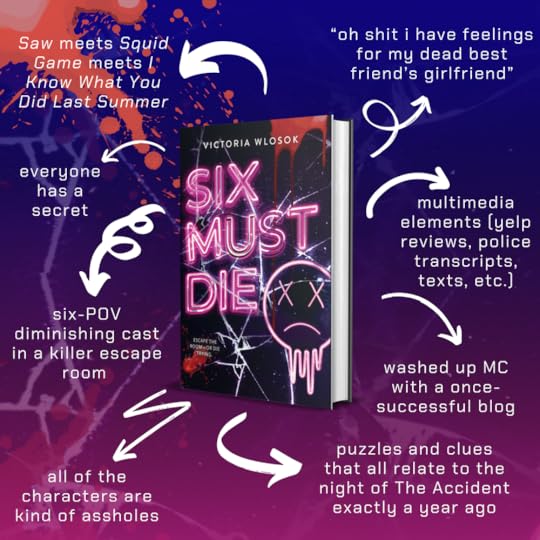
The truth is, I’m simultaneously incredibly nervous and also mind-numbingly excited for y’all to read this book. Six Must Die is definitely my most ambitious project to-date. It’s a dual-timeline, locked-room, diminishing-cast, six-POV psychological-thriller-slash-murder-mystery with an unreliable narrator at the forefront that unfolds entirely over the course of an hour. It features a variety of multimedia elements, including witness testimony transcripts, court documents, newspaper articles, blog posts, text messages, yelp.com reviews, and characters that you’ll either fall in love with…or be waiting with bated breath to see die on-page. It’s Squid Game meets Until Dawn meets Killer Book Club. It’s Five Survive meets One of Us is Lying by way of Secrets Never Die. It’s an intense character study wrapped up in a campy video-game-inspired narrative, it’s every intrusive thought you’ve ever had while locked in your local escape room franchise with people you’re not entirely sure how to feel about anymore, and it’s a book that took me five years to write.
And you know what? I’m so proud of it—despite the fact that it literally tried to kill me, several times—that I cannot wait to share it with you on March 10th, 2026.
(I’m also terrified that people will hate it, of course, because I’m an author and it’s always agonizing to go from the point where you’re obsessing over your brainchild and every minute detail within it and only you, your editor, your agent, and your in-house publishing team can see your changes, to where suddenly you have to let your book go off into the world and be judged for itself. That’s an occupational hazard, though, and one I’m more than happy to put up with if it means I get to keep telling stories about grieving gay girls who must fight to survive impossible odds. Those are the stories that I think we need more than ever right now.)
The idea for this novel came to me in April 2021, before I even started querying HtFaMG. And even though I didn’t truly start drafting Six Must Die (lovingly called BREAKOUT until my publisher said “enough of that” in mid-2024 and bestowed me with a proper title) in earnest until after edits on How to Find a Missing Girl were done in late 2022, that’s still a chunk of time to go from concept to draft, and that’s because I rewrote it like a gazillion times.
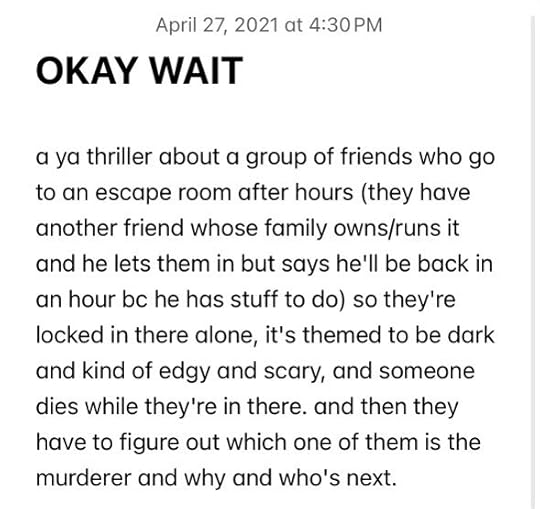
Thank you, trusty Notes app, for always letting me know just how long I’ve actually been working on a single idea. (Too long, to be honest, in this case.)
I don’t even know how many drafts of Six Must Die I went through to get to the Final Draft, but I know that I have four binders full of printed hard copies that may as well be different books, and that my physical ARCs are still significantly different from the edits I just turned in during pass pages. This is the longest I’ve ever spent on a single book before. If you do the math, you’ll learn I literally spent my entire undergraduate career working on this one novel. (If you went to UNC-Chapel Hill with me, you’ll know this is true based on how much agonizing I did at any given moment when asked about how my second book was going.)
Why did it take me so long? A lot of reasons. First, the plot of Six Must Die is super complex. I kind of realized I bit off more than I could chew on a technical level halfway through pantsing the first draft, and my editor and I went back to the drawing board a lot of times throughout the process to ensure the POVs worked, that the pacing was tight, and that the lines of reasoning throughout the book made sense. This was a super arduous process, but the rigor was worth it. In my opinion, it shows on the page.
Another part of the reason that it took me so long to draft this book was that I was a full-time student for the entirety of the time I was working on it, and because I’m fully financially independent, I also juggled three additional jobs while drafting to put myself through college. This one is self-explanatory, I think. (On a personal note, I’ve since graduated with distinction from UNC-Chapel Hill and now hold degrees in Business Administration and English & Comparative Literature with Honors in Creative Writing. Slay!)
But probably the largest part of the reason that Six Must Die took me this long is something we hear a lot about in this industry: luck and timing.
Let me say this: I am super lucky for how quickly my book deals panned out. I am incredibly thankful to be in this industry and so thrilled to be living out my childhood dream every day. But timing-wise, things moving as fast as they did for me in the publishing process increased the pressure and stress put on me as a debut author who had a guaranteed deal for her sophomore novel. Did I know this would happen at the time? Definitely not! Did it still impact me in a lot of ways? Absolutely.
To be a little more transparent: Six Must Die sold alongside How to Find a Missing Girl in a two-book deal to Little, Brown Books for Young Readers back in February 2022, during my freshman year of college, and LBBFYR bought it off a one-paragraph pitch that I sent to my agent as sort of a “hey, this is what I’m planning on working on next, okay talk to you in 20 years when the slow-moving submission process is finally over thanks baiiii.”
Well. If you’ve read my other blog post where I talk about the sub process with HtFaMG, it was insanely fast. I mean like, two weeks fast. So when Six Must Die sold, I didn’t have… any of it written, actually, except for the paragraph below:
BREAKOUT is I KNOW WHAT YOU DID LAST SUMMER X ALL YOUR TWISTED SECRETS
Six friends. Six secrets. One hour to spill them, or everyone dies.
When seventeen-year-old high school senior Steffi Lockstone invites her five friends to an escape room in an attempt to save their dying friendships, she’s just happy when they all show up. But once the door locks behind them and the game begins, Steffi and her friends quickly realize they’re being held hostage by someone who knows each of their dark secrets—including the biggest one they all share—and is willing to go to any length to make them pay for it.
So then we launched into edits for How to Find a Missing Girl, and I tried to keep drafting Six Must Die throughout that process, but the HtFaMG edits took up most of my brain power. It became more difficult to juggle both projects simultaneously than I thought it would be, and I kept needing more time for Six Must Die deadlines even after HtFaMG wrapped because the writing for my sophomore novel just wasn’t where I wanted it to be.
And man, it was so difficult to go through that. I’m a perfectionist and a people-pleaser who hates letting people down, and even though my pub was so lovely about giving me extensions when I asked for them, I still felt like a Big Fraud. I started questioning if I was even cut out for this whole “being an author” thing, and it felt like even if I’d managed to get published once, I wouldn’t be able to do it again.
You always hear about the goalposts moving in this business, but it’s so real, y’all. The only thing that mattered to me became finishing my sophomore book and finishing it well. I pulled more all-nighters massaging this germ of an idea into something viable than I ever did studying for my ECON finals, until the inciting incident morphed into a memory-loss-addled, newly Czech-American Steffi Zamekova insisting to herself that she didn’t invite her ex-friends to BREAKOUT Escape Rooms INC. after-hours… right?
This book is so twisty, y’all. It’s fun, too, despite all the challenges I faced while writing it, and I’m truly looking forward to it being out in the world. (I’m also super excited to draft more books without juggling Canvas assignments with publishing deadlines. Imagine!)
Anyways, now that you have all of that background, please allow me to officially present: Six Must Die!
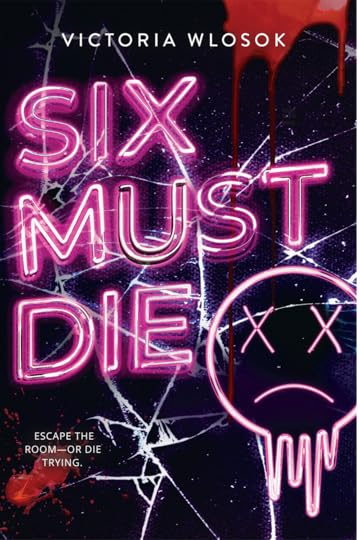
Perfect for fans of Karen M. McManus’s The Cousins and I Know What You Did Last Summer, this propulsive thriller follows a fractured group of friends as they fight to survive a killer escape room in rural Tennessee.
Twelve months ago, an escape room fire took everything from Steffi Zamekova. In just one hour, she lost it all: her popular blog, her close-knit inner circle, and her memories of the night that killed one of the group’s own… the charismatic (if infuriating) Matt Cesari.
On the anniversary of the bewildering tragedy, Steffi is still desperate to piece together what went wrong. So when she receives an ominous invitation in the mail summoning her to the new escape room across town, she seizes the chance for answers.
Reunited with her former friends, Steffi sees the game as a last chance to uncover the truth behind Matt’s death. But it’s soon clear that each participant has their own cagey reasons for accepting the challenge. And as tensions rise and the players are picked off one by one, it’s a race against the clock for Steffi to uncover their secrets and unlock her own memories before the game’s mastermind ensures that no one escapes the room alive.
Well, there you have it! If you’re an author and want to blurb it, please reach out to me because we’re currently looking for blurbers. If you’re a bookish influencer or friend and you want to read it early in exchange for an honest review, contact me via my contact form or Instagram DM and I’ll hook you up. And if you want to pre-order it now to make sure you don’t miss it when it releases on March 10, 2026, Barnes & Noble is currently having a 25% off sale with the code PREORDER25. The sale is for members-only, but becoming a member is free.
You can pre-order Six Must Die for 25% off from now until July 11th here.
Lastly, it’s important to me to tell you that Six Must Die is, at its core, a friendship breakup story. It’s about loss and grieving and how difficult it is to lose the people in your life who once meant so much to you as you get older, and the different ways in which we grapple with that loss. It’s inspired by (and in many ways, borne out of) the emotional pain of losing my own high school friend group.
And if you’ve ever experienced something similar, then this book is for you, too. ❤︎ ⋆˙⟡


September 19, 2024
A Year in Reflection: 12 Things I Learned from HTFAMG’s Debut
Confession time: this post has been sitting in my drafts since April 18, 2022. Although I swore I’d do better when I first ambitiously created a blog on my author website, I’ve unfortunately fallen into the same trap that plagues many of my peers in the industry. I created my shiny “How I Got My Agent” post and then… basically went radio-silent.
To be fair to myself and the Herculean amount of effort I put into running my socials, it’s not like I haven’t tried to stay relevant. My blog post graveyard is littered with working-title skeletons like “My Pitch Wars Experience” (I say, as we all sob in unison) or “Questions to Ask an Editor on The Call” (I never ended up publishing this one either, because I don’t think I’m the definitive resource to compile Editor Call questions. I’ve actually only had one Editor Call in my life, and at this point it was two years ago.)
Anyways. All this to say… How to Find a Missing Girl’s publication-anniversary is rapidly approaching. (It’s today, actually! Hi!) As I sit and type these words at an umbrella’ed picnic table outside of Lenoir Dining Hall on UNC-Chapel Hill’s campus, there’s a week to go before I will have been a traditionally published author for an entire year. Commence Operation Huge Freak Out, because… what? That’s wild.
I’m big on anniversaries. I’ve learned a lot from my debut experience, and I’m extremely lucky that I’ve been able to do a lot to advance my authorial career post-debut. I’ve been contracted (and paid) to lead nine virtual and in-person workshops. I’ve given presentations to high school and college clubs. Professors at my university have integrated me into their syllabi, and I’ve had the incredible opportunity to be able to travel to foreign countries to promote my novel (and release a translated edition in Slovakia) post-release.
So. Without further ado, here is the post that was once titled “How I Got My Book Deal,” which then became “How I Got My Book Deal: A How to Find a Missing Girl One-Year Anniversary Post,” which is now finally “A Year in Reflection: 12 Things I Learned from How to Find a Missing Girl’s Debut.”
TLDR: I wrote a listicle, with one lesson learned for every month I’ve been published. I hope it’s helpful to you.
lesson one: GETTING THE BOOK DEAL ISN’T THE HARDEST PART.Woof. How oxymoronic, right? How easy to say. Personally, I had an incredibly lucky submission process. I didn’t struggle to get my book deal… which is part of the reason I’ve struggled to write a blog post expressly detailing the process in the first place. My Sub Story, to borrow Kate Dylan’s amazing blog post series of the same name, would largely look like this: My agent had a great sub plan. We went out at a great time. The book had a great premise and fit the current market well. As a result of all those factors, one editor rejected the book, and then within two weeks, another editor took the book to acquisitions. It sold in a very nice two-book deal; everything submission-related was fast and easy.
But everything else that came after? Not so much.
If you’ve read my How I Got My Agent blog post, or How to Find a Missing Girl for that matter, you probably know I’m an anxious person. I agonize. And throughout the entire process of releasing my debut novel, I agonized. Probably way too much.
I had a great editor, a great agent, and a great publishing team all in my corner. But I agonized over edits, and over cover design, and over marketing copy, over the marketing plan, and just… I don’t think I was prepared, really, for how hard everything would feel. So I want to impart that to you. Getting the book deal is amazing. It feels so good. But all the real work comes after you sign the contract. So for all intents and purposes, no matter how arduous the journey, I’m telling you now what I wish someone had told me (even though it may not apply to you, if you’d had a particularly grueling sub experience): getting the book deal isn’t the hardest part.
lesson two: SOCIAL MEDIA ISN’T YOUR GOD.All of us breathe a collective sigh of relief.
Of course, there are definite benefits to being on social media. I have seen social media strategies employed strategically in ways that have worked and helped a book succeed; I have also seen efforts try and fail miserably. Here’s the thing: if you possess The Knack for social media, you likely already know it. You probably enjoy social media; maybe you even already run a few accounts of your own with a legitimate following. Mobilizing this following is great; it can help your numbers and make you look more appealing to your publisher. But a lot of the time, social media metrics are vanity metrics. They’re not actually indicative of sales; although your 20,000 followers may enjoy your content, only a handful of them are going to drop $18.99 MSRP on a full-length novel. And even if you do manage to mobilize a significant portion of your passive social media audience and turn them into paying customers, you will be able to move the needle only a fraction when compared to the Publisher Machine.
I can’t emphasize this lesson enough. I heard it all the time in the months preparing for debut—Only do social media if you enjoy it! Authors can’t move the needle themselves!—but I brushed off most of these comments, thinking I could make a tangible difference. I imagined myself as The Exception.
In a lot of ways (cough cough, vanity metrics), I was successful. I built a legitimate following of over 25,000 followers across a variety of platforms, with almost 11,000 followers on TikTok alone. I had high engagement; I interfaced with real customers and real readers. It felt exciting! I saw spikes in Goodreads To-Reads adds; the book climbed the ranks on NetGalley. But it still all felt quite ambiguous. How many of my To-Reads adds would actually translate to sales? How many NetGalley e-ARC requests were truly being accepted, and what percentage of accepted readers would actually 1) read the book and 2) review it early? I had no idea. And when my publisher ran a physical Goodreads giveway for HTFAMG, my To-Read numbers basically doubled overnight. All the work I had put in to edit content, create hooky pitches, and engage with my audience, and my publisher still out-performed me on a massive scale by simply… marketing my book with money. Imagine!
For this reason, social media is not your God. If you enjoy it, do it! You will probably move the needle slightly if you’re good at marketing; importantly, you will also make long-lasting friendships and connections online that you wouldn’t be able to cement otherwise. You may even get extraordinarily lucky. But even viral success online doesn’t guarantee sales. And being fully aware of that before debuting will help you to more accurately budget how much time you should devote to lip-synching to trending audios, and how much to spend… actually writing.
lesson three: TEACHING IS REWARDING AND WORTHWHILE.Giving back is one of my favorite parts of being in this industry. There’s a lot of gatekeeping in publishing—many authors have to fight tooth-and-nail through whisper networks, social media discourse, and bitter jealousy (or worse, outright derision) from their family and friends to even hope at learning the tricks of the trade in the bloodbath of tradpub. Once you have a book deal, though, you become privy to Valuable Information. It’s up to you to choose where, how, and when you share that information—if you do at all. But in my opinion, sharing your amassed publishing knowledge with others is one of the most rewarding and worthwhile ways to spend your time. I’ve built a platform on staying open about my journey to authordom—and the lessons I’ve learned along the way—and it’s allowed me to give back in a way that fills my soul. Teaching is rewarding and worthwhile.
Now, I recognize that not everyone is a teacher. If the thought of standing in front of classrooms, speaking to readers, or posting writing tips on social media fills you with the heebie-jeebies, don’t sweat. There are a lot of other ways to feel fulfilled in your authorial role besides positioning yourself as an expert on the world of tradpub. You could donate signed copies to fundraisers, answer reader emails, or volunteer with literary organizations such as Authors Against Book Bans… just to name a few examples. But the important thing is that you find a way to give back. Publishing is not all about you, and sharing your story—in more ways than one—is empowering for both you and your audience.
lesson four: COMPARISON IS THE THIEF OF JOY.It will be soooooo tempting to compare yourself. Constantly. Publishing is a business, after all, and humans are hard-wired to compare and contrast. You can easily fall into thought spirals and mental pitfalls within the entire process of debuting—she has a better cover, he had the largest advance, her book is climbing the NetGalley ranks and mine is falling, why didn’t I get a star from Kirkus when this book I hated did, why didn’t this author agree to blurb me when they blurbed XYZ—but fight against it. Fight as much as possible. Comparison is the thief of joy; if you want to have any shot at surviving in this industry, you need to re-wire your brain away from comparison as soon as possible. Recognize your feelings, allow yourself to sit with your emotions, and then let them go.
Publishing is not a race. A lot of it is predetermined; moping about it won’t get you anywhere. All you can do is put your best foot forward and write the next book. You have control over your own output in traditional publishing. Nothing else.
Also, be happy for your friends. Celebrate their wins. Freak out and geek out with them; encourage them to celebrate when they minimize their own accomplishments. It’s better to go through traditional publishing with a genuine support system—and though you’re not going to be able to be 100% supportive 100% of the time, do not let insecurities or jealousy destroy the relationships that will keep you grounded throughout publishing’s turbulent waters. A rising tide lifts all boats. Keep your eyes on your own paper, surround yourself with people who love you, and love them in turn.
lesson five: IF YOUR BOOK IS PUBLISHED, YOU ARE DEAD.Caveat: I read my reviews. Authors have wildly differing opinions on this; for me, and for my own mental health, I prefer to see what people are saying (good and bad) about my writing. If I can, I use the feedback constructively to write better books for my ideal reader. However, my thoughts about my own reviews do not breach containment. If you don’t know how to engage with something silently, for the love of God, do not read your own reviews.
Death of the author is real. If you read your reviews, be sure to stay out of reader spaces at all times. Let me say that again: If you read your reviews, be sure to stay out of reader spaces AT ALL TIMES. This includes venting about bad/nonsensical/bigoted reviews on your Close Friends story. It includes DMing other authors to complain about their or your negative reviews. It includes complaining about reviews in 250-people-strong Debut Slacks, using positive reviews in marketing materials without your team expressly pulling them for such, using negative reviews in marketing materials to entice readers into reading your book a-la Gossip Girl TV show, and liking reviews of your own book. Stay away.
There will be times where you are tempted to forgo conventional wisdom and write your way out of criticism. You will want to release a public statement telling everyone why You Are Right and They Are Wrong about all the feedback they have regarding your book and its pesky characterization and the unraveling plot and all the “boring parts”; you will beg for an Author’s Note in the paperback release explaining your reasoning; you will silently thank the heavens for the three or four readers who truly Understand Your Vision. Do not succumb to defense. The only words that matter in the end are the ones you put on the page. If your book is published, you are dead.
If you are anything like me, this will be one of the hardest lessons for you to learn post-debut. It will also be one of the most important. Commit to learning it early, and learn it well.
In the end, despite the messaging publishers love to send out to convince you otherwise, Goodreads and The Storygraph mean nothing. Reviews are not about you. They are not for you. Let that shit go, and write another (better) book.
lesson six: PRE-ORDER CAMPAIGNS WILL BURN YOU OUT.Pre-order campaigns will burn you out, so only take on as much as you know you can handle. (If that’s nothing, that’s fine too. Readers are getting more and more tired of pre-order swag, and only dedicated readers pre-order books from authors these days. It’s hard to reach most readers in order to tell them how important pre-orders are for sales—a lot of authors don’t bother. If you want to bother, that’s great! But all of us have only so many resources—energy, time, money, space.)
There are many ways to run a pre-order campaign or build hype for a book. You could run a street team; you could mail out art prints yourself to addresses you collect via a Google Form. Again, this is one of those do-it-if-you-want-but-it-probably-doesn’t-really-make-that-much-of-a-difference things. That was hard for me to stomach, again, because I thought I’d be The Exception. I ran a pre-order campaign for HTFAMG with art prints, and I also ran a promotional campaign for influencers where I sent each one a physical ARC, a custom keychain, a signed bookplate, an art print, and a book mark in a cardboard book box designed and customized to look like the book itself. It was a lot of work, and it cost a lot of money, and… this is the kicker… I don’t think it actually helped the book sales-wise. It may have gotten more eyes on HTFAMG than if I hadn’t sent the ARCs, and I felt proud of the personalized touch I gave to each influencer mailing, but many of the influencers I sent boxes to didn’t actually post about receiving the box (lolsob), so it was just a great way to 1) feel good about myself while 2) burning money. (Vanity metrics, rearing their ugly heads once again.)
Protect your peace, protect your energy, and only run what you can stomach. A pre-order campaign will not make or break your sales. It may give you a small boost, but the people who pre-order your book were likely going to pre-order it without a pre-order campaign. Another lesson learned.
lesson seven: PUBLISHING (IN GENERAL) WILL BURN YOU OUT.Publishing (in general) will burn you out, so ensure you have multiple methods of reigniting your passionate flames at the ready.
Self-care is important. I don’t think publishing is necessarily designed to kill you, but it may get close. Take time for yourself. Meditate. Journal. Practice mindfulness. Ensure you eat while on deadline, and shower, and sleep when possible. Don’t feel guilty for resting.
While writing, you may temporarily grow to hate reading. This is normal—or at least, it was for me. Give yourself the time and space to fall back in love. Engage with story in as many ways, shapes, and forms as possible. Listen to podcasts. Watch TV shows. Read craft books, ask a family member to tell you a story from their childhood, eavesdrop on the conversations of strangers. Give yourself grace. Allow yourself to work through ebbs and flows in your process. Throw out your entire process and go back to the drawing board. Loop in your team when you need more time or if you’re feeling stuck. If you want something publishing-related, ask. The worst anyone can say is no. And if they say no, give yourself a period to grieve. At the end of the day, you are the person who cares the most about your book. Identify the three things that are most important to you about your debut and allocate energy to accomplish those tasks—anything additional will stress you out and likely not be worth it. Learn to live with the background noise.
lesson eight: FIGURE OUT YOUR FINANCES EARLY.This lesson is hard for me to write about, because 100% of my book deal money went-and-is-still-going to funding my undergraduate education. Pro: No student loans! Con: No investments, no potential for growth, and no high-yield savings account. Oops.
Finances are tricky. What works for me may not work for you, and vice-versa. But what I do strongly recommend is to sit down and look at how your book deal money (AKA your advance) will impact you tax-wise. How often are the payouts? When are they scheduled? Should you invest in a Certified Public Accountant (CPA)? If you already have a CPA, should you switch from your current CPA to one who specializes in working with authors? How much of your office space will you be able to write off in taxes?
Also, open a high-yield savings account (HYSA) as soon as possible if you don’t already have one. The APR yields are much higher than with a regular savings account at a bank, and if you have extra money you want to put in savings, it’s better off in a HYSA than a regular savings account. The more you know!
Basically, do whatever is right for you. But choose to do something. Figure out your finances early, and make adjustments as needed. The nice splashy number in your contract is not how much you will be getting after your agent takes their 15% cut, you realize it’s split into 4 or 5 installments, and you get hit with taxes… so be smart and be aware.
Note: I am not a financial advisor, and this is not official financial advice. I am literally a college Business Administration major—but if you can make your life easier financially for as long as possible with book money, take the steps early on to do so.
lesson nine: JOIN YOUR DEBUT SLACK EARLY, AND ENGAGE WITH OTHER AUTHORS AS MUCH AS YOU CAN.All debuts typically have a Debut Slack to share news, ask for advice, and vent to each other. This is great. It can also be super overwhelming. As a result, I didn’t join my Debut Slack Group until much later in my debut process, and it made it harder to plug in to the community. (That being said, everyone in my 2023 Debut Slack was super lovely and welcoming! It just felt tricky to navigate on my end after friendships had already been formed.)
If possible, join your debut slack early. And engage with other authors as much as you can. The friendships, alliances, and acquaintances you make within your debut group are so important. To name a concrete example, my 2023 Debut Slack had a crowdfunded, shared Canva Pro account which we all used to create assets in the months-long slog of promo (Barnes & Noble Bi-Annual Pre-Order Sale, anyone?) leading up to debut. For a broke college student like me (see Lesson Eight above), this was invaluable. I also learned a lot from the other authors in the group—what was normal, what wasn’t, questions I should ask that never even crossed my mind—so I absolutely recommend using others around you as a resource and giving back to them in turn. If you ask a lot of questions, make sure you’re providing support and answers when you can! You don’t want to assume the role of a Taker in a large group, especially when you have so many other eyeballs watching your actions. People notice Takers, so strive to be a Giver, too.
lesson ten: THE WORST ANYONE CAN SAY IS NO.I’ve briefly touched on this lesson in Lesson Seven, but I’m giving it its own lesson because I believe in its importance: the worst anyone can say is no.
Are your cover concepts atrocious? Tell your publisher exactly what you want changed—and if that means going back to the drawing board entirely, make that clear. Do you want art you commissioned as the endpapers? A foil stamp? A sensitivity reader who matches a specific background? A Goodreads giveaway? More physical ARCs? Ask, ask, ask. The worst anyone can say is no… but they may say yes. And you may be surprised by the yesses you do get.
If you dream big and aim high, you may receive about 15% of your asks for your debut. There’s a lot that prohibits publishers cost-wise, and they may knock down many of your ideas, but asking is always better than not-asking. Send that email. You never know where it could lead. 15% isn’t a great metric at face value, but when you think about it in terms of adding a 15% value to your book, asking suddenly becomes more important.
Talk to your agent. Start an email with, “Hey, so I had this crazy idea—” and see where it leads. Don’t let yourself be talked out of your big ideas by your family or friends. Just ask, ask, ask. At worst, you’ll be labeled an Asker. This is usually not a bad thing, because it shows your publisher you truly care.
lesson eleven: DEBUT DAY IS WHAT YOU MAKE IT; BE KIND TO YOURSELF.On my debut day, I cried in the bathroom of the local independent bookstore hosting my launch. Everything was going well: My lovely conversation partner Serena Kaylor arrived early and in full pink glam. Chairs were filling up, and we were on track to be standing-room-only by the time the event started. I’d spent the day visiting bookstores to sign copies alongside my friends who flew in to support my launch; I spent an ungodly amount of time photographing the lovely bookies (book cookies!) I commissioned from the extraordinary Sierra at Novel Cookies. But despite everything, I was, once again, anxious. (Wow. Who could have possibly predicted this?)
Everything turned out phenomenal. It was one of the best days of my life, actually. I felt so loved and supported and seen—by my professors, by my peers, by my friends and family, by my online writing community. But there were definitely low moments within my debut day highlight reel. They didn’t diminish the highs, though, because I prepared for them. I allowed myself the grace to let the high and lows coexist.
Debut day is what you make it; be kind to yourself. Even if you don’t have any events planned on your debut day, I recommend getting out of the house and doing something nice for yourself. You don’t want to spend your whole debut day sitting at home, refreshing socials, trying to see how many Instagram likes you’ve gotten or how many reviews are trickling in. One of my creative writing professors, YA author Angela Velez, went to an art museum on her launch day. Her advice to me prior to debuting was to consciously unplug for the day. I listened, and only went on social media after the whirlwind of debut was over; it felt great to catch up on all the love I’d gotten before going to bed, and I fell asleep knowing I’d actually lived in the moment of launching instead of spending the majority of the day online.
lesson twelve: ONCE IT’S ALL OVER, YOU HAVE TO DO IT AGAIN.This is the most important lesson. It’s also the hardest one. After all the sparkles and butterflies and heart-emojis of debut day die down, it’s back to you and your blank document. Again.
Get started early, if you can. After the ceaseless promotion of your debut, it’ll feel cathartic to throw yourself full-force into a new world (or the same world, if you’re writing a sequel) and get back to creating. The long, terrifying, arduous process of writing—butt in chair, fingers on keyboard—is where the magic happens. It’s true alchemy. You’re making something out of nothing.
It’ll feel incredibly daunting at first. You’ll kick and scream and complain to anyone who listens that you don’t actually know how to write, that you’re probably not even qualified to be a writer, that the first book was a miraculous fluke (even if you’re written others prior to your debut) and you’ll never be able to pull off writing another one ever again. But you will. You will. And you’ll keep doing it, as long as you let yourself find the magic in the writing itself, as long as you do it again once it’s all over.
Because once it’s all over, you have to do it again.
And while you work on finishing your next book, the whole process—all the swirling anxiety, all the fiery hopes and wispy dreams, all the sparkles and butterflies and heart-eye emojis of launch day—will be waiting for you in the wings.
March 4, 2022
How I Wrote My Query Letter
Hi, dear reader! I haven’t made a blog post in a while, so I figured it was time for me to make another one. As you can see from the title, I’m going to share the query letter that got me my agent (and four other offers) for my YA thriller, in the hopes that it will help you in your querying journey (or simply give you more information about my book if you’re nosy like me!)
A couple of small notes before we dive in: I didn’t have a lot of people look over my query letter before I started querying. However, I had written about three other complete query letters before this one, and by then I was pretty sure I knew what I was doing. If you’re unsure about how to write a good query or what makes a query letter great, I’d recommend reading the blog posts over at Query Shark and Shelby Mahurin’s blog post about querying her debut novel SERPENT & DOVE. They were super helpful to me as I was perfecting my sub package, and I really recommend both blogs as resources.
(One small tip: I like to approach query letters by including three body paragraphs about the actual book that build up CHARACTER, CONFLICT, and STAKES, with another paragraph for housekeeping (this includes your TITLE, category, genre, comps if applicable), and a final paragraph for your bio. For more info about this, I’d once again recommend looking into the links above.)
Also, I want to note that I broke a few small rules with my YA thriller query. For one, I included the themes of my book (something which is usually frowned upon) in it, but I intentionally did this because I really wanted to highlight the fact my story had #ownvoices LBGTQ+ rep, since the MC is pan like me. I also kept my bio short and simple, but I did try and personalize the first paragraph of my query to each agent where I could.
I also want to note that in every query letter I sent, I wrote my salutation as “Dear [Agent First and Last Name].” This was because I didn’t want to accidentally misgender any of the agents I was querying, and I definitely recommend doing this in your own query letter, along with putting your own pronouns in your sign-off if you’re comfortable. Make sure to spell the agent’s first and last name correctly, though! :)
Now. Without any further ado, here it is: the query letter that got me my agent!
MY QUERY LETTERDear [Agent First and Last Name],
Seventeen-year-old amateur detective Iris Blackthorn hasn’t placed much trust in the Hillwood police department ever since they failed to find her older sister a year ago. Instead, Iris counts on herself and her two-employee-strong agency, operating from the shadows to track everything from cheating boyfriends to stolen essays. So when Heather Nasato—Iris’ ex-girlfriend, the Blackthorn Agency’s most valuable client, and the creator of a locally notorious podcast about Iris’ vanished sister—goes missing, Iris wastes no time in taking up the case. After all, the professionals have already botched locating one Hillwood girl.
At first, Iris sees Heather’s disappearance as a second chance—one with a time limit. With her eighteenth birthday only a month away and her sister’s old detective assigned to Heather’s case, Iris risks jail time if she gets caught interfering with another investigation as a legal adult. But then the Blackthorn Agency unravels something sinister: Heather didn’t vanish by accident. Someone wanted her gone.
Now, Iris and her friends must question everything they thought they knew about the town they call home before whoever made Heather disappear comes for them, too. Because with every step closer the sapphic teen trio comes to uncovering Heather’s secret, the closer they get to the people willing to kill to protect it. And with the clock running and threats looming around every corner, Iris must decide: fight the system to get the justice she couldn’t for her sister, or abandon the case of her life before she loses her own.
Told from Iris’ point-of-view with interspersed transcripts of Heather’s podcast episodes, HOW TO FIND A MISSING GIRL is an 80,000-word YA thriller that combines the whip-smart amateur detectives from A Good Girl’s Guide to Murder by Holly Jackson with the spunky format of I Killed Zoe Spanos by Kit Frick. It contains #ownvoices LGBTQ+ elements, themes of found family, and sharp-edged girls who often do more harm than good.
When not researching methods of murder, I’m a full-time student who drinks way too many cups of coffee.
Thank you for your time and consideration,
Victoria Wlosok (she/her)
###-###-####
@xvictoriawrites
October 1, 2021
How I Got My Agent
This is all still so bizarre to me, but writing this blog post (and creating this website) has cemented it a bit: I have an agent!
If you’ve been following my journey on Twitter, then you probably know I’ve been working towards this goal for a while. You write a book. You query that book. You get an agent. Simple, right? Except… not really.
So, here’s my very own blog post about my experience. I’ve split it into three overarching parts (the beginning, the middle, and the end, haha), where I detail exactly how I got my agent, including all the trial-and-error it took me with writing to get an offer of rep. (But if you would rather skip all of that and just get to my querying journey, that’s perfectly fine too! I’ve included some funky little stats at the bottom that you can look at in addition to that, because I always loved seeing those while getting ready for the trenches.)
Alright! Let’s get into it, shall we?
THE BEGINNINGI’ve always loved to write. My mom likes to joke I was writing before I even knew how to read, and I knew from a very early age (shoutout to all the five year olds out there with big hearts and bigger dreams) that when I grew up, I wanted to be an author. I attempted my first novel when I was nine, and I got about 12,000 words in before I eventually abandoned it. But that first attempt was monumental in shaping me, and it definitely gave me the confidence I needed when I decided to finally pick writing back up again.
It took a while, though. Throughout middle school, I strayed from that big dream I initially had. As I grew older, I somehow internalized that being an author was an unrealistic goal to have, and although I kept in touch with books (I read constantly, volunteered as a library assistant in my K-12 library, and consistently competed with my friends in Battle of the Books, which is one of the coolest school programs ever), I wasn’t actively trying to write them.
Enter high school. I was a wide-eyed freshman and didn’t wholly know what I was doing, but I somehow managed to find out our school had a Creative Writing Club. I attended that first meeting, sat in the front row, and latched on to the teacher’s every word. There were some other people there on the first day, but a lot of them didn’t return. I did, though. And slowly, I started writing again.
THE MIDDLENear the end of September, my Creative Writing Club teacher told me about National Novel Writing Month, or NaNoWriMo. He brought up the idea of attempting the challenge of writing a novel (defined by the program as 50,000 words) in a month, and I eagerly jumped at the opportunity. Alongside some of my friends who I (lovingly) pushed into doing NaNo with me, we each tried to write 50,000 words. And by the end of November in 2017, I had finished my first full-length manuscript—a 55,000-word YA coming-of-age novel-in-verse.
I’d love to say I did anything with that first manuscript, but I don’t even think I edited it. My best friend read it and loved it, I was satisfied with the fact I had entertained at least one person, and then I shelved the book and life moved on. To be completely honest, though, I didn’t know there was anything I could do with the novel I had just finished. (I also didn’t think it was publishing-worthy, but that’s a different story.) In 2017, I had never heard of a literary agent. I didn’t even know what an agent was. But (and I say this all the time) actually finishing that first book set me up to write better books later, much like starting a draft when I was nine set me up to try drafting again once I grew older. I didn’t know it at the time, but I was building up to something great. I was honing my skillset. I was learning how to finish things.
A year later in 2018, I did NaNoWriMo again. This time, I wrote 70,000 words of a YA contemporary fantasy in one month—and when November ended, I kept writing. This was huge to me because it was the moment I realized I could write a novel at any time, and not just during the month when everyone else was doing it. (Which I know is kind of a silly realization to have, but the notion genuinely hadn’t occurred to me until that moment.)
After that, I worked on that YA contemporary fantasy every spare moment I had. Researching, revising, editing, revising again. I would go to AP Statistics and write in the three minutes we had every day before class officially started. With each moment I spent in the world I was creating, I felt more powerful than I had before.
Then summer rolled around, and I played around with some more concepts. I wanted to write a sequel for my contemporary fantasy (in my head, I thought it would be a three-book-series, which is important for later), and I wanted to try writing the zero draft during the next NaNo. For some reason, though, I couldn’t write the sequel. 2019 was the only year I didn’t meet my 50,000-word minimum goal, and I felt super dejected about it until I realized why the sequel wasn’t coming along as well as it should—the first book wasn’t done.
Okay. Back to the drawing board, I thought. Surely we can polish the first book to be the best it can be first. (Surprisingly, this was a pretty genius idea on my part. If you’re a writer and you want to write a series, you shouldn’t work on any of the subsequent books until you’ve gotten an agent [and hopefully eventually a book deal] for the first book in that series.) I read what I had written. I changed parts, threw out parts, revised parts. I was still researching and editing and revising that first book until March of 2020.
Hang on. I actually think that deserves its own section, don’t you?
(THE PANDEMIC)I was on spring break with my family in March of 2020 when the news broke: there was a pandemic. Cool, I remember thinking. Maybe this extra week off (cue present-day us crying in unison) will give me the time I need to finally finish my YA contemporary fantasy and get it out to betas.
Well, that’s exactly what I did. And then none of them read it.
Okay, that’s an exaggeration. A LOT of my betas (read: friends from high school) finished my book, and I got a lot of serotonin from their comments in the massive shared Google doc I had emailed them all one-by-one. But even though I was super happy that people seemed to be enjoying my writing, very few of them were actually equipped to give me actionable feedback on how to make my manuscript better. I knew I needed a writing community if I wanted to improve, so I set out to find one.
(THE SEARCH)Although I finally felt like I had a book that might be worthy of being published, I wanted to make sure it was the best it could be first (which meant finding critique partners and beta readers, even though I didn’t know either of these terms back then.) At this time, I was thinking about self-publishing, since it was the only kind of publishing I vaguely understood.
“But Victoria,” you yell at me from the other side of your screen, “you have an agent now! Agents are for people who want to publish traditionally! What made you change your mind?”
Around the time I had first started doing NaNoWriMo, a family friend paid for me to attend a small writing conference held at my community library. There were a lot of local authors there, and one of them gave a seminar that was specifically about the publishing industry. During that seminar, the speaker said something that completely realigned how I was approaching publishing: you can always self-publish, but why not try traditional publishing first? You can’t do it the other way around.
When I read back over that in my notebook, it’s like a lightbulb went off in my brain. I needed to pursue traditional publishing first, especially if I wanted my books in libraries and bookstores (which I did). I started Googling things about writing, and I found out there was a huge writing community on Twitter. I made my own account in September of 2020, and then I slowly started getting acquainted with the world of tradpub. Somehow during this period, I also managed to stumble across Pitch Wars, and I eagerly took my YA contemporary fantasy manuscript and applied with it.
I didn’t get in. Not only that, but I didn’t get a single request. It could have been crushing, but instead I decided to dust myself off and keep pursing my dream. I emerged from the Pitch Wars application process with the beginnings of a writer community (including a few CPs and betas) as well as a strong foundational knowledge of how publishing worked, so I buckled down and sent off some queries with my new submission package. While I was doing that, I also kept working on the project I had tentatively started for 2020’s NaNoWriMo—a standalone YA thriller about a girl gang of amateur high school detectives that embodied everything I wanted to be.
With that manuscript, though, something clicked as soon as I started it. The girls in it were powerful and smart, and their ringleader reflected who I was and who I wished I had the strength to be. It helped that I was completely in love with the genre I was writing (One of Us is Lying by Karen McManus was the first book I devoured after a long reading dry spell in high school and prompted me to pick up everything from A Good Girl’s Guide to Murder to The Cheerleaders after that), and I adored being able to create a completely new world that I could fall into alongside my characters. This book just felt different, and I knew that I wanted it to be The One.
By the end of November, I had written 51,000 words of my thriller. I took a break in December to try something new and draft an #ownvoices middle-grade chapter book (which I finished at 18K as practice for a later project and has since been banished to a folder on my computer), and from January to February I wrote a 7.5K science-fiction short story about sapphic girls in space. (I actually entered Author Mentor Match with my MG chapter book in January of 2021, which I didn’t get into either. I did get into the RevPit #10Queries event though, which I found out after checking my spam when my Harvard interview called me to say I hadn’t followed up on his email. Oops.)
But in March, I opened up my thriller document again. I read everything I had written, and I decided it needed a major overhaul (as in, a complete rewrite). That was fine, though. I knew it had potential. This was still The Book I Wanted to Be Published With, especially since I was slowly starting to realize the YA contemporary fantasy I had spent the better part of two years on was something I should have never written in the first place. (I had actually gotten one full request for that MS from my first batch of queries, but I withdrew it and pulled the rest that same month. I was writing from a place that didn’t come from lived experience, and once I realized I didn’t want to speak over those who deserve to tell their own stories, I permanently shelved that book.) After that, there was only one thing that mattered: finishing my thriller. So once again, I buckled down and got to work.
I finished the first real draft of How to Find a Missing Girl in 30 Days (Or Less) on July 7th, 2021, after over four months of editing and rambling to the CPs and betas I had accumulated through Twitter and various pitch events/mentorship programs. She came out to 83,000 words and I loved her, but she still needed a lot of work. So I decided to rewrite the manuscript again.
On August 4th, 2021, I finished the second draft, and I was more than ready to just throw it into the querying trenches and see what happened. I had been ITCHING to query ever since November of the previous year, and I felt like my book was finally ready to land in some agent inboxes. It helped that one of my good friends and CPs was about to start querying her YA contemporary at the same time as me, and after I did a quick read-through and editing pass of HTFAMG, we decided to just go for it and query our agent lists at the same time. (She ended up getting her first offer four days after we queried our first batch, which was absolutely amazing. You can check out her blog post about that here.)
THE ENDIf you’ve gotten this far, I commend you. This is probably the part you’re truly here for, which involves how I, you know, got my actual agent (lol).
So, to recap, it was August of 2021, and I was officially querying the book of my heart. I can’t explain it, but things just felt different from the first time I had queried. Somehow, I just knew this book would be the one to land me an agent. (Don’t do this, but I actually only had two betas read the manuscript before I sent it out. A friend of mine refers to this as “pulling a Chloe Gong.” It’s probably a bad idea. Have other people read your work before you try to get rep.)
I queried 10 people in my first batch. And five hours after I sent out my first few queries, I already had a partial request in my inbox.
I screamed and ran to my parents, where I frantically waved my phone around and tried to explain between shrieks of joy that an agent was already interested in seeing my work. She wanted the first three chapters, and she said she was “really into” my opening pages, which I took as a good sign. When I finally calmed down, I sat down and sent her my materials.
The next day, I refreshed my inbox (something I started doing constantly the second I first sent out my queries) and saw I had gotten a full request from an agent I loved. He requested my full on a weekend, which seemed like a great sign since agents usually don’t work during those, and since I opened the email in a Starbucks it took everything in me not to panic until I got home and was able to send him my manuscript. Two days after that, I got another full request. I couldn’t believe it—it felt like I had struck querying gold. I started letting myself query a new agent every time I received a positive response, which meant that my initial 10 queries turned into 13 within a few days.
A few weeks passed, and rejections on my cold queries started trickling in. I still had a 60% request rate, though, so I was remaining cautiously optimistic. At times, though, being in the trenches felt like I was suspended in writing limbo. I would get a partial request from an agent that I loved, but then an agent with my full would pass with a form rejection and I would start crying in my school’s dining hall. (I also moved to college during this time, which made the whole process of querying somehow even more excruciating. Whenever someone asked me what I wanted to do with an English degree, I had to physically restrain myself from explaining how the publishing industry worked [and only occasionally succeeded.])
In September, though, I participated in #PitMad. (I actually totally forgot it was happening that day, as evidenced by my chaotic tweets here and here, and ended up writing all of my pitches on the spot in between my classes.)
And, by some miracle, all of them… did pretty well.
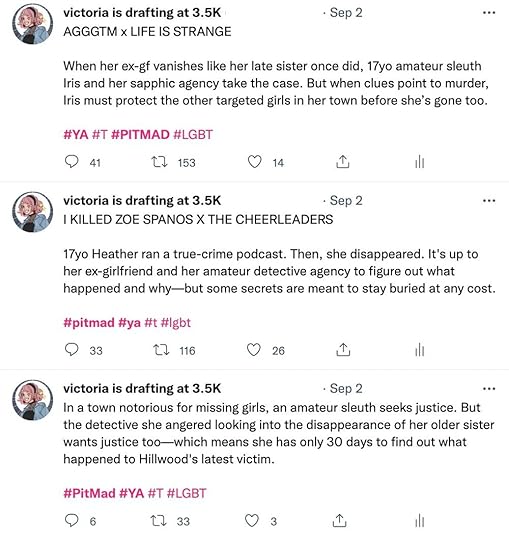
In total, I got fourteen agent and two editor likes across my three pitches on September 2nd. I was over the moon, especially since my past experiences with pitch contests had always been disappointing. I immediately vetted all the agents who wanted to see my materials, added which editors wanted to see my manuscript once I secured representation to my query letter, and sent out another batch of queries.
Within five days, I had five fulls and two partials out with agents. During that time, I also received an email from a book pitch contest I applied to earlier in the year letting me know that my YA thriller was selected for their longlist. Things felt like they were finally starting to happen for me, but I was still anxious. What if every agent who had my full hated my book? What if all those requests turned into rejections like they did with the Starbucks agent, and then I’d be back at square one? I was a nervous wreck, and I couldn’t stop checking my email. And then, as I was refreshing it while pretending to pay attention in my religion class a few weeks into college, I got an email back from one of the agents who had my full from #PitMad. And she wanted to set up a call.
Reader, I was absolutely vibrating in my seat. I could not pay attention for the last fifteen minutes of class to save my life, and as soon as I got outside I called my mom (who DIDN’T PICK UP???) and then my boyfriend to let them know the news. The agent had emailed me on a Thursday (September 9th, a week after I had participated in #PitMad and 35 days after I sent out my first batch of queries), and she wanted to call me on either the immediately following Friday, Saturday, or Monday. Initially, I wanted to take her call on Monday, but Ann told me to get it over with as quickly as possible (thank you Ann lmao), and so I emailed the offering agent back to thank her for her interest and schedule a Friday call.
I told myself not to freak out too much. Don’t count your offers of representation before they hatch. It might be an R&R, so stop daydreaming about what your author headshots will look like and pay attention in your English class. But still, there was that little voice in my head that told me this call was going to be an offer. And it wouldn’t shut up, no matter how hard I tried to tell it to chill.
On Thursday afternoon, I bit the bullet and sent out the rest of my queries to all the remaining agents on my list. And then on Friday, I had my call, and the agent was fantastic and lovely and officially offered me representation, and I thanked her and hung up and definitely cried a little afterward. Here it was: all my dreams felt like they were finally starting to come true. But I was also (still) massively anxious; things didn’t feel wholly real, so I kept quiet about the whole thing and sent out all my nudges while waiting for the requests (and rejections) to inevitably roll in.
The following Tuesday, I had another email in my inbox from a second agent who wanted to set up a call. I called my parents again (they picked up this time) and couldn’t stop my voice from shaking—I had received MULTIPLE offers of representation, which meant I would have to CHOOSE the agent I wanted to go with. I was super excited, but I also wanted to throw up. I hopped on the call with the second agent on Thursday, and it was also amazing. I felt so torn. How in the world was I going to pick who I was going to go with?
Then, a few hours after my call with the second agent wrapped up on Thursday, I got a third call email from a third offering agent. We had a great call the next day, and I immediately clicked with her and her vision for my story. But on Saturday, I got yet ANOTHER email from a fourth agent who wanted to call me to discuss my book. The decision was starting to get harder and harder.
We scheduled our call for the following Monday, but I was starting to get nervous. I already had four offers of representation, and there were still eight other agents who had my full and eleven who had my query with a deadline of September 23rd to get back to me by. (I was in an incredibly privileged position to have this dilemma, but I also want to emphasize that this entire process was incredibly emotionally taxing for me. I was barely sleeping and constantly breaking down in between my classes because of how stressed I was; something can be both amazing and terrifying at the same time.)
On Monday, I had my call with the fourth offering agent. At this point, I still had several fulls out with people who said they would get back to me by my deadline, but I was also feeling REALLY antsy. All of the agents I had spoken with so far (including the fourth offering agent!) were fantastic, but I couldn’t help but feel a sense of impending doom every time I looked at my email inbox. I was about to make a huge decision that would affect my entire career and the rest of my life—it was hard not to worry about making the wrong one.
My fifth offer came in on Wednesday, one day before my agent deadline. I had another Zoom call, and again the offering agent was fantastic. The remaining fulls I had out trickled in with incredibly kind rejections over the next few hours, and then the number of queries and fulls I still had out finally dwindled to zero as I marked the rest of them as CNRs. The rush was over. All my offers were in, and I would have to decide.
Or so I thought. On the day of my agent deadline, however, I got an email from an agent who had my full that I had already logged as a CNR (Closed No Response) into QueryTracker. It was 8:42 PM and she wasn’t finished with my book—but she wanted to talk after she’d read it. Could I possibly extend my agent deadline for her?
Full disclosure, reader, I LOST MY MIND. I hadn’t expected this agent to respond to me, and especially not when things were so down to the wire. Once again, this was truly my Chloe Gong moment—the agent who was now interested was Big, and she represented an author in my genre that I looked up to A LOT. But I just couldn’t bring myself to extend the deadline any longer. I didn’t feel like it would be fair to any of the other five offering agents who were waiting to hear back from me, and there was no guarantee that the big agent would offer anyway. (And even if she had, I wasn’t certain I would go with her.) So after crying and freaking out over the phone to Ann, who acted as my actual rock through my entire querying journey, I composed myself and wrote an email back to the final agent: I was very sorry, but I would not be able to extend my deadline.
And just like that, my querying journey was (actually) over. I had five offers of representation from some very incredible people, and now I had the privilege (and terror) of deciding who I was going to sign with.
The thing is, all of querying is terrifying. I was in the trenches with my second book for only 35 days before I got my first offer, but I had been in them beforehand with my first book for months. I knew how excruciating the entire process was, but the anxiety I felt about my agent decision was staggering. I was constantly sending emails, staring at stats on Publisher’s Marketplace, scouring agency websites, and just generally feeling a sense of Extreme Panic about the entire process.
Through it all, though, there was one agent who made me feel at ease no matter what was going on at my end. She was the third agent I had spoken to, the one I felt like I had instantly connected with, and the one who had consistently stayed in touch with me after our call. Through all of her kind, thoughtful, and considerate emails, I could just tell that I would love to work with her. I didn’t want to jump the gun though—after all, picking out an agent is huge!—so I reviewed clients and contracts all the way up to the end of my agent deadline. I wanted to give each person who offered on me a fair shot.
Finally, decision day rolled around. I tentatively drafted up emails to each of the incredible agents who wanted to work with me, and then I wrote my acceptance email to my agent.
As soon as I sent all of my emails, it was like this huge weight was lifted off of my chest. I knew that I had made the right decision, and I felt so excited at the prospect of working with the agent I had picked: Jessica Errera at Jane Rotrosen Literary.
From the very beginning, Jess’s vision for How to Find a Missing Girl really resonated with me, and I couldn’t be happier to be working alongside her to bring Iris and her team of sapphic amateur detectives to the world. :)
(THE CLOSING)So, that’s it! That’s my querying journey! It’s not a typical one, but it’s wholly mine, and I’m incredibly proud of myself for it.
I can’t wait for what comes next. I hope you’ll stick around to see it.
STATS:Book #1 (YA Contemporary Fantasy)
Queries Sent: 6
Partial Requests: 0
Full Requests: 1 (Withdrawn)
Offers of Rep: 0
Book #2 (YA Thriller)
Queries Sent: 47
Partial Requests: 1
Full Requests: 19
Offers of Rep: 5
September 21, 2021
My First Blog Post
Oh my gosh, hi!
I’m so happy you’re here. :) I hope you like my new website (I’ve been secretly working on it over the course of September), and I hope you like this blog as well! Although this first blog post doesn’t actually hold a lot in terms of content, I wanted to publish one so the “Blog” part of my blog didn’t look so empty.
Have fun poking around. I hope you come back soon!
~ Victoria