
John C. Baez's Blog
April 23, 2026
Learning from Nature with System Dynamics

We have left the Holocene and entered a new epoch, the Anthropocene, in which the biosphere is rapidly changing due to human activities. We do not need to decide to address these issues. They are already addressing us: grabbing us by the collar, so to speak. Our only choice is how to respond.
In the process we can learn a lot from nature, which has had far more time than human civilization to develop flourishing complex systems, and has successfully weathered many crises. Nature has many...


April 11, 2026
Feldspars
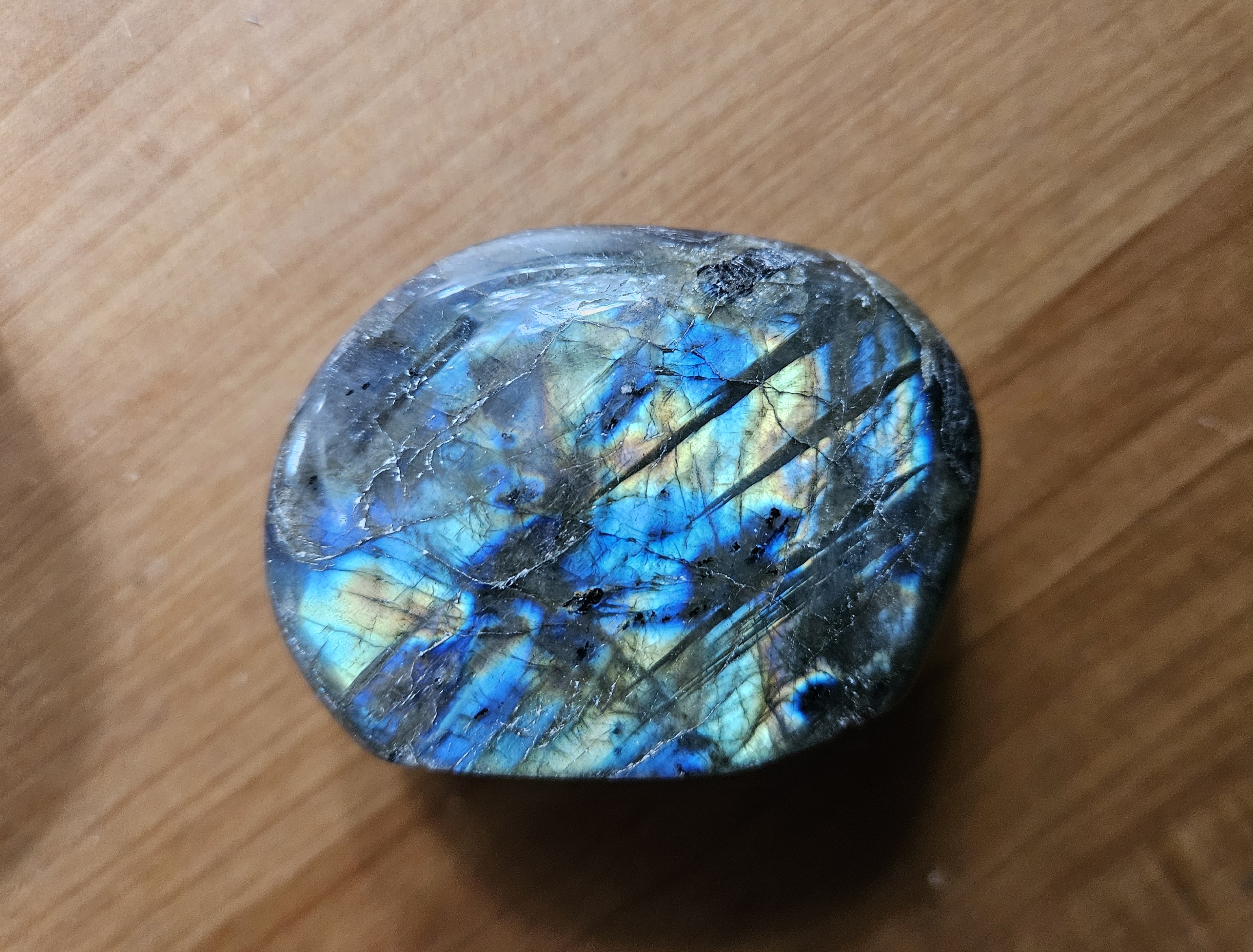
Returning from a trip to New Mexico to explore some Puebloan ruins, I picked up this beautiful chunk of labradorite in the town of Quartzsite. This mineral creates an eerie blue shimmer in the sunlight: a phenomenon called ‘labradorescence’. Reading up on it, I discovered it’s a form of feldspar.
60% of the Earth’s crust is feldspar, and I know so little about this stuff! It turns out there are 3 fundamental kinds:
• orthoclase is potassium aluminosilicate
• albite is sodium aluminosilica...
March 28, 2026
Vector Meson Dominance
I’m only now learning about ‘vector meson dominance’—a big idea put forth by Sakurai and others around 1960.
Here’s a family of 9 mesons called the ‘vector nonet’. Each one is made of an up, down or strange quark and an antiup, antidown or antistrange antiquark. That’s 3 × 3 = 9 choices.
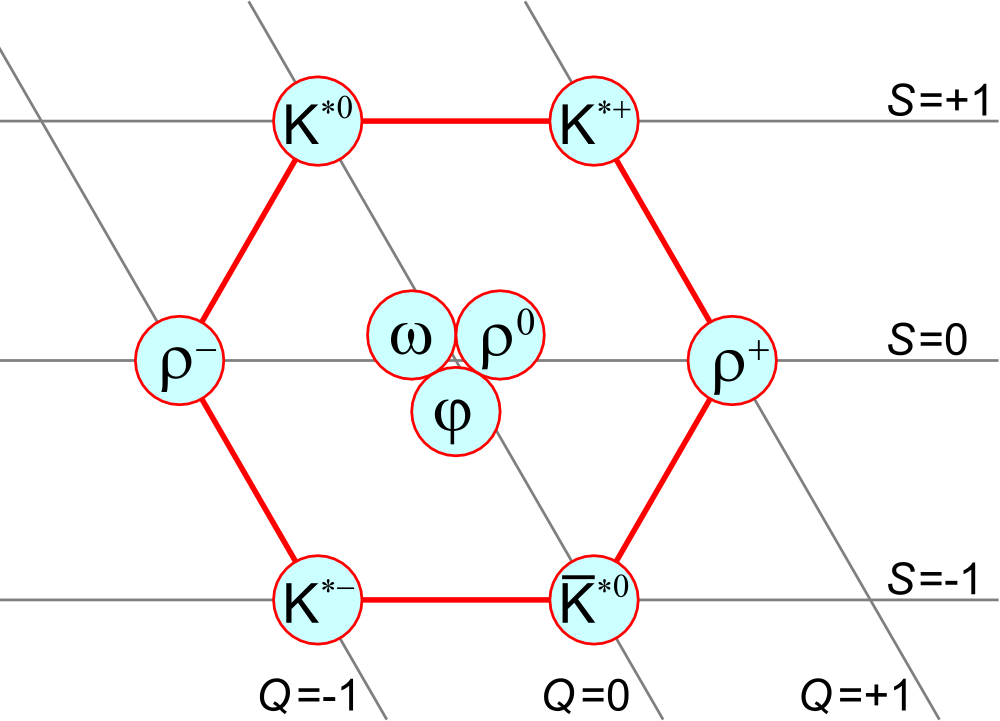
In this chart, S is strangeness (the number of strange quarks minus the number of antistrange antiquarks in the particle) and Q is electric charge. I’ll focus on the neutral rho meson, the ρ⁰, which has...
March 27, 2026
Geometry and the Exceptional Jordan Algebra
I’m giving a talk online tomorrow at the 2026 Spring Southeastern Sectional Meeting of the American Mathematical Society, in the Special Session on Non-Associative Rings and Algebras. The organizers are Layla Sorkatti and Kenneth Price. I doubt the talk will be recorded, but here are my slides:
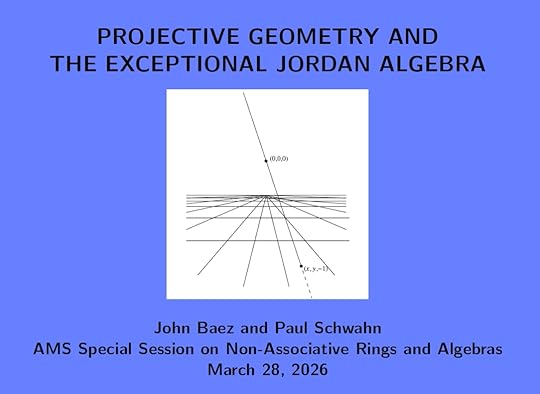
• Projective geometry and the exceptional Jordan algebra.
Abstract. Dubois-Violette and Todorov noticed that the gauge group of the Standard Model of particle physics is the intersection of two maximal...
March 23, 2026
Standard Model 7: Pions
This time I’m talking about pions:
Pions were a revolutionary discovery in the 1930s—part of the first wave of the ‘particle zoo’—but I’m explaining them as a way to work toward the math and physics concepts needed for the Standard Model.
As soon as the neutron was discovered in 1932, Heisenberg invented the idea of ‘isospin’, and the idea that the proton and neutron are two different isospin states of a single particle, the ‘nucleon’. This is why I spent 3 videos explaining the math of spin-...
March 20, 2026
The Agent that Doesn’t Know Itself
guest post by William Waites
The previous post introduced the plumbing calculus: typed channels, structural morphisms, two forms of composition, and agents as stateful morphisms with a protocol for managing their state. The examples were simple. This post is about what happens when the algebra handles something genuinely complex.
To get there, we need to understand a little about how large language models work. These models are sequence-to-sequence transducers: a sequence of tokens comes in, a s...
March 16, 2026
Standard Model 6: Pauli Matrices
Wolfgang Pauli invented his famous matrices to describe the angular momentum of a spin-1/2 particle back in 1927. You’ll see them in most courses on quantum mechanics. We tend to take them for granted. But where do they come from? Here I derive them from scratch!
There are lots of ways to derive them, and the method I use is not ultimately the best, but it’s the easiest—given that we already have a recipe to describe states of a spin-1/2 particle where it spins in any direction we want.
March 13, 2026
Standard Model 5: Spin-1/2 Particles
One of the simplest quantum systems is a spin-1/2 particle, also known as a spinor. If we measure the angular momentum of a spin-1/2 particle along any axis, there are two possible outcomes: either the angular momentum along that axis is +1/2, or it’s -1/2.
How is it possible for this to be true along every axis? Here I explain this, using the basic rules of quantum physics described last time. In particular, I say how any point on a sphere of radius 1/2 gives a quantum state of the spin 1/...
March 11, 2026
A Typed Language for Agent Coordination
guest post by William Waites
Agent frameworks are popular. (These are frameworks for coordinating large language model agents, not to be confused with agent-based modelling in the simulation sense.) There are dozens of them for wrapping large language models in something called an agent and assembling groups of agents into workflows. Much of the surrounding discussion is marketing, but the underlying intuition is old: your web browser identifies itself as a user agent. What is new is the capabil...
March 8, 2026
Un Bar aux Folies-Bergère

Manet’s famous painting Un Bar aux Folies-Bergère never appealed to me. But now I realize its genius, and my spine tingles every time I see it.
The perspective looks all wrong. You’re staring straight at this barmaid, but her reflection in the mirror is way off to right. Even worse, her reflection is facing a guy who doesn’t appear in the main view!
But in 2000, a researcher showed this perspective is actually possible!!! To prove it, he did a reconstruction of this scene:
• Malcolm Park,...
John C. Baez's Blog

- John C. Baez's profile
- 29 followers

