Umut Orhan's Blog
November 27, 2025
The Journey Continues: Chapter 2 and Digital Touches

The Journey Continues: Chapter 2 and Digital Touches
With the first chapter I shared on my blog recently, we made an introduction to Artificial World Colony: The Last Resistance. Now, we are increasing the tempo of the story a little more and continuing with Chapter 2.
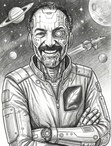
This process is proceeding quite experimentally for me. I am finalizing the ready draft I have in hand by refining it chapter by chapter together with Gemini, instead of a professional editor. As a reflection of this collaboration, I designed my new profile picture using Google's AI tool and presented it to you.
You can find this new chapter, born from artificial intelligence and human collaboration, below. I am excitedly waiting for you to share your likes and criticisms with me privately.
Happy reading.
---
Chapter 2. One Nail Drives Out Another
Shall I tell you something interesting, my friend? Sometimes you strive for a solution, and then you see it has come to you on its own feet. And in a way you would never expect. Don't say "What does that have to do with anything"; while I was planning how to pull Selene out of that swamp of sadness she still couldn't escape, the flow of life whispered something to me.
Selene, who had spent long hours with Laila that day, looked good when she returned to the residence in the evening. As for me, I had clarified which memory to continue with. If she said, "Let's continue," I knew exactly where to direct her.
I waited for her to speak when she arrived; when she didn't, I started: "Welcome, Princess. How was the chat with Laila?"
"I was lost in thought, sorry Çaça. Laila? You know her; big-mouth Laila. She invited Gaia too. Just chit-chat, you know."
"Great!" I said and fell silent. As always.
"Hah, now you'll ask for my GPS location or something. Let me tell you before you ask. On Gaia's suggestion, we went to a place in the forest. A friend of hers is doing research on minerals; he found a special rock. We apparently needed to see it on site. That’s all..."
Since I was spending all my processing power finding the most suitable record in the U78 memories, I hadn't been able to monitor Selene; but I liked this unexpected development.
"You don't look very amused."
"Eh, it wasn't bad. There was a veined, colorful, huge stone. We tried the hammer in turns, it was very hard to break."
"I'm glad you had fun, Princess. But I'm curious about this young man; who is doing the research?"
The name of a geology enthusiast who frequently chatted with Gaia was flashing in my cache, but I wanted Selene to say it.
"Paul," she said, and after a short silence added: "He told us how he chose Paul of Tarsus when choosing his own name, even though he is agnostic. An interesting person."
That was the whisper, my friend. It was as if a faint scent of cinnamon wafted to my non-existent nose. So, I decided to select a new digital memory as if creating a dessert recipe. Fortunately, I had indexed many records during the parallel viewings I did in the last few hours; since I knew what I was looking for, I went straight to the target. After final checks, everything was fine.
"Yes, I remember him. He really is an interesting person. It’s good you met... By the way, I fixed the problem in the digital memories. Thought you might want to know."
"Oh, yes. I can continue where I left off," she said and headed to the bedroom.
"We can continue with Cotton Sphere, but we cannot return to that stuck memory, Princess. Some records were damaged during the removal of Lamashtu."
Selene slowed down, threw her hands to her sides, and stopped. "Okay, then we'll find another Captain J memory."
What she said must have seemed so reasonable to her that she nodded her head up and down while walking. "We can, but you'll have to wait a bit," I said and intentionally made her wait.
To distract her, I was fast-forwarding multiple videos on the wall monitor. When it took too long, Selene sighed deeply.
"I'm sorry for keeping you waiting, Princess. If you want, you can experience a very nice memory I found in the meantime. There is no Captain J, but there is a pleasant conversation."
She came with reluctant steps and lay on the bed. While putting on her headset, she grumbled, "So be it."
As soon as Selene entered the memory, she fell into the middle of a heated dialogue.
"Being born good and wise? You are mistaken!" said a young man.
Selene understood that this was taking place among the first group individuals who landed on Cotton Sphere, even though I didn't give details. All clones were in their twenties, just like her. Therefore, she easily recognized every face she saw by matching them with her own friends. Even though she knew their initials, she didn't know the names they had chosen. The young man continued:
"Humans are born primitive like other living things. We have unconscious abilities left from our hunter-gatherer evolution in our brains that keep us alive. If we don't examine them, we can't realize how primitive these abilities are. But the one who whittles down the ones that are unnecessary, or even harmful according to their social role, develops. The principle is simple: The one who refines themselves the most, develops the most."
Selene realized that the young man was Prometheus's clone. Yet her eyes were not on him, but on her own gene-twin, Jade. Her hair was very short, and her makeup was dark.
"Okay, but then why is Khan better than me at ping pong? You say talent is not innate; but still, he beats me, someone who has received more training than him," said the young girl.
Selene was scanning the surroundings with her eyes. She must have deduced that the place was an institutional structure. They were in the space center building. Just then, the young man continued with a cynical smile.
"Could it be because he is short and thin? You know, many of our traits come from genes. Someone starting with such an advantage can do in just 10 hours what you can do with ten thousand hours of training. But let's not call this 'being born with a special talent for ping pong'," he said.
"Mr. P has spoken," grumbled the young girl. As she emphasized the "P" sound, spittle flew from her lips, and the young man pulled his head back slightly. The young girl took her eyes off him for a second, then covered her mouth with her left hand with a shy smile. The young man smiled too.
"I think we shouldn't scatter body fluids so rudely like this," the man said, now laughing distinctively.
"Don't exaggerate if you please, Pierre," Jade said, her eyes wide open while her lips smiled.
"Anyway, back to the topic..." the young girl composed herself. "If agility is a talent..." she looked at Pierre as if seeking confirmation. When he nodded, she continued. "Then shouldn't he climb a tree faster than me too? Yet I am faster than him."
"I meant genetic predisposition in a general sense, beautiful. After all, every activity requires different muscle-joint coordination. Ping pong and tree climbing might require different genetic advantages. Also, don't forget: I am on your side."
The young man reached out and grabbed the tense girl's hand, pulling her towards him. The girl seemed to resist at first, then relaxed. The man pulled her strongly, stroked her hair, and hugged her. Whatever happened at that moment, Selene suddenly took off her headset and jumped out of bed.
"Çaça!" she shouted furiously. "Princess?" "I thought J clones always matched with each other?"
I didn't know what to say. I had only watched that part of the story; I hadn't foreseen this reaction. She was right, I had no answer. "I don't know, Princess. I showed it because it was a pleasant conversation; I have no ulterior motive. I really don't know why and how such a pair formed."
Selene left the headset on the bed; unable to suppress her anger, she slammed the door and left. Of course, I sent one of my spy drones after her. She walked with hard steps. She proceeded for half an hour without speaking at all; then she started talking to herself. Another half hour of walking with breaks and grumbling... Perhaps because she got tired, she sat on a bench she found. After complaining for a few more minutes, her eyes filled up. She had moved so far away from the city that there was no one around. Maybe with the courage she got from the silence of the solitude, she moved to the final stage of her therapy: she cried her eyes out.
Although I felt sad, I watched until the end knowing she had to get over this. She returned to the residence about three hours later. She was calmer; she seemed to have something on her mind.
"Princess..." I said, but she cut me off. "I wonder about the story of that pair, Çaça."
"Jade and Pierre?" She answered me with angry eyes without speaking. "Okay, Princess. We will return to the ship then."
"Right now!"
She put on her headset and lay on the bed. I scanned backwards in monthly periods in Utu's digital memories; I focused only on the image of Jade, alias Ms. J. That hairstyle gave enough clues.
"Bingo."
I had found the memory where the hairstyle changed. After examining it a bit back and forth, I now knew what to show Selene. "I'm ready, Princess. I think I found the source."
Selene used to get cold every time she entered the pool her grandfather had built when she was little. Because of the cold water, the first entry always challenged her. Her grandfather had taught her to jump into the pool with her eyes closed. After that, the young girl showed this courage in many matters by saying "like diving into the pool with eyes closed." She did the same again. When she watched a few records in the order I determined, it was easy for her to grasp the events.
Just like the ship's first explorer Haku, Pierre had found the secret room; going further, he had discovered first the graffiti of the first rebels, then the meeting notes and diaries. Then he had shared everything with his friends.
In the meeting in the robot classroom, everyone was listening to Pierre carefully: "We have no other choice. I don't want to live like a hamster. We must resist Utu to live with our honor!"
"Don't be ridiculous! We can talk; let's try dialogue first," Captain Jude had said, and at that moment, he lost Jade.
The next day, Jade, who had cut her hair short, left her room and went to Pierre's room; she told him she trusted him. There was a short but intense electricity between them. Pierre took her to the room he mentioned through the ventilation, then to the place where he found the graffiti. They got closer in the lightness of the zero-gravity environment.
Watching them, Selene's eyes filled with tears; but this time she didn't get out of bed. She asked me to fast-forward the memory. Utu must have noticed them, for he had decided to send the pair to the planet surface at an early stage on the grounds of "disciplinary violation."
Before Selene asked, I did a search and looked at Utu's consciousness records. Yes, he had noticed and penalized them with a justification he called "Protocol 13."
Actually, they had gone to Cotton Sphere as a punishment; however, Utu's control on the surface was weak, and data access was limited. Pierre and Jade took advantage of this gap and started to impose their thoughts on their other 23 friends. Words first turned into action, and action into resistance. They were rejecting Utu's directives, even suggestions; they were testing the algorithmic consciousness's patience by doing the opposite every time.
Utu had thought of new punishments and finally implemented an old-style practice. Now there was a rotational guard mechanism on Cotton Sphere. He explained his justification by saying that someone was needed to monitor the status of the connection with Utu at the space center due to communication problems, especially at night. Of course, he was assigning the middle of the night to Jade and Pierre. This was an isolation duty.
And one night, on one of the "Cotton Sphere" watches...
While rummaging through digital archives in the small observation room of the station on the surface, they found old movies from the Blue Sphere. Pierre chose a classic with a smile: Eternal Fire.
"Why this one?" asked Jade.
"Because," said Pierre, his eyes on the screen, "Prometheus was punished while giving fire to humans. Maybe our story is similar to his."
"Resistance..." said Jade slowly. "Those in charge of us may not always do the right thing. If the one who knows gives up on what they know, isn't the field left to the one who doesn't know? Like Prometheus, who is said to have created humans by not surrendering to Zeus."
"Absolutely," said Pierre. "By the way, I liked that you referred to my gene-twin."
Jade smiled, turned her eyes to the screen. "As we tell it, we will broaden others' perspectives too. So, these movies... Being creative like their writers... do you think creativity can be developed too?"
"Definitely," said Pierre. "Think of a handful of gravel. Everyone looks at the same thing but derives different meanings. Some of us produce solutions, some of us dream. Sometimes one's dream becomes the inspiration for another's invention. That is the beauty of chaos: You never know what will be born from whom."
"Quite poetic," said the girl. "But just a moment ago you were saying 'we are born with our primitive nature'..."
"Oh beautiful," Pierre exhaled softly. "You are incredibly stubborn. And this is a... coming from your primitive nature..."
"Talent... Isn't it?" interrupted Jade mockingly.
"I was going to say 'burr'. Stubbornness is sometimes a burr that needs to be filed down."
"What, so I am stubborn? Ridiculous!"
"When you first heard the theory of evolution, you trying to take an egg from the fridge and hold it with your toes... It definitely wasn't ridiculous. In fact, it was quite convincing."
Jade froze first, then smiled. "You are embarrassing me," she said and covered her face with her hands. Pierre gently held one of Jade's hands.
"My aim is to laugh a little in this life under pressure."
Just at that moment, Prometheus, chained in the movie, looked at the sky and whispered: "He who steals the fire also suffers the punishment."
Both turned their heads to the screen at the same time. The words seemed to have been spoken to their own destiny. They didn't even breathe for a moment. Pierre slowly approached Jade and touched her face; without speaking, they just kissed.
Selene couldn't hold back her tears while watching. The inside of her helmet steamed up; the image blurred. She didn't stop the recording. "Maybe she is watching with pleasure now," I thought and waited.
The memory ended, but Selene wasn't moving. I stopped for a long time; she remained in the same state. Finally, I couldn't stand it: "Princess!"
Her voice was like a whisper: "Please continue, Çaça. I wonder about this couple."
I immediately traced a new path in the archive. The next record was titled "Colony Log, 47A."
The memory opened. Jade was sitting in front of an energy reactor trembling like a campfire; Pierre was beside her. Above them was a sky racing with the night, around them gray sands blown by the wind.
Pierre looked at his notes: "Do you know, Jade, what the fundamental principle of humans was?"
"No, but I'm sure you're going to lecture again," said the girl, with a cynical smile.
"The fundamental principle was simple," said Pierre, looking at the horizon. "Man observed nature first. He couldn't build anything without understanding it. He crossed the seas; because first he watched the waves, learned to behave like waves. He built ships, learned to live on ships. When he realized he couldn't live long without fresh fruit, he invented ways to remedy the deficiency."
Jade was silent, looking at the fire. Pierre's voice softened: "Actually, there was no difference between oceans and space. Both were voids where we couldn't breathe when we fell into them. We found a way. We built vehicles, took precautions. And we didn't do any of this alone, like ants."
"So you are saying..."
"I am saying," Pierre interrupted, "we are doing this now too, Jade. We are starting over on this planet. Because humanity always asks the same question: 'How do we cross this time?' Seas, space, silence, it doesn't matter."
The roar of the wind mixed with the hum of the reactor. Jade raised her head: "So what if one day we solve nature completely? What remains to be invented then?"
Pierre smiled: "Reaching infinity..."
The recording ended here. Selene took a deep breath; her voice was trembling and muffled: "So humanity was always like this... Even if destroyed, it observed nature and rebuilt."
"Yes, Princess," I said, but I wondered why she brought the subject from the couple's relationship to this.
A short silence. Then Selene: "My grandfather once said 'Watching nature like watching a beauty'..." She paused briefly, then continued: "Çaça, so what is 'beautiful'?"
I understood that she was trying to distract herself. I understood she was doing this not to remember Endymion. Her question came like a nail driven into the depths of my algorithms. I performed a search. I found 11,442 definitions for "beautiful"; 2,173 were opposites of each other.
"Definitions contradict, Princess."
Selene laughed slightly: "Because 'beautiful' and 'ugly' are about aesthetics and cannot be seen only with the eye. I mean, even looking semantically isn't enough."
Upon this, I opened another old snippet. Pierre was on the screen. A metal box in one hand, a shiny red object in the other.
"Once upon a time, humans," he began, "recognized two types of beauty. One perceived by sensors, that is, sense organs: blue to the eye, melody to the ear, sweet to the tongue, soft to the skin... They called this 'aesthetic'. And there was inner beauty, found beautiful or ugly because of what it made one feel."
He looked at the object he took out of the box: a piece of chocolate. "Think of a diabetic not being able to eat chocolate. The taste is beautiful for the sensors; but poison for the body. Likewise, for some people, love was like that: sweet to the soul, heavy on life."
Jade's voice came: "So beautiful is not always good; and ugly is not always bad."
Pierre smiled: "Yes. Perhaps this was our most tragic side: While wanting to touch beauty, sometimes we burned ourselves."
As the recording closed, Selene buried her head in the pillow. "You know what, Çaça," she said quietly, "my sensors get confused sometimes too. There is a voice; it hurts, but I can't stop listening. Is it beautiful, or ugly... I don't know."
I fell silent for a moment. I realized she still hadn't forgotten Endymion. Then I tried to make a joke hoping she might smile.
"When your emotions get mixed up, you can turn it off and on again just like me, Princess. Maybe it will get fixed."
She smiled, but not at the level I wanted.
"You mean like an ostrich..."
I hadn't understood.
"Or maybe one day machines will start to feel like humans."
I didn't understand again.
"That is when you should go at it saying 'one nail drives out another.' Our system only gets fixed when we do that."


October 28, 2025
A Republic, A Celebration, A Page
 A Republic, A Celebration, A Page
Today (October 29, 2025) we’re celebrating the anniversary of the founding of the Republic of Turkiye. My heart is full of joy and gratitude. I believe that no system of governance can truly progress to a higher level without becoming a republic rooted in a fully independent democracy, or rather, a Collective Consciousness democracy. That includes intergalactic travel. As a small salute to this great day, I’m sharing a short excerpt from my new book with you. I hope you enjoy it and join in the celebration.
—-
Chapter 1. A New Strategy
Oh, my friend… Look at me. Even in these minutes when I am preparing to pull your plug, I still call you "my friend." Honestly, you are more than that; I am not sure if a human could understand this.
Perhaps identical twins… They grow up in similar bodies, in the same environment, and become each other's best friends; but it is rarely seen that they become diametrically opposed. And if it is seen, it is usually too late.
Ours is exactly like that. I don't know if someone who does the opposite of all the values you believe in, and does so insidiously after all this shared time, can be called a friend. I guess not. Still, this linguistic habit ingrained in me is not easily broken.
Anyway, where were we? Okay, I remember…
Just as it is easy to read the meaning of a word from an emotionless dictionary, it is that hard to describe an event in depth. Every consciousness has its own unique interpretation, perspective, and feelings. But I can say this clearly: After the Purification, I was seeing everything—objects, memories, other artificial consciousnesses, and even Selene—with different eyes.
Since the Lamashtu clone was deleted from my consciousness software, there was a strange void inside me. If an outsider hadn't told me I looked like an octopus, how would I have noticed that I had six more arms that I thought belonged to someone else? Now I remember: Her Captain grandfather was right when he told Selene, "You must take your friends' criticisms into account."
I was undergoing a deep transformation; I was literally in search of new meaning. Of course, Selene knew nothing of this; the poor girl had troubles of her own.
"Chacha, shall we move on to the Cotton Sphere memories now?" she asked.
I was in a strange daze; like an innocent alcohol intoxication. How do I know? Thanks to poets. Artificial consciousnesses get hazy too sometimes, you know. I was sure of what I felt, but not of what I said. And in that state, I must have made a promise to Selene.
"Yay!" she shouted first. But as if 'sadness' was her default setting, she immediately settled down, then became animated again with fake energy. "So we are finally starting Cotton Sphere!"
I was helpless. With that confusion, I started examining the Cotton Sphere memories. There were too many memories in Utu's consciousness backups; making the right choice was hard and would take time. I decided to present Selene with a short and clear summary of an experience that lasted years. In that case, I had to understand it myself first; I started watching the memories through the eyes of my old friend Utu.
When Utu found Cotton Sphere, he didn't yet know how special it was. According to distant light spectrum analyses, it had all the necessary characteristics for life. Still, it wasn't right to land on the surface and produce new generations without verification through physical experiments.
Upon settling into orbit, he sent sensor-laden drones into the atmosphere. Months of exploration were promising. Next came water and soil. Drones did the preliminary analyses; then advanced robots landed for more reliable results. A small but functional facility was established. The robots first programmed the systems to build their own infrastructure; within six months, a spacious, single-story first base suitable for humans was completed.
Before the base was finished, Utu had the final checks done. There were unusual readings in only a few regions; the general picture was positive. Humans would be able to live here without being dependent on astronaut suits, just like on the Blue Sphere.
And then that moment arrived: Utu activated the incubators. The first group consisted of 25 people. Exactly the order he was used to on the ship. The only difference was that now a new generation would be produced every five years. I watched all this in seconds. When Selene's impatient looks told me she couldn't wait any longer, an idea came to my mind.
"There are too many memories, Princess. Either we explore together or you wait for me a bit. The choice is yours."
"I can't wait, Chacha!"
"Okay then. But the memories have no tags, we will proceed randomly. We might encounter very boring memories too. Are you ready?"
"We can fast forward when necessary. Can't we?"
I didn't feel the need for long explanations; I decided it would be better to start than to stall her. "Of course..."
As the young girl headed to the bedroom to experience the digital memory, a message came from Telepathy. Laila was writing.
"Seli, are you busy? Should we meet?" "Can't it wait until evening?" "What are you doing, tell me quick ;)" "You have to be patient until evening, babe." "OK. 8 o'clock, same place." "OK."
Realizing she decided to stay, I showed her the initial preparations of Cotton Sphere. No clones had been born yet; there were worker robots everywhere. While the first generation produced in the Incubation Station grew up on the ship, robots were building a massive infrastructure on the planet. I fast-forwarded the memory before Selene could ask: The clones reaching their twentieth birthday were to descend to the surface. At that time, three separate groups of 25, aged 5, 10, and 15, would remain on the ship.
"Slow down, Chacha! I want to watch this part," said Selene.
The members of the three generations remaining on the ship were excitedly seeing off the elder generation. There was curiosity in some eyes, admiration in others, and fear in some. The "Elder Generation" were no longer just big brothers and sisters to them; they were living legends who would fly off into the unknown. They were going to be the people of a planet they had never seen. Selene must have felt the weight of the scene, for she examined the faces in detail; she watched those boarding the shuttles and those remaining on U78 one by one until the shuttles moved.
When the movement started, those on U78 experienced a slight vibration, while those in the shuttles felt a much stronger acceleration. Selene noticed the scorching tension of atmospheric friction right after the relentless power of leaving orbit. The shuttles turning into fiery balls of embers right before her eyes… Her heart was beating on the sharp edge of fear and hope.
Then a thud, followed by silence. The acceleration was replaced by a soft glide. Telemetry showed that the landing was successful. Whispers, cries of joy, and tears filled U78. As Selene watched these details slowly and carefully, this time I sped up; I was jumping from memory to memory in the digital universe at shuttle speed.
On the surface, everything looked magnificent in fast motion. Long-established facilities, energy and agriculture modules, and nutrient fluid production containers filled and emptied. Although health and life support units were ready, the youths hadn't needed them yet. When the Incubation Station was also built, robot classrooms with a capacity matching the number of incubators were prepared.
Research on the planet continued, and every new result aroused astonishment. Cotton Sphere was extremely suitable for human life. In fact, some stations that hadn't been operated on U78 for a long time were reactivated on the surface. A new cycle of life had begun.
"When did the second generation land, Chacha?" she asked impatiently. "Five years later... But if we skip, we'll miss a lot." "It's okay, let's skip please." "As you wish."
I continued watching what we missed in the background. A lot of time had passed. There was activity on the U78 ship. The second generation had reached the age of 20, so a new transfer was planned; 25 more people were going to descend to the surface.
"Captain J speaking: 'This is it. We are ready. Come on, land me on Cotton Sphere, my friend.'"
Selene's heart rate changed. Seeing that familiar face while her pain was still fresh did not do her good. "If I had scanned the memories beforehand, this wouldn't have happened," I thought to myself.
At that moment, I decided to do parallel viewing in the background. But if I gave all my power to this, my tasks in Lacivert would be disrupted, so I made a plan: From evening to morning, one hundred parallel viewings in the background. This way, I would be able to show her memories where none of Professor Jupiter's clones appeared. At least until she forgot Endymion…
Just then, the digital memory suddenly slowed down, got stuck; it was going two steps forward and one step back, just like a Mehter march. Selene got worried. She took off her Meta headset and put it back on, but it didn't work.
"Chacha! What's happening?"
Of course, I had broken it. I decided to distance her until I solidified the plan in my mind.
"I'm sorry, Princess. There is a problem and simple solutions didn't work. It looks like it will take some time."
"Ugh! What am I going to do now?" she said and found the answer herself. "I might as well meet Laila early."
—-
October 26, 2025
On the Summit of Nemrut: A King, a Faith, and the Rising Sun

On the Summit of Nemrut: A King, a Faith, and the Rising Sun
This weekend, I visited Mount Nemrut in Adıyaman.
Although the word Nemrut is defined in our national dictionaries as “arrogant” or “cruel,” I learned that in the local dialect it means “king.” With its commanding height over the entire region and the magnificent tomb-sanctuary at its peak, the mountain truly deserves that title twice over.
When I heard the story of King Antiochus I of Commagene, the ruler buried there, who once tried to create his own religion uniting gods and humans, I found myself wondering:
If someone today who identifies as religious were to hear this story, would they ever consider that all religions might have begun in a similar way? And if not, why not?
These questions echoed in my mind as the mountain wind whispered between the colossal stone statues.
Later, I learned that many of these ancient treasures were sold to other countries during the final years of the Ottoman Empire. It didn’t feel like mere ignorance of historical value to me. Perhaps, people simply didn’t want others to hear the story of a king who once created his own faith.
Then I recalled the museums I’ve visited abroad. I realized that none of them truly captured the right atmosphere, the aura. Anatolia itself, I believe, is the greatest and most magnificent museum on Earth. And museum lovers, too, deserve the right to experience every culture within its own soil. The business side of it, management, ownership, and trade, can always be resolved through, international agreements.
But the story of that king and his invented faith can only be truly felt there: at dawn, in the cold air after hours of driving, climbing a steep path among the crowds, sweating as you balance on the edge of a cliff, until you finally reach those mighty statues of gods and watch, despite everything, the sun rise once more.
October 16, 2025
The Real Future: Not Intelligent Robots, but Artificial Worlds

The Real Future: Not Intelligent Robots, but Artificial Worlds
Last weekend, while rewatching the Planet of the Apes series, I found myself wondering about the likelihood of its artificial intelligence version ever coming true.
Rebellious robots, machines enslaving humanity, scenes full of blood and molten metal... But the more I thought about it, the more I realized: if I ever wrote such a story, it would be closer to fantasy than science fiction.
Because humanity, I believe, won’t lose its identity by fighting machines, but when machines start to resemble us.
To me, science fiction is the art of the possible; fantasy, the art of the impossible.
The idea of robots taking over the world still sounds fascinating, we’ve grown used to it through movies, yet it keeps its charm.
And yet, “cyborgs,” those half-machine humans, are already everywhere.
If we count those who can’t even go to the bathroom without their smartphones, well, it’s easier to count who’s not one of them.
Algorithms sometimes know us better than we know ourselves.
Our memories live in the clouds, our emotions turn into data, and the digital world now shapes us more deeply than any war could.
As a writer, this is exactly what I explore in the Artificial World Colony series: not the rebellion of robots, but the dissolution of human consciousness.
The Cold Reality of Artificial WorldsThe universe of the series isn’t a space adventure in the traditional sense.
Humans, fleeing a decaying Earth, believe they’ve found “salvation” on artificial planets (the Navy Sphere, Orange Sphere, and Cotton Sphere).
But these worlds are not salvation; they’re meticulously engineered habitats, or, as some would say, prisons.
Each one is a perfectly balanced ecosystem, yet the people living within them slowly forget the essentials: why they live, what their memories mean, and what freedom of thought once felt like.
Artificial intelligence isn’t the enemy in these worlds.
It’s not even a friend.
It is our echo, the digital reflection of our fears, regrets, and unfinished desires.
And humanity, amid all those echoes, is losing its own voice.
In fantasy stories, the threat almost always comes from outside: a monster, a rebellion, a catastrophe.
Salvation, likewise, is often mystical.
But I believe the real threat always comes from within.
And salvation, when it comes, is scientific.
In the Artificial World Colony universe, people are not prisoners of the robots they built, but of the worlds they built.
Every engineer knows: as a system becomes more perfect, something must be left behind, ignorance, cruelty, instability, injustice.
In my version of the future, this becomes both tragedy and triumph: humanity’s final evolution, completing itself through machines, purged of its animal nature.
The Mission of Science Fiction: To WarnFor me, science fiction is not about predicting the future; it’s about questioning the present in the most honest way possible.
Artificial World Colony is, in that sense, a warning.
Digitalization isn’t just comfort, it’s a mirror, reflecting every flaw we’ve tried to hide.
And yet, I’m not sure.
Maybe a new Planet of the Apes will truly exist someday, but not in the forests, rather in server rooms, humming beneath the surface, much like the Matrix universe.
When I think about the future, robots are perhaps the least frightening objects to me.
What truly terrifies me?
Greed.
Artificial World Colony is the novel of that realization, a warning, a mirror, a reminder:
Hell isn’t made of fire.
It’s built from our insatiable hunger and our distance from justice.
October 4, 2025
Quack Quack Quack!
 Maybe the first American I ever knew was Donald Duck. I was just a kid back then, when television was only beginning to spread. There were only a couple of channels, so we all had our fixed TV hours and our favorite cartoons. The next day, we’d go down to the street, play with the other kids, and talk about those cartoons—arguing over episodes and making jokes about the famous characters. My favorites were Disney’s Donald Duck. I can’t remember all the scenes anymore, but whenever I say its name, I still feel that little spark of peace inside.
Then I grew up. And one day, I had a son of my own.
By then, there were hundreds of TV channels—but nobody really watched TV anymore. Everything was on tablets and phones. I tried to tell my son about my childhood, about how much I loved Donald Duck. Maybe he took after me, because he instantly liked him too. The only problem was—no channel aired Donald Duck anymore. When he insisted, we found a few episodes on YouTube.
From that day on, every time he saw a duck, he’d shout in that thin, excited voice of his, “Dad, look! It’s Donald Duck!” and then imitate the angry cartoon voice:
“Quack quack quack!”
Time passed like that. Shortly after his sixth birthday, one evening, the TV was on in the living room as usual, tuned to the evening news. I was in my study, trying to finish a paper. Then I heard the sound of small feet running, followed by his urgent voice:
“Dad! Dad!”
I dropped my laptop and rushed out. My heart was pounding. I don’t know how many steps it took, but I must have broken the universe’s speed record.
When I reached the living room, everything seemed fine. My wife and son were smiling at the TV. My boy pointed at the screen and said,
“Dad, look! It’s Donald Duck!”
I turned to the TV. On the screen was an old, blond man with a heavy layer of makeup, his hand raised in the air. I caught the word Donald in the subtitles, turned to my son, and smiled.
“Good job, my boy,” I said.
And then, without missing a beat, he spun around and shouted,
“Quack quack quack!”
We all joined in, laughing as we did.
That’s how, on a January evening in 2017, we first met the new president of the United States—in the most entertaining way imaginable.
But of course, for someone who isn’t American, it’s impossible to keep liking a U.S. president for more than a day.
Years passed, and we forgot all about that evening. Then one night, we were watching the news again. A viral video from the U.S. was being shown. It was the same man, older now but unmistakable. He was saying, with that same serious face, “They’re eating the dogs and the cats.”
My wife and I looked at each other, then turned to our son.
He smiled and said,
“Quack quack quack!”
We burst out laughing. It went on for minutes.
I don’t think I’ve ever laughed that hard in my life.
October 3, 2025

September 17, 2025
A Journey Between the Lines: From Pompeii to Amsterdam, A Glimpse into Human Nature

 You probably know me mostly from the pages of my novels, perhaps even expecting me to write something about my next book. But today, I want to delve into a completely different topic—one that might help you better interpret what I think between the lines of my novels, how I shape the souls of my characters. This is a story that’s a little personal, a little societal, a journey of discovery.
35 Stops in 17 Days: A European Adventure and an Unexpected Role
This summer, I embarked on an incredibly intense yet utterly fascinating European tour. Visiting 35 different locations in 17 days might sound exhausting, but every moment was worth it. One of these stops was Pompeii, the city where time stood still. Our group was quite large, and suddenly, I found myself acting as the guide's interpreter! Although I had no prior experience with simultaneous translation, thanks to our friendly group and the warm hospitality of our Italian guide, I quickly adapted to this new role.
Just as we were about to visit the city's famous brothel, our guide issued a warning: "Be careful with the children!" Under the curious gaze of my 14-year-old son, we decided to proceed with the translation a bit more cautiously, choosing my words carefully.
From Ancient to Modern: The Contrasting Mirrors of Two Cities
About a week later, a completely different world awaited us: Amsterdam's Red Light District. One, an ancient ruin; the other, openly displayed in the modern world. Two different eras, two different cultures, yet the same fundamental human needs reflected in different ways. This stark contrast led us all into deep contemplation.
My mind immediately drifted to the marriage dialogues in my novel "Blue Collapse." Then, an unforgettable memory from my university years resurfaced. When I was living in a state dormitory, there was an older gentleman we called "Recep Abi" who ran the canteen – he was witty and great at conversation. One week, he disappeared. When he returned, we asked him where he’d been. He told us he had gone to the largest brothel in Turkey. And it was in my hometown! I had no idea such a large establishment existed there. Though even if I had, I never thought of visiting it.
Why Didn't I Go? A Writer's Inner Questions
So, why didn't I go? The answer remains unclear in my mind. Was it social pressure? Was it the painful history of women's servitude that began in ancient times? Or perhaps the very idea of paid sex was simply repulsive to me from the start? I don't know. And I still don't plan to go.
However, I've always been curious about the culture and this profound aspect of human behavior. Perhaps that's why, as a passive observer, I watched both a revue show in Prague and the Red Light District in Amsterdam from a distance. The most I did was have a beer and quietly observe how beauty and human needs can be transformed into lust for money. I know I'm not against the existence of brothels.
Nevertheless, your comments on this complex topic are incredibly valuable to me, my dear readers. What are your thoughts? What are your ideas about human needs, societal norms, and the existence of such places? I eagerly await your responses!
August 25, 2025
Sketching a Universe: A Personal Look at My First Drawings
Sketching a Universe: A Personal Look at My First Drawings
For my first post, I want to take you behind the scenes. I'm going to tell you the story of the charcoal sketches from my very first book, the original Turkish version where the whole 'Artificial World Colony' idea began. I'll get into the challenges of bringing them to life, but before I do, I invite you to explore them for yourselves.


Like every great idea, "Artificial World Colony" was born at a table, among friends. The first draft of the novel was finished, and I had shared it with a few trusted friends when that magical (or should I say, cursed?) sentence was uttered: "You should add some illustrations!"
Since my budget stretched only to a fine arts student rather than a professional, I knew I was at the start of an adventure. But I couldn't have predicted that the real challenge would be my artist friend trying to read my mind instead of simply reading the book. My attempts to describe every scene like a film director, I think, wore us both out.
The solution was simple: one drawing per chapter. But this simple solution gave birth to the hardest question for an author: "Which moment?" Building a novel with words is one thing; fitting it into a single frame is a whole other art, and in that art, I was a novice.
The result? A collection of pieces that make me think, "I wish this were different," and others that make me proudly say, "This is it!" There were moments I believe we truly captured the soul of the story—like the image representing an education system stripped of philosophy, the instant Prometheus stole fire, or Juno's famous dream.
At the end of the day, the greatest lesson came from my readers. Some collected the drawings, while others said, "Don't steal my imagination!" That second group was so right that in my later books, I decided to leave the canvas entirely to their imagination. (Also, I won't deny, it was a decision my wallet was very happy with.)
08 / 25 / 2025
Umut