Kim Varney Chandler's Blog
February 14, 2026
The Legend of “Boston” John Clark
“Boston” John Clark was a nineteenth-century New Hampshire builder whose work ranged from house framing and bridge construction to dam building and large-scale hydraulic engineering. Renowned for his physical strength, mechanical intuition, and unconventional intellect, he became a well-known figure in his hometown of Franklin and beyond, shaping some of the region’s most ambitious early infrastructure projects. At the same time, accounts of his life demand scrutiny, as observation, reputation, and embellishment are often tightly intertwined.
Tracing his life requires some patience with the Clark family’s naming practices. The same few given names appear repeatedly across several generations, often overlapping in time and place. This repetition can make the record difficult to follow. The nickname “Boston John,” acquired early in his working life, serves as an essential distinction and will be used here to identify the subject of this account.
Boston John’s story begins with his namesake and great-grandfather, John Clark (1680-1753), born in Haverhill, Massachusetts. This first John later removed to Stratham, New Hampshire, with his family. His son (and Boston John’s grandfather), Joseph (1719-1790), was a cooper in Stratham and eventually acquired two 200-acre lots in what was then Sanbornton: Lot No. 68, now in Tilton, and Lot No. 69, now in Franklin. Two of Joseph’s three sons would eventually settle those lands in 1775: John (1749-1832) and Captain Joseph (1752-1810).
Boston John Clark was born on one of these Sanbornton lots on October 3, 1790, to John Clark and his wife, Jane Sanborn (1765-1860). He had three siblings: Joseph (1785-1815), David (1793-1814), and Sally (1796-1866). Both of his brothers died while serving in the United States Army. Joseph died in Boston in 1815 at age thirty, and David died of camp disease in Marietta, Ohio, in 1814 at age twenty-one (Runnells 1881). It has been reported that Boston John also served in the Army, but that could not be verified.
Boston John’s nickname, often shortened to just Boston, has several origin stories.
In 1807, at age seventeen, he went to Boston and “served his time as a house builder, especially as a framer, came back at 21, and went earnestly into his trade” (Merrimack Journal 1874). Later, in the mid-1820s, he went south to work on the Boston Mill Dam, “and it was this, in connection with his learning his trade three years before, that gave him the name” (Merrimack Journal 1874). Regardless of the origin, his nickname conveniently distinguished him from the several other John Clarks living in Franklin.
Family and the Shakers
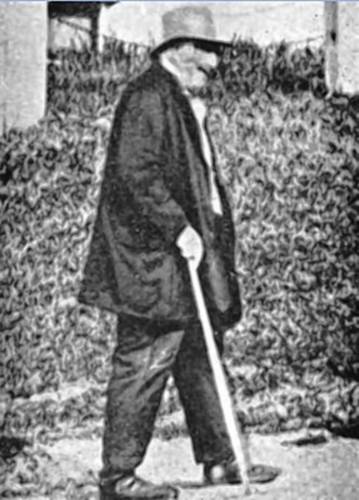 Boston John. Photo courtesy of Canterbury Shaker Village.
On February 3, 1814, Boston John married Elizabeth Glines (1791–1879). She was the daughter of Elizabeth Blanchard (1734–1830) and Revolutionary War veteran William Glines (1736–1830) of Northfield. The marriage took place in the Northfield home of her late brother’s widow’s second husband, Captain Thomas Clough (1740–1839), where Elizabeth was residing at the time. The couple had three children: George (1814–1900), Abraham Sanborn (1816–1835), and Albe C. (1826–1833).
Shortly after their marriage, Boston John built a house for his family and a carpenter’s shop near Cross’s Mills in what is now Franklin. They would reside there until the young family moved with the Shakers in Canterbury.
The Shakers, formally known as the United Society of Believers, were a communal religious group founded in eighteenth-century England by dissenters from Quaker and Methodist traditions. Emigrating to the United States in 1774, they established self-contained villages across the Northeast and Midwest, with Canterbury Shaker Village founded in 1792. The community combined strict discipline, celibacy, and gender separation with remarkable economic ingenuity, operating productive farms, workshops, and industries and producing goods widely respected for their quality. At its peak in the 1850s, Canterbury housed roughly 300 members on 3,000 acres, living in more than 100 buildings and maintaining a highly organized, orderly society.
During the Era of Manifestations (1837–1850), the Shakers experienced a surge of spiritual activity that included visions, ecstatic worship, and communication with spirits, reflecting broader American interest in revivalism, mesmerism, and alternative spiritual practices. Manuscripts and preserved messages document hundreds of such experiences in communities like Canterbury.
The Shakers were not alone in their fascination with spirit communication; mid-nineteenth-century America was captivated by mesmerism, or “animal magnetism,” the belief that an invisible natural force could restore health, calm the nerves, and alter consciousness. Practitioners claimed success treating chronic pain, nervous disorders, hysteria, and ailments that conventional physicians could not cure. New England proved especially fertile ground for these ideas, with lyceum lectures, traveling demonstrations, and newspaper debates bringing mesmerism into parlors, town halls, and meetinghouses. Mesmerists induced trances, performed “magnetic passes,” and sometimes exhibited subjects who appeared clairvoyant or insensible to pain, blurring the line between medical treatment and public entertainment.
Boston John’s time with the Shakers and exposure to this national fervor seemingly influenced his later career in faith healing and mesmerism. For decades, he was regarded as a mesmerist and itinerant healer, operating on the margins of conventional medicine. These experiences, combined with his extraordinary strength and skill, placed him at the intersection of religion, labor, and exploration of the unseen in nineteenth-century America.
The timeline of the Clark family’s residence at Canterbury is not entirely clear. Many published accounts state they arrived in 1835. However, Shaker records indicate that two of their sons, George and Abrahm, arrived at the Church Family on January 25, 1827; Albe was an infant and would have remained with his parents in the North Family, where the novitiate order was housed. They then left the village on May 24, 1828. The record states that when they left, “the father takes George and Abram quite contrary to their wishes” (Blinn 1891). Just over two weeks later, on June 12, fourteen-year-old George “returns to his home in the Church family, having obtained the consent of his parents. The father and mother always retained a friendly feeling toward Believers” (Blinn 1891). George remained at the Canterbury Village for the rest of his life, working as a blacksmith until his death in 1900 at age eighty-six.
The family’s later movements are similarly difficult to reconstruct. On October 13, 1833, their youngest son, Albe C., died just after his seventh birthday. Merrimack County property deeds show that Boston John, listed as John Clark IV, paid $1,600 for property along the Winnipesaukee River on November 29, 1833, from John H. Durgin. On October 30, 1834, Boston John signed a quitclaim back to Durgin. His second son, Abram, died on September 16, 1835, at age nineteen. That December, he purchased property from the widow Lydia Sanborn, which he held until he sold it to Walter Aiken in 1865. After that, “for some years they boarded at the Shakers where their son George had always remained” (Merrimack Journal 1874).
According to Boston John’s obituary, the family returned to the Shaker Village after the loss of their sons and remained there for some time. They then moved back to their former home for a year or two before building a house in Franklin. Although the precise sequence remains uncertain, Boston John maintained intermittent ties to the Shakers in various capacities for the remainder of his life.
Reputation
It has long been reported that Boston John never received any formal education; The History of Sanbornton states that he “never attended school a day in his life” (Runnels 1881), and several reports indicate that he could neither read nor write. Despite his lack of time in a classroom, Boston John showed signs of genius in measuring and framing. He was considered a man with “great mechanical genius” (Runnels 1881) and a lifelong student of hydraulic science and art.
Boston John could “carry any number, even to 100,000 feet, accurately in his head,” (Runnels 1881). Taught by his cousin, named James no less, to measure lumber with a rule, he frequently utilized a ten-foot pole to make measurements, which he did so accurately and adeptly.
An oft-repeated legend purports that while he was working in Concord, a group of troublemakers cut a couple of inches off his pole while he was eating dinner. He apparently immediately noticed and “discarded it without comment” (Granite Monthly 1922), and “never lost sight of it until the job was ended” (Granite Monthly 1895). Whether anyone dared to mess with his ten-foot pole seems unlikely given his physical description.
Physically, Boston John is described as “of stalwart frame” (Runnels 1881), at six feet two inches and 240 pounds (Runnels 1881). Stories exist of Boston John performing an earlier version of cross-fit by swinging a 700-pound roll of lead on his shoulder and walking around the lot, “as steady as a deacon” (Cross 1927). He was also reputedly unbeatable at a contest known as twisting, a test of strength in which two men grasped a bar or pole and attempted, through leverage and rotational force, to wrench it from the other’s hands. Such matches, often referred to as pole pushing or pole twisting, were common in the nineteenth century. As one account noted, “When Boston John was about, there was no betting, and the only excitement consisted in seeing how quickly he could vanquish whoever had the courage to ‘twist’ with him” (Cross 1927).
His intellect and physical strength made him a remarkable figure. “Boston John was built for a philosopher. He had a great intellect in a great body, and had his life been fashioned and environed in higher and more benign fortunes, he might have stood among the greatest philosophers or statesmen of his time” (Merrimack Journal 1874). Over the course of his career, Boston John built a wide range of structures. Still, he was most often engaged in dam building. Many accounts refer to him as a “dam builder,” a description whose double meaning may or may not have been intentional.
New Hampshire State House
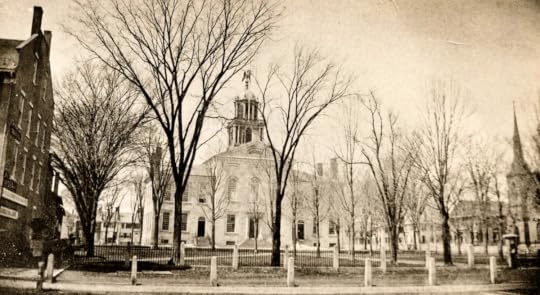 1819 State House. Photo courtesy of the New Hampshire Historical Society.
One of Boston John’s major framing projects came at age 29 in the new capital city of Concord. Architect Stuart James Park (1773-1859) submitted a $32,000 proposal to build a new state house, approved by the State Legislature in 1815, with construction starting the following year. This building was constructed of New Hampshire granite, fashioned into shape by inmates from the nearby prison that Park had built a few years earlier. The Federal-style state house was designed to accommodate both legislative bodies, the governor’s offices, and public galleries, and was to be topped with a cupola adorned with a large eagle. Work began in September 1816.
Initially, Boston John was given the contract to supply lumber for the project. Reports indicate that he rafted “168,000 feet of lumber from Franklin down the Merrimack River to Concord” for the project. The timber came primarily from his farm and that of his neighbors. He was reportedly paid $5.50 per thousand feet, or $924, which would be approximately $22,000 in today’s dollars.
The trees he felled were quite large; one measured 15.5 feet in diameter at breast height and was 100 feet tall before it fell, with the top snapping off upon landing. That tree yielded a “stick of timber 85 feet long and nine inches square” (Cross 1927). His contract called for six main sills and eight timbers for the belfry. These 18-foot-long timbers were “bored through the heart, from end to end, to prevent cracking” (Cross 1927). Whilst these timbers were floating in Butler’s Eddy in Concord, another lumberman tried to lay claim to the wood. “Boston John permitted the Captain to get well along with the discussion before he pointed out to the accuser the holes in the sticks whereupon all arguments ceased” (Cross 1927).
Boston John’s involvement with the timber led to his eventual framing work on the state capital. By the summer of 1817, construction had advanced to the upper story and roof of the new State House. The framing required to carry the building’s raised central section was unusually heavy and complex, spanning the full width of what would become Representatives’ Hall and supporting the weight of the cupola above without interior posts. This work fell to Boston John.
According to The History of Merrimack and Belknap County, Park called on Boston John to frame the upper part of the building because the mechanic responsible for the lower framework “was not venturing to do the upper” (Runnels 1881). He was paid $1,600 for the job.
One of the project’s superintendents was a man named Albe Cady (1769-1843). Cady was a prominent merchant and Judge from Keene who moved to Concord in 1814. He was an abolitionist and an active member of the Episcopal Church in Concord. The relationship between Cady and Boston John is unclear, but Boston John would name his son Albe Cady Clark in 1826.
It has been reported that a man named Dudley Ladd (1789-1875) worked with Boston John to “frame and tin the dome” on the State Capitol. Ladd was reportedly a station master on the Underground Railroad, carrying escaped enslaved people through Franklin to Canada. A 2021 book about his side hustle states, “The Concord statehouse was built in 1818, and Ladd’s handiwork can be seen in the tinsmith work on the dome” (Sherburne 2021). Ladd and Clark may have tinned the original dome, but it is not the one we see today.
By the 1860s, the New Hampshire government had outgrown the two-story granite building. Architect Gridley J.F. Bryant (1816-1899) designed a larger building, incorporating the existing structure while adding a new third floor and a larger gold dome on the top. The 1819 cupola was replaced entirely. As Boston John was in his mid-seventies by then, it is unlikely that he participated in the project. The claims that he built the gold dome on today’s state house are more than likely false.
Dams and Hydraulic Engineering
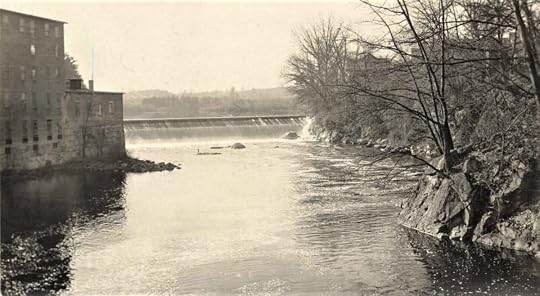 Amsden Dam, Penacook. Photo courtesy of Ruth Speed.
Boston John’s dam-building career began in 1818 and was successful in part due to his assistant, Enos F. Brown (1796-1881) of Bridgewater. Brown was known as “Boston John’s Diving Bell,” because he could reportedly dive deeper and remain underwater longer than any man. “He would go 15 or 20 feet under water and knock around with his hammer as if in the air,” (Clark 1927).
In 1818, Boston John built a dam near Bow Street in Franklin by Robinson’s machine shop and Walter Aiken’s finishing room. He was paid $300. By 1864, Aiken built a large mill complex on the site that later became Stevens Mill. Boston John also reportedly built the Amsden Dam at Fisherville (now Penacook), near what became the H.H. Amsden Furniture Company, and the dam at Bristol over the Pemigewasset River. Details on those two dams have not yet been located.
Following completion of the state house project, Stuart Park relocated to Boston to work on one of the country’s largest dams. The Boston Mill Dam (officially the Boston & Roxbury Mill Dam) was an early 19th-century engineering project built between 1818 and 1821 to dam Boston’s Back Bay tidal basin to harness tidal water power for industrial mills and create a raised roadway (now Beacon Street) connecting Boston to its western neighbors. The venture proved a commercial failure; few mills were built, costs far exceeded estimates, and stagnant water contributed to sanitation issues, yet the dam laid the foundation for later land reclamation that produced today’s Back Bay neighborhood.
Boston John reportedly worked on this project, perhaps remembered by Stuart Park, and was asked to participate. The History of Sanbornton reports that he was “called to Boston to superintend the erection of a tide-water dam” (Runnels 1881) in 1823. But the Boston Dam was done and opened by 1821. However, an article in the Pittsfield Sun from January 1823 states that the Boston and Roxbury Mill Dam Corporation sought to widen their dam (Pittsfield Sun 1823). No records about the Boston and Roxbury Mill Dam list Boston John as a superintendent, but it is possible he worked on the project.
He was, however, hired in 1833 by the Proprietors of the Sewall’s Falls Locks and Canal to build a canal from Sewall’s Falls to the mouth of Mill Brook in Concord. He and his crews had dug about half of the two-and-a-half-mile canal when the corporation abandoned the project. The dam would eventually be built in 1894.
Boston John reportedly worked on another dam in Lawrence, Massachusetts. The Great Stone Dam was an unprecedented 900-foot masonry gravity dam built on the Merrimack River at Bodwell’s Falls between 1845 and 1848 to raise the river head and power textile mills as part of the Essex Company’s plan to create Lawrence, Massachusetts. At the time of its construction, it was the largest dam in the world.
His obituary states that Boston John was the “chief supervisor in all the hydraulic works on the Winnipiseogee lake and river, when the Lake Company was putting down the foundations of its improvements a third of a century ago, there was no man to be found anywhere, in those days of his mature experience and full intellectual strength, who could so easily as he, and so surely conquer an ugly spot of water power. He grasped the situation at a glance, the work fashioned in his own way and which he pronounced solid, was never known to move” (Merrimack Journal 1874).
Bridges and Transportation
Franklin’s nickname, Three Rivers City, certainly implies that bridges will be needed to get from here to there. The first bridge to be built over the Pemigewasset River was built in 1802 and was named the Republican Bridge, “reflecting a chief phase of political excitement of the time” (Runnels 1881). That bridge was replaced in 1824 and stood until a powerful storm destroyed it and the nearby Federal Bridge on Sunday, January 27, 1839.
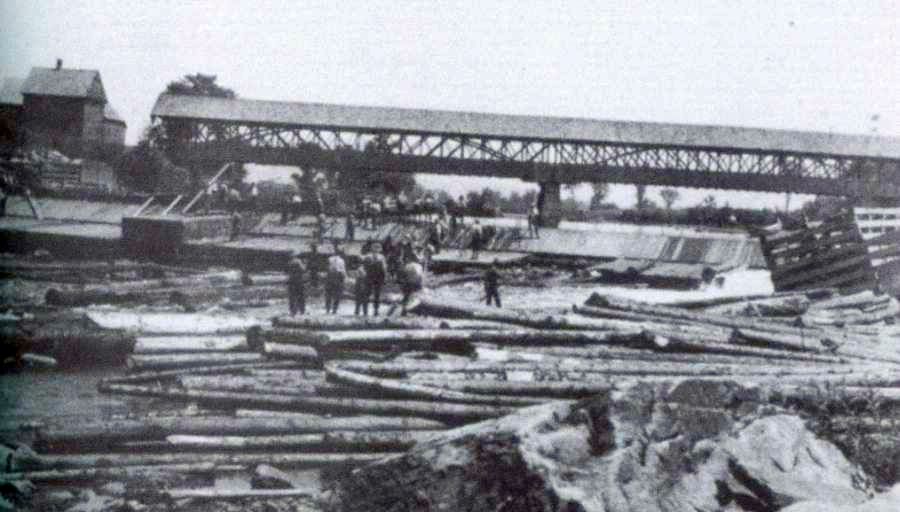
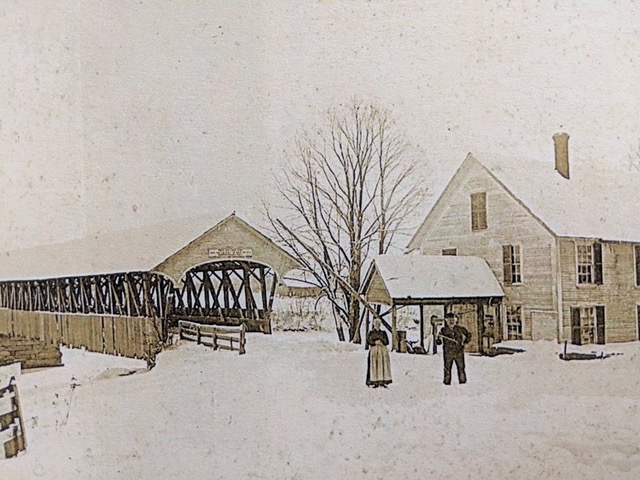
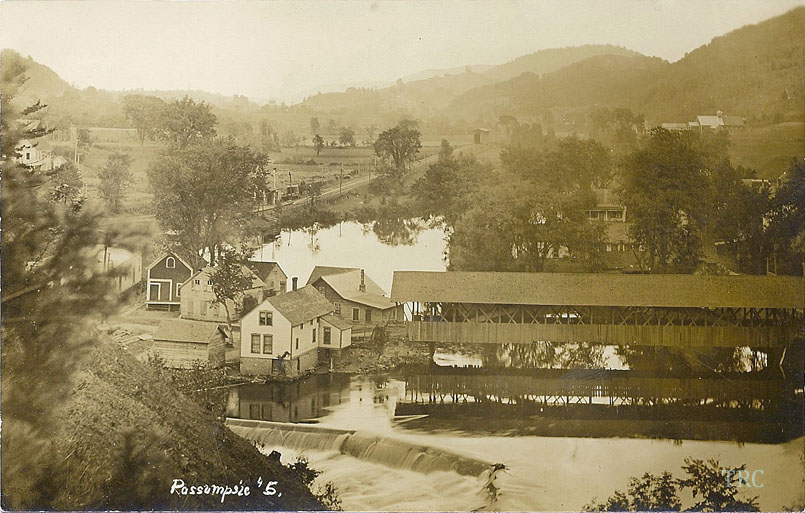
The City of Franklin hired Boston John to build its replacement. The Republican Bridge was a 400-foot-long, three-span, Town lattice truss bridge that cost $7,000. The structure had a covered pedestrian walkway on each side and was one of only two covered bridges in New England with a gambrel roof. Boston John spent the summer building this unique toll bridge connecting Franklin to Franklin Falls. The trunnels, wooden pegs used to hold the pieces of wood together, were made of white oak and delivered in six ox cart trips by Herrick Aiken (1797-1866). The stone abutments were constructed by John Ladd (1807-1873) with granite hauled by Stephen Kenrick (1806-1884).
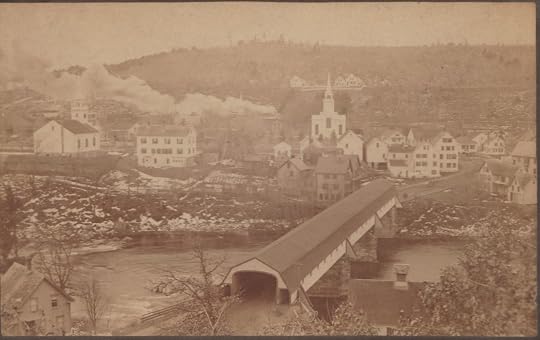 Republican Bridge, Franklin. Photo JB Warren Photo Studio.
 The bridge collected tolls on the west side of the river until 1845. In June 1879, the bridge was damaged by a freshet. The abutments were repaired using granite from Stuart Park’s recently demolished State prison in Concord. The Republican Bridge was dismantled in 1931 and replaced with the Daniel Webster Bridge. The timber was used for other purposes, and the granite stones were laid as riprap along the riverbank. The New Hampshire Historical Society has a gavel made from the timber, and the Franklin Historical Society has a display case full of items made from the discarded wood.
In 1840, Boston John built a new water wheel for the tannery at Canterbury Shaker Village.
In 1845, the Northern Railroad enlisted the help of Boston John to construct trestles over the Merrimack River to extend the railroad from Concord to Franklin. Instead, he “informed the officials that it would be cheaper to change the course of the river… thus came about the famous Boston John cutouts of the Merrimack River” (Cross 1927). He used oxen to excavate channels that widened and deepened the river, thereby straightening it. The soil he removed was used to supplement the railroad beds.
In 1848, Boston John was involved in the construction of another bridge, but it differed significantly from his Republican Bridge. The Enfield Shakers sought a more direct route to the new railroad station in North Enfield, rather than the five-mile trip around Mascoma Lake. They hired George W. Fifield (1806–1867) as project superintendent and Boston John to design a bridge to span the lake. Because the site spanned water more than 40 feet deep with an additional 30 feet of mud, conventional bridge construction was impractical, and the structure was conceived as more of a causeway than a bridge.
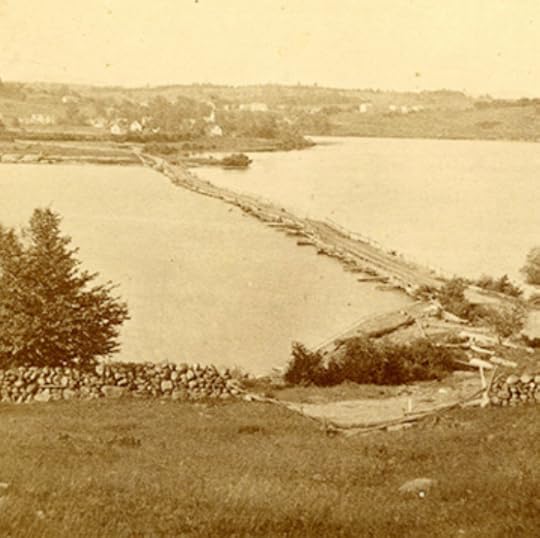 Enfield Shaker Bridge. Photo courtesy Enfield Shaker Museum.
Built of logs, stone, and earth atop pilings, the Shaker Bridge was considered the only bridge of its kind at the time. The bridge opened in 1849 and remained in service until it was destroyed by the 1938 hurricane. “Most early travelers were afraid of crossing the Shaker Bridge because of the roller coaster effect combined with its zigzag motion” (Beale 2002). It was often called the “famous Shaker Bridge” and a “wonder of all who view it” (Colby 1907).
An article in the Enfield Advocate from 1904 states that Boston John was “the engineer and overseer of the whole work” (Cumings 1904). However, a later news account includes a letter from Fifield’s daughter indicating that Boston John was present for “a week to advise, but I believe it was well underway before he came” (Newspaper 1907).
Mesmerist
Boston John Clark’s reputation as a mesmerist reportedly brought him into the orbit of Mary Baker Eddy (1821–1910), founder of the Christian Science movement. In the 1840s, before her later prominence, she was simply Mary Baker, daughter of the strict and often volatile Mark Baker of Sanbornton Bridge (now Tilton). Mary Baker experienced recurring periods of illness throughout her youth and early adulthood, episodes later described by contemporaries as sudden and dramatic. Seeking relief, she eventually turned to mesmerist Phineas Parkhurst Quimby (1802-1866), whose influence she later acknowledged as formative. The religious meaning she drew from these experiences would culminate decades later in the founding of Christian Science.
In a biographical series published in McClure’s magazine, Georgine Milmine (c.1871-1950) claimed that Mark Baker (1785-1865) summoned Boston John Clark to the family home in Sanbornton during the 1840s in an attempt to cure his daughter. This assertion is disputed. Writing in Human Life magazine in 1907, author Sibyl Wilbur (1871-1946) concluded that Eddy and Clark likely never met.
A separate anecdote comes from Franklin native Sarah Clement (1833-1913), who recalled a drowning of seminary students in the Winnipesaukee River. Clement stated that a man known as “Boston John” sought to hypnotize Mary Baker to locate a missing body, believing her to be a receptive subject. According to Clement, Mary accurately predicted the body’s location—an outcome Clement attributed to common sense rather than clairvoyance (McNeil 2017).
This account was flatly rejected by Caroline A. Rowell (1836-1916) in an affidavit dated January 10, 1907. Rowell stated that she had “never heard of [Mary Baker Eddy] being in any way associated with Boston John Clark as a pupil or even interested in mesmerism or spiritualism,” adding that she would have known had such an association existed (McNeil 2017).
Regardless of his brush with fame, his wife was not too keen on his powers. In an 1838 letter on file at the Western Reserve Historical Society, David Parker wrote, “Perhaps you may remember of having heard of one John Clarke of Franklin, NH, who attended meeting the first Sabbath we were at New Lebanon last. He is a great mill wright & his only son George is in the Church at Canterbury. Br. Rufus, Elder Richard, & Samuel Swett know him. That meeting had a very powerful effect upon him. He talks much of the supernatural power he there witnessed & has, we learn, said he must set out. The world now, some of them, call him Shaker. It is also said he has offered his wife who has no faith $1000 if she would separate from him” (Parker 1838).
One man whom Boston John used his powers of hypnosis on was Jeremiah Fisher Daniell (1800–1868), owner of the J. F. Daniell & Son mill. Daniell severely damaged his arm when it got caught in some machinery, and he was experiencing extreme pain and sleeplessness. One visit from Boston John put Daniell into a deep sleep, allowing his wound to heal. He reportedly healed others in town of severe headaches with “a few magic passes of his hands” (McNeil 2017).
Pastor Wilton E. Cross’s report on Boston John claims he was quite the prankster. “One citizen of Franklin, in particular, was a constant victim, for at the sight of the influence of Boston John would cause this man to go through all the motions incident upon the sawing of wood” (Cross 1927). Another tale recounts, “a scene which never failed to strike awe to its beholders was Boston John on the street drawing a circle with his cane about some urchin and telling him he couldn’t get out of the circle” (Cross 1927). These tales are accompanied by another that claims Boston John, after chiding four men who couldn’t move a large log, tied a rooster to the log, “and at the signal ‘go’ the little red rooster went hopping along dragging the huge log behind” (Cross 1927). Clearly, his legend became greatly exaggerated over time.
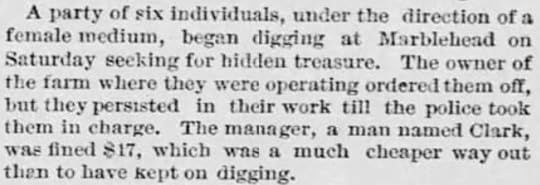 Boston Globe, July 1872.
Boston John’s powers eventually got him into a bit of trouble. After communing with the spirits to seek the location of Captain Kidd’s long-lost treasure in Marblehead, Massachusetts, he and a small group of people left Franklin to dig for buried treasure. In 1872, he and five others, including a female medium, were fined $17 for digging a hole on a Sparhawk farm in Naugus Head in search of buried treasure. An article in the Boston Globe on July 31, 1872, reports, “the owner of the farm where they were operating ordered them off, but they persisted in their work till the police took them in charge. The manager, a man named Clark, was fined $17, which was a much cheaper way out then to have kept on digging” (Boston Globe 1872).
Final Years
Boston John was known to partake in a different kind of spirits as well. One story tells of him attempting to cross the Winnipesaukee River on the ice with a jug of “the old familiar juice” under his arm. When the thin ice broke beneath his large frame, “all those who beheld the accident could make out was the old high beaver hat bobbing up and down” (Cross 1927), but noticed that before he fell, Boston John “stretched forth his arm and deposited [the jug] as far as possible from the water” (Cross 1927).
Another tale recounts a local man overtaking Boston John walking home after a night of drinking. When the man offered Boston John a ride, indicating that his walk home was a long one, he replied, “It’s not the length of the way that bothers me, it’s the width” (Cross 1927).
In 1861, Boston John “came near making a last plunge over one of his dams” (McFarland 1899). The seventy-one-year-old was crossing the mill pond above Aiken dam on the ice on a track cleared by previous travelers. Soon enough, all 240 pounds of him fell through the ice. A man named Henry Crane intervened. Boston John reportedly shouted to him, “Bring me a long board,” and “forthwith, Boston and his cane were standing erect again, unharmed saved a gentle chill, which he says was at once dispelled by warm and soothing drinks,” (McFarland 1899).
It has long been reported that Boston John resided with the Shakers in Enfield at the end of his life. However, he was, in fact, in Canterbury.
A single photo of Boston John exists, cropped from a larger image of a Shaker building and taken by photographer W. G. E. Kimball of Concord. After careful inspection, the photo is determined to depict the Church Family Trustees’ Building at Canterbury. One can see Boston John walking with his cane in front of the building in Canterbury, not Enfield.
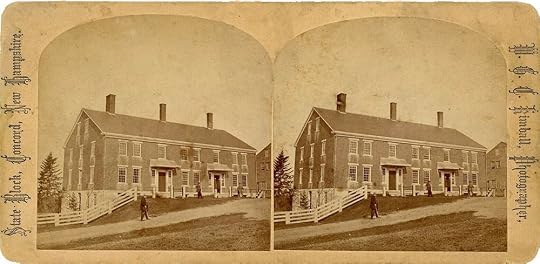 Boston John Clark walking by Trustees’ Building. Photo courtesy of Canterbury Shaker Village.
Boston John died of dropsy on October 30, 1874, at the age of 82. His obituary states, “Boston John is dead. His stalwart form … will be seen no more. He was 84 years old and for half a century was a famous man all up and down the country from the Green Mountains to the Nutmeg State” (Merrimack Journal 1874). Several reports indicate that Boston John “died with the Shakers,” but he in fact died at the same family home he was married in, as he and his wife had been boarding there with her great nephew, Jonathan Scribner (1813-1888). His body was, however, prepared for burial by two Canterbury Shaker Sisters, Sally Ceeley (1805-1898) and Abby M. Hall (b. 1831), before his internment in the Franklin Falls Cemetery.
Stories followed Boston John Clark during his life and long after it. Some can be supported by the record; others cannot. He had no formal engineering training, yet he built dams and bridges that endured. He understood timber, stone, and water, working from experience rather than theory. Over time, fact and legend blurred, but his work remains a steady point of reference—quiet, practical, and lasting.
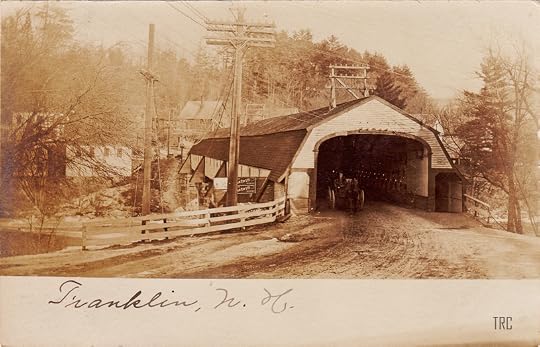 Republican Bridge, Franklin. Photo from the Todd Clark Collection.
 References
Historical photos are a part of the author’s collection or were used with permission from the New Hampshire Historical Society, Ruth Speed, Penacook Historical Society, and Todd Clark, National Society for the Preservation of Covered Bridges.
Special thanks to Michael O’Connor and Mary Ann Haagen, Enfield Shaker Museum; Shirley Wajda, Canterbury Shaker Village; and Leigh Webb, Franklin Historical Society.
Beale, Galen. 2002. “The Shaker Bridge.” The Friends’ Quarterly, XIV, no. 3 (Summer 2002).
Blinn, Henry Clay. 1891. “A Historical Record of the Society of Believers in Canterbury, N.H., From the time of its organization in 1792 Till the year one thousand, eight hundred and forty eight,” 1891 (Ms. #763, Canterbury Shaker Village Archives, transcription).
__. c. 1895. “Church Record by Henry Clay Blinn,” c. 1895 (Ms. #764, Canterbury Shaker Village Archives, transcription).
City of Franklin. 1930. Annual Report of the City of Franklin. Franklin, NH: City of Franklin.
Colby, Edith Mellish. 1907. “Shakers in Enfield.” The Granite Monthly: A Magazine of Literature, History and State Progress, 1907.
Concord Monitor. 2024. “Vintage Views: The Simple Genius – John Clark.” Concord Monitor, 2024.
Cross, Lucy Rogers Hill. 1905. History of Northfield, New Hampshire 1780–1905: In Two Parts with Many Biographical Sketches and Portraits Also Pictures of Public Buildings and Private Residences. Rumford, ME: Rumford Printing Company.
Cross, Wilton E. 1927. “‘Boston John’ Clark, Master Builder.” New Hampshire State Library. Transcribed with corrections in The Official History of Franklin, New Hampshire, vol. 1, by Albert G. Garneau, 2002. Franklin, NH: Albert G. Garneau.
Cumings, Henry. 1904. “Building of Shaker Bridge.” Enfield Advocate. Transcribed by Enfield Shaker Museum, December 2, 1904.
“[John Clark].” 1838. August 27, 1838. CSV #764, p. 122. Transcription by Enfield Shaker Museum, Enfield, NH.
Garneau, Albert G. 2002. The Official History of Franklin, New Hampshire, vol. I. Franklin, NH: Albert G. Garneau.
Garvin, James L., and Donna-Belle Garvin. 2018. “The Granite State House.” Historical New Hampshire 71, no. 2 (Fall/Winter 2018).
Granite Monthly. 1922. “‘Boston John’ Clark: A Picturesque Figure in Franklin History.” Granite Monthly: New Hampshire State Magazine, vol. LIV, 1922.
Hadley, Amos, and Will B. Howe. 1903. History of Concord, New Hampshire. Concord, NH: Rumford Press.
Hamilton College Manuscript. “Current Records of Events from 1792 to 1885: Record in brief of the accession of members, and Building of the Church at Canterbury, N.H,” Transcribed by the Canterbury Shaker Village.
Hurd, D. Hamilton. 1885. History of Merrimack and Belknap Counties, New Hampshire. Philadelphia, PA: J. W. Lewis & Company.
Leighton, Fred. 1910. “The Evolution of the New Hampshire State House.” The Granite Monthly: A Magazine of Literature, History and State Progress, 1910.
Means, Andrew. 1978. “Builder Toted a Measure of Franklin’s Past.” Concord Monitor, August 2, 1978.
Merrimack Journal. 1874. “Boston John Clark.” Merrimack Journal, November 6, 1874. Transcribed by Enfield Shaker Museum.
McFarland, Henry. 1899. Sixty Years in Concord and Elsewhere: Personal Recollections. Concord, NH.
McNeil, Keith. 2017. A Story Untold: A History of the Quimby–Eddy Debate. https://ppquimby-mbeddydebate.com/about/. Retrieved January 18, 2026.
Moses, George H. 1895. “New Hampshire’s Youngest City: A Sketch of Franklin.” Granite Monthly: New Hampshire State Magazine, vol. XVIII, 1895.
New England Ski Museum. 1989. New Hampshire, A Guide to the Granite State. United States.
New Hampshire Historical Society. 2026. “Sewall’s Falls Dam, 1892 October 8.” New Hampshire Historical Society Collections. https://www.nhhistory.org/object/9368.... Retrieved January 18, 2026.
Newspaper Clipping. 1907. Transcribed by Enfield Shaker Museum, September 13, 1907.
Parker, David. 1838. “Letter from Enfield, New Hampshire, to Seth Y. Wells, August 27, 1838.” WRHS Manuscripts, IV A 4. Transcription by Enfield Shaker Museum, Enfield, NH.
Pittsfield Sun. 1823. Pittsfield Sun, January 23, 1823, 3.
Runnels, Moses Thurston. 1881. History of Sanbornton, New Hampshire. Boston: A. Mudge & Son, printers.
Shaker Manuscript Records. 2026. Shared with the author by Enfield Shaker Museum.
Sherburne, Michelle Arnosky. 2021. Slavery & the Underground Railroad in New Hampshire. United States: Arcadia Publishing.
Sherman, Carrie, and John W. Hession. 2019. “The People’s House for Two Centuries.” New Hampshire Home, April 15, 2019.
Spain, James W., II. 2024. “The Simple Genius.” Concord Monitor, May 4, 2024.
Starbuck, David R. n.d. “Historic American Engineering Record, Sewall’s Falls Hydroelectric Facility, HAER No. NH-20.” Washington, D.C.: National Park Service, U.S. Department of the Interior.
The post The Legend of “Boston” John Clark first appeared on Covered Bridges of New Hampshire.


December 14, 2025
The Bridge Builder Zadoc Lovell Taft
Zadoc Lovell Taft was a Swanzey carpenter, millwright, mechanic, farmer, and bridge builder, and part of a family with deep colonial roots.
The Taft family arrived in the New World in Braintree, Massachusetts, around 1678, when Robert Taft (c. 1640–1725), Zadoc’s great-great grandfather, emigrated from County Louth, Ireland. He would build the original Taft homestead in Uxbridge, Massachusetts, in 1681.
One branch of the family later moved west to Ohio and produced William Howard Taft, the 27th President of the United States. Zadoc and the future president were third cousins, twice removed. When Zadoc died in 1866, President Taft was not quite nine years old, so it is unlikely the two ever crossed paths. President Taft did, however, spend summers in nearby Dublin, New Hampshire, between 1910 and 1913 at Knollwood Estate, his so-called “Summer White House,” a detail Zadoc would almost certainly have found more interesting if he had lived to see it.
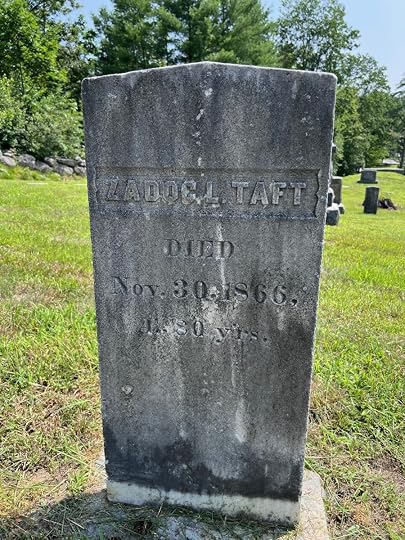 Zadoc’s Grave
Zadoc’s branch of the family moved to New Hampshire. Zadoc, sometimes spelled Zadock, was born on April 12, 1786, in Swanzey, to Nathan Taft (1754–1809) and Judith Sibley (1757–1786). Nathan was a Revolutionary War Patriot, serving in the Massachusetts Militia as a private in Captain Lebbeus Drew’s company and Colonel William Shepard’s 4th Continental Regiment in 1781. After the war, Nathan settled his family in the southeast corner of Swanzey, near the L.W. Holbrook place on what is now Old Homestead Highway.
When Zadoc’s mother died shortly after his birth at age 28, he had a four-year-old brother, James Sibley Taft (1782–1854), and a two-year-old sister, Betsey (1784-1854). The History of Swanzey indicates that Nathan had more children after Zadoc; however, no records have been located to substantiate these children or any subsequent marriages for Nathan.
Zadoc was first taxed in Swanzey in 1808 when he lived on the E. K. Aldrich place. The following year, his father died at age 54 at the home of his sister Betsey and brother-in-law, William Park (1782-1867), in Woodford, Vermont.
On March 29, 1810, Zadoc married Italy Ramsdell (1789–1818). She was 21, and Zadoc was 24. They had four children: Giles (1811–1889), a wheelwright, carpenter, and mechanic who spent his life in Swanzey; Lovell (1813–1894), a carpenter and joiner; Farris (1815–1854), a carpenter and mechanic who worked at the Colony Mills in Keene; and Eveline (1817–1831), who died at age 14.
Italy died in 1818, at age 29. Less than a year later, Zadoc married Italy’s sister, Anna Ramsdell (1792–1863), on August 26, 1819. They had six children, including Italy Ann (1820–1828), named for Zadoc’s first wife; Bezaleel (1822–1882), a carpenter and mechanic; Caroline A. (1825), who married James Willard of Keene; Don Carlos (1827–1907), who earned degrees from Amherst College and Union Theological Seminary, and became a professor at the University of Illinois; Samantha Melvina (1829–1848); and Esther Ann (1831-1896), who married Alfred Marble. Don Carlos’s son, Lorado Zadoc Taft (1860-1936), would go on to become one of America’s most prominent sculptors, ensuring that the Taft name remained attached to tools, craftsmanship, and hard work—just in a different medium.
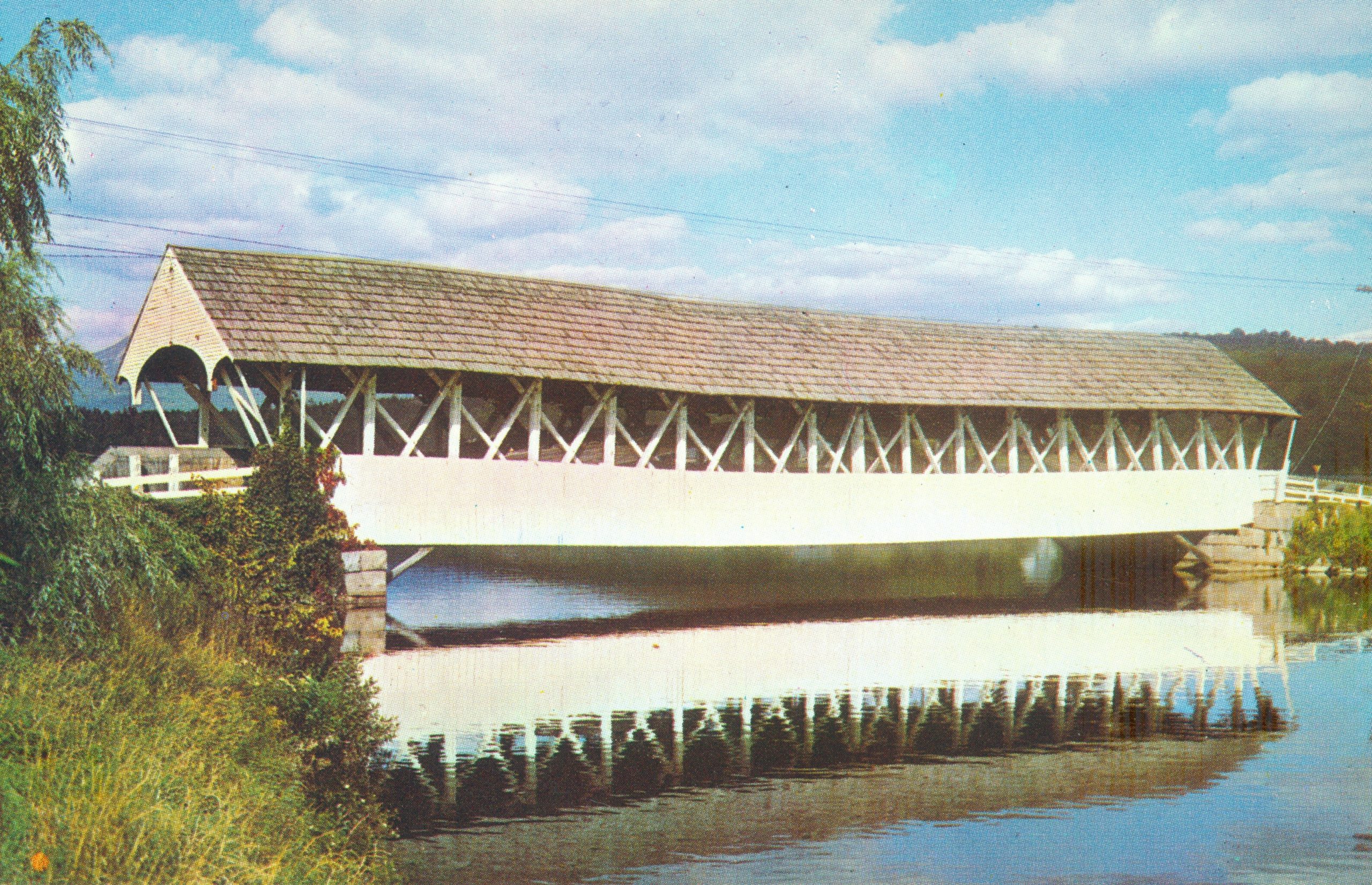
In 1832, the town of Swanzey hired Zadoc to build a covered bridge over the Ashuelot River in West Swanzey, replacing an earlier bridge constructed in 1774. Taft employed a Town Lattice Truss design. The 151-foot bridge rests on a center pier and features partially open sides with decorative portals. Known today as the West Swanzey Bridge or Thompson Bridge, it originally included two pedestrian sidewalks capped with a decorative arch. Only one sidewalk survives. The total cost of construction was $523.27.
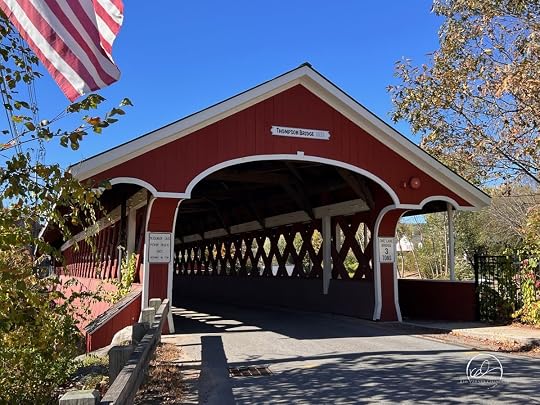
Zadoc spent his entire life in Swanzey. He served as town selectman in 1832 and as town representative in 1852. An 1858 map places his home along present-day Old Homestead Highway near Warmac Road, with his son Farris living nearby.
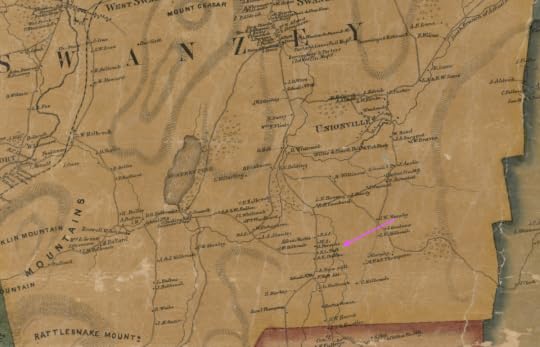 1858 Map
Census and town records reflect a lifetime of steady work. In 1843, Zadoc worked under Lyman Parker and Major Ezekiel Page on the construction of the Mount Caesar Union Library. In 1850, at age 64, his occupation was listed as farmer; by 1860, at age 74, it was millwright, suggesting that slowing down was never part of the plan.
Zadoc Lovell Taft died on November 30, 1866, at age 80, and was buried in Mount Caesar Cemetery. His probate inventory reads like a concise autobiography: oxen, a cow, wagons, farming implements, mechanic’s tools, a chest of tools, and a few personal items, including a cane, spectacles, and a basket. It was not the estate of a president, but it was unmistakably the estate of a working New Hampshire craftsman whose covered bridge still stands as his most visible legacy.
References
Historical photos are a part of the author’s collection.
Read, Benjamin. 1892. The History of Swanzey, New Hampshire, from 1734 to 1890. Salem, MA: Salem Press.
The post The Bridge Builder Zadoc Lovell Taft first appeared on Covered Bridges of New Hampshire.
August 8, 2024
The Bridgewright Captain Charles Richardson
Captain Charles Richardson’s story in America begins with the arrival of Thomas Richardson (1608-1651) in the Massachusetts Bay Colony. Along with his two brothers, Ezekiel (1602-1647) and Samuel (1604-1657), and his wife, Mary Baldwin (1612-1670), Thomas came from Hertfordshire, England, sometime around 1635. The Richardsons became some of the original settlers of Woburn, Massachusetts, where the brothers built their homes on the Mystic side of town and “became prominent citizens of Woburn” (Crane 1907).
Thomas’ seventh child and youngest son, Nathaniel (1650-1714), served as a soldier in King Philip’s War, one of the most devastating conflicts in American Colonial history. Nathaniel was one of the hundreds of militiamen who raided the indigenous Narragansett settlement in Rhode Island on December 19, 1675. Close to a thousand Narragansett people and about 70 colonists died in the conflict; hundreds more were wounded, including Nathaniel, who returned to Woburn with six other wounded men.
As compensation for his service, Nathaniel and the hundreds of other soldiers who fought against the Narragansett people were promised land in the Massachusetts Colony. It would take fifty years for the lands to be granted, and Nathaniel was long dead by then. His grandson, John (1721-1768), would draw a lot in what was then called Narragansett No. 6, about seventy miles west of Boston. Busy with his life as a distiller in Roxbury, John never settled that land.
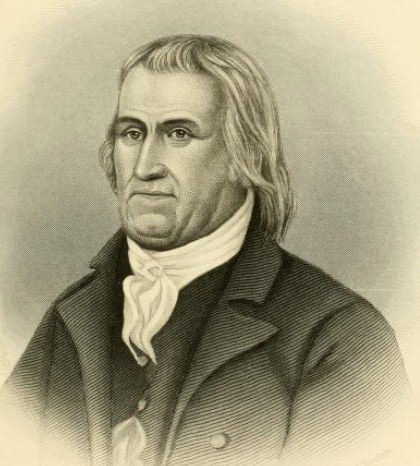 Captain John Richardson, Sr.
However, John’s nephew, Captain John Richardson (1737-1819), inherited his great-grandfather’s land, and after his 1757 marriage to his first wife, Ruth Sawtell (1736-1764), he settled the lot. In 1762, John and his neighbors incorporated their properties into Templeton, Massachusetts. Two years later, Ruth died at age 28, leaving her husband and one son, John Jr. (1758-1823). Captain John married Rebecca Moore in 1769 and had thirteen more children. He would serve as selectman and town clerk of the new township before the onset of the American Revolution.
In 1772, Captain John led a committee convened “to consider the encroachments made by the British ministry on the rights and liberties of the American colonies” (Vinton 1876). Two years later, he was appointed to chair another committee to report on British imports. In 1779, Captain John was chosen on a committee “to regulate prices as affected by the depreciation of Continental currency” (Vinton 1876). His patriotic service was complimented by his enlistment in the 6th Massachusetts Regiment in the Revolutionary War. Captain John fought at Bunker Hill and participated in the battle of Fort Ticonderoga. After the war, he returned to Templeton, where he was regarded as “a man of strong mind and will, independent in judgment and action, an ardent patriot, ready to serve his country on every fit occasion” (Vinton 1876).
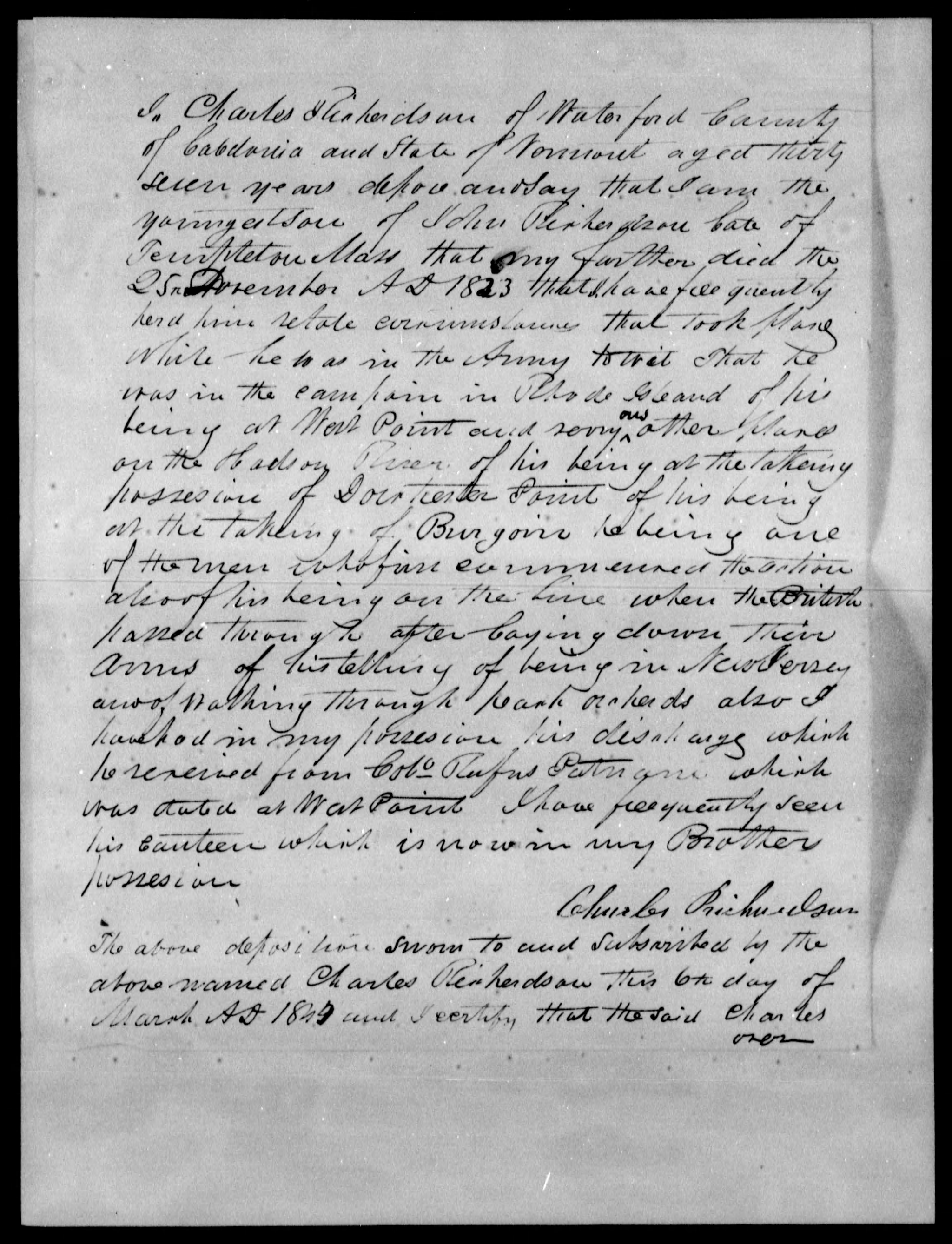 1844 Pension Application
John and Ruth’s son, John Jr. (1758-1823), also served as a private in the Revolutionary War, enlisting when he was just seventeen. According to an 1844 pension application by John’s widow, Sarah Wilder (1764-1851), supplemented with a statement from their son, Charles Richardson himself, John Jr. served in the Continental Army in Long Island, Dorchester Heights, White Plains, and “various places along the Hudson River,” including being present at the Battle of Saratoga for “the taking of Burgoine (sic), he being one of the men who fire cannon” (Pension Application, 1844). Sarah reported, “I have often heard him state his sufferings while in the service of his country, with hunger and at one time of his going from Springfield, Mass to New York on barefoot.” She continued, “All the compensation he received was in Continental money, which proved good for nothing… his health was very much ignored” (Pension Application, 1844).
John Jr. returned to Templeton after the war and married Sarah in 1782. The couple had nine children: John III (1786-1874), Joshua (1788-1842), James (1791-1845), Thomas (1793-1874), Sarah (1796-1815), Caleb (1798-1871), Charlotte Corday (1800-1899), Henry (1803-1805), and finally, Charles, born on November 28, 1806.
John Jr. died on Christmas Day 1823 at age fifty-five, when Charles was just 17 years old. 1830 census records suggest that Sarah and Charles went to live with Joshua in Templeton. Two years later, on February 28, 1832, Charles married Unity Partridge (1814-1836). He was 25, and she was 17.
Unity and Charles had one son, Charles P. (1836–1906), born in Templeton on August 30, 1836. Six weeks later, Unity was dead at the age of 22. She is buried in the Pine Grove Cemetery in Templeton with her parents and siblings.
On January 23, 1838, Charles married Miranda Cook (1815-1897) and had seven more children: Unity (b.1840), John (1843-1851), Frank F. (1844-1900), Clara (1846-1936), Edward C. (1849-1851), Sarah H. (1849-1880), and Edward C. (1858-1891).
By 1840, the Richardson family had relocated to Waterford, Vermont, a Connecticut River town 175 miles north of Templeton. Charles opened a shop where he made and sold furniture, chairs, carriages, and cabinets.
Around this time, Charles began to be called Captain Charles Richardson. An extensive search of military records in Massachusetts, Vermont, and New Hampshire does not turn up any proof of his military service. It is possible he was a member of a local militia, or it may be a moniker bestowed on him or by him, given his family history of military service. The origins of the Captain title are unclear.
By 1844, Charles had entered the covered bridge business. Along with mechanic Jesse Bishop (1804-1877), Charles constructed the first covered bridge across the Connecticut River connecting Waterford, Vermont, to Littleton, New Hampshire. This covered bridge replaced an earlier structure built in 1803. The two constructed a 265-foot, two-span covered bridge using a Paddleford truss. Records indicate that not only did Charles build the bridge, but he owned it as well. The bridge was known as the 1st Littleton Bridge or the Upper Bridge, and tolls were collected on the Vermont side for many years.
Jesse Bishop was an interesting man. In 1847, he constructed the 2nd Littleton Bridge just downriver from the Upper Bridge. Like its neighbor, this 220-foot bridge employed a Paddleford Truss and collected tolls. In addition to bridge building, Bishop constructed several houses in Waterford and worked as the village shoemaker for thirty years. In an 1863 notice in the St. Johnsbury Caledonian, Bishop stated that he had cured himself of a lifelong stammer and offered his services to help other stutterers with his method. Fourteen years later, Bishop and his wife were thrown from their wagon. He sustained a broken leg and head injuries. A few weeks later, he got up in the middle of the night and disappeared. He was found dead in the bushes about 20 yards from his house. He was “a man quite well known in this and the neighboring towns, and he leaves a large circle of mourning friends” (St. Johnsbury Caledonian 1877).
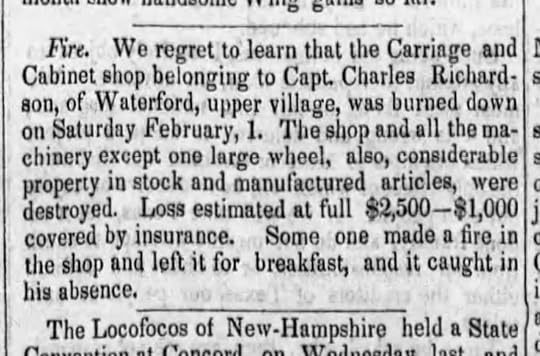
An article in the Vermont Watchman and Statesman in February 1845 reported that there had been a fire in the carriage and cabinet shop belonging to Capt. Charles Richardson, of Waterford, upper village. “The shop and all the machinery except one large wheel, also, considerable property in stock and manufactured articles, were destroyed. Loss estimated at full $2,500-$1,000 covered by insurance. Someone made a fire in the shop and left it for breakfast, and it caught in his absence” (Vermont Watchman and Statesman 1845).
The 1850 Census shows the family living in a home owned by 44-year-old Charles, who is identified as a machinist and farmer. In addition to Miranda and the children, seven adult boarders lived on the property, including farmer George Perry (1829-1861), Sarah Perry (1829-1913), mechanic Aaron Tilton (1823-1906), Sumner Stockwell (1827-1893), Ethan N. Lewis (1825-1887), John Temple, and Scotland immigrant Ann Stuart (1827-1910). (Incidentally, Tilton and Stuart were married in 1853.) Charles and Miranda’s daughter, Sarah, is missing from this census report and the 1860 report; whether she was missed or placed elsewhere is unclear.
In 1851, tragedy struck the Richardson family. The village of Waterford was hit with a dysentery outbreak, “which has raged among the children” (St. Johnsbury Caledonian 1851). Eight children died, including two of Charles and Miranda’s sons: Edward, age two years and four months, and John, age eight years. The two little boys were initially buried in the Pike Cemetery but were moved to the Riverside Cemetery in Waterford after the creation of the Moore Dam in 1956.
In 1852, the town of Northumberland, New Hampshire, hired Charles to build a covered bridge in the village of Groveton over the Upper Ammonoosuc River near the paper mill. Records indicate the bridge was built by “Captain Charles Richardson and Son,” which would indicate sixteen-year-old Charles P. helped his father. The other Richardson boys were too young to be of any help. The 126-foot Paddleford truss bridge was built from native spruce cut from nearby Cape Horn Mountain and milled by lumberman George W. McKellips (1826–1908) at his Groveton sawmill. The Groveton Bridge still stands today and is used as a pedestrian bridge.
A year later, the Guildhall Toll Bridge, constructed by Peter Paddleford (1785-1859) in 1842, was destroyed by a windstorm. Charles was hired to oversee the construction of a new bridge spanning the Connecticut River from Northumberland to Guildhall, Vermont, in 1854. He employed a Paddleford truss for this 300-foot covered bridge, which stood until it was destroyed by cyclonic winds in 1918.
In 1857, the town of Barnet, Vermont, was looking to replace an earlier bridge across the Passumpsic River that had been constructed in 1787. The town hired William Adams (1811-1896) and Ezra Parks (1821-1897) as the contractors, who, in turn, hired Charles as the carpenter (Wells 1923) to build a covered bridge. Another Paddleford truss, this bridge stood across the Passumpsic until it was destroyed by a flood in 1927.
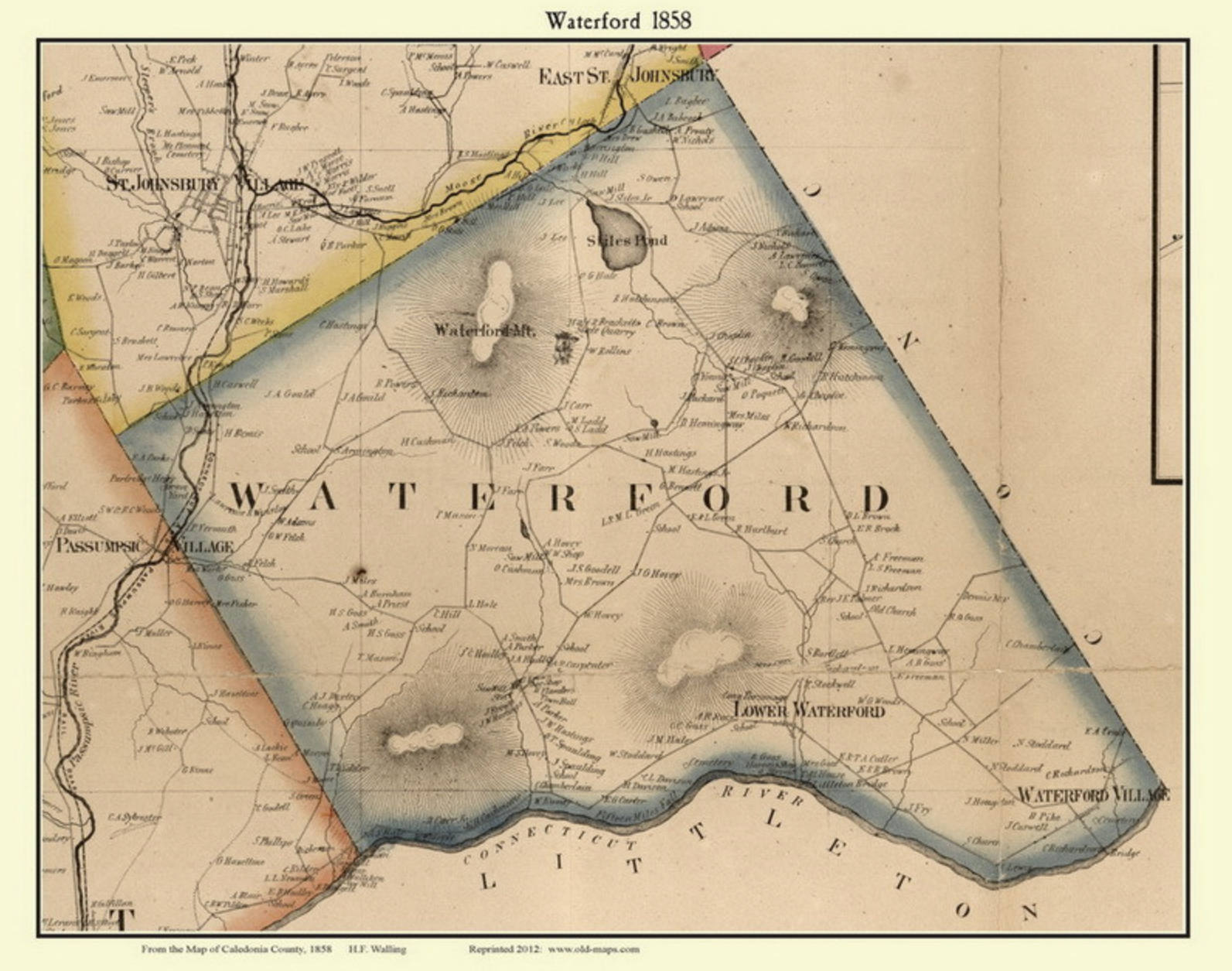
An 1858 map of Waterford identifies the Richardson property in Waterford Village along a stream close to the Connecticut River in the southeast portion of the town. A few miles from the Richardson property is the site of the Upper Bridge spanning the Connecticut River into Littleton, New Hampshire, labeled the “C. Richardson Bridge.” All of this now lies underneath the Moore Reservoir.
In 1859, Charles is credited as the carpenter of the third Waterford Congregational Church. The second building had been destroyed by fire that same year. The new structure was reportedly built with timbers from a previous meetinghouse constructed in 1818 by Deacon Abial Richardson (1773-1843) which had been torn down. There does not appear to be a relationship to Charles.
The 1860 Census shows Charles living with Miranda and his surviving children in Waterford. Nineteen-year-old Unity was working as a teacher; 25-year-old Charles P. is recorded as a carpenter journeyman residing in the home with his wife, Kate. Charles’ occupation is listed as a lumber manufacturer. Also living in the home were teamster James Hurlburt and laborer Sylvester Hurlburt.
Sometime between 1860 and 1870, Charles, Miranda, and their three younger children moved across the river to the village of Groveton in Northumberland, New Hampshire. In addition to owning a farm, Charles operated the Charles Richardson & Co. lumber manufacturing company and continued to work as a furniture maker and bridge builder. The 1870 Census indicates that Charles’ son, Frank, lived next door to his father with his wife and young daughter. Frank also worked as a carpenter.
In 1862, the town of Lancaster, New Hampshire, hired a bridge builder to construct two covered bridges in the downtown area. One was the Mechanic Street Bridge, and the other was the Main Street Bridge, which became known as the Double Barrel Bridge because of its unique design. Town reports indicate that it cost $2,610 to construct both bridges, and up until March 2023, the builder’s identity was unclear. However, after a close examination of receipts at the Weeks Public Library, it is confirmed that Charles built both bridges.
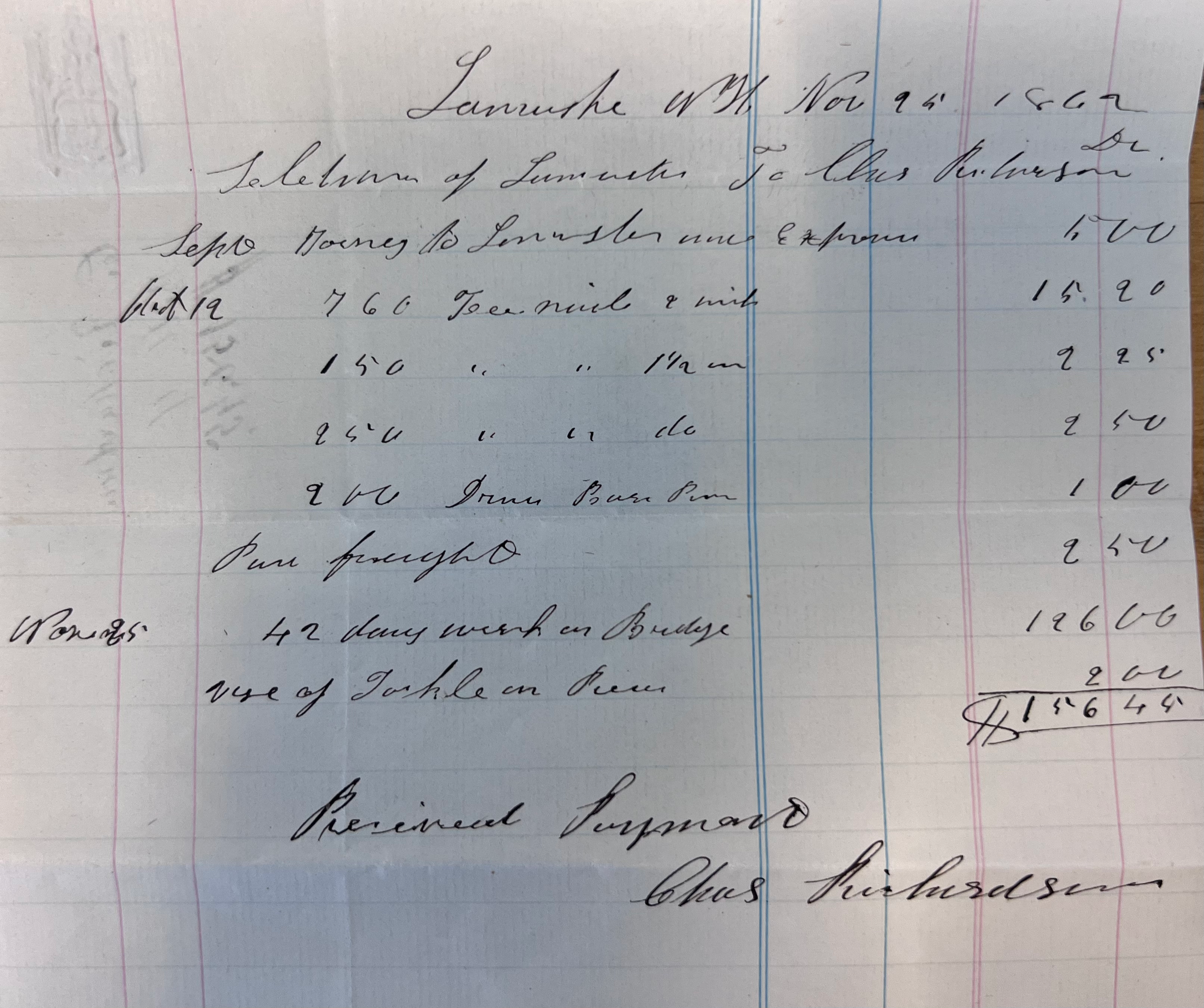
The payments for both covered bridges began in May 1862 and ended in November and simply refer to work on “the bridge.” Charles Richardson was first paid for nineteen days of work on May 21, 1862. On June 26, he was paid for 16 days. Richardson was subsequently paid for expenses such as board, belts, pine, nails, treenails, freight, and use of tackle. On November 9, he was paid for “42 days work on the bridge,” bringing his total to seventy-seven work days for both bridges. In all, he was paid $328.49.
The Main Street/Double Barrel Bridge was damaged beyond repair in 1866 and subsequently replaced. The Mechanic Street Bridge stands today.
Up for debate is Charles’ involvement in building the nearby Stark Bridge. It is unclear exactly when the current bridge was constructed and by whom, but the town has settled on 1862. The Stark Bridge looks incredibly similar to Charles’ other covered bridges, specifically the Groveton and Mechanic Street bridges.
An article by Muriel Rogers Stuart (1913–1990) in the July 1947 edition of New Hampshire Highways Magazine credits Captain Richardson as the builder and unilaterally states it was built in 1857, but this has not been corroborated (Stuart 1947). Stuart served as an auditor for the town of Stark, and her husband, Raymond, served on the school board and as town moderator. It is unclear if she had documented information or was reciting oral tradition. Sadly, neither the Stark Heritage Center nor the Town of Stark have any records prior to 1893.
The 1868 Gorham, New Hampshire, Annual Report indicates that Charles Richardson constructed a bridge across the Peabody River in 1867. He was paid $1,485.48 for his work. According to the Androscoggin River Valley by D.B. Wight, the bridge was destroyed by the freshet of October 4, 1869. “The town had just built a new covered bridge over the Peabody River, on the main road to Shelburne… this was the only highway covered bridge that Gorham ever had” (Wight 1967). No photos exist of this bridge.
 1844. Upper/1st Littleton Bridge
 1852. Groveton Bridge
 1854. Guildhall Toll Bridge
 1857. Passumpsic Village Bridge
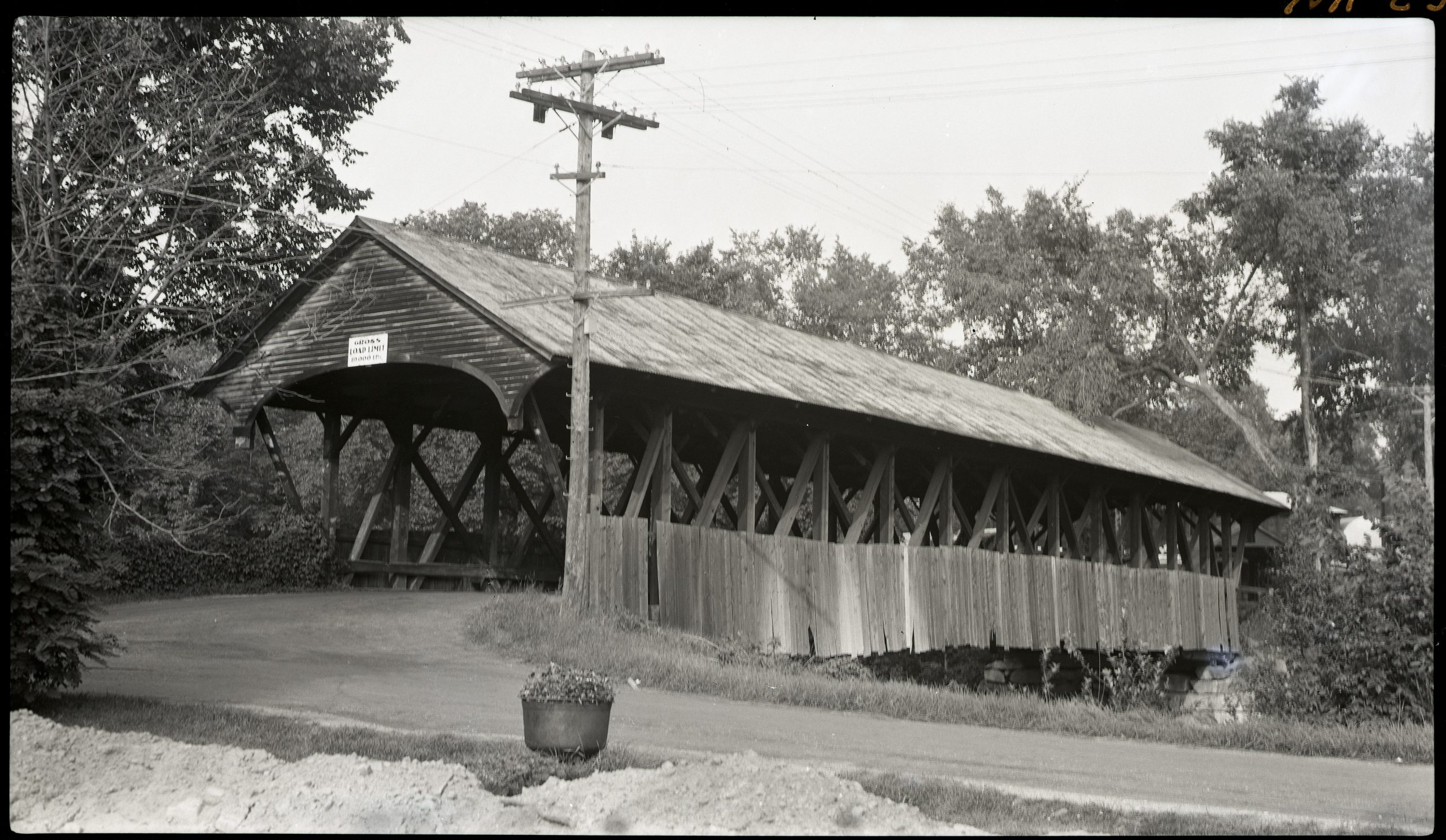 1862. Mechanic Street Bridge
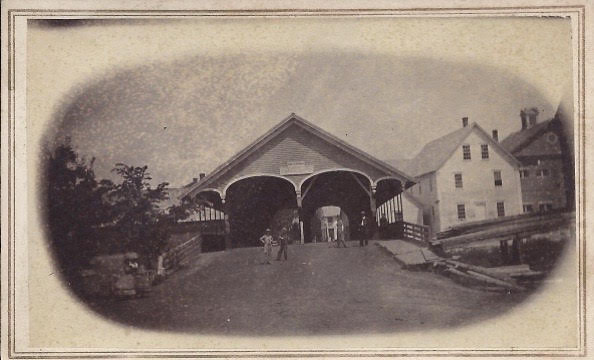 1862. Main Street/Double Barrel Bridge
1844. Upper/1st Littleton Bridge. Waterford, VT/Littleton, NH. Lost 1890.
1852. Groveton Bridge. Northumberland.
1854. Guildhall Toll Bridge. Northumberland, NH/Guildhall, VT. Lost 1918.
1857. Passumpsic Village Bridge. Barnet, VT. Lost 1927.
1862. Mechanic Street Bridge. Lancaster.
1862. Main Street/Double Barrel Bridge, Lancaster. Lost 1866.
1868. Androscoggin River Bridge. Gorham. Lost 1869.
In 1890, Charles’ Upper Bridge in Waterford was destroyed. A log jam gathered around the abutments, causing the west side of the bridge to collapse. “Charles Caswell was driving across the bridge and had barely time to get over when the bridge fell” (St. Johnsbury Caledonian 1890). By that evening, the rest of the bridge went out along with the piers “so that the water now runs as smoothly over the spot as if no bridge had ever been there” (St. Johnsbury Caledonian 1890).
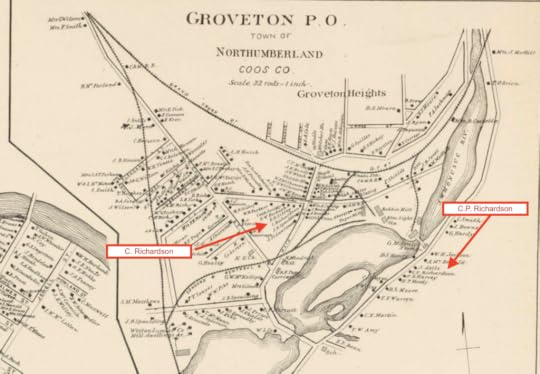
An 1892 map of Groveton indicates C. Richardson living on the corner of Main and State Streets. A bank building stands in that location today. His son, Charles P., is shown as living on what is now Brooklyn Street.
Charles died of heart failure on December 7, 1894, at the age of eighty-eight. He is buried in the Northumberland Cemetery with his wife, Miranda, who died in 1897.
Charles’ son, Charles P. Richardson (1836–1906), also became an established carpenter and builder. Together, they were “successful contractors and builders, especially of dams, bridges, and mills” (Coos County Democrat 1898). Vital records indicate Charles P.’s occupations as a carpenter (1857), carpenter journeyman (1860), mechanic (1860), millwright (1880), building mover (1900), and millwright (1905).
Charles P. married Catherine “Kate” S. Moore (1836-1900) on December 12, 1857, and the couple had two children, Flora E. (1860-1938) and Charles Fremont (1862-1939). The family moved across the Connecticut River to Groveton in 1864. He was soon regarded as “one of the most energetic and picturesque characters that have recently figured upon the stage of business life in this vicinity… he is a keen, spare, resolute man, who studies calmly every element of risk or danger” (Coos County Democrat 1898).
On March 18, 1873, Charles P. received patent number 136,939 for an improvement in grindstone troughs and supports. “This invention relates to the construction of troughs for grindstones, and the brackets or hangers for supporting the stone, and it consists in the manner of putting in the bottom of the trough, and in so constructing the hangers that the trough may be fastened down with screws” (Richardson 1873).
Charles P. was an industrious man. A profile in the Coos County Democrat stated that during his lifetime, he “moved fully 50 buildings, and has built, or helped to build, ten bridges, including one at Upper Waterford long owned by his father, 300 feet long, and one at Bethel, Me., 400 feet long. He has raised bells and has raised 34 smokestacks and taken down 12” (Coos County Democrat 1898). The “helped to build” statement seems liberal, given that Charles P. was only eight years old when the Upper Waterford Bridge was built. The Bethel Toll Bridge in Bethel, Maine, was constructed between 1868 and 1869. Charles P. was 32 and could have participated in the build. However, the builder of this bridge has never been proven and has been speculated to have been Hiram York (1828-1897). Records have not been found to substantiate either claim.
After Kate died in 1900, Charles P. lived with his married daughter, Flora, her second husband, William Nelson (1862-1919), and their surviving son, Charles. W (1900-1968). In 1906, Charles P. married Vesta Viola Smith Stinson (1845-1931). He died a month after their wedding. He is buried with Kate in the Northumberland Cemetery.
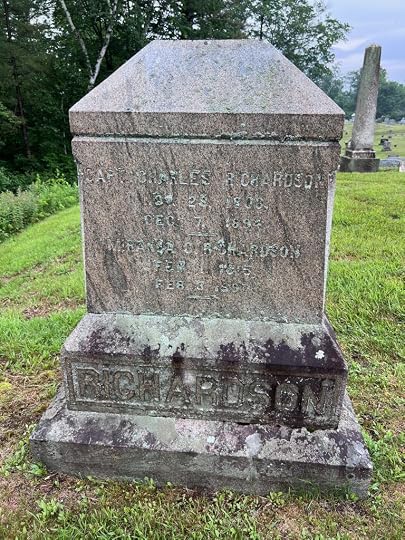 Charles Richardson Gravesite
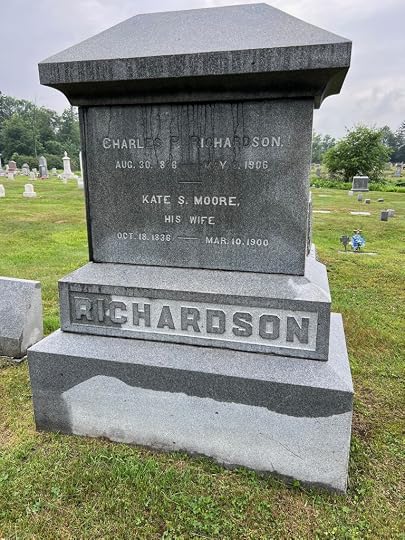 Charles P. Richardson Gravesite
References
Historical photos are a part of the author’s collection or were used with permission from Anne Morgan, Beth Kanell, Covered Spans of Yesteryear, and the National Society for the Preservation of Covered Bridges.
Special thanks to Barbara Robarts, Weeks Memorial Library, Lancaster; Beth Kanell, Waterford, Vermont; Helen-Chantal Pike, Waterford, Vermont; Gail Andrews, Narragansett Historical Society, Templeton, Massachusetts; Reuben Rajala, Gorham Historical Society, New Hampshire; Bill Caswell, President, and Scott Wagner, Co-Vice President, National Society for the Preservation of Covered Bridges..
Affidavit of John Richardson (age 80), 6 March 1844, Sarah Richardson, widow’s pension application file W. 18814, for service of John Richardson, U.S., Revolutionary War Pension and Bounty-Land Warrant Application Files, 1800-1900, Department of Veterans Affairs, Archive Publication No. M804, Archive Roll No. 2039, retrieved from ancestry.com: accessed June 23, 2024.
Allen, Richard S. 1947. “Upper Connecticut River Bridges.” Covered Bridge Topics, June: 4.
Casella, Richard M. 2012. Stark Covered Bridge, Stark, New Hampshire, Historic Structure Report. Portsmouth, RI: Historic Documentation Company, Inc.
Conwill, Joseph D. 2002. Historic Amercian Engineering Record, Sunday River Bridge, HAER No. ME-69. Washington, D.C.: National Park Service, U.S. Department of the Interior.
—. 2003. Maine’s Covered Bridges. Charleston, SC: Arcadia Publishing.
Coos County Democrat. 1898. C.P. Richardson. Coos County Democrat, May 4, 1898.
Crane, Ellery Bicknell. 1907. Historic Homes and Institutions and Genealogical and Personal Memoirs of Worcester County, Massachusetts: With a History of Worcester Society of Antiquity. United States: Lewis Publishing Company.
Political Manual and Annual Register for the State of New Hampshire. 1867. United States: McFarland & Jenks.
Richardson, Charles P. 1873. Improvement in grindstone troughs and supports. US Patent 136,939, issued March 18, 1873.
St. Johnsbury Caledonian. 1851. St. Johnsbury Caledonian, October 18, 1851.
—. 1863. “To Stammerers.” St. Johnsbury Caledonian, October 16, 1863.
—. 1877. “Sudden Death.” St. Johnsbury Caledonian, June 29, 1877.
—. 1890. “The Bridge Disasters.” St. Johnsbury Caledonian, May 15, 1890.
Stuart, Muriel V. Rogers. 1947. “Stark Covered Bridge.” New Hampshire Highways Magazine, July.
Town of Gorham. 1868. “Annual Report of the Town of Gorham.” Gorham, NH.
Vermont Watchman & State Journal. 1845. “Fire.” Vermont Watchman & State Journal, February 21, 1845.
Vinton, John Adams. 1876. The Richardson Memorial: Comprising a Full History and Genealogy of the Posterity of the Three Brothers, Ezekiel, Samuel, and Thomas Richardson, who came from England, and United with Others in the Foundation of Woburn, Massachusetts, in the Year 1641, of John Richardson, of Medfield, 1679, of Amos Richardson, of Boston, 1640, of Edward and William Richardson, of Newbury, 1643, with Notices of Richardsons in England and Elsewhere. United States: subscribers.
Wells, Frederic Palmer. 1923. History of Barnet, Vermont: From the Outbreak of the French and Indian War to Present Time. United States: Free Press Printing Company.
Wight, D.B. 1967. The Androscoggin River Valley: Gateway to the White Mountains. Charles E. Tuttle Company, Rutland, Vermont.
Wright & Potter Printing Co.; Boston, MA, USA; Massachusetts Soldiers and Sailors of the Revolutionary War; Volume: Volume 13.
The post The Bridgewright Captain Charles Richardson first appeared on Covered Bridges of New Hampshire.
April 14, 2024
The Bridgewrights Granger
Part One – Sanford Granger (1796–1882)
The Granger story in New Hampshire begins with Eldad Granger (1766-1866) and his wife, Sarah Holmes (1771-1852). Natives of Connecticut, Eldad and Sarah moved north to the Connecticut River Valley and settled in Chesterfield, New Hampshire, shortly after their marriage in 1786.
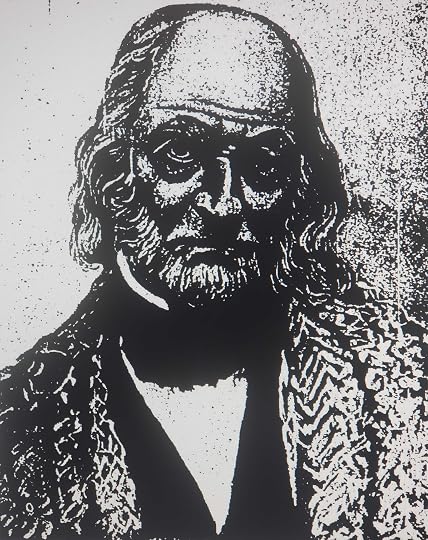 Eldad Granger, Sanford’s Father
Eldad worked as a mechanic and wheelwright and, for a time, as a boat captain on the ferry boats on the Connecticut River. At the end of the eighteenth century, the family moved a few miles north to Westmoreland, where Eldad built a house. He also purchased several mill properties on Mill Brook, which he rebuilt and combined into a single mill operation around 1800. The mill became known as the Granger Mill, and the area around it was known as Granger Hollow.
He and Sarah had fifteen children: Lucinda (1788-1822), Luther (1791-1867), Sabra (1793-1793), Sabra (1794-1849), Sanford (1796-1882), Mary (1798-1881), John (1800-1805), Elihu (1802-1896), Maria (1804-1884), Miranda W. (1808-1892), Nancy (1808-1861), John J. (1810-1826), Lucy H. (1814-1900), Daniel H. (1817-1841).
Eldad was a respected member of the Westmoreland community and lived to be almost one hundred years old; he missed being a centenarian by fourteen days when he died on March 2, 1866. Following his death, he was remembered for having voted in “every Presidential election from George Washington to Abraham Lincoln” and for some unusual physical features. He was described as “never sick in his life… he used tobacco and spirits in moderation …he was spare and slight in figure and wiry and muscular. He had what is known as a double set of teeth all around, and at his death, they were in perfect condition” (Granger 1893).
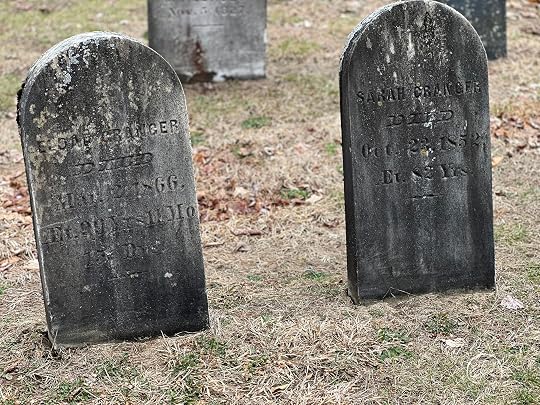 Eldad and Sarah’s graves, Westmoreland
Eldad left his Westmoreland property to his son, Sanford, who sold a parcel to George H. Britton (1835-1891) in 1875 and eighteen acres to Willard S. Shaw (1813-1895) in 1878. The 1967 town history indicates that the mill had “gone to decay” by 1885 and that “no recognizable remains of the Granger dam or mills have been found” (Westmoreland History Committee 1976). The Granger home no longer exists, and in 2006, the road bearing their name was relocated. All that remains of the Grangers in Westmoreland are family tombstones in the North Cemetery.
The Granger bridge building legacy begins with Eldad’s fifth child and second son, Sanford. He was born on March 12, 1796, and according to his birth record, he was born in Westmoreland. Various biographies list his birthplace as Chesterfield or across the Connecticut River in Bellows Falls, Vermont. Regardless of where he came into the world, Sanford inherited his father’s propensity for mechanics and millwork.
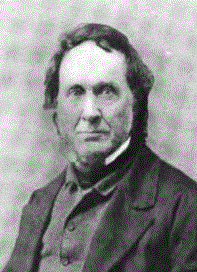 Sanford Granger
Around 1820, the 23-year-old Sanford moved from Westmoreland to Bellows Falls, a village in Rockingham, where he bought a former mill site. Sanford erected a dam down the river from some other mills. But before he could build his sawmill, a freshet destroyed his dam, “causing so great financial loss that he abandoned the project” (Hayes 1907).
On February 26, 1826, at age 30, he married Abigail R. Stevens (1800-1877) in the neighboring town of Westminster, Vermont. The couple had five children: Albert Sanford (1834-1922), Harriet Abigail (1837-1880), Edwin (1843-1843), Edward Loring (1844-1894), and Mary Geyer (1846-1846).
A few months after the wedding, Sanford purchased a sawmill at Gageville, a village in Westminster alongside the Saxtons River, which he owned and operated for many years. Another freshet would threaten his livelihood in April 1826. “Mr. Granger and his family had retired to rest, supposing the water was falling and the danger past. With this security the inmates of the house had sunk into sleep, and so sudden was the vent, that they never heard the crash nor discovered their loss until morning. Mr. Granger had in the mill between sixty and seventy dollars worth of joiner’s tools when carried away” (Hayes 1907).
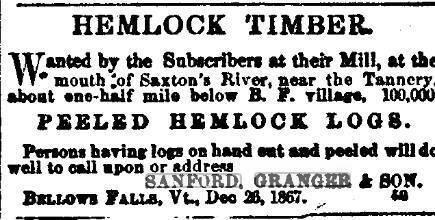 Bellows Falls Times, 1867
Granger developed the sawmill into a profitable lumber business called S. Granger & Son. Also on the property was a brickyard. Sanford is credited with providing bricks to the Vermont Valley Railroad to construct a train station near the Cheshire and Sullivan Bridges. The two-story brick station was built in 1851 and destroyed by fire in 1921. The property would later become the site of the Gage Basket Factory and is now home to the abandoned Chemco building. While the Granger properties are long gone, the road that ran through it still bears their name.
Sanford was a founding member of the Methodist Church in Bellows Falls. In 1835, he bought an abandoned one-story brick schoolhouse on Westminster Street as temporary quarters for the congregation. Later that year, Sanford and two other businessmen financed the building of the new Methodist Church on Atkinson Street. In return, he was given the choice of pews. Sanford served as one of the church’s first trustees and remained a lifelong congregant, even leaving $500 to the church in his will. Various reports indicate that Sanford actually built the building itself, but that is not substantiated. The building was demolished in 2021.
Sanford’s covered bridge career seemingly began in the Saxtons River village on Hartley Hill Road. Sanford constructed a bridge interchangeably called the Village, Saxtons River, Sawmill Bridge, and even the Brookline Bridge. It is unclear when this bridge was built, but it was destroyed by a freshet on Monday, October 4, 1869. It was replaced the following year; the builder is unknown.
In 1835, Sanford built another covered bridge over the Saxtons River, this time just down the river from his mill in Gageville. Sanford himself petitioned the county court for both a road and a bridge at this location. In July 1835, the town decided to build both the road and the bridge, given that Sanford would “agree to pay $200 toward the road and build the bridge aside from the abutments ‘on the plan of the one which the said Granger built across Saxtons river’ for $6 per running foot” (Springfield Reporter 1941). Known interchangeably as Gageville or Grangers Bridge, this 118’ Town lattice truss bridge stood until it was destroyed by arson on August 13, 1967.
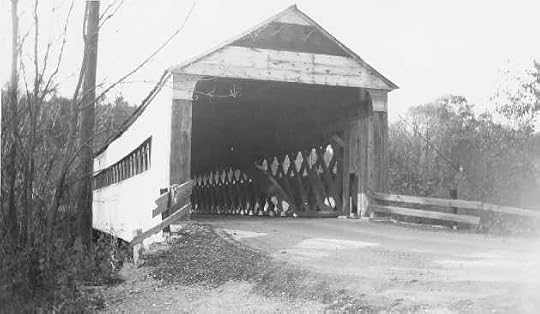 1835. Gageville Bridge
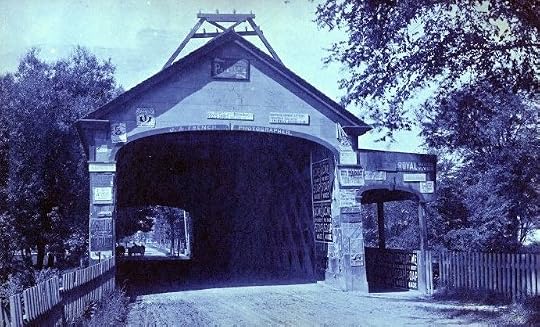 1837. West Street Bridge
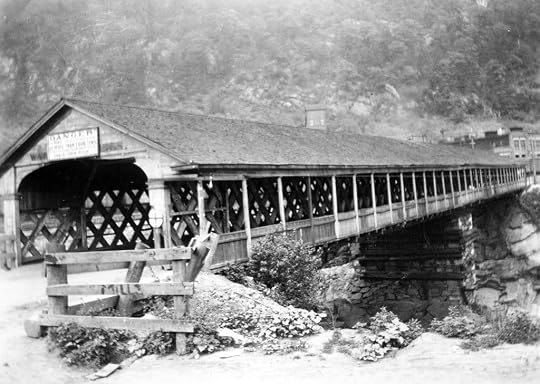 1840. Tucker Toll Bridge
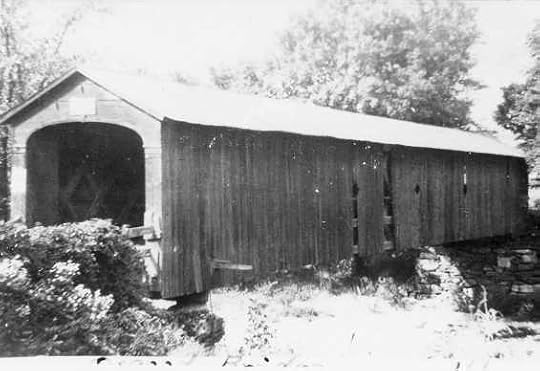 1867. Hall Bridge
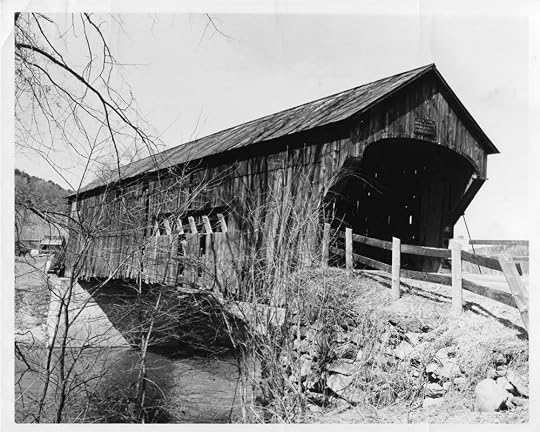 1868. Worrall Bridge
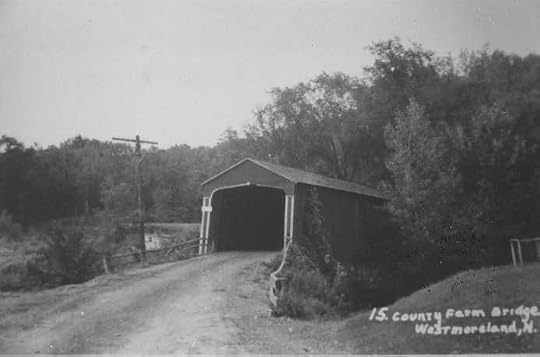 1870. County Farm Bridge
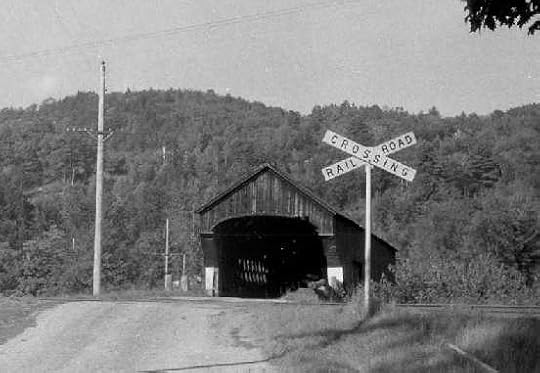 1870. Bartonsville Bridge
Sanford was contracted by Aaron Willson (1795-1846) and Oren Dickinson (1809-1890) of Keene to assist in building the West Street Bridge in 1837. “The bridge was laid out and framed by a man named Granger, from Westminster, Vt. The pins that hold the lattice work are of white oak” (Keene Evening Sentinel 1900). When the bridge was taken down in 1910, it was reported that the planks were as “good as ever” (Keene Evening Sentinel 1900).
In 1840, architect and builder Captain Isaac Damon (1781-1862) of Northhampton, Massachusetts, was hired to build a new covered bridge connecting Bellows Falls and Walpole over the Connecticut River. Damon had previously built many covered bridges across the Connecticut River and several alongside his business partner, Lyman Kingsley (1800-1862). Damon and Kinglsey employed Sanford as part of the project. “Sanford Granger, as a builder, had a prominent part in building the new bridge and furnished lumber for it in connection with the Elwells of Langdon” (Hayes 1907). Robert Elwell (1807-1884) was a lumberman across the river.
The crew replaced an uncovered bridge constructed in 1795 by Colonel Enoch Hale (1733-1813). At the time, this structure was considered one of the strongest and most elegant bridges in America, but by 1840, it was in rough shape. Damon and his crew built the new bridge fifteen feet above the old one. Travelers utilized the old bridge until the new bridge opened; then, workmen “cut away the old bridge after the completion of the new one in July 1840. The old frame was allowed to fall to the rocks many feet below and later was carried away by high water” (Hayes 1907).
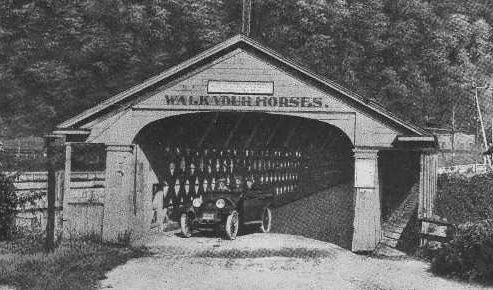 Tucker Toll Bridge
This 262’, two-span, Town lattice truss bridge was known as the Tucker Toll Bridge. Financed by Bellows Falls businessman Nathaniel A. Tucker, the bridge collected tolls until 1904. It was replaced in 1930 by the Charles N. Vilas Bridge, which has been closed since 2008.
In 1843, Sanford was hired to raise and lengthen the Lewis Bridge in Westminster. The 1838, 41’ bridge was damaged by high water that washed out one abutment. Sanford lengthened the bridge to 65’ and was paid $170 for the job. The Lewis Bridge was replaced in 1953.
For almost two decades, it appears Sanford took a hiatus from building covered bridges and turned his attention to buildings. In 1855, Sanford tore down that Westminster Street schoolhouse and constructed a three-story building called the Granger Block. According to Hayes’ History of Rockingham, several Native American skeletal remains were exhumed during the construction of the building. The Granger Block is often referred to as a brick building, but it appears to have been constructed with a wood frame with brick veneer.
Sanford moved his family to the second floor of the Granger Block. The ground floor was used as a store for many years, housing businesses such as D. W. Brosnahan Grocers, H. W. Redfield Grocers, M.B. Kelley Grocers, F.B.F. Grocers, Harty & Keane Grocers, G.B. Albee Plumbing, F. P. Hadley’s Stove and Tinware, C.E. Whitman’s Lenten Goods, A. F. Winnewisser’s dry goods store, Bailey Brothers piano warehouse, and Connors’ Store. The building was eventually purchased by Eugene Cray (1888-1965) in 1930, officially ending the Granger affiliation. The Cray Block was ultimately expanded to include a bowling alley on the top floor and modern shops below. The building was destroyed by fire on February 19, 1984. A parking lot exists today in its location.
In 1860, the Bellows Falls Times reported that Sanford had “taken the job of building the block on Westminster street for C. E. Chase and son” (Bellows Falls Times, 1860).
In 1867, Sanford returned to building bridges with the construction of the Hall or Osgood Bridge in Rockingham, just east of Saxons Village. The 1973 National Register for Historic Places describes the bridge as “a single span supported by two flanking timber Town lattice trusses. At each corner of the bridge an iron buttress extends from an extended floor beam to the upper side of the bridge, providing lateral support for its superstructure…. The bridge is 117 feet long and 15 feet wide, with a 12-foot roadway” (Henry 1973).
The Hall Bridge stood until it collapsed under the weight of a truck overloaded with stone on October 2, 1980. A replacement bridge was erected in 1982 by Milton S. Graton of Graton Associates, Inc. of Ashland. Graton’s bridge stands today.
The following year, Sanford constructed the Worrall Bridge over the Williams River in Rockingham. This 83’ Town lattice truss bridge is the oldest surviving nineteenth-century covered bridge in Windham County and the last of Sanford Granger’s covered bridges to exist. It has been reinforced over the years and survived damage from both Tropical Storm Irene in 2011 and the major flooding of July 2023.
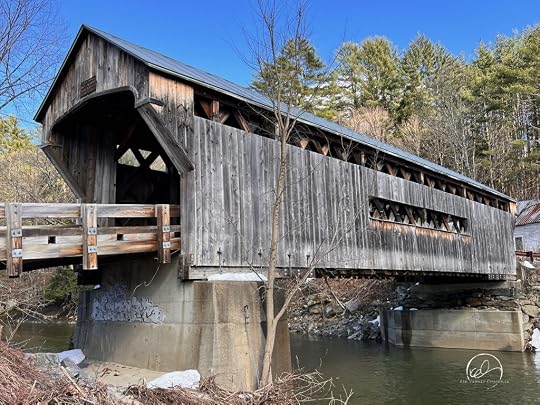 Worrall Bridge, 2024
The year 1870 marked the construction of the last of Sanford Granger’s covered bridges. The County Farm Bridge, an 80’ bridge over Partridge Brook in Westmoreland, was reportedly built by Sanford. The bridge stood until it was destroyed by the Great Freshet of 1936.
That same year, Sanford built the Bartonsville Bridge in Rockingham. This 151’ Town lattice truss was constructed to replace a covered bridge that was destroyed by the freshet of 1869. The Bartonsville Bridge stood over the Williams River until it was destroyed during Tropical Storm Irene in 2011. (You can see the tragic collapse as recorded by Susan Hammond and shown on CBS News here. Be forewarned; it’s tough to watch.) The bridge was rebuilt in 2012 by Cold Water Bridges.
Local communities hired Sanford to make repairs on their bridges. In 1875, Sanford was paid $123.97 for repairing the Walpole and Westminster Bridge, which had been built only five years before. Alstead paid him $57.83 for “work and lumber on bridge” (Town of Alstead 1879) in 1879 and for “use of capstan and jacks for raising bridge” (Town of Alstead 1882) in 1882. The specific bridges are not identified.
Sanford’s second act of bridge building and repairs began when he was 71 years old. It also coincides with his son Albert’s return to Bellows Falls. It’s more than likely the two worked together on these projects.
Sanford’s wife, Abigail, died on November 19, 1877, of pneumonia. She was 77 years old. Sanford died five years later, on May 17, 1882, at 86, also of pneumonia. They are buried together in Oak Hill Cemetery in Bellows Falls.
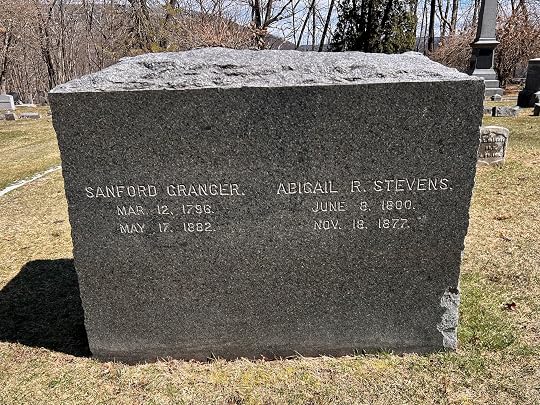 Sanford and Abigail’s graves, Bellows Falls
It appears Sanford had been preparing his funereal vessel well in advance of his passing. According to an article in the Rutland Daily Herald, Sanford would closely watch “the lumber passing through his hands and whenever he found a particularly nice board he laid it aside and later he fashioned for himself his last resting place… old men, boys then, tell of his inviting them up to his apartment and taking them to a particular room in the rear where he showed them the coffin…the elegant appearance of the selected woods made indelible impressions, on their minds as well as the gruesome use to which it was to be devoted” (Rutland Daily Herald 1930).
Sanford was remembered as “a strong advocate of temperance” and as an “ardent abolitionist” (Hayes 1907). He was an active participant in the Underground Railroad, assisting in bringing enslaved people to freedom across the border in Canada. His son, Albert, recounted seeing Black people “come from the hay mow and go into the house in the morning with a pail for breakfast so freely given” (Hayes 1907).
It is important to note that many of Sanford’s covered bridges are referred to as “Granger Bridges,” which leads one to assume that a specific truss design may have been employed. It has been speculated that Sanford applied for a truss patent in 1833. However, there is no record of a patent for a bridge design attributed to Sanford Granger. If it existed at all, his patent request is believed to have been destroyed in the fire in the patent office on December 15, 1836. Most of Sanford’s bridges employed a Town lattice truss, a fact reinforced by Victor Morse in “Windham County’s famous covered bridges” in 1960.
Part Two – Albert Sanford Granger (1834–1922)
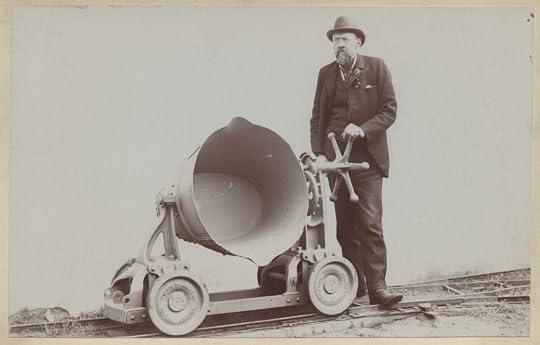 Albert S. Granger (Photo courtesy of Historic Richmond Town.)
Albert Sanford Granger was born on November 10, 1834, in Westmoreland, the first child of Sanford and Abigail. Very little is known about his childhood. However, by the late 1850s, Albert was living in Concord, New Hampshire, where he worked as a gas fitter. On March 16, 1857, at age 22, he married Loretta E. Carpenter (1835-1870) of Springfield, Massachusetts. He moved his young wife to the capital city with him.
Albert and Loretta had five children: Clement Alfred (1834-1922), Carrie Augusta (1861-1953), Rose B. (1863-1950), Ruth Elizabeth (1865-1949), and Sanford Thomas (1868-1870).
In 1861, Albert moved the family to Springfield, Massachusetts, when, according to his daughter Carrie’s obituary, he had a contract to build the South End Bridge over the Connecticut River, which was “to be similar to others he had constructed in Vermont and New Hampshire” (Transcript-Telegram 1953). Albert was 27 years old at the time. It is unclear which covered bridges Albert constructed prior to 1861. He was too young to have assisted his father in the 1840s. Either this recollection is inaccurate, or there are more Granger covered bridges that were constructed. More research is needed.
Regardless, the Civil War caused the bridge project to be postponed, and Albert took a job at the Springfield Armory, where he aided in the manufacture of firearms for the Union. He worked as an inspector, examining guns for any defects. Weapons bearing the US inspector marking of ASG were personally inspected by Albert.
In 1867, Albert and his family relocated to Bellows Falls. The 1870 census indicates he worked as a bridge conductor and resided with his wife, Loretta, his five children, his mother-in-law, and two others. His infant son Sanford died on April 21, 1870, of brain inflammation, and his wife Loretta died on June 16. Her cause of death is unknown. She was 34 years old.
In 1869, the nearby town of Langdon, New Hampshire, lost one of its covered bridges in the Great Freshet. The Cold River Bridge needed to be replaced. Handwritten town records at the Langdon Town Office mentioned the bridge in a notation dated November 20, 1869, regarding a new highway. A new roadway petition had been brought forth on October 25 after the previous highway was destroyed, presumably by the flooding. The measurements of the new roadway specifically mention Calvin Smith’s barn and “four rods and four links to the center of the face of the new abutment on the north side of Cold River” (Town of Langdon 1869).
A new covered bridge was constructed for $450, using virgin timber from nearby Fall Mountain. Several accounts, including the National Register of Historic Places application, indicate Albert built the bridge. However, town records could not be located to prove this assertion definitively. Today, the bridge is called the McDermott Bridge and stands on Crane Brook Road.
The following year, Albert constructed the Jones or West Bridge in Saxtons River Village, less than two miles from his father’s first covered bridge. The Jones or West Bridge was originally a Queenpost pony truss with later reinforcing additions, resulting in the appearance of Kingpost trusses, and was 89 feet long (Wagner 2024). The bridge was razed in 1964.
In 1874, the town of Langdon once again hired Albert for bridgework, this time to replace the Prentiss Bridge over Great Brook. The town of Langdon paid $1,062.09 for the project. Granger himself was paid $197.50 for labor, $34.97 for lumber, bolts, and spike, and $23 for the use of a derrick; nineteen other men were paid for labor and supplies (Town of Langdon 1875).
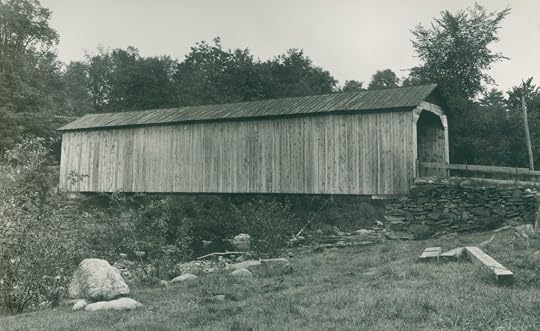 1869. McDermott Bridge
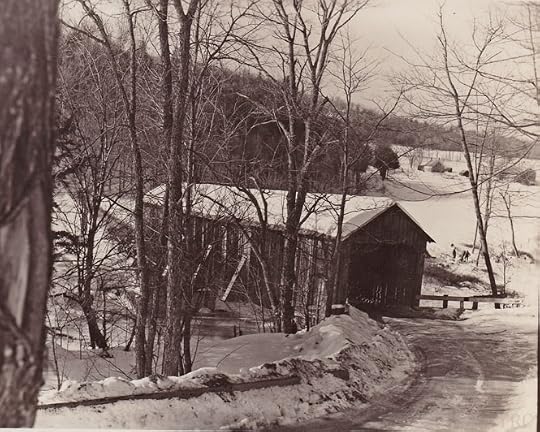 1870. Jones/West Bridge
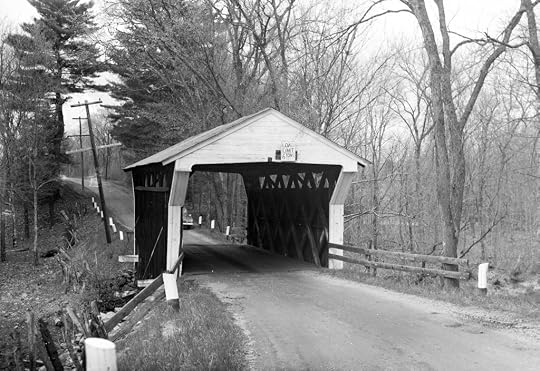 1875. Prentiss Bridge
After six years as a widower, Albert married Sarah E. Hodgkin (1846-1880) on October 29, 1876, in Framingham, Massachusetts. That same year, the Grangers relocated to Brooklyn, New York, where Albert took a job as the machine shop foreman at the C.W. Hunt Company in Staten Island, one of the largest manufacturers of industrial equipment, such as hoisting engines, steam shovels, and coal-handling machinery. The photos of Albert on this page were taken by the C.W. Hunt Company.
The 1880 census shows Albert and Sarah residing at 605 Pacific Street in Brooklyn, but Albert’s children are not listed. Clement is listed in Brooklyn as a boarder on Jay Street and working as a machinist. Clearly, his younger three children were there as well. Ruth would later graduate from PS 15 in Brooklyn and became a school teacher, principal, and superintendent in the NYC school system. She married Captain Arthur N. Gray (1862-1949) and, after her retirement, moved to Agawam, Massachusetts. Rose also taught school in Brooklyn for many years before retiring to Florida. She never married. Daughter Carrie would marry Israel M. Charlton (1860-1931) in Massachusetts and make her home there.
By the end of that year, Albert would once again be a widower. Sarah died of consumption on December 8, 1880. Like Albert’s first wife, she was 34 years old. A month later, on January 8, 1881, his only surviving son Clement also died of consumption. He was 23 years old.
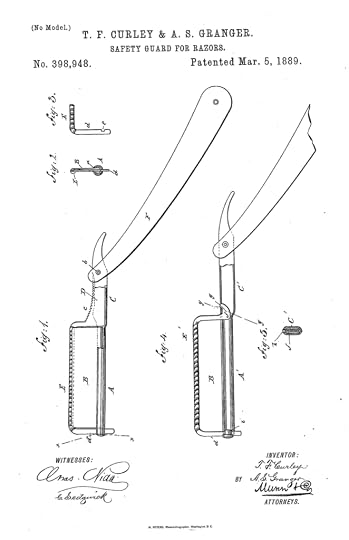
In addition to his work as a machinist, Albert was also an inventor and held several patents for a variety of products, including a pen holder, patented in 1859, a machine for cutting teeth of rack bars, patented in 1885, and a check perforator, patented in 1899. More notably, Albert partnered with safety razor inventor Terence F. Curley to improve upon his earlier patent. Albert and Terence were issued a patent in 1889 for the Curley Ideal Safety Razor. Promising a “sliding diagonal shave” and claiming to be “the one razor that will not let you scrape your face,” the Curley Ideal Safety Razor was “unconditionally guaranteed” (J. Curley & Brothers).
When Albert was 54, he got married for the third time. His wife was Adelaide C. Hayes (1837-1903), a native of Farmington, New Hampshire, who had been working as a New York City school teacher for several years. The two married on January 25, 1889, in Manhattan. Adelaide’s 1898 will indicates she owned property on Douglas Street in Brooklyn, but the couple was living on Staten Island.
In 1892, Albert served as a juror for The People vs. Michael J. O’Connell. During his juror testimony, he indicated he worked as a mechanical engineer. Incidentally, O’Connell was charged with murdering his wife; Albert and eleven others found him guilty of manslaughter in the second degree.
By 1900, Albert and Adelaide were living in Washington, DC. The census shows the pair as boarders at 516 Ardmore 13th St. NW. Albert’s occupation is listed as mechanical engineer. Why they were in the nation’s capital is unclear.
The couple returned to Staten Island, where Adelaide died on November 5, 1903. She was 66 years old. Adelaide was laid to rest back in New Hampshire, and Albert moved north to live with his daughter, Carrie and her husband, Israel M. Charlton (1860-1931). The family lived on Riverdale Street in West Springfield, Massachusetts, in a home owned by Albert.
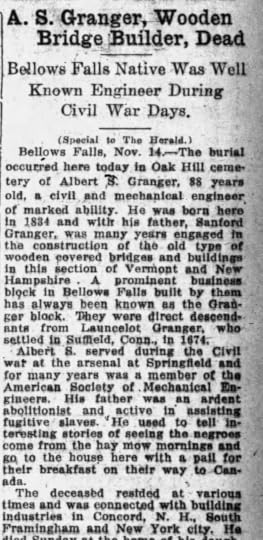
The 1910 census shows Albert still working as a millwright in a machine company at age 75. Ten years later, he had seemingly retired.
Albert died in West Springfield on November 12, 1922, at the age of 88, after a four-week illness. The funeral was held at his home, and the Reverend Allan K. Chalmers officiated. Albert is buried alongside his first wife, Loretta, in the Oak Hill Cemetery in Bellows Falls.
His obituary remembered him as an “inventor and a civil and mechanical engineer of marked ability” and that, along with his father, he built “many of the covered bridges in Vermont in New Hampshire” (Transcript-Telegram 1922).
Albert Granger’s work can be seen today in Langdon’s two existing covered bridges, the McDermott and the Prentiss. Fortunately, the town of Langdon opted to bypass both bridges instead of removing them. After years of neglect, both were restored with monies raised by the Langdon Covered Bridge Association. The Prentiss Bridge was restored by master bridgewright Arnold M. Graton of Arnold M. Graton Associates, Inc. of Holderness, and rededicated in 2002. The McDermott Bridge was rehabilitated by Daniels Construction, Inc. of Ascutney, Vermont, and rededicated in 2008.
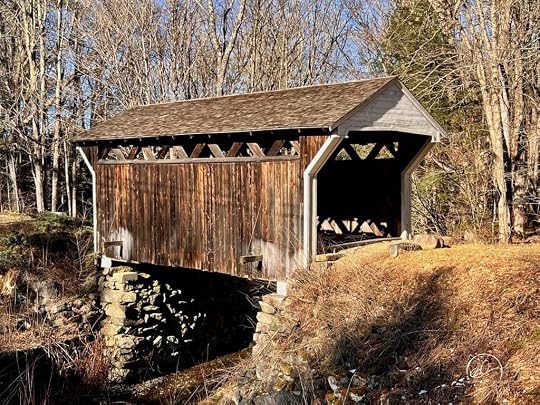 Prentiss Bridge, Langdon
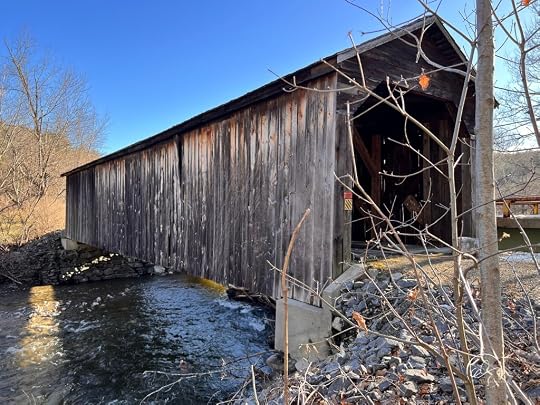 McDermott Bridge, Langdon
References
Historical photos not part of the author’s collection were used with permission from Historic Richmond Town, Mac McClaren, Covered Spans of Yesteryear, and the National Society for the Preservation of Covered Bridges.
Special thanks to Walter Wallace, Coordinator, Rockingham Historic Preservation Commission; David Deacon, SUNY Oswego; Larry Clark, Vice President, and Cathy Bergmann, President, Bellows Falls Historical Society; Pamela Johnson-Spurlock, Reference and Historical Collections Librarian, Rockingham Free Public Library; Carli DeFillo, Collections Manager, Historic Richmond Town, Staten Island, NY; Carla Westine and Rachael Spafford, Chester Vermont Historical Society; Tina Gilbert Tidd, and Dianna Hart Wilson; Scott Wagner and Bill Caswell, National Society for the Preservation of Covered Bridges.
Allen, Richard Sanders. 1962. Rare Old Covered Bridges of Windsor County. Brattleboro, VT: The Book Cellar.
Argus and Patriot. 1883. “Bellows Falls Briefs.” Argus and Patriot. July 11, 1883, 2.
Bacon, Edwin Monroe. 1906. The Connecticut River and the Valley of the Connecticut: Three Hundred and Fifty Miles from Mountain to Sea; Historical and Descriptive. United Kingdom: G. P. Putnam’s Sons.
Bellows Falls Times. 1860. “Local Matters.” Bellows Falls Times. May 25, 1860.
———. 1863. “Local Matters.” Bellows Falls Times. October 2, 1894.
———. 1867. “Local Matters.” Bellows Falls Times. December 26, 1867.
———. 1894. “Business Cards.” Bellows Falls Times. June 21, 1894.
———. 1894. “Ed Gould’s Apartments in the Granger Block Burned Out.” Bellows Falls Times. December 13, 1894.
CBS News. 2011. “Caught on tape: Irene’s flooding takes out bridge.” Amateur footage provided by Susan Hammond. Accessed March 17, 2024. https://www.youtube.com/watch?v=ZEs8u....
Conwill, Joseph D. 2004. Vermont Covered Bridges. United States: Arcadia.
Curley, Terence F., and Granger, Albert S. 1889. Safety-Guard for Razors. US Patent 398,948. Issued March 5, 1889.
Encyclopedia of Massachusetts, Biographical–genealogical. 1916. United States: American Historical Society (Incorporated).
Granger, A. 1859. Pen Holder. US Patent 23,366. Issued March 29, 1859.
Granger, A. 1885. Machine for Cutting Teeth of Rach Bars. US Patent 313,201. Issued March 3, 1885.
Granger, James Nathaniel. 1893. Launcelot Granger of Newbury, Mass., and Suffield, Conn: A Genealogical History. United States: Higginson Genealogical Books.
Griffin, Simon Goodell. 1980. The History of Keene, New Hampshire. United States: Heritage Books.
Hayes, L. S. (1907). History of the Town of Rockingham, Vermont: Including the Villages of Bellows Falls, Saxtons River, Rockingham, Cambridgeport, and Bartonsville, 1753-1907, with Family Genealogies. United States: The Town.
Henry, Hugh H. 1973. “National Register of Historic Places Inventory Nomination Form: Hall Bridge.” May 8. Accessed March 17, 2024. https://npgallery.nps.gov/GetAsset/5f....
———. 1973. “National Register of Historic Places Inventory Nomination Form: Worrall Bridge.” July 16. Accessed March 17, 2024. https://npgallery.nps.gov/GetAsset/59....
Hess, E.B. and Granger, A.S. 1899. Check Perforator. US Patent 621,455. Issued March 21, 1899.
Keene Evening Sentinel. 1878. “Real Estate Conveyances in Cheshire County from Mar. 14 to March 20.” Keene Evening Sentinel. March 28, 1878.
———.1900. “The West Street Bridge.” Keene Evening Sentinel. September 8, 1900.
Kingsbury, Frank Burnside. 1925. History of the Town of Surry, Cheshire County, New Hampshire: From Date of Severance from Gilsum and Westmoreland, 1769-1922, with a Genealogical Register and Map of the Town. United States.
Morse, Victor. 1960. Windham County’s famous covered bridges. Brattleboro, VT: The Book Cellar.
———. 1932. History and Genealogical Register of the Town of Langdon, Sullivan County, New Hampshire, From the Date of its severance from Walpole and Charlestown From 1787–1930. White River Junction, VT: Right Printing Co.
Newcomb, Anne. 1973a. “National Register of Historic Places Inventory Nomination Form: Prentiss Bridge.” March 8. Accessed March 23, 2024. https://npgallery.nps.gov/ GetAsset/74009c04-b450-49f7-9aa2-79d34c482c1e.
———. 1973b. “National Register of Historic Places Inventory Nomination Form: McDermott Bridge.” May 17. Accessed March 23, 2024. https://npgallery.nps.gov/ GetAsset/7e40d888-3f75-4b14-bb1c-57afb27d9bee.
New York Supreme Court. 1894. “N.Y. Court of Oyer and Terminer, The People of the State of New York vs. Michael J. O’Connell, Case on Appeal.”
Rutland Daily Herald. 1930. “Coffin is Ready.” Rutland Daily Herald. December 11, 1930.
Scientific American. 1899. United States: Munn & Company. March 23, 1889.
Springfield Reporter. 1941. “Gage’s Covered Bridge is 106 Years Old.” Springfield Reporter. July 25, 1941.
Strahan, Derek. 2015. Tucker Toll Bridge, Bellows Falls, Vermont. Lost New England. Accessed March 17, 2024. https://lostnewengland.com/2015/01/tucker-toll-bridge-bellows-falls-vermont-1/.
Town of Alstead. 1879, 1882. “Annual report of the town of Langdon, New Hampshire.” Langdon, NH.
Town of Langdon. 1869, 1874. “Town records, 1849–1880.” Langdon, NH.
———. 1875. “Annual report of the town of Langdon, New Hampshire.” Langdon, NH.
Transcript-Telegram. 1922. “Albert S. Granger Dead.” Transcript—Telegram, November 13, 1922, 3.
———. 1953. “Mrs. Carrie Charlton, Mother of Former Local Ford Dealer.” Transcript—Telegram, December 26, 1953, 10.
Vermont Phoenix. 1903. “Bellows Falls News.” Vermont Phoenix, July 31, 1903, 3.
Truax, Will. 2011. The Bridgewright Blog; High Water. February 26. Accessed March 17, 2024. https://bridgewright.wordpress.com/20....
Wagner, Scott. 2024. Interview.
Westmoreland History Committee. 1976. History of Westmoreland (Great Meadow) New Hampshire: 1741-1970, and Genealogical Data. United States: Westmoreland History Committee.
The post The Bridgewrights Granger first appeared on Covered Bridges of New Hampshire.
February 10, 2024
The Bridgewright Horace Childs
Bridgewright Horace Childs comes from a long line of Puritan Yankee stock. His fourth great-grandfather, William, was one of the earliest settlers of the New World. William arrived from England in 1630 and settled with his family in Watertown, Massachusetts. The family would remain there until Horace’s grandfather, Solomon Childs (1743-1827), and his wife, Martha Rice (1746-1804), moved to Henniker shortly after their marriage in 1767, where they established a farm.
Horace was born on August 10, 1807, the first of eleven children born to Solomon Childs, Jr. (1781-1865) and Mary “Polly” Long (1784-1823). In addition to maintaining the family farm in Henniker, his father was a carpenter and cabinetmaker. For several years, he was employed in building factories in Dover, fifty miles east of Henniker. It appears Solomon traveled back and forth for this employment as his family remained in Henniker.
Horace spent his childhood on the farm with his parents and surviving siblings. Only seven of the Childs children would live into adulthood. Three of his siblings, David C. (1815-1816), William C. (1816), and Celestia M. (1818-1820) died as infants. Brother David Curtis (1818-1837) died of an ulcerating stomach at age twenty.
When Horace was sixteen years old, his mother Polly died eighteen days after giving birth to her last child, Caroline (1823-1867). No cause of death is listed on her death certificate, but it is plausible that the 39-year-old may have died after suffering complications from childbirth.
That same year, 1823, Horace left the farm and went to work with his father, building factories on the seacoast. At some point, Solomon sent Horace back to Henniker to finish his education. A story recounted in a biographical review indicates Horace’s inclination to save a dollar. “While working in the latter place, his father decided to send him home to attend school, and fitting him out with clothing gave him a dollar to pay his stage fare. Young Horace, however, decided to walk, and seems to have kept on traveling afoot until he reached Hopkinton” (Biographical Review 1897).
Once he arrived home, it seemed Horace did not take his father’s advice to go back to school. Instead, he moved north to Claremont, where he worked as a carpenter. While in Claremont, he became quite ill with typhoid fever. His younger sister, Mary (1810-1896), left school to care for Horace. As he recovered, he decided to go back to school after all. Horace attended Hopkinton Academy, working as a carpenter to pay his way.
It was during this time that Childs connected with his first cousin, once removed, Colonel Stephen Harriman Long (1784-1864). Long was an army civil engineer, explorer, and inventor born in Hopkinton to Moses Long (1760-1848) and Lucy Harriman (1784-1837). Horace’s maternal grandfather and Long’s father were brothers. In addition to many military expeditions, Long consulted with various railroads and eventually patented his truss design for wooden covered bridges in 1830 and 1839.
In the early 1830s, Long moved his family back to Hopkinton, and Horace boarded with his cousin for a short time, using his carpentry skills to earn his keep. Horace was mainly focused on residential building and employed other local carpenters, including Frederick Whitney (1806-1879), Dutton Woods (1809-1884), and Thomas Livingston (1800-1878).
As the story goes, Long was so impressed with Horace’s work that he offered him the lead on a contract for a covered bridge in Haverhill. Horace constructed the New Bridge over the Connecticut River, connecting Haverhill, New Hampshire, to Newbury, Vermont, in 1834. The New Bridge was the first covered bridge in New Hampshire to be built using Long’s truss design and marked the beginning of Horace’s career as a bridge builder. He was twenty-seven years old.
In 1835, Horace built a home for himself on Maple Street in Henniker. The following year, the Town of Henniker was looking for a location for a new school. Horace donated land adjacent to his property for the project and was contracted by the town to build the Henniker Academy. On January 3, 1837, Horace married Matilda Rowena Taylor (1816-1897) of Lempster. The couple had no children.
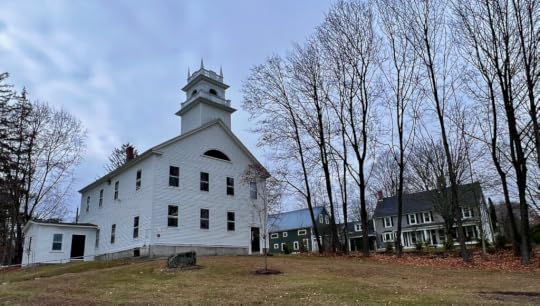 Henniker Academy and the Childs Home
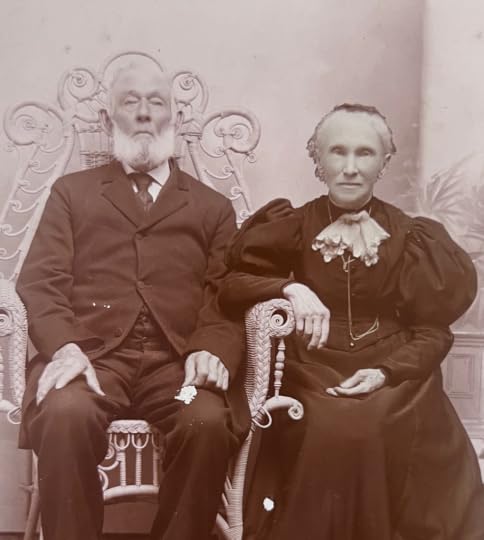 Horace and Matilda
Following his success with the New Bridge, Horace was awarded several covered bridge contracts of his own, including two in his hometown. Horace built the “first bridge of the kind in this town, across the river at West Henniker, in 1835” (Cogswell 1880). Known as the Amsden Mill or Upper Bridge, this structure was destroyed when ice knocked down one of the piers in May 1852. A replacement bridge was built by Horace’s former employee, Frederick Whitney, and stood until it was replaced in 1915. No photos of Horace’s bridge exist.
In 1843, Horace constructed the Lower or Howes Mill Bridge in Henniker. This structure stood on what is now Ramsdell Road until it was destroyed by fire in 1900. There are no photos of this bridge, but it is illustrated on an 1889 map of Henniker drawn and published by George E. Norris of Burleigh Litho.
The demand for Horace’s bridge-building services grew as the railroad lines spread throughout the country. “With Long’s assistance and prestige, Childs was able to obtain many contracts for covered railroad bridges, and as the railroad’s demands were urgent, they were willing to pay premium prices for the means of crossing the streams of their right of way” (Walker 1959).
In 1839, Horace landed a contract with the Hartford and New Haven Railway Company. Despite paying Long a royalty for using his patent, Horace greatly profited from his work building covered bridges along the railroad line. His first bridge on this line was the 1839 Hartford & New Haven Railroad bridge in Hartford, “a heavy bridge of one span carrying three tracks, and the depot was built partly on the bridge. Most of the timber for the bridge … was cut in Haverhill, NH, and run down the river to Olcutt’s Falls below Hanover. There it was sawed and then rafted down the river through several sets of locks to Hartford” (Daily Morning Journal and Courier 1899).
In 1837, Whitney and Woods left Horace’s employ to pursue their own bridge work. By 1846, Horace’s business had grown so significantly that he hired his two brothers to come work with him. Enoch (1808-1881) came on as the civil engineer and business manager, and Warren (1811-1898) as the mason at what was now known as H. Childs & Co.
Enoch Long Childs was educated at Hopkinton Academy. In 1831, he entered Yale College and completed one year before withdrawing and returning to Hopkinton to teach at the Academy. He returned to Yale in 1837 and graduated with a civil engineering degree in 1840, the same year he married Harriet “Hattie” Long (1816-1881). Enoch opened Montgomery Academy in Alabama the following year, where he served as principal for six years before returning to New Hampshire in 1846. Enoch is listed in census records as a railroad conductor, civil engineer, and gentleman. He and Hattie had no children.
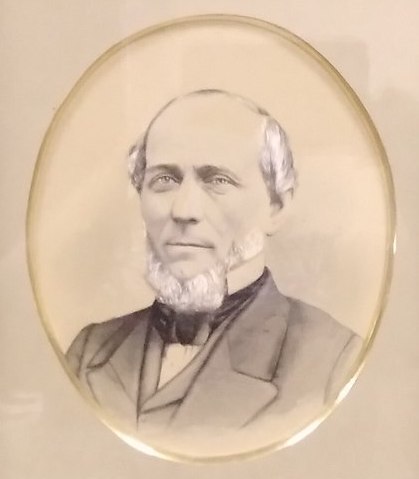 Enoch Long Childs
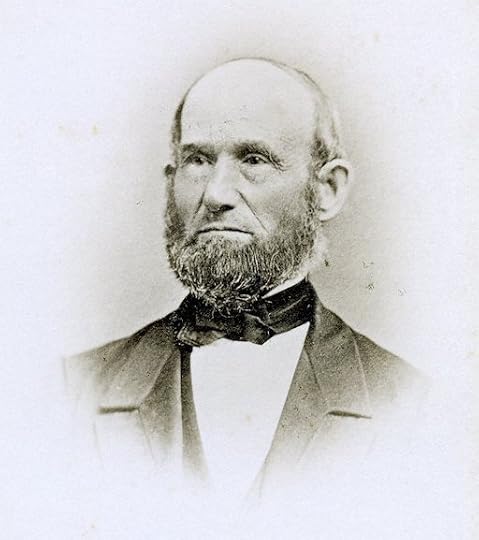 Warren Story Childs
Warren Story Childs attended Yale for one year before returning to the family farm with his father. He married Sarah Tilton Lane (1815-1890) of Candia in 1830. The couple had four children: Richard Lane (1843-1909), Curtis Benson (1845-1923), Mary Abby (1849-1912), and Frederic Warren (1853-1854). Census records list Warren’s occupation as a farmer.
Reports in various histories indicate that the Childs brothers constructed bridges on the Providence & Worcester Railroad, the Northern Railroad from Andover to White River Junction, and the New Hampshire Central Railroad. They also had contracts on railroad lines in Ohio, Pennsylvania, and New York.
A Yale College fraternity catalog specifies that Enoch worked as the “architect of bridges for the Providence & Worcester, the Norfolk County, the Northern New Hampshire, and the Passumpsic Railroads, and contractor with his brothers for the Concord & Bristol, and the New Hampshire Central Railroads” from 1846-1853, the Somerset & Kennebec Railroad from 1853-1856, and the Troy and Greenfield (Hoosac Tunnel) Railroad from 1860-1862 (Yale, 1888).
The Childs implemented several types of trusses in their covered bridges, including Long, Pratt, Town lattice, and Burns’ truss designs before Horace patented his own truss design in 1846.
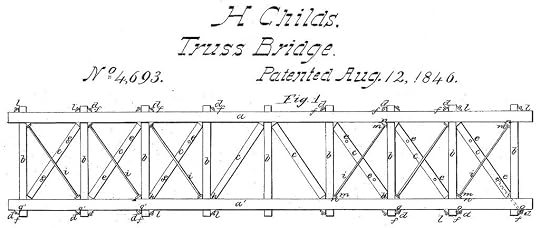
In 1851, H. Childs & Co. was hired by the City of Manchester to build a railroad bridge across the Merrimack River in the heart of the city. Named the Granite Street or Merrill’s Bridge, the structure was a four-span bridge of an undetermined length. Horace was injured during the construction of the bridge, badly breaking his leg. The injury would have a significant impact on his business. “This accident so interfered with his work that he decided to refrain from taking large contracts in the future, and from that time until his retirement, he devoted his attention to work nearer home” (Biographical Review 1897). Before the injury, Horace had contracted to build railroad bridges in Maine; his brothers fulfilled the contracts.
In 1853, Horace would build his last covered bridge in the neighboring town of Hopkinton. When the West Hopkinton or Rowell Bridge was destroyed in a flood in 1852, the town of Hopkinton contracted with H. Childs & Co. to replace it and paid $2,637.64 for the work. Oddly enough, the Rowell Bridge does not employ either a Childs or a Long truss. Horace constructed the bridge using a unique truss design that had never been seen before or since. “One might suspect that it is a unique one-of-a-kind masterpiece where Childs used most everything he had learned to put together the strongest and best bridge he possibly could for his neighbors” (Sindelar 2020).
The covered bridges known to have been specifically constructed by the Childs Brothers are listed below. Ongoing research may uncover more.
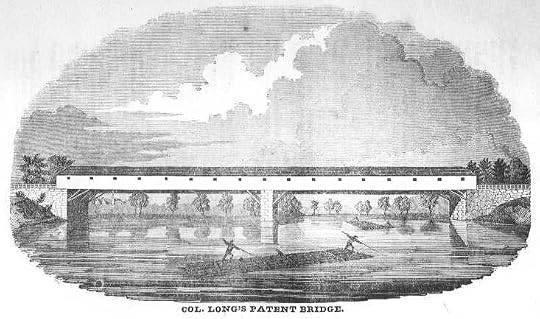 New Bridge. 1834.
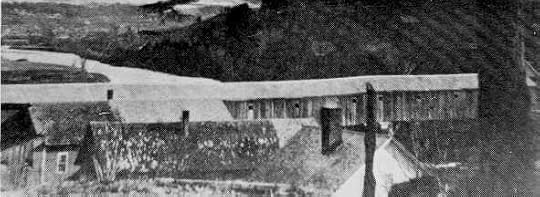 Hartford Village Bridge. 1836.
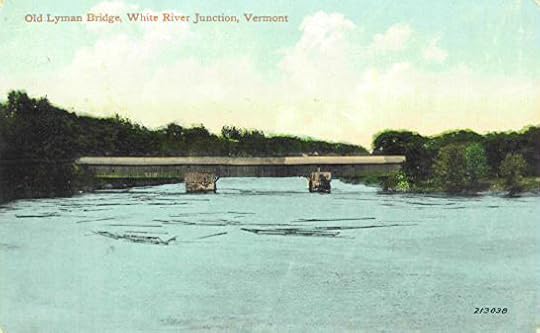 Lyman’s Bridge. 1837.
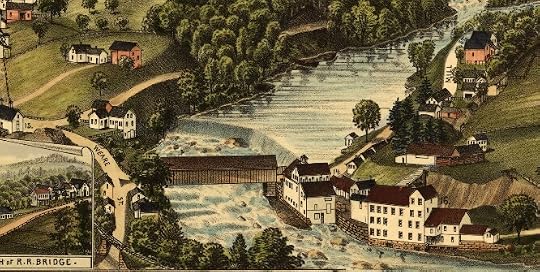 Lower/Howes Mill Bridge. 1843.
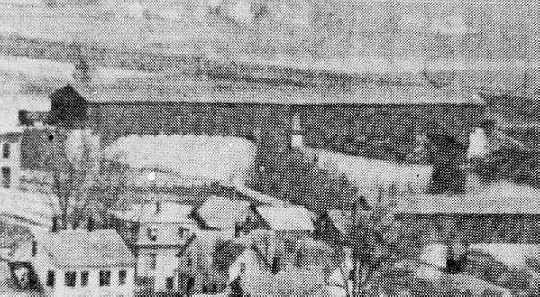 CT & Passumpsic RR Bridge. 1848.
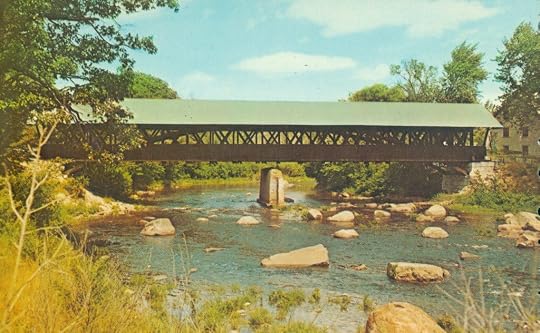 Rowell Bridge. 1853.
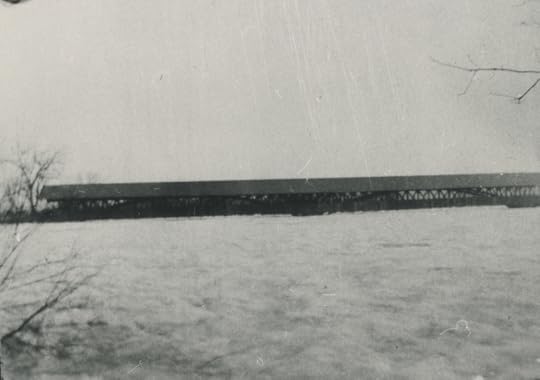 Canterbury Bridge. 1853/1857.
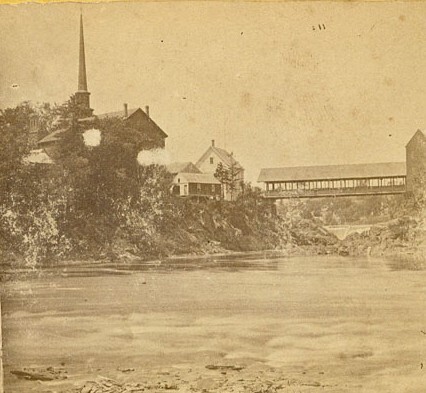 North Fork Bridge. 1855.
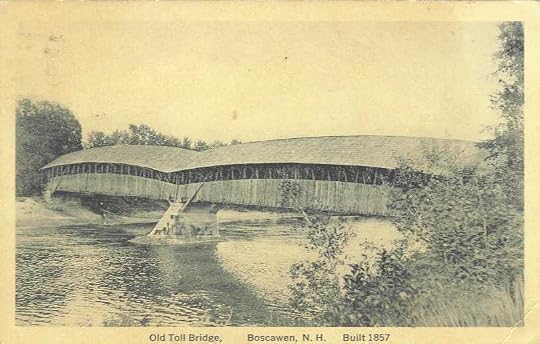 Rainbow Bridge. 1857.
 1834. New Bridge. Haverhill, NH/Newbury, VT. Replaced in 1913. Built by Horace Childs.
1835. Amsden Mill/Upper Bridge. Henniker. Lost in May 1852 to ice. Built by Horace Childs.
1836. Hartford Village Bridge. Hartford, VT. Lost in 1892 by flood. Built by Horace Childs.
1837. Lyman’s Bridge. West Lebanon, NH/Hartford, VT. Replaced in 1895. Built by Horace Childs.
1837. Fox/Foxville Bridge. Royalton, VT. Lost in 1866. Built by Horace Childs.
1843. Lower/Howes Mill Bridge. Henniker. Lost in 1900 to fire. Built by Horace Childs.
1848. Connecticut & Passumpsic Rivers Railroad Bridge. White River Junction, VT. Replaced in 1890. Built by Henry R. Campbell & Horace Childs & Co.
1851. Merrill’s/Granite Street Bridge. Manchester. Lost between 1857-1862. Built by H. Childs & Co.
1853. Rowell Bridge. Hopkinton. Built by Horace Childs.
1853/1857. Canterbury Bridge. Boscawen/Canterbury. Lost in 1896 by flood. Built by Enoch L. Childs.
1855. North Fork Bridge. Skowhegan, ME. Lost 1903. Built by Enoch L. Childs.
1857. Rainbow Bridge. Boscawen/Canterbury. Lost in 1907 by flood. Built by Enoch L. Childs.
The Rowell Bridge is the only surviving covered bridge built by Horace Childs.
Work on the Rowell Bridge began in 1852. Town reports indicate payments were made in 1852, and the account was settled in 1853. When the bridge was completed is unknown, but Horace’s work on the project ended in January 1853.
On the afternoon of January 6, 1853, Horace was one of sixty passengers on a Boston and Maine train heading to New Hampshire from Hartford, Connecticut. When the train stopped in Andover, Massachusetts, United States President-Elect and New Hampshire native Franklin Pierce, his wife, Jane, and their son, Benny, boarded the train. Two miles north of Andover, the forward axle of the passenger car broke. The damage sent the car off the track and tossed it down a steep 15-foot embankment. The train car was broken into fragments, and several passengers were seriously injured. Young Benny Pierce was struck in the head by a piece of the train car and instantly killed. He was eleven years old.
Horace suffered significant injuries in the crash. One report indicates that Horace was “picked up for dead” (Biographical Review 1897), but an article in the New England Farmer states he experienced bruising of his head and face. After the accident, Horace retreated to his home in Henniker to recover from his injuries. He never returned to bridge building.
Warren Childs retired from bridge building the same year and focused his efforts on his Henniker dairy farm. Warren died on April 10, 1888, of typhoid fever at age 75.
Enoch Childs continued building bridges for the railroad and for other communities. He oversaw the construction of the Canterbury and Rainbow Bridges in Canterbury and Boscawen. In 1862, Enoch Childs changed careers and took a job with the Internal Revenue Service, where he began as a clerk and retired as a chief deputy collector in 1870. In March 1880, he suffered an injury to his spinal column that left him prostrate. Enoch died on September 8, 1881, of a fever at the age of 72. His wife, Hattie, had died just eighteen days earlier of epilepsy.
It is worth noting that several publications indicate that the three covered railroad bridges in Hooksett were constructed by the Childs brothers in 1868. But all three brothers had retired from bridge building by then. Extensive research has concluded that the triple bridges on the Suncook Loop were rebuilt in 1889 by the Concord Railroad, not the Childs.
Horace spent the rest of his life in his hometown of Henniker, where he was considered a generous and benevolent man. He was a long-time member of the Henniker Congregational Church and would later serve as Deacon. He and fellow parishioner Fayette Conner (1824-1889) paid for the repair of the building and purchased a church organ.
Horace valued both education and hard work. In addition to incorporating and building Henniker Academy, he financially supported several young men in obtaining their education. He was also a sober man. Horace was “an earnest advocate of temperance, making it a point, when employing men upon public works, that no ardent spirits should be used in or about the works” (Hurd 1885). He was a staunch Republican and a life member of the American Board of Foreign Missions.
Horace’s wife Matilda died in 1897 at age 80. After her death, Horace went to live with his nephew, Curtis Benson Childs. Curtis was educated at Henniker Academy and the Chandler Scientific Department at Dartmouth College. Curtis worked as a civil engineer and was engaged in surveying for railroad construction in Iowa, Kansas, Colorado, Missouri, the Indian Territory, and Texas before returning to New Hampshire in 1876 to operate the family farm.
Horace died on June 7, 1900, at the age of ninety-two. He is buried alongside his wife in the Henniker Cemetery.
Horace was remembered as “a man of strict integrity, marked generosity, and liberality of character. As a business man successful, as a citizen respected and beloved, and as one who has done much to further and promote the improvement and prosperity of his native town, he stands among her representative men, and is a worthy descendant of the ‘old pioneer’ “ (Hurd 1885).
Sadly, Childs’ truss design has been relegated to history. There are seven covered bridges in Ohio that employed a variant of his truss design. New Hampshire native Everett S. Sherman (1831-1897) constructed several bridges based on Child’s truss design in Ohio in the late nineteenth century. According to National Society for the Preservation of Covered Bridges co-vice president Scott Wagner, “It seems obvious that Sherman was inspired by Childs’ design, but he chose to make a few design modifications that differentiate his design from the intentions of Horace, as described in his patent description from 1846. No true examples of Horace’s truss design remain today” (Wagner 2024).
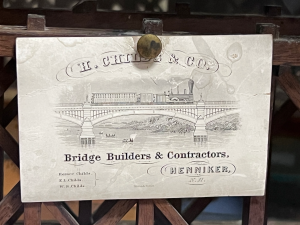
In New Hampshire, Childs’ craftsmanship can be seen in the Rowell Bridge, his home on Maple Street, and the adjacent Henniker Academy building. The Academy building is now home to the Henniker Historical Society, which houses other evidence of Horace Childs. His photograph is posted proudly at the entrance to the museum room. Inside, one can see Childs’ Long truss model with an engraved H. Childs & Co. business card tacked to the top. His legacy lives here, in the building he crafted almost two hundred years ago. He is not forgotten.
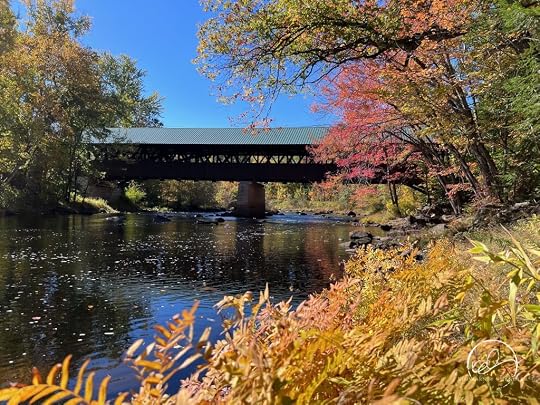 Rowell Bridge, Hopkinton
References
Historical photos were used with permission from the Henniker Historical Society, Covered Spans of Yesteryear , and the National Society for the Preservation of Covered Bridges.
Special thanks to Sue Fetzer, Marc McMurphy, Martha Taylor, Henniker Historical Society; Scott Wagner and Bill Caswell, National Society for the Preservation of Covered Bridges.
Biographical Review Publishing Company. 1897. Biographical Review; containing life sketches of leading citizens of Merrimack and Sullivan counties, N. H. Boston: Biographical Review Publishing Company.
Child, Elias. 1881. Genealogy of the Child, Childs, and Childe Families: Of the Past and Present in the United States and the Canadas, from 1630 to 1881. United States.
Childs, Horace. 1846. Truss Bridge. US Patent 4,693, issued August 12, 1846.
City of Manchester. 1847. Annual Report of the Committee on Finance on the Receipts and Expenditures of the City of Manchester, Together with the Treasurers’ Accounts. United States.
Cogswell, Leander Winslow. 1880. History of the Town of Henniker, Merrimack County, New Hampshire. Henniker, NH: Republican Press Association.
Collections of the Dover, N.H., Historical Society. 1894. United States: Scales & Quimby.
Daily Morning Journal and Courier. 1899. “First Railroad Bridge: Builder of Structure in Hartford Now Living.” Daily Morning Journal and Courier. November 18, 1899.
Granite Monthly: A New Hampshire Magazine. 1894. United States: Granite Monthly Company.
Hurd, D. Hamilton. 1885. History of Merrimack and Belknap Counties, New Hampshire. Philadelphia, PA: J. W. Lewis & Company.
Lord, Charles C. 1890. Life and times in Hopkinton, NH. Concord, NH: Republican Press.
New England Farmer. 1853. “Sad Railroad Accident.” New England Farmer. January 15, 1853.
Sindelar, James. 2020. “Hopkinton New Hampshire’s Rowell Bridge.” Covered Bridge Topics, Spring: 3-7.
Walker, C. Ernest. 1959. Covered Bridge Ramblings in New England. Contoocook, NH: C. Ernest Walker.
Yale College. 1888. General Catalogue of the Psi Upsilon Fraternity. United States.
The post The Bridgewright Horace Childs first appeared on Covered Bridges of New Hampshire.
December 12, 2023
The Bridgewright Frederick Whitney
Note: This post was updated in June 2024 with new information uncovered by Bill Caswell (June 2024).
Frederick Whitney was born in Henniker on October 5, 1806. He was the third of six children born to Eleazer Whitney (1777–1838) and Alice Peabody (1779–1867) and was the only one of his siblings to live to old age. Little is known about Whitney’s childhood apart from a significant tragedy in 1819 when he was just thirteen.
That June, his two younger brothers, Benjamin “Carroll,” age ten, and Alexander, age seven, died by drowning. The boys drowned in the Contoocook River about a half mile southeast of the village. They were buried with a combined tombstone in the Center Cemetery in Henniker. The circumstances of their death surely weighed heavily on the Whitney family.
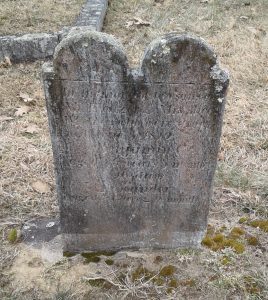 Final resting place of Whitney’s brothers
It is unclear where Whitney was educated, but we do know he was trained as a carpenter. Eventually, he went to work for the Childs Brothers of Henniker. Led by elder brother Horace Childs (1807-1900), H. Childs & Co. was founded in 1834 and constructed many covered bridges along the New Hampshire railroad lines and lines in New York, Ohio, and Pennsylvania. Whitney began his tenure with the Childs as a simple carpenter. By the time he left their employ, he was a skilled bridgewright. It is unclear exactly when or for how long Whitney was employed by the Childs, but his work there proved to be advantageous for him both personally and professionally.
While at H. Childs & Co., Whitney worked alongside another young carpenter, Dutton Woods (1809-1884). Woods apprenticed with Childs from 1830 until 1837 before going out on his own. Soon after, Whitney would join him in business. In March 1837, the two purchased a parcel of land in Henniker for $150. The deed identifies the boundaries as “the northerly side of Mill Brook, thence northerly forty-five feet to a stone part to the road leading from Woods Mills.”
The two reportedly, “…built all the bridges upon the line of the Concord & Claremont and Contoocook Valley Railroads. They constructed bridges for many years when Mr. Whitney retired from the business” (Cogswell 1880). What specific railroad covered bridges Whitney and Dutton may have constructed have been lost to time. Regardless, none of those railroad bridges remain today.
Not only were the two business partners, but they soon became family. On January 22, 1835, Whitney married Dutton Woods’ younger sister, Fidelia. He was twenty-nine years old; she was twenty-four. On October 20, 1838, the couple welcomed a daughter, Julia F. Their second child, a son named Frederick, was born in July 1846. He died ten weeks later.
Woods would go on to build at least eight highway covered bridges in his lifetime. As far as we know, Whitney constructed two.
In 1844, Whitney built the Hillsborough-Henniker Road Bridge alongside Horace Childs. The bridge cost $1,097.66 to construct. The abutments were built by Daniel Reed for $420. The bridge was destroyed by fire on July 2, 1899. The photo below is believed to be the Hillsborough-Henniker Road Bridge.
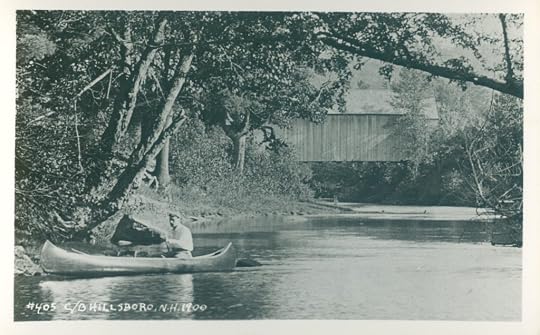 Hillsboro-Henniker Road Bridge
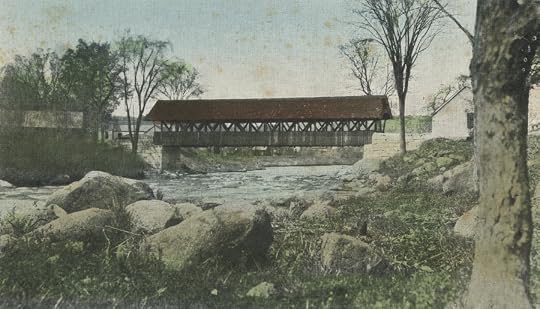 West Henniker Bridge
The Amsden Mill, or Upper Bridge, was constructed in West Henniker in 1834 by Horace Childs. The bridge was one of the first structures built by Childs and employed a Long Truss, designed by Childs’ cousin, Col. Stephen Harriman Long (1784-1864). Given that Childs employed Whitney at the time, it’s possible that he worked on the bridge during its construction. When this covered bridge was destroyed by an ice floe in May 1852, Whitney was contracted by the town of Henniker to replace it.
Whitney was paid $185 as “agent, in part to build upper bridge” (Town of Henniker 1853). He constructed a 110’ covered bridge over the Contoocook River; the truss design he employed seems to be up for debate. The bridge is described as both a Paddleford Truss and a Long Truss. Without interior photographs, it isn’t easy to discern. Regardless, the West Henniker Bridge stood over the Contoocook River until it was replaced with a metal truss bridge in 1915.
The United States Census records list Whitney’s occupation as a carpenter throughout his lifetime. The diversity of his talents undoubtedly provided him with steady work and landed him a side business as an undertaker.
In the early nineteenth century, woodworkers had the skills necessary to build coffins for the dead in their community. At the time, the local undertaker would take the measurements for a coffin, construct it, and return it to the home for the deceased to be laid out for viewing. Family members would dress the deceased in their best clothing, and the body would lie in the coffin for several days until the funeral. Sometimes, doorways or windows were too narrow to accommodate a coffin and had to be temporarily removed. Records show Whitney had been making coffins since at least 1840, when he was paid $2 for a casket. When he retired from bridge building, undertaking became his primary business.
In addition to his carpentry skills, Whitney was a talented musician. For most of his life, he sang in the Congregational Church choir and was the choir director for many years. He “exhibited a good deal of the taste for music for which he was noted in his younger days” (Cogswell 1880).
Whitney was a member of Henniker’s first brass and reed band. Formed in the winter of 1836-1837, the band consisted of thirteen original members, with Whitney playing the clarinet and his brother-in-law Dutton Woods playing the bugle. As this type of music was just coming into vogue, the Henniker Band was in demand to play at “trainings and muster days.” The band first played in public in the fall of 1838 in New Hampton and soon “furnished themselves with a ‘band wagon’ and a large tent for camping purposes. For several years, and, in fact, until the militia was disbanded in 1851, they attended several musters and furnished music for some of the best companies of militia within fifty miles of their home” (Cogswell 1880).
Whitney was also civically minded and served the town of Henniker as the tax collector in 1843, selectman in 1847 and 1849, school committee member in 1866, and town treasurer in 1876.
It seems Whitney was equally committed to his family, many of whom were befallen by tragedy. The 1850 census shows that in addition to Frederick, Fidelia, and Julia, the Whitney household also included Fidelia’s brothers, Benjamin Franklin Woods (1820-1893) and William Lewis Lawrence Woods (1823-1900), and Frederick’s youngest sister, Alice B. Whitney (1816-1854).
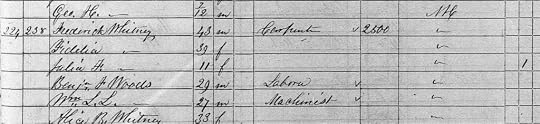 1850 Census
Alice seems to have experienced some type of mental illness or disability. In the last two years of her short life, she appears in town reports as a pauper, and the town pays Frederick and other community members for her care. In 1854, she was reported as having a “sickness” and died shortly thereafter. Her death record indicates she died of “nervous debility.” She was 38.
Whitney’s oldest brother, Asa (1800-1858), described as “a hard-working honest man,” sang alongside his brother in the church choir. In 1850, his first wife, Patty Rice, died after falling from the scaffolding in her barn. That same year, he married Mary Long Childs (1810-1896), sister of Horace Childs. Eight years later, Asa was killed after being struck by a falling tree in the woods. He was 57.
On June 2, 1857, his wife, Fidelia, died of consumption. She was 45 years old. One can only imagine the duality of Whitney’s role as a grieving man and the town undertaker. Did he craft the coffins for his beloved family?
Whitney remarried on May 12, 1864, to widow Helen “Hannah” Badger Carter (1819-1909) of Warner. Hannah’s first husband, merchant William S. Carter (1816-1851), died at age 34, leaving her with two young boys. The youngest, Henry, died of typhoid fever in 1860 at age 12. Her oldest, William Scott Carter (1842-1931), would become a prolific member of the Lebanon community.
Shortly after their marriage, Frederick and Hannah moved to a house next to the Congregational Church. The home had been built by Napoleon Bonaparte Connor (1810-1883) in 1837 after the previous house had been struck by lightning and burned. Records indicate that Whitney bought the home at what is now 25 Maple Street sometime “after the Civil War.” The property is three lots over from the 1835 home of Horace Childs.
After moving to the Maple Street property, he purchased a vacant schoolhouse and relocated it behind his house as a coffin-making shop. Notes on file at the Henniker Historical Society state, “he was a carpenter whose side business was undertaking…undertakers made their own coffins. Mr. Whitney did not employ help.”
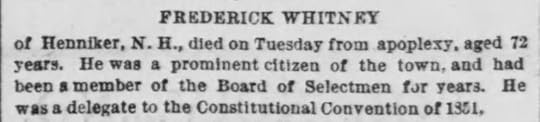 Obituary
Frederick Whitney died on May 20, 1879, at age 72, of apoplexy, or what would be called a stroke today. His wife, Hannah, moved to Lebanon to live with her son. She would outlive Whitney by thirty years.
After his death, Hannah deeded the property to Whitney’s daughter. Julia had married Civil War soldier William Odlin Folsom (1838-1920) in 1869. Folsom was a widower; his first wife, Caroline “Carrie” Fidelia Foster (1835-1866), had died three years earlier of consumption. Carrie was the daughter of Whitney’s older sister, Lois (1803-1852) and Zebulon Foster (1797-1897). She and Julia were first cousins.
Folsom was a merchant and, much like his father-in-law, served the town of Henniker as treasurer and selectman. After Whitney died, Folsom took over the undertaking business but not the coffin-making side. He used the coffin shop as a storehouse and sales office for the business. In 1873, the Folsoms welcomed their only child, a daughter named after William’s late wife and Julia’s cousin, Caroline “Carrie” Eliza. Carrie died in Wellesley, Massachusetts, in 1961.
Frederick Whitney was regarded as a “kindly, genial man, much loved by his fellow townsmen.” For decades, Whitney crafted a final resting place for many of his neighbors and family members. Those coffins, like his covered bridges, cannot be seen today. But their significance remains.
References
Historical photos were used with permission from Covered Spans of Yesteryear and the National Society for the Preservation of Covered Bridges.
Special thanks to Sue Fetzer, Marc McMurphy, and Martha Taylor, Henniker Historical Society; Todd Clark, Bill Caswell, and Scott Wagner from the National Society for the Preservation of Covered Bridges; and Catherine Dart, Whitney’s second-great granddaughter.
Biographical Review Publishing Company. 1897. Biographical Review; containing life sketches of leading citizens of Merrimack and Sullivan counties, N. H. Boston: Biographical Review Publishing Company.
Browne, George Waldo. 1921. The History of Hillsborough, New Hampshire, 1735-1921: History and description. United States: John B. Clarke Company, printers.
Childs, Francis Lane. “Genealogies on file at the Henniker Historical Society.”
Cogswell, Leander Winslow. 1880. History of the Town of Henniker, Merrimack County, New Hampshire. Henniker, NH: Republican Press Association.
Harriman, Walter. 1879. The History of Warner, New Hampshire, One Hundred and Forty-Four Years from 1735–1879. Concord, NH: Republican Press Association.
Hillsborough-Enterprise. 1899. Hillsborough-Enterprise, July 22, 1899.
Hillsborough Messenger. 1899. An Old Landmark Gone. Hillsborough Messenger, July 6, 1899.
Goodell, John. 1899. Letter to the Editor. Hillsborough Messenger, July 13, 1899.
Town of Henniker. 1840, 1847, 1848, 1853, 1855, 1866. “Annual report of the town of Henniker, New Hampshire.” Henniker, NH.
The post The Bridgewright Frederick Whitney first appeared on Covered Bridges of New Hampshire.
October 25, 2023
The Bridgewright John C. Briggs
John Clark Briggs was born in Putney, Vermont, on May 28, 1824. Briggs was the last of five children born to Silas S. Briggs (1788-1864) and his wife, Lucy Davidson (1789-1866). Their first child, Silas (1814-1815), died at only fifteen months old. Their only daughter, Lucy Philena (1816-1840), was born in Plymouth, Vermont, and their son, Silas Parmenas (1817-1886), was born in Ludlow, Vermont. The birthplace of younger sons Joseph Davidson (1818-1878) and John Clark is not known but is frequently cited as Vermont.
In the early nineteenth century, the family moved eighty miles west to Saratoga, New York, where they lived on a five-acre farm. The elder Silas supported the family as an insurance agent and ensured that his sons were educated. The details of Briggs’ high school education are unclear, but we know he attended Burr Seminary alongside his brother, Joseph, in 1835.
Brothers Silas and Joseph would go on to study law together at the University of Vermont from 1839-1841. Silas transferred to Union College, where he would graduate in 1843. The two worked as practicing attorneys for the remainder of their careers.
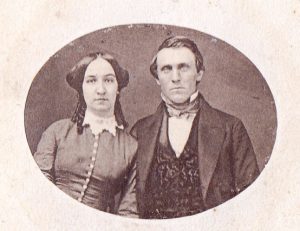 Emma Josephine “Josie” Briggs with her father, John C. Briggs, April 22, 1863.
John Briggs followed his older brother to Union College but chose an engineering career instead, graduating in 1845 with a degree in civil engineering. In 1849, Silas married Sarah Stickney (1826-1890) and moved to her hometown of Calais, Maine, to practice law. Twenty-six-year-old Briggs went with them. By 1850, he lived with his brother and sister-in-law and worked as a teacher. But the Briggs didn’t stay in Calais long, and while Silas and Sarah moved back to Saratoga, Briggs found himself in the middle of New Hampshire.
On December 14, 1853, Briggs purchased property on the corner of Washington and High Streets in Concord. The next day, he married Lucy Hatch Chase of Hillsboro, New Hampshire. Lucy was born in 1832 to James Chase (1786-1884) and Lucinda Andrews (1794-1884). Where the couple met is unclear, but after their marriage, they would make their home twenty miles east of Hillsboro in the capital city.
 Briggs Rotary Clock
In 1855, Briggs received patent No. 13,451 for a conical pendulum clock. His unique design features a rotating steel ball pendulum suspended from a string at the front of the face. The ball is driven by a spring movement underneath the piece. The components are enclosed in a glass dome and sit on cast iron paw feet. According to the patent, “by this arrangement, the operation of the clock is noiseless. It does not tick. There is no reciprocating motion” (Briggs 1855).
Known as the Mystery, Briggs Rotary, or Flying Ball clock, the clocks were made by the E.N. Welch Manufacturing Co. of Bristol, Connecticut, through the 1870s. Vintage Briggs Rotary Clocks are still collectibles and are available online.
Briggs was active in the Concord community and served as president of the Ward 4 Common Council. He was also a member of the Republican party. Briggs was the chief marshal of a grand parade in Concord as part of the 1856 presidential campaign. The procession, “went over…the principal streets, and then counter-marched in alternate lines in State House Park until the square was full to overflowing, beside thousands of men to spare” (Lyford, Hadley & Howe 1903).
On April 4, 1857, Briggs and his wife welcomed their only child, a daughter named Emma Josephine.
In November 1858, Briggs was awarded a second patent, not for clocks but for bridges. Patent No. 22,106 was for the invention of a “new and improved mode of giving elasticity to the compressed joints of truss frames,” and reads, “The invention consists in the application of springs to the bearings of either the posts, main braces, counter braces, iron rods of all descriptions, or to any compressed joint in trusses constructed either of wood, iron, or wood and iron combined. The most convenient and available material for these springs is India rubber… short solid cylinders, with holes through their centers” (Briggs 1858).
In 1859, Briggs was appointed by the Concord City Council to develop a new cemetery. Thirty acres of land was purchased on North State Street for $4,500 with the plan to create a municipal cemetery in the then-popular rural style. Designed much like a public park, these cemeteries were a departure from the traditional burial grounds of the time. Rural cemeteries included natural features, roads and paths, and elaborate memorials for the dead.
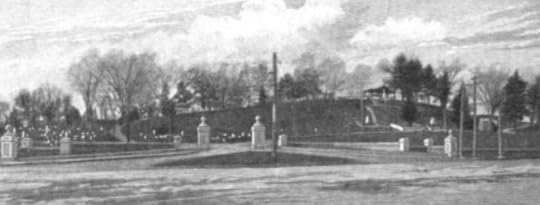 Entrance to Blossom Hill Cemetery, 1903
Briggs, “whose eminent ability as a civil engineer,” and “was fully equaled by his skills and taste as a landscape gardener,” (Lyford, Hadley & Howe 1903), was appointed to design the layout of the new burial ground. Blossom Hill Cemetery opened in 1860 with 170 lots laid out. The cemetery features two grand entrances, winding roads, a running stream, and grassy paths. The first burials were up on the hill, where visitors had commanding views of the city.
That same year, Briggs was hired by the town of Hooksett to rebuild the Village Bridge that had been destroyed by an ice flow in March. Town reports indicate the cost of the bridge project was a hefty $9,916.37, $3.3 million in today’s dollars. Briggs was paid a total of $5,200. It is assumed that he built the timber superstructure, but unfortunately, the records do not specify his specific role in the project.
The 1860 Census lists John and Lucy Briggs living in Concord with their three-year-old daughter, Emma Josephine, and an eighteen-year-old domestic helper named Harriet E. Hook. Property deeds indicate that Briggs purchased a home at the intersection of Spring, Cambridge, and Academy Streets in 1860. His civil engineering business was a few houses down the block on the corner of Washington and Spring Streets in a property he purchased in 1857. But a little over a year later, Lucy died on February 10, 1861, at age 30. A cause of death cannot be found.
Briggs buried his young wife in the cemetery he designed. The Briggs’ large square plot rests high up on the hill and is bordered with granite stones. Large, old cedar trees stand at three corners of the plot; in the fourth corner, only remnants of a tree remain. The small headstone is enclosed in a tent-like granite structure featuring four short granite pillars topped with a square granite roof. Briggs’ memorial to his wife is unlike any other at Blossom Hill: a beautiful tribute to a woman gone too soon.
In 1861, a truss design created by Briggs was employed in three covered railroad bridges in Hooksett. Briggs would receive patent No. 38,653 in 1863, but he had been advertising his truss variant for some time prior. His timber lattice truss configuration became known as the Briggs Triple Lattice Truss. The patent reads, “This improvement consists in stiffening the truss by the crossing of inclined ties, combined with inclined braces, with an additional stepping piece above the sills at each end to bolt the braces into, and an end brace or post mortised to the underside of the upper sill and projected laterally to a secure step on the foundation” (Briggs 1863).
Constructed by Cole & Company of Lake Village (later Laconia) and designed by Briggs, the Triple Bridges at Hooksett carried the railroad over the Merrimack River. One two-span 175′ bridge connected to an island in the river. The railroad continued past the island and to the shore over a three-span, 308′ bridge and a two-span, 186′ bridge. All three bridges stood for seven years before being damaged by a flood in 1888.
In 1862, Briggs constructed the Henniker Road Bridge in nearby West Hopkinton. This single-span, 164’ bridge employed his triple lattice truss design and crossed the Contoocook River along a new road to Henniker. The new road and bridge project cost $1,978.43; Briggs was paid $1,450 “in part for bridge” (Town of Henniker 1862). The Henniker Road Bridge was replaced in 1936.
Also that year, Briggs was hired by the City of Concord to rebuild the Sewall’s Falls Bridge. The first bridge at this location over the Merrimack River was constructed in 1835 and lost in an ice jam in 1839. That bridge was replaced in 1840, only to be destroyed during a log drive nine years later. A covered wooden truss bridge was constructed in 1853 by Philip Henry Paddleford at this location. It lasted until January 1, 1862, when it was destroyed by a “gale of wind.” That year, the City of Concord hired Briggs to build yet another bridge. This 300’ structure consisted of “long arches of wood reaching from pier to abutments, with a deck or roadway on top, without covering to protect it from the weather” (City of Concord 1875). He was paid $566.47. Briggs’ structure was reportedly covered three years later and stood for close to a decade before being destroyed by a log jam in 1872. No photos exist of this iteration of the Sewall’s Falls Bridge.
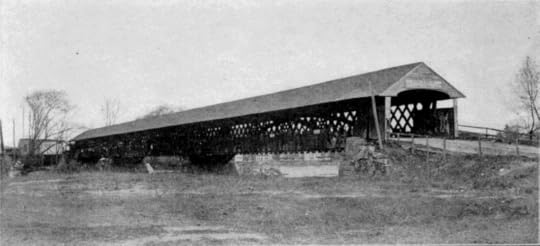 Village Bridge, Hooksett
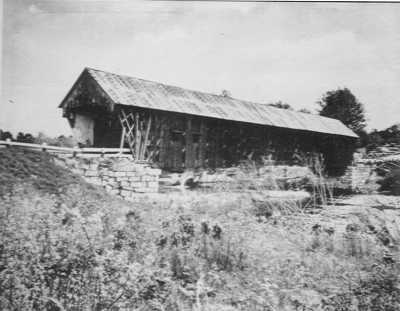 Henniker Road Bridge, West Hopkinton
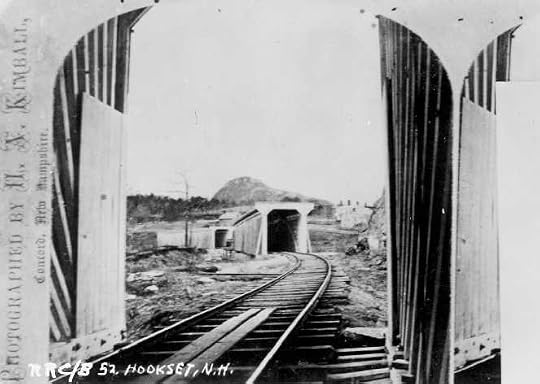 Triple Bridges at Hooksett
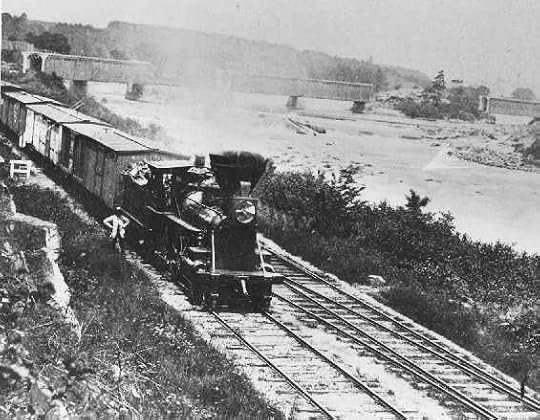 Triple Bridges at Hooksett
Beginning in 1854, several local communities employed Briggs for engineering, surveying, and bridge repair work, but that seems to have ended in 1863. In June of that year, Briggs registered for the Civil War Draft in Concord but was not called into service. Little information about Briggs is recorded for the next two years, likely due to an illness that cut his career, and his life, short.
On May 26, 1865, Briggs died of consumption at his family’s home in Saratoga. He was two days shy of his 41st birthday.
Consumption, later identified as tuberculosis, killed more people in New England in the nineteenth century than any other disease. The physical effects were debilitating, causing a literal wasting-away, or consumption, of the patient. Those who made it through their first bout would suffer debilitating recurrences for the rest of their lives. It is not known when Briggs began his struggle with consumption and how long he suffered. Perhaps it took the life of his wife three years before him. We may never know.
At age 8, Emma Josephine Briggs was left an orphan. She went to live with her grandmother, Lucy, and her uncle, Joseph, in Saratoga. Lucy died the following year. In her will, Lucy identifies that Emma Josephine had “no general guardian” and appoints John S. Thurber as a “special guardian.” Where Emma Josephine went after the death of her grandmother is unknown.
In 1878, Josephine married New Hampshire attorney Butler Amzi “B.A.” Jones (1848-1922). In 1880, the couple lived in Indiantown, Illinois, with a son named Harry. The 1900 census shows the family living in Sidney, Nebraska, and indicates the couple had had six children, with only two surviving. By 1920, the couple had relocated to Portland, Oregon. Josephine died there in 1931.
John C. Briggs’ impact here in New Hampshire was brief but significant. Despite his contributions to bridge design and clock making, he is best remembered for the cemetery he created on the hill. After his death, Briggs’ brothers returned to Concord to settle his affairs and to bury him beside his wife. His epitaph is carved on the backside of Lucy’s marble stone and humbly reads, “first surveyor of this cemetery.” Today, the Briggs’ lay at rest, enclosed in granite and shaded by 160-year-old cedars, high on the hill in the city they called home for their brief lives.
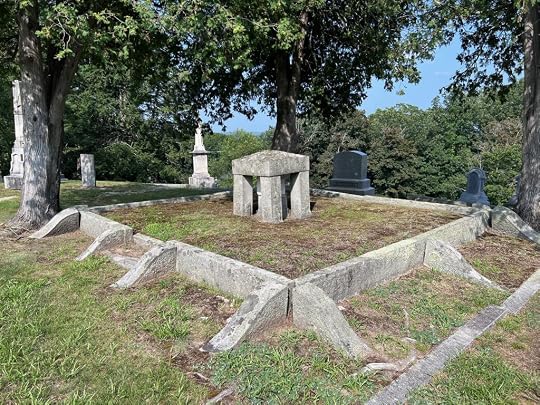
References
Historical photos were used with permission from Covered Spans of Yesteryear and the National Society for the Preservation of Covered Bridges.
Special thanks to Pete Mori, Concord City Clerk’s Office; Joe Lueck, Outreach & Reference Archivist, Union College; Dave Anderson, Society for the Protection of New Hampshire Forests; LaRae Rutenbar, John C. Briggs’ great-granddaughter.
Briggs, John C. 1859. Application of the Conical Pendulum to Timekeepers. US Patent 13,451, issued August 21, 1855.
Briggs, John C. 1858. Truss Bridge. US Patent 22,106, issued November 23, 1858.
Briggs, John C. 1863. Improvement in Bridges. US Patent 38,653, issued May 26, 1863.
Browne, George Waldo. 1921. The History of Hillsborough, New Hampshire, 1735-1921. United States: John B. Clarke Company.
Casella, Richard M. 2016. Hooksett Village Bridge. Portsmouth, RI: Historic Documentation Company, Inc.
City of Concord. 1854, 1855, 1857, 1858, 1860, 1861, 1862, 1863, 1875. “Annual report of the city of Concord, New Hampshire.” Concord, NH.
Hannibal, Edna Anne. 1969. Clement Briggs of Plymouth Colony and his Descendants, 1621-1965. United States.
Journal of the Franklin Institute. 1856. United States: Elsevier.
Knowlton, Rev. I.C. 1875. Annals of Calais, Maine. United States: J.A. Sears, Printer.
Lyford, James Otis, Hadley, Amos, Howe, Will B. 1903. History of Concord, New Hampshire: From the Original Grant in Seventeen Hundred and Twenty-five to the Opening of the Twentieth Century. United States: Rumford Press.
Town of Henniker. 1860, 1861, 1862. “Annual report of the town of Henniker, New Hampshire.” Henniker, NH.
Town of Hooksett. 1860, 1861. “Annual report of the town of Hooksett, New Hampshire.” Hooksett, NH.
Town of Hopkinton. 1862. “Annual report of the town of Hopkinton, New Hampshire.” Hopkinton, NH.
Truax, Will. 2014. The Bridgewright Blog. December 31. Accessed October 17, 2023. https://bridgewright.wordpress.com/ta....
The post The Bridgewright John C. Briggs first appeared on Covered Bridges of New Hampshire.
May 30, 2023
The Bridgewright Dutton Woods
Note: This article was amended in June 2024 after receiving information from Jim Garvin regarding the Main Street/Factory Bridge in Suncook.
Dutton Woods was born on October 19, 1809, in Henniker, New Hampshire, the third of ten children born to William L. Woods (1776-1847) and Betsy Dutton (1783-1849).
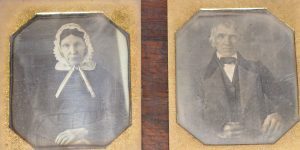 Betsy Dutton Woods and William Learned Woods
His father, William Learned Woods, was the son of Revolutionary War soldier David Woods (1746-1793) and Deborah Swallow (1748-1821). Born six months before the signing of the Declaration of Independence, William was one of eleven children born in Groton, Massachusetts. The Woods family moved northward to Deering, where they operated a farm. At age 24, William moved to Henniker, where he purchased the mills at West Henniker. Together with one of his younger brothers, he was one of the first in the town to manufacture cloth. He worked as a clothier and was “an energetic, industrious man, of sound judgment, and one of the most substantial citizens of the town during his life there” (Stearns 1908).
Dutton Woods was born nine years after the family moved to Henniker and was given his mother’s maiden name as his first name. Young Dutton worked alongside his father in the mill until 1830 when, at age 21, Woods went to work as an apprentice for the Childs Brothers of Henniker. Led by elder brother and bridgewright Horace Childs (1807-1900), H. Childs and Company was founded in 1834 and grew so significantly that brother Enoch (1808-1881) came on as the business manager and designer, and brother Warren (1811-1898) came on as the mason. The Childs Brothers built many covered bridges on the New Hampshire railroad lines and on southern lines in Ohio and Pennsylvania. Woods worked for the Childs Brothers for seven years.
In 1837, Woods left their employ and began a long career with the railroads. On New Year’s Eve that same year, he married Hannah Chase (1811-1845) in Newport. On June 16, 1845, the couple had a daughter, Hannah Maria Woods, whom they called Maria. Hannah died eleven days after giving birth to their only child. She was just 34 years old. Less than two years later, Woods’ father, William, died of pneumonia at age 71.
On May 9, 1848, Woods married Maria Peabody (1809-1882) of Newport. They were both 39 at the time. The couple had no children of their own, but Maria became a stepmother to a not-quite-three-year-old Hannah Maria who coincidentally shared her name. In her adult life, Hannah Maria Woods was known professionally as H. Maria Woods, presumably to differentiate herself from her stepmother.
Woods’ mother, Betsy, died of consumption at age 66 the following year. In 1850, the Woods moved from Henniker to Contoocook. Two years later, in the spring of 1852, they moved again to the Capital city of Concord, where they lived at 7 Wall Street on the west side of South Main Street.
 The Mortgage Button
In 1856, Woods began building a home for his family on the fashionable Merrimack Street in Concord. The house was originally a two-story Italianate building with a cupola situated on a hill that provides a commanding view of the city. Later, a third-story gambrel-roofed structure was added, perhaps to provide lodging for live-in help. By the mid-twentieth century, the Woods house was converted into four apartments but was restored as a single-family home in 2003. Remaining in the newel post is a mortgage button, a symbol to all who visited that there were no liens on the property.
Between 1837 and 1850, Woods was employed by the Hartford & New Haven, the Connecticut, White River & Northern, Concord & Claremont, and Contoocook Valley Railroads. In 1855, Woods became the Superintendent of Bridges for the Concord Railroad and held that position until his death. “Mr. Woods has been employed for a long series of years by the Concord Railroad Company in building and repairing bridges upon the line of their road. He also constructs some outside of the road and is noted as one of the most competent builders in the country” (Cogswell 1880).
Dutton Woods’ impact on bridge building in New Hampshire is significant, particularly through his work with the railroads. In twenty-five years, “he constructed more than ten thousand lineal feet of truss bridging, and over four thousand feet of pile and truss bridges” (Stearns 1908), in addition to repairing many existing bridges. Together with Henniker’s Fredrick Whitney (1806-1879), Woods “…built all the bridges upon the line of the Concord & Claremont and Contoocook Valley Railroads. They constructed bridges for many years when Mr. Whitney retired from the business” (Cogswell 1880). His connection to Whitney was also personal. His younger sister, Fidelia (1811-1857), married Whitney in 1835, making the two brothers-in-law.
It is impossible to know how many covered railroad bridges Woods constructed throughout his career. It is probable that Woods may have had a hand in building the first covered railroad bridge in Contoocook Village. Built in 1850, this two-span, 153’ bridge employed a Childs truss and was known as Railroad #125 Contoocook. It carried trains across the Contoocook River until it was replaced in 1889 by the current covered bridge.
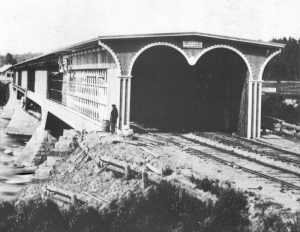 Moore’s Crossing Bridge
He may have also helped to construct the 1852 Moore’s Crossing Bridge that spanned the Merrimack River connecting Manchester to Bedford. Originally constructed as a single-track bridge, the bridge was expanded to a double-track bridge by the Concord Railroad. While work on this project was led by bridge builder Samuel F. Patterson (1840-1917), Woods was superintendent of the Concord Railroad at the time. Clearly, he was proud of the bridge. Woods’ obituary states that “among his best works was the construction of the large double-tracked bridge at Goff’s Falls on the Concord Railroad, where, from the beginning to the completion, not a single train was interrupted.”
Woods also worked as an independent bridge builder and constructed at least nine highway bridges in New Hampshire, listed below. Only the Waterloo Bridge remains.
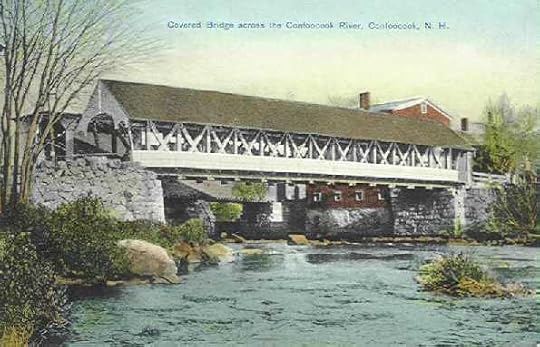 1853. Contoocook Village Bridge
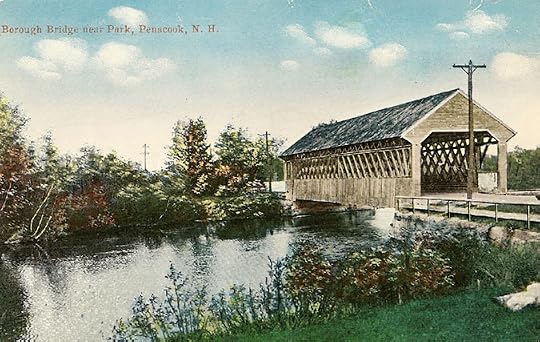 1853. Borough Bridge
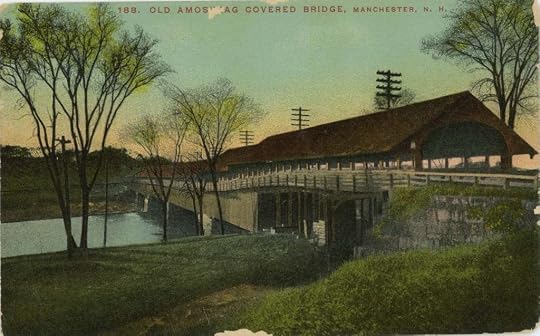 1854. Amoskeag Falls Bridge
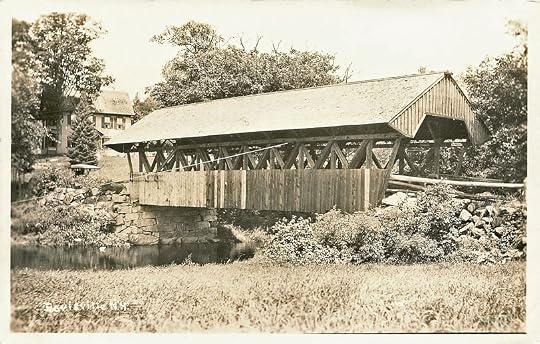 1855. Amesbury/Davisville Bridge **
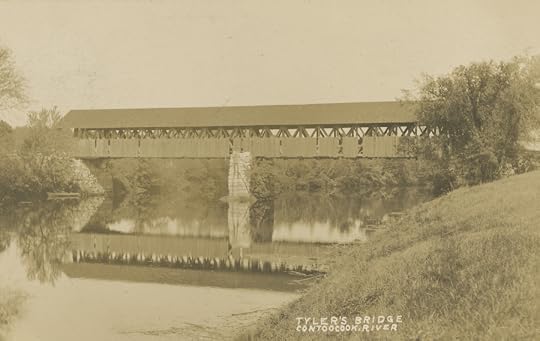 1858. Tyler Bridge
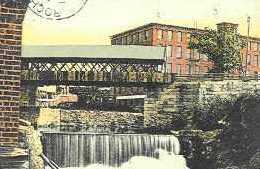 1859. Main Street/Factory Bridge
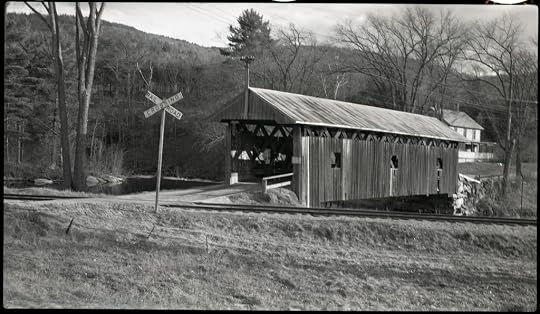 1860. Waterloo Bridge
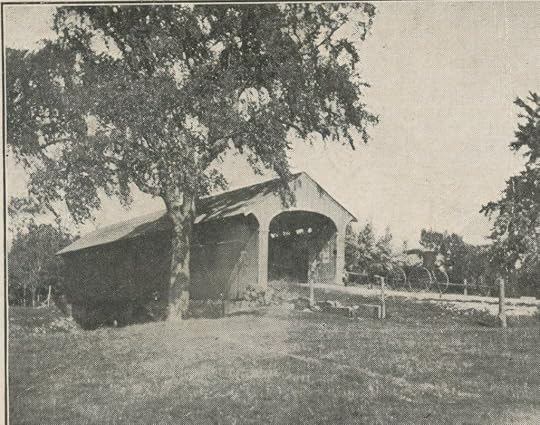 1864. Ponemah/Poor Farm Bridge
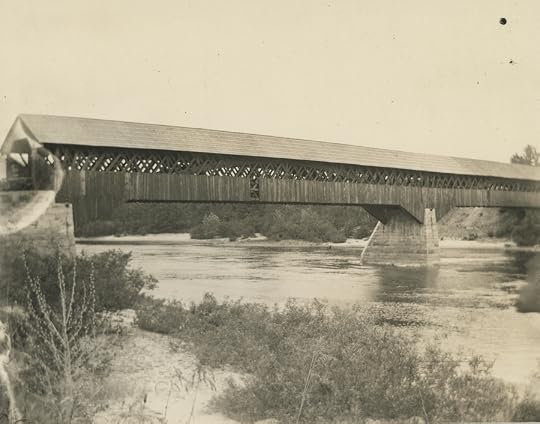 1873. Sewall’s Falls Bridge
1853. Contoocook Village Bridge. Hopkinton. Replaced 1935.
1853. Borough Bridge. Concord. Replaced.
1854. Amoskeag Falls Bridge. Manchester. Collapsed August 15, 1920.
1855. Amesbury/Davisville Bridge. Warner. Lost March 1936. **
1858. Tyler Bridge. Hopkinton. Lost 1938.
1859. Main Street/Factory Bridge. Suncook. Replaced.
1860. Waterloo Bridge. Warner.
1864. Ponemah/Poor Farm Bridge. Amherst. Lost 1912.
1873. Sewall’s Falls Bridge. Concord. Replaced 1915.
As communities did not always keep detailed records regarding their bridges, it is possible that Woods was responsible for building more covered bridges than we know. One such conjecture involves the 1854 Bement Bridge in Bradford. The builder has never been identified. However, the counter brace feature found in the Bement Bridge can be seen in the Rowell Bridge, constructed by Horace Childs. “The Bement Bridge’s truss design is evident that the builder had dealings with or was familiar with other builders who were using this design feature” (Wagner 2023). Unless further records are uncovered, the builder will remain a mystery.
In addition to bridge building, Woods helped to build Concord’s South Congregational Church. He served in the New Hampshire State Legislature from 1874-1875. Woods was regarded as “a skillful mechanic, a trusted employee, an intelligent gentleman and a highly valued citizen“ (Stearns 1908).
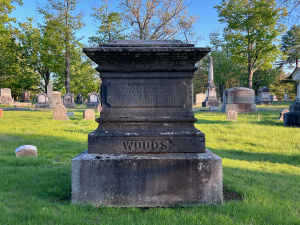 Blossom Hill Cemetery
His wife Maria died in 1882 at age 73 of hydrothorax. Woods died of chronic cystitis two years later, on May 22, 1884. He was 74. Both were buried with his first wife, Hannah, at the Blossom Hill Cemetery in Concord.
Woods’ only child, Hannah Maria Woods (1845-1933), was well-known in Concord’s civic, religious, and social circles throughout her lifetime. She was a member of the South Congregational Church, Appalachian Mountain Club, the New Hampshire Historical Society, the Concord Woman’s Club, and was a board member for the New Hampshire Centennial Home for the Aged, where the Centennial Hotel is now. An 1891 passport application describes her as five foot, four inches tall, with blue eyes, a small nose, a high forehead, a long face, and brown, slightly gray hair. Never married, H. Maria resided in the home on Merrimack Street throughout her lifetime.
In 1893, H. Maria funded a $1,000 scholarship at Dartmouth College in memory of her late father. The scholarship was for a Bachelor of Science degree candidate at the Abiel Chandler School of Science and Arts, a separate undergraduate college at Dartmouth. Neither Maria nor her father attended Dartmouth; her desire to bequeath what would amount to about $30,000 in today’s dollars is unknown. However, Chandler was a resident of Concord, so it seems likely that the two were affiliated in some manner.
The Dutton Woods scholarship ended by 1919, and H. Maria died in 1933. Dutton Woods’ legacy lives on in the structures he so carefully constructed.
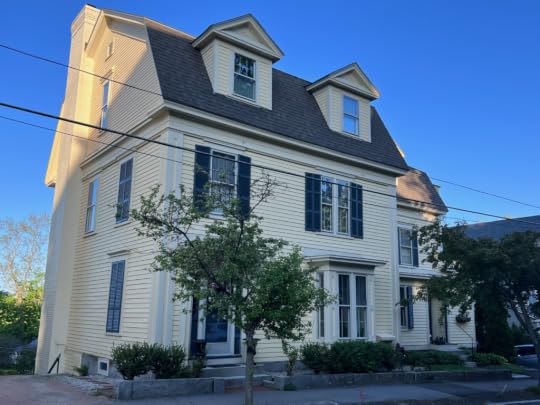 Merrimack Street Home
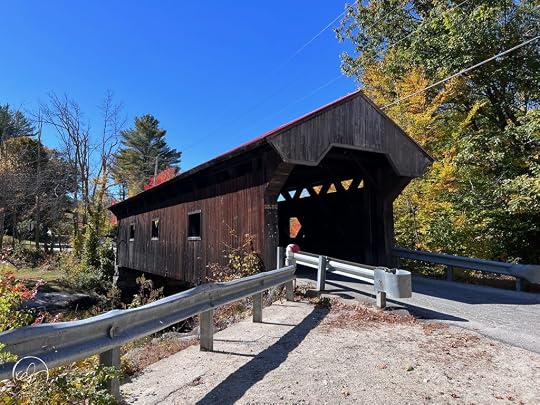 Waterloo Bridge
References
Historical photos were used with permission from Autumn Van Sice, Covered Spans of Yesteryear, and the National Society for the Preservation of Covered Bridges.
Special thanks to Ilana Grallert, Dartmouth College; Autumn Van Sice, Concord; Bill Caswell, President, and Scott Wagner, Co-Vice President, National Society for the Preservation of Covered Bridges.
Barrett, Jr., Frank J. 2021. Vermont’s Woodstock Railroad. History Press.
Cogswell, Leander Winslow. 1880. History of the Town of Henniker, Merrimack County, New Hampshire. Boston: Republican Press Association.
Concord, Town of. 1873. “Annual Report.” Concord, NH.
Granite Monthly. 1900. “The South Congregational Church of Concord.” The Granite Monthly 3-14.
Manchester, Town of. 1873. “Annual Report.” Manchester, NH.
Poor, H. V. 1870. Poor’s Manual of Railroads. United States: H.V. & H. W. Poor.
Secomb, Daniel Franklin. 1883. History of the Town of Amherst, Hillsborough County, New Hampshire. Boston, MA: Evans, Sleeper & Woodbury.
Stearns, Ezra S. 1908. Genealogical and family history of the state of New Hampshire : a record of the achievements of her people in the making of a commonwealth and the founding of a nation. Vol. II. New York: Lewis Publishing Co.
Truax, Will. 2023. Names & Places and Windows through Time. May 2. https://bridgewright.wordpress.com/20....
Wagner, Scott J. 2023. “Dutton Woods – A New Hampshire Bridge Builder.” Covered Bridge Topics.
Notes
** There is ongoing research to determine if the Amesbury/Davisville Bridge were, in fact, two separate bridges in Warner. It seems their histories may have been combined. Stay tuned.
The post The Bridgewright Dutton Woods first appeared on Covered Bridges of New Hampshire.
March 20, 2023
The Loose End in Lancaster
Prior to researching covered bridges, I spent a good amount of time researching genealogy. I’ve traced my Varney ancestors from New Durham and Dover to the West Indies and the Salem Witch Trials, all the way back to 12th-century England. I’ve traced my husband’s Chandler line to John Chandler, who arrived at Jamestown Island as an unaccompanied nine-year-old in 1609. I’ve found quite a few exciting things on this journey, including that King Henry III of England is my 22nd great-grandfather. But no matter where the rabbit hole leads, the research starts with the same essential baseline questions for each person – name, date of birth, and place of birth.
I approached my covered bridge research in quite the same manner. I began each covered bridge narrative with four essential questions – when it was built, where it was built, how much it cost, and who built it. For most of New Hampshire’s covered bridges, I was able to answer all four of these basic questions before Covered Bridges of New Hampshire went to print. But others remained unanswered and left gaping holes in my stories.
I don’t care for loose ends.
Such was the story of Lancaster’s Mechanic Street Bridge.
We know the bridge was built in 1862. Local merchant Richard P. Kent (1806–1885) kept a diary in which he documented the construction of the new Mechanic Street Bridge. Kent noted that construction commenced on June 11, 1862. He noted that the first team crossed the covered bridge on Tuesday, November 18, 1862.
We know it was at least the second bridge across the Israel River at this location. Kent wrote that the covered bridge replaced an unsafe wooden bridge. Mechanic Street was laid out in 1852, and by 1859 the road was extended through “Mr. Joyslin’s land for the continuation of the street leading from the Town Hall to the house of Gilman Colby. We learn that the bridge is commenced” as reported in the Coos Republican (Bennett 2004).” This led some to infer the covered bridge was built in 1859, but it was not, thanks to Mr. Kent.
We know that the town of Lancaster constructed both the Mechanic Street Bridge and the Main Street/Double Barrel Bridge in 1862 and that both bridges cost $2,610 to construct. The town sadly lumped the expenses for both bridges into one line item in their town report. Even more sad is that the Main Street/Double Barrel Bridge was damaged beyond repair in 1886 and subsequently replaced.
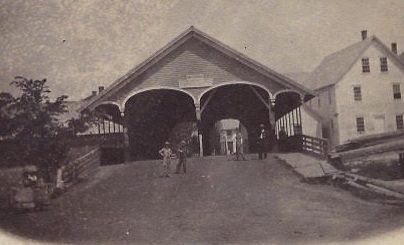 Main Street/Double Barrel Bridge, Lancaster
 What we haven’t known for 161 years is who built the bridge. It seems neither the town nor Mr. Kent found this detail important enough to write down.
It’s been a bone of contention for decades. At the Mechanic Street Bridge’s 100th birthday celebration, the Coos Republican reported, “It is fortunate that Mr. Kent cared enough to have jotted down these two items, for the town report for the year 1862 failed to even mention the bridge, let alone the cost of building or the builder.”
During my initial visit to research in Lancaster in 2021, I met with Barbara Robarts of the Weeks Memorial Library. In addition to providing me with historical documents about Lancaster’s covered bridges, she told me there were seven boxes of unsorted town receipts marked “roads and bridges.” In the short time that I had to spend there, I sorted through one box and found several promising receipts from 1862. But I didn’t have time to go through them all.
Finally, this February, I made the trip back.
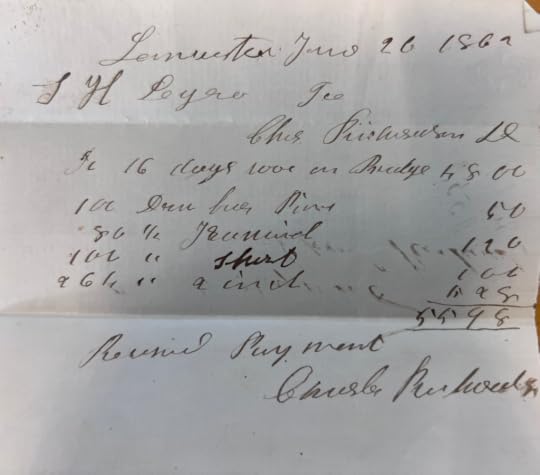
Barbara graciously gave my husband and me seven boxes of handwritten receipts from the 1800s. For over three hours, we reviewed hundreds of small pieces of paper, some official receipts from a pre-printed book and others literally torn from a full sheet. Each receipt was handwritten with an ink-well pen in cursive script, some legible, some not so much. We pulled out any receipt mentioning bridge work in 1862 and piled them on the table. Finally, in the last box, we hit paydirt.
Charles Richardson built the Mechanic Street Bridge.
It comes as little surprise that Charles Richardson had a hand in building the two Lancaster covered bridges. Ten years earlier, “Charles Richardson and Son” were credited for building the Groveton Bridge ten miles up the road. The elder Richardson was also rumored to have built the Stark Bridge in 1857. The four bridges are very similar in design; it would be a safe bet that the same person constructed them. Just take a look for yourself.
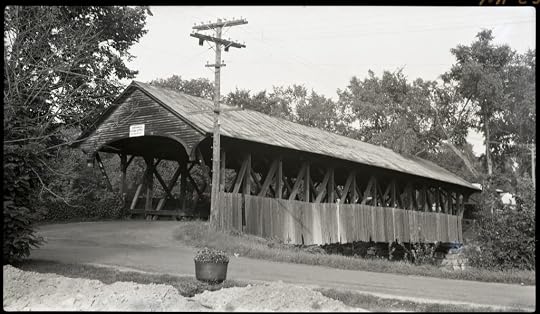 Mechanic Street Bridge
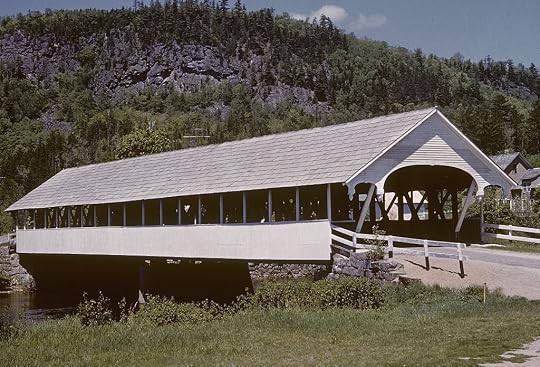 Stark Bridge
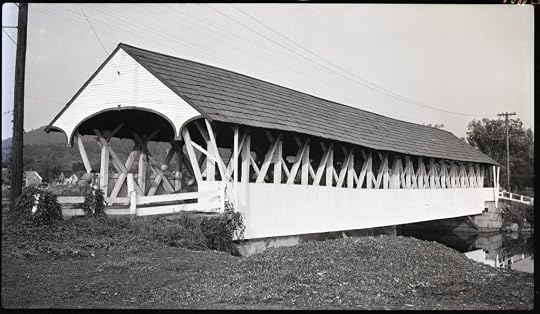 Groveton Bridge
So who was Charles Richardson? Well, there were two.
Captain Charles Richardson (1806–1894) was the son of John Richardson (1758–1823) and Sarah Wilder (1764–1851). Richardson married Unity Partridge (1814–1836) and had his first son, Charles P. (1836–1906). Unity died six weeks after her son was born. Richardson then married Miranda Cook (1815– 1897) and had seven more children, four of whom were sons.
In addition to owning a farm, Richardson operated Charles Richardson & Co. lumber manufacturing in Northumberland. He worked as a furniture and chair maker in addition to constructing covered bridges. The 1870 and 1880 censuses both report his occupation as a bridge builder. Richardson built the Guildhall-Northumberland Bridge in 1855. He is often called “Captain,” but his military service is still unclear. Richardson died of heart failure at the age of eighty-eight in 1894.
Richardson “and son” built the Groveton Bridge in 1852 when he was 46 years old. So who was the “son?” His oldest son Charles P. was sixteen years old at the time. Two of Richardson’s younger sons died within a week of each other in 1851; the remaining two were under the age of eight in 1852. Therefore, Charles P. should be credited with helping his father construct the Groveton Bridge.
Young Charles’s career trajectory seems to reinforce this theory. Vital records indicate that the younger Charles followed in his father’s footsteps. His occupation is listed as a carpenter (1857), carpenter journeyman (1860), mechanic (1860), millwright (1880), building mover (1900), and millwright (1905).
Given the elder Charles’ definitive occupation as a bridge builder, it may be safe to assume that he was the builder of both the Main Street Bridge and the Mechanic Street Bridge. Perhaps his son worked alongside him. Either way, one or both of them were involved.
The receipts we culled totaled $2,558.94, $51.06 short of the amount expensed in 1862. We either missed some receipts, or they aren’t in the box, but I’m rather pleased with the proximity. The payments for both covered bridges began in May 1862 and ended in November and simply refer to work on “the bridge.” An analysis of the receipts indicates that the abutments were constructed by Samuel Davidson (1805-1878). Davidson was paid a total of $705 over six installments. Timber was purchased from farmer Emmons S. Freeman (1833-1924), farmer William F. Smith (1820-1896), Anson F. Weston, C.B. Allen & Co, and carpenter William L. Rowell (1835-1917).
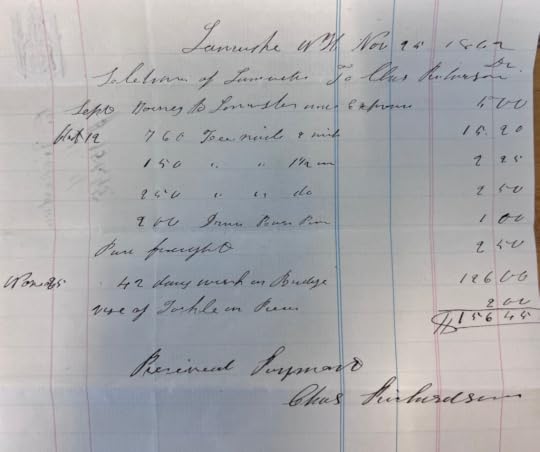
Other men who were paid to work on the bridges include merchant William H. Heath (1824-1889), mason Daniel W. Spaulding (1826–1881), carpenter Joseph Nutter (1829–1890), farmer Edward Melcher (1825–1897), David Young (b. 1819), Richard O. Young (1842–1862) who was killed in the Civil War shortly after working on the bridge, carpenter Seneca B. Congdon (1822–1912), farmer James Legro (1826–1909), laborer Freeman S. Moulton (1837–1907), carpenter Frank B. Smith (1832–1909), mason Chester C. Fisk, laborer Daniel W. Spaulding (1814-1883), Fielding Smith, farmer Francis Kellum (1833-1896), George Smith, Daniel Pellum, Richard M. J. Grant (b.1836), George T. Wentworth (1842-1913), Nelson B. Lindsey, road agent Samuel H. Legro (b. 1825), farmer Samuel S. McDonald (b.1823), and someone identified as O. Nutter.
Charles Richardson was first paid for nineteen days of work on May 21, 1862. On June 26, he was paid for 16 days. Since Kent’s diary states work on the Mechanic Street Bridge began on June 11, we can assume the bulk of these days were for the Main Street Bridge. Richardson was subsequently paid for expenses such as board, belts, pine, nails, treenails, freight, and use of tackle. On November 9, he was paid for “42 days work on the bridge,” bringing his total to seventy-seven work days for both bridges. In all, he was paid $328.49.
One loose end is tied up; now, on to the next.
Did Charles Richardson build the Stark bridge, and if so, when? It is unclear exactly when the current bridge was constructed and by whom, but the town has settled on 1862. The Union Church was built in 1853, and the bridge is often attributed to being constructed at this time; some publications claim 1857 as the date. An article by Muriel Rogers Stuart (1913–1990) in the July 1947 edition of New Hampshire Highways Magazine credits Captain Richardson as the builder and unilaterally states it was built in 1857, but this has not been corroborated (Stuart 1947). Stuart served as an auditor for the town of Stark, and her husband, Raymond, served on the school board and as town moderator. It is unclear if she had documented information or was reciting oral tradition.
I intend to find out.
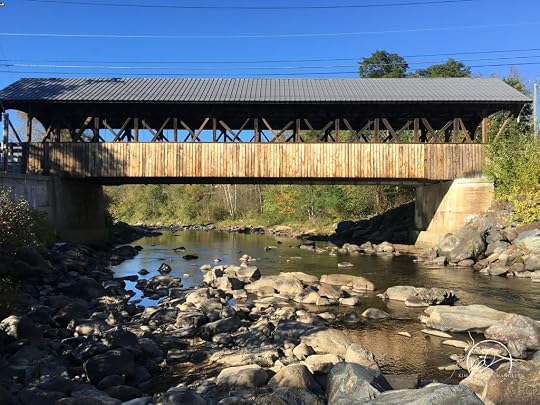 Mechanic Street Bridge
References
Historical photos were used with permission from Anne Morgan, Covered Spans of Yesteryear, and the National Society for the Preservation of Covered Bridges.
Bennett, Lola. 2004. Historic American Engineering Record, Mechanic StreetBridge, HAER No. NH-45. Washington, D.C.: National Park Service, U.S. Department of the Interior.
Stuart, Muriel V. Rogers. 1947. “Stark Covered Bridge.” New Hampshire Highways Magazine, July.
The post The Loose End in Lancaster first appeared on Covered Bridges of New Hampshire.
February 23, 2023
The Three Bridges at Hooksett
Note: This article was amended in February 2024, after extensive research proved that the three bridges were not rebuilt in 1868 by the H. Childs & Co. Documents indicate that the bridges were rebuilt between 1888 and 1889 by the Concord Railroad. While this took away the excitement of having a piece of a Childs brothers’ bridge in my kitchen, I am nonetheless thrilled to have a piece of covered bridge history. (February 2024).
The Portsmouth and Concord Railroad was founded in 1845 to build an east-west railroad line connecting the ports of the seacoast to the capital city of Concord. The following year, a branch line from Hooksett to Suncook was granted to supply service to Suncook and surrounding towns. The line crossed the Merrimack River just above the falls and the namesake “hook” in the river.
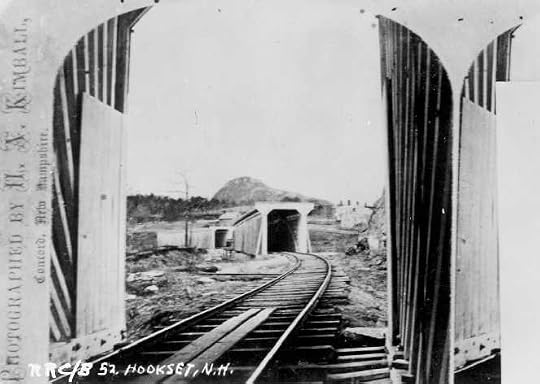 The 1861 Briggs Triple Lattice Truss Bridges
(Richard Donovan Collection)
In 1861, Cole & Company of Lake Village (Laconia) constructed three covered railroad bridges designed by Concord civil engineer John C. Briggs (1824-1865). All three bridges were built using Briggs’ truss design which would be patented in 1863 as a Briggs Triple Lattice Truss. One two-span 175′ bridge connected to an island in the river. The railroad continued past the island and to the shore over a three-span, 308′ bridge, and a two-span, 186′ bridge. These bridges were damaged by a flood in 1888 and rebuilt the same year by the Concord Railroad.
It is worth noting that some publications indicate that the bridges were rebuilt in 1868 by Horace Childs and his brothers, Enoch and Warren. However, after extensive research of H. Childs & Co, it appears that all three brothers had retired from bridge building by 1862. Further research into these bridges proved that they were rebuilt by the Concord Railroad, not the Childs, and in 1889, not 1868.
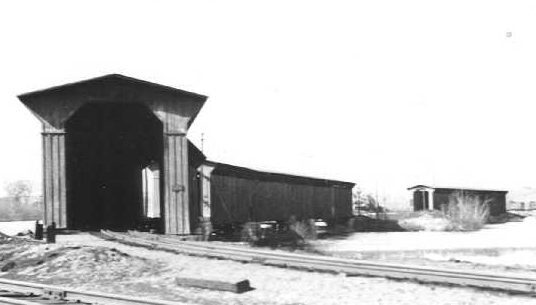 The 1889 Bridges (Richard Roy Collection)
All three structures were Town truss bridges and followed the same layout as the previous covered bridges. The bridges were slightly damaged during the flood of 1927, but after a period of repairs were reopened. The final train run over the Hooksett bridges occurred on January 11, 1935. The bridges were slated to be demolished by the Boston and Maine Railroad the following year. Those plans were soon thwarted.
The winter of 1935–1936 had been a long, cold, snowy one. On March 11, following a warm front that melted a good amount of snow, it started raining. For two days, it poured over northern New England. This rainwater, combined with snow runoff, turned the rivers into raging highways full of large chunks of ice.
The following week, a second storm sat over the area from March 16 to 19. This additional four days of rain put most of New Hampshire underwater. In many places, the record water levels still stand today. The Great Flood of 1936 killed 150 New Englanders, left 430,000 people homeless, and cost between $250 and $500 million in damage. This flood caused significant damage and destruction to bridges and dams across New England.
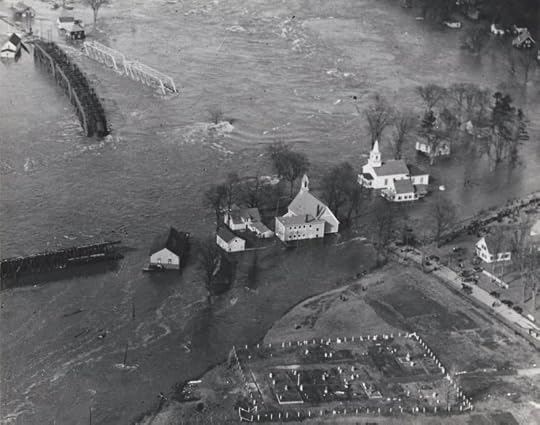 Hooksett flood damage. Covered bridge span at left. 1936
 (Town of Hooksett)
Hooksett was especially hard hit. The Merrimack River was raging. An article in the Keene Evening Sentinel reported, “the main section of Hooksett, a town north of Manchester, lay in ruins. A survey indicated thirty houses and buildings had been wrecked, and several swept into the swirling Merrimack. A tenement house and a school building were included in the damaged area. The steel town bridge went out, and three wooden bridges followed… they were in shambles.” Twenty-five bridges, including the three covered railroad bridges, were destroyed.
The Town of Hooksett reported, “the bridges were washed down river over the Hooksett Falls and caused the collapse of the brick two-story Village School and the Odd Fellows Hall (on what is now Veterans’ Drive) and also damaged or destroyed several other buildings including serious damage to both the Protestant and Catholic churches.”
Meanwhile, four and a half miles south of the covered bridges, a young family was building their home. Joseph “Alfred” Hebert (b. 1898) and his wife, Aldea C. Roy (1901-1987), purchased a property in 1925 on what is now Daniel Webster Highway. Alfred was the son of Jean Baptiste Hebert (1867-1907) and Celine Helie (1873-1926), immigrants from French Canada who came to work in the mills. Alfred and Aldea married in 1920, and he supported the family as a truck driver. Their son, Roger, was born in 1922. By 1930, the Hebert’s started construction on what they referred to as their Sunday House, as that was the only day their busy work schedules allowed them time to build it.
 Hooksett Stone House
Constructed entirely of field stones harvested from the property, the home is decidedly unique. Now referred to as the Stone House, the home features a large flagstone fireplace, stained glass windows, concrete stairways, and a beautiful front porch. A date scratched into the concrete just inside the front door marks the year 1937, the same year the Heberts were operating the Green Lumber Company out of the Stone House.
Where am I going with this, and what does the house have to do with covered bridges?
Well, the Heberts were both frugal and resourceful. The house, remember, is built mainly of found stones and concrete. The ceilings are reinforced with steel from old Model-T and Studebaker cars. The walls were insulated with newspapers and other paper products. The wooden roof was also made from repurposed material.
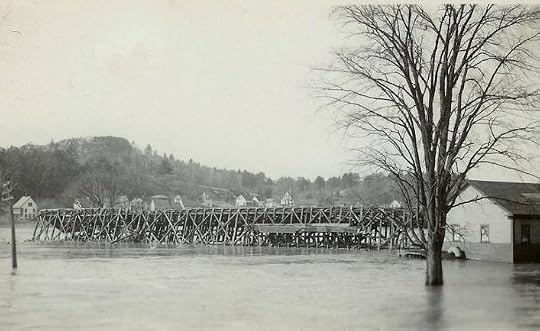 One of the covered bridge spans floating down the river, 1936
 (Town of Hooksett)
In March of 1936, the hook of the Merrimack River was full of scrap wood from the three railroad bridges. Over 600 feet of covered bridges were destroyed, leaving long, three-inch thick planks of wood along the shoreline. It is reported that Alfred paid the town $20, and they let him take as much wood as he wanted. He used those timbers to put a roof on his house, and those timbers remain today.
The Stone House remained in the Hebert family and was for sale for many years. When a buyer did come along, the intention was to tear down the house and build a storage facility in its place. Townspeople were having none of that. Residents submitted a petition and asked the town to intervene to save the property. In the end, the developer changed plans, and the Stone House went back on the market. In 2021, the Stone House was purchased by Christina Katsikas.
A couple of weeks ago, Christina contacted me after watching my segment on NH Chronicle. Now in the midst of a complete renovation of the Stone House, Christina is about to insulate the property to provide an energy-efficient home. The beautiful roof rafters will soon be covered in spray-on insulation. “I’d like you to see the structure in person before we apply the foam insulation to it,” Christina said. “It breaks my heart to do that, but there’s no other way to be able to live in this stone house. If you’d like to come visit, I will show them to you before they disappear out of sight in the house,” she wrote.
That was a hard yes.
On Monday, Christina graciously showed us around her house. It is simply incredible. The house is like a small castle, seemingly out of place alongside a busy Route 3, surrounded by a flood of commercial buildings that have taken over the area. Carpenters were just as busy inside framing rooms and preparing for the next steps – drywall, plumbing, and electricity. Christina pointed out the car parts in the ceiling and the newspapers on the walls. She took us into the basement where the lumber company was once housed and showed us a built-in safe. After walking up a concrete staircase to the second floor, we saw the repurposed timbers from the 1889 covered bridges.
Many of the timbers still have the trunnels attached. Some have holes where the trunnels once were, and some of those holes are filled with spray foam. Several still have metal pins that once held sheets of tar paper; tiny pieces of black paper are attached to some of the pins. Many have nails sticking out every which way. But there they are, repurposed from destruction, providing shelter for the framework of this unique home. It was neat to see. Soon, the timbers will be covered up, and no one will ever see them again.
Except for one. Christina gave us a large, 6-foot timber as a keepsake. I’m unusually excited about having timber from an historic covered bridge in my kitchen. It may not be everyone’s idea of décor, but it’s my kind of cool.
References
Historical photos used with permission from Covered Spans of Yesteryear and the Town of Hooksett.
Albertson-Grove, J. 2021. “Hooksett’s Stone House gets a reprieve.” Union Leader. May 6, 2021.
Kansas City Star. 1936. “Arms Over Cities.” Kansas City Star, March 20, 1936.
Keene Evening Sentinel. 1936. “Town of Hooksett Is in Ruins.” Keene Evening Sentinel, March 20, 1936.
Knoblock, Glenn A. 2012. Historic Iron and Steel Bridges of New Hampshire and Vermont. McFarland Publishers.
Montreal Gazette. 1936. “Dead in Floods Reach 152.” Montreal Gazette, March 21, 1936.
Town of Hooksett. 2021. Scenes from Hooksett’s Past: Heritage Month Continues! http://hooksett.org Retrieved February 22, 2023.
Truax, Will. 2014. “Briggs- the Man – the Truss – The Enigma.” The Bridgewright Blog, December 2014.
The post The Three Bridges at Hooksett first appeared on Covered Bridges of New Hampshire.