Ryan Stevens's Blog
April 19, 2026
The Ban on Booing

Since the 19th Century, the International Skating Union has governed the sport of figure skating and established rules for its skaters. In the 1930s, the ISU took the unprecedented step of making rules for the audience, too.
In the summer of 1937, at the ISU Congress in St. Moritz, Switzerland, delegates voted to adopt a proposal submitted by Herbert J. Clarke, the National Skating Association of Great Britain's delegate: "That the referee should suspend any International Championship or Competition if the behaviour of the public towards any judge or competitor is improper or unsatisfactory." The President of the ISU at the time that this rule was passed was Ulrich Salchow, the creator of many people's least favourite jump.
 Photo courtesy "Skating" magazine
When this rule was introduced, it quickly earned the nickname "The Ban on Booing" - and it was quite controversial. Critics argued that if spectators were paying to attend a figure skating competition, they were perfectly entitled to voice their displeasure with the judges' marks.
 Photo courtesy "Skating World" magazine.
At the time, the Open Marking System was brand spanking new, and the ISU had concerns about judges "being intimidated by the public".
Interestingly enough - after "The Ban on Booing" was instituted, audience behaviour got much worse, before it got better. There are many tales, from those first decades of the 6.0 System's existence, of audience members taking things one step further and throwing things at judges. Famously, at the 1956 Olympics in Cortina d'Ampezzo, the audience was so incensed by the marks awarded to Carol Heiss that they hurled "bottles, cigarette cartons... tomatoes or what have you [onto] the ice, so that the judges had to take shelter. It held up the proceedings for about twenty minutes until order was restored and the ice cleared of rubbish," recalled Mildred Richardson, the wife of international judge and eminent British figure skating writer T.D. Richardson. In the pairs event at the same Olympics, the judges and referee were pelted with so many oranges that the ice had to be cleared three times.
Over the years, skating audiences have simmered, shifting their focus from flying produce to flying camels. For many, social media has provided a welcome outlet for people to complain.

Interestingly enough, the rule once dubbed "The Ban on Booing" never really went away. Even today, referees at ISU Championships still have the "duty and power" to suspend a competition "until the order is restored in case the public interrupts the competition or interferes with its orderly conduct."
So while the tomatoes may be packed away and the boos a little more subdued, the tension between audiences and judges will always simmer beneath the surface - proof that in figure skating, the drama isn't just on the ice.
Skate Guard is a blog dedicated to preserving the rich, colourful and fascinating history of figure skating. Over ten years, the blog has featured over a thousand free articles covering all aspects of the sport's history, as well as four compelling in-depth features. To read the latest articles, follow the blog on Facebook, Bluesky, Pinterest and YouTube. If you enjoy Skate Guard, please show your support for this archive by ordering one of eight fascinating books highlighting the history of figure skating: https://skateguard1.blogspot.com/p/buy-book.html.

April 11, 2026
The 1930 World Figure Skating Championships


 ISU championship medals for men (left), women (center) and pairs (right) used at the 1930 World Championships
From February 3 to 5, 1930, the world's best figure skaters descended on The Big Apple for the 1930 World Figure Skating Championships. To really get a sense of how big a deal this competition was, it was the first World Championships ever held on North American soil, the first time official World Championship events in men's, women's and pairs skating were held at the same time in the same location and the first time that Sonja Henie ever skated in North America. Pretty historic stuff!

 Top: Karl Schäfer, Sonja Henie, Ludwig Wrede, Melitta Brunner and Georges Gautschi. Bottom: Melitta Brunner, Karl Schäfer, Maribel Vinson and Sonja Henie.
How did it all come about? In the book "First twenty-five years of the United States Figure Skating Association, 1921-1946", Charles T. Church, then president of the USFSA wrote: "Countless letters and cables had passed between the Internationale Eislauf Vereinigung and the USFSA and Henry Howe, when he was in Europe, had many conversations with Mr. [Ulrich] Salchow, I.E.V. President, before the Europeans agreed to having the World Championship Competitions held in the United States under the auspices of the USFSA and The Skating Club of New York. Permission was finally granted in the fall of 1929, and from that time, things began to hum in preparation for the great event. About February 1, 1930, the following cable from Stockholm was received: 'Internationale Eislauf Vereinigung send congratulations. Convinced first World Championships skated America will result in growing cooperation and fellowship - Salchow.'"

One of the major players in ensuring that the rules set forth by the ISU were instituted properly was Joseph Savage. The same five judges from Austria, Canada, Great Britain, Norway and the United States presided over the marking of all three disciplines - another first - and competitions in school figures were arranged at The Ice Club on West 50th Street, with free skating competitions to be held in Madison Square Garden.
 William Nagle, Ludwig Wrede, Roger Turner, Bud Wilson, Georges Gautschi, Karl Schäfer, Gail Borden II and James Lester Madden at the 1930 World Championships. Photo courtesy "Skating Through The Years".
The timing of the controversial European Championships in Strbske Pleso, Czechoslovakia, on January 19 and 20, 1930, meant that the vast majority of skaters who had opted to participate were simply unable to secure ocean passage to America in time to participate in the World Championships. In fact, the only skater in any discipline who had competed in the High Tatra mountains who made it to New York City was the men's runner-up, Karl Schäfer of Austria. A rushed voyage by train and boat brought him to America just in time to compete. Also on the missing list was the reigning World Champion Gillis Grafström of Sweden, who the "Engadine Express" slanderously surmised didn't attend due to his "fresh temperament". In reality, Grafström had already booked his passage to Europe but had suffered a concussion during a fall practicing "new acrobatic jumps to suit expected American taste, new spins, astonishing tracing" in Villars. The Henie family was met at the pier by a swarm of journalists and Mayor Jimmy Walker and from the first step Sonja took on North American soil, she was given the star treatment. Church recalled, "One highlight of the championships was engineered by 'Billy' Bird of The Skating Club Of New York, and that was when he arranged to have Sonja's taxi escorted to her hotel by New York City motorcycle policemen - the only skater I know of who has had this honor." The participation of Henie and other foreign skaters in the wildly successful "Land Of The Midnight Sun" ice carnival that preceded the competition generated much hype for the competition and played a major factor in filling the seats at Madison Square Garden for the free skating competitions. Varying accounts put anywhere from thirteen to seventeen thousand bodies in those seats... long before the days of television advertisements.


The day before the competition got underway, an international who's of figure skating gathered at the Kelwynne Road home of Skating Club of New York judge Joel B. Liberman for a formal luncheon served by Mr. and Mrs. A Cushing Ash of the Scarsdale Tavern. Joel's sister, Grace Munstock, assisted in receiving guests. Those in attendance included Sonja Henie and her parents, Melitta Brunner and Ludwig Wrede, Andrée and Pierre Brunet, Cecil Smith, Constance Wilson, Maribel Vinson and her parents, Georges Gautschi, Willy Böckl and USFSA Presidents past, present and future Henry Wainwright Howe, Charles T. Church and Joseph K. Savage. How did the competitions play out? Let's take a look back!
THE MEN'S COMPETITION

 Karl Schäfer in 1930. Photos courtesy National Archives of Poland, "Skating" magazine.
After finishing second the two previous years to Willy Böckl and Grafström, twenty-year-old Karl Schäfer won in a spectacular fashion in New York City, making history as the youngest man yet to win a World title. He earned first-place ordinals from every judge in both the school figures and free skating.
Although he only had one second place ordinal in free skating, American Roger Turner earned the silver medal based on his strong second-place showing in the figures. His medal win was also of great historical significance as it was the first medal won by an American man in the history of the World Championships. With a strong free skating performance, Dr. Georges Gautschi of Switzerland claimed the bronze ahead of Canada's Montgomery Wilson and four other competitors. Benjamin T. Wright recalled a story concerning Richard L. Hapgood, who was a reporter for the "Boston Transcript" at the time: "He travelled from New York after the competition with the Austrian judge and asked him by he had given Schäfer 11 sixes (6.0) out of 12 (the other being a 5.9) in the compulsory figures, to which the judge, Mr. Julius Edhoffer, replied that he 'always gave a six to the best figure.'"
The only British entry in the entire event, Ian Home Bowhill, was forced to withdraw. A short footnote in "Skating" magazine noted, "Mr.Bowhill... actuallyarrived in New York harbor, yet could not land and skate! Otherthan the following, we know nothing. He is said at times to have beenafflicted with heart trouble. During a storm, he became so violentlyill, affecting his heart, that the ship's doctor refused to allow himto leave his room when he arrived, ordering his return to England atonce. Wewish to express our admiration of his sportsmanship in coming and ourdeepest regrets and sympathy in his great misfortune."
THE PAIRS COMPETITION
 Andreé and Pierre Brunet with Charles T. Church. Photo courtesy "Skating" magazine.
In the pairs competition, newlyweds Andreé and Pierre Brunet of France captured their third World title. The silver went to Melitta Brunner and Ludwig of Austria and the bronze to Americans Beatrix Loughran and Sherwin Badger. The Brunets' win was impressive in that there was no French judge on the panel, and there was clearly some national bias going on. Three judges put the Brunets first, one tied them with Melitta Brunner and Ludwig Wrede of Austria, and the Canadian judge placed Constance Wilson and Montgomery Wilson first... although no other judge even had them in the top three. That same Canadian judge also put Isobel and Melville Rogers third. No one had them in the top three either.
THE WOMEN'S COMPETITION

 Constance Wilson-Samuel, Suzanne Davis, Melitta Brunner, Cecil Smith, Maribel Vinson and Sonja Henie. Photos courtesy "Skating" magazine (top) and "Skating Through The Years" (bottom).
The real talk of the Championships was, of course, the women's competition. The stories, as they always did when Henie was involved, started before the competition even began. In an interview for David Young's book "The Golden Age Of Canadian Skating", Cecil Smith recalled that during a practice, "First came Sonja, swathed in furs. Then came Mother, swathed in furs. Then Papa Henie, with a fur coat and [a] cigar. Then the brother, with long blond hair, carrying Sonja's skates, and behind him one of the international judges. Sonja walked over to my patch to see what my figures were like, but I said nothing - just smiled." It was at this event that Smith competed in white boots, a statement which Henie later 'borrowed' and popularized. Despite taking a tumble in the free skate, the Canadian star recovered without missing a beat. Constance Wilson was lucky to compete at all. A faulty skate sharpening had led to an accident in practice that nearly took her out of the event altogether. Despite missed training time, she too performed quite well all things considered.
 Photo courtesy "Skating" magazine
With a little luck from the rabbit's foot she wore around her neck and a little wheeling and dealing, no doubt from Papa Henie, Sonja won her fourth consecutive World title. However, her win wasn't unanimous. In the figures, British judge Herbert J. Clarke - who was also the ISU Vice-President at the time - had her third behind Smith and Vinson. American judge Joel B. Liberman had her second behind Smith. In the free skating, Canadian judge J.C. McDougall had Henie second behind Constance Wilson. All other judges had her first. Overall, Henie earned first place ordinals from every judge, Smith three seconds and two thirds for second and Vinson one second, two thirds and two fourths for third. Wilson, Melitta Brunner and American Suzanne Davis finished fourth, fifth and sixth, respectively.
In her book "Wings On My Feet", Henie recalled, "In the wings, preparing none too calmly to face all those thousands of eyes in the galleries, I remember checking carefully every detail I could think of - my boots, the sharpness of my blades, whether my gloves were fastened and the ornaments on my hair firmly in place... Norwegian-Americans fell upon us after the competitions, hordes of them. They came over to the Biltmore with us, and when they had crowded into our suite, it seemed we should have taken a floor instead. Several of them remembered father from his cycling days at the Bygdøy track and, to his vast pleasure, recognized him by sight despite the fact that back then he had been less than a shadow of his 1930 self."
Joel B. Liberman's report on the event in "Skating" magazine was unusually frank for the time. He wrote, "Sonja will always win over Maribel in spite of dark whisperings of disillusion about Sonja which circulate like evil spirits around a rink in practice and are blown away when the referee announces that the tournament has begun. That is - Sonja will always win unless Maribel will listen and learn. I have always felt that if our American star could give that measure of practice under efficient coaching which is accorded the foreign stars that she would be the greatest skater of them all. Her school figures are excellent (they were good enough to win a first from a foreign judge) and she skates them with daring. Her free skating has vitality and dash. She has personality plus on the ice. You may want to drag her off and lecture her on how to win, but you can't ignore her. Notwithstanding this great talent she will not reach the goal to which she is entitled unless she learns - repose. Strangely enough it has a place in skating and Sonja is a champion because she has it coupled with speed and accuracy. In her school figures Sonja is slow motion. She sticks to the trace like a veteran. Her forced turns are just good enough to get by, but at loop-change-loop she is a wizard. At the end of a long school program she will be found at the top or so near it that her remarkable ability as a free skating performer will always pull her through. She is still the same dashing free skater that she was at the Olympics and her program is practically unchanged except that she is even more complete mistress of the art of showmanship in skating than ever. Granted that Sonja has not a varied free skating program, and that she relies for her points on a wide variety of spins, a few perfect jumps, and a couple of eagle moves, yet she performs these so faultlessly and with such ease that on her performance any fair minded judge should give her practically the maximum. As to the lack of dances, spirals, original specialties... Iwould say that while Sonja retains her extreme youth and vivacity,she does what she does so well that we must condone what she omits.As a solo skater among women amateurs she stands alone."
 Fritzi Burger. Photo courtesy National Archives of Poland.
Fritzi Burger didn't make the trip to New York, saying her father told her, "Why not be the first European Ladies Champion, rather than travel all that distance just to be second again to Sonja." The American press coyly alluded to a relationship between Schäfer and Henie, who were seen holding hands, to make good copy and a skater's party was thrown for the competitors by Mr. and Mrs. Church. The hugely successful competition really did generate a huge boom of interest in the sport in America and proved to the Eurocentric ISU that North Americans were fully equipped to host major international competitions. Quoted in the December 31, 1936 issue of the "New York Post", Joseph K. Savage recalled, "Those championships convinced the skeptical Garden authorities that figure skating was a paying proposition and won a large following for the sport." Perhaps Sherwin Badger summed up the event best when he said, "Judging by the enthusiasm of the audiences, the press, and the management of Madison Square Garden, it looked as if, at long last, figure skating had left its struggling beginnings behind and was about to become a firmly established sport."

Following the competition, Cecil Smith headlined the Minto Follies in Ottawa. Schäfer, Henie, the Brunets and a cast of European stars joined their American counterparts in a whirlwind series of exhibitions in New York, Boston, New Haven and Philadelphia before returning on steamers to Europe to compete in the (second) 1930 European Championships in Berlin.
 Annulled results from the 1930 European Championships (take one) in Štrbské Pleso
The results of the men's event in Štrbské Pleso had been declared null and void by the ISU because Yugoslavian ISU judge Ivo Kavsek had been swapped out for a non-certified judge named Victor Vadisek. Judging under Kavsek's name, Vadisek led a bloc of judges from Czechoslovakia, France and Yugoslavia to place Josef Slíva ahead of Karl Schäfer. Schäfer had the last laugh in Berlin, easily winning his second European title and putting to bed a controversy that had made front page news in both Czechoslovakia and Austria.
Skate Guard is a blog dedicated to preserving the rich, colourful and fascinating history of figure skating. Over ten years, the blog has featured over a thousand free articles covering all aspects of the sport's history, as well as four compelling in-depth features. To read the latest articles, follow the blog on Facebook, Bluesky, Pinterest and YouTube. If you enjoy Skate Guard, please show your support for this archive by ordering one of eight fascinating books highlighting the history of figure skating: https://skateguard1.blogspot.com/p/buy-book.html.
March 28, 2026
Echoes of Gold: The Eva Romanová and Pavel Roman Story

As the world's best take to the ice in Prague at the 2026 World Figure Skating Championships, we look back at another defining moment in the city's skating history. In 1962, siblings Eva Romanová and Pavel Roman made history on this very stage, becoming the first Czech ice dance team to capture a World title - delighting a home crowd and etching their names into skating history.

Pavel Roman was born on January 25, 1943, in the Moravian city of Olomouc. His younger sister Eva Romanová was born on January 27, 1946. Their parents, Frantisek and Jarmila, worked as a sales representative and a costume designer.
As children, Pavel and Eva enjoyed biking, playing tennis, and swimming during the summer. In winter, they skated at the Olomouc rink with their half-brother Zdenek. In a 2019 interview with the "Blackpool Gazette", Eva recalled, "My brother wanted to play ice hockey but my father said you have to learn to figure skate first. There weren't many boys doing that, so they wanted to pair him up with other girls. But my father said, 'no, he has a sister,' so we ended up skating together."

When it quickly became clear that both Eva and Pavel had a natural talent for skating, their father became a regular presence at the rink and took a strong interest in their development. Although Frantisek had no background in skating, he studied skating literature, observed other coaches, and eventually took on the role of coach, training Eva and Pavel three days a week. Because the rink was primarily used for hockey, many of their practices took place early in the morning before school.


In 1952, Frantisek was transferred to Prague for work. He continued coaching his children for a few more years, but it soon became clear they needed more advanced instruction than he could provide. He approached coach Mila Novaková, who agreed to train Eva and Pavel at Stadion Praha.
The siblings initially competed as a pairs team, winning medals at the Czechoslovakian Championships in 1957 and 1958. During the 1959/1960 season, they competed in both pairs and ice dance. At that year’s national championships, they placed second in pairs and won the first Czechoslovakian ice dance title. At just thirteen, Eva became the youngest woman ever to win a national title in her country.
At the European Championships in Davos, Switzerland, they finished twelfth in pairs but seventh in ice dance. That result helped the talented young brother and sister decide where to focus their efforts. By the following season, they had committed entirely to ice dancing.

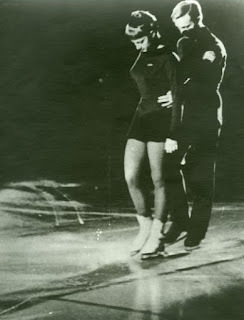 Right photo courtesy Národní muzeum
In 1960, Eva and Pavel again placed seventh at the European Championships, but the following year they moved up to fifth. The cancellation of the 1961 World Championships - scheduled to be held in their home city, due to the Sabena Crash that killed the entire U.S. figure skating team, delayed their World debut.
Alongside their skating careers, both pursued post-secondary education. Eva earned a degree in Decorative Arts from an art-industrial school while working as a window dresser at a department store. Pavel attended the industrial school Střední průmyslová škola na Proseku, where he studied machining and engineering. In their spare time, Eva enjoyed drawing, while Pavel took an interest in building sports cars. He would often ride Jawa motorcycles to "break them in" for new buyers.
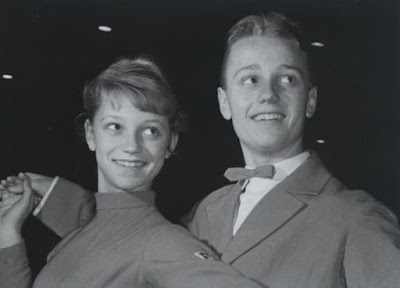 Photo courtesy Národní muzeum
In 1962, Eva and Pavel showed remarkable improvement, finishing third at the European Championships in Geneva, Switzerland, behind France's Christiane and Jean Paul Guhel and Britain’s Linda Shearman and Michael Phillips. In the May 1962 issue of "Skating World", British skating historian Dennis L. Bird wrote that in Geneva they had the best free dance, but that their performance "looked like pair skating without the jumps."
"To me, they were amazing," recalled the late World Ice Dancing Champion Bernard Ford, in Steve Milton's book "Figure Skating's Greatest Stars". "It wasn't dance-y, like things had been. They skated to the music, but they attacked it. They had a lot of speed." Believe it or not - at the time, some actually criticized their speed, but their athletic style, which contrasted sharply with the British ice dancing style of the time, proved immensely popular when the World Championships finally took place in Prague from March 14 to 17, 1962, drawing enthusiastic crowds to the Sportovní hala.
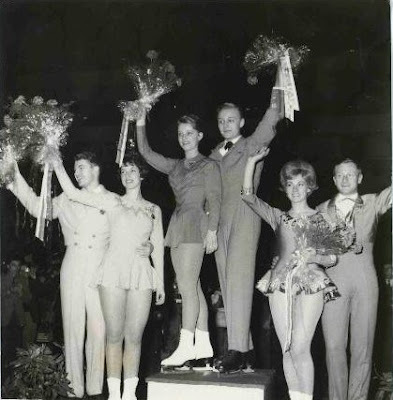 Photo courtesy Národní muzeum
Eva and Pavel achieved the unthinkable, winning the title in their debut at the World Championships, in front of a home crowd. Writing in "Skating" in May 1962, Jane Vaughn Sullivan wrote, "Dressed in matching costumes of glowing coral which set off their blonde hair, they skated with fire and spirit to win the Dance title." That year, they became the first non-British team to win since 1952, when ice dancing was first officially included in the ISU World Championships record books.
As Lynn Copley-Graves observed in "Figure Skating History: The Evolution Of Dance on Ice", "the British were shut out of the medals altogether, shut out of what seemed like their birthright, for the only time in the first 12 years of World Dance." Following their victory, Eva and Pavel performed in exhibitions in Moscow and Kiev alongside Karol Divín and members of the U.S. team.
During the off-season, Eva and Pavel traveled overseas to train in Colorado Springs, where they also performed in the Broadmoor Ice Revue for two weeks. At the 1963 European Championships in Budapest, they won the free dance with first-place ordinals from eight of the nine judges. However, losses in the Foxtrot, Westminster Waltz, Kilian, and Argentine Tango to Britain’s Linda Shearman and Michael Phillips - who had finished fourth at the previous year’s World Championships - left them second overall in a result so close that it took more than an hour to tabulate the marks.
Video courtesy Frazer Ormondroyd
At the 1963 World Championships in Italy, the rivalry between the two teams was again intense. The Britons won the compulsory dances, while Eva and Pavel took the free dance. According to the "Reading Eagle" on March 3, 1963, "officials announced the Czech brother and sister team had won the ice dance title, but did not release point scores immediately. The Britons were so close that unofficial point totals gave them more points than the Czech defending champions, 322.7 to 321.6."
Ultimately, the defense of Eva and Pavel’s World title came down to the votes of the nine judges - and this time, it was enough.
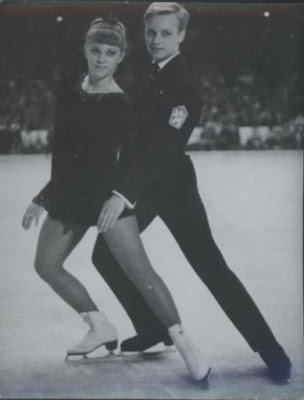 Photo courtesy Národní muzeum
The following season, Eva and Pavel made the unusual decision to keep the same free dance they had used the year before. At the 1964 European Championships, history seemed ready to repeat itself when another British team, Janet Sawbridge and David Hickinbottom, led after the first two compulsory dances, the Foxtrot and European Waltz. In her book, Lynn Copley-Graves noted, "Romanová/Roman, in search of the elusive European title, caught up in the Kilian and held a narrow lead after the Tango. Their dazzling free dance had a sequence where Eva did a series of lightning spread eagles between turns on her toe picks. Aside from Lawrence Demmy's 5.4 and 5.5, their lowest marks were 5.7 for their first European title."
With the newly crowned European title under their belt, Eva and Pavel headed to Dortmund for the World Championships, where they faced an easier path to victory. Building a substantial lead in the compulsory dances, they earned first-place votes from six of the seven judges, scoring 249.2 points with eight ordinals, and comfortably defeated Canadians Paulette Doan and Kenneth Ormsby to win their third World title.
During the summer of 1965, Eva and Pavel trained at home in Czechoslovakia at the country’s first summer skating school. When they arrived at the Palace of Sports at Moscow’s Lenin Central Stadium for the 1965 European Championships, they made mistakes in the compulsory dances but nonetheless maintained their lead. They also debuted a new free dance, which was highly praised for its unison and speed, allowing them to hold off three British couples.
At nineteen and twenty-two, as three-time defending World Champions, Eva and Pavel headed to their fourth and final World Championships at the Broadmoor in Colorado Springs. As Lynn Copley-Graves noted, "no couple could hope to oust Pavel and Roman in the free dance... With amazing cohesion in their free leg movements, Eva and Pavel amassed a fourth consecutive World title. They did not skate in the exaggerated straight-back position of the British, with the result that came across as more fluid. Their innovative free dance energized the audience."
As swiftly as they had risen on the World stage, Eva and Pavel retired at the peak of their careers, leaving the World Championships undefeated.


Eva and Pavel received numerous offers to skate in shows and even signed with the Ice Capades, but Czechoslovakian officials voided the contract. In May 1965, they competed in the World Professional Championships in England, winning the Starlight Waltz, Blues, Quickstep, and their free dance to take the title over four British teams. They later joined the Holiday on Ice tour in Cologne, Germany.
 Photo courtesy Joseph Butchko Collection, an acquisition of the Skate Guard Archive
To receive permission to tour with the show, they had to give the Czechoslovakian government ten percent of their earnings and agree to renew their visas each year.
 Photo courtesy Toronto Public Library, from Toronto Star Photographic Archive. Reproduced for educational purposes under license permission.
While on tour, both Eva and Pavel found love. Eva married British ice comedian Jackie Graham, who bred Arabian horses in Devon, England. Pavel met his wife Sonia Grand, a singer and Holiday on Ice skater who was the goddaughter of skating historian Nigel Brown, in Switzerland. They celebrated with two wedding ceremonies - one in Switzerland and another at Karlštejn Castle, southwest of Prague.

Eva and Pavel toured with Holiday on Ice until 1971, when Pavel and Sonia took jobs in Tennessee at the Kingdom of Camelot inn. Pavel served as recreation director and planned engineering projects, while Sonia entertained guests with her singing. Meanwhile, Eva continued to tour with Holiday on Ice alone in Johannesburg, South Africa, before moving to England.

Pavel's half-brother Zdeněk published a book about Eva and Pavel's skating career. The book claimed that their father had been "a strict disciplinarian to the point of abuse." In an interview at the 1962 World Championships, Eva disputed these claims. "He was much older than me and he wrote about all the funny things. I had a different view. Father taught me to the best I could be and that comes in handy in life. Our parents made sure we didn't tell tales. If we did, my father would punish us both. At school they would say, 'How can you skate with your brother?' Most brothers and sisters beat each other up, but we were best buddies. We skated for fun, not ambition."

Off the ice, Pavel enjoyed carpentry and furniture making and, according to Bernard Ford, was "a man's man. He did all sports. He cross-country motorbiked, he raced cars. He was an all-around jock, which was certainly well outside the ice dance image." He was also an amateur mechanic with a need for speed. In a 2014 interview with Lidovky, Eva recalled, "Unfortunately, Pavel drove too fast. My mother had always said, 'Pavel, you make me me one million dollars.' And he had replied, 'No, if anything, I would kill myself.'"

Pavel’s words proved tragically prophetic just days after his twenty-ninth birthday, while he was driving guests to the Kingdom of Camelot. The February 3, 1972 edition of the "Rogersville Review" reported, "A one-car accident early Thursday morning on State Route 94, near the Kingdom of Camelot, snuffed out the life of former world figure skating champion, Pavel (Paul) [Roman], 29. [Roman], who had been serving as recreation director at the Kingdom of Camelot since last summer, was pronounced dead on arrival at Hawkins County Memorial Hospital. State Highway Trooper Russell Tipton, who investigated the accident, said [Roman] lost control of his car on a curve, left the road and went down an embankment, hitting several trees. The accident happened [within] the shadow of the Camelot Inn, near the athletic field. [Roman] was returning to the Inn when the accident happened."

Roman’s funeral was held at St. Henry's Catholic Church. Although he was originally to be buried at Highland Cemetery, he was ultimately interred in Olšanské hřbitovy Cemetery in Prague.

Life continued for Eva, but it was never easy. In a 2006 interview, she said, "Not a day [went by] that I did not remember him. For me, [he did] not age, he is still twenty-nine." She skated for a time with her husband, performing a comedy act with chimpanzees. She also tried teaching ice dancing in England, but when it proved unprofitable, she ran a retirement home for a decade before moving to the United States.
After teaching skating in Dallas for four years, she retired to a farm in Texas, caring for ducks and geese. In the 1990s, Eva and her husband sold the farm, bought a caravan, and traveled across America for five years before returning to Europe, spending time in England and Spain before settling at a farm in Lipnice, near Rokycany, in the Czech Republic in 2001. Now a widow, Eva lives in Lytham St. Annes, a seaside town near Blackpool, England.
Eva and Pavel Roman's story is one of extraordinary talent, dedication, and trailblazing achievement. As the first Czech team to win a World title in ice dancing, they achieved success internationally at a time when the sport was dominated almost entirely by British teams. From their early days skating together in Olomouc to becoming four-time World Champions, they brought speed and athleticism to ice dancing. While Pavel's life was tragically cut short, Eva continued to embrace life with determination, pursuing teaching, performing, and later farming and travel, all while keeping the memory of her brother and skating partner alive. Their legacy stands as a testament to their talent and the lasting impact they made on the world of ice dance.
Skate Guard is a blog dedicated to preserving the rich, colourful and fascinating history of figure skating. Over ten years, the blog has featured over a thousand free articles covering all aspects of the sport's history, as well as four compelling in-depth features. To read the latest articles, follow the blog on Facebook, Twitter, Pinterest and YouTube. If you enjoy Skate Guard, please show your support for this archive by ordering a copy of figure skating reference books "The Almanac of Canadian Figure Skating", "Technical Merit: A History of Figure Skating Jumps" and "A Bibliography of Figure Skating": https://skateguard1.blogspot.com/p/buy-book.html.March 26, 2026
The Chaotic History of Menning
 Nobunari Oda taking a tumble at the 2009 World Championships. Photo courtesy Silvie Touchette.
If you have spent any time engaging in online figure skating discussions over the past few years, you may have come across the term "Menning."
In today's figure skating pop culture, "Menning" refers to the tendency for men's events to produce chaotic and unpredictable results. It's the short program where no one seems to be able to stay on their feet. It's the free skate where there seem to be more Waxels than Axels. It's the skater who lands everything all season and then unravels at the biggest competition of the year. It’s the standings that look nothing like the expected podium after the short program. In short, when the men’s event refuses to behave logically, today's generation of fans shrugs and says: "That’s menning."
The lingo isn't meant as an insult so much as affectionate exasperation. Men's singles has long had a reputation for volatility. As they say, "ice is slippery", and with huge risk comes the greater potential for failure. While the discipline has produced extraordinary champions and historic programs, it has also produced a not insignificant number of dramatic defeats, surprise medallists, and head-scratching final standings.
In today's blog, I'll look at a few historical examples that helped cement the idea of "Menning" in skating culture. Then, because anecdotes are fun but data is better, I have compiled a chart tracking instances of "menning" since the introduction of the International Judging System (IJS). I've focused on the IJS era because it allows for more consistent technical comparisons and clearer statistical patterns. As for the 6.0 era? That would require rewatching approximately a million programs - and as a wise woman named Sweet Brown once said, "Ain't nobody got time for that."
Let's look back at the history of how the men have, well... menned.
 Jack Ferguson Page. Photo courtesy "Skating World" magazine.
In 1927, the World Figure Skating Championships were held in Davos, Switzerland. The entire competition was skated in a blinding blizzard. Eight men competed, and Manchester-born British skater Jack Ferguson Page was the only one of them who didn't fall in the compulsory figures and free skating. All of the other competitors fell at least once in the figures and once or twice in the free skating. The weather clearly played a factor, but interestingly enough, Page finished fourth in both phases of the competition and fourth overall. In the days before the "one judge per country" rule, a trio of Austrian skaters swept the podium, thanks to a bloc of three Austrian judges. The British judge reported the matter to the UK's National Skating Association and kicked up a fuss with the press. The media attention surrounding this incident, coupled with a similar one in that year's World Championships for women in Oslo, helped change the ISU's rules, but it didn't stop men from menning.

Newspaper clipping about the men's competition at the 1963 World Championships, courtesy "Buffalo Evening News"
At the 1963 World Figure Skating Championships, the men's free skate devolved into a midnight survival test that perfectly exemplified "men menning." Skated in temperatures plunging to minus twenty Celsius, with the final group beginning shortly before midnight on splinter-hard, brittle ice, the event saw contender after contender falter. Spectators watched in disbelief as skater after skater struggled on jumps they could do every day in practice. The leader after the compulsory figures, Manfred Schnelldorfer of West Germany, "fell so badly backwards that he lost a lot of time to get up again," recalled his mother. "In those seconds, he wondered whether to give up. He did not want it anymore and had to leave some difficulties out. He jumped only simple jumps, no more doubles and dragged to the end. It was cruel." Czechoslovakia's Karol Divín, second in figures, skated cautiously. Donald McPherson and Alain Calmat both fell on triple loop attempts, but moved up to finish first and second overall. Backstage, no one could confidently predict the podium after a competition defined less by brilliance than by widespread falls, fatigue, and freezing temperatures.
.jpg) Medallists at the 1982 World Figure Skating Championships. Photo courtesy "Canadian Skater" magazine.
Medallists at the 1982 World Figure Skating Championships. Photo courtesy "Canadian Skater" magazine.Two decades later, at the 1982 World Championships in Copenhagen, skater after skater seemingly tumbled on cue during the short program. Half of the top ten skaters after the figures (Jean-Christophe Simond, David Santee, Igor Bobrin, Brian Pockar and Fumio Igarashi) fell on the required combination, which had to include a double flip that year. The standings were all over the place. Brian Orser, twelfth in figures, was third in the short program. David Santee, third in figures, was sixteenth in the short program. The unpredictable skating led to some unpredictable results. Fortuitously for Canada, when the marks were tabulated, Brian Pockar became the first Canadian man to win a medal at the World Championships since Toller Cranston in 1976, despite finishing outside of the top three in all three phases of the competition.
 Results from the 1982 World Figure Skating Champions, courtesy "A Complete History of the World Figure Skating Championships"
Before we quantify menning in the IJS era, it's worth acknowledging a fundamental truth: technical progress in men's figure skating has never moved in a straight line. Yes, technical difficulty has constantly increased over time, but breakthroughs have rarely produced instant revolutions or inspired a "monkey see, monkey do" mentality of other skaters rushing out to put history-making jumps in their programs right away.
When Donald Jackson landed the first triple Lutz at the 1962 World Figure Skating Championships, it did not trigger a stampede of triple Lutz attempts the following season. Skaters included the jumps they needed to in order to succeed under the judging system of their era - no more, no less. In fact, the next World Champion to include a triple Lutz in his winning program was Jan Hoffmann more than a decade later, at the 1974 World Figure Skating Championships. The same pattern appeared with Vern Taylor's historic triple Axel at the 1978 World Championships - it was not the culmination of years of failed attempts by the entire field, but an outlier moment that did not instantly redefine "the gold standard."
Even in the modern era, Ilia Malinin's quadruple Axel stands as an example of how one skater's extraordinary ability isn't necessarily the setting of a new "goal post" that every skater needs to achieve to win. That said, as the standard of technical difficulty accelerates faster than consistency can keep up, the result is often volatility.
In order to take a look at how the men have menned over the last twenty plus years, I had to come up with some way of quantifying "menning". The Skate Guard Blog Menning Index™ measures how chaotic and risk-heavy major competitions were by focusing primarily on quad attempts. It calculates how many quads are attempted versus how many are landed to determine a "chaos rate", then factors in total falls per segment as an amplifier of that risk, and finally adds a small adjustment for placement volatility. Quad efficiency drives 70% of the score since it is the main engine of modern men's technical risk, falls account for 25% because they indicate unpredictability, and result swings contribute 5% as confirmation of competitive turbulence, producing a 0–100 scale where lower numbers indicate a competition that was mostly smooth sailing and higher numbers suggest a competition that was unpredictable at best. By no means is this system foolproof - skaters could have landed every quad and missed every triple Axel, as an example. However, it does give a decent indication of which events went particularly awry.

I divided the scores into 3 categories:
🚗 Start The Car! - 0-35% - A competition with a high reward vs. risk ratio on quads and/or a lower percentage of falls
😐 Chaotic Neutral - 35-50% - A competition with a medium reward .vs. risk ratio on quads and/or a lower percentage of falls
🧴 Tequila and Holy Water Needed (shout out to The Runthrough Podcast!) - Break out the strong stuff and call a priest. If you're rewatching this competition, brace yourself for some serious menning!
Year
Event
Quads Tried
(SP)
Quads with 0/+ GOE (SP)
Quads Tried
(FS)
Quads with 0/+ GOE (FS)
Falls (SP)
Falls (FS)
# of SP Top 3 Who Didn't Medal
# of FS Top 3 Who Didn't Medal
Score
Menning Level
2005
Euros
5
2
7
5
9
7
1
0
43.8
Chaotic Neutral
2005
4CC
5
3
8
2
10
17
1
0
66.8
Tequila and Holy Water Needed
2005
Worlds
10
3
12
9
14
16
1
1
59.3
Tequila and Holy Water Needed
2006
Euros
5
2
8
3
14
20
0
0
68.1
Tequila and Holy Water Needed
2006
4CC
4
2
1
1
8
13
0
1
46.8
Chaotic Neutral
2006
Olympics
6
3
14
5
8
18
1
1
66.2
Tequila and Holy Water Needed
2006
Worlds
7
5
13
9
5
8
2
0
34.3
Start The Car!
2007
Euros
4
0
7
3
10
20
1
0
77.2
Tequila and Holy Water Needed
2007
4CC
2
0
4
2
7
13
1
1
65.8
Tequila and Holy Water Needed
2007
Worlds
4
1
11
4
14
13
1
0
70.4
Tequila and Holy Water Needed
2008
Euros
4
1
9
2
12
19
0
1
80.1
Tequila and Holy Water Needed
2008
4CC
3
2
6
3
6
14
0
0
47.8
Chaotic Neutral
2008
Worlds
5
3
12
5
12
12
1
1
59.6
Tequila and Holy Water Needed
2009
Euros
3
3
6
3
9
5
1
1
37.5
Chaotic Neutral
2009
4CC
1
0
5
2
13
16
0
1
72.1
Tequila and Holy Water Needed
2009
Worlds
4
1
8
6
12
8
0
0
45.8
Chaotic Neutral
2010
Euros
5
3
10
4
9
5
1
0
50.3
Tequila and Holy Water Needed
2010
4CC
1
1
5
2
17
12
2
1
62.9
Tequila and Holy Water Needed
2010
Olympics
4
1
11
3
4
13
0
1
66.8
Tequila and Holy Water Needed
2010
Worlds
6
3
13
7
15
14
0
1
58.6
Tequila and Holy Water Needed
2011
Euros
4
2
9
7
9
9
2
0
39
Chaotic Neutral
2011
4CC
2
0
7
1
5
11
0
1
76.8
Tequila and Holy Water Needed
2011
Worlds
8
3
15
10
9
14
2
0
52.1
Tequila and Holy Water Needed
2012
Euros
7
3
10
5
7
12
1
0
54.1
Tequila and Holy Water Needed
2012
4CC
7
1
9
3
16
23
1
1
80
Tequila and Holy Water Needed
2012
Worlds
11
5
22
10
11
10
1
0
56.9
Tequila and Holy Water Needed
2013
Euros
9
5
11
9
9
6
1
0
34.8
Start The Car!
2013
4CC
10
5
16
9
4
13
1
1
49
Chaotic Neutral
2013
Worlds
13
7
23
10
7
13
1
1
56.1
Tequila and Holy Water Needed
2014
Euros
12
4
18
7
12
13
1
0
66.4
Tequila and Holy Water Needed
2014
4CC
7
2
11
3
8
8
1
0
65.1
Tequila and Holy Water Needed
2014
Olympics
17
6
23
11
10
13
1
0
60.7
Tequila and Holy Water Needed
2014
Worlds
17
8
19
11
11
6
0
0
47.2
Chaotic Neutral
2015
Euros
8
4
13
4
12
15
1
0
67.1
Tequila and Holy Water Needed
2015
4CC
9
4
15
6
8
11
1
1
59.2
Tequila and Holy Water Needed
2015
Worlds
17
3
21
10
8
15
0
0
65.2
Tequila and Holy Water Needed
2016
Euros
10
5
16
9
15
9
1
2
56.1
Tequila and Holy Water
2016
4CC
13
4
20
11
13
20
1
0
64.4
Tequila and Holy Water Needed
2016
Worlds
20
8
29
13
14
11
1
0
62.1
Tequila and Holy Water Needed
2017
Euros
14
8
20
8
9
14
1
0
57.5
Tequila and Holy Water Needed
2017
4CC
15
8
33
17
7
22
0
0
57.7
Tequila and Holy Water Needed
2017
Worlds
27
17
47
30
10
14
1
0
46.8
Chaotic Neutral
2018
Euros
16
3
23
9
17
15
1
0
74.7
Tequila and Holy Water Needed
2018
4CC
14
5
30
13
6
15
1
0
60.1
Tequila and Holy Water Needed
2018
Olympics
27
16
45
28
12
18
0
1
53.5
Tequila and Holy Water Needed
2018
Worlds
27
11
44
15
13
17
1
1
71.9
Tequila and Holy Water Needed
2019
Euros
17
13
25
9
14
19
1
0
59.6
Tequila and Holy Water Needed
2019
4CC
13
8
23
11
5
12
1
1
49.7
Chaotic Neutral
2019
Worlds
30
16
44
24
13
12
1
0
54.3
Tequila and Holy Water Needed
2020
Euros
17
5
26
14
8
11
1
1
57.4
Tequila and Holy Water Needed
2020
4CC
14
12
23
14
6
16
1
0
40.4
Chaotic Neutral
2020
Worlds
N/A
N/A
N/A
N/A
N/A
N/A
N/A
N/A
N/A
Menning Occurred In Self-Isolation
2021
Euros
N/A
N/A
N/A
N/A
N/A
N/A
N/A
N/A
N/A
Menning Occurred In Self-Isolation
2021
4CC
N/A
N/A
N/A
N/A
N/A
N/A
N/A
N/A
N/A
Menning Occurred In Self-Isolation
2021
Worlds
19
15
44
27
13
14
0
1
47.1
Chaotic Neutral
2022
Euros
20
10
26
16
9
15
2
0
52.9
Tequila and Holy Water Needed
2022
4CC
13
7
23
11
9
13
0
0
53.3
Tequila and Holy Water Needed
2022
Olympics
32
21
49
33
5
13
0
1
39.6
Chaotic Neutral
2022
Worlds
22
17
44
23
5
16
1
1
47.6
Chaotic Neutral
2023
Euros
16
8
19
6
6
14
1
0
59.9
Tequila and Holy Water Needed
2023
4CC
15
7
25
14
8
17
1
0
55.3
Tequila and Holy Water Needed
2023
Worlds
30
13
47
24
11
9
0
0
53
Tequila and Holy Water Needed
2024
Euros
14
5
23
14
11
13
1
0
55.3
Tequila and Holy Water Needed
2024
4CC
17
12
29
17
10
15
0
0
46.7
Chaotic Neutral
2024
Worlds
30
16
45
32
8
11
1
0
42.3
Chaotic Neutral
2025
Euros
18
9
29
13
9
15
2
0
59.7
Tequila and Holy Water Needed
2025
4CC
17
4
28
15
13
12
1
0
62.5
Tequila and Holy Water Needed
2025
Worlds
28
13
47
27
14
11
0
1
54.8
Tequila and Holy Water Needed
2026
Euros
18
8
29
14
7
16
2
0
58.9
Tequila and Holy Water Needed
2026
4CC
21
17
27
20
5
10
1
1
31
Start The Car!
2026
Olympics
34
21
59
31
5
14
3
1
51.7
Tequila and Holy Water Needed
A couple of interesting takeaways here:
While the men's free skate at the 2026 Winter Olympics in Milano Cortina stood out for its utter chaos, the success rate for quadruple jumps was actually quite high. 21 of the 34 quads attempted in the short program received a GOE of 0.00 or higher, and 31 of the 59 quads attempted in the free skate received the same. There were fewer falls in both the short program and free skate than there were at the 2018 Winter Olympics in PyeongChang.We should definitely get nervous whenever a skating competition is being held at the Taipei Arena. All four times the Four Continents Championships were held in Taipei, serious menning occurred.In terms of a low risk vs. reward ratio on quadruple jumps and a high number of falls, the most chaotic men's event at a senior ISU Championship or Olympics since the introduction of IJS was the 2012 Four Continents Championships in Colorado Springs. This event also had the most falls in the free skate of any of the competitions studied. The least chaotic, by the same metrics, were this year's Four Continents Championships in Beijing.And so the story of menning in figure skating continues to unfold. By the time the dust settles at the 2026 World Figure Skating Championships in Prague, perhaps the judges, skaters, and statisticians will all agree on one thing: the ice is still slippery, jumps are still extremely hard, and pressure is absolutely a thing. Until then, we'll keep crossing our fingers that everyone stays upright.
Skate Guard is a blog dedicated to preserving the rich, colourful and fascinating history of figure skating. Over ten years, the blog has featured over a thousand free articles covering all aspects of the sport's history, as well as four compelling in-depth features. To read the latest articles, follow the blog on Facebook, Bluesky, Pinterest and YouTube. If you enjoy Skate Guard, please show your support for this archive by ordering one of eight fascinating books highlighting the history of figure skating: https://skateguard1.blogspot.com/p/buy-book.html.
March 25, 2026
The World Figure Skating Championships History Hub

As the world's best skaters take to the ice in Prague for the 2026 World Figure Skating Championships, there’s no better time to jump into the rich history of this incredible event. From unforgettable performances to groundbreaking moments that shaped the sport, the legacy of the World Championships spans more than a century - and it’s all in one place.
Skate Guard Blog's World Figure Skating Championships History Hub will be updated daily throughout the week, with new historical features, archival videos, and stories that connect the past to the present. You'll also find links to trusted sources covering this year’s competition in Prague, making it easy to follow along while exploring the sport’s deeper roots. Visit the hub here and be sure to bookmark the page and check back often for new content! ⛸️
March 14, 2026
Unison And Upper Cuts: The Lawrence Demmy Story
 Lawrence Demmy, Jack Wake and Jean Westwood. Photo courtesy "Ice Skate" magazine.
The son of Gertrude (Marcovitch) and Albert Dembovsky, Lawrence Demmy was born November 7, 1931, in Manchester, England and grew up in the nearby town of Prestwich on Bishops Road in Sedgley Park. By day, his father worked as a manufacturer and salesman of Mackintoshes; by night he was the Jewish featherweight boxing champion of Northern England. The extended Demmy (Dembovsky) family of Manchester was all involved in the family raincoat business. Lawrence's uncle Gus was a well-known boxing promoter and bookie. Lawrence also dabbled in boxing while attending Stand Grammar School in Bury. His younger brother Franklyn was the school's senior sports champion.


Lawrence started skating at the age of fourteen when the Manchester Ice Palace in Cheetham Hill reopened after the Second World War. He wasn't the only skater in the family. His cousin Michael took up the sport as well and was an early partner of June Markham before she teamed up with Courtney Jones. Lawrence placed second in the Northern and Midlands Ice Dance Championship and finished sixth in his first British Championships in 1950 with Janet Hudson before teaming up with Jean Westwood in the autumn of that year. It was a partnership concocted by the Ice Palace's manager, Jack Wake, who himself was a British Open Professional Champion in ice dancing in thirties - and a match in heaven it was not. In a February 16, 1998 interview in the "Times Colonist", Jean admitted, "I hated Demmy. In my mind's eye, I would superimpose my boyfriend's face on his whenever I looked at Demmy in competition. For all the world, we looked as if we were passionately in love. Nothing could have been farther from the truth. But both of us wanted to be World Champions. We were of value to each other, of use to each other."
 Jean Westwood and Lawrence Demmy. Photo courtesy "Skating" magazine.
If Jean and Lawrence's partnership wasn't all roses, you certainly couldn't have guessed it when you saw them skate. In their very first competition together, the International Ice Dancing Competition at the 1951 World Championships in Milan, they bested eleven other couples and earned first place. Upon returning home to England, they were met at the London Road Station at two o'clock in the morning by a crowd of family, friends and fellow skaters. Among the crowd were Ethel Muckelt and Kathleen Shaw, two of England's biggest skating stars of the roaring twenties.
 Jean Westwood and Lawrence Demmy presenting an award to British skater Elaine Skevington. Photo courtesy "Ice & Roller Skate" magazine.
In the years that followed, Jean and Lawrence made history as the first ice dance winners at both the European and World Championships. They were European Champions twice, World Champions four times (five if you count 1951, which you should) and British Champions twice. Lawrence made history as the first ice dancer of Jewish heritage to win all three of these prestigious titles.
Jean and Lawrence's list of honours didn't stop there. They were the first ice dancers ever to be recipients of the National Skating Association's prized Vandervell Trophy, British junior pairs champions, senior pairs medallists and winners of the Northern and Midlands Dance Championship, Open Dance Trophies of Liverpool, Manchester and Nottingham Skating Clubs, Wembley Open Fourteenstep Competition and Northern and Midlands Blues Competition, Northern and Midlands Pair Skating Competition. They worked with a who's who of top British instructors, including Miss Gladys Hogg, Len Liggett and Thelma Jenkinson. Lawrence passed his Gold Dance test with Miss Hogg; Jean took hers with Len Liggett because he insisted Lawrence "wasn't good enough. Lawrence, as World Champion, was not impressed," recalled Jean.

Jean and Lawrence's partnership ended in 1955. Lawrence was serving with the RAF at the time. He became engaged to his first wife, Patricia, and decided to focus on running his own businesses - a light engineering firm and a company that manufactured electrical components. Jean went overseas and became one of North America's most successful ice dance coaches. Lawrence remarried to Pamela Coverdale in 1960 and settled in North Humberside, East Yorkshire. The couple had three children.
 Jean Westwood and Lawrence Demmy. Photo courtesy "Ice Skate" magazine.
Lawrence's contributions to ice dancing after retiring from competitive skating were quite remarkable in their scope. He established an open ice dance event in Manchester, the Lawrence Demmy Trophy, that was quite popular in the sixties. He was a judge and referee at countless British Championships and judged at the first international ice dancing competition for juniors in Oberstdorf, West Germany in 1961. His first ISU Championship as a judge was the 1964 European Championships in Grenoble. He ruffled some feathers as the only judge on the panel to place the top British couple, Linda Shearman and Michael Phillips, in first in the compulsories, but the following year joined the Ice Dance Technical Committee as a substitute. He became a Committee Member in 1967 (the first former World Champion to do so) and served on the Committee for over twenty years, fifteen years of which he was the Chairman. From 1984 to 1994, he served on the ISU Council and from 1993 to 1998 served as the ISU's Vice-President for Figure Skating. In 1994, he lost a bid for the ISU Presidency to Ottavio Cinquanta. In 1998, he was made an Honorary Vice-President of the ISU. He was the Assistant Referee of the very first Olympic ice dance competition in Innsbruck in 1976 and Referee of the dance events at the 1980 Games in Lake Placid, 1984 Games in Sarajevo and 1992 Games in Albertville. During his long tenure as an ISU Official, he was involved in many sweeping changes in ice dancing - from the introduction of the OSP to the introduction of small lifts and jumps to the increase in value of the free dance.

Christopher Dean, Jayne Torvill and Lawrence Demmy at the British Embassy in 1983. Photo courtesy "Ice & Roller Skate" magazine.
The anecdotes from Lawrence's decades-long career as an ISU Official run the gamut. For starters, in 1984, he proposed a Pacific Championship as an alternative to the European Championships. This concept would later be realized, over a decade later, when the first ISU Four Continents Figure Skating Championships were held in Halifax in 1999. He was one of the brave officials who approached Suzanne Bonaly in the nineties and told her, in no uncertain terms, that her daughter Surya was to stop doing backflips on official practice sessions because it was spooking her competitors. He was behind the suspension of Tatiana Danilenko, a Soviet judge who gave high marks to a Soviet skater who fell twice. He was vocally opposed to professionals reinstating to the amateur ranks to compete in the 1994 Winter Olympic Games in Lillehammer. As early as 1976, he was behind an ISU push for "modest and dignified costumes". For over ten years, Lawrence earned somewhat of a reputation for being the 'fashion police', for his role in drafting rule changes to push back against theatrical costuming. After the 1988 Winter Olympic Games in Calgary, he remarked, "It's becoming a glitter competition. It's a question of who can spend the most money and have the most dazzling outfit. There have been one or two skaters with bare midriffs, no sleeves, almost allowing for bikini tops, decorations and feathers in the hair. It's gone a bit over the top. We have to bring it back."
What's interesting about Lawrence is that, despite drafting numerous rule changes to 'reel in ice dancing', he was also a big supporter of skaters that pushed the envelope. He praised couples like Jayne Torvill and Christopher Dean (whom he advised), Lyudmila Pakhomova and Aleksandr Gorshkov, Natalia Linichuk and Gennadi Karponosov and Natalia Bestemianova and Andrei Bukin, and was a particular fan of 'Min and Mo' - Irina Moiseeva and Andrei Minenkov. He believed that the judging of the compulsory dances, OSP/original dance and free dance should be independent of one another. At a press conference at the 1988 Olympics in Calgary, he remarked, "We have to change the attitudes of the judges. They have to realize there are three distinct stages, and they have to judge them on style and merit. That's not what's happening and it's beginning to look ridiculous. We have to rectify that. We've got to continue to look for new concepts, as Torvill and Dean did. I had [the Duchesnays] second in the original set pattern and free dance and I just couldn't understand it. It's madness. I think their program was fabulous. The more unconventional it is, the better I like it. If we don't accept new concepts, the event is going to stagnate."
In 1992, Lawrence remarked at a press conference, "In my day, the competition was four compulsory dances, which were worth sixty per cent, and one free dance. It's fair to say you were inclined to work harder for the biggest reward. For many years, there [were] no lifts or jumps. It was purely dance steps. That's very restrictive. When I became chairman, I looked to improve the integrity of ice dance. For many years, it was the poor relative."
Though he may have sought to improve the integrity of ice dancing, Lawrence's own integrity would be called into question more than once. When Lawrence suspended six out of nine judges from the dance event at the 1993 World Championships in Prague for inappropriate conduct, the suspensions didn't stick, because protocol wasn't evidently followed. At another event, when an official wanted to file an official complaint about the judging, Lawrence brushed them off and told them it was too late.
Lawrence was a polarizing figure among his peers at the ISU. He developed a close friendship with Courtney Jones, but in her 2004 book "Cracked Ice: Figure Skating's Inner World", Sonia Bianchetti Garbato expressed no love for him whatsoever: "He could change his opinion whenever it suited his personal interests, with no shame whatsoever... He fooled me for years. It took me a little longer to realize how dangerous this man was. He was so good at double-crossing and I was so trusting... [He] could not stand my popularity and did not miss the opportunity to attack me." When he ran against Ottavio Cinquanta for the ISU Presidency in 1994, Cinquanta, the sitting President Olaf Poulsen and Tjaša Andrée-Prosenc mounted a campaign against him. Some felt his loss was karma working its magic.
In 1998, Lawrence lost his seat on the ISU Council when he was defeated by Japan Skating Federation President Katsuichiro Hisanaga. He retired in Spain for several years, before returning to England and settling in Hull, North Yorkshire. He passed away on December 9, 2016, at the age of eighty-five. For his contributions to the skating world, he (along with partner Jean Westwood) were the first ice dancing duo to be inducted to the World Figure Skating Hall of Fame in 1977. He became a Member of the Most Excellent Order of the British Empire (MBE) in 1983.
Skate Guard is a blog dedicated to preserving the rich, colourful and fascinating history of figure skating. Over ten years, the blog has featured over a thousand free articles covering all aspects of the sport's history, as well as four compelling in-depth features. To read the latest articles, follow the blog on Facebook, Bluesky, Pinterest and YouTube. If you enjoy Skate Guard, please show your support for this archive by ordering one of eight fascinating books highlighting the history of figure skating: https://skateguard1.blogspot.com/p/buy-book.html.
March 7, 2026
Book Review - Cut to Black: A Legendary Life in Sports (and Maybe a Few Beers)

Some Canadians might know Rod Black for his work as a commentator for hockey, football, baseball or golf... but to many of us, he will always be best remembered as the voice of Canadian figure skating.
In figure skating's glory days in the 1990s, Black and Barbara Underhill narrated so many incredible moments in the sport that none of us will ever forget.
Black's upcoming memoir, "Cut to Black: A Legendary Life in Sports (and Maybe a Few Beers)" introduces us to the man behind the microphone.
Did you know that one of Rod Black's first gigs CTV Sports was hosting the Tournament of Roses Parade down in the States on New Year's Day with Tracy Wilson? In his youth, he was so captivated by sports broadcasts that he would imitate Johnny Esaw’s voice. He once played a round of golf with Prime Minister Jean Chrétien. Earlier in life, he worked as a “skate boy” and DJ at the Saints Regent Roller Skating Centre in Winnipeg, boogieing like Disco Stu on roller skates to "Staying Alive". At the roller rink, they called him "Hot Rod."
If you're a sports lover - and you really should be if you're reading this book - you'll recognize plenty of names mentioned, including Mark Tewksbury, Ben Johnson and Silken Laumann. Figure skating is not as heavily featured in the book as other sports, but fans will appreciate some of the tidbits featured throughout - like the revelation that it was Black’s hot mic that captured Nancy Kerrigan famously complaining about the delay before the women’s medal ceremony at the 1994 Winter Olympics.
Black also sets the record straight about an interview with Kurt Browning at the 1994 Winter Olympics in Lillehammer. He received a great deal of hate mail for interviewing the Canadian favourite after a rough program and supposedly “making him cry.” In reality, the interview was filmed about 30 minutes after Browning skated and later edited to appear as though it happened immediately afterward. Speaking of the men’s event in Lillehammer, Black also shares some intriguing backstage chatter about the judging. If gossip's your bag, you might find it interesting.
Remember the toe-tapping judges that were caught on camera at the 1999 World Figure Skating Championships? It was Rod Black who told a CTV camera operator to film them. He showed the footage to someone very famous in the figure skating community, who shrugged it off and told him it "was nothing". The Russian and Ukrainian judges in question, Sviatoslav Babenko and Alfred Korytek, both ultimately received suspensions from the International Skating Union.
Rod Black proves to be as engaging a storyteller on the page as he was behind the microphone as a skating commentator. Again, figure skating isn’t the central focus of the memoir, but it’s an entertaining read nonetheless, peppered with just enough skating anecdotes to keep fans interested.
Thank you to Simon & Schuster Canada and Netgalley for the advance review copy of the book.
"Cut to Black: A Legendary Life in Sports (and Maybe a Few Beers)" is available for pre-order from Indigo.
Skate Guard is a blog dedicated to preserving the rich, colourful and fascinating history of figure skating. Over ten years, the blog has featured over a thousand free articles covering all aspects of the sport's history, as well as four compelling in-depth features. To read the latest articles, follow the blog on Facebook, Bluesky, Pinterest and YouTube. If you enjoy Skate Guard, please show your support for this archive by ordering one of eight fascinating books highlighting the history of figure skating: https://skateguard1.blogspot.com/p/buy-book.html.
February 28, 2026
If The Team Event Always Existed, Olympic Figure Skating History Might Look Different

During the Milano Cortina Games, I received a fascinating question by email: what if the Olympic team event had always existed? Which countries might have stood atop the podium decades earlier? It's impossible to know for certain. Performances, strategy, and athlete selection would all played very important roles in this. However, we can absolutely take look at some data to get a sense of which nations may have excelled under a team format.
To explore this idea, I pulled every country that had at least one entry in each discipline at a given Games and recorded the placement of that country's top finisher in the corresponding individual events. By adding those placements together, we get a rough indicator of overall team strength - essentially a snapshot of how competitive a country was across the board. It certainly isn't a perfect science, but it gives some indication of what teams may have been successful (with a little luck) in different eras.
There are, of course, plenty of caveats. Under today's rules, countries without an entry in a particular individual discipline can still add one for the team competition. It's impossible to know which countries may have added skaters in historical events, if any, and how they may have performed. In several instances, nations that performed exceptionally well overall were missing a skater in just one discipline. Had they fielded even one entry, they might have been serious medal contenders. It's all hypothetical, of course - but half the fun of figure skating history is asking "what if?" and letting the data spark debate.
With those caveats in mind, here's a look at how countries might have fared if a team event had been contested prior to 2014. If a country isn't listed, they didn't have at least one entry per discipline.
2010 OLYMPICS
Canada had a very realistic chance of winning the team event in their home country at the 2010 Winter Olympic Games in Vancouver, but it woul have been a close battle with the United States and Russia.
Nation
Top Placing Man
#
Top Placing Woman
#
Top Placing Pairs Team
#
Top Placing Dance Team
#
Total
CAN
Chan
5
Rochette
3
Dubé/Davison
6
Virtue/Moir
2
16
USA
Lysacek
1
Nagasu
4
Evora/Ladwig
10
Davis/White
2
17
RUS
Plushenko
2
Leonova
9
K/Smirnov
4
D/Shabalin
3
18
ITA
Contesti
18
Kostner
16
DM/Kocon
12
Faiella/Scali
5
51
GER
Lindemann
22
Hecken
18
S/Szolkowy
3
Beier/Beier
18
61
2006 OLYMPICS
With medallists in every discipline, a team event at the 2006 Torino Games likely would have been a runaway victory for Russia.
Nation
Top Placing Man
#
Top Placing Woman
#
Top Placing Pairs Team
#
Top Placing Dance Team
#
Total
RUS
Plushenko
1
Slutskaya
3
T/Marinin
1
N/Kostomarov
1
6
USA
Lysacek
4
Cohen
2
Inoue/Baldwin
7
B/Agosto
2
15
CAN
Buttle
3
Rochette
5
Dubé/Davison
10
W/Lowe
11
29
UKR
Kovalevski
20
Liashenko
17
V/Morozov
12
G/Goncharov
3
52
2002 OLYMPICS
Russia would have likely dominated a team event at the 2002 Olympics in Salt Lake City. They were the only country to have medallists in every discipline that year.
Nation
Top Placing Man
#
Top Placing Woman
#
Top Placing Pairs Team
#
Top Placing Dance Team
#
Total
RUS
Yagudin
1
Slutskaya
2
B/Sikharulidze
1
L/Averbukh
2
6
CAN
Stojko
8
Robinson
7
Salé/Pelletier
1
B/Kraatz
4
20
USA
Goebel
3
Hughes
1
I/Zimmerman
5
L/Tchernyshev
11
20
UKR
Dmitrenko
18
Maniachen.
12
S/Morozov
15
G/Goncharov
9
54
ITA
Dolfini
26
Fontana
10
Cobisi/De Pra
19
FP/Margaglio
3
58
1998 OLYMPICS
A team event at the 1998 Olympics in Nagano likely would have been dominated by Russia. Their team won medals in three of the four disciplines. Canada failed to qualify for a spot in the women's event that year, but they may have been a factor for a medal if they had.
Nation
Top Placing Man
#
Top Placing Woman
#
Top Placing Pairs Team
#
Top Placing Dance Team
#
Total
RUS
Kulik
1
Butyrskaya
4
K/Dmitriev
1
Grishuk/Platov
1
7
USA
Eldredge
4
Lipinski
1
Ina/Dungjen
4
P/Swallow
7
16
FRA
Candeloro
3
Gusmeroli
6
A/Bernadis
6
A/Peizerat
3
18
UKR
Zagorodniuk
10
Liashenko
9
F/Marchenko
11
R/Yaroshenko
9
39
JPN
Honda
15
Arakawa
13
Arai/Amano
20
Kawai/Tanaka
23
71
1994 OLYMPICS
Of the teams with at least one entry in every discipline, Canada would have had a very good shot at a gold medal if a team event existed at the 1994 Olympics in Lillehammer - with a caveat. Russia won gold medals in three out of four disciplines at the Games, but they didn't qualify for a spot in the women's event. Two Russian women finished in the top five at that year's European Championships. Had one of them participated, a Russian team could have very well won.
Nation
Top Placing Man
#
Top Placing Woman
#
Top Placing Pairs Team
#
Top Placing Dance Team
#
Total
CAN
Stojko
2
Chouinard
9
Brasseur/Eisler
3
Bourne/Kraatz
10
24
UKR
Petrenko
4
Baiul
1
B/Maliar
16
R/Yaroshenko
7
28
USA
Boitano
6
Kerrigan
2
Meno/Sand
5
P/Swallow
15
28
GRB
Cousins
9
von Saher
15
S/Jenkins
15
Torvill/Dean
3
42
1992 OLYMPICS
With gold medals in three out of four disciplines, the Unified Team, consisting of skaters from the former Soviet Union, would likely have dominated in a team event at the 1992 Olympics in Albertville, France.
Nation
Top Placing Man
#
Top Placing Woman
#
Top Placing Pairs Team
#
Top Placing Dance Team
#
Total
EUN
Petrenko
1
Vorobieva
14
M/Dmitriev
1
K/Ponomarenko
1
17
USA
Wylie
2
Yamaguchi
1
U/Marval
10
S-T/Witherby
11
24
CZE
Barna
3
Kulovaná
11
K/Novotný
4
M/Šimeček
10
28
CAN
Browning
6
Preston
8
Brasseur/Eisler
3
Petr/Janoschak
12
29
FRA
Pétorin
14
Bonaly
5
Haddad/Privé
16
D/Duchesnay
2
37
GRB
Cousins
12
Conway
18
P/Briggs
17
Bruce/Place
17
64
PRK
Li
28
Li
27
Ko/Kim
18
Ryu/Pak
19
92
1988 OLYMPICS
A team event at the 1988 Olympics in Calgary would have been a three-way race between the Soviet Union, Canada and the United States. All three countries had very strong teams that year.
Nation
Top Placing Man
#
Top Placing Woman
#
Top Placing Pairs Team
#
Top Placing Dance Team
#
Total
SOV
Petrenko
3
Ivanova
7
G/Grinkov
1
B/Bukin
1
12
CAN
Orser
2
Manley
2
B/Johnson
6
Wilson/McCall
3
13
USA
Boitano
1
Thomas
3
W/Oppegard
3
S/Gregory
6
13
FRG
Fischer
9
Leistner
6
Groh/Maletz
11
B/Becherer
9
35
GRB
Robinson
18
Conway
12
Peake/Naylor
12
Jones/Askham
13
55
CHN
Zhang
20
Jiang
26
Mei/Li
14
Liu/Zhao
19
79
1984 OLYMPICS
A team event at the 1984 Olympics in Sarajevo would have likely been a very close race between the United States and the Soviet Union.
Nation
Top Placing Man
#
Top Placing Woman
#
Top Placing Pairs Team
#
Top Placing Dance Team
#
Total
USA
Hamilton
1
Sumners
2
C/Carruthers
2
B/Seibert
4
9
SOV
Fadeev
7
Ivanova
3
V/Vasiliev
1
B/Bukin
2
13
CAN
Orser
2
Thomson
12
U/Martini
7
Wilson/McCall
8
29
FRG
Cerne
4
Ruben
7
M/Azzola
13
B/Schönborn
9
33
GRB
Robinson
22
Jackson
17
G/Jenkins
14
T/Dean
1
54
CHN
Xu
18
Bao
22
Luan/Yao
15
Xi/Zhao
19
74
1980 OLYMPICS
If a team event existed at the 1980 Olympics in Lake Placid, the United States would have had a very strong chance of winning - even moreso if Tai Babilonia and Randy Gardner, who were forced to withdraw from the pairs event due to injury, would have been participated. East Germany won medals in both singles events and pairs, but ice dancing was so unpopular in the German Democratic Republic that the discipline hadn't even been included in their National Championships since 1970.
Nation
Top Placing Man
#
Top Placing Woman
#
Top Placing Pairs Team
#
Top Placing Dance Team
#
Total
USA
Tickner
3
Fratianne
2
C/Carruthers
5
B/Seibert
7
17
SOV
Bobrin
6
Ivanova
16
R/Zaitsev
1
L/Karponosov
1
24
GRB
Cousins
1
Richardson
12
Garland/Daw
10
Torvill/Dean
5
28
FRG
Cerne
13
Lurz
3
R/Nischwitz
8
F/Steiner
10
34
CAN
Pockar
12
Kemkaran
15
U/Martini
9
W/Dowding
6
42
1976 OLYMPICS
Had a team event existed at the 1976 Olympics in Innsbruck, it would have been a close battle between the United States and the Soviet Union. The Soviet Union won medals in three disciplines to the United States' two that year, but their Achilles heel would have been the women's event.
Nation
Top Placing Man
#
Top Placing Woman
#
Top Placing Pairs Team
#
Top Placing Dance Team
#
Total
USA
Santee
6
Hamill
1
B/Gardner
5
O/Millns
3
15
SOV
Kovalev
2
Vodorezova
12
R/Zaitsev
1
P/Gorshkov
1
16
GRB
Curry
1
Richardson
15
T/Taylforth
11
Green/Watts
7
34
CAN
Cranston
3
Nightingale
9
Jones/Fraser
14
B/Porter
10
36
CZE
Pazdirek
12
Ďurišinová
19
S/Spiegel
13
P/Pokorný
11
55
1972 OLYMPICS
The gold medals in the singles events at the 1972 Sapporo Olympics were won by skaters from Czechoslovakia and Austria, but their countries didn't field entries in every discipline. Both the United States and East Germany would have had strong chances of winning a team event that year.
Nation
Top Placing Man
#
Top Placing Woman
#
Top Placing Pairs Team
#
Total
USA
Shelley
4
Lynn
3
Starbuck/Shelley
4
11
GDR
Hoffmann
6
Morgenstern
6
Groß/Kagelmann
3
15
CAN
Cranston
9
Magnussen
2
Bezic/Bezic
9
20
SOV
Chetverukhin
2
Sanaya
18
Rodnina/Ulanov
1
21
GRB
Oundjian
7
Scott
11
Connolly/Taylforth
14
32
JPN
Higuchi
16
Yamashita
10
Nagasawa/Nagakubo
16
42
1968 OLYMPICS
If a team event existed at the 1968 Olympics in Grenoble, it would have most likely been won by the United States.
Nation
Top Placing Man
#
Top Placing Woman
#
Top Placing Pairs Team
#
Total
USA
Wood
2
Fleming
1
Kauffman/Kauffman
6
9
GDR
Zöller
11
Seyfert
2
Steiner/Walther
4
17
AUT
Schwarz
1
Schuba
5
Schneider/Bietak
15
21
SOV
Chetverukhin
9
Shcheglova
12
Protopopov/Protopopov
1
22
FRG
Krick
12
Feldmann
10
Glockshuber/Danne
3
25
CAN
Humphry
7
Magnussen
7
Forder/Stephens
16
30
CZE
Nepela
8
Víchová
21
Šrámková/Šrámek
10
39
GRB
Williams
15
Stapleford
11
Bernard/Wilson
18
44
1964 OLYMPICS
If a team event existed at the 1964 Olympics in Innsbruck, it would have likely been a close battle between the United States and Canada.
Nation
Top Placing Man
#
Top Placing Woman
#
Top Placing Pairs Team
#
Total
USA
Allen
3
Fleming
6
Joseph/Joseph
3
12
CAN
Knight
9
Burka
3
Wilkes/Revell
2
14
GER
Schnelldorfer
1
Paul
14
Kilius/Baumler
2
17
AUT
Danzer
5
Heitzer
2
Schönbauer/Bietak
12
19
CZE
Divín
4
Mašková
15
Wlachovská/Bartosiewicz
9
28
SUI
Germann
19
Schmidt
23
Johner/Johner
6
48
1960 OLYMPICS
A team event at the 1960 Winter Olympics in Squaw Valley would have almost certainly been a victory for the United States. The American team was the only one to win medals in every discipline that year.
Nation
Top Placing Man
#
Top Placing Woman
#
Top Placing Pairs Team
#
Total
USA
Jenkins
1
Heiss
1
Ludington/Ludington
3
5
CAN
Jackson
3
Tewkesbury
10
Wagner/Paul
1
14
GER
Schnelldorfer
8
Martin
14
Kilius/Bäumler
2
24
AUT
Jonas
13
Heitzer
7
Hinko/Döpfl
8
28
AUS
Spencer
17
Shaw
24
Mason/Bower
12
53
1956 OLYMPICS
At the 1956 Olympics in Garmisch-Partenkirchen, the United States would have had a very good shot at winning a gold medal if the team event existed.
Nation
Top Placing Man
#
Top Placing Woman
#
Top Placing Pairs Team
#
Total
USA
Jenkins
1
Albright
1
Ormaca/Greiner
5
7
AUT
Felsinger
7
Wendl
3
Schwarz/Oppelt
1
11
CAN
Snelling
8
Pachl
6
Dafoe/Bowden
2
16
GRB
Booker
6
Sugden
4
Coates/Holles
10
20
GER
Gutzeit
10
Pettinger
10
Kilius/Ningel
4
24
CZE
Divín
5
Kramperová
20
Suchánková/Doležal
8
33
1952 OLYMPICS
"That will put them in very good stead," Dick Button famously quipped. Well, an American team at the 1952 Olympics in Oslo - led by Button - would have been in very good stead indeed.
Nation
Top Placing Man
#
Top Placing Woman
#
Top Placing Pairs Team
#
Total
USA
Button
1
Albright
2
Gerhauser/Nightingale
6
9
CAN
Firstbrook
5
Morrow
6
Dafoe/Bowden
5
16
GER
Stein
8
Busch
8
Baran/Falk
1
17
AUT
Seibt
2
Schilhan
16
Schwarz/Oppelt
9
27
SUI
Pache
9
Wirz
15
Grandjean/Grandjean
7
31
HUN
Czakó
12
Jurek
23
Nagy/Nagy
3
38
1948 OLYMPICS
A team event at the 1948 Olympic Games in St. Moritz would have likely been an interesting battle between the United States, Austria and Canada. All three teams had very strong competitors - as well as disciplines where they weren't as strong.
Nation
Top Placing Man
#
Top Placing Woman
#
Top Placing Pairs Team
#
Total
USA
Button
1
Sherman
6
Sherman/Swenning
4
11
AUT
Rada
3
Pawlik
2
Ratzenhofer/Ratzenhofer
9
14
CAN
Distelmeyer
12
Scott
1
Morrow/Distelmeyer
3
16
GRB
Sharp
7
Adams
7
Silverthorne/Silverthorne
5
19
SUI
Gerschwiler
2
Hug
15
Unold/Kuster
12
29
HUN
Király
5
Saáry
17
Nagy/Nagy
7
29
ITA
Fassi
15
Barcellona
24
Barcellona/Fassi
13
52
1936 OLYMPICS
Though Norway's Sonja Henie was the big star at the 1936 Olympics in Garmisch-Partenkirchen, her country did not have a competitor in the men's event that year. A team event would have been a close battle between Austria and Germany, though the UK had a very strong team that year as well.
Nation
Top Placing Man
#
Top Placing Woman
#
Top Placing Pairs Team
#
Total
AUT
Schäfer
1
Stenuf
6
Pausin/Pausin
2
9
GER
Baier
2
Lindpaintner
8
Herber/Baier
1
11
GRB
Sharp
5
Colledge
2
Cliff/Cliff
7
14
USA
Lee
12
Vinson
5
Vinson/Hill
5
22
HUN
Terták
8
Botond
15
Rotter/Szollás
3
26
LAT
Auls
25
Dzeguze
23
Švarce-Gešela/Hiiop
17
65
1932 OLYMPICS
The gold medals in the men's, women's and pairs events at the 1932 Olympics were won by skaters from Austria, Norway and France. However, the only two countries that fielded entries in all three fields were the United States in Canada. Both teams were strong, and it could have gone either way.
Nation
Top Placing Man
#
Top Placing Woman
#
Top Placing Pairs Team
#
Total
USA
Turner
6
Vinson
3
Loughran/Badger
2
11
CAN
Wilson
3
Samuel-Wilson
4
Wilson-Samuel/Wilson
5
12
1928 OLYMPICS
A team-event at the 1928 Olympics in St. Moritz would have been a runway victory for Austria - the only country to win medals in every discipline that year.
Nation
Top Placing Man
#
Top Placing Woman
#
Top Placing Pairs Team
#
Total
AUT
Böckl
2
Burger
2
Scholz/Kaiser
2
6
USA
Turner
10
Loughran
3
Loughran/Badger
4
17
FRA
Brunet
7
Joly
11
Joly/Brunet
1
19
CAN
Wilson
13
Smith
5
Smith/Eastwood
10
28
GER
Franke
12
Brockhöft
9
Kishauer/Gaste
8
29
GRB
Page
9
Shaw
14
Muckelt/Page
7
30
1924 OLYMPICS
As in 1928, Austria was the only country to win medals in all three disciplines at the Chamonix Games in 1924. If a team event existed, they likely would have won.
Nation
Top Placing Man
#
Top Placing Woman
#
Top Placing Pairs Team
#
Total
AUT
Böckl
2
Szabo
1
Engelmann/Berger
1
4
GRB
Page
5
Muckelt
3
Muckelt/Page
4
12
USA
Niles
6
Weld Blanchard
2
Weld Blanchard/Niles
6
14
FRA
Brunet
8
Joly
5
Joly/Brunet
3
16
CAN
Rogers
7
Smith
6
Smith/Rogers
7
20
1920 OLYMPICS
Though Swedish skaters won both singles events at the 1920 Olympics in Antwerp, Sweden didn't field a pairs team that year. Of the three countries that did have entries in all three events, Norway's team was perhaps the strongest.
Nation
Top Placing Man
#
Top Placing Woman
#
Top Placing Pairs Team
#
Total
NOR
Krogh
2
Moe
5
Bryn/Bryn
2
9
USA
Niles
6
Weld
3
Weld/Niles
4
13
GRB
Williams
7
Johnson
4
Johnson/Williams
3
14
1908 OLYMPICS
At the very first Olympic figure skating competitions, held in conjunction with the 1908 Summer Games in London, only the host country had at least one entry in every discipline. By default, Brittania likely would have ruled the waves.
Nation
Top Placing Man
#
Top Placing Woman
#
Top Placing Pairs Team
#
Total
GRB
Greig
4
Syers
1
Syers/Syers
3
8
We'll never really know for sure how things might have played out, but it's always interesting to consider how figure skating history might have looked if the record books had a few more names in them.
Skate Guard is a blog dedicated to preserving the rich, colourful and fascinating history of figure skating. Over ten years, the blog has featured over a thousand free articles covering all aspects of the sport's history, as well as four compelling in-depth features. To read the latest articles, follow the blog on Facebook, Bluesky, Pinterest and YouTube. If you enjoy Skate Guard, please show your support for this archive by ordering one of eight fascinating books highlighting the history of figure skating: https://skateguard1.blogspot.com/p/buy-book.html.
February 21, 2026
10 Unforgettable Figure Skating Moments from the 2026 Winter Olympics
 Photo courtesy International Olympic Committee/Alisha Lovrich
Under the bright lights of the Milano Cortina Ice Skating Arena, figure skating once again proved why it remains the emotional heartbeat of the Winter Olympics. The 2026 Games edge-of-your-seat performances, historic breakthroughs and moments so raw they transcended sport.
These 10 unforgettable figure skating moments from the 2026 Winter Olympics will be remembered for years to come.

10. YUMA KAGIYAMA - TEAM EVENT SHORT PROGRAM
Olympic and World Medallist Yuma Kagiyama brought the house down in the team event's short program, delivering a clean skate featuring two quadruple jumps and decisively defeated reigning World Champion Ilia Malinin by over ten points. Kagiyama's performance played a major role in Japan's silver medal win in the team event.
9. LIA PEREIRA AND TRENNT MICHAUD - PAIRS SHORT PROGRAM
Canadian Champions Lia Pereira and Trennt Michaud surprised everyone - most of all, themselves - by finishing third in the pairs short program. Their outstanding performance to Jessie Ware's "Say You Love Me" earned them a new Personal Best score of 74.60.
8. STEPHEN GOGOLEV - TEAM EVENT SHORT PROGRAM
Canadian Champion Stephen Gogolev said that his goal at the Milano Olympics was to "deliver two clean programs... I don't really think about the results." Gogolev's short program in the team event was the first of four outstanding performances he gave in Milano, and the results (including a second place in the men's free skate) spoke for themselves.
7. MIKHAIL SHAIDOROV - MEN'S FREE SKATE
Mikhail Shaidorov exceeded all expectations, landing four quadruple jumps in the men's free skate and making history as the first figure skater from Kazakhstan to win an Olympic gold medal. The country had not won a gold medal in any sport at the Winter Games in over thirty years.
6. PIPER GILLES AND PAUL POIRIER - RHYTHM DANCE
"She is fierce... on the catwalk"... Canadian Champions Piper Gilles and Paul Poirier brought the house down with their crowd-pleasing rhythm dance to RuPaul's "Supermodel" and Right Said Fred's "I'm Too Sexy", stealing the show and earning a Season's Best score of 86.18.
5. ALYSA LIU - WOMEN'S SHORT PROGRAM
World Champion Alysa Liu earned a Personal Best score of 76.59 in the women's short program, delivering an exquisitely nuanced and technically difficult performance to "Promise" by Laufey, choreographed by Massimo Scali.
4. RIKU MIURA AND RYUICHI KIHARA - PAIRS FREE SKATE
An uncharacteristic error on a lift left World Champions Riku Miura and Ryuichi Kihara in a surprising fifth place after the pairs short program. Miura and Obitano rebounded to deliver an inspiring and memorable performance to music from the film "Gladiator", winning the Olympic gold medal in the pairs event by nearly ten points. Miura and Kihara made history as the first team from Japan to win an Olympic gold medal - or a medal of any colour, for that matter - in the pairs event.
3. MATTEO RIZZO - TEAM EVENT FREE SKATE
4-time European Medallist Matteo Rizzo missed the 2024 World Championships due to a serious hip injury and wasn't named to the Italian team at the 2025 World Championships. The underdog from Sesto San Giovanni delivered the performance of a lifetime in the team event free skate, earning a Season's Best score of 179.62. There wasn't a dry eye in Milano after Rizzo's performance to music from the film "Interstellar" and his skate helped Italy win its first ever medal in the team event in Milano.
2. PIPER GILLES AND PAUL POIRIER - FREE DANCE
Piper Gilles and Paul Poirier's haunting "Vincent" free dance lived up to the spirit of what John Curry once said - that great performances "have to move you… have to make you feel something." After years of being consistently undermarked and underappreciated despite their artistry, technical precision, and creativity, their long-awaited Olympic bronze felt, to many, like a medal that should have been silver or gold. Yet for Gilles and Poirier, the bronze was as good as gold, because the performance itself was vindication: the culmination of a comeback story told not through scores but through emotion, beauty, and storytelling. Their "Vincent" was the free dance of the night that truly reached people's hearts.
1. ALYSA LIU - WOMEN'S FREE SKATE
I first saw Alysa Liu's "MacArthur Park" program when Skate Canada was here in Halifax last season and I knew it had the potential to be something special. Little did I know that it would propel her to the top of the podium at last year's World Championships in Boston. By the time Alysa Liu reached the 2026 Winter Olympics – Milan-Cortina, her free skate had become a signature program. Dressed in gold from head to toe, she had the audience completely in the palm of her hand - not a step out of place, not a moment wasted. The performance was joyful and unmistakably real. Her confident and charismatic skate earned her personal-best score of 226.79, and she became the first American woman since Sarah Hughes to win a gold medal in the women's event at the Olympics. Hair flip... "That’s what I’m f***ing talking about!"
Skate Guard is a blog dedicated to preserving the rich, colourful and fascinating history of figure skating. Over ten years, the blog has featured over a thousand free articles covering all aspects of the sport's history, as well as four compelling in-depth features. To read the latest articles, follow the blog on Facebook, Bluesky, Pinterest and YouTube. If you enjoy Skate Guard, please show your support for this archive by ordering one of eight fascinating books highlighting the history of figure skating: https://skateguard1.blogspot.com/p/buy-book.html.
February 19, 2026
A Look Back At The 1948 Winter Olympics
What did Olympic figure skating look like in the late 1940s - before television coverage, slow-motion replays and the modern scoring system? This rare 16mm film offers a glimpse.
The footage features Jeannette Altwegg, Hans Gerschwiler and Barbara Ann Scott at the 1948 Winter Olympics - an event that marked a return to international competition after World War II. Their skating reflects a different era: long, controlled edges, measured pacing and an emphasis on compulsory figures and carriage.
The film itself has an interesting history. It was purchased by World Champion Frances Dafoe, later transferred to VHS and preserved by a private collector before ultimately being donated to the Skate Guard Archive in 2026.
Beyond the performances, what makes this footage special is its survival. Thanks to a chain of careful custodianship, this small piece of skating history remains available to view today.
Skate Guard is a blog dedicated to preserving the rich, colourful and fascinating history of figure skating. Over ten years, the blog has featured over a thousand free articles covering all aspects of the sport's history, as well as four compelling in-depth features. To read the latest articles, follow the blog on Facebook, Bluesky, Pinterest and YouTube. If you enjoy Skate Guard, please show your support for this archive by ordering one of eight fascinating books highlighting the history of figure skating: https://skateguard1.blogspot.com/p/buy-book.html.