
Anthony Louis's Blog
November 28, 2025
An Interesting Primary Direction by Haly Abenragel
Haly Abenragel (aka Abū l-Ḥasan ‘Alī ibn Abī l-Rijāl al-Shaybani) was an Arab astrologer of the 10th to 11th century CE who is known for his Kitāb al-bāri’ fī aḥkām an-nujūmm, which was translated by Yehudā ben Moshe into Old Castilian for Alfonso X of Castile in 1254 under the title El libro conplido en los iudizios de las estrellas (The complete book on the judgment of the stars). A Latin translation of the Old Castilian manuscript was published in Venice in 1485 and became an important source in Renaissance Europe for the understanding of medieval astrology. I am not aware of an English translation of the text, so I’ve been using the Spanish translation of the old Castillian text by Collectivo de Traductores/es y Astrologos/os de la Antigua Corona de Aragón.
In Book IV, Chaper VII Haly discusses “directions” or “atacirs,” and gives several interesting case examples, beginning with: “Ejemplo de un nacido que fue su ascedente Leo y la Luna estuvo con la estrella cárdena [Praesepe], que está en Cáncer. Y cuando el atacir de la Luna llegó al grado del ascendente, cegó aquel nacido al cabo de .XL. años.“
[My translation: “Example of a native whose ascendant was Leo and the Moon was with the star Cardena [Presepe], which is in Cancer. And when the Moon’s atacir reached the degree of the ascendant, that person went blind after 40 years.”] Here, the Moon is the significator which is imagined to be “released” to symbollically travel forward in the zodiac until it reaches the Ascendant degree. In other words, Haly is directing the Moon to the Ascendant degree.
Unfortunately, Haly does not give the data for this chart. To re-create this nativity I looked for charts meeting the criteria he specified. Since Haly died around 1037 or 1040 CE and this native went blind after 40 years, I assumed he was born in the late 900s and went blind before Haly died. This native’s Moon must be near the fixed star Praesepe in the head of the Crab (around 23 degrees of Cancer in the late 900s CE). The site astrologyking.com notes that this area of the constellation Cancer is “popularly termed the Beehive, Manger or Crib, and known by the Chinese under the name Tseih She Ke, Exhalation of Piled-up Corpses. With the Aselli it was the ‘cloudy spot of Cancer’ mentioned by Ptolemy as causing blindness.”
Of the charts between 970 and 997 CE, the best fit seemed to be someone born in Tunisia on April 27, 977 CT around 12:30 pm LMT. Here is such a late 10th century chart with Alcabitius houses which were commonly used at that time:
 Possible birth chart for native who went blind around age 40 — a case example used by Haly Abenragel.
In this chart, Leo rises. The Moon rules and conjoins the the 12th cusp. The fixed star Praesepe, which signifies blindness and the left eye, conjoins the Moon and the 12th house cusp. The Sun, which signifies the right eye, lies in Taurus near the Pleiades, also traditionally associated with blindness and vision problems. The Sun and the Pleiades in Taurus are in square to Saturn in Leo (Saturn’s detriment) in the 12th house. Venus, which is dispositor of the Sun and the Pleiades, is also is close square to the debilitated Saturn (ruler of the 6th of illness) in Leo in the 12th house.
Calculating his primary directions (direct and neo-converse, without latitude) in Delphic Oracle produces the following:
 Direct and Neo-converse primary directions, Ptolemy Key (1 degree = 1 year of life).
 Moon as signficator is directed to the Asc-degree with an arc of 40.056, corresponding to May of 1017 CE at age 40.
By neo-converse (NC, or modern converse) direction the Asc is directed to the Moon with an arc of 43.124, corresponding to June of 1020 CE at age 43.
 By traditional converse direction, the Asc is directed to the Moon with an arc of 40.056 (Ptolemy key) at age 40.
In a YouTube video, Martin Gansten discusses converse directions, traditional and modern, using Haly’s comments and Luca Gaurico‘s 16th century discussion of a similar chart cast for Rome, Italy. Of note is that Gaurico (1476 – 1558 CE) appears to use the modern method of converse directions in this chart to conversely direct the Asc-degree to the Moon. In other words, as Gansten notes, he calculates the direction of the Asc to the Moon, as if the Moon were descending toward the fixed horizon in the East and the Earth were rotating backward, essentially calculating primary directions pre-birth. This is in contrast to Haly’s original chart in which he directed to Moon to the Asc-degree by allowing the degree of the Asc to rise by primary motion to the natal position of the Moon — a standard “direct” direciton.
 Possible natal chart of man who went blind after 40 years, an example by Haly Abenragel.
The above chart is cast with Placidus houses, which were described in the 17th century.
Haly directed the 12th-ruler Moon to the degree of the Asc (the state of the native’s health).


November 20, 2025
In Defence of the True Lunar Node
Several years ago the astrologer James Braha made a prediction on Facebook that the price of gold would begin to rise starting in January of 2016. Using the sidereal zodiac, he reasoned that the benefic planet Jupiter was transiting Leo, which in general is good for gold. The true north lunar node (true Rahu), which Braha was accustomed to using in his astrological work, was about to enter Leo in January of 2016. Rahu tends to amplify worldly desires and material gains, especially combined with a benefic like Jupiter, which signifies expansion. The Sun and the sign Leo are especially connected with gold.
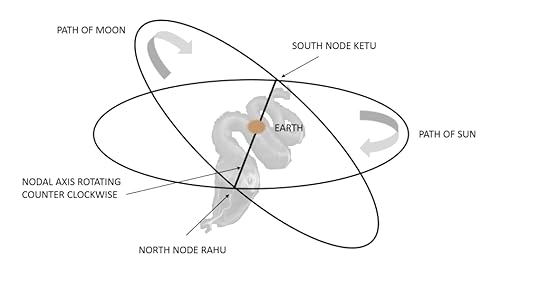 Image from https://mythandastrology.wordpress.com/2016/06/05/first-blog-post/
In the revised edition of his book, The Art and Practice of Ancient Hindu Astrology Part II, Braha reports that several Hindu astrologers wrote to him to correct his error in prediction which they claimed was off by one month. He should have used the mean node rather than the true node, they cautioned, because gold rose dramatically in February rather than January of 2016. Braha took their advice, gave up his longstanding practice of using the true lunar nodes, and ever since has been using the mean lunar nodes.
 RAHU sculpture from British Museum.
He is a severed head of an asura who swallows the sun. thereby causing eclipses. Rahu is depicted in art as a the head of a serpent which has been severed from its body. Indian astrology regards Rahu as a shadow planet which is associated with materialism, insatiable worldly desires, and obsession.
The lunar nodes are the two points where the Moon’s orbit crosses the Earth’s orbital plane (the ecliptic). The North Node (RAHU) where it crosses from south to north, and the South Node (KETU) where it crosses from north to south. The difference between true and mean nodes comes down to calculation methods: the mean node assumes an averaged, smoothed-out orbit that moves steadily backward through the zodiac at a rate of about 19° per year, representing an idealized theoretical position, while the true node calculates the actual real-time position accounting for all the wobbles and irregularities in the Moon’s orbit caused by the Sun’s gravity, resulting in a more erratic movement pattern. Though they’re usually within 1-2 degrees of each other, in astrology some people prefer the mean node for its imagined consistency and symbolic “average” meaning, while others prefer the true node because it reflects the actual astronomical position. My experience is that stationary true lunar nodes in a solar return almost always signal a dramatically memorable and eventful year.
My preference is to use the true lunar nodes, so I decided to check the claim of the Indian astrologers who “corrected” Braha’s mistaken ways. It turns out that James Braha was correct in his initial assessment of the true lunar nodes, and the Indian astrologers who cautioned him were mistaken. Here is the evidence: I looked up the price of gold in January and February of 2016 and the dates on which the true and mean lunar nodes entered Leo. Here it is in spreadsheet form:

The price of gold at the beginning of January 2016, at the close of the day January 4th, which begins the official listing, was $1082.25. True Rahu (north lunar node) entered Leo on January 10, 2016 and the price of gold began to rise steadily, so that by the end of January 2016, it was 2.75% above baseline. In other words, somone who followed Braha’s advice and invested money in gold at the beginning of January would have realized a 2.75% gain by the end of the month as the price of gold rose slowly but steadily to $1111.80.
The mean north lunar node (mean Rahu) entered Leo on 30 January 2016, and gold continued to rise throughout February but at a faster pace with Jupiter and the true and mean north nodes of the Moon all in Leo. An investor would have been better off following Braha’s advice to invest in gold at the beginning of Janurary rather than at the end of January. Clearly, the ingress of true Rahu into Leo on January 10th had initiatiated the steady rise in the price of gold, which was further enhanced by the entrance of the mean north lunar node into Leo on January 30th.
November 9, 2025
Sahl’s Fifteenth Aphorism: Planets in the Last Degree of a Sign
On page 79 of Ben Dykes’s translation of the works of Sahl B. Bishr Volume I, Sahl explains that the strength of a planet is diffused over 3 zodiacal degrees: the degree the planet occupies, and the degrees that immediately precede and follow it. Thus, if a planet is in the very last or 30th degree of a sign, its strength is diffused over the last two degrees of the sign it occupies and the very first degree of the following sign. To quote Dykes’s translation, such a planet “is in the position of a man putting his foot on the threshold of [his] door, and on the verge of departing: so if the house falls, it will not harm him.“
[See the Addendum at the end of this post, which is partially repeated here:
Sahl gives each planet an “orb” (sphere of influence) of 3° and a half-orb (moiety, radius of the sphere of influence) of 1.5°.
When planet A gets within 3° of planet B, Sahl considers the two planets, to be within orb of each other:
A — 1.5° —> — 1.5° —>]
In the English language, the phrase “foot on the threshold” is a metaphor for being on the verge of a significant change or transition, at a moment just before making a major decision, or at a crossing point between two different states or phases of life. Because planets are not dots, but have angular diameter, there is a period, as a planet is moving from one sign to the next, during which the body of the planet occupies both signs simultaneously. Since reading this passage in Sahl, I’ve been interested in the charts of persons who have a planet in the 30th degree of the sign. One such chart was that of actor Jeremy Renner whose natal Pluto occupies the final degree of Virgo.
In this post, I’d like to look at the chart of Governor Gretchen Whitmer who has natal Venus at 29 Leo 14′ very closely conjunct the fixed star Regulus (of the nature of Jupiter and Mars) at 29 Leo 26′. The Sun at 0 Virgo 15′ in her chart also conjoins Regulus (“the little king”), which is a “royal” star that traditionally indicates leadership, recognition, nobility, authority, high rank, success, honors, and victory over adversaries.
According to Sahl’s aphorism, the Sun’s strength diffuses over the 30th degree of Leo (where Venus and Regulus lie), and over the 1st and 2nd degrees of Virgo. The Sun in the 1st degree of Virgo applies to trine the MC, which occupies the 5th degree of Capricorn. Overall, this is a favorable configuration for a position of authority and leadership in government.
Because Regulus is of the nature of benefic Jupiter and malefic Mars, there is a martial side to its influence. Robson notes that Venus conjunct Regulus is found in the charts of people who suffer “many disappointments, unexpected happenings, violent attachments, and trouble through love affairs.” The Sun conjunct Regulus and mutually applying to square 10th-ruler Saturn suggests that such problems may be connected to her holding government office. In fact, in October of 2020, the FBI announced the arrest of 13 men suspected of plotting to kidnap Governor Whitmer of Michigan and using violence to overthrow the state government.
 From https://www.astro.com/astro-databank/Whitmer,_Gretchen
Source Notes: Sy Scholfield provided birth report, “New Father,” Lansing State Journal (Michigan), 24 August 1971, p. 4, Rodden Rating ‘A’
This chart uses Ptolemy’s formula for the Part of Fortune, which lies in Taurus in the 1st house and is disposited byVenus conjunct Regulus in Leo.
At age 47 Gretchen Whitmer was elected governor of Michigan on November 6, 2018. She campaigned on the promise to improve Michigan’s “fundamentals” (schools, roads, water system), which is fitting for the cluster of planets early in the 6th house of service trine the MC. In addition, Mercury, which occupies Virgo in the 6th and is dispositor of the Sun and the 10th-ruler Saturn, is applying to the MC by trine within an orb of about half a degree.
At age 47, Whitmer was in a 12th sign profection year, making Pisces the profected Ascendant and Jupiter Lord of the Year. Jupiter occupies the 8th Placidus house and rules the 9th Placidus cusp.
She was born on a Moon day during a Mercury hour, making her Lord of the Orb at age 47 the Sun, which applies trine the MC and closely conjoins Mercury, Regulus, and Venus — setting the stage for career advancement.
Interestingly, Whitmer’s firdaria period at this time is Sun/Jupiter, which runs from October 2017 until March 2019.
Let’s look at her birthplace solar return at age 47.
 Gretchen Whitmer Birthplace Solar Return at age 47
Here is the Solar Return with the natal planets superimposed outside the wheel:
 Age 47 Solar Return with natal chart outside the wheel.
The Solar Return (SR) Asc in the 28th degree of Leo is conjunct the natal stellium of Venus-Regulus-Sun- Mercury, with Venus ruling the SR Midheaven. Her natal Saturn occupies the SR 10th house. Her natal MC is conjunct the SR Saturn. The Sun is Lord of the Orb at age 47 and rules the SR Asc this year.
The true lunar nodes are stationary in her solar return of 2018, marking the SR year as highly significant and often characterized by an event that the querent will never forget.
Let’s see if there is a significant primary direction around this time. These are her zodiacal Placidus primary directions, without latitude and with the latitude of the signnificator, timed with the Naibod Key for the year before and the year of her election as governor in November of 2018.

The most significant directions involve the Angles (Asc, MC) and the time-lords (Jupiter as Lord of the Year and firdaria sublord, Sun as Lord of the Orb and firdaria lord).
The Asc is directed to the trine of Mars in March of 2017. There are no other directions of the Asc up to the time of her election. Mars rules the natal Asc, is dispositor of the time-lord Jupiter, and rules the natal MC by exaltation. Whitmer is also in her Mars period in Ptolemy’s Seven Ages of Man.
The MC Lord Saturn is directed conversely (classical converse) to the trine of Jupiter (Lord of the SR year beginning in August of 2018) in late October of 2017, about a year before the election. There are no other primary directions involving time-lord Jupiter up to the time of the election.
In August of 2018 Mars, ruler of the 10th by exaltation, is directed by classical converse direction to the trine of the Sun, Lord of the Orb and principal lord of the firdaria period at the time of the election.
The final primary direction active before November 6, 2018, is the Prenatal Syzygy directed to the sextile of Mercury, which is dispositor of Saturn and the Sun, and is closely trine the natal MC.
We can check other types of direction for confirmation. A useful technique is the Ascendant-arc direction. There is only one Asc-arc direction in the months between Whitmer’s birthday in 2018 and the end of the year: time-lord Jupiter trine MC-lord Saturn.

If you are unfamiliar with Asc-arcs, they are quite similar to solar arc directions. The difference is that the arc (angular distance) between the natal Ascendant and the secondary progressed Ascendant is calculated and then this arc is added to every planet and point in the natal chart to “direct” them forward. When these directed planets or points make significant aspects to the natal chart, they are believed to indicate key life events related to the symbolism of the planets or points involved in the context of the Ascendant (the self, identity, life course, personal motivations, etc.).
The Asc-arc is simply the progressed Ascendant minus natal Ascendant, and it is added to each natal planet and point. Any planet or point, not just the Sun as in solar-arc directions, can be used as the basis of an “arc” direction. The most commonly used arc is the solar arc, which uses the Sun’s progressed position, but the Ascendant-arc allows for predictions that reflect themes connected to the self, identity, lfie course, and personal motivations.
Addendum (13 Nov 2025):
It may be that Sahl understood the available ancient Greek texts to mean that the influence of the planet extended only throughout the 3 zodiacal degrees centered on the planet itself (+/- 1.5° orb, a total of 3°) as opposed to the 3 degrees extending out from the planet in all directions (+/- 3° orb, a total of 6°) which is more consistent with my understanding of ancient Hellenistic astrology. Although I am not expert in Hellenistic astrology, from my reading of translations of Hellenistic texts, it seems that early Hellenistic astrologers treated degree-based planetary aspects as occurring within a three-degree limit, effectively using a 3° orb for applying aspects (even though sign-based relations were fundamental).
Consider planet A applying to planet B.
Sahl gives each planet an “orb” (sphere of influence) of 3° and a half-orb (moiety, radius of the sphere of influence) of 1.5°.
Thus, when planet A gets within 3° of planet B, Sahl considers the two planets, A and B, to be ‘within orb’ (the sum of the two moieties or radii of the individual spheres of influence) of each other:
A — 1.5° —> B — 1.5° —>
Is Sahl correct in his understanding of the ancient Hellenistic texts?
November 5, 2025
Which Primary Directions are Most Significant?
Astrologers who use primary directions are aware of the existence of their many variations. The origin of the primary direction technique probably dates back to the legendary Nechepso and Petosiris who advocated beginning an astrological consultation with the determination of the estimated length of life of the native. To quote Ptolemy (2nd century CE) regarding the likely number of “years of life” of the native :
“The consideration of the length of life takes the leading place among inquiries about events following birth, for, as the ancient says, it is ridiculous to attach particular predictions to one who, by the constitution of the years of his life, will never attain at all to the time of the predicted events.”
In an article in the journal Greek, Roman, and Byzantine Studies 52 (2012) 587–602, Martin Gansten reviews two 1st century BCE horoscopes used by Balbillus to illustrate the “Method concerning the length of life from starter and destroyer.” Here is a modern rough approximation in the tropical zodiac of the chart L-71 (from O. Neugebauer and H. B. Van Hoesen, Greek Horoscopes, 1987, page 77). The chart is dated 21 Jan 0072 BCE around the latitude of Alexandria, Egypt.

 Chart L-71 by Babillius. This is a rough computer approximation of the original L-1 chart, cast here in the tropical zodiac with whole-sign places. To estimate the longevity of this native, Balbillus calculated the arc from Saturn to Mars, presumably using the ascensional times of the zodiac signs, and converted that the number of degrees in that arc to length of life. The text by Balbillus does not state the length of life which he calculated, but we can estimate it from the data he provided.
In the modern approximation chart, Mars lies in 6 Aquarius and Saturn in 0 Capricorn. The ecliptic arc between them is about 36 degrees. By the method of rising times of zodiac signs this arc corresponds to a lifespan of about 42 years (assuming 1 equatorial degree = 1 year), as we shall see further along in this article.
In the original Balbillus chart, Mars lies in 14 Aquarius and Saturn in 4 Capricorn. The ecliptic arc between them is about 40 degrees. By the method of rising times of zodiac signs, this arc corresponds to a lifespan of about 47 years, which is likely very close to the result obtained by Balbillus.
 This is a schematic of chart L-71 by Balbillus from Martin Gansten’s 2012 article. Note that the Lot of Fortune is not included, even though classical astrologers did include Fortuna among their candidates for hyleg (starter, releaser).
 This is the equivalent figure from Neugebauer and van Hoesen, 1987, p. 77. The letter ‘H’ at the top of the chart refers to the Horoskopos or Ascendant degree in Gemini. The letter ‘M’ on the right side of the circle represents the Midheaven degree, which lies in Pisces. The tics around the circle are the boundaries of the zodiac signs.
The arc from 0 Aries to Mars is an error on the part of Neugebauer and van Hoesen, who did not realize that the text contains a copyist error: the Greek word for Aries (Κριοῦ) resembles the Greek word for Saturn (Κρόνου) and a copyist must have mistakenly copied (Κρόνου: Saturn) as (Κριοῦ: Aries), throwing Neugebauer and van Hoesen into a state of confusion. In fact, Balbillus directed Saturn to Mars and calculated the arc from Saturn (the starter or hyleg) to the anaereta Mars to estimate the length of life.
This ancient length of life method consisted of identifying the “hyleg” or “starter,” that is, the life-giving planet or point in the natal chart. Then, to determine the length of life the astrologer measured the arc between the hyleg and the life-negating planet (anaereta), which was often a traditional malefic (Mars or Saturn), and converted this arc to years of life. Gansten points out in his article that the prognostic method of aphesis (ἄφεσις), meaning “sending out, or release,” is based on the apparent diurnal rotation of the celestial sphere (the primary motion of the sky in which planets appear to rise in the east, culminate at the Midheaven, set in the west, and anti-culminate at the IC).
Various astrologers had their own rules for determining which point or planet qualifies to act as hyleg or starter. Commonly, the Luminaries (Sun, Moon), the Angles (especially the eastern horizon), the Lot of Fortune, and sometimes the ruler of the prenatal lunation was utilized as hyleg which was then “directed” to the life-negating point or planet. In addition to these classical choices for hyleg, Balbillus and Ptolemy allowed the non-luminary planets (Mercury, Venus, Mars, Jupiter, Saturn) to function as starter or hyleg in charts in which the usual suspects (Luminary, Angle, Lot of Fortune, dispositor of prenatal lunation) do not qualify as “starters” and the non-lumiary planet “has greater claim” in the chart. Gansten explains that in this chart “Saturn has greater claim” means that it has “a position of dominion relative to the most important points in a nativity.”
Balbillus felt that none of the classical choices met the criteria for hyleg in this chart (L-71). Therefore, like Ptolemy a century after him, Balbillus sought the dominant planet in the chart and concluded that Saturn should play the role of “starter” in this chart. Why Saturn? Because Saturn lies in its own domicile (the highest essential dignity) Capricorn, occupies the angular 7th house, is co-present with the sect-Light Sun in Capricorn in a diurnal chart, is a diurnal planet in a day chart and rises before the Sun, is in whole-sign trine with benefic Jupiter and in whole-sign sextile with benefic Venus, and is the day-ruler of the airy triplicity so it rules the Gemini Ascendant by triplicity.
Having chosen Saturn as the “starter” planet (hyleg), Balbillus then locates the most destructive planet (anaereta), which happens to be Mars, the malefic of the nocturnal sect in a day chart. Mars is also square the Moon which is the Luminary of the Night. Mars in Aquarius has no essential dignity (is peregrine) and occupies the sign of detriment of the daytime luminary Sun, a symbol of vitality.
Balbillus’ next step is to direct the starter planet Saturn to the destructive planet Mars by imagining that the natal chart (an the entire zodiac circle) is rotating clockwise like the observable sky, carrying the position of life-negating Mars to that of life-giving Saturn. When the two positions align, the arc between Saturn and Mars can be converted to years of life (1 degree = 1 year of life) to estimate the longevity of the native. Gansten comments on p.600 of his article:
“The precise method employed by Balbillus for computing this arc of direction is unknown to us. It was perhaps most likely a simple calculation of rising times, although it is not inconceivable that Balbillus’ mathematical procedures, like his method of selecting the starter, were akin to those employed by Ptolemy.”
The earliest method to compute arcs of direction for points or planets intermediate between the horizon and meridian was that of rising times of the zodiac signs. At a given latitude on Earth, each sign rises in a certain amount of time, measured in Right Ascension along the Equator. For example, in this computer-generated approximation of the Balbillus chart, the rising times are:
 For example, here the rising time of Cancer is 34.90 degrees of R.A. on the Equator, which means that an arc of 34.90 degrees of Right Ascension on the Equator will cross the native’s meridian as the entire sign Cancer rises across the eastern horizon.
Ptolemy criticized the use of rising times to calculate the length of the arc of directions of points or planets at positions intermediate between the horizon and meridian as scientifically invalid because ascensional times only apply to the rising of zodiac signs and not to the movement of signs located at other places in the chart. Ptolemy’s preferred method was that of proportional semi-arc. In other words, for points intermediate between the horizon and merdian, Ptolemy noted that such points allign in their diurnal travel around the chart when they occupy positions that are in the same direction and positon along their own diurnal semi-arc with respect to both the horizon and meridian.
Both methods (simple rising times and proportional semi-arc) persisted through to the Middle Ages, but Ptolemy’s astronomically accurate method became dominant as astrologers became more adept at mathematics and scientific astronomy Nonetheless, the calculation of arcs determined by proportional semi-arc was rather complex and intimidating to some astrologers. The 10th century astrologer Alcabitius gave a detailed description of Ptolemy’s 2nd century method of proportional semi-arc in his nfluential Introduction to the Art of Judgments of the Stars. The late Robert Zoller included Alcabitius’ explanation of Ptolemy’s method in his lessons on medieval astrology.
The general consensus among astrologers was that directions of the Midheaven (meridian) were measured in Right Ascension, and directions of the Ascendant (eastern horizon) were to be measured in Oblique Ascension or Rising Times of the zodiac signs.
In ancient times there were two methods for directing planets or points intermediate between the horizon and meridian axes. The more primitive and scientifically invalid method was to use the rising times of signs whereever they appeared in the horoscope wheel, regardless of whether or not the sign was actually rising. The more astronomically correct method, documented by Claudius Ptolemy, was the method of proportional semi-arc, which became the standard of practice until the 15th century CE.
In 11th century Spain, al-Jayani, an Islamic mathematician and scholar known for writing the first treatise on spherical trigonometry, proposed a different but scientifically valid method for directing planets or points located at positions intermediate between the horizon and meridian. Al-Jayanni drew a great circle through the body of a planet and the North and South points of the horizon. This “circle of position” (a kind of pseudo-horizon of that planet) was imagined to represent the planet on the Celestial Sphere. Then, any planet or point carried by primary motion to intersect this “circle of position” was regarded as forming a direction with the planet whose body defined the particular circle of position. The length of the arc between the circle of position of a planet and the body or aspect of another planet that would intersect the circle of position was considered a direction which could be straightforwardly calculated using spherical trigonometry.
In the 15th century, Regiomontanus popularized al-Jayanni’s “circle of position” method, which became the standard of practice for Morinus in France and William Lilly in England. In the 17th century Placidus became a champion of Ptolemy’s method of proportional semi-arc, and the popularity of the writings of Placidus in England established Ptolemy’s method of directing by proportional semi-arc as the standard of practice among British astrologers from the 18th century onwards. Aware that many astrologers had difficulty calculating intermediate directions with the proportional semi-arc because of its reliance on hour-lines which were not great circles, Placidus suggested as an alternative the method of Placidian “directions under the pole” which was similar to the al-Jayanni “circle of position” method but used proportional semi-arc along the equator as an approximation to the original method of Ptolemy. Unfortunately, the British inventors of modern astrology misunderstood Placidus and thought he was describing Ptolemy’s original method, which was decidedly not the method of Placidian directions under the pole.
Let’s look at these three methods in the modern approximation of the Balbillus chart L-71. We want to know when the primary motion of the sky will carry Mars at 6 Aquarius 21′ to Saturn at 0 Capricorn 27′, that is, when will Saturn be directed to Mars? To work with rising times (making the false assumption that signs rise at a uniform rate), we can ask when will the opposition of Mars at 6 Leo 21′ be carried by primary motion to the opposition of Saturn at 0 Cancer 27′.
We can roughly estimate the age as follows:
The rising time of Cancer is 34.9 degrees. The opp. of Saturn lies at 00 Cancer 27′. Mars must travel 29.55 degrees from the end of Capricorn to reach Saturn. 29.55/30 = 0.985 x 34.9 = 34.38 years.
The rising time of Leo is 36.34 degrees. The opp. of Mars lies at 6 Leo 21′, so Mars must travel 6.35 degrees through Leo to enter Capricorn. 6.35/30 = 0.21 x 36.34 = 7.69 years.
The sum or 34.38 + 7.69 = 42 years of life, as measured by the method of rising times, allowing one degree of R.A. for each year of life.
Using Janus 6 software to calculate the primary direction of Saturn to Mars, the result for Ptolemy’s method of proportional semi-arc at Ptolemy’s rate of one degree of R.A. for each year of life is 41d 49′ 28″ = 41.82 years of life. (At the Naibod rate, this becomes 42.43 years.)
Using Janus 6 software to calculate the primary direction of Saturn to Mars, the result for the al-Jayanni/Regiomontanus method of circles of position at Ptolemy’s rate of one degree of R.A. for each year of life is 42d 05′ 29″ = 42.09 years of life. (At the Naibod rate, this becomes 42.7 years.)
In this modern version of the chart all three methods for calculating the timing of the direction of Saturn to Mars give a result very close to 42 years as the length of life. In other cases, the results of such “intermediate” directios can differ by a year or more. Sometimes the method of Placidus is a better fit for events related to the direction, and sometimes the Regiomontanus method gives more accurate timing. M.J. Makransky in the December 1995 issue of American Astrology commented on his decades of work with primary directions of planets intermediate between the Angles of the chart: “I don’t believe that there is a valid method of directing planets to one another, no matter how appealing that idea might seem. The only valid primary directions are those to angles.“
William Lilly makes a similar, but not as extreme, statement in Christian Astrology, Book III, p.508: “verily a Nativity cannot well be rectified but by Accidents belonging to the one or both those Angles” [the Asc and MC]. Clearly, Lilly found that directions of the native’s horizon and meridian to be the most reliable and useful in rectifying a birth chart.
October 29, 2025
William Frankland’s Predictive Techniques: A Case Study
According to his Birth Certificate, actor and musician Jeremy Lee Renner was born in Modesto, California, at 11:06 AM on 7 January 1971. Early in 2023 he was in the national news because of a near-fatal accident in which he was run over by his snow plow on 1 January 2023 at his residence in a rural area of Nevada. Renner’s 14,000-pound PistenBully snow groomer ran him over when he tried to stop it from rolling toward his nephew. Given this dramatic and serious accident, I thought it would be interesting to see how William Frankland’s predictive techniques work in Renner’s AA rated birth chart.
In Frankland’s technique, Renner’s Primary Birth Number (the sum of all the birth digits): 7 January 1971 = 7 + 1 + 1 + 9 + 7 + 1 = 26, which reduces further to 2 + 6 = 8.
His Additional Birth Number (sum of his primary number added to the year of birth, then totaling the digits and further reducing): 26 + 1971 = 1997 = 1 + 9 + 9 + 7 = 26 (secondary), which reduces to 8. Then, 26 (primary) + 26 (secondary) + 8 (reduced secondary) = 60 (additional birth number, corresponding to 60 years old. He will turn 60 years old in January of 2031, which should be a highly significant period for him, that is, the period roughly from 7 Jan 2030 to 7 Jan 2032. Frankland considered the active period to be centered on the birthday date, plus or minus about 6 months to a year.
Other significant ages by combinations of birth numbers are 26 + 26 = 52 years old, and 26 + 8 = 34 years old. We can check what happened in the roughly year-long periods surrounding those birth dates.
Jeremy Renner was 34 years old in 2005 and turned 36 in January of 2006. He was awarded Best Actor at the 11th Annual Palm Beach International Film Festival on 28 April 2006 for his role in the film Neo Ned, which was released on 22 April 2005 when Renner was 34 years old.
Renner turned 52 years old on 7 January 2023. His near-fatal snow plow accident occurred on 1 January 2023, just 6 days before his birthday. He was airlifted to the hospital where he was treated for multiple fractured ribs and other bones, a collapsed lung, a broken cheekbone and eye socket, a pierced liver, and substantial blood loss. During his hospitalization, he was in critical condition, spent time in intensive care, and underwent two surgeries. Here is his birth chart:
 Born on a Jupiter day during a Mercury hour.
Hyleg = the Sun.
Contrary to sect malefic = Mars in Scorpio in the 8th Placidus house.

 Jeremy Renner Birth Chart with Egyptian Terms
Frankland began with a careful study of the natal chart. Several features stand out:
Aries (ruled by Mars in Scorpio in the 8th house ruled by Mars) rises, and the Asc-degree occupies the term (bound) of Jupiter in Scorpio in the 8th house. Mars in domicile is the only natal planet that possesses essential dignity in this chart. All other planets are peregrine.
Mars also rules Capricorn on the 10th cusp by exaltation. Asc-ruler Mars in Scorpio in the 8th sextiles the Sun in Capricorn in the 10th and opposes 10th-ruler Saturn in Taurus in the 2nd. Mars clearly dominates this chart and has a major influence on the character, temperament, body, health, physical well-being, career, actions, and undertakings of this individual. Typically, Mars is associated with action, energy, drive, initiative, leadership, courage, competitiveness, athleticism, independence, and assertiveness. With dominant Mars in its domicile Scorpio, the native is likely to be strategic, intense, deeply passionate, psychologically perceptive, highly focused and determined in achieving his goals.
Frankland was one of the first British astrologers to pay attention to midpoints. Having understood the importance of Mars in this chart, he would have noticed that Mars lies in close aspect to the Jupiter/Saturn midpoint (at 20 Aquarius 19′) and the MC/Uranus midpoint (at 22 Scorpio 46′). Here Saturn rules the 12th cusp and Jupiter rules Pisces which lies in the 12th house. In Frankland’s technique for measuring age along the zodiac from 0 Aries, 22 degrees of fixed signs corresponds to age 52.
Of concern is the fact the Mars occupies and rules the 8th house (risk of mortal danger) and also conjoins and disposits Jupiter, the 12th ruler which signifies confinement, hospitalization, undoing, etc. In addition, Morin de Villefranche noted that the ruler of the 1st house in the 8th indicates that the native may, through his own actions, voluntarily or inadvertently expose himself to mortal danger, sometimes resulting in a premature death (or near-death experience). Pluto is also about to station Rx in the sign Virgo.
Consonant with Mars ruling and occupying the 8th and conjunct 12-ruler Jupiter is the placement of Pluto conjunct the 7th cusp (profoundly transformative relationships) opposing the Asc-degree (the native’s bodily health) and Chiron (wounds) in a T-square formation with stationary Mercury, which rules Virgo in the 6th house of bodily ailments. The 6th house is also the derived 12th house from the 7th.
The 8th house Mars-Jupiter conjunction opposes Saturn and also squares the lunar nodes, forming another T-square within this chart.
William Frankland popularized the Point of Life as an imaginary point that starts at 0° Aries and progresses through the zodiac at a rate of one sign for every seven years of life (or approximately 4 2/7 degrees per year), forming aspects with planets, points, and midpoints in the birth chart. This technique was based on Alan Leo’s study of the orbit of Uranus.
Frankland would have noticed these configurations and wondered when they would be likely to manifest in the life of this native. Using Alan Leo‘s scheme that each sign represents 7 years of life, beginning at 0 Aries as the start of life, Frankland might make noticed the following about this native:
Virgo covers ages 35 up to 42. With Pluto SRx at the end of Virgo, the period around age 41 may be highly transformative with regard to 1st personal and 7th house relationship issues. Libra covers ages 42 up to 49, and Uranus will oppose its natal position around age 42, indicating signficant changes or disruptions in close partnerships, marriage, or intimate relationships in his early to mid-40s. In the 90-degree midpoint sort, Pluto occupies 14 degrees 41′ of fixed signs, which corresponds to around 44.7 years old.
Scorpio covers ages 49 up to 56. This appears to be a troublesome period with potential danger to health because the 8th cusp lies at 13 Scorpio (roughly age 52), the opposition of Saturn lies at about 16 Scorpio (roughly age 52 1/2), the planet Mars lies in 20 Scorpio (roughly age 53 1/2), 12th-ruler Jupiter is at about 29 Scorpio (around age 55), and the 8th ruler Mars /12th ruler Jupiter midpoint at around 24.6 Scorpio at the “bendings” in square to the lunar nodes which occupy the 12th and 6th houses (roughly age 54.7) .
In addition, the sinister square of Mars, in 20 Aquaries, approaches the MC by primary motion and will cross the midheaven around age 52 by primary direction. All-in-all the early 50s, especially around age 52, are of concern. Here is a list of his primary directions for this period (Placidus method, without latitude, Naibod Key):
 Active Primary Directions during the period surrounding the New Years Day 2003 Accident.
The square of Mars had risen to the meridian by primary motion, and the semi-square of Chiron was carried to the meridian by primary motion shortly after the accident.
(Arcs to the MC are measured in Right Ascension.)
From the biography of Jeremy Renner, we find that he married and divorced in 2014 when he was 43 years old. His marriage took place on 13 January 2014, and his wife filed for divorce on 30 December 2014. Frankland paid attention to planetary cycles and would have been aware that during this period Uranus transiting the 1st house was opposing natal Uranus in the 7th house, and transiting Neptune was squaring its natal position. The next chart shows his natal chart with the solar return of 2014, near the date of his marriage, superimposed.
 Natal chart with 2014 (age 43) Solar Return at Birthplace superimposed.
He married on 13 January 2014, and his wife filed for divorce on 30 December 2014.
Transiting Mars conjoins natal Uranus in the 7th, which is opposed by transiting Moon and transiting Uranus in the 1st. Transiting Pluto squares natal Uranus in the 7th.
Transiting Saturn in the 8th conjoins natal Asc-ruler Mars.
The true lunar nodes of the solar return are stationary, which indicates a memorable and significant year.
Another interesting feature of this chart is the presence of Pluto at 29 Virgo 41′, almost in 0 Libra, affecting 7th house issues around ages 42 – 44 as we saw above. Sahl in his Fifty Aphorisms states the idea that the strength of a planet is diffused over 3 zodiacal degrees: the degree the planet occupies, and the one before and after it. In this chart, according to Sahl, the strength of Pluto would be spread over the last two degrees of Virgo and the first degree of Libra, thus simultaneously influencing the 7th sign from the Ascendant (marriage, partnerships, lawsuits, etc.) and the derived 12th from the 7th, that is, the sign representing the dissolution of close relationships.
—————————————–
Addendum (10 November 2025):
With regard to Renner’s natal Pluto, I noticed that on 21 September 2025 a partial solar eclipse occurred at 29 Virgo 05′ in the 6th house conjunct the 7th cusp, directly on Pluto in Renner’s birth chart. Recently (early November 2025) the actor has been in the news because of a dispute with his Chinese business partner, the filmmaker Yi Zhou — a scandal replete with 12th and 7th house symbolism.
According to a November 8th (2025) article at yahoo.com: “Jeremy Renner has denied allegations from filmmaker Yi Zhou, who accused him of sending explicit photos and threatening to call immigration on her after their alleged brief romance. Zhou claimed the actor later denied their relationship and refused to promote their joint project. His attorney has since called her claims “fabricated” and retaliatory. Jeremy Renner has now hit his accuser with a cease and desist letter, claiming she was the one who pursued him for a romantic relationship.”
“According to TMZ, in a copy of a cease and desist letter sent out by the actor’s lawyer, Marty Singer, Renner claims Zhou came on to him during their first meeting in July after he agreed to take part in her documentary, ‘Chronicles of Disney.’ The actor then admitted that he and Zhou had a “brief consensual encounter,” however, when they met again in August, he turned down her alleged sexual advances, opting to keep things professional by putting her in his guest bedroom. Renner went on to claim that this didn’t stop Zhou from being flirtatious with him, noting that after their August collaboration, she sent him a myriad of NSFW texts demanding he sleep with her. Renner is accusing Zhou of threatening to ‘harm him publicly’ if he doesn’t agree to promote her Disney documentary, and ‘make it falsely appear’ like they were once a couple.”
William Frankland, studying the Point of Life in Renner’s chart, would have correctly anticipated that the period around age 54.7 (September of 2025) would be characterized by prominent 7th and 12th house issues.
It is also interesting that as the scandal is making news headlines the method of “distributions,” with the Sun as hyleg and timed at the rate of the true solar arc, indicates that the divisor (distributor) is Jupiter ruling Pisces in the 12th and occupying the 8th, and the partner (participant) is Saturn which rules the 12th.
 Distributions of the Sun as hyleg in Jeremy Renner’s birth chart.
Timed by true solar arc, the current divisor (Nov. 2025) is Jupiter and Jupiter’s partner is Saturn.
Timed at the rate of one degree per year, the current (Nov. 2025) Jupiter’s partner would be the Moon which opposes Neptune in the 8th.
October 23, 2025
Part of Fortune: to reverse or not to reverse?
Recently, Wade Caves gave an excellent presentation for the Skyscript Member Group about the Part of Fortune in which he discussed the history of this “lot” and whether its inventor intended the longitudes of the Sun and the Moon to be reversed when calculating it, according to the sect of the chart, that is, during the day (Asc + Moon – Sun) vs. during the night (Asc + Sun – Moon). According to documented history, this has been a point of controversey since at least the 1st century CE. Links to Wade’s video and article are:
Read the article: https://www.skyscript.co.uk/fortuna.html
Watch the recording: https://www.youtube.com/watch?v=OEjwYV0jj_c&t=269s
A discussion area has also been set up in the Skyscript forum for anyone who’d like to comment at: https://www.skyscript.co.uk/forums/viewtopic.php?p=133786
The fundamental formula of the Part (Lot) of Fortune by day is: Asc + Moon – Sun, which means that you measure the arc along the ecliptic, starting from the Sun and ending at the Moon, and then in a day chart you project that Sun-to-Moon arc from the Ascendant to arrive a point called the Part of Fortune. In essense, if you were to place the Sun on the Ascendant degree, the Part of Fortune would then fall on the Moon, which is to say that the angle from the Sun to the Moon is the same as the angle from the Asc to the Part of Fortune (Sun ==> Moon equals Asc ==> Fortuna) or, put another way, the Sun is to the Asc as the Moon is to the Part of Fortune. In fact, in Tetrabiblos Book III, Chapter 10 (in some editions III.11), Ptolemy describes the Part of Fortune (Lot of Fortune/τύχη) as functioning like “the horoskopos of the Moon” — essentially treating it as if it were the Moon’s own ascendant.
Wade’s basic argument is that Ptolemy’s understanding is indeed the basic definition of the Part of Fortune, and therefore no reversal by night of the longitudes of the Lights is indicated. The Lot of Fortune at all times, by day or by night, functions like the horoskopos [Ascendant] of the Moon. William Lilly agreed with Ptolemy and used only the “day formula” in his own practice of astrology. Wade points out that the texts of ancient astrologers who reverse the formula in night charts “are missing a compelling rationale as to why we are adding and subtracting longitudes between luminaries and the ascendant.”
How is it then that some early Hellenistic astrologers reversed the formula of the Part of Fortune in night charts? One possibility is that they misunderstood the original definition which may date back to the legendary writings of Nechepso and Pitosoris, no longer extant. Another possibility is that two distinct traditions developed regarding the Lot of Fortune, one that used only the day formula and another that varied the formula based on the sect of the chart.
Evidence reveals that the controversy goes back to at least the first century CE. Wade cites chart No.81 from the book Greek Horoscopes (Neugebauer and van Hoesen). This chart is recorded on P. Lond. 130, a papyrus from the Greek Papyri in the British Museum collection. The author of this papyrus is unknown, but it dates back to the year 81 CE — a century earlier than Vettius Valens or Claudius Ptolemy. Given the content and educated literary style of the text on this papyrus, it is possible that the astrologer was familiar with the work of the first century scholar and astrologer Balbillus the Wise, high priest at the Temple of Hermes in Alexandria.
In this nocturnal chart the Part of Fortune is calculated to lie in Sagittarius, and the author adds superciliously that only an ignorant astrologer would place Fortuna in Libra (the result obtained with the “night formula’). This anonymous astrologer sounds arrogant but well educated, and is rather disdainful of more poorly informed astrologers who follow the mistaken tradition of reversing the formula in night charts. In the following century Ptolemy commented that the only way to calculate the Part of Fortune was his way: take the arc from, the Sun to the Moon and project it from the eastern horizon (Asc + Moon – Sun). Ptolemy also criticized the earlier method of timing circumambulations by ascensional times around the zodiac wheel was overly simplistic, uninformed and scientifcally invalid. Here is a modern approximation of chart No.81:
 This is a nocturnal chart (Sun below the horizon). The arc from the Sun to the Moon (moving forward in the zodiac) is the same as the arc from the Asc to the Part of Fortune. If we reverse the formula, the arc from the Moon to the Sun moves backward in the zodiac, and if profected from the Asc degrees takes us to the Part of Spirit (aka the “nightime” Part of Fortune.)
Note the symmetry around the horizon of the Part of Fortune and the Part of Spirit (the nighttime Part of Fortune in this chart). The reversal of the Sun and Moon in the daytime Part of Fortune formula gives as a result the position of the Part of Spirit or Daimon. The midpoint of Spirit and Fortune is always the horizon. It may be that a tradition existed which emphasized the importance of symmetry in astrology and therefore posited a day and a night Part of Fortune based on the sect of the chart. We see such symmetry in the Thema Mundi, which is a foundational concept for much of Hellenistic astrology.
Consider the following rough approximation of the famous Thema Mundi chart for the creation of the world:
 This is a night chart with the Sun below the horizon at the moment of creation. By the daytime formula the Part of Fortune when our universe began was in Gemini in the 12th house — not an especially fortunate position for material well-being. If we calculate this Lot using the nighttime formula, the nocturnal Part of Fortune (aka Part of Daimon or Spirit by day, labeled Sp) conjoins the life-giving Sun in Leo in the 2nd, where it receives the sextile of Venus from Libra and the trine of Jupiter from Sagittarius — an extremely favorable position for material assets and prosperity.
Astrologers impressed with Euclidean mathematics and the symmetry of the Thema Mundi could reasonably argue in favor of the “nighttime formula” for the Part of Fortune as a good symbol of material good fortune at the very beginning of the universe. A more spiritually-minded astrologer, like Vetius Vallens, might prefer splitting the Part of Fortune into Fortuna and Spirit, whereas a natural scientist, like Ptolemy, might prefer a single formula that can be used to determine length of life more easily.
October 22, 2025
A Useful Astronomical Site and a Troubling Direction of the Sun to Mars
The US Naval Observatory Astronomical Applications Department has a website that calculates rise, set, and transit times for the Sun, Moon, planets and bright stars for the period 1800 to 2050. The link to this site is https://aa.usno.navy.mil/data/mrst
The site gives the following preamble: “The output table also includes azimuth at rise and set, as well as altitude at transit. The altitude and azimuth values are for the center of the apparent disk of the object. The altitude values include the effect of atmospheric refraction when the object is above the horizon . The azimuth values are computed with respect to true north (not magnetic). The user can specify the height of the observer, which can range from the surface of the Earth to a maximum of 10,999 m (the top of the troposphere). It is assumed that the observer’s horizon is flat (i.e., no geometric ‘dip’ is applied) and unobstructed. This data service incorporates a model that determines the angular refraction by numerically integrating a ray passing through a simple polytropic atmosphere.”
“Rise and set times are tabulated to a precision of one minute only (i.e., no seconds are tabulated). This is because the observed times of rise and set are affected by random changes in local atmospheric conditions and other local variables which cannot be accurately modeled.” This last comment is interesting for those who believe that astrology was based on observation. It is essentially saying that determining the precise actual time of sunrise or sunset is beyond the scope of our astrological software because random changes in the local atmospheric conditions and other local variables cannot be accurately taken into account by the programs that we use. In other words, there is a kind of “uncertainty principle” regarding timing based on any astrological technique that requires an accurate time of sunrise or sunset at a particular location.
To show the usefulness of this site for astrologers, let’s look at an example. This chart belongs to a man who has recently experienced his Saturn return. It is cast in the tropical zodiac with Placidus houses, geocentric coordinates and true lunar nodes. It is a diurnal chart with the Sun above the horizon. The native was born on a Jupiter day during a Mercury hour, the 5th hour of the day as can be seen by the location of the Sun in the half of the 10th house closer to the 11th cusp where the 4th hour of the day ends.


If Claudius Ptolemy were reading this native’s chart, he would have begun his analysis by estimating the native’s longevity. First, he would determine the “life-giving” planet, which in this case is the Sun. It is a diurnal chart and the Sun is powerful in the angular 10th house which forms a whole-sign sextile to the Capricorn Ascendant.
Next, Ptolemy would identify the planet most inimical to life in this chart. Here, the most harmful planet would be Mars, the “lesser malefic” which belongs to the nocturnal sect and is particularly unfortunate in a diurnal chart. Mars is also peregrine (without essential dignity), conjunct the 12th cusp (undoing) and conjunct Jupiter (the ruler of the 12th in the 12th). In addition, the “greater malefic” Saturn, which is also peregrine (without essential dignity), has recently stationed Rx, and is mutually applying to square Mars.
Both Mars and Jupiter are disposited by Jupiter, which rules and occupies the 12th house; and both are in square aspect to the planet Saturn. In fact, with the Moon in partile opposition to Mars, this chart features a powerful T-square of the Moon on the cusp of the 6th house (illness) opposing Mars and Jupiter on the cusp of the 12th house and square to Saturn Rx in Pisces in the 2nd house. According to Morinus, planets in the 2nd house “accidentally” signify the matters of the opposite 8th house (mortal dangers). Here, Saturn in 18 Pisces in the 2nd casts its opposition into 18 Virgo in the 8th, which is ruled by Mercury and occupies the term of 12th ruler Jupiter.
Ptolemy would next ask when the life-giving Sun would meet with life-negating Mars via primary motion (the turning of the sky from east to west after birth). In other words, Mars at birth lies near the cusp of the 12th house, so Ptolemy would want to know when Mars as it rises from the Asc to the MC will be at a position in its daily motion equivalent to where the Sun is in this chart, that is, in the 10th house several degrees away from the cusp of the 11th.
This is where the US Naval Observatory site comes in handy. If we enter the date and location of the native’s birth, we can calculate the following data for the Sun and Mars:
 Data for the Sun
Sunrise Nov 9th: 6:42
Sun’s Culmination Nov 9th: 11:53
Sun’s Semi-arc: 5:12 = 312 clock-minutes = 78 years at ~ 4 min per degree = 1 degree RA = 1 year of life
For Mars:
 Data for Mars
Mars-rise Nov 9th: 9:02
Mars’ Culmination Nov 9th: 13:47
Mars’ Semi-arc: 4:45 = 285 clock-minutes
[Note: Initially, I made some slight errors reading the above. I have corrected these in this update of the text. The results are essentially the same. Given that the times involved are correct only to the nearest minute on the clock, the final result of a date for the perfection of a primary direction will have an “orb” of a few months and cannot be expected to be exact.]
Given this data, Ptolemy would compute how far along their daily semi-arcs were the Sun and Mars when this native was born at 10:43 AM (apparently timed to the nearest minute on the clock).
The Sun rose at 6:42 AM (accurate to the nearest minute on the clock) and birth occurred at 10:43 AM, a difference of 241 minures on the clock, out of a total of 312 minutes in the Sun’s semi-arc: 241 / 312 = 0.7724, or 77.24% of the Sun’s travel from the Asc to the MC.
Mars rose at 9:02 AM and birth occurred at 10:43 AM, a difference of 101 minures on the clock, out of a total of 285 minutes in Mars’ semi-arc: 101 / 285 = 0.3543 or 35.43% of the Mars’ travel from the Asc to the MC.
 At birth, Mars has traveled about 35.43% of the way along its semi-arc from the Asc to the MC.
At birth, the Sun has traveled about 77% of the way along its semi-arc from the Asc to the MC.
Ptolemy would ask: when will Mars reach 77% of the way along its semi-arc so that it “aligns proportionately” with the position of the natal Sun with respect to the horizon and meridian?
The answer would be that about 119.13 minutes after birth the sky will carry Mars by primary motion to proportionately align with the birth postion of the Sun.
Ptolemy and his followers until the time of Naibod equated every 4 minutes to an equatorial degree, which they equated to a year of life. 119.13 divided by 4 = 29.78 years (around late August of 2025).
When will Mars be 77% of its way between the Asc and the MC on its diurnal semi-arc, which will place Mars in an equivalent position to where the Sun is at birth with respect to both the horizon and the meridian?
77% of the 285 minutes in the semi-arc of Mars equals 220.13 minutes after Mars-rise, which we must add to the time of Mars-rise so that Mars will arrive at an equivalent position with the natal Sun. BUT Mars had already moved 101 minutes from Mars-rise when the native was born, so 220.13 minutes minus 101 minutes = 119.13 minutes after birth.
Ptolemy converted this number of minutes to the native’s age by the simple formula one degree of timing on the Equator in RA equals one year of life. Here, Mars will be proportionately at the same position as the natal Sun when 119.13 minutes have passed after birth. Dividing 119.13 by 4 clock-minutes per year gives the result of 29.78 years old, or around 29 years 9.4 months of age.
Naibod used a different “key” for timing in which the average daily motion of the Sun equals on year of life. At the Naibold rate, natal Mars will align with the Sun at age 30.297 years, or around 30 years 3.6 months of age (around the end of January of 2026).
I find that the midpoint of the age indicated by the keys of Ptolemy and Naibod is often a good estimate of the timing of an event. In this case, 29.78 + 30.297 = 60.077, which gives an average (midpoint) of 30.04 years, or age 30 years and 14 days. Since this native was born on 9 November 1995, the primary direction of the Sun to Mars, measured by Ptolemy’s method of proportional semi-arc and timed by the midpoint of the Ptolemy and Naibod keys, would be expected to manifest about half a month after his birthday on 9 November 2025, that is, arround 23 November 2025. In reality, this young man died unexpectedly on Sunday 19 October 2025, within about a month of the predicted date. Because the recorded time of birth is specified only to the nearest minute on the clock, and the time of sunrise is also calculated to the nearest minute on the clock, these calculations may be off by up to two minutes, which implies an accuracy to within about 6 months (each clock-minute corresponding to about 3 months in timing).
Calculting this native’s directions by proportional seim-arc around ages 29-30 in Janus software, using the recorded birth time of 10:43 AM, we get the following results, shown with both Ptolemy’s and Naibod’s Key:

In the list of directions without latitude, Mars is carried to the position of the natal Sun on 26 Sep 2025 (Ptolemy Key) or on 4 March 2026 (Naibod Key), the midpoint of these dates being mid-December of 2025. This list was compiled using only the conjunction and the traditional aspects (sextile, square, trine, opposition), and it is apparent that 2025 is likely to be a highly stressful year, especially the period between September of 2025 when Mars aligns with the Sun by primary motion, according to Ptolemy, and March of 2026, when Mars aligns with the Sun by primary motion, according to Naibod. When the Sun was directed to the conjunction or hard aspect of Mars, medieval astrologers considered it a critical period, potentially indicating illness, danger, or even the risk of death, depending on other factors in the chart.
If we calculated the direction of the Sun to Mars with latitude (here Mars is below the ecliptic and has a latitude of 00 S 49′), then this direction with latitude, using Ptolemy’s Key, would perfect on 23 October 2025, which is very close to the event of 19 October 2025. With the Naibod key, it would perfect 01 April 2026.
Next is the Polar Chart of this native from NOVA Chartwheels, giving a view of the natal planets spread out around the Earth’s Equator from a point in outer space directly above the North Pole of the Earth’s axis. Wwe want to know how long it will take Mars (the anaereta) to move to the fixed position of the Sun (hyleg) as the sky appears to rotate from east to west after birth:
 In this view we are above the North Pole of the Earth looking down. The natal planets are spead out around the Equator. As the sky appears to rotate from east to west (primary motion), it will carry the position of natal Mars to the Sun’s birth position. Timing this direction with proportional semi-arc and the Ptolemy Key gives a result of roughly 30 years old when the direction perfects, that is, within a few months of his birthday of 9 November 2025.
Another way to look at this chart is through the ancient method of “circumambulation.” With the Sun as the “life-giver,” we would let primary motion carry the zodiac across the natal position of the Sun. Doing so, we would see that around age 29 – 30 years, the position of the harmful planet Mars in Sagittarius in the term (bound) of Venus, which also contains the 12th cusp (sorrow, misfortune, undoing), aligns with the Sun.

At the time of the unexpected passing of this man, his distributor (divisor) was Venus, which ruled the Venus bound of Sagittarius containing the natal 12th cusp, Mars, and the opposition aspect of the Moon — part of the powerful T-square linking Mars, Moon, Saturn, Jupiter and the significations of the 6th, 8th and 12th houses.
If we consider his Profections, at age 29 he is in a 6th sign from the Asc profection year with a Gemini Asc, ruled by Mercury. Gemini being the profected Ascendant activates the Moon on the 6th cusp in Gemini, with the Moon squaring Saturn and opposing Venus, Mars, Jupiter and the 12th house cusp — a very stressful T-square in the birth chart..
With Mercury as the hour lord at birth, the Lord of the Orb or Turn at age 29 becomes the Moon, which also activates the stressful T-square in his chart.
October 21, 2025
Primary Directions Course at Kepler College
In January of 2026 I will be teaching an introductory course about primary directions as part of the Medieval Astrology Certificate sequence. The focus will be on the conceptual understanding of primary directions and their use in the history of astrology.
If you are interested, the link to the Kepler store to register is at:
ML206: An Introduction to Primary Directions – Fall Term 2025.
The course is listed under the WINTER TERM 2026.
The textbook for this course will be Martin Gansten’s Primary Directions (2009), published by The Wessex Astrologer.
To give potential students an overview of the type of material that will be covered Callum Wilkinson of Kepler College invited me to discuss it in a recent video, which is at https://www.youtube.com/watch?v=efnOYVtXfEs.
October 10, 2025
The Birth Chart of Carl Gustav II Jung
The famous Swiss psychiatrist Carl Jung was born in Kesswil, Switzerland (47n36, 9e20) on 26 July 1875, in his own words “when the last rays of the setting sun lit the room.” The precise time of birth is uncertain but, if Carl’s words are accurate, he was born very close to sunset. According to astro.com, Jim Eshelman calculated that astronomically the last rays of the sun (without parallax) lit the room at about 7:41 PM LMT.
In 1775 Switzerland there was no unified “Swiss time.” Each town or city used its own local mean time (LMT) based on the sun’s position at that specific location. Birth times cited in Astro.com from various sources include 7:24 PM Bern Mean Time, 7:37 PM Thurgen, 7:24 PM near Zurich, 7:30 PM Bale, and so on. Local times could vary by several minutes in neighboring places.
Carl’s daughter Gret Baumann-Jung, a practitioner of astrology, reports her father’s birthtime as 19:32 LMT (7:32 pm LMT) and she published the chart she uses for her father in the book Jung on Astrology (2017). Her paper was delivered in German at the Psychological Club Zürich in October 1974. Unfortunately, there are varying birth times recorded for C. G. Jung, and it is not clear whether this is the chart Carl Jung used for himself, or whether this is his daughter’s best guess as to the actual chart. The inclusion of the asteroids near the western horizon suggests that this is Gret Baumann-Jung’s chart for her father rather than the one Jung used for himself because he died in 1961 and the four major asteroids (Ceres, Pallas, Juno, and Vesta) weren’t widely incorporated into astrological practice until the 1970s-1980s.
 Birth chart of Carl Jung (with Campanus houses) according to his daughter Gret Baumann-Jung, published in “Some Reflections on the Horoscope of C. G. Jung” Spring (1975), 35–55, and reproduced in the book Jung on Astrology (2017).
It is a MOON day during a SUN hour, the 12th and final hour of daytime.
Gret’s chart for her father, cast for 7:32 PM LMT, seems to fit the facts fairly well. The sun is just above the western horizon and about to set. A problem with this chart is that the Asc at 2 1/2 Aquarius means the MC lies at 29 Scorpio 56′, just 04′ of arc away from Sagittarius. If he were born a mere 15 seconds later on the clock, the MC would be in Sagittarius.
Which MC makes more sense symbolically? A Scorpio MC, ruled by Mars, fits Jung’s interest in depth psychology and ancient wisdom; however, a Sagittarius MC, ruled by Jupiter, is a good match for his international recognition as a teacher and author in search of knowledge and wisdom.
The final term (bound) of Scorpio belongs to Saturn which is Rx in its domicile Aquarius in the 1st house (the self). The first term (bound) of Sagittarius is ruled by Jupiter which is direct in Libra in the 8th house (ancient occult knowledge). Jupiter and Saturn form a mutually applying trine. Mars (ruler of Scorpio) is stationary direct and peregrine in Sagittarius in the 11th house from which it forms a harmonious sextile with both Jupiter and Saturn.
A case could be made for either MC, Scorpio or Sagittarius. I lean toward Sagittarius because Jupiter conjoins the fortunate fixed star Spica in Libra in the 8th house, which seems fitting for a revered psychoanalyst who explored the hidden depths of the psyche and left a lasting legacy for future students of analytic psychology.
We can use predictive techniques to help decide between a Scorpio and a Sagittarius MC. A significant 10th house event occurred when Jung was 25 years old. In his autobiography Jung writes: “On 10th December, 1900, I took up my post as assistant at the Burghölzli Mental Hospital, Zürich.” His age on that date was 25.37 years old.
At age 25 his Lord of the Year by profection of the Ascendant sign is Jupiter, ruler of Pisces, the 2nd sign from the Ascendant. The activatin of Jupiter by profection, with Sagittarius ruling the 10th sign, would make sense in a year of great professional advancement. The Lord of the Orb at age 25 is Saturn (natally the Sun is hour lord) which partners with the Lord of the Year, Jupiter. Saturn occupies the 1st house in its domicile Aquarius and rules the 12th house of hospital and mental health institutions. Saturn also trines the MC.
 Carl Jung’s Birth Chart with Placidus Houses, according to his daughter Gret.
In Morinus freeware, this is cast for 19:34:46 LMT.
The identical chart cast with Janus software has a birth time of 19:27:11 LMT, a difference of 00:07:35. (I don’t understand why this discrepancy exists.)
If we consider the directions (Placidus, zodiacal, without latitude, Naibod key) of the MC directed to Mars, Jupiter, and Saturn around December of 1900, in Janus software we find: Mars without latitude to the MC in October of 1898, the Sinister Sextile of Jupiter to the MC in June of 1901, and Dexter sextile of Saturn to the MC in Novermber of 1901, which means that the MC of Gret’s chart for her father is a bit too early in the zodiac and should probably be in the first degree of Sagittarius.
If we adjust the time of birth and recalculate the directions, we find in Janus software that on 10 December of 1900 Mars without latitude crosses the MC by primary motion with a birth time of 19:18:35 LMT; on that same date with a birth time of 19:29:06 LMT the Sinister Sextile of Jupiter reaches the MC by primary motion; and with a birth time of 19:30:49 LMT the Dexter sextile of Saturn arrives at the MC by primary motion on 10 December 1900.
If we look at the directions around the time of his passing (6 June 1961), with a birth time of 19:27:11 LMT In Janus software, the opposition of Mars comes the the Ascendant on 12 September 1961, about 3 months after the event. This implies that the original MC is too early in the zodiac and ought to be in early Sagittarius. If we adjust the birth time in Janus to 19:28:14 LMT, the directed opposition of Mars arrives at the Ascendant on 6 June 1961.
Isaac Starkman, who specialized in rectification, using techniques developed by Alexander Marr, tested many events from Jung’s life and concluded that he was born around 19:28:20 LMT, with the Ascendant at 2 Aqu 54′ and the MC at 0 Sag 11′. My own experimentation with rectifying Jung’s chart comes to a virturally identical conclusion. Here is the rectified chart.

Starkman’s Rectified Chart for Carl Jung:


I found that different software gave very slightly different results, probably because of the level of accuracy of their calculations. Sometimes the coordinates were slightly different. I didn’t use the precise coordinates of Jung’s birthplace, just the city. What was most compelling was that the “rectified” time from a group of events, using primary directions, produced a birthtime of 19:28:18 LMT (quite close to Starman’s 19:28:20 LMT. When I ran the Placidus primaries for 1961, it showed the opposition of Mars on the Ascendant on 1 June 1961, just 5 days from the date of Jung’s demise at age 85.
Using the 19:28:18 LMT chart, in the distributions (circumambulation) from his Sun (hyleg in this chart), timed with mean solar arc, at age 85 his divisor was Saturn, and in April of 1961 Saturn’s partner became Mars, which crossed the Dsc by primary motion on 1 June 1961, almost exactly on the date of Jung’s passing.

September 27, 2025
The New York Times as Yellow Journalism and Fake News
When it comes to covering topics in astrology, the New York Times resorts to fake news replete with sensationalism and silly exaggeration. The most recent example is a piece written by Aatish Bhatia, Francesca Paris and Rumsey Taylor and published on 7 September 2025. These authors, who appear to be totally ignorant of astrology, should be ashamed to pass themselves off as journalists. They ignore fact-checking and repeat nonsense that has been thoroughly debunked by scholars who actually know the history of horoscopic astrology dating back to Hipparchus and Claudius Ptolemy.
 Claudius Ptolemy
The title of the article by Bhatia, Paris and Taylor is “Your Zodiac Sign Is 2,000 Years Out of Date.” Unfortunately, these uninformed authors have not done their research and are unaware of the difference between a zodiac sign and a constellation in the zodiac band of stars in the heavens. In their confused state, they write: “Sept. 27 is in Libra because 2,000 years ago, this constellation was more or less behind the sun on that date.” What are they talking about? September 27th is a date, not a planet. They seem to mean that on Septermber 27th in the year 0025 CE (2000 years ago) the sun appeared to be in the constellation of stars called Libra. This is true, but constellations are not zodiac signs.
They correctly state “But this year [2025], the actual constellation behind the sun on Sept. 27 is Virgo, not Libra,” but they are totally unaware that constellations are not zodiac signs. How can they be so uninformed about such a basic tenet of astrology? Can we really expect the New York Times to be concerned about fact-checking which might interfere with their love of sensationalism?
Since these author don’t bother to fact-check what they write, let me briefly clarify matters for them. My hope is to to dispell their ignorance and fill in some gaps in their education.
A zodiac sign and a zodiac constellation are related but distinct concepts. Astrologers have been aware for a few thousand years that there are 13 constellations, including Ophiuchus, along the ecliptic circle.
Zodiac Constellations are star patterns in the sky that lie along the ecliptic (the path that the Sun appears to travel along throughout the year). There are 13 zodiac constellations that the Sun passes through, including the 12 traditional ones plus Ophiuchus. These are physical groupings of stars that form recognizable patterns when viewed from Earth.
Early astronomers (astrologers) devised a method to orient themselves in the heavens so that they could accurately track the movement of the stars and planets. Because the planets travel close to the ecliptic (the path of the Sun), they divided the ecliptic circle into twelve 30-degree segments, which they called “signs.” To facilitate communication, they gave the 12 equal 30-degree signs (mathematical divisions) names corresponding to the constellation of stars they most closely correlated with in the heavens some 2000 years ago.
Thus, there are the 12 equal divisions of the ecliptic (called “zodiac signs“) in astrology, each spanning exactly 30 degrees. The signs are named after constellations but in the tropical zodiac are based on a fixed calendar system (with the vernal equinox in the northern hemisphere as the start of the zodiac sign Aries). Astrologers in India prefer to start the zodiac at the beginning of the constellation Aries; this is the “sidereal” zodiac, but its signs are also exact 30-degree segments of the ecliptic circle and are not constellations.
 Description
Aristotelian cosmology, with astrological and zodiacal symbols. This Earth-centred (geocentric) worldview originated with the Ancient Greeks and dominated medieval Europe until the time of Copernicus (1543). The heavenly bodies circled the Earth attached to spheres. At centre are the four elements of Earth, Water, Air and Fire. Then there are successive spheres for the Moon, Mercury, Venus, the Sun, Mars, Jupiter and Saturn. The outer three spheres are: the Firmament (including the stars), the Crystalline Heaven, and the Primum Mobile. Beyond this is the Empyreal Heaven, the Abode of the Blessed. Published in Cosmographia (1524) by the German astronomer Petrus Apianus.
Note how the outer circles show the difference between the tropical and sidereal zodiacs, which was well-known to ancient Greek astrologers but is apparently unknown by the writers of the modern New York Times.
The constellations (star patterns) vary greatly in size, and the Sun spends varying amounts of time in each. In contrast, the zodiac signs are uniform 30-degree segments. Due to precession (Earth’s axial wobble), the zodiac signs have gradually shifted relative to the constellations over thousands of years, but the zodiac SIGNS, which are mathematical divisions of the 360-degree ecliptic circle, are not the same as the zodiac CONSTELLATIONS, which are patterns of stars that vary in size.
Astrology uses 12 SIGNS of exactly 30-degrees each while astronomy recognizes 13 star patterns called CONSTELLATIONS along the ecliptic. The “missing” constellation (star pattern) Ophiuchus sits between Scorpius and Sagittarius. Ophiuchus is NOT a zodiac SIGN because it is not one of the twelve exact 30-degree mathematical segments of the zodiac circle. Zodiac signs are exact 30-degree divisions of a circle, while zodiac constellations are the actual star patterns which the Sun appears to move through during the year. The zodiac signs are named after 12 of the 13 the zodiac constellations as they appeared about 2000 years ago.
I would ask authors Aatish Bhatia, Francesca Paris, and Rumsey Taylor to repeat after me, 100 times, “Zodiac signs are not constellations, even though they are named after constellations. Zodiac Signs are the twelve equal 30-degree segments of the ecliptic circle, whereas the zodiac constellations are the thirteen star groups that lie along the ecliptic circle. Signs are not constellations.”
To believe that zodiac signs are the same as zodiac constellations is simply an admissition of ignorance, but the New York Times seems to value sensationalism over truth and fact-checking. Their article is the epitome of yellow journalism.
Can you spot the difference between the next two images?

 Yellow Journalism at its Finest: The New York Times
Anthony Louis's Blog

- Anthony Louis's profile
- 29 followers

