Pat Sullivan's Blog
June 4, 2026
Short Review: Snap by Susin Nielsen
Have you ever reached the end of your tether and just wanted to let loose? You may have controlled yourself, but the three main characters of Susin Nielsen’s entertaining novel Snap did not. Frances, a children’s book author, Geraint, a garage mechanic, and Parker, a budding costume designer, each snapped, in uncharacteristic ways, when pushed to their limits. Charged with crimes, they found themselves diverted to an anger management class and community service. They would never have met each other in the normal course of their lives, but, forced to work together, they become friends.
Each character is under pressure. Frances’s husband of twenty-five years has left her and she acted out on the day of their wedding anniversary. Geraint’s misbehaviour towards his sleazy boss Ron stemmed from two levels of betrayal. We see Parker in an assault, which she apparently puts behind her, until we learn about its consequences later. They navigate serious issues like sexual harassment, parental custody battles, reputation damage, and coping with a spouse’s new gender preference, but Nielsen keeps the tone light. When a distraught Frances drives to her husband’s new home, knowing she shouldn’t, she begs the Google Maps voice (whom she has named Siobahn and confides in) not to judge her. “Recalculating,” Siobahn replies. Fortunately, Frances’s new friends are more sympathetic to her plight.
The novel is set in Vancouver. Frances has a comfortable house in Kitsilano, Geraint is reduced to a squalid hotel apartment in the West End, and Parker shares a tiny flat with her devoted boyfriend in the Sunrise neighbourhood. Nielsen moves her characters around the city, from Locarno Beach to the Vancouver Aquatic Centre to Shaughnessy to the Endowment Lands. A clandestine outing to Hope is proof of how loyal they have become to each other, as they band together to outwit a foe.
The novel switches point of view among the three leads, with Frances being the most developed. She never fails to notice how Geraint’s lips turn red as he dives into a bag of ketchup chips, and she struggles with her self-esteem under the critical eye of her daughter Daisy. Each character is pleasantly surprised when they are able to use some of the anger-coping techniques from their class to improve their lives. There may be a tiger in each of us, as the book’s cover suggests, but the three characters learn that it can be tamed with friendship and humour.


April 2, 2026
How I began In the Frame
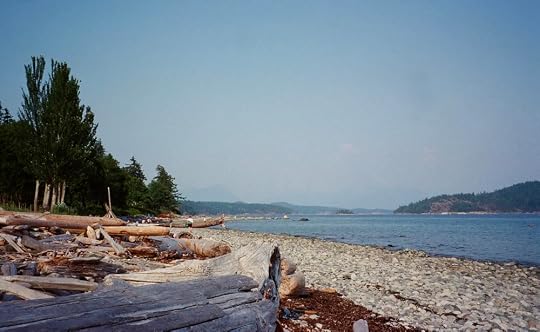
Beach at Hollyhock, Cortes Is., B.C. August 2009. Pat Sullivan
In August 2009, I attended a 4-day writing workshop at Hollyhock, a retreat centre on Cortes Island, BC. Unless you fly, it’s a trek to get there. I forget how I made my way to Horseshoe Bay, but after that I took the ferry to Nanaimo, then a mini-bus to Campbell River, then a water taxi on choppy Discovery Passage and Sutil Channel to Manson’s Landing on Cortes. A Hollyhock shuttle bus picked us up and brought us to the south end of the island. As the instructor said, nobody comes to Hollyhock unless they have something they need to get out. What did I need to say?
I had signed up for a workshop called Writing Start to Finish, my first such commitment to several days of writing. I thought I would work on a creative non-fiction piece about researching my family history. As I strolled along the beach before dinner that first night, I wondered if I would be able to produce enough to fill the time
At the introductions that evening, I bit my tongue as I listened to some of the others. Several people wanted to write their memoirs and treated this gathering as a chance to spew out unconnected details from their lives that were better left in their rough notes. I did not want to treat the workshop as a therapy session. As a longtime journal-keeper, I worked out my angst privately. I wanted to delve into craft and shape a readable piece.
Some participants brought laptops, but I used a 99-cent Hilroy exercise book that I’d bought at Safeway. In between its solid blue lines, there were dotted blue lines, to help children print upper and lower-case letters. I must have used a similar notebook 51 years earlier, when I was learning to print! Longhand was still my first choice: gripping a pen helped squeeze out the words more easily than tapping on keys.
On the first morning, the instructor asked us to write about a dramatic moment in our lives. When I read my piece on my father’s death aloud, I heard gasps from the listeners. But later when I read my work on my family history search, the content I thought I’d come to work on, it felt flat and I sensed boredom from the group. I was dismayed. I told the instructor that I felt my writing was too formal and reserved. She said that’s why she’d assigned the first exercise, to make us reach vulnerability and write from the heart.
I brooded on this as I strolled the beautiful grounds in between our sessions. On the rocky beach, I perched on a log and stared at the ocean. I ambled past the well-tended gardens that supplied the vegetables for our tasty meals and photographed the abundant flowers. I’d left steamy Vancouver for a paradise with fresh air and cooling breezes. No need to prepare meals or do chores. For a long time, I had vaguely thought of going to a beautiful place to write. Here I was! Now what?
We were supposed to write from 4 pm to 5 on that first day, but I lay on my bed in my room, not sure what to do. I no longer felt interested in my family history topic. I had long harboured a secret desire to write a satirical novel about a fictional public art gallery, my work milieu, but all I’d done was take notes. In my funk, I told myself, “I’m on vacation. I can do what I want! If not now, when?” I rose from my bed, as if pulled by the notebook on the desk, and sat down and wrote, “The wine ran out at 7 pm.” When it came time to go to supper, I didn’t want to stop.
The next day the writing flowed. For much of it I sat on the deck of the house, caressed by the balmy air as I wrote. I took breaks for a nature hike and a massage, but kept writing. When I sat on the beach after supper, fifteen eagles flew over me. Their magnificence made me appreciate why Indigenous people revered them. I was having such a good day that I could not help thinking their appearance meant an auspicious omen for me, too.
On our last evening, we each had to read for ten minutes and write comments on what we heard to give to each writer at the end. I was the only one who read fiction. Some of the memoirs were more interesting than I had expected, but I didn’t pay them much attention. I was so gratified by the reactions to my piece. One woman said, “You brought us into this whole world, the drinks, the gallery, the people, everything, and all without using a laptop.” She looked pityingly at my humble notebook. On the feedback sheet, a man wrote, “I can see myself lying on the beach in the sun reading your book. Really well put together—flows naturally, the dialogue and characters.” The instructor commended me: “What a shift. The fiction form suits you.”
My Hollyhock writing became The Opening, a novel I worked on for ten years until I did a re-think in 2019. By that time, I was long past the Hilroy notebook and able to compose on my laptop, but it still took six years of revisions until In the Frame appeared in 2025. I’ll always be grateful for those few days at Hollyhock. I may not have become as free as those magnificent eagles, but I found my voice.
January 31, 2026
Laughing while Canadian
In my first blog, about my inspiration for writing In the Frame, I mentioned two satirical books I’ve loved for years: Small World, by David Lodge, and The Hound in the Left-Hand Corner, by Giles Waterfield. Two British writers. What about Canadians? After all, we award an annual Leacock Medal for Humour, in memory of Steven Leacock. I have a vague recollection of enjoying his Sunshine Sketches of a Small Town when I was an adolescent, but I think they qualify more as gentle studies of human nature than barbed satire.
The Canadian writer who made me laugh out loud the most was Mordecai Richler, first with The Apprenticeship of Duddy Kravitz, much later with Barney’s Version. I received that novel for Christmas 1997 and I fear that my work might have suffered in early January, because reading it in bed kept me awake until 3 am for several nights. My laughter shook off any drowsiness and I’d keep going. In his rambling memoir, Barney snipes at everything from Canadian small literary publishing houses to Hollywood television executives. Only his beloved Montreal Canadiens seem to escape his scorn: he left his own second wedding reception at the Ritz to ask the bartender about the score of a playoff game. (I’m reading Ken Dryden’s The Game now, which offers some insight as to why this team inspired such strong devotion.) Richler’s skewering of the Montreal he knew so well won the Giller Prize in 1997 and the Leacock Medal in 1998.
One way that I’ve learned about many contemporary writers is through my submission process for In the Frame. Several publishers request that you compare your submission to a book that they have already published, to help them gauge if your work is a good fit. That sent me scanning their websites, reading the brief descriptions of novels, trying to quickly assess what I could compare to In the Frame. The writer who most reminded me of Richler is Michael Tregebov. His novel Shot Rock, from the recently closed Vancouver publisher New Star Books, follows a group of Winnipeg men trying to save their curling rink. The thin plot is enlivened by well-drawn characters and raunchy dialogue. I can confidently say that it has one of the funniest scenes in Canadian literature concerning a line from God Save the Queen. I’ll leave it to you to discover it.
The literary world itself is the target of several Canadian writers. Russell Smith, in Muriella Pent, makes fun of everyone in the Toronto cultural world—writers, book clubs, university students, and arts councils. For a clever parody of a guide to creative writing, see Sam Shelstad’s The Cobra and the Key. Through the voice of an unreliable narrator who thinks his unsuccessful book makes him a writing mentor, this over-the-top novel provokes some wry smiles of recognition. A much more gentle poke at literary illusions can be found in Molly of the Moll: Literary Lass and Purveyor of Fine Footwear, by Heidi L. M. Jacobs. This whimsical novel won the Leacock Medal in 2020. Molly is an English Literature student who works in a shoe store at the West Edmonton Mall, so enamoured of the writers she studies that she constantly asks herself what Miss Austen would do. I laughed out loud at the juxtapositions of Molly’s idealized hopes with her mundane reality.
Ian Ferguson and Will Ferguson took on the theatrical world in their debut mystery I Only Read Murder. It satirizes a has-been actress through many funny examples of her diva behaviour. Curtains for Roy, by Aaron Bushkowsky, follows two friends on a trip from Vancouver to Kelowna. The curtains of the title have a double meaning, referring both to the theatrical milieu in which they work and to the fact that Roy is very ill. But don’t let that put you off. It’s a hilarious story.
The academic world gets its satiric turn in Suzette Mayr’s 2017 novel Dr. Edith Vane and the Hares of Crawley Hall. It’s a convincing portrayal of the many contemporary pressures faced by a professor: a business-minded dean, precocious younger colleagues, whining grad students. Its humour is dark and ironic rather than laugh-out-loud.
The Quebec writer David Turgeon’s novel The Supreme Orchestra is described as an art world parody but it didn’t achieve that for me, as it’s also a spy story and those features dominated.
While the arts are always a rich source of humour, some writers find it in other aspects of contemporary life. Ali Bryan’s The Figgs was a finalist for the Leacock Medal. Both it and a later novel, Coq, are fast-paced comedies based on quirky family relationships. I wouldn’t call them satire, but their rapid-fire dialogue makes for entertaining reading.
The cruise ship industry comes under fire in Will Aitken’s The Swells. It has a promising premise but veers into dark irony and violence that I found too outlandish. Deborah Hemming’s Goddess is more successful in its parody of wellness influencers. No laugh-out-loud moments, but I did appreciate its sharp depiction of an almost cult-like world.
There are 65 books submitted for the 2026 Leacock Medal for Humour. In the Frame is number 21. Seeing as I’m up against writers like Margaret Atwood, Ian Ferguson and Will Ferguson, and Mark Critch, my hopes have dimmed, but I’m pleased to see that Canadian literary humour is flourishing.
January 2, 2026
Short Review: Cobalt by Charlie Angus
Charlie Angus is the former NDP MP for Timmins-James Bay and now an activist writer of The Resistance on Substack. His 2022 book Cobalt: Cradle of the Demon Metals, Birth of a Mining Superpower, is a must-read for anyone interested in Canadian history. In 260 fascinating pages, he focuses on the town of Cobalt, Ontario, chronicling its mining history from the start of the silver boom in 1903 to the present rush for strategic metals. By delving into the local, Angus reveals much about how extraction, railway-building, and greed propelled Canada’s 20th-century growth.
Although Cobalt’s silver rush ended in 1921, the town is newly relevant today because of the metal for which it is named. Cobalt has been mined since antiquity but is hard to locate, often extracted as a by-product. Medieval German miners called it ‘the demon metal.’ Tech companies now seek it out for use in rechargeable batteries, smartphones, laptops and electric vehicles. Angus says it is key to a green energy future.
Sustainable management was far from the thoughts of the mining companies that descended on the town in 1903 and created its boom. Angus writes clearly and passionately about the toll the mines took on the settlers, the Indigenous people, and the environment. The book also has intriguing chapters on how women fared in this gritty milieu and the class conflict as newly-formed unions fought for workers’ rights. There are also colourful accounts of Cobalt’s entertainment scene, provided by sports and vaudeville. The town once had eight theatres.
Angus writes with great empathy for the people who struggled to make a living in a harsh environment, against mine owners who did not want to give an inch. He sees Cobalt as the source of Canadian mining expertise that has spread internationally, but now comes full circle because of strategic minerals. He asks if we can learn from the past and create prosperity that benefits all, not just the corporations. The stories in this book will stay with me.
November 13, 2025
From Moby Dick to Big Blue
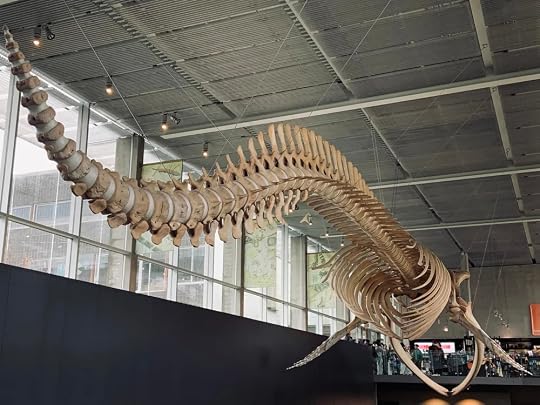
Skeleton of Big Blue, Beaty Biodiversity Museum, UBC, Vancouver. Pat Sullivan, 2025.
Why read Moby-Dick today? It was on my list for awhile, as Herman Melville and his epic novel are referred to so often in books on writing. But it never seemed urgent. There is so much to read! Who has time for a 726-page whale of a book (pun intended) with typical 19th-century long descriptions and convoluted language? And, other than agreeing that whales should not be held in captivity, I had no interest in them.
But a fluke (no pun intended) connection started me on my path from ‘someday’ to ‘now or never.’ Last summer, I randomly googled the name of an old friend with whom I’d lost touch, Andrea Kirkpatrick, and found a link to a book she had written: A Game of Chance: The Story of British North American South Seas Whaling. After contacting her through the publisher, Friesen Press, I read her historical narrative. She combed archives from Canada to Australia to provide a compelling tale of the whaling expeditions that set out from colonial New Brunswick and Nova Scotia. Among many other facts, I enjoyed learning about the camaraderie that existed on the high seas, as whaling ships met, the captains spoke to each other, and sometimes ‘gammed’—visited each others’ ships. No doubt the confinement of shipboard life and the dangers of the business motivated them to share stories and information. Her factual, well-researched account of the whaling industry offered just enough details of the human experience to intrigue me. I knew the time had come to grapple with Melville’s fictional version.
Grapple is the word. The thick copy I borrowed from the library was a leviathan of a book, to borrow Melville’s word, too cumbersome to read in bed at night. I committed to one hour a day, propping the tome on a cushion on my lap, to get through it. Six weeks later, I finished it.
‘Call me Ishmael’. Why is this opening sentence of Moby-Dick one of the most resonant of any novel? Its shortness is deceptive, as it leads us into a long and complex book. I think its power stems from what it leaves out, the greeting to the reader. Implied is ‘You may’: You may call me Ishmael. He speaks directly to us, inviting us to follow him on his adventure, from Nantucket to the Pacific Ocean aboard the whaling ship Pequod. Moby-Dick is not a casual read, but the fact that it is told in short chapters propelled me along.
It's a book that few people I spoke to had read, but everyone seemed to know that it is about the obsessed Captain Ahab and his search for the white sperm whale that had bitten off his lower leg. What I was not prepared for was how viscerally Melville describes life at sea and the chase when the lookout sights a whale. The men scramble into action, lowering small boats that are tossed about on the open ocean as they row madly towards their prey. After the harpooner strikes successfully, they battle with the wounded mammal as it thrashes, trying to escape. Processing begins with hauling up the carcass to the side of the ship, cutting off the blubber, rendering the valued oil in the brick furnace, and storing it in barrels. Then they cleaned up and began the watch for the next whale. Ishmael not only tells us what happened in straightforward immersive scenes but expounds on the physical characteristics of whales and the symbolism of the colour white. The language varies from colloquial American English to Biblical prophecy and Shakespearian soliloquies; I let many chapters wash over me, but I always regained my footing when the story returned to the Pequod.
Melville knew that whale stocks were diminishing by the 1850s, as ships had to travel farther in search of them. Kerosene, derived from the recently discovered petroleum, replaced whale oil as a lighting source. Yet whaling has continued into the 21st century, even though the International Whaling Commission adopted a moratorium on commercial whaling in 1982. The small boats of Melville’s era, lowering from the big ship to launch a chase, have given way to vessels from Greenpeace or Sea Shepherd Global that now confront rogue industrial whalers.
Perhaps you could say that in Melville’s era they had reached ‘peak whale.’ Almost two centuries after Moby-Dick appeared, we now are reaching ‘peak oil’, and trying, in fits and starts, to change to more sustainable energy sources. I couldn’t help comparing the gut-wrenching descriptions in Moby-Dick to what I’ve read about drilling for oil. Another job that takes place far away from the people who enjoy the comforts of the end product, it is also dangerous. The workers handle heavy machinery and harsh elements. Extraction of any type takes its toll on nature and on the human beings who do the dirty work it demands.
I picture Melville writing at night, by the light of a whale-oil lamp or candles made from sperm whales, penning the ocean of words that is Moby-Dick. He made Ishmael an omniscient narrator, with uncanny knowledge not just of history and philosophy, but also of his shipmates. Ishmael recounts conversations between the mates that he could not have heard, and dives into the dark innermost thoughts of the bedevilled Captain Ahab. Among the many themes of Moby-Dick is obsession and the power of nature, but I never felt it was didactic. Melville’s gripping descriptions inspired sympathy for the whale and the men inhabiting this remote yet human world.
Curiousity compelled my friend Andrea to write her book, as she studied two Easter Island artifacts in the museum where she worked and speculated on the New Brunswick whaler who had brought them back. Curiousity drove me to make my own expedition. Not as arduous as Ishmael’s, it meant riding the 99 bus to the UBC campus to visit the Beaty Biodiversity Museum. A skeleton of a blue whale, called Big Blue, hangs in their atrium. It left me speechless. As long as two buses, its heart would have been the size of a car! Although Moby-Dick describes the killing of sperm and right whales, which are smaller, they are still colossal. It must have been astounding, to a sailor on the Pequod, to see and then confront such huge creatures.
I now know more about whales than I ever thought I would, and I still know so little. But I have a new sympathy for these magnificent mammals, inspired by Moby-Dick and enhanced by seeing Big Blue. Not a bad legacy from a book I hadn’t intended to read.
October 6, 2025
How long did it take to write In the Frame?
By one count, I started in 1995, so 30 years. But that was just making some notes. I really started shaping a novel in 2009. It was called The Opening, and I brought it to the Vancouver Manuscript Intensive. I knew I had something, but I didn’t feel brave enough to show it to friends; I wanted a professional opinion. My mentor advised me to start over, to work more on character development, and develop a more dramatic story. So I did that in 2019 and by the fall had a version I showed to some trusted readers for feedback.
My first round of submissions to publishers had no result, but almost as soon as I sent it out I thought of a better way to open the novel. I revised it and sent it out again in May-June 2021. That’s when The Porcupine’s Quill, a traditional publisher, accepted it. I was thrilled! So, from March 2019 to May 2021, it took just over two years. But a lot of work went on before that, as I had to work through the more academic writing I’d done for years and learn how fiction works. A huge learning curve and of course I’m still on it.
Unfortunately, in October 2023, the publisher had to suspend operations and they cancelled my book. But the editor had started to work on it and she gave me her notes. From December to February, I revised In the Frame again and sent it to traditional publishers in March 2024. I had no takers by December, so began to investigate hybrid publishers. From my new conception in March 2019 to publication last August, it took 6.5 years.
August 29, 2025
Short Review: The Adversary by Michael Crummey
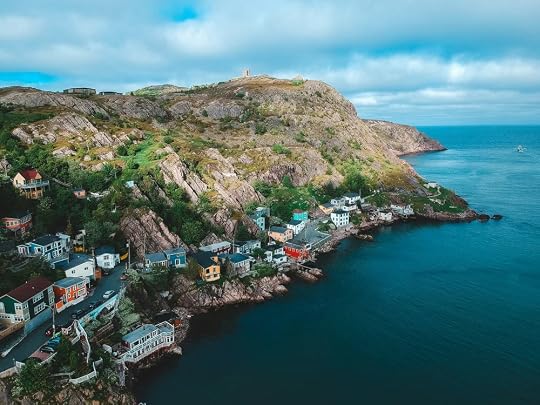
Newfoundland village. Photo by Erik McLean on Unsplash
I immediately felt immersed in The Adversary’s setting, Mockbeggar, a remote fishing village in late 18th-century Newfoundland. Michael Crummey has written the best kind of historical fiction, in which his extensive research does not overwhelm the reader with information, but fuses with his imagination to portray a rugged place and the people who live there. His convincing specificity shows why this gripping novel won the 2025 Dublin Literary Award.
The plot is dominated by the sibling rivalry of Abe Strapp and the Widow Caines. They run mercantile businesses that control the supplies used by the fishermen but also the price of the fish they fetch. Abe is a drunken lout who agrees to marry a young daughter of another merchant only to increase his wealth, but is thwarted in this by his sister. The consequences and long-simmering resentments between the two propel the grim plot to a violent climax.
The distinctly drawn characters and granular details of life held my interest. Even the wealthier residents of Mockbeggar are subject to forces beyond their control: a harsh, destructive storm, predatory marauders, and the edicts of the governor in faraway St. John’s. It’s a hardscrabble existence for most of the inhabitants, made worse by the ‘killing sicknesses’ that invade the village and overpower the limited skills of the two characters with any medical knowledge. Such references to a pandemic resonate with our time, of course, as does the harsh economic system, but those echoes never drew me out of the absorbing narrative.
Crummey acknowledges his use of The Dictionary of Newfoundland English and A Dictionary of the Vulgar Tongue, research tools that help enliven the characters’ speech. Phrases like ‘on six men’s shoulders’ easily conjure an image of a coffin being carried, a frequent event in the novel. The second book, dating from 1811, provides colourful phrases actually used by the people of the time. We will never hear their voices, but their speech comes to life through insults like ‘dishclout’ and ‘tripes and trullibubs.’
But it is Crummey’s imagination that provides this vivid description of the pack ice drifting along the coast: “pans rising and falling on the tide-swell like a flock of sheep rubbing tight in a paddock.” Archaic insults, regional slang, and contemporary language seamlessly ground us in a distinct time and place.
While gritty details paint a bleak existence, there is some dark humour. Crummey reminds us of Newfoundland’s status as British colony, and the class conflicts that go along with it, when he describes the St. Patrick’s Day celebrations. At the end of the day, the Irish workers sleep off their drunken carousing. The wily Abe Strapp had fostered that by offering credit to the men, encouraging them to leave their home brew and patronize the alehouses. The narrator offers a sardonic take on Abe’s greedy calculation, as the terms were expensive:
“He shifted to a discussion of how clever he’d been to think of offering credit for drink then, talking up the innovation as if it had never been undertaken in the history of the British Empire.”
Not content with exploiting the men in their working conditions, Abe abuses his power by taking advantage of them in their limited leisure time, too.
A touch of surreal dark humour comes from a pet crow that has somehow learned a few words and menacingly caws “Trouble, trouble, trouble” as the strong-willed characters careen from one conflict to another.
Newfoundland and Labrador is the one province I’ve never been to, in spite of long wanting to experience its rich culture and rugged beauty. Reading The Adversary reminded me of its beleaguered but intriguing history and made me want to visit even more. It’s the first novel I’ve read by Michael Crummey, but it won’t be the last.
August 22, 2025
Short Review: Birnam Wood by Eleanor Catton

New Zealand. Photo by Match Sumaya on Unsplash
I gobbled up Birnam Wood by Eleanor Catton. The novel is very much of the moment, throwing together eco-activists and rogue gardening, an American billionaire building a bolt-hole in New Zealand where he can outwait the apocalypse, and the search for rare earth minerals. A comparison with Jane Austen would not be my first thought, but Catton said on CBC Radio’s Writers and Company that she admired the British author for her focus on character-revealing dialogue rather than metaphors and similes. Birnam Wood demonstrates that homage to Austen: using a close third-person voice, Catton examines her themes through lively, believable debate and conversation, and empathetic interior monologues.
For a Canadian, there’s an extra edge. Catton was born here, but grew up in New Zealand. She’s not afraid to poke fun at the Kiwi self-image, as when a character thinks: “He was long accustomed to regarding his country as an automatic underdog, as a righteous, plucky, decent, and fundamentally good-natured contender, unfairly disadvantaged, in any instance of unflattering international comparison, by its small population, its short history, and its geographical remoteness from the great power centres of the world.” While the last phrase doesn’t fit us, I think many Canadians might find all the other descriptions chime with our self-perception. Catton notes that Kiwis often define themselves as being different from Aussies. At one time, that may have sounded familiar to any Anglo-Canadian trying to articulate what distinguishes us from our southern neighbour. However, the rise of Canadian patriotism in response to American tariffs has shown that similarities are superficial and differences are profound. The question of national identity is just one example of the many threads that Catton skilfully weaves into this compelling novel.
August 15, 2025
Short Review: You Dreamed of Empires by Álvaro Enrigue
Sculpture, Templo Mayor, Mexico City. Pat Sullivan, 2025
Enrigue vividly describes the 1519 encounter between Moctezuma, the emperor of Tenochtitlán (now Mexico City), and the Spanish conquistador Hernán Cortés. His use of words from Nahuatl, the language of the Mexica, threw me into the tension created by the meeting of two cultures. I can only imagine the patience demanded of Moctezuma and Cortés as they waited for their two translators (one working from Nahuatl to Maya, the other from Maya to Spanish) to relay the conversation. Although this is a short novel, I made frequent use of the helpful list of characters, until I became more familiar with the names.
He does not use quotation marks to delineate conversation, and sometimes characters’ points of view change within a chapter, but Enrigue’s colloquial and humorous style makes it easy to surrender to the tone of the novel. It's a very earthy book: one of the conquistadors tries to trim his toenails with a sword after the long march from the coast to the city. Whoever thought of the challenges of grooming before nail clippers? The imaginative use of such mundane facts is what I admire about good historical fiction.
Towards the end, the real world gives way to hallucinations and dreams. Cortés takes peyote with Moctezuma. They each dream of conquering the other. We know who won.
I visited Mexico City for the first time last March. I saw the ruins of the pre-conquest main temple and the powerful sculpture of the Aztecs and other Indigenous peoples in the stunning National Museum of Anthropology. I stayed in the same hotel where the dictator Porfirio Díaz ate in 1910 just before he learned of the revolution’s start. I saw Trotsky’s grave and Frida Kahlo’s painting studio. The dynamism of Mexico’s history impressed me, but you don’t have to go there to be drawn into You Dreamed of Empires. Enrigue’s lively prose, translated by Natasha Wimmer, will transport you.
June 20, 2025
How did I come up with the title In the Frame
I thought of it in an aquafit class, which proves that ideas can pop up at any time, if the seed is germinating away in your brain. My first title was The Opening, because an earlier version of the book centred on an opening reception at a public art gallery. But when I ditched that version in favour of my current plot, I knew I needed a new title.
In the Frame fits on several levels. Obviously, an art gallery is full of frames, so it evokes the setting. Some characters feel framed, in the sense of being blamed for something they didn’t do. And ‘in the frame’ also refers to being considered for a new job, which is the goal of one of the protagonists, Rachel. Cameras, which feature in the plot, are always framing the shot. So, even though this is a title that other authors have used, it suits my book perfectly.