
Ryu Zhong's Blog - Posts Tagged "prince-of-blue-flowers"
Ta-Guan, the Celestial Marten
Characters of Prince of Blue Flowers: Adventures of Takuan from Koto: Ta-Guan, the Celestial Marten.
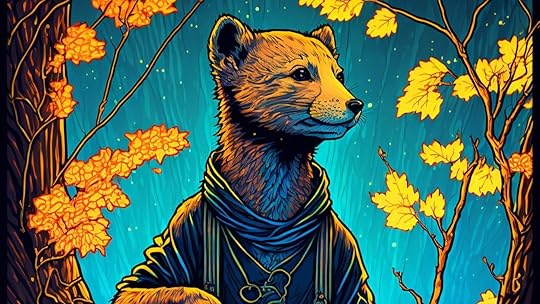
Ta-Guan isn’t a simple northern marten. She was born from a stone egg. A little later, she mastered the human language; and then she ended up in the Heavens.
In ‘Adventures of Takuan,’ the celestial marten is one of the main tricksters. She does not sit still; she is ambitious and cunning, although this cunning sometimes works against her.
If you want to know a little more about the celestial marten, you must visit Ta-Guan’s page on Makipedia, the encyclopedia of Anno Ruini.
Ta-Guan isn’t a simple northern marten. She was born from a stone egg. A little later, she mastered the human language; and then she ended up in the Heavens.
In ‘Adventures of Takuan,’ the celestial marten is one of the main tricksters. She does not sit still; she is ambitious and cunning, although this cunning sometimes works against her.
If you want to know a little more about the celestial marten, you must visit Ta-Guan’s page on Makipedia, the encyclopedia of Anno Ruini.


Xiwanmu, the Goddess of the West
Characters of Prince of Blue Flowers: Adventures of Takuan from Koto: Xiwanmu, the Goddess of the West.
The Most Beautiful and Eternally Wise Goddess of the West lives in the Heavens, but sometimes descends to the Middle Realm, where her temple and peach garden are located on the top of Mount Gunlun.
Xiwanmu is the first of the celestials that the reader meets. As befits a goddess, she is regal and majestic. Her golden hair floats in the wind, as do the garments that mask and show her beauty.
If you want to know a little more about the Goddess of the West, you must visit Xiwanmu’s page on Makipedia, the encyclopedia of Anno Ruini.

The Most Beautiful and Eternally Wise Goddess of the West lives in the Heavens, but sometimes descends to the Middle Realm, where her temple and peach garden are located on the top of Mount Gunlun.
Xiwanmu is the first of the celestials that the reader meets. As befits a goddess, she is regal and majestic. Her golden hair floats in the wind, as do the garments that mask and show her beauty.
If you want to know a little more about the Goddess of the West, you must visit Xiwanmu’s page on Makipedia, the encyclopedia of Anno Ruini.
Yanwang Umma-ö, the Ruler of the Under Realm
Characters of Prince of Blue Flowers: Adventures of Takuan from Koto: Yanwang Umma-ö, the Ruler of the Under Realm.
Yanwang Umma-ö appears before us as a stern ruler of the Under Realm and a hunter of weredemons. Yanwang’s brother, the Jade Emperor himself, instructed the ruler of the Under Realm to catch all the demons who annoyed both mere mortals and celestials.
The reader is introduced to Yanwang at the beginning of ‘Prince of Blue Flowers.’ This celestial, although distinguished by courage, remarkable strength, and his abilities in magic, is straightforward, angry, and even naive.
If you want to know a little more about the Ruler of the Under Realm, you must visit Yanwang’s page on Makipedia, the encyclopedia of Anno Ruini.

Yanwang Umma-ö appears before us as a stern ruler of the Under Realm and a hunter of weredemons. Yanwang’s brother, the Jade Emperor himself, instructed the ruler of the Under Realm to catch all the demons who annoyed both mere mortals and celestials.
The reader is introduced to Yanwang at the beginning of ‘Prince of Blue Flowers.’ This celestial, although distinguished by courage, remarkable strength, and his abilities in magic, is straightforward, angry, and even naive.
If you want to know a little more about the Ruler of the Under Realm, you must visit Yanwang’s page on Makipedia, the encyclopedia of Anno Ruini.
Sung Hatsukoi, the Protagonist
Characters of Prince of Blue Flowers: Adventures of Takuan from Koto: Sung Hatsukoi
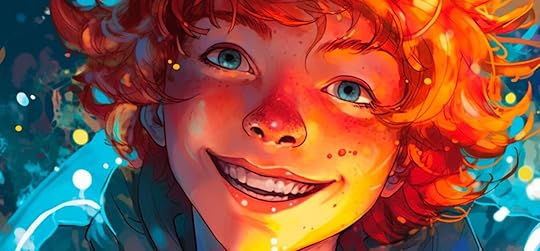
Hatsukoi is the protagonist of the ‘Prince of Blue Flowers’ and of the rest of the ‘Adventures of Takuan from Koto.’ The full story bears his monastic name which he got in the monastery on the Mount White.
Hatsukoi, like the celestial marten Ta-Guan, is a trickster. His monastic name – Takuan – he received for his tricks in honour of the heavenly trickster. But, unlike the marten, Takuan-Hatsukoi comprehends his destiny and applies his cunning to good deeds. This is how Hatsukoi first grows up, and then Takuan continues the path of becoming a whole person.
Story of Hatsukoi
Once upon a time, in the Sung family, an extraordinary child was born. He was given the name Hatsukoi which means ‘fruit of motherly love’.
Growing up, Hatsukoi can’t sit still. He plays tricks on his parents and other villagers and then goes wandering about. After a couple of pranks, he returns home, quite pleased with the results. But for some reason, his parents aren’t happy at all. They send him to a monastery. And in the monastery, he gets a new name – Takuan.
If you want to know what tricks Hatsukoi got sent to the monastery for, as well as what he did as Takuan, you have to listen to Prince of Blue Flowers: Adventures of Takuan from Koto.
Hatsukoi is the protagonist of the ‘Prince of Blue Flowers’ and of the rest of the ‘Adventures of Takuan from Koto.’ The full story bears his monastic name which he got in the monastery on the Mount White.
Hatsukoi, like the celestial marten Ta-Guan, is a trickster. His monastic name – Takuan – he received for his tricks in honour of the heavenly trickster. But, unlike the marten, Takuan-Hatsukoi comprehends his destiny and applies his cunning to good deeds. This is how Hatsukoi first grows up, and then Takuan continues the path of becoming a whole person.
Story of Hatsukoi
Once upon a time, in the Sung family, an extraordinary child was born. He was given the name Hatsukoi which means ‘fruit of motherly love’.
Growing up, Hatsukoi can’t sit still. He plays tricks on his parents and other villagers and then goes wandering about. After a couple of pranks, he returns home, quite pleased with the results. But for some reason, his parents aren’t happy at all. They send him to a monastery. And in the monastery, he gets a new name – Takuan.
If you want to know what tricks Hatsukoi got sent to the monastery for, as well as what he did as Takuan, you have to listen to Prince of Blue Flowers: Adventures of Takuan from Koto.
Takuan’s Journey to the West
‘The most fascinating element about this book for me is the style of writing. The writer has a smooth and unique style. It’s artistic but not complicated. It’s a special book away from modern life and its hustle. It has this ancient eastern theme and takes you to a very different place.’
— Hager Salem, Online Book Club
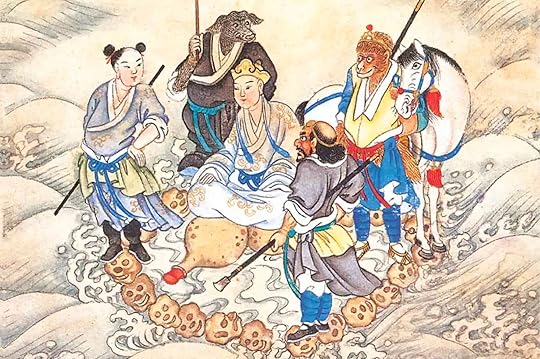
Recently, we released the second volume of ‘Takuan’s Adventures,’ which goes by the title ‘Hunters of Weredemons.’ In the book, it becomes apparent that ‘The Adventures’ have lots in common with one of the four classic Chinese novels. ‘Journey to the West’ is the title of that novel, and to the modern reader, it’s known as ‘Son Wukong, the Monkey King’ or simply ‘Monkey.’
The similarities (and differences) between ‘Takuan’s Adventures’ and ‘Journey to the West’ are no coincidence, and I’ll tell you why.
When I was working on the sci-fi novel series ‘Demons Within,’ its world needed a story. A history even. This often happens with fictional worlds: just having a set of random facts isn’t enough, not only for the author and readers but also for the characters themselves.
Every thinking person, sooner or later, thinks about the past: about their own as well as about the days gone by. What will my heroes look back on? Where will they get knowledge about the past of their world?
Historical Novel, History Textbook, or a Fairy Tale?
I didn’t want to write historical treatises and dictionary encyclopedias. Reading those isn’t the most exciting thing to do either. Especially for the younger heroes of ‘Demons Within.’ So, I decided to give the story a more entertaining form.
The dominant culture of the ‘Demons’ world arose from a fusion of Asian traditions: Indian, Chinese, and Japanese. In their past, these traditions faced the same challenge that I did – to preserve the history of the world, they needed a medium that could be easily and happily passed down through the ages. This medium is an epic novel.
Indian ‘Ramayana’ and ‘Mahabharata’; Japanese ‘Kojiki’ and ‘Kujiki,’ ‘Nihongi’ and ‘Kaidans’; Chinese classic novels ‘Journey to the West,’ ‘Romance of Three Kingdoms,’ ‘Water Margin,’ and ‘Dream of the Red Chamber’ — here are perhaps the most famous of them. There’s plenty to choose from!
I chose with no hesitation: most of all, stories I love to read (and write!) about tricksters, cunning and foolish at the same time. Sun Wukong from ‘Journey to the West’ is just that: he fools both gods and demons, but he falls for their tricks as well. ‘Journey’ takes place both in the mortal world and in the Heavens, and by following this canon, I’ll have enough space for all the necessary details for the world building.
If you want to know more about the style ‘Takuan’s Adventures’ are written in, you must listen to the story in my personal blog.
Hungry Spirits Yokai
Yōkai (妖怪, ‘strange apparition’) are a class of supernatural entities and spirits in Japanese folklore. In ‘Adventures of Takuan from Koto’, yokai are referenced in the books only once, in the context of demons ravaging the Earthen Realm during and after the Great Storm.
Yōkai in Japanese Folklore
Yōkai often have animal features (such as the kappa, depicted as appearing similar to a turtle, and the tengu, commonly depicted with wings), but may also appear humanoid in appearance, such as the kuchisake-onna. Some yōkai resemble inanimate objects (such as the tsukumogami), while others have no discernible shape.
Yōkai are typically described as having spiritual or supernatural abilities, with shapeshifting being the most common trait associated with them. Yōkai that shapeshift are known as bakemono (化け物) or obake (お化け).
Japanese folklorists and historians explain yōkai as personifications of ‘supernatural or unaccountable phenomena to their informants.’ In the Edo period, many artists, such as Toriyama Sekien, invented new yōkai by taking inspiration from folk tales or purely from their own imagination. Today, several such yōkai (such as the amikiri) are mistakenly thought to originate in more traditional folklore.
If you want to know more about different creatures and things of Anno Ruini Universe, you must visit the Anno Ruini Glossary.

They hunted people, caught them and ate them on the spot. Infants were their most delicious food. As soon as a baby was left unattended, disembodied yokai spirits appeared and dragged the child away.
To protect mortals, the Jade Emperor brought seeds of good luck that were given to people by monks of three hundred monasteries.
Yōkai in Japanese Folklore
Yōkai often have animal features (such as the kappa, depicted as appearing similar to a turtle, and the tengu, commonly depicted with wings), but may also appear humanoid in appearance, such as the kuchisake-onna. Some yōkai resemble inanimate objects (such as the tsukumogami), while others have no discernible shape.
Yōkai are typically described as having spiritual or supernatural abilities, with shapeshifting being the most common trait associated with them. Yōkai that shapeshift are known as bakemono (化け物) or obake (お化け).
Japanese folklorists and historians explain yōkai as personifications of ‘supernatural or unaccountable phenomena to their informants.’ In the Edo period, many artists, such as Toriyama Sekien, invented new yōkai by taking inspiration from folk tales or purely from their own imagination. Today, several such yōkai (such as the amikiri) are mistakenly thought to originate in more traditional folklore.
If you want to know more about different creatures and things of Anno Ruini Universe, you must visit the Anno Ruini Glossary.
Takuan from Koto
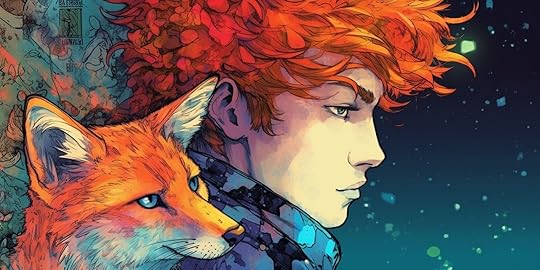
The runaway from the monastery, Takuan, appears before the reader as a teenager of around thirteen or fourteen years old, with red hair that he sometimes shaves off to pass himself off as a monk.
From a very young age, Takuan possessed cunning and restlessness, and during his time in the monastery, he learned how to use them for a good cause. Although this good cause was primarily for Takuan himself, only those who indulged in their vices – greed, anger, and ignorance – fell for his tricks.
If you want to find out about the adventures that befell Takuan, read the book called ‘Prince of Blue Flowers,’ and then its sequels: ‘Hunters of Weredemons’ and ‘Envoys of Celestials.’
And if you want to find a little more about Takuan himself, visit Takuan’s page on Makipedia.
From a very young age, Takuan possessed cunning and restlessness, and during his time in the monastery, he learned how to use them for a good cause. Although this good cause was primarily for Takuan himself, only those who indulged in their vices – greed, anger, and ignorance – fell for his tricks.
If you want to find out about the adventures that befell Takuan, read the book called ‘Prince of Blue Flowers,’ and then its sequels: ‘Hunters of Weredemons’ and ‘Envoys of Celestials.’
And if you want to find a little more about Takuan himself, visit Takuan’s page on Makipedia.
Seven Lucky Gods
In Chinayindu, the Seven Gods of Luck are revered above all others, even more so than the wise and beautiful Goddess of the West. It is thanks to the Gods of Fortune that people were freed from the domination of weredemons who took over the Middle Realm after the Storm.
The Lucky Gods bestowed upon the Jade Emperor three hundred bottomless bags containing magical seeds. The Emperor himself distributed these bags among three hundred mountain monasteries, instructing the monks to plant a Fortune seed for each of the inhabitants.
The Lucky Seeds were not powerful enough to drive the weredemons out of the Earthen Realm, but those who had such a seed under their protection were no longer easy prey for the demons.
If you want to know a little more about these gods, you must visit their page on Makipedia.

The Lucky Gods bestowed upon the Jade Emperor three hundred bottomless bags containing magical seeds. The Emperor himself distributed these bags among three hundred mountain monasteries, instructing the monks to plant a Fortune seed for each of the inhabitants.
The Lucky Seeds were not powerful enough to drive the weredemons out of the Earthen Realm, but those who had such a seed under their protection were no longer easy prey for the demons.
If you want to know a little more about these gods, you must visit their page on Makipedia.
Wang-Zhu Leizu, a Wandering Warrior
Wang Leizu, nicknamed ‘Zhu,’ which means ‘pig,’ catches Takuan's eye in the middle of ‘The Prince of Blue Flowers,’ but his story began long before the events described in the book.
A distinguishing feature of Wang-Zhu Leizu is his nose, which resembles a boar’s snout. Together with his completely bald head and pointed ear tips, the nose of the wandering warrior became the cause of his derogatory nickname.
This nose caused concern to its owner not only due to its appearance but also because, like many forest animals, it was the most sensitive and therefore the most painful spot for Leizu. If he was struck on the nose in the heat of another fight, he would become so furious that his eyes would be veiled in blood, and green smoke would emanate from his ears.
If you want to know a little more about Wang-Zhu Leizu, you must visit his page on the Makipedia.
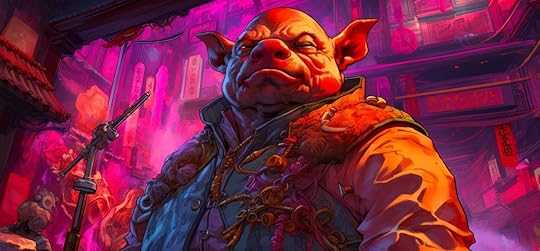
A distinguishing feature of Wang-Zhu Leizu is his nose, which resembles a boar’s snout. Together with his completely bald head and pointed ear tips, the nose of the wandering warrior became the cause of his derogatory nickname.
This nose caused concern to its owner not only due to its appearance but also because, like many forest animals, it was the most sensitive and therefore the most painful spot for Leizu. If he was struck on the nose in the heat of another fight, he would become so furious that his eyes would be veiled in blood, and green smoke would emanate from his ears.
If you want to know a little more about Wang-Zhu Leizu, you must visit his page on the Makipedia.


