Michelle Simkins's Blog
September 15, 2024
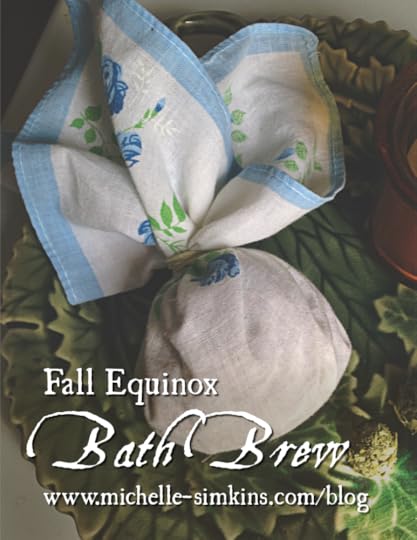
Fall Equinox Bath Brew
Fall equinox is a hinge day, a day when the year turns the corner and begin its descent into its dark half. From this day forward, the nights will lengthen, leading us into the otherworldy twilight of Samhain’ and the deep dark of winter solstice. As the darkness grows, spirits gather closer, and we feel called to turn within. It becomes easier to enter the Otherworld, where we learn secret truths about ourselves and the spirits. This is a beautiful, rewarding process, but at time it can be challenging or overwhelming, especially for the novice.
So I'd like to share with you three herbs which can help us both open our hearts in celebration of the season and prepare ourselves to do the introspective personal work we're called to do during the dark months. I've chosen herbs which are both easy to grow and easy to purchase on-line or in herb shops, and which are gentle enough to use for almost everyone.
Chamomile: We're all familiar with chamomile's reputation as a relaxation and sleep aid, but magically chamomile is much more than a gentle soother. Chamomile is an herb of abundance and prosperity, used by some modern witches to attract money. What better herb for the celebration of the harvest than a loving comforter who is also a summoner of material abundance? During the celebration of the equinox, chamomile can represent the abundance we are honoring. And as the days darken, they can help us let go of our anxieties about change, relax into the flow of the seasonal shift, and soothe our worries about what we might discover as we move into the dark of the year and into ourselves. (Do be aware that some people are allergic to plans in the asteraceae family and can experience unpleasant reactions to chamomile. If you are prone to plant allergies, you could omit chamomile, or test the infusion on a small patch of skin a day or two before using the the flowers in your bath.)
Rose: rose might seem more fitting for summer celebrations, but consider how the equinox is both a time to express gratitude and a time to prepare ourselves for the inward journey of the dark half of the year. Balance is also a theme of this moment poised between light and darkness. And rose is a hinge plant, swinging the gate between generosity and self-care. The beauty and sweetness of her flowers opens the heart to love and gratitude, helping us to love others and ourselves. But her sturdy canes and hard, sharp prickles empower us to set good boundaries for ourselve AND teach us--sometimes through sharp physical pain--the importance of respecting the boundaries of others. She is an herb of the balanced heart and healthy love. I can't think of a better ally to see us through the dark half of the year with strong, open hearts.
Yarrow, too, is a hinge plant; according to Matthew Wood's Earthwise Herbal: A Complete Guide to New World Medicinal Plants, she is considered "both cooling and warming, fluid generating and controlling." Yarrow, it seems, reads the state of the body and gives it what it needs. And in my experience they work the same way metaphysically, helping us enter meditative and trance states more easily or helping us maintain a foothold in our bodies and the physical plane as our spirits wander the other side, as needed. In this way, they are an effective helper for experienced travellers on the astral plane and a valuable ally for beginners to the art of journeying. Yarrow not only opens the doors to other worlds; they also protect us while we are there and help us make our way safely home. I also feel they help us assimilate the sometimes challenging discoveries of the internal landscape or the spirit realm in a way other psychically inclined herbs don't. Yarrow is a wonderful plant for the days between the equinox and Samhain, preparing us for the Otherworld bleeding into the everyday, and helping maintain our balance and a sense of safety as we explore other realities.
There are many ways to work with all three herbs during the darkening season. They can decorate the altar, be made into teas or soaked in wine or liquor to drink during ritual and feasting. They can be burned to prepare the ritual circle, or strewn around its perimeter to delineate sacred space. They can be placed in a bowl and covered in boiling water, and the resultant steam can be inhaled to alter one's mental state. But one of my favorite ways to use these beautiful herbs is in a magickal bath.
This herbal blend is intended as a pre-ritual bath for your fall equinox celebration, or to be used throughout the weeks between the equinox and Samhain to help you transition into the time of journeying and introspection. Dried herbs work best for this preparation.
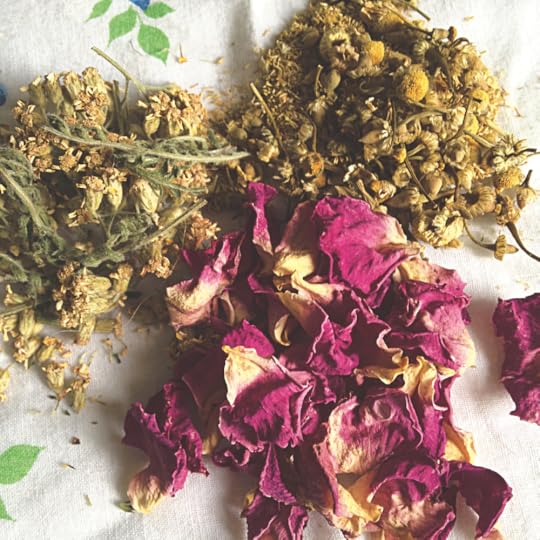
You will need
1 part chamomile flowers
1 part rose petals
1 part yarrow flowers (or a combination of flowers and leaves)
Place herbs in the center of a cotton handkerchief or bandana or a washcloth and gather up the corners so the fabric forms a little pouch. Tie it closed with kitchen twine or other natural string. Or use one of those muslin drawsting bags made for bath tea.
Float the bundle of herbs in the tub as you run your bath. As you bathe, use the bag of herbs like a sponge to squeeze herbal water over your face and body.
To heighten the experience of relaxation and purification prior to ritual, burn candles and/or appropriate incense around the tub.
If you don't have a bathtub or can't take a bath for some reason, make a strong infusion by placing a handful of each herb in a quart jar and pouring boiling water over them until the jar is full. Cover and allow to steep until the jar is comfortably warm to the touch. Then strain out the herbs and return the infusion to the jar. Pour the warm infusion over your body in the shower.
You can also use the infusion as a foot soak, or dip a washcloth in the infusion for a cooling wash. Don't be afraid to use the blend creatively, but remember most infusions are only usable for a few days, even when kept in the refrigerator.
All text and images in this post by Michelle Simkins. Please don't reproduce text or images without permission.
If this post inspired or informed you, or just made you happy, feel free to buy me a cup of ko-fi or purchase an item from my ko-fi shop . Your support helps with the cost of web hosting and other expenses, allowing me to spend more time creating posts for you.


July 28, 2024
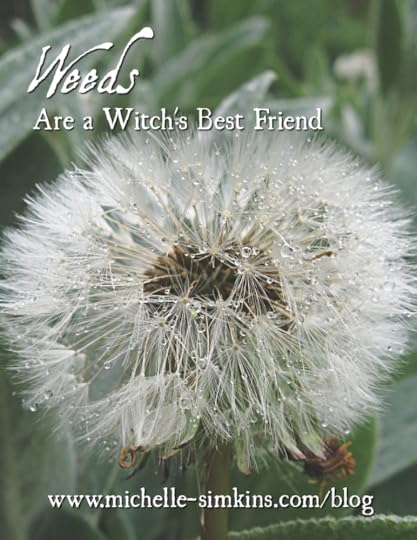
Weeds Are a Witch's Best Friend
I love weeds. But I also pull weeds out of my garden. I love native plants, too, but I get annoyed by most native plant enthusiast groups because they hate on all introduced species.
I recognize that some invasive weeds are a serious problem: they can crowd out native plant species and destroy biodiversity. Many introduced weeds have limited value as food for insects and wild animals. But there are good things about weeds too, and as a witch? I find them to be incredible friends and allies.
So the approach I take to weeds as a witch, a native plant lover, a gardener, and a friend of the land, is one that seeks balance.
In my own yard, I focus on adding native plant species, reducing invasive plant populations, and increasing biodiversity. But I don’t take a scorched earth approach to weed removal. After all, soil suffers when too much of it is left bare. If I don’t have something specific I want to plant in an area, I let the weeds grow there, chopping or mowing them down periodically but letting their roots remain in place to prevent erosion and, in some cases, draw up nutrients from deep underground, making them more available to other plants. I try to cut them down before they set seeds, to slow their spread around the neighborhood. But I wait to pull up weeds by the roots until I’m ready to plant in an area. Then I remove the weeds, plant something new, and mulch heavily to help slow the return of new weeds. With this method, I’m growing soil as much as I’m growing plants. It’s not a perfect approach, and doesn’t yield a manicured, magazine-ready yard. But it’s what the land wants from me, so it’s what I do.
While I focus on increasing the percentage of native plants in my yard, I rarely take anything from them. Instead, I leave the native plants as food for insects, birds, and small mammals. For magick and medicine, I harvest from the weeds and some introduced species instead. And I emphasize the use of invasive plants in my magickal practice. Personally I think weeds are a witch’s best friend. For example:
They’re plentiful. And while this is sometime a problem for the ecosystem or the gardener, it’s a boon for us witches. We can harvest freely from invasive populations without fearing we are taking too much from the land. In fact, often removing invasive plants is a service to our local ecosystem. Of course, it’s still important to ask permission, and leave an appropriate offering in return. It’s also crucial to practice awareness when we harvest a plant for any reason, being careful not to damage more fragile plant friends growing near or among the weeds, or to take so much we leave behind exposed soil. And it’s important to remember that even invasive plant species can create shelter for small creatures and nesting birds, so think of our animal friends when you go gathering even the most invasive of plants.
They’re everywhere. Even in barren places, weeds find a way. For the witch who has no garden and can’t afford to buy expensive spell ingredients, weeds are a free and easily acquired source of magickal supplies.
They’re friendly. Obviously there are exceptions to this point, but many weeds are incredibly generous and willing to work with humans. They do, after all, follow us around, and our disruptive activities create opportunities for them, so they’re usually happy to return the favor. More importantly, they’re often open to forming close relationships with humans. My approach to witchcraft is one of forming relationships with all the spirits around me, rather than treating non-human beings as commodities. The ease of forming bonds with our prolific plant friends makes them perfect allies in a magickal practice.
They’re resilient. Most weeds are virtually indestructible. If I want my magick to be potent and powerful, it makes sense to work with plant friends who are tough as nails, vibrant, and adaptable. Their amazing strength tends to make weeds magickally and energetically potent.
If you want to make powerful magick with strong ties to the land you live on, I highly recommend finding those weeds who are plentiful and thriving in your neighborhood and getting to know them. I think they might surprise you with how delightful they can be.
All text and images in this post by Michelle Simkins. Please don't reproduce text or images without permission.
If this post inspired or informed you, or just made you happy, feel free to buy me a cup of ko-fi or purchase an item from my ko-fi shop . Your support helps with the cost of web hosting and other expenses, allowing me to spend more time creating posts for you.
July 21, 2024
The Magick of Herb Robert
One day a few years ago I was walking in the woods, and kept feeling called to the same type of diminutive plant with tiny rose pink flowers.
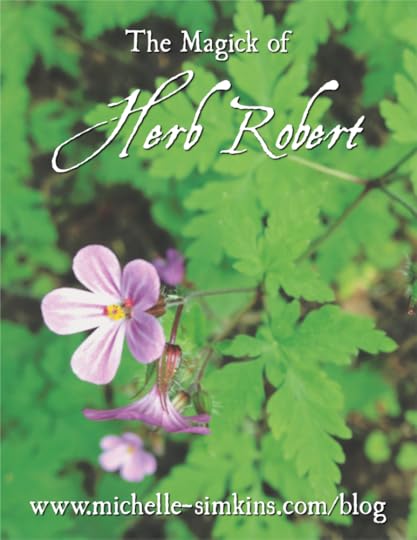
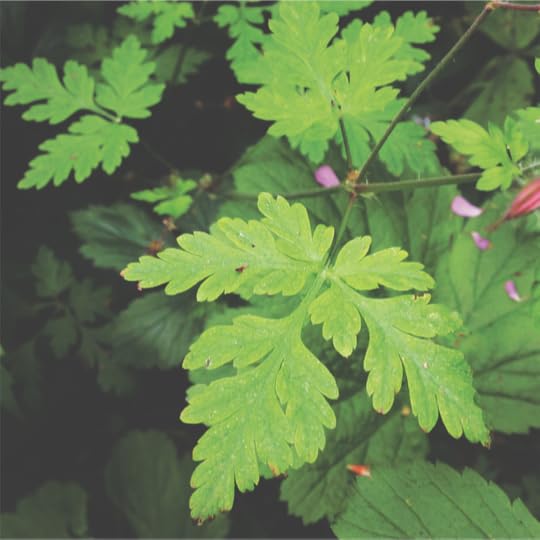
I stopped and said hello, touched the leaves and flowers carefully, took some pictures. I kept walking, but another patch of the same plant called out to me, so I went and said hello to that one too. But it wouldn't leave me alone. Everywhere I looked, I saw the soft foliage and tiny flowers, waving gently in the breeze, drawing me in. I wasn't even certain of the plant's identity at the time: some kind of wild geranium, I was pretty sure, but that was about it. Finally I took the hint and carefully gathered some sprigs of the plant, including leaves, flowers and unopened seed pods. Holding the plant in my hands, I felt an interesting sensation of being pulled more tightly into myself--a sensation I associate with being centered, being fully present inside myself. It wasn't a closed off feeling at all, and it didn't feel like a shield or like protection. Instead it felt like being more me, like I was inhabiting myself more fully. I put the plant in the big front pocket of my shirt, and throughout the rest of my walk I found myself patting the pocket affectionately. There was such a sweetness about the plant, even though it didn’t smell very nice at all.
Once home, I spread the plant on screens to dry. Then I pulled out herb books and got on the internet and confirmed the identity of my new friend: Herb Robert (Geranium robertianum), a European native who's made themself at home in the woods and shade gardens of North America. In some areas (including my own) it’s considered invasive.
Curious to see if my experience of the plant's energy resembled that of any other magical practitioners, I turned to my collection of titles on magical herbs--but none of them mentioned herb Robert, or any other wild geranium. (Cunningham does mention a “geranium”, but they’re varieties of Pelargonium, who are very different from Geranium species.) Turning to the internet, I found an interesting post by blogger Cathy Skipper, who had this to say about herb Robert:
"I felt that he was teaching about boundaries in relationships…sacred, personal space in relationship, instead of moving towards someone that you want to get closer to, step back into oneself and meet the person in oneself … real partnership is about two whole and separate people who meet but retain their separateness, there is no neediness. I don’t know if you have ever noticed that the flowers grow in twos and each flower has its own petiole, they are together but separate from each other."
This really lined up with my feeling of being more myself, but in a way that allowed me to be open with others. The combination of self-sustaining and loving is a hard one to find.
Other notes in Cathy's post included "Very shallow, fragile, nearly non-existent roots, ‘I don’t need to be anchored with roots because I am the earth’" and "Stand in your own space and the world will bring you all you need to be yourself and all relating will come from this point of authenticity -from this point of anchorage in yourself comes all you have been waiting for."
This felt very right. But I like to get as many sources as possible to confirm my feelings about a plant, so I turned to Matthew Wood's Earthwise Herbal: A Complete Guide to Old World Plants. In it, Wood says herb Robert has similar properties to cranesbill, another wild geranium (Geranium maculatum), and especially recommends it to stop bleeding.
And Scott Kloos says in Northwest Medicinal Plants, “All parts of this plant are astringent and helpful for a wide range of inflammatory conditions where the tissues need tightening.” (emphasis mine).
There, again, is confirmation of this energy: self containment, holding onto one's self and one's essence, in this case physically.
Curious about the comparison to Cranesbill, I went to Earthwise Herbal: New World Plants to read about wild geranium. Wood recommends Geranium maculatum for:
"People who have lost a part of their essence; people who depend on prescription or recreational drugs to function and have lost the ability to function on their own; people in recovery from drug addiction.
"Helps to separate people who have been closely connected after the failure of a marriage, relationship, or friendship.
"Helps mothers separate themselves from children."
At this point, I felt very comfortable with my sense of herb Robert's magical character.
Once dry, that bit of herb Robert I brought home went into a love talisman. Using herb Robert in love magic might seem counter intuitive after all this talk of self-reliance and self-sustenance, but here's the thing: it's very easy to lose ourselves when we fall in love. It's easy, and unfortunately common, to give up a great deal of what makes us ourselves when we find a partner. And this is tragic, because it leads to unhappiness and loneliness even as we become deeply intimate with another. So a charm to attract a love that lasts benefits from the presence of an element of self-reliance, to assure us we can love and care for ourselves while we love and care for others.
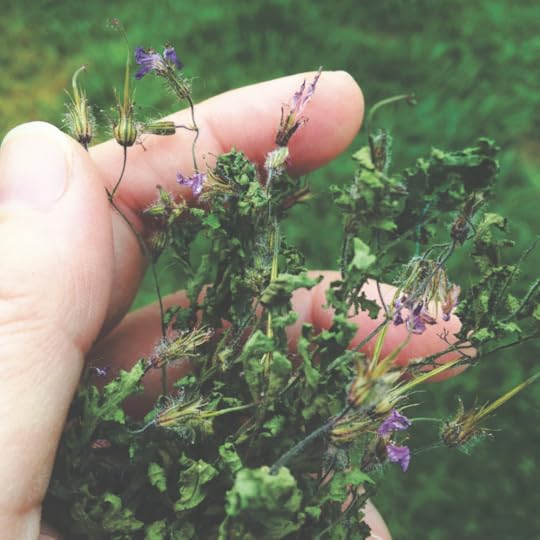
I would also use herb Robert in spells for confidence--which would make it useful when looking for a job, going to court, starting a new venture, etc.--and for courage, especially alongside borage.
Herb Robert seems like an excellent plant ally for anyone who needs help cultivating self love. There aren't many plants that strengthen our sense of self while also allowing love to flow freely through our whole being, but herb Robert does it well and - in my experience, at least - works their magick quickly.
And yes, I will continue to use it in love spells when there’s a lack of confidence or difficulty setting healthy boundaries and practicing self care in relationships.
For any of these purposes, one might create a tincture, glycerite or elixir of herb robert and take a few drops as needed. Or dry the herb and put it in a pouch or bottle you can carry, along with other herbs and/or stones. You could also make an infusion of dried or fresh herb and add it to the bath, or make a flower essence from the blossoms. Be warned, though— while my research assures me herb Robert is safe for internal use, and I've eaten a bit of it with no ill effects, this little plant smells and tastes a bit unpleasant. In other words, you can drink it in tea, but you probably wouldn’t enjoy it very much.
One final note, herb Robert can be quite aggressive. I don't recommend planting it on purpose unless you can be sure it will be easily contained in your garden. And if you are in an area where the plant is invasive, as I am, I suggest harvesting more intensively than I'd usually recommend, to help control the plant population rather than increasing it. I know parts of my yard would be completely eaten by this friend if I didn't remove them frequently. So why not get to know them better and work with their magick in the process?
This post contains affiliate links. By purchasing items from Amazon through these links, a portion of the proceeds from your purchase support this blog. If you found this post helpful, educational or useful, you could also support A Witch's Path by making a purchase from the store, or donating via Patreon.
All text and images in this post by Michelle Simkins. Please don't reproduce text or images without permission.
If this post inspired or informed you, or just made you happy, feel free to buy me a cup of ko-fi or purchase an item from my ko-fi shop . Your support helps with the cost of web hosting and other expenses, allowing me to spend more time creating posts for you.
July 14, 2024
Some Thoughts on Journeying with Mugwort
This is a revised version of a post I published on an older blog which is no longer available.
By late July the mugwort towers over me, their blossoms opening up to little brown-yellow tassels or pompoms. Their scent is heady, and the wind-blown pollen can make me sneeze on a dry day. While many things are languishing in the heat, the mugwort is in their full glory and power in the last half of summer. They look ragged, having grown so tall and bloomed out, but they’re incredibly potent, and especially ready to take the plant loving witch on a journey.
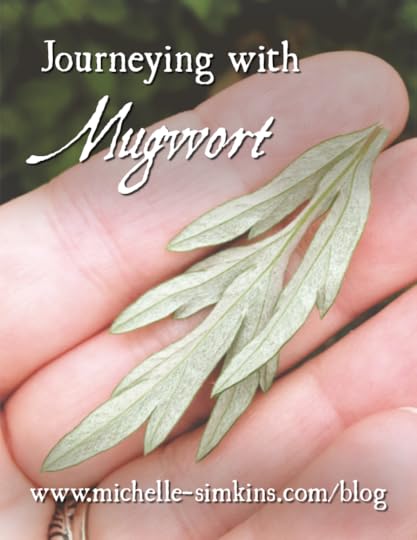
I make a simple wreath of mugwort flowering branches, and take it indoors to my cool, dark bedroom. I get comfortable in bed, lying on my back. I crush a leaf of mugwort and use the juices to draw a pentacle over my forehead, which immediately pulses intensely for a few moments before slowing into a gentle thrum. I rest the wreath on my chest, and place a single fresh leaf over each closed eyelid.
I whisper a prayer to my Gods, and the spirit of mugwort, to grant me safety as I journey. Then I enter the journey with my favorite visualization of descending 13 stone steps. At the bottom of the steps I find myself at the entrance to a dark forest, and I follow a short path to a meadow with a massive, flat-topped rock at its center.
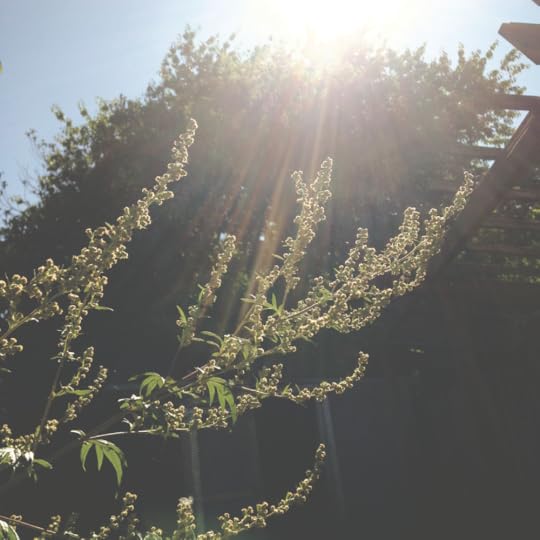
In my vision, tall mugwort dances in the meadow under a starlit sky. Here I am visited by an antlered God, a figure I always find equal parts unnerving and compelling. But he always shows me many things about the shadows, the parts of myself I’m unwilling to share with the world at large, the parts of myself that are only allowed free reign in this other place.
He shows me how so many of us need an otherworld where day to day reality is reversed, twisted, or overturned. The more the witch strives to be kind and generous, the more she benefits from a place where being “good” and “nice” isn’t required or even expected. In this shadowy otherworld, the witch can consort with dark and wild spirits, and can learn secrets and access deep magick. It’s not necessarily a “good” place, or a safe one. But it is, for some of us, an essential place, where it’s easier to commune with the old Gods, and where fear can be a tool of learning and transformation. There’s power in accepting one’s own darkness and looking directly at one’s fears.
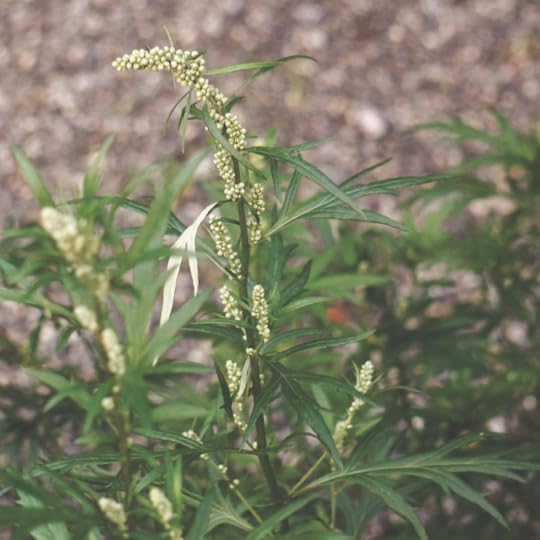
Mugwort can take us there. Moreover, mugwort can help us make the journey there and back again safely, protecting us and helping us stay truly ourselves no matter what we encounter. Because while she helps us to travel and to see, mugwort is also intensely earthy, allowing us to maintain our own connection to the land and our bodies as our spirits wander elsewhere. Hold on to mugwort as you travel so you won’t be lost in the shadows.
I’ve heard complaints from some practitioners that mugwort causes nightmares. This is sometimes true. I would ask, however, what is a nightmare but an involuntary journey to the world of shadows? Nightmares teach us. I would say mugwort brings us true dreams, or at least teaching dreams—but not usually sweet ones. For sweet dreams turn to lavender, chamomile, roses. But if you want to see into the darkness and find the truth hidden there, fly with mugwort. She might carry you to frightful places, but she will keep you safe.
All text and images in this post by Michelle Simkins. Please don't reproduce text or images without permission.
If this post inspired or informed you, or just made you happy, feel free to buy me a cup of ko-fi . Your support helps with the cost of web hosting and other expenses, allowing me to spend more time creating posts for you.
July 1, 2024
Clearing Unwanted Energetic Attachments: A Free Guide
Hello friends, I have a gift for you!
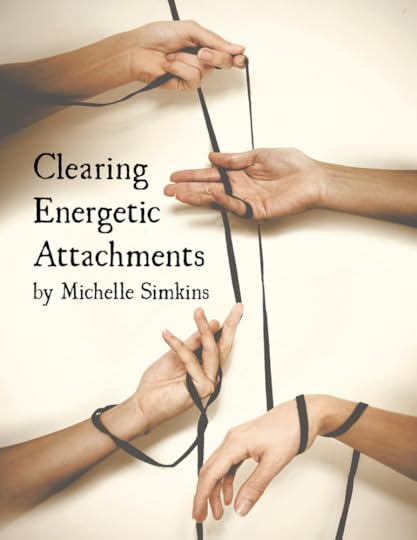
Over the weekend I gave a free workshop to members of my favorite Discord server, The Bonefire Inn. The server is a gathering place for devotional polytheists and witches, with an emphasis on kindness, inclusivity and accessibility. You can find us here: https://discord.gg/6ceeVuVh
The workshop covered the process of finding and removing unwanted energetic attachments (or cords), and techniques for protecting yourself from further attachments going forward. It's a technique I originally learned from a reiki master many years ago, and have expanded on in my own practice over the years. I believe it's an essential skill for anyone with an esoteric practice, so I converted my workshop notes to a 9 page PDF, which is now available on my Ko-fi page as a "pay what you want" offering. There's no obligation to pay if you can't afford to: I want this information to be as widely accessible as possible. I hope you will find it easy to understand and helpful.
Image of hands wrapped in ribbon by an anonymous user on Pixabay , a royalty free image sharing site.
June 21, 2024
The Stranger on the Path: The Sacred Mile Project in June
It's only a little woodland, just a few acres of trees, part of a larger public park in a prosaic suburb of Portland. The main trail loop is less than half a mile: hardly a place you could get lost in. Hardly a place, you might think, for anything very extraordinary to happen. Aren’t all the seekers jetting off to Thailand, India, Bali, etcetera, for a reason?
Except. The Otherworld is here too.
On the summer solstice I went for a walk, around the block to the little nature park with the little woodland. The day was just beginning to warm, so the sun slanting through hte trees was welcome when I walked through it. As I rounded a curve in the path, I a big old yellow lab slowly emerged from the trees and shuffled over to me to say hello. Behind him, a woman stepped out of the trees, walking slowly and leaning heavily on a metal cane. She had long gray hair and a garish blouse in shades of purple and white. She carried a big, bright blue, cloth bag.
“Have you seen the rabbit?” she asked me.
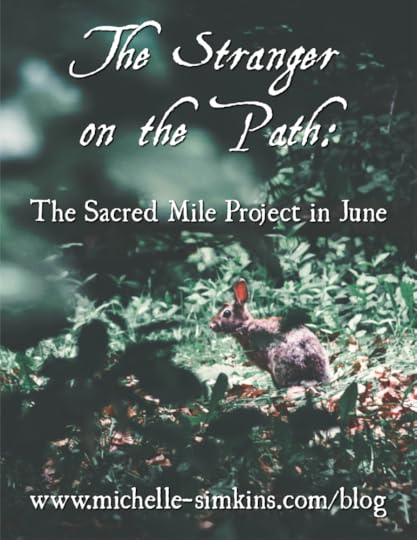
It just so happened that I had seen a rabbit just moments before, at the edge of the trees, where a fence divided the park from a church parking lot. I pointed out the location.
“I have organic carrots for him,” she said, and started rummaging in her bag. Then: “Do me a favor. Put these under that big tree over there.”
And she filled my hands with peanuts, still in their shells.
Well.
When you meet an old woman on a path on the morning of the solstice, with the air full of birdsong and a whole woodland watching, you do as she asks. I placed the nuts at the feet of a towering Douglas fir and continued on my walk.
Now. Obviously these events could all be very simply a random encounter with a quirky older woman and her dog. The morning provided an amusing anecdote about the people you meet when you wander your neighborhood. But there was a feeling about the encounter, something slightly surreal in the air. One friend said “it sounds like you’re describing a dream” when I told her about it. Another said “Did you just meet Baba Yaga?!” Another said “you’ve met your future self!” Or maybe I just met an old lady who likes to feed the animals in the park. Maybe on, some level, many of those theories are correct at the same time. Maybe none of them are.
I’m beginning to think it’s best not to know. I don’t need to prove - or disprove - anything about the encounter. The beauty of the whole thing is in the ambiguity. It’s knowing that any time I step out my door I might encounter anything: a fellow eccentric making friends with squirrels, or a spirit or Deity in disguise, setting me a minor task to see what I’ll do. Everything is more than what it is: everything is also just as it seems. The Gods and spirits move in and out of the physical world, and often we brush up against them in shapes we wouldn’t expect. And while I say being kind is the best default setting, if you need a reason, let it be this: the stranger on the path could be a God in disguise, and They will remember how you respond to Them.
This is what happens when you dig deep into your home soil. This is what happens when you look closer, and closer, and closer still, when you court the familiar like an ardent lover. This is why I started the Sacred Mile Project: to help myself, and anyone who wants to join me, in seeing “mundane” things through a new lens. Keep looking closer, and you pass through familiarity to a new strangeness, and find the mysteries here at home.
But you have to retrain your thinking. You have to be willing to accept that maybe, sometimes, the Otherworld puts on human shapes and wanders the public parks of suburbia with a cane and a fat, elderly yellow lab. You might have to let go of your categories and classifications of experience, and embrace ambiguity. When you do, you can see the everyday world as a mystery.
Sometimes a wild god comes to the table.
He is awkward and does not know the ways
Of porcelain, of fork and mustard and silver.
His voice makes vinegar from wine.
-Tom Hirons, "Sometimes a Wild God"
Image of a brown rabbit by Ali Kazal , courtesy of Unsplash
If this post inspired or informed you, or just made you happy, feel free to buy me a cup of ko-fi . Your support helps with the cost of web hosting and other expenses, allowing me to spend more time creating posts for you.
May 21, 2024
Engage Your Senses: An Exercise in Sensing Energy
I’ve seen a lot of witches and polytheists struggle with doing energy work, often lamenting that they can’t sense energy. But usually after some conversation on the topic, it turns out they ARE sensing energy, they just aren’t doing it the way they expected to. But in my experience (and I’ve been practicing energy work since 1999), it’s rare for two people to sense energy in exactly the same way. The challenge is understanding how you, personally, experience energy. And the only way to do that is to practice. So here’s a simple and fun little exercise that might help you begin to understand how you sense energy.
And, bonus, this technique also helps you begin understanding the energies of items you might want to work with magickally or energetically. You don’t need books full of “correspondences” if you can go directly to the plant, stone, or other being to find out who they are and how they affect you and the energy around them.
So, sensing the energy of a physical item can go something like this:
Choose an object whose energy you want to explore. It’s easiest if the object is small enogh to hold in your hands, especially at first.
Place the item within reach but not touching you. In a box or bag close at hand is great.
Now get comfortable. Some energy workers say you shouldn’t cross your legs or arms, as this could hinder the flow of energy. I don’t always find this to be true, but if you’re new to sensing energy, you might want to take this advice to give you the best chance of feeling the energy move. More importantly, be as comfortable as you can. Breathe as you usually would.
Now engage your senses. How does your body feel? Are you hot or cold? Do you have any areas of discomfort? Do you feel any tingles, flutters, or vibrations anywhere in your body? Do you feel tired or energized or somewhere in between? Take your time paying attention to input from your senses. What do you hear, smell, taste, see (both with your eyes open, and with your eyes closed)? Pay attention to your breath: is it fast, slow, somewhere in between? Are you breathing deeply, or shallowly? Don’t hurry through this part of the exercise: you’re getting a sense of yourself and your current energetic state.
When you’ve scanned your bodily sensations and made mental note of sensory input, take your chosen object in your hands or rest it in your lap. If it’s too large to hold, place your hand on it or lean against it
Take several breaths and make sure you’re comfortable again.
Now repeat step four while holding or touching the object. Check in with your senses. Do you notice any differences in your sensory input now that you’re holding the item? How does the item itself feel? When you close your eyes, what do you see? Do you have any tingles, flutters, or vibrations you didn’t have before you held the item? How does your body temperature compare to before? What about your breath? Once again really take your time here, paying careful attention to ALL your senses.
When you’re finished, thank the item for spending time with you and set it aside. Jot down notes about the experience so you can compare it to future repetitions of the exercise.
You might feel a little spacy or odd after even simple energy work exercises. So when you’re finished, check in with yourself. Drink a little water, maybe have a small, protein rich snack. Stretch a little, or pat yourself down to make sure you’re really present in your body. An exercise like this one rarely (but not never!) causes a person to feel particularly ungrounded or out of it, but it’s good to get in the habit of checking in with yourself and making sure you're grounded and present before going on with your day.
Repeating this exercise with a variety of items over time will help you begin to understand how YOU sense energy. Energetic sensations vary from person to person, and comparing is really fun as long as we understand there’s no one right way to sense energy. You might feel vibrations or temperature fluctuations, you might hear different tones or musical notes, you might see textures or colors or moving lights, you might feel emotional shifts that have nothing to do with your personal emotional state, or any other of a vast number of responses to shifting energy. It really helps to approach energy work with playfulness and curiosity. I’ve always found energy work to be full of surprises and that’s my favorite part.
Image of a hand holding a rose by Javardh , courtesy of Unsplash
If this post inspired or informed you, or just made you happy, feel free to buy me a cup of ko-fi . Your support helps with the cost of web hosting and other expenses, allowing me to spend more time creating posts for you.
April 26, 2024
Fiddler: A Short Story
Here's another of my stories that previously appeared on the Hagstone Publishing website. If you enjoy my short stories, you'll probably also enjoy my novella, Briar.
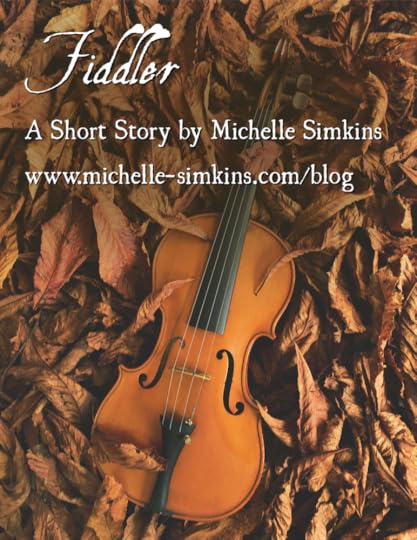
Becky Jo Halstead had a bite of birthday cake halfway to her mouth the first time the traveling fiddler came knocking. He wore a summer-yellow coat, and his eyes sparkled green as grass from under the brim of his fancy hat. When he heard she was the birthday girl, he played a song just for her. Beside the bonfire that night he let her hold his honey-colored fiddle and showed her how to drag the bow across the strings. Her mama said it sounded like a litter o’ cats gettin’ eaten alive, but the traveling fiddler said Becky Jo Halstead had potential. Becky Jo felt like she finally knew what her hands were for. She went to sleep with music in her ears and a pair of gleaming green eyes on her mind.
When the fiddler went on his way the next morning, he left his second-best fiddle with a note: “For the birthday girl. I expect you’ll know how to play some songs by the time I come back ’round. Your friend, Nick.”
The note made her heart flutter like it did when she almost fell climbing a tree. But she liked that fluttering, and she liked thinking Nick would come back for her.
Becky Jo Halstead took to fiddle playing like a mouse takes to cheese, and before six months had passed she knew four songs and was half way to learning a fifth. Within a year she could charm possums and foxes out of the woods with her music, and by the time she was twelve she could call the shades from the graveyard just practicing scales.
A boy from down the river came courting, even wrote poems to Becky Jo’s chestnut hair and freckled nose. Another boy brought her flowers and candy from the city. But none of the boys could compare to Nick the traveling fiddler. Her mama said she was too stubborn for her own good, but Becky Jo Halstead knew he’d come back. She didn’t mind waiting.
And sure enough, on her 18th birthday, when she had her first bite of birthday cake halfway to her mouth, the traveling fiddler knocked on the door. He came into the shack like he’d left just yesterday. He hadn’t changed a bit, but Becky Jo Halstead surely had, and the fiddler made no bones about noticing the difference and liking what he saw. He invited her out for a walk, and she grabbed her fiddle and went along before her mama could say a word. They played together til the moon went to sleep, all manner of creature from this world and the next dancing to the music they made.
When the moon tucked down behind the mountain, Nick looked at her and said, “I been lookin’ for a woman could play that good for more years than I can count, Becky Jo Halstead. You can bet I’m not lettin’ you get away.”
He kissed her on the mouth right there in the graveyard. Then he took her hand, and she thought he’d walk her home, and wouldn’t her mama pitch a fit when she found out about them. Becky Jo didn’t care; she was too happy to care about anything at all.
Until he locked her down in that dark cellar and went off whistling into the shining morning.
Becky Jo Halstead paced in the dark. She was mad as a bee-stung hound dog, and wasn’t she gonna give it to him good when he came back? If he came back.
She wouldn’t think about that. She still had her fiddle, so she played.
When the light faded from the crack between the cellar doors, her fiddler came in carrying a pot of beans in one hand and a plate of cornbread in the other. She wanted to glare at him and turn her back, but she was mighty hungry; and she could smell bacon mixed in with those beans. She decided she better keep her head for once. Losing it was what got her here in the first place.
“Glad you came back,” she said. “But what’d you lock me down here for?”
He smiled and handed over the food. She couldn’t help it: She ate, fast, while he sat down on the pile of straw in the corner.
“I told you. I been lookin’ for a woman could play the fiddle as good as I can, and now I found you. I’m gonna keep you forever.”
“I ain’t gonna live forever,” she said.
“That’s where you’re wrong,” he said. “This here is my place, and in my place you won’t never die.”
She swallowed down her last bite of beans.
“Who are you, Nick?” she asked, and wondered why she never thought to ask before.
“Well now, plenty of people call me Nick,” he said. “But they put ol’ in front of my name.”
Nick looked straight into her eyes with his green ones, and sure enough, Becky Jo Halstead saw the fires of hell flickering down in the depths of his gaze.
She sat real still and thought about that.
“Well,” she said after a while, “I always knew you were a handsome devil. I just always thought you were more handsome than devil. Guess I had that wrong.”
She was glad to hear her voice was steady, though she was shaking all over.
Nick laughed, and put her fiddle in her hands.
“Let’s play,” he said, and they did.
Over the weeks that followed, Becky Jo Halstead tried without success to find a way out of the cellar. She watched real close, and one day she finally caught Ol’ Nick slipping a little key into the pocket of his yellow coat. After that she came up with a plan.
She’d already learned how to fiddle to make the stars dance, to make the birds sing, to make the sprites show themselves. Now she meant to out-fiddle the devil.
She played that fiddle every day, and every night, every minute she wasn’t sleeping or eating she played. And she started making up a lullaby that put even the flame on the candle to sleep. And when the wind through the cellar door tasted like autumn, she knew she had it down. When Nick brought her bowl of beans and plate of cornbread, she could hardly eat for hoping.
She told him, “I have a surprise for you.”
“You do?” he asked.
“I wrote a song just for you,” she said. “Will you hear it?”
“Why Becky Jo Halstead, here I thought you were plottin’ to leave me,” he said, “and you been writin’ me a song.”
“That’s right,” she said. “I can’t believe you wouldn’t trust me.”
So the devil sat himself down in the straw, and Becky Jo Halstead played the stars wheeling over the mountains, and the devil leaned back on his elbows and smiled. She played the baby at his mama’s breast, and the devil lay down with his head pillowed on his arms. She played the down-filled quilt on grandma’s feather bed, and the devil closed his eyes. And when she played the candle flickering on a winter night, the devil snored like a hive of bees. She played the moon on the snow at midnight, and the devil slept so deep he didn’t stir when she kicked him. Then she played a little more.
When his snores were like to split her ears, she finally set the fiddle down, slipped her hand into the pocket of his yellow coat, and eased out the key to her freedom.
* * * * *
Ol’ Nick slept through the winter, and didn’t wake up until the birds were singing spring into the trees. He looked around and knew Becky Jo Halstead had bested him fair and square, and wasn’t he just mad at himself for letting her get away. He jumped up outta that cellar and called down a mighty storm to tear off after the girl who got away.
But Becky Jo Halstead was ready. She’d found herself a place out in the deep green wood, and she’d spent the winter playing for the ghosts and the faeries, the goblins and the wild things. They were keeping watch for trouble, and when the storm came seeking her they kept her safe. Then they chased Old Nick off, and gave him such a scare he swore he’d never come back again.
When Becky Jo Halstead had babies, she hung Rowan crosses around their cradles and said prayers over them morning and night. She lived a good, long life, and told her kids and grandkids about the time she beat the devil at his own game.
And she was mighty happy none of her babies ever wanted to touch that fiddle.
Story copyright Michelle Simkins, 2011
Fiddle image by Jean-Louis Aubert , courtesy of Unsplash .
If this post inspired or informed you, or just made you happy, feel free to buy me a cup of ko-fi. Your support helps with the cost of web hosting and other expenses, allowing me to spend more time creating posts for you.
#shortstories #writing #fiction #freestories #stories
April 23, 2024
Lovers of the Land: Living with Ecological Grief Part 2
This series of posts is an expansion on an article I wrote for Hagstone Publishing’s Stone, Root, and Bone. Some portions of the posts are unchanged from the origional article, but I’ve added thoughts and ideas, making it far too long to be a single post! I don’t have all the answers, but I hope that what I share here is helpful to anyone who feels deep ecological grief the way I do.
In my last post in this series, I wrote about the necessity of feeling, and honoring, our grief. In this post I would like to look at the way we think about our relationship with the land, and how reconsidering this relationship might be helpful. There are several common attitudes toward the world around us that can be very detrimental to the earth, but also to us humans.
The Land Isn’t Our Shopping Mall
The world, we are told, was made especially for man - a presumption not supported by all the facts. A numerous class of men are painfully astonished whenever they find anything, living or dead, in all God's universe, which they cannot eat or render in some way what they call useful to themselves.
John Muir
An all too common attitude toward the land is one of owner, or consumer. Sometimes I’ve heard it described as “stewardship” by people who want to approach the land more ethically. This seems to be the most common view in our culture at large, shaped by xtianity and capitalism. In this view, nature is inert, a collection of items to be consumed. There’s no consideration of the beings around us as conscious, and there’s certainly no consideration of their agency.
My guess is, if you’re reading this series of posts, you already see the problem with such an attitude toward the land. Most pagans and polytheists I know wish to be allies to the land, and embrace at least a theoretical animism that drives them to be more ecologically minded.
But even within the sphere of paganism and polytheism, there’s sometimes a tendency to think that we have a claim on the treasures of the natural world. That if we approach these treasures with “reverence” and a spiritual mindset, then the land will offer us endless gifts. And it’s true the land is generous and grants us many treasures. But often we enter outdoor spaces assuming that we can go on a sort of free shopping spree, and this attitude sometimes causes us to do damage without realizing it. And sometimes we even think we are “giving back” or making offerings by leaving treasures of our own, but if those treasures aren’t useful to the plants, animals, or soil, then they’re litter or pollution.
In order to have a healthy relationship with the land, we need to devote some time and energy to understanding their needs better, and to behaving accordingly. Does that mean we can never pick up a leaf or a stone, never leave an offering? Of course not. But it does mean it’s important to consider the needs of the land, and to understand that all the spirits of the world, all the beings of the world, have their own kind of consciousness and their own desires. Which means not just taking whatever we want, whenever we want, even if it’s for magical or spiritual purposes. Respecting the agency of the land is as essential as revering the magic of the land. Maybe moreso.
We Aren’t Saviors
In the Western tradition there is a recognized hierarchy of beings, with, of course, the human being on top—the pinnacle of evolution, the darling of Creation—and the plants at the bottom. But in Native ways of knowing, human people are often referred to as “the younger brothers of Creation.” We say that humans have the least experience with how to live and thus the most to learn—we must look to our teachers among the other species for guidance. Their wisdom is apparent in the way that they live. They teach us by example. They’ve been on the earth far longer than we have been, and have had time to figure things out. They live both above and below ground, joining Skyworld to the earth. Plants know how to make food and medicine from light and water, and then they give it away.
Robin Wall Kimmerer - Braiding Sweetgrass: Indigenous Wisdom, Scientific Knowledge and the Teachings of Plants
There’s a tendency among people who care about the Earth to feel burdened by an overwhelming sense of responsibility AND a feeling of crushing hopelessness. We talk, often, of saving the planet, or saving some individual species. There’s good intention behind this language and emotion: we want to protect and help those we love. But our savior mentality is damaging to us and to the planet. It’s linked to an old-school, Biblical view of humanity as the ultimate creation with the right - even the responsibility - to shape nature as we see fit. While a desire to save the earth is a more positive version of this attitude, it is nonetheless problematic.
“We often forget that WE ARE NATURE. Nature is not something separate from us. So when we say that we have lost our connection to nature, we’ve lost our connection to ourselves.”
― Andy Goldsworthy
For one thing, the savior mindset places us in a position as other than nature, as somehow set apart from the land. And we are not other than. We are nature. Understanding this could help us resume our proper position as members of the community of nature. Letting go of our savior complex, we can learn to work with the land, and, at times, to get the hell out of the way and let the spirits do their work unhindered.
For another, there’s an arrogance embedded in the savior perspective. The beings of nature are not our children, our property, or our resources. They are people with their own ideas, desires, and agendas. They deserve to be approached with respect and humility, rather than condescension. Condescension isn’t conducive to true love, and nothing less than true love will do now. And when I say "true love”, I don’t mean some romantic idealization of nature in which we traipse through the woods wearing fairy wings and spouting poetry. I mean the kind of love that treats the beloved as a partner, an ally, and that makes choices based on mutual benefit.
We Aren’t in Charge
One otherwise unremarkable morning I gave the students in my General Ecology class a survey. Among other things, they were asked to rate their understanding of the negative interactions between humans and the environment. Nearly every one of the two hundred students said confidently that humans and nature are a bad mix. These were third-year students who had selected a career in environmental protection, so the response was, in a way, not very surprising. They were well schooled in the mechanics of climate change, toxins in the land and water, and the crisis of habitat loss. Later in the survey, they were asked to rate their knowledge of positive interactions between people and land. The median response was “none.”
I was stunned. How is it possible that in twenty years of education they cannot think of any beneficial relationships between people and the environment? Perhaps the negative examples they see every day— brownfields, factory farms, suburban sprawl—truncated their ability to see some good between humans and the earth. As the land becomes impoverished, so too does the scope of their vision. When we talked about this after class, I realized that they could not even imagine what beneficial relations between their species and others might look like. How can we begin to move toward ecological and cultural sustainability if we cannot even imagine what the path feels like? If we can’t imagine the generosity of geese?
Robin Wall Kimmerer - Braiding Sweetgrass: Indigenous Wisdom, Scientific Knowledge and the Teachings of Plants
And yet another thing: we as individuals aren’t responsible for the majority of the harm being done to the planet. It’s industry, and government. It’s capitalism and the drive for profit over all else. And yes, we can do what we can. We can write letters, we can try to purchase responsibly, we can do activism, we can take as many steps as possible in our personal lives to be better members of the community of life. But in the end the really monumental changes just aren’t within the grasp of the average individual. So seeing ourselves as potential saviors, or even as stewards, is unrealistic. We are victims of the systems that are destroying the planet. We are fellow sufferers WITH the land. To place ourselves in the position of power over the land, or of a savior, is unrealistic and sets us up to always, every day, feel like we are ineffective at best, a plague on the land at worst.
Becoming Lovers
What if, instead of seeing ourselves as saviors, we saw ourselves as lovers of the land?
As lovers, we can view our responsibility more realistically. We can make decisions that are the best possible decisions for the good of our beloved, but also know that not everything will be within the scope of our influence. Which means we can more realistically evaluate what our realm of influence actually is, and what choices and actions we can make in our every day lives to be of benefit to the land. We can be less focused on harm reduction and more focused on being good loved ones, and consider how we might benefit the one we love.
Seeing ourselves as lovers of the land removes the notion of control and domination: the good lover respects the strength and agency of the beloved even while walking with the beloved through difficulties and challenges hand in hand. The good lover doesn’t coddle the beloved, but works with the beloved to create a life that benefits each individual. Of course, the good lover also doesn’t pump the beloved full of poisons, steal their valuables, or exploit them for financial gain. The good lover protects the beloved, knowing the favor will be returned. The good lover stands by the beloved in sickness and devastation and finds a way to support the beloved as they heal and overcome obstacles. But ultimately, the good lover also knows they have no right to control or condescend to the beloved.
Seeing ourselves as lovers instead of saviors also provides us a degree of relief from the weight that crushes us when we consider the enormity of environmental devastation. All of nature does not rely on humanity to save it. Yes, she needs us to stop poisoning and disfiguring her. But the earth, like the human body, is capable of healing herself, with the proper resources and support. As lovers of the earth we can find ways to offer those things while respecting her strength and resilience. And we can do it without torturing ourselves with an unrealistic sense of responsibility.
And finally, as lovers, we can celebrate our beloved without ignoring their suffering. The good lover finds joy in the presence of the beloved, even when the beloved is ill or struggling. I’ve personally experienced the comfort and even healing power of being loved and appreciated by my wife even in my worst moments. The land is still here: we can love them and take joy in spending time with them right now, exactly as they are. I think it will do them good.
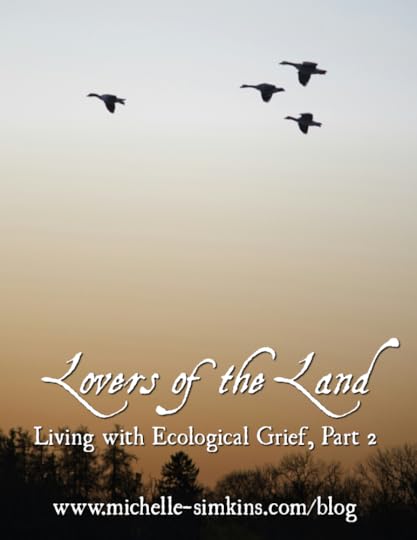
Photo of flying geese by Jonas Stolle , courtesy of Unsplash .
If this post inspired or informed you, or just made you happy, feel free to buy me a cup of ko-fi. Your support helps with the cost of web hosting and other expenses, allowing me to spend more time creating posts for you.
February 8, 2024
Cold and Sharp: Sacred Mile Project Art Piece #2
Since January's ice storm storm, and all its side effects, dominated my attention for the whole month, it seemed clear my second art piece for the Sacred Mile Project should honor the ice, and cold, and stabbing pain.
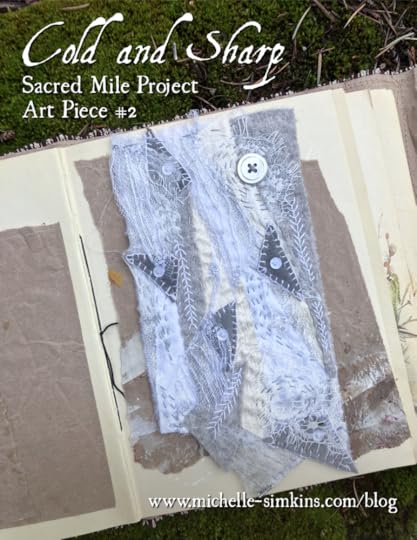
I didn’t take any walks in the second half of the month, so there were no forest floor or mud puddle finds to create art from. I had to rely on the more immediate habitat of my home for materials. I wanted to create something that looked cold and sharp, so I wandered the house looking for supplies. I found the white plastic netting from some produce; used fabric softener sheets; scraps of silk and eyelet lace in white and cream; bits of an old, gray, ruined cashmere sweater; small remnants of silver holiday ribbon; and bits of a gray velvet upholstery sample. I added new threads and some beads from the cover of a damaged journal.
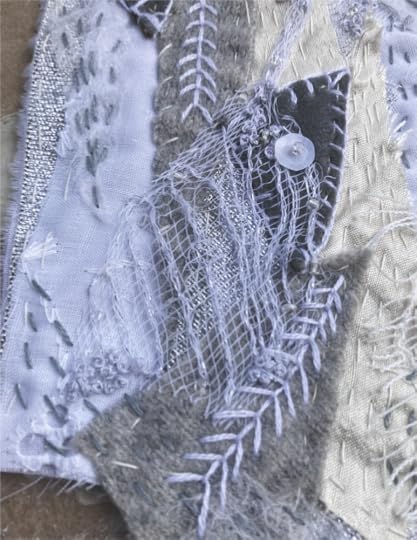
Usually I favor curves, spirals, and circles in my work, but to honor the cold, painful, sharp-edged spirit of this January, I cut my pieces into triangles and long jagged strips. While this piece has different shapes from my usual preference, I quite like how it came out. It captures the feeling I wanted it to express, and it has loads of texture - and y’all know I love some texture.
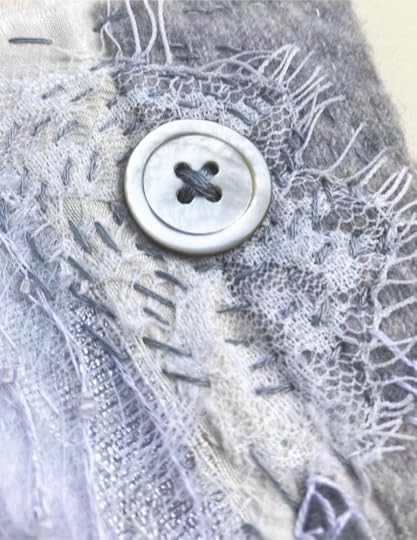
I added it to my journal on a background of packing paper which was previously used to protect my desk while I worked with wet mediums on paper. I don’t keep EVERYTHING, but I keep and reuse as much as I can.
I hope to get more walks and enjoyable outdoor time in February than I did in January. Not too bad so far, so I’ll take what I can get.
Don’t know what The Sacred Mile Project is? Read the introductory post .
All photos and text in this blog post copyright Michelle Simkins, 2023. Please don’t reproduce or use for purposes other than personal, private use without permission.
If this post inspired or informed you, or just made you happy, feel free to buy me a cup of ko-fi . Your support helps with the cost of web hosting and other expenses, allowing me to spend more time creating posts for you.