
Sheenagh Pugh's Blog
April 16, 2026
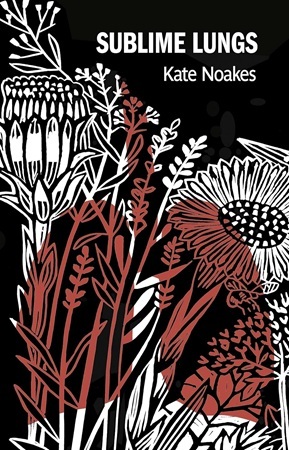
Review of Sublime Lungs by Kate Noakes, pub. Two Rivers Press 2026
Humpbacks off the starboard bow, blowing and blowing.
One breaches for the sheer joy of it
(“Stellwagen bank and a god’s breath”)
This is one of your “themed collections”, the theme being, basically, living with severe asthma, though it does sometimes go wider, to consider the lungs and the act of breathing in a more general and indeed sometimes metaphorical sense. Themed collections can have the advantage that poems play off against each other, illuminating the theme from different angles, a bit like Monet painting Rouen Cathedral. The different angles are crucial, because with a collection on one theme there are always the dangers of repetition and monotony.
One way of avoiding these dangers is by thinking figuratively, finding various images in which to encapsulate and convey the act of breathing and the impediments to it. In “Ice threatens my breath”, the image is that of bagpipes, and sharply evocative:
the lungs
steadfastly Scottish,
as when an infection
has me struggling to inflate them,
only to expel air
too, too quickly
from the goatskin bag.
I drone for days
And the image of the “stone dresses” in “Asthma is dressed stone rasping”, though not as immediate, is convincing to anyone who has seen an asthmatic fighting what clearly feels like a stone wall. In “The living death, a childhood nightmare”, Snow White “in her glass coffin” is a striking likeness for the girl in hospital:
Immobile, she is condemned to forced breath,
this living-death-iron-lung no handsome prince
can rouse her from.
In those poems that relate directly to her own experience there are inevitably personal references and not all communicate equally well – I am still puzzled by the line “my certificate will say I died like little Ella” (“Particulates”), because I don’t know who she may be; a literary or film reference or something more personal – I even wondered momentarily if it might be a mistake for “Little Eva”. And “Common ground”, quoted in full, totally lost me:
I can’t breathe because of the environment
and five defective genes.
You can’t breathe because in this environment
the police think all your genes defective.
I can only suppose the “you” of the poem is someone she knows and I don’t, but the poem’s intent eludes me.
Many poems, though, go beyond the personal into a world where the naturalness of breathing, which most of us take for granted, becomes an envied luxury:
The frog
breathes on through skin or mouth or lungs
(“Kent marsh frogs”)
The “lungs” of the world itself are in danger, as we all know (well, all except the climate change denial nuts) and in “Dead ice: the end of a glacier”, the image of breathing is persuasive and illuminating throughout:
Winter’s snows are its inhalation: a freezing
draw, replenishment.
Another successful poem, I thought, was “Painting for people with asthma”, which vividly conveys what may not be obvious to a non-sufferer (as it happens, I am married to an asthmatic, so it especially resonated with me):
Everyone is clasping their hands to their breasts.
This does not signal love or respect
or their hearts being touched. […]
Their faces have changed colour –
to scarlet mostly from the strain of inhalation.
Somehow scant air needs to be rendered
as a trail of fine smoke or thin wind.
Cigarettes are often involved.
I also liked “Pearl fishers” up to the last line and a half. But perhaps the most convincing of all the metaphorical takes on the theme was “How the night breathes”:
in the random shufflings of tiny creatures
in the hedgerow trying to stay alive,
and in the longed-for call of the tawny owls
making a swift end to them.
I’ve always been a little wary of themed collections, feeling that the occasional weaker poem may sneak in because it fits the theme, when in a non-themed collection it would have been culled. I don’t think this is totally immune from that tendency, but mostly the poems earn their place and enable the reader to see the world from an unusual and thought-provoking angle.


April 1, 2026
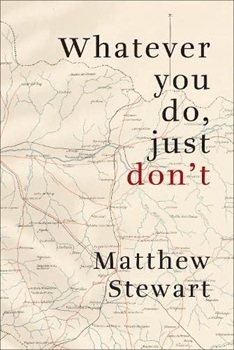
Review of Whatever You Do, Just Don’t, by Matthew Stewart, pub. Happenstance 2023
This is a collection by what you might call a doubly displaced poet: brought up in England, he moves to Spain and experiences being seen as a foreigner there, but when, many years later, he returns to the scenes of his youth (as the Welsh poet JT Jones put it, “to walk in the places where I used to run”), both he and they have changed enough to make him, again, a “foreigner”.
The collection is thoughtfully structured to reflect this narrative; in the first section “Britanico”, we can sense the strangeness of a new climate in “Calor”:
This isn’t heat. This is Calor,
silting and clogging up the air
and the effect of different history and memories in “Translator, Traitor”:
The War was 39 to 45,
suffering for the sake of a cause—
common enemies, common memories.
La Guerra, 36 to 39,
was brother killing brother, scores settled
with the neighbours, decades of reprisals.
He is good at focusing on the small details that constitute identity – forgetting which side of the road to drive on, having trouble with the Spanish rhotic “r” – the poem “Rolling my ‘r’s” echoes in reverse the Proclaimers’ anthem about how they could never “throw the R away”. I did think his reaction to surrendering his UK driving licence a bit overdone:
my balance
tilted and swayed— I had to make a grab
for the counter. (“Carnet de Conducir”)
But then I’ve never had a driving licence, so perhaps I underestimate the trauma involved…
There is a section dealing with “Family Matters”, principally memories of parents, in which there are some memorable images, like the paper clip around documents:
How it brings their things together.
How neatly, temporarily,
it brings them together.
The section “Starting Eleven”, at first sight, is something of an outlier in the pattern, concerning as it does past players for Aldershot FC. But since most of them seem to have come from elsewhere and later moved on, they too can be seen as deracinated, only ever temporarily at home. I liked “Ian Phillips”:
All he wants is to play one more season,
one more season, his shoulder relishing
the chance to usher dainty right-wingers
straight into the advertising hoardings
The last section, “Retracing Steps”, is the mirror of the first: on a visit to England it is the poet’s wife (or possibly son), rather than he, who is the foreigner, and post-Brexit, this takes on a menacing tinge. Brexit and its aftermath do not crop up much in UK poetry, but then few UK poets have this perspective on it:
Just don’t raise your voice if speaking
Spanish while on a bus or train.
Just don’t think anyone means you
when they slag off the foreigners.
Just take no notice of the flags
in every town. (“Warning”)
The poet himself, though screened by the English accent he has never lost, is conscious that he is no longer quite the same person who left:
But there’s a lift of my eyebrow,
rise in my tone at the end
of words. My dancing hands.
I wear these clues, can’t take them off
like some disguise. I’m different.
Are you afraid of me?
I was reminded of Confucius’s observation: “Men’s natures are alike; it is their habits that drive them far apart”.
But the most powerful poem in this section, and perhaps in the whole collection, for me was “Aveley Lane”, heavy with the transience of human existence wherever it is, “temporarily”, lived:
Here’s another mother getting supper
in Neil’s kitchen. Here’s another father
parking his car in Adrian’s driveway.
They go about their family routines
as if they’ll never be replaced.
This is an unusual collection, from a viewpoint we do not often see, and correspondingly enlightening.
March 16, 2026
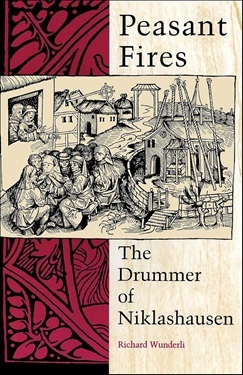
Review of Peasant Fires: The Drummer of Niklashausen by Richard Wunderli, Indiana University 2024
What was so frightening to authorities—those whom Widman spoke for—was that these people took to the road to Niklashausen and did not ask anybody’s permission, not from their landlords to leave work, not from their priests to go on a pilgrimage. Social rank and obligations just seemed to dissolve.
And we’re back to revolutionary history, in particular the class struggle in mediaeval Germany. In 2024 I reviewed Andrew Drummond’s fascinating account of the life and times of Thomas Müntzer, a priest who fought alongside his flock in the Peasants’ Revolt of 1525. Here, from 1476, is an earlier revolutionary, Hans Behem, or Böhm, who herded animals for a living (though so contradictory is the information about his life that we are not even sure if it was sheep, cattle or pigs) and who for recreation played the drum and wrote songs.
Both, after their death, were traduced by their enemies, but while Müntzer, a highly educated man, left us his own trenchant writings to correct the balance, Behem was illiterate. So we are left with the words of his opponents, and they differ wildly. Bishop Rudolph von Sherenberg of Würzburg, a contemporary, saw him as a dangerous opponent, shrewd and intelligent despite his lack of education. Later writers seem to have been determined to mock and belittle him, asserting that he was a noted fool whose words were dictated to him by a Franciscan friar – it is at this time that they begin to call him a swineherd rather than a shepherd, presumably with the symbolic implications of each in mind.
We do know, from the charges against him, some of what he preached to the peasants who flocked to his home valley of Niklashausen. In a time when land was held by a small number of nobles and churchmen, and peasants had few if any rights, he preached that “the waters and woods belonged to everybody"; and that the rich should be stripped of their wealth “so that we all have enough” (so hetten wir glich all genugk); and that “the time will come when princes and lords must work for a daily wage” (eβ karnpt dar zu, daβ die fursten und hern noch umb eynen taglone mussen arbeitten)”. He also held the recent Church invention of Purgatory in contempt and did not believe priests had the power to excommunicate people.
Behem’s transformation, apparently sparked by visions of the Virgin Mary, took place just after the season of Karneval and Wunderli argues convincingly that this season, when the world briefly turned upside down and normal social conventions ceased to apply, may have been the trigger.
Like Drummond, Wunderli is writing a history with many lacunae. He is scrupulous in indicating when he is speculating rather than reporting known facts, but I could do without his attempt to reconstruct from fragments one of Behem’s actual sermons. He is honest about it being a reconstruction, but it still feels off-key, because though we may know the gist of what Behem said, we can only guess at his tone, his delivery, whatever it was that so impressed his listeners.
Nevertheless, this is an absorbing account of a turbulent time and its main characters come very alive: Sherenberg, himself a would-be reformer whose attempts were constantly frustrated; the mysterious Beghard Brother who accompanied Behem to execution; the pragmatic Count Johann of Wertheim, who, replying to Church requests to prevent pilgrims travelling through his lands to see where Behem had preached, said that “he was reluctant to ban the movement of pilgrims through his lands because of the revenues pilgrims brought in. At least the count held a consistent position: banning tourism is bad business.” And Hans himself, commonly called “the youth”, whose behaviour at the stake, albeit reported by one of his detractors, who did not see it, still rings oddly true: “When he was tied to the stake for burning, however, he sang certain songs or verses in a high voice about Our Lady, which he had composed in the German language. […] But as soon as he felt the flames, he cried out three times, with a weeping voice, ‘O, o, o’. He was then engulfed by the flames. His voice uttered nothing again.”
February 28, 2026
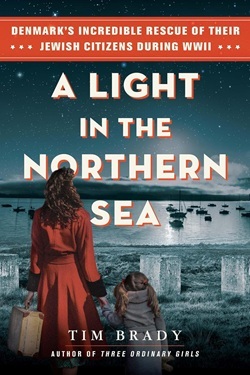
Review of A Light in the Northern Sea, by Tim Brady, pub. Citadel Press 2025
"So unprepared were most people; so little did a large part of Denmark’s population understand what had happened; so little had a majority grasped the nature of Nazism."
This is an account of the Nazi occupation of Denmark in World War 2, with special reference to Danish Jews and the largely successful efforts of the resistance and others to save them from genocide. But its relevance goes beyond that one situation; it also concerns the difficulties of deciding how to deal with aggressors and madmen in power, which could hardly have more contemporary relevance.
While Sweden’s neutrality was respected, Denmark, like Norway, was invaded and occupied by Germany early in the war (1940). They were caught unprepared: “Intelligence had suggested for weeks that German forces had been building on the border near Jutland in obvious preparation for an invasion, but Danish leaders in the foreign ministry had decided that any defense preparations would be viewed as provocative by Hitler, so they opted to do nothing, which left the Danish Army and Navy with their hands tied” (I should mention that Brady is American and hence naturally uses US spelling conventions). Now faced with vastly superior forces, the king (Christian X) and government reluctantly decided to submit, under protest, rather than resist at the certain cost of many Danish lives.
This did not sit well with most Danes. There were some, especially near the border with Germany, who supported Hitler, but most were indignant and ashamed at having been invaded and without resistance – sabotage, on a small scale, began almost at once and soon escalated when SOE were able to help. But it is hard to see what else the Danish authorities could have done, except be better prepared in the first place. Resistance, once the invasion had begun without warning, would not only have cost many lives but would also have been futile. The king, especially, hoped to be able to influence the course of events and protect his people better by staying and wielding at least some authority.
For some time, this seemed to work. The Germans, warned by their men on the spot about the Danish character – “The Dane is freedom-loving […] He rejects every coercion and every subordination. He lacks a sense of military discipline and authority” – adopted a hands-off approach. Saboteurs were dealt with under Danish law rather than shipped off to Germany and there was at first no persecution of Jews, the king having made it very clear that “there is no Jewish question in the country. There is only my people.”
With hindsight, the first hint of trouble came when, after invading Russia in 1941, the SS demanded the arrest of Danish Communists. “Would the Danish government insist on their protection as Danish citizens? […] The answer to that last question was no, […] Danish Communists were rounded up and taken to a Danish internment camp, Horserod, in August. Soon after, the Danish Ministry of Justice drafted a law making any Communist activities and organizations illegal in Denmark”.
Danish Communists had made themselves unpopular with their fellow-citizens by supporting the Soviet Union’s invasion of Finland. But resistance fighters, like the Kieler family, recognised that this was the thin end of the wedge, an admission that Denmark could not rely on being able to protect its own citizens from the invader. But the Communists were at least still in Denmark, and many still allowed themselves to hope things would get no worse. This, by and large, included Denmark’s Jews. They had had a long and mostly untroubled history of settlement in Denmark, since the 17th century when Sephardic Jews came to escape Tsarist pogroms in Russia. They were very assimilated. “The Jewish population, in general, felt as certain as most other Danes in the hope that the country’s culture, its democratic traditions, its king, and its economic importance to Germany would save it from the usual depredations visited on Germany’s own Jews and the Jews of Eastern Europe. If they just kept their heads down; if they stayed as invisible as possible, they might make it through.”
But imitating the action of the ostrich can be risky, when faced with an unpredictable and capricious opponent. Hitler’s attitude to Denmark apparently hardened after he sent Christian X a rather fulsome birthday greeting in 1943. This seems to have disgusted the king, already no fan of his, who replied with a curt 4-word note of thanks. Hitler went into a tantrum, as mad despots tend to do when they feel insulted; indeed much as Trump does these days. From then on, the Jews of Denmark were in as much danger as elsewhere, but it would still take a lot to convince them.
Fortunately there was by now a flourishing Danish resistance. In response to their increased activity the Germans demanded that the Danish government declare a state of emergency and enact draconian laws. The government refused and abdicated its functions, while Christian X declared himself a prisoner of war. “The next day, the citizens of Copenhagen awoke to find German troops swarming everywhere in the city, guarding and occupying all government buildings. In addition, von Hanneken ordered the roundup of hundreds of Danish leaders, including military figures, intellectual and political leaders, and, for the first time, leaders of the Jewish community.”
The resistance now applied themselves not just to sabotage but to helping the Jews to escape. But many would not have been persuaded of their danger in time, had it not been for a German diplomat, Georg Duckwitz, who tipped off both the Danes and Sweden that arrests were imminent and urged Sweden to accept the refugees. The physicist Niels Bohr, whose mother was Jewish, had also been working to this end and continued to do so once he had escaped to Sweden.
From then on, the book describes the efforts of good and brave people to thwart the genocide. Led by the young surgeon Dr Karl Koster, the staff of Bispebjerg Hospital turned the whole place into a safe house. The Kieler family, Henny Sinding and others organised boat crossings to Sweden and raised money both for the emigrant families, and for the fishermen who were risking life and livelihood by carrying them. “During a particularly busy moment at the height of the evacuation, Dr Koster found the coffers bare just as a group of Jews were being prepared for transport. In searching around for some source of emergency funds, he remembered that King Christian was being held under house arrest in nearby Sorgenfri Palace. In a move that was considered as audacious as it was necessary for the rescue of the refugees, Koster sent two of his most trusted nurses to the king to ask for his charity. According to Koster’s own account of the incident, ‘They were not disappointed’.”
The book focuses on individuals and is the livelier and more absorbing for this. But the message it left with me concerned the danger of the ostrich approach. If it looks like a fascist, talks like a fascist and acts like a fascist, don’t waste time hoping it may turn out to be a pussycat. Believe that it will do what it says. 95% of Denmark’s Jews were saved, but the conduct of the Nazis toward those they did lay hands on, including all the inhabitants of an old folk’s home, indicates what would have happened were it not for people like those in this book. Don’t think you can appease the beast either; you probably can’t. Elsebet Kieler, one of the resistance, was conflicted because she was a confirmed pacifist and hated the idea of causing death. She consulted the pastor, poet and resister Kaj Munk, who advised “Burn all your literature on this topic, at the present moment it is not relevant, or is simply a millstone round your neck—and learn how to use a machine gun”. Munk was eventually killed by the Nazis.
February 15, 2026
Review of The Other Ancient Civilisations, by Raven Todd DaSilva, pub. Mango 2024
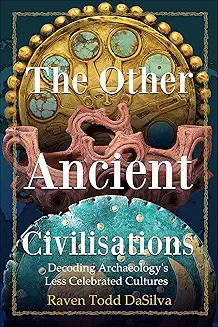
This is an introduction to twenty ancient civilisations that don’t get as much attention as some more famous ones, partly because there is less archaeological information on them, partly because they have not the initial glamour of ancient Greece or Egypt. Some are more obscure than others. I would guess many know at least something of the Cretan, Akkadian and Indus Valley cultures, while far fewer will be acquainted with those of Great Zimbabwe, the Lapita of Oceania, and the Moche of Peru (a bunch with whom you wouldn’t want to be at all closely acquainted, unless you had an unusual interest in torture and Toby jugs). And I certainly wasn’t aware there had ever been such a thing as a Mississippian civilisation.
Each section begins with an imagined and italicized reconstruction of a moment in the life of someone from the culture in question. I don’t mind these, since the italics make it clear that they are fictional. Then we get an overview of the particular civilisation: where its people came from, what marked them out as a culture, what caused their decline and what influences and achievements they left behind.
Surveying so many cultures in succession can be slightly overwhelming; one tends to merge into another. But there is a great advantage: it shows not only what individualises these civilisations but what they had in common. It becomes clear, for instance, that few things matter more to any urban or semi-urban culture than good management of water and sewage. Over and over, we find that societies which lasted for any length of time - the Hittites, the Minoans, the Nabateans - had engineers who could ensure a supply of pure water and the removal of waste. At Harappa in the Indus Valley, they “created water management and sanitation systems that were unheard of for their time, and not seen again until Roman times, two millennia later. Drains and sewage systems were built to help remove wastewater and other sewage from the city. They normally ran down the middle of the main streets”. This would have materially reduced death by disease, though in that way towns could become victims of their own success – at a later stage of Harappa’s existence, its population outstripped the infrastructure, “sewage overflowed onto streets and into houses, forcing the city’s inhabitants to raise the level of their doors and walls.”
One craft product which individualises any culture, and which fortunately for archaeologists tends to survive in the ground, is pottery, and here the variety is extraordinary, from the Minoans of Crete, who, almost alone in the Bronze Age, ignored the celebration of rulers and wars in their art, favouring instead flowing designs of sea creatures, to the Moche, who preferred depictions of sacrificial victims, or possibly just enemies, being tortured to death. They also, no kidding, seem to have invented the Toby jug: “the Moche created lifelike portrait vessels either in the form of a human head or of their full figure. These vessels were modelled with individual traits and features that evoke their personalities so well, that they appear to have been modelled after living people. These portraits are so detailed that researchers today have been able to identify individuals possessing infectious and neurological diseases, mutilation, and congenital disorders. People were masterfully sculpted with various conditions such as Down syndrome, extra toes, and cleft lips.” An odd lot, the Moche.
Another common factor that emerges is the way these cultures go into decline. She makes it clear that there is seldom or never one reason for this, rather a number of factors coming together, but one possible cause that crops up over and over is environmental. Sometimes it is in the form of climate change outside human control, like the Little Ice Age which may have put an end to the Thule Inuit. Sometimes it is down to over-use of natural resources: the wealth of Nubia was built on iron, but the smelting of iron requires huge amounts of charcoal, which entails burning wood. “Eventually, this caused mass deforestation and Meroë depleted its local wood supply. This, combined with overuse of their fields, led to the complete exhaustion of their environment.”
Downsides to this book. There are too many typos, at least in the Kindle edition, I can’t speak for the print version. There is no index, at least in the Kindle version. There are also infelicities of style. The chapter heading “A Return Back Home” is just an irritating tautology, and the sentence “The girl poked her head around the stable door, careful not to alert her father of her presence” is bad grammar; “of” should be “to”, but at least the meaning is clear. But this sentence; “To the European colonists, Great Zimbabwe was made by who they considered to be the great people of the ancient world, and centuries older than what it really was” is so clumsily phrased that I am not at all sure what it means. This is infuriating, as it occurs in the course of a fascinating and informative account. I was not surprised that early Europeans insisted on believing buildings, monuments and artefacts in Africa to have been made by ancient Phoenicians or Arabs; indeed most are aware that they did. But it was news to me that long after it became clear that this narrative was false, as late as the 1960s, “the ruling political party, the Rhodesian Front, even went as far as blocking books about Great Zimbabwe. Some archaeologists who refused to accept the narrative of the site’s biblical origins were imprisoned and deported.”
This book, then, has much to tell us, and while I don’t find the style always to my liking, I can’t deny the import. It does not claim to be anything but an introduction to all these cultures, there is a bibliography for those whose interest has been whetted by some chapter and who want to find out more (on the Akkadians, I can recommend "Weavers, Scribes, and Kings: A New History of the Ancient Near East" by Amanda H Podany).
February 1, 2026
Review of Secrets of the 17th Century Medicine Cabinet by Katherine Knight, The History Press 2024

Use three Physicians still; First Doctor Quiet, Next Doctor Merry-man, and Doctor Dyet.
- From Sir John Harington’s translation into English of the Regimen Sanitatis Salerni
“Avoid stress, keep cheerful and eat the right things” is not bad advice for maintaining good health, and a feature of this book is that it does not spend much time mocking the supposed credulity and ignorance of our ancestors. There are of course some outlandish “cures” that can only have made matters worse. But as Knight points out, quite apart from the state of medical knowledge at the time, most people simply could not afford a qualified doctor – as Nicholas Culpeper observed in a bit of tart wordplay, “Too many Physitians in England being like Balaams Asse, they will not speak unless they see an Angel.”
People were therefore driven back on their own knowledge and resources, and “people” generally meant housewives, who were responsible for keeping their families healthy as they were for feeding them. Medicine, in an everyday context, seems to have been viewed as a rather specialised branch of cookery – indeed this was how the author, from an original interest in historical cookery, came to research the subject - and the “household books” that many women kept contained recipes and remedies indiscriminately mixed: “in 1699 a cure for urinary gravel appears between recipes for potted tongue and potted herrings”.
Most of these remedies were of course herbal and relied on knowledge, or assumed knowledge, passed down generations. When this was observational, the result of trial and error or of watching what animals ate to relieve pain, it often worked. The use of onion juice to treat burns, for instance, was based on the work of Ambroise Paré, a French surgeon of the sixteenth century, who pioneered more humane and effective methods of treating battle wounds, and since, as we now know, onion has antibiotic properties, it would have helped the damaged tissue to resist infection. And Lady Egerton’s remedy for “greensickness” in girls, which involved dissolving iron hobnails, looks less eccentric when one realises that greensickness was probably a form of anaemia.
Remedies were less useful when based either on the ancient medical knowledge of men like Galen which, though outdated, had acquired a sort of unchallengeable authority, or on superstition and sympathetic magic – eg, yellow plants would be good for jaundice. And some herbal cures would have been of more use if their authors had not crammed in as many herbs as they could think of, presumably either on the basis that more was better, or in hopes that one of the many might prove curative. In fact though, the effect of one ingredient might well counteract that of another, while boiling them to intensify their essence might also destroy much of their virtue.
Indeed some of the receipts are fiendishly complicated and would have taken days to prepare. Knight suggests, plausibly, that the amount of work involved may have been as much to relieve the home physician’s feelings as the patient’s condition. Referring to a medicine for advanced TB, a condition which was almost certainly going to be fatal, she says:
“It is a ‘raire watter’ distilled from a cock, half a gallon of sack, milk, dried fruit, herbs, rose water, hartshorn and china root – plus sugar candy, gold, musk, ambergris, horn of unicorn and bezoar stone. Very expensive, but when a life was obviously ebbing it may have helped to realise how much one was prized by the family who were paying for these costly ingredients. As far as the family was concerned, too, perhaps they felt that they had done their utmost for the patient.”
The mention of gold among the ingredients is interesting. As late as the mid-20th century the tubercular George Mackay Brown was being given injections of gold which probably did no good and were certainly potentially toxic. We may no longer tie dismembered tench to the stomach to cure jaundice, and we know that tobacco, far from being the panacea Culpeper thought it, caused his early death, but we are perhaps not so far removed from our ancestors as we might think: sick folk and their relatives still hope for miracles and sometimes look for them in bizarre places. Richard Burton (the author of The Anatomy of Melancholy, not the actor or the explorer) remarked “We see commonly the toothache, gout, […] and many such maladies cured by spells, words, characters and charms […] All the world knows there is no virtue in such charms or cures, but a strong conceit and opinion alone”. In other words, vis medicatrix naturae, the impulse of the body to heal itself, can sometimes be aided by what we would now call the placebo effect, the feeling of being valued and looked after.
There are amusing moments in this book, but the feeling it left me with was one of sympathy for ordinary people, usually the women who kept those “household books”, who were doing the best they could in the face of diseases they knew very little about.
January 16, 2026
Review of Becoming Henry, by Graham Strugnell, pub. Constellations Press 2025
Thank you, dear,’ she said, the way adults did when they thanked you for something that hadn’t really helped and that they hadn’t really wanted.
This is a coming-of-age novel, the progress of the eponymous Henry through the sixties and seventies, from birth to leaving for an unspecified university. It is written in close third person, and almost all from Henry’s point of view.
A child’s-eye view can give a fresh outlook on things, because their perspective is so different from an adult one. They observe in a way adults seldom do – “the mangle, a strange thing that looked alive and sad and whose rubber lips were chapped and perished” – and their sense of priorities and realities is different, as becomes apparent when a sudden accidental death happens at Henry’s primary school. The adults are horrified, but the children sharing the news, “smiled, because deaths never happened at boring old school, and it was exciting and not quite real, like something in a story or film”.
They also tend to be solipsistic, and Henry is no exception. He is not particularly likeable or dislikeable, more your average ordinary child morphing into your average whiny. self-obsessed, self-pitying teenager. Indeed a key moment in his development is when he briefly contemplates suicide, for no better reason than that a girl he’s only just met has refused to go out with him, but is distracted by a phone call from a friend. Afterwards, returning to the pills he has collected: “he stared at them for a while and tried to remember how he’d been feeling before the phone call but could not. Then he picked up the pills and went back to his mum’s room, replacing them in her medicine bag. Back in his room, he re-read his note and shook his head, as Mr Muldoon would have done, at the hackneyed phrasing. Then he tore the note into small pieces, and put them carefully in the bin.”
Henry’s viewpoint is challenging, both for the writer and any adult reader, because we can share, as Henry at the time cannot, the adult viewpoints that baffle him as a child and annoy him as an adolescent. It may be particularly challenging for a female reader, because part of Henry’s trouble, in his own mind, is that he is male. His father does not provide the kind of male role model he wants, and he feels his mother prefers his sisters and sees his masculinity as a nuisance: “‘Why can’t you be more like your sisters?’ she said, waving her duster, a technicolour nylon thing on a stick, as if she would dust him out of existence, or at least, into femininity”.
An adult reader can see that this may not be what she means at all, and can also see that Henry’s resentment at his sisters “getting away” with things at certain times stems from his total inability to appreciate how enervating the onset of menstruation can be: “They were girls; they had strange fits of weakness where all that would console them was cake and music and cartoons on TV. Henry knew then that girls would always get away with things that he couldn’t, and that, all things considered, he would have been better off born female.” But though the first reaction of a female reader to this whinge may be pardonable irritation, it is illuminating and thought-provoking to see how things look to him, and perhaps to boys in general.
Henry grows up in the 60s and 70s, which makes him about 10 years younger than me. For the most part, I think the evocation of the time period is convincing without looking over-researched. The obsession of Henry’s mother with class and her horror of anything “common” ring very true for the time, as does the gradual change in dietary habits: “You should never invert your fork and shovel in food as if it were coal going into a boiler. Holding your fork that way was only acceptable if you moved it to your right hand and were eating spaghetti Bolognese, which you sprinkled with a thin dusty cheese called Parmesan, that smelled faintly of vomit. The smell made it sophisticated and more Italian, his mother said. Sophisticated meant eating food that was slightly disgusting. This food was what was called an acquired taste.” Only at two points did I feel “hang on, it wasn’t like that”. One was when we hear that Henry and his sisters, as teens, liked The Waltons. Now admittedly it is hard to judge, because I was a teenager in the 60s, which were more rebellious and cynical than the 70s, and it’s also possible that because of the Vietnam war, we were more anti-American than the next wave of teens, but I recall The Waltons (first broadcast 1972) as the sort of squeaky-clean programme one’s parents liked, which pretty much made it anathema; I can’t imagine teenagers of any time watching it unless to mock.
The other point that puzzled me was the indifference of Henry’s teenage schoolmates to events in the wider world: “Outside the window, the other world was still there. It was a world of power cuts, and punk; a world of strikes and the IRA. Bombs were everywhere: in pubs, letters, packages, carrier bags, pillar boxes; in tube stations, trains and litter bins. There were firebombs and nail bombs, car bombs and boat bombs. All this was in the air and on the radio and on the TV in the living room, but the boys hadn’t been taught to take an interest, and these events might as well have been happening in another country.” I went to the same kind of school as Henry (except that mine was co-ed) and I remember heated conversations in the playground about current events. Again, this may point to a difference between the two decades: maybe the space race, swinging London and the 1968 assassinations in the USA were just more interesting, but one would have thought the IRA bombs at least would have held their attention.
The author’s wry, observational tone can often be very funny, and he is good at pinpointing a character. The foibles of Henry’s mother make an especially good target: “She believed in extra sensory perception and sometimes exclaimed when she turned on the radio, because the song she’d been humming in her head was playing right now, and that just showed you, didn’t it?” Not that Henry himself escapes: “He’d begun drinking coffee because he believed doing so made him an intellectual. In fact, it only succeeded in making him jittery and giving him heartburn, but still, he thought, one must suffer for one’s art.”
In many ways, this is an ambitious first novel – set in a past many can still recall, seen through a child’s eyes – and one of the most ambitious things about it is its choice of a really quite ordinary boy as protagonist. Henry’s progress toward being adult, male and reasonably comfortable in his skin is not that of someone in any way remarkable but of Everyman, which makes it the more interesting and meaningful.
January 1, 2026
Review of Dead in the Water, by David Wishart, pub. 2025
“Marcus. If Meton is stuck in bed upstairs for the foreseeable future, then who’s doing the cooking?”
Who indeed? Meton the anarchic but brilliant chef is so essential to the Corvinus household that his indisposition is a serious matter, especially since the solution proposed by Vipsania, Corvinus’s mother, is to play her own chef, the too-inventive Phormio, as substitute… Meanwhile Corvinus is investigating another murder, that of an inoffensive boatman with no known enemies. His investigations take him to Corsica, where he runs into an old acquaintance of his and ours, the philosopher Seneca, currently in exile. Corvinus has fond memories of their former meeting:
“He may be a serial furkler, a social climber of the first water and a third-rate poet, but he hasn’t got a speck of real political ambition in his makeup, let alone the stomach for any kind of risk-taking. He’s a worm, the sort that gives other invertebrates a bad name.”
It's the presence of Seneca that alerts us to the fact that this is one of the “political” Corvinus cases. As so often with these cases, the ending proves frustrating for Corvinus, in that though he knows whodunnit, there is a limit to what he can do about it.
Indeed in some ways this feels like one of those films-in-the-middle-of-a-trilogy, where you can sense that the author is building up to No 3. The first in this “trilogy” would have been Family Commitments, two or three books ago, in which Corvinus became aware of certain treasonable goings-on involving a relative. Three characters from that book, his major-domo Bathyllus. the latter’s slightly dodgy brother Damon, and the freedman at the top of the civil service, Narcissus, also figure in this case. And I can guess what the climax of the third is set to be…
In the meantime we have a complex plot with one quite surprising (but plausible) twist at the end, and some memorable characters.
You can keep up with Mr Wishart’s proceedings on his website.
December 19, 2025
List of 2025 blog reviews
Here's my list of this year's reviews, with links
Poetry
Real Lear: New & Selected Poems by Claire Crowther, pub. Shearsman 2024
From Base Materials by Jenny Lewis, pub. Carcanet 2024
Chalking the Pavement by Kate Noakes, pub. Broken Sleep Books 2024
A Bird Called Elaeus: poems for here and now from the Greek Anthology, by David Constantine, pub. Bloodaxe 2024
Leaving the Hills by Tony Curtis, pub. Seren 2024
Aleph Bet by Sue Rose, pub. Cinnamon 2025
maybe i'll call gillian Anderson by Rhian Elizabeth, pub. Broken Sleep Books 2025
Object Permanence by Anne Berkeley, pub. The Garlic Press 2025
The Green Month by Matthew Francis, pub. Faber 2025
Anthologies
Fire, Brigid and the Sacred Feminine, eds Shauna Gilligan and Niamh Boyce, pub. Arlen House, 2024
Prose fiction
Fox Bites, by Lloyd Markham, pub. Parthian 2024
Circulation, by Magnus Florin, trs. Harry Watson, pub. Vagabond Voices 2024
The Bruegel Boy, by Emma Darwin, pub. Holland House Books 2025
Children’s/YA
Kata & Tor, by Kevin Crossley-Holland, pub. Walker Books Ltd 2025
Non-fiction
The Hundred Years War Vol 5: Triumph and Illusion, by Jonathan Sumption, pub. Faber 2023
Edinburgh: A New History, by Alistair Moffat, pub. Birlinn 2024
Embers of the Hands; Hidden Histories of the Viking Age, by Eleanor Barraclough, pub. Profile Books 2024
The Haitian Revolution: An Enthralling Tale of Resistance, Freedom, and the Birth of a Nation, by Billy Wellman, pub. Enthralling History, 2024
Little Englanders: Britain in the Edwardian Era, by Alwyn Turner pub. Profile Books 2024
The Book of Hope: A Survival Guide for an Endangered Planet by Jane Goodall and Douglas Abrams, pub. Viking 2021
Twilight Cities, Lost Capitals of the Mediterranean, by Katherine Pangonis, pub. Weidenfeld & Nicolson 2023
Bletchley Park’s Secret Source, by Peter Hore, pub. Greenhill Books 2021
The Ship Beneath The Ice, by Mensun Bound, pub. Macmillan 2022
Our Daily War by Andrey Kurkov, pub. Open Borders Press 2025
December 16, 2025
Review of The Bruegel Boy, by Emma Darwin, pub. Holland House Books 2025
If he’s lying by omission then it’s only as all storytellers lie: they tell what makes the story work and they don’t tell what they must not; nor what they cannot.
In 1627, Gillis Vervloet, known as Gil, is a man of 79, seeking to end his life as a monk at an abbey in Saarland. But because, in his far-back youth, he was involved in some dubious activities, his admission to the abbey depends on two things: doing the abbey a favour via some detective work involving a statue looted and possibly destroyed during the religious wars of those times, and an account of his life that he is writing to help the abbot decide whether he is suitable.
There is a split narrative from then on, between 1627 and Gil’s youth. In addition we see some of the account he is writing, from which it becomes clear that the abbot is getting a heavily edited version of the story that we, as readers, are hearing from Gil. Indeed there are sixty years for which we do not see this account, and it is implied that whatever else Gil told of these years, he cannot have included the profession he practised then, or the abbey doors would surely be shut to him.
Most of the narrative takes place in the Low Countries – Antwerp and Brussels, mainly – between the years 1562 when the 15-year-old Gil arrives in Antwerp and somewhere around 1567, when he has to flee abroad. They are eventful years, dominated by religious strife and Gil’s friendship with the artist Pieter Bruegel, who takes him on as an artist’s model and to keep his accounts. Gil also models for other painters and sculptors and there is an intriguing possibility that he may have modelled for the very statue he is seeking.
Gil’s life at this point in his youth is complicated by the involvement of his brother Roeland and his religious mentor the priest Paulus in reform movements which could get them and all their associates into trouble with the Inquisition. His other problem is that though his greatest wish is to be a priest himself, his attraction to women, and to the idea of marriage and a family, is almost equally strong. He is continually having to choose between friendship and duty (as he sees it), and between the religious life and his natural inclinations.
A major factor in the religious strife of the time is the question of images, which ties into Gil’s search for the statue. Paulus the reformist priest objects to the whole idea of earthly representation of holy images; ‘But in kneeling to lead-white and madder, and to the image of a lazy servant girl and a lewd apprentice paid by the hour to represent the saints, a man plants God’s gift of adoration into the sinful earth of his gross and worldly desires.’ This could not be further removed from Bruegel’s ethos in painting, as expressed in a conversation with Gil: ‘Why do you draw drunkards? Or criminals?’ ‘Because they’re men, and men get drunk and so do women, and they’re proud, and wrathful, and they fornicate. So I need them for my pictures.’ ‘So you paint sin?’ ‘Men sin, and women too. Wrong-doing – malice and hurt – or folly, or simply what we break by our own carelessness…they’re in our nature.’ All his life, Gil is torn between seeking fulfilment in the religious or the secular, between idealism and nature, and it may seem that at the end of his life he has opted for the former, but a key passage earlier suggests that it is Bruegel’s view of the world that has influenced him more:
‘It was on the long, damp trudge back home to Antwerp that happiness came on him suddenly, like sunshine. It was in the moment he stooped to talk to a dog who reminded him of Pelle, and when he broke his limping stride to help an old man and his even older wife over a stile. It overflowed when he came on a woman at a crossroads weeping over a newborn baby as she sought the White Sisters’ orphanage at Middelheim. He could say with truth that the Sisters would be good to the baby and were very holy and loving, and when he left her and the child with the portress she was quite calm, her face softened if not smiling, and reconciled to her sacrifice. And in all that ordinary road was nothing glorious: no beauty among the dripping hedgerows and the cow-pats, no glory of angels in those sodden skies, no high majesty and passion in the sacrifice, no joy in being reconciled to sorrow…only the happiness granted to an ordinary witness to these ordinary things.’
In a time of murderous religious intolerance, Gil eventually seems to come close to believing, with Elizabeth I, that ‘there is only one Christ Jesus, one faith. All else is a dispute over trifles”. He also comes to see that concepts like “truth” and “memory” are not as clear-cut as some imagine and that ‘people are lots of things’, as Bruegel paints them, unlike the saints his fellow-servant Doortje recalls from the orphanage of her childhood:
‘the saints they taught us in the Maagdenhuis – I shouldn’t say it, I suppose – but they were so simple. Like the puppets at the Poesje Theatre: carved to be good, or bad, and the same – just wood – all through. You never wonder what they’re thinking, the way you do with Mijnheer’s people.’
Gil, looking at one such painting, reflects, ‘it was the Bruegel Gil had always known – a true Bruegel if not the only true Bruegel – who had painted it. Gil could not accept Bruegel’s faith, any more than he could accept Roeland’s. But each was a good man, and a wise man – most of the time – and surely the rest of it all could be left to God’.
The end of the book, where sixty years are skipped over in a few paragraphs, did feel somewhat rushed to me. In a way, this is inevitable given the novel’s structure. It is the events between 1562 and 1567 that Gil is trying to justify to the abbot, plus for his own safety he needs to conceal from him much of what happened afterwards. But given that Bruegel had been so important to him, it seems odd that his early death in 1569 doesn’t rate a mention – it would have happened while Gil was abroad, but we are told they kept in touch by letter.
One reason this struck me, though, is that Bruegel is such a towering character in the novel – fully realised, fully rounded, as contradictory and exasperating as humans generally are. He comes alive as Doortje’s wooden saints did not. So, and this is important in a historical novel, do the place and time.

