
Kevin T. Patton's Blog: Patton's Anatomy & Physiology
March 28, 2022
Active Concept Maps Help Students Make Connections
We all know that concept maps help students learn anatomy and physiology in at least two ways.
One way is when we use concept maps to teach principles in a visual manner that clearly shows relationships among several ideas. Students thus clearly see how to organize their thoughts about connected ideas as they construct their own conceptual frameworks as they learn.
Another way concept maps help students learn is when they build their own concept maps from what they already know about anatomy and ...


March 10, 2022
Tips and Shortcuts for Surviving and Succeeding in A&P
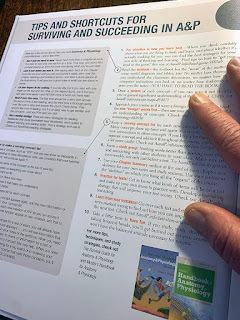
A feature of Patton Anatomy & Physiology that is often overlooked by faculty, but loved by beginning anatomy and physiology students is called
Tips and Shortcuts for Surviving and Succeeding in A&P.
As soon as an A&P student unwraps and opens their new textbook, they flip over that endpaper and find this one-page guide on how to get started on the path to success. That one page is loaded with great study tips and how-to-read-a-textbook guidance organized in an intuitive, graphic manner.
From meta...
October 21, 2021
Netter 3D Anatomy—Now Better Than Ever!
We've been offering Netter 3D Anatomy as a supplement to Patton Anatomy & Physiology at no added cost through the past few editions. Faculty and students alike have enjoyed the adventures they've undertaken as they explore the various regions of the human body using three-dimensional, dissectible images. That won't change in the new 11the edition. Or will it?!
The availability of Netter 3D Anatomy will still be there. And it will continue to be offered at no added cost to students. But it will be...
August 21, 2021
The Lymphatic System Deserves Its Own Chapter

A social media thread I ran across recently laments that the lymphatic system is an undervalued and undertaught topic in the anatomy and physiology curriculum. That puzzles me.
Admittedly, I don't bring up the lymphatic system a lot in my day-to-day conversations. Not even other A&P enthusiasts. But it does come up sometimes in conversations about teaching or learning A&P. And when it does, I think the usual reaction involves some variety of love for the lymphatic system. So I'm puzzled.
In our P...
June 29, 2021
Diverse Representation in Anatomy & Physiology
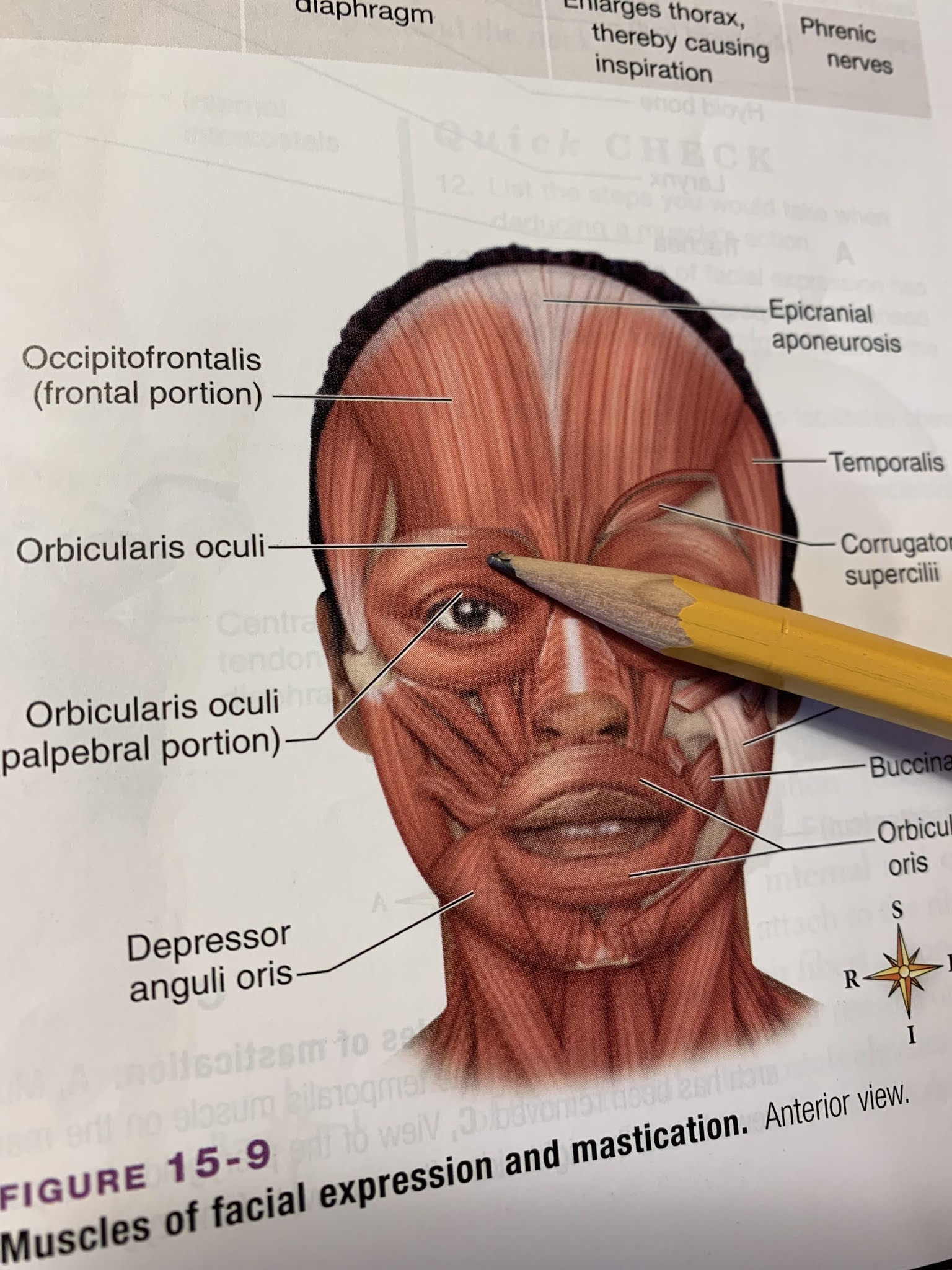
From the earliest days of my involvement with the Anatomy & Physiology textbook, I've strived to ensure that the representation of people in the illustration program, the chapter narratives, the examples and cases presented, reflects the diversity of humanity.
My publisher has fully supported my (rather expensive) requests for creating new artwork and shooting new photographs. They have also supported my chapter revisions and have helped me find and revise passages that need improvement.
March 31, 2021
Stress Deserves Its Own Chapter
One of the advantages of organizing anatomy and physiology concepts into short, modular chapters is that it gives us more flexibility in teaching. It also permits us to focus on important topics that are often buried within a large chapter that covers many subtopics. Taking this advantage, Anatomy & Physiology puts the clinically important concepts of stress into a single, independent chapter.

March 22, 2021
Your Modular Anatomy & Physiology Textbook
Ever dreamed of rearranging the order of topics in your course. That is, have you ever wanted to shift the order of topics as they are presented in your textbook to fit the way you tell your story of the human body? Without the obstacles of assigning a half-chapter here and the other half-chapter there—and possibly causing some students to get a bit lost?
Yeah, me too. That's why I've worked hard to move away from the gigantic-chapter model we see in most A&P textbooks to the modular model in our...
June 22, 2020
Pandemic Scramble: Keeping It Simple
First, "remote" need not always be "online." There are a lot of learning opportun...
June 15, 2020
Pandemic Scramble: Use Netter's 3D Anatomy Included with Your Textbook
Guess what? If you and your students are using the Patton Anatomy & Physiology textbook in your course, you already have a great tool! At no ex...
June 1, 2020
Pandemic Scramble: Use Your Included Online A and P Course
One such tool that we may already have handy is Anatomy & Physiology Online . This product is packaged at no extra cost with many versions of the Anatomy & Physiology textbook. Check which version has be...
Patton's Anatomy & Physiology

- Kevin T. Patton's profile
- 12 followers

