Ginger Marks's Blog
July 3, 2022
What Publishers Want You to Know
As a publisher with nearly two decades of experience, and authors from all over the world, it is my distinct honor to share my accumulated knowledge with you. Let me begin by sharing a bit of how I got here.
My career as a publisher began after I published my first book, Presentational Skills for the Next Generation, which was reviewed by the author of PowerPoint for Dummies. I was so excited when I held my ‘baby’ in my hands! Then, I opened the cover, and the cover cracked! I cried, yes, literally cried. That is when I decided that I was going to find a better way and help others to do so as well. Thus, my journey began to find a way to publish books without the unreasonable cost and time that I endured.
Like many other business owners before me, I too started as a one-stop-shop and as my business grew, I began to add sub-contractors for the various services required to bring a quality book to press. My one requirement was, and still is, that my joint venture partners would embrace my business statement, “High quality results at a reasonable rate”.
Besides working with my authors, I also assist other publishing houses and self-published authors to create first-class books at an affordable price. I very seldom market DocUmeant Publishing or it’s sister company DocUmeant Designs, because my business model is referral based. This allows me to give back a little bonus income to the person referring a new author or publishing house to DocUmeant Publishing. Therefore, it’s a win-win-win for all three individuals/companies involved.
So, as an author, you probably want to know what you can expect from a publisher. Well, to be blunt, publishers publish, marketers market. However, most mid- to large-size publishing houses hold memberships in trade associations that can offer us discounts on services. This savings can then be passed along to our authors, giving them cost savings on their marketing dollars, if they so choose. In addition, more often than not, publishers charge for marketing design. This is one of the ways DocUmeant gives back to our authors. Because I am an ISNI registered designer, I am able to provide, at no cost to my authors, an Author Media Kit that contains all of the initial marketing designs an author needs to get their marketing started.
Now, you probably want to know how to get our attention. There are really several very important things you need to be aware of. There are three types of publishing options available to you. Traditional, self-publishing, and hybrid publishing aka subsidy publishing. If you want to learn more about these options, feel free to either comment below or send me a quick IM or email.
Another thing to look for is if the publishing house even publishes your genre. A quick look at their website will reveal not only their book genres, but the quality of their end product. While you are there, be sure to check to see if they have submission guidelines. If you want them to take your book under consideration, you absolutely need to format your manuscript to their specifications. Failure to do so could result in yet another rejection.
I offer you one final tip that will go a long way to helping you get that contract. Write, read, re-write, at least three times before you send it off to your editor. The cleaner it is the less time it takes to edit, thus less costly.
For more information visit https://www.DocUmeantPublishing.com


June 29, 2017
Creative Ways to Market Your Book
As a publisher I am often asked what type of marketing I do. Like most publishers these days, we generally make your book available to the bookstores, libraries, and other book sellers through the purchase of book catalog listings and advertising. However, the bulk of the marketing must be done by the author themself.
You, as the author, are best equipped to market your book because you know it best. Besides, who else can sign your book? Surely not the publisher. That is why they call them “Author Book Signings” and not “Publisher Book Signings.”
So, how can you market your book to help you make the most out of your time and effort? Here are just a few creative ways to get the word out and as a result sell more books.
Quote Excerpts
Everyone is using social media today, but what can you do different that will make you and your book stand out? Rather than just posting your book cover and asking for the sale, why not start by quoting from your book and then share with them where you pulled the quote from in your book, by chapter at the very least.
Here’s an example:
“If you are lucky enough to have kids old enough to write ask for their assistance. Begin a marketing campaign with their help. Have them write a short note to your target market inviting them to visit your store. Everybody love kids and their handwritten note could be just the thing to get your potential client or customer to take action.” Excerpt, Complete Library of Entrepreneurial Skills, Abridged. ISBN 978-1-937801-78-6. See Marketing, Ten Summer Marketing Ideas for Your Business, p 167.
Everybody loves graphics! Take advantage of that fact and create graphics that showcases your book…
Click To Tweet
 Graphics
Even better still, turn it into a graphic! More and more we are seeing sites like Pinterest and Snapchat and even Facebook is getting on the bandwagon with video and graphics. So, why not take advantage of this phenomena and create an eye catching graphic?
Joint Venture Partners
Have you ever experienced a truly memorable dining experience? After you did, what did you do? I bet, like most of us, you told everyone who would listen how wonderful your experience was? What about a product you used that really worked? Same thing, right? Well, then why not find others who believe in your product, services, or book and offer to talk up their wares when they talk about yours? You don’t even have to split the profits! In this way, they open their list you to and you to them.
Affiliates
Yes, affiliates are a terrific way to take your JV partners one step further. However, who said you can’t be your own affiliate? Sign-up to be an Amazon Affiliate and claim your books and products. Grab the free marketing tools provided by Amazon like their image and link combination and use that instead of the direct to Amazon link. Not only will you earn your regular commission, but the added affiliate commission is yours too!
Character Interview
This is not only fun for you, but for your audience too! Get into one of your characters and have some fun. Write like your character of choice, do interviews as them, tell a secret not shared in your book—maybe something you left out, etc. You can even dress up like your character while doing the writing or interview to help you get into character. Radio hosts, podcasts, blog hosts, and even on social media all love these fun and enticing connections. As Bob Ieva, author of the Joey Toranetti Series would say, “I’m gunna make you an offer you can’t refuse!”
Keep your creative juices flowing and I am sure you will come up with some additional fun ways to market your book. Be sure to share in the comments below.
May 20, 2017
Author Copyright Questions Answered
 Copyright; it’s a scary word, but like all creative professionals, authors need to understand it. You’ve probably thought about copyrighting your work at least once. So, to help you better understand it, here’s a quick summary of some of the most often asked copyright issues.
What is a copyright?
Let’s begin by explaining just what copyright means? Copyright is the right to control reproduction and commercial exploitation of your work. This means others cannot make money off something you created, without compensating you. It protects any kind of work: books, movies, photographs, graphic designs, etc. Copyright falls under Intellectual Property laws, which concern creations of the human mind. So basically, if you can create it, you can own it. What does this mean to you?
Do I need to copyright my work?
Technically, your work is automatically protected under Intellectual Property laws. Anything you create, design, draw or write is legally yours, provided you have physical evidence. To make sure, you can register your work under copyright laws. But, since it is already copyrighted, unless you expect to have to file a claim, it really isn’t necessary.
One additional step you can take is to put your manuscript in an envelope and mail it to yourself.
Click To Tweet
This is known as a “poor man’s copyright.” In a time of need, the USPO’s (United States Post Office) date stamp is credibility enough of when you wrote your work. This can be beneficial if someone attempts to claim they wrote your work before you did.
However, my Literary Attorney informs me that if you think this is all you need to prove your claim in court, you are sadly mistaken. “There is no provision in the copyright law regarding any such type of protection, and it is not a substitute for registration.” The only way to ensure your claim will stand up in court is to actually file your copyright claim with the government. This is a fairly straight forward process and not all that expensive. At the time of this writing the filing fee is $35 if you register one work by a single author. Otherwise, the fee for online registration is $55. So, if you think that someone might steal your work then you need to register it. Here’s the link to get your copyright started: https://eco.copyright.gov.
The only exception I am currently aware of is if you’re employed or under contract to create this work, then it may be owned by your employer/contractor. Most employment agreements stipulate that anything you create for that company, while you’re employed, is owned by it. You may have the right to use it for your portfolio, but I highly advise you to run it by your employer first; just in case. Obviously, if this is your situation, you can’t sell your work to another organization.
When should I register my work?
When your registration occurs within five years of publication, it is considered prima facie evidence in a court of law. But, the sooner you register, the sooner you are covered in the case that a plagiarism claim is necessary to be made. When you choose to register your work it verifies the fact that your copyright is a legally registered work on public record. Registered works may be eligible for statutory damages and attorney’s fees in successful litigation.
 Will my copyright status be honored worldwide?
The sad answer is no. Nevertheless, the US has copyright relations with most countries throughout the world. As a result of these agreements they honor each other’s citizens’ copyrights. However, the United States does not have copyright relationships with every country. So, when you have a question in this regard you may want to check with the copyright office.
I want to quote another author or use a part of a current work; is that legal?
The answer is yes, but. . . . NOLO.com states, “Under the “fair use” rule of copyright law, an author may make limited use of another author’s work without asking permission. Fair use is based upon the belief that the public is entitled to freely use portions of copyrighted materials for purposes of commentary and criticism. The fair-use privilege is perhaps the most significant limitation on a copyright owner’s exclusive rights. If you write or publish, you need a basic understanding of what is and is not fair use.
“A use that benefits the public can qualify as a fair use, even if it makes money for the user.”
So, you can quote a short part of a work as long as it is not the ‘heart’ of the work without permission as fair use allows. Merely citing the source does not make it legal, but it does show the intent if a question arises. Nevertheless, the safest course of action is to get permission from the copyright owner before using copyrighted material. Learn more about this subject in Section 107 of the US Copyright Code.
The next question continues this train of thought.
I did not create this image; can I use it if I change it?
We all know the importance of having access to royalty-free stock photos. We use them in our books and especially on our book covers. But what if you find a graphic designs or other image on Google Images, Flickr, or somewhere similar? It’s safe to assume that any other images you find are copyrighted as well. Many people believe the myth that if they change an existing image a percentage (10%, 30%, etc.) they can legally use it. Be advised: that is not the law.
What about Fair Use for Images?
Fair Use applies only if you are downloading and altering it for your personal use. Modifying or altering an image is infringing upon the copyright owner’s rights unless expressed permission is granted or the modification falls under fair use (which is highly unlikely). So, for any other use contact the creator or whoever owns the rights to the image. Sometimes all it takes is asking for permission (and a small fee) to use an image. If the copyright owner can’t be located and therefore, permission to use or alter the image obtained, what can you do next? Don’t use it; plain and simple.
I hope that this gives you a brief glimpse into copyright, what it is and what it isn’t. However, if in doubt, consult a copyright attorney.
For more information on citing copyrighted work read my previous article, Give Credit Where and When It’s Due.
https://www.copyright.gov/help/faq/faq-general.html#mywork
http://www.nolo.com/legal-encyclopedia/copyright-ownership-rights-29953.html
http://www.nolo.com/legal-encyclopedia/fair-use-rule-copyright-material-30100.html
April 8, 2017
Kindle and Book Reviews
 When you put your book in the Select program others who are signed up for KU get your book for free! This makes the incentive to read your book that much greater—especially with review groups.
The other way is to purchase a copy yourself and then loan it out. When the review has been posted they can return the loan before the 15 days are over. So, don’t worry that you can only lend it out twice a month. That’ll depend on the loanee to return it early, if they finish early. But, don’t forget to remind them in your note when you send the loan notice that they should return it manually if they finish before the 15-day deadline.
I hope this helps those of you all here who are worried about reviewers having to purchase a copy of your book in order to review it; KDP Select/KU programs or purchase a copy yourself to loan out.
Publisher/Designer
www.Calomarllc.com
March 2, 2017
Interesting Turn of Events
Recently I met with a potential author to discuss the possibilities available to her. When we sat down, with one of my authors who was introducing us, I fully expected to be able to assist her in some way. But as the conversation developed, it was clear that she already had a substantial product line and really needed to focus on getting that out there instead.
It took a bit of convincing, and she was a bit put-off when I handed her back her sample manuscript and told her to table this for a later discussion. That’s when I had a ‘light bulb’ moment!
What I saw is that with the Adult Coloring Book (ACB) phenomena in full swing, she needed to take her products and turn them into ACBs. At that time, I was unaware that others in the industry were thinking along those same lines.
It's not just about Mandalas anymore! Many other books are being turned into Adult Coloring Book (ACB)…
Click To Tweet
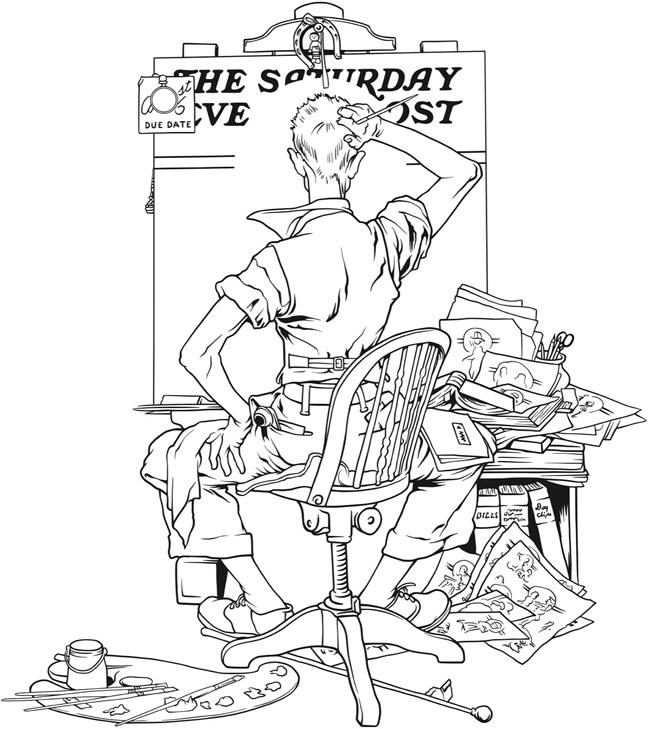
Norman Rockwell Adult Coloring Book page
For example, did you know that Norman Rockwell images are available for you to purchase and color to your liking? Yes, even Rockwell’s images have joined in on the ACB craze.
If you have products that fit this market, I highly suggest you open your mind to the possibility of this addition income stream. And, do it now, before it passes you by entirely.
February 11, 2017
Remain Steady On Your Course
You’ve done all the work, your book is published and you had a successful launch. But, you’re not seeing the sales you envisioned. All too often this is true for new and seasoned authors alike. The result is you get disillusioned and are ready to call it quits. But, don’t give up quite yet. After all, you really are just getting started.
The truth of the matter is that it takes three years to see a modicum of success. Usually, momentum hasn’t even begun to build until almost a year down the road. If you think about it, you don’t even get your first commission check from Amazon or your publisher for two to three months after your first sale. So, after four months of time and money investing you have barely scratched the surface.
To promote your book without breaking the bank, think local.
Click To Tweet
What I mean is consider things like author readings, speaking engagements, and keeping the buzz with social media going.
Create a new graphic that you could share with a tip from your book
Pick a character and write a character interview for your blog
Expand beyond the story line and ask your readers what they want to know about your character
The good news is that if you take the time to talk to your readers and fans they will tell you what they want to hear or know. With that information in hand, as a writer you should have the ability to provide them with answers and keep the conversation alive around your book or its content.
As an example, for my Weird & Wacky Holiday Marketing Guide I now provide a free Bonus Marketing Idea every month on my website, http://www.HolidayMarketingGuide.com to help my readers beyond what the calendar of ideas itself contains.
If you can afford to, be sure to submit your book for awards and continue to seek reviews as both will keep the buzz alive and give you reason to talk about your book. Besides, both of these tools have been proven to be essential to your book sales bottom line.
What are you doing to keep the buzz alive and your excitement candle burning brightly? Let me know in the comments below. We all can learn from each other, so don’t be shy.
February 2, 2017
Amazon Book Review Guidelines from the Horse’s Mouth
There’s a lot of question around Amazon reviews. As a publisher/author this is a subject near and dear to my heart. So, I went searching and found the answers. Now, to set the record straight, it seems going to the source directly, instead of reading other ‘take’ on the issue makes the most sense.
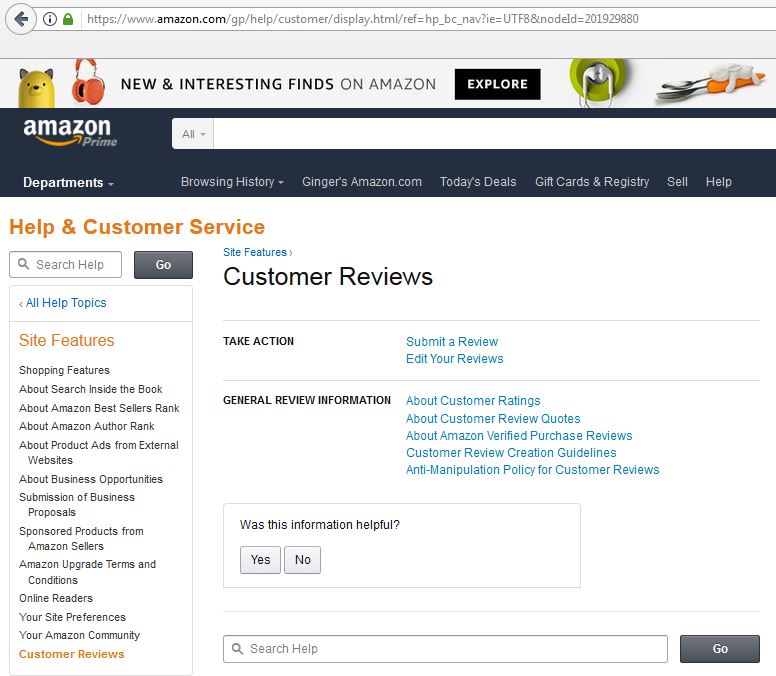
Amazon Customer Review Help Page
When I first arrived at the Official Help Page for Customer Reviews it was a bit confusing as I found that when I click each link in the body of the page it came up blank. Nevertheless, my tenacity paid off when I discovered that on the left sidebar is a list of subtopics that actually hold the information I was on my Amazon Quest to find. Oh, I like that!
So, here we go …
Rule 1: You must be a customer WITH an active, purchase profile.
Before you can post a review, you need to have an Amazon.com account that has successfully been charged for the purchase of a physical or digital item. Free digital downloads don’t qualify.
Amazon affirms, You don't need to have purchased the product you're reviewing on Amazon!
Click To Tweet
Now that is good news.
However, there’s a 48-hour waiting period after your first physical order has been completely shipped, or your digital item has been purchased, before you’ll be able to submit your review. If you’ve purchased a digital gift for someone else, the 48-hour waiting period doesn’t begin until the gift has been redeemed.
This requirement helps to ensure fake accounts can’t post reviews for products or write negative reviews on their competitor’s products. Which brings us to Rule 2.
Rule 2: Zero Tolerance
Customer Reviews are meant to give customers genuine product feedback from fellow shoppers. Their goal is to “capture all the energy and enthusiasm (both favorable and critical) that customers have about a product while avoiding use of reviews to outright advertise, promote and especially mislead.” They have a zero tolerance policy for any review designed to mislead or manipulate customers.
Authors and artists can add a unique perspective and they very much welcome customer reviews. While they encourage reviewers to share their enthusiasm and experience, there can be a fine line between that and the use of customer reviews as product promotion. They don’t allow anyone to write customer reviews as a form of promotion and if they find evidence that a customer was paid for a review, they’ll remove it.
“If you have a direct or indirect financial interest in a product, or are perceived to have a close personal relationship with its author or artist, we’ll likely remove your review.”
Nor do they allow authors to submit customer reviews on their own books even when they disclose their identity. Now that does make sense!
To help illustrate, here are a few examples of reviews that they don’t allow:
A product manufacturer posts a review of their own product, posing as an unbiased shopper
A shopper, unhappy with her purchase, posts multiple negative reviews for the same product
A customer posts a review in exchange for $5
A customer posts a review of a game, in exchange for bonus in-game credits
A family member of the product creator posts a five-star customer review to help boost sales
A shopper posts a review of the product, after being promised a refund in exchange
A seller posts negative reviews on his competitor’s product
An artist posts a positive review on a peer’s album in exchange for receiving a positive review from them
There is an appeals process if you think they got it wrong and removed a customer review that shouldn’t have been removed, even it it is your own. It starts with a simple e-mail to review-appeals@amazon.com.
Note: The best place for authors (or publishers) to communicate with their readers is in the Book description, Editorial Reviews and From the Author sections. To learn more about taking advantage of these features, visit Author Central.
Rule 3: Anti-Manipulation Policy
If Amazon thinks you’re attempting to manipulate reviews or violate their guidelines in any manner, they may immediately suspend or terminate your Amazon privileges, remove reviews, and delist related products.
In addition, if they determine that an Amazon account has been used to engage in review manipulation, remittances and payments may be withheld or forfeited. Misconduct may also violate state and federal laws, including the Federal Trade Commission Act, and can lead to legal action and civil and criminal penalties. So tread lightly here.
Amazon Author Articles
This is something I didn’t know, and you may not have been aware of either. You can actually be invited by Amazon to write articles from your experience about your product experience. These articles will appear on your profile page. However, Amazon may “use the article in other ways to help provide a great shopping experience.”
And lastly …
Amazon Verified Purchase
An “Amazon Verified Purchase” review simply means Amazon has verified that the person writing the review purchased the product at Amazon and didn’t receive the product either free or for a deep discount. Reviews that are not marked “Amazon Verified Purchase” are still considered valuable. Which tells me for certain you don’t have to have purchased the product to leave your Amazon Customer Review. It simply meant that they can’t confirm that the product was purchased at Amazon or the customer did not pay the price listed on Amazon.
To read the rules yourself, you too can visit: https://www.amazon.com/gp/help/customer/display.html/ref=hp_bc_nav?ie=UTF8&nodeId=201929880
January 23, 2017
Give Credit Where and When It’s Due
Recently, on one of my FaceBook groups a question was posed by one of the authors that I hear time-and-time again, “What are the rules for using quotes in books/journals?” So today, I thought I would answer that question here for you as a handy reference.*
To start out, any meaningful, significant, copyrighted phrase, and music lyrics can not be used without the expressed permission from the source. Sometimes that means months, and even years if ever, of waiting and/or payment to do so. If you are wondering what ‘significant’ means it is more than 30% or the ‘meat’ of the work.
Here’s how it is officially stated.
“In determining whether the use made of a work in any particular case is a fair use the factors to be considered shall include:
the purpose and character of the use, including whether such use is of a commercial nature or is for nonprofit educational purposes;
the nature of the copyrighted work;
the amount and substantiality of the portion used in relation to the copyrighted work as a whole; and
the effect of the use upon the potential market for or value of the copyrighted work.
The fact that a work is unpublished shall not itself bar a finding of fair use if such finding is made upon consideration of all the above factors.”
Now, direct quotes with attribution either following or in bibliography or End/Footnotes, and Bible passages with the publisher provided attribution on the copyright page are all allowed.
Photographs that have fallen out of copyright date and/or government provided do not require attribution. Unless specified as common use, photographer, artist attribution is required. Also, TM or R should be placed after each use of a Trademarked or Registered piece, but my IP attorney says you CAN get away with just first use.
Okay, let’s look at Bible passage quotes for a minute.
Each version of the Bible, e.g., KJV, NIV, TNIV, AMS, etc. must carry on your copyright page a sourced scripture copyright. You can check the company, i.e., Zondervan and they will tell you exactly what they need to see on your book copyright page. However, when quotations are used in non-salable media such as church bulletins, orders of service, posters, transparencies or similar media, a complete copyright notice is not required, but the initials of the version must appear at the end of each quotation.
The one exception to the above rule is the King James Version of the Bible. This, and only this version requires only one line added to your copyright page: “All Scripture quotations are taken from King James Version of the Bible.”
Here’s a sample of what a copyright page for a Scripture Quote would read like. But, remember, each version will be different. If you only use one version of the Bible you only have to say All Scripture … otherwise you should state it as Scripture marked …
New King James Version
Scripture quotations marked “NKJV” are taken from The New King James Version / Thomas Nelson Publishers, Nashville : Thomas Nelson Publishers., Copyright 1982. Used by permission. All rights reserved.
Another thing to note is that the NIV 2011 (actually copyrighted 2010) version of the Bible is no longer allowing you to quote it. This is due to “gender-related” language problems it previously identified in the TNIV.*
*Read more at http://www.christianpost.com/news/report-75-percent-of-tniv-gender-related-problems-in-updated-niv-bible-50191/#RqIMuWhaAPGrq0VP.99
So, if you have any 2011 NIV quote, then you probably want to go back and resource them and change your copyright appropriately.
The US Copyright Office official stance is:
Works Created on or after January 1, 1978
The law automatically protects a work that is created and fixed in a tangible medium of expression on or after January 1, 1978, from the moment of its creation and gives it a term lasting for the author’s life plus an additional 70 years. For a “joint work prepared by two or more authors who did not work for hire,” the term lasts for 70 years after the last surviving author’s death. For works made for hire and anonymous and pseudonymous works, the duration of copyright is 95 years from first publication or 120 years from creation, whichever is shorter (unless the author’s identity is later revealed in Copyright Office records, in which case the term becomes the author’s life plus 70 years).
Works in Existence but Not Published or Copyrighted on January 1, 1978
The law automatically gives federal copyright protection to works that were created but neither published nor registered before January 1, 1978. The duration of copyright in these works is generally computed the same way as for works created on or after January 1, 1978: life plus 70 years or 95 or 120 years, depending on the nature of authorship. However, all works in this category are guaranteed at least 25 years of statutory protection.
You can download the PDF of the entire act here: https://www.copyright.gov/circs/circ15a.pdf
While you are at it be sure not to forget to use all the appropriate copyright page notices on your book’s copyright page. There are several to consider including Medical Liability, Limit of Liability, and Accuracy of Work just to name a few.
*Although the author and publisher have strived to ensure the accuracy and completeness of the information contained in this post, we assume no responsibility for errors, inaccuracies, omissions or any inconsistency herein.
January 21, 2017
Facebook Social Media Graphic ‘Hack’
As you all know, graphic design is what I love. All forms of design from business branding and marketing to book cover design and formatting done well draw my immediate attention. That’s why in this post I just have to share with you a Facebook social media graphic ‘hack’ that I learned and implemented just yesterday!
You already know that in Facebook, in your profile area, you can use up to five images that you have uploaded to ‘Feature’. Well, that’s all fine and dandy, but … this area can be used to better purpose by following these doable, and simple, directions.
First, you have to design the graphic. I know, not all of you are designers so you may have to ask for help from yours—or you could hire me, *wink*—but here’s what you need to know about how to design it.
In your graphic design program open a new document and set the size to 300 x 300 px. If you go longer than that it will be cut off, as I found out the hard way and had to go back and readjust my original longer design.
Add a CTA (Call To Action) either button or text at the bottom that we have become used to seeing so your visitor knows what you want them to do. This can be something as simple as ‘Click here’ or as specific as you want and will encourage them to click the graphic where they will find your link, which you’ll add later in the description.
Design your graphic while keeping in mind the purpose you intend.
Click To Tweet
If you want to share more “About Me” information or you want more of a graphic about your services the text you use will vary. I chose to go with my services and therefore the text had to be “All about Them” rather than “All About Me”. That’s like a golden rule of advertising.
Save your graphic as a .png. This is so Facebook won’t mess with the compression.
Next, go to your Facebook profile page and upload your photo.
Be sure to set the privacy for the photo to ‘only me’ so it won’t be shared all over your news feed. Now save it.
Immediately go to your timeline and hide your graphic.
Hover over your ‘Feature Photos’ and your will see a pen icon show up that when you mouse over it will say ‘Edit’. Click to edit. Here’s where the magic begins.
If you have any photos selected delete them all. And then select ONLY your new graphic. Here’s the hack. This will replace all other photos and it will be rendered in all its full glory! There’s no need to add a description at this point, because it won’t show up anyway.
Now it’s time to add your description and link. Click anywhere on your graphic and you will see an option to add a description to the left of it. If you already have a description there click it to edit it and add your text. You can add a shortened, trackable link if you like. There are free and paid services that allow you to track clicks. Save.
That’s all there is to it.
Visit my Facebook page to see my graphic in action or if you are looking for inspiration. Here’s the link: https://www.facebook.com/gmarksfl. Let me know if you need help creating your graphic, that’s what I do best.
Comment below and share your graphic. I would love to see how you did.
January 13, 2017
Life After Kindle Book Launch
In order to keep your book alive after your promotion on Kindle ends you could do quite a few thing. They all involve promotion. After all is said and done, if you don’t promote they won’t come, if they don’t come, they won’t see, if they don’t see how can they ever purchase? You have to accept the fact that you are changing your hat, so-to-speak. When you wrote your book, like I did, you were a writer. Then you changed hats the day your book launched and earned the moniker of Author. Now, you have another chapeau to wear, that of marketer.
But what does that really mean?
Do at least five things each day to keep your book in the pubic eye.
Click To Tweet
Some of the things that I do are:
Comment on blogs to create link backs
Use Social Media to connect with potential readers
Grow my contact list by connecting with other authors in my niche (they are potential partners, NOT competition!)
Create and purchase ad space
Search for podcasts that you could possibly be a guest on
There’s five different things you could start with, but don’t limit yourself to these. There are a ton more you could benefit from sticking your toe in the proverbial water.
Until next time, “Show you care before you share.” —Ginger Marks