Alex Galassi's Blog
September 28, 2023
Behind the Name: Eklatros & the Ekataramn
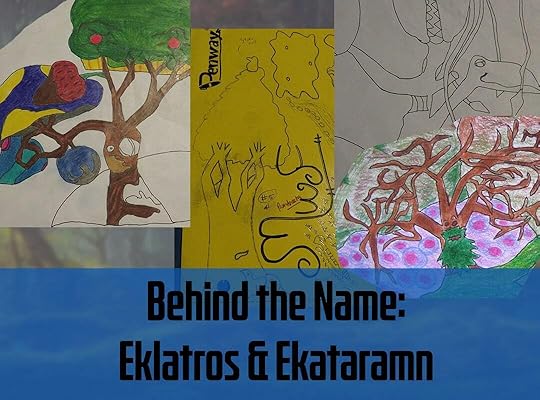
In the second issue of the Behind the Name Series, I dive into the inspiration behind Eklatros and the Ekataramn.
EklatrosWhile Eklatros is in my book title and the name of the world the story is set on, the name itself isn’t based on all that much. From what I remember, I came up with the name around September 2017, as it was September 16, 2017 that I purchased RPG Maker VX Ace. I already had the story in mind, and I’m sure I had the name Eklatros already by then, but that is around the time I first came up with the name (and I still consider Eklatros a ‘newer’ name/word that I made up).
The inspiration behind the name Eklatros stems from Ekataramn. I liked the ‘Ek-‘ combination, and from there I came up with Eklatros.
As I hinted at already, Ekataramn is much older than Eklatros. I don’t quite know the age of it, but the oldest date I can pinpoint is 2013-2014, as I find notes about Ekataramn in my 2014 version of my story. However, it could be older than that.
In the 2014 version, the planet Eklatros didn’t exist yet, so they were based on a different planet I called Musai. But even back then they were tree-like beings, and rather than there being seven of them, there were five of them. The five were Bugenaluf, Yttendaus, Roheefy, Galasem, and Panabeeta + Alakana. Alakana was not quite an Ekataramn back then, but Panabeeta and Alakana were always linked together.
That all being said, I have no idea how I came up with the name Ekataramn. But it shows my love of the suffix -ramn goes back quite some time.
Before I move on to the individual Ekataramn, I want to say that most of the Ekataramn are based off of pictures and doodles I drew. I believe most came from my high school years, but Bugenaluf’s picture comes from my freshman or sophomore year in college.
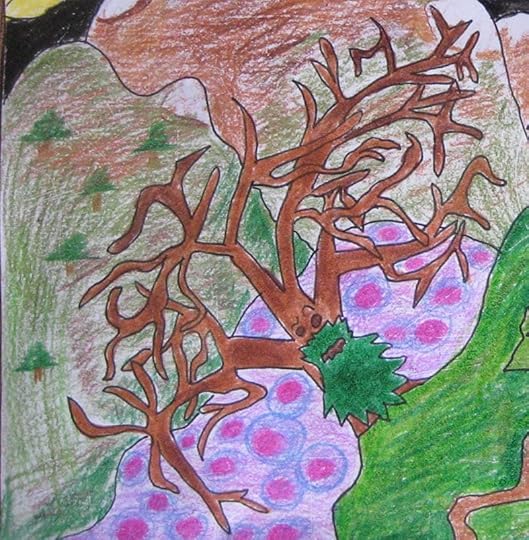
BugenalufTraditionally, Bugenaluf was the leader of the Ekataramn. This is the description I found from the 2014 version:
The Leader of Ekataramn, Bugenaluf is the wisest out of all Ekataramn. His branches are bare, but beautiful. The pattern that they have grown in is huge and fantastic. The only foliage growing on him is for his beard. His mouth is covered in a big, thick beard of dark green moss. His eyes are a burning red.
The name Bugenaluf comes from melding two different names together – Bugenhagen from Final Fantasy VII and Gandalf. It really doesn’t matter that this name is over ten years old now, but even today I remember the decision I made while making this name, because I had given myself two options. It was always going to be the beginning of one of the names and the ending of the other name. So, the options were either Bugenalf or Gandhagen. Even back then, I kinda liked the name Gandhagen better, but I chose Bugenaluf because it was the one that sounded the strangest – Bugenalf. I added the ‘u’ to make it Bugenaluf to make it sounds more aloof.
So, for Bugenaluf’s drawing, his is based off of a tree that I drew on my friend Keith’s 20th birthday card (I used to create my own birthday cards for friends and family). I am not going to show the entire picture of the card, but only Bugenaluf:
Yttendaus was traditionally the second Ekataramn. When Yttendaus was first imagined, it was not on a floating island, and it apparently had a telescope that it could use to peer into the universe.
I don’t have any recollection on how I came up with the name Yttendaus. It could have been one of those where I just put letters together to create names, which was a tactic I used on several occasions. If that is the case, then I believe I wanted to have a name similar to Yggdrazim, but rather than ygg- I used ytt-.
Also, Yttendaus does not have a drawing, because it is one of the only ones that was never based on a drawing.
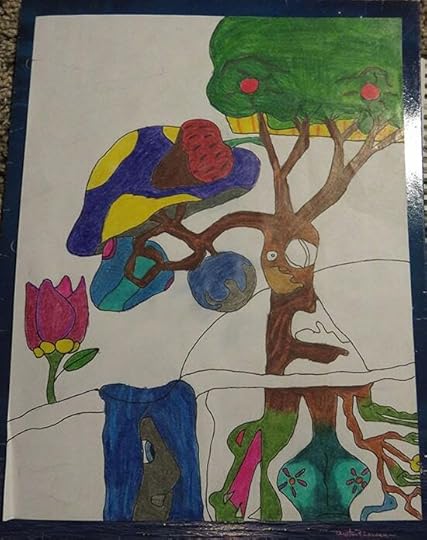
KalahsemOriginally, Kalahsem was the third Ekataramn, and its name wasn’t Kalahsem, but Galasem. Galasem is of course a play on my own name, Galassi. So, to better differentiate my own name with the Ekataramn, I changed the Gal to Kal, as there are some spellings of the name Galassi that use a k I believe. So Galasem became Kalahsem.
Here is the picture I drew that I used to create Kalahsem. Of course, when I originally drew this picture, I was just drawing. I also have no idea when I drew this picture. My best guess is sometime during college or late high school. And I still have never finished coloring it in either.
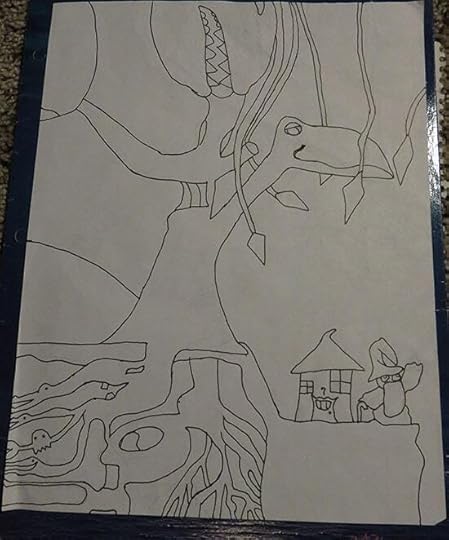
Originally, Roheefy and Kalahsem were connected by their canopies. The image I based Roheefy off of connects to Kalahsem’s image via the roots and the canopy. So, back then I took the drawing literally.
Roheefy’s name comes from melding the beginning of one of my friend’s first names with her last name. So, Rose Heaphy became Roheefy. I also like how Roheefy sounds like leafy, like a big leafy tree.
As mentioned, this drawing is a companion to Kalahsem’s drawing, so I believe I drew this around the exact same time as the other one. Also, yes, that is a Chibi Theodore next to a miniature house.
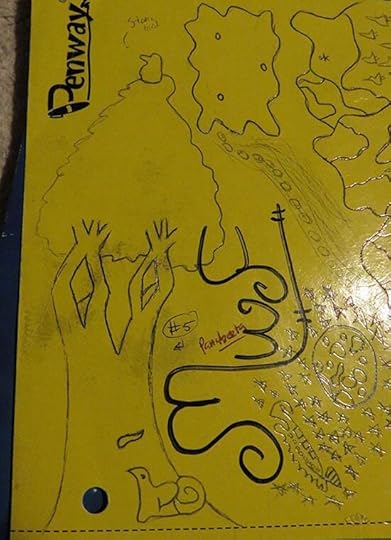
Panabeeta was originally the 5th and final Ekataramn. Panabeeta was supposed to be the smallest of them all, and always had a bird on the top of its canopy. The doodle I based Panabeeta off of comes from the cover of a school notebook. I believe this is from my senior year of high school, or maybe one of my first years of college, as I remember having a year where I had Tuesdays and Thursdays off from school. That was a great time.
The name Panabeeta comes from somewhere, but it’s hard to remember when it’s a name I’ve been using for over ten years. In fact, the oldest dated document I can find with Panabeeta comes from July 14, 2013, but is most likely older than that. I think it’s interesting how some names that I make up I remember everything about how and why I came up with that name, and other names I completely forget how I came up with them. But as is life, I suppose.
Alakana was always the name of the bird that hung out on top of Panabeeta (since 2014 at least). And originally, it was literally a bird. The description I have for Alakana is this:
Bringer of doom and destruction when it dies. Its birth is also a forewarning of change and misery to come.
So, it seems as if I originally imagined Alakana as some kind of phoenix. Also, its appearance was supposed to change as it aged. So this bird was originally green like the tree as a chick and then before it died it would have rainbow hues.
I can’t really recall when I changed Alakana to become an actual Ekataramn that can fly like a bird, but it was most likely when I was working on Battle for Eklatros.
And yes, Alakana and the whole idea of having the bird-like being perched on top of Panabeeta’s canopy was because of the way I drew that tree on the cover of that school notebook. As soon as I drew it, I connected the base because I thought it looked like a bird. So yes, this random doodle did impact my entire story.
The Seventh EkataramnWhile I will not yet reveal the name of the seventh Ekataramn, that name is pretty old. I don’t want to say much, but it is base off of the old show, Johnny Quest. Also, the seventh Ekataramn will be seen at some point in my story.
The post appeared first on Alex Galassi.


June 24, 2023
Building the Cosmos: How Battle for Eklatros Came to Be
Welcome to the start of a new series, Building the Cosmos. This series will dive into how I built a book series out of LEGO Characters.
This first one will not start at the very beginning, but instead will explain how Battle for Eklatros became what it is today.
Some very minor spoilers for those who haven’t read Battle for Eklatros.
The Prologue to The SeriesIn my mind, Battle for Eklatros is a 600-page prologue to the entire book series. The second book, in which I was currently writing at the time this blog was published, was always meant to be the start of the story—at least the start of the newest version of the story. For ease of explaining, I will call this New Vortex. I will explain this in more detail at a later date. I hope that this won’t be too confusing.
However, I will say that I had always struggled with writing out this story. Each version of New Vortex that I tried to write never got very far. I struggled with getting everything right with all the characters I was juggling. Professor Navacus Clums was always meant to be the main character, and his story is pretty straight forward, but again, I had a lot going on. I had always had plans to include Theodore and Cecil into the story, but trying to include them always made my stories fall apart.
Battle for Eklatros’ Original ConceptionIf my memory serves me right (which sometimes it doesn’t), then I first starting formulating the idea for Battle for Eklatros at my Great Aunt’s 95th birthday celebration. Or, more accurately, while was at the hotel during that trip out to Brandon, Florida.
While I was formulating the idea, I was very committed to building it out as a computer game using RPG Maker VX Ace. And I worked on that game for at least a year or more. But man, let me tell you, that was hard work. I thought that since I was a website developer, and I knew HTML and CSS, that it would be easy. But the logic behind creating a video game is, in my opinion, much more complex than building a website. I don’t really have a stable version of the game anymore, which is a bit of a shame, but I do have a semi-playable version. Feel free to check out the video walkthrough at the end of this post.
I actually got decently far during the build out of the game. I made it past Pikkul Harbor, to where they are on a ferry. But at that point, the story of the game is quite different as there is no . I started to diverge the story from the video game after the party meets Dasch (Sterg).
Anyway, once I started realizing just how complex the story would be to create as a video game, and how I had messed up a few things that would be quite difficult to fix, I abandoned ship and decided to turn it into a book, which I’ll get into more in a bit.
I also want to say that I only created artwork for Ànifa, Theodore, and Cecil for the game. I was actually set to create artwork for Dasch (Sterg), but the artist stopped working for me after Cecil, which I am actually happy about, since she was quite expensive. So were made several years later by a different artist. Those were not made for the game, but for my own reference and usage.
When Battle for Eklatros was its Own StoryWhen I was building out the Battle for Eklatros computer game, I decided to use names and characters that I was already familiar with in a new story. So that’s why I used Ànifa, Theodore, Cecil, Joan, and Tyrona as my main characters. I also had ideas for completely different characters. First of all, Dasch was originally named Sterg, and while he was also supposed to be from the past, his story was different back then. Also, Vesten was originally named West. Both the names Sterg and West were borrowed from different characters, and both are major characters in their own right.
Also in the original party were characters named Carl and Ivy. In this original version, Carl was supposed to be from the future, to serve as a foil for Dasch (Sterg) who came from the past. Ivy was supposed to be a woman with her own band of travelers and explorers, which served as a basis for Ms. Matros.
So, every single name I used in Ànifa’s party was a name I have been using for multiple years. At the time, this was fine because this was meant to be a completely separate story from New Vortex. But as I worked on the story, I grew to really like it, and knew I wanted to tell this story one way or another.
Also, aside from the characters, the original video game version was always meant to feature the Ekataramn. Now, without getting too into things, the Ekataramn date back to at least the 2014 version of the story, but the concepts are much older. I always have had the idea for magical tree-like beings that hold unique and divine powers. So, they were always supposed to be part of the New Vortex story to begin with. They just had a different origin story, but I really like how it’s all played out.
The Fusion of Eklatros and New VortexThe idea to fuse Eklatros and New Vortex together seemed like a logical solution to the situation I was in. As I mentioned previously, I already had a lot of the elements that were always supposed to be part of the main story (The Ekataramn, and Theodore and Cecil’s characters). There was just a lot that needed to change. The party itself got a complete overhaul as I somewhat explained, and some characters got renamed or completely removed.
The process itself to change the names and rework the party wasn’t very difficult. As for the story, the majority of the story I built out as the computer game is still part of the book. For instance, the way in which Ànifa meets Charlotte, Theodore, Sage Mason, Cecil, and Dasch (Sterg), all happen nearly identically in the game as it happens in the book. There are differences, of course, such as the dire sloths, jackhorn, and woolly rhinoceroses aren’t present in the game. And actually, it was only when I was writing the dire sloth god that I even had the idea to include the animal gods. I ran with the idea, and am very happy that I did so.
It is around Pikkul Harbor that the story diverges quite a bit. The biggest change was including Vesten as early on as I did. In the game, Anifa and her party don’t meet a mob of people, and the docks aren’t full; there is no conflict at all. The party simply finds and boards a ferry, and they are headed to Sortuga, not to Gallheim. But at that point in writing the book, the story was making much more sense, and flowing much more naturally then the story I was building out for the game.
The Interlude ChaptersSince this was going to be book 1 in the series, I knew I couldn’t start it without including the main character of the series, Professor Navacus Clums, so I had the idea for the interlude chapters. Writing out the stories for Svetlana, West, Norman, Ivy, Sassafrass, Blood Bat, Newtus and Denoptace as interlude chapters was the perfect way to tell those stories.
The reason why I had struggled writing the original versions of New Vortex was also because I was trying to do too many things. Svetlana was always supposed to be Professor Clums’ first subject, so I always tried to start the story with her. But again, there was too much to do and too many characters to introduce before the main source of conflict was introduced, which just led to a bland story. So being able to tell those stories through the interlude chapters was the perfect way for me to introduce all of those characters while setting up the conflict that kick-starts the entire New Vortex story.
In ReviewOkay, so I hope that this isn’t too confusing, and I hope this explains everything well even if you aren’t familiar with my story. I do want to say that fusion the two stories together is the absolute best thing that could have happened. Neither story would have held up on its own, but combined, it works absolutely perfectly. Everything is how it is meant to be. The Ekataramn, and how they are depicted, are exactly how they were meant to be. Ànifa, Theodore, Cecil, Tyrona, Joan, Quaant, and Druder are all who they were always meant to be. And Dasch and Vesten are the best ‘new’ and ‘unplanned’ characters that I ever could have asked for. I say unplanned because they were never part of New Vortex until the Eklatros fusion, and now they are both absolutely integral parts of the story. Read more about this in my blog .
I am going to plan on the next blog in this series to dive into the meaning behind New Vortex, and why there is a new vs an old Vortex.
See the Game in ActionIf you want to see what the Battle for Eklatros video game looked like, watch the video below. This 20-odd minute video gives a good overview on the similarities and differences between the game and the book.
The post Building the Cosmos: How Battle for Eklatros Came to Be appeared first on Alex Galassi.
June 21, 2023
Behind the Name: Ànifa’s Party
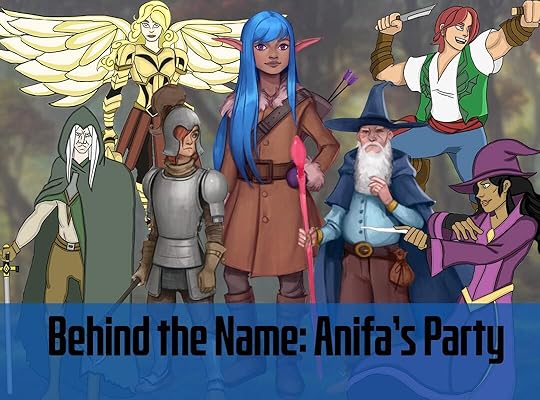
My debut Science Fantasy novel, Battle for Eklatros: Book 1 in the Rebalancing the Cosmos series, contains well over a hundred unique names. Whether those are names are for characters, animal gods, locations, or aliens, each name is unique and has a story to tell.
The first blog in this series will focus on Ànifa’s nine official party members, as most members have an extensive history.
Warning: Mild spoilers ahead.
The Heroine Herself: ÀnifaÀnifa’s name has quite the story behind it. The name began as Anifa, without the accent. I first thought up the name when I was in Florida on Summer break in the early 2000’s. I remember sitting in my aunt’s car as we were pulling into her garage. I was examining a water bottle—specifically a bottle of Aquafina. As I looked at it, I began to spell it backwards – Anifauqa, which then shortens down to Anifa. For my family—this was the place off of Pine Echo Road.
Now, I could have sworn that Anifa had appeared alongside Quaant in Quaant’s first outing (which I’ll get to in a little bit), but I was mistaken. I just looked it up, and Anifa’s first appeared is actually in a different story altogether, one I had titled Ados: Book 1: The Beginning of the End. (Fun fact, the name Ados is another backwards spelling of a beverage—soda. And Ados is now a spider, not a humanoid.) The date on the document says it was last modified on Saturday, November 6, 2004, which means that I began writing a few months before then—my stories back then never lasted very long. So I was around 13 when I first came up with Anifa’s name.
After that story, the name Anifa was used almost exclusively alongside Quaant, which is why I always associate the two together. Anifa was a fairy—the Faeryious as I named them (I wanted to use every vowel, haha).
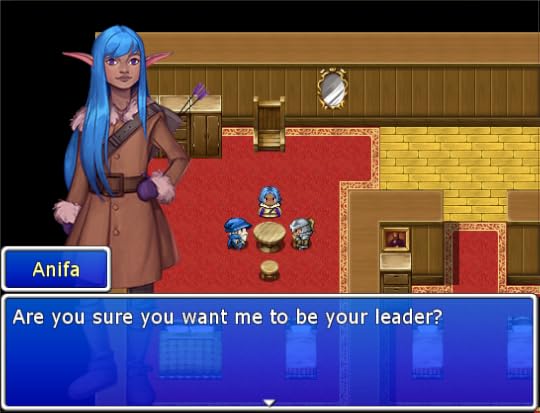
Anifa remained a fairy until late 2017 or early 2018, when I started formulating the story that would become Battle for Eklatros. I decided to use Anifa as the name of the main character. As I mentioned my first Building the Cosmos blog, Battle for Eklatros was originally created to be a computer game. I was building it out with RPG Maker VX Ace, but it got way too complicated, and so in April 2018 I began to turn it into a book. Fun Fact: I do have a semi-stable version that still is somewhat playable (but barely), and when I go back into it every now and then, I can still find lines that came directly from the video game that made it into the book. Here’s a screenshot from that game:
Anyway, the final evolution of Ànifa’s name was the addition of the accent. This came from a suggestion from my wonderful editor. Her comment was that Anifa closely resembled Antifa, and I didn’t want to be associated with anything political. I honestly really like the change; I think that accent on Ànifa makes her that much more unique (even if I may not pronounce it correctly.)
The B-Class Sorcerer Theodore Henry CaldwellTheodore Henry Caldwell was inspired by a LEGO minifigure. This minifigure in particular I have had since I was very young (for all I know it came from one of my sister’s LEGO sets). However, it didn’t get a proper name until I was in college. So Theodore never appeared in any older stories like Ànifa and other characters. Instead, Theodore was involved in many different LEGO photoshoots I used to do that I called Hyptno-Toad Anonymous (yes, that is not a typo; its Hyptno-Toad). Theodore appears for the first time in the third collection in the series, ‘Shelling Noodle Hares’ (and that name came from the Noodles and Company hotwheels-like van that I have). That was shot on July 6th, 2011, which means I began the series during the summer between my sophomore and junior year of college.
Now, the name Theodore Henry Caldwell comes from, well, THC. I started smoking marijuana in my sophomore year in college, and when I started the Hyptno-Toad Anonymous series, I wanted to name the wizard something weed related. So I decided to create a name using THC as the initials: Theodore Henry Caldwell.
So back in the Hyptno-Toad Anonymous series, Theodore often appeared beside a blue striped Battle Droid LEGO figure that I named Blue Dream, after one of my favorite strains at the time. While Blue Dream (Now spelled Blu-Dreem, aka Beedee) did not make it into Battle for Eklatros, he will appear in the next book, Into the vortex.
Here is the first picture I can find of Theodore and Blue Dream together, and funnily enough, Theodore isn’t wearing his iconic hat. Also appearing in the picture are Wallace Dine, Raza, and Raff. (Yes, I know. I am not very familiar at all with Teenage Mutant Ninja Turtles, so when I named Raff, I thought that Raphael was the purple one… I now know that Donatello is the purple one, and Raphael is the red one.) Anyway, all three of those characters—Wallace, Raza, and Raff—will appear in one of my sequels.
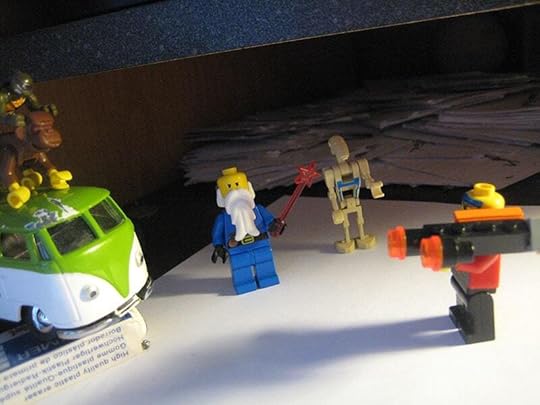
Fun Fact: Theodore’s face comes from a Star Wars LEGO Set—I believe it was a Luke Skywalker head. This of course plays well into the weed-related theme—Skywalker.
The Lost Knight: Sir Cecil Johnathan KloudCecil was another character that got is real debut from the Hyptno-Toad Anonymous LEGO photoshoot series. This was another LEGO character that I had for a long time that never got an official name until the series. Cecil’s first appearance is actually in the second series, titled ‘Skeleton’s Island’. He appears next to an Ultraman toy (That Ultraman toy comes from Thailand—My dad brought it back for me as a gift when he went in 1997.) Here is that photo:
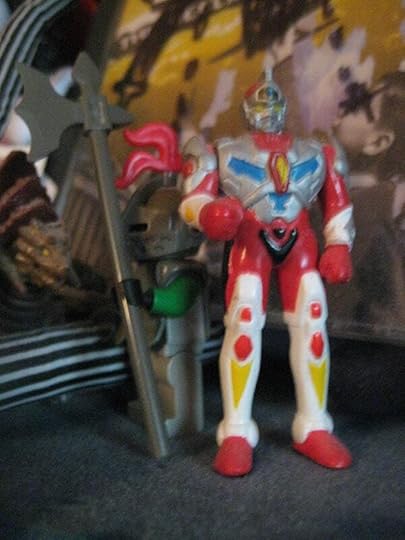
Now, if we dissect Cecil’s LEGO Character, under the armor is, and has always been, a bank teller. I just always enjoyed the color combo of the bank teller with the armor. Here is a little video of that dissection:
As you can see, the head I’m using for Cecil has long red hair that covers one of his eyes. That is the main motivation behind giving Cecil long hair. I now think that it suits his character really well.
Okay, onto the name behind Cecil. So, Cecil Kloud combines the names of two Final Fantasy protagonists – Cecil Harvey and Cloud Strife. While Cecil Harvey is a very different character, I always really liked the name Cecil for a knight. And Cloud—well, Final Fantasy VII was always traditionally my favorite (today I think I like Final Fantasy XIII slightly more). So I simply combined Cecil and Cloud to create Cecil Kloud. Of course, I changed the spelling of Cloud to have the ‘K’ instead, and again I just like it better that way.
As for his middle name, Johnathan, that I came up with on the spot while I was writing Chapter 21: Battle for Friendship. I can’t say why exactly I chose Johnathan, but it works well I think.
Finally, I named him the lost knight here because I thought it suits him pretty well, as Cecil is quite lost when Ànifa first meets him.
The Man from the Past: Dasch ValentineThis is probably going to be one of the simpler names to explain, which seems fitting for Dasch Valentine. As I was working on the Battle for Eklatros RPG Maker video game, I came up with an original character that came from hundreds of years in the past. Now, originally, I used a different name for this character—Sterg. However, when I was transitioning the story from being a video game to being a book, I knew I needed to change the name, as Sterg is already a character in the storyline; you’ll meet Sterg in book 2. (So, this was also before I fused Battle for Eklatros into my Vortex storyline – but now I think it is one of the greatest decisions I ever made). For the new name, I naturally went with yet another Final Fantasy reference. This time I drew from Final Fantasy XII and Final Fantasy VII. Basch fon Ronsenburg is one of the main playable characters of FF12, and I was replaying that game around the time I was working on the video game. I really like Basch—he’s a fantastic character. So I just changed Basch to be Dasch—and now I actually like the name Dasch far better than Basch, haha. As for Valentine, well, that’s Vincent’s last name (from FF7), and I think that Vincent and Dasch are quite similar in ways.
Also, while Dasch may be a brand-new character that was never envisioned within the Vortex storyline until I fused the stories together, he is now absolutely integral to the story and I can’t imagine it without him. So, go Dasch the Destroyer! I also want to say that the original version of Dasch did have hair. It was only while I was writing the book that I decided to make him completely hairless.
The Pirate turned Privateer: Vesten James TeixeiraSo Vesten is another character, like Dasch, who was created specifically for the story set on Eklatros. I knew that Ànifa and her party needed a ship, and that the ship needed a captain, so Vesten was born. His character evolved as I was writing the story, more so than any other character. I knew about certain arcs that he would complete, but there was one main arc that took me completely by surprise. His relationship with another character was absolutely not planned, but Vesten seemed like he was leaning that way, so I ran with it.
Vesten James Teixeira’s name comes from several different sources. First, during the video game version of Battle for Eklatros, his name was West. However, when I fused the story together, I couldn’t keep that name, so West became Vesten. Also, when I was making the video game, I didn’t yet come up with the name West Wind yet. So when I named the ship, I wanted to keep the reference to his original name (that was borrowed from West Kilinder.) That all being said, I think the uniqueness of the name suits him really well. His middle name, James, is a nod towards my good friend named James. His last name, Teixeira, was inspired by another friend of mine, Patty. (So I’ll go into this more in a different post, but Patsy’s name is inspired by this same friend.)
The A-Class Sorceress Tyrona Claire KnorseTyrona is another character with a long history, and she has changed a lot since she was first ‘born’. The oldest date I can find associated with her is April 5, 2008, but that means that she is older than that. I think that she may have been a LEGO character, since I do have a LEGO character for her, but I can’t remember if what I am using has always just been a placeholder, or if she was born through LEGO like all my other LEGO characters. I say that because her LEGO character looks nothing like her—I think I have always envisioned her with dark skin. Fun Fact: The pirate hat Tyrona is wearing is actually my LEGO character for Lyd (he’s part of Professor Clums’ crew). More on that when I write the blog about Navacus’ crew.
Here is Tyrona’s LEGO character. This is from set 14 of Hyptno-Toad Anonymous, titled ‘Thai Avenue, or On the Night of Which Both Cowboys and Aliens Appeared’:
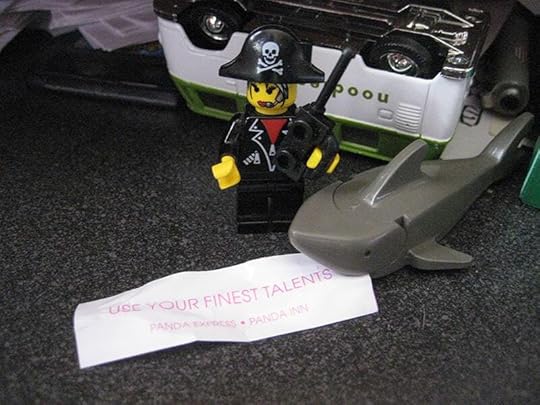
Back when Tyrona very first appears in my old drafts, she had a very different power. It was only when I was writing Battle for Eklatros that I changed her powers. Tyrona used to always have the power of electricity—and pretty much only electricity. She was quite powerful with it too. However, since Theodore was already my elemental magic-user, I didn’t want Tyrona to have the same power. So that’s when I changed her to have the power to control soundwaves and vibrations, and through that, she is able to control people’s thoughts and resize objects (since everything has a vibration). This makes her far more powerful than she ever was when she just controlled electricity.
For Tyrona’s name, that I just came up with on my own. It wasn’t inspired by anything really, I just thought it was (and is) a cool name. Also, while I don’t want to give too much away here, Tyrona has had different middle names and surnames in the past. She’s also very closely associated with a different character that will get her spotlight in the second book. Her middle name now, Claire, is actually yet another Final Fantasy reference, this time from Final Fantasy XIII. Claire Farron is the given name of the main protagonist, Lightning, and Lightning is probably my all-time favorite Final Fantasy character. As for her last name, Knorse, well, that’s just Norse with a ‘k’, since I thought it sounded cool.
The Angel of Light: Joan de LigtheramniiJoan is another old name that I have been using for a very long time. The source comes from my mom, and when she used to read to my sister and I. From what I can recall, there was a book about Joan of Arc, and she read us that book because she had a connection with Joan of Arc. So, the name Joan has always meant a lot to me because of that personal affiliation.
The oldest story I can find that features Joan comes from 2004/2005, also from Ados—the story that first featured Anifa. In that story, I have it written that Joan was the queen of the enchanted forest, and she was a fairy. Then she became an angel in 2008 when she became integrated with the main Vortex story.
Joan’s last name, for probably about a decade, was Weisel. Weisel was inspired by Elie Wiesel, the author of Night. I remember reading Night in middle school, and while I don’t remember much about that book at this point in my life, I think it was one of the first times that I really started to understand the horrors of the Holocaust, so it always stuck with me.
Now, her last name, de Ligtheramnii, is a play off of Jeanne d’Arc, for the ‘de’ part at least. Ligthera, which I based Ligtheramnii off of, is another very old name, and had many different uses. One of the uses was an alternate name for Light Beings, but the main and current use of Ligthera is for a different species. This is an excerpt from a document dated from July 13, 2013 (almost 10 years ago from the time this was posted).
They are like a mix between a cat/lynx/fox. They have white hair with blue streaks in it. The darker the blue, the more magical abilities the Ligthera has. Sometimes the stripes are teal or even purple, but this just means the Ligthera has more specific magic in a specific field of study. Besides their white fur and stripes, they have tall ears and long black whiskers. They have two tails, split at the base. Both are long and skinny, with a poof at the end.
Anyway, the Ligthera won’t be seen until much, much later into the series (book 3 or 4 maybe), so I hope you don’t mind the tangent. Now, the source for the name Ligthera is Light. Just swap the ‘t’ and the ‘h’ and add ‘era’. So Ligthera, or Ligtheramnii, was always used for spiritual and divine characters.
The Forever Faerie: Quaant YttenramniiQuaant hails from a story that I attempted to write when I was about 11 or 12 years old (2002-2003 or so). This is a story that will never see the light of day. It was called ‘The Scared Watch of Power’. I wanted to write a story like The Lord of the Rings that featured wristwatches instead of rings. So yes, it is quite bad. It looks like I only made it to 26 pages, haha.
Anyway, Quaant was the main character of that story, and he was a fairy. So, Quaant has always been a fairy, which is pretty cool.
Concerning Quaant’s name, I only have a vague recollection of the motivation behind zir name, as I was quite young when I came up with it. From what I remember, I wanted a name similar to Queen (my favorite band at the time) but rather than the double E I opted for the double A. I don’t believe I ever gave Quaant a last name back then. Zir current last name, Yttenramnii, breaks down into three different parts: Ytten, for Yttendaus; Ramn I use in many of my names; and the double I for the finishing touch.
You may notice that I use ‘ramn’ and ‘ii’ a lot, and its mainly because I like how it sounds. And ramn reminds me of om, the sacred sound in Hinduism.
The Goblin turn Fairy turn Elf: Druder NanasaziiDruder is actually another character that comes from The Scared Watch of Power. Druder was a goblin—the King of Goblins. Druder was originally written as an antagonist, but throughout the years I’ve used the name for a variety of other characters. The 2009 version of my Vortex story featured Druder as a Fairy. He was part of a crew that contained Quaant, Anifa, and others.
I always liked the name Druder, so when I started writing Battle for Eklatros, I knew I wanted to include him in this story. And rather than make him a fairy, I wanted to go back to his roots as a goblin. While dark elves are elves, and not goblins, in some stories, goblins were once elves. Also, while I was writing the book, I used the term ‘drow’, but I ended up cutting it out because I didn’t want it associated with Dungeons & Dragons. I want to add that I do not remember how I came up with the name Druder, but is a name I just made up on my own.
As for his last name, Nanasazii, that is a combination of Anasazi and Nanaki. Anasazi is a term that is Navajo in origin meaning ‘ancient enemy’, and it should not be used to describe any group of Native Americans anymore. However, growing up in Colorado, I grew up hearing that word used a lot, and as a word itself, I like how it sounds (as an artist I’m allowed to manipulate things, right?). As for Nanaki, I’ll give you three guesses. If you guessed yet another Final Fantasy reference, you would be correct. Nanaki is the given name for Red XIII, a playable—and absolutely awesomely amazing—character from Final Fantasy VII.
What Comes NextIf you’ve gotten this far, thank you! I hope you enjoyed my rambling explanations and tangents, haha. But as you can see, many of these names are very old now, and so they have long and winding histories. And as with anyone or anything that has a long and winding history, it can be hard to keep track of things. That’s actually why I’m really glad I am starting this blog series—so this information can be recorded, now, before even more time passes.
The next one in the series will dive into the meaning behind Eklatros and the Ekataramn.
Until next time!
The post appeared first on Alex Galassi.
March 20, 2023
Why You Should Create A Language For Your Fictional World
If you are a science fiction or fantasy author, chances are high that you have done at least some amount world-building. This includes worlds, cities, religions, political powers, species of animals, and so forth. And this can often include creating unique languages for certain groups of characters, whether those characters be humans, elves, dwarfs, or aliens.
If you are intimidated by the thought of creating a language, know that you are not alone. I resisted doing it for many years, thinking that I could get away without one. But now that I have one, it is so much more helpful than I ever would have thought.
While having unique languages adds another layer of depth to your fictional world, they can also help you create that fictional world. I feel like most authors can agree that coming up with names can be a difficult task, especially if you have dozens if not hundreds of names to come up with. Creating a fictional language can greatly help with coming up with names.
My Journey to Create the Lakinceitian LanguageWhen I was mapping out Melridion, I created a large number of settlements and natural features and landscapes that I had to now give names to. I had a few names to start with – Nalpetalis (the city closest to The Compound) and The Volgash Desert (where The Compound is actually located), but now I had over a dozen names to come up with. Not only that, but I wanted to make these names sound inherently different from the names I used on my Eklatros Map (Gallheim, Roffen, Ajenti, Sathon, etc.). Two different worlds that host two different intelligent species can’t have similar sounding names. Also, I did not create any languages when I wrote Battle for Eklatros. The Lakinceitian language is the first and only language I created as of this writing.
So, I took the few words that I did have, including Gnusar, Lakinceitian, Melridion, and the names I provided in the previous paragraph. I broke up the syllables into their own words. While I did take a linguistics class in college, which helped, it was not necessary. Just think about our own language and the roots of our words. Take the word ‘literature’ as an example. According to Merriam-Webster, literature comes from “Middle English, from Anglo-French, [and] from Latin litteratura [meaning] writing, grammar, learning.”1
Many of our own words come from literal meanings. So that was my inspiration for the Lakinceitian language I recently created. Let me give you two specific examples.
Example 1: Volgash DesertI mentioned the Volgash Desert earlier. That name is at least from 2014 or 2015, if not older than that. But now, Volgash in Lakinceitian breaks down to:
Volug = Endless / Infinity
Gash = Sand
So, Volgash (Volug Gash = Volgash) literally translates to ‘endless sand’.
Example 2: Nobatroxbic RiverHere’s another example. On Melridion, there is one large, massive river that splits the central landmass into two main halves. That river is named the Nobatroxbic River, which breaks down to:
Noba = Life
Trox = Giving / To give
Bic = River
So, Nobatroxbic literally translates to ‘the life-giving river’.
Remember: It’s Your LanguageThe great thing is that you don’t need a full library of hundreds of words. You can create only the terms that you need to create, and if you need more in the future, you can always add more. Make this process as stress-free as possible. Currently, I have 81 words in the Lakinceitian dictionary. I know that sounds like a lot, and it is, but for a full language it’s just scratching the surface. Which again, is all you need to get started for coming up with names for your fictional world or universe.
Finally, remember to keep your list organized. When I was writing my list, it quickly got out of hand, and became hard to find things. So I alphabetized the list, which helped immensely.
Keep in mind that these aren’t rules in any way. There are no rules in writing, just guidelines. Feel free to use your own methods when creating your own languages. If you do have your own methods, feel free to share them in the comments below.
Purchase Battle for Eklatros on Amazon
Citations and Attributes
1Merriam Webster – https://www.merriam-webster.com/dictionary/literature
Online Word Cloud Generator – https://www.freewordcloudgenerator.com/generatewordcloud
The post Why You Should Create A Language For Your Fictional World appeared first on Alex Galassi.