Timothy Green's Blog
August 13, 2024
Filling Up on Haibun
This article first appeared in the Press-Enterprize, August 11, 2024
A few weeks ago, during the peak of a heat wave, I took the kids to the San Diego Zoo’s Safari Park. Despite the weather, we had a great time, and I decided to capture one of the moments in a haibun.
The haibun form dates back to the 15th century master Basho. Already well-known for his haiku, Basho began publishing journals of his travels interspersed with the short form poems, and the genre spread from there. Haibun is the combination of haiku with any other style of writing–most commonly journalistic prose. The pairing results in a powerful juxtaposition, allowing large leaps between layers of meaning.
For many decades, English language haiku journals have included sections for the haibun form, but poets have only begun to fully explore its rich possibilities in recent years, as haibun have become more polished and experimental.
As explained by Roberta Beary, Lew Watts, and Rich Youmans in Haibun: A Writer’s Guide (Ad Hoc Fiction, 2023), the key is to create a series of “sparks” within the reading experience. These bursts of surprise are the heart of haiku themselves, and the haibun form allows them to stack together like nesting dolls.
Remember that, regardless of what you might have learned in school, haiku have nothing to do with counting syllables. The Japanese don’t count syllables–they count mora, a sound unit that we aren’t tuned to in English. Because there are multiple mora in many syllables, lines of 5-7-5 result in poems that are much too long, and the counting itself puts the emphasis on the wrong thing.
The real essence of haiku, instead, is that spark, that leap of surprise, contained within a single utterance, so that the silence around the poem rings with meaning. I like to say haiku are “two worlds in one breath.” They show us two ways to look at something, revealing the complexity of life in the process.
For example, one of my favorite haiku from Basho is this:
summer grasses …
all that remains
of the warrior’s dreams
Even though the poem is written in three lines, it’s read and expressed as a single sentence with two parts. The “summer grasses” evoke a setting and season, a scene that repeats year after year, as grasses grow and cure. That image is juxtaposed against the ephemeral hopes of a warrior fallen in battle, here and then gone like all of our dreams, eventually. The haiku is a profound reflection on the cyclic nature of life, and our small part in propagating the wave of history, each of us a single blade of grass bending to the invisible winds that move through a field.
This experience of profound juxtaposition works well no matter how small the package, and contemporary haiku poets sometimes condense their poems down to the single line of a monoku, like this one in Jennifer Hambrick’s new book, A Silence or Two (Red Moon Press, 2024):
in too deep to turn back starlight
In this one breath we see both the stars at the end of a long night hike, and the idea of falling so deeply into something (love?) that it becomes as impossible to give up as would be to turn back starlight.
That “spark” between ideas is the essence of haiku, and the haibun form takes it one step further, creating sparks not only within the haiku, but in the gaps between styles of writing. The title of the piece cuts against the prose, which then cuts against the haiku, which includes its own cut inside–all of these imaginative leaps swirling in a way that sets the mind ablaze.
This is what I’ve tried to do with my haibun:
Hot AirMy son and I stand beneath the huge balloon at the center of the almost-
empty safari park. It’s still hot at closing time. The orange globe sways
in a warm breeze. Whoa, we shout as it topples toward us, and then we
laugh as it tips away. Again and again it looms and lets go, looms and
lets go, until finally a voice in the loudspeaker sends us home.
always practicing joy ride
 I wrote the prose first, simply describing the little game we were playing, and the haiku arose as a reflection on what it meant–how the practice of joy is a choice we have to consciously make. The title, though, “Hot Air,” points both to the balloon itself and a subtle suggestion that all this profundity might be fleeting. That practice of joy might only last until we hit traffic on the drive home.
Haibun is the perfect form for anyone who wants to make writing a part of their life. We all have experiences like this, that mean something and that we want to remember. Often we’ll take a photo and be satisfied with that, but memories become richer when fully explored. With enough of a leap, haibun can spark them into stars.
Learn more about some of the poets pushing the form to it’s limits on episode 72 of The Poetry Space_: Experimental Haibun.
The post Filling Up on Haibun first appeared on Timothy Green.


June 26, 2024
We Dug That Tunnel with Spoons
after James Tate
the size of shovels. They looked
like silver oars in the lamplight,
which made the dirt a chocolate
ice cream. “This is so sweet,” you
said behind me, pretending too.
We rowed that way through the
darkest soil, through the worms
and the roots, the tiny gems in
the jetsam. All night the coxswain
far ahead shouting “Stroke! Stroke!”
with such confidence we were
almost sure we could catch him.
—first appeared in B O D Y
The post We Dug That Tunnel with Spoons first appeared on Timothy Green.
June 24, 2024
The Real Magic of Poetry
Originally published in the Press-Enterprise, July 2014
If you ask a roomful of poets what poetry actually is, you’ll hear a lot of grandiloquent hemming and hawing. Poets talk about poetry like the old parable of the blind men describing an elephant: “It’s long and slender like a snake!” “No, it’s thick and sturdy like the base of a tree!”—even though they’re all talking about the same thing. But to me, the answer is as simple as it is self-evident: Poetry is magic.
I don’t mean magic as some august metaphor, nor that poetry will make a table float up off the floor and wow the crowds. I mean poetry is real, honest-to-god, actual-because-it-works magic.
Recently I started playing video games again, reenacting a part of my youth. Everyone seemed to recommend a game called Skyrim. It’s basically Dungeons & Dragons on the computer, with swords and shields and health points and all that—including magic. If you’re not a wizard and adept at magic, you cast your spells by reading a scroll. Each scroll has a silly little phrase, like “Woe be upon you,” and presumably your character says the phrase aloud to produce the desired effect.
That’s what a spell is: a string of words you recite to produce some desired effect.
And that’s what poetry is: a string of words you recite to produce some desired effect.
Unlike in Skyrim, there are no poems for walking on water or shooting lightning out of our fingertips—but you could easily say that there are poems for healing. There are poems for laughter, poems for joy, poems for sadness, poems for epiphany, poems for transformation.
Another word for a spell is a mantra, which comes from the Sanskrit “man-” (to think) and “-tra” (tool)—literally translated, then, a mantra is a tool for transforming the mind. Mantras have been a key component to meditation in the Vedic tradition for thousands of years, and are taken as seriously as any religion, distilled in the now infamous Om. Buddhism has the Great Compassion Mantra, and the Heart Sutra. Hinduism has mantras for Vishnu and Shanti. Mantra japa are recited in cycles of 108, counted on beaded necklaces called malas, which do more than just remind one of Catholic prayer beads—they’re one in the same.
No matter what tradition they’re working from, people use the sounds and rhythms of language as a nexus of meditation, in an effort to alter their own mental states. That’s all poetry is—a spell, a prayer, a mantra, transcribed by one and recited by another.
Once you see poetry in this way, other aspects of the art-form start to make a lot of sense:
Every sound is important. If Bugs Bunny says Abracablahblah instead of Abracadabra, the Count doesn’t turn from a vampire into a cute little bat. The spell just fails. That’s why a certain word in a poem can feel “off.” And the rhythm matters, too—that’s why a poet can spend the entire day deciding to delete a comma only to add it back again. If you’re conjuring up the Devil, you don’t want to mispronounce his name.Every time you cast a spell, it loses some of its effect. Clichés are old spells. They’re little poems that used to work, but we’ve used them so often the papyrus is crumbling and the magic’s worn off.Attention matters. One of the main tenets of any school of magic is the idea that the focused will is central to execution. If your mind starts to wander, or you lose your suspension of disbelief, the spell fails. You have to have faith in the magic for the magic to work. You have to fully engage in a poem if you want to get anything out of it.Most importantly, the poem-as-spell definition explains the fundamental connection between meditation and composition, what Elizabeth Bishop calls an art’s “self-forgetful, perfectly useless concentration.” It explains why so many poets like to write in the woods, why they all have little tricks to get in the right mindset, why it helps to read other poems first to prime the pump of language in their heads.
If what a poet is doing is crafting a mantra—a tool for altering one’s mental state—it’s necessary to be experiencing that desired state at the moment of creation. A poet’s job is to conjure a magical space, and then record it as a string of language, so that others may follow them there.
It’s as simple as that, and we should be able to say it as sincerely as a Vedic priest: All poetry is magic.
The post The Real Magic of Poetry first appeared on Timothy Green.
June 22, 2024
After Hopper
Nighthawks, 1942
She says that everything is after Hopper.
That posh hotel—you looked about to slap her,
but never did. Sometimes she’d wait at night
in her blue robe, face folded like the note
you didn’t leave crumpled in a coat pocket.
Sometimes she’d stand in broad daylight, naked
before an open window, flesh so pale
and round and full it seemed about to pull
a tide of ruttish men up from the street.
But mostly it’s the red dress. The cut straight,
sleeveless, loose. And her mouth is only lipstick.
She says you never even see her talk,
but just about to talk, about to smile.
She says that every moment is a jail;
this diner is her prison of endless light,
the ceaseless hour always getting late—
yet no one moves. Her cigarette remains
unlit. The busboy doesn’t lift his hands.
You could write a thousand lines, she says,
on all the things she never does or has.
How she seems so sad she might have cried.
How you only see her almost satisfied.
—from American Fractal
The post After Hopper first appeared on Timothy Green.
Poem from the Homeland
Rose Bowl, 2006
As she trills
the last note,
there’s smoke.
Each song now
taken literally.
When the fire-
crackers burst,
we leap to our
relief. We clap,
put our fingers
in our teeth. Then
the B-1 Lancer
in the twilight.
Drum-roll of
the turbofans,
their heat.
—from American Fractal
The post Poem from the Homeland first appeared on Timothy Green.
Poem from Dark Matter
First light through the limbs of the trees. And then
the trees. Each morning the hum of traffic
through the freeway wall. And then the traffic
we’re bottled in. Each thing first betrayed
by the shapes around it. As if shadows held
all our weight. Like the empty space that props
each fiery nest of stars, the smooth circumference
of every heavenly body toward which astronomers
might dream. I’m at the kitchen window, early light.
Reading science for tea leaves. Pluto, it seems,
is far colder than we thought. Even the constant
speed of light is decaying. And look where thoughts
can lead: Somewhere in a lonely future, a man
hears his heart stop beating long before the world
goes black. So slow the rate at which nothing
approaches. Or maybe like an ostrich we’ll outrun
our past. And then our present. And this, my gift
to you, whatever you’ll make of it: The soul, a ship
in a bottle lost at sea. Drops its anchor anyway.
—from American Fractal
The post Poem from Dark Matter first appeared on Timothy Green.
What Passes for Optimism at MacArthur Park
Beside the concrete pond, small children fish
for nothing. This is all it costs to wish:
a yard of yarn, a crooked stick. They cast
their paper cups as if they might outlast
hunger, as if a minnow might appear
from muck and shoes and empty cans of beer.
We watch them scoop up all the trash that floats.
We watch the lovers on their paddle boats
like swans, like swans! the little children holler.
We have our picture taken for a dollar.
And on the gravel path the pigeons scatter
for crumbs, their tiny feet a kind of chatter
so empty and so full of soft demands
that everyone, not listening, understands.
The post What Passes for Optimism at MacArthur Park first appeared on Timothy Green.
Poetry and the Subconscious
Talk first given at the RochesterINK Festival Brunch, Sunday, October 21, 2007
This talk might be subtitled, “Where Poetry Comes From,” because that’s what I’m most interested in. The best poems, the poems we want to reread and memorize and carry with us forever, are those that offer some kind of insight. They connect. They resonate. They touch on a deeper truth—a universal, emotional, spiritual truth that’s more difficult to access than simple fact. And it can be a small truth—we don’t need our worldview shattered by every poem we love. But always there’s a vibrancy, an excitement. Surprise. Where do these experiences come from? How can we create them on paper?
I have my own ideas, but I’m no expert. I wrote my first poem less than 10 years ago. Many of you were probably writing poems before I was born. As the editor of Rattle, I live in poetry 24/7—it’s literally my day job—but that makes me more of an expert in unsuccessful poetry than anything else; the majority of the poems I read fail to reach the epiphanic promised land, to say the least.
What I do have, is a 600 page manuscript of interviews with 40 of the best living poets in the country, which Rattle has done over the last dozen years. A selection of these interviews is appearing as an anthology by Red Hen Press next month. All of them talk about process, how they go about tackling their craft, and so I read through all of them, looking for commonalities. What I found seemed to be 40 varying descriptions of the same thing, to the extent that I started wondering if this wellspring of creativity was common knowledge, if it was even worth talking about. But in all the workshops I’ve attended—from U of R to USC, and all the conferences and seminars in between—it never seems to be addressed directly. Classes in writing poetry focus on the shaping of language—line breaks and sentence clutter, finding the heart in what you already have—but they tend to ignore where those words and ideas and images come from. How does writing work?
Billy Collins: “I examine lots of little notions to see if there’s a poem in them, and most of the time I don’t find one there, it doesn’t flower, it doesn’t open itself up to possibility. And then every once in a while, there’s a little notion or an observation or a phrase or some little starting point that wants to go on, that wants to go to a second step, and then I become like a little bloodhound. I kind of sniff my way through the trail and try to see what’s at the end of it. So, it’s pretty much catch as catch can.”
Stephen Dobyns: “The poem begins with what I think of as inspiration, which is the sudden hitting upon the metaphor, which I may not even know is metaphor. I may just have an image and the writing of the poem is the trying to discover the object for the image … if something strikes me and I start generating lines in my head, then I have to do something with it. If I have a line, then I have a second line, and then I have a third line. I have to go with it.”
Yusef Komunyakaa: “I usually have an image, sometimes no more than a word, that I meditate on to improvise on. For me, jazz is important.”
Li-Young Lee: “I’m always listening for or trying to feel, just to get a sense of that field of mind that you’re in when you write, when a poem happens, so I’m always feeling around for that.”
David St. John: “I go into a poem with a piece of language and a piece of verbal music and some vague pressure, some sort of interior concern, whether it’s a kind of psychological concern, whether it’s a context of some emotional situation, whatever it is, that pressure is there. But I don’t want to know where the poem is going to go.”
Charles Simic: “Whatever the eventual subject of the poem is, it emerges in the process of fumbling around.”
You get the point. Fumbling around. Feeling out. Following the trail. Listening for. To quote Robert Creeley, “I think the presumption that one knows what one is writing is pretty naïve, that it’s all planned and everything goes to some specific point of purpose or even understanding.” In other words, poetry isn’t an act of creation, it’s an act of pursuit. It starts with an itch—an image or a phrase, an idea stuck in your head. A poet feels a gust of wind, throws up a sail, and discovers where it leads.
This is why I prefer to use “subconscious,” rather than unconscious. The term subconscious appeared in Freud’s earlier works, but quickly grow out of favor for its ambiguity, yet I don’t think what we’re talking about can be described without ambiguity. Moreover, I feel like the word “unconscious” is inaccurate—we’re never completely unaware of these deeper thoughts that lurk below the surface of our understanding. We’re not randomly plunging our own depths like a trawler at sea casting its net; we’re fly-fishermen throwing our lines into the eddies where intuition and experience tell us a bass might rise. What many call “inspiration” is simply the soft pang of truth from below, a blip on the sonar telling us where to look.
If anything other than subconscious, it might be the preconscious impulse we’re chasing—not in the psychological sense of memories that we haven’t yet accessed—I mean preconscious in the truly precognitive sense—not necessarily seeing the future, but finding some harbinger of a future mental state. Poets press at certain material because they sense a broader understanding, a surprise, hidden beneath it.
And why write toward surprise? Poetry, like any other form of language is a means of communication—why not simply communicate what we already know? Well, if I wanted to simply be informed, I’d read a position paper, or a philosophical proof. Poetry is not a logical argument. Again from the interviews, here is
David St. John: “I believe that poems are not meant to be essays. So … poems persuade invisibly. They enter through the mind and the experience of reading. But it’s really about the music of intelligence. It’s really the pulse and the rhythms of language that are enacting whatever the poet’s concerns happen to be. For me, poems persuade through the texture and the rhythms and the movement of the speaker’s perceptions. But not by argument. Only a bad poem tries to convince somebody of something. Only a didactic poem tries to convince somebody that A or B is “right.” What a good poem does, always, is to provide the reader with a particular experience. A poem itself is an experience.”
I don’t want to get too mystical, but I think that last sentence is the key: A poem is more than just the words on a page, it’s an experience. To me, the difference between prose and poetry is the medium—prose is of the mind, it exists the holistic, engrossing world that consumes our imagination while we read. Poetry, however, is of the body—it exists as a physical state within the reader, in the pattered regulation of breath, in the orientation of the tongue in the mouth. Even when we don’t read out-loud, neuroscience tells us that subvocalization stimulates the muscles of the throat as though we were. A poem doesn’t exist on the page, it exists within the reader, and so it’s able to communicate the kind of experiential insight that those words alone cannot.
Think of the first line from Lao Tzu’s Tao Te Ching, “The way that can be spoken of / is not constant the way.” What he means, of course, is that Reality (with a capital R) is so vast that it can’t be contained, or even described, by language. It’s like trying to bite into a beach ball, or imagining a sphere in four dimensions. This is what Einstein meant when he said that the highest physics evolves into poetry—only poetry can touch it, even fleetingly.
Roshi Philip Kapleau, founder of the Zen Center of Rochester, writes that, “Ultimate truth can be grasped only through direct experience, not by abstract thought. Zen training can be called a process of bringing into consciousness what was formerly hidden in the subconscious mind.”
Is it any wonder, then, that the poetry’s excavation of the interior often presents itself as Zen-like? Elizabeth Bishop writes that “the thing we want from great art is the same thing necessary for its creation, and that is a self-forgetful, perfectly useless concentration.” What a wonderful phrase: a self-forgetful, perfectly useless concentration—that is Zen. And don’t gloss over the first part: “the thing we want from great art is the same thing necessary for its creation.” Not only is the creation Zen, but the act of creating is Zen, too.
One of my favorite of the Rattle interviews is with Alan Shapiro, who picks up Bishop’s quote and runs with it:
SHAPIRO: To me, the only thing that has kept me going through the years, as a writer, is that deep, private, self-forgetful joy that I feel when I’m working. When you sit down at the table and it’s eight o’clock in the morning and then you look up and it’s, God, it’s three o’clock in the afternoon. All that time has gone by as if in a single moment. And in that prolonged moment, you were completely given over to the task at hand, you were joyful, even if you were writing about how joyless your life has been. Because you had totally forgotten everything but the poem you were trying to make.
Shapiro is describing what the Buddhists call Samadhi—a unified state of mind in which there is no distinction between self and environment, no sense of time or place. Samadhi is becoming attuned to the fundamental interconnectedness of reality. It’s the dissolution of Self, the absorption of one mind into the total oneness of creation. As such, doesn’t it makes sense that melting into the universal would bring us into contact with universal insight? Doesn’t it make sense that a fading of “consciousness” would reveal the secret knowledge of the subconscious?
I have to digress here and admit that this joyful, meditative state is what drew me to writing in the first place, as it has for so many. I mentioned that it was only 10 years ago that I wrote my first poem, and I remember the day very clearly. It was early spring, the day of final cuts for varsity baseball at Greece Arcadia. Growing up I’d always been overweight, but a good athlete regardless, and I played Frosh and JV, did well in tryouts, so I thought I had the team made. When the coach didn’t agree, I was devastated. I literally ran home crying in the rain like a scene from a bad movie. My English teacher that year, Carl Ruggeri, gave us a weekly extra credit assignment to write creatively based on a phrase. That’s all it took for my first poem: “Angry Cats.”
I won’t reproduce the poem here—Samadhi doesn’t guarantee good poetry, it only facilitates it—but what I wrote came out in perfect tetrameter, the thoughts I didn’t know I had, laid out stanza by stanza as if the thing were pulled out whole from my gut. It wasn’t therapeutic in the traditional sense of catharsis—I was still upset for weeks—but that trancelike state, that full immersion in language, was something I needed more of. So I wrote on the Word of the Week for the rest of the year, and have kept at it ever since.
It’s interesting to me, too, that baseball lead me to writing, because baseball is the only other place I’ve ever experienced a similar state—sometimes I can feel myself merging with the field in the same way I can merge with the page, so that when a ball is hit, I’m moving before I think to move, and after I make a play, I have no recollection of what just happened. A Buddhist would call it experiencing notan—nothingness—a Taoist would call it the Tao, but it’s all one thing.
Back to Shapiro, who makes the same sports metaphor:
SHAPIRO: It’s the same thing that athletes talk about when they say they’re “in the zone.” The game slows up, and everything seems like it’s happening in slow motion, and the basket is this wide, or the strike zone is this wide, it’s exactly the same kind of profoundly in the body and profoundly out of body experience. You feel there’s a, I don’t know how to describe it except as an intense state of happiness where you feel like all of your faculties are in agreement with one another, and what’s inside is in agreement with what’s outside.
The word Zen, of course, is derived from Zazen, the practice of seated meditation. Nabokov wrote standing up, so we know that’s possible, but I think it’s safe to say he was in the minority. So are all poets unwitting practitioners of Zazen? As Master Dogen wrote almost a thousand years ago: “Do not think you will necessarily be aware of your own enlightenment.”
But Zazen isn’t easy. If it was, we wouldn’t need retreats, we wouldn’t need the Zen Center of Rochester, or Breadloaf. We wouldn’t need MFAs, or workshops with Dorianne. Poetry would spill from our mouths like tunes from an iPod. So how do you do it?
In game 1 of the 1992 NBA finals, Michael Jordan hit a record 6 three-pointers in the first half. For his career he only made a third of his three point attempts, but he couldn’t miss that day. Jordan played over 1,000 regular season games, another 200 in the playoffs—how often was he “in the zone?” 5% of the time? 10%? And this is the greatest basketball player of all-time.
C.K. Williams: You can’t tell [if this is a day that you’re going to be inspired]. I tell my students that you have to sit there for a certain amount of time, even if it seems as though nothing is going to get written, because sometimes if you wait long enough, it might.
his first rule seems obvious, but it might be the hardest for people to accept: Like the lottery, you gotta be in it to win it. Randall Jarrell said that “a poet is someone who spends his life standing out in rainstorms. A good poet is someone who gets hit by lightning six times. A great poet is someone who gets hit by lightning 12 times.” As a poet, you have to let yourself get wet if you want to get struck—but just because you’re standing in the storm doesn’t mean you will; you have to keep going out there day after day. You have to stay in the game through all of the failures and false starts that come with it. So many poets talk about writing every day, but that doesn’t mean they’re publishing everything they write. In his interview, David St. John mentions that he only publishes about a third of the poems he writes, and I suspect that figure is close to the unspoken norm.
But sitting in a chair waiting for Nirvana isn’t much better than getting up and making a ham sandwich. There are ways to make yourself more receptive to your subconscious—besides drugs and alcohol. Ginsberg may have written “Howl” after a peyote trip, but I want to write about life, not shorten my own.
We can start with ritual. Humans all over the world have been using ritual since the dawn of time for one reason: It works. Rituals are the doors between mental states. We use rituals to mark the passage of time, and to transition smoothly from one context to another; they help us feel safe and secure. The more ritualistic we make the process of writing, the more we might see those benefits.
All rituals have two equally important components: action and intent. Think of Michael Jordan at the foul line. The ref hands him the ball and he tosses it out in front of him with backspin, the seams parallel to the baseline. He catches it and takes three short dribbles, bends his knees, exhales, and shoots. Every time, ten thousand times in his career, and always the same pattern. He’s telling his mind and body, “This is a free throw like all of the other free throws,” he’s relaxing, eliminating any distractions, and opening himself to the perfection of muscle memory.
Any simple repetition can help to make yourself more receptive to the subconscious miracle; it’s a way of telling your deeper mind that it’s time to write. Lucille Clifton composes all of her poetry on a 30-year-old Magnovox Videowriter. Tess Gallagher always uses the same pen. Lawrence Sargent Hall turned an old codfish-drying shack, no bigger than a kingsize bed, into his writing cabin, where he worked for 50 years.
I’ve always had problems with insomnia. One of the ways to resist it is to only use your bed for sleep—don’t read in bed, don’t watch TV or lie awake. In a very Pavlovian way, you can train your body to become tired when you’re in that space. While it’s not necessary—many poets can write in cafes, on planes, or on a Jack-in-the-Box bag—training your subconscious to be ready for the creative encounter can only help.
No matter what you do to get ready to write, I think part of the ritual should include reading out loud something you love, some piece of writing that’s on the level you aspire to write. Keep it fresh—read something different every day, something with a tone that fits what you’re working on. Think of it as stretching before a run; get those muscles loose. It’s important to have quality language bouncing around your head. It stimulates the neurons in your frontal lobe, like warming up your car in the morning. If the words echoing in your head are from a television commercial, you’ll just end up writing poems that sound like television commercials.
I realize some people aren’t as auditory as I am when it comes to poetry, though—Sam Hamill writes by ear, but Denise Duhamel says she thinks better with her hands than with her mouth. If your connection to poetry is more tactile, don’t read your favorite poems out loud—type them out. All of the same benefits apply. Think of it as Thai Chi for your fingertips.
Still, this is only the physical side of ritual. The less obvious side is intent. As Huai-jang would say, “Are you doing zazen to attain buddhahood, or to become a Buddha?” In other words, are you writing poetry to write a poem, or to become a poet? Do you love poetry, or do you love being seen with poetry? This is a huge problem, I think, particularly in MFA programs. A lot of people are writing not because they enjoy it, or want to explore language and the deeper reality, but because they like to be able to say that that wrote something, they like the praise of someone telling them it’s good. That mindset makes the self-forgetful, perfectly useless concentration, become self-conscious and goal-oriented. Remember that Samadhi is the dissolution of self—writing for the sake of your own ego is the exact opposite of that.
From Zen in the Art of Archery: “The right art is purposeless, aimless! The more obstinately you try to learn how to shoot the arrow for the sake of hitting the goal, the less you will succeed in the one, and the further the other will recede. What stands in your way is that you have a much too willful will. You think that what you do not do yourself does not happen.”
You could probably read that book, substituting the word “writing” for “archery,” and have a better talk than I could ever give. The “willful will” is what the poet must avoid; it’s the conscious mind’s burying of the subconscious; it’s the killer of creativity.
If you’re having trouble stifling that oppressive self-consciousness, there’s an easy trick to get rid of it: Write something you don’t care about. It happens often that we’re so invested in an idea or image or story, we want so bad for it to be good, that we start trying to wrestle it out before it’s ready. Earlier I mentioned my high school Word of the Week exercises, but that isn’t just kids’ stuff. I took a fiction workshop with Janet Fitch, author of White Oleander, and she still does them—she says that every story she’s written, including both of her novels, has come from one of her weekly words. The randomness of the themes prevents you from forming any preconceived notions of what you want it to become; it removes the goal and gives you room to play. If it turns out to be garbage, who cares? You never said you were writing White Oleander. And it works for poetry, too.
In any event, the ideal mindset of the writer is that of a child at play: purposeless, aimless, for its own sake. Children have the most incredible imaginations, they come up with amazing metaphors like its nothing—why? Because they haven’t yet been beaten by conformity; they haven’t been burdened with cliché. Their conscious mind isn’t yet oppressively thick, and so the subconscious bubbles up on its own.
Sharon Olds: There’s not a bad poet in first grade. None of them are anything but fresh and original. Why am I saying that? Surely, they sometimes just write “roses are red, violets are blue,” but when I’ve done a little in schools, they aren’t old enough yet to know that they’re supposed to be worried. I mean, we’re all so worried about what other people think of us … But in first grade, it’s different … they don’t know how to avoid being original.
In some respects, we’re all born enlightened, and the spiritual journey can be seen as a stripping of entanglements.
Again from Zen in the Art of Archery: “You must hold the drawn bowstring like a little child holding a proffered finger. It grips it so firmly that one marvels at the strength of the tiny fist. And when it lets the finger go, there is not the slightest jerk. Do you know why? Because a child doesn’t think: I will now let go of the finger in order to grasp this other thing. Completely unself-consciously, without purpose, it turns from one to the other, and we would say that it was playing with the things, were it not completely true that the things were playing with the child.”
If that concept of “the things playing with the child” doesn’t sound familiar, I haven’t been doing my job. That’s the creative encounter, the miracle of “the poem writing itself.” It’s rare, but special insight is rare. Finding Samadhi can be seen as eliminating the lag-time between impulse and action. It’s diving for the ground ball before you realize it was even hit. If you think about it first, to quote Archery again, “Calculation which is miscalculation sets in.” Or to quote Nike: “Just do it.”
In focusing on spontaneity and play, it might sound like I’m endorsing automatic writing. I’m not. If you’re unfamiliar with automatic writing, it’s a Surrealist technique, taking advantage of the ideomotor effect to write unconsciously, basically turning your hand into a Ouija board. You can try it, and it might help you with writers’ bloc, but most of what’s produced is nonsense. It does reveal the unconscious mind, and it’s been used in psychoanalysis, but remember, we’re after the subconscious. We’re not casting nets; we’re fly-fishing. We need to be able to monitor feedback with the conscious mind, in order to stay on the path, and make sense of what we encounter.
It might sound, instead, like I’m endorsing the Beats’ motto “first word, best word,” and while that’s closer to my position, I don’t think that’s true—sometimes there is a better word than the first. What’s more, moments of trance-like concentration aren’t restricted to the initial composition of a poem. Some people get a kick out of editing; some find epiphany there.
Mark Doty: I’m very obsessive about the revising process … in part because the work of revision is so much fun. I mean, it’s deeply satisfying and at a certain point, you are no longer the exploring artist in danger of encountering a messy and uncomfortable feeling, you are the craftsperson who is lost in the work of doing it, making it as well said as it can be, and that absorption in the making, in the shaping of the surface of the poem, is just endlessly pleasurable to me, and I find that when I do that, hours can pass unnoticed. It is a blissful absorption in the process.
What I am endorsing is a phrase borrowed from Jack Grapes, a Los Angeles poet and actor and teacher. What he calls Method Writing is the literary equivalent of Method Acting—the technique where actors try to replicate the real-life emotional conditions of their characters, to create a realistic, life-like performance. The actor becomes the character, and then acts spontaneously within the context of the scene—so any tears are real tears, a shout of joy is really joy. In method writing, the writer becomes the work, and creates spontaneously within it.
When I came across this school of writing, I knew immediately that this is what I’d always done. This was “Angry Cats,” and everything I’ve written successfully since—before I knew to call it method writing I called it “the flow” (a word I must have gotten from Mihaly Csikszentmihalyi): When you become immersed within the language, a phrase has its own momentum, and so the first line begets the second, the second begets the third, and so on, as if the path were carving itself, always one step ahead of you. It’s mysterious and it’s magical, and I think it’s what other poets do, too. I think it’s what David St. John calls “the music.” It’s what Lucille Clifton means when she says that “each poem has its own rules, and I try to obey them.” It’s what Sharon Olds is alluding to when she says she can hear the shape of a note that’s missing.
When the writer and the work become one they find Samadhi, they achieve that self-forgetful, perfectly useless concentration. That’s what connects, what resonates. Jack Grapes calls it the “deep voice.” I’ll let him explain.
GRAPES: As I began to write more seriously in college, I realized there was something missing in my work. I remember picking up a book by Thomas Wolfe, a short story called “The Lost Boy.” And I heard a tone, I don’t want to say a voice because people think voice means the character of a person, a personality. It doesn’t. Voice is a tone, it’s the tone of a violin, the tone of a cello, it’s the tone of a trumpet depending on what the notes are and who’s playing them … I heard this tone, this deep note, and it vibrated inside of me. I realized that when I read the great poetry, that deep voice is what I hear, that tone that lies beneath the words. That’s why I can read Shakespeare or “Prufrock” in a coffee shop and all the noise goes away, the traffic, people talking, the clanking of the dishes. All I hear is the sound of that bow being pulled across the strings of the cello, like the moan of a human being sitting in a room at two in the morning. I heard that sound, and I knew that that’s the sound a poet must be able to get to. It doesn’t exclude the higher pitched notes and the more frenetic syntax and diction, but without that deep tone, it’s just scribbling.
And why is that? Without the deep voice, without Samadhi, why is writing just scribbling? The answer is complicated, but I think I can explain it simply, and hopefully still make sense. By becoming one with the work, the poet becomes one with all of creation, and so may access the ineffable truth that we all share. As the Tao Te Ching concludes, “It is because it never attempts itself to be great that it succeeds in becoming great.”
If a picture is worth 1,000 words, a poem should be worth at least 5,000. So I’ll end with a little tongue-in-cheek piece I wrote for a friend—one of my favorite poets—after he complained that I was more prolific than him:
Advice To A Better Poet
—for Erik
Think buckshot:
Not the rifle,
but the musket.
Ear-horn of
powder, arm-
deep in black
soot. Think
flint lock
and flash pan.
Muzzle blast.
Hollow point.
Don’t paint
the rounds,
don’t ready
the bayonet.
No aim
is necessary;
nothing is true.
Think percussion
cap. Any metal
as shrapnel.
Any spark as
lightning;
be bottled.
The post Poetry and the Subconscious first appeared on Timothy Green.
October 17, 2021
Sunday Sciku | Seedy Places
Researchers at the Karolinska Institutet in Sweden have discovered what amounts to a reflexive negativity bias in our sense of smell, showing that bad smells are processed rapidly and unconsciously. The olfactory bulb can process and send a signal to the motor cortex in 300 milliseconds, alerting us to rotten food before we swallow or of the presence of predators. The processing speed is much faster for smells that alert us to danger than for those with positive connotations.
Meanwhile, we tried a new trail last week only to realize that a family of bears must be using it daily—and why.
another trail
downwind of the dumpsters
bear scat
October 10, 2021
Sunday Sciku | Play Ball
In a paper published this week, researchers at Florida State University demonstrated that having a sense of purpose makes our memories more vivid. It reminds me of past studies showing far less cognitive decline in residents of eldercare centers who were given a pet to care for—even a pet like a goldfish that required very little actual care.
Meanwhile, I was feeling nostalgic yesterday, taking Colin to his Little League game in the bitter cold of an early autumn morning. Then last night we watched The Sandlot. It’s easy to forget how meaningful simple days like this are at 7 years old, but I still have vivid memories like these from that age, and it will be the same for him.
Just for fun, I made this week’s sciku a sciga, too.
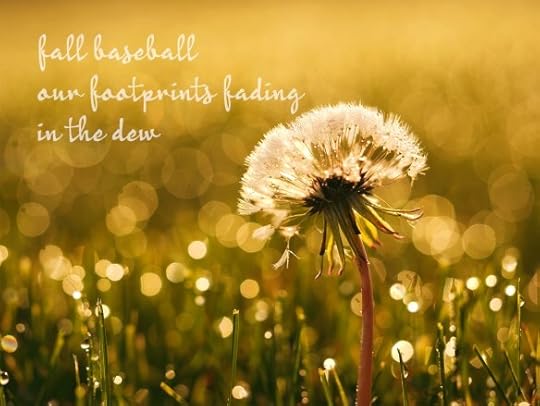
fall baseball
our footprints fading
in the dew