Mayra Calvani's Blog - Posts Tagged "civil-war"
Interview with Nick West, Author of The Long Road Home
 their children, Tammy, John and Christy, along with their families all live on the farm where he grew up near Archer. He is the author of The Great Southern Circus and The Long Road Home.
The Great Southern Circus , his first book, is a collection of circus stories told to him by his grandmother as they were told to her by her grandmother, Miranda Madderra, who performed with this horse drawn caravan just prior to the Civil War. His second book, The Long Road Home , follows the main characters from The Great Southern Circus as they traverse the difficult and painful years of the American Civil War.
Visit the author and learn more about his work at http://thelongroadsouth.com.
Thanks for this interview. Tell us a little about what got you into writing?
I believe that all writers are avid readers. As such I have tremendous respect for those who are talented enough to draw their readers into a caring relationship with the characters in their books. I have found that after reading a good book, I often recall the experiences of the characters as I would good friends or family members. That is my goal as a writer. I have attempted to relate these stories in a way that future generations of my own family could relate to them as the real people that they were. My effort is to bring these wonderful people to life in my books so that even readers outside of my own family would feel as connected to them as I do.
 What was your inspiration for The Long Road Home?
When The Great Southern Circus became available nationally on Amazon, I was contacted by a large number of readers who had become invested in the characters of that book. As that book ended, half the characters rushed to join the Union Army and the other half joined the Southern cause. Readers wanted to know what had become of these folks during the Civil War. This book answers those questions.
So the novel is part biographical, part fictional?
Biographical in the sense that these were real people who actually lived the events about which I have written, and fictional in the sense that I can only imagine most of their actual conversations based upon recollections as handed down through oral history for several generations.
For those readers who haven’t read your first book yet, is there something about the plot or characters they need to know in advance before reading The Long Road Home or is it a stand alone novel?
I have had readers who read The Long Road Home first, but invariably went back to read the Great Southern Circus to better understand the relationships. I would encourage folks to read the books in the order they were written to become more involved with all of these wonderful people.
How long did it take you to write the book and did you plot in advance?
The Great Southern Circus was a work in progress for years. I remembered the stories as they were told by my Grandmother and was determined to put them down in written form for future generations of my own family. The advent of the internet made it possible to not only verify that the events chronicled in the book actually took place, but also to connect me with other descendants of the same tour to compare notes and flesh out the other characters. This book took about a year to actually write and told the story of a two year circus tour that ended when the Civil War broke out. The Long Road Home picked up the adventures of the same characters as they struggled to survive the terrible years of the war. This book also took about one year to research and write.
I understand you did a lot of research for this novel. What was the process like and what surprised you most about this dark time of American history?
The American Civil War is probably the most researched period of American History. No matter how small a skirmish or political event, someone has researched and written about it. I read countless articles, books and research papers as they related to the experiences of my ancestors during this dark period. I found many surprises (at least to me) along the way. For instance, at the beginning of the War, Lincoln was more concerned with the preservation of the Union than he was about slavery which I was always taught was the major reason for the conflict. I also learned that racial prejudice in the North did not allow black men to even join the Union Army until late in the war. I had forgotten that our Nation was less than one hundred years old at the time and that many of the States believed that the Union was voluntary and that they could simply "opt out" if they believed that the Federal government was causing them more problems than it was helping their individual cause. I also learned to respect even more the character displayed by, and heartaches endured by President Lincoln during this time.
What themes do you explore in your novel?
Romance, friendship, adventure, hardships in a historical context. This is an attempt to put into perspective the individual stories of each of these men and women as they were swept along by events beyond their control. These characters first met each other and became close friends during the hardships of a circus tour that lasted two years before the outbreak of the War. One man was the northern son of the circus owner and performer, one young black man who joined to circus to search for his sister who was still held as a slave somewhere in the South, one young Alabama girl (my 3x Great Grandmother) who was a bare back rider and a young man from Alabama who joined the circus just to be near her. This is primarily their story.
What has been the reaction from your friends and family so far?
Friends and family loved both books and I have been blessed by the fact that total strangers have discovered my books. From the reviews on Amazon and other sites they seemed to have enjoyed them as well.
Are you planning any local book signings or other promotional events you’d like to announce?
I have periodic signing events that I advertise locally and through social networking. I am also happy to personalize and sign books that my office will mail to anyone who phones in a request to 1 (352)495-9858.
What’s on the horizon for you? Is there a third novel in the works?
I am now working on my third novel.
Is there anything else you’d like to share with my readers?
I am always happy to hear from readers who have enjoyed my books. They can find me on Facebook or E-Mail me at CountryGator@AOL.COM
Thanks again for the interview and best of luck with your books!
My interview originally appeared in Blogcritics Magazine


5 Questions with Alison Bruce & Kat Flannery
 Alison Bruce has had many careers and writing has always been one of them. Copywriter, editor and graphic designer since 1992, Alison has also been a comic book store manager, small press publisher, webmaster and arithmetically challenged bookkeeper. She is the author of mystery, suspense and historical romance novels.
Find Alison on the web:
Website: http://www.alisonbruce.ca
Blog: http://alisonebruce.blogspot.ca
Twitter: https://twitter.com/alisonebruce
Facebook: https://www.facebook.com/alisonbruce.books
 Kat Flannery’s love of history shows in the novels she writes. She is an avid reader of historical, suspense, paranormal, and romance. When not researching for her next book, Kat can be found running her three sons to hockey and lacrosse. She’s been published in numerous periodicals. This is Kat’s third book and she is hard at work on her next.
Find Kat on the web:
Website: www.katflannery-author.com
Blog: www.kat-scratch.blogspot.ca
Twitter: https://twitter.com/katflannery1
Facebook: http://www.facebook.com/pages/Kat-Flannery/131065966999142
SUMMARY:
Twin sisters separated by war, bound by love…
After the death of their father, twin sisters Maggie and Matty Becker are forced to take positions with officers’ families at a nearby fort. When the southern states secede, the twins are separated, and they find themselves on opposite sides of America’s bloodiest war.
In the south, Maggie travels with the Hamiltons to Bellevue, a plantation in west Tennessee. When Major Hamilton is captured, it is up to Maggie to hold things together and deal with the Union cavalry troop that winters at Bellevue. Racism, politics and a matchmaking stepmother test Maggie’s resourcefulness as she fights for Bellevue, a wounded Confederate officer and the affections of the Union commander.
In the north, Matty discovers an incriminating letter in General Worthington’s office, and soon she is on the run. With no one to turn to for help, she drugs the wealthy Colonel Cole Black and marries him, in hopes of getting the letter to his father, the governor of Michigan. But Cole is not happy about being married, and Matty’s life becomes all about survival.
Two unforgettable stories of courage, strength and honor.
--------------------------------
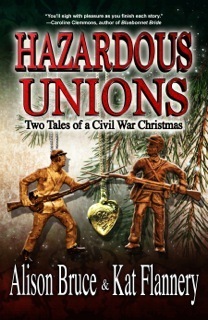
Q: What’s inside the mind of a historical romance author?
Alison: Sometimes I think that if I didn’t write fiction, I’d want a job writing Trivial Pursuit questions or maybe Jeopardy answers. I’m a research junkie – which is why I’m drawn to historical romance. The inside of my mind is a jumble of research, laundry lists and observations of the human condition – not unlike my desk.
Kat: Many things and only a quarter of it is writing but before the writing comes research.
Q: Tell us why readers should buy HAZARDOUS UNIONS.
Alison: I’d rather say what kind of reader should buy HAZARDOUS UNIONS. Someone who enjoys strong female characters and the kind of men who would fall in love with them is a prerequisite. Loving history as much as Kat and me isn’t required, but it doesn’t hurt.
Kat: Great answer, Ali.
Q: What makes a good historical romance?
Alison: Research is essential. You’ve got to know your period–at least as well as your characters would. The next step is to write so that your research isn’t obvious. The rest is good storytelling which includes the usual suspects of plot, characterization and pacing. Regardless of the genre an author writes in, storytelling is the bottom line.
Kat: What Ali said.
Q: What is a regular writing day like for you?
Alison: First coffee must be made. The next step is procrastination. Since I have two kids, three jobs and house to take care of, procrastination is easy. Finally there will be the tipping point when a blank page is more inviting than dirty dishes and I get down to it. Once I start, it’s hard to get me to stop. Fortunately my daughter cooks.
Kat: Oh, yes coffee for sure. Once the kids are off to school I answer emails, and if I have a freelance job I need to complete I work on that. Every Friday is bookkeeping day for my husbands business. Once all the loose ends are tied up I write.
Q: What do you find most rewarding about being an author?
Alison: As Hannibal from the A-Team says, “I love it when a plan comes together.”
Kat: Fan mail. I love to hear from my readers.
Q: How did you celebrate the completion of your book?
Alison: When I finished Maggie’s story in HAZARDOUS UNIONS I ordered pizza and the kids and I watched half of season two of Teen Wolf on DVD. It had arrived the week before but I wasn’t allowed to watch it until the book was done.
Kat: I made my three boys their favourite dinners over the course of the week and then on the weekend we all went out for dinner.

Meet F.W. Abel, author of Deeds of a Colored Soldier during the Rebellion, Volume 1: From the Beginning to Chickamagua
 F.W. Abel was born in the city of New York, long ago enough to have not even been a teenager at the beginning of the Civil War Centennial. He escaped from Fordham University with a degree in psychology into the U.S. Army. The army had him function as a psychologist for a while, until he escaped from that into “the real army” that is, the infantry. After postings in Berlin, Tokyo and the southern United States, he left and became a junior executive in the insurance industry. He now labors diligently for the American taxpayer as a federal bureaucrat. He currently resides in a Maryland suburb of Washington, D.C. As many of the most important battles of the Civil war was fought within a relatively short distance, he has taken advantage and visited most of them, as well as several in the so-called “Western Theater.”
Q: Congratulations on the release of your book, Deeds of a Colored Soldier during the Rebellion, Volume 1: From the Beginning to Chickamagua. How does it feel to be published for the first time?
A: I’m ecstatic, and apprehensive at the same time. I think just about anyone who writes something, anything, that took scores of hours and pounds (if not tons) of effort, wants to share their creation with the wider world. Of course, in doing so, said author leaves themselves open to criticism, and possibly, some of it is deserved. A work that made you a literary legend in your own mind just might not be perceived that way by readers. Hence, the ecstasy and the apprehension.
Q: What compelled you to write this Civil War story?
A: I recall a reviewer of the motion picture “Glory” as having stated it would have been interesting to know more about the African-American soldiers portrayed in the film, as it revolved around the story of their commanding officer. “Glory” was an outstanding movie, but it gave the impression that the 54th Massachusetts Regiment was the first colored regiment to fight. My novel kind of sets the record straight, and from the viewpoint of the enlisted men, the African-American soldiers who did the fighting. Also, I was a pre-teen during the Civil War Centennial, and I read a number of young adult novels with that theme. I essentially combined the two.
Q: Tell us something about your protagonist that my readers won’t be able to resist.
A: The novel tells the story of Jedediah as a young man, told by himself more than 30 years later. So a reader can see the enthusiasm and cock-suredness of a youth contrasted with rueful regret of his older, and perhaps wiser, self.
Q: Did your characters surprise you with their own ideas? Did you listen to them?
A: I remember reading long ago the novel, The Robe by Lloyd C. Douglas. It included a scene where Marcus asked a young man who had sculpted two gladiators what their names were. The young man thought he was being mocked, until Marcus explained that to really animate his two figures, they had to have names, past lives; they had to be real to him, or their sculpted selves would be lifeless. So, I created lives for them, before the action taking place in the novel. Of course, the great thing with dealing with fictional characters is the author’s ability to make any amendments needed to fit the narrative.
Q: How was your creative process like during the writing of this book and how long did it take you to complete it?
A: I wrote it linearly, without a formal outline, although I always knew where I was going. Historical fiction is great in that way, as it provides your general plot. The surprises came from filling in the details.
My book is about the rigors of war, and how life-changing, but a story with nothing but battles would bore even the most devoted reader of military fiction.
Q: How did you conduct your research?
A: I had an fairly extensive reading background in the Civil war from the time I was a pre-teen (I won’t tell you how long ago that was). But to insert a character into the major events portrayed in the novel required a considerable amount of research to get the minor details, in one case, weather conditions on a particular night, correct. Readers who read history fiction are also usually avid readers of history, and would be cognizant, and unappreciative, of dramatic license that did too much violence to the facts.
Q: How do you keep your narrative exciting throughout the creation of a novel without letting the historical details drag the pace?
A: You have to be judicious. You have to strike the delicate balance between verisimilitude and throwing in details to show how much research you did. And ideally, the minor historical details should have some bearing on the story. In one case, I made a big deal of the difference in the bullet sizes of two rifles, because (as really happened) during a battle, the soldiers ran out of one size of ammunition and were in dire straits because the only ammunition available was an unusable size.
Q: What is your writing schedule like and how do you balance it with your other work and family time?
A: I have a full-time job, so I have to fit writing in, but other things usually have priority. I look forward to the (now somewhat few) totally free days. I can write for 5-8 hours, but I can’t write anything good in one hour.
Q: Tell us about your publisher and how you found it.
A: After acquiring a fairly impressive collection of rejection letters, a friend going back to my college days introduced me to his publisher. The intro only got me so far, as like any good publisher, Lida Quillen wanted to judge the work for herself. Thankfully, she greeted it with enthusiasm and encouragement. I’m grateful to Lida, and my friend, Scott.
Q: What advice would you give to aspiring writers whose spouses or partners don’t support their dreams of becoming an author?
A: First, don’t get divorced. The number of aspiring authors is probably exceeded only by the number of aspiring actors, currently waiting tables, or the number of aspiring general currently serving as lieutenants. My wife has a business writing background, so I lured her in by having her do copy editing. Even so, although she liked my novel, she was still very skeptical that I had produced a saleable work. Sometimes, the person you have to convince is yourself.
On the other hand, writing is a less expensive hobby than golf or deep-sea fishing, so an aspiring author can approach it on that basis until the magic moment when he surprises even himself by having produced something good (good = publishable + saleable).
Q: Anything else you’d like to tell my readers?
A: There’s an old adage for writers, which is write what you know. To that, I would add, read, and extensively, because at some point, a reader could get the spark from something read to transition into a writer.

Talking Craft with S.W. O’Connell, Author of ‘The Cavalier Spy’

 S.W. O’Connell is the author of the Yankee Doodle Spies series of action and espionage novels set during the American Revolutionary War. The author is a retired Army officer with over twenty years of experience in a variety of intelligence-related assignments around the world. He is long time student of history and lover of the historical novel genre. So it was no surprise that he turned to that genre when he decided to write back in 2009. He lives in Virginia.
Q: Congratulations on the release of your latest book, The Cavalier Spy. To begin with, can you gives us a brief summary of what the story is about and what compelled you to write it?
A: The Cavalier Spy is an action and adventure story about a young immigrant to the New World (Lieutenant Jeremiah Creed) who gets caught up in the American Revolution. It tells his story while presenting a unique look at the War for Independence through the eyes of those people (on both sides) caught up in the conflict and in espionage. It takes off where the previous novel in the series, The Patriot Spy, leaves off. George Washington has his back to the wall after the British take lower Manhattan. He launches the protagonist, Jeremiah Creed in a series of desperate gambits to save the American cause from crumbling just months after independence was declared.
Q: What do you think makes a good historical fiction work? Could you narrow it down to the three most important elements? Is it even possible to narrow it down?
A: The history. And remember, history ends in story. So the historical story should be compelling. This includes the setting and the historical characters (if any). Obviously the fictional plot should move along and entertain. It should also mesh seamlessly with the historic events. Finally, the fictional and historical characters should complement each other. The fictional characters should be true to the story line. The historical characters should be as true as possible to what they really were. The sweet spot is when they become as interesting as the fictional characters.
Q: How did you go about plotting your story? Or did you discover it as you worked on the book?
A: One advantage of doing novels set against a military background is that the known military events can provide a guideline. For example, the main character can’t slip into British occupied territory and meet his significant other if he is 100 miles away fighting for George Washington. SO the historic setting provides a template for the writer, but it also places some restrictions on the writer. In my own writing, scope out the historic timeline first. Then, I settle on the fictional plot and sub plots that I must weave through it. Since this is a series, I can draw on a cast of existing characters, fictional and historic. But I always add new ones too. That’s the fun part. Getting to the second part of your question: I do improvise as I go along. I may take the plot anc characters in a totally different direction while crafting a scene. And I don’t typically decide who is good or bad up front. I let the scenes I write draw that out. This doesn’t include my core protagonists…. Usually.
 Q: Tell us something interesting about your protagonist and how you developed him or her. Did you do any character interviews or sketches prior to the actual writing?
A: Well, Creed joined the rebellion to lead soldiers in combat but is unwillingly drawn into intelligence work by General Washington himself. So he is, at first, not very enthusiastic about his situation. However, he determines to make the best of it. I knew I wanted to create someone who was sympathetic and generally good guy. But one who could stand out and lead men into places they wouldn’t, or shouldn’t go. I wanted someone a bit self-deprecating and loyal to his values. He had to be valiant. He had to be upstanding. But he had to have a past. And he is somewhat mysterious – he has a past. Some of his past was revealed in The Patriot Spy. A LOT more is revealed in The Cavalier Spy. I didn’t really do any character interviews or sketches. I had the idea for how he should be pretty clear in my head. I do think he matures into his role in The Cavalier Spy. Just a real people involve when sent into combat and other stressful situations. He won’t be the same.
Q: In the same light, how did you create your antagonist or villain? What steps did you take to make him or her realistic?
A: I need a foil on the other side for Creed. His name is Major Sandy Drummond. I decided up front to not make him a cartoon or stereotype. He, like Creed, gets thrust against his will into espionage work after he gets wounded in battle. He doesn’t know much about the work but grows into it quickly. To make him realistic I drew on what I thought a mid-level officer of the period would be like: professional, demanding, dedicated, etc. Since he is a dragoon officer he is a bit more used to operating on his own. Oh, and he is a Whig. That means he is from the political party in England that seeks reconciliation with the Americans. But, like the other Whig officers, he is committed to suppressing the illegal rebellion.
Q: How did you keep your narrative exciting throughout the novel? Could you offer some practical, specific tips?
A: Having a lot of battle scenes helps! But actually, The Cavalier Spy is less of that than The Patriot Spy. However, there is lots of movement as the war turns to the maneuver phase. And this enables my character to engage with the populace along the way. He gets several secret missions. These enable me to craft scenes with suspense, intrigue and action. As for specific writing – I improvise scenes all the time. Although I have the plan, I never know where or when I will divert from it. That keeps it interesting to me, the writer, in the hope that it will be more interesting to the reader.
Q: Setting is also quite important and in many cases it becomes like a character itself. What tools of the trade did you use in your writing to bring the setting to life?
A: Well, I do lots of research on the war and the general events that provide the background to the story. Then I try to develop the timeline with the venues. The ones that will provide the background, I try and draw out through description or the events (scenes) that take place there. I have four major settings in The Cavalier Spy. Each helped drive the story and the characters. I also researched the weather for this one. As it played a major role in shaping events in two of the settings.
Q: Did you know the theme(s) of your novel from the start or is this something you discovered after completing the first draft? Is this theme(s) recurrent in your other work?
A: I’ll answer the second question first. Yes. Since this is a series, I really just picked up where the first book ended as the saga of Jeremiah Creed, willing patriot soldier but unwilling spy, continues. Theme one is how he molds his men into soldier-spies. Another is his relationship with George Washington and Washington’s fictional chief of intelligence. The overall them of the story is adversity and courage in the face of overwhelming odds. This goes for Creed, the American army, and the American cause. The story takes place, after all, during the times that tray men’s souls. Apologies to Thomas Paine.
Q: Where does craft end and art begin? Do you think editing can destroy the initial creative thrust of an author?
A: With regard to editing, not thus far. As a staff officer in the Army I learned to lose my sense of pride if I wanted to get my point across. Likewise, the advice of professional editors, particular with regard to the basics of scenes, characters, point of view, etc, seems very helpful to me. So long as they don’t try to inject themselves into it in ways that makes it theirs. I have yet to encounter that. As to where craft ends and art begins, who knows? If the story is good, and the characters are good, that’s what matters. But the sum of it is art-like, almost like a painting made of words.
Q: What three things, in your opinion, make a successful novelist?
A: The dedicated writer must love the stories. I am dedicated to what I write because I love the stories want to get the stories out. Stories about the American Revolution; about the soldiers and spies who fought it; and about the people who lived it. So, as hard as the writing is, and it is hard, it’s an enjoyable hard. Like running a marathon I suppose.
Q: A famous writer once wrote that being an author is like having to do homework for the rest of your life. What do you think about that?
A: I disagree. Homework is a drill. A better analogy is doing a term paper. But you get to pick the topic, length, etc. The process of writing is difficult and sometimes tedious. But if you are committed to the tale you want to tell, it’s not homework.
Q: Are there any resources, books, workshops or sites about craft that you’ve found helpful during your writing career?
A: For me it has been hard knocks, trial and error and trying to emulate (but not copy) some of my favorite writers.
Q: Is there anything else you’d like to share with my readers about the craft of writing?
A: Pick something to write that excites YOU. Write often. Write what you love. Love what you write.
////////////////////////////////////
Title: The Cavalier Spy
Genre: Historical
Author: S. W. O’Connell
Website: www.yankeedoodlespies.com
Publisher: Twilight Times Books
Purchase link: http://www.twilighttimesbooks.com/TheCavalierSpy_ch1.html
About the Book:
1776: His army clinging to New York by a thread, a desperate General George Washington sends Lieutenant Jeremiah Creed behind British lines once more. But even the audacity of Creed and his band of spies cannot stop the British juggernaut from driving the Americans from New York, and chasing them across New Jersey in a blitzkrieg fashion. Realizing the imminent loss of one of the new nation’s most important states to the enemy, Washington sends Creed into the war-torn Hackensack Valley. His mission: recruit and train a gang of rogues to work behind British lines.
However, his mission takes a strange twist when the British high command plots to kidnap a senior American officer and a mysterious young woman comes between Creed and his plans. The British drive Washington’s army across the Delaware. The new nation faces its darkest moment. But Washington plans a surprise return led by young Creed, who must strike into hostile land so that Washington can rally his army for an audacious gamble that could win, or lose, the war.
“More than a great spy story… it is about leadership and courage in the face of adversity…The Cavalier Spy is the story of America’s first army and the few… those officers and soldiers who gave their all to a cause that was seemingly lost…”
~ Les Brownlee, former Acting Secretary of the Army and retired Army Colonel
“Secret meetings, skirmishes and scorching battles… The Cavalier Spy takes the reader through America’s darkest times and greatest triumphs thanks to its powerful array of fictional and historical characters… this book shows that courage, leadership and audacity are the key elements in war…”
~ F. William Smullen, Director of National Security Studies at Syracuse University’s Maxwell School and Author of Ways and Means for Managing UP