Mayra Calvani's Blog - Posts Tagged "political-thriller"
5 Questions with James Stone, author of the spy novel, CRYPTO
 Dr. Stone has a Ph.D. degree in electrical engineering, and numerous international certifications in computer security. He has worked at NSA, NASA, and the Department of Defense in various capacities, as well as having been a professor of engineering at a major university. He recently retired from engineering and plans to devote himself to writing. His first novel is CRYPTO, published by Twilight Times Books.
Q: Congratulations on the release of your novel! Tell us, what’s inside the mind of an espionage author?
A: I can’t speak for others, but I want to tell a good story. My next book is not even in the espionage genre. The third will be. It happens espionage, treason, and various other forms of misbehaviour are displayed prominently on the current world stage, making it easy to be relevant.
Q: Tell us why readers should buy CRYPTO.
A: First, it’s a really good story written by an author immersed for decades in the security world. I’ve tried to be very accurate in the background materials, and give a sense of what it’s like, while not compromising anything that might be sensitive. Incidentally, I actually personally knew a prominent spy who got caught.
Q: What makes a good espionage novel?
A: Let’s start with the basic rules: interesting people, doing interesting things, in interesting places: Have strong central characters, run them up a tree, and let the reader struggle with them to get down. Espionage stories should be obscure mysteries simply involving politics, plots, and treason.
Q: What espionage authors do you admire or recommend?
A: Eric Ambler, Richard Condon, Len Deighton, Ian Fleming, Ken Follett, Frederick Forsyth, Jack Higgins, John LeCarre (a bit dark), Robert Ludlum, Helen MacInnes, Daniel Silva, and many more. Unfortunately, I took a speed reading course some years ago and keep running out of books by favourite authors. Fortunately, I also like ‘space opera (Cherryh, Weber, Bujold), serial killer novels (Deaver, Sandford), and even some classic Regency Romance (Austen, Heyer). I like to read.
Q: What was the most difficult aspect of writing this book?
A: Making sure the details are all correct. For instance, I wanted a stream of Zil limos entering the Lubyanka in Moscow. I’ve never been there, so didn’t know where a door might be. Google Street View shows the only such portal off an alley at the back. I was amazed.
Q: How did you celebrate the completion of CRYPTO?
A: I started my next book, My Every Thought, a near-future Sci-Fi/Thriller about human-realistic robots and ‘Monsters from the ID.’


Talking Craft with Sally Fernandez, Author of ‘Climatized’
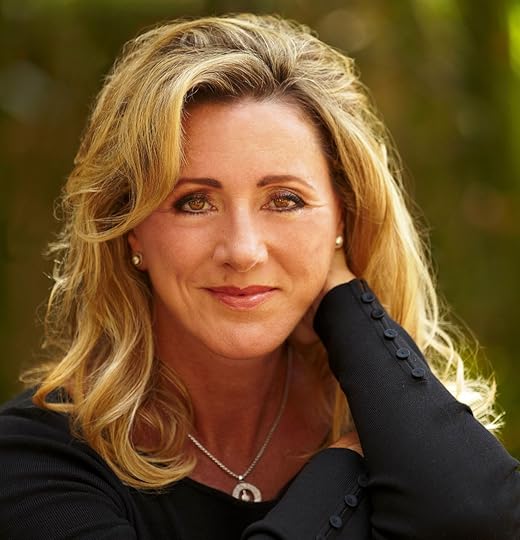 Sally Fernandez, a novelist of provocative political thrillers, wasn’t always twisting facts with fiction. Heavily endowed with skills acquired in banking, she embarked upon her writing career. Fernandez’ focus on computer technology, business consulting, and project management, enhanced by business and technical writing, proved to be a boon. Her books of fiction also reflect the knowledge garnered from her business experiences, while living in New York City, San Francisco, and Hong Kong.
Fernandez’ foray into writing fiction officially began in 2007 when the presidential election cycle was in full swing. The overwhelming political spin by the media compelled her to question the frightening possibilities the political scene could generate. As a confirmed political junkie, she took to the keyboard armed with unwinding events and discovered a new and exciting career.
Climatized is Fernandez’ fifth novel and the first in the “Max Ford Thriller” series, featuring Maxine Ford as the female protagonist. Her prior series, “The Simon Tetralogy,” was comprised of Brotherhood Beyond the Yard, Noble’s Quest, The Ultimate Revenge and Redemption. Each book provided an exhilarating platform for the next, with a gripping narrative that challenges the reader to put the book down. The ever-elusive Simon’s daring escapes add unheard of dimensions to the classic cat and mouse game. Her development of the other characters has created a lasting bond between them and the reader, especially now that Max has taken center stage.
A world traveler, Ms. Fernandez and her husband, also the editor-in-residence, split time between their homes in the United States and Florence, Italy.
Q: Congratulations on the release of your latest book, Climatized. To begin with, can you gives us a brief summary of what the story is about and what compelled you to write it?
A: In Climatized, Max is hired by the wife of a prominent senator to determine the cause of his untimely death. It leads her to discover that three world-renowned scientists had lost their lives days before they were scheduled to testify before the late senator’s investigative committee. Meanwhile, a fourth scientist has gone missing. Max determined he is the key to unearthing the motives behind the deaths. Following the many twists and turns, Max and her associate, Jackson Monroe uncover a powerful organization responsible for the killings. Cogent evidence is provided to the president, forcing him to make a crucial decision—to cover up a diabolical plot—or bring down a multi-trillion-dollar world-wide economy.
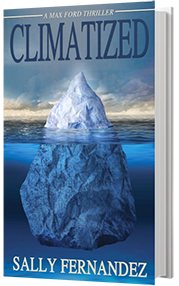 In the course of conducting research for two earlier novels, I discovered there is a disconnect between the scientific data that explains global warming and the public policy. Climate change undoubtedly, is a topic up there with religion and politics that creates not only heated conversations, but much confusion. As with all my novels I weave fact with fiction as a means of creating an entertaining read, but also to inform my readers. Climatized will put to rest much of the confusion and shine a light on the real science.
Q: What do you think makes a good political fiction? Could you narrow it down to the three most important elements? Is it even possible to narrow it down?
A: Francis Bacon said, “Truth is hard to tell, it sometimes needs fiction to make it plausible.” This statement became the impetus for my plot lines, therefore most of the political events are factual and weaved into a fictional plot. This greatly increases the plausibility. To further the realism, I have used my knowledge in technology to some degree, as well as my international travels in the plotline. Oftentimes, I have used a location and real characters where I shared experiences. Overall, my style of writing is to create an entertaining read, to inform the reader and to challenge the reader to ask the ultimate question, “What if?” In the end, the reader will be left with the challenge to sort out what is real and what is fictional. If I accomplish my goal, then that is what makes good political fiction.
Q: How did you go about plotting your story? Or did you discover it as you worked on the book?
A: In the course of writing a book, the plot for the next book begins to gel. Invariably, I come up with a beginning and end, although they may be modified later, but not to any great degree. Then I let the story develop starting with chapter one. As I create new chapters I name them as I go along, which might actually be the chapter title I eventually use in the publication, or I might assign a temporary title and change it later. This gives me the flexibility to add chapters in between or to reorganize the chapters as I move forward and keep track of the content. Primarily, my novels read much like a movie, so in essence I write reel-to-reel in a stream of consciousness as it rolls forward in my mind.
With regard to the characters, I keep track of the total image to include ages, personal appearance, and physical locations, to ensure my new characters emerge fresh and unique. And depending on the complexity of the plot, I may create a timeline to maintain accuracy in timing and sequence.
Q: Tell us something interesting about your protagonist and how you developed him or her. Did you do any character interviews or sketches prior to the actual writing?
A: After developing a series of strong male characters in the tetralogy, it was time to create an alter-ego. Maxine Ford represents my fantasies of one day becoming a secret agent. And even though a few of the male characters from the prior series will reemerge in this new series, Max’s antics will hold center stage.
Max debuts as the female protagonist in her role as a private investigator. Her character was first introduced in Noble’s Quest, the second book of “The Simon Tetralogy,” as the trusted deputy director for the States Intelligence Agency, where she worked side-by-side with Noble Bishop, the director. And while her character continued to develop, this new series provides Max challenging avenues to strut her stuff fully. She is intelligent and attractive, but her determined nature and formidable mouth will shape her persona. She also possesses a life-changing backstory that will slowly ooze out, allowing the reader to become increasingly enchanted by her dynamic character. Yet, at all times Max remains believable, not a sci-fi super being, but someone you could sit down and chat with over a glass of wine.
In my mind’s eye, if Climatized were a movie, Megan Boone would star as Max. Currently, she plays Elizabeth Keen in Blacklist…One time she dyed her hair blond, resembling Max. Now she is back to being brunette, but her attitude is Max all the way.
Q: In the same light, how did you create your antagonist or villain? What steps did you take to make him or her realistic?
A: In all honesty, as with Max, my characters just come to me and I develop them as I plod through the storyline. Simon, my antagonist in “The Simon Tetralogy” series appeared in the same way. I set off to make him charming and mysterious and then slowly he became more treacherous. The readers and the other characters were led first to admire him and then slowly grew to fear him. In Climatized, my assassin named L, materialized without any forethought. He simply appeared on the scene and I weaved him through the story in the most interesting ways.
Q: How did you keep your narrative exciting throughout the novel? Could you offer some practical, specific tips?
A: I attempt to create a mini cliffhanger at the end of each chapter to keep the pages turning. I also vary the word count in the chapters; some may only be one page. And because I tend to deal with a lot of political facts the narrative can sometimes bog down the chapter, so I mix it up with as much dialogue as possible to lighten the intensity without lessening the information and/or the message. Oftentimes, I will have my characters reading from some form of media, and break up the narrative by saying, “Hold on, let find my notes,” or “Are you following?” or “Listen up, this is cool stuff,” etc.
Q: Setting is also quite important and in many cases it becomes like a character itself. What tools of the trade did you use in your writing to bring the setting to life?
A: I often use a location and real characters where I’ve shared experiences, but I also will use a location, hotel, restaurant, or street where I’ve never ventured. In both cases, I believe it is crucial that these places be described accurately to add to the realism. Thanks to the internet and satellite maps there is no reason not to make them as real as possible. Given my reel-to-reel writing style the reader always has a clear vision of the local scene.
Q: Did you know the theme(s) of your novel from the start or is this something you discovered after completing the first draft? Is this theme(s) recurrent in your other work?
A: As I mentioned, while I’m writing one book the theme for the next book starts to gel. And being a political junkie I find it fascinating to take current political events and weave them into a fictional tale; again forcing the ultimate question, “What if?” Because I write several novels as part of a series there may be cross-over in characters and flashbacks to prior cases, but I strive to keep the theme fresh and current.
Q: Where does craft end and art begin? Do you think editing can destroy the initial creative thrust of an author?
A: The craft never ends and is always being honed. Over the course of my writing career, I’ve become extremely detailed and rather picky. The narrative must be grammatically correct, but I allow for colloquial expressions in dialogue. That along with the appropriate style of language will keep the characters genuine. In total I’ve become a better student of words and grammar and it has become apparent in normal discussions and presentations. The art, in my case, had been dormant and surfaced in 2007. I’m fortunate that I discovered storytelling was in my DNA. As for editing, my husband is my editor. He has never tried to change the narrative and has only helped to enhance my storyline. Most important, my creative juices are still in full thrust.
Q: What three things, in your opinion, make a successful novelist?
A: You have to have a story to tell and be able to express it in an captivating way. The characters must be believable and in my genre, research must be impeccable.
Q: A famous writer once wrote that being an author is like having to do homework for the rest of your life. What do you think about that?
A: Someone also said, “If you love what you do, you’ll never have to work a day in your life.” Although the inevitable marketing and promotional aspects can become unwelcome chores, it is superceded by the joy of the creative process.
Q: Are there any resources, books, workshops or sites about craft that you’ve found helpful during your writing career?
A: Naturally, the Chicago Manual of Style is the bible. I also find www.wordsmith.org a great place to discover words, covering the gamut from archaic to modern campy, along with their etymology and usage. It is a great source to improve one’s vocabulary.
Q: Is there anything else you’d like to share with my readers about the craft of writing?
A: Write, write, and write. Don’t get caught up initially, in grammar, editing, and organizing; that is why cut and paste was invented. Let your thoughts flow, they can be shaped later.
5 Questions with John Ford Clayton, Author of ‘Manipulated’
John Ford Clayton lives in Harriman, Tennessee with his wife Kara, and canine companions Lucy, Ginger and Clyde. He has two grown sons, Ben and Eli, and a daughter-in-law, Christina. He earned a BS in Finance from Murray State University and an MBA from the University of Tennessee in Knoxville. He is active in his East Tennessee  community having served on the local boards of the Boys and Girls Club and a federal credit union, on church leadership and creative teams, and on a parks and recreation advisory committee. When he’s not writing he works as a project management consultant supporting Federal project teams. John is a huge fan of Disney parks and University of Kentucky basketball. Visit his website at www.johnfordclayton.com.
Find out more about Manipulated.
Q: What’s inside the mind of a political thriller author?
A: In our hyper-polarized 2018 political climate, where any discussion of politics can quickly turn toxic, my primary thought is, there must be a better way. This current partisan rancour can’t continue. We seem to be rapidly approaching a time where the country is either going to explode or find a way to heal itself. Manipulated explores an alternative reality where that healing process begins. It is an outlet to provide a glimmer of hope in what appears to be a hopeless situation. It dares to ask, what if we didn’t settle for two firmly entrenched political parties but instead forged a third path out of this abyss. What if?
Q: Tell us why readers should buy Manipulated.
A: The 2016 presidential election elicited raw emotions from many Americans. Okay, I already know what you’re thinking, “politics, no thank you!!” Believe me, I understand. For countless political observers the entire election process demonstrated the ugly underbelly of our country, regardless of which side of the political aisle you call home. Manipulated reimagines that election cycle.
Manipulated chronicles a 70-year clandestine effort to seize control of the United States at the foundational level. It's all happening right under the noses of an unsuspecting nation. The long-awaited scheme will come to fruition with the 2016 presidential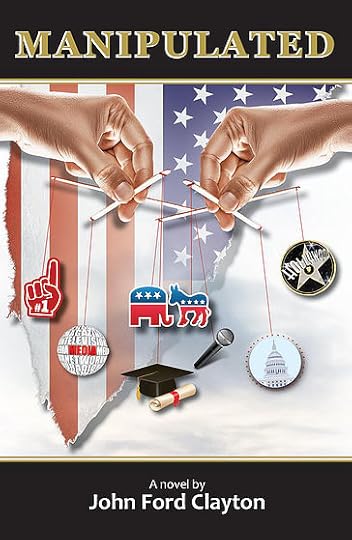 election. Everything is going according to plan, but then something happens. A new voice emerges. A strangely authentic candidate captures the fascination of the American people. But is it too late? Has the machine gotten too large to overcome? The stakes are high. The survival of the nation as we know it hangs in the balance.
Q: What makes a good political thriller?
A: A political thriller must thread the needle of not being so far-fetched that it is unbelievable but far enough from reality that it is compelling. It must have a rapidly evolving storyline that demands the reader to ask, “what’s next?” It must have characters that the reader cares about, including those they love and those they want to strangle. In the end the author owes a debt to the reader’s investment of time paid off in the currency of an ending that leaves them moved, fulfilled, and satisfied.
Q: Where can readers find out more about you and your work?
A: My website www.johnfordclayton.conm provides information about me and my book. I am on social media at www.facebook.com/johnfordclayton and www.twitter.com/johnfordclayton.
Q: What has writing taught you?
A: Writing is hard. It requires energy, focus, and a stubborn commitment. It demands equal parts of the left brain and right brain. The left brain is necessary to produce an organized storyline that stays focused on evolving the plot. The right brain is the source of colourful characters, interesting scenes, and intriguing dialog. While the story can always be improved, there must come a time when the writer is complete and transfers the product into the hands of the reader. The reader is the ultimate arbiter of whether a book is successful. The reader is always right.
community having served on the local boards of the Boys and Girls Club and a federal credit union, on church leadership and creative teams, and on a parks and recreation advisory committee. When he’s not writing he works as a project management consultant supporting Federal project teams. John is a huge fan of Disney parks and University of Kentucky basketball. Visit his website at www.johnfordclayton.com.Find out more about Manipulated.
Q: What’s inside the mind of a political thriller author?
A: In our hyper-polarized 2018 political climate, where any discussion of politics can quickly turn toxic, my primary thought is, there must be a better way. This current partisan rancour can’t continue. We seem to be rapidly approaching a time where the country is either going to explode or find a way to heal itself. Manipulated explores an alternative reality where that healing process begins. It is an outlet to provide a glimmer of hope in what appears to be a hopeless situation. It dares to ask, what if we didn’t settle for two firmly entrenched political parties but instead forged a third path out of this abyss. What if?
Q: Tell us why readers should buy Manipulated.
A: The 2016 presidential election elicited raw emotions from many Americans. Okay, I already know what you’re thinking, “politics, no thank you!!” Believe me, I understand. For countless political observers the entire election process demonstrated the ugly underbelly of our country, regardless of which side of the political aisle you call home. Manipulated reimagines that election cycle.
Manipulated chronicles a 70-year clandestine effort to seize control of the United States at the foundational level. It's all happening right under the noses of an unsuspecting nation. The long-awaited scheme will come to fruition with the 2016 presidential
election. Everything is going according to plan, but then something happens. A new voice emerges. A strangely authentic candidate captures the fascination of the American people. But is it too late? Has the machine gotten too large to overcome? The stakes are high. The survival of the nation as we know it hangs in the balance.Q: What makes a good political thriller?
A: A political thriller must thread the needle of not being so far-fetched that it is unbelievable but far enough from reality that it is compelling. It must have a rapidly evolving storyline that demands the reader to ask, “what’s next?” It must have characters that the reader cares about, including those they love and those they want to strangle. In the end the author owes a debt to the reader’s investment of time paid off in the currency of an ending that leaves them moved, fulfilled, and satisfied.
Q: Where can readers find out more about you and your work?
A: My website www.johnfordclayton.conm provides information about me and my book. I am on social media at www.facebook.com/johnfordclayton and www.twitter.com/johnfordclayton.
Q: What has writing taught you?
A: Writing is hard. It requires energy, focus, and a stubborn commitment. It demands equal parts of the left brain and right brain. The left brain is necessary to produce an organized storyline that stays focused on evolving the plot. The right brain is the source of colourful characters, interesting scenes, and intriguing dialog. While the story can always be improved, there must come a time when the writer is complete and transfers the product into the hands of the reader. The reader is the ultimate arbiter of whether a book is successful. The reader is always right.
A Conversation with Trial Lawyer/Political Thriller Author Michael Bowen
After his graduation from Harvard Law School, Michael Bowen worked as a trial lawyer for thirty-nine years before retiring in 2015. He focused on franchise and distribution disputes, but found time to assist in representing the Milwaukee Brewers baseball team in complex litigation over a proposal to put a maximum security prison across the street from County Stadium, and to represent numerous pro bono clients, including one who had been sentenced to death. His career in fiction began with the 1987 publication of Can’t Miss, a “gently feminist” (St. Louis Post Dispatch) novel about the first woman to play major league baseball. It continued through publication of one political satire and nineteen mysteries, culminating in 2019 with False Flag in Autumn, a follow-up to 2016’s Damage Control (“ . . . consistently delightful . . . . Bowen’s ebullient antidote to election season blues . . . . ” Kirkus Reviews). During his legal career he also wrote numerous published articles on legal and political matters, and co-authored the Wisconsin State Bar treatise on the Wisconsin Fair Dealership Law (paperback and movie rights still available). He lives in Fox Point, Wisconsin, a suburb of Milwaukee, with his wife Sara, who is also a Harvard Law School graduate and a published lecturer on Jane Austen and Angela Thirkel. www.michaelbowenmysteries.com

INTERVIEW
Q: Congratulations on the release of your latest book, False Flag in Autumn. To begin with, can you give us a brief summary of what the story is about and what compelled you to write it?
A: False Flag in Autumn asks why there wasn’t an “October surprise” before the 2018 mid-term elections, and whether there will be one before the presidential election in 2020. It features Josie Kendall, whose memoirs will not be titled Nancy Drew Goes to Washington, a manipulative Washington apparatchik who is engaging, ambitious, cheerfully cynical, and (as she puts it) not possessed of “an overly delicate conscience.” A rogue White House aide has tabbed her for the role of unwitting pawn in 2018’s planned October surprise, which leads to her being caught up in the more nefarious scheme planned for 2020. Knowing that the stakes are high and could quickly get personal, Josie will have to decide whether to keep her head down and pray that the prospective victims die quickly and without too much pain, or to venture outside the Beltway bubble where the weapons are spin, winks, and leaks, into a darker world where the weapons are actual weapons. She ends up on the side of the angels although, Josie being Josie, these angels play a little dirty. I decided to write it because, after a lifetime as a reasonably savvy political junkie, I spent 2016 making one wrong prediction after another, and I wanted to see if I could at least imagine something weirder than what was actually going to happen.
Q: What do you think makes a good political thriller? Could you narrow it down to the three most important elements? Is it even possible to narrow it down?
A: The single most important element of a political thriller is heart. The protagonist has to care about something – country, cause, ideology – larger than himself or herself, and the reader has to care about the protagonist and at least one of the potential victims. As Lenin said, “The death of millions is a statistic. The death of a single human being – that is a tragedy.”
The second indispensable element is believable action. A punch in the mouth hurts; you don’t just shrug it off. People don’t exchange snappy patter during fistfights. Most people have no idea of whether they could fire a gun at another human being, and in combat situations they don’t act like robots (or like Hollywood action heroes – but I repeat myself).

The third critical element is human weakness, shared by the protagonist with other characters. The protagonist should have at least occasional doubts, make serious mistakes, and perhaps shiver a bit at times when he (or, in this case, she) looks in the mirror.
Q: How did you go about plotting your story? Or did you discover it as you worked on the book?
A: I firmly believe that plot flows from character. I had detailed portraits of my main characters in my head before I typed the first word of the story. Characters being true to themselves will go a long way toward shaping the plot because, after all, the plot is basically what the characters do, and well thought out characters won’t behave randomly.
I had the basic premise in my head before I booted up my computer. I didn’t prepare a chapter-by-chapter plot outline, but I did work out a reasonably detailed synopsis of the plot in the initially successful pitch that I made to the first publisher I approached. At the same time, twists and turns inevitably developed, and the plot evolved as I dealt with them. I think it’s important for writers not to have too much of an ego-investment in their initial conceptions. You know things that you don’t know you know, and that knowledge will bubble to the surface as you solve basic problems – e.g., after twenty pages of talk, I need an action scene pretty soon – that come up while you’re telling the story.
Q: Tell us something interesting about your protagonist and how you developed him or her. Did you do any character interviews or sketches prior to the actual writing?
A: Since Josephine Robideaux Kendall was fifteen years old, she has wanted to work someday on the White House staff; to fly one day on Air Force One, working out talking points for the president to use in discussing a crisis that arose after the plane was in the air. Her uncle says that her mind, like the rapids on Louisiana rivers, is fast but not deep, and she agrees. She knows that she is smart but not (yet) wise, and that she is capable of serious moral lapses, but when they occur she confronts them honestly, without kidding herself. I had developed Josie thoroughly in Damage Control, and in False Flag in Autumn I let her grow from the harrowing experience that she had in the earlier book as a result of her flippancy and misjudgments.
I prepared a sketch of her, but that was mostly for the benefit of the publisher. I knew who Josie was and would be. I didn’t do “interviews” with her. That idea frankly never occurred to me. On reflection, it would have been fun but I’m not sure it would have moved the ball very much.
Q: In the same light, how did you create your antagonist or villain? What steps did you take to make him or her realistic?
A: The key to Hank Sinclair is that he’s book-smart but not gut-smart. Washington is full of people like that (some of whom have run for president recently). One of my law partners, who had worked on the staff of a governor and labored in that governor’s effort at a major party convention to get himself put on the ticket as the vice-presidential candidate, told me that the core, single-minded attitude of anyone on any elected official’s staff is “Can do.” A staffer wants to accomplish whatever the candidate wants, regardless of what it takes, what the risks are, or whether it’s right or wrong. Put that together with book-smart but not gut-smart and you get Watergate – or Hank Sinclair. He doesn’t have to be evil. He simply has to be useful to people who are.
Q: How did you keep your narrative exciting throughout the novel? Could you offer some practical, specific tips?
A: The key to excitement is suspense, and the keys to suspense are foreshadowing and investment of the reader in the protagonist (or in whoever is in peril). Action itself is very useful, but it is secondary to and derivative of suspense. The reader doesn’t know what’s going to happen, and has to care whether one thing happens rather than another. Once you’ve accomplished that, you can (as Raymond Chandler put it) have someone walk through the door with a gun in his hand. It is very important to genuine excitement that action not be arbitrary, that it flow organically from the plot. You can’t have your protagonist get into a fight just to prove to someone else (the leader of a gang of outlaws or terrorists that he’s trying to infiltrate, for example) that he’s tough or capable. (That trope, by the way, was a staple of westerns and private-eye TV shows in the 1950’s and 1960’s.) Finally, action has to conform to character. Josie Kendall grew up in Louisiana and she knows how to handle firearms, but until she has to find out the hard way she doesn’t know whether she’d be any use in a firefight. (Neither do I and, odds are, neither do you.) As she says when considering options in a tight situation, no one will confuse her with Jack Reacher.
Q: Setting is also quite important and in many cases it becomes like a character itself. What tools of the trade do you use in your writing to bring the setting to life?
A: The most important element of convincing setting is concrete detail. In Vienna, lots of people ride bicycles at night. In Milwaukee, Wisconsin, streetwalkers don’t ply their trade east of the Milwaukee River. In Washington, D.C., everyone hates the Metro, locals have an aversion to tourists, and a lot of people who smoke hide their indulgence like eighth-graders sneaking behind the gym because the optics are bad and Washington is a city where people care about optics. In Baton Rouge, Louisiana, a key police force is the East Baton Rouge Parish Sheriff and his legions of deputies – and people are not particularly shy about smoking.
In a perfect world, an author can get to some facet of the essence of a particular place. In the American south, generally, there is a sense of history, and in the American Midwest a sense of identification with a particular locale, that would seem alien to someone in, say, New Jersey or California. In Washington, one such defining element is the perpetual tension between elected officials (especially presidents), who are viewed as transients, and the permanent government (or “deep state,” as some call it these days) that plans to run administrative agencies forever. How do you figure out what that defining feature is for a particular place? Three ways: (1) live and work there for over a year; (2) marry someone from there; or (3) visit there for a while, keeping your eyes and ears open and your mouth shut.
Q: Did you know the theme(s) of your novel from the start or is this something that you discovered after completing the first draft? Is this theme recurrent in your other work?
A: I have had the basic themes of my Washington crime stories firmly in mind since I published Washington Deceased some thirty years ago: Washington is a place where people do things – both good things and evil things – for reasons that would make no sense in (say) San Francisco or Chicago or Atlanta; and where, somehow, for some reason (the genius of the Constitution? Divine providence?) messy compromises get worked out and the United States muddles through one crisis after another without catastrophe and sometimes in startling triumph. Somehow a zeitgeist of depraved and sordid cynicism leads to people rising above their limitations and actually shocking themselves by doing what’s right for their country.
Q: Where does craft end and art begin? Do you think editing can destroy the initial creative thrust of an author?
A: Let’s not kid ourselves: in mystery writing, art and craft are basically the same thing. We’re telling stories about good and evil, free will and determinism, logic and intuition, causation and randomness. Such storytelling is an art if it’s done right (that is, in a craftsmanlike way), and it’s a waste of time if it’s not. It’s an art if it engages the reader, which can be done only by those with a confident command of the craft, and it’s a flop if it doesn’t, no matter what literary pyrotechnics attend it. G.K. Chesterton wrote that it may be a finer thing to be a lyric poet than to be a wit, but it’s a lot easier to pretend to be a lyric poet than to pretend to be a wit. The same thing is true of writing mysteries and thrillers: their art and craft is that they work for readers (or they don’t). If they don’t, you can tell right away, and you know that neither art nor craft is involved.
In theory, of course is it possible for conformist or mindless or ideology-driven editing to negate the creative brilliance shining through an author’s work. In over thirty years of publishing fiction, however, I’ve never had a bad editor. Every editor I’ve ever worked with has done everything he or she could to bring out what was best in my work and to cast aside what detracted from its quality. Hence, I’m more than a little skeptical about whether this theoretical possibility is ever realized in practice.
Q: What three things, in your opinion, make a successful novelist?
A: That depends on the definition of “successful”. If a “successful” novelist is one who writes bestsellers, then the three keys are (1) knowledge of the target demographic; (2) willingness and ability to tell a fast-moving story using an eighth-grade vocabulary; and (3) a talent for developing fresh premises to hang those stories on. If a “successful” novelist is one who gets critical acclaim in high-minded publications, then the three keys are (1) achieving first-hand or at least second-hand contact with the people, mostly in New York, who determine the orientation of those publications; (2) willingness and ability to tell stories that reflect that orientation; and (3) a talent for developing fresh premises to hang those stories on. If a “successful” novelist is one who writes stories that he or she (and, ideally, others) can still read with pleasure twenty years after those stories were published, then the three keys are (1) an imaginative knack for asking “What if . . . ?” and then following the implications of that question to an emotionally satisfying conclusion; (2) a willingness to pound a keyboard until your brains fall out and a coherent narrative structure has taken shape; and (3) a talent for developing fresh premises to hang the resulting stories on. Careful readers will notice a theme here.
Q: A famous writer once wrote that being an author is like having to do homework for the rest of your life. Thoughts?
A: I don’t agree. Homework is something you do, even though you don’t want to, because you don’t have any choice. Professional writers do have a choice. Anyone who could be an author could, if nothing else, sell fraudulent securities or successfully manage a house of assignation.
Q: Are there any resources, books, workshops, or sites about the craft that you’ve found helpful during your writing career?
A: The closest I can come – and it’s not particularly close – is Evelyn Waugh’s memoir A Little Learning. Beyond that, the truthful answer is no. I don’t mean to suggest that I’m so good that I couldn’t have benefitted from resources such as these. I simply mean that I never consulted them. Because I was practicing law full time, I had to either write fiction during the times when my partners were playing golf, or not write fiction at all. Studying about how to write better simply wasn’t an option, because even my partners didn’t play that much golf.
Q: Is there anything else you’d like to share with my readers about the craft of writing?
A: Two things. First, unless you so fervently want to write that nothing I might say could possibly dissuade you, then don’t take up writing as a profession. Effective fiction should proceed from an urgent inner need that cannot be satisfied except by written expression. Second, believe in the stories you tell. There are plenty of successful writers who don’t, and in general they are unhappy people.
INTERVIEW
Q: Congratulations on the release of your latest book, False Flag in Autumn. To begin with, can you give us a brief summary of what the story is about and what compelled you to write it?
A: False Flag in Autumn asks why there wasn’t an “October surprise” before the 2018 mid-term elections, and whether there will be one before the presidential election in 2020. It features Josie Kendall, whose memoirs will not be titled Nancy Drew Goes to Washington, a manipulative Washington apparatchik who is engaging, ambitious, cheerfully cynical, and (as she puts it) not possessed of “an overly delicate conscience.” A rogue White House aide has tabbed her for the role of unwitting pawn in 2018’s planned October surprise, which leads to her being caught up in the more nefarious scheme planned for 2020. Knowing that the stakes are high and could quickly get personal, Josie will have to decide whether to keep her head down and pray that the prospective victims die quickly and without too much pain, or to venture outside the Beltway bubble where the weapons are spin, winks, and leaks, into a darker world where the weapons are actual weapons. She ends up on the side of the angels although, Josie being Josie, these angels play a little dirty. I decided to write it because, after a lifetime as a reasonably savvy political junkie, I spent 2016 making one wrong prediction after another, and I wanted to see if I could at least imagine something weirder than what was actually going to happen.
Q: What do you think makes a good political thriller? Could you narrow it down to the three most important elements? Is it even possible to narrow it down?
A: The single most important element of a political thriller is heart. The protagonist has to care about something – country, cause, ideology – larger than himself or herself, and the reader has to care about the protagonist and at least one of the potential victims. As Lenin said, “The death of millions is a statistic. The death of a single human being – that is a tragedy.”
The second indispensable element is believable action. A punch in the mouth hurts; you don’t just shrug it off. People don’t exchange snappy patter during fistfights. Most people have no idea of whether they could fire a gun at another human being, and in combat situations they don’t act like robots (or like Hollywood action heroes – but I repeat myself).
The third critical element is human weakness, shared by the protagonist with other characters. The protagonist should have at least occasional doubts, make serious mistakes, and perhaps shiver a bit at times when he (or, in this case, she) looks in the mirror.
Q: How did you go about plotting your story? Or did you discover it as you worked on the book?
A: I firmly believe that plot flows from character. I had detailed portraits of my main characters in my head before I typed the first word of the story. Characters being true to themselves will go a long way toward shaping the plot because, after all, the plot is basically what the characters do, and well thought out characters won’t behave randomly.
I had the basic premise in my head before I booted up my computer. I didn’t prepare a chapter-by-chapter plot outline, but I did work out a reasonably detailed synopsis of the plot in the initially successful pitch that I made to the first publisher I approached. At the same time, twists and turns inevitably developed, and the plot evolved as I dealt with them. I think it’s important for writers not to have too much of an ego-investment in their initial conceptions. You know things that you don’t know you know, and that knowledge will bubble to the surface as you solve basic problems – e.g., after twenty pages of talk, I need an action scene pretty soon – that come up while you’re telling the story.
Q: Tell us something interesting about your protagonist and how you developed him or her. Did you do any character interviews or sketches prior to the actual writing?
A: Since Josephine Robideaux Kendall was fifteen years old, she has wanted to work someday on the White House staff; to fly one day on Air Force One, working out talking points for the president to use in discussing a crisis that arose after the plane was in the air. Her uncle says that her mind, like the rapids on Louisiana rivers, is fast but not deep, and she agrees. She knows that she is smart but not (yet) wise, and that she is capable of serious moral lapses, but when they occur she confronts them honestly, without kidding herself. I had developed Josie thoroughly in Damage Control, and in False Flag in Autumn I let her grow from the harrowing experience that she had in the earlier book as a result of her flippancy and misjudgments.
I prepared a sketch of her, but that was mostly for the benefit of the publisher. I knew who Josie was and would be. I didn’t do “interviews” with her. That idea frankly never occurred to me. On reflection, it would have been fun but I’m not sure it would have moved the ball very much.
Q: In the same light, how did you create your antagonist or villain? What steps did you take to make him or her realistic?
A: The key to Hank Sinclair is that he’s book-smart but not gut-smart. Washington is full of people like that (some of whom have run for president recently). One of my law partners, who had worked on the staff of a governor and labored in that governor’s effort at a major party convention to get himself put on the ticket as the vice-presidential candidate, told me that the core, single-minded attitude of anyone on any elected official’s staff is “Can do.” A staffer wants to accomplish whatever the candidate wants, regardless of what it takes, what the risks are, or whether it’s right or wrong. Put that together with book-smart but not gut-smart and you get Watergate – or Hank Sinclair. He doesn’t have to be evil. He simply has to be useful to people who are.
Q: How did you keep your narrative exciting throughout the novel? Could you offer some practical, specific tips?
A: The key to excitement is suspense, and the keys to suspense are foreshadowing and investment of the reader in the protagonist (or in whoever is in peril). Action itself is very useful, but it is secondary to and derivative of suspense. The reader doesn’t know what’s going to happen, and has to care whether one thing happens rather than another. Once you’ve accomplished that, you can (as Raymond Chandler put it) have someone walk through the door with a gun in his hand. It is very important to genuine excitement that action not be arbitrary, that it flow organically from the plot. You can’t have your protagonist get into a fight just to prove to someone else (the leader of a gang of outlaws or terrorists that he’s trying to infiltrate, for example) that he’s tough or capable. (That trope, by the way, was a staple of westerns and private-eye TV shows in the 1950’s and 1960’s.) Finally, action has to conform to character. Josie Kendall grew up in Louisiana and she knows how to handle firearms, but until she has to find out the hard way she doesn’t know whether she’d be any use in a firefight. (Neither do I and, odds are, neither do you.) As she says when considering options in a tight situation, no one will confuse her with Jack Reacher.
Q: Setting is also quite important and in many cases it becomes like a character itself. What tools of the trade do you use in your writing to bring the setting to life?
A: The most important element of convincing setting is concrete detail. In Vienna, lots of people ride bicycles at night. In Milwaukee, Wisconsin, streetwalkers don’t ply their trade east of the Milwaukee River. In Washington, D.C., everyone hates the Metro, locals have an aversion to tourists, and a lot of people who smoke hide their indulgence like eighth-graders sneaking behind the gym because the optics are bad and Washington is a city where people care about optics. In Baton Rouge, Louisiana, a key police force is the East Baton Rouge Parish Sheriff and his legions of deputies – and people are not particularly shy about smoking.
In a perfect world, an author can get to some facet of the essence of a particular place. In the American south, generally, there is a sense of history, and in the American Midwest a sense of identification with a particular locale, that would seem alien to someone in, say, New Jersey or California. In Washington, one such defining element is the perpetual tension between elected officials (especially presidents), who are viewed as transients, and the permanent government (or “deep state,” as some call it these days) that plans to run administrative agencies forever. How do you figure out what that defining feature is for a particular place? Three ways: (1) live and work there for over a year; (2) marry someone from there; or (3) visit there for a while, keeping your eyes and ears open and your mouth shut.
Q: Did you know the theme(s) of your novel from the start or is this something that you discovered after completing the first draft? Is this theme recurrent in your other work?
A: I have had the basic themes of my Washington crime stories firmly in mind since I published Washington Deceased some thirty years ago: Washington is a place where people do things – both good things and evil things – for reasons that would make no sense in (say) San Francisco or Chicago or Atlanta; and where, somehow, for some reason (the genius of the Constitution? Divine providence?) messy compromises get worked out and the United States muddles through one crisis after another without catastrophe and sometimes in startling triumph. Somehow a zeitgeist of depraved and sordid cynicism leads to people rising above their limitations and actually shocking themselves by doing what’s right for their country.
Q: Where does craft end and art begin? Do you think editing can destroy the initial creative thrust of an author?
A: Let’s not kid ourselves: in mystery writing, art and craft are basically the same thing. We’re telling stories about good and evil, free will and determinism, logic and intuition, causation and randomness. Such storytelling is an art if it’s done right (that is, in a craftsmanlike way), and it’s a waste of time if it’s not. It’s an art if it engages the reader, which can be done only by those with a confident command of the craft, and it’s a flop if it doesn’t, no matter what literary pyrotechnics attend it. G.K. Chesterton wrote that it may be a finer thing to be a lyric poet than to be a wit, but it’s a lot easier to pretend to be a lyric poet than to pretend to be a wit. The same thing is true of writing mysteries and thrillers: their art and craft is that they work for readers (or they don’t). If they don’t, you can tell right away, and you know that neither art nor craft is involved.
In theory, of course is it possible for conformist or mindless or ideology-driven editing to negate the creative brilliance shining through an author’s work. In over thirty years of publishing fiction, however, I’ve never had a bad editor. Every editor I’ve ever worked with has done everything he or she could to bring out what was best in my work and to cast aside what detracted from its quality. Hence, I’m more than a little skeptical about whether this theoretical possibility is ever realized in practice.
Q: What three things, in your opinion, make a successful novelist?
A: That depends on the definition of “successful”. If a “successful” novelist is one who writes bestsellers, then the three keys are (1) knowledge of the target demographic; (2) willingness and ability to tell a fast-moving story using an eighth-grade vocabulary; and (3) a talent for developing fresh premises to hang those stories on. If a “successful” novelist is one who gets critical acclaim in high-minded publications, then the three keys are (1) achieving first-hand or at least second-hand contact with the people, mostly in New York, who determine the orientation of those publications; (2) willingness and ability to tell stories that reflect that orientation; and (3) a talent for developing fresh premises to hang those stories on. If a “successful” novelist is one who writes stories that he or she (and, ideally, others) can still read with pleasure twenty years after those stories were published, then the three keys are (1) an imaginative knack for asking “What if . . . ?” and then following the implications of that question to an emotionally satisfying conclusion; (2) a willingness to pound a keyboard until your brains fall out and a coherent narrative structure has taken shape; and (3) a talent for developing fresh premises to hang the resulting stories on. Careful readers will notice a theme here.
Q: A famous writer once wrote that being an author is like having to do homework for the rest of your life. Thoughts?
A: I don’t agree. Homework is something you do, even though you don’t want to, because you don’t have any choice. Professional writers do have a choice. Anyone who could be an author could, if nothing else, sell fraudulent securities or successfully manage a house of assignation.
Q: Are there any resources, books, workshops, or sites about the craft that you’ve found helpful during your writing career?
A: The closest I can come – and it’s not particularly close – is Evelyn Waugh’s memoir A Little Learning. Beyond that, the truthful answer is no. I don’t mean to suggest that I’m so good that I couldn’t have benefitted from resources such as these. I simply mean that I never consulted them. Because I was practicing law full time, I had to either write fiction during the times when my partners were playing golf, or not write fiction at all. Studying about how to write better simply wasn’t an option, because even my partners didn’t play that much golf.
Q: Is there anything else you’d like to share with my readers about the craft of writing?
A: Two things. First, unless you so fervently want to write that nothing I might say could possibly dissuade you, then don’t take up writing as a profession. Effective fiction should proceed from an urgent inner need that cannot be satisfied except by written expression. Second, believe in the stories you tell. There are plenty of successful writers who don’t, and in general they are unhappy people.