Tim Hayes's Blog
June 30, 2017
Children And Horses - An Alternative To The Internet
Throughout human history, people have loved owned, and ridden horses. Horses fascinate us; they silently speak to our hearts


January 12, 2017
December 21, 2016
November 1, 2016
July 21, 2016
Saratoga WarHorse... Saving the Lives of Our Veterans
<![CDATA[The emotional healing that begins with the nonverbal nonjudgmental acceptance of a horse enables veterans to feel safe enough to be themselves. This breakthrough Connection helps bridge the barrier of shame and isolation created by Post Traumatic Stress and enables the veteran to go on and continue to recover often utilizing emotional expressive therapy with another human.]]>
December 22, 2015
The Horse, A Gift For All Seasons
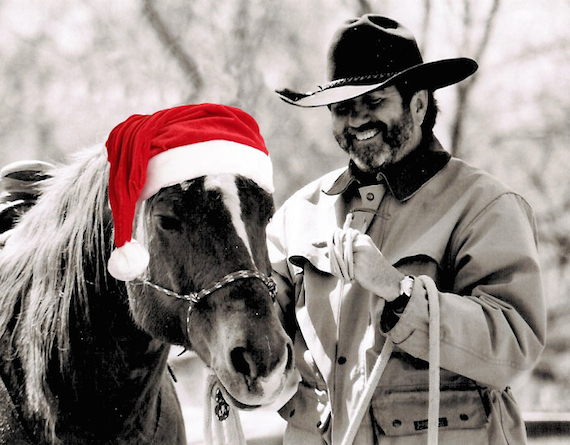
Tim and his horse Austin 2015 ~ Courtesy Tim Hayes Collection
When I set out to write RIDING HOME ~ The Power of Horses to Heal I wanted to share about the profound emotional healing one can experience from today's equine therapy. I also wanted people to discover the joy, empowerment and self-awareness they could receive by simply having a relationship with horse. In both cases these personal transformations occur not by sitting on a horse's back but by being with them on ground and from their heart.
Having had a wondrous relationship for almost twenty years with my horse Austin, I thought it might be meaningful at this time of year to share both my gratitude as well as what I've learned from the amazing gifts I have received not only from Austin but from every horse I've met.
For many of us the holiday season can bring feelings of happiness that often come from fun, thoughtful and exciting gifts. As enjoyable as these feelings can be many of them disappear when the season ends. If my happiness begins to fade as I start to get scratches on my new iPhone I might ask myself what else might give me more sustainable happiness as time goes on?
Actually there is another kind of happiness that does not come from material things but comes spontaneously from inside us. For me this kind of happiness has usually come when I'm both feeling good about myself and my relationships with others are working positively and are mutually rewarding. What can I do to feel this way inside?
For me the answer is found today in the same guidance I was given when I was a little kid: Treat others the way I would want them to treat me and treat myself the same way. If I have a happy relationship with myself, I have a very good chance of having a happy relationship with others: spouse, partner, father, mother, son, daughter, friends, boss, etc. When my relationships bring me happiness, I feel happier. It's the ideal win-win situation. My parents called this: The Golden Rule.
The greatest teacher of The Golden Rule I have ever known is the horse. From years of studying how horses treat each other in their relationships I have discovered their herd dynamics possess the same 12 qualities found in The Golden Rule: acceptance, kindness, understanding, patience, generosity, trust, consistency, honesty, justice, respect, compassion and forgiveness. They treat each other the same way they want to be treated and they treat humans the same way. I also believe it is these 12 qualities that constitute the best and most accurate definition of Love.
My horse is a prey animal whose survival depends on getting along with others. His natural world is living outside with his herd-mates. When I show up he accepts me as I am, never questions my race, my gender or my age. He's kind and doesn't seek to hurt me. If I get bit, kicked or dumped it's because I haven't taught him to respect my vulnerability and not to play or communication with me like another horse. If I am clear, consistent and patient in my requests he always understands me.
He's a generous soul who never complains if I ask him to let a little kid pet his nose or sit on his back. He's always honest with me and consistently tells me the truth about what he thinks and feels whether he's scared, annoyed or happy. He's fair and just with me. If he tries to ask or tell me something and I don't listen and acknowledge him, he let's me know I'm being disrespectful by resisting my requests of him.
Finally with great compassion and forgiveness he continually tolerates all my mistakes and inadequacies. If I allow my horse to help me become a better person then all my relationships with both horses and humans will improve. This will bring me the kind of happiness I could never find in a store. My horse, love in its finest form. What a gift. © Tim Hayes 2015
Tim Hayes is the author of RIDING HOME - The Power of Horses to Heal. It is this amazing power of horses to heal and teach us about ourselves that is accessible to everyone and found in the pages this book. To learn more about the book please visit: http://www.ridinghome.com/. Every book ordered will benefit children of families in need, veterans with PTSD and children with autism. To contact and for articles & blogs by Tim Hayes go to: http://www.hayesisforhorses.com/
December 3, 2015
How Horses Heal Our Emotional Wounds
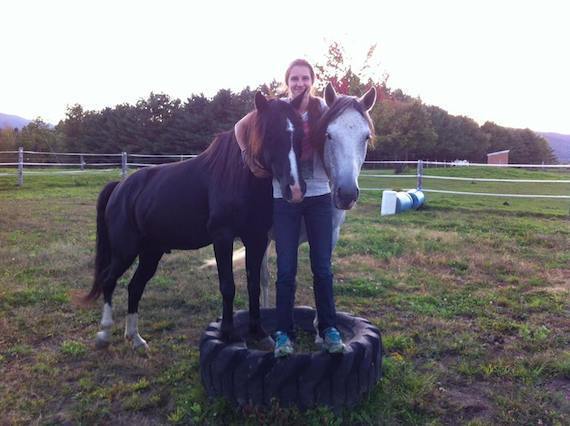
Photo courtesy of Stephanie & Eliza Lockhart Collection
Twenty years ago as I began to gather research that would eventually form the basis of my book, Riding Home - The Power of Horses to Heal, I had my first eyewitness exposure to the psychological impact a horse can have on a human. It occurred when I was invited to observe a unique equine program at a high-end health spa outside of Tucson, Arizona. Its name is Miraval, and then as well as today, it offers what it calls the Equine Experience, created and led by a brilliant therapist and horseman named Wyatt Webb.
Unlike other equine health spa programs, which focus chiefly on horseback riding, the Equine Experience offers what it says is "a program designed to help participants challenge learned behaviors, correct false beliefs, and rediscover one's authentic self." This is accomplished not only by interacting with horses without any riding but in short periods of time. Tasks are simple and range from getting a horse to walk from point A to B without the aid of a halter and lead rope to picking up and cleaning each of a horse's four feet.
A forty-year-old woman named Mary was asked to walk over to a horse named Daisy and pick up and clean all four of her feet. Mary tried everything she could think of--making noises, pinching the horse's leg, even verbal pleading--to get Daisy to lift up a hoof, but nothing worked. After about five minutes Mary stopped trying and tears started rolling down her cheeks.
Mary was asked to come back and share with the group what she was thinking and feeling. She said, "I feel like such a failure. I hate myself for not being able to do this." The therapist said, "Mary, have you ever done this before?" Mary said, "No." The therapist said, "Why didn't you ask for help?" Mary said, "It's embarrassing." Then she paused, thought for a moment, and almost absentmindedly added, "That's probably why I don't like to try anything new."
The therapist asked Mary to share what else was occurring for her. Mary told the group that she thought her need to look good and not ask for help was probably something she had done her whole life, without thinking. By now Mary had stopped crying and looked deep in thought. She said this had probably prevented her from doing things she had always wanted to try, both personally and professionally.
The therapist asked Mary if she could now see how a lifelong attachment to what others thought of her and wanting to look good in others' eyes might have caused her to overcompensate by "playing small" and, consequently, robbed her of wonderful, un- tried life experiences.
He also asked her if she thought exploring this insight with a therapist when she returned home was some- thing she might consider. Mary took a deep breath, smiled slightly, and said yes. Her entire session had taken forty-three minutes. I was astounded.
Miraval's Equine Experience brilliantly demonstrates the natural ability of horses, when interacting with humans, to instantly present a psychological awareness to a person that is often not only insightful but in many cases transformative.
Over the next few years I watched as horses were brought in to assist therapists in a number of varied human rehabilitation programs in what is now generally referred to as equine-facilitated psychotherapy, equine-assisted therapy, or sometimes simply equine therapy. In addition to how horses helped with self-awareness I could see how humans with mental and emotional wounds were also experiencing profound healing effects from interacting with horses.
Even though they may lack any knowledge of equine behavior, many humans with certain types of emotional damage experience positive feelings of well being, acceptance and compassion as they unconsciously identify with two primary equine survival traits:Hypervigilance ~ empowered by superhuman sensesandHerd-Dynamic-Based Social Skills ~ established and practiced with the greatest principles of love. This identification can lead a person to the self-awareness necessary for healing his or her emotional wounds.
Hypervigilanceallow horses to detect the slightest sound, smell, or movement, any of which might indicate the presence of a life-threatening predator. Their ability to read with flawless accuracy not just the behavior of others but theirsilent intentionsis what gives the horse the psychological mirroring expertise of the most gifted human therapist.
The horse's survival skill of external awareness through hypervigilance also exists as a symptom in humans suffering from PTSD. It can be acquired by a soldier in combat or by someone who has grown up in an alcoholic or abusive family.
It is both the identification with and the attraction to what is familiar between a hypervigilant horse and a hypervigilant human victim of emotional trauma that creates feelings of safety, acceptance and compassion that constitutes the first of the two natural equine qualities that enable horses to dramatically help in the healing process of these wounded individuals.
The second natural equine survival characteristic that gives horses their unique ability to heal the emotional wounds of humans involves herd dynamics. In order to increase their chances of survival, horses live in herds. Any species that depends on living in groups in order to survive must be able to continually get along with all of that group's members.
To promote social harmony and keep the herd together, horses possess a number of evolutionary hardwired qualities. These include: being accepting, tolerant, kind, respectful, honest, fair, nonjudgmental, compassionate, and forgiving. All of these innate equine qualities are also utilized when a horse interacts with a human.
Horses do not judge humans they judge our behavior including our most subtle intentions. A person, with or without the assistance of an equine therapist, can see himself or herself reflected back from the behavior of a horse. A horse will consistently mirror back the exact feelings, attitudes, and intentions of a human that initiates even the slightest interaction. This can instantly be observed by how the horse responds to the person. Amazingly the fastest and most accurate way to discover who you are and what your presenting to the world is revealed from interacting with a horse.
The horse's sophisticatedHerd-Dynamic-Based Social Skills along with their Hypervigilanceare not only at the core of their epic fifty-five million years of survival, they constitute the basis of the horse's power to heal our human emotional wounds many of which often originate in either a past trauma or from one's damaged feelings of self-worth.
The populations that most often suffer from these wounds are War Veterans with PTSD and troubled teenagers, defined as At Risk Youth. Although Autism is not classified as an emotional disorder, many autistic children have also found significant emotional healing from participating in equine therapy.
Today, with the guidance of a professional equine specialist, a horse with its natural mirroring ability can help initiate therapeutic psychological epiphanies for anyone in need of emotional healing. Equine therapy has become one of the most beneficial and cost-effective programs for today's Veterans with PTSD, At Risk Youth, Children with Autism and Families in Need.
To think that millions of emotionally wounded men, women and children can get a second chance at a healthy and meaningful life is heartwarming. The idea that this can be achieved from a breakthrough in self-awareness that occurred from simply interacting with a horse is extraordinary.
This story is adapted from my new bookRIDING HOME - The Power of Horses to Healand appears in Chapter 3 ~"Horses Healing Humans . . . Bodies and Minds". It is this amazing power of horses to heal and teach us about ourselves that is accessible to everyone and found in the pages this book. To learn more about the book please visit:http://www.ridinghome.com/.Every book ordered will benefit children of families in need, veterans with PTSD and children with autism. To contact and for articles & blogs by Tim Hayes go to:http://www.hayesisforhorses.com/
How Horses Heal Our Emotional Wounds
Twenty years ago as I began to gather research that would eventually form the basis of my book, Riding Home - The Power of Horses to Heal, I had my first eyewitness exposure to the psychological impact a horse can have on a human.
November 2, 2015
Youth, Addiction, Horses and Healing
Horses don't care who you are, what you've done, or what you believe. They care only about how you behave with them. This enables them to give unconditional acceptance to a troubled teen who is revealing his or her true self.