Nancy Lawrence's Blog
February 5, 2026
Oooooh! Decorating with Gloves
I freely admit I have no eye for design. I don’t know the first thing about pulling random items together to make something beautiful, but once I see something I like, I can do my vital best to make my own version of the idea so that it reflects my individual taste.
Not long ago I came across this photo of a lovely vignette that would fit quite nicely in my home office.
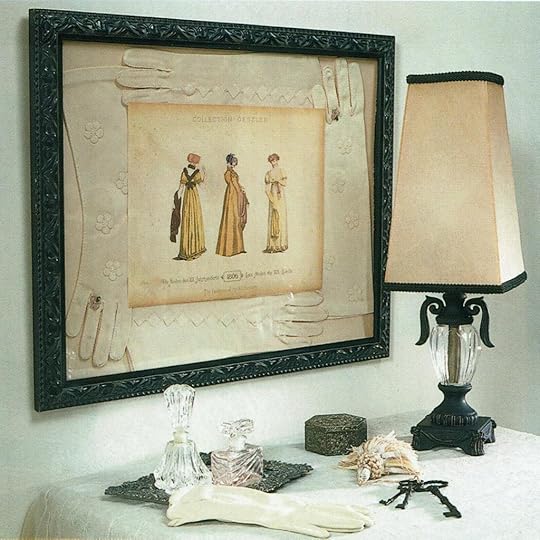
Arranged on top of a chest of drawers are some small items that reflect a by-gone era: delicate perfume bottles, a trinket box, some skeleton keys, a lady’s glove, and a clothes brush. But it what’s hanging above that arrangement that really caught my eye.
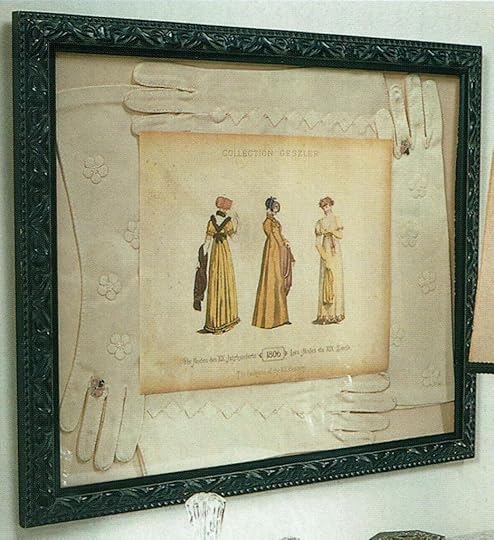
I’ve seen a lot of Regency-era fashion prints over the years, but the framed print in this photo uses ladies’ long gloves to create a beautiful mat for the old magazine color plate of fashionable costumes.
What a charming vignette! I think this is something even I—with my lack of training and imagination—can adapt and create for my own home.
Among my keepsakes is a pair of gloves my grandmother wore. They’re made of a lace and have a single button, so they’re only long enough to cover a lady’s wrist. I’d love to find another pair of similar length, combine them with my grandmother’s gloves to use as mats, and then frame them with my grandmother’s wedding photo. And as luck would have it, there’s a large antique mall not far from my house that has lots of vintage things.
Anyone in the mood to go shopping with me?
If you like decorating with mementos of a by-gone era, I’d love for you to tell me about it in the comments below!

January 22, 2026
Dainty, Delicate, and Divine: My Regency Discovery
I recently went with friends to see the Camille Pissarro exhibit at the Denver Art Museum. I’m not an art expert, by any means, but I have a partiality for French Impressionism, and I especially enjoyed viewing the evolution of his painting style, from the realism of the Barbizon School to the light and colorful Impressionist movement.
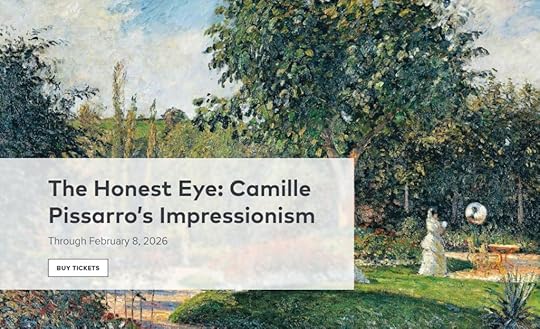
After we finished seeing Pissarro’s works (and visiting the gift shop), we wandered through some of the other collections on display, and ended up in the architecture and design exhibit.
I was delighted to find that my casual wanderings led me to two pieces from the historical era I love the most: the Regency.
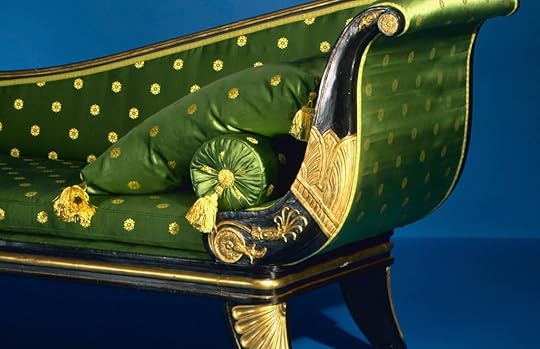
First was a piece labeled as a “Neoclassical Chaise Lounge” dated 1810. The silk upholstery is reproduction, but the warm rosewood and lustrous gilding appear to be original.
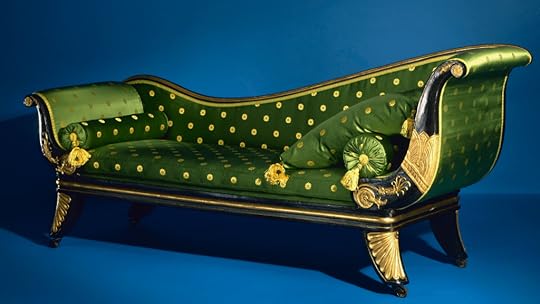
The detail is fantastic, and the good news is, the museum purchased the piece so it will be well cared for and available to be admired by future museum-goers for generations to come.
The second piece was American in origin, but created in the Regency style (which, incidentally, was equally popular in the U.S. at the time). It’s a simple side chair, made of birch and cane, that dates to the 1790s.
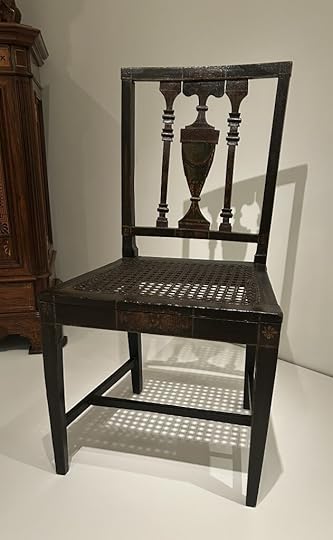
At first glance, it’s difficult to see the beauty of it, although the urn-shaped center on the back of the chair immediately caught my eye. The back is decorated in green and gold. The urn features a painted drapery swag.
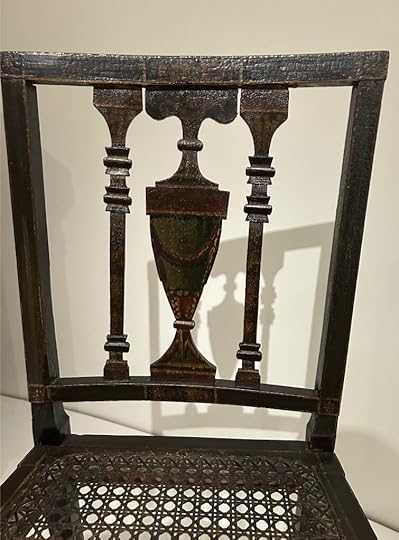
In person, the back of the chair looks so dainty and delicate, it’s a wonder to me that it survived even two decades, let alone two hundred years!
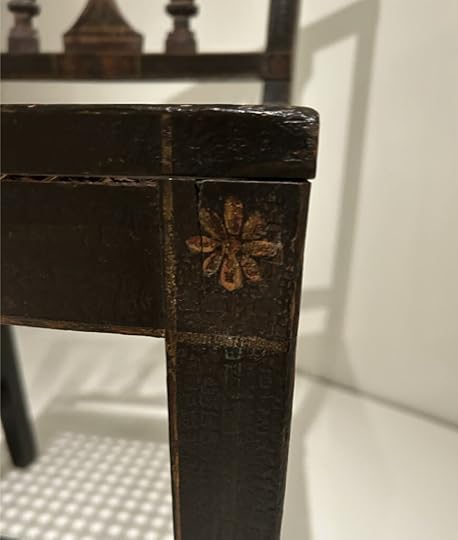
If you look closely, you can see gold paint outlines the chair’s front apron, seat, and legs. At the top of both front legs is a green and gold flower, from which a green vertical decoration trails down the leg to the floor.
I enjoyed the Pissarro exhibition immensely, but seeing these two pieces really put the cherry on the top of my museum visit. It’s always a marvel to me when beautiful creations are cared for and survive for future generations to appreciate and love them as the works of art they truly are.
So—to whoever it was that took such wonderful care of this delightful chaise and delicate chair—Thank you!
Can you imagine a Regency heroine reclining on that stunning rosewood chaise while reading a letter from her suitor? If you were decorating a Regency-era drawing room, which of these pieces would you choose to include: the gilded Neoclassical chaise or the dainty birch side chair with the painted urn? Let me know in the comments!
January 1, 2026
Happy New Year!
A Glad New Year be Yours!

January 17, 2025
Staying Warm with British Films
I live in Colorado so I’ve seen my share of cold winter temperatures; but the forecast for this weekend calls for bitterly cold days and nights. Here’s the five-day prediction as of this morning:

And those temperatures don’t include the wind chill that will make the air feel anywhere from -20 to -30 below zero. Yikes!
I think I’ll take Jane Austen’s advice and “stay at home for real comfort.” My plan is to watch a few of my favorite British movies while I cuddle on the couch with my dog Keats. I have a good variety of films to choose from, but I narrowed my list down to six cozy, feel-good, warm-your-heart movies. In no particular order they are:
Billy ElliotThis uplifting drama follows young Billy as he pursues his passion for ballet against the stifling alpha-male mentality of his coal-mining hometown in northern England (“Boxing, not ballet!”). Julie Walters is wonderful as the cigarette-smoking dance teacher who recognizes Billy’s potential; and Gary Lewis is marvelous as Billy’s father. It’s one of my favorite movies about taking chances and following your dreams.

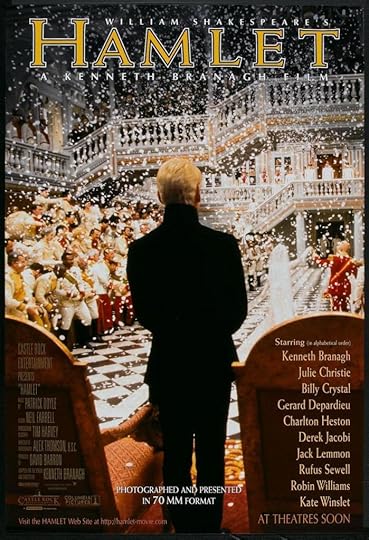 Hamlet
 When someone tells me they don’t like Shakespeare, or they can’t make heads or tails of his plays, I tell them to watch this 1996 film from Kenneth Branaugh. It’s my absolute favorite Shakespeare adaptation. What I especially love about this movie is that Branaugh deliberately avoided all the dark, brooding drama that filmmakers typically associate with Shakespeare’s tragedies. Instead, this version of Hamlet is a bright, visually beautiful film with a cast that makes it tons of fun to watch.
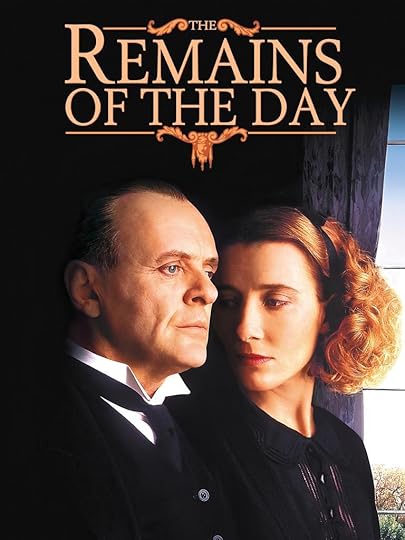
The Remains of the DayI once read a review that said this film is “a masterpiece in understated emotion and impeccable British restraint,” and I agree. In this film, Emma Thompson and Anthony Hopkins work together in one of Britain’s stately homes in the years leading up to World War II. But this is more than an upstairs-downstairs kind of film. This quiet, beautifully filmed movie explores the relationship between the very-British-stiff-upper-lip butler (Hopkins) who is unable to express his love for the high-spirited housekeeper (Thompson). I’ll admit the first time I watched this movie I was an emotional wreck at the end. I’m older and wiser now, so I think I can handle it; but I’ll still keep a box of tissues nearby, just in case.
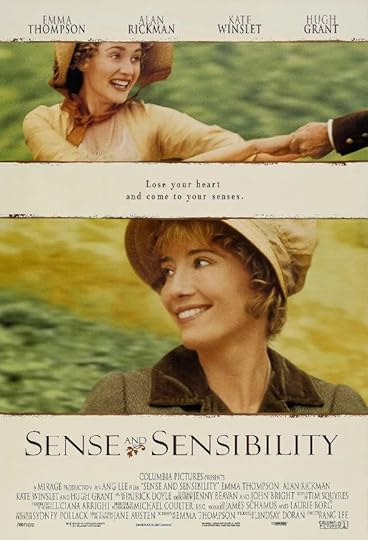 Sense and Sensibility
This is another Emma Thompson film. Based on the Jane Austen novel, it’s the story of the Dashwood sisters who experience life, love, and a bit of heartbreak as they try to navigate a new life after the death of their father. I love everything about this 1995 adaptation, from the sumptuous locations to the elegant costumes, and the spot-on script. It’s a Jane Austen feast for the eyes, ears, and heart.
The Importance of Being EarnestThis 1952 movie adaptation of Oscar Wilde’s play is my favorite, with Sir Michael Redgrave, Margaret Rutherford, and Dame Edith Evans as Lady Bracknell (“To lose one parent, Mr. Worthing, may be regarded as a misfortune; to lose both looks like carelessness.”).

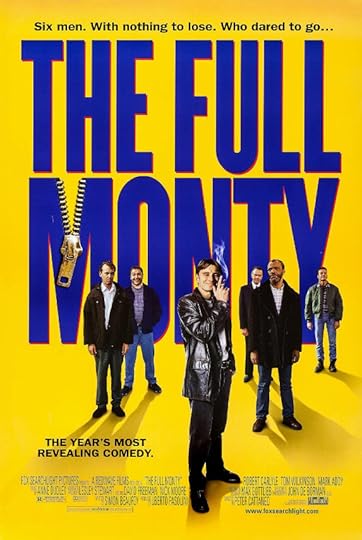 The Full Monty
A group of unemployed steelworkers band together to try to earn money by putting on a show—a strip show, that is. Although the premise of this movie is a little bit absurd, I can’t help but love it for the many sweet, charming moments it offers. Thanks to this movie, I’ll never think of standing in line at the DMV or unemployment office the same way again. It’s a movie filled with humor, warmth and lovely lessons about friendship, perseverance, and self-acceptance.
So those are the movies I think I’ll watch over the next four days; but, of course, plans can change. If I’m in the right mood, I might decide to skip the entire list and instead watch the 1995 BBC version of Pride and Prejudice (because anytime is a good time for five-plus hours of P&P, right?).
Do you have a favorite feel-good British movie? Tell me, so I can add it to my list!
February 21, 2024
My New Favorite Newsletter
In a previous post I wrote about one of my favorite TV shows (hint: it’s about houses). Today I thought I’d share one of my favorite newsletters (hint: it’s also about houses!).
If you’re like me, you probably subscribe to several newsletters from favorite authors, local shops, online book sellers, or news sites. Sometimes I think I subscribe to too many newsletters, and I can’t possibly read them all with the attention they deserve.

I’ll admit, too often I simply scan a newsletter topic and make a quick decision whether I want to delete it or read more. And even when I choose the read-more option, I often view the newsletter in terms of how quickly I can master its contents before I clear it from my inbox.
But there’s an exception.
And that exception is my weekly newsletter from Historic Houses.

When it arrives in my virtual mailbox, I grab a cup of coffee, sit back and enjoy learning about some of the most beautiful and historically fascinating homes in the United Kingdom.

It’s a newsletter dedicated to historic homes of all sizes, from quaint thatched cottages to over-the-top Gothic extravaganzas like Carlton Towers in Yorkshire.
 Carlton Towers, Yorkshire
It features plenty of photos (always a plus, since I’m a visually-oriented person) to fire my imagination. I love to daydream about touring the homes I read about in the newsletter. And I wonder how it would feel to wander through the beautifully-landscaped gardens they feature in every issue.
 Island Hall, Cambridgeshire
Some issues have aerial photos of homes and parklands (like the view below of Belmont House). From a research perspective, they help me better understand how far the stables were from the main house, how long it would take a carriage to travel from the gate to the front doorstep, and what kind of views guests had from their bed chambers.
 Belmont House, Kent
From a personal perspective, they’re just so lovely to look at.
 Deans Court, Dorset
Then there are the photos of the gorgeously maintained and restored interiors, like this bathroom at Comberemere Abbey:
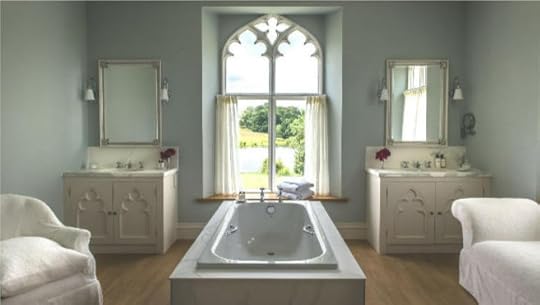 Comberemere Abbey, Whitchurch, Shorpshire
Granted, it’s a very modernly-looking bath, but I love how it was designed to make the original Gothic window the centerpiece.
Some issues of the newsletter have interviews with property owners or chatelaines (yes, they still use that word!) who share histories of the properties and the families who live in them.
 Raby Castle (credit Raby.co.uk)
If you’re lucky enough to live in (or plan to visit) the U.K., the newsletter has plenty of advice about:
Which properties serve high tea Where to do a whiskey tasting What properties are hiring (Yowza, wouldn’t it be great to work in one of these places?)The best time of year to tour a certain property, and how to buy ticketsAll of this newsletter goodness arrives in my mailbox each week for free. And for about thirty minutes every Friday I can sit back and escape my everyday American life for the beauty and rich history of centuries-old homes that are still important and thriving today.
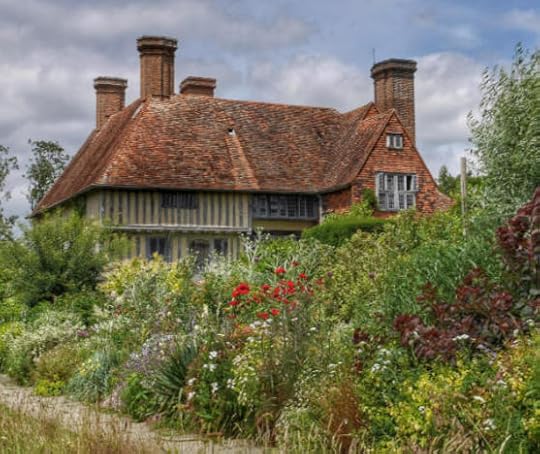 Dixter House and Gardens, East Sussex
If you’re not already a subscriber, you can have your share of historic house happiness. Sign up to receive their free newsletter by clicking here. You’ll also get access to all their past newsletters. (Warning: Reading them can be addictive.)
Do you subscribe to any excellent newsletters? Please share your favorites in the comments!By the way, unless otherwise noted, all the photos of houses in this post are courtesy of HistoricHouses.org.
Another by the way: I don’t receive any compensation of any kind for recommending HistoricHouses.org. I just like to share things I like with others.
December 13, 2023
And a Little Somethin’ For Me
As of today my Christmas shopping is officially done. My last stop was my local Barnes and Noble store, where I planned to pick up some small items to use as stocking stuffers.
As luck would have it, B&N displays those very same small items right next to their display of planners and calendars.
I truly had no intention when I entered the store of buying something for myself, but their selection of book-themed desk items were simply too cute to resist. (Confession: I really didn’t make much of an effort to resist.)
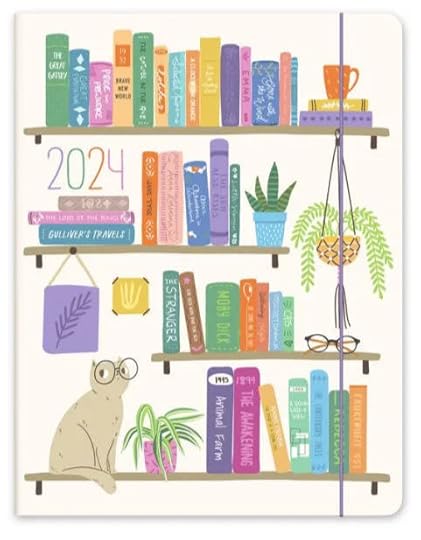
I picked up this planner by Orange Circle Studio. Inside are monthly spreads for seventeen months (ending December 2024). That’s plenty of time for me to plan out my projects and memorialize my future deadlines.
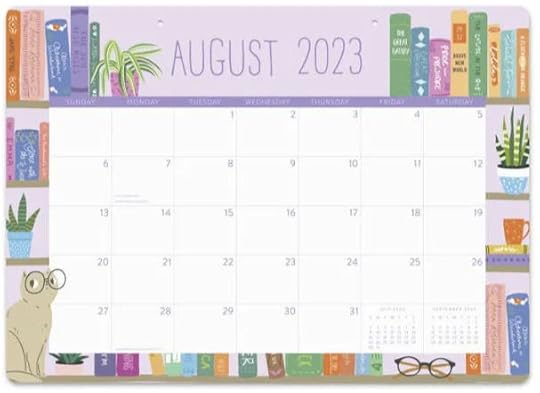
The matching desk blotter/wall calendar is large (18-1/2” wide by 13-1/2” tall) with ample room to make daily notes or track my word counts.
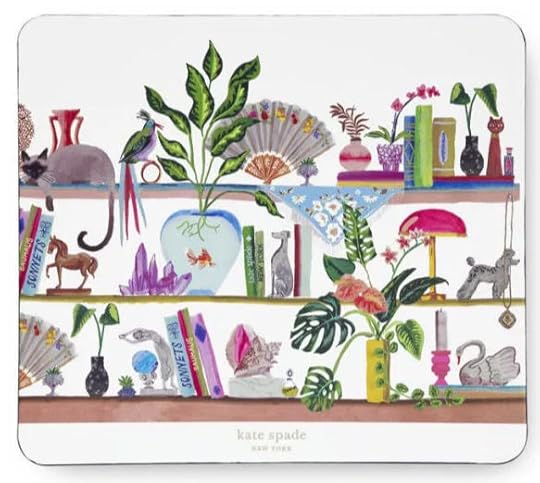
And the design of this mouse pad by Kate Spade coordinates perfectly with the calendars.
These three pieces just gave my work space a bit of a refresh and made me a bit happier to sit down at my desk and get some work done.
Tonight, after I’ve shut down my computer and turned off the office lights, I’ll wrap those last stocking-stuffers, and place them in the stockings I’ve hung. And with that, I’ll be officially ready for Christmas 2023!
How are your holiday preparations going?
BTW, you can click on any of the images above to find out more about these items. I am not an affiliate of Barnes and Noble, nor do I receive compensation from them. I just like to share fun things I find that others might like, too.
August 15, 2022
What Story Does This Tell?
There’s an old saying that “every picture tells a story.” I think some paintings are better at storytelling than others, because they spark more questions in my mind than answers. Here’s an example of such a painting:
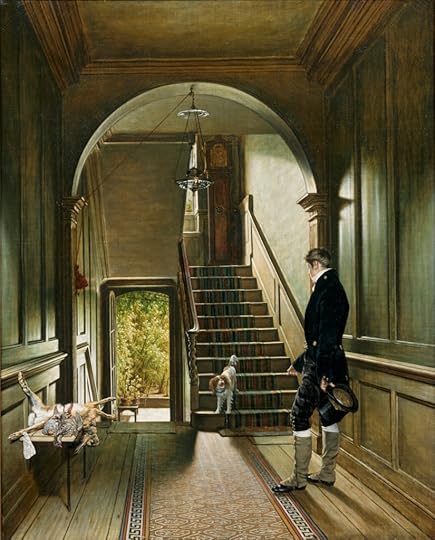 “The Staircase of the London Residence of the Painter” by Pieter Christoffel Wonder.
The piece is titled “The Staircase of the London Residence of the Painter” by Pieter Christoffel Wonder.
To begin, may I just point out that the artist’s surname has a touch of the whimsical about it? It’s an ideal name for an artist!
Now, back to the painting:At first glance it looks like a nice interior of the entry hall of a Regency gentleman’s residence, but my eye is drawn to the detail of the cased clock on the stair landing and the lamp suspended from the arch.

I wonder what servant is responsible for winding the clock? And which servant carefully guides the red rope as he lowers the lamp every evening so it can be lit as the sun goes down?
Oh, the Details!I love the wide floorboards and the exquisite details of the mouldings and paneling. They make me feel like I want to live in this house, too. They’re also a reminder to me that those are details of craftsmanship that are rarely found in the cookie-cutter homes we live in today.
A Young Man, Fashionably Dressed.Our gentleman has brass buttons galore! Shiny buttons adorn our gentleman’s coat and the cuffs of his breeches. What’s interesting to me is that at first glance I thought he was wearing two-toned top boots. Instead, our young gentleman is wearing spats to protect his snow-white stockings and polished shoes. I think it suggests that he just came into the house from the out-of-doors (or is about to make his way out).

The fact that he’s holding his hat reinforces that suggestion. I like the detail showing the liner inside his beaver-style top hat. The distance between the top of the liner and the crown of the hat hints at how tall his top hat was (his appears to be rather modest in height).
 A Fashionable London Home.
On the stair landing is a small glimpse of a window ledge that holds a small potted plant. For some reason, that little touch of greenery makes me wonder if there might be a Mrs. Young Man.

I also noticed there’s a short stair that leads down to the open door; through it we can see a garden, instead of a street scene. That suggests our view is toward the back of the house. I wonder how unusual it was for a London residence to have a patch of lawn and a garden attached?

Our young gentleman is beckoning to a sweet little dog. I like to think she (or he) is a pet that rules the household (much like my little dog does) and is always on hand to greet our young gentleman when he comes home.

Another interesting detail is the entry table on the left; on top of the table are a dead rabbit and two dead birds:

The hand-written tag tied to the rabbit’s hind leg suggests they were purchased from a traveling peddler or were just recently delivered from a butcher’s shop.
Either way, I wonder why they were left in the front hall on the very table where guests lay their calling cards, gloves and hats?
Despite all my questions and wondering, I think this image gives us some great insights into what life was like in a Regency era household—or, at least, into life inside the front hall of a fashionable gentleman’s residence. It’s one of my favorite depictions of the era!
What observations do you have about this image?Have you ever found yourself wondering about the stories behind an appealing work of art?April 11, 2022
Jane Austen’s Social Media
I original published this post on a Jane Austen related site in 2018. I hope you enjoy it!
Sometimes I think the best part of writing Regency-era fiction is the research I get to do. There’s nothing I like better than reading old books about the time period, or taking a tour of a museum exhibit on Georgian costumes or decorative arts.
Not long ago I stumbled upon a newspaper from the early 1800s, and it opened up an entirely new line of research for me.
One of the great things about newspapers is the wealth and variety of information they contain. Before the Internet became a part of our daily lives, print newspapers played the role of social media.
They reported on people’s comings and goings, who was a member of what committee, and how much an individual person gave to charity.
In my research I’ve been lucky enough to find newspapers from the period that provide a few small glimpses into the life of Jane Austen and her family.
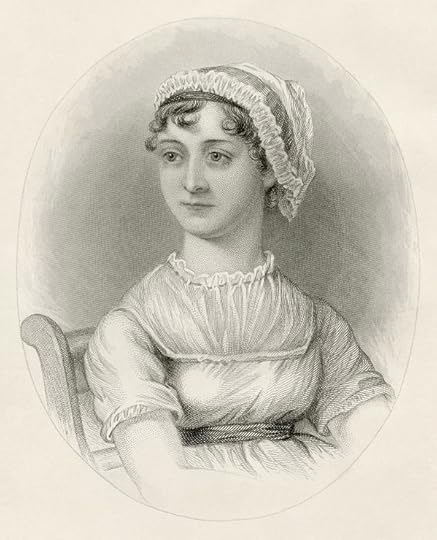 Jane Austen (from A Memoir of Jane Austen 1870)
 Here’s an example:
Jane’s brother Francis was a successful naval officer, and eventually rose to the office of Admiral of the Fleet. Newspapers tracked Francis’s comings and goings from port to port, as in this snippet from 1812:

In fact, I found several small articles like this about Francis, with little details about life in the navy and ports he have visited.
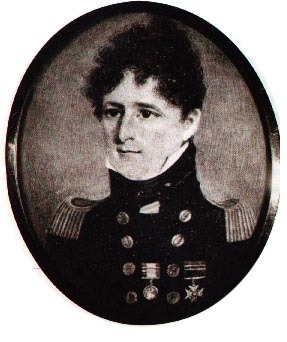 Francis Austen
Another brother, James, was the curate of Steventon and Deane—both parishes in the Deanery of Basingstoke. James was active in the community and was part of an effort to make Bibles, prayer books, and religious tracts available to more people in the area.
His efforts were documented in a Hampshire newspaper. You can read the entire article by clicking here, but here’s an excerpt listing James as a member of the Basingstoke committee:

A few weeks later, James Austen and his committee had a plan in place. They launched a “Society for Promoting Christian Knowledge,” and began selling subscriptions to raise needed funds to purchase Bibles and other religious publications.
Who bought a subscription? Jane Austen did, along with her mother and sister, Cassandra (“Miss Austen”). You can read the full list of subscribers here, but here’s an excerpt:

Did you recognize any other names in that excerpt? Jane’s friend, Miss Lloyd, contributed to the fund, as did Harris Bigg-Wither, and perhaps one of Harris’ cousins, a Mrs. Wither.
I’ve always been fascinated by the story of Harris Bigg-Wither’s proposal to Jane Austen, which she accepted, only to change her mind the next day; so finding their names together in the newspaper surprised and delighted me.
Two years later, the neighborhood came together again in the same manner. This time subscriptions were sold for the relief of the “distressful situation” of a widow and her family after the passing of the woman’s husband, a local minister.
Organizers published a list of people who contributed to the fund (which you can read here), but this excerpt shows that Jane’s brother James and his wife and daughter Caroline, made contributions:
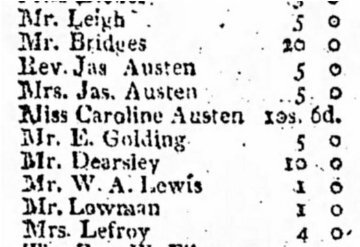
I also recognize the name “Mrs. Lefroy” on the list. I only wish there were more details in the article so we could correctly identify which “Mrs. Lefroy” they mean!
Henry Thomas Austen was another of Jane’s brothers (and her favorite). He had a number of different careers before he took orders in the Church. He served as curate at Chawton, chaplain to the British Embassy at Berlin, and rector of Steventon. Jane thought he was an eloquent speaker and wrote “very superior sermons.”
 Henry Thomas Austen
Some of his sermons and lectures were later collected and published in book form. I found this 1820 advertisement for his book:

Jane’s brother Edward was adopted by the Knight family of Kent, which paved the way for him to inherit Chawton and Godmersham.
 Edward Austen
With that inheritance came a number of perquisites, such as being appointed Sheriff by the King, as Edward was in 1801:

The last clipping I’ll share is this brief, but respectful, notice of Jane Austen’s death, which appeared in the Hampshire Telegraph and Naval Chronicle on Monday, July 28, 1817:

For me, finding these little gems adds a new dimension to what I knew about Jane Austen’s world. They’re real-time reports of what was happening in her life and in the lives of the people she loved. In that respect, these newspaper articles serve the same purpose Facebook and Twitter (and Instagram and . . . well, pick your preferred social media poison) serve in our moderns lives.
And given what we know about Jane Austen’s curiosity and wit, she was probably just as curious about her neighbors and what was going on with them as they were about her. I’m sure articles like these satisfied her curiosity.
How about you? Do you read newspapers? Do you read for research or simply to stay informed?What’s the most interesting newspaper article you’ve read?Have you ever had your name appear in a newspaper?March 29, 2022
The Art of J.M.W. Turner
I find inspiration for my writing in many things. Snippets of overheard conversations, news articles, and reading books from an historical time period are all things that inspire me.
I’m also inspired by viewing art pieces that depict the Regency period. One of my favorite artists is Joseph Mallord William Turner, commonly styled at J.M.W. Turner.
He’s famous for his hazy, dreamy landscapes, like this one depicting sunrise at Norham Castle in Northumberland:
 Norham Castle, Sunrise c.1845 Joseph Mallord William Turner 1775-1851. Accepted by the nation as part of the Turner Bequest 1856 http://www.tate.org.uk/art/work/N01981
Here’s another Turner view of Norham Castle from the River Tweed:
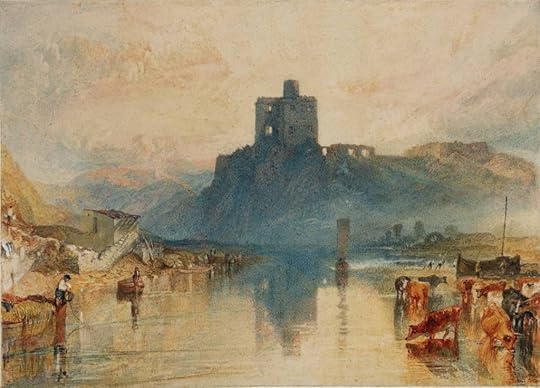 Norham Castle, on the River Tweed circa 1822-3 Joseph Mallord William Turner 1775-1851. Accepted by the nation as part of the Turner Bequest 1856 http://www.tate.org.uk/art/work/D18148
But as beautiful as his landscapes are, my favorite J.M.W. Turner pieces are his interiors. Here’s his straight-forward rendering of the drawing room at Farnley in 1818:
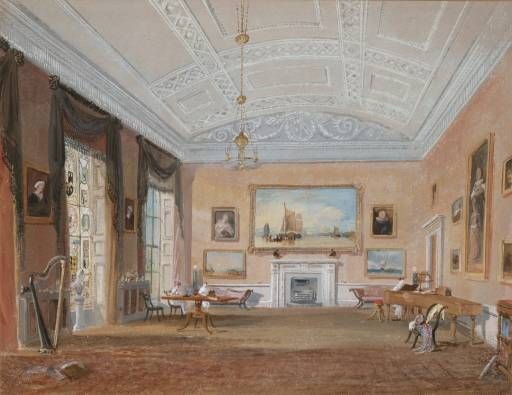
I love everything about this room, from the carpets to the ceiling; from the harp to the life-size portrait on the wall.
Turner painted a series of interiors of Petworth House in West Sussex. Here’s “The White Library at Petworth,” dated 1827:
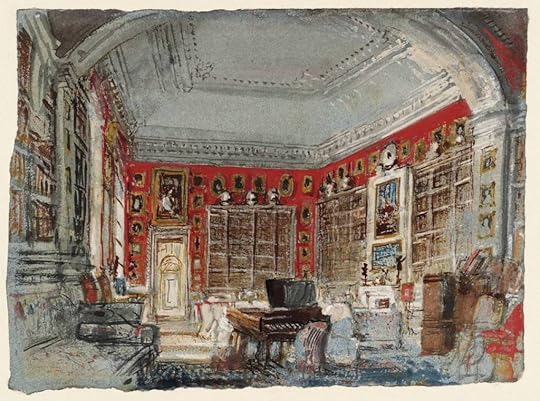 Petworth: the White Library, looking down the Enfilade from the Alcove, 1827; Joseph Mallord William Turner 1775-1851. Accepted by the nation as part of the Turner Bequest 1856 http://www.tate.org.uk/art/work/D22678
He used the same setting of the White Library to illustrate an evening of “Music in the White Library” at Petworth:
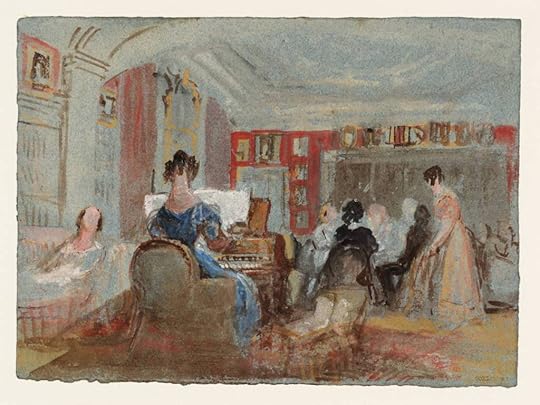 Music in the White Library 1827; Joseph Mallord William Turner 1775-1851. Accepted by the nation as part of the Turner Bequest 1856 http://www.tate.org.uk/art/work/D22699
And he used the White Library again as a backdrop for “The Lady in Pink: Conversation in the White Library” from 1827:
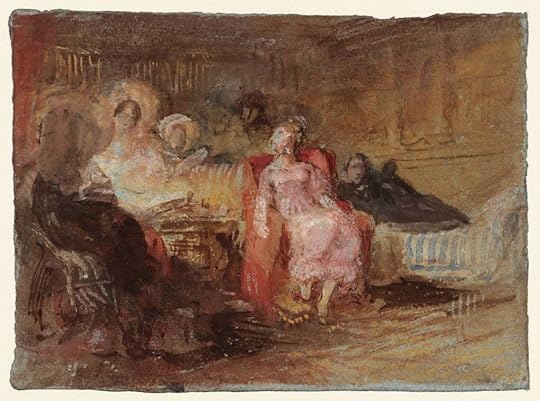 The Lady in Pink: Conversation in the White Library 1827 Joseph Mallord William Turner 1775-1851. Accepted by the nation as part of the Turner Bequest 1856 http://www.tate.org.uk/art/work/D22688
I like to study the way he captured each person in the library; who was sitting or standing; whether they seemed relaxed or formal; and if they conversed while someone was playing music or simply sat and listened—it’s all food for my imagination.
Do you have a favorite artist who inspires you?February 23, 2022
My Regency-inspired Calendar
A couple of weeks ago I was browsing the Internet, looking for images I could use in the planning calendar I was setting up for the new year.
Luck was on my side. I found these images that made up a hanging wall calendar from 1901.

Each page has a three month calendar with a very odd layout that makes me scratch my head. Have you ever seen a calendar with days and dates arranged like this:

But I can ignore the crazy calendar because the illustrations are spot-on. They’re just what I was looking for.

Of the four illustrations, two feature couples tripping the light fantastic. Here’s the illustration for the summer months of July through September:

And two feature just the ladies in their ballroom finery. This one covers the last three months of the year:

I like all the little details about their attire, such as the men’s shoes and fobs. I also like the ladies’ gloves and styles of gowns; and the trailing ribbons and shawls seem to give each figure a sense of movement.
So, I decided to use one illustration per week in my February calendar. Here’s my calendar for last week, before I filled it up with appointments, tasks, reminders, and things to do.

I have lots of stencils and stickers I use to decorate my planner pages; but I have to say that my little Regency lady is the page decoration that makes me smile every time I see it.
What made you smile last week?