
Discover new books on Goodreads
See if your friends have read any of Vladimir Bukovsky's books
Vladimir Bukovsky’s Followers (29)


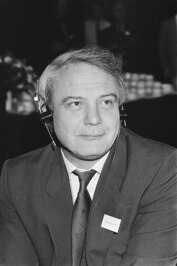
Vladimir Bukovsky
Born
in Russian Federation
December 30, 1942
Died
October 27, 2019


|
To Build a Castle: My Life as a Dissenter
by
—
published
1978
—
17 editions
|
|

|
Judgment in Moscow: Soviet Crimes and Western Complicity
by |
|

|
Письма русского путешественника
by
—
published
2008
|
|

|
To Choose Freedom
—
published
1987
—
5 editions
|
|

|
Московский процесс
by
—
published
1996
—
2 editions
|
|

|
I powraca wiatr...
by
—
published
1983
—
2 editions
|
|

|
EUSSR : the Soviet roots of European integration : "Our slogan is a world-wide Soviet Union" - Anthem of the Comintern 1938
by
—
published
2004
|
|

|
Reușești sau mori
by |
|

|
Peace Movement and the Soviet Union
|
|

|
Наследники Лаврентия Берия: Путин и его команда
by |
|
“Justice is always naive and self-confident; believing that it will immediately win once recognized. That is the reason why the forces of Justice are so poorly organized. On the other hand, the Evil is cynic, sly and fantastically organized. It never ever has the illusion of the ability to stand on its own feet and to win in a fair competition. That is why it is ready to use any kind of means without hesitation. And of course it does - under the banners of the most noble ideas.”
―
―
“Furthermore, as if forgetting the existence of the Soviet “Evil Empire”, she practically called for the various peoples of the USSR to stay “loyal to the Soviet Union as a commonwealth of nations”, to be content with a certain degree of cultural and religious autonomy, like the various tribes in Nigeria. And this was said at the time of the offensive against the sovereignty of the Baltic republics, whose absorption into the USSR was never acknowledged by Britain or the USA. Alas, Thatcher was no exception. Even Ronald Reagan, President of the USA, a man for whom the very name Lenin was always anathema, did not fail to praise Gorbachev for his “return to the paths of Lenin.” This was also said in a radio address transmitted to the USSR. As for his successor, George Bush and his Secretary of State Jim Baker, they outdid everyone, opposing the inevitable disintegration of the USSR until the very last day. “Yes, I think I can trust Gorbachev,”—said George Bush to Time magazine357 just when Gorbachev was beginning to lose control and was tangled hopelessly in his own lies—“I looked him in the eye, I appraised him. He was very determined. Yet there was a twinkle. He is a guy quite sure of what he is doing. He has got a political feel.”
― Judgment in Moscow: Soviet Crimes and Western Complicity
― Judgment in Moscow: Soviet Crimes and Western Complicity
“People in general, and the intelligentsia in particular, are extremely arrogant, egotistic animals, considering themselves smarter than anyone else in the world, and certainly smarter than their governments. I can think of no occasion on which the intelligentsia admitted that it had been wrong, especially when it came to disputes with the lawful authority. The reason for this is probably the intelligentsia’s belief that its real abilities remain unwanted. Terrible. After all, they are the elite, and that means that they should rule the world or, at least, rule people’s minds. But life, that unfair judge, has condemned them to more humble pursuits: teaching children the alphabet, curing our aches and pains, studying bacteria through a microscope, being bored in provincial courtrooms, or giving communion to parishioners and listening to their endless complaints about the injustice of life. And all around, out in the big world, completely different people make important decisions that determine the fate of mankind. Moreover, those people are not brighter, better educated, or morally worthy. How can one accept that? So a member of the intelligentsia cannot simply force himself to do his job without contrivances and pretensions. He cannot just teach children to read and write—no, he has to “raise future generations”; he cannot just prescribe pills for a patient and ease his suffering—no, he needs to concern himself with the health of all mankind. A priest, meanwhile, is convinced that God Himself has put him in the pulpit for the salvation of one and all.”
― Judgment in Moscow: Soviet Crimes and Western Complicity
― Judgment in Moscow: Soviet Crimes and Western Complicity