Mo Fanning's Blog
August 6, 2026
Becoming self aware

I’m not mad keen on it being really hot, and I very much regret mocking my neighbour who spaffed five hundred quid on a portable air-con unit in February. But I’m equally hard to please when it’s cloudy and cool. I’ve always been a huge fan of spring. Were I of a philosophical bent, I might call it the season of hope. A time when the first snowdrops poke through the soil and M&S place buckets of daffodils at their doors. But that’s not the bit that gets me excited. It’s the later part - the sort-of-summer weeks when it’s warm enough to manage without a coat, but not so hot that you’re plagued by sweat-patch shame. I know so many people who wax lyrical about autumn, and I do get the whole season of mists and mellow fruitfulness thing. I really do. But to me it’s just a way of announcing the flowers are dying, the leaves are turning brown, and any day now I’ll return from a dog walk with hands numb from cold.
I love it when my books sell in their hundreds rather than handfuls, even when hundreds is down to the authorial walk of shame. By which I mean the 99p ebook week that tends to follow most every big launch month. When a new book comes out, I enjoy a few delightful weeks where websites and magazines want my words of wisdom and lovely reviews flood my way. The 99p week is always sitting there waiting. And there’s a lot to be said for seeing your latest book break into top 100 lists - even if they tend to be what you might term ‘special interest’ categories (fake engagement workplace romance, anyone?). But each sale earns pennies. Six weeks earlier, each sale went so much further towards paying back the financial faith invested in editing, design, promotion and generally making a show of myself.
Mo’s Newsletter is a reader-supported publication. To receive new posts and support my work, consider becoming a free or paid subscriber.
I love ironing. And even just typing that, it feels like a form of coming out. For years I refused to have anything to do with an ironing board, but just this year I’ve found it to be the most relaxing hour or two of my week. I set myself up in a window where I get to see what’s going on in the street - who’s doing what, who’s been shopping where, who’s walking which dog. I listen to the radio, usually something soothing from Radio 3 Unwind, and lose myself. Obviously, I’m still very much a fan of diazepam, but this comes pretty close to the same empty-headed feeling my overheated brain craves.
Turns out, it takes a lot of poking and pushing to get me back into writing after giving birth to a book. For two or three months, my head has to travel back in time to something I wrote a year or more ago and act like I still love it, even if I’d sooner dance around a bonfire of slow-burning copies of the damn thing. It must be like this for artists and musicians too. You finish something, then it sits around getting ready to be seen or heard by strangers, by which time you’re deep into something new. Something you love so much more. Something you know is a million times better than the last thing you did. I’m trying hard to get back into my next book. A coaching session with the wonderful Kate Davies helped, but it’s still a rare day when I turn on my computer, shut off every other distraction and write.
And then there’s the news. I doom scroll like it might somehow change the bad stuff by seeking out something better. It never happens, does it? Why is the world such an angry, selfish place right now? I sort of get that money and social media are the key guilty parties, but we can’t seriously pin all of this shite all on two things. If you took away the money and shut down the internet, would we suddenly become nice again? We’re all doing something wrong, and I wish I knew what.
All things considered, I’m not sure how useful these random discoveries will turn out to be, or how I’ll use them to make anything better. Certainly I’ll turn up to social events in nicely pressed shirts. But beyond that?
It’s a trial, isn’t it. The whole persuading yourself out of bed each morning.
But on we go...
(Shirt - model’s own, think it was from H&M)
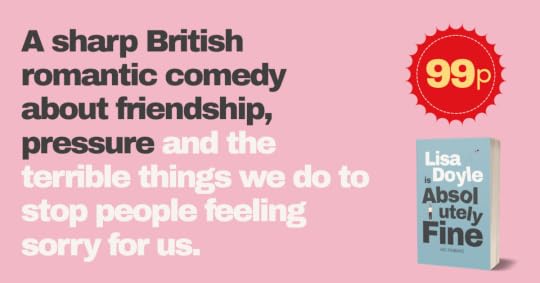
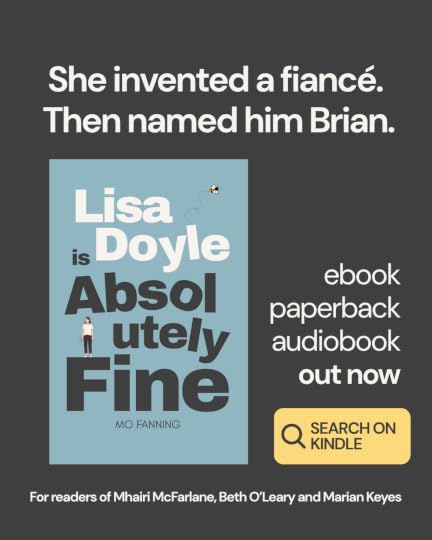
Here’s an advert for my latest book anyway. It’s 99p until Friday at midnight. You’ve only yourself to blame if you turn up late to this party.
Mo’s Newsletter is a reader-supported publication. To receive new posts and support my work, consider becoming a free or paid subscriber.


July 27, 2026
Stuff authors need to know: metadata
It sounds technical. It sounds dull. It is both, but if you (or your publisher) screw up the metadata behind your book, chances are it won’t find the right readers.
A romcom-writing friend of mine told me over coffee and cake (carrot, since you’re likely wondering) about how their book launched into the sound of one hand clapping.
Mo’s Newsletter is a reader-supported publication. To receive new posts and support my work, consider becoming a free or paid subscriber.
It’s a great story, well-written, professionally edited with a cover that makes me weep jealous tears of rage. The publisher even talked her into letting them ‘launch price’ it at £2.99.
Within the week, her book scored a dozen Amazon reviews, averaging 4.4, and Goodreads reviewers didn’t pile on and stamp until all signs of life faded. 26 reviewers rated it at an average of 4.2. Dreams are made of stuff like this.
BUT… one week after launch, it was selling precisely zero copies on a daily basis, which is why she emailed me at ten past eleven on a Tuesday night asking whether Amazon had “shadow-banned” her.
First off, I pointed out that this is a term invented by authors with nothing better to do - authors who should be writing books not posts on social media hate lists. Then I broke the bad news. Nobody at Amazon knew she existed, because the metadata behind her book gave them nothing to work with.
Seven sinsLet’s assume you’re publishing with KDP. And why not? Yes, you’re supporting a billionaire whose key aim appears to be shutting down every other retail outlet in the world, but it gets books to readers, so you do what you have to do.
KDP gives you seven keyword slots. My friend’s publisher had picked: romance, romantic comedy, love story, funny, chick lit, women’s fiction, fiction.
Seven slots. Zero information.
Every one of those terms was already covered by her categories, her subtitle, or both. In effect, her publisher was giving Amazon the same information seven times over: this book is a romance.
Genre is the least useful thing you can spend a keyword on, and “fiction” on its own is worse than useless. You’re asking to be ranked against four million other titles on a term no reader ever types into the Amazon search bar when looking for a novel.
What keywords are actually forKeywords exist to catch the searches your title and categories don’t cover. That’s their whole reason for being there.
Romance readers search by trope. Grumpy sunshine. Second chance. Fake dating. Enemies to lovers. They search by setting, too, and by mood: “romcom set in Cornwall”, “funny beach read”, “workplace romance British”. Type a trope into the Amazon search bar and watch the autocomplete finish your sentence. That’s reader language, handed to you free, and it’s what should have been sitting in those seven keyword slots.
Her book has a fake-relationship plot, a seaside setting, and a heroine pushing fifty. Three strong search hooks. Not one of them appeared anywhere in her metadata. A reader hunting for exactly her book wouldn’t find it by describing exactly her book.
The knock-on problemLazy keywords rarely travel alone. Her categories had the same disease. The book sat in Fiction > Romance > General, which on Amazon is where romance novels go to be forgotten. Two clicks deeper and she’d have landed in Romantic Comedy and Later in Life Romance, both categories where a book selling eight copies a day in the UK can crack the top twenty and start showing up in also-boughts.
General categories put you in the biggest room with the most competition. Specific ones shift you into a smaller room where the readers already want what you write.
The fix took forty minutesWe rewrote the seven keywords around tropes, setting and age of protagonist. We picked new categories. We tweaked the subtitle so it earned its place. No advertising spend. No blog tour. Just time spent filling out forms. She took the lot back to her publisher and, credit where due, they made every change without any sort of fight.
I won’t pretend it turned her into Marian Keyes. It didn’t. But the book went from invisible to findable, page reads woke up within a fortnight, and her ads, when she later ran some, had a product page worth sending traffic to.
That last bit matters more than people admit. Ads pointed at broken metadata just burn money fast.
Over to youOpen KDP, or wherever you publish, find the keyword fields. If any of them repeat your categories, your title, or the word “fiction”, you’re wasting space.
Maybe I’ve convinced you metadata matters.
I very much doubt I’ve made it sound interesting. Because it really isn’t.
If you’d rather someone else looked, I run a free Book Visibility Audit. Ten minutes of form-filling from you, a written teardown of your biggest blockers from me, including the stuff you can fix yourself without paying anyone.
Don’t be the author who ends up having to buy me cake to hear this.
Mo’s Newsletter is a reader-supported publication. To receive new posts and support my work, consider becoming a free or paid subscriber.
July 15, 2026
Some other sucker bought it

Way back when writing was a release valve rather than a job, I posted sporadic updates about my actual life instead of banging on about the state of the world and the publishing industry. I lived in Amsterdam then and believed I had no big problems to speak of. I’d just launched my first book and watched it shift over 5,000 copies on a marketing budget of next to nothing. This was when Kindle was new and self-published books were almost all absolute shite. Mine contained full sentences, which made me a market leader.
So all I really had to contend with was an over-dependence on drink and weekend recreational drug binges. I was mid-30s, and believed a daily diet of 40 Camel Medium, a box of takeaway ramen and three ‘happy hours’ spread across four Amsterdam gay bars was somehow sustainable.
Mo’s Newsletter is a reader-supported publication. To receive new posts and support my work, consider becoming a free or paid subscriber.
This time out, I was going to write about how publishing seems to have absolutely no problem with straight women writing explicit gay romance, then decided... so what? If two hockey players knobbing in the changing rooms gets people reading, good. Better they do that than set fire to trees in my local park.
Instead, I’m going back to my slice of life roots.
It’s been hot, right? The sort of hot where I spend fruitless hours scanning online stores for portable air-con units - an object I once mocked and swore I’d never buy. We get two weeks of sunshine in this part of the world and everything goes to shite. Hosepipe bans, power cuts, wildfires, people dying of heatstroke. This year feels a lot like two years ago and (if I’m honest) like this is how it’s going to be now my generation has pootled through life setting the planet on fire.
Last night I spent over an hour adding and removing an eBay air-con unit from my basket. The sort of thing that should cost £300 in the real world, on sale for four times that. In the end I handed my phone to my husband and told him to refuse any and all attempts to get it back.
(I checked this morning. Some other sucker bought it.)
On the writing front, the ‘shaggy dog story’ project moves along. I need to fix up another coaching session with the wonderful Kate Davies, as I suspect I’ve written my main character into a dark side street, cowering while the plot parties past without her. Then it goes back to an editor who makes Mussolini seem lenient, and whose input I value more than anyone or anything in the world. Husband and dog excepted.
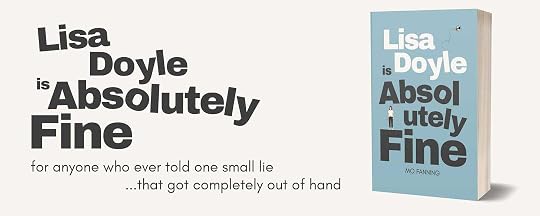
Lisa Doyle has had a lovely little run, way outselling my modest expectations and making a brief appearance in the top 2,000 paperbacks sold in the US, for reasons nobody can explain. Here at home, she’s ticking along, and I’ve broken even after one month rather than the usual twelve at a pinch. If you’ve bought, read, borrowed or advance reviewed a copy, thank you. And if you haven’t yet posted a review on Amazon, PLEASE can I beg a few seconds of your time to do that? If you’ve never published a book, you can’t begin to understand how much power that place holds over our careers, even those of us who wish it didn’t exist. Amazon review counts matter more to the industry than actual sales. Which is quite wrong, isn’t it?
Here’s a handy link to do just that
I’ll keep posting my bizarre back catalogue of PR shots overlaid with captions on Instagram, because it keeps me busy. Share and like. It makes my day.
Otherwise, it’s back to the air-con hunt.
How are you keeping cool on these awful hot nights?
Mo’s Newsletter is a reader-supported publication. To receive new posts and support my work, consider becoming a free or paid subscriber.
July 1, 2026
The book launch hangover

My latest book made its way into the world in the middle of June. On one of those weeks where it was more fun to sit inside with a fan on your face than risk exposure to what weather people termed a ‘heat dome’.
Three weeks on, I’ve hit a wall. Not a dramatic one. I’m not currently shopping for a fainting couch. This is simply the ordinary, unglamorous kind of wall which finds me sitting at my desk, staring glassy-eyed at what ought to be my next manuscript and wishing I had enough money in the bank to tell the people who pay me for doing a day job to leave me alone.
Mo’s Newsletter is a reader-supported publication. To receive new posts and support my work, consider becoming a free or paid subscriber.
For a month or two before any book comes out, everything in an author’s life starts pointing in one direction. Publication day becomes the date glowing at the end of the corridor. Publicists tell us to give it our all - as if we’re juggling the seating plan for a wedding day brunch where everyone hates everyone.
There are graphics to make. Captions to write. Articles that might or might not need to be written (or rewritten) for editors that may or may not want them. Emails to approve. Links to check. Metadata to stare at until the words romantic comedy lose all meaning.
Then you send another pitch. And another. And another.
Would anyone like a piece about queer joy in commercial fiction?
Would anyone like a piece about writing romantic comedy without pretending life is simple?
Would anyone like a piece about the pressure to be fine when you are, in fact, absolutely not fine?
Mostly, the answer was silence.
Administrative silence. Inbox silence. The silence of someone meaning to reply and then never doing so because an indie author’s novel is not high on the list of national emergencies.
The big dayAnd then the big day arrives. And your husband mutters something about how the flowers he ordered haven’t come and the dog throws up on a rug you’ve been ordered to itemise as valuable on your household contents insurance policy.
In short, it’s a day just like any other.
The truth is that big-name media and big-name personalities have very little natural interest in indie books unless there’s some other hook attached.
A book by a working novelist from the West Midlands, published through a small imprint, about a woman in Manchester who invents a fiancé after too much wine? Lovely, perhaps. Useful, rarely.
And that does something to you.
It doesn’t just disappoint you. It starts to make you feel faintly ridiculous for asking. As if writing a novel was already a bit much, and now here you are tapping strangers on the shoulder saying, excuse me, would you mind paying attention to this thing I spent months making?
There’s no graceful way to keep asking.
You can be professional. You can be warm. You can tailor the pitch, spell the name correctly, mention the journalist’s recent piece, send the cover, attach the press release, include the retailer links and remember not to sound desperate. But beneath all that, the emotional position is still fairly naked.
There is joyAnd yes, there is joy in it. Real joy. I don’t want to flatten that.
A reader sends you a lovely message and a blogger says something incredibly generous. And you pack a bag for an event you’ve been nervous as hell about (that turns out to be the best thing ever). You dare yourself to check and paperback sales are up. Someone posts a photo of your book in the wild, sitting beside a coffee cup or a cat or a tasteful candle. For a moment, everything feels possible.
But joy is not the same as energy.
By the time publication day arrives, most authors have already spent weeks scatter-gun firing off pleas for attention. We’re upbeat in newsletters. Breezy on Instagram. Available for interviews. Gracious when things fall through. Funny when we’d rather sleep the day through.
You share the coverage. You thank people. You answer messages. You nudge the reviews. You post event photos. You look at ads. You wonder if the ads are doing anything or if you’re paying Jeff Bezos to show your book to three bots and a retired geography teacher in Basingstoke.
BUT, because the world has the nerve to continue, you keep going.
The wallAnd that’s why I think today is my ‘hit the wall’ moment.
I can only stare at the numbers for so long before I start using them as evidence against myself. I can only keep asking what else I could have done before the answer becomes: nothing useful, go to bed. Try sleeping. It’s said to be good for you.
The strange thing is that the parts that made this launch worth it were not the biggest things.
They were not the emails to Important People. They were not the fantasy of a national newspaper deciding that my romantic novel was the cultural event Britain had been waiting for. It turns out the things that save you are much smaller and much more human.
Other authors. And book tour bloggers.
The ones who understand why you’re twitchy about Amazon rankings even while insisting you don’t care. The ones who repost without making a production of it. The ones who tell you which opportunity is worth your time, and which shiny thing is probably a money pit with lovely lip gloss.
And festivals like Queer the Shelves in Nottingham.
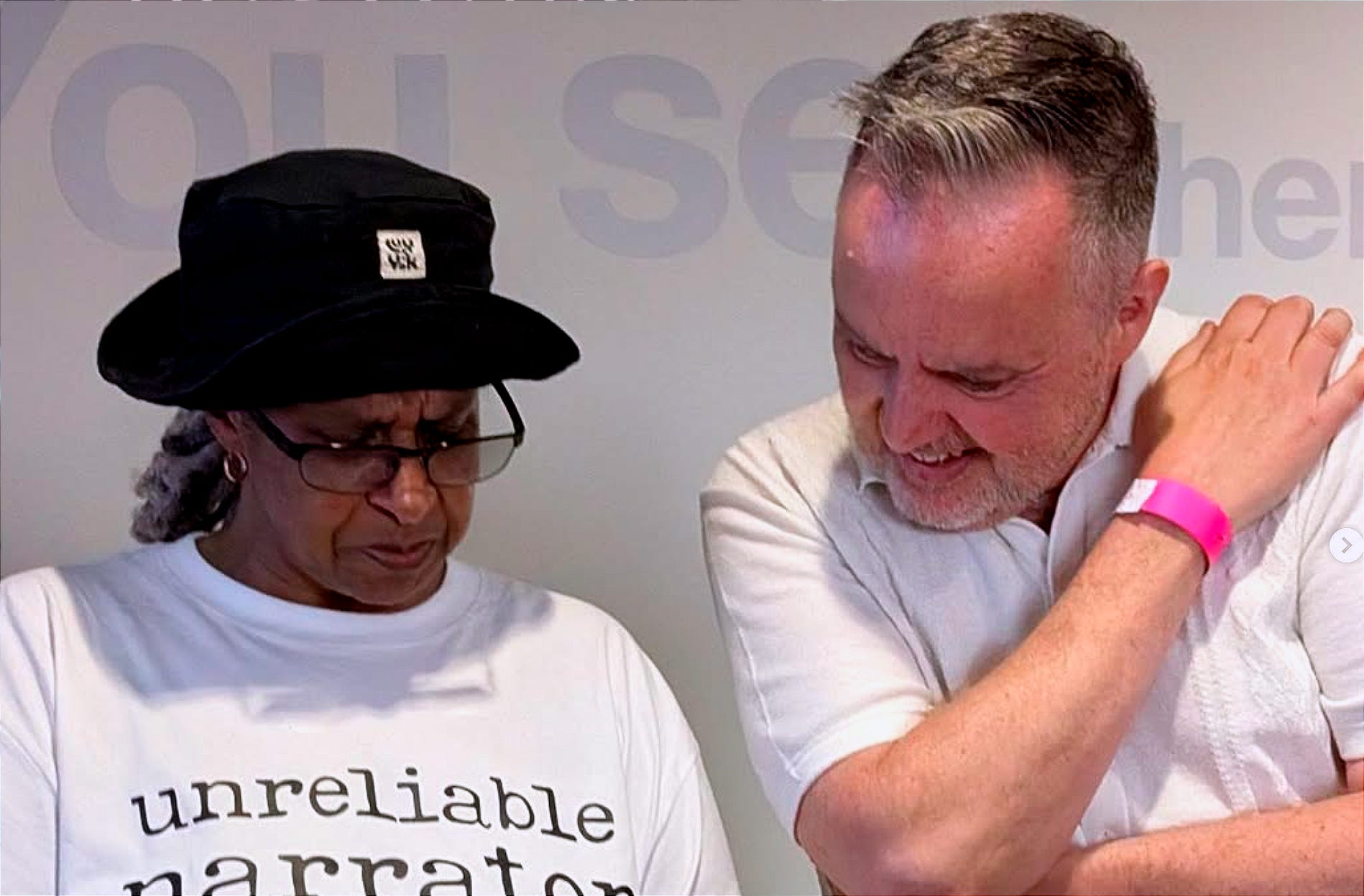
That mattered. Being in a room where books were not being treated as units of content, but as points of connection. Meeting readers and writers and people building something because they believe queer stories deserve space. Talking to people who weren’t asking whether the book had gone viral, but what it was about, why I wrote it, and who it might speak to.
That is the part that puts the blood back in the work.
Not because it magically sells three thousand copies. It might not. Usually it won’t. But it reminds you that a book launch is not just a transaction. It’s a series of small handovers. Writer to reader. Reader to reader. Author to author. Room to room.
The big machine - all things considered - doesn’t care.
But the people do.
The trick is remembering that before you burn yourself to ash trying to win attention from people with bigger fish to fry.
So this is where I’ve landed, three weeks after launch day, with my files mostly tidied and my launch notes full of arrows, post-its and question marks.
The breakAnd it’s time to take a break.
Close the spreadsheets.
Stop checking whether someone reviewed the book.
Stop turning every nice comment into “content”.
Stop trying to squeeze one more post out of my tired face.
Shut down the machine. The actual machine. Set my phone to silent and turn off notifications.
Tomorrow, me and my man and my dog will get into our car and head south. To a tiny village where nobody knows or cares that I’ve got a book out. Where cars rarely pass below windows and the only sound is of birds singing and breezes passing through trees.
My next book can wait a while longer. The third draft is half-written and that’s how it must stay for the next week. I’m not one of those writers who takes a laptop away in the hope inspiration strikes.
I plan to walk outside. Eat cake. Read something new. I’ll sit in a garden sipping a drink and won’t consider the most efficient prose to describe how I feel at that moment.
Because…
The current book will still be there.
Work on the next one will still be there.
There will be more to do, because there’s always more to do. That’s the horrible and wonderful truth of being someone who writes books. Publication day isn’t the finishing line. Far from it.
So, if you’re a writer and you have a book out soon - or had one out just recently, be kind to yourself. Not in a fluffy scented candle way. In a practical, grown-up, commercially sensible way. A burned-out author makes worse decisions. A tired author wastes money. A resentful author starts confusing silence with failure and visibility with worth.
You did the work.
You asked.
You showed up.
You made the thing, then stood beside it in public, which is braver than most people realise.
Shut the laptop.
Let the book breathe without you for a few days.
Let yourself breathe too.
Mo’s Newsletter is a reader-supported publication. To receive new posts and support my work, consider becoming a free or paid subscriber.
June 10, 2026
The 20-minute discovery job most indie authors put off
There’s a particular panic that hits when a book is nearly out. In the days leading up to its unleashing.
You’ve checked the cover and fixed the word-blind typo. You’ve checked the files across three different distribution sites. You’ve checked ‘buy now’ links.
Mo’s Newsletter is a reader-supported publication. To receive new posts and support my work, consider becoming a free or paid subscriber.
Then you see something on Instagram about ‘discoverability’ and worry you’ve not done whatever that means.
Because discoverability sounds like algorithms, metadata, Amazon categories, keywords, ads, reader magnets, SEO, BookTok, Instagram, newsletters, open rates, sales pages and everything you hate about being an indie author.
But one of the most useful discovery jobs I’ve learned makes it all so much easier.
Read your reviews properly.
Don’t read them fishing for reassurance on dark days. Read them for reader language. Because readers often describe our books better than we do.
We’re too close to the thing. We know why we wrote it. We know how much time we invested researching details. We’re all-too-aware of the rewrites and deleted scenes. The character whose name changed twice.
Readers know something else. They know what landed. And that’s gold dust.
The mistake I madeFor years, I treated reviews as social proof. Nice things to share. Scraps of encouragement to get me through the inevitable next wobble.
I’m not made of stone. If someone says one of my books made them laugh and/or cry, I’ll be insufferable for at least twenty minutes.
But the bigger value is hidden in repeated words. If several readers say a book is about found family, that matters.
If they talk about grief, second chances, friendship, sharp humour, messy relationships, Birmingham, queer joy, older characters, toxic families, starting again, loneliness, romance with a dark edge, or whatever else keeps surfacing, that’s not just feedback.
It tells you what readers think they’ve bought. More importantly, it tells you what the next reader might be looking for.
Do this todayOpen your reviews. Amazon, Goodreads, NetGalley, BookBub, blog tour reviews, emails from readers. Open them all. Even the truly awful ones.
If you don’t have many reviews yet, use reviews of three books that sit close to yours. Not books you admire from a distance. Books your ideal reader would realistically read before or after yours. Amazon often lists these as ‘also buys’.
Copy 20 short phrases where a reader describes the book. Not the star rating. Not the generic ‘I loved this’. Look for the useful stuff.
The bits where they say:
‘I loved the found family angle.’
‘This was funny but much darker than I expected.’
‘The grief felt real.’
‘It reminded me of...’
‘This is perfect for readers who like...’
Now highlight the phrases that repeat. That is your discovery language.
Not a bunch of random words invented in a panic by you the day before launch. Not bland ideas borrowed from an Instagram clip purporting to know how to turn your skim-readers into buyers.
Actual reader language.
Where to use itOnce you’ve got those repeated phrases, put them to work. Add one to the first paragraph of your book description. Use one in your Amazon subtitle if it genuinely fits. Use a few in your website copy. Turn one into a social post hook. Use them in your newsletter subject lines. Add them to your ad copy. Check your categories and keywords against them.
Because discovery isn’t only about being seen. Being seen by the wrong reader is just expensive confusion. The wrong reader will tell you your book wasn’t quite what they expected and award you two stars. three if you’re lucky. Discovery works when the right reader recognises the book quickly enough to think, ‘Oh. That’s for me.’
A tiny exampleYou might describe your book as: ‘A contemporary novel about grief, identity and friendship.’ Which is Rainbows and Lollipops, if I’m being honest.
Those words are all good, accurate ones. But also they sound a lot like something you might see written on a committee room flipchart.
But if the reviews keep saying: ‘It made me laugh and cry.’ ‘The friendships felt like real chosen family.’ ‘It’s queer, funny and emotionally honest.’
Then you suddenly have something closer to:
‘A funny, emotionally honest novel about grief, queer friendship and the families we build when life goes sideways.’
That’s not louder. It’s clearer. And clear beats loud almost every time.
The lesson I wish I’d learned earlierFor a long time, I thought discoverability meant doing more. More posts. More platforms. More frantic little dances for the algorithm, which usually behaves like a distant relative who made her dislike known by referring to you as ‘and family’ in Christmas cards.
Now I think it starts with making the book easier to recognise.
A strong cover helps. A sharp blurb helps. Good metadata helps.
But the bridge between your book and its next reader is often hiding in plain sight, in the words previous readers have already used.
So today’s indie author job is this:
Spend 20 minutes mining your reviews for repeated reader language.
Find five phrases.
Use three of them somewhere useful.
That’s it.
No grand strategy. No new platform. No expensive course. No pretending you enjoy video when every reel makes you want to peel off your skin and roll in sea salt.
Just a small repair to the way your book introduces itself.
Mo’s Newsletter is a reader-supported publication. To receive new posts and support my work, consider becoming a free or paid subscriber.
May 26, 2026
How to make millions from publishing without writing a single word
 a genuine and entirely unaltered photograph of the author
There is a folder in my inbox labelled, with more hope than honesty, “To do.” It fills at a rate of several messages a week, and until fairly recently I enjoyed taking a break from deadlines and edits to read through what the world wanted me to know. I’d cringe at the all-too-obvious scams. Addressed to “Dear Author/Writer.” Sent (from a Gmail address) by an ‘upcoming’ literary agency, offering to turn me into a household name.
That era is over. The people who run these operations have harnessed AI, and fed it with anything and everything it can find about my books. Four breathless emails arrived this morning. Each desperate to tell me how they loved my work. Each outraged on my behalf at the lack of Amazon/Goodreads reviews. Each offering to turn it all around.
Mo’s Newsletter is a reader-supported publication. To receive new posts and support my work, consider becoming a free or paid subscriber.
I want to take you through all four, in rising order of how much they should worry you, because the last one is good enough to fool a tired writer at the end of a long day, and I would rather that tired writer isn’t you.
One. The radio invitation.
“Susan, Booking Producer at Fresh Air Radio Station” wrote to invite me onto her Monthly National Author Radio Interview Series (the choice of uppercase letters lies with Susan). Fresh Air is an actual programme on actual American public radio, presented for about forty actual years by Terry Gross. It’s not a radio station, and Susan doesn’t work there. She admired my novel’s exploration of “identity, self-perception, resilience, and the complexities beneath outward appearances.” A fellow author had already warned how it would play out should I respond. The interview would be free, but there would be a small fee ($300 or so) for expenses and registration. Delete.
Two. The promotion package.
The second was meagre rather than nasty. A service called BookPinks, offering pride of place on their homepage, a slot in a Monday newsletter to ninety-two thousand subscribers, and “Daily 3 Tweets and 2 Facebook posts.” Work out three tweets a day shared between every author paying for the privilege and your head will hurt. The ninety-two thousand subscribers, if they exist at all, are opening nothing. Delete, with less satisfaction than Susan gave me.
Three. The marketing plan.
The third is where you get to watch the machine running. Twelve meaty paragraphs of praise from “Linda Shea,” who runs “a book marketing agency” and has “studied the positioning of (my 2024 novel) Husbands carefully.” Linda’s careful study had produced a plan to add it to Goodreads lists with names like “Best LGBTQ Romantic Thrillers Where the Comedy and the Conspiracy Are Genuinely Inseparable” and “Hollywood Satire Fiction That Takes the Dark Underbelly as Seriously as the Glamorous Surface.” Those lists do not exist. No human being has ever typed a sixteen-word list title into a search bar. They’re what you get when you ask a chatbot for “the right Goodreads lists”. Most basic chatbots are pathological liars, and would sooner invent one than admit to not having a clue how to answer.
The same email cheerfully told me Husbands has just a modest handful of Amazon reviews (and a rating I'm fond of). Things which no human publicist would ever dream of putting in writing. Linda promised a hashtag (whoop). All I had to do to change my life was reply with the word READY. In capitals.
Four. The editor.
The fourth came from Shana Drehs, Senior Editorial Director at Sourcebooks Landmark. She wanted to hear about my current and forthcoming projects. She wondered, very warmly, whether I happened to have a literary agent.
Shana Drehs is real. She’s a genuine senior editor at a genuine, sizeable publisher, and has done that job for years. The email was not from her.
A real editor at a real house does not cold-email an author who has never been submitted to her, and on the rare occasion such an approach is made, it arrives from a company address and it travels through your agent, because your agent is the only possible way your manuscript would ever have reached her desk.
The question about whether you have representation sorts the writers who can see through this from the ones who can’t. Tell them you’re represented and the conversation goes cold, because an agent would smell bullshit in seconds. Tell them you’re not, and a few friendly emails later you’ll be introduced to “one of our trusted literary agents,” whose name has either been invented or lifted from a real agent who has no idea it’s being used. That agent will then nudge you towards an editorial or marketing service. And so the requests for money will begin.
This is the one that makes me angry. The real Shana Drehs is somewhere in Illinois doing her actual job, and her name is being marched around the internet several times a day to rob people she’ll never meet. Worse, some of the authors who half-fall for it end up blaming her, when she’s done nothing but become a target.
And none of it is a secret. Writer Beware has logged this scam for years and keeps a running list of the editors and agents whose names are being borrowed. The Authors Guild warns its members about it. The Bookseller wrote up the wider flood of the stuff before Christmas.
It carries on anyway, because the well of writers who would love to believe a big name editor has read their book never runs dry, refilling with every fresh intake of debut novelists.
How to spot the lot of them.
A warning with no way out is just a method of frightening people, so here’s the useful part.
Check the email sender address on everything. A real editor, agent or producer writes from a company domain, never Gmail, never Outlook, and never a near-miss like “sourcebookspublishing” with an extra word or letter bolted on. Free email account, fake person. Every single time.
Nobody legitimately charges you to be published, signed, interviewed or reviewed. Money moves towards the author, never the other way. The instant a “publisher” or “agent” points you at a service you have to pay for, you risk being mugged for money.
Praise that names no scene, no line, no character is praise written by a machine that has read your blurb and nothing else. Genuine enthusiasm is specific. It quotes you back to yourself and gets the quote right. Though if your work has been stolen by AI, chances are the scammers will get around this soon enough.
Anything promising a shortcut past the part everyone else finds hard is built to move money from your account to theirs
What actually works in this trade is duller than any of the above and a great deal harder to sell. You write the next book. You send it to people with a real reason to like it. You answer the blogger with eighty engaged followers instead of chasing the one with eighty thousand bots. You turn up. None of that fits inside a tempting subject line, which is the precise reason nobody bothers to forge it.
So if you are a writer, forward this to the next one you meet who tells you, eyes shining, that an editor at a major house has emailed them clean out of the blue. And if anything ever lands from me with a Gmail address and a photograph of me flying, do me a favour and count the fingers.
Mo’s Newsletter is a reader-supported publication. To receive new posts and support my work, consider becoming a free or paid subscriber.
May 12, 2026
The Nibbies just validated everything indie romance authors have been doing for years

I’m writing this the morning after the British Book Awards, watching the news ripple out across Bluesky and Substack with a cup of tea and a slowly dawning sense of vindication.
For thirty-five years, the Nibbies has handed out gold-painted nibs for fiction without ever quite admitting romance is a category. Last night, they finally did.
Mo’s Newsletter is a reader-supported publication. To receive new posts and support my work, consider becoming a free or paid subscriber.
The newsEmily Henry won the inaugural Romantic Fiction Book of the Year for Great Big Beautiful Life. The first time in the awards’ history that a romance novel was honoured for being a romance novel, rather than smuggled in under “fiction” or “page-turner” or whatever euphemism the trade preferred that year.
Alongside that, the ceremony paid tribute to Dame Jilly Cooper, who died last October aged 88. Sophie Kinsella and Joanna Trollope were honoured beside her as the writers who built a genre the industry has spent decades pretending wasn’t really there, or didn’t truly matter as much as the more weighty words of (often) older men. Three women who between them sold tens of millions of books and got patted on the head for it instead of taken seriously.
The room at Grosvenor House finally said it out loud. These writers matter. Romance matters. The readers who buy it matter.
The numbersHere’s what made the new category inevitable.
Romance and Sagas hit £69.1 million in UK sales in 2024, according to Nielsen BookScan. That edges out the previous record set in 2012, the year Fifty Shades of Grey single-handedly inflated the chart. Last year wasn’t a one-book spike. It was the third straight year the category cleared £50 million. In 2019, before lockdown rewired everyone’s reading habits, the same category sat at £24 million.
Women under 35 are driving the latest boom. They buy most of the romance and romantasy on the chart. They talk about it on their socials and WhatsApp. They make book recommendations the way I used to make mixtapes. And while traditional publishing was busy worrying about literary prestige, those readers built a market the trade can no longer pretend isn’t really there.
That’s what the new category at the Nibbies actually represents. Not a benevolent gesture from on high. Money. Plain, blunt, undeniable money.
The lesson for indie authorsThe trade didn’t discover romance last night. Indie authors have been writing for these readers for over a decade, and selling to them, and listening to them. We knew where they shopped. We knew what they wanted. We didn’t need a category at an awards dinner to validate the genre.
What we got last night was the ever-slow-moving establishment quietly admitting it might have got things ever-so-slightly wrong. That those in charge of lofty sponsored-table awards ceremonies were wrong to dismiss it. Wrong to file it under that quaint little category that makes my piss boil… guilty pleasure. Wrong to assume that fiction by women (or occasionally men), for everyone (women and men), about feelings was somehow a lesser form than fiction by big strapping lads, for men who know how to strip down a lawn mower. Books about war or crime or the (not my fault) slow decline of a marriage in Hampstead.
If you’ve been writing romance and apologising for it, stop. Stop trying to rebrand yourself as writing Uplit or Book Club Fiction. The market doesn’t need you to apologise. The market is the largest it has ever been.
The mistake I madeI wrote rom-coms and refused to call them rom-coms.
Husbands is a fake-marriage farce set partly in Vegas, with a darker undercurrent around abuse. Ghosted is a meet-cute on a Christmas cruise. Rebuilding Alexandra Small is a book about moving on from alcoholism into a new relationship. Three books that any honest reader would shelve under romantic comedy without thinking twice.
And what did I put on the back covers? “Character-driven fiction exploring identity, belonging and the search for connection.” Which is true. It was also me dressing my books up in a tweed jacket so they’d be allowed into the literary fiction party. I positioned them as something more serious than what they were, because “serious” felt safer than “commercial.”
It was snobbery. My own. Internalised from years of book reviewers treating romance as a punchline.
The cost wasn’t reviews or awards. The cost was readers. Readers who would have loved my books, but couldn’t find them… because I was hiding them in the wrong aisle.
What I’d do differentlyOwn the genre. Clearly. Without hedging.
If the book is a rom-com, the cover should suggest rom-com. The blurb should promise the thing rom-com readers want. The comp authors should be the ones those readers already love. The Amazon categories should be the ones those readers already browse.
This isn’t about dumbing anything down. Emily Henry is a careful, observant, brilliant writer. So is Beth O’Leary. So is Marian Keyes. The craft is there. The depth is there. What romance asks of a writer is empathy, pace, and a refusal to be embarrassed about the emotions on the page.
The Nibbies just proved there’s no ceiling on commercial romance in 2026. The ceiling was always the snobbery, and the snobbery has cracked.
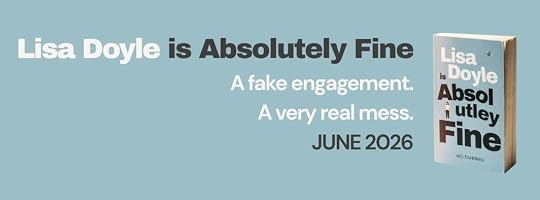
The pivotLisa Doyle is Absolutely Fine is my first dare-to-be-deliberate move into this space. And it feels a lot like coming out, all over again. “Mum, Dad… there’s something I need to tell you!”
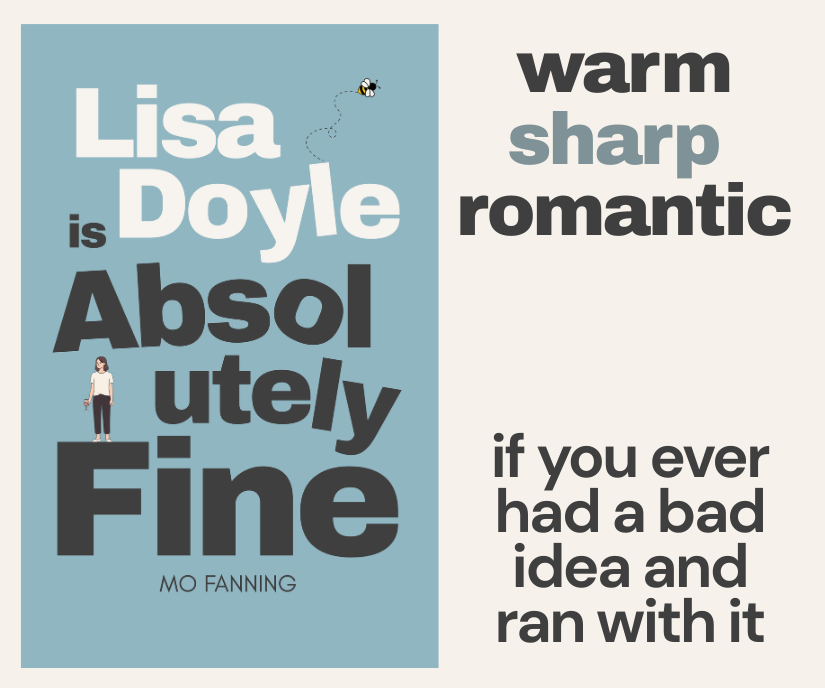
The title of my new book says romcom. The cover, when it lands in the spring, is very much pitched at romcom readers. The pitch is fake engagement, Manchester, social performance, the messiness of pretending you have your life together when you very much do not. The comp authors are Beth O’Leary, Mhairi McFarlane and Marian Keyes, because that’s who Lisa’s readers already love.
I’m putting this book where the readers are, instead of where I once wished the critics would notice me. I accept it’s unlikely to spawn a Guardian Weekend two-page in-depth piece on how an aging gay man (with a great skincare regime) fills his days writing frothy romcoms. I’d rather the right readers found the right book.
If you’ve been quietly writing romance and quietly hoping someone will tell you it’s allowed, this is me telling you it’s allowed. The biggest awards night in British publishing said it last night. We were always right. They just took thirty-five years to catch up.
Mo’s Newsletter is a reader-supported publication. To receive new posts and support my work, consider becoming a free or paid subscriber.
March 23, 2026
Your reader is not ‘someone who likes a good story’
Last time, I said a successful book marketing campaign should kick in way before you finish your first draft. If you leave things until you’re paying a marketing consultant to help sell your novel, it’s already much too late.
The first thing any PR person worth their salt will ask (after ‘what do you want to achieve?’) is ‘who is this book for?’
Mo’s Newsletter is a reader-supported publication. To receive new posts and support my work, consider becoming a free or paid subscriber.
And any PR person worth their salt won’t accept a fluffy branding statement. “My audience is women aged 35 to 55 who enjoy a gripping read” tells them next to nothing.
What you need to have clear in your head is: who is this book for in terms of taste, expectation, emotional appetite and reading habits?
If you can’t answer that clearly (and using very few words), everything is going to be so much harder than it ever needed to be.
The big struggleAnd it’s not just at the marketing stage where you’ll flounder - and find the idea of alphabetising your spice draw a bigger draw than finishing a chapter.
Without a clear picture of the reader:
You’ll struggle to write with confidence.
You’ll struggle to know which bits of your work matter, and which bits are darlings to kill
You’ll struggle to brief a cover designer.
You’ll struggle to write a killer blurb.
You’ll struggle with metadata - categories, keywords, comps and setting up ads.
Most of all, you’ll struggle to make the right reader recognise that your book is a must-read.
The small pictureWhen I started out as an indie author, my most basic mistake was failing to truly define my audience. I’d say things like:
My book is for people who like emotional stories.
It’s for anyone who likes a bit of romance and drama- with laughs.
It’s for readers who enjoy a strong plot and great characters.
That all sounds perfectly lovely. It’s also about as useful as saying your ideal dinner guest is “someone who likes food”.
The point is to get to grips with a set of preferences that shape how somebody responds to your book.
Think about a reader who loves funny, emotionally messy novels with a romantic thread, strong friendship dynamics, modern British settings and an ending that leaves them wrung out but satisfied…
You can do something with that.
If I tell you they’re a woman in her forties who likes a good story, you’ve learnt almost nothing.
Age and gender matter (a bit), but tastes matters far more.
Start with yourself as a readerA good place to begin isn’t by thinking in marketing terms. Start by being honest with yourself about how you pick your next book.
Not how you think an ideal reader ought to decide. Not something that makes you sound noble and literary (or slick and tuned in to the market).
What actually makes you buy one.
When you’re in a bookshop, or scrolling online what gets you interested?
Usually it is not one thing.
It is a chain of small recognitions.
The cover looks right - the tone comes across
The title sounds like your sort of thing
The blurb whets your appetite - it sounds good
A comparison with another author or title chimes with you
The setting appeals
That’s what your readers are doing too. They’re not waiting to be dazzled by your marketing prowess. They’re scanning book covers for clues.
Go away now and find yourself a book. You don’t even need to buy it, just pick one out. See what clues work on you.
What kind of covers grab your attention
What is it about the blurb that you like the sound of?
What moods do you go back to again and again?
What do your favourite books have in common besides “being good”?
Your real audience lives in the overlapNo two writers are alike. Just as no two author audiences are identical. The reader for your book usually sits somewhere in the overlap between four things:
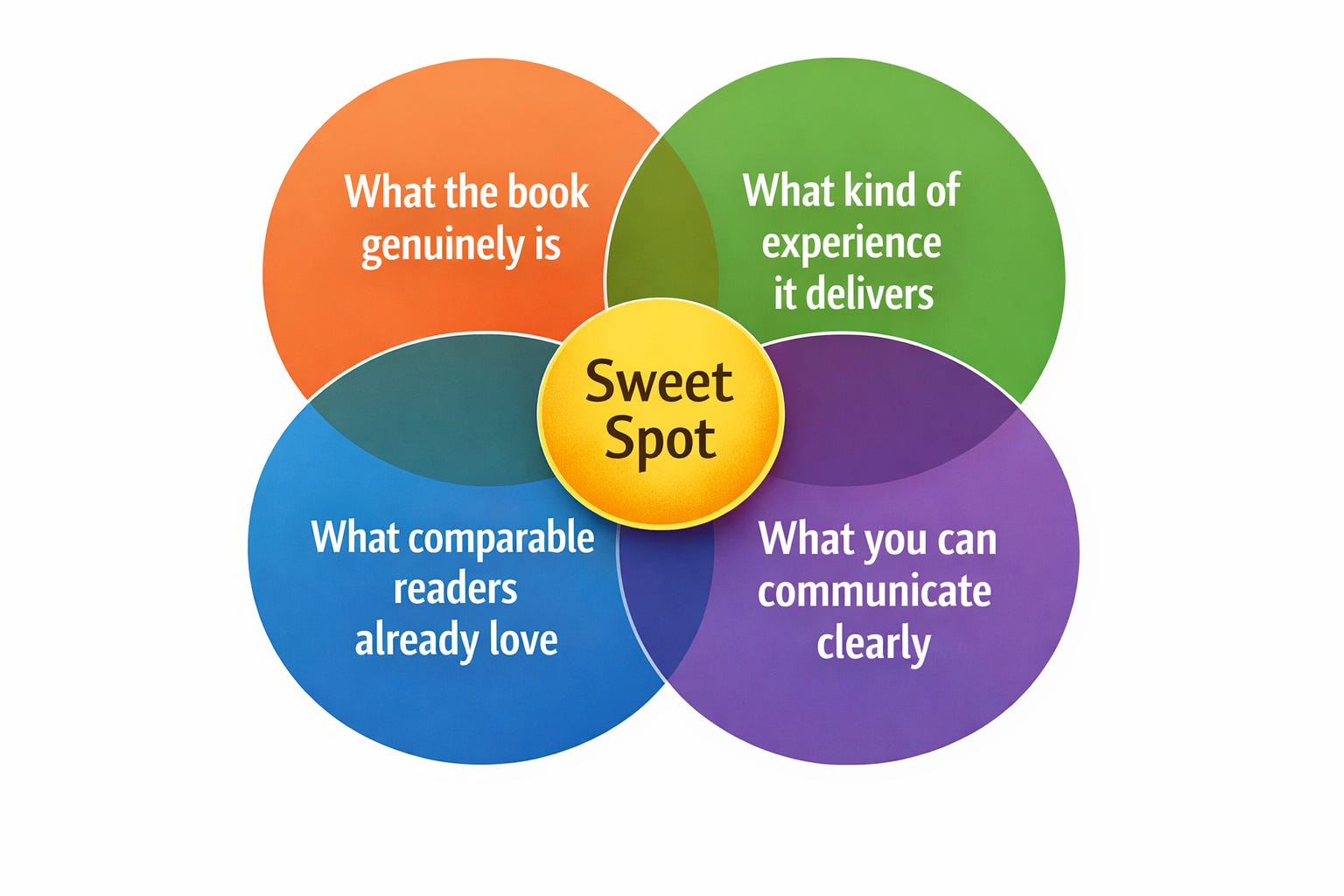
Readers make up their mind in 2-3 seconds. Plenty of books fail to find readers not because the book is bad, but because the writer can’t describe the experience it offers in a way that makes sense quickly.
And if the writer can’t do that, what chance does the cover designer have? What chance does the publisher have (even if you’re the publisher). What chance do you have of paying for the right ads in the right place at the right time?
Let’s say you’ve written a queer novel about grief with a strong friendship thread, a love story, comic dialogue and a sad undercurrent. (Like Rainbows and Lollipops). Fine. But what’s the dominant experience?
Is it warm and funny with emotional bite?
Is it melancholic literary fiction with moments of levity?
Is it a romcom with more depth than usual?
Is it book club fiction with queer themes?
Is it a commercial novel about chosen family and grief?
Those five statements are not identical - even if they share some readers. Get it wrong and it doesn’t just impact your blurb or cover design. It affects the whole way you frame the book.
What your reader wants from this kind of bookA reader is not just buying a premise. They’re buying a particular kind of satisfaction.
Romance readers usually want emotional tension, chemistry and a convincing payoff. If the ending withholds too much, or the love story gets buried under unrelated subplots, they’ll feel the book has broken its promise.
Thriller readers want momentum, jeopardy, escalation and release. A thoughtful novel can still be a crime novel, but if it never tightens the screws, the reader will walk away disappointed.
Cosy crime readers want something different from dark procedural readers.
SciFi and Fantasy readers don’t fall in love with worlds, they fall in love with what it feels like to live in them. You’re not selling the world, you’re selling the experience of being inside it.
Commercial women’s fiction readers want something different from readers of quieter literary domestic novels. Even within queer fiction, readers come looking for very different things. Escape. Pain. Hope. Wit. Comfort. Heat. Political edge. Tenderness. Glamour. Mess.
If you don’t know what kind of satisfaction your reader is seeking, you’ll end up writing a book that’s technically competent but emotionally screwed.
And when that book fails to sell, it’s one of the most frustrating outcomes for indie authors, because it feels as though the book is “not landing” for mysterious reasons, when actually the issue is simpler.
The wrong promise was made. Or the right promise is being made too weakly.
A better way to define your readerInstead of trying to invent a fake person with a name and a Starbucks milk-of-preference, I find it more useful to define a reader using five areas:
1. What else do they read?Name real books by real authors.
If your book would most naturally appeal to readers of Beth O’Leary, Mhairi McFarlane and Dolly Alderton, say that. If it sits closer to Tana French than Richard Osman, be honest about that too.
Comp titles are not just marketing tools. They’re clues to taste.
2. What are they hoping to feel?This matters just as much as plot.
Are they looking for comfort? Tension? Romantic yearning? Cleverness? Catharsis? Escapism? Darkness with wit? Bittersweet hope?
A lot of authors can sum up their story in a few clever lines, but fail to get across the feeling it’s meant to leave behind.
The feeling is the bigger buying trigger.
3. How do they like stories to move?Fast start or slow build?
Chatty voice or cleaner prose?
Big hook or gentle immersion?
Lots of banter or minimal dialogue?
Openly emotional or more contained?
This changes how you write, not just how you sell.
4. What do they expect this genre to deliver?Not every convention has to be followed to the letter, but you absolutely should know which expectations are flexible and which are game changers.
A reader will always forgive innovation more readily than confusion.
Break rules if you like. But know which rule you are breaking, and what you are offering instead.
5. What will make them feel safe in your hands?This is the least discussed part, and one of the most important.
Readers want to know that the writer understands what kind of book they are reading. And they want to know this from the first couple of pages.
That doesn’t mean everything needs to be obvious and explained on the page. It means the tone must feel intentional. The pacing needs to come over as controlled. The emphasis has to be in the right place. They need to think that you know what you’re doing.
That sense of confidence is often what turns interest into trust.
Signs you’ve not really defined your audienceYou describe the book differently every time someone asks.
Your comps are all over the place, depending on who asks
You keep saying “it doesn’t fit neatly into any genre”
Beta readers like the writing but disagree wildly on what kind of book it is
You’re quitely hoping the cover, blurb and ads will somehow solve problems that are actually baked into the manuscript
Or, my personal favourite, you say the book is for “readers who like to be taken on a journey”.
If you’re saying any of the above, have a word with yourself.
This isn’t about cynicismWhenever this topic comes up, somebody will hear it as a joyless call to write to market.
That is not what I mean.
I don’t mean flatten out the weirdness.
I don’t mean chase trends (because they’ll date by the time you finished writing chapter six, anyway).
I don’t mean remove your quirks in favour of maximum saleability.
I mean know what you are offering.
It respects the reader’s time.
It respects the form you’re writing in.
It respects your own work enough to position it clearly.
The best books often do have something singular about them. But singular is not the same as unreadable, and original is not the same as vague.
Why this matters so much for indie authorsTraditionally published authors get a lot wrong too, obviously. Boy, do they ever. But they have people to put them right.
An indie author is the writer, the publisher, the brief-writer, the marketer, the metadata department, the publicity team and the person panic-googling “what is BISAC” in the small hours.
If we understand the reader early, a lot of later decisions become easier.
You can tell your designer what the cover needs to signal.
You can write a blurb that addresses the right desire.
You can choose comp titles with confidence.
You can pick categories that make sense.
You can stop trying to appeal to everyone and start becoming recognisable to someone.
That’s a far better use of your energy than posting social media slop into a void six times a day.
A useful testIf you had to finish this sentence in one clean line, could you?
This book is for readers who love...
Not everyone.
Not vague notions of quality.
Not “a bit of everything”.
Something specific. Something felt. Something recognisable.
If that sentence is hard to finish, keep working.
Because the clearer it becomes, the easier everything else gets.
The real workBefore you even start to fret about algorithms, newsletter swaps, influencer lists and whether you’re posting enough on Bookstagram, ask these deeper questions:
Do I know who my book is for?
Do I know what my reader already loves?
Do I know what kind of reading experience they’re hoping for?
Do I know what promise I’m making?
If you can answer those questions while you’re still writing, you’re not just improving your marketing. You’re improving the book’s chances of becoming the right book for the right reader.
And that’s where the real work starts.
Mo’s Newsletter is a reader-supported publication. To receive new posts and support my work, consider becoming a free or paid subscriber.
March 13, 2026
Why most indie book marketing doesn’t work
 Photo by Tom Hermans on Unsplash
Every indie author ends up asking the same question: how do I sell more books? And there’s always someone online ready to answer.
Start a newsletter. Post on the socials every day, twice every day, three times, every few waking hours, and if you dig around there are tools to cover the sleeping ones too. Run ads. Build a ‘street team’. Schedule a ‘blog tour’. Pitch influencers and bookstagrammers. Create content. Be visible. Beg bookshops to stock your book or host a signing.
Mo’s Newsletter is a reader-supported publication. To receive new posts and support my work, consider becoming a free or paid subscriber.
Do all of the above. Be everywhere, do everything, all at once. And still find time to put a wash on.
Some of that advice is fine. A lot of it might work. But these pre-packed answers skip over what matters most.
Most indie book marketing doesn’t fail because authors are lazy, or because they’re not doing enough of the right things. It fails because it starts too late.
And by that, I don’t mean it’s left until a month or two before publication.
By the time most authors think about marketing, the book already exists. The title and cover are often locked in. The words have been through every kind of edit, or not, but they’ll have had a few reads-through at the very least. The blurb is done. The positioning is mostly done. The metadata is sort of right.
All that matters now is getting people to notice it.
Right?
I’d argue that selling your book needs to happen long before this. It starts on the day you write the first line, even if that line never makes it to the final draft.
Because this is the bit many indie authors miss.
Marketing is not only what happens after the book is finished. It is not just launch graphics and captions and newsletter swaps and shouting into Instagram while pretending not to mind when nobody shouts back. Marketing starts much earlier than that. It starts with knowing who you are writing for, what they already love, and what kind of promise your book is making.
That does not mean cynically chasing trends. It does not mean stripping out everything strange or specific or personal. It does not mean writing by committee, or trying to reverse-engineer whatever is popular this week.
It means writing with awareness.
It means understanding that books don’t just land in readers’ hands. They get chosen. Usually quite quickly. And the reasons people choose them are rarely mysterious.
So before you ask the internet how to market your book, ask yourself a simpler question:
How do you choose the next book you fancy reading?
Not in theory. Not as an author who wants to believe quality matters more than anything else, and that if your writing is good enough it will somehow find its reader.
What makes you click on a cover? What makes you pick a book up in a shop? What makes you read the sample? What makes you buy it now rather than vaguely meaning to come back to it later?
If you’re honest, it’s probably not because the author posted about it six times in one day on Instagram.
More likely, it’s because something about the book feels right.
And it might not just be the story or the subject.
Maybe the cover caught your eye. The title sounded like the sort of book you like to read. The blurb connected. Someone you trust mentioned the title. You found it in a bookshop on a shelf or a table beside novels you already know and like.
All of the above.
Everything suggested it’s the kind of book you tend to enjoy.
Readers respond to signals.
We all do.
Readers aren’t scrolling past cat videos waiting to be told about a random book. Something has to grab their attention. Not bright colours or loud noises or a funny dance craze. You have less than one second to show potential readers what you’re all about. And they need to know in that one second that it looks like something they might want.
It’s something they might enjoy. Something like the other books they’ve loved. And that might come down to the title, the cover, three or four words amplified on the screen.
All of this is why audience matters so much, and why it matters earlier than many authors think.
If you only start thinking about audience after the manuscript is finished, you may already have a problem. You’ve likely written a perfectly good book, but one that’s difficult to position, difficult to package, and hard to describe in a way that reaches the right people quickly.
Worse, you may have written a romance full of chemistry, sex and lovely moments, but without the emotional payoff romance readers expect. Or a crime thriller with a strong premise but lacking in tension and release.
Nothing about that means the book is bad.
Books rarely sell on merit alone. They sell when the right reader recognises them.
And that recognition starts in the writing.
If you know who your reader is while you’re drafting, you make smarter choices.
You know how quickly to get to the heart of the story. You know what sort of opening will pull them in. You know which elements are part of the core appeal and which are clutter. You know whether readers have come for yearning, pace, darkness, humour, comfort, heat, jeopardy, or some genre-busting mash-up.
You know what kind of emotional contract you are making.
That affects everything: tone, pacing, how soon each character needs to make their mark, when the central conflict needs to appear, what details to linger on, which parts of the promise you deliver first and which can wait. It affects whether the book feels legible to the people most likely to love it.
Too many authors treat audience as something faintly grubby, as if thinking about readers (with money) somehow taints ‘the art’.
Writing without any sense of audience isn’t more pure. Most of the time, it’s simply less focused.
An audience is more specific than ‘woman, mid-thirties, likes a great story’.
What else do they read? What are they hoping to feel? What level of darkness or warmth do they enjoy? Do they like a fast start or a slow build? Do they want a sweeping emotional journey or a sharper commercial hook? Do they love banter, angst, glamour, danger, hope? What would make them feel, within a few pages, that they’re in safe writerly hands?
These are writing questions long before they become marketing ones.
Once you understand the reader, you’re not writing into a void. You’re shaping an experience for someone. You’re not just telling a story you care about. You’re presenting it in a way another human being might actually want.
And that, to me, is where so much indie frustration comes from.
Authors finish a book, then try to market it backwards.
They try to find the audience after the fact. They try to work out the angle once the manuscript is set. They rely on the cover to do the heavy lifting. They ask the blurb to explain a book that was never clear on its own terms. Then, when nobody buys their work, they assume they need more noise. More posts. More effort. More ads.
If you write with the reader in mind, the later stages get easier.
When you brief a designer, they understand what the cover needs to say. Certain genres use particular visual tropes to signal what’s between the covers.
When you write your blurb (or pay someone to do it for you), it’s aimed at the sort of reader who’s likely to care.
Comp titles become clearer.
Keywords and categories make more sense.
Most importantly, when the right reader lands on the page, the book recognises them back.
A book isn’t just a product to be pushed. It’s a set of promises. About tone. About experience. About emotional payoff. About belonging.
So yes, learn about newsletters. Learn about ads. Learn how covers work and how metadata works and how to write a decent caption. All of that has its place.
But don’t leave audience until the end.
Because marketing doesn’t start a month before your book launch.
It starts on page one.
Mo’s Newsletter is a reader-supported publication. To receive new posts and support my work, consider becoming a free or paid subscriber.
March 2, 2026
Should writers overshare more?
I read a piece this weekend asking whether we should be oversharing more.
Apparently vulnerability is good for us. We build connection by saying out loud the stuff that’s rattling around inside our heads. Confession is not only good for the soul, it’s the answer to loneliness.
Mo’s Newsletter is a reader-supported publication. To receive new posts and support my work, consider becoming a free or paid subscriber.
Which is slightly awkward timing, because I’m a novelist in 2026, and it sometimes feels as if I’ve already shared quite enough, thank you very much.
Writers are now expected to be emotionally available, politically literate, transparent about our writing processes, honest about rejection, and our mental health. we need to be charming - but never self promoting. Vulnerable, but not messy. Authentic, but not to the point where we become exhausting.
It’s a lot.
We’re told that readers want to know us. Not just the books. Us.
And I understand that. I really do. The reason I’ve found so many of my favourite authors over the past few years is because I connected with them somewhere. Through a newsletter. A podcast. A recommendation or review. An Instagram post that felt human rather than curated.
But I keep circling the same question: Is oversharing the same thing as intimacy?
Because I’m not convinced it is.
There’s an Instagram-optimised version of vulnerability that we’re told to aim for. Cry, but only in good lighting. Confess, but in lean, efficient paragraphs. We only get to tell the story of our fuck-ups once they’re tidy enough to package.
And that’s not a criticism. It’s self-preservation. The internet is not a gentle place.
But there’s a difference between saying, “Here’s something awful,” and saying, “Here’s the part of me that still doesn’t know how to deal with this.”
One builds audience.
The other requires trust.
When I’m eyes down, trying to write, I live in that tension.
There are parts of my life I’m perfectly happy to talk about. The graft. The rejections. The slightly delusional optimism required to keep writing books in a crowded market and think someone might read them. I’ll happily talk about sales figures, algorithms, the strange quirks of publishing, because those things are part of the job.
But there are parts of me that do not belong on a timeline.
Not because they’re shameful. Not because they’re dramatic. But because they’re unfinished. They’re still forming. They haven’t yet turned into any sort of story I feel like sharing.
And that’s the thing I don’t think we say often enough: writers do overshare. We just do it in fiction.
If you want to know what I really think about performance, about the masks I wear to survive, about the quiet panic of trying to be acceptable while also wanting to be seen - it’s not in my curated captions. It’s in one (or all) of my books.
Fiction is the safest way to tell the truth.
Not because it hides me. But because it protects the people I care about. It lets me exaggerate the emotion without betraying the real memories. I get to say what I want to say but… sideways.
When I was writing Lisa Doyle Is Absolutely Fine, I wasn’t thinking, “Aha, so this is my strategic vulnerability moment.” I was thinking about what it costs to tell the world that we’re doing ‘fine’.
About the way women, particularly, become experts in emotional management. About the pressure to be palatable. And about how easily we mistake composure for contentment. How often have you said: “I asked him and he said he was fine, so what more can I do. I can hardly force him to admit he needs help.”
My character (Lisa) is funny. She’s sharp. And absolutely capable of handling herself.
She is not fine.
Writing her meant putting onto the page the thoughts I wouldn’t necessarily articulate in a social post. The small resentments. The private comparisons. The fear that if you stop performing, the applause might stop too.
It’s interesting, watching a cultural shift towards “share more, be more real tell us everything,” at the same time as algorithms quietly reward polish and punish complexity.
Because the truth is, real intimacy isn’t a viral clip, a perfectly put-together trauma arc, or a confessional thread.
It’s someone reading 300 pages of your work and recognising themselves in a sentence you almost cut.
That’s the kind of oversharing I believe in.
Sustained story.
Which is why, if you’ve pre-ordered my next book already, thank you. Genuinely.
Pre-orders don’t just boost a ranking for a day. They tell retailers that readers are waiting. They signal that this story - about performance and pressure and the absurd effort of keeping everything together - deserves space.
In a market that’s louder than ever, that matters more than people realise.
And if you haven’t pre-ordered yet, this is the part where I resist the urge to overshare some dramatic anecdote to persuade you.
Instead I’ll say this:
If you’ve ever described yourself as “fine” when you absolutely were not,
if you’ve ever curated a version of yourself for safety,
if you’ve ever wondered what would happen if you stopped performing …
Lisa Doyle is Absolutely Fine might feel uncomfortably familiar.
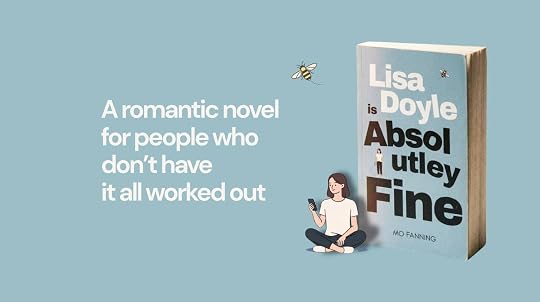
Lisa Doyle Is Absolutely Fine is available to pre-order now.
If you’d like to meet the version of me that only exists on the page, she’s waiting there.
Mo’s Newsletter is a reader-supported publication. To receive new posts and support my work, consider becoming a free or paid subscriber.